



Abstract
Support for radical parties on both the left and right is on the rise, fueling intuition that both radicalisms have similar underpinnings. Indeed, existing studies show that radical left and right voters have overlapping positions and preferences. In this article, however, we focus on the differences in the voting bases of such parties. We show that radical left and right voters have sharply diverging ideological profiles. When it comes to the historical traditions of the ‘left’ and ‘right’, these voters differ radically from each other. Both groups express the traditions associated with their mainstream counterparts—particularly with respect to (non-)egalitarian, (non-)altruistic, and (anti-)cosmopolitan values. Such differences also explain why radical left voters tend to be more, not less, educated than mainstream or radical right voters.
Introduction
Radicalisms of both the left and the right have been gaining electoral ground in advanced democracies. In the United States, Donald Trump surprised friend and foe with his election to the US Presidency, and during the primaries Bernie Sanders managed to attract a large share of dissatisfied Democrats. Similar developments have been taking place for a longer series of election cycles in Europe. Until recently, most of the headlines concerned radical right parties. In the aftermath of the elections to the European Parliament in May 2014, for instance, many news outlets designated the electoral victory of the Front National (FN) in France and the United Kingdom Independence Party (UKIP) in Britain as a political ‘earthquake’. 1 The recent successes of parties such as Alternative für Deutschland (AfD) in Germany, Wilders’ Party for Freedom (PVV) in the Netherlands and the Movement for a better Hungary (Jobbik) also demonstrate how radical right parties have become important political forces in almost all European countries. Yet radical left parties have experienced a simultaneous rise in success. Parties like Syriza in Greece and Podemos in Spain are gaining ground electorally, attracting much journalistic and academic attention, shock, and awe towards the radicalisms on both extremes of the political spectrum.
Important to the future of democratic governance is not just understanding the characteristics of the parties manifesting these radicalisms, but also understanding the motives and characteristics of voters giving radicalisms their political power and future. Unfortunately, existing scholarly and popular discussions of radicalism offer limited insight into what drives radical left as opposed to radical right voters. Studies on the party level have suggested that radical left and radical right parties have plenty in common. Both party families have been shown to be nationalist (Burgoon, 2013; Halikiopoulou et al., 2012), eurosceptic (Hooghe et al., 2002), and populist (Rooduijn and Akkerman, 2017). Building on the assumption that also voters for these parties may resemble each other, two recent studies have found that radical left and right voters share key political desires and discontents, and come from similar social strata (Lubbers and Scheepers, 2007; Visser et al., 2014). Although these studies have encountered important differences between the two electorates—especially some ideological attributes and levels of education—such differences do not constitute the central focus of study or receive a theoretical accounting. The emphasis on commonalities instead of differences is strengthened by the pervasiveness of the concept of ‘populism’. Populism is often defined as the political message that the good people are neglected, exploited or corrupted by an evil elite (see Mudde, 2004). This message can regularly be encountered among both radical left- and radical right-wing politicians. The present focus on populism increases the attention to what parties like the FN in France and Podemos in Spain have in common instead of what divides them. The existing literature, hence, provides a portrait of radical left and right voters in which differences are exceptions that prove a rule: that the similarities among radicalisms are the principal pattern of importance to electoral democracy.
In this article we take issue with this portrait. Our main argument is that radical left and right bases should be seen as splinters from the party families with which they are commonly associated. While they may well share discontent and economic vulnerabilities, they can also be expected to express the traditions and sentiments associated with their respective mainstream counterparts, particularly with respect to (non-)egalitarian and (non-)altruistic values, and with respect to (anti-)cosmopolitanism that can be clearly linked to such values. We test our expectations through analysis of European voters and support for radical right and radical left parties, using seven waves of European Social Survey (ESS) data (from 2002 to 2014) that cover 23 countries, 26 radical right, and 23 radical left parties. Although our analysis uncovers similarities between the support bases of the two party families, the data also reveal major differences that manifest the legacies of left versus right orientation.
Our findings are important to understanding contemporary democratic politics. They reveal that, although voters for the radical left and the radical right have a lot in common in socioeconomic terms, such voters also differ in fundamental respects that mirror well-known differences between the mainstream left and mainstream right. These differences can be expected to shape European politics for years to come, not only in national political arenas, but also the supranational EU arena, where radical left and right parties sometimes collaborate with each other, at least within their respective party families. The distinctions between multiple radical left and right parties suggest that national and European party systems are likely to face increasing polarization in attitudes and positioning toward the EU, immigration, law-and-order and inequality.
Radical parties and radical voters
Radical parties on both the left and the right are increasingly successful in Europe. As a result of, among other factors, increasing electoral volatility (Van der Meer et al., 2012), growing media attention for radical parties (Boomgaarden and Vliegenthart, 2007; Walgrave and De Swert, 2004), and the rising salience of issues that these parties ‘own’: immigration, Islam and security for the radical right; socioeconomic inequality and the financial crisis for the radical left; and European integration for both (see March, 2011; Mudde, 2007)—mainstream parties in most European countries are now seriously challenged by at least one credible radical party. What makes these radical parties so attractive to voters?
When it comes to the radical right, extensive study has delineated key explanatory characteristics (Mudde, 2007; Rooduijn, 2014; Rydgren, 2007). They are nationalist parties, meaning that they strive for congruence of the political unit (the state) and the cultural unit (the nation). Yet radical right parties endorse a xenophobic form of nationalism that can be called ‘nativism’. In Mudde’s useful formulation, nativism ‘holds that states should be inhabited exclusively by members of the native group (“the nation”) and that non-native elements (persons and ideas) are fundamentally threatening to the homogeneous nation-state’ (Mudde, 2007: 19). Modern European radical right parties also tend to be populist: they employ a discourse portraying ‘the good people’ as exploited, betrayed, neglected or corrupted by ‘an evil elite’ (Mudde, 2007; Rooduijn, 2014). The radical right party family constitutes a homogeneous party family. Although radical right parties often differ from each other regarding ethical issues, the party family is as or more homogenous than are, for instance, the conservative or liberal party families (Ennser, 2012).
Various studies have shown that those who vote for radical right parties come from lower socioeconomic positions. Such voters are generally less educated, tend to have lower incomes and come from ‘lower’ social classes, and are more likely to be unemployed (Lubbers et al., 2002; Werts et al., 2013). Moreover, socioeconomic variables affect vote choice, mediated by attitudes like preferences toward immigration, European unification, law-and-order, and political cynicism (Arzheimer, 2009; Ivarsflaten, 2008; Kriesi et al., 2006, 2008; Werts et al., 2013; Van der Brug et al., 2000, 2005).
While radical right voters may tend to have lower socioeconomic positions, it does not follow that citizens from lower socioeconomic strata are automatically inclined to vote for the radical right. These citizens might just feel equally attracted to the radical left. Indeed, studies of voting behavior have long found that people with lower socioeconomic positions tend to vote for left-wing parties, whereas citizens from higher socioeconomic strata are more likely to vote for right-wing parties (Evans, 2000). This has made sense, as left parties have long called for decreasing income differences by redistributing welfare, whereas right-wing parties tend to oppose such state intervention. While differences between the traditional left and right have blurred over the years, radical left parties continue to decry the skewed socioeconomic structure of contemporary capitalism, and to advocate reducing inequalities through far-reaching redistribution and through major changes in economic and power structures (March, 2011: 8–9). Radical left parties also strongly criticize the ‘neo-liberal’ character of global and European economic integration. This agenda should appeal to the same lower-class, economically vulnerable voters associated with radical right parties. Ramiro (2016) has indeed found that those who vote for radical left parties tend to be those who identify with the working class.
Radical distinction
Studies of radical right and radical left parties uncover, as expected, patterns of support broadly in line with such possibilities. Both party families have been found in their position-taking to be broadly nationalist (Burgoon, 2013; Halikiopoulou et al., 2012), eurosceptic (Hooghe et al., 2002), and populist (Rooduijn and Akkerman, 2017). As for voters for radical parties, Lubbers and Scheepers (2007) found that citizens with lower incomes and from lower classes (manual workers) are more inclined to vote for both the radical left and right. 2 Visser et al. (2014) come to similar conclusions, focusing on the subjective positioning of citizens as extreme left or right based on their self-placement on a 0 to 10 left-to-right scale. These studies have unearthed important differences between radical left and right voters. Supporters of the radical right tend to be less educated than other voters, while voters for the radical left tend to be more educated. And Visser et al. (2014) find attitudinal differences between the radical left and right, revealing distinct orientations on redistribution and ethnic diversity. In these studies, however, such differences are not explained or further examined theoretically or empirically. Indeed, the broad tenor of existing studies is that the individual socioeconomic profiles of support for the radical left and right are more common than distinct.
It is important to look more closely, however, into differences between radical left and radical right voters, and to explore whether support for radical left and radical right parties reflects, or fundamentally departs from, the orientations of the party families with which they stem. Well-known differences between left and right with respect to the state and markets may in some respects fade and in other respects get amplified once one gets to the radical left and right. In any event, empirical differences characterize support for the radical left and for the radical right, belying any simple explanation—for instance the higher education levels of radical left compared to radical right supporters. These patterns and enigmas need fuller examination in light of what ‘left’ and ‘right’ mean in contemporary politics—reckoning with single or multi-dimensional conceptions of the electoral political space (cf. Van der Brug et al., 2000; Van der Brug and Van Spanje, 2009).
Argument: The party-ideological roots of distinct radicalisms
We argue that differences in voter support for radical left and for radical right parties—that is, ‘radical distinctions’—reflect the socioeconomic interests but also normative preferences associated with the broader and deeper historical traditions of the ‘left’ and ‘right’. Whether voter positions underlie or are cued by party orientations (Ezrow et al., 2011), voters supporting the radical left and right can be expected to share important commonalities but also to be divided by differences in economic positions and social attitudes. On the one hand, both party families have traditions favoring representation of socially and economically disadvantaged citizens, and both traditions share extreme offshoots from mainstream movements, expressing outspoken political and economic discontent, distrust, and protest. On the other hand, classic and well-known left-right distinctions predict very different normative bases for the radical left and right. Radical left supporters, in direct contrast to their radical right counterparts, can be expected to harbor economically egalitarian and altruistic views. These crucial distinctions, in turn, can be expected to undergird important differences in the way radical left and right voters view the promise and pitfalls of globalization. All such differences, finally, make sense of the stark contrast in the education levels of radical left and right voters.
We argue that radical left and radical right voters are, like mainstream voters, ideological voters (see Van der Brug et al., 2000). Radical voters’ attitudes about the policy issues they deem important are decisive for vote choice, such that voters choose a party that is ideologically proximate. This often boils down to a choice for a party with either a left-wing or a right-wing ideology. 3 Once this main ideological choice is made, other factors determine for which specific party an individual votes. We believe that those with lower socioeconomic positions are more likely to vote for radical parties because these parties better address their economic struggles and political concerns (see below). Hence, a voter with a low socioeconomic status (SES) who is politically and economically discontented and holds a left-wing ideology will likely vote for a radical left party, whereas a similar voter with right-wing positions will be prone to vote for a radical right party. In other words, both radical left and right voters will most likely have lower socioeconomic positions and stronger feelings of economic and political discontent compared to the average voter. However, they will be completely different from each other in terms of their principal voting motivations: their main ideological attitudes.
This puts the onus on where and how the relevant ideological attitudes are overlapping or contrasting. We argue that one can deduce areas of both overlap and contrast from the histories of broader left and right party families. We begin by discussing the areas of overlap, or similarities, but we focus more on differences, developing three sets of hypotheses on how radical left and radical right diverge in their ideological positioning: Hypotheses on normative-ideological differences concerning (economic) egalitarianism and the responsibilities and role of government in support of such egalitarianism; hypotheses on differences on issues of nationalism versus cosmopolitanism; and hypotheses on differences concerning the character and implications of a voter’s education.
Shared interests and discontents
Both radical left and right parties, in contrast to their mainstream counterparts, are focused on representing the social and economically vulnerable to have grown frustrated with the mainstream. This shared focus, whatever its particular origins, predicts that the socioeconomic interests and profiles of those supporting the radical left and right ought to converge. Economic and demographic conditions that have been found to cause or select for economic risk or vulnerability—lower-class professional orientation, unemployment, low income—can therefore be expected to distinguish both radical right and radical left voters from their mainstream counterparts.
Both radical left and radical right voters have also been shown to share strong anger towards conventional politics and the economy. They often express deep dissatisfaction with the functioning and stewardship of the economy and government, and express low trust in politicians and political institutions (Rydgren, 2007). Their party platforms often have at their center radical changes to government institutions and policies, albeit usually within the ambit of the democratic process (see March, 2011; Mudde, 2007).
Radical distinctions in statism and egalitarianism
Beyond these important commonalities, the normative ideological traditions historically associated with left and right can be expected to attract different kinds of voters to distinct left and right radicalisms. Consistent with the historical traditions of the left and right in 20th century European politics, the party families sharply clash on normative ideals related to economic justice and to the state’s economic intervention in pursuit of such justice. The first manifestation of such normative ideals is broad economic egalitarianism. This commitment has been central to leftism of all shades—particularly when related to economic equality of outcome or opportunity. And it has not been shared by right-wing partisan discourse and positioning; in fact, many right-wing parties reject such egalitarianism in favor of embracing economic difference based on birth, ability, or wealth (Klingemann et al., 2006). This distinction on economic egalitarianism might well be part of a broader distinction with respect to egalitarianism generally—encompassing not only economic but also political and social equality of opportunity and condition. But we suspect that the economic face of egalitarianism is as important as any in the ideological distinctions between left and right. Hence, this contrast on economic egalitarianism can be expected to yield a major difference between left and right radicalism. H1: Voters who support economic egalitarianism (equality of opportunity and effect in economic life) are more likely to vote for radical left parties compared to mainstream parties, but not more likely to vote for radical right parties compared to mainstream parties. H2: Voters who express altruism (other-regarding concern for the wellbeing of others) are more likely to vote for radical left parties compared to mainstream parties, but less likely to vote for radical right parties compared to mainstream parties. H3: Voters who embrace an active government or state to intervene in the economy to promote economic egalitarianism are more likely to vote for radical left parties compared to mainstream parties, but not more likely to vote for radical right parties compared to mainstream parties.
Radical distinctions in nationalism/anti-globalization
The above differences should also have strong implications for attitudes of radical left and right voters with respect to globalization. Various studies show that the left-to-right political spectrum harbors a horseshoe-shaped pattern in euroscepticism of party platforms (Hooghe et al., 2002) and anti-globalization generally in such platforms (Burgoon, 2013). 5 Recent studies of radical left and right supporters have also found this U-curve of euroscepticism to unite the two extremes (Lubbers and Scheepers, 2007; Van Elsas and Van der Brug, 2015; Visser et al., 2014). Providing a more nuanced portrait, Halikiopoulou et al. (2012: 504) identify variation in the kinds of nationalism embraced in radical left and radical right platforms—with the former engaging in more civic nationalism and the latter more ethnic or xenophobic nationalism. Yet both radicalisms share ‘a common denominator’ of euroscepticism.
This portrait of radical left and radical right voters sharing strong nationalism may need some revision in light of the arguments and hypotheses developed above. The same SES and normative-ideological attitudes towards egalitarianism and government economic activism that we hypothesized to undergird distinct left and right radicalisms can be expected to strongly color the attitudes on globalization. In particular, the socio-economic conditions and normative positioning on egalitarianism can be expected to cut in the same direction for the radical right, but in opposite directions for the radical left. For the radical right parties and their supporters, low SES and anti-egalitarianism and anti-economic activism push voters towards anti-European integration, anti-globalization, and anti-immigrant attitudes. With respect to immigrants, for instance, economic insecurity for radical right parties dovetails with their rejection of egalitarianism or equal treatment.
For radical left voters, on the other hand, the SES and attitudes on egalitarianism and state activism cut in opposite directions. On the one hand, the low SES of voters ought to make them likely ‘losers’ of globalization, including with respect to the skewed labor-market competition posed by immigration. On the other hand, voters embracing egalitarian and altruist values and believing in the propriety of economic interventions to uphold those values might have offsetting attitudes towards globalization. Their commitment to redress inequities might make them see globalization, including immigration flows, as threatening less-skilled citizens and communities (Mansfield and Mutz, 2009). But that same commitment might foster substantially less anti-globalization and anti-immigrant attitudes in particular—as newcomers can be seen as deserving equal treatment even in a world with substantial borders and inequalities (Pantoja, 2006).
Such logic suggests that radical left and radical right voters harbor distinct anti-globalization attitudes. Radical left voters and parties, unlike right counterparts, can be expected to be particularly focused on the inegalitarian aspects of globalization (i.e. opposing a ‘Neo-liberal Europe’ but not a ‘Social Europe’). And we can expect radical left and right voters to have very different atittudes on immigration, where the equality, equal treatment, and social inclusion of newcomers divide the left and right. On top of such logic from our above analysis, the historical and mainstream left has been found to have strong ties to globalism and internationalism, or anti-nationalism (March, 2011; Minkenberg, 1995), that ought to moderate any nationalism among the radical left as opposed to radical right voters. To conclude, although the radical left and right electorates share a negative attitude toward European integration, they likely differ radically vis-à-vis their attitudes regarding the immigration face of globalization. H4: Voters who are more anti-immigration are more likely to vote for radical right parties compared to mainstream parties, but less likely to vote for radical left parties compared to mainstream parties.
Radical distinctions in education
Education is an important measure of SES relevant to skill-profile and economic risk: the more educated (European) voter will be more equipped with the skills in demand in the modern global economy, and less likely to be attracted to radical left or right parties. This should apply in equal measure to left and right radicalism. Yet, education also shapes and ideas about the global economy and internationalism in ways that foster cosmopolitanism. Education has been found to spur pro-globalization and pro-immigration attitudes among voters, via cosmpolitanism and not just or mainly of skill premia (Hainmueller and Hiscox, 2010; Hainmueller and Hopkins, 2014). Education is also associated with reduced levels of euroscepticism (Hakhverdian et al., 2013), and higher levels of cosmopolitanism directly (Mau et al., 2008). Education can be expected to lead to straight-ahead and consistent rejection of radical right parties—with respect to the intervening link of cosmopolitanism, not just the intervening link of lowering socioeconomic risk. But with respect to support for radical left parties, more education can be expected again to have offsetting implications. More educated individuals may experience less economic frustration that plausibly underlie both left and right radicalism. However, via their education, these individuals may also have a more cosmopolitan embrace of global interaction and of egalitarian treatment of immigrants. It is possible, of course, that education plays out in ways that constitute two distinct bases for radical left support—on the one hand, those of low SES including education, who embrace the state-activist egalitarianism and nationalism; and on the other hand, those of higher SES who support the same but also the equal treatment of immigrants. In general, education should play out differently for radical left and radical right voter support. H5: Voters with higher education are more likely to vote for radical left parties compared to mainstream parties, but less likely to vote for radical right parties compared to mainstream parties. H6: The tendency of the higher educated to vote for radical left parties (relative to mainstream parties) increases when voters embrace egalitarian and/or altruist values, and this does not hold for the tendency to vote for radical right parties compared to mainstream parties.
Data and measurement
Selected countries and parties.
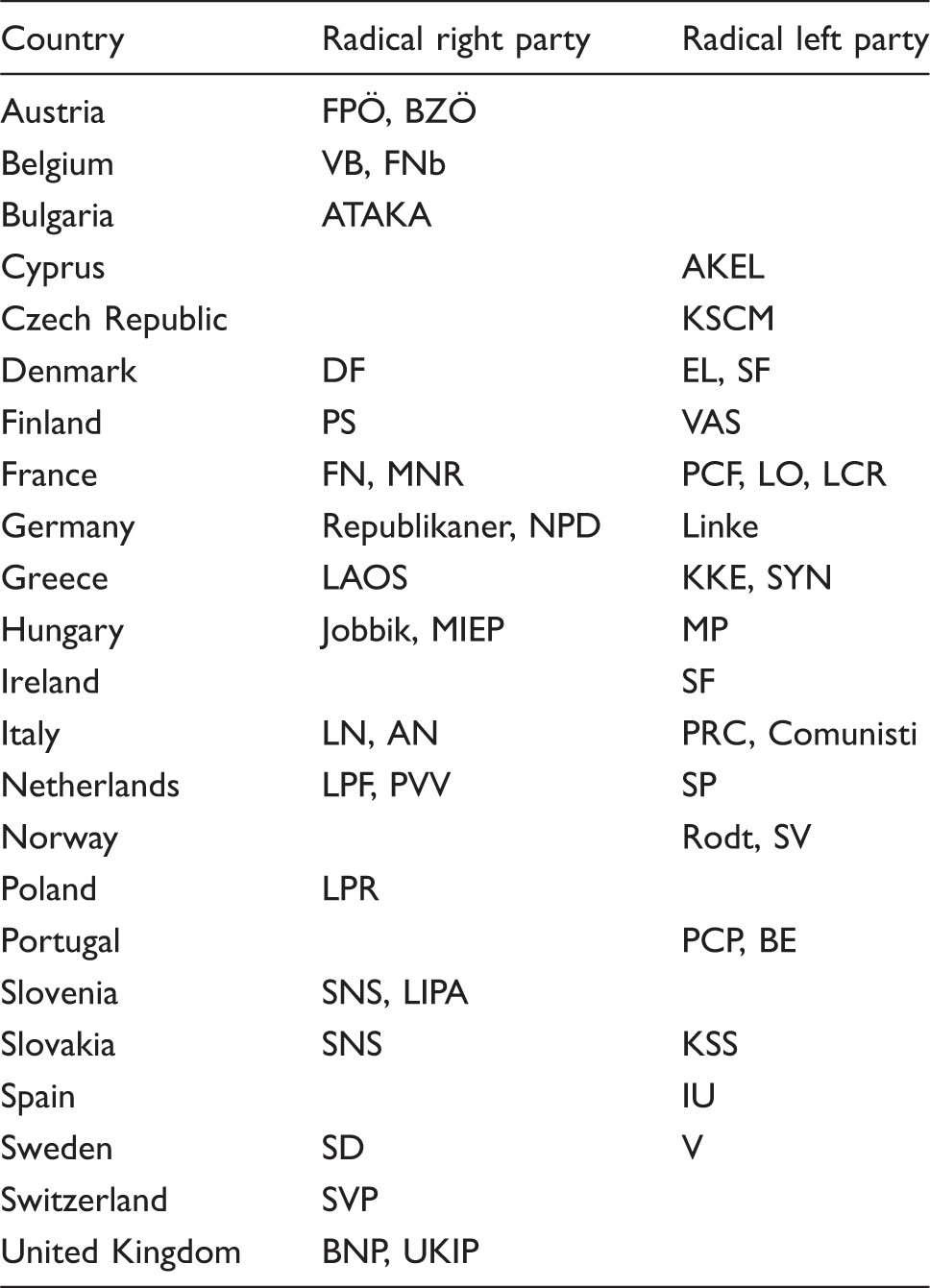
The dependent variables are based on the vote choice of respondents. Respondents were asked whether he or she voted during the last national general election. If yes, he or she was asked which party s/he voted for. Based on this vote-choice variable we constructed various dichotomous dependent variables representing comparisons between categories of parties, based on the following three categories: (1) mainstream; (2) radical right; and (3) radical left. 7 Our baseline models include radical right versus mainstream and radical left versus mainstream.
Our independent variables address the expectations articulated above. The first set is relevant to SES: Education, Class, Subjective income and Unemployed (See for more information the Online Appendix). Another set of variables concerns normative stances on political and economic dissatisfaction. We included a variable of Economic dissatisfaction, which measures how satisfied respondents are with the state of the economy in their country (0 = ‘extremely satisfied’; 10 = ‘extremely dissatisfied’). And we included a measure of Political distrust in our analysis. On an 11-point scale respondents could indicate trust in the country’s parliament and the country’s politicians. We recoded these so that they range from ‘complete trust’ (0) to ‘no trust at all’ (10), and combined them into a political trust scale (Cronbach’s Alpha = 0.85).
A third set of variables gauges the normative-ideological stances of voters relevant to hypotheses 1–3. To measure Egalitarianism (for H1), we rely on a question asking respondents whether they believe the following description applies to them: ‘S/he thinks it is important that every person in the world should be treated equally. S/he believes everyone should have equal opportunities in life’. The 6-point Likert-scale answers range from 1 (‘not like me at all’) to 6 (‘very much like me’). To measure Altruism, relevant to hypothesis 2, respondents answered another 6-point Likert-scale question on whether respondents recognize themselves in the following description: ‘It is very important to her/him to help the people around her/him. S/he wants to care for their well-being’. 8 The answering categories range from 1 (‘not like me at all’) to 6 (‘very much like me’). Finally, to measure support for government intervention to support egalitarian goals, relevant to H3, we rely on Government redistribution, measuring whether respondents strongly disagreed (1) or strongly agreed (5) with the proposition that ‘The government should take measures to reduce differences in income levels’.
A final set of independent variables concern anti-globalization sentiments. We focus on the two domains consistently addressed across multiple ESS waves: European Union integration and immigration. Our Anti-EU measure is based on the question ‘European unification should go further or has gone too far’, responses ranging from 0 to 10 (0 = ‘European unification should go further’ through to 10 = ‘European unification has already gone too far’). Anti-immigration (hypothesis 4) is a scale that measures perceived ethnic threat. 9 The new variable was recoded so that 0 means ‘immigrants are good rather than pose a threat’ and 10 is that ‘immigrants pose a large threat’ (Cronbach’s Alpha = 0.84).
We control for a respondent’s priority for a strong state and law-and-order. We rely on Strong state for safety, based on a 6-point Likert-scale asking whether respondents judge themselves similar to someone for whom ‘it is important that government is strong and ensures safety’, with answers ranging from 1 (‘not at all like me’) to 6 (‘very much like me’). All models control for religiosity, age, gender, and rural/urban residence of the respondent. Religiosity is measured in subjective categories ranging from ‘not at all religious’ (0) to ‘very religious’ (10). Age is in years, though we dropped all respondents younger than 18 years old who are not allowed to vote yet. A gender dummy classifies females as 1 and males as 0. The rural/urban residence is urban (1) versus rural (0). Our baseline estimations are logistic regression models that include country- and year-fixed effects to account for the fact that respondents are nested within both countries and years. The reported coefficients are odds ratios, and standard errors are robust-clustered by country-year. The observations are also weighted using the population size weights and the design weights provided by the ESS. Observations with missing values were deleted listwise.
Findings
Logistic regression models estimating radical right and radical left support.
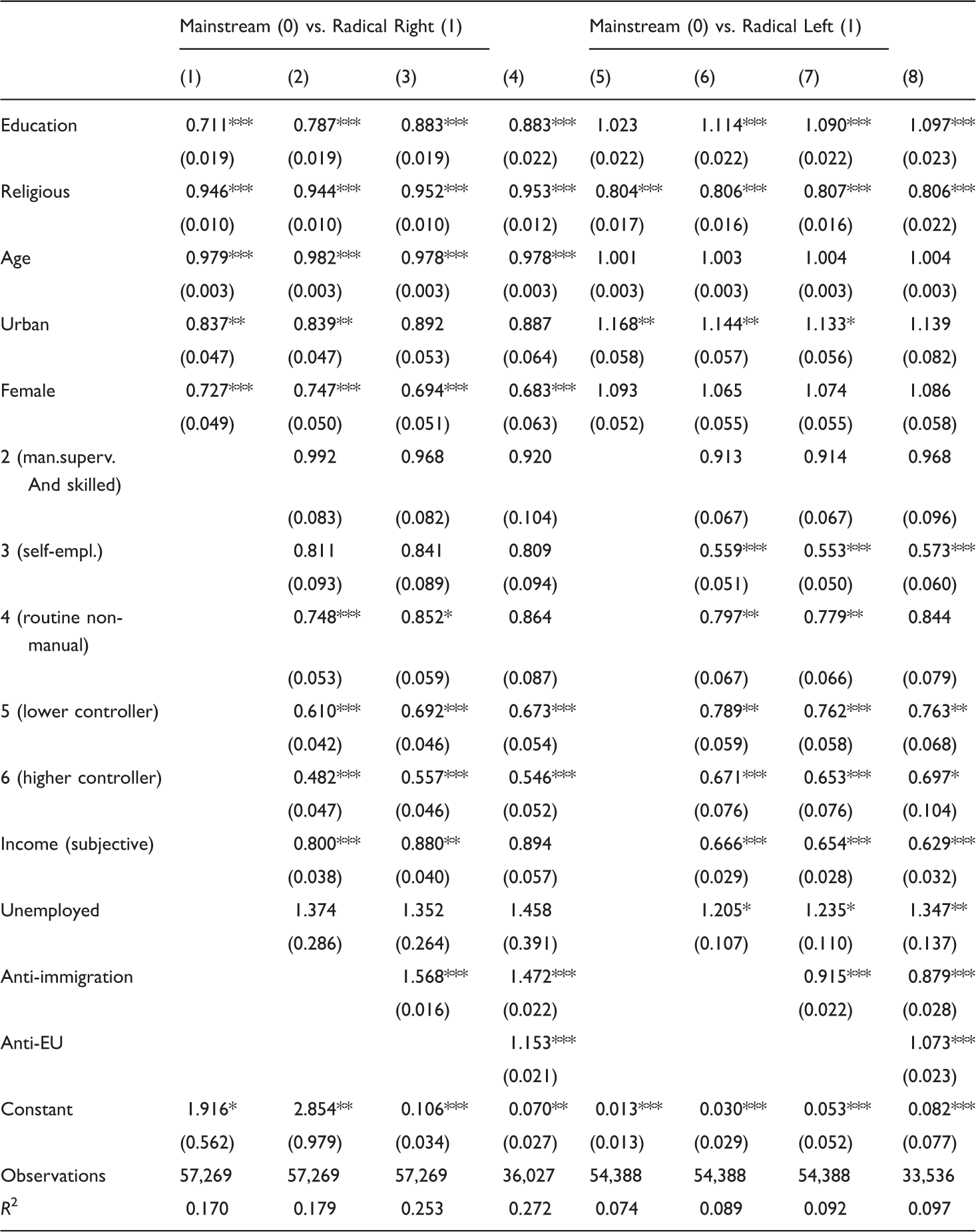
Clustered standard errors; entries are odds ratios.
p < 0.05, **p < 0.01, ***p < 0.001.
The results show that both radical left and right voters tend to be disproportionately lower class. Although not all class categories differ significantly from the reference category of semi- and unskilled manual workers and agricultural laborers, the lower and higher level professionals and managers and entrepreneurs do differ in the expected direction from this category. When it comes to radical right voting, unemployment and income lose statistical significance with the addition of attitudinal controls. Still, lower socioeconomic positions yield, to some extent, higher likelihood of voting for radical parties compared to mainstream parties—albeit with some heterogeneity in our models. The clear exception is, as expected, education (H5), which tends to statistically significantly lower chances of voting for radical right but increases the chance of voting radical left.
Additional evidence for hypothesis 5 is that the negative effect of education on support for radical right voting becomes less negative once one controls away the influence of (direct measures of) socioeconomic risks. Similarly, the positive effect of education on the chance of voting radical left becomes more positive once one controls for the same socioeconomic parameters, suggesting that what remains of the education effect after removing economic risks has to do with the positive impact on radical left support via education’s fostering of cosmopolitanism.
Finally, Table 2 considers the effect of Anti-European Union and Anti-Immigration attitudes on radical left and right voting. Respondents with stronger Anti-European Union attitudes tend to disproportionately support both the radical right and left parties (see model 4 and model 8). 10 However, with respect to Anti-immigration (H4), considering immigration to be a threat is much more likely to spur radical right voting, but much less likely to spur radical left voting. These effects are among the substantively (and statistically) strongest in the model, where a one-unit increase in the 10-point scale of Anti-immigration is associated with a 57-percent increase in the odds of supporting radical right and 8-percent drop in the odds of supporting radical left parties. In line with our theory, the positive effect of education on support for radical left and negative on support for radical right are both dampened by inclusion of these putative intervening variables.
Logistic regression models estimating different dependent variables, including attitudes as independent variables.

Clustered standard errors; entries are odds ratios.
p < 0.05, **p < 0.01, ***p < 0.001.
Equally striking are the comparisons between radical left and right with respect to the more ideological parameters. The patterns broadly corroborate the above hypotheses. Consistent with hypothesis 1, radical left voters are more likely to support Egalitarianism while radical right voters are less likely to do so. Consistent with hypothesis 2, radical left voters are also more likely to express Altruism, while radical right voters are not. Consistent with hypothesis 3, finally, radical left voters are much more likely to Support Government Redistribution than are mainstream voters, whereas radical right voters are not.
Model 3 in Table 3 considers an alternative specification of the baseline results. It focuses on only radical voters, with the dependent variable being 1 for radical left voter and 0 for radical right voter. This sets the patterns of the baseline models into sharper relief. For instance, the two sorts of radical voters are similar with respect to class background or income, but significantly different with respect to unemployment: radical left voters are only half as likely as their radical right counterparts to be unemployed (OR = .55). And of course, we see again the large difference with respect to education. More striking, still, are the differences with respect to the party legacies of the left and right, with patterns virtually identical to the baseline (Models 1 and 2).
Logistic regression models estimating the interaction effect of education and altruism on different dependent variables.
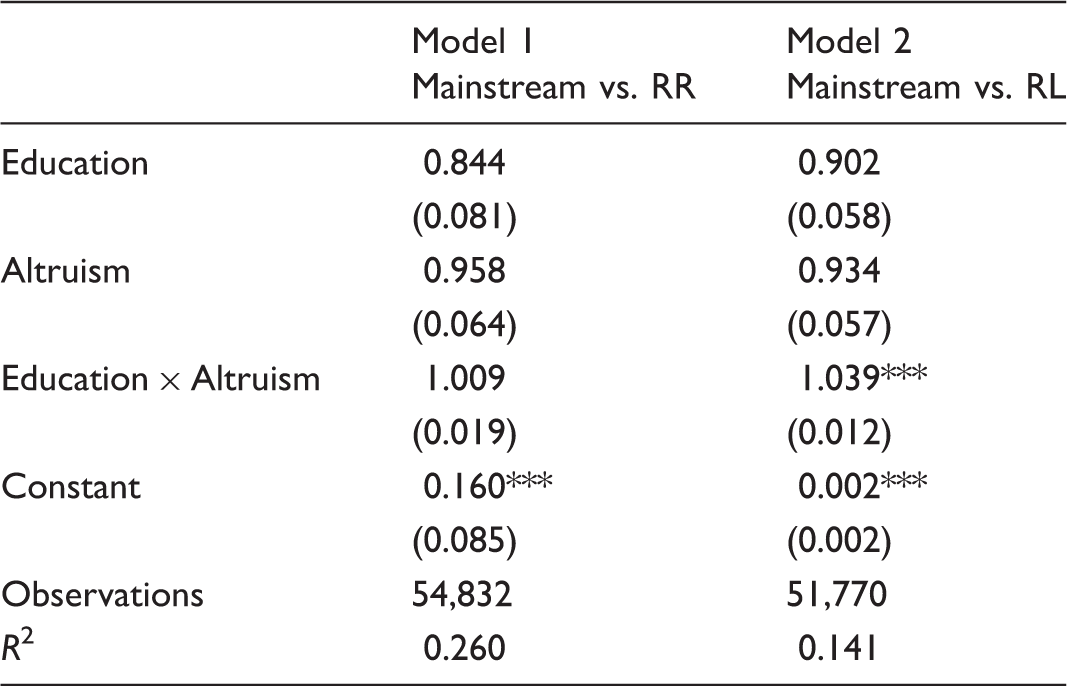
Clustered standard errors; entries are odds ratios; control variables are included but not displayed.
**p < 0.001.
Figure 1 clarifies the marginal effects of the interactions. The first panel (a) presents the insignificant interaction between altruism and education for voting radical right rather than mainstream. The figure shows a consistent negative effect of education on radical right voting, irrespective of altruism levels. Panel (b) displays the inverse interpretation of the same interaction term, which reads that altruism has no significant effect on voting for the radical right compared to mainstream parties—no matter the level of education. Figure 1’s third and fourth panels show the same marginal effects for radical left voting. Here, the third panel (c) shows no significant effect of education for more egoistic individuals. However, for more altruistic voters education becomes positive and statistically significant. Importantly, the difference in the education effect between very egoistic and very altruistic voters is also statistically significant. Panel (d) confirms that the interaction is significant and shows that the effect of altruism on radical left compared to mainstream voting is significant only among higher-educated voters. These results provide substantial support for hypothesis 6: the higher educated vote radical left only when they are more altruistic. Importantly, the interaction plausibly captures conditional effects in the opposite direction: not only is the tendency of higher educated to vote radical left conditional upon altruism, but lower-educated voting for the (conservative) radical left is also reinforced by egoism. See the Online Appendix for extensive robustness checks.
Marginal effects of education conditional upon altruism and altruism conditional upon education. Note: The graphs display the marginal effect of education conditional on the level of altruism (Panels a and c), and the marginal effect of altruism conditional on the level of education (Panels b and d).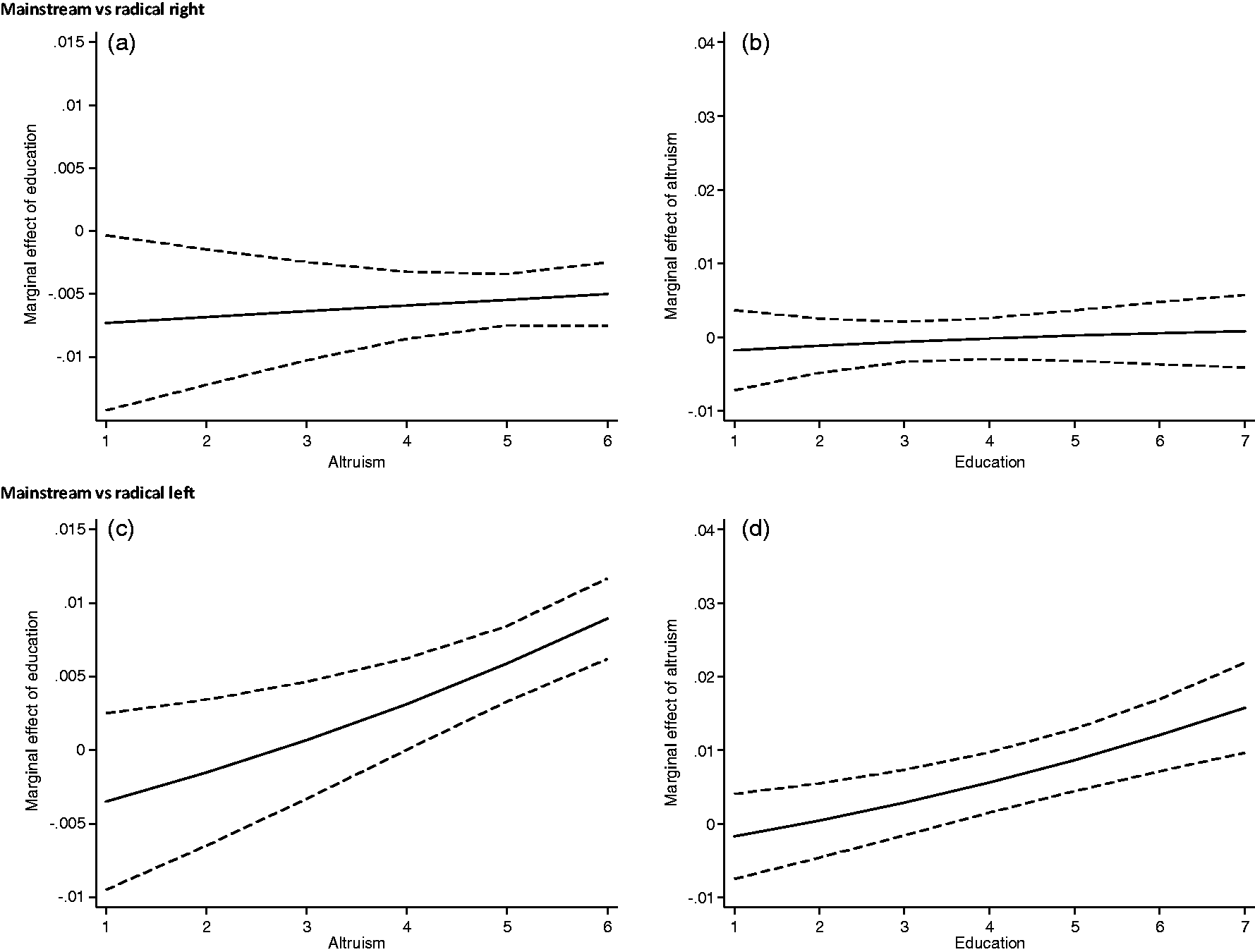
Conclusion and discussion
There are reasons to expect similarities between radical right and radical left electorates. Both have been thought to draw upon similar socioeconomic voter positions. Existing empirical studies of voter radicalisms have affirmed such patterns, while also unearthing some differences. The problem is that such differences are more induced than explained, leaving them conceptualized as, at most, ad hoc exceptions that prove a rule that the radical left and radical right share more than they contest.
We argue that although the radical left and right voter-bases have plenty in common, they strongly differ when it comes to their main voting motivations. With respect to fundamental values on equality, altruism, and appropriateness of government promotion of equality, radical left voters embrace and radical right voters more readily eschew such values. As a plausible consequence of such divergences in fundamental values, radical left and right voters differ in their nationalism: The radicalisms of both left and right share concerns about the European Union, but they yield diametrically opposed attitudes about immigration—where the radical left shows marked signs of cosmopolitanism and the radical right clear nativism. Finally, these patterns clarify why radical left voters tend to be more educated than their radical left counterparts (or, indeed, more than mainstream voters): the radical left’s commitment to cosmopolitanism, itself likely a product of egalitarianism, develops in part through education.
Future studies should investigate the relationship between egalitarianism, education, and radical voting in more detail and by means of more sophisticated attitudinal measurements. Further, it is important to assess the role of macro-level variables like socioeconomic inequality, economic growth and the percentage of foreign-born residents. Another possible venue for future research is development of radical voting over time, or differences between various regions within Europe.
Meanwhile, our findings clarify the future of radicalisms and of coalition formation in an age of electoral turmoil in Europe. The findings imply that the radical left and radical right likely to draw on very different segments of the same pool of ‘losers of globalization’. Relatedly, the competing radicalisms can be expected to rally discontents to very different ends and party programs—to seek to win hearts and minds in ways that should be familiar to what we know about left-right divides in electoral democracy. Another important implication is that radical left and radical right parties, both doing better in the polls and national elections, may be less likely to find a common cause and form coalitions than is often discussed or feared. We know that such coalitions are possible—as in the wake of the 2015 Greek elections when Syriza formed a government with a small radical right party. Such an example, our arguments and evidence suggest, represent a ‘bootlegger-baptist’ coalition—always possible in political life, but no harbinger for enduring and broader political alliances. Examples of radical left and radical right cooperation are exceptions that prove, or at least predict, a rule—a rule of radical distinctions.
Footnotes
Funding
The author(s) disclosed receipt of the following financial support for the research, authorship, and/or publication of this article: This research has been made possible through the Amsterdam Centre for Inequality Studies (AMCIS) of the University of Amsterdam.
Supplemental material
Supplementary material is available for this article online.
Notes
References
Supplementary Material
Please find the following supplemental material available below.
For Open Access articles published under a Creative Commons License, all supplemental material carries the same license as the article it is associated with.
For non-Open Access articles published, all supplemental material carries a non-exclusive license, and permission requests for re-use of supplemental material or any part of supplemental material shall be sent directly to the copyright owner as specified in the copyright notice associated with the article.
