




Abstract
Scientific debates surrounding feminism in the 21st century increasingly call for mainstream feminism to include the voices of non-white women, as well as looking also at the work and expressions of feminism taking place in the Global South. While progress has been made in the United States in acknowledging the work and demands of non-white feminism, Europe lags behind in recognizing and amplifying the feminist contributions and demands of its largest non-migrant ethnic minority, the Roma. This article presents findings from qualitative fieldwork conducted with 23 Romani women and young adults organized in civic organizations across Spain, exploring how they understand and experience feminism. Despite working towards gender equality among Romani men and women, as well as equality between Romani and nonRomani women, many do not identify with dominant representations of feminism. Our results highlight three key elements of what these women would claim as Romani feminism: the role of men as allies, claiming freedom as women as a central aspect of Roma cultural identity, and advocating for a feminism that promotes and safeguards the idea of equality of differences.
In Spain, 2018 marked the year when feminism was revitalized. On March 8, women took part in the first national strike to combat wage inequality and gender violence (The Guardian, 2018). Women all over the country stayed home from work, calling on the attention of international feminism and demonstrating that if women stop, a whole country can be stopped. Romani women also were part of that strike. However, although the Roma people are the largest non-migrant minority in Europe, many Romani women still state that dominant representations of feminism are not the feminism they identify with.
The #MeToo movement has refocused attention on the ongoing challenges women face with violence and harassment, indicating that sexism and violence persist for women and girls. However, the movement has been criticized for overlooking the unique harassment forms and vulnerabilities experienced by women of color (Boyd & McEwan, 2022; Onwuachi-Willig, 2018). This underscores the dominant portrayal of feminism in contemporary activism, which lacks inclusivity. As Jonsson (2014) suggests, this portrayal presents feminism in the Global North as an extension of white feminist traditions, emphasizing unity among “like-minded” individuals, and an ideal of “diversity” and “happiness.” Despite challenges from non-white feminism, these notions persist within prominent news and feature articles (Jonsson, 2014).
The study's authors have engaged in longstanding collaborations with Romani women's civic organizations in Spain, one of whom is herself Roma. Our central concern revolves around understanding why grassroots Romani women, whom we have partnered with extensively at the local level and who hold recognized leadership roles within their communities, perceive a disconnection from mainstream feminist narratives. When asked if they identify as feminists, most of these women respond with a nuanced perspective.
This study centers on Romani feminism in Spain, aiming to explore this question: What are the features that Romani women identify and claim as part of a “Romani feminism”? This exploration delves into discussions and viewpoints emerging from grassroots Romani women about the Romani Women's Movement and its feminist essence. Despite its presence across European countries since the 1990s, including Spain, this movement has received limited scholarly attention. While existing studies touch on Romani feminism and the grassroots efforts to challenge disparities (Sorde et al., 2013; Brooks, 2012), much remains to be uncovered about its unique characteristics. Additionally, an analysis is necessary to comprehend why actively engaged Romani women, often leading organizations, perceive their voices as insufficiently integrated into mainstream feminism.
This article is structured in four sections. First, we review the literature about antigypsyism in Europe and Spain, deepening in the case of Romani feminism in Europe and Spain. Second, we explain the methods used. Third, the findings are presented and discussed, structured in two main subsections, which relate to the exclusionary and transformative aspects identified with reference to the research question. Finally, findings are discussed, extracting some key conclusions and implications for social work.
Literature Review
Antigypsyism in Europe and Spain
While official EU-wide ethnicity data is absent, estimates suggest that Europe houses 10–12 million Roma, with about 6 million within the EU. Originating in Northwest India and arriving between the 9th and 14th centuries, the Roma have faced slavery, expulsion, historical persecution and criminalization. EU-level investments amounting to millions are dedicated to addressing Roma disadvantage fueled by the persistent antigypsyism—a specific form of racism toward Roma and one of the root causes of the social exclusion and inequality affecting them (Council of Europe, 2012). Progress has been seen, including fostering cooperation among Roma inclusion stakeholders (Moschovidis, 2022). However, the Midterm review of the EU Framework for National Roma Integration Strategies highlighted the challenge of enforcing EU legislation regarding Roma, with discrimination and antigypsyism remaining ingrained in societal structures across Europe (European Commission, 2017). The EU Fundamental Rights Agency (FRA, 2023) gathered data from its 2021 survey in 10 countries, revealing that 25% of surveyed Roma felt ethnically discriminated against in various life aspects (work, education, health, housing, public services or other services). Despite progress against hate-driven harassment and violence, advancements in combating discrimination remain limited (FRA, 2023).
Regarding Romani women's situation, the 2019 EU-Midis II survey by FRA (2019) examined Romani women in nine EU Member States. Compared to both Romani men and non-Romani women, Romani women fare worse in education, employment and health. The age distribution of Roma respondents in FRA's EU-MIDIS II survey indicates they are younger than the general population upon leaving school. Between 73% and 91% of Roma children attend primary school at age seven, as expected, yet this enrollment rate remains underwhelming across surveyed countries. Although slightly more Roma girls than boys attend primary school, their rates still fall short of the general population for 7-year-old girls. Furthermore, approximately 16% of surveyed Romani women and 12% of Romani men never attended formal education.
Romani women and men have significantly lower employment rates compared to the general population, with more Romani men employed than women—34% to 16%. In healthcare, Romani women encounter barriers due to gender stereotypes and discrimination (Aiello et al., 2019). As pointed out by the EU 2014 Roma Health Report, 25% of Romani women aged over 16 have never gone to a gynecologist compared with 18% of the non-Roma population. Besides, Romani women still suffer from forced and/or child marriages in particular communities and are also one of the most vulnerable groups for human trafficking in Europe (ERRC, 2011).
The socio-economic situation of Spain's Roma parallels their status across Europe (FRA, 2023). Since their arrival in the 15th century, over 250 anti-Roma decrees from 1499 to 1749 enforced eviction, punishment, torture, slavery and even extermination (Motos Pérez, 2009). The 1749 Great Gypsy Round-Up by the Spanish Monarchy remains a chilling episode, paralleling the Roma genocide by the Nazis (Carballo-Mesa, 2023). This tragedy deepened the Roma–non-Roma divide, worsening poverty and marginalization (Martínez-Martínez, 2017). Franco's dictatorship (1939–1975) further oppressed the Roma through measures like banning Caló language and enforcing surveillance on Romani settlements by the Spanish Civil Guard from 1943.
Romani feminism in Europe
Much needs to be done to better understand how Romani women are shaping and claiming a feminism of their own, why they feel that hegemonic white feminism does not represent their views, demands and positions (Kóczé et al., 2019; Munté et al., 2020) and the ways that Romani women are exerting their human agency and organizing to fight for gender equality, open spaces for social and political organization not solely with Romani men, but also with non-Romani women (Amador, 2019; Sordé et al., 2013).
A body of literature has traced the connections between Romani politics, Romani feminism and antigypsyism in Europe. Oprea (2004, 2012) argues that feminist and antiracist politics in Europe are still by and large two separate struggles, and Roma feminists wind up in a separate, isolated sphere fighting on their own. Asking for the inclusion of a gender dimension into Romani politics, Oprea has for long now denounced that many times the work done by Romani women aimed at combating triple marginalization has not been considered as something related to Romani politics at all. Nor is it given due respect as gender politics, since it deals with Romnia (Romani women) who are considered “Gypsies” not women. Feminist discourse in Europe has tended to ignore Romani women and other minority non-white women while advocating a universal doctrine of gender empowerment (Oprea, 2004, p. 32).
This way, antigypsyism and its impact on Romani women is an issue that according to many Roma scholars and feminists remains untackled (Kóczé et al., 2019). Based on this, scholars and activists’ claim Romani women's activism as a potential voice for challenging societal hierarchy in general, and thus call upon states to take specific actions to address intersectional discrimination (Kóczé, 2009a; Oprea, 2004). Romani women's experience can be central to the foundation of anti-patriarchy and anti-racist politics (Oprea, 2004). Thus, the need for intersectionality to capture the complex reality of Romani women is evident. By employing intersectionality as an alternative explanation, Romani feminist scholars go beyond the limitations of existing scholarship, using a conceptual language to reveal the racialized, classist and gendered intersected oppressions of Roma at the structural, discursive and biographical levels (Jovanović et al., 2015; Kóczé, 2009a; Sordé et al., 2013).
In relation to the above, Romani feminism seeks to establish itself as a political endeavor focused on advocating for and reclaiming the development of a modern Roma identity. This identity embraces diversity and equality within Roma communities and confronts the multifaceted challenges faced by Romani women, considering their intersections of gender, ethnicity and class (Bitu & Vinzce, 2012). Romani feminism calls for the centrality of the solidarity between women of different ethnicities, ages and social classes (Bitu & Vinzce, 2012; Schultz, 2012). Accordingly, if Romani women have been for a long time portrayed as passive victims of patriarchy who need saving, and as thieves and beggars getting rich from the welfare state as Brooks (2012) denounces, then friendship, personal connections and solidarity among activists and scholars, across ethnic identifications, are key elements to develop real possibilities for a Romani feminism (Brooks, 2012; Schultz, 2012; Sordé et al., 2013).
Romani feminism has been explored by Roma feminists and scholars who draw from their personal life stories as victims of antigypsyism and gender-based antigypsyism. Viewing themselves through the lens of cultural identity as Romani women, they challenge aspects like maternity, which might appear “traditional” or linked to oppressive patriarchal norms from the perspective of white feminism (Garcia-Espinel et al., 2017; Gelbart, 2012). By contesting these enduring stereotypes that persist in prevalent feminist representations, Romani women activists make an explicit request to academics: to avoid hastily assuming that motherhood is an imposed and oppressive role and that celebrating it restricts women's potential (Gelbart, 2012).
Roma feminist discourse extends to various issues, with Roma feminist politics addressing topics such as forced sterilization, early marriages, prostitution, human trafficking and street begging (often involving women and children; Bitu & Vinzce, 2012). These matters profoundly affect the lives of numerous Romani women across Europe and have persisted for centuries. Rooted in the collective memory of Romani women victimized by manifestations of gender-based antigypsyism and patriarchy, Romani feminism serves as a tool to challenge multiple injustices. Moreover, embracing Romani feminism as intersectional politics paves the way for a feminism founded on solidarity among women, addressing not solely patriarchy but also class disparities and racial bias (Gheorghe et al., 2019). Linked to this, Schultz (2012) underscores a significant point: Romani feminism defies a common taboo within marginalized groups by critiquing its own community to confront the dominant society. This underscores the imperative to forge a Romani women's rights agenda despite the considerable challenges involved.
Romani Feminism in the Spanish Context: The Inclusion of “Other Women's” Voices
In the Spanish context, Romani feminism emerged during the 1990s through the establishment of Romani women-led organizations. These groups aimed to address the unique challenges faced by Romani women, who experienced triple discrimination due to their gender, Roma identity and socio-educational status (SES). The Association of Romani Women Romi was a significant starting point. Formed in Granada in 1990 by educated Romani women who believed that mainstream feminism was not adequately addressing their concerns, Romi aimed to empower Romani women internally through education and externally by advocating for recognition of their issues within governmental bodies, all while managing familial responsibilities.
Subsequently, more Romani women’s associations emerged in the 2000s across Spain, such as Fakali, Amuradi, Alboreá and Drom Kotar Mestipen. In 1999, the National Federation of Association of Romani Women (KAMIRA) united over 20 associations. In the last decade many other Romani women’s organizations have emerged, advocating also for the LGBTIQ+ Roma rights.
The landscape of Romani women associationism in Spain today is rich in its diversity and plurality, revealing that Romani women's experiences are intersected by Spanish social structure, and in particular by antigypsyism. Adding to the above-mentioned contributions of Roma feminist scholars’ and activists, key contributions to Romani feminism have also been made from the perspective of Dialogic Feminism (De Botton et al., 2005), led by Roma and non-Roma scholars and feminists. Dialogic Feminism emphasizes the need to take into account and make visible the contributions done by the “Other women”, those working-class women, non-academic, many times participants of adult education circles, who most of the time have been left out from the feminist debate and from spaces of decision-making (De Botton et al., 2005).
Sánchez-Aroca (2004) highlighted elements present in Dialogic Romani Feminism, echoing other Romani women scholars who value and aim to preserve strong cultural aspects within their identity. Close family bonds, unity within extended families, reverence for elders and seeking dialogue and consensus are pivotal elements in Roma culture and this form of feminism. Elder Romani women, with their wisdom, hold valuable contributions for the community (García-Espinel et al., 2017). The pursuit of dialogue and unity is not solely a cultural trait but a core aspect of Romani feminism, as emphasized by Sánchez-Aroca (2004). This embrace of Dialogic Feminism by grassroots Romani women is advocated by the Roma Association of Women Drom Kotar Mestipen. Over its 20+ years, the association has organized two European conferences gathering “other Romani women,” non-academic women, along with the Romani Women Students’ Meeting (Aiello et al., 2019) and more. Their agenda focuses on ensuring Roma girls and women succeed in education (Kostic-Cisneros, 2020), representation in social and political debates at all levels, and advocating that Romani women participate fully in societal spaces without compromising cultural identity.
Overall, there is still a dearth of research exploring why Romani women, even those who are actively engaged in organizing and advocating for gender equality, often feel disconnected from mainstream representations of feminism and are hesitant to identify as feminists. This study seeks to address this gap in the literature by examining this phenomenon in greater depth.
Methods
This study is framed by research about grassroots Romani women and leadership on which the co-authors have been collaborating and researching during the last years, and which during the last years is being developed in the framework of the EU-funded research Narratives4Change (Reference Nr. 841355)*, and the Spanish-funded project Rom21 (Reference Nr. PID2020-117098RA-I00). These research projects have, in different ways, explored how grassroots Romani women are organizing at the local level to contest inequalities that themselves and their communities face.
The current study engages with the following research question: What are the features that Romani women identify and claim as part of a “Romani feminism?” By doing so, this study delves into the discussions and positions of interviewed grassroots Romani women concerning the nature of the feminism they represent.
Data Collection and Data Analysis
A total of 23 Romani women aged between 18- and 58-year-old took part in this study. Selection criteria were that participants are or have been public leaders engaged in grassroots Roma civic or political organizations across different geographic regions in Spain. The organizations to which these women belong are mostly Romani women's “grassroots-based organizations” working at the local level (Smith, 1997), and in some cases, Roma organizations operating at the regional level or national level.
Participants were initially identified through a snowball method, leveraging the authors’ contacts in grassroots-based organizations. These initial participants, referred to as “contact points,” were then asked to suggest other Romani women who could also be considered public leaders or members of organizations. After confirming names mentioned by multiple contact points, these Romani women were invited to take part in the exploratory study. The authors also aimed to identify Romani women leaders across different regions of Spain, using the snowball technique and suggestions from initial contacts. As a result, the focus of analysis was on grassroots Romani women leaders, not the organizations themselves. This distinction is crucial because although participants were chosen due to their recognized leadership roles within organizations, they were asked during fieldwork to share their personal perspectives and experiences as Romani women leaders. This approach aimed to capture their individual viewpoints rather than aligning with the organizational discourse they might belong to.
Fieldwork took place from April to June 2022, during which a total of 23 interviews were conducted. These interviews covered two key themes explored in the projects: leadership and feminism within the grassroots Romani women's movement in Spain. Initially, a preliminary analysis focused on leadership, leading to a dedicated study on the dialogic aspects of Romani women's leadership. Following this, all collected data underwent a second round of analysis, specifically examining themes related to feminism. The results from this subsequent analysis form the foundation for the present study.
Interviews were semi-structured and focused on the links between the two mentioned themes. Consequently, the questions for this study centered around their perspectives on feminism and its prevailing portrayals. The participants were asked various questions, such as: Do they identify as feminists? Why do they explicitly emphasize their leadership role in advocating for gender equality and opposing sexism, yet refrain from using the label “feminism”? What elements distance them from conventional perceptions of feminists? What life experiences as organized Romani women leaders have influenced their perception of not aligning with mainstream feminist representations? Furthermore, what aspects do they believe contribute to their unique experience and assertion of Romani feminism?
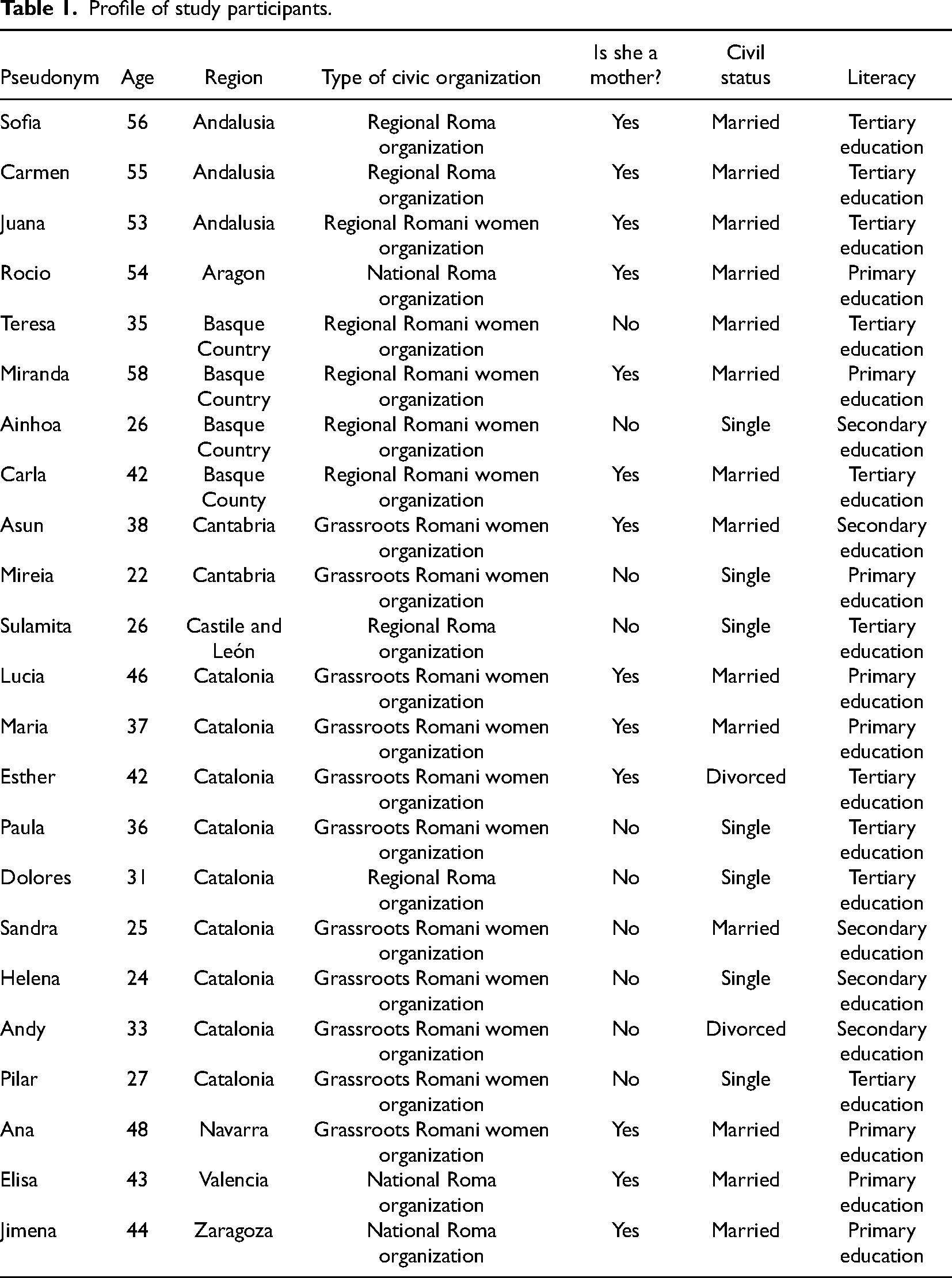
To triangulate information gathered during the individual interviews, two focus groups were conducted. Each focus group included five Romani women, who had already been interviewed and were familiar with the topic of the study. The goal of these focus groups was to open a dialogue among participants about the issues addressed in the interviews, and also to validate the findings. Table 1 describes some demographics information of study participants, as well as the type of organization in which they are involved. Note that for the sake of data protection, pseudonyms have been used.
Profile of study participants.
Data analysis considered analytical dimensions informed by existing scientific literature related to Romani women's organizing, Romani feminism and Roma cultural identity, as well as by categories derived from the research question. A first coding scheme was drafted by two co-authors and contrasted with the scientific literature. Two co-authors coded all data according to this coding scheme, and then brought the findings derived from the initial analysis of data to an open discussion among all co-authors. This round of internal discussion served to contrast the suitability of the coding scheme and refine some codes to ensure that they responded to scientific literature, and to the nature of all themes that emerged during the data collection process.
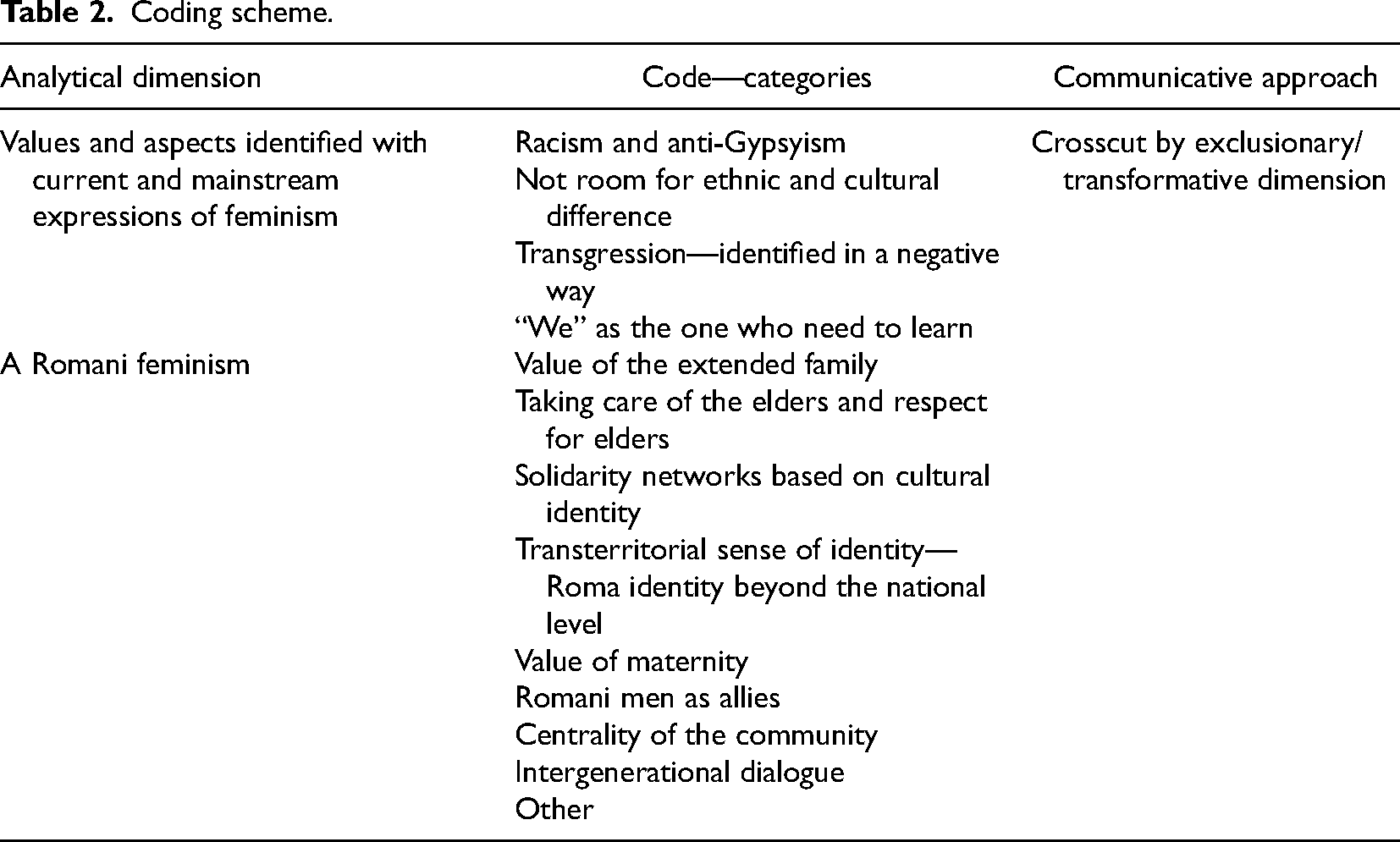
This study and its guiding studies follow a communicative approach (Gómez et al., 2011), which means that research is not solely focused on describing a given social reality, but the main goal and commitment is to shed light on existing elements that are latent in the reality studied, and if were acknowledged can be used to improve that social reality. The communicative approach allows us to look at the social reality from a transformative perspective, that is, observing what grassroots Romani women who are in constrained and difficult conditions can do in collaboration with each other to transform their lives and the lives of the entire community. This study involved not solely looking at those elements related to Romani feminism, but also taking into account the transformative/exclusionary analytical dimension (Aiello & Sorde-Marti, 2021): for the exclusionary dimension, identifying those elements that prevent women from feeling identified with the “feminist” label; for the transformative dimension, those ones which open up ways of experiencing “feminism” in a “Roma way,” and vindicating it. The final coding scheme is showcased in Table 2. It includes the analytical dimension defined for the study and the categories included within them.
Coding scheme.
Ethics
To safeguard the confidentiality of the participants’ identities and personal information, pseudonyms have been employed. All participants were given consent forms that provided comprehensive information about the study and clarified that they retain the option to withdraw from the research at any given point in time. All data gathered under the Narratives4Change and the Rom21 projects in which this specific study is framed complies with the Ethics Approval Procedure required by the Horizon 2020 research program, funded by the EC. As required, both research investigations follow the Regulation (EU) 2016/679, the EU new General Data Protection Regulation (GDPR). In addition, the Rom21 research and this specific study has received ethical approval by the Ethical Committee of the Community of Research on Excellence for All (CREA) with reference number 20230212.
Limitations of this study
This exploratory study is not intended to comprehensively represent the full range of Roma feminist perspectives present within the Roma community in Spain. Instead, its focus is solely on the insights and viewpoints of the 23 participants who took part. The study's scope is confined to Romani women leaders in civic organizations, predominantly heterosexual, and from a low-to-middle socio-economic background.
To ensure participant privacy, the research team made the decision, prior to commencing fieldwork, not to disclose the names of the organizations associated with the participants. Although sharing these organization names could have offered valuable insights into participants’ perspectives within the context of their respective organizations’ public and political discourse, concerns about potential breaches of personal data confidentiality led to this decision. Many of these organizations operate at the grassroots level, and revealing their names along with interviewee demographic information could potentially identify individuals. Consequently, this study primarily captures individual Romani women leaders’ viewpoints, rather than focusing on the organizations themselves.
Findings
In this section, we present and discuss the findings of our study. They are structured in two main sections, which relate to the exclusionary and transformative aspects identified with reference to the research question about the features that Romani women identify and claim as part of Romani feminism. The first section discusses why Romani women struggle with dominant representations of feminism (exclusionary dimension). The second section engages with the aspects that Romani women identify and express as part of their way of experiencing feminism.
The Exclusionary Dimension: “The Fights of the ‘Payas’ First Have to be Anti-Racist”
Interviewed women explained why they consider that what they (mostly) identify as mainstream feminism, the one which is portrayed in television and represented by (mostly) white feminist leading 8 March marches—as described by one interviewee—is still exclusionary to women who are different: those from low SES, or immigrant and ethnic minority women. Sulamita, a Roma young woman explains how many of the discriminatory situations that she experiences in her daily life are because she is a woman, but also because she is Roma: When “feminists” think of a woman, they never think of the Romani woman. Is it that we do not even have the category of women? “We are Roma. End of the discussion” (…) What we understand by freedom is different… They [“feminists”] expect you to separate the fact that you are a Roma, with the fact that you are a woman, and I cannot separate it… Because many times what happens to me is because I am a woman and because I am a Roma. If they talk about intersectionality. This is what intersectionality looks like. (Sulamita)
According to the participants, most Romani women feel unrepresented by dominant expressions of feminism, which they perceive as being racist and catering primarily to white and middle-class women. As Rocio puts it, these representations perpetuate the negative stereotype of Romani women as dirty and poor. The majority of Romani women are unaware of the existence of Romani feminism. Moreover, the form of Romani feminism that receives public attention is not representative of the actual movement. This portrayal is often seen negatively, as it fails to resonate with our experiences, excludes us, and even perpetuates racism. The Romani woman is associated with the poor, dirty woman. It is for these reasons that the term “feminism” simply does not represent us. (Rocio)
Also, in Teresa's words, there is also classism in feminism, but this is something rarely mentioned by mainstream discourses: We have spent years saying that current feminism, generally speaking, is racist, because they don’t take us into account… It's just that in feminism there is also classism. We just ask to be treated with dignity. (Teresa)
As Teresa expressed, asserting dignity, and receiving dignified treatment stand as pivotal desires. The interviewed women wish to witness these qualities in mainstream feminist expressions directed at Romani women or those who do not fit the academic or white molds. Pilar and Sulamita illuminate a prevailing notion: often, mainstream feminism demands that Romani women compromise their cultural identity and way of life, their “gitanidad.” For the others, everything that is related to the Roma culture, to the Roma world, is macho, is classist…. So for you, to stop being that little poor thing, the one who can’t do this or that, the one who is oppressed, because for them (the “payos”, -referring to non-Roma people) to stop thinking that you are like that, well you have to stop being and do everything that is Roma. That is to say, you have to lose your gitanidad. (Pilar)
In a conversation among them in one of the focus groups, participants discussed how Romani women tend to be infantilized. It is as if they need to be told what to do because they are perceived as not being able to figure things out or as not being smart enough to think for themselves and make decisions about their own bodies: And the less Roma you are, then yes you can be a feminist because otherwise, you will always be the poor Roma (…) Whatever you do, it is always because you are a Roma, it is not because you are a woman with your own mind because I feel like that (…) For example: well, I use sanitary pads instead of tampons. “You do that because you’re a Roma.” No. This is not true. I use this because it is what works best for me (…) They say, “my body, my choice”; well… The same for us: our bodies, our choice. (Helena)
Jimena, leading a local organization, shared her insight that when Romani women engage with mainstream feminist groups, their participation is frequently seen as a positive by white women. This recurring theme emerged throughout the qualitative fieldwork, underlining the perception that Romani women are often told, “It's time for you to join,” implying that they hadn’t organized before: Occasionally, while participating in a feminist gathering, you might hear comments like, “It's wonderful to have you (the Roma) here! At least there's one representative!” Hold on a moment… Are you suggesting that all these years we’ve made no progress towards achieving gender equality and earning respect? So, what my grandmother accomplished before me—toiling at the market, striving tirelessly for her children—during a time when non-Romani women were primarily confined to domestic roles, amounts to nothing? Well, in my view, this perspective also inadvertently reinforces the very principles that feminism aims to uphold. (Jimena)
Participants consistently conveyed that Romani women's organizations have been a constant presence in street protests condemning gender-based violence, and offering solidarity and support to non-Romani women. However, in ongoing public protests against antigypsyism, participation and support primarily come from Roma individuals. As evident from the gathered evidence, a fundamental issue within prevailing portrayals of feminism that repels Romani women is the persistent presence of anti-Roma biases and stereotypes. This constitutes a distinct form of racism aimed at the Roma community. According to most participants, prevalent attributes of inherent racism and classism continue to be prominent features in many contemporary manifestations of mainstream feminism.
The Transformative Dimension: Underlying Aspects Identified with Romani Feminism
Crafting allies: “Men also support our feminist struggle”
One of the central themes that our interviewees emphasize and discuss when describing their perspective on feminism is the concept of not opposing men and Romani men, but rather recognizing them as allies in the struggle to eliminate gender-based violence and achieve gender equality. According to their viewpoints, the prevailing portrayals of feminism contradict this notion. Consider Rocio's viewpoint: It's like thinking that you attribute all negative things that happen to you to all men in Earth. Well…. Our fight is different. And our supports are also different: I would not have gotten where I am if my father, my brothers, my sisters, my aunts and uncles, had not supported me. And our idea of feminism celebrates this, it welcomes it. (Rocio)
As observed in Rocio's story above, the central role of the extended family is a cultural aspect that according to her, Romani feminism also embraces and observes. This is also expressed by Teresa, who adds that in her case and the case of her female colleagues involved in the Romani women organization that she represents, male colleagues are considered to walk together along with them in their vindications as women: Romani feminism, the basis is that our partners, our men, walk along this path with us. However, general feminism does not contemplate it because it does not consider this to be feminism. (Teresa)
Carmen, a Romani women's leader who is also a politician on the national level, explains that historically, many Romani men have been key pillars in supporting Romani women's organizations. They have empowered and encouraged them to take the lead in advocating for gender equality. Similarly, Juana and most of the other women interviewed also contemplate the notion that, similar to women in general, there remains significant progress to be made in attaining gender equality and eradicating sexism: The first Romani women organizations in Spain were created counting on the support of Romani men. They (referring to men) believed and still believe in us (…) in Spain, Romani men leaders have publicly said that we, Romani women, have been the ones who have taken the lead in so many issues. (Carmen). And we need to keep working with Romani men… There are still things on which not enough progress has been made, in the matter of sharing domestic tasks for example. There are many things to do. (Juana)
In closing, these accounts underscore a distinct facet of Romani feminism—one that recognizes men as allies in the pursuit of gender equality and combating violence. Rather than adversaries, men within the community are portrayed as pivotal supporters, driving progress.
“We are people of freedom: Our bodies, our choice”
The participants in the study consistently emphasized that Romani feminism uniquely empowers Romani women to exercise autonomy concerning their bodies and make choices about pivotal aspects of their cultural identity, including marriage, maternity and family life. The interviewed women highlight that these elements are often rigidly framed by mainstream feminism, failing to recognize the rich tapestry of ethnic and cultural variations. Below, Lucía eloquently illustrates her perspective on maternity, both as a woman and as a Roma individual: The Romani woman isn’t characterized by submission; instead, she has held a position of strength within the family. Freedom plays a crucial role for us—we have the right to make choices about our bodies, including the decision to have children or not, whether that's none at all or four. My choice to become a young mother wasn’t impulsive; it was a decision I carefully considered. (Lucía)
During the fieldwork, another significant aspect that surfaced was the concept of virginity as a revered cultural value within the Roma community. Sulamita's narrative highlighted this aspect. According to her, the “machista” sentiment does not stem from choosing to preserve virginity until marriage, but rather from not having the freedom to decide for oneself and being burdened with the constant need to justify one's choices: They [the feminists] will always be the ones who are above you, and who have to help you so that you can progress, “be a free woman”… Or for example, the issue of being a virgin at marriage: “This is macho”. I’m sorry, but what is macho is not choosing. But if you choose, it's okay. (Sulamita)
When discussing marriage and Roma values, Elisa emphasized that within the Roma culture, both Roma values and the significance of marrying a Romani man hold a central place. She revealed that she herself married a Romani man, and she aspires for her daughters to follow suit. Nonetheless, Elisa acknowledges that she cannot enforce this choice upon her daughters: This is our identity, and our values hold significant importance. I, myself, married a Romani man, and I hold the hope that my daughters will choose similarly. Nevertheless, the decision rests with them; I can’t make that choice for them. In my household, I have a sister who opted to marry a non-Romani partner. (…). Recently, a young woman with a successful career was proposed to in accordance with Roma tradition for marriage, and this, to me, is a point of pride. It demonstrates the coexistence of different paths. (Elisa)
Divorce is another aspect that arose during our discussions. According to our interviewees, Romani women have been pioneers in this area, yet their contributions have often gone unrecognized. This recognition predates the legal ability of non-Romani women to divorce in Spain: We have consistently encountered stories of older Romani women who have experienced divorce and even had children with different partners. I believe that this is quite natural and not uncommon. Such occurrences were present even during the time of our grandmothers. Interestingly, the notion of divorce among payas was a relatively recent development until just a short while ago. (Pilar)
The reverence for elders, particularly for elder Romani women, and the acknowledgment of their role as cornerstones within their families, stand as pivotal values in the Roma cultural identity. As conveyed by the study participants, within their conceptualization of feminism, it is imperative to honor and consider the opinions of elder Romani women. This is because they embody wisdom, experience and knowledge: In the Roma culture, individual considerations operate in a different way; we honor our collective values. We prioritize the concepts of generosity and humility, focusing on the well-being of others, including their circumstances, children, and homes. This perspective involves placing oneself in another's position to navigate challenges collectively. This approach is deeply ingrained due to our upbringing. (…) Younger generations are advised to heed the wisdom of older individuals who can impart these values. (Juana)
Overall, the notion of Romani women elders emerges prominently, underscoring their pioneering role in appropriating public spaces for multifaceted purposes—as nurturing mothers and diligent workers. This assertion, corroborated by the study participants, resurfaces as a recurring theme, serving as a poignant reminder of the pervasive tendency to render Romani women invisible. In the words of Andys, a young female leader and community organizer based in Barcelona, the historical precedent set by Romani women in publicly breastfeeding their children predates its adoption as a feminist rallying cry. Nevertheless, she laments that in contemporary times, this very act has gained a veneer of trendiness, juxtaposed with the past when Romani women engaging in it were unjustly stigmatized: “now it's what is fashionable. When Romani women did it, they were the ones doing something wrong.”
Equality of differences: “I am as much feminist as my non-Roma fellows”
The participants’ discussions in the study highlight a central theme: the nature of Romani feminism and how they perceive and experience it. A key tenet of their understanding is that Romani feminism, which they view as inclusive and dialogic, should be grounded in the core principle of “equality of differences”. This involves accepting and defending an equal right to differences, the right of all women, no matter their cultural, migrant or socio-educational background to navigate and interact in our multicultural societies while expressing their cultural differences. Doing this, according to them, goes hand in hand with acknowledging first that Romani women have a different material situation—most of the time being of low SES—and different cultural values with which they want to live. This impacts their ways of engaging in political and social organizing: A distinction exists between the prevailing assertions of mainstream feminism and our own declarations, which stem from extensive periods of repression. Throughout history, the Roma community has encountered repression across various contexts. This experience profoundly influences our perspective on society and, consequently, shapes our approach to political engagement. (Mireia)
The participants in the study revealed that within their organizations, they are actively engaged in raising awareness and shedding light on gender-based violence. Therefore, they ask to be allowed to join their fellow feminists’ public debates contributing their experiences, with the work they are doing on the ground, drawing on an egalitarian base, and not “looked over the shoulder”—as Juana said. This involves, as Sofia says below, learning from each other. She explained that some Romani women organizations are doing valuable work promoting alternative masculinities, educating girls about male models of attractiveness that are far away from violence: In our organization we are working on the issue of new masculinities, also as part of the feminist movement. That is why we must be able to share this work and these experiences with other feminisms, in equal conditions. (Juana)
The interviewees contemplated the unfortunate reality that risk factors associated with gender-based violence victimization impact all children and adolescents, with Roma girls being no exception. Lucia echoed Juana's sentiment, emphasizing that all feminists must collaborate closely to address these issues. This collaboration necessitates attentive listening to one another, engaging in grassroots efforts, and weaving networks of solidarity between Roma and non-Romani women, as well as involving men: Numerous young women display a lower level of insistence when it comes to addressing gender-based violence, and this stance is far from satisfactory. Certain matters simply cannot be endorsed (…). When considering Roma girls specifically, it becomes imperative to enhance educational prospects and prevent dropout rates. So the broader concern of desensitization to violence impacts all girls universally. It is crucial to facilitate open dialogue with the broader feminist movement (…). (Lucia)
The stories discussed above showcase that Romani women are organizing on the ground to end gender-based violence and sexism. Yet, they express that many times they feel that their experiences are treated as anecdotal, not central, in conversations in the public sphere with other feminist fellows.
Discussion
Over the last decades, Roma and non-Romani women scholars and feminists across Europe have been working together to better understand how Romani feminism is shaped, its claims, and in which ways it differs from mainstream feminism (Brooks, 2012; Kóczé et al., 2019). Yet, most of the grassroots Romani women leaders do not feel represented by what some call “dominant representations of feminism” (Jonsson, 2014). Framed by these debates, in this study, we have explored these issues by dialoguing with 23 Romani women leaders of civic grassroots organizations across Spain, about the reasons why they feel distant from this dominant understanding of feminism, to then articulate what are those features that Romani women identify and claim as part of a Romani feminism.
The evidence collected indicates that many of the women interviewed have experienced discrimination and classism when trying to join mainstream feminist spaces. As suggested by academic literature about Romani feminism and gender antigypsyism (Kóczé, 2009b; Oprea, 2004; Sordé et al., 2013), Romani women are calling for mainstream feminism to address intersectionality and to recognize the experiences of minority women, such as themselves and other non-white groups. Also, evidence suggests that due to the prevailing antigypsyism in dominant feminism and society at large, Romani women are often seen as “backward” and “Othered” (Bitu & Vincze, 2012; Munté et al., 2020).
The study reveals Romani women's grassroots efforts and highlights the call for mainstream feminism in the Global North to include the perspectives of these “Other women” (Flecha & Puigvert, 2010). Amid widespread gender issues like violence and sexism, fostering dialogue becomes essential, especially within the context of Dialogic Society (Flecha, 2023). Establishing channels of communication, recognizing the essence of dialogue in forging connections, and ensuring that no individual is marginalized, has ceased to be a mere choice—it is now an ethical, societal, and even scientific obligation. This responsibility becomes increasingly evident in the sphere of research into these critical subjects.
Key Implications and Contributions
This study identifies three defining elements of Romani feminism. It should be noted that these aspects are not exclusive, but rather the ones that this study has focused on in depth. Firstly, it underscores the collaborative nature of Romani women's feminist endeavors, emphasizing the involvement of their male counterparts. They critique prevailing representations of feminism that exclude men and adopt a blame-centric approach. Romani women stress the potential of alternative masculinities in combating gender violence and promoting gender equality. While acknowledging persistent patriarchal structures that oppress all women, including themselves, Romani women align with other non-white women in upholding cultural values. They perceive their male counterparts as strategic allies, historically recognizing Romani women's role as social transformers (Aiello et al., 2019; García-Espinel et al., 2017).
The second aspect identified as characteristic of Romani feminism is the claim for freedom as women, which Romani women consider a central aspect of their cultural identity. Interviewees expressed deep concern with dominant feminists who often infantilize them and assume that they are not making free choices. Thus, Romani feminism acknowledges and confers Romani women the freedom to decide over their bodies and how they want to experience and live central aspects of their cultural identity such as marriage, virginity, maternity or the family. Study participants demand respect for their decision-making and not to be labeled as “oppressed” if they decide to follow Roma cultural practices, such as Roma marriage.
Finally, regarding the third aspect identified, the interviewees emphasized the importance of promoting a feminism that values and respects the equality of differences. In their understanding of feminism, and a central demand to dominant feminism, is to be seriously considered at the time of dialoguing with other women. This is in line with the idea of fostering and building solidarity and friendship networks with non-Romani women, something that as stated by some authors, can be of upmost importance for cultivating Romani feminism as intersectional politics (Gheorghe et al., 2019; Oprea, 2004; Sordé et al., 2013). Underlying racism still operating in all areas of society, and in the case of the Roma, impacts how Romani women read the world and engage in it. As women themselves explain, this is part of the Roma history as a people, and intersects also with the macho culture, suffered by all women. Beyond this, as interviewees explain, equality of differences in the feminism movement needs to be rooted in all women's experience. This is shaped and influenced by years of discrimination, of women growing up with stories of other Romani women having been victims of forced sterilization, having been denied basic care and information when attending the doctor, among other situations (Bitu & Vincze, 2012; Gelbert, 2012; Schultz, 2012).
Implications for social work practice
Romani women want to contribute their own views to the fight against gender violence, and to promote and work with the idea of “alternative masculinities” to overcome sexism. Thus, taking the contributions and experiences of Romani women organizations into account, and on an equal footing with the work that other feminist organizations are doing, can be extremely valuable at the time of designing not only gender violence prevention policies, but also other social policies aimed at challenging antigypsyism.
Building upon the foundation of insights drawn from both the literature surrounding non-white feminism and studies illuminating the pivotal role of women as agents of transformative change within Roma communities, several key implications for social work practice emerge. Firstly, the voice of Romani feminism calls for an expansion of the discourse on feminism and its inherent diversity. It urges both non-Roma feminists and professionals working with Romani women to actively heed the contributions made by organized grassroots Romani women at the grassroots level. True engagement with these contributions can enable social policies and practices to more effectively embrace the intricate tapestry of ethnic and cultural diversity, thereby potentially achieving higher efficacy in their intended objectives. Secondly, the realm of social work practice finds in Romani women leaders steadfast allies in the identification and implementation of on-the-ground social assistance. To materialize this alliance, it is paramount not only to listen to Romani women's voices, as discussed earlier, but also to acknowledge their identities as Romani women. Fostering a dialogue-driven approach, intrinsic to Roma identity, presents social workers with a route to channel assistance and forge partnerships that facilitate the development of interventions accommodating the multifaceted dynamics underlying the situations faced by Romani women. Lastly, the dynamics between Roma and non-Romani women within civic organizations, and the nuanced sensitivities inherent to these interactions, offer a wellspring of insights that can inform various facets of social work. These insights extend to interpersonal relationships among inter-ethnic groups, ushering in the potential for meaningful contributions within the realm of social interventions.
In all, the implications of Romani feminism for social work practice are multifaceted and profound. Embracing the tenets of inclusivity, equitable collaboration, and dialogue, practitioners can work toward fostering a more comprehensive and effective approach to addressing the challenges and aspirations of Romani women within diverse societal contexts.
Footnotes
Declaration of Conflicting Interests
The authors declared the following potential conflicts of interest with respect to the research, authorship, and/or publication of this article.
Funding
The authors disclosed receipt of the following financial support for the research, authorship, and/or publication of this article: 1) Narratives4Change: Capitalising Public Narratives in the organising of Grassroots Roma Women, which received funding from the European Union's Horizon 2020 research and innovation programme under the Marie Sklodowska-Curie (Grant Agreement Number 841355); 2) ROM21: Roma Women leading communities' transformation, which received funding from the Spanish Ministry of Science and Innovation (Grant Agreement Number PID2020 -117098RA-I00); and 3) Ramon y Cajal grant number RYC2021-033530-I, funded by MCIN/AEI/10.13039/501100011033 and by the European Union «NextGenerationEU»/PRTR.
