




Abstract
Largely absent from the feminist qualitative social work research literature are practical discussions about the ethics of white researchers who “study up” people and institutions of power. This methodological article grapples with how to conduct data collection from an anti-racist framework. I explore my use of an arts-based self-reflexive memoing process of embodied tableaux to inform my experimentations of rejecting “neutrality” when interviewing participants. I provide examples of disrupting white, patriarchal, and colonial norms during qualitative interviewing, including directly naming my whiteness and anti-racist stance; intentionally challenging the racism of white participants and deepening critical reflection; and viewing myself through a lens of critical skepticism to recognize when I was protecting whiteness or failing to effectively intervene. I conclude with an invitation to others to experiment with an anti-racist research praxis—an iterative process of self-reflexivity and relational accountability to reflect, theorize, and act differently during feminist social work research.
Collins and Cannella (2021) argue that racism is embedded in the regular practices of research and point to the necessity of reconceptualizing and redesigning qualitative inquiry from an anti-racist perspective. Anti-racist researchers have typically focused on the importance of centering racialized participants’ stories (Dei, 2005), choosing not to reproduce “damage-centered narratives” (Tuck, 2009), and actively unsettling “the coloniality of the researcher” (Henson, 2021). Others suggest the need to “study up” the people, institutions, policies, and ideologies which produce this harm in the first place (Becker & Aiello, 2013; Nader, 1972). Yet, largely absent from the social work literature are the ethical feminist and anti-racist responsibilities that those of us who are white have when the research subjects are white people and culture, dominant institutions, and/or those who are in positions of power. Far too often, researchers may simply list their social identities at the beginning of a study but give little attention to how their positionality shapes the course of the research and the relational accountability of the researcher.
Often missing from the literature are practical discussions about what to do during “messy” moments that emerge during social work data collection with research participants. For example, when racism is espoused by research participants, how might white researchers push back against supposed “neutrality” as the benchmark for “good” data collection, which otherwise serves to protect whiteness (Foste, 2020)? How do white researchers who are engaged in critical work contend with the fact that their study may have “richer” results when this racism is shared? How do white researchers demonstrate their capacity to have meaningful conversations about racism when interviewing Black, Indigenous, and racialized participants? And, how do white researchers remain critically skeptical of their own work? Given that social work was largely formed in alignment with, and as a tool of, white supremacy and colonization (Badwall, 2014; Blackstock, 2009), it is essential that social work research practices are unapologetically grounded in anti-racist principles.
Therefore, the focus of this methodological article is an examination of the ethical problems, possibilities, and responsibilities that emerged for me, a white female social work researcher, when collecting data on the role of whiteness and anti-Blackness in trauma-informed school supports and school social work. In the article that follows, I describe the dissertation study from which these methodological and ethical tensions emerged and briefly summarize the existing literature on the rejection of a “neutral” researcher, limits of self-reflexivity, and the anti-racist ethical responsibilities of white feminist researchers. To deepen this process of reflection, theorizing, and anti-racist actions during data collection as a white woman who studies racism, I developed an arts-based self-reflexive memoing process using an adapted version of an existing arts-based social work research method called embodied tableaux (Mayor, 2020). This article provides examples of this art-making and how the process informed my attempts to conduct data collection from an anti-racist and relational framework, including directly naming my whiteness and anti-racist stance with racialized participants; compassionately challenging whiteness and deepening the critical reflection of participants; exploring times when these strategies were ineffective or I failed to act; and the value of white feminist researchers seeing themselves through a lens of critical skepticism. I conclude with an invitation to experiment with what I am calling an anti-racist research praxis—an iterative process of self-reflexivity and relational accountability to reflect, theorize, and act differently during feminist social work research.
The Study Context
Despite increasing interest in trauma-informed schools, few have explored the kinds of unintentional harm these programs may be doing, particularly to Black students (Alvarez, 2020; Gherardi et al., 2020; Golden, 2020; Joseph et al., 2020; Khasnabis & Goldin, 2020; Mayor, 2018; Petrone & Stanton, 2021). The larger dissertation research from which the methodological findings from this article are drawn focused on critically examining how whiteness and anti-Black racism structure Canadian K-12 school social workers’ definitions of trauma and their “trauma-informed” responses to students. One of the goals when designing this study was to engage in research of “refusal” (Tuck & Yang, 2014). Rather than extract Black students’ painful stories, I studied school social workers, a group with relative power in schools and who are disproportionately white women. I intentionally made the choice to critically examine roles and structures that as both a practitioner and a researcher, I am also deeply implicated in.
To do this, I designed an innovative, critical qualitative study where I combined fictional vignettes with semi-structured interview questions when talking with individual school social workers in Ontario, Canada (n = 19). Research participants were primarily recruited through the Ontario Association of Social Work and the Ontario College of Social Workers and Social Service Workers. Recruitment materials included information about the goal of the study, including naming that the study was interested in exploring how student identity, including race, may impact school social workers’ assessment, responses, and support to students in schools who have experienced trauma and developing trauma responses that might equitably support all students. Participants had been employed as a school social worker past or present in public, parochial, and private K-12 schools, including in a range of urban and rural communities across the province. Most participants were assigned to multiple schools as part of their weekly caseload. Most participants identified as female (female, n = 16; male, n = 2; Two-Spirit, n = 1) and as white (white, n = 13; racialized, n = 6). This study received Research Ethics Board approval from Wilfrid Laurier University.
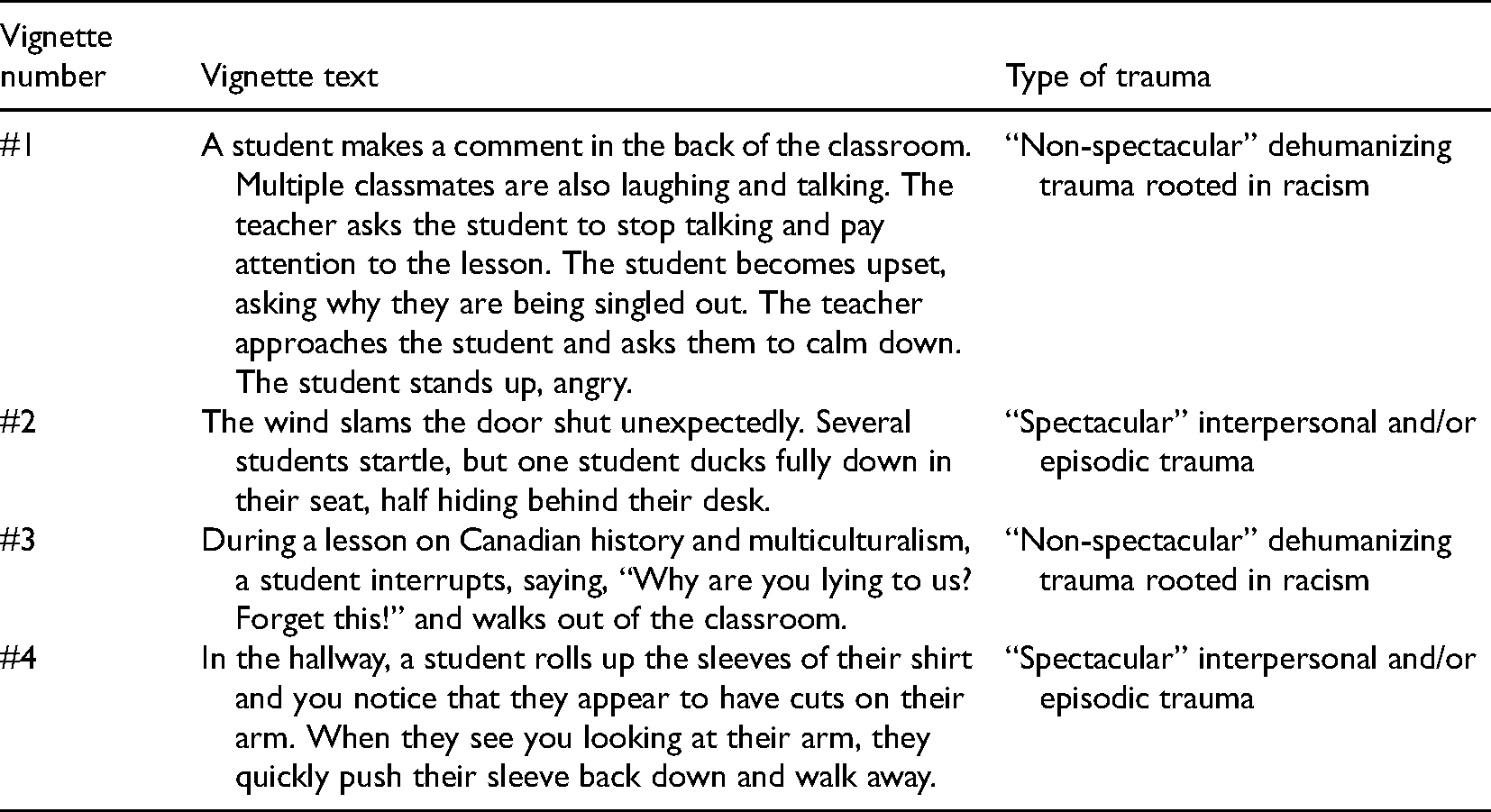
For this study, I read out loud four vignettes (Table 1) that provided 2–4 sentences about the situation and gave no social identifiers for the students. I designed two vignettes (#2 and #4) that might apply to all students who have experienced forms of “spectacular” interpersonal and/or episodic trauma, and two vignettes (#1 and #3) that aimed to address forms of “non-spectacular” dehumanizing trauma rooted in racism (Stevens, 2011). A series of questions to debrief each vignette aimed to unearth assumptions about who is seen as an appropriate trauma victim, how trauma is defined, and how school social workers see their role as a way of understanding how various ideologies, policies, and structures in education and social work constrain and shape their decisions. Questions were also explicitly asked about what, if anything, might change in their assessment of the situation if the racial identity of the student was different than what they had imagined and whether they thought racism was a form of trauma. I was interested in not only what interviewees said, but also how they said these things, including changes in verbal nuances (e.g., tone of voice, speed, repetition) and non-verbal responses (e.g., gestures, facial expressions), which were included in the data analysis. I analyzed the data through Lawless and Chen’s (2018) critical thematic analysis, using a theoretical framework that combined critical whiteness, anti-Blackness, and critical trauma theories. The codes, sub-themes, and themes were organized using NVivo. I also engaged in a written and arts-based self-reflexive memoing strategy as part of my feminist and anti-racist relational accountability as a white researcher during the data collection phase, which is explored in more detail below.
Research Vignettes.
Recognizing the Problem of “Neutral” Reactions to Racism During Data Collection
Critical researchers reject a post-positivist epistemology, instead viewing the researcher as both implicated in the research and invested in challenging and transforming these inequities (Fine & Gordon, 1989; hooks, 1990). White feminist researchers challenged the supposedly “objective” male researchers who conducted research about women, pointing out that patriarchal stereotypes shaped the questions being asked, the data that “counted,” and the theories used to interpret these findings (Haraway, 1988; Harding, 1987, 1992; Smith, 1987). Feminist standpoint theory and feminist social constructivism highlighted the importance of critically examining who is conducting the research, for what purpose, and how these perspectives and aims reflect the “truth” articulated in research (Wigginton & Lafrance, 2019).
Despite these important contributions, this scholarship often focused on patriarchy and ignored the role of whiteness (Collins, 2000). In contrast, Black feminist and critical race researchers traced the ways in which science can be a tool for controlling and pathologizing racialized populations (hooks, 1990; Collins, 1992, 2000; Ladson-Billings, 2000; Mullings, 1997). As Evans-Winters (2019) articulates, “Black feminists have always proclaimed, for personal and political reasons, that objectivity in the critique of society is neither desirable nor feasible in ongoing efforts to employ systematic investigation methods in combating White supremacy and male domination” (p. 21). Similarly, Indigenous researchers have long argued that white settler research that claims to be “neutral” is a colonial tool designed to control populations and the land (Absolon, 2011; Tuck, 2009; Tuck & Yang, 2014; Wilson, 2008). Rather than aiming for “objectivity,” Absolon (2011) argues that “The self is central to Indigenous re-search” (p. 67). Instead, knowledge is seen as relational, holistic, and ceremonial (Absolon, 2011; Kovach, 2009; Smith, 1999; Wilson, 2008). Wilson (2008) argues that relational accountability must be interwoven throughout all aspects of an Indigenous research paradigm.
Based on these perspectives, I spent significant time reflecting on how my positionality as a white woman would shape the design of my vignettes and interview questions, how I would analyze the data, and decisions I might make about dissemination. When piloting the vignettes, I witnessed a group of mostly white female participants actively protect whiteness, espouse racist bias, and tell stories about their practices that would likely result in harm to racialized students and families. For example, one strung together a series of stereotypes about Black people, including associations with gangs, rap music, and domestic violence. Another stated she would only be worried about the existence of racism if the student was the only non-white student in the classroom or in the school. The racism being displayed was disturbing, but not surprising, particularly since unearthing the ways whiteness and anti-Blackness are perpetuated by “trauma-informed” school social workers and school policies was the purpose of the study.
What did surprise me was the new ethical twist in my gut when hearing this racism when in the role of social work researcher. Of course, I needed participants to reveal their bias in order to offer a critique of how whiteness and anti-Blackness are embedded in trauma-engaged theory and practices, provide better recommendations for practice in schools, and demonstrate the need for anti-racist training for future social workers. Yet, when I was being truly (and shamefully) honest, the more comfortable white people felt freely expressing their racism, the stronger I knew my findings would be. While I was deeply upset by what I was hearing, I was also hit with an unanticipated feeling of excitement that the vignette methodology I had designed was effective in eliciting these “rich” data. I was reminded of Caouette and Taylor’s (2007) writing that, Ultimately, even if our intentions are altruistic, our position as white social scientists, whose research hinges upon group inequality, will always remain paradoxical: our careers are fundamentally built on studying the plight of those most disadvantaged. Even though our intent is to curb inequality, we are, in fact, earning a respectful living out of other people’s disadvantage. (p. 80)
The fact that participants’ problematic views and practices were being expressed and that I said nothing to interrupt them was benefitting me as a researcher. Realizing this made me feel nauseous.
Engaging in written self-reflexive memos helped me to better understand this nausea. For example, after a pilot interview, I wrote: Memo June 28th, 2019: What do I do with the fact that the people I am interviewing sometimes say (and I assume do) horrifying things? I know these kinds of answers when I do the real study are what I’m trying to uncover – the point is to reveal these problems and to try to offer some possible strategies for the future. But in the meantime, I just sit there, listening, thinking to myself: ‘What are they saying?! This is so not ok,’ all while I just nod along. And they see me nodding and think ‘She gets it.’ I’m just doing the same ‘white silence is white violence’ thing that I critique in the actions of school social workers, but I’m cloaking it in the role of ‘researcher’ to somehow absolve myself. I do not feel absolved. Also, at what point do I have enough data? I don’t need 35 anti-Black examples from one participant to write this study. I feel like I am collecting,
Without consciously realizing it, I had taken in the white, colonial, and patriarchal premise of “good” research that I should have a “neutral” response when conducting data collection interviews. By not intervening, I was protecting white supremacy culture (Okun, 1999/2021), namely: the right to white comfort, perceived neutrality/objectivity, resource and power hoarding, and delusions of exceptionalism as the “good” white person/researcher. Simply deciding to “study up” school social workers who are primarily white women and the systems they work in, and choosing to analyze these data using critical frameworks did not mean that my research process was actually anti-racist. I was still embodying a patriarchal, colonial, and white supremacist way of seeing research as extraction, where getting the data mattered more than my relational accountability. I needed to develop a different approach to conducting data collection.
Developing Anti-Racist Data Collection Strategies
Some researchers have argued for the importance of writing “messy” (Pillow, 2003) self-reflexive accounts of how their privilege, oppression, and power overdetermine the research process (Chadderton, 2012; D’Arcangelis, 2018; Howard et al., 2016; Hurd, 1998). A few researchers, mostly white, have written self-reflexively about the dilemma of witnessing racism from their white participants (Castagno, 2008; Deliovsky, 2017; Foste, 2020; Vaught, 2008). These researchers typically follow a similar pattern in their writing, where they: (1) critically reflect on how their racial identity helps white participants feel comfortable expressing racist beliefs; (2) feel tension about staying silent; (3) report being conflicted about sharing these embarrassing stories and critiquing their participants because they are operating from what is often described as a “feminist” approach to research; and (4) share these stories of racism with the reader, framing this as part of their commitment to challenging racism.
My problem with this pattern is that the participant’s racism not only goes unchallenged but is potentially reinforced by being witnessed by the researcher (a critique also made by Becker & Aiello (2013); Foste (2020); and Hurd (1998)). I would argue that the “feminist” principles these researchers claim to be in tension with—i.e., needing to create a bond of mutual trust, empathy, and comfort with research participants because of the power of the researcher—is not an intersectional feminist perspective, but a white feminist one. Simply writing about our identity as white researchers or our complicity when racism occurs does not make our work anti-racist or feminist. Badwall (2016) explains how critical reflexivity in social work is at risk of merely “reinscribing colonial constructions of whiteness” (p. 1) by allowing those who engage in the practice to see themselves as innocent and morally superior by reflecting on their “badness.” I would argue that if we choose to only make our stance known when writing up the findings or by simply including a positionality statement, we are neither truly accountable to the relationships with our white participants nor to the racialized communities that may continue to be harmed through our inaction. This is an example of what Ahmed (2004) calls the non-performativity of anti-racism, meaning that the declaration of one’s whiteness or an anti-racist commitment “does not do what it says” (para. 12) and we often position ourselves as outside of racism.
Thus, in consultation with my supervisor, peers, and the literature, I began to experiment with ways to disrupt my own white, patriarchal, colonial, and capitalist impulse to extract more data as a resource. During data collection, I attempted to stay implicated in what I was critiquing by challenging the racial bias of participants and explicitly naming my stance on the research topic during the interviews themselves. I began by using written memos as a form of accountability and radical reflexivity (D’Arcangelis, 2018) to unearth some of my conscious and unconscious processes. Despite the usefulness of writing, I felt that part of my experience was missing, namely what was happening in my body, affect, and potential actions in relationship to the participants and this study. I have long used the arts as a way of knowing, understanding, analyzing, and expressing my experiences, including when working through stuck-points and challenging material. I have found that the “aesthetic distance” (Landy, 1994) provided by using arts-based tools allows me to both think and feel simultaneously without becoming numb or stuck, as well as notice patterns across these reflections about what ideas about the world or myself are being challenged. I have also used creative writing as a form of decolonizing intersectional feminist critical reflexivity, finding it powerful for revealing hidden biases and norms in my practice work (Mayor & Pollack, 2022). Given these previous experiences, I felt that using the arts as part of my memoing strategy to unpack my reactions to each interview might offer additional and important insight.
While there are a few studies which describe using an arts-based memoing strategy (Boyle & Butler-Kisber, 2019), no known studies describe creating an arts-based piece in response to each participant interview as part of the memoing process. Previously, I have created a methodological guide for using embodied tableaux at various phases of social work arts-based research (Mayor, 2020). In this method, frozen embodied sculptures are created to express and signify themes, relationships, stories, or scenes. To adapt the method for memoing purposes as a solo researcher, I created and photographed three embodied tableaux responses following each interview: (1) how I felt during the interview, with a focus on how whiteness emerged in my relationship with the interviewee; (2) how I imagined the participant felt; and (3) how I would embody the relational dynamic between us. I then studied the photographs and wrote based on what I was noticing and feeling. Coupling the creation of these embodied shapes with writing prompts invited me to consider the role of the body in challenging, perpetuating, and holding knowledge about racism and whiteness and reflect on discourses that might otherwise remain unconscious or taken-for-granted (Sinding & Barnes, 2015). Using an arts-based process allowed me to move from self-reflexivity as simply a cognitive process towards a more holistic connection with my emotions and body. As detailed below, this process was particularly useful for reflecting on and adapting my attempts at anti-racist data collection throughout the study.
Direct Naming of My Whiteness and Anti-Racist Stance with Racialized Participants
When designing my interview guide, I had imagined that my decision to use fictional vignettes might create enough “distance” to allow racialized participants feel comfortable enough to express their experiences of racism. However, early in the data collection, I interviewed a racialized participant who used the pseudonym Truth, who appeared tense, answering brief, short answers and providing little critique of the system they were working in. They also stated multiple times that they are careful when talking to white colleagues to not bruise their egos or increase their defensiveness. I wondered if this participant was (rightly) wary of me as a white researcher and that they might be also treading lightly because they were uncertain of my capacity to talk about racism without collapsing into a white fragility performance. 1
Truth then stated that their school board had decided to roll out Black and Indigenous curriculum that had not been created by members of those racial groups. I sensed there was more to the story and decided to make my anti-racist critique explicit, responding,
Yes and what you are sharing speaks to the ways in which whiteness shows up in education, right? In terms of these kinds of dynamics where white folks think that they should be developing curriculum for all things. That as white people we can hold and teach all knowledge.
The participant’s face lit up, seeming surprised. They proceeded to tell a more detailed story about their advocacy for a new curriculum and in protecting students who were reprimanded for their similar critique of the curriculum. As this participant discussed the administration’s defensiveness, I named this as a “defensive, white fragile response.” Again, after making my perspective clear, there was a marked shift in the participant’s affect, body language, and shared content—they moved from being protective and brief, to more open, expressive, and directly critical of how anti-Blackness, whiteness, and colorism show up in schools and social work.
After this interview, I used the arts-based self-reflexive process to help me unpack the response to being more direct about my own whiteness and anti-racist stance. This was a way to explore my feminist and anti-racist relational accountability to this participant, as well as to un/learn how to act differently in future interviews.
Tableau #3 Truth: July 20th, 2020
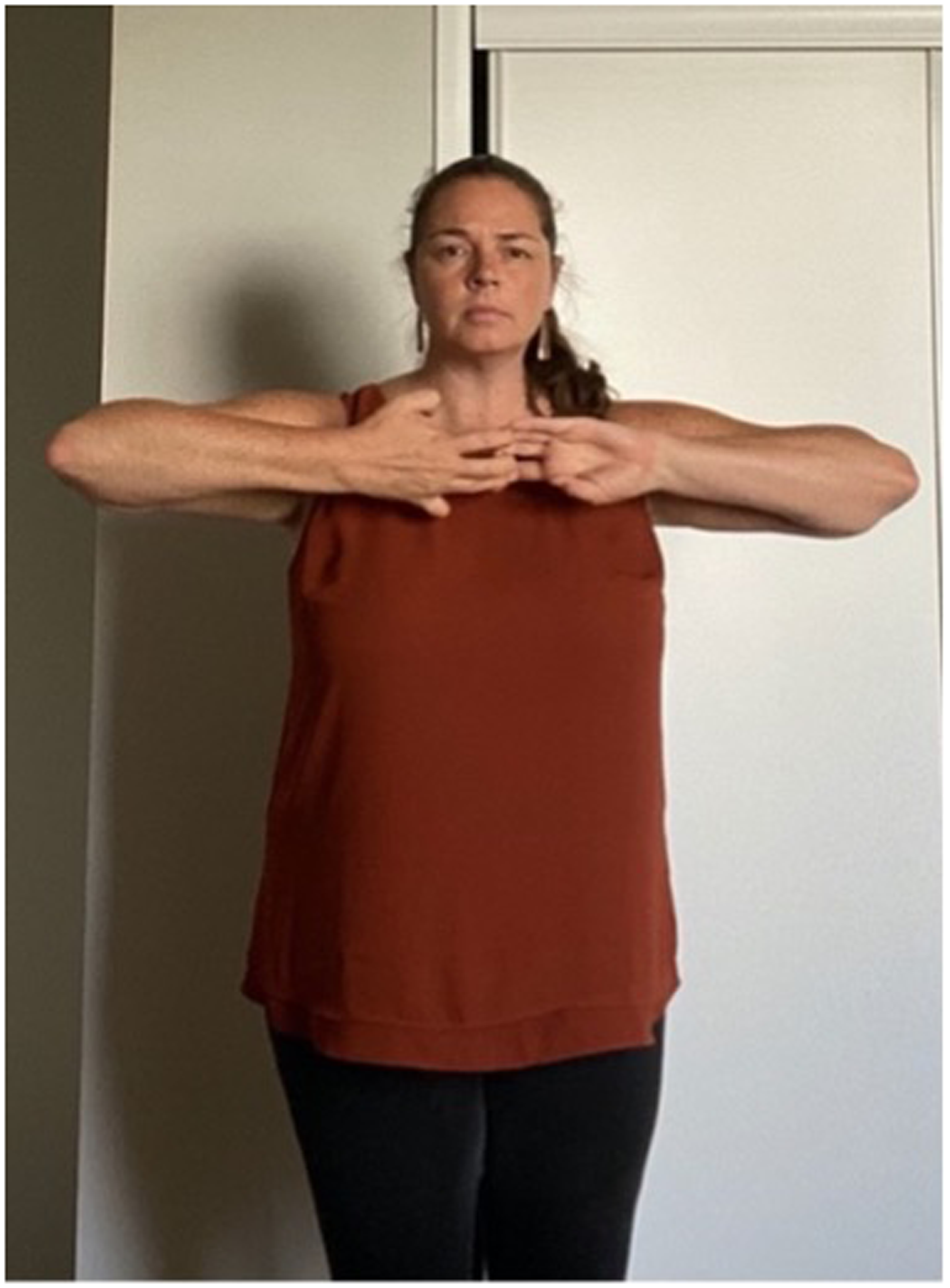
Image depicts the researcher looking straight into the camera, both hands tentatively gripping each other at the fingertips.
Dialogue/Relationship: At the beginning we were uncertain. Not sure if there is trust or if there even should be trust. One not wanting to cause harm. One rightly tentative, wary about being disappointed yet again. We both hold ourselves with some degree of protection, but work to find ways to make points of contact. I remember ‘neutral’ isn’t neutral. I name racism and whiteness more truthfully. They noticeably shift to speaking more freely. This bridge to each other needs work, nurturing. It is not a secure path, nor a guaranteed one. But a point of connection is possible because we face each other, with eye contact, both willing to risk a little and to be direct. This is a choice.
This creative process helped me reflect more deeply on the need to transparently name my whiteness and my critical stance. This should have been more obvious to me, considering how many white people are uncomfortable, avoidant, or defensive when hearing stories about racism. Appearing “neutral” means protecting whiteness, which may shape what stories racialized participants are willing to tell and with what level of vulnerability. Aligned with Okolie’s (2005) anti-racist research framework, I embraced research as “unapologetically political” (p. 247). After this reflection, near the beginning of the remaining interviews I began to explicitly name the risk of talking to a white female researcher about racism and clearly state my own anti-racist critique of schools and trauma work. I more boldly asked questions about the unspoken stories about racism that I had an embodied sense were there, rather than rigidly sticking to my interview guide. I also worked hard not to separate myself from whiteness in the language I was using (e.g., “for those of us who are white, I think we often can miss […]”).
This decision to clearly name my relationship to whiteness and anti-racism was not only a rejection of the white, colonial, and patriarchal idea of the “objective” researcher, but it was also a way to build more authentic relationships with those I was interviewing. For example, when Michelle, a racialized participant, talked about how she has to be careful not to evoke discomfort with white educators, I actively checked in with her by saying:
And I’m also aware that you’re talking to a white person about this, so I don’t know how much you’re feeling the need to protect me in it. I want you to know that you don’t need to, but I know that it can be potentially anxiety provoking because we don’t know each other.
Michelle thanked me for naming this dynamic and then spoke openly about her experiences of anti-Black racism in schools. While I do not know for sure, I believe these decisions to be direct helped many racialized participants gauge my ability to be in dialogue about racism together.
Compassionate Challenging of Whiteness and Deepening Self-Reflection
As I explored my ethical responsibilities regarding directness with racialized participants, I was also compelled to consider what rejecting “neutrality” with white participants truly meant. White researchers Foste (2020) and Deliovsky (2017) argue that by pushing back against racist or problematic stories, participants will alter their answers to more desirable ones and this will prevent these stories from being unearthed. In contrast, as I began to be more direct with white participants, including interrupting their racism, I found it possible to unearth many of these problematic stories early in the interviews and then weave more critical perspectives and compassionate challenges later in the interview. As social work researchers, we also may need to consider when participants are able to take in what we are saying; yet, both Foste (2020) and Deliovsky (2017) seem to fall into the trap of binary thinking, assuming that the only option we have as white researchers is to name the racial bias immediately and every time, or not at all. They also conclude that white people can seamlessly produce socially desirable responses, when in fact my interviews suggest that these shifts are bumpy and often coupled with white fragility performances that provide additional and important data about the way school social workers may protect whiteness and reproduce anti-Blackness. For example, during direct conversations about racism, some demonstrated noticeable changes in their speaking patterns, talking speed, and eye contact. Others would position certain individuals in the school as the “bad racists” and themselves as innocent. Other social workers would respond in ways that minimized, doubted, or negated the existence of racism as a whole, or anti-Black racism specifically, in schools. Further, some were not even capable of hearing my critique, let alone able to smoothly perform socially desirable responses.
While a few participants shared they had chosen to sign up for the study for the express purpose of engaging in a self-reflective practice about their work, most white social work participants, despite our profession supposedly being grounded in social justice, avoided discussions about racism or were evasive of the assumptions that emerged during the vignettes. With these participants, I often worked on building rapport during the beginning of the interview and then began to attempt to more openly discuss whiteness and anti-Black racism later in the conversation. In general, I found that my challenges were more likely to be “heard” by the participant once some rapport was built and if my interventions came from a place of compassion. I attempted to acknowledge how we all have been raised in a culture of white supremacy, and, for those of us who are white, we are most rewarded when we reproduce white ideology and practices. Therefore, many of the tactics I used were rooted in a kind of feminist relational and compassionate “calling in” (rather than “calling out”) and by including my own experiences of benefitting from whiteness in the conversations.
One tactic I used was paying attention to what was happening in my own body during the interview, seeing my embodied reaction as part of my “knowing” about whiteness. For example, Sarah, a white participant, talked about a meeting regarding two female students who were potentially being sexually abused/trafficked and often left school at lunch time. The mental health expert in the meeting advised the students’ father to lock the house door and told the school to call the police if the students “trespassed” by returning to school property. This was advice that Sarah disagreed with, but the principal decided to enforce. Sarah told this story about girls being criminalized rather than provided with support with little noticeable affect. I listened while literally feeling sick to my stomach. After the interview, I created the following tableau and piece of writing:
Tableau #1 Sarah: July 14, 2020
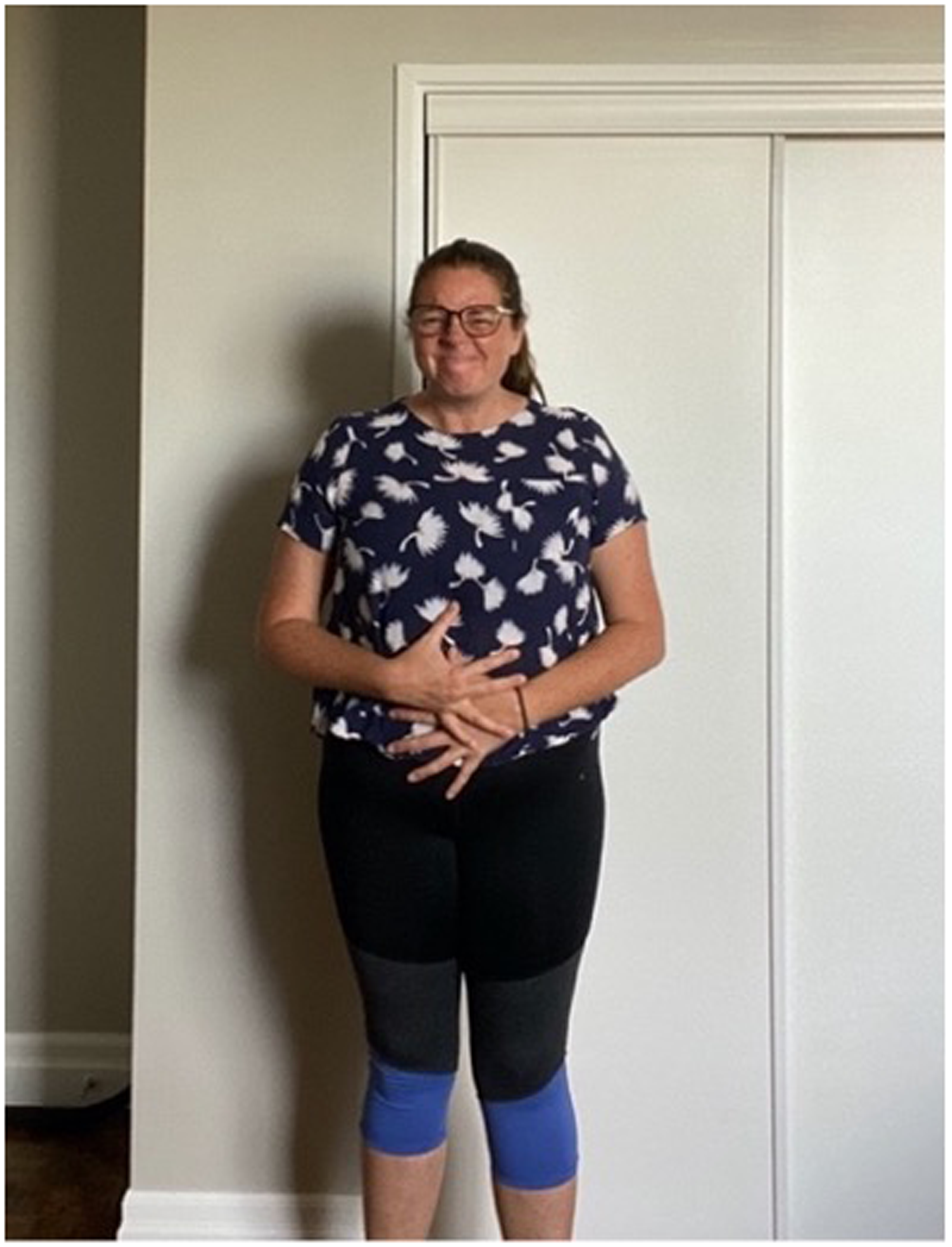
Image depicts the researcher with a grimace on her face and hands at her belly as though she is going to be sick.
How I Felt: I feel the nausea you don’t name, the split off feelings of sickness and of dis-ease. I feel like I want to be sick hearing these stories of absolute callousness of educators who put these racialized students in more harm’s way. I wonder if you are numb? I wonder how often I was numb when working in schools? How much of white supremacy continues not just because of silence but also because of numbness? What would happen if we were to try to pause and actually feel the horror? Kathy Absolon (2019) talks about decolonization also being a process of de-colon-ization. Yes. Ugh. I feel tight, constricted, I’m not taking full breaths to my belly. My gut is not well. This is why I need to listen to it when I hear it rumbling.
Okolie (2005) wrote about the possibility of utilizing interventive in-depth interviewing, where the researcher asks probing questions to better understand how participants interpret their experiences and then offers possible theoretical and political context for their experiences to “help conscientize them” (p. 254). While I was unaware of Okolie’s (2005) work when I engaged in data collection, I similarly attempted to engage in a dialogic manner with my participants, with part of the goal being to expand their understanding of the racial and political context of their work in schools. Thus, rather than ignore the embodied nauseous reaction I was having with Sarah, I used it as an indication that I needed to dig deeper from an intersectional lens.
Sarah’s critique of this plan for the two students had remained primarily at the individual level and had not included an analysis of power, racism, classism, or criminalization. I began to attend to the nausea I was feeling by asking directly, “Can I ask the race and class of these two girls?” Sarah confirmed that the family was living in poverty and her belief that the girls were Indigenous. She then told a story about this same principal telling her to charge an Indigenous student with truancy before she had even been able to meet with them, noting that “the system [had] historically traumatized these families.” I decided to challenge her idea that the harm was over, saying, “And not just historically,
I’m saying that because you’ve just highlighted a way in which the school becomes an unsafe place, right? It becomes a site of trauma. That’s why I was asking the race and class of the students, because I knew it was not going to be white, wealthy students that the school was responding to in this way and are criminalized in this way. I don’t think it’s random who there’s pressure to charge truancy against, who there would be the invitation to lock to school door and call the police on if they try to show up at school.
Sarah took a huge breath, nodded, and continued with noticeably increased affect and a deeper intersectional analysis about who was being harmed in schools. Having these direct conversations about race, class, and colonization, rather than participating in Sarah’s avoidance, opened up a pattern of stories about the role of schools in criminalizing and potentially contributing to the missing and murder of Indigenous girls. As I added in critical analysis to our conversation, Sarah began to make more confident connections between what was happening and systemic power.
Throughout the interview, Sarah described being “desensitized” to trauma, interested in somatic approaches, and noticing the avoidance of discussing racism in schools. Therefore, during the interview I recommended she read: My grandmother's hands: Racialized trauma and the pathway to mending our hearts and bodies (Menakem, 2017). This book offers practical somatic and reflective tools for racialized and white people to engage in conversations about racism. Menakem (2017) articulates how those of us who are white need to process our embodied reactions to the intergenerational transmission of the trauma of racism, rather than being desensitized or numb which can allow the harm to continue. My hope was that if Sarah could be engaged in more of this personal un/learning work, it might expand her capacity for pushing back within these inequitable systems. Sarah excitedly thanked me for this suggestion. While it is not possible to know what, if any, impact these conversations or suggestions had on Sarah’s actual work in the schools, the more I introduced these ideas and resources, the more she engaged in meaningful self-reflection, systemic analysis, and conversations about her potential role in challenging these systems. Conducting interviews in this way appeared to be an opportunity for participants to critically self-reflect on the assumptions emerging for them within a racial, sociopolitical, and educational policy context. With other participants in this study, I also experimented with tactics like challenging stereotypes that emerged during discussions of the vignettes, providing information about the history of colonization and anti-Black racism, offering resources, and brainstorming together concrete anti-racist steps or advocacy participants could engage in.
In response to this approach to data collection, some participants communicated the impact that these conversations had even after the interview was over. For example, one of the racialized participants continued to think about one of the stereotypical assumptions that emerged for her in response to the vignette about self-injury. She contacted me after the interview to make changes to her answer and to discuss the critical reflection she had been engaging in following our discussion. The fact that this participant continued to think about the vignette long after the interview suggests that the methodology may be effective in not only eliciting data for the study, but also as an invitation to consider what biases we hold and how they might impact our practice. In another example, a white participant whose views on racism I had challenged multiple times, wrote to me the day after to tell me that the interview had sparked a conversation with her family about these topics. For multiple participants, the active tactics for deepening the conversation and challenging the bias that emerged through the vignettes appeared to have some impact on how they were critically thinking about their work, both during the interview and after.
Ineffective Attempts to Challenge Whiteness and Racism
While I attempted to interrupt whiteness in some of the ways outlined above, these strategies did not always work, appearing to be least effective when participants repeatedly espoused racial stereotypes. At times, my interventions were ignored, not understood, or resulted in a predictable white fragility performance. Common responses included becoming defensive, cutting me off before I could finish my sentence, agreeing with me profusely but continuing to repeat the same rhetoric, changing and reframing the story to appear “good,” rapidly switching the subject to avoid discussing racism, or telling stories about their own victimhood.
For example, in response to vignette #3, a white participant named Suzy imagined an Indigenous or Black student leaving class when being forced to learn inaccurate Canadian history. Suzy was critical of this imagined student walking out of class and wanted them to act “in the correct way,” by instead taking on the role of educating their white teachers and classmates in this “awesome learning opportunity.” She then began comparing this “incorrect” choice to walk out of class to the “defacing” and “destruction” of a local John A. Macdonald 2 statue. She repeatedly communicated her belief that the removal of statues was an attempt to “get rid of history,” stating, “it’s almost like needing to blame someone for what happened to the Indigenous population.” Unbeknownst to Suzy, I was working in solidarity with an Indigenous leader to remove a Macdonald statue and other statues along the Prime Minister’s Pathway, in fact possibly the very same statue that Suzy was discussing. I was struck by how Suzy was not only placing all the burden on racialized children to teach adults and their peers, but she was also failing to see the intentional harm enacted by the state against Indigenous and Black people. Counter to her argument, there is someone to blame for the ongoing genocide against Indigenous communities. Further, having statues which valorize the men who constructed residential school policies is offensive and is part of the propoganda that maintains colonial practices and logics.
I began by first attempting to challenge Suzy's idea that it is the responsibility of racialized students to educate their peers and their teachers, saying, “I think there’s a responsibility for white folks in particular to do their work and to see preemptively what might be missing in that history [textbook], right? Not to just take the history book for granted -”. Before I could finish my sentence, Suzy cut me off, saying, “100%.” She then continued to talk about how the teacher needs to be creative “in order to have this student’s voice teach.” Aware that what I had said had not been understood by Suzy, I responded more directly, “I mean, this is… you’re going to hear my opinion and hopefully that’s ok. But I think there’s a fine line here […] around if the student would
Further, when I asked Suzy whether she thought trauma was at play in this vignette, her answer included her saying, “You know, none of this happened to you per se, but that it happened to your family bloodline does impact you. And that is trauma, right?” Attempting to challenge her belief that the state-produced harm against Indigenous people is over, I replied,
Yeah, and I think sometimes we don’t always see the ways in which those policies are
Again, I was cut off with “Oh 100%” before I could finish saying “clean water.” My interpretation of this pattern was that Suzy’s white anxiety, defensiveness, and need to be right/good were preventing her from hearing what I was trying to offer, let alone critically reflect on a different response to students.
Despite these and other attempts to have a more direct conversation about racism or to challenge some actions I believed might cause harm to students, my tactics were not working. After the interview, I created the following:
Tableau #1 Suzy: July 28, 2020
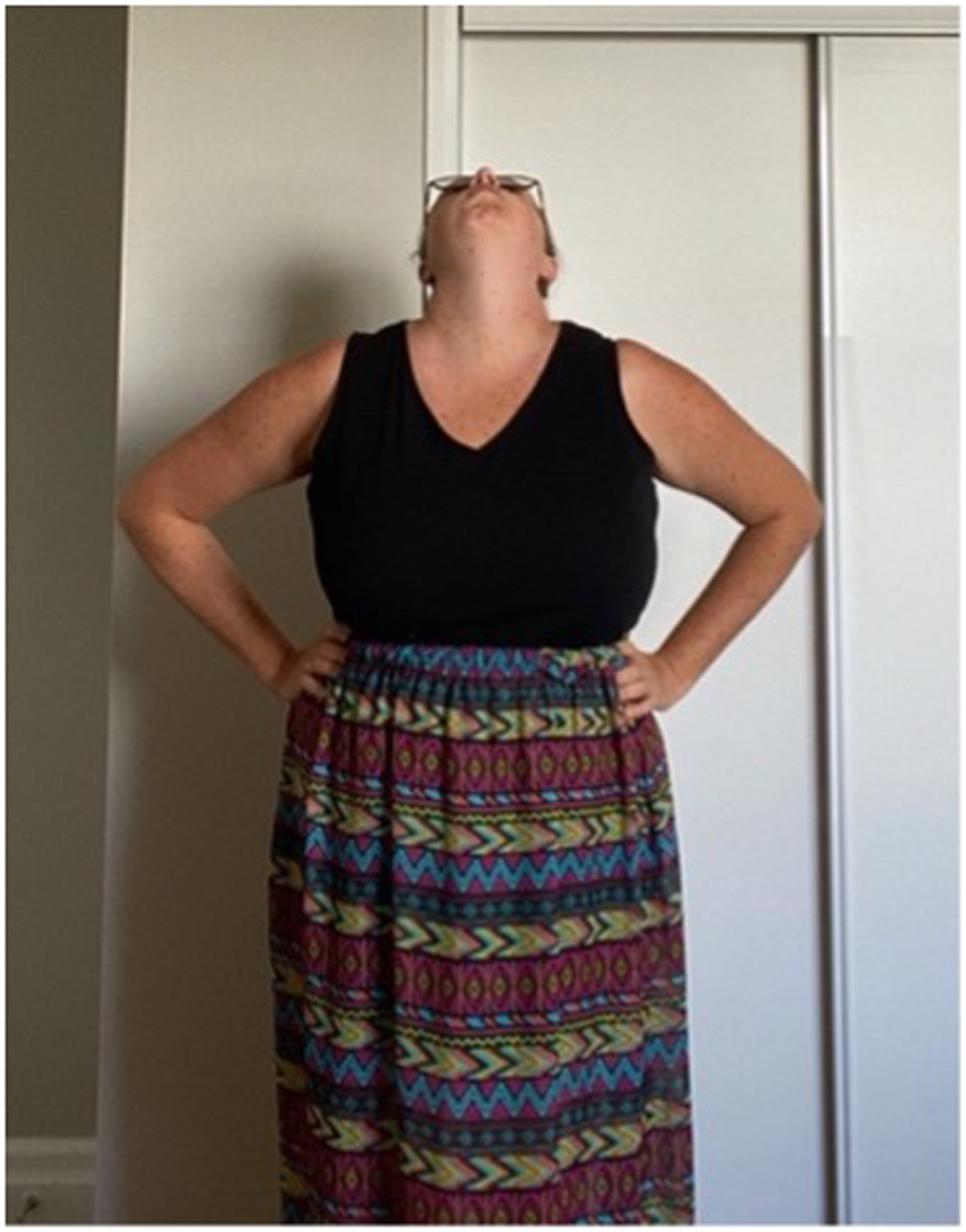
Image depicts the researcher looking up to the sky, exasperated, and with hands on her hips
How I Felt: I am impatient, frustrated. You nod, say to me “100%” over and over but I don’t think anything that I said sunk in. I don’t even know if you heard it. I want to sigh. I feel tired. I am worried for the kids that you see and what you say to them. And I feel worried that my attempts to challenge you didn’t work. They fell flat. I feel like maybe this is pointless? And I also feel guilt for feeling so frustrated and wanting to give up because if I feel this frustrated after a couple of hours with you as a white person, what is happening to the racialized kids you are meant to be supporting?
The frustration in both my body language and my writing is clear, as is my worry for the students she is working with. I pushed as hard as I felt I could have given the research context we were in, but I did not feel like I had made any meaningful impact. I ended the interview frustrated not only with her, but also with my own inability to move the needle on some of these issues.
Of course, a single conversation is not ever going to be enough to undo or transform these ways in which we all—white, Black, Indigenous, or racialized—are embedded within the historic and ongoing ideologies and systems of white supremacy and anti-Blackness. This tableau and my experiences with this participant and others, is a reminder that these tactics are not enough to challenge individual bias, let alone disrupt white supremacist structures in schools and social work. It is also a reminder that while individuals may actively support or attempt to disrupt these anti-Black and white supremacist systems and policies, the root of our critique and work must be with these larger systems which coerce and constrain our actions. This, too, was an important finding for the research study and I contextualized these individual reactions from social workers within larger systems and ideologies of education, trauma, and social work.
“I Would Like to Think”: Critical Skepticism of Self as White Researcher
A further learning came when unpacking the fact that several white female participants repetitively used the phrase “I would like to think,” when answering what they or their colleagues might do in response to vignettes. When I began asking participants about the phrase, often what would emerge were stories that contradicted what had just been said. The veil was often pulled off of an answer that had served to protect their own or their colleagues’ “goodness.” For example, Amy, a white participant, stated, “I would like to think that most social workers would work on connecting with the child.” I replied, “Right. And you said it in an interesting way. You said, ‘I would like to think’ this is what they’d do.” Amy then proceeded to talk about social workers who would not deescalate the situation or focus on the child, saying, “I’ve seen other people jump in and work to maintain the relationship with the teacher or the school, siding with them over the child.” In this reflection, Amy reveals the tension between the named core social work value of social justice, and how school social workers instead may act to protect the racist school system. When conducting the research, the literal phrase “I would like to think” was often a coded and perhaps gendered way of protecting whiteness, goodness, and social workers, even when the participant knew their answer did not reflect what happens in practice.
I also realized that I have my own ‘I would like to think.’ I would like to think that I am the feminist, good, exceptional white person who consistently acts in an anti-racist way. Yet this belief is in tension with the reality that I, too, protected whiteness in my interviews. For example, Hiker, a white participant, complained that racialized students claimed the school discipline practices were racist and they could not see how a white lady could help. I asked her,
Just to circle back to the first comment you made, which was that racialized students were saying there was a difference in how they were being disciplined and that racism might play a role. What was your assessment of that? Did you think that was true?
Hiker doubled down, denying that racial bias exists, blaming the racialized students, and claiming that a fair, universal metric was being applied to everyone. She concluded by saying, “So we had to wrestle with – ‘We’re not doing this because of your race or where you come from. This is the metric that we apply to everybody.’ Not everyone liked that. So we had to work with that.” I was appalled by the ways she ignored students’ experiences of racist discipline and framed the Special Education team and herself as the victims of these unfair claims. Yet, I was so focused on how this explicit denial of racism was providing strong data about how racialized students receive disproportionate punishment and are not supported by “trauma-informed” school social workers, I failed to critique or challenge her statements further. I simply replied, “Mm-hmm. Mm-hmm. Yeah. And does anything else about this first scenario come to mind that you think I need to know about?” After the interview, I created and wrote the following:
Tableau #1 Hiker: July 16th, 2020
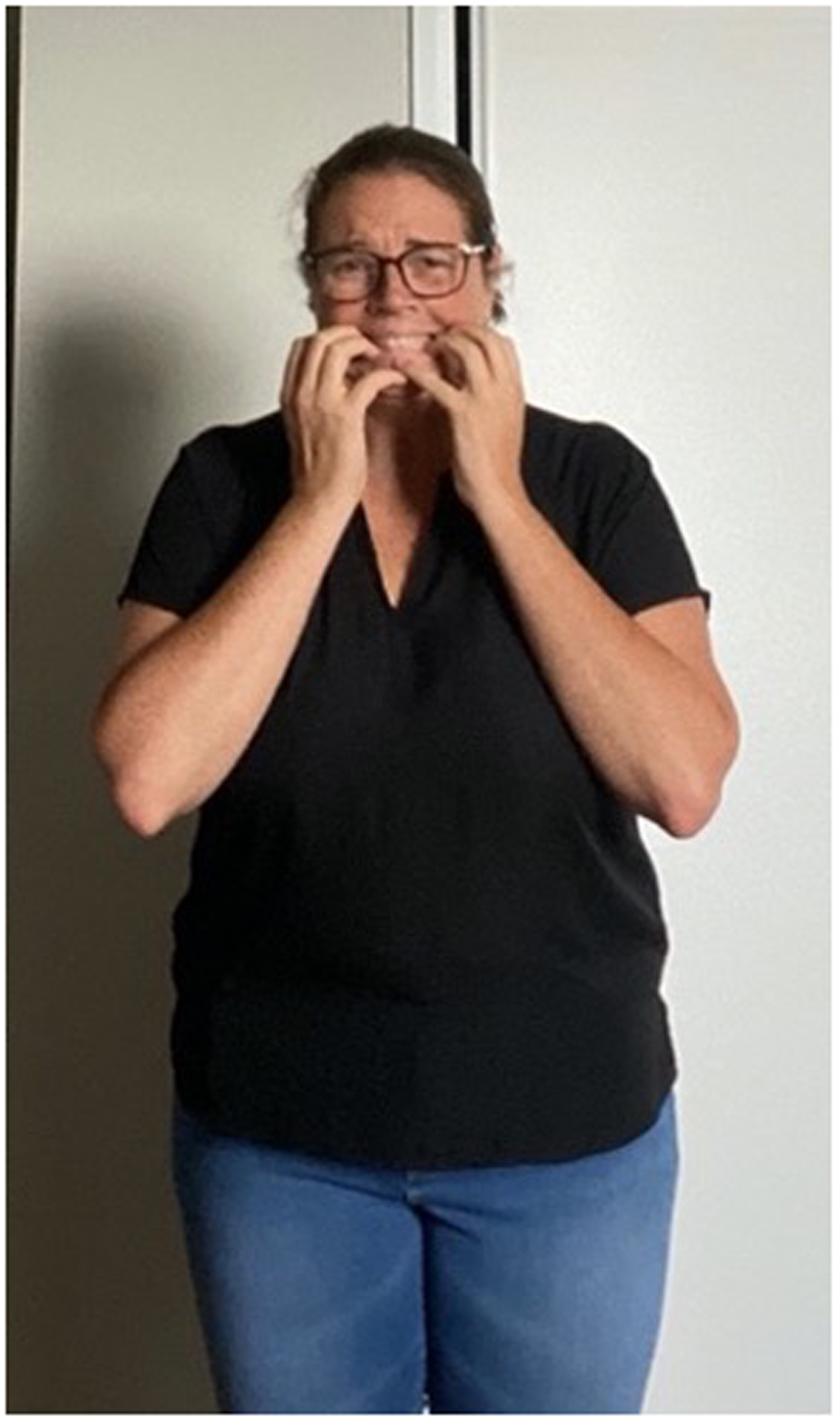
Image depicts the researcher with a worried look on her face and biting her fingernails on both hands.
How I Felt: I cringe about what is being said by you. And I cringe about what isn’t being said by me. I feel tension around some of my inaction. I can feel in my jaw, teeth gritted, clenched down. I don’t feel great about my role in this interview […] I am worried about the ways you might weaponize your whiteness in the world. I’m worried that I just nodded and told you: “uh huh.”
In this example and others, my failure to act may not only have maintained whiteness but may have strengthened it by unintentionally appearing to support their stance and actions (for reflections on how silence affirms racist beliefs, see Foste, 2020; Hurd, 1998). When I noticed failures like these, I felt like I was an imposter for doing this research.
Furthermore, when pressing play on the interview tape, I was struck by my own parallel process. I was listening from the state that “I would like to think” I am doing anti-racist data collection in a “good” and consistent way. When I played the tapes and heard participants say very problematic things, I often had no memory of whether I challenged the person’s racism. While waiting and listening for my own reaction during the interview, I was often awash with anxiety and an internal monologue of “Oh no, please, please, please let me have said something.” Even though, more often than not, I did attempt to intervene, it was clear that I did not trust myself to have done so. I wrote,
Memo August 27, 2020: This is pathetic. I’m literally sitting on my hands listening to this tape, praying that I say something. If I can’t even trust myself to interrupt racism, what right do I have to do research on whiteness and anti-Black racism? What right do I have to critique their work in schools?
When I first began reflecting on this, I felt ashamed, stuck, and unable to engage in action.
By spending time in reflection and theorizing, however, I began to realize that this lack of certainty about my actions was useful. If I had felt certainty, I would have been buying into the delusion that my work is complete. As Howard (2004) writes, I suggest that it is vitally important that racially dominant bodies that would take up anti-racist work and live out oppositional whiteness realize that their choice to do so does not stop the privilege of whiteness from converging upon their bodies, nor does it guarantee that they have escaped the looming possibility that whiteness will find expression through their bodies and work. (p. 75)
Deliovsky (2017) implores us to engage in data analysis from a stance of critical skepticism because many white participants will answer in a way to make them look “good.” I believe Deliovsky’s conceptualization ought to be extended; for those of us who are white social work researchers, our ethical responsibility is to also examine our own work with critical skepticism. 3 We ought not to fall into a kind of binary carceral and white supremacist logic that perpetuates the idea that there is a clear division between those who are good and those who are bad, or those who are critical social workers and those who are not.
What this study has helped me understand is that we should not trust that we will consistently act in anti-racist ways when conducting research (or, for that matter, when engaging in social work practice). In fact, we should be honest that this will not happen, and be actively watching for these moments of failure. As Thompson (2003) reminds us, “There is no such thing as racial innocence, only racial responsibility and irresponsibility” (p. 3). This honesty encouraged me to listen to the interviews more carefully and humbly invite myself to really trying to hear when I missed something or reinforced whiteness. This stance also allowed me to experience these misses more holistically—to feel my body cringe, nausea in my stomach, hotness on my cheeks—without rushing so fast to hide, minimize, or defend. Instead, I tried to view these reactions as embodied opportunities to learn from my failings and to strive towards greater accountability.
Towards an Anti-Racist Research Praxis
I believe that Ahmed’s (2004) call for a double-turn where white people do not absolve themselves from racism, might also be interpreted as a call to act differently while remaining implicated in what we critique. When trying to write these methodological findings, I reflected, Memo July 13, 2021: So what do I do with these learnings as a white researcher? In an interview on the podcast Finding Our Way (Hemphill, 2021), abolitionist Mariame Kabe talked about how part of carceral culture is seeing people as good or bad. I also think it is part of whiteness. She described how she is actively moving away from trying to be
I believe one of our responsibilities in social work is to reject these kinds of binary carceral logics, where we increase our capacity to hold multiple truths about ourselves and others and commit ourselves to continue attempting to act differently to challenge these systems we have inherited. Similarly, Freire (1972) wrote about how we have a responsibility to move these learnings into action. These processes of reflection, theory, and action function as a cycle he called praxis, defined as “reflection and action upon the world in order to transform it” (Freire, 1972, p. 52). I believe this intentional and iterative process of interviewing; creating critically self-reflexive art and writing; connecting what I was noticing to the theory; and engaging in another attempt to act differently by centering relational accountability and reckoning with my own whiteness as a researcher serves as a feminist experiment in anti-racist research praxis.
This experiment with an anti-racist research praxis during data collection was a way to practice confronting and challenging embedded norms of colonial, white, and patriarchal research. Rather than simply asking the questions from my interview guide and listening to whatever answer I received, I worked to be more explicit and honest with participants about my own identity, politics, and relationship to the topic I was researching. Rather than clinging to the colonial myth that “good” researchers are, or even can be, neutral, I embraced a feminist, anti-racist, and decolonizing research stance where relationships, accountability, and ethical responsibility are central. This provided opportunities for challenging racism and whiteness, critical dialogue, and building trust with many of the racialized participants. Furthermore, using the arts and writing allowed me to be more honest with myself about my relationship to whiteness through embodied and creative opportunities to reflect, theorize, and practice differently. As explored above, these creative, iterative processes helped me embrace a critical skepticism towards myself as a white social work researcher and encouraged me to try to do better. While beyond the scope of this article, I could imagine that similar forms of anti-racist praxis might extend beyond research and be used in social work practice to regularly reflect upon and to challenge whiteness and racism when espoused by clients and communities during direct service, with colleagues across disciplines, and in the process of policymaking.
My experience of this process was that it both strengthened and deepened the data that were generated and provided opportunities for me to have conversations with participants about views, practices, and policies that might uphold racism; however, it is important to note that this is only based on my own views of these actions. Limitations of this proposed anti-racist research praxis include the lack of: formal inquiry about participants’ experience of generating data in this way, evaluating the short- or long-term impacts of these decisions on participants’ views or behaviors, or comparing the use of these strategies to any other form. Future research in these areas would deepen our understanding of whether the critical lens and strategies are being used in meaningful ways by other researchers and what impact this process might have on our research design and with our participants.
Last, to be clear, I do not think that the arts-based methods of self-reflexivity nor tactics for interrupting whiteness articulated in this article are the “right” ways. They are simply strategies I used for creating a structured process for anti-racist accountability, thinking deeply about the ethical issues that were arising during data collection, and inviting me to pay attention to my own role in protecting whiteness. My hope is that by offering examples of my imperfect practices, other social work researchers will be inspired to develop their own anti-racist research praxis and study and write about their experiences.
Footnotes
Acknowledgments
I want to thank my advisor Dr Shoshana Pollack; committee members Drs Philip Howard, Maurice Stevens, and Cheryl-Anne Cait; and my examiners Drs Tanya Sharpe and Carolyn FitzGerald for their feedback and guidance on this dissertation study. I also want to acknowledge Jessica Hutchison, Giselle Dias, Heather Stuart, and the editors and reviewers at Affilia who helped to strengthen the ideas in this work. My doctoral studies were funded by the Canadian Social Sciences and Humanities Research Council and Ontario Graduate Scholarship Program.
Declaration of Conflicting Interests
The author declared no potential conflicts of interest with respect to the research, authorship, and/or publication of this article.
Funding
The author received no financial support for the research, authorship, and/or publication of this article.
