




Abstract
The purpose of the study presented here was to examine whether a measure of femininity ideology, normed on largely white, middle-class samples of adolescent girls, could be verified among a sample of low-income Latina adolescents. The results revealed that the previously identified factor structure could not be confirmed for this sample, which brings the scales’ validity for use with low-income, Latina samples into question. These findings suggest that minority girls may interpret femininity ideologies differently than do white, middle-class girls and underscore the importance of examining the validity of measurement tools for use with diverse populations. They emphasize that improving measurement for diverse populations is needed to develop culturally responsive and relevant intervention strategies.
Feminist theory argues that female development is situated in a sociocultural environment that promotes rigid adherence to patriarchal societal and cultural norms (see e.g., Miller & Scholnick, 2000). As a result, girls and women experience a loss of voice and power in personal relationships and develop an objectified relationship with their bodies (Brown, 1998; Brown & Gilligan, 1992; Impett, Schooler, & Tolman, 2006; Tolman, Impett, Tracy, & Michael, 2006). Feminist theory also contends that gender is a significant individual characteristic that interacts with other characteristics (such as race and class) to structure relationships within society—between individuals and groups (Rosser & Miller, 2000). However, the experiences of Latina adolescent girls have largely been absent from research on the ways in which girls negotiate feminine norms (Denner & Dunbar, 2004; Raffaelli & Ontai, 2004). One important mechanism for understanding how girls negotiate these norms is through developing valid measurement tools. The purpose of the study presented here was to examine whether a measure of femininity ideology, normed on largely white, middle-class samples of adolescent girls, could be verified among a sample of low-income, Latina adolescents, measured through the feminist development framework.
The Feminist Development Framework
The feminist developmental framework describes the ways in which girls’ development is affected by, and responds to, patriarchal societal and cultural norms (Impett et al., 2006). It suggests that in a patriarchal society, many girls experience pressure to behave in “feminine” ways in their relationships with others—by avoiding conflict, suppressing anger, and behaving nicely versus assertively—and in their relationships with their bodies—by managing their bodies to conform to predominant standards of beauty and attractiveness (Impett et al., 2006; Tolman et al., 2006).
The feminist developmental framework suggests that, for a girl, the experience and development of the self is integrally connected to her personal relationships and is largely based on her ability to maintain these relationships (Impett et al., 2006). One way in which girls may attempt to preserve relationships is to silence their authentic thoughts, needs, and feelings, particularly as a strategy to reduce conflict and avoid the expression of anger (Impett et al., 2006). The construct, inauthenticity in relationships (Tolman & Porche, 2000), is realized when girls conceal their true thoughts and feelings, especially those seen as unfeminine, such as anger (Impett et al., 2006).
The feminist developmental framework proposes that learning to live in a female body is a critical developmental aspect of adolescence, particularly with the onset of puberty occurring during this stage of development. The experience of the body for girls, according to this framework, is greatly affected by societal and cultural norms about the commodification and objectification of the female form (Impett et al., 2006; Tolman & Porche, 2000), which may result in a preoccupation with one’s own body, whereby girls and women constantly survey and evaluate their physical appearance. This preoccupation, in turn, may create a disembodying experience in which one’s body becomes an object rather than the subject of a person’s experiences (Tolman & Porche, 2000). This process can be described as having an objectified relationship with one’s own body and is realized through the disassociation with the body and the performance of feminine or “ladylike” physical movements (Impett et al., 2006).
In previous studies, the feminist development framework has been applied to the study of sexual and mental health through the Adolescent Femininity Ideology scale (AFIS), which measures the inauthentic self in relationships with others and the objectified relationship with one’s own body. Tolman, Impett, Tracy, and Michael (2006) investigated the relationship between femininity ideologies and mental health outcomes among a sample of eighth-grade girls. They found that a greater internalization of norms of femininity was associated with lower self-esteem and higher rates of depression. Impett, Schooler, and Tolman (2006) examined how the degree of internalization of femininity ideologies affected sexual self-efficacy among a sample of 12th-grade girls. Their findings suggested that greater internalization of these norms was related to poorer sexual self-efficacy, which, in turn, predicted less use of protection.
Reliability and construct, discriminant and concurrent validity, were established initially for the AFIS by Tolman and Porche (2000) among a sample of 192 girls, ranging in age from 10 to 22 with an average age of 14. The initial scale included 10 questions on each subscale: inauthenticity in relationships and body objectification. A confirmatory factor analysis (CFA), conducted by Tolman et al. (2006), found a good model fit. Although the diversity found in each study using the AFIS is far more than is typically seen in measurement validation studies, the samples still contained a large number of white and middle-class girls. Research has suggested that unique gender socialization practices are found within Latino families (e.g., Kasturirangan & Williams, 2003; Raffaelli & Ontai, 2004; Rodríguez, 2003). Thus, it is important to verify the AFIS on a predominantly low-income, Latina sample to determine whether it is a culturally relevant and appropriate measurement tool for this population.
Gender Socialization Practices Among Latino Families
Distinct socialization patterns have been found to occur within Latino families that tend to promote rigid adherence to traditional gender roles (Kasturirangan & Williams, 2003; Raffaelli & Ontai, 2004; Rodríguez, 2003). For example, Rodríguez (2003) noted that Latin American cultures commonly mark socialization practices by gender. That is, many Latino families promote different messages to girls and boys. For girls, they tend to endorse increased family supervision and protection through childhood and adolescence, whereas, boys are encouraged to explore “the world of work, romance, politics and so forth” (Rodríguez, 2003, p. 34). Girls are often viewed as more physically and emotionally dependent and thus are raised with stricter rules that are believed to provide greater protection for them.
Furthermore, Raffaelli and Ontai (2004) discussed several cultural values that are commonly conveyed within Latino families, which are thought to affect the ways in which gender norms are communicated. Familismo emphasizes family relationships and places a strong value “on childbearing as an integral part of family life and the feminine gender role” (Raffaelli & Ontai, 2004, p. 288). Respeto refers to the value of respect and emphasizes the “hierarchy in social relationships” (Raffaelli & Ontai, 2004, p. 288). The combination of these cultural values bears particular significance for Latina girls because the values embody an idealized feminine gender role that involves being “submissive, chaste, and dependent” (Raffaelli & Ontai, 2004, p. 288). It is important to note, however, that significant variation exists across Latino families in how these cultural beliefs are communicated (Lac et al., 2011).
The degree of adherence to these culturally specific socialization practices is influenced by the immigrant status of the parents. On one hand, recently immigrated parents are more likely to promote rigid adherence to these values in an effort to protect daughters from “the negative influence of American street culture” (Rodríguez, 2003, p. 34). On the other hand, these cultural values are thought to weaken as acculturation progresses (Smokowski & Bacallao, 2006). Zayas, Gulbas, Fedoravicius, and Cabassa (2010) noted the challenges that many Latina adolescents experience as they attempt to negotiate two cultures that promote different values. Specifically, traditional Latino family values endorse family, interdependence, and loyalty over individuality and independence, which are common mainstream values in the United States. Furthermore, although the cultural paradigm of machismo has been thought to have weakened to some degree, an emphasis on male domination and female subordination can still be found in many Latino families. Modern feminism in the United States has sought to weaken traditional gender roles and to promote images of strength and assertiveness, which are in direct opposition to the gender norms that are commonly found in traditional Latino families. The combination of these opposing cultural values leaves many Latina adolescents struggling to develop a sense of belonging in either culture (Zayas, Gulbas, Fedoravicius, & Cabassa, 2010).
Latina Girls’ Interpretation of Feminine Norms
Generally, studies on gender development have assumed that socialization into masculine or feminine roles occurs in a linear fashion and that these roles are defined by white, middle-class culture (Denner & Dunbar, 2004). That is, research on gender socialization has seldom focused on ethnic differences (Raffaelli & Ontai, 2004) despite a growing body of evidence on the experiences of Latino adolescents. This dearth of research limits our understanding of how girls from different social locations may experience gender socialization and the manner in which they may interpret and internalize such messages. The distinct socialization practices that are found in Latino families suggest that Latina adolescent girls may experience and interpret gender norms in unique ways, particularly as they negotiate norms from their families of origin and the mainstream U.S. culture. Accordingly, Latinas may engage in a complex process of interpreting and critiquing feminine ideologies that subsequently affects their performance of such norms. In fact, one qualitative study of Mexican American girls found that the participants viewed others as embracing “traditional gender expectations about how girls should behave, whereas they themselves engage in a complex critique and performance of femininities in relationships with their family, peers, and teachers” (Denner & Dunbar, 2004, p. 301).
Inauthentic Self in Relationships With Others
In an effort to understand how Latina adolescents experience the “loss of voice,” which has been theorized to be a part of girls’ development (e.g., Brown, 1998; Brown & Gilligan, 1992), Denner and Dunbar (2004) investigated how Mexican American adolescent girls experienced being a girl and their sense of power in personal relationships. Through qualitative interviews and surveys, the participants reported that “being a girl is associated with multiple, contradictory meanings” (p. 305) and that they perceived power within the context of relationships rather than within themselves. Thus, the girls in Denner and Dunbar’s study critiqued traditional feminine roles in their homes, school, and neighborhood, but also admitted that they moved in and out of performing these roles. Denner and Dunbar contended that “[i]n response to inconsistent messages from adults, the girls changed how they enacted femininities across contexts in order to negotiate in and around traditional cultural and gender role expectations with which they did not agree” (p. 310). Accordingly, the girls adopted “strategies to negotiate in and around socially and culturally embedded notions of femininity [to] create new roles to satisfy their own and others’ expectations about what it means to be a Mexican American girl in the U.S.” (p. 311).
Body Objectification
To date, no studies have explored body objectification specifically among Latina girls. However, several studies have examined body dissatisfaction and body image—related constructs—among Latino adolescents. For example, Nieri, Kulis, Keith, and Hurdle, 2005 suggested that poor body image among Latino boys and girls may result less from internalizing mainstream ideals of beauty than from attitudes and beliefs that devalue common features of the Latino appearance. Conversely, Rubin, Fitts, and Becker (2003, p. 49) found that both African American and Latina young women (aged 18) challenged ideals that narrowly characterize beauty by thinness and whiteness and instead adopted a “body ethic of self-acceptance and nurturance that reject[ed] mainstream cultural pressures to reshape bodies to approximate aesthetic ideals promulgated in the media.”
The Study
Purpose and Research Question
Research has suggested that gender norms among Latina girls are expressed and internalized differently than among white girls (Denner & Dunbar, 2004; Kasturirangan & Williams, 2003; Raffaelli & Ontai, 2004; Rodríguez, 2003; Rubin, Fitts, & Becker, 2003; Zayas et al., 2010). However, little research has examined differences in gender socialization and the internalization of feminine norms among samples of Latina adolescent girls. One important mechanism for understanding how girls interpret and internalize these norms is through the development of valid measurement tools. The purpose of the study presented here was to examine whether the AFIS can be verified using CFA among a sample of low-income, Latina adolescents. The primary research question guiding the investigation was this: Can the factor structure of the AFIS be confirmed among a sample of Latina adolescent girls, given the unique socialization practices commonly found in Latino families?
Participants
The sample for the study was 150 eighth-grade Latina girls from four middle schools in a large western city that were predominantly Latina and low income. A total of 472 girls were enrolled in the eighth grade in these four schools, of whom 338 identified as Latina (Colorado Department of Education, 2007). The consent rates ranged from 28% to 64% across schools, with an overall consent rate of 44%. Of the 155 girls (46%) who returned parental consent forms, the parents of 150 agreed to their participation in the study. The mean age of the girls was 13.5 years (SD = .81). Slightly more than 85% (n = 128) of the sample participated in free or reduced-lunch programs. Approximately 51% (n = 77) indicated that their mothers or female guardians did not complete high school (data on the mothers’ level of education were not available for the nonparticipating girls). The participants were similar to other girls in these four schools who did not participate in the study in regard to age, ethnicity, and participation in the free or reduced-priced lunch program.
Procedures
Data for the study came from a larger study that examined the relationships among femininity ideology, aggressive behavior, peer victimization, and self-concept. Human subjects approval was obtained for the larger study from both the sponsoring university and the school district. The sampling frame for this investigation included schools, stratified by geographic location in the city that had high rates of minority enrollment. Ten schools were identified within the district and contacted about the study’s purpose and logistics. Of the 10 targeted schools, 4, which represented three of the four geographic quadrants in the city, agreed to participate in the study. The principals of these schools indicated a willingness to coordinate the consent and data collection process and revealed a concern about aggressive behavior and victimization among their female students.
Parental consent forms were distributed to parents by the eighth-grade teachers in each participating middle school. Students who returned parental consent forms, regardless of their consent status, were entered into a drawing for a free iPod shuffle. Incentives ($15 gift cards) were offered to the teachers for their assistance in distributing and collecting the consent forms. Survey administration procedures varied across the schools since the principal of each school determined an appropriate class time during the day to administer the surveys. The girls whose parents consented to their participation were identified in each classroom and given an assent form to sign. Then, they completed a onetime, anonymous survey that included questions about demographic characteristics, femininity ideology, aggressive behavior, victimization, and self-concept.
Measures
Although the study’s measures were available to the participants in English and Spanish, all the participants chose to complete the English version of the survey instrument. Basic demographic information, including age and socioeconomic status (SES), was collected from the participants. SES was measured by a series of questions about participation in free and reduced-price lunch programs as well as the levels of their mothers’ education. The level of maternal education has often been used as a proxy measure of SES (Entwisle & Astone, 1994).
The AFIS was used to assess inauthentic self in relationships with others and objectified relationship with one’s body (Tolman et al., 2006; Tolman & Porche, 2000). A CFA that was previously performed (Tolman et al., 2006) revealed a good model fit after three questions were eliminated (χ2 = 1.32, p < .05; common fit index [CFI] = .91; root mean squared error approximation [RMSEA] = .04, standardized root mean square residual [SRMR] = .07). The final scales included nine questions that were used to assess inauthenticity in relationships and eight questions that were used to measure body objectification. Items were measured on a 6-point scale ranging from strongly agree to strongly disagree. Three items on the inauthentic self in relationships scale and 2 items from the objectified relationship with one’s body were reverse coded so that higher scores indicated a greater degree of internalization.
Analytic Strategy
CFA was used to validate the factor structure of the AFIS. The benefit of using CFA over other statistical techniques is its ability to model latent constructs and explore complex relationships among a set of indicators (Kline, 2005; Muthén, 2002). McDonald and Ho (2002) characterized a CFA measurement model as a set of observable variables with multiple indicators that measure a smaller set of latent variables. Each indicator is represented as having two causes: An underlying latent factor that the indicator is presumed to measure and an error term that captures all other unique sources of causation (Kline, 2005). The interpretation of the latent variable in CFA is determined specifically by the magnitude of the standardized factor loadings of each indicator on the latent variable (Palmer, Graham, Taylor, & Tatterson, 2002). The standardized factor loadings are then interpreted as the correlation between each indicator and the latent variable. Indicators with the highest standardized factor loadings or correlation with the factor define the meaning of the latent variable (Palmer et al., 2002). After removing items with low factor loadings and verifying an adequate model fit, one can identify a measurement model. Items were removed if the standardized factor loadings were below .32, as recommended by Comrey (1973) and Floyd and Widaman (1995) because these items are thought not to measure the latent variable adequately. Model fit was assessed using a combination of commonly used fit indexes: chi square (χ2), the CFI, and the RMSEA (McDonald & Ho, 2002). Higher chi-square values indicate a worse model fit (Kline, 2005). A CFI value above .900 is typically considered an adequate fit (McDonald & Ho, 2002). Typically, an RMSEA of .05 or less indicates a close fit of the model, whereas a value between .05 and .08 is considered an acceptable fit (McDonald & Ho, 2002).
Results
The CFA models for each subscale were analyzed using MPlus version 5.1 Base Program software (Muthén & Muthén, 2008) and estimated using maximum likelihood estimation. First, the inauthentic self in relationships with others subscale was estimated. Second, the objectified relationship with one’s own body was estimated in a separate model. Means, standard deviations, and standardized factor loadings for all the items are reported in Table 1.
Descriptive Statistics and Standardized Factor Loadings for the Femininity Ideology Subscales
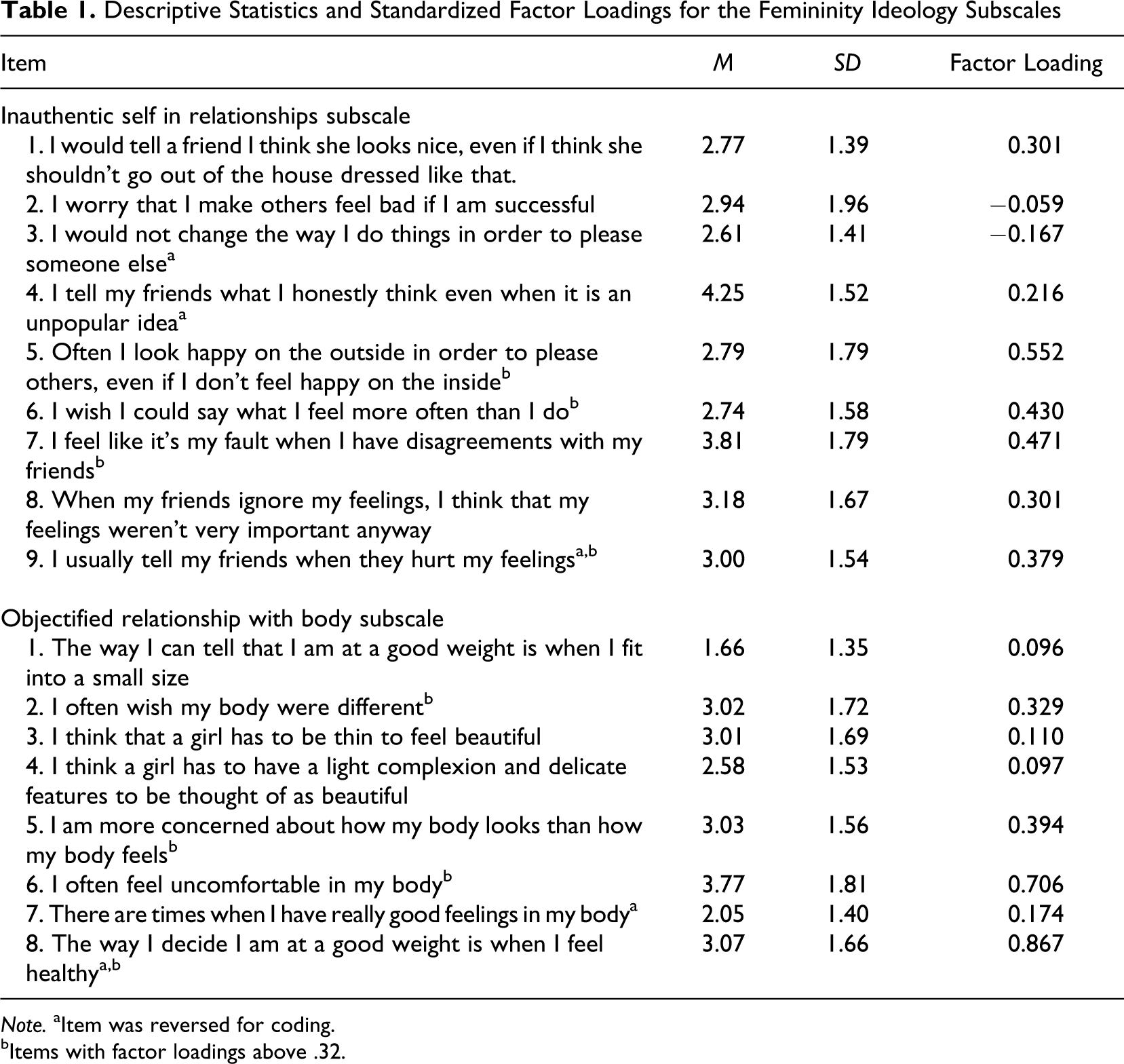
Note. aItem was reversed for coding.
bItems with factor loadings above .32.
The CFA results for the 9-item inauthenticity subscale indicated a poor model fit (χ2 = 62.27, p = < .001; CFI = .572; RMSEA = .093, confidence interval [CI: 0.063, 0.124]). Similarly, the 8-item body objectification subscale demonstrated a poor model fit (χ2 = 55.773, p = < .001; CFI = .744; RMSEA = .109, CI [0.076, 0.144]). This poor model fit is most likely the result of low-standardized factor loadings for many of the subscale questions. In fact, 2 items were negatively correlated with the inauthenticity factor. Applying the standard recommended by Comrey (1973) and Floyd and Widaman (1995), items with factor loadings below .32 were removed. For the inauthenticity subscale, 5 items were removed, and for the body objectification subscale, 4 items were removed.
Items with the highest factor loadings are thought to define the factor (Palmer et al., 2002). The item with the highest factor loading (.552) on the inauthenticity scale was “Often I look happy on the outside in order to please others, even if I don’t feel happy on the inside,” followed by “I feel like it’s my fault when I have disagreements with my friends” (.471). On the body objectification scale, the highest factor loading (.867) was found for “The way I decide I am at a good weight is when I feel healthy,” which was reverse coded to correspond with greater internalization of a negative convention of femininity. The second highest factor loading on this subscale (.706) was “I often feel uncomfortable in my body.”
Reliability for each subscale was estimated by examining the internal consistency as measured by Cronbach’s α (Cronbach, 1951) for the full scales and the modified scales. For the 9-item inauthenticity scale, the Cronbach’s α was .46. After all the low-loading items were removed, the scale’s reliability with 4 items remained low (Cronbach’s α = .52). The Cronbach’s α for the 8-item body objectification subscale was .57; the α for the 4-item scale was .66.
Discussion
The study sought to verify the factor structure of the AFIS among a sample of Latina adolescent girls. The results revealed that more than half the questions on the inauthenticity subscale and half the questions on the objectification subscale had to be removed because of low factor loadings. The previously identified factor structure was not confirmed on this sample, which, therefore, brings the scales’ validity for use with low-income, Latina samples into question. Furthermore, final Cronbach’s αs would be considered inadequate by most standards. For example, Nunnally (1994) suggested that reliability estimates greater than or equal to .70 can be considered acceptable. In my study, the reliability estimates did not exceed this recommended threshold for either subscale.
Complementary to the findings reported by Denner and Dunbar (2004) and Rubin et al. (2003), the results of this study suggest that Latina girls may experience gender socialization in unique ways that influence how they interpret and negotiate feminine ideologies. As a result, the femininity ideologies assessed by the AFIS may not accurately capture the experiences of low-income, Latina adolescent girls. Although traditional gender roles are commonly communicated within Latino families (Kasturirangan & Williams, 2003; Raffaelli & Ontai, 2004; Rodríguez, 2003), Latina girls may find themselves engaging in a more active and complex critique and performance of femininity in their relationships with others (Denner & Dunbar, 2004) and in their relationships with their own bodies (Rubin et al., 2003). It is possible that the femininity ideologies assessed by the AFIS represent a linear process of gender socialization that is defined by white, middle-class values. Thus, the AFIS may not adequately assess the ways in which Latina adolescents experience gender socialization and subsequently interpret and enact traditional feminine roles.
As Denner and Dunbar (2004) and Rubin et al. (2003) suggested, Latinas may challenge mainstream cultural beliefs about femininity and may instead create their own unique interpretations of these ideologies that the AFIS does not capture. In fact, evidence suggests that Latina adolescent girls “actively resist simplistic gender stereotypes” and instead may move in and out of certain feminine roles on the basis of their desired outcome for the specific situation and the relationships that are involved (Denner & Dunbar, 2004, p. 311). In this sense, Latinas do not passively enact femininity ideologies but, rather, engage in a complex critique and performance of feminine roles that are spurred by the adoption of certain strategies to negotiate these norms. It has been suggested that Latinas may use certain strategies that liberate them from traditional gender roles by questioning and resisting a single definition of feminine ideologies (Brown, 1998) through speaking out or shifting identities (Denner & Dunbar, 2004). A consideration of strategies that girls use to negotiate traditional feminine norms offers an important “perspective that views girls as active constructors and reconstructors of their own changing femininities rather than as passive recipients of family, school, and community gender role socialization” (Denner & Dunbar, 2004, p. 303). Latinas, particularly because of their exposure to potentially conflicting and contradictory cultural beliefs, may critique gender norms differently than do their white counterparts. Thus, this critique may shape how Latina girls interact with mainstream beliefs about femininity and with culturally specific values about traditional gender norms. Accordingly, Latina girls may construct their own unique interpretations that inform the performance of such norms.
The results of the study underscore the influence of culture on the ways in which the body is experienced, relationships with others are negotiated, and mainstream values are interpreted. Specifically, these findings suggest that low-income, Latina adolescent girls may interpret femininity ideologies differently from their white, middle-class counterparts. Therefore, the AFIS may not be an appropriate scale to use to gauge the experiences of Latina adolescent girls accurately. We cannot assume that gender norms are interpreted and internalized similarly across different cultures. Further study is necessary to identify the unique ways in which gender norms are communicated and subsequently internalized by diverse populations of girls. After such study, valid and reliable measurement tools must be developed.
Implications for Social Work
To develop culturally responsive and relevant intervention strategies, we must be able accurately to assess the experiences of diverse populations by using valid and reliable measurement tools. The findings of this study underscore the importance of examining the validity of measurement tools that are normed on largely white, middle-class samples for use with diverse populations. The participants in this study appeared to interpret femininity ideologies differently than did previous samples for which the AFIS was used. This finding highlights the need to be mindful of cultural differences in the ways in which gender norms are communicated within families and subsequently negotiated by Latina adolescents when working in clinical and school social work settings. As practitioners, we must be sensitive to these complex, cultural dynamics because they may affect issues, such as eating disorders, sexual behavior, and aggression, and how such issues should be addressed for diverse populations.
Limitations
A significant methodological limitation of the study was the selection biases with the participants. Consent rates varied considerably across the schools. It is possible that the students who returned their consent forms may have differed from the students who chose not to return their forms. Furthermore, the study was limited to eighth-grade girls. Younger and older girls may interpret and negotiate femininity ideologies differently. These selection biases affect the generalizability of the findings beyond the participants.
An important feature not assessed, and therefore a significant limitation of the study, was the level of acculturation of the participants. A related feature that was also not measured was the parents’ immigrant status. Both variables have been found to influence the ways in which gender norms are constructed and communicated within Latino families and subsequently the ways in which Latina girls interpret them (Rodríguez, 2003; Smokowski & Bacallao, 2006; Zayas et al., 2010). Another limitation was that the girls did not indicate their cultural heritage beyond the broad ethnic category of Latina. It is likely that gender socialization practices may differ across Latino populations, depending on their families’ country of origin (Lac et al., 2011). Future research should examine the ways in which gender norms differ and therefore are interpreted by diverse Latino populations.
Furthermore, it will be important to examine differences across various income levels of Latina adolescents to determine whether girls from higher-income brackets experience gender socialization differently from their lower-income counterparts. Prior research has noted that other factors, such as SES, are also associated with immigrants’ generational status, which suggests that acculturation may “occur unevenly across immigrant generations and does not exclude the possibility of biculturalism” (Peña et al., 2008, p. 300). Future research must take into consideration the impact that SES and the generational status of girls and their parents may have on how Latinas experience gender socialization and negotiate norms from multiple cultures.
Conclusion
The results of this study underscore not only the importance of examining the validity of measurement tools that are normed on largely white, middle-class samples for use with diverse populations but also the need to identify the unique ways in which gender norms are communicated within families and negotiated by Latina adolescent girls. Previous research on the ways in which girls negotiate feminine norms has largely excluded the experiences of Latina adolescents (Denner & Dunbar, 2004; Raffaelli & Ontai, 2004). Yet, the findings of this study support prior studies that have suggested that Latina girls express and internalize gender norms differently than do white, middle-class girls (Denner & Dunbar, 2004; Kasturirangan & Williams, 2003; Raffaelli & Ontai, 2004; Rodríguez, 2003; Zayas et al., 2010).
To intervene in a culturally responsive way in clinical and school social work settings, we must be mindful of these complex cultural dynamics because they may have an impact on how a variety of issues manifest and should be addressed for diverse populations. Furthermore, by creating valid and reliable measurement tools that are derived from these unique cultural experiences, we will be better positioned to develop culturally responsive and relevant intervention strategies.
Footnotes
Acknowledgments
The author thanks the Graduate School of Social Work at the University of Denver for its generous support of the study reported in this article.
The author declared no potential conflicts of interest with respect to the research, authorship, and/or publication of this article.
The author received no financial support for the research, authorship, and/or publication of this article.