




Abstract
This article revisits the concept of empowerment that has underpinned the global movement to address gendered violence. Using a critical praxis lens, the article explores different understandings of empowerment that arose in interviews with front-line domestic violence workers who support refugee and migrant women experiencing gendered violence in Queensland, Australia. Two-thirds of the participants are from refugee and migrant backgrounds themselves. The findings reflect the shift in the service sector from more macro understandings of empowerment, grounded in feminist activism, to more micro understandings. In a context of neoliberal, bureaucratic service delivery, and limited means to address gendered violence that focus on women leaving and legal interventions, empowerment is sometimes viewed in individualistic, therapeutic terms of self-help. There is evidence that domestic violence services, founded on theories of empowerment, are now implicated in the surveillance and risk tracking role of social work as a profession, which has implications for survivor centeredness, agency, and equal participation. However, there is also evidence that front-line workers are aware of structural failings and questioning individualistic conceptions of empowerment amid broader concerns of social justice. Empowerment is viewed as transformative, with possibilities for more collective models aimed at addressing social justice. Outlining implications for feminist scholarship and practice, I suggest empowerment might be revisited by considering the differences between and within groups; structural violence and the consequences of interventions for marginalized groups; collective strategies aimed at broader structural change, such as poverty and race; and by strengthening the capacity of communities to respond to violence.
Some people really hate the word empower. I think it's not a [refugee]-friendly word because [refugee] women do not like to feel empowered. They like to feel–in control of their own destiny. (Zahra 1 , interview participant)
Zahra is a front-line worker who participated in my PhD research, exploring responses in the human services 2 to the issue of domestic violence 3 (DV) and refugees in Australia. The research grew out of my own observations while working in refugee resettlement and DV organizations that refugee women often fall between mainstream DV organizations that do not sufficiently consider potential cultural difference or structural vulnerability, and refugee resettlement organizations that are not designed to deal with DV. Seeking to understand this erasure of refugee women from Australian gendered violence (GV) policy and front-line service delivery, the research questions explored the practical implementation of an intersectional framework: (1) What frameworks, knowledge, experience and skills inform the practice of service providers in relation to DV? (2) How do service providers understand culture, gender, ethnicity and class? (3) What are the broader structural influences on understanding and implementing an intersectional framework? The workers who participated in this research (n = 31) came from mainstream DV organizations, refugee resettlement organizations, and migrant-specific organizations who support women experiencing violence. Two-thirds of the participants (n = 20) are from refugee and migrant backgrounds themselves.
In this paper, I focus on one theme that arose in the data—“what is empowerment?” Empowerment is a contested concept that is used in many different ways and to fulfill diverse agendas (Forde & Lynch, 2015). Human service workers in this study often discussed empowerment as underpinning their practice, yet there were different understandings and uses of the term. Sometimes, as in the case of Zahra, empowerment was a deliberate term reflecting on women's “destiny” in terms of agency and self-determination, the lived experiences and realities of refugee's women's lives and broader structural inequalities, such as race, that looked beyond gender as a problem (or a solution) (Collins, 2002). Often, however, particularly in the mainstream context of professionalized services (MacDowell, 2019), empowerment emerged as an empty signifier, open to the interpretations of workers.
Using a critical praxis lens, I explore these different narratives of empowerment with the aim of moving from individualistic notions of empowerment to more collective strategies aimed at addressing GV. Goodkind et al. (2021) define praxis as “a core feminist tenet in which theory and practice are understood as inextricably linked. Our theories about how the world works, whether articulated or not, undergird our actions; therefore, being intentional about the theories on which we base our practice is important” (p. 483). I go on to discuss critical praxis in greater detail, as well as my own reflexivity and positionality in methodology. However, I would like to position myself early on, as the researcher and author of this paper, as a white-settler, cis-gender, heterosexual women. I worked in the human services for 15 years, mostly in refugee resettlement and mainstream DV organizations. Building on my work experience, my research has a particular interest in critical praxis, focusing on strategies addressing GV at the level of policy, advocacy and front-line service delivery. I am particularly interested in examining the inclusion and exclusion of marginalized groups from mainstream systems and institutions, and exploring what can be done differently to address social inequalities.
This article provides one example of how critical praxis might be utilized to explore new ways of addressing GV, in front-line policy and service work, as an issue of social justice that considers multiple, intersecting inequalities. I start by locating this paper in the Australian service context and outline my contribution to the literature. I then give a brief overview of the literature on empowerment, “feminisms,” and critical praxis; present methodology; and the findings. I conclude with a brief discussion, and outline the implications of these findings for feminist social work policy and practice.
Refugees, Empowerment, and the Human Services
In Australia, refugees who come under the Humanitarian Program 4 are subject to the same interventions for GV available to all Australians, regardless of race, ethnicity, or even class status. While there might be some nuances regarding “culturally specific” support, even refugee resettlement organizations are guided by the same mainstream interventions determined by federal and state GV policy and laws. Drawing on interview data from my research, I show that front-line organizations claim empowerment models as offering choice and agency to the women they support. However, in addition to poorly defined and under-theorized concepts of empowerment, the choices and resources available to women are increasingly limited. Women seeking help for DV are now often met with similar sets of choices guided by the same general set of values, beliefs, and practices that form the dominant discourse of the GV movement in most western countries (Kasturirangan, 2008; Mehrotra et al., 2016; Mellaard & Meijl., 2021; see also Vaughan et al., 2015, for an Australian context specific to refugees). Centered on gender equality, and often focusing on legal interventions and individualistic notions of breaking up the family (Merry, 2011; Ong, 2003), it is not difficult to see why many women—let alone refugee and migrant women, or even workers supporting them—might find these choices disempowering (Kasturirangan, 2008; Mellaard et al., 2021).
Despite the steady flow of refugees resettled in western countries such as Australia since the 1970s, there remains limited scholarship on empowerment and refugee women experiencing GV in resettlement countries. Researchers have investigated the concept of empowerment in refugee resettlement organizations, focusing on refugees in neoliberal terms of success as economically self-sufficient, autonomous rights-bearing subjects (Correa-Velez et al., 2017; Dykstra-DeVette, 2018); however, these studies have not been gender-specific. Much of the scholarship on empowerment and refugee women has taken place in refugee camps, examining the practices of humanitarian aid and development workers (Fiddian-Qasmiyeh, 2010; Grabska, 2011). Regarding GV, and gender equality, there has been significant literature on interventions with women in the Global South (Baines, 2017; Olivius, 2014), as well as scholarship both on and from women of color and their efforts to, as Roy (2017) suggests, “disrupt the will to empower.” Rather than envisioning empowerment as individual autonomy and control, Cruikshank (1999) theorized “the will to empower” as a means of governance where subjects are made, through certain technologies of citizenship, to reflect and achieve the agendas of governments, social movements, and welfare organizations.
What I add to this literature are the perspectives of front-line workers supporting refugee women experiencing GV in resettlement. Through the accounts of front-line workers, and varying references to and understandings of empowerment, the realities of refugee women's lives and the structural limitations of individualistic interventions to address GV become apparent. Also apparent is the potential that greater attention to empowerment at the site of praxis can facilitate more conscientious strategies aimed at addressing broader conceptions of GV as social justice. Referencing Freire (1970), Carr (2003) says that “praxis is essential to the process of empowerment because empowering action is bolstered by critical reflection and reflection necessarily leads to action” (p. 13).
Empowerment, “Feminisms,” and Critical Praxis
Cornwall and Rivas (2015) contend that interventions addressing women's inequality continue to use “old language,” such as empowerment and gender equality, with little regard for the origins of these terms or their contemporary uses. Narratives of empowerment emerged out of the feminist movements in the 1980s and 1990s. While there were also different feminisms emerging at this time, and thus different positions and strategies aiming to address women's inequality, strategies that espoused empowerment were most often linked to liberal, second-wave feminism (Cornwall & Rivas, 2015; McFadden, 2010). Liberal feminist ideals of empowerment centered on gender equality, seeking to rectify women's economic and political participation to address social inequalities (Halley, 2006; Squires, 2013). Women of color scholars challenged mainstream, liberal ideals of empowerment and gender equality as being inherently individualistic, and promoted more community-driven, transformative approaches that challenged systemic power relations and inequalities (Collins, 2002; Crenshaw, 1990; Mohanty, 1988).
With the institutionalization of gender equality as a strategy of “add women and stir,” mainstream concepts of empowerment were mobilized as part of the transnational campaign to address women's inequalities (Squires, 2013). Empowerment as a term was particularly successful in taking liberal feminist ideals into the Global South (Baines, 2017; Merry, 2011). A focus on human rights in countries in Africa, the Middle East, and Asia brought interventions by liberal, second-wave feminists wanting to “save” poor, oppressed, and backwards women (Mohanty, 1988). The rhetoric of rights highlighted and exoticized certain forms of violence, such as female genital mutilation, honor killings, and child marriage (Merry, 2011; Mohanty, 2005). Interventions in the Global South, under the pretence of empowerment, human rights and development, have also seen the production and mobilization of knowledge by women's movements across the globe, addressing the ongoing tensions between feminist theory and practice (Ahmed, 2013; DeKoven, 2001; Mohanty, 2005). This scholarship provides key theoretical underpinnings to draw on for my investigation into front-line service delivery for refugee and migrant women in Australia, assisting to explain some of the different understandings and positions on contemporary uses of the term empowerment.
Some scholarship suggests that feminism has been co-opted by neoliberalism and that greater attention to earlier concepts of empowerment might recover some of the original goals of earlier feminist movements that have “fallen out” (Bumiller, 2008; MacDowell, 2019). Earlier feminist activism based on empowerment traversed both the micro and the macro, drawing on collective strategies aimed at both individual and structural change (MacDowell, 2019). Now, however, hierarchical models of service delivery and overly bureaucratic processes limit the decisions women can make (Mellaard & Meijl, 2021). A focus on resourcing for women's shelters and front-line services, the movement's alignment with the rise of therapy culture, public health approaches to risk and surveillance, and the ongoing pursuit of criminalization, have diverted resources away from both material resources and the development of alternative policy and practice responses (Bumiller, 2008; Goodmark, 2018; Mehrotra et al., 2016). The entrenchment of feminist advocates in the neoliberal welfare state has depoliticized the movement and aligned the DV movement with the regulatory state (Cruikshank, 1999; Gruber, 2020; Halley, 2006; Ong, 2003). As a legacy of second-wave feminism, empowerment, like gender equality, now fits easily into policy and programs (Baines, 2017) as empty rhetoric that does not consider the reproduction of inequalities via institutions, organizations and community (Acker, 2006).
Other scholars suggest that the feminist movement has not necessarily been co-opted but that mainstream, liberal feminists have played a dominant role in defining terms such as gender equality and empowerment, and therefore, subsequent policies and narratives on how women's inequality and GV are understood (Halley, 2006). As McFadden (2010) notes, “research on empowerment ‘invented’ the notion of ‘empowerment’ and systematically used it to discuss and or debate the integration of ‘women of the South’ into global capitalist systems in the wake of anti-colonial resistance” (p. 161). McFadden (2010) suggests that empowerment has not been co-opted but currently sits exactly where it should: in the realm of neoliberal, individualistic service delivery, where terminology of empowerment does not contradict its epistemic underpinnings in western, liberal feminism. As evidenced by Zahra's quote at the beginning of this study, not everyone likes the word empower, or wants to be empowered. Cornwall and Rivas (2015) also suggest that new frames and terminology are needed; the challenge “may lie less in finding new ways to make gender equality or women's empowerment matter to those engaged in the shaping of policy in mainstream … bureaucracies. It may instead be in creating new possibilities for alliance building … by fellow travellers with a shared concern for social justice” (p. 408). I use the data from my research as a starting point to these discussions of alliances and coalitions, suggesting that greater attention to how front-line workers understand empowerment assists to deconstruct notions of power and inequality towards new frames of social justice (Kabeer, 2005).
I attend to this dual goal of bringing together theory and practice by examining empowerment through a critical praxis lens. Intersectional scholars suggest that a reflexive process of bringing together theory and practice as praxis can assist with moving beyond the individual to more holistic, transformative and collective means of addressing power inequalities (Collins, 2019; Dill & Zambrana, 2009). On praxis as a site of intersectional critique, Cho et al. (2013) suggest that “as part of these efforts, scholars and activists illustrate how practice necessarily informs theory, and how theory ideally should inform best practices and community organising” (p. 286). At the individual level, theory on empowerment often focuses on women's agency, without attending to the structural constraints maintained by sources of oppression such as racism, sexism, homophobia or class inequality (Alcoff, 1994; Carr, 2003). In social work, for example, empowerment in the context of GV is often promoted as a strengths-based model that centers women's agency to avoid replicating the practices of the abuser. As Keeling and Van Wormer's (2012) research on DV demonstrates though, women who received social work interventions experienced stark similarities between the controlling behaviors of their abusers and interventions offered by social workers. Greater attention to the experiences of women who live their lives at the intersections of gender, race, class and other identities can assist to deconstruct individualistic notions of empowerment and gender equality as social justice and challenge multiple power relations that contribute to women's inequality (Dill & Zambrana, 2009; Hankivsky & Jordan-Zachery, 2019).
Methodology
This research used qualitative research methods. The research was conceptualized as an ethnography within an anthropological tradition, aiming to examine the socio-cultural context in which human service workers operate. Interviews were considered the most appropriate method 5 due to ethical considerations regarding the observation of workers supporting women experiencing DV, and the complexities of the topic regarding subjectivity, race, and gender. The research is grounded in intersectional feminist principles that consider how to go about including those who might be excluded or less supported by social systems (Ahmed, 2017) the ways that inequalities are politically and historically mediated (Hankivsky & Jordan Zachary, 2019) and broader concerns of social justice that center lived experience and mobilize knew knowledge via coalitions (Collins, 2019; Dill & Zambrana, 2009; May, 2015).
Sampling and Ethics
Purposive sampling methods were used to recruit participants. Permissions were sought from organizations to pass on information about the research to their staff. Organizations in the human services were identified by geographic location—Southeast Queensland—and their specific mandates and/or target groups for support. These included mainstream organizations 6 that support women experiencing DV, refugee resettlement organizations, and migrant organizations supporting women experiencing violence. The researcher identified and contacted key people in organizations by phone and email, giving information about the project and participant information forms to pass onto their staff. Potential participants were asked to contact the researcher directly and confidentially; however, some smaller organizations opted to organize a day for the researcher to attend and interview interested case managers (usually 4 or 5).
Ethics approval was granted by the University of Queensland Human Research Ethics Committee A, approval number 2018000422. All interview participants were given relevant information related to participation, withdrawal, use and storage of data and confidentiality. Written consent was obtained from all participants.
Data Collection and Participant Information
One-on-one, semi-structured interviews were used to collect the data. Questions followed an interview guide that focused on (1) about the worker; (2) worker's experiences supporting refugee and migrant women experiencing DV; (3) what guided the practice of the worker; (4) worker's understanding of the intersections between gender, race and class; and (5) worker's understanding of cultural competency. 7 Interviews lasted between 1 and 1.5 h. I conducted all the interviews myself. One interview was conducted via Zoom in 2020. The rest of the interviews, mostly in 2018, were conducted in-person, usually at the participant's workplace. Some chose to meet at a neutral and confidential location such as a coffee shop. All the interviews were conducted in English, spoken by participants as a requirement of their employment in human service organizations. Interviews were audio recorded and transcribed. Twenty-four were transcribed by a professional transcription company and I transcribed two myself. Five of the interviews were not transcribed in full, as it was felt that a level of saturation had been reached by that point. I acknowledge the limitations of not transcribing all the interviews in full, as thematic analysis was therefore not conducted on all the interviews. Some sections of these interviews have been transcribed by me for use as quotes.
Thirty-one workers from 13 organizations participated in the interviews. Two-thirds of the interview participants identified as being from refugee and migrant backgrounds, the rest I identify as Anglo-settler 8 (Table 1).
Participant Information.
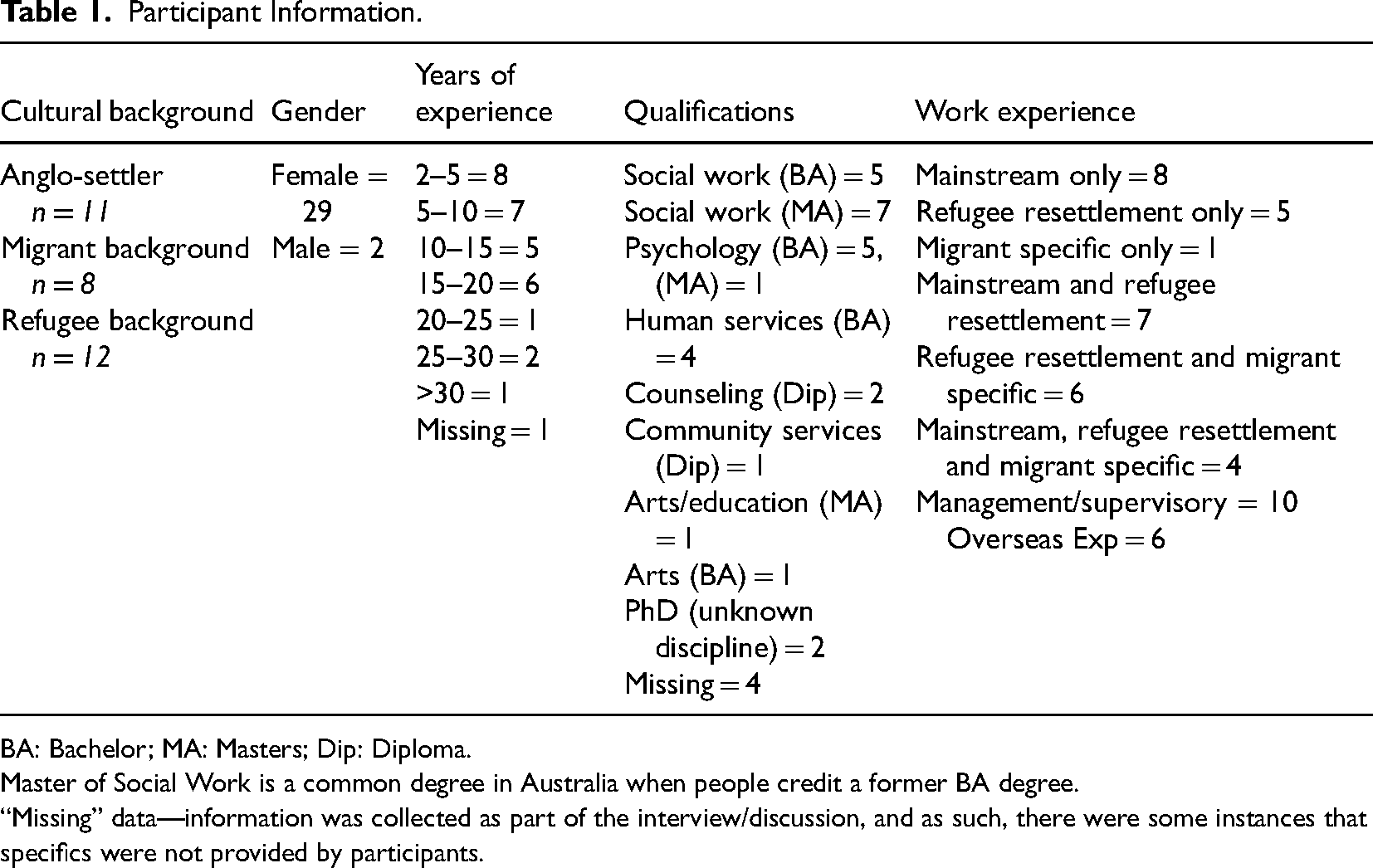
BA: Bachelor; MA: Masters; Dip: Diploma.
Master of Social Work is a common degree in Australia when people credit a former BA degree.
“Missing” data—information was collected as part of the interview/discussion, and as such, there were some instances that specifics were not provided by participants.
Participants who identified as being from refugee or migrant background identified as the following ethnicities: South Korean, Bangladeshi, South Sudanese, Chilean/Argentinian, Italian, Iranian, Indian/Iraqi/Portuguese/British, Fijian, Ghanaian, Ethiopian, Indian, Bosnian, Serbian, Brazilian and Lebanese. Identifying information, such as ethnicity, or specifics regarding organizations, has been limited in the findings to protect confidentiality.
Data Analysis, Positionality, and Reflexivity
Thematic analysis (Braun & Clarke, 2006) was used to interpret the data. As a PhD candidate, I was trained in thematic analysis. I did the coding myself, supported by NVivo software. Interview transcripts were coded line by line. Codes were generated using an “inductive” process, a data-driven and “bottom-up” process similar to grounded theory (Braun & Clarke, 2006). Some data was double or triple coded. As coding progressed, some codes were merged or discarded, and codes were sorted into themes and subthemes. Coding is not a linear process. Data analysis went back and forth between coding, applying theory and literature, feedback from my supervisors, adding codes, merging codes, rearranging themes and so on. Furthermore, sticking to discreet themes or codes can potentially lose the narrative or the context of the conversation or extract in question (Braun & Clarke, 2006). Throughout analysis data was examined as a whole, forming connections between interrelated codes and themes, the positionality of the worker, and the context in which the quote took place.
While coding was inductive and a “bottom-up” process, Braun and Clarke (2006) argue that we are never free from bias. As the researcher, I also have 15 years of practice experience working in the human services, including refugee resettlement and mainstream DV organizations. The qualitative interview is a social process (Silverman, 2013), and I am aware that my work experience created a familiarity between myself and the interviewees. This allowed for the generation of rich and complex data through conversation and understanding the socio-political context in which workers and organizations operate. However, I am also aware of how my shared work experience with the participants influenced data collection and analysis. These would not likely be the same if someone else were to do the research.
As a PhD candidate in anthropology/sociology as a discipline, researching services that I had experience working in, and as a white feminist researching violence at the intersections of gender, race and class, I engaged in an ongoing process of reflexivity through regular feedback on data analysis, writing and discussions with my supervisors. My PhD journey entailed my own experience of engaging in critical praxis, grounding my practice in theory and my theory in practice. Throughout the research process, I was engaged in theory on intersectionality but also refugees and GV in the context of development, humanitarianism and global, transversal feminist politics. Reading the development literature and scholars such as Mohanty (1988), I was struck by the history of problematic power relations between western, northern feminists and women in the Global South and my own positionality, privilege, and role in upholding systems of oppression. This path of theory and reflexivity continued throughout data analysis, extending to organizations in the context of neoliberal governmentality. Cruikshank's (1999) work on “the will to empower” was particularly influential. While bracketing was not used as a formal method, this process of reflexivity resulted in what Starks and Brown Trinidad (2007) describe as being able to “recognize and set aside (but not abandon) [my] priori knowledge and assumptions, with the analytic goal of attending to the participants’ accounts with an open mind” (p. 1376).
Results
This research did not set out to explore workers’ perceptions of empowerment; however, “what is empowerment” was a prominent theme that arose early on in data analysis. In addition to the word empowerment being used frequently, as I show in the findings, participants often discussed practices aimed at engaging women in services and encouraging them to leave violent relationships. These discussions often contradicted other conversations about agency, broader structural inequalities affecting refugee and migrant women, and a lack of resources to support women. However, interview data analysis also showed the different positions taken by workers on empowerment. I explore these divergent views in the following themes: (1) from macro to micro understandings of feminism and empowerment, (2) competing priorities = barriers to empowerment, (3) hierarchical concepts of empowerment and (4) community as a source of empowerment.
From Macro to Micro Understandings of Feminism and Empowerment
The findings from my study reflect the shift in the DV sector from more macro understandings of empowerment, grounded in feminist activism, to more micro considerations grounded in bureaucratic, individualistic service delivery.
Many organizations who participated in my study did not identify as feminist, including DV-specific organizations and programs. Workers in my study who had been in the DV sector a long time, often upwards of 10 years, talked about the ways that many key organizations who had previously identified as feminist had been taken over by larger organizations. This included women's shelters, the original services founded by the DV movement based on theories of empowerment and survivor-centeredness: When I first started…..it was like this is a feminist organisation…..over the years that I worked there, which was around eight years, they changed to (organisation). They had some management changes or structural changes,
they combined with (organisation)…..they became a corporation and without me even knowing or realizing that, we were no longer a feminist organisation.
Larger, mainstream organizations focused on multiple issues, such as homelessness or supporting children and families, and had DV programs. While the organization itself did not identify with a feminist framework, workers often did, but not always. Reflecting the different backgrounds of workers who participated in the study, different feminisms were also evident. Some workers from refugee and migrant backgrounds, for example, expressed a position that reflected “difference feminism,” affirming difference from the male norm and valuing women's roles in societies (Squires, 2013). These workers often talked about a process of finding ways to reconcile gendered norms and traditional roles, such as motherhood and being a wife, with feminism.
9
The manager of a small migrant service said: We have lots of discussions, what does it mean for us and what are the ideas of feminism that we want to adapt….We have a woman on our team who….she was in an arranged marriage and who am I to judge and to say ‘you cannot be feminist because your marriage was arranged’. It's a bit of ignorance, isn’t it?
Other workers from refugee or migrant backgrounds talked about aligning with a more liberal feminism that challenged gendered norms and traditional roles in the family: I started working at (mainstream organisation) and just immediately felt like, yep, this is it…..I just felt that feminist perspective…..was just very aligned to my personality…. so, the household and the environment that I grew up in was very patriarchal….things are done a certain way….and I just always felt a bit of a disconnect from that and felt it wasn’t quite just or fair.
Mainstream organizations were more dominant in size and had more influence in directing policy and service sector discourse. One mainstream organization, for example, had upwards of 50 staff in their DV program, while the migrant organization in the same area had just 5 case managers. Workers from mainstream organizations sometimes expressed feminism in more of an off-hand kind of statement, rather than as a dedicated expression of their personal values. ‘Choice feminism’, a version of feminism that has been co-opted by neoliberalism and allows those who claim it to take a more depoliticized and non-radical position (Ferguson, 2010), was expressed by many workers in mainstream organizations. Look yes I am a feminist and I believe in equality for everyone, I’m not far right or far left with my views, I’m just equality for all.
The limited choices available to women seeking help for DV were frequently discussed by workers. A focus on women leaving violent intimate relationships and legal responses were said to be the primary responses. Responses by DV organizations were thus described as time limited and focused on the initial crisis. One worker described workers in mainstream organizations as “ants in a building.” A worker from a large mainstream organization said: We’re basically told because of how we’re operating at the moment – lack of staff, lack of funding……you have to be in and out, in and out, bare basics.
In this context of individualistic service delivery and the limited choices available to assist women experiencing DV, some workers viewed empowerment in neoliberal terms of self-help, putting responsibility on individual women to improve their situation. Workers saw their role as modeling responsible choices to women who accessed their services, choices that workers believed would improve women's lives, and in many cases the lives of their children. An Anglo-settler worker from a DV shelter, said: I think for us to come from a point of empowering women, so walking beside them to make better decisions.…. We’re really big on role-modelling alternatives…. trying to teach and invest in the self-regulation in kids…. teaching that in the parents would be really beneficial. And I guess that's the reality of what we’re dealing with…. once they’re back into their day-to-day living in the real world, in the home, the likelihood of those skills being taught…. might be fairly remote.
Therapeutic frameworks, such as strengths-based practice, were often associated with empowerment. Rather than recognizing and building on the histories, resilience, and abilities of women, however, strengths-based practice was often understood as maximizing the efficiency of women seeking help from their organizations. An Anglo-settler worker from a mainstream organization said: Strengths based……I think that's a really good approach, it seems to get a lot more done, yeah, with it–I don’t baby them though, or do a lot for them, unless there's literacy or numeracy or that issue there–or they are frozen, then I’ll move it a little, I believe in empowering them.
Bureaucratic processes and strict funding agreements were said to compromise values, such as women's empowerment and respecting women's choices. Rather, the focus was on managing risk and fulfilling competitive tender requirements. I guess sometimes when the services put their heads together, they do try their best.….but at the end of the day, you are limited to what your funds allow you to do. It's their funding, you can’t go outside of that….it's just about the money.
Competing Priorities = Barriers to Empowerment
There was evidence in my study of conflicting priorities between mainstream organizations and refugee and migrant women. While workers wanted to consider culturally appropriate interventions, interventions addressing DV were described as being based on a ‘one-size-fits-all’ model, focused on gender equality and western centric approaches.
For example, a worker from a small migrant-specific service, who came to Australia as a refugee herself, talked about her attempts to engage with a large mainstream organization. The worker said they invited the organization to the launch of a culturally specific DV resource their community group had developed. Rather than engaging with the group and showing interest in their resource, which might have been empowering for the women who made it, the representative from the mainstream organization talked to the group about what DV was and how to access help from their service. The worker said there was “no sensitivity to try to understand” the unique needs of the refugee community. Yes, [mainstream organisations] are doing this and that, but we want to keep our family together….it's not the same issue as the mainstream–yes the issue is DV is a manifestation of things, it's the manipulation of things….maybe finance, maybe family dependency, the problems which are aggravating DV (in refugee communities) is not drug, or addiction, or other things but it's more of just….how to find themselves the space in the new emergent problem.
The “new emergent problem” that this worker talked about referred to the challenges that refugee resettlement in a new country can bring, such as loss of culture, changing gendered norms, and other challenges in settlement such as unemployment and language barriers. As I have discussed in greater detail in Maturi (2023), communities struggling with changing gendered norms and the effects of the refugee journey were identified by workers as causing a backlash to gender equality and diminishing efforts aimed at women's empowerment.
On the one hand, these understandings of the refugee experience could lead to racializing practices. When asked specifically about refugee and migrant clients, or the intersections of race, gender and class, some workers tended to make assumptions that refugee and some migrant women might not know what DV is or might have limited knowledge of services that could help. These workers were often Anglo-settler or had only worked for mainstream organizations. There was a perception by these workers that women might not be so willing to engage mainstream systems for protection or to leave violent intimate relationships. It was along these lines that workers sometimes talked about finding ways to educate refugee and migrant women on what DV is and encourage them to engage services. The difficulty I found sometimes is getting the women to acknowledge that they may need this or that there is a mental–or even dealing with that trauma–if you’ve lived with it all your life, it's kind of your normal. And so, it's having those conversations where they want to access that sort of thing–probably would be the main barrier, maybe?
While violence might be “normalized” in many instances of intimate partner violence and is not necessarily attributed to “culture,” my research found distinct differences in how refugee and migrant women were perceived compared to white, Anglo-settler women. As we discuss in greater detail in Maturi and Munro (2023), Anglo-settler women were not viewed as having culture. But for refugee and migrant women, culture was often attributed to the racial, ethnic and/or religious backgrounds of women and was perceived to put them at greater risk of DV.
On the other hand, however, workers also recognized structural failings. Many workers from refugee and migrant services, for example, discussed concerns that women were being encouraged to leave violent intimate relationships, without considering the reality of refugee and migrant women's lives. It was not that women didn’t know or understand what DV was, or that they put up with violence, rather they might experience structural barriers such as social isolation, poverty, homelessness, or access to services because of language. I would say there is a moment towards removing the person who is experiencing DV with an assumption that once the violence part is removed, they can thrive. But our experience…. once they are removed from that context, you see that they are just like a fish out of water, they don’t know how to survive ….so we see quite a lot of times people go back knowing that it is a violent situation, knowing that it is not changing.
Women who were on precarious visas, such as asylum seekers or those on spousal visas, were often discussed as ineligible for services such as housing or the income payments one would need to leave a violent relationship. A worker from a mainstream organization said: It's really tricky getting the women into public health ‘cause they're not entitled to that if they don’t have the certain Medicare card and things like that…..I know we've had to broker costs for women because there's no other way, and if they're not linked into services, then how are they gonna actually get medical support.
The issue of homelessness, for all women, came up often in the interviews. This included limited places in DV shelters. Workers often discussed that women on temporary visas stayed at women's shelters for 1 year or more, rather than the usual 3-month period for “everyone else.” In most instances, women on temporary visas are not eligible for housing support services or, as the above quote discussed, income support payments or government subsidized services such as health services. Women then became reliant on services, such as women's shelters, to provide necessities for daily living. Said one shelter worker: She was really relying on us for food, shelter, clothing…..then it was applying to get the (visa application) fees waived……it was like walking through cement. I literally had to just be with her every step of the way.
Throughout her interview, this worker expressed frustrations with power relations she found herself caught in and her marred attempts to expand service delivery to better assist women accessing her service. Constraints came about via problematic managerialism, limited resources and time and the restrictive discourse of the service sector that prioritizes individual safety over broader structural inequalities. Identifying that the service she works for is feminist, presumably liberal feminist, this worker says that for herself she aspires to be “I don’t know if it’d really be radical feminism” but moving towards more of a “critical social work” or “post structuralist” approach. Another worker said: It's like, well, it's not that we’re purposely not providing (more culturally specific services), it's that there is no scope for that given what our roles have been defined as and what our funding and reporting and KPI's
10
are and all of that kind of stuff.
Based on these findings, while there is evidence of competing priorities and racializing practices, front-line workers also appear to have inadequate tools and resources to assist refugee and migrant women experiencing DV. Bureaucratic processes and a focus on individualistic service delivery limit options that consider broader structural inequalities, not only for women accessing services but also for workers wanting to empower them.
Hierarchical Concepts of Empowerment
Many workers were questioning the concept of empowerment in the context of bureaucratic service delivery, managing risk, and accountability. Empowering blah blah blah, but what does that actually look like on the ground when they have decided they want to make a choice that we would consider a bad choice…. We’re wanting accountability for services…. for community…. for perpetrators. How do we work with that but in the same way also ensure that we want women to be at the centre of that?
This Anglo-settler worker from a mainstream organization suggests that accountability for services, community, and perpetrators, might have different goals to client-centered empowerment. Workers often suggested that women were expected to perform agency in some situations to gain redress for intimate partner violence. The department of child safety, for example, was viewed as taking away women's empowerment through coercive encounters. Workers often spoke about women being forced to leave a relationship to protect the children if child safety got involved. When (DV) crisis comes up, it's not women's choice what they’re doing. Its more about, ok, police say this and the workers say this and child safety this…. when child safety involved then the lady doesn’t have any choice, you need to leave.
The decision for refugee and migrant women to leave, though, was further complicated by considerations of breaking up the family. Sometimes this was because women were from cultures that held more collective notions of personhood as important, and sometimes this was out of love or loyalty, particularly women who might share the trauma of the refugee journey with their partners and families. Along with their mothers, children could be “ostracized” from their communities and cultures, placing further pressure on women considering their children's future. She's going back knowing she's not going to ever be welcomed in anyone's weddings or birthdays and her children aren’t invited to things. She's not able to go to church anymore, her friends and family will stop spending time with her…..the violence would have to be so so bad for most people to walk away from all that because what else is there? What's at stake and would you make that choice for yourself?
Workers often said that staying in a relationship might be safer for women and children, either physically (and research shows that women are most at risk of homicide when they leave) or due to structural inequalities. One worker talked about a client who left a violent relationship because of child safety intervention but returned to the relationship multiple times because of pressure from her husband and community and because of structural barriers such as poverty and homelessness. The worker said that her client did eventually make her own decision to leave. However, child safety then continued to engage in a surveillance role, continually checking with the DV shelter she was placed at that the woman and her children had not returned to the violent relationship. They said this process of surveillance and monitoring: ….traumatised her and her children…. she couldn’t really get away from the fear of child safety…. every time we speak to her, “this is your option” she ask us back “what would child safety say?”
For refugee and migrant women, who might already be struggling with asserting agency and consent in the face of traditional gendered norms and cultural expectations, the need to perform consent for actors in mainstream systems must be exhausting (Roy, 2017). But the punitive system of child safety also appears to constrain the ability of DV workers to meaningfully contribute to empowerment. A worker from a women's shelter said: We do have families that come in that have child safety involvement. And on occasions, we do have to make child safety reports, that sort of thing.
DV services are also now implicated in the surveillance and risk tracking role of social work as a profession. Accountability for services, community and DV perpetrators should align with goals of empowerment; however, hierarchical models of service delivery based on accountability and surveillance reaffirm a relation of power between the organization and the client (Roy, 2017), diminishing women's empowerment agency and equal participation.
Community as a Source of Empowerment
In light of the limits of individualistic, bureaucratic service delivery, this section presents the views of workers who consider more collective and transformative means of empowerment. “Community” is both problematized and viewed as a potential source of empowerment.
Workers sometimes problematized individualistic conceptions of empowerment as women's rights, suggesting a focus on women taking up their rights compromised safety. You know what I most fear from woman's safety, when they are empowered. Because the fact that she is feeling empowered and that she knows her rights may not make her safer in her house and in her community….it has to be about working with the [refugee] communities…..and to find something that they feel benefit them, will that be how they are seen in Australia as a community, would that be how they manage to keep their children at home, would that be how to save the face of the family.
This worker, from a migrant service, suggests that there are broader structural inequalities affecting women's empowerment. As discussed already, these might include poverty, homelessness, barriers to accessing services or coercive practices by the state and organizations. As I introduced earlier, racism was also discussed as diminishing women's empowerment, contributing to a backlash to gender equality in refugee communities (Maturi, 2023). Kinship ties to family and community were often problematized as putting women at greater risk of violence outside of interpersonal relationships. Workers often talked about the violence that women were subjected to by their in-laws and extended family if they left their relationships. Women and their families could also be threatened by extended family overseas. Obviously, there is nothing that workers in Australia can do about threats of violence overseas, either legally or through front-line organizations: Their family could be killed…we can’t do anything about that. You could go to the police and say, “his family has threatened my family in Iran”, and there's nothing they can do.
However, family, kin and collectivist cultures could also be discussed as a source of empowerment and strength for women. A number of workers, who were usually from refugee/migrant backgrounds and a part of those communities themselves, said that refugee and migrant women didn’t want to access mainstream services: A lot of our women coming from African countries…..they don’t go to psychologists and counsellors. They sit down and have the coffee ceremony, talk about their problems, complain about whatever and that's their therapy……you just want to get around with some people in your community and just laugh and talk and deal with it in that way.
Discussing the limited means available through mainstream organizations that focus on women leaving and legal interventions, another worker from a refugee background said that strategies aimed at empowerment “needs to be within the community because women are not the cause of this problem” …..it seems unfair to put that on them and say “If I tell you, those are your eyes. If I educate you, then it's your fault that you’re still in that relationship”.
Put another way, when considering empowerment as choice, agency, and gaining control over one's life, it is unfair to expect women as individuals, particularly those subordinated at multiple intersections, to be responsible for changing the structures that create and reproduce the inequalities in their lives.
Discussion and Implications
The findings presented in this paper highlight different understandings of the term empowerment by front-line workers who support refugee women experiencing DV. These understandings take place in the context of a depoliticized, bureaucratic service system (Bergstrom-Lynch, 2018), reflecting the shift from more macro understandings of empowerment as collective, feminist activism.
On the one hand, the findings align with the literature on empowerment that suggests front-line workers understand empowerment in neoliberal, therapeutic terms of self-help. Radicalized representations of refugee women as vulnerable victims encourage the participation of subjects who are considered unable to, or uninterested in, helping themselves (Cruikshank, 1999; Miller & Rose, 2008; Pease, 2002), legitimating coercive interventions aimed at women leaving violent intimate relationships. Refugee women's encounters with the department of child safety provide an example of the ways women are required to “perform” agency and consent to gain redress for DV (Merry, 2011; Stubbs & Wangmann, 2015) as both the “good victim” and the “good mother” (Valenzuela-Vela & Alcázar-Campos, 2020).
On the other hand, these findings show that workers also consider empowerment in more macro terms of social justice and activism but are constrained by bureaucracy and hierarchy. Workers considered structural issues, such as homelessness, poverty and racism, and the complexities for refugee and migrant women wanting to keep their families, and communities, together. There is evidence of front-line workers considering the need for policy and practice interventions grounded in more transformative and collective means of empowerment that consider race, gender, culture, and the diversity of women.
Encouraging the equal participation of all members of society, strategies based on empowerment should be concerned with providing the resources necessary to achieve opportunities and goals as part of the empowerment process (Cornwall & Rivas, 2015). But the equal participation of women is not possible in a context of individualistic service delivery that prioritizes accountability and risk over choice and agency (Darlington et al., 2010; Wiley, 2020). While front-line workers are required to carry out their training and assigned roles, significant scholarship is calling on those in professions such as social work and the human services to resist bureaucratic, neoliberal managerialism (Delgado, 2020; Mehrotra et al., 2016). The heterogeneous views and dissenting voices of workers who challenge individualistic, mainstream strategies addressing GV in my study add to this literature, providing opportunities for social work to find ways for “alliance building” with others towards new frames of social justice (Kabeer, 2005). This inevitably means exploring new ways of addressing GV. To conclude, I discuss some of the implications of these findings and the ways empowerment might be ‘revisited’ via critical praxis towards more collective and transformative action.
Consider, and Accept, Difference and Diversity
Strategies promoting empowerment should consider differences in the values of women they support (Katsuringan, 2008). Some women might value more individualistic notions of independence and autonomy, while others might hold more collective notions of personhood as important. Even for women who might want to emancipate themselves from communities or families that hold tradition and cultural norms as important, what is at stake for women leaving might be more harmful than the violence they experience in intimate relationships.
Broaden Definitions of Violence Beyond Interpersonal Violence
GV is not just about interpersonal violence; it is also about structural violence and broader social inequalities that move beyond gender as a primary concern (Critical Resistance and INCITE!, 2003). Strategies developed to improve the situation of one group, usually the dominant group, might have harmful consequences for marginalized groups. As McFadden (2010) notes: “Women who are economically and consequently socially and politically excluded engage in struggles that follow long-term trajectories; struggles that engage the individual but which encompass an entire historical, social and cultural context” (p. 163).
Consider Empowerment as a Process, Not an Outcome
There has been some debate in the literature over if empowerment should be considered an outcome or a process. Empowerment might be measured as an outcome in terms of women's engagement with services, leaving interpersonal relationships, or tangible outcomes such as housing and so forth. However, there are structural barriers that impact on women's ability to achieve these goals, as well as questions over if goals are set by women or services. With a goal of gender justice in mind, empowerment might be considered as “clearing the path” (Cornwall and Rivas, 2015) of structural barriers that contribute to women's inequalities.
Empowerment as Strengthening the Capacity of Community to Respond to Violence
In light of the limits of individualistic means to address GV, scholars are considering more transformative solutions that aim to strengthen the norms and values of community to respond to violence (Kim, 2018). Considering new conceptualizations of power and equality through family, community and kinship structures, Collins (2002) says that when empowerment is considered beyond gender as a primary concern, community can also act as a “source of support when … women [of colour] encounter race, gender, and class oppression” (p. 224). Investing in the resources needed to support culturally appropriate and client-defined empowerment would assist to strengthen the capacity of communities to respond to violence.
Strengths and Limitations
While 31 interviews are considered a good sample size for qualitative research, this research is location specific and is not representative of the human services as a whole. The theme of empowerment arising in the data is powerful as it was not the focus of the original study; however, this is also a limitation as it comprised only one of many themes represented in the findings. Empowerment from the perspectives of workers who support women experiencing violence, particularly those whose culture, knowledge, and values might differ from the norm, would benefit from further, specific research.
Despite these limitations, however, this study provides a valuable contribution to feminist theory on empowerment, extending several areas of scholarship. There are limited studies that view empowerment from the point of view of front-line workers who support women experiencing violence and fewer studies still that explore perceptions of empowerment as they relate to refugee women experiencing violence. The findings from my research, showing the different positions of women on the concept and use of empowerment, provide a starting point to discussions of alliances aimed at more community-driven means to address GV.
Conclusion
This article used a critical praxis lens to revisit the term empowerment. As Cornwall and Rivas (2015) suggest, policy and practice interventions aiming to address GV continue to use “old language,” such as empowerment and gender equality, without considering their origins or contemporary uses. The different understandings of empowerment by front-line DV workers in my research suggest that contemporary uses of empowerment tend to focus on individual choice as agency. Individualistic conceptions of empowerment come at the expense of interrogating structural failings and broader goals of social justice, such as addressing poverty, racism, and women's subordination at the hands of punitive systems. However, the heterogeneous views of participants in my study provide evidence of front-line workers questioning individualistic conceptions of empowerment due to problematic power relations and bureaucratic managerialism. For many, centering the lived experiences of refugee and migrant women led to the recognition of structural failings, the potential consequences of mainstream interventions for refugee and migrant women, the restrictive discourse of the service sector that impaired women's ability to affect change in their own lives and communities and the desire to seek alternative ways of knowing and practice. These heterogeneous views provide a starting point towards “alliance building” as solidarity and coalitions, with the aim of moving towards new frames of social justice.
The broader question informing this research was the practical implementation of intersectionality in front-line GV policy and practice. As a critical project concerned with structural transformation, intersectionality “is inherently a political orientation grounded in solidarity and collective contestation” (May, 2015, p. 48). The next step for policy-makers and front-line workers then, and for feminist theorists concerned with critical praxis, might be to forge out spaces that allow marginalized groups to articulate their own subjectivities, identities and ways of knowing. These ways of knowing might disrupt commonly taken for granted and normative power hierarchies which reproduce inequalities and limit the equal participation of all groups necessary for collective and transformative action. Solidarity and coalitions thus require those from more dominant groups to engage in reflexivity over their own social locations and positionality, with the aim of identifying problematic practices of exclusion (or inclusion) that take away the political power of groups to resist subordination and marginalization. Being intentional about the theories we use, and exploring the ways that lived experience and practice can inform theory, can progress collective and transformative efforts aimed at alleviating women's subordination towards broader goals of social justice.
Footnotes
Acknowledgment
I would like to thank Dr Jenny Munro and Professor Greg Marston for their ongoing support throughout the research process, their guidance on theory and helpful feedback on earlier iterations of this article. Thank you to Dr Debby Lynch for their helpful comments and suggestions on a later draft. I would also like to thank the anonymous reviewers and the editorial team for their feedback and suggestions which helped to strengthen the article.
Declaration of Conflicting Interests
The author declared no potential conflicts of interest with respect to the research, authorship, and/or publication of this article.
Funding
The author disclosed receipt of the following financial support for the research and/or authorship of this article: This research was supported by a Research Training Program Grant through the University of Queensland.
