




Abstract
Feminist praxis in conference planning and implementation may be a promising approach to addressing the complex issue of gender-based violence in an academic setting. This “In Brief” provides an overview of how the Michigan Meeting on Ending Gender-Based Violence planning committee at the University of Michigan embraced feminist praxis by foregrounding diversity in conference presenters and topics presented; structuring the conference’s formal and free spaces; creating an inclusive, trauma-informed space where participants and presenters felt welcome; and highlighting participant feedback. By design, this focus in conference planning and implementation enabled tensions to surface between community-based practitioners and university-based researchers, while encouraging the formation of trust. The interdisciplinary conference structure also promoted and made possible greater connections and opportunities for networking and brainstorming on potential future programs and projects. Overall, the outcomes of this conference were positive and show that engagement and participation of community-based practitioners in traditionally academic settings leads to more nuanced discussions necessary for effectively addressing and, hopefully, ending gender-based violence.
At a time in the United States when Title IX is under attack and conversations regarding the #MeToo, #TimesUp, and #MuteRKelly movements are bringing attention to abuses of gender-based power, feminist praxis in conference organization and implementation may be a promising approach to encouraging solution-focused conversations and innovations centered on addressing gender-based violence (GBV). This approach is promising because it emphasizes nonhierarchical practitioner–researcher collaborations for the primary purpose of ending GBV. Similar to others’ (Matwychuk & Moss, 1996) conference design experiences, our interdisciplinary 1 and intellectually diverse 22-member Michigan Meeting on Ending Gender-Based Violence (MM-EGBV) 2 conference planning committee, comprised of practitioners and researchers from a variety of disciplines, 3 believed that thoughtfully and sustainably addressing GBV meant designing a conference that engaged “the space between practice and research where ideas are translated into concrete activities” (p. 3). In the spirit of feminist praxis, the committee’s goal was to facilitate conversations between practitioners and researchers with the aim of strengthening practice, policy, and research. The MM-EGBV was developed under the premise that practitioner experiences are of paramount importance to guiding research and interventions, and both practitioner experiences and researcher findings must guide policy development.
This “In Brief” provides an overview of the 2017–2018 MM-EGBV committee experiences planning and hosting the conference, as well as next steps. Each has been executed “through praxis,” where practitioners and researchers were and are “challenged and supported to act and make research relevant to the actual lives of people who are affected by research and to explore critically and theorize action as it informs research” (Gringeri, Wahab, & Anderson-Nathe, 2010, p. 394). A critical aspect of feminist praxis in research is reflexivity, the concept that “all knowledge is affected by the social conditions under which it is produced and that it is grounded in both the social location and the social biography of the observer and the observed” (Mann & Kelley, 1997, p. 392). In this context, we interpret reflexivity as encouraging candid participant evaluation throughout the event and learning from those evaluations during ongoing intersectional (Crenshaw, 1991), critical reflection (Mattsson, 2013).
Background
During the 2015–2016 academic year, University of Michigan faculty and administrators engaged in a process of revising the student sexual misconduct policy. A number of faculty participated in this revision process, becoming acquainted with and sharing concerns about issues of GBV on campus and beyond. Eventually, these efforts and relationships evolved into planning 4 and hosting a 3-day conference loosely designed along the arc of human development: adolescence and emerging adulthood, young adults on college campuses, and life beyond the campus (MM-EGBV, 2018a, 2018b). The goal was to “catalyze conversations across disciplinary boundaries with the aim of stimulating research and creative interventions to contribute to safer communities, locally, nationally, and internationally” (MM-EGBV, 2018b, p. 3). This “In Brief” provides an overview of the MM-EGBV planning, implementation, and next steps using a feminist praxis framework that highlights participant feedback.
Feminist Praxis and Conference Planning
According to Hesse-Biber (2007), “Feminist praxis builds on the understanding of difference and translates these insights by emphasizing the importance of taking issues of power, authority, ethics, and reflexivity into the practice of social research” (p. 16). In the context of conceptualizing the MM-EGBV, the planning committee was aware of the power inherent in the group’s decisions regarding where information for such a challenging subject area was presented (i.e., the university campus) and who would be invited to present. Such decisions were important for a range of reasons, particularly given that practitioners may not always feel welcome in spaces largely understood as “academic.” Therefore, following feminist praxis in the MM-EGBV planning effort meant (1) foregrounding diversity in conference presenters and topics presented, (2) structuring the conference’s formal and “free” spaces in a manner that encouraged conversation among practitioners and researchers, (3) creating an inclusive, trauma-informed space 5 where participants and presenters across disciplines felt welcome and safe to engage, and (4) highlighting participant feedback. Each aspect of the four-part planning effort was intended to simultaneously minimize power differences among conference planners, presenters, and participants while promoting appreciation and understanding across professional experiences and disciplines. It was the conference planners’ hope that purposeful planning with these four components of feminist praxis in mind would minimize the power differences traditionally present in academic settings. Each of the four components is explored below in more detail.
Foregrounding Diversity
In foregrounding diversity, conference planners prioritized the intersectional (Crenshaw, 1991) diversity of each person invited to be a panelist and/or keynote speaker. The conference planning committee operated with a general understanding that, “Intersectionality references the critical insight that race, class, gender, sexuality, ethnicity, nation, ability, and age operate not as unitary, mutually exclusive entities, but as reciprocally constructing phenomena that in turn shape complex social inequalities” (Collins, 2015, p. 2). The planning committee believed, particularly with the conference’s focus on GBV, that presenter diversity in personal identities, practice, and/or research had to move beyond second-wave feminists’ primary concern with gender inequality and, therefore, could not solely be grounded in a focus on women’s experiences or “essential notions of categories of difference … but, rather, recognize the complexities of multiple, competing, fluid and intersecting identities” (Gringeri et al., 2010, p. 394). This was particularly the case in the planning committee’s commitment to minimize power differentials by highlighting activist, survivor, and student viewpoints among and within groups of presenters with a spectrum of identities (Mehrotra, 2010). In order to attain this goal, the conference planners purposely incorporated researchers and community practitioners on every panel, with attention to gender and racial/ethnic composition of speakers. There was also an attempt to include individuals with distinct knowledge, experiences, and viewpoints to represent the breadth of work related to GBV and stimulate discussion about creative ideas and interventions to move forward. For example, a panel on the role of technology in GBV specifically tackled the intersection of youth development, race, gender, and technology use, initiating dialogue around social interfacing with technology among adolescents and emerging adults, both for claims of self and identity and coercion and violence. Another panel on centering culture incorporated two white researchers who had adapted a campus-based sexual violence prevention program from the United States to Ghana, a South Asian practitioner who developed community-based resources in the United States for South Asian women experiencing violence, and an East African practitioner who worked for the State of Michigan discussing work with communities of color to address various forms of GBV. Each speaker brought her or his unique identity, knowledge, and practical experience to stimulate an invigorating conversation about creating and adapting interventions for unique cultural contexts.
Conference Structure
Planning committee members envisioned that formal and informal spaces would encourage conversation and innovation among practitioners and researchers. It was intended that formal presentation spaces would have presentation formats that cultivated synergy between panelists and participants. With that in mind, session moderators were encouraged to design each session in collaboration with panelists to promote as much nuanced interaction and engagement as possible. In this effort, the planning committee sought guidance from University of Michigan’s Program on Intergroup Relations (IGR) regarding various methods to encourage conversation. The planning committee then informed moderators and panelists of IGR’s suggestions. The planning committee also incorporated lessons learned from previous positive conference attendance experiences. A particularly effective example of a format that cultivated synergy was opening Day 3 with “Ignite Talks.” The 2- to 3-minute talks given by one member from each of the day’s panels meant to “ignite” interest and participation in the panel later that day. The brief talks were met with enthusiasm and generated interest in panel participation. Although the planning committee promoted innovation regarding presentation formats, such as the Ignite Talks, the traditional PowerPoint presentation seemed to be the default. In hindsight, the planning committee’s effort would have been more successful if specific presentation examples were provided to the moderators and panelists during the planning period. For example, one presenter felt uncomfortable with active participant interactions because it was outside of her experience as an academic speaker/lecturer. Consequently, additional guidance or a variety of presentation/interaction models may have supported her in utilizing a format more engaging than the traditional PowerPoint followed by Q&A format to which she was accustomed. Moreover, her fellow panel speakers felt unable to use more interactive presentation styles so as not to alienate their co-presenter who was the most senior speaker on the panel. In the future, attention to these speaker panel dynamics may also facilitate more lively speaker-participant dialog.
Evans (1979) coined the term “free spaces” when referring to less formal settings, beyond the control of the dominant culture, where people convene to voluntarily generate ideas that lead to mobilizing cultural and/or social change. The planning committee believed that these “free spaces” would serve as a nonthreatening space for individuals who may not feel comfortable speaking up in a larger group setting as well as a space to discuss ideas and make connections for future collaborations. To achieve this, the planning committee encouraged informal gatherings by purposefully scheduling plentiful and long breaks between sessions. The breaks drew people in by including delicious food that met a range of dietary needs. Planning committee members were pleasantly surprised to learn in the evaluations how much conference participants with dietary restrictions appreciated the provision of tasty food that they could eat. The receptions and breaks were also purposely devoid of alcoholic beverages, an intentional choice made clear to participants, due to the complex relationship between alcohol and GBV. Participants' responses included: “The layout was great with times for breaks and networking” and “Having breaks in between presentations is effective because it allows people to reflect on what they just heard.”
Creating an Inclusive Space
GBV is a challenging topic to discuss and consider, particularly over 3 days. The conference planning committee aimed to create an inclusive space where all participants felt welcome, free to share their experiences and viewpoints, and could engage in open and honest conversations about GBV. The committee believed that in order to achieve this, there should be recognition that many researchers and activists in this arena have a history of trauma. Therefore, the committee provided participants with a range of materials before the conference to encourage the creation of space where everyone felt welcome and comfortable. The materials included an antiharassment resource guide, dialogue guidelines, how to create a trauma-informed conference space, and guidelines for presentations that encouraged engagement between presenters and participants (MM-EGBV, 2018a). Specifically, the trauma-informed conference space applied the principles of trauma-informed care (SAMHSA, 2014) to the conference by highlighting that there would be trauma survivors in the audience, reminding people that trauma impacts the brain and body, and providing some practical tips to help avoid triggering someone as well as strategies to help someone that may feel triggered. Advocates from the Sexual Assault Prevention and Awareness Center (SAPAC—https://sapac.umich.edu/how-we-work) were also available throughout the conference for personal support and easily identified by SAPAC advocate buttons.
Participant Feedback
Two hundred and forty-eight participants registered for the conference. Many of the conference participants occupied both a practitioner and researcher role. For instance, practitioners at the university level were engaged in research and evaluation with colleagues, many academic researchers came to this work due to a passion for practice, and some community-level practitioners were interested in how to incorporate research and evaluation into their organizations.
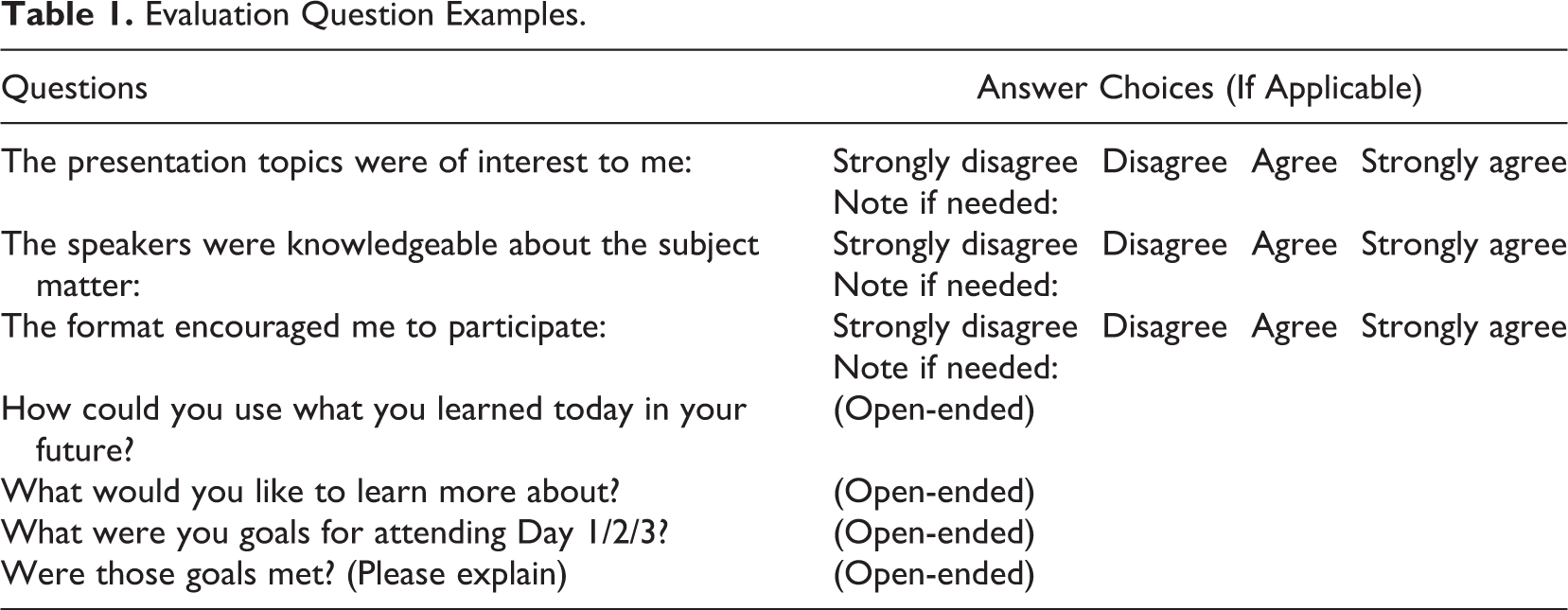
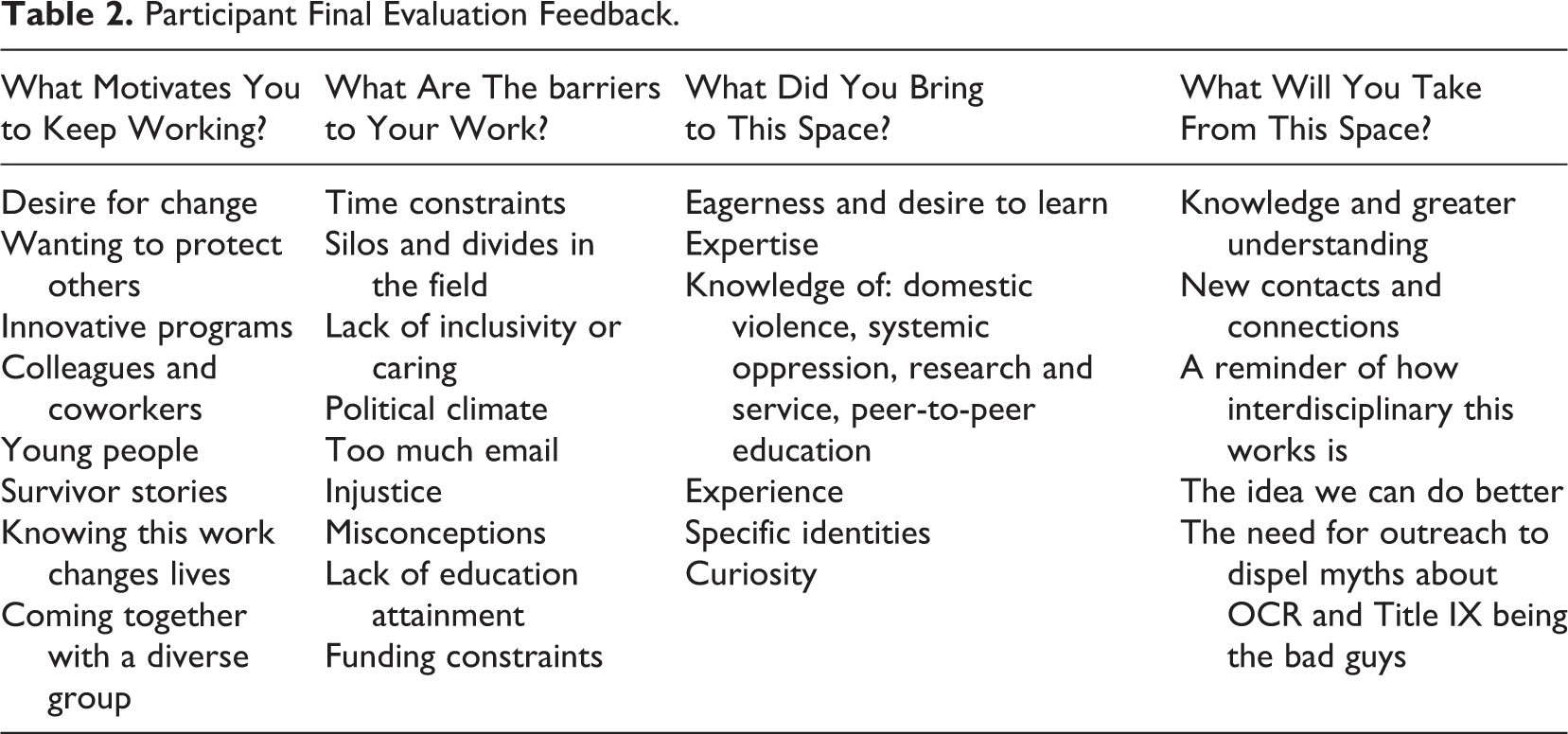
The planning committee used a variety of methods to collect anonymous feedback to capture both in-the-moment and more reflective reactions for each of the 3 days. The committee intended to use this feedback to make any immediate changes necessary to attend to power differentials noted by participants as well as to inform future collaborations and conferences. For immediate reactions, participants were encouraged to submit their daily reflections in readily accessible comment boxes. The committee then reviewed and discussed the comments at the close of each day. From this, the committee learned that it is not always possible to respond to comments in the midst of an event. For example, comments at the end of the first day noted a lack of diversity of Day 1 panelists. This was instructive, as our participants let us know that they were eager for a more diverse event than we were able to assemble. For feedback specific to each day, the committee handed out surveys throughout the day that participants were encouraged to anonymously submit after the sessions they attended (Refer to Table 1 for evaluation of question examples). For more integrative and reflective feedback to inform future collaborations and conferences, the committee planned the final session around participants’ discussions and written answers to thought-provoking questions displayed on six easels around the room. Responses to the final session’s evaluation questions revealed themes overviewed in Table 2.
Evaluation Question Examples.
Participant Final Evaluation Feedback.
Implementation: The Conference Event
The conference featured 73 speakers/moderators and 38 poster presenters representing a range of institutions, specializing in multiple fields, including leading researchers, community activists from local nongovernmental organizations, and budding undergraduate and graduate scholars. Discussions ranged from the need for trauma-informed practices, research on perpetration, to the role of athletics, racism, and survivor stories. The minimal registration fee was waived for student volunteers and reduced for other participants who reached out and mentioned that the fee might be a barrier to their attendance (MM-EGBV, 2018b). Conference presentation highlights included activist Sofie Karasek’s keynote speech encouraging a social justice movement for survivors, professional development for young scholars in a student poster session engaging participants in their ongoing research, a panel of campus sexual assault survivors sharing their experiences formally reporting their sexual assaults to university administration, and Dr. Beth Richie’s keynote analyzing carceral versus abolitionist feminisms. Participant responses included: “The keynote speaker, Beth Richie, was extremely insightful and motivating for next steps of the movement”; “It’s incredible to have that legal panel and Beth Richie on the same day, you all centered Black women”; and “Beth’s talk was on fire! That’s millennial-speak for ‘amazing.’”
By-Products of Feminist Praxis: Tension and Trust
The conference planning committee learned that, by design, feminist praxis in conference planning and implementation enables tensions to surface and trust to evolve between community-based practitioners and university-based researchers. The committee believes these by-products are consistent with the conference goals of stimulating research and creative interventions that encourage safer communities.
Tension as Generative
One plenary panel session surfaced tensions between practitioners and researchers from different epistemological perspectives (Dobash, Dobash, Wilson, & Daly, 1992; Gringeri et al., 2010; Straus, 1979). The tension centered on a panelist’s explanation of research findings that adolescent girls can be as violent, if not more so in dating relationships, as adolescent boys. Tense exchanges among participants—including self-identified practitioners and researchers—and the presenter addressed the quandary of how quantitative research scales such as the Conflict Tactics Scales (Straus, 1979; Straus, Hamby, Boney-McCoy, & Sugarman, 1996) risk decontextualizing gendered experiences of GBV. Although research scales were at issue on the surface, the deeper tension focused on whether or not women in patriarchal societies have the structural ability to be abusive to men. The exchange spurred deeper insight, while highlighting philosophical and theoretical rifts. Rather than escalating in tension or breaking down communication, participants and panelists continued to discuss the issues during lunch, throughout the conference, and afterward. By creating a context of trust, planning for skilled facilitation, and building in time for ongoing conversations, discussion of this controversial issue built rather than severed connections. Participant evaluations reflected the tension and need for continued conversations in this area, for example, “[the presenter’s] research perpetuated the myth of ‘mutual abuse’” and “I found it extremely concerning that intimate partner violence was discussed as being exacerbated by women.” The tense exchange, situated in a welcoming space, seemed generative as evidenced by questions and ideas that emerged about the spectrum of GBV in people’s lives and how that violence may play out across people’s diverse networks. From this exchange, a panelist and participant, both of whom identify as practitioner–researchers, met afterward and shared ideas on possible future collaboration.
Evolving Trust
The following examples demonstrate how (1) trust between practitioners and researchers can be broken and (2) how invisibility may prevent trust from evolving in the first place. During a separate session on intervention innovations, some panelists publicly stated that they were hesitant to invite academic researchers into their GBV survivor-focused agencies because they believed survivors do not have the time or desire to talk to researchers, their agencies have had negative experiences with researchers, and they believed there were potential challenges to researchers maintaining respondent confidentiality. The practitioners’ statements addressed a difficult truth that often goes unspoken—trust between practitioners and researchers is often broken or damaged in the research process. Researchers in the room, who were committed to survivor support, were disappointed by the panelists’ statements and were cautious about how to publicly respond. Although the complex issue was not resolved during the time-limited panel, after the panel practitioners invited a researcher on the panel and researchers attending the conference to come to the survivor-support agencies and provide staff training on their areas of expertise. The invitations suggest that trust is evolving. Although the panelists did not offer specific examples detailing their concerns, their perspectives demonstrate how important ongoing practitioner–researcher communication is in building trust for future collaboration that ultimately serves survivor and agency needs.
During one of the breakout panel sessions, presenters and participants exchanged ideas about intersectional identities and experiences of GBV perpetration and survivorship that emphasized community-based responses to heterosexual women’s use of force. One of the conference participants (this paper's seventh author), an advocate who works with sexual assault survivors, pointed out to the panelists that lesbians who identify as masculine of center or masculine presenting were underrepresented at the conference and could hardly be found in the academic literature. In short, she explained, “I don’t see people like me in what there is to read [about the issue].” The participant then detailed experiences within her community regarding challenges around GBV perpetration and survivorship. A larger conversation ensued regarding representation and identity and how the lack of visibility prevents the formation of trust between practitioners and researchers. One of the panelists (this paper's first author) and the participant then engaged in a public exchange of how to increase visibility, and therefore, build trust. The public conversation grew into a private discussion over lunch. The panelist offered support in guiding the participant through the writing and publication process. In an additional effort to bring visibility to this often-overlooked population, the planning committee is co-sponsoring an on-campus screening of the seven author's documentary film: WoMan: Gender Expression and Race.
Moving Forward
By design, the MM-EGBV provided the opportunity to build trust between community-based practitioners and university-based researchers, while also recognizing the tensions inherent in this complex work. Feminist praxis in planning and hosting a GBV-centered conference encouraged the kind of trust that has been shown to facilitate collaborative innovation and change for mutual benefit (Putnam, 1993). The MM-EGBV planning committee is building on this trust with a more established presence that will further cultivate and encourage practitioner–researcher relationships (Jordan, 2011). With this goal in mind, the MM-EGBV planning committee has become the Institute for Research on Women and Gender (IRWG) 6 Initiative on Gender-Based Violence and Sexual Harassment. The “initiative” is now focusing on bringing documentaries to campus; moving practitioner publications forward, in the form of published “practitioner notes;” reaching out to community-based organizations for ongoing in-service trauma-informed trainings; and spearheading interdisciplinary conversations in order to inform broader policies around GBV-SH. Additionally, the “initiative” is attentive to using the lessons learned and community formed from the MM-EGBV as a resource for the University of Michigan related to policy development and implementation (such as changes to the student sexual misconduct policy), evaluation, and education. The motivation for each effort is to effectively bridge the researcher–practitioner divide in the spirit of feminist praxis.
Footnotes
Acknowledgments
The authors would like to thank the core planning committee members, beyond those listed as authors on this article, they are Nadia Bazzy, Nicole Bedera, Bethany Buschmann, Erin Bonar, Lilia Cortina, Miriam Gleckman-Krut, Anne Huhman, Timothy Johnson, Jennifer Osetek, Sarah Rominski, Suellyn Scarnecchia, Rita Seabrook, Vijay Singh, Richard Tolman, Kaaren Williamsen, and Emma Zorfass. We would also like to thank the volunteers and participants who were so generous with their time and insight as well as the funders who made this event possible.
Declaration of Conflicting Interests
The author(s) declared no potential conflicts of interest with respect to the research, authorship, and/or publication of this article.
Funding
The author(s) received no financial support for the research, authorship, and/or publication of this article.
