




Abstract
Immigrant well-being sits at the intersections of race, ethnicity, socioeconomic status, and gender. Cumulative migration stressors, poverty, and socio-cultural factors have made female immigrants of sub-Saharan African descent especially susceptible to poor psychological outcomes. Furthermore, family characteristics including birth order, family size, and interpersonal relationships are known correlates of physical and mental health functioning. And yet, African immigrants are often aggregated into larger groups, effectively masking the groups’ unique historical and cultural characteristics. This phenomenological study examined how the identity of “daughter,” birth order, and transnational experiences inform the well-being of young African women. Participants (N = 11) who self-identified as cis-gender females were invited for two cycles of in-depth interviews. These young women contextualize their identities around family and familial obligations. They struggle with the contradictions of the parent–child relationship and credit parenting strategies they sometimes view as problematic with their career and academic drive. Feelings of being overwhelmed by familial and social expectations are countered by excitement around their emerging liberated identities. These findings point to the need for inclusive spaces which consider the multiple identities they embody.
While sub-Saharan Africa is the most culturally diverse region on the planet, commonalities around religion, family configuration, and gender roles can be found across clan, tribe, and ethnic groups (Appiah et al., 2018). Of the 44.7 million immigrants in the US as of 2018, sub-Saharan Africans (SSA) made up only 4.5% but were a rapidly growing population (Tamir & Anderson, 2022). It is well recognized that there are differences in immigrant mental health at the intersections of race, ethnicity, socioeconomic status, and gender, yet data on SSA immigrants is often aggregated into larger groups, with Caribbean and African American communities, effectively ignoring the unique historical and cultural factors that impact this population (Alegría et al., 2017). Post-immigration experiences for black immigrant women in western countries include experiencing racism and discrimination, feelings of downward social mobility due to their change in status, feelings of isolation due to the absence of social networks, and job market inequalities (Okeke-Ihejirika et al., 2018).
Stigma and socio-cultural institutions influence the help-seeking behavior of black immigrant women, decision-making choices, gender expectations, and the acculturation process. These factors are crucial to understanding their mental health and how it is prioritized and addressed in their households. While the literature on birth order and its effects on one's mental health is mixed, the data points to family size and birth order as correlates of both physical and mental health disorders (Carballo et al., 2013; Lehmann et al., 2018). The purpose of this study is to examine young women's experiences and well-being at the intersection of gender, culture, immigration, and family configuration, specifically to expand our understanding on how being the eldest daughter of a SSA immigrant family impacts well-being.
Transnationalism and Identity
Foreign-born young adults embody multiple identities and exist at the intersection of both home and host cultures (Tran & Vu, 2017). Immigrant youth often find themselves living in two distinct worlds, each with their own rules, customs, traditions, and expectations. For children from SSA households, there is a large emphasis placed on interdependence, which stands in contrast to the individualistic expectations for U.S.-born youth (Appiah et al., 2018). However, rather than feeling “split” between these two environments, immigrant children have adapted themselves into accepting both as a part of who they are (Yazykova & McLeigh, 2015). Despite the overall positive outcome of navigating their transnational status, they face many challenges along the path of identity development. Maleku et al. (2022) refer to this as spiritual homelessness, a state of being in which young adults struggle to realize belongingness in their new transnational realities. Salami et al. (2020) found that within African immigrant households in Canada, power dynamics often shift in favor of the child, negatively affecting family cohesion. Likewise, as children moved into adolescence and adulthood, the degree of independence they sought was often seen as excessive by parents (Salami et al., 2020).
Birth Order, Gender, and Well-Being
Family size and birth order can correlate as risk factors for physical and mental disorders (Carballo et al., 2013; Lehmann et al., 2018). Being the middle child and living with both biological parents act as a protective factor against emotional disorders (Carballo et al., 2013). Firstborns and only children had a higher risk of emotional disorders when compared to middle children (Carballo et al., 2013). Research has found a negative correlation between birth order and educational achievement, indicating that higher birth order is associated with worse educational and social outcomes as adults (Lehmann et al., 2018). Gender also plays a significant role in affecting an individual's mental health outcomes.
An individual's family has a large influence over that individual's decisions; the African family arrangement will often include extended family members and grandparents. In fact, Appiah et al. (2018) state that “siblings of one's parent are fathers or mothers, not uncles and aunties, respectively. Further, cousins are referred to as brothers and sisters, deepening the relationship among members” (para. 20). Daughters in a family unit usually take on roles not accorded to their male siblings. Within immigrant households, girls are often caretakers of their younger siblings, sometimes referring to themselves as “surrogate” or “second” parents (Sy & Romero, 2008). This often occurs as adaptation to migration and resettlement, especially when both parents work outside of the household (Dodson & Dickert, 2004; Lee & Pacini-Ketchabaw, 2010). While the role of being the eldest daughter in an immigrant household has not been studied, literature on birth order and the influence of gender on the immigrant condition suggests that this population has unique experiences that significantly impact their overall well-being.
Theoretical Foundation
W. E. B. Du Bois’ theory of double consciousness (Du Bois, 1903) and Kimberle Crenshaw's theory of intersectionality (Crenshaw, 1989) can be used to interpret the narratives of black women in America. In The Souls of Black Folk, Du Bois (1903) brings to attention how being a black person and an American seems to stand in opposition to each other. Du Bois’ theory on double consciousness states that African Americans view themselves from two perspectives, one being the lens by which they see themselves, while the other is the lens society sees them through (Meer, 2019). Many researchers have expanded this theory beyond race to include other minority groups such as immigrants, women, and religious minorities (Islam, 2020; Pelt-Willis, 2021; Welang, 2018). An integration of Du Bois’ argument and feminist thought expands the basis on which we can examine perceptions and realities as informed by gender manifestations and expectations. Belongingness in this study is therefore informed by blackness, womanhood, and nationality.
Itzigsohn and Brown (2015) highlight three essential components of double consciousness: the veil, twoness, and second sight. Du Bois’ veil referred to the color line, a term describing the racial segregation present in post-slavery America. More recently, Islam (2020) has described the veil to be a separation based on “racial meanings of otherness, nationalism, boundary making, denial of citizenship, and a denial of belonging” for Muslim Americans (para 20). The veil is visible to everyone, but the majority group projects their concept of the minority group onto the veil while the minoritized often internalize these images as they navigate self-formation (Itzigsohn & Brown, 2015). The minority group then finds themselves operating in two worlds: one of their own communal construction and the other, more dehumanizing realm, dominated by the majority group (Itzigsohn & Brown, 2015). This language is similar to Kumi-Yeboah's (2018) description of Ghanian-born immigrant students managing multiple worlds and Pelt-Willis’ (2021) explanation of black women as having been “programed to believe that the outside teaching is of more value than those ingrained though life experiences” (p. 49). In this world of twoness that Du Bois has constructed, second sight arrives as an awareness of the veil by individuals within the minority group. With this comes awareness of their dehumanization by larger society and the privilege of the other group (Itzigsohn & Brown, 2015). While on one hand this can lead to despair, Islam (2020) highlights that through the gift of second sight, the minoritized begin recognizing the structures that constrain them and thus are able to envision new possibilities for redefining and representing themselves.
Intersectionality addresses the multiple dimensions of oppression faced by black women (Crenshaw, 1989). The term centers on interlocking systems of oppression that depend on a cycle of socialization wherein defined differences among people serve to over-empower certain groups at a disadvantage to others (Crenshaw, 1989). Intersectionality lies within the second sight of Du Bois’ double consciousness. This theory recognizes that the group in power controls the image of the minority population. Because the subjugated cannot control their image, individuals at the cross-section of multiple minoritized identities find themselves experiencing the same situation in different ways (Crenshaw, 1989). Within both theories, there is a shared understanding that social identities are interconnected and interact to shape experiences of oppression and privilege (Crenshaw, 1989; Du Bois, 1903).
Methods
Study Description and Design
With this theoretical backdrop, this qualitative analysis investigated the well-being among eldest daughters in SSA immigrant families. This study sought to understand the life experiences of participants and how their birth order, gender, and first- or second-generation immigrant status have intersected to influence their psychological well-being. The intersectionality of the research participants and the specific nature of their experiences necessitated multiple in-depth interviews where individuals were able to control the narratives of their stories. Women who identified as cis-gender females between 18 and 26 years old, were first- or second-generation immigrants, migrated before the age of ten years, and were the oldest daughter in a household with at least one younger sibling were invited to participate. The age limit of 26 was set to ensure homogeneity of the sample in terms of generational experiences. This is also the average age of students enrolled in colleges and universities (Fishman et al., 2017). First-generation immigrant women must have arrived in the United States when they were 10 years of age or younger, since adolescence is when children begin developing an independent identity for themselves (Schachner et al., 2017). Through convenience sampling, the study was advertised at two- and four-year institutions of higher education in a midwestern metropolitan area. Study flyers were disseminated electronically through African and African American student organizations. Participants were offered $15 and $10 Target e-gift cards for the first and follow-up interview, respectively. Past research has shown that 9–17 individuals are needed to reach saturation; therefore, this present study sought to recruit 10–15 participants (Hennink & Kaiser, 2022). After a potential participant was identified, screening questions were used to determine eligibility. On average, the first interviews took 40–60 min, while the follow-up member check-ins were between 5 and 20 min.
Interview Guide
The first and second interviews asked participants to reflect and respond to three key aspects of their lives: (a) family roles and relationships; (b) identity and values; and (c) mental health and well-being. The first questions pertained to the chores and responsibilities assigned, their feelings on the equality in this distribution, and if matriculating into college altered at-home expectations. In the identity and values section, the women were asked to reflect on the different ways they honored and interreacted with their American and natal cultures. The participants were provided with Leary and Tangney's (2012) definition of personal and social identity as a guide and asked to situate their experiences. Lastly, women were asked to examine how their experiences and identity informed their mental and physical health functioning. To ensure the women had control over their narratives, the second interview was conducted at least a month later and provided participants the opportunity to review their data and examine preliminary codes, categories, and emerging themes.
Interviews were conducted in English at times convenient for each participant. Primarily due to COVID-19 restrictions, all interviews were virtual and were conducted using author #1's institutional Zoom platform. Data was managed and analyzed using ATLAS.ti (ATLAS.ti, 2018). This study received human subjects’ research approval from the authors’ home institution.
Data Analysis
After interviews were complete, the scripts were synthesized in search of patterns and commonalities in the stories of the participants. Two coders handled the data with the lead researcher (author #1) acting as the primary coder. An iterative process was used to analyze the data following the first and second cycle coding methods described by Saldaña (2016). First, inductive preliminary codes were assigned to segments of data that described the perspective associated with being a first daughter in an immigrant household. Code mapping organized these codes into meaningful categories and ensured that the context was maintained. Second, axial coding was undertaken followed by theoretical coding to establish the data's primary themes. Throughout the analysis process, analytic memos were kept and reviewed, with the lead researcher constantly engaging in journaling and a reflexive review of her positionality as it impacts data analysis.
Rigor and Trustworthiness
Multiple methods were used to ensure the validity of the research. After the transcription and summary of each interview, one re-contact with each interviewee was made to allow them a chance to provide additional data, clarity, and feedback on the researchers’ interpretations. The researchers engaged in reflexivity to better understand how their backgrounds influenced the way they interacted with the data. Weekly peer check-ins with the faculty mentor (author #2) involved discussions on how to interact with the data. Journaling was used for coding, organizing information, and ensuring self-transparency. Team coding was utilized to ensure that the richness of the data was properly examined.
Lead Researcher's Reflexivity
To ensure the trustworthiness of the research, it is crucial that the researchers understand their perspectives and preconceptions to properly bracket them. Author #1 is a bachelor of science in social work student preparing to practice in immigrant health. I was propelled to undertake this research study to address the dearth of disaggregated data in the health and mental health literature on experiences such as my own. Further, my lived experiences as the eldest immigrant daughter, a college student, my interaction with various human service providers, and my transnational reality informed the structure and nature of this study. My parents were economic immigrants from Guinea, a country classified by the World Bank as low-income. As I grew up in the United States from the age of five, my family worked their way from poverty into the American middle class. I have never had to worry about food, shelter, or my safety. I am the oldest daughter of four children. My younger sisters were born in America, and for as long as they have been alive, I’ve felt an increased sense of responsibility for their upbringing and well-being. To this day, I manage many parts of my sister's lives that are traditionally regarded in the US sense as the responsibility of parents and other caregivers. Due to my background, while analyzing the data, I was able to recognize and relate with the stories these individuals told. While instances of gendered experiences and transnationalism were rampant in the data, the first theme I recognized in the narratives of these women was their desire to exercise power over their own lives. Despite repeated instances where they were unable to have the same experiences as their peers, these women continued in their attempts at gaining control.
The second author is also an African immigrant and the eldest daughter of her natal family. I identify as an educator–activist committed to preparing students for radical social change, which can only happen in a learning environment that encourages the disaggregation of and acknowledgment of learners’ distinct experiences. This worldview shaped my interaction with this project and in particular supporting Author #1 develop a research protocol that provided a space where college-age African women felt valued and affirmed in the telling of their stories.
Results
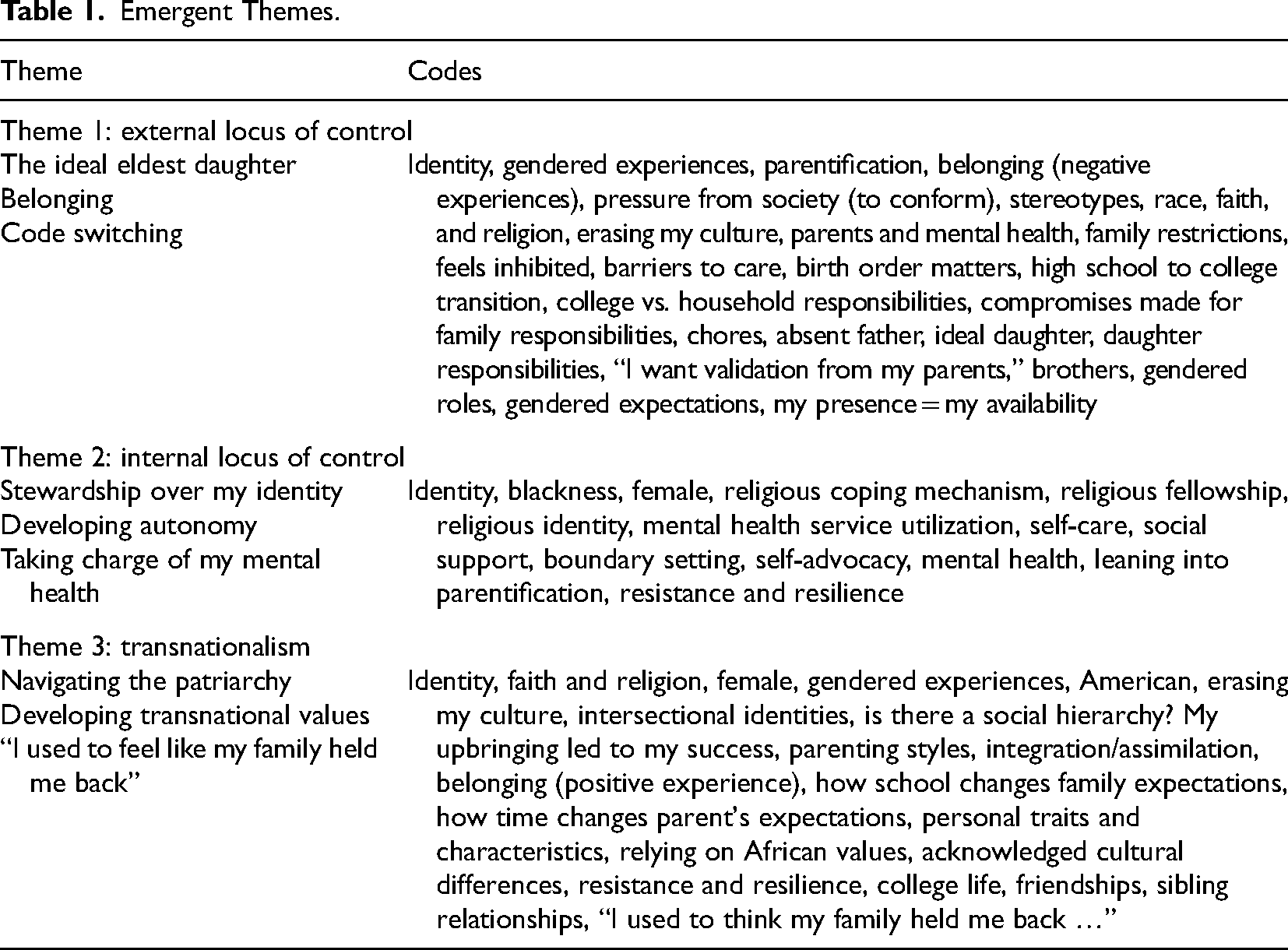
Eleven women were interviewed with a total of 20 interviews completed. Two participants opted out of the second interview. Participants were asked to select a pseudonym with which their data would be linked in analysis and reporting. Participant age ranged from 18 to 24 years, and they lived in households with an average of three siblings. Nine of the women were the eldest daughter of both parents while two were the eldest daughter living in that household. Seven of the respondents were second-generation immigrants, and four were first-generation immigrants. Respondents’ families hailed from Mauritania, Senegal, Guinea, Tanzania, Sierra Leone, Ghana, and Somalia. Table 1 provides a visual representation of codes and themes. First cycle coding identified 50 codes which were organized into nine categories: (a) the ideal eldest daughter, (b) belonging, (c) code switching, (d) stewardship over my identity, (e) developing autonomy, (f) taking charge of my mental health, (g) navigating the patriarchy, (h) developing transnational values, and (i) “I used to feel like my family held me back.” This present paper discusses three themes that emerged after a deeper interrogation of codes and the larger overarching categories: internal locus of control, external locus of control, and transnationalism. Women's identity lies at the core of this data. Although identity is not listed as a distinct theme, it weaves through each thematic discussion. These young women refer to the domestic, parentified, and African daughter archetype and their attempts to navigate this identity. Women's narratives of well-being and belonging are constructed through the multiple consciousness of race, gender, religion, and national identity.
Emergent Themes.
Theme 1: External Locus of Control
Rotter (1966) defines an internal locus of control as a belief that one has influence over outcomes in their life. External locus of control is an individual's perception that outside forces are controlling these outcomes (Galvin et al., 2018). An individual with a higher external locus of control is more likely to self-victimize and identify as having a passive role in their life, while increased well-being has been positively associated with internal locus of control (Galvin et al., 2018). The data points to a distinct push and pull between respondent's sense of internal versus external locus of control in relation to their mental health and well-being.
These women spoke extensively on the “outside” forces attempting to tell them who they are or should be. Outside forces include social or cultural expectations; stereotypes based on race, religion, and gender; and parents, relatives, and sometimes peers. Navigating these forces often lead to a decreased sense of belonging and mental health challenges. Belonging, both within and outside of the home, was an area of struggle for these women. Within the home, some women felt that they had to uphold an image of themselves that did not truly reflect who they were, while others felt muted or closed in. Outside of the home, women were made to feel small or villainized by the stereotypes associated with their visible identities. In both cases, women attempted to navigate these situations in ways that would best protect them and their identity.
The Ideal Eldest Daughter
According to Bunny, in an ideal world, her parents expect her to be “like a maid [who] doesn’t complain about cleaning, [a] babysitter, um very involved within the family. Which is not fair to me, really, because I have my own life.” As Bunny states, these expectations are unrealistic. Zarah compares the ideal eldest to “someone who basically is a machine.”
The recognition of these unrealistic expectations does not stop these women from attempting to fulfill their parents’ wishes. Bunny feels that her responsibilities to her family tie her to that household. Any idea of leaving or simply going out with friends causes guilt because she associates her identity with being a caretaker. Bunny's household responsibilities restrict her from investing time in academics or extracurriculars. Meanwhile, Zarah wants her parents’ approval, even if that means becoming an “ideal eldest daughter,” an expectation she knows is impossible to reach. Instead of setting more realistic goals, she constantly compares herself to the “machine.” Hakimo, who lives with her mother and younger sisters, spoke on the struggle of acquiescing to her mother's expectations for her daughters: “as being older she expects us to like raise them and, like mold them to be more better people.”
Although Barry feels that she has met her parents’ expectations, she knows they (the expectations) do not leave any room for human error, which is not sustainable. A manifestation of this can be found in how she takes these expectations with her outside of the home, where they fill her with thoughts of acting appropriately to not embarrass her family in public. Katie, being the first child to go to college in her entire family, feels pressured to be an example for younger relatives. “I’m the first child that's going to college in my entire family so everybody's looking at me to really succeed and even like emotionally, I can’t really be that emotional in the house.” Although she finds her studies challenging, failure or showing weakness is not an option.
Belonging
Within the household, the will of the parent reigns supreme. As Samantha says, “I live in their household, and I have to do all these tasks and things to make sure that they’re happy, and if they’re happy, then we’re all happy.” Although every woman valued communalism over independence, they also recognized the importance of finding a balance. Oftentimes within their households, balancing these values was either not an option or not a priority. As a result, many of these women felt constrained at home. Eve restricts her self-expression at home because her younger siblings are looking to her as a role model. Similarly, Barry, Katie, and Aisha find that their status as the eldest among siblings adds to the pressure of “acting accordingly.” Aisha, a 24-year-old medical student who lives with her family, states that in situations of crisis, “The first person that gets run toward is me … It's really hard trying to live up to the expectation of the eldest.”
Some women mentioned that their home was not a safe place to display emotions. Bunny's personality was shaped by her parent's reactions to her emotional expression, “Like they would get upset at how I felt, or they would start yelling at me when I’m trying to tell them something.” The high expectations her parents placed on her early in life made Bunny a reserved person. Zarah felt that she and her siblings didn’t have a right to struggle mentally within their household because their parents struggled more. She states, “If we’re depressed and we’re going through stress we’re not allowed to do that, because our parents went through a whole war and came here and stuff like that, because their struggles are more grand.” Akos and Katie mention a similar sentiment. Akos, a 24-year-old who has since moved out of her mother's house, felt that “as a kid you can’t have any like dissatisfaction, you don’t pay bills.” Adapting to parental expectations made self-expression challenging for these women. In some cases, the severity at which these expectations were asserted shaped the personality of the individual.
Code Switching
All participants addressed code switching as a strategy which helped them alternate between their American, Black, African, and religious identities. Code switching strategies were mainly applied when outside the household in school or at work. Respondents found themselves cautiously traversing their environments to counter the stereotypes associated with being a black woman, an African immigrant, and in some instances, a Muslim woman. These conscious and unconscious adjustments to behavior, language, appearance, and dress were as a response to both structural and interpersonal aspects of daily living. Code switching emerges both as a consequence of these forces and as a form of resistance.
It is not uncommon for these women to be the only black immigrant woman in the room; this is especially true for hijab-observing Muslim respondents, who often felt the need to stymie their religious identity when interacting with different groups of friends. Fay feels that after people see her skin color and hijab, they have already made an assumption about who she is, an assumption that is usually wrong. Her constant awareness of the negative language associated with her religion in the media led her to feel “small” in certain places. Meanwhile, at home, her cultural and ethnic identity is very much present. Aisha is compelled to mute her cultural identity in school because she is aware of the preconceived notions classmates hold from seeing her as a visibly black hijab-observing Muslim woman. Even though some of them will try to bring it up to me they’ll be like. Oh, “how does your family do this? Does your family do that?” and I just, I just don’t want to talk about it because they already have their preconceived notions about me, and like my culture my background and I just don’t want to feed into that.
Khadija and Eve find themselves changing their tone and expressions to embody the normative concept of professionalism while working. Eve says, “I kind of like, limit myself to bring a part of me out if that makes sense, like I’m really not like who I am while I’m at work, like I adapt to it, the way I even speak is different.” As someone who is acutely aware of the negative stereotypes attached to her race and gender, Akos finds that expressing aspects of her identity is dependent on her environment. While working on campus, she feels the need to tone down her blackness, but in majority black spaces on campus, she expresses her race “a hundred fifty percent.” So, I would say dodging that type of stereotype and try to dial myself down to be less emotional or less expressive than I actually am to fit in the professional world in a leadership role, sometimes gets hard … but I feel like outside of my household I’m not allowed to be in that space of anger upset emotions, like I’m not allowed to be in that present moment. Because I’m like, because I’m black and because I’m a woman like I’m not allowed to be “too emotional” or I’m irrational.
She feels dehumanized because she is not allowed to express her emotions fully without fear of being villainized due to the negative stereotypes associated with black women.
Theme 2: Internal Locus of Control
Stewardship Over My Identity
While these women acknowledge the pressures that exist to control their identities, two distinct methods of handling such pressures have emerged. Within the household, these women primarily dealt with parentification by leaning into the power this position can give them to disseminate their values onto their younger siblings, while others push back on the position their parents have placed them in entirely.
Eve's parents accept that she has taken on a parental role and encourage this by redirecting her siblings to ask her for permission instead of asking them. In the beginning, it felt like if she didn’t take responsibility over her younger siblings, no one else would take care of them, especially since both parents worked. She takes advantage of her position as a parental figure within her household by assigning chores to her younger siblings, male and female. In this way, she is giving her younger siblings the childhood that she didn’t have by instilling egalitarian values when dividing the household chores. Eve says, “Now that I have that like control over my siblings, I divide the housework … I give them chores. like it's just not my little sister that does things it's all of them.”
Developing Autonomy
In other cases, these women were given the responsibility of a parent without the power of one. In these situations, they had to advocate for themselves within the household. Both Aisha and Zarah acknowledge that due to their self-advocacy efforts, their siblings now enjoy a wider range of freedoms both inside and outside of the house. Aisha says, When I see my siblings do something. It just brings back memories of things that I wasn’t able to do that I was told “no” and they just really get to do it … And I sometimes I do wonder, like wow “What if I was the youngest?” like how would my experience have been?
Other women found that self-advocacy and boundary setting became a goal after beginning college. Khadija observed that her older brother was given much more freedom leaving the house and interacting with the outside world than she was given when she reached his age. To assert her independence, she continually stayed out late until her parents shifted their expectations from keeping her in the house to keeping her safe when she leaves the house. On this topic she sates, “Maybe because they started to see like, being so strict and being so like you know, obnoxious and all that stuff is just, it's not going to get it nowhere.” Khadija mentioned that she rarely feels overwhelmed at home because her parents have successfully shifted their expectations to meet her values. They have been able to meet in the middle where she is still expected to take care of household tasks, but her parents understand that she has a life outside of the house. It was through her persistent self-advocacy that her parents realized that expecting her to fully uphold their cultural values in a foreign land was a fruitless endeavor.
College forced Eve to have a conversation with her parents about the responsibilities she had in the household and how they were becoming unmanageable for her. Boundary setting was difficult, but as the pressures began impacting her schoolwork, Eve knew that she had no choice. “So it was more like you guys need to be home more or like, find a way to you know deal with your kids because at the end of the day, they’re not my kids they’re just my siblings and I also need to make sure I’m all right.”
Taking Charge of My Mental Health
The way respondents dealt with mental health is best described as intentional, even as they interacted with negative and dismissive attitudes toward mental health disorders within the home. Most participants stated that their parents did not have a positive view of seeking out professional resources to address one's mental health. Despite this, three respondents did so anyway. Zarah pursues mental health services regardless of her parents’ negative opinions on the need for such assistance. She displays confidence in the value system that she's been able to create for herself, which serves as a mix between both cultures. Like many of the other women, she does not allow her parents' expectations or cultural norms stop her from seeking support. Zarah mentions that “If I’m going to psychiatrists, they wouldn’t really know. My dad though, he's like ‘you don’t need that crap you’re not about to go,’ but he's never here so that's fine with me.” These respondents relied on their own perception of mental health and recognized the role it played in their life, this caused them to take matters into their own hands and seek out the help they needed. Some respondents even made it a point to mention that they talk about mental health with siblings, either as a way of support or to sensitize their sibling to its importance.
To take charge of their mental health well-being, participants also described active engagement in a variety of coping and self-care strategies, the most common being hanging out with friends, shopping, skincare, leaving the house, allowing breaks for themselves with schoolwork, and rewarding themselves for getting things done. For Barry, “representation matters,” so her self-care involves dressing well and getting her hair and nails done. Based on the data, all participants showed a propensity of using active coping mechanisms to address and support their mental health well-being.
Khadjia uses religion as a strength to help with mental health challenges. “Anytime like I’ll go through anything, or like dealing with anything God always you know, comes through and always helps me fight through whatever it is.” When Aisha, a practicing Muslim woman, decided to include her parents in her journey to receive mental health services, they dismissed it and told her to pray and read more Quran, which disheartened her. She felt that while religious practices certainly have their place, other mental health services should not be dismissed. Aisha continued to have such conversations with them and pursued mental health services while giving her parents a limited amount of information about her therapy sessions. This was Aisha's way of merging two important values of hers: her parent's involvement and the importance of mental health.
Theme 3: Transnationalism
Navigating the Patriarchy
Although these women look for ways to negotiate household expectations while juggling their responsibilities to school and work, conflict inevitably arises when household responsibilities are not prioritized. Several participants mentioned feeling frustration with the number of responsibilities they are given compared to the amount their brothers have. For women with siblings significantly younger than them, they use their power to assign household chores. In Khadija's case, she would occasionally attempt to direct her younger brother to help with housework. Katie self-parentified to compensate for her parent's laxity with her brothers. “I would teach my brothers like basic life skills and even though my parents has let loose a little bit on my siblings I’ve been trying to like get them back on track.” This has been beneficial to her in that she has made progress in getting them to complete housework. Katie feels life skills are important no matter the gender, and she wants her brothers to have these skills.
Aisha dealt with similar issues. She feels that “I’m living in a household that just values women doing these things, as opposed to men … I do think there's a problem, and I really wish it would change.” Her multiple attempts in advocating for a more equitable distribution of chores were unsuccessful, primarily because she does not have the power to hold her brothers accountable and her parents accept gendered chores as the way things should be. In Barry's case, the restrictions that existed in the household sometimes manifested outside the home as well. Barry's status as “parent” does not grant her autonomy in her social interactions. I’m still definitely treated with stricter rules because I’m a girl and so in regard to like going out with friends and stuff like that it's never really been a problem for him. He's able to spend the night at whoever's house and all that but like with me I wasn’t always allowed to I’m still not really always allowed to go spend the night at whoever's house.
Developing Transnational Values
Each woman concluded that she was a mix between her native culture and the American culture in different ways. Fay felt like growing up, she was very individualistic and often thought about herself, which caused tension within her household because her parents were trying to uphold values of communalism. Visiting her native country as a child brought some understanding to her. Despite this realization, she still felt frustration with her parents upholding cultural practices with their children despite the reason behind the said practice losing its significance: So I feel like those gender norms are kind of more applied to like the kids rather than the parents, because both of my parents work … it was still on the kids to like do house stuff and even then, I still felt like it was pretty gendered.
Now that these women are confident in their value systems, they take efforts to ensure that they can live in accordance with these standards. Zarah has respect for her native culture but will not follow cultural norms that go against her self-identified values, a benefit of growing up in a transnational environment. “So, they were telling me how American that is, and I was sitting there like so?” She rejects her elders’ dismissal of American values because having grown up here, she sees them in a more nuanced manner. Lastly, although Barry considers her priorities for herself similar to that of her parents, she emphasizes that she expects to “sometimes to be able to put myself first” which stands in contradiction to her parent's expectation that she “always play that role as the older sister and be able to manage the house.”
“I Used to Feel Like My Family Held Me Back, But Now …”
When asked, “Do you feel that your family stops you from or enables you to do the things you want to do?” all but two participants began their answer with some variation of “I used to feel like my family held me back, but now …” Their explanations covered a wide range of possibilities for their increase in freedom. Fay was expected to succeed in both her education and to successfully reach culturally set values. Meanwhile, she wanted to focus on solely on her education and getting into medical school. This misalignment of goals caused resentment when she was younger and made her feel misunderstood, but as she's grown older, Fay recognizes that she displayed highly individualistic tendencies as a child. Therefore, her current feeling that her family does not hold her back stems from a shift in her mindset. Samantha attributes her increase in freedom to her improved time management, “So, like at first yeah, but I don’t know I got really good at like starting to maintain like manage certain things so like if I knew I wanted to do something I would make sure that I would plan.”
Other respondents acted to create distance and set boundaries to gain this freedom. For Akos, moving out of home fostered an understanding from her mother that she is an adult and has the autonomy to make her own decisions without her mother's input. On the topic of her mother's power over her, Akos says, “I think now because of the distance and because of moving out she can either enable activities or try to disengage it with lectures, but she can’t have any action.”
Barry and Aisha feel that reaching an identifiable marker of adulthood is what caused their freedoms to change. Aisha states, “They don’t stop me from doing things like I need to do and it's like they can’t really stop me, because I need to do them regardless, because one day I’m not going to be at this house and it's like they can’t hold me from like my potential future that is going to be most likely without them.”
These women realize that as they’ve grown, their household structures have changed, whether it be by their conscious effort or not. Overall, participants acknowledge that their experiences made them who they are today. A number of respondents stated that they are proud of who they have become, despite not agreeing with the challenges they had to overcome to get there. Many of these women feel that they have reached educational successes and feel a high sense of independence and self-determination because of their upbringing.
Discussion
This study offers a glimpse into young African women's experiences as daughters living in immigrant households and the strategies applied to navigate the expectations of the eldest daughter while balancing responsibilities outside of the household. They argue that living in a transnational space and simultaneously conforming to the expectations of multiple distinct cultural expectations are quite stressful, especially when one perceives they have failed in some way (Yazykova & McLeigh, 2015). Operating in such an environment creates a sense of twoness in these women, and they contend that there are few places where they can fully express themselves. Within their households, they are more reserved due to the expectation that they serve as an example for younger relatives. In public, they employ code switching as a tool to avoid harmful stereotypes. They see the need to “tone down” various aspects of themselves as a necessity and form of protection in situations where their minority status is visible.
The Du Boisian veil is very much present in the narratives of these women. They find themselves separated from the rest of society through their race, immigrant status, gender, religion, and often a combination of these traits. In addition, all these women displayed second sight in their awareness of these societal challenges. They recognized that they lived in a society that projects on them an identity different from the one they hold for themselves. Beyond twoness, these women felt split based on the various markers of their identity. Zarah struggled accepting her Somali culture while growing up, Akos and Aisha felt the need to tone themselves down to avoid stereotypes, and Eve spoke of a bifurcated “self,” a hybrid of a Senegalese and American woman.
In agreement with intersectionality theory, the women in this study do not separate their gender from their racial or ethnic identity. They view their experiences from the lens of being an “African immigrant woman.” They recognize the multitude of identities they inhabit, and to separate any single identifier would be to nullify their reality. While dual consciousness plays a role in the lives of these women, they also find themselves navigating multiple cultures, within themselves and with the outside world. At times, the identities imposed on them by the dominant group engendered a sense of inferiority. To mitigate harm, respondents restricted their self-expression. While life inside the household was restricting in its own ways, outside the home, these women held the weight of negative assumptions formed from the combinations of their identities and the pressure to not conform to such images.
A critical examination of this data indicates that while these women acknowledge how multiple facets of their identities interact in their everyday life, they seem to draw primarily on their experiences as African immigrant daughters to construct their sense of self, a personal value system, and to inform their advocacy and resistance strategies. As first-born African daughters in a traditional household, these women are socialized to be future homemakers. By recognizing the value inherent in these skills, they do not shy away from conveying the cooking, cleaning, and domestic skills learnt at an early age to younger siblings, including their brothers. Furthermore, even as they concede that the caregiving responsibilities foisted on them as African daughters can be stressful, they appreciate that the role of surrogate parent is integral to keeping the household functioning. Finally, these African daughters speak of the immense pressure to live up to parental and community expectations, and yet, it is this pressure that propels them to set high career goals and to excel academically. These results underscore the need to recognize the distinctness of the African diasporic experience as we move away from amalgamating the black experience in research.
In all of the respondents’ households, patriarchal structures were in place, and women challenged the complicity of parental figures (both male and female) in perpetuating the patriarchal privilege extended to male siblings. These sentiments and customs, which are strongly held in their homes, can impede both professional and personal aspirations. Parentification—which stemmed from a patriarchal worldview—was a factor in shaping women who highly valued family ties while being highly independent in the public sphere. Growing up as the individual often tasked with caregiving and managing the household brought about situations that improved the decision-making skills and maturity of these women at a young age, thus allowing them to excel outside of the home. As they’ve grown, these women have come to understand that their parents learned parenting from a culture very different from the American way of life. While this has caused some setbacks and impacts to the respondents’ mental well-being, these women persevered and created identities for themselves while in this transnational space.
Despite the restrictions that may have been placed on them at home, these women displayed a strong internal locus of control and often worked to advocate for issues that concerned them. Within the home, these women would use the power they held to actualize their values among their younger siblings. Respondents that were unable to do so never stopped speaking to their parents on the topic and informing household members of their stance. One respondent even used disobedience as a form of protest. These women found ways to utilize the resources at their disposal to change or cope with the forces attempting to define their identities.
Implications for Practice
Women in this study talk of feelings of invisibility. Their narratives make a clear case for the need for disaggregate data when addressing the well-being of black populations. The experiences of the African diaspora including formative years lived outside of the United States, family and relational configurations, and diverse belief systems differentiate them from native-born blacks and other diasporic blacks. Lumping these groups together presents the real danger of obfuscating differences across sub-populations. Social workers are adept at creating spaces where the unique needs of ethnic minorities are recognized and addressed. Conscious recognition of their unique experiences allows for more responsive mental health and other support services. For researchers, examining within-group experiences would allow for a deeper understanding of these racialized black experiences and the unique spaces of marginality African women are forced to occupy.
Further, these college women's voices have implications on the educational institutions they interface with. Seeking to understand African women's identities as daughters, siblings, and members of traditionally structured households should be a priority for support officers in colleges and universities. Student success is predicated on the ability to navigate the education process in a way that affirms their diverse identities or at the very least learning in an environment that is not injurious to them. A commitment to inclusive excellence requires a cohesive and collaborative integration of diverse experiences, perspectives, and identities across university structures. However, this is only possible if student affairs practitioners acknowledge the spectrum of the diversity each student occupies. In these narratives, women discuss at length their personal struggles reconciling the complexities of their national, religious, and gendered identities and how these identities intersect with their experiences as students. Understanding the complexity of the coping mechanisms employed by students of African descent should therefore be of concern. For example, religion and spirituality (which these women draw upon in daily life) were recognized as a protective factor, yet there were instances where religion was used in a way that created barriers to mental health access and care. Therefore, while spaces where religiosity is celebrated should be created, instances where religion is used to diminish the need for professional mental health support must also be recognized and addressed.
Strengths and Limitations
This study has several strengths, first of which are the rigorous qualitative practices integrated throughout the study process. These practices which served to reduce researcher bias, included participant check-ins, maintaining a journal, a detailed audit trail, and peer debriefing.
In response to COVID-19, the study was able to pivot and reconceptualize data collection processes. Advertisement and recruitment were undertaken virtually as were interviews which were conducted at times that were most conducive to participants. In addition, a significant number of participants mentioned that the interview itself was cathartic as it allowed them to reflect on their childhood and deepened their understanding of their parents and the situation in which they were raised.
Regarding limitations, while recruitment efforts were robust and invitations to participate disseminated through multiple channels, participants self-selected into the study. This means that results could be biased based on the subset of women who felt comfortable participating in the study and those with access to stable internet. Given that the focus of this study was to highlight the narratives and lived experiences of a small group of cis-gender women of African descent, these findings may not be applicable to the entire African diaspora. Indeed, while our findings call for data disaggregation of black communities, we admit that the voices captured in this study do not encompass the diversity of the African continent.
Conclusion
This is a population with little research, and this study provides the scientific community with insight into the challenges young women of African ancestry have faced from their adolescence to young adulthood. These women's voices shape our understanding of how best to adapt wellness interventions for immigrant women in the future. These findings point to the need for further research to facilitate inclusive spaces for young SSA women living in these transnational spaces.
Footnotes
Declaration of Conflicting Interests
The author(s) declared no potential conflicts of interest with respect to the research, authorship, and/or publication of this article.
Funding
The author(s) disclosed receipt of the following financial support for the research, authorship, and/or publication of this article: This work was supported by the Ohio State University.
