




Abstract
Latinas may be unlikely to report violent crime, particularly when undocumented. This research examines the impact of fear of deportation and trust in the procedural fairness of the justice system on willingness to report violent crime victimization among a sample of Latinas (N = 1,049) in the United States. Fear of deportation was a significant predictor of Latinas’ perceptions of the procedural fairness of the criminal justice system. However, trust in the police is more important than fear of deportation in Latinas’ willingness to report violent crime victimization. Social workers can provide rights-based education and encourage relationship building between police and Latino communities.
Keywords
Latinos/Latinas are the largest and one of the fastest growing minority populations in the United States (Humes, Jones, & Ramirez, 2011). They are victimized by serious violent crime (i.e., serious domestic violence and violent crime involving weapons and/or injury) at rates higher than Caucasians (Rennison, 2002; Truman, Langton, & Planty, 2013). Some specific types of violent crime—such as rape and intimate partner violence (IPV)—are generally directed at women (Black et al., 2011; Rennison, 2002), and research suggests IPV is the most common type of violence experienced by Latina immigrants (Davis & Erez, 1998). Regardless of the type of crime, Latinos/Latinas are less likely than African Americans and Italians to report crimes (Davis & Henderson, 2003). Given the nature of violent crime against women, Latinas may be particularly unlikely to report their experiences of violence to the police, and this unwillingness to report may be compounded if the victim or the perpetrator are undocumented.
The majority of those migrating to the United States are women, resulting in the feminization of immigration (Erez, Adelman, & Gregory, 2009; Salcido & Menjivar, 2012). Women migrating to the United States often do so to escape violence in their country of origin, just to experience similar or increased violence when they arrive (Arguelles & Rivero, 1993; Gonzalez-Lopez, 2007). This necessitates studies, such as this one, that build on the limited research on violence against women and crime reporting among Latinas. Our review of the literature closely attends to the ways in which the intersection of nondominant identities and gender-based victimization may further exacerbate both fear of deportation and mistrust of the system for Latina immigrants. In a unique contribution to the literature on violence against Latinas, we analyze data from the Pew Hispanic Center (2008) to examine the impact of fear of deportation and trust in the procedural fairness of the justice system on willingness to report violent crime victimization among Latinas in the United States.
Gender Inequality in the Lives of U.S. Latinas
Violence against women or IPV—the systematic power and control of women by men that often includes physical and sexual violence—is condoned through patriarchal systems of power within the social structure. When considering violence against Latina women, it is also important to consider the intersections of culturally defined constructions of gender, family life, racial discrimination, ethnicity and cultural diversity, language, citizenship status, and socioeconomic status, among other social factors that exacerbate inequality within intimate relationships and the social structure as a whole (Crenshaw, 1993; Marrs Fuchsel, 2013; Menjivar, 2011). Each of these social processes will differentially impact Latina women’s fear of deportation and trust (or mistrust) of the systems in place to protect them against violence, which will, in turn, affect their willingness to report crime (Belliveau, 2011; Salcido & Menjivar, 2012).
Legality, or women’s awareness of and connection to the laws that govern their lives, is particularly salient for Latina women (Menjivar, 2011). Whether or not a particular woman is documented, the “legal violence” of the immigration system coalesces and magnifies women’s experiences of law such that incorporation into the dominant social structure becomes difficult (Menjivar & Abrego, 2012, p. 1384). When a woman’s phenotype and language identify her as Latina, regardless of her immigration status, members of the dominant social group may feel entitled to treat her or her loved ones as criminal thus impacting her ability to utilize the systems—particularly the legal systems—in place that may protect her (Menjivar, 2011; Menjivar & Abrego, 2012).
In research with Latinos/Latinas, gender roles are often dichotomized as representing the constructs of machismo and marianismo. Machismo is thought to encompass traits such as pride, honor, and responsibility and may be used to justify control, aggression, and sexual violence (Gonzalez-Lopez, 2007; Marrs Fuchsel, 2013; Postmus, McMahon, Silva-Martinez, & Warrener, IN PRESS ). Marianismo suggests that women should be submissive, deferent, and self-sacrificing (Marrs Fuchsel, 2013; Postmus et al., IN PRESS ). Along with marianismo, the concept of familism is described as socializing women to place the maintenance of the family unit before their own well-being, and this is thought to be directly related to Latinas’ willingness to report violence within the family (Marrs Fuchsel, 2013). Previous studies have used these concepts to explain IPV in Latino heritage couples. For example, previous research found that Latinos may not always recognize IPV as a violent crime because of the association of IPV with machismo and that victims who hold firmly to the concept of familism are less likely to report their victimization to police because of the strong value of keeping the family together (Postmus et al., IN PRESS ). The social and cultural construction of gender roles conceptualized in the literature as machismo and marianismo, however, imply that Latino/Latina culture is to blame for IPV, when IPV occurs in all cultures (Gonzalez-Lopez & Gutmann, 2005). Women living in a patriarchal society may respond in similar ways as Latinas to IPV, but their response is not necessarily thought to be related to particular cultural traits. For example, white men abuse white women, yet white culture is not implicated as the cause of white men’s aggression and white women’s unwillingness to report IPV. Living in a sexist and patriarchal society, as well as concerns surrounding legality, may limit Latinas’ perceptions of their ability or perceived worthiness to report victimization (Marrs Fuchsel, Murphy, & Dufresne, 2012). The patriarchal social context may also make Latinas reluctant to disclose IPV to their extended family members due to feelings of shame and embarrassment and may lead family members to be unsupportive of women who choose to disclose (Marrs Fuchsel, 2013; Marrs Fuchsel et al., 2012; Postmus et al., IN PRESS ).
Fear of Deportation and Willingness to Report Crime
One of the factors most strongly associated with the willingness of Latino/Latina immigrants to contact police is stable immigration status. For many Latina immigrants, the fear of deportation is common in everyday thought (Menjivar, 2011; Menjivar & Abrego, 2012). Women who have experienced rape by border patrol agents and/or other human rights abuses in immigration detention, or who have heard about this violence and abuse, have additional reason to be afraid (Androff & Tavassoli, 2012; Arguelles & Rivero, 1993; Falcon, 2007). Latinos/Latinas who fear deportation are less likely to contact police when they are the victim of a crime (Ammar, Orloff, Dutton, & Aguilar-Hass, 2005; Arguelles & Rivero, 1993; Menjivar & Bejarano, 2004; Reina, Lohman, & Maldonado, 2014; Vidales, 2010). Research suggests that Latinos who are undocumented are the least likely to contact the police, at least partially due to the linkage between local law enforcement and border patrol (Menjivar & Bejarano, 2004).
Historically, immigration laws placed value on Latinos entering the United States to work; Latinas and their children followed, leading to Latinas reliance on Latinos for citizenship status (Salcido & Menjivar, 2012; Villalon, 2010). IPV may include the threat of deportation as a tactic to maintain power and control; financial dependence on a partner because of a partner’s stable immigration status similarly results in control and isolation (Abraham, 2000; Crandall, Senturia, Sullivan, & Shiu-Thornton, 2005; Erez et al., 2009; Erez & Hartley, 2003; Sullivan, Senturia, Negash, Shiu-Thornton, & Giday, 2005). Although there are independent legalization options for immigrant IPV victims under the Violence Against Women Act (Violence Against Women Reauthorization Act [VAWA], 2013), this legislation emulates the patriarchal values of marriage, family, and personal responsibility and is, thus, selective in eligibility (Salcido & Menjivar, 2012; Villalon, 2010).
A victim may fear the deportation of loved ones when an offender or other family members are undocumented, whether or not she is concerned about her own documentation status and deportation (Menjivar & Bejarano, 2004). These risk factors specific to immigrant women make it more difficult for victims to reach out to law enforcement for assistance (Ammar et al., 2005; Ingram, 2007; Menjivar & Bejarano, 2004; Reina et al., 2014; Vidales, 2010). Indeed, one study found that Latinos/Latinas were more likely to report a robbery/burglary than they were to report IPV (Davis & Henderson, 2003).
Procedural Fairness and Willingness to Report Crime
Latino/Latina immigrants’ trust in the police is shaped by their experiences with law enforcement in their home country, their experience with the local police in the United States, and the experiences of their social support system (Menjivar & Bejarano, 2004; Reina et al., 2014). Menjivar and Bejarano (2004) use the term “bifocal lens” to conceptualize how immigrants’ perception of U.S. law enforcement is shaped through their experiences of crime, police responsiveness, and politics in their country of origin. Lack of responsiveness by the police and/or the acceptance of violence against women in an immigrant’s country of origin carries over to Latina immigrant’s perception of the U.S. criminal justice system, making reporting less likely in the United States (Menjivar & Bejarano, 2004; Menjivar & Salcido, 2002).
Involuntary contact with police—generally related to discrimination, racial profiling, or immigration enforcement—directly contributes to a lack of trust in law enforcement (Menjivar & Bejarano, 2004). Latinos/Latinas commonly have a strong connection with people in their neighborhood who speak the same language, and distrust of police can be developed based on the experiences of formal (e.g., church) and informal (e.g., family, friends, neighbors) social supports (Correia, 2010; Menjivar & Bejarano, 2004). Trust of law enforcement is also associated with characteristics of police, such as appropriate response to calls (Correia, 2010; Menjivar & Bejarano, 2004) and use of excessive force (Cheurprakobkit & Bartsch, 1999; Menjivar & Bejarano, 2004). Immigrants who have voluntary contact or positive interactions with law enforcement report more positive attitudes toward police and greater willingness to utilize law enforcement in the future (Conaway & Lohr, 1994; Davis & Henderson, 2003; Fleury-Steiner, Bybee, Sullivan, Belknap, & Melton, 2006; Vidales, Day, & Powe, 2009). In general, people are more willing to call the police if they believe the outcome will be helpful (Dichter & Gelles, 2012).
Language is a barrier to contacting police for assistance (Skogan, 2005; Vidales, 2010). Officers who arrive to a crime scene without the resources to communicate effectively with victims and witnesses often show frustration and inappropriately use children, neighbors, or the perpetrator as translators (Ammar et al., 2005; Herbst & Walker, 2001). Ammar, Orloff, Dutton, and Aguilar-Hass (2005) found that in 31% of IPV calls reported to police with Spanish-speaking Latina victims, the officer did not speak directly to the victim; in 20% of cases they used a child, neighbor, or friend to translate, and in 11% of the cases the officer used the perpetrator to translate. Fear of retaliation (i.e., additional violence, alienation from social support) is often present in IPV situations and the use of perpetrators or others to translate may put the victim at greater risk, impacting future use of law enforcement (Erez & Hartley, 2003; Menjivar & Bejarano, 2004).
Immigrants can be trusting of police within their community and have positive attitudes about law enforcement but still would not contact them for assistance (Correia, 2010), indicating that other variables may be more important when considering reporting crimes to police. For example, when Latino immigrants feel that their ethnic group is accounted for in their local government and that the local government meets their needs, they are more likely to report crimes to the police (Davis & Henderson, 2003). Alternatively, the criminalization of immigration makes it important to consider the political environment (Menjivar, 2011) and cities with aggressive police enforcement of immigration laws have seen an increase in racial profiling by police and a decrease in Latinos’ willingness to report crime (Vidales et al., 2009).
Methods
We asked the following research questions: Will Latinas who report a greater fear of deportation also report less confidence that (1) the police will not use excessive force, (2) police officers will treat Latinos/Latinas fairly, and (3) the courts will treat Latinos/Latinas fairly? We then ask whether Latinas who report less confidence that (1) the police will not use excessive force, (2) police officers will treat Latinos/Latinas fairly, and (3) the courts will treat Latinos/Latinas fairly also indicate that they are less willing to report being victimized by violent crime?
Sampling
The second author drew data on 1,049 self-identified females from the 2008 Pew Hispanic Center survey of a disproportionate stratified nationally representative sample of Latino/Latina respondents aged 18 years or older. Researchers at the Pew Hispanic Center used random digit dialing to recruit participants via landline/cell phones and conducted interviews in English or Spanish depending on participant’s language preference. We selected the Pew Hispanic Center data for this study as they collect data on variables of interest from a large number of Latinas utilizing a linguistically appropriate survey and random sampling procedures.
Measurement
Participant characteristics
Female participants self-reported their age in years, whether they were the parent/guardian of children under 18 currently living in their household, yearly household income, level of education, the number of years that they had been living in the continental United States, and U.S. Citizenship status.
Fear of deportation
Participants were asked: “Regardless of your own immigration status, how much do you worry that you, a family member, or a close friend could be deported?” with the following response options: 1 = Not much at all, 2 = Not much, 3 = Some, 4 = A lot.
Procedural fairness
Three questions examine Latinas’ perceptions of the procedural fairness of the justice system. The first question examines trust in the police: “How much confidence do you have that the police in your community will not use excessive force on suspects?” The second question asks Latinas about their perceptions of racial profiling: “How much confidence do you have that police officers in your community will treat Latinos/Hispanics fairly?” The third question examines trust in the judiciary: “How much confidence do you have that the courts in your community will treat Latinos/Hispanics fairly?” Response options for all three questions were as follows: 1 = Very little confidence, 2 = Just some confidence, 3 = A fair amount of confidence, and 4 = A great deal of confidence.
Willingness to report violent crime victimization
Participants were asked “If you were the victim of a violent crime, would you call the police to report this?” Response options were as follows: 1 = Definitely not, 2 = Probably not, 3 = Probably would, and 4 = Definitely would.
Analysis
The second author conducted the analysis. He earned his MSW and PhD in social work, has been trained in the statistical techniques used, and has worked extensively with Pew Hispanic Center data. This author used univariate analyses to describe the characteristics of the sample. He then used ordinal logistic regression models to examine the research questions outlined earlier. Ordinal logistic regressions are appropriate to use with ordinal-level data (e.g., Likert-type scales) because, although the responses can be ranked ordered, the distance between the various response options may not be consistent (Allison, 1999). Multivariate models control for age, income, education level, and citizenship status; meet the proportional odds assumption of ordinal logistic regression; and indicate no issues with multicollinearilty (Allison, 1999).
Results
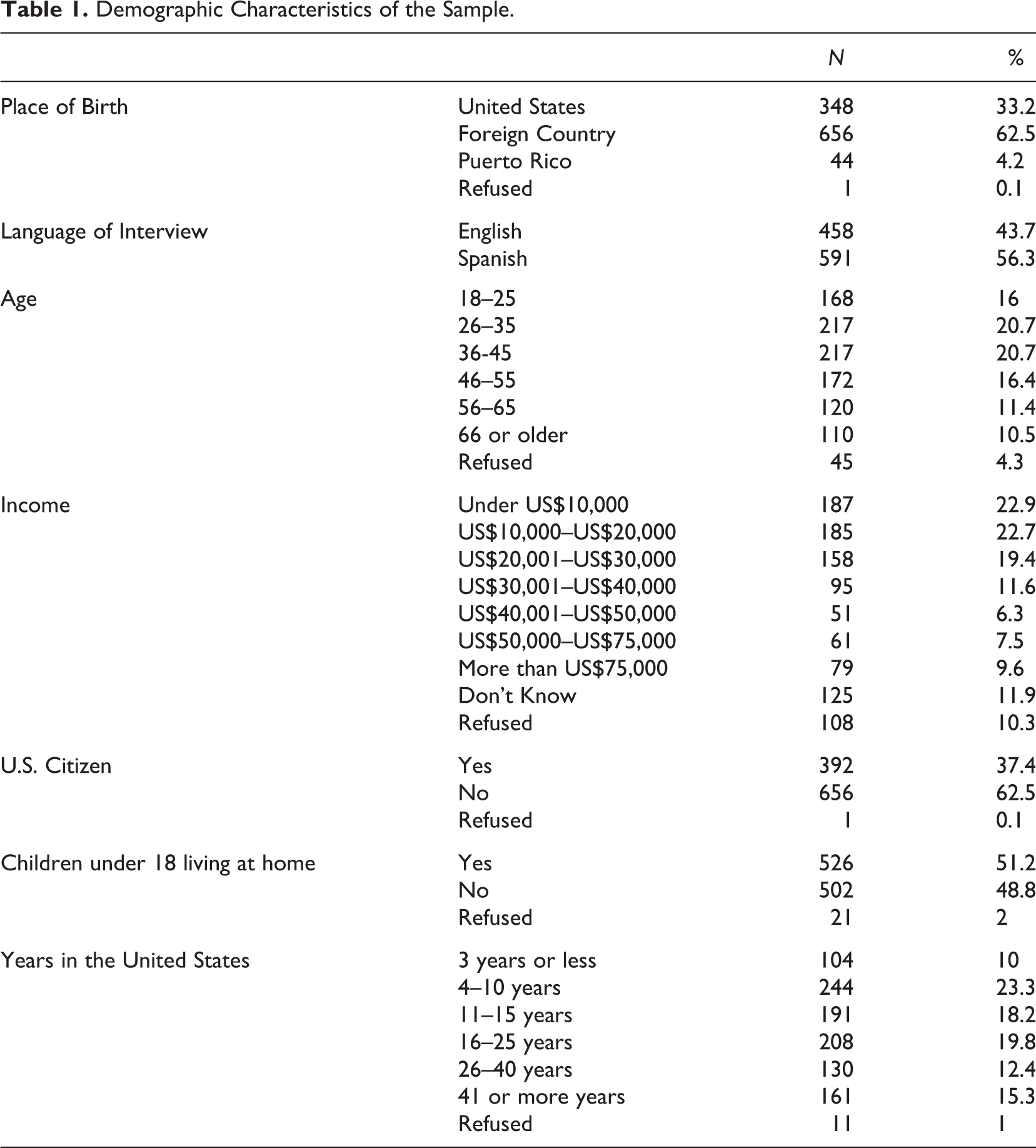
Table 1 provides information about the demographic characteristics of the sample. Fear of deportation was a significant predictor of Latinas’ perceptions of the procedural fairness of the criminal justice system (see Table 2). Specifically, Model 1 demonstrates that for each 1-point increase in fear of deportation (e.g., moving from being worried “not much” to “some” or from being worried “some” to “a lot”), Latina participants had 10% less confidence that police would not use excessive force on a suspect. That is, holding all other variables constant, for each 1-point increase in fear of deportation, the likelihood of Latina participants responding that they have “very little confidence” that police would not use excessive force on a suspect is 10% higher than all of the other responses combined. Similarly, for each 1-point increase in fear of deportation, the odds of Latina participants responding that they have “a great deal of confidence” that police would not use excessive force on a suspect is 10% lower than each of the other responses combined. Model 2 indicates that for each 1-point increase in fear of deportation, Latina participants had 13% less confidence that police would treat Latinos fairly. Finally, Model 3 demonstrates that for each 1-point increase in fear of deportation, Latina participants had 13% less confidence that the courts would treat Latinos/Hispanics fairly. These models also demonstrated that increases in education led to greater confidence that police would not use excessive force and that courts would treat Latinos fairly.
Demographic Characteristics of the Sample.
Ordinal Logistic Regression Models: The Impact of Fear of Deportation on Latinas Confidence in the Procedural Fairness of the Justice System.
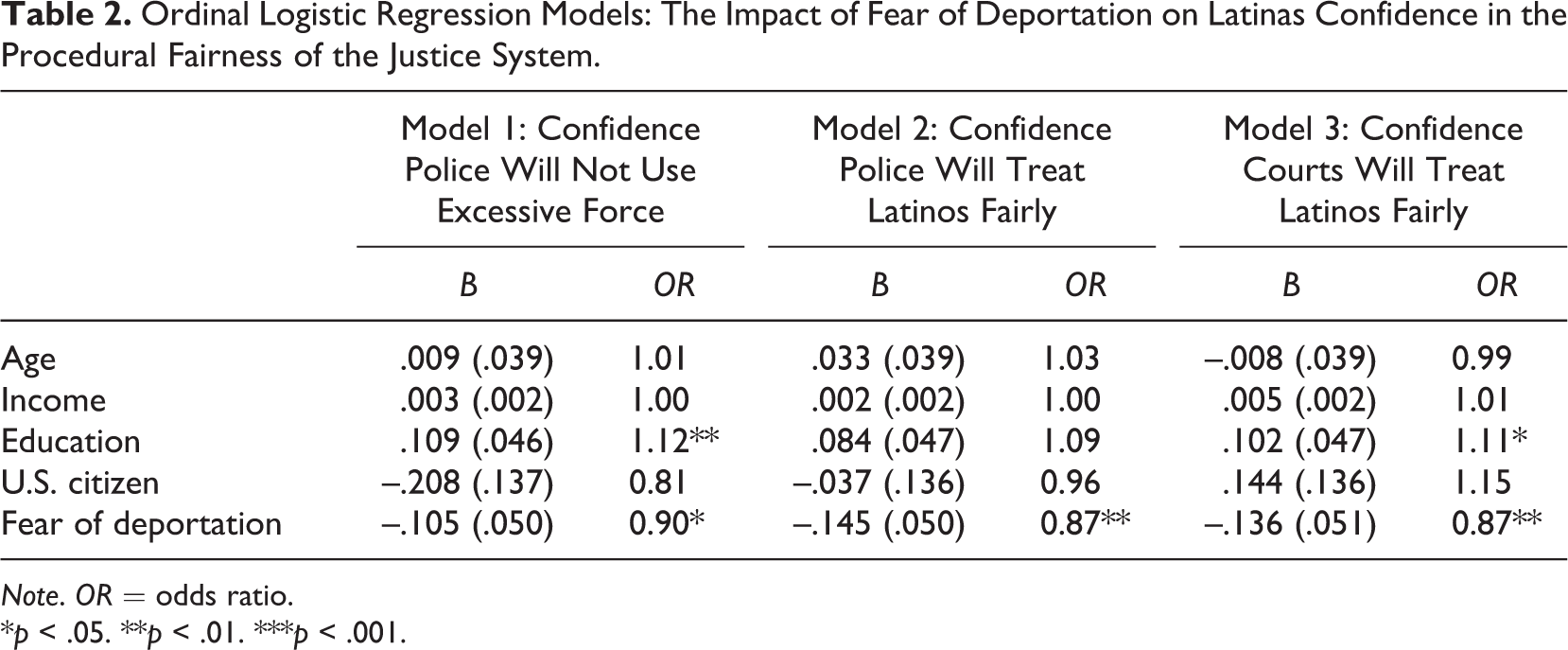
Note. OR = odds ratio.
*p < .05. **p < .01. ***p < .001.
The first ordinal logistic regression presented in Table 3 examines fear of deportation on immigrant Latinas’ willingness to report violent crime. The results indicate that for each 1-point increase in fear of deportation, Latina participants were 15% less willing to report being victim of a violent crime to police. That is, holding all other variables constant, for each 1-point increase in fear of deportation, the odds of Latina participants responding that they would “definitely not” report being the victim of a violent crime to police is 15% higher than all of the other responses combined. Similarly, for each 1-point increase in fear of deportation, the odds of Latina participants responding that they “definitely would” report being the victim of a violent crime to police is 15% lower than all of the other responses combined. In Model 2, when the variable examining confidence that police will not use excessive force is entered into the model, fear of deportation no longer has a significant effect on reporting violent crime. For each 1-point increase in confidence that police would not use excessive force, participating Latinas were 45% more willing to report being victim of a violent crime to police. Model 3 examines Latinas’ perceptions of racial profiling. The significant effect of confidence that police would not use excessive force remained, and for each 1-point increase in confidence that police will treat Latinos fairly, participating Latinas were 32% more willing to report being victim of a violent crime to police. Finally, in Model 4, we find that immigrant Latinas’ perceptions of the fairness of the judiciary is not associated with their willingness to report victimization by violent crime. Throughout the models presented, older participants and those with higher levels of education were significantly more likely to report victimization by violent crime to the police and immigrant Latinas who identified as being U.S. citizens were significantly less willing to report being victim of a violent crime.
Ordinal Logistic Regressions: Willingness to Report a Violent Crime.
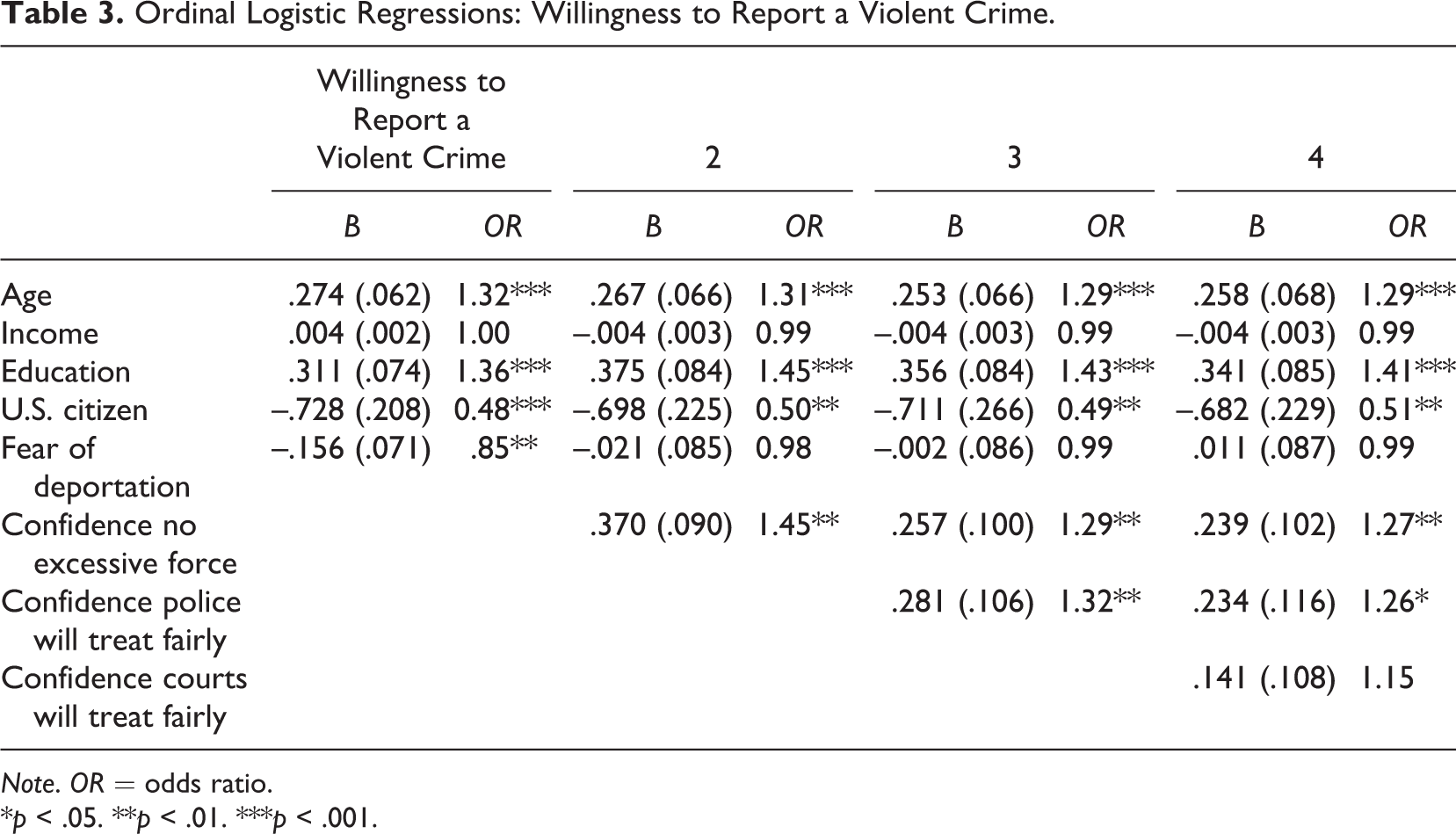
Note. OR = odds ratio.
*p < .05. **p < .01. ***p < .001.
Discussion
Latina immigrants’ unequal treatment within the criminal justice system, violence associated with immigration detention, the unlawful imprisonment of immigrants through immigration detainers, and other human rights abuses (Androff & Tavassoli, 2012; Falcon, 2007; Villalon, 2010) may help to explain the effect of fear of deportation on Latinas’ trust in the procedural fairness of the criminal justice system. These findings are consistent with previous literature regarding the role that fear of deportation plays in Latinas’ perceptions of the criminal justice system and provide support for the idea that immigrants’ legal status is a lens through which they view everyday experiences (Menjivar & Abrego, 2011; Menjivar & Bejarano, 2004).
Also consistent with previous research, we found that fear of deportation was a predictor of willingness to report violent crime (Ammar et al., 2005; Menjivar & Bejarano, 2004; Reina et al., 2014; Vidales, 2010). However, we were able to extend this analysis, finding that the relationship between fear of deportation and Latinas’ willingness to report violent crime no longer existed when taking into account Latinas’ confidence that police would not use excessive force. While fear of deportation affects Latina immigrants’ perceptions of the police, it is perceptions of the police that affect Latina immigrants’ willingness to report violent crime victimization. For victims of IPV, concerns that police will use excessive force against suspects and/or that the police will not treat offenders fairly may take on greater importance because the suspect is a loved one. Based on these analyses, it appears that immigrant Latinas’ trust in the judiciary is not a significant factor in their willingness to report violent crime. This may be because this outcome is too distal and, as such, not a consideration in determining whether to report a violent crime to police. As IPV offenses are rarely prosecuted (Messing, 2014), this may not be a consideration for IPV victims.
Fear of deportation continues to play a role, as it influences women’s perceptions of the procedural fairness of the criminal justice system. Since these data were collected, there have been a significant number of anti-immigrant state-level policies enacted, such as Arizona’s SB1070, which grants immigration enforcement authority to local police officers, as well as escalating anti-immigration rhetoric on a national level. Increased deportations and human rights violations that occur in the deportation and detention process, particularly against women, may additionally affect women’s perceptions of the justice system (Androff & Tavassoli, 2012; Falcon, 2007). Future research should continue to examine the differential contributions of fear of deportation and perceptions of the justice system on willingness to report violent crime.
Concerns of legality do not only affect women who are undocumented (Menjivar, 2011), and this research found that U.S. citizens were less likely to express a willingness to report violent crime victimization. This may indicate that U.S. citizens have had more encounters with the police and experienced discrimination or the legal violence of the immigration system or that their social supports have reported these types of encounters. Female victims of violent crime—who are often victimized by an intimate partner—may be living in mixed citizenship families, protecting an undocumented partner or other undocumented loved ones by not reporting violent victimization to the police. Threats to report a victim or other loved ones to immigration or other authorities is an abusive tactic that may impede willingness to report IPV to police regardless of immigration status (Abraham, 2000; Crandall et al., 2005; Erez et al., 2009; Erez & Hartley, 2003; Sullivan et al., 2005).
Strengths and Limitations
This study has several limitations. Although this research is innovative in that it captures data from Latina women, we were unable to compare respondents by country of origin due to the low number of respondents from countries other than Mexico or Puerto Rico, though research suggests that perceptions of the criminal justice system may vary by country of origin. Some immigrants may have chosen not to participate because they were afraid that their documentation status would be reported. A strength of this research is that fear of deportation was assessed for the participant and their loved ones and, as such, takes into account women’s concerns for family members and others close to them. Data were collected by landline and cellular telephone; women without telephones were not included in the sample. This research reports on Latina immigrants’ perceptions, and it does not report on actual behaviors. The use of hypothetical questioning to assess behavior is not ideal, but this method has been used successfully in previous research to assess Latinos willingness to report crime (i.e., Davis & Henderson, 2003). Finally, specific questions about IPV were not asked and it is not clear whether participants consider IPV a violent crime. Further research should be conducted examining Latinas’ actual reporting of violent crime victimization including IPV and the factors associated with this.
Implications for Social Work
This research has implications for improving community–police relations and for the empowerment of Latina and immigrant victims of IPV. These results suggest that positive relationships between police departments and immigrant communities will increase Latinas’ willingness to report violent crime victimization; strategies to build community–police relations and promote trust in law enforcement agencies are necessary. Law enforcement agencies must take steps to maintain or develop institutional credibility with the communities that they protect and serve. Social workers should provide training for local law enforcement agencies on themes related to Latino communities, victims of IPV, and how to work effectively with immigrant crime victims. Interventions to improve community–police relations include community policing, community review boards of police departments, and including social work practitioners on interdisciplinary teams with law enforcement, such as in mobile crisis units or coordinated community response teams. Interprofessional teams that use social work practitioners and interventions to help law enforcement agencies become more responsive to community concerns may also reduce fear among Latinas. Police departments should employ outreach liaisons with Spanish language capacity to improve community relations with Latino populations. Specialty police teams that focus on the needs of female crime victims, such as victim advocates with Spanish language and Latina cultural competency, are also recommended. In order to improve community relations, social workers should advocate for institutional reforms among police departments that increase procedural justice and reduce racial profiling and the use of excessive force. These measures may increase the perception of police fairness among Latinas; this is key as trust in the police was found to be more important than fear of deportation to crime reporting.
Social workers can also play an important role through community education focused on increasing Latinas’ understanding of their rights. Ensuring that women know that IPV is a crime and that there are resources to assist victims of IPV is an important first step. Given the importance placed on social supports in the Latina community, the promotora model—wherein community leaders are trained and enlisted to educate community members—may be well suited for promoting education about IPV as well as victim and perpetrator rights in the criminal justice context. Social workers should partner with immigration attorneys who can provide “Know Your Rights” seminars that include information about protecting yourself when interacting with law enforcement and the criminal justice system. In jurisdictions where police do not act as immigration authorities, community education programs should also highlight the differences between immigration and law enforcement agencies. These measures could improve Latina’s awareness of and connection to the laws that affect their lives and enable them to make more informed decisions if they are victimized.
Social workers should also contribute to the self-determination of IPV victims. Women in abusive relationships may not reach out the police for a variety of reasons and may choose to continue their relationship with an abusive partner. While it is important that women understand their risk for intimate partner homicide (Messing & Thaller, 2014) and are educated about available resources, the decision to report violent crime to the police ultimately lies with the victim. Social workers can facilitate the empowerment of IPV victims through ensuring their access to legal resources, such as protection orders, immigration attorneys, and possibly defense or expert witness services as necessary, and access to social services, such as shelters or counseling. Social workers should act to prevent the incidence of IPV by educating women and men in immigrant communities about healthy relationships and red flags indicating a partner’s propensity for abuse. Measures to reduce crime in general, and IPV in specific, would be the best prevention strategy to reduce Latina victimization.
Several findings indicate the need for broad social reforms that would contribute to the empowerment of Latinas. As education status was related to Latinas’ willingness to report violent crime and Latinas’ confidence that police would not use excessive force, social workers should work to increase Latina’s educational achievement. Social workers could facilitate Latina’s retention in secondary schools and work to promote recruitment and retention of Latinas in higher education. Social work practice roles of brokering or case management could help Latina’s access resources to support their achievement of education goals. Increased education status may increase Latina’s trust in law enforcement, removing a key barrier to their protection and safety in the face of violent crime.
Social workers should also work to broaden the VAWA protections for immigrant IPV victims. In the longer term, advocacy for comprehensive immigration reform that guarantees legal provision or status for immigrant women would reduce the vulnerability of undocumented immigrant victims. With some form of legal standing, immigrant victims would be humanized and their social welfare would be less affected by their documentation status. Further immigration advocacy to halt deportations, which have reached unprecedented levels in recent years, would reduce fear of law enforcement among immigrant and Latino communities. Antidiscrimination policies, programs, and campaigns to reduce and prevent gender and ethnic discrimination against Latinas would also serve to promote their interests and contribute to the empowerment of this population. Economic and legal empowerment would serve to reduce the dependence of Latina victims of violence upon abusive partners. Finally, more research should be done to further examine this issue, given the increase in immigration enforcement and anti-immigration policies since these data were collected.
Footnotes
Declaration of Conflicting Interests
The author(s) declared no potential conflicts of interest with respect to the research, authorship, and/or publication of this article.
Funding
The author(s) received no financial support for the research, authorship, and/or publication of this article.