




Abstract
A successful academic trajectory tends to be characterized by a singular Standard, that is, doctoral degree, tenure-track position, tenure, and promotion to full professor, administration, or both. Significant numbers of social work faculty struggle with the intersection of the traditional career life cycle and the developmental life cycle. This article discusses barriers that emerge from the intersection of these life cycles. Strategies to support career success and family satisfaction are also discussed, including, current law, work/life policies, self-care, and mentoring.
Keywords
Over the past 50 years, women have made significant gains in their representation in higher education. Despite these gains, a gender gap remains. From 1970 to 2010, female faculty have increased substantially from 23% to 47% (National Center for Education Statistics, 2012). But women were disproportionately represented in the lower ranks of instructors and lecturers, with only 28% of professors in degree-granting institutions being female. Also, the percentage of female faculty with tenure in 2010 was significantly lower than male faculty with tenure (41% vs. 55%; National Center for Education Statistics, 2012).
McPhail (2004) observes that social work is a “male-dominated, female majority” profession. Women have historically occupied a second-class status within the profession as well as within social work education. Numerous gender gaps prevalent in social work are also seen in higher education today (Sakamoto, Anastas, McPhail, & Colarossi, 2008). Female social work faculty are less likely to be employed at strong research-focused universities. Administrative positions female social work faculty hold tend to be characterized as “less prestigious.” Women more often serve as chair (70% vs. 30%) but less often serve as dean (47% vs. 53%) and director (34% vs. 66%; Patrick & Colby, 2011).
In social work education, gender gaps across the academic life cycle are normally argued using a feminist perspective. A feminist perspective includes a commitment to the empowerment and inclusion of women, power deconstruction, women’s experiences, and social change (Kemp & Brandwein, 2010). Feminist theory offers a set of lenses for the purpose of analyzing oppression and the promotion of equity in a range of contexts, including higher education (Allen, 2011). As feminist social work educators, we value “for all people, female and male, liberation from sexist role patterns, domination, and oppression” (Vakalahi, Starks, & Hendricks, 2007). We must build structures and institutions that embody these feminist values.
A developmental life span perspective offers deeper understanding about female faculty in the broader context of their life span and within the complexity of biopsychosocial events (Greene, 2009). It provides broader parameters to understand female faculty’s developmental trajectory within the academy. More specifically, it allows a holistic longitudinal perspective in light of specific predictable changes that occur over the course of the academic careers of female faculty (Barker, 2003).
This article, in using a feminist perspective to analyze the intersection of the developmental and academic life cycles, argues that there are more constraints in progressing through the academic life cycle for women than men—attainment of a PhD, tenure-track position, tenure, promotion, and administrative positions. The analysis is followed by an examination of pertinent strategies to counter the gender gap, with an emphasis on legislation, institutional policy, social support and self-care, and mentoring.
Intersection of Academic and Developmental Life Cycles
A successful traditional academic trajectory tends to be characterized by a singular academic trajectory, that is, doctoral degree, tenure-track position, tenure, and promotion to full professor, administration, or both. Accomplishments of these standard milestones are based on the concept of the “normal” life course where certain normative life events are ordered, and adverse consequences result from not meeting a benchmark in its customary sequence (Wolfinger, Mason, & Goulden, 2009). Unfortunately, this classic profile of the academic career was geared toward the traditional man, where promotion norms evolved to suit a “family-free” male academic. This assumption was based on the belief that a traditional wife was present at home to manage all home and child-related responsibilities (Young & White, 2001). Wolfinger, Mason, and Goulden (2009) reported that, “More than most vocations, academia does not really offer any good time to have children” (p. 1613). By the time women (and men) complete their education and training, they are generally in their 30s. If women wait until post-tenure to have a child, they are likely reaching the end of their fertility window.
Although women may enter the professional pipeline at different places in their developmental life cycles, caregiving tends to cause leakage or interruptions. Attrition in women’s academic careers has been documented at distinct stages in the professional pipeline: (a) tenure-track employment, (b) promotion from assistant professor to tenured associate professor, and (c) promotion from associate to full professor (Wolfinger et al., 2009).
While the majority of American women—married and single, raising children and childless—now work, inequities persist both in household labor and in the relative importance placed on men’s and women’s careers. Female faculty have difficulty achieving equality due to dual career matters and family obligations as well as a host of career impediments. Our focus here is on the former. Holley and Young (2005) explored factors that affect male and female doctoral-level social work faculty’s career decisions. These authors present quantitative and qualitative findings on participants’ concerns in deciding which job or jobs to accept and their perceptions and experiences of both gender-related barriers and organizational supports when working toward career goals. Women may accept lower status academic positions, such as adjunct professor, in lieu of tenure-track positions due to family responsibilities (Holley & Young, 2005; Webber & Williams, 2008; Wolfinger et al., 2009, p. 25).
In light of the aging of the U.S. population, the developmental trajectory of female faculty remains different than men after the childbearing years. More female faculty members are trapped within the sandwich generation, caring for their children and their aging parents at the same time. Reasons for the increased caregiving responsibilities have been influenced by changing demographic trends in rates and timing of fertility, mortality, chronic illness, and morbidity (Keene & Prokos, 2007; Singer, Yegidis, Robinson, Barbee, & Funk, 2001).
The typical in-home family caregiver providing care for an aging parent normally is female, married, employed outside the home, and expected to spend as many years caring for a parent as for her children (Clark & Weber, 1996). Engaging in multiple caregiving roles can lead to mental and physical exhaustion and increased stress (Keene & Prokos, 2007). The timing of this dual role expectations for female faculty normally coincides with the traditional academic trajectory of promotion to full professor. Although female faculty may have survived the childbearing years and received tenure, caregiving responsibilities in later years may have consequences for post-tenure reviews and promotion to full professor, a potential explanation for why women remain behind men in being promoted to the rank of full professor (Wolfinger et al., 2009).
The analysis of the intersection of the developmental and academic life cycles for female faculty will not be complete without adding intersectionality into the discussion. Intersectionality adds to a feminist analysis because it acknowledges that socially and culturally constructed categories interact on multiple levels to manifest themselves as inequality in society and ultimately within the academy. It posits that oppressions based on identity constructs, such as race/ethnicity, gender, religion, nationality, sexual orientation, class, or disability do not act independently of one another; instead, these forms of oppression interrelate, creating a system of oppression that reflects the “intersection” of multiple forms of discrimination (Hill Collins, 1990). Sociocultural issues may present unique challenges of having to navigate through ageism, racism, and sexism within the academy (Bent-Goodley & Sarnoff, 2008; Vakalahi et al., 2007).
A guiding principle of Black Feminism Theory, which includes a race, class, gender analysis, is its focus on the “simultaneous, multiple and interlocking oppressions of individuals” (Hill Collins, 2000, p. 42). The intersectional and structural approaches offers a necessary critique of the traditional feminist approaches, which has traditionally failed to represent women at the margins—“women of color, lesbians, poor women, and other women for whom gender is but a part of their marginalized status” (Hill Collins, 1994, p. 45). A challenge of using this approach is that nothing fits neatly into a category except as a result of imposing a stable and homogenizing order on a more unstable and heterogeneous social reality for all females with multiple sociocultural identities. As a result, rather than focusing solely on one social inequality, an intersectional approach lends itself to a systemic analysis of how oppression and marginalization have been embedded within structures of higher education in a variety of ways (Hill Collins, 1990, 2000).
Many societal inequities are replicated and reinforced within the social contexts of universities. Within the framework of intersectionality, several researchers have reported the findings of co-occurring discrimination related to race and gender within higher education (Bent-Goodley & Sarnoff, 2008; Bonner & Thomas, 2001; Vakalahi et al., 2007; Zamani, 2003). Others have researched how co-occurring discrimination related to age and gender manifests itself within the academy (Carr et al., 2000). Also, Chonody, Woodford, Brennan, Newman, and Wang (2014) and Woodford, Brennan, Gutierrez, and Luke (2013) examined the discrimination experienced by lesbian faculty.
Strategies to Minimize Life Cycle Conflict
The conflict between the developmental life cycle and the academic life cycle may be minimized by changes in policies, whether mandated by government or voluntarily implemented by organizations. Given the numbers of female faculty and the many distinct barriers they face, strategies are needed to support career success as well as family satisfaction. This section will discuss legislative initiatives, institutional work/life policies, self-care, and mentoring as strategies to help female faculty be successful and satisfied at work and home.
Legislative Initiatives
A few important legislative initiatives changed women’s participation in higher education during the second part of the 20th century. The Equal Pay Act of 1963 mandated equal pay for equal work regardless of sex. Title VII of the 1964 Civil Rights Act prohibited employment discrimination on the basis of sex. The most vital change came in 1972 with the passage of Title IX of the Education Amendments of 1972 that prohibited discrimination based on sex in educational programs receiving federal funds. The Title provides that “no person in the United States shall, on the basis of sex, be excluded from participation in, be denied the benefits of, or be subjected to discrimination under any education program or activity receiving Federal financial assistance” (Section 1681 (a); Allen, 2011).
Federal law requires that minimum standards must be in place at universities to protect and support specific benefits related to childbirth, child care, and eldercare. Such laws include, for example, the Pregnancy Discrimination Act (PDA) of 1978, the Family and Medical Leave Act (FMLA) of 1993, and recently, Section 4208 of the Patient Protection and Affordable Care Act (ACA) of 2010. The PDA makes it illegal to discriminate on the basis of “pregnancy, childbirth, or related medical conditions.” PDA may be relevant to faculty women in the early stages of their careers life cycle, as they are reaching the end of their childbearing years.
Despite the stated intention of the PDA to alleviate employment discrimination on the basis of pregnancy, the PDA has shown to be insufficient in providing equal employment opportunities to women, largely because it does not require employers to provide a separate benefit for pregnancy-related leave, which is the norm internationally (Alkadry & Tower, 2014).
Another law potentially relevant to faculty mothers in the early stages of their career trajectory is Section 4208 of the ACA of 2010. It protects mothers returning to work who wish to continue breast-feeding their child. Universities are required to provide a private, non-bathroom space to express breast milk, for 1 year after the birth of a child. Employees are entitled to a reasonable amount of time, each time she has the need to do so. When faculty mothers work from home or in their private office, this policy may not be needed. When classes and meetings are scheduled, particularly away from one’s office, utilizing this policy may be necessary.
Unlike PDA and Section 4208 of the ACA, the FMLA is relevant to faculty women across their developmental life cycle. The major provision of FMLA allows for some flexibility for workers who need to take leave in the event of personal illness or for an immediate family member (e.g., spouse, child, or parent). Under FMLA, eligible employees are entitled to 12 weeks of unpaid job-protected leave during a given 12-month period. The employee may take the leave intermittently or on a reduced leave schedule, which allows the employee to work part time during the time leave is taken. Unfortunately, FMLA has significant limitations. The primary barrier to using FMLA is that leave is unpaid, which is often unaffordable. To begin to fill these gaps, some state laws go beyond FMLA, for example, CA, NJ, and WA added wage-replacement for leave takers (Yang & Gimm, 2013).
Researchers have found that faculty, particularly female faculty, are more likely to report not having children or as many children as they had wanted (Mason & Goulden, 2004). Armenti (2004) described strategies female faculty used to accommodate their caregiving demands. Women tried to have “May babies” to minimize work/life conflict. Others postponed family formation until after achieving tenure. Unfortunately postponing childbearing for too long may result in foregone fertility. Armenti attributes these trends to male-oriented university policies and benefits (e.g., no or inadequate day care and lack of paid family leave). Women who lose the ability to have a wanted child suffer a terrible social cost (Tower & Alkadry, 2008).
PDA (job protection for pregnant women) and Section 4208 of the ACA (ability to express milk when needed) are likely only relevant to faculty women who pursued their PhD young, hence beginning or resuming childbearing at the twilight of their fertility. Women who practiced social work for several years before earning a PhD and a faculty position may be beyond their childbearing years. FMLA is relevant to academic women throughout the developmental life cycle, and will vary depending on how it intersects with the academic life cycle. For example, a young academic mother may use FMLA to care for a young child, while an older faculty member may use FMLA to assist an aging mother or partner.
Institutional Work/Life Policies
University-level policy
The apparent lack of political will and a sluggish economy makes it unlikely that sweeping policy change will require universal protections for families in terms of paid sick leave, paid parental leave, or subsidized day care or eldercare on the national stage. There are U.S. universities, however, implementing selected family-friendly or work/life satisfaction policies. These policies are defined as workplace policies, with the goal of helping employees manage their work and family responsibilities, including, parental leave, on-site child care, or lactation support programs.
Williams (2010) makes the case that organizations should adapt to the changing realities of the workforce in order to optimize organizational effectiveness. There are evidence-based reasons for universities to offer these benefits. Benefits have been linked with higher morale and productivity (Callister, 2006; Sima, 2003) and perceptions of institutional reputation (Hollenshead, Sullivan, Smith, August, & Hamilton, 2005).
The earliest years in a faculty member’s career life cycle are likely to be the most difficult ones, due to the particularly high expectations during the 6-year probationary period to demonstrate one’s ability to be a productive and independent scholar and an excellent teacher who provides excellent service to the university. From an analysis of 124 U.S. universities, Tower and Dilks (2014) found that institutional characteristics predict the creation of more (or less) flexible work/life policies. For instance, increases in Carnegie classification is associated with more progressive parental leave, child care, eldercare, and lactation policies.
In a recent meta-analysis, Kossek, Pichler, Bodner, and Hammer (2011) concluded that work/life support is central to an individual’s experience of work/life conflict. Institutions that fail to support work/life fit are likely to see increased turnover because satisfaction impacts one’s intentions to leave an institution (Rosser, 2004). Unfortunately, even though these policies provide faculty with more options, the policies are not fully utilized by faculty (Mason & Goulden, 2004; Young & White, 2001). Barriers include not being aware of the policy or how to use it, stigma associated with the use of the policy or concern of colleague retribution for using the policy (Villablanca, Beckett, Nettiksimmons, & Howell, 2013). Support of supervisors and department chairs for using work/life policies is critical to its usage (Blair-Loy & Wharton, 2002; Lester, 2013).
Work/life policies must also be fully integrated into the culture of the organization for faculty to be aware and open to using work/life policy (Villablanca et al., 2013). Affecting cultural change may feel daunting, but it is possible and financially supported. In 2001, the National Science Foundation (NSF) began the ADVANCE Institutional Transformation Awards, with the goal of data-driven systematic organizational change. There is much to be learned about organizational change from this literature. As an example, the University of Michigan had much success using “organizational catalysts” who were highly respected colleagues and administrators located across the university. The role of organizational catalysts was to recognize, question, and challenge institutional discrimination and uncover implicit biases (Meyerson & Tompkins, 2007). Social work faculty have the opportunity to take on this role throughout their networks (e.g., membership on institutional committees), we suspect some already are. To leverage more institutional power, with the added benefit of helping ones’ own career, social work faculty ought to collaborate with an interdisciplinary team to apply for grants in the ADVANCE program. Social work faculty have the expertise to affect change and develop important work/life policy. Yet, few social work faculty have taken on this role. O’Connor et al. (2015) wonder if the corporatization of universities has made faculty less willing to advocate.
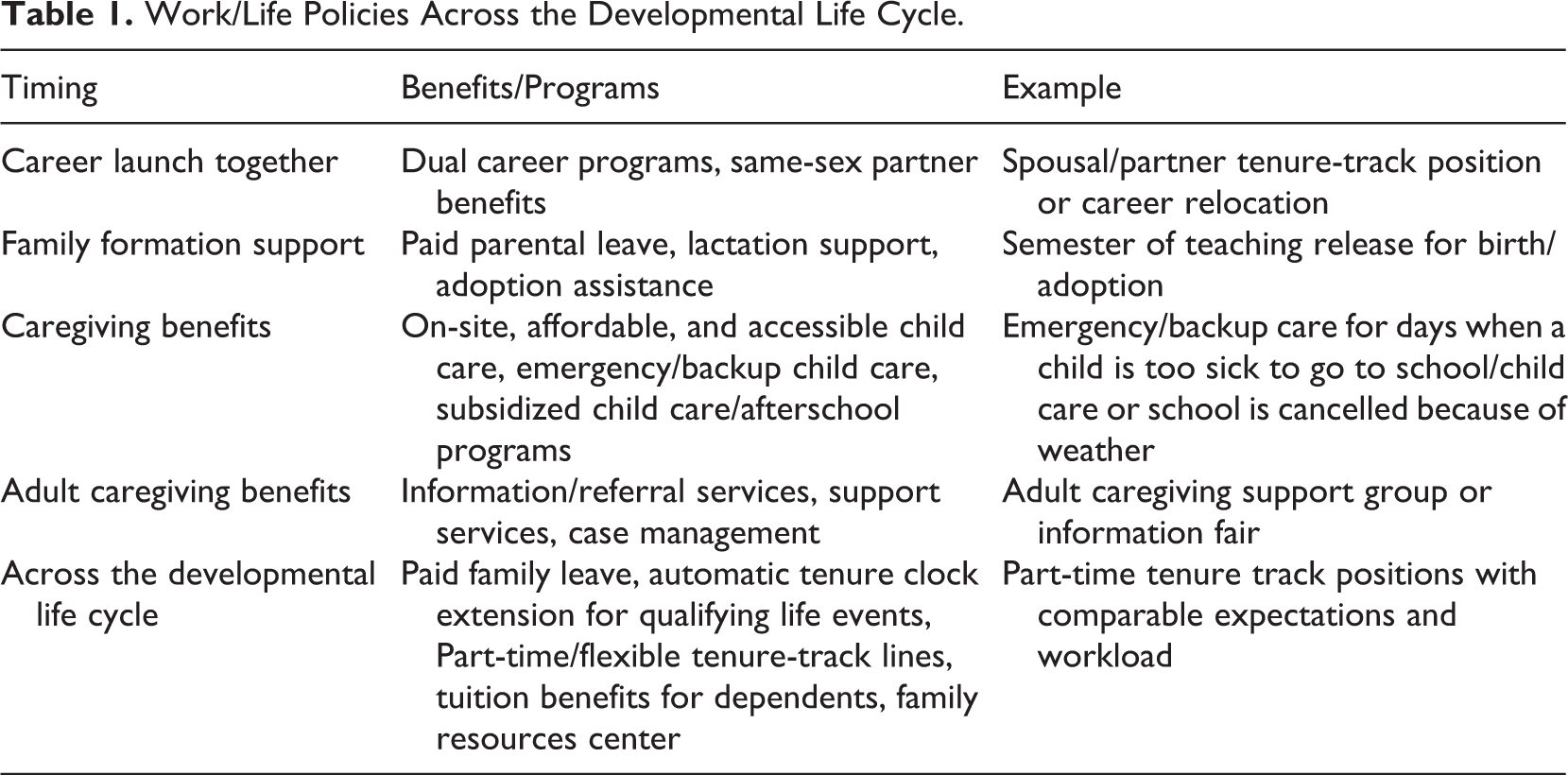
As recently as 2011, Gerten (2011) concluded that even though some universities have created a supportive environment for faculty mothers, formal policies to support female social work faculty are lacking. Through our analytic lens, policies are needed to support work/life satisfaction across the developmental life cycle. Leslie and Manchester (2011) suggest degendering work/life conflict as a strategy to increase the support of such initiatives. They reframe work/life conflict as both a man’s and woman’s issue, recognizing differences in men’s and women’s experiences. In discussions around work/life policy, giving examples of aging parents and unexpected illnesses help to dissociate gender and work/life fit (Lester, 2013). In Table 1, various work/life policies are organized, as each is relevant across the developmental life cycle.
Work/Life Policies Across the Developmental Life Cycle.
While degendering some work/life policies may be an important strategy to gain more universal support for work/life policy, gender and other axis of discrimination remain important analytic lenses to retain in the pursuit of equity in the social work academy. Inequity within university settings also manifests between faculty and other categories of employment. It is important to question work/life fit assumptions that perpetuate inequity between groups (e.g., full-time faculty vs. contingent faculty or faculty vs. staff) as well as the meaning of work/life satisfaction (e.g., applied narrowly to maternity leave vs. family leave; Lester, 2013).
Social workers have the knowledge, values, and skills to engage in advocacy efforts to increase work/life policies across the developmental life cycle. From a 7-year case study, Tower (2015) describes the following 10 strategies to achieve institutional change: (a) understand the institution; (b) conduct peer comparisons; (c) gather data to understand the internal and external environments; (d) describe the benefits to the institution and the target group; (e) estimate the costs; (f) act within your control, as change may occur from the bottom up; (g) cultivate policy champions and alliances; (h) remember policy change is not linear, anticipate resistance; (i) consider implementation; and (j) evaluate, correct, and improve policy to reach the policy goals. Others have suggested the importance in advocating for policy by educating faculty members and administrators, addressing climate issues, and finding champions within institutions who have the power and influence to institute policy changes (Hollenshead et al., 2005; Task Force on Women in Academe, 2000).
With university budgets repeatedly being cut, it is difficult to find the resources for new benefits. There may be important benefits that are relatively inexpensive. In the “career launch together” phase of the developmental/career life cycles (see Table 1), it is relatively inexpensive for a university to join a regional network of employers who recognize that hiring diverse and talented employees is frequently a two-career decision (e.g., Higher Education Recruitment Consortium).
During the timing of the “family formation support” phase, it appears that universities may be adding paid parental leave policies that are relatively inexpensive. Rather than adding a defined benefit through human resources, workload assignments are being reduced (without a pay reduction) through the academic side of the house (e.g., the provost’s office). Paid parental leave, for example, appears to be taking a trend of providing full pay and removal of teaching assignment for a semester. Of ADVANCE Universities (N = 124), Tower and Dilks (2014) report that while 36% offered 6–8 weeks of paid leave plus teaching release for the semester, about 10% only offered FMLA, 29% accrued sick or disability payments, 5% offered 4 weeks of paid leave, 16% offered 6–8 weeks of paid leave. Hence, the majority of institutions receiving the prestigious NSF ADVANCE grants did not offer generous paid parental leave.
During the timing of the “caregiving benefits” and “adult caregiving benefits” phases there is a care industry (e.g., Care.com or Select Plus/Sitter City) that caters to employers, including universities. These companies offer a childcare, eldercare, and other care (e.g., pets, housekeepers, & tutors) for long-term and last minute care (e.g., snow day or sick child). These companies provide metrics on its return on investment to the university.
Council on Social Work Education (CSWE)
Within social work there are some authors who suggest that CSWE’s accreditation standards and the efforts of CSWE’s Council on the Role and Status of Women are partially responsible for positive changes within Schools of Social Work (Di Palma, 2005; Sakamoto et al., 2008). Some of these changes are attributed to the shared social work values of social and economic justice.
The CSWE (2008) has provided a broad mandate with its accreditation process to address discrimination against women by requiring schools to demonstrate efforts to recruit, retain, promote, and compensate women equally with men (Bent-Goodley & Sarnoff, 2008; Sakamoto et al., 2008). Despite this broad mandate, CSWE does not gather annual data through its survey of accredited schools or its accreditation self-study documents to determine if this mandate is met.
Social support and self-care
Social support and self-care are important across the developmental and academic life cycles. Academic women and particularly those with children or older parents experience numerous challenges as they struggle to manage various aspects of work and meet tenure expectations (Goeke, Klein, Garcia-Reid, Birnhbaum, & Brown, 2011; Hellsten, Martin, & McIntyre, 2010). Within the context of academia, the demands of caring for family, illness, and work-related expectations may have an overall emotional impact, as well as an effect on collegial support (Hill, 2004; Lease, 1999). Other pressures may include incompatible demands from different personal and organizational roles, inadequate resources for appropriate performance, publication of cutting-edge research articles, increased expectations to secure grant funding, or leading one’s area of research expertise, while continuing to teach various classes, although this may be beneficial pedagogically (Gregory, 2001; Hill, 2004; Holmes, Land, & Hinton-Hudson, 2007).
Conversely, African American female faculty may experience their academic roles differently than their Caucasian colleagues. Teaching at a historically Black university (HBCU), Mawhinney (2012), in her personal narrative, explained the student–teacher bond that she describes as “othermothering.” Othermothering is a relationship where older members of a black community act as fictive kin to care for younger members in the community. In the institutional environment of HBCUs, black faculty are known to assume this othermothering role because there is an embedded sense of duty for them to support and nurture students relationships. This continued connectedness and othermothering role often entails personal and career sacrifices. Mawhinney reports that the self-sacrificing nature of othermothering results in a lack of self-care and that the mothering aspect of teaching can take an emotional, physical, and financial toll and can be equated to caresickness (i.e., black women educators tired from too much caring).
Whether female faculty are responding to institutional challenges or othermothering roles, a common consensus is that there is a point where unbalanced lives and multiple stressors become a negative factor in practicing self-care and building social networks and supports (Hellsten et al., 2010; Mawhinney, 2012). In a broad sense, female faculty overlook personal wellness and become remiss in routinely practicing self-care behaviors that self-nurture their minds and bodies including practices that involve looking at healthy ways to live and to assess self-renewal, reflection, and quality time away from issues of work (Stark, Manning-Walsh, & Vliem, 2005). In essence, job-related stress hampers female faculty from investing in quality time to care for personal needs and can result in burnout that generates physical and emotional exhaustion, apathy, cynicism, low energy and depression, lower motivation to work, and job dissatisfaction (Kelly, 2007).
The negative consequence of meeting academic and institutional requirements can also result in organizational stress or “role strain” which is understood to mean a chronic or ongoing stressor that is linked to the expectations of a particular social role or roles (Elliott, 2003, p. 158). When a faculty member has difficulty meeting career development expectations, this work imbalance can manifest into limited networking and social support experiences, which include restricted access to critical information, fewer opportunities to communicate with senior colleagues regarding the norms, protocols, and ethics of the profession, diminished visibility in the field, or reduced contacts within networks that may yield valuable job information and informal recommendations (Zu & Martin, 2011). Faculty women are therefore wise to build social relationships and professional networks as a way to reduce strains and mitigate the level of stressors (Viswesvaran, Sanchez, & Fisher, 1999). Social support networks can be of benefit to women across the developmental and career life cycles.
Social support and networking helps to give individuals the emotional and practical resources to feel cared for, loved, esteemed, connected, and valued. In times of need, social relations also become essential to people’s well-being and health. During the early childbearing years when a female faculty is working on tenure and simultaneously caring for young children, it can be very supportive to be connected to other faculty within a similar developmental phase, and in this way creating a network of support that can promote well-being. The same applies to older female faculty who are taking care of both older teenage children and aging parents. Hence, academic women need to find ways to build strategies to increase feedback loops within their professional circles to manage challenging obstacles, become intentional in taking advantage of opportunities to regroup and refresh without feeling guilty, access and connect to a professional community, and ensure that they are not giving lip service to self-care practices (Collins, 2006) but are embracing and implementing healthier lifestyle options.
At the same time, universities owe it to their faculty to facilitate social support. Examples may include new faculty orientations, development opportunities, and leadership initiatives. For a faculty orientation to meet the needs of faculty women, adding materials particularly of interest to women may include community support resources, university policies related to work/life satisfaction, sexual harassment, and the workplace.
Modeled after the coaching method used at the Women’s Leadership Forum at Harvard, the West Virginia University Women’s Leadership Initiative (WLI) is an “on-campus leadership development and support program” (p. 52) that serves large groups of women, at a relatively low cost (De-Frank-Cole, Latimer, Reed, & Wheatly, 2014). WLI uses an evidenced-based, structured curriculum that is led by former WHI participants who have been trained to coach.
The role of mentoring
Many researchers concur that mentoring is a critical resource for career development and advancement for women (Simon, Perry, & Roff, 2008) and “invaluable for social work education and practice” (Pomeroy & Steiker, 2011). However, discussions around work/life conflict have normally been excluded from the traditional role of mentoring until the reality of female academicians was taken into account. The purpose of mentoring is to allow the experienced professional (mentor) to act as a role model and advisor to the professional (mentee or protégé) with less experience (Simon et al., 2008).
Mentoring may be valuable across the developmental and academic life cycles. As faculty ascend the academic life cycle, one may continue to benefit from mentors as well as offer and experience benefits from being in the role of mentor to more junior colleagues. Unfortunately, many societal inequalities are replicated and reinforced with the social contexts of universities, and without better representation of women faculty in leadership positions, change within the academy may be slow, and lead to accumulated disadvantages for faculty women. These disadvantages are intensified for women of color (Vakalahi et al., 2007).
Goeke, Klein, Garcia-Reid, Birnhbaum, and Brown (2011) cautioned that helping female faculty requires more and specific types of mentoring than most programs provide due to being a typically male-dominated and centered setting. When specifically focusing on the mentorship experiences among women, mentoring has been described as a developmental relationship (Jabour, 2012; Pomeroy & Steiker, 2011) constructed on mutual trust. Grant classified effective female mentorship into three types as follows: (a) a peer mentor may help build knowledge about the current position; (b) a career development mentor may be valuable in navigating the system’s policies, procedures, and politics; and (c) a personal mentor may provide support and advice on issues including the delicate balance of work, family, social, and civic obligations.
The mentoring process for women ought to have various components to be meaningful to the gendered experience. One is informal support in the form of informal meetings with mentors that are personally selected (O’Connor et al., 2015; Young & Holley, 2005). Another is a type of feminist co-mentoring that involves supporting women’s development by leading and guiding; listening, questioning, and connecting; and being an ally (Bloom, 1995). Vaught (2008) emphasized the type of listening that leads to healing and empowerment. While McGuire and Reger (2003) favored including the whole person that dispels the view of the “disembodied intellectual” by attending to academics’ familial, personal, and emotional needs (p. 54). Such mentoring is in contrast to traditional hierarchical mentoring models. As such, mentoring is appropriate throughout the career life cycle.
There is some evidence that mentoring is best done within social affinity groups, for example, in relationship with women by women. Mentoring is a stable characteristic in the successful careers of many social work faculty women leaders and pioneers (Jabour, 2012), especially through female relationship and friendships, which were closely connected and mutually reinforcing. A study by Perrakis and Martinez (2012) on how female chairs with young children negotiated their personal and professional roles found the mentoring from a departmental dean was vital. These authors emphasized that most of the deans had children, an indication that personal experience with a phenomenon is an important factor in empathizing with it. They support having many mentors inside and outside of one’s departmental unit.
There are concerns expressed about the mentoring process. One of the main concerns is the lack of senior women at higher rank and in management positions that can act as female mentors to junior faculty (Cullen & Luna, 1993). A strategy to overcome this obstacle is to implement peer mentoring. Jabour (2012) contends that “female circles of friendship, same-sex partnerships, and single-sex political networks facilitated women social workers’ political effectiveness, professional causes, and personal fulfillment in the formative decades of the profession” (p. 25). Peer mentoring is a model that may reinforce female faculty’s agency. Some scholars have been successful leveraging institutional support for such an initiative (Bussey-Jones et al., 2006).
Another concern about mentoring relates the geographical distance between mentor and mentee. Social media can lessen some of the challenges. Mentors outside of the protégé’s academic unit are heavily reliant on the mentee’s explanation of the culture and context of her concerns with home institution. One strategy, if possible, is to also have a mentor at the mentee’s home institution.
Social identity and intersectionality, particularly across gender and race, is another challenge. Same gender mentors may take into account protégé’s family life in aspect of her work. Racially dissimilar mentors and protégés may not discuss racial issues (Simon et al., 2008). Strategies to combat this exclusion include selecting a mentor who is open to difficult conversations, becoming adept at initiating difficult conversations, and making time to meet (McGuire & Reger, 2003). For mentoring to help women achieve work/life satisfaction, it must be structured to fit the lives of women. Optimally, women ought to be mentored by other women; however, males sensitive to the context of gender may be appropriate substitutes. Mentoring is a complex phenomenon. It involves relationships that need to be nurtured as well as shared feminist values.
Conclusion
The goal of this article is to reinvigorate conversations about how to ameliorate inequities female social work faculty face in the academy. We find hope in women continuing to bring their experiences to the foreground. Through a feminist lens, we examine barriers faculty women encounter as well as strategies to reduce these barriers across the developmental and career life cycles. Solutions suggested herein include supportive work/life policies. As social workers, we have the expertise to advocate for new work/life policies at our home institutions. In doing so, it is important to minimize inequities across institutional stakeholders as well as organize support so that faculty may feel comfortable using the policies. Additional solutions suggested include social support and self-care and mentoring. While these suggestions are not new, these solutions are being evaluated with promising results.
Footnotes
Acknowledgment
We wish to express appreciation to Anna Greta Hrafnsdottir for her research assistance, which was made possible by the Beatrice Ruth Burgess Center for WV Families and Communities.
Authors’ Note
Any opinions, findings, and conclusions or recommendations expressed in this material are those of the author(s) and do not necessarily reflect the views of the National Science Foundation. A version of this article was presented as a Connect Session at the 2013 APM for the CSWE.
Declaration of Conflicting Interests
The author(s) declared no potential conflicts of interest with respect to the research, authorship, and/or publication of this article.
Funding
The author(s) disclosed receipt of the following financial support for the research, authorship, and/or publication of this article: Partial support for this work was provided by the National Science Foundation's ADVANCE IT Program under Award HRD-1007978.