




Abstract
In this paper, we theorize toxic white femininities as a performance and persona in school social work. To develop the theory and analytic tool of “toxic white femininities,” we used critical discourse analysis to analyze school social work professional association materials from 1906 to 1936. Our analysis isolated three performances of toxic white femininities in early 1900s school social work: (1) the exclusionary social and material gains of “her” professionalization, (2) “her” reinforcement of racial-gender-class hierarchies, and (3) “her” strategic use of helper identity to mask social control. We trace how these performances coalesced into a collective professional persona, operating beyond the scope of individual practitioners. This persona institutionalized a racialized-gendered professional identity, presented in the archives as a universal “she”—white, middle class, and feminine. With private funding from white elites in the early 20th century, school social workers—constructed discursively as white women—would become the “right” profession to shape the lives of young people and guard the privileges of whiteness. We close with a discussion of “her” long shadow and contemporary performances, outlying the ways toxic white femininities operate as a form of incremental violence impacting the profession and social services.
Keywords
Introduction
Fifteen years after Flexner (1915) declared social work a non-profession, a white 1 woman named Newton (1930) proclaimed that social work had become professionally legitimate, referring to the rapidly proliferating “Miss Case-Worker” archetype. Rather than being dismissed as good-hearted charitable volunteer women, Newton claimed that social workers finally embodied authority and expertise that warranted professional status and wages. Walkowitz (1990) described this shift as indicative of the efforts by women to embody applied sciences as well as culturally prescribed assumptions of inherent knowledge relating to household management and the care of children. Though race and class were not explicitly named in Walkowitz's analysis, the implication was that the “Miss Case-Worker” persona allowed predominantly middle-class and wealthy white women to have “a work identity that would both give professional status and preserve their femininity” (p. 1051).
Though undertheorized in social work literature, we argue that white femininity—the intersection of white racial privilege, femininity, and middle-class respectability—was and continues to be a phenomenon in social work. In the example of “Miss Case-Worker,” the need for an archetype or persona that advanced professional status and protected femininity itself signaled gendered and classed racial privilege, as Women of Color and poor women in the early 20th century were forced to the margins of the workforce without concern for how white hegemony and a classist society denied them femininity (Haley, 2016; Hartman, 2019). Recently, critical feminist social work scholarship has theorized about race, gender, class, and social work professionalization in relation to contemporary issues. However, white femininity remains undertheorized as a contemporary or historical phenomenon in the social work literature.
We propose a theory of “toxic white femininities” in social work by weaving together concepts from feminist theories of gender and whiteness as performances (Ahmed, 2007; Butler, 1993; Inda, 2000; Mirón & Inda, 2000). After building a theoretical foundation, we present a critical discourse analysis (CDA) of the National Association of Visiting Teachers (NAVT) archives from 1906 to 1936. The NAVT was the national professional organization in the United States representing the interests of visiting teachers, the early 20th-century term for school social workers. We demonstrate how white women leading the NAVT produced and circulated performances of white femininity through speech acts, NAVT newsletters and conference proceedings, ultimately coalescing these performances into “her”: a white middle-class feminine persona that institutionalized white hegemonic expectations of social work knowledge and practice in public schools.
Drawing from Nixon’s (2011) concept of slow violence, “a violence of delayed destruction that is dispersed across time and space, an attritional violence that is typically not viewed as violence at all,” (p. 2) we use the word toxic to describe how the discursive, epistemic, and material choices of an organized group of white women during a critical moment in school social work professionalization culminated over time to create the bedrock for social work practice in schools. Further, we use the word toxic to signal how, during a period of social and economic upheaval, white women organized themselves to become institutional agents who, in the position of “helper,” maintained public schools as hostile spaces for Families of Color as well as settings where racial privilege was afforded to white American families and select European immigrant families (Du Bois, 2017). In our findings, we demonstrate how white women, under the guise of “helping professionals,” actively engaged with and benefited from the reproduction of white hegemony. We close with a discussion of how toxic white femininities as a persona persists and orients normative processes of school social work practice, significantly shaping students’ educational trajectories, and determining who was deserving of class mobility, and educational advancement across generations of families. In conjunction with white femininities, we chose the word toxic to encompass our theorizing of gradual, organized violence dispersed through everyday professional performances of school social workers across the United States.
Theoretical Foundations of toxic white femininities
Femininity as a Performance
Butler's (1993) theory of gender performativity countered notions of gender as a stable individual identity or bodily fact. Instead, Butler argued that gender as well as its material consequences are created through “stylized repetition of acts,” or performance (p. 519). In this vein, femininity is not preconditional to talk, text, or action. Discourse—talk, text, or action—as a form of performance, has power “to produce the phenomena [of gender] that it regulates and constrains” (1993, p. 2). Feminist scholars have traced how discourses of femininity operate within white hegemony to construct expectations of womanhood that not all bodies can successfully perform. The regulation of femininity as an exclusionary performance justifies the subsequent material consequences that follow when groups are deemed incapable of a particular gender performance (Haley, 2016). This work has extended Butler's theory of gender performativity to understand white femininity as an exclusionary performance that is raced and classed (Frankenberg, 1993; Moon, 1999). Specifically, the protections and benefits of “true womanhood” in the context of white hegemony fully converge at the intersection of whiteness and middle-class respectability (Davy, 1995).
Feminist education scholars have applied the concept of “true womanhood” to examine the white woman teacher archetype as a byproduct of middle-class sensibilities, anti-Black sentiments, and settler colonial attitudes (Bauer, 2021; Meiners, 2002; Schick, 2000). The specific heroic image of the exemplary white woman school teacher saving children is rooted in a legacy of 19th-century white Republican motherhood, “inherently holy and pious, enshrined as the mothers of the nation and thus the obvious protectors of the family's and the nation's moral compasses,” a role which extended into the professional domain (Bauer, 2021, p. 646). In this vein, the white women teacher archetype demands exclusionary feminine performances that are inherently raced and classed. The ongoing legitimatization of these exclusionary performances and their association with “good teaching” has resulted in the overvaluing of white femininity in the teaching profession and the simultaneous erasure of Black and Indigenious traditions of knowlegde (Meiners, 2002).
whiteness as a Performance
Whiteness is both an embodied socially constructed identity and the nexus of structural inequalities upheld by the law, which at its origins involved enslaving, rather than becoming enslaved, and seizing land, rather than having land seized (Harris, 1993). The embodied, experiential, and material dimensions of whiteness are captured in Ahmed's (2007) conceptualization of whiteness as a phenomenon: “an effect of racialization, which in turn shapes what it is that bodies ‘can do’” (p. 150). Ahmed (2007) uses Bourdieu's (2020) concept of habitus to argue that whiteness is a phenomenon experienced across society and upheld in specific social spaces (e.g., public schools and professional conferences) through habits, everyday mundane doings of whiteness that shape public life and subsequently shape the socialization of future white habits (Frey et al., 2022).
Whiteness as something that is done through mundane acts in social spaces shaped by and oriented toward whiteness has resonance with theories of race as performance and racial performativity (Mirón & Inda, 2000). Building upon Butler's (1993) theory of gender performativity, Inda (2000) argues that discourse is a performance that can construct racial bodies. If the social category of “woman” is constructed through a string of performances in public discourse—for example, the repetitive use of the words “she” and “her” to refer to an anonymous body—then race may also be constructed discursively through discursive performance. Inda (2000) demonstrates this performance by tracing a thread between Butler's declaration “it's a girl!” and Fanon's remark “look, a Negro” (Fanon, 2008). In both examples, gender, race, and social space are constructed by speech acts of people with contextual authority. In the example of Fanon, where Blackness is Othered, the remark assumes a social space shaped by prior performances of whiteness and oriented toward future performances of whiteness (Ahmed, 2007).
white femininity as an Intersectional Performance
Crenshaw's (2013) theory of intersectionality describes how “relationships of power intersect” (Ahmed, p. 159). Drawing on a conceptualization of power that hinges on structures of inequality having “mutually constituted relationships with each other” (Ferree, 2016, p. 85), Mirón and Inda (2000) named the inherent intersectionality of discursive performance: “the subject is sutured, stitched in place as it were, at the intersection of various discourses. A raced subject is thus always a hybrid gendered, sexualized, and class-oriented construct” (p. 96). We take this as an analytic starting point for white femininity as an intersectional performance of whiteness, femininity, and middle-class respectability. Specifically, we examined the space of professionalized school social work and public schools.
Critical education scholars regard performances of white femininity in schools as evidence of white women's participation in white hegemony (Allen, 2022). Repetitive, institutionalized performances of white femininity continue to make public education a system that universalizes 2 whiteness; staff, the majority of whom are white women, are trained and expected to disperse privileges to white families while subjecting Families of Color to standards of whiteness through curriculum, assessment practices, and disciplinary techniques (Leonardo & Boas, 2021). Institutional performances of white femininity by public school teachers have been the focus of much scholarship (Bauer, 2021; Meiners, 2010). While teachers’ performances are directly linked to students’ experience of academic curriculum, schools are also sites of direct service provision, other types of instruction (e.g., social emotional learning), and cultural reproduction. Therefore, it is critical to examine the particular legacy of school social work and how performances of white femininity may be institutionalized within school-based social work practice.
Methods
We conducted a CDA of 63 NAVT conference proceedings, professional association materials, and Bulletin (national professional newsletter) articles from 1906–1936. During our analysis, we referred to Willey-Sthapit and coauthors’ four signposts of CDA: “(1) theoretical framing and rationale, (2) sampling and data generation, (3) data analysis, and (4) dissemination of findings” (2022, p. 130). CDA was well-suited for our inductive archival analysis of school social work documents, as it is a method focused on how acts of public speech—performances of talk, text, and action—are shaped by and in turn shape configurations of power (Park & Kemp, 2006). In this vein, we used CDA to uncover why and how specific discourses, knowledge, and practices became legitimated and institutionalized, as well as what the longer-term effects of this legitimization and institutionalization were on school social work and public education.
Our process of CDA was sensitized by Butler's (1993) notion of gender as a performance that “seems to congeal into the most reified forms, the ‘congealing’ is itself an insistent and insidious practice, sustained and regulated by various social means” (p. 43). It was also informed by Mirón & Inda's (2000) notion of race as “constituted performatively as a kind of speech act that, in very act of uttering, retroactively constitutes and naturalizes the subject to which it refers” (p. 103). Thus, our analysis traced discursive patterns across archival documents that implicitly and explicitly described visiting teachers’ whiteness, femininity, and middle-class identity. We also examined when and how these performances became institutionalized within the visiting teachers’ movement. Within each document, we attended to moments in the text when words, phrases, organizational elements, and subjective expressions constructed white femininities in the professional space of the NAVT (Willey-Sthapit et al., 2022). Through this process, we identified three performances of toxic white femininities: (1) the exclusionary social and material gains of professionalization, (2) reinforcement of racial-gender-class hierarchies, and (3) strategic use of helper identity to mask social control.
In our analysis, we regarded the NAVT archive as a single case. The focus on social workers in public schools strengthens the construct validity of our findings by specifically articulating the role of school social workers in contrast to the role of other helping professionals in schools. Further, we approached the NAVT archive as a collective performance by an organized group of white women, seeking to isolate moments in the text where speech acts reified a particular racialized and classed gender performance—a set of talk, text, and action that constituted the archetypal white woman school social worker. We entered our analysis with prior knowledge and context about the archives. Most saliently, we were aware that the NAVT was led by white women and that the White-Williams Foundation, a private foundation in Philadelphia, funded the NAVT's early 20th-century conferences and published materials (Everett, 1925). Therefore, we regarded the NAVT's performance of specific discourses, knowledge, and practices as choices legitimatized by a powerful philanthropic group.
Lastly, we explicitly selected CDA based on our positionalities and continuously shifting relationship to white femininity as a persona and performance. Author 1 is a queer white Jewish woman and Author 2 is a queer bi-racial Black woman. We are both early-career social work scholars with direct practice experience in schools and community mental health settings. Our intent was not to evaluate the thoughts and feelings of individual white women, but instead to trace how the public performances of an organized collective of white women shaped school social work at a critical moment of professionalization (Willey-Sthapit et al., 2022). As part of this analytic commitment, we asked each other questions about why certain sections of the archival material were salient to each of us, as well as how our own positionalities potentially influenced our analytic decisions and priorities. These self-critical dialogs allowed us to memo individually and collaboratively about the ways in which gender, race, social class, and professional experience were shaping our first interpretations of text on the page, and the implications of those interpretations for our broader conceptual project. Our analysis within this archive facilitated deep and self-critical reflections about the potential impact of this analysis, prompting us to identify the ways that we have each professionally participated in the legacy of toxic white femininities laid out in these documents from nearly a century ago. This reflexivity on the institutionalization of toxic white femininities in school social work was particularly salient during our reflections on our own clinical social work training, where conceptualizations of mental health were highly individualistic, foundational conversations of social work boundaries and rapport with clients were scripted through white femininity, and these ontological assumptions mirrored the demographics of our respective programs.
Three Performances of toxic white femininities
“Her” 3 Exclusionary Gains of Professionalization
The NAVT frequently disseminated illustrations of the visiting teachers’ movement with the ideal visiting teacher personified as a white woman. The image below reflects the ways these illustrations directly engaged performances of femininity, whiteness, and middle-class respectability (NAVT, 1926b). Specifically, the visiting teacher was consistently illustrated as a white, young, thin woman wearing modest feminine clothing. This archetypal visiting teacher was always well-groomed in alignment with white ideals of early 20th-century middle-class femininity. In addition to circulating illustrations that explicitly gendered, raced, and classed their profession, the NAVT repetitively referred to anonymous visiting teachers using the pronouns “she” and “her.” Taken together, the NAVT's discursive choices created exclusionary expectations for who visiting teachers were—middle-class white women—and oriented the visiting teachers’ movement toward legitimizing performances of white femininity.
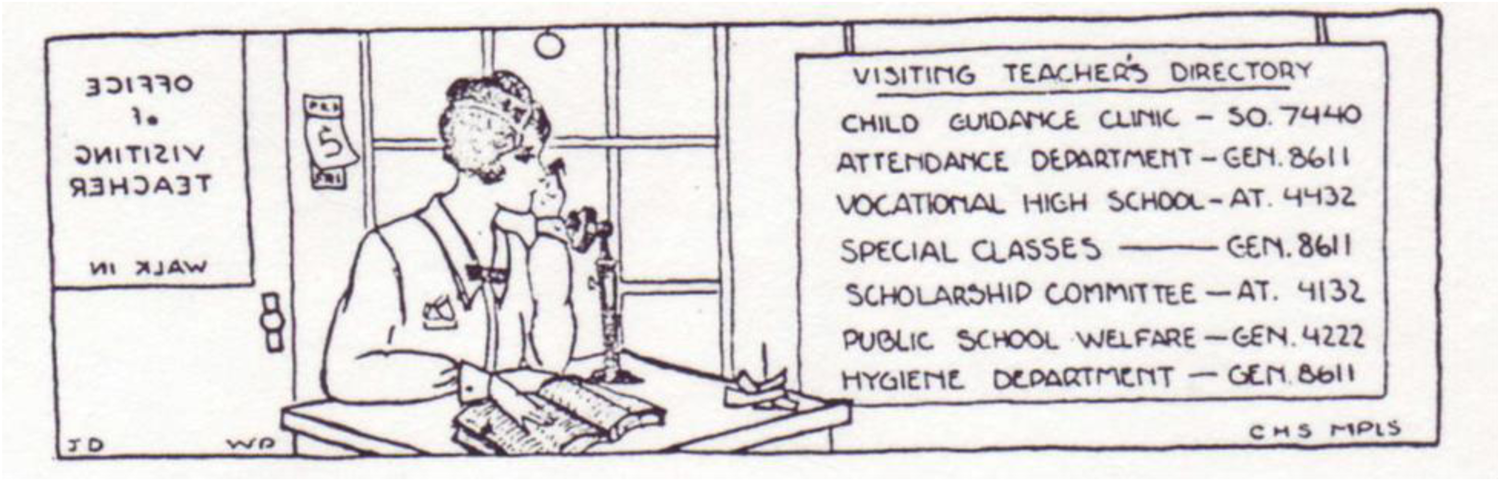
In addition to disseminating images of the archetypal visiting teacher, the NAVT paired the illustrations with text describing “her” ability to handle professional obligations. For example, the image above was placed under the heading “The Visiting Teacher and the Co-Ordinated School Departments,” an article describing how visiting teachers in Minneapolis coordinate with other school departments (NAVT, 1926b, p. 13). The frequent pairing of the archetypal visiting teacher with text describing her labor crafted a performance that extended preexisting characteristics associated with middle-class white womanhood, such as inherent civility and morality, into the professional domain. The NAVT achieved this linkage by portraying visiting teachers as astute and rational. To demonstrate, in relation to the specific image above, NAVT argued that the visiting teacher had expertise about how and when to engage with other school professionals. With expertise about the various systems at “her” disposal, the visiting teacher was positioned as the ultimate referral source and service-navigator: …the Vocational high school, the different scholarship aids, and the Public School Child Welfare are all within the system, their energies released and set in motion toward the visiting teacher does she but lift the receiver and call their numbers. (NAVT, 1926b, p. 13)
The NAVT's illustrations of the visiting teacher were also repetitively paired with text describing “her” ability to deploy applied sciences in school-based practice. At the turn of the 20th century, social workers—including visiting teachers—were economically incentivized and socially legitimatized when they applied scientific methods to predict and treat individual “maladjustments” (Abrams & Curran, 2000; Kennedy, 2008). The NAVT's professionalization strategy expanded the preexisting archetype of white womanhood in the United States to include the white feminine embodiment of proximal human sciences, such as psychiatry and case work (Everett, 1925; Walkowitz, 1990). For example, in a 1927 publication circulated amongst visiting teachers, a male professional was quoted as saying, “I thought just any ‘good woman’ could be a visiting teacher. I never realized the size of her job” (NAVT, 1927, p. 2).
The illustration below demonstrates how the persona of the visiting teacher, a respectable middle-class white woman capable of psychiatric social work and casework, “formed the bedrock” of school social work at a critical moment of professionalization (Allen, 2022, p. 91). In the illustration, “she” was presented as integral to NAVT's past as well as foundational for the future of school-based practice (NAVT, 1933 p. 6). On the left, in 1913, “she” was an elderly white woman frowning while using The Kingdom of Evils, a psychiatric social work book, to diagnose children. In 1933, “she” aged backward into a young, thin, white woman adorned with high heels, feminine modest clothing, and neatly-coiffed hair. In between the images is a quote from early 20th-century educator John Dewey, describing personality and character as traits that children develop in school.
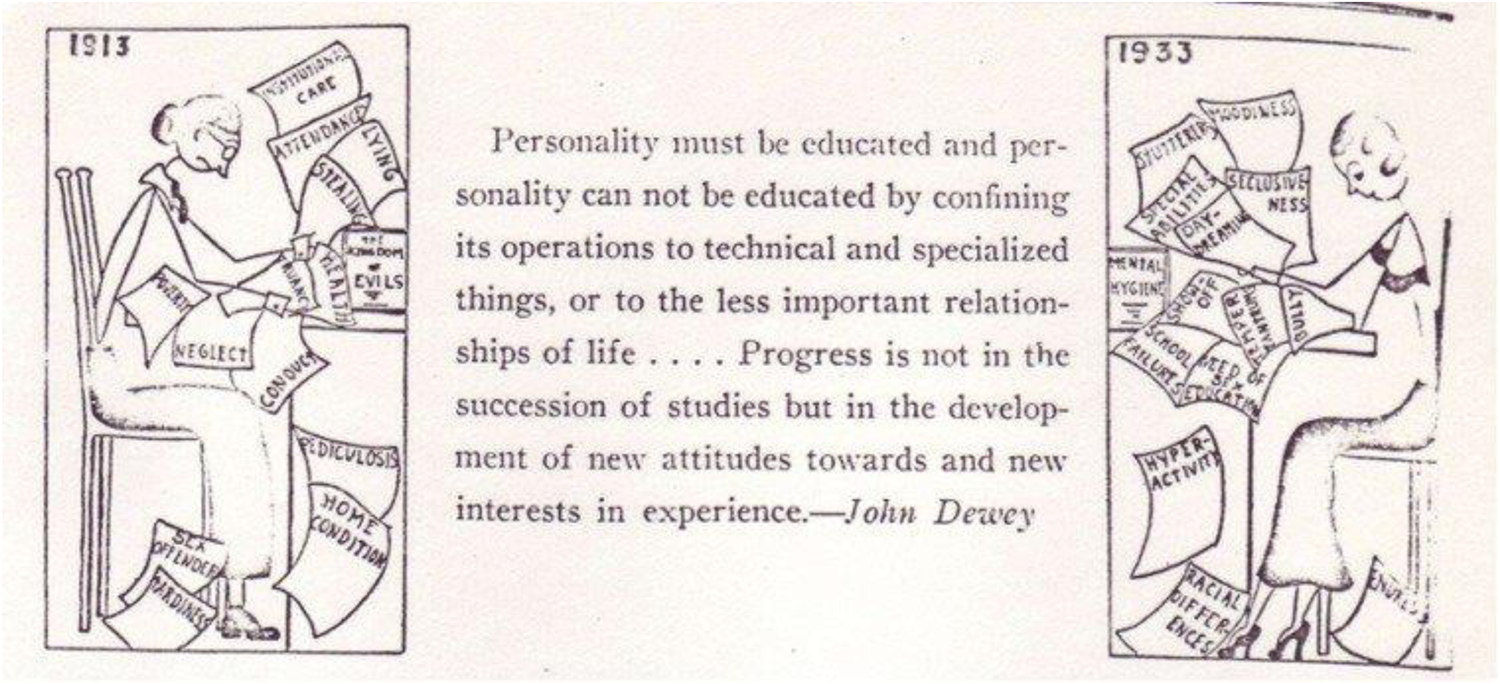
Embodying middle-class white femininity and applied sciences, the visiting teacher of 1933 used Mental Hygiene, a psychiatric social work book, to identify predictive characteristics of “maladjustments” in children such as “hyper-activity,” “racial differences,” and “school failure.” The text, in conjunction with the image of “her,” discursively positions visiting teachers as preventative professionals who know which students to target for intervention. Further, the NAVT's depiction of “her” aging backward into an idealized well-kempt white woman suggests that visiting teachers’ embodiment of applied sciences improved over time as the profession's role shifted from diagnosis toward preventive intervention. The NAVT's commitment to embodying predictive scientific knowledge hinged on racialized and ableist perceptions of human difference. This active participation in white hegemony legitimized racial hierarchies among students, affecting their experiences in school and subsequently in society. The NAVT disseminated illustrations of the visiting teacher like the one above in an attempt to construct a persona that brought together the discourse, knowledge, and practices of dispersed visiting teachers employed in schools across the United States.
“Her” transformation above is a reflection of the NAVT's exclusionary professionalization strategy, the cultural production of a socially desirable persona which depended on performances of middle-class white femininity and applied sciences. Notably, the NAVT deemed these professionalization efforts successful. In 1926, NAVT President Rhea Kay Boardman published a letter to members in the Bulletin reflecting on visiting teachers’ increasing professional status: We have not only grown in numbers but have gained recognition as a professional group as well … One fact apparent in the general meetings and manifest individually, seemed to be that visiting teachers combine the vigor and enthusiasm of the pioneer with the technique and equipment of the trained worker. (1926c, p. 1)
The NAVT repeatedly used settler colonial language to describe their work, characterizing the visiting teacher as a “pioneer” and public schools as a frontier. These discursive choices took material form as middle-class white women were employed as visiting teachers by the U.S. Indian Bureau. As visiting teachers, these white women worked in boarding schools that separated Indigenous children from their families where they were subjected to abuse and forced assimilation (Adams, 1995). At a 1932 NAVT regional conference held in Washington D.C., the U.S. Indian Bureau announced its plan for expanding the role of visiting teachers: Carson Ryan JR., Director of Education of the Indian Bureau, then told of his plan to introduce visiting teacher service into the Indian Schools and introduced Miss Dorothy Deane as the first visiting teacher to be appointed. Miss Deane has been serving in this capacity since September in the school at Lac du Flambeau, Wisconsin. She told of the conditions she finds in family life among the Indians of this reservation and described the character of her work as she has found it necessary to adapt it to the needs of that community. (NAVT, 1932 p. 2)
4
The NAVT's discursive performances culminated into an exclusionary professional persona, an early 20th-century gender innovation that embodied middle-class white femininity and applied scientific knowledge. The creation of this persona reflects the institutionalization of white femininity in the visiting teachers’ movement, highlighting how the NAVT implicitly required visiting teachers to perform white femininity as part of professionalization.
“Her” Reinforcement of Racial, Gender, and Class Hierarchy
The NAVT published issues of the Bulletin focused on visiting teachers’ practice in specific Northeastern and Midwestern cities. These issues included articles describing localized problems that visiting teachers encountered and case examples of visiting teachers’ responses to those problems. The NAVT's narratives of these place-based issues served to demonstrate the localized expertise of visiting teachers while also signaling the existence of generalizable social ills and problem community archetypes across the United States. Within these local descriptions, the NAVT's discourse separated problem-community archetypes into categories of inherently good and inherently bad communities. As demonstrated in two New York City neighborhood case studies published in the same issue of the Bulletin, this discursive construction justified the racialized-gendered-classed practice interventions that followed.
Between 1910 and 1920, the previously majority-white New York City neighborhood of Harlem became the majority Black (Editors, 2020). In 1910, three-fourths of New York City residents were immigrants or first-generation Americans from Southern and Eastern European countries (Library of Congress, n.d.). A 1926 issue of the NAVT Bulletin contextualized the landscape of visiting teachers’ work in New York City by comparing the Lower East Side, a European immigrant community, to West Harlem, a predominantly Black and Brown community (NAVT, 1926a). The Lower East Side was described as follows: The section east of the Bowery populated with immigrants from Russia, Poland, Austria and the countries adjacent, and bordered on the west and south by Italian immigrants. Many of the tenements are old and dark. Some of the streets are narrow. Playgrounds are few, small, and inadequate. In this congested neighborhood there is a public school and a movie every few blocks. Many streets are lined with push carts. (NAVT, 1926a, p. 24)
The NAVT's publication of these community descriptions positioned visiting teachers as experts on groups of people to whom they assigned generalized attributes. This was reflected in the NAVT's continued description of European Jewish families living in the Lower East side neighborhood: These Jewish families came to America with hopes of prosperity for the family and education for the children. However hard their lot, the parents are ambitious for something better for the children. The stepping stone to this is education. A majority of the elementary school graduates attend high school. If finances do not permit attendance by day, then they work by day and attend at night. In the same way they frequently get a college education. With this predisposition toward education, why the need for the visiting teacher in this section? (NAVT, 1926a, p. 24)
The coupling of immigrant European Jewish culture with a “predisposition toward education” attributed desirable traits to European Jewish immigrants; according to the NAVT's narrative, they came to America to give their children “something better” and viewed education as “the stepping stone” to success for their children and future generations. Through this discourse, goodness and a “predisposition toward education” become inherent traits of the European Jewish communities of New York City. This essentializing of European Jewish communities continued in the text: Misunderstanding arise between foreign parents and their children educated in America and conflict of purpose between parents and children- and children
This construction of European Jewish communities as a distinct “race” with inherently good qualities directly informed a specific practice strategy: The visiting teachers realize that these people are struggling against great odds in a strange country. They are ambitious, zealous, often gifted, emotional, neurotic; drifting away from the traditions, culture and religion of their forefathers, and as far as the elders are concerned not replacing these with the traditions of America. Their children with their intellectual pursuits and their independence are their pride and their despair. Leaders they will be, but of what kind depends on the wise personal guidance of the school during their early years (NAVT, 1926a, p. 25)
The NAVT's racial discourse placed American-born children of European Jewish immigrants in a tenuous position, not quite of their elders and not quite American. However, through the “wise personal guidance” of visiting teachers, NAVT argued that American-born Jewish students could become the right kind of “leaders” in America. Given the NAVT's explicit racial language to describe European Jewish communities, we interpret this characterization as the visiting teachers’ essentializing application of racialized notions of intellectual ability to an entire group. After essentializing European Jewish communities, NAVT then used that essentialization to inform a practice of “guidance,” working to bring European Jewish students closer to whiteness.
The NAVT's description of the European Jewish community on the Lower East Side starkly contrasted against their description of West Harlem's residents: The largest group of colored people in New York City, and in fact in America is located in that portion known as West Harlem. Its population comes from Cuba, Porto Rico,
5
British, Dutch and French West Indies, as well as our northern and southern states. (NAVT, 1926a, p. 26)
The NAVT's description of European immigrant communities allowed groups to retain their distinct ethnic identities; Jewish, Polish, and Italian were descriptors used across archives to trace cultural lineages of children with the potential to become white. This contrasts with the NAVT's discursive flattening of culturally- and linguistically-heterogeneous Black and Brown families into a single “colored” racial category. The text above is the only place in the archives were the NAVT elaborated on “colored” as a racial category; in all other places, the NAVT racialized diverse communities as “colored.” Further, compared to the “wise personal guidance” given to Jewish students, the NAVT's visiting teachers neglected to invest their advice and support in West Harlem students as future “leaders.” Instead, they constructed the West Harlem community as an inherently and intergenerationally deficient group: While the visiting teacher's problems are very much the same as other districts, there are two added features, i.e., the economic status which forces both parents to go out to work, and the automatic segregation of the population whereby the good and the bad live in close juxtaposition. The former fact supplies the opportunity for every form of vice, and the latter supplies the agent. (NAVT, 1926a, p. 26)
Though the NAVT reported high levels of poverty and disruptions to family life in the Lower East Side and West Harlem, only families in West Harlem were associated with perpetual “vice.” Additionally, in contrast to the sympathetic tone used to describe European Jewish immigrant parents, the NAVT denied parents in West Harlem humanity by failing to acknowledge the challenges of simultaneous wage labor and household management. West Harlem parents, many of whom were identified in the text as immigrants, were constructed as negligent in the NAVT's eyes, characterized as absentee parents who left their children exposed to neighborhood “vice.”
The contrasting discourse in the same issue of the Bulletin constructed two separate student groups, one good and one bad. The side-by-side publication of these cases in the Bulletin discursively positioned Lower East Side Jewish students’ whiteness in contrast to their “colored” and intrinsically deficient West Harlem peers. Given the shifting boundaries of whiteness in the late 1800s and early 1900s, nativism played a substantial role in the racial attitudes of many Americans (Jacobson, 1998). As Park and Kemp (2006) have noted, social workers during the early 1900s experienced “concerns in the period about race, raciocultural propensities, and the inevitable racial amalgamation of American and alien stocks” (p. 710). The NAVT's racial logic is an example of social work practice in schools redrawing the boundaries of whiteness, an essential task in the reproduction of the U.S. racial-gender-class hierarchy.
“Her” Strategic Use of a Helper Identity to Mask Social Control
A central focus throughout the archive was the public's perception of the visiting teacher and her professional tasks. This focus largely manifested in the NAVT's discursive moves to the position and reify the visiting teacher as a helper to low-income European immigrant children and families. However, retaining this focus required participation in the maintenance of boundaries between whiteness and racial Otherness. Further, the NAVT produced a professional persona, a presumably American-born middle-class white woman, as the ideal professional to attend to these racial boundaries in public schools. Situating both these discursive strategies, this section illustrates that when constructing visiting teachers as helpers, the NAVT relied upon the constructions of some immigrant families as pathological racial others. While doing so, they administered interventions that often functioned as forms of social control.
The visiting teacher's helper identity was carefully articulated: she was to be a noble but humble worker. One issue of the Bulletin presumed that the informed public would “call upon the visiting teacher for help in their official or individual projects, and will reciprocate” (Brown, 1925, p. 9). Later, however, the report clarified that professional publicity campaigns should not be explicitly pursued: “Publicity should grow naturally out of the work in hand and the need for presenting its purposes to those most nearly concerned” (Brown, 1925, p. 9). In this rhetorical turn, the visiting teacher's work was rigidly re-oriented toward the recipients of “her” services. Here, the text reiterated that rather than being seen as an enterprising woman, the visiting teacher must be understood as a professional helper first.
In alignment with the formation of a professional helper identity, the NAVT clearly articulated the aims of the visiting teacher movement: Endeavor to reach the child when he first shows signs of maladjustment and thus prevent him from getting very far in the wrong direction. This is not always possible since the visiting teacher may be assigned to several schools; but it is the ideal which she holds before her schools and herself. (NAVT, 1926a, p. 6)
As a preventative interventionist, the visiting teacher was presented as an authoritative helper with an expert capacity to intervene early in the lives of maladjusted children. From this perspective, the helping ethos of the visiting teacher was amplified alongside the increasing scope of “her” tools of social control. Implied in this discourse is the visiting teacher's expertise in identifying “maladjustment” in students, as well as “her” expert ability to correct deviance. This expertise was enacted via the visiting teacher's authority to refer students to specific courses, assign mentors to students, and intervene in parenting decisions made by the low-income parents of these students. Notably, the visiting teacher's authority to administer financial resources for students and their families was a key mechanism for enacting expertise in the name of preventative intervention.
The visiting teachers’ use of scholarship awards was one mechanism in which the more controlling objectives of the visiting teacher were made explicit. A scholarship fund was financed by public schools and “organizations, individuals, and a Christmas Newspaper Fund” (NAVT, 1925, p. 12). The visiting teachers’ scholarships sponsored white students from American-born and European immigrant families to prevent them from leaving school, which often happened when children needed to financially contribute to their households (NAVT, 1925). In response to concerns about low-income European immigrant mothers pushing children into work and out of school, visiting teachers felt the obligation “to straighten out these matters – advise, cajole, demonstrate; and evolve plans whereby the children of limited finances may continue their education” (NAVT, 1926a, p. 22). Visiting teachers served as scholarship administrators, making home visits and holding weekly sessions with scholarship recipients to monitor their progress. Principals and teachers, agencies, and “interested individuals” could refer students for applications—after an intensive investigation involving a home visit, an interview, a Child Study exam, and wage verification for each applicant, 19 out of 58 applications were accepted (NAVT, 1925, p. 13). There is no mention of how other applicants might have fared. Further, the referral-based system that relied on institutional actors for scholarship referrals may have perpetuated bias in which only white American-born and European students were able to apply. The role of whiteness in the visiting teachers’ administration of scholarship funds cannot be overlooked; as other sections of this paper have discussed at length, the visiting teacher's racialized construction of redeemable and irredeemable populations no doubt carried over into “her” service administration.
Two distinct scholarship case studies were presented in the NAVT Bulletins, reflecting the trajectories of two scholarship recipients. Through notes from visiting teachers that are reprinted in the Bulletin (1925, p. 14), the newsletter tells the story of Joe, a “recent arrival from Sicily” who “is becoming typical street boy” after several months attending school and selling newspapers in New York. In response to these concerns, Joe's visiting teacher afforded him a scholarship to complete grammar school while learning a trade. In a letter from Joe to his visiting teacher that was printed in the Bulletin, he extolled the benefits of the Christian school he enrolled in after completing grammar school on a scholarship: The religious atmosphere is very sweet…. I am working hard to graduate next January. I am hoping to go to Colgate if I can save enough money … P.S. You may be interested to know that I have become a citizen of this country a month ago. (NAVT, 1925, p. 14)
Reflective of the time period, Joe occupied a transient space within the United States racial hierarchy—between the mid-1920s and World War II, many European immigrants were assimilated into the racial label of Caucasian (Jacobson, 1999). As an immigrant belonging to an ethnic group that was actively being assimilated into whiteness, Joe was a worthy student for the visiting teacher to invest in, given his capacity to eventually embody whiteness and affluence. The visiting teacher's removal of Joe from his neighborhood via a scholarship facilitated his growth into a young, educated, and moral white male citizen, aiding in the assimilation of Italians by taking a young man away from a neighborhood at the boundary of normative whiteness and nonwhite pathology. Through directives attached to the provision of scholarship funds, Joe was required to complete training as a barber and graduate from grammar school, and in turn, Joe adopted Christian morals, principles of civic engagement, and plans for higher education. These are all performances of white middle-class masculinity, exemplifying the invitation into whiteness that visiting teachers could extend to students like Joe, an Italian immigrant boy.
Another scholarship recipient, Carmella, was presented to readers of the 1926 Bulletin, with a similar trajectory. Carmella was described as a “modest, well-mannered girl” with aspirations of becoming a teacher. Although no racial or ethnic descriptor was provided for her in the text, it can be presumed that she was white American-born or European, since zero Black or Brown students received scholarships—the NAVT provides no mention of whether Black or Brown students were even eligible to apply for funds. After her mother's serious injury and father's suicide, Carmella “saw her dreams of becoming a teacher fade away. She must go to work too” (NAVT, 1926a, p. 23). Upon informing her school of these plans, Carmella was referred to a visiting teacher: A pension from the city was secured for the younger children, and a scholarship fund of six dollars a week was raised in the school for her maintenance during the three years of high school … she graduated from the high school with honors, and is working by day and attending college by night preparatory i.e., carrying out her dream to be a teacher. (NAVT, 1926a, p. 23)
In this example, a promising student is ushered into middle-class white femininity through the social and financial interventions of the visiting teacher. The visiting teacher becomes a dream-maker adept at identifying potential in girls like Carmella; “she” becomes the helper responsible for leading efforts to form the next generation of benevolent white women helpers. Through the visiting teacher's role in administering scholarships, “she” retains helper status while making targeted interventions that effectively invite European-descended students into middle-class whiteness with “her.”
Discussion: “Her” Long Shadow and Contemporary Performances
While much about social work practice in schools has shifted over the past century, toxic white femininities as an entrenched professional persona remains relevant. The persona has continued to shape social work and has oriented social work toward future performances of toxic white femininities. The demographic patterns within social work are one manifestation of this process. A 2017 profile of the social work profession's workforce indicated that 85% of Master's-level social workers were female and 72.6% of Master's-level social workers identified as white (CSWE, 2017). This is further reflected in the demographics of school social work; in a national survey of school social workers, 91.2% identified as female and 82% identified as white (Kelly et al., 2015). Taken together, this indicates that white women remain a dominant demographic within the profession of social work (Plummer et al., 2021). Additionally, racial disparities in social work licensure are reflective of structural inequities related to educational access, licensing exam affordability, competencies on licensure exams, and socioeconomic disparities among the social work workforce (Kim, 2022).
With notable exceptions (e.g., Johnstone, 2018; Plummer et al., 2021), social work has not been theoretically or empirically attuned to middle-class white femininity as a phenomenon within the profession. When analyzing the NAVT archives, we asked ourselves the question: “who is invested in our not knowing?” 6 We believe the lack of critical consideration given to white femininities in social work operates in service of white hegemony and prevents white femininity from being considered a social problem. As intermediaries between the state and the public, social workers are political actors who have the discretionary power to determine the micropolitics of social services: who gets what, when, where, and how. Thus, as street-level bureaucrats, school social workers ultimately play a role in determining which groups are served within public education (Gallagher-MacKay, 2017). Numerous authors speak to the role of whiteness in shaping social workers’ behaviors and attitudes in various practice settings, and this logically applies to school social work settings as well (Lee & Bhuyan, 2013; Vincent, 2022). It is therefore imperative for school social work professionals and scholars to continue examining and theorizing the political impact of toxic white femininities in shaping practice and professional priorities. Our analysis demonstrates that the organized work of the NAVT institutionalized toxic performances of white femininities, forming the professional persona that school social workers are forced to contend with and are still expected to embody.
In addition to examining the political salience of toxic white femininities in direct practice, a critical analysis of school social work curriculum and continuing education is warranted. Toxic white femininities continue to dictate the training that school social workers receive and are later expected to embody, placing raced, gendered, and classed performances at the center of the profession's implicit curriculum, continuing education, and definitions of professional competency. Broadly speaking, much of the contemporary curriculum taught to U.S. social work students is scripted through whiteness, presuming the social worker to be a white individual while the client is often implicitly characterized as a Person of Color (Badwall, 2015). More critical exploration into the ways curricular scripting is racialized, gendered, and classed could be useful to understanding school social work's expectations of “professionalism.”
Although this paper articulates one particular persona and set of performances, we are not claiming this is only persona that has shaped discourse, knowledge, and practice within school social work. 7 However, in an attempt to recognize gendered racism and hierarchy-reinforcement within the profession, toxic white femininities emerged as a clear persona in past and present iterations of social work practice in schools as well as practice children and their families. The long shadow of toxic white femininities is cast through adherence to racialized-gender hierarchies that perpetuate exclusionary professional norms, epistemic injustice against clients, and controlling interventions that remove client agency under the guise of helping. In social work practice and education, toxic white femininities continues to present “herself.” Our animation of the phenomena as a professional persona brings toxic white femininities into the foreground, inviting practitioners and scholars alike to critically identify traces of “her” performances in their own practices and organizations. With this recognition comes a clear imperative to know better and do better. Naming toxic white femininities as a problem and challenging “her” continued presence is a step in that direction.
Footnotes
Acknowledgments
We would like to thank our professors, Dr. Gina Fedock and Dr. Gina Samuels, and colleague, Celina Doria, who supported this work by providing feedback and guidance.
Declaration of Conflicting Interests
The author(s) declared no potential conflicts of interest with respect to the research, authorship, and/or publication of this article.
Funding
The author(s) received no financial support for the research, authorship, and/or publication of this article.
