




Abstract
The concept of “insight” plays a critical role in child protection court decisions yet remains poorly defined and potentially problematic. Through critical discourse analysis of case files from one African American mother's four-year fight to regain custody of her infant son, this study examines how insight functions as a discursive practice to reproduce systems of power and control. Using Gee's (2014) analytical framework, we show how insight operates as a mechanism of state control by demanding specific performances of compliance and contrition. Our analysis reveals how the insight discourse is deployed without clear definition to both justify child removal and determine reunification criteria, while systematically delegitimizing parental perspectives that diverge from those of state authorities. We argue that by requiring mothers – particularly mothers of color – to demonstrate insight through acceptance of state narratives, the system maintains authority while obscuring racial and class-based assumptions underlying judgments of parental fitness. This study raises legal and ethical concerns regarding how parental capacity is evaluated in child protection proceedings.
Introduction
The critical discourse analyst James Paul Gee writes that we use language not only to say things but to “do things, and be things” (2014, p. 3). Within the context of child protection cases in the United States, the discourses used by judges, attorneys, and social workers construct and deconstruct family relationships and, through this discursive process, reproduce and enact political, economic, and social power relations. Our observations of child welfare practices suggest that a key discourse that appears in child protection cases is that of parental “insight,” which frequently intersects with gendered expectations placed on mothers for maternal capacity and understanding. Originally stemming from the field of psychiatry, where insight refers to “a conscious meaning shift involving new connections” (Hill et al., 2007, p. 442), this concept has been adapted to evaluate parents in the child welfare system. In this study, we use critical discourse analysis of one mother's child protection case files to examine how the discourse of insight operates within court decisions to perpetuate oppressive power dynamics. We show how the construction of parental insight, particularly when applied to mothers, functions to justify child welfare interventions and reproduce institutional power relations.
Conceptualizing Insight
The importance of insight to psychological well-being dates to the early days of psychotherapy and is rooted in psychodynamic approaches, sometimes called insight-oriented psychotherapies (Amador & David, 1998). Within the psychological literature, insight has been extensively discussed in regard to patients with schizophrenia and psychosis (Amador & Kronengold, 2004; Galasiński, 2010; Mintz et al., 2003). Mintz et al. (2003) identified five key components of patient insight: awareness of the mental disorder and its symptoms, attribution of those symptoms to the disorder, understanding the social consequences of the mental disorder, and recognizing the need for treatment. Although insight is not listed in the diagnostic criteria for any mental disorders, lack of insight is sometimes considered a symptom of various mental illnesses, and assessment of a patient's insight is considered a standard part of practice (Galasiński, 2010; Gurbai et al., 2020; Hamilton & Roper, 2006; Pilling et al., 2018).
Despite the widespread acceptance of insight as a useful concept in understanding mental illness and patient well-being, critics argue that insight is not an objective concept reflecting new understanding, but rather is a discursive practice that reproduces existing structures of power and oppression (Diesfeld & Sjostrom, 2007; Galasiński, 2010; Hamilton & Roper, 2006; Pilling et al., 2018). Mental health professionals use their position of legitimacy to construct a patient's insight by assessing the patient's agreement with the dominant medical model's narrative of their illness (Gurbai et al., 2020; Hamilton & Roper, 2006). For example, in a study of psychiatrists, Galasinski and Opalinski (2012) found that patients “have insight” only when they agreed with their doctor's diagnosis and proposed treatment plans. The authors argue that this approach demands that patients “adopt and accept the psychiatric view and understanding of their experiences” (Galasinksi & Opalinksi, 2012, p. 1465). Similarly, in an analysis of insight in 120 inpatient psychiatric charts, Pilling et al. (2018) found that psychiatrists used insight “as a discursive means to delegitimize patient perspectives that diverge from the medical model of mental illness” (p. 192). For example, in one chart, the researchers read about a Black male patient who disagreed with the psychiatrist's diagnosis of bipolar disorder: rather, he attributed his mental health issues to stress surrounding his mother's recent terminal illness diagnosis. In the chart, the psychiatrist described the patient's disagreement with the diagnosis and then evaluated the patient as having “partial to poor” insight (Pilling et al., 2018, p. 197). This assessment, made under the guise of objective clinical judgement, illustrates the researchers’ broader finding that patients who “expressed the logics and lived realities of white, middle class, male heteronormativity” (Pilling et al., 2018, p. 192) were more likely to be characterized as insightful.
Mental health professionals not only construct insight as a patient's level of agreement with the dominant medical narrative, but they employ this construct to reinforce their power over the patient's thinking, behaviors, agency, and bodily autonomy (Hamilton & Roper, 2006).
Diesfeld and Sjostrom (2007) found that insight was frequently used in decisions regarding involuntary psychiatric detentions even though there was little clarity on the meaning of insight, how to measure it, or the logic connecting it to compliance. The vagueness of insight allows it to be employed frequently in psychiatric treatment and civil commitments (Gurbai et al., 2020), serving as what Diesfeld and Sjostrom (2007) call “an avoidance mechanism,” that creates “a convenient detour around the philosophical minefield surrounding involuntary detention” (p. 98). Similarly, in their review of inpatient psychiatric records, Pilling et al. (2018) found that psychiatrists utilized insight as a synonym for compliance with treatment protocols. Patients who challenged their involuntary commitments were only discharged once “they capitulated to biopsychiatric explanations of distress and submitted to psychiatric treatment” (Pilling et al.., 2018, p. 205). These examples illustrate Galasiński's (2010) argument that “people do not have insight; rather, if anything they ‘do’ insight” (p. 74). In psychiatric contexts, patients “do insight” when they endorse the medical professional's narrative of their illness and when they perform compliance with their treatment plans (Galasinski & Opalinski, 2012; Hamilton & Roper, 2006).
While psychiatric approaches frame insight as an objective clinical assessment, critical feminist and Mad Studies scholars challenge this perspective by identifying the epistemic injustice inherent in such psychiatric evaluations (Bueter, 2019; Cranford & LeFrançois, 2022; Crichton et al., 2017; Drożdżowicz, 2021; Hess, 2024; LeFrançois et al., 2013; Rimke, 2018; Ussher, 2023). Epistemic injustice occurs when individuals are systematically disbelieved, and their knowledge invalidated unless it aligns with normative understandings (Liegghio, 2013). This delegitimization is particularly pronounced for racialized individuals, as psychiatry's claims to scientific objectivity have historically maintained dominance over non-Western understandings of mental health (Kanani, 2011). The psychiatric discourse, including that of insight, thus reproduces colonial logics of white supremacy while pathologizing divergent forms of knowledge and experience (Mills, 2017). We argue that the concept of insight in child protection cases functions in a similar way, devaluing maternal knowledge while privileging professional interpretations of family situations and parental capacity, constituting a form of epistemic violence that disproportionately affects marginalized communities, particularly women of color.
Similarities between the Mental Health System and the Child Protection System
The child protection system (CPS) shares some characteristics with the mental health system. Both systems deal with involuntary or mandated clients. In both contexts, professionals hold the power to make life-changing decisions for individuals and families – decisions that directly impact physical and emotional safety, self-determination, and bodily autonomy (Donskoy, 2015; Powell, 2024). Additionally, mental health commitments and child welfare cases are civil proceedings with limited due process protections, including inconsistent rights to legal representation across states (Congressional Research Service, 2023; Sankaran & Pollock, 2016; Powell, 2024).
Both systems also serve a function of social control through practices that, while framed as help and aid, perpetuate historical patterns of racism, sexism, and classism (Cranford & LeFrançois, 2022; Fong, 2023; Rimke, 2018; Roberts, 2022). Notably, both the mental health and child protection systems share historical roots in colonialism and slavery that continue to shape their contemporary practices (Cranford & LeFrançois, 2022; Roberts, 2022). Mad Studies scholars describe psychiatry's coloniality as systematically suppressing and erasing alternative knowledge systems and lived experiences (Cranford & LeFrançois, 2022; Mills, 2017), a process mirrored in child protection systems that delegitimize non-Western parenting practices and family structures (Blackstock et al., 2023; Dettlaff & Boyd, 2020). These institutional systems function as complementary mechanisms of social control through which white supremacist and colonial ideologies are enacted in everyday practice.
Daley (2021) shows how psychiatric institutions function as “technologies of moral and gendered personhood” (p. 57) by privileging specific performances of hegemonic femininity and masculinity through documentation practices that pathologize class and racial differences. Similarly, child protection systems enforce white, gendered, middle-class standards of family structure and parenting with a regulatory apparatus that evaluates parents, particularly mothers, against these standards (Azzopardi, 2022; Dettlaff, 2023; Roberts, 2022). Both systems disproportionately scrutinize and penalize those who deviate from white normative standards of emotional expression or parenting practices, with those who question professional authority often being labeled as lacking insight or being non-compliant (Kanani, 2011; Roberts, 2012).
Decision-making in child protection and civil commitment court cases also share similarities in terms of the lack of clear, objective standards and the ability of a judge to make decisions based solely on the opinions expressed by professionals. As previously discussed, decisions that judges make in civil commitment hearings regarding a patient's ability to be released from involuntary commitment can hinge on whether or not the patient is performing compliance to both the narrative of their illness and the treatment plan endorsed by the medical professionals (Diesfeld & Sjostrom, 2007; Pilling et al., 2018). In child protection cases, once a child is removed from their parents’ care, judges’ decisions about family reunification often consider the opinions of government attorneys and social workers, without requiring objective evidence or allowing the parents to appeal the decision (Gupta-Kagan, 2022). As feminist and legal scholars have noted, decisions on family reunification are often based less on objective assessment of child safety and more on the government's assessment of mothers’ competence and compliance behaviors (Azzopardi, 2022; Henry et al., 2020; Powell, 2024; Roberts, 2022).
The emphasis on compliance and professional authority takes on particular significance when considering how gender shapes child protection practices. In this way, the concept of insight takes on distinctly gendered dimensions that reflect broader societal constructions of motherhood. Since the Victorian era, mothers have been positioned as the moral guardians of the family (Hays, 1998). These historical constructions continue to shape modern day assessments of maternal adequacy, resulting in what Kilty and Dej (2012) describe as a “hierarchy of motherhood” (p. 7) where “good” mothers are those who demonstrate insight by agreeing with professional assessments and readily accepting professional intervention, while “bad” (or mad) mothers are those who question or resist professional judgment and intervention (Sweeney & Taylor, 2021).
Similarly, in child protection cases, assessments of maternal insight typically focus on individual mothers’ willingness to acknowledge individual deficits, rather than considering how systemic inequities might affect their ability to parent as prescribed by professionals (Azzopardi, 2022). The application of insight as a measure of maternal adequacy particularly impacts mothers from marginalized communities, who may face additional barriers in demonstrating “appropriate” insight according to middle-class, white, professional standards (Collins, 2000; Roberts, 2012).
The Current Study
Study Impetus
The concerning use of insight as a decision-making tool in child protection became apparent during a research project where the first author worked on a study in which CPS workers, county attorneys, guardians ad litem, defense attorneys, and parents with previously open CPS cases were interviewed about their experiences (Haight et al., 2017). Although insight was not the focus of that study, one of the county attorneys interviewed shared that when deciding whether or not a child should be returned to their parents, they (the CPS worker and the county attorney) want to see that the parent is demonstrating “insight” into why their child was removed in the first place. When asked, “What does insight mean?” the attorney laughed uncomfortably and said, “that's a good question.” Attorneys can, at times, be insufferably precise, thus it struck the first author as odd to hear an attorney openly state that they use a vague psychodynamic concept to guide their decision-making. If a parent's ability to have custody of their children could rest on a vague concept that even the county attorney couldn’t define, how does that relate to principles of justice and due process that are supposedly at the core of the American legal system?
In the following years, the first author began working with the third author on various projects. When the first author shared this story about insight, the third author was unsurprised, stating that she had frequently witnessed how the concept of parental insight is used in child protection court to determine the outcomes of cases for families. This led to the decision to take a closer look at how the insight discourse operates in child protection cases.
Research Questions
Discourses are social practices through which we are constantly constructing and reproducing our social realities (Fairclough, 2010). This is clearly the case in child protection case files, in which texts written by judges, attorneys, and social workers determine long-term outcomes for children and parents. Despite a growing literature examining and challenging oppression within the child protection system (e.g., Detlaff et al., 2020; Fong, 2023; Roberts, 2012, 2022; Raz, 2020), no analysis specifically examining the insight discourse has been conducted in this area. Our study addresses this gap by bringing attention to how the insight discourse operates in the child protection system. We explore the following research questions: How is the concept of insight employed within the discourse of a child protection court case? What does an insight discourse do in a child protection case?
Methodology & Theoretical Orientation
This study uses critical discourse analysis to explore how the concept of insight functions within one child protection case that spanned from 2015–2019. The case involves an African American mother whose infant son was removed from her care following a medical emergency, and whose disagreement with the official explanation of her son's injuries became central to assessments of her parental fitness. An overview of the case is provided below.
Critical discourse analysis (CDA) is both a methodology and a theoretical framework that employs concepts and strategies from linguistic and social theories to explore how power and oppression are constructed and reproduced via texts (van Dijk, 2001). As a research approach, CDA is grounded in critical post-structural epistemology, examining how language constructs social realities and reproduces systems of power (Weedon, 1987). Our analysis is specifically informed by intersectional feminist perspectives which recognize how multiple dimensions of power and oppression, including race, class, and gender, interact to shape experiences (Collins, 2000). We also draw on insights from Mad Studies to examine how marginal knowledge is systematically delegitimized through the process of professional intervention (Cranford & LeFrançois, 2022). This theoretical orientation helps illuminate how the concept of “insight” operates differently across these intersections for mothers involved in the child welfare system, with mothers of color facing heightened scrutiny and diminished presumptions of parental competence.
There are many approaches to CDA, but this study uses the framework developed by critical linguist, Gee (2014). Gee (2014) argues that we use language “to say things, do things, and be things” (p. 3). Gee's (2014) approach to CDA includes specific “building tasks” and “tools of inquiry” that can be used to uncover and illuminate how systems of power and oppression are being enacted within texts that may, on their surface, be viewed as “objective”, “neutral”, or “non-political”. CDA's ability to take social discourses and “uncover, reveal, or disclose what is implicit, hidden, or otherwise not immediately obvious” (van Dijk, 1995, p. 18) is a necessary first step in disrupting existing systems of power and oppression in our institutions (Leotti et al., 2022).
Data Source
The case analysis presented in this manuscript is part of a larger research project examining case files from mothers who had their children removed from their home as part of a child protection case. We partnered with a university-affiliated interdisciplinary parent representation clinic 1 and used purposive sampling to recruit participants. Eligibility criteria included: (1) participants were over 18 years of age and fluent English speakers; (2) their case was open at any time between 2017–2022, during which period the clinic served about 45 clients with similar case profiles; (3) their case was no longer active with the clinic; and (4) their case included a CHIPS (Child in need of Protective Services) or TPR (Termination of Parental Rights) proceeding that went to trial.
From the eligible pool of approximately 45 former clients, a representative of the clinic identified several potential participants meeting our inclusion criteria. Due to challenges with current contact information and participant availability, the clinic was able to make successful initial contact with two former clients and informed them of the study. Both individuals expressed interest in learning more about the study and completed a Release of Information form, which allowed their contact information to be shared with the research team.
The analysis presented in this manuscript focuses on one case involving a parent, whom we refer to as Desiree. 1 We specifically selected Desiree's case for detailed analysis because of its richness in illustrating how the discourse around “insight” operates in child protection cases. This approach aligns with CDA, which prioritizes in-depth analysis of illustrative examples over quantitative representativeness, allowing for close examination of how language constructs and reproduces power (Wodak & Meyer, 2015).
After receiving IRB approval, a clinic representative shared the project purpose with Desiree and obtained her permission to share her contact information with the research team. The first author contacted Desiree by phone and obtained informed consent. During the consent process, we emphasized Desiree's right to withdraw at any point for any reason. We also emphasized that her relationship with the parent representation clinic would not be jeopardized in any way if she were to decline participation. After detailed discussion of the project, Desiree verbally consented to provide the researchers with access to her case file, which was held at the parent representation clinic. Once we received Desiree's consent, the clinic reviewed Desiree's case file and removed any Health Insurance Portability and Accountability Act (HIPAA)-protected data. Additionally, the names of the parents and children involved in the case were blacked out using Adobe Acrobat Pro redacting tools. The files were then transferred to the research team's secure electronic folder.
Throughout the course of our broader research project, we recognized that trust was a significant barrier for many potential participants due to their previous negative experiences with systems and professionals. Therefore, to ensure participant comfort and facilitate recruitment, a trusted liaison was necessary. The third author, who is employed at the partnering parent representation clinic and had previously served as a member of Desiree's interdisciplinary representation team, acted in this role. Still, this pre-existing relationship required careful ethical consideration. The research team established clear boundaries between the third author's professional role at the clinic, their role on the research project, and the research purpose. As such, the roles throughout the project were carefully delineated. While the first and second authors led the primary analysis, the third author's role was specifically limited to: (1) facilitating initial communication between Desiree and the research team; (2) serving as a trusted point of contact for Desiree when she had questions about the research process; and (3) collaborating with Desiree to co-write the case context section, ensuring her perspective was accurately represented. In order to maintain an unbiased analysis, the third author did not provide direct analytical involvement with the case materials.
On Confidentiality and Anonymity
While we use the pseudonym “Desiree” throughout this paper, we acknowledge the tension between protecting confidentiality and presenting case details. Desiree has actively participated in this project and has provided informed consent for sharing her story, including the specific details presented. We have altered or omitted certain identifying information such as specific locations, dates, and names of institutions while preserving the essential narrative elements that are critical to understanding the context of our analysis. Desiree has reviewed the manuscript and approved the level of detail included, sometimes requesting more, as she believes sharing her experiences can help other families facing similar circumstances.
It is also important to note that Desiree initially expressed a strong desire to be identified by her real name in this manuscript and to claim her story publicly as part of her personal advocacy. After extensive discussions about the implications of full identification, we collectively decided to maintain a pseudonym for her—not to override her agency, but because her story is not just her own, it is also the story of her children, whose privacy rights and future interests must also be considered. To honor Desiree's desire to share her perspective directly, she authored an afterword to this paper.
Positionality Statement
As researchers examining the professional discourses enacted within child protection systems, it is important to acknowledge our positionality as white, cisgender women with advanced academic degrees analyzing systems that disproportionately impact families of color. That being said, in this study, we are specifically analyzing the writings and testimonies of white-presenting 2 professionals (a county attorney, guardian ad litem, and a CPS case worker) to determine how these discourses enact and reproduce gendered, classed, and raced systems of power and oppression. At no point in this paper do we attempt to analyze or impose our interpretations on Desiree's experiences or narratives but instead focus exclusively on a critical analysis of professional discourse in the context of CPS. To ensure that Desiree's voice was not absent from this paper and to honor her desire to share her perspective directly, we had her review and provide feedback on the overview of case (presented in the following section) and author an afterword. We now turn to an overview of Desiree's case to provide context for our analysis.
Overview of Desiree's Case
Desiree is an African-American woman who, in September 2015, was living in a mid-sized midwestern city with her four children. At the time of the incident, Desiree was receiving government financial assistance, in the form of disability income and food support. On September 5, 2015, Desiree's sister was at Desiree's home and stepped outside the front door to smoke a cigarette. Desiree got up to shut the door while her children, ranging in age from 8 months to 12 years, were in the living room watching TV. Before getting up to shut the door, Desiree had left her youngest child, 8-month-old Isaiah, on the floor in a Bobby pillow. 3 After shutting the door, Desiree picked up Isaiah and felt his body completely go limp. She noticed he was struggling to breathe. She began to breathe into his mouth and asked her sister to call 911.
At the hospital, the medical team determined that Isaiah had suffered severe head injuries, including a subdural hematoma that required an emergency craniotomy, and retinal hemorrhages. The cause of Isaiah's injuries has never been fully determined. According to the CPS file, Desiree told medical professionals that her oldest child, who was 12 years old at the time, had taken Isaiah to the other room to change his diaper and when they returned to the living room, he child placed Isaiah down on his Bobby pillow, which was on the living room floor. When questioned by child protection staff, the children who were present that night did not give consistent or clear answers as to what happened. The determination that Isaiah's condition resulted from an injury, likely from a fall, was made by a physician from the hospital's child abuse and neglect clinic, whose primary role is to evaluate and diagnose cases of potential abuse. Desiree was not accused of physically abusing Isaiah. However, the medical and child protection professionals concluded that Isaiah's injury occurred when Desiree was closing the front door and not directly observing Isaiah. Hence, they determined that Desiree had neglected Isaiah by leaving him in an unsafe situation, alone with his older siblings. On September 15, 2015, when Isaiah was ready to be discharged from the hospital, the County CPS agency filed a CHIPS (Children in Need of Protection or Services) petition and Isaiah was placed in a foster home.
Desiree did not agree with the County CPS agency's assessment that Isaiah's health condition was due to an injury he suffered while she was shutting the front door. Instead, she developed a theory (based on her own research and her conversation with a doctor at the hospital) that Isaiah's injury was due to his premature birth and a lack of Vitamin D and iron. Isaiah had been born prematurely due to Desiree experiencing a placental abruption. The placental abruption resulted in Isaiah being deprived of oxygen during birth and he was born not breathing. He was hospitalized in the neonatal intensive care unit for approximately three months after his birth. Desiree reported that both she and Isaiah suffered from significant deficiencies of iron and Vitamin D due to prenatal complications for which she did not receive appropriate care. After Isaiah was discharged from the neonatal intensive care unit after his birth, Desiree continued to have concerns about his breathing and what she suspected could be possible seizures he was experiencing. While at the hospital after Isaiah's injury, Desiree asked the surgeon who was treating him if his injuries could be a result of the trauma and deficiencies he experienced due to his prematurity. Desiree reports that the surgeon treating Isaiah confirmed that this was a possibility due to Isaiah's complicated medical history. In the first few months after Isaiah's injury, Desiree continued to talk to medical professionals and to CPS staff about Isaiah's Vitamin D and iron levels and her concerns that the full scope of Isaiah's medical needs was not being fully considered. Desiree's refusal to agree with the CPS agency's understanding of the cause of Isaiah's injury then became a central focus of the case.
Although Desiree complied with the activities she was required to complete as part of the case plan (i.e., attending Isaiah's doctor's visits, receiving a mental health diagnosis and meeting with a therapist, attending supervised visits with Isaiah), documents filed by the CPS agency and the state-appointed guardian ad litem argued that Desiree's belief in the Vitamin D hypothesis made her an unfit parent. Although Desiree never lost custody of her older children, Isaiah remained in foster care for 3 ½ years while the County CPS agency attempted twice, in two separate court hearings, to terminate her parental rights. The CPS agency was unsuccessful in getting a judge to terminate Desiree's parental rights and Isaiah was eventually returned to Desiree's custody in September 2019, nearly 4 years after his removal.
Data Selection
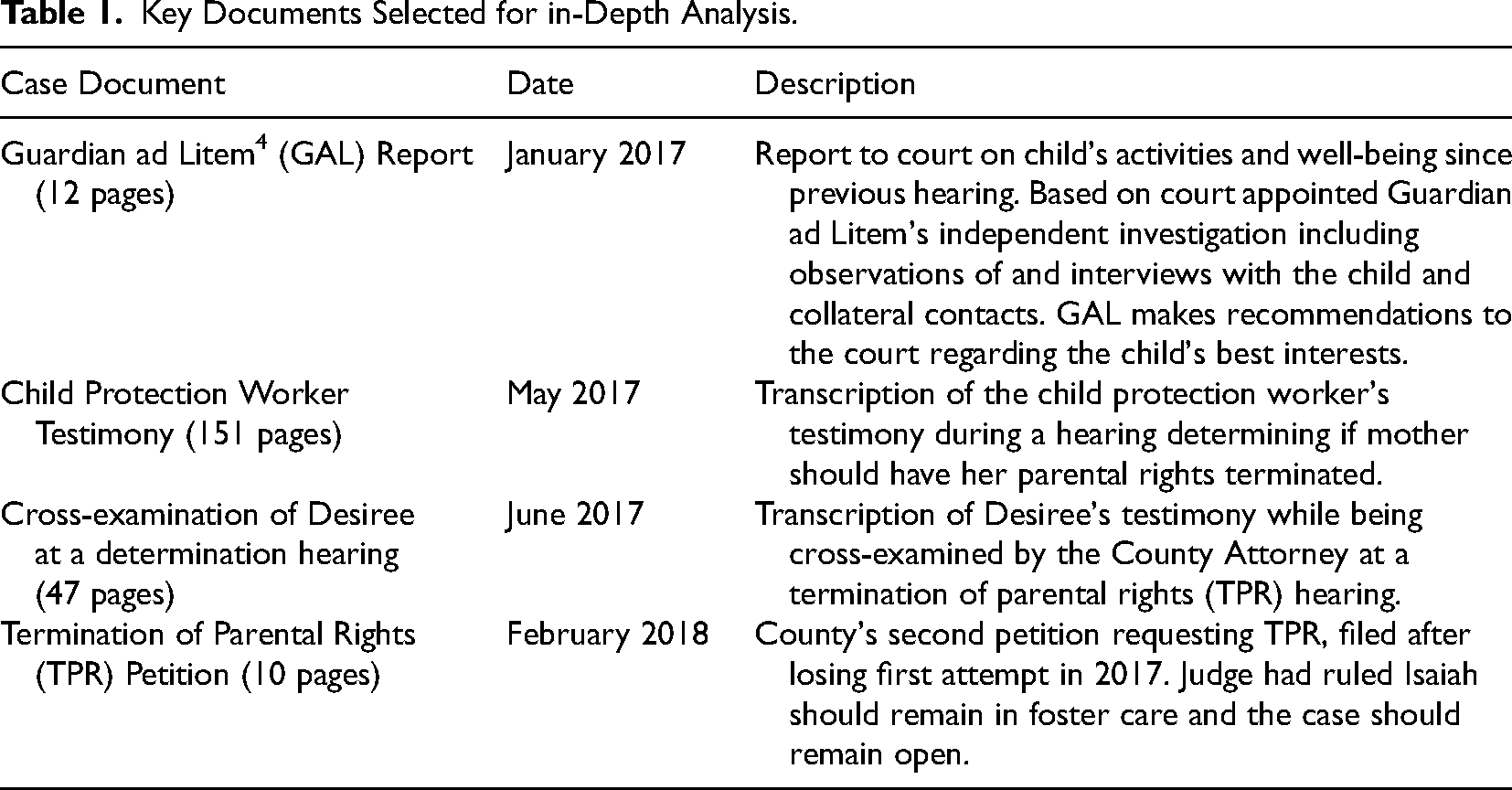
Desiree's case file was extensive in documenting this lengthy case trajectory. The files shared with the research team contained 23 documents from Desiree's case spanning the years 2016–2019. We began by eliminating duplicated documents. We then read through each document, made annotations, and wrote analytic memos (Corbin & Strauss, 2014). This process allowed us to become more familiar with the case, refine our operationalization of insight to include related concepts (e.g., understanding, acceptance, etc.) that perform similar discursive work throughout the case, and select the most relevant documents for further analysis. After multiple research team meetings to discuss our initial analytic memos and impressions of the documents, we chose four documents for more detailed analysis. We selected these documents because they included explicit and implicit discussions of Desiree's insight, belief system, and understanding as it related to her ability to regain custody of her child. The documents follow standard legal and professional writing conventions typical of child protection case files and court proceedings and were authored by representatives of the state. Table 1 provides an overview of the four key documents selected for in-depth analysis.
Key Documents Selected for in-Depth Analysis.
Analysis Approach
Our analysis of Desiree's files was guided by Gee's (2014) building tasks and tools of inquiry, summarized in Table 2. The building tasks examine how language constructs meaning and reality, and the tools of inquiry help analyze how these constructions operate in context.
Gee's (2014) Building Tasks and Tools of Inquiry.
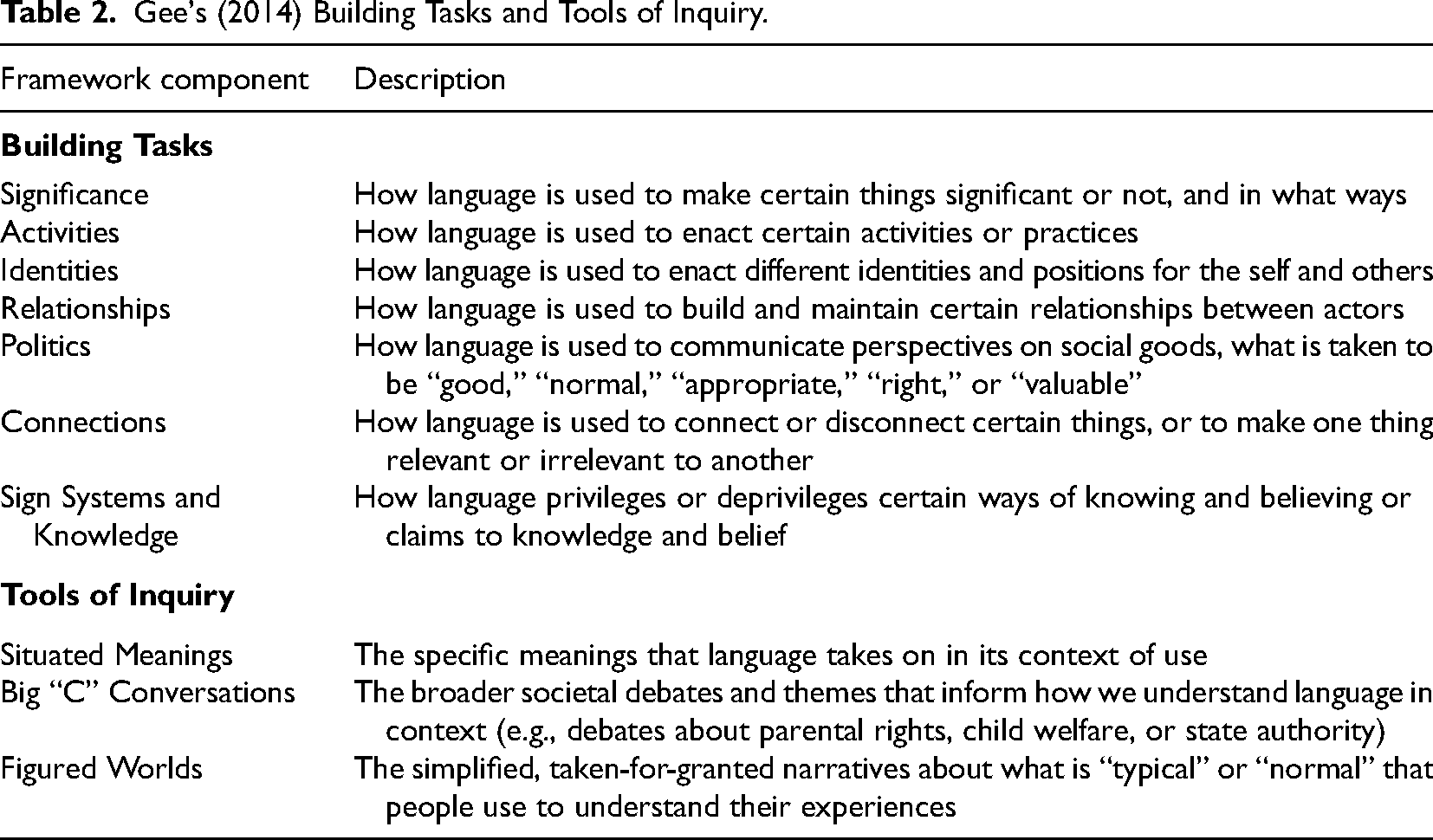
For each of the four documents selected for in-depth analysis, we created an analysis guide that included a chart with Gee's (2014) seven building tasks and three tools of inquiry noted above. The first author read through each document and used the analysis guide to identify and code examples of the building tasks and tools of inquiry, while also making note of additional questions and reflections as they arose. After the first author completed her analysis, the second author read through each of the four documents using the analysis guide. This process allowed us to check for understanding and agreement between researchers. We then met to discuss our analyses and resolve any disagreements. After completing our analyses, we shared our findings and conclusions with the third author, who provided contextual insights based on their direct experience with the case. After reaching consensus among the authors regarding the presentation of results, we then shared our findings and conclusions with Desiree. Desiree offered additional clarifying information regarding the details of the night that Isaiah was injured and the impetus for her decisions throughout the case. After incorporating Desiree's feedback, we had Desiree review the final paper and approve the changes.
As we transition into our findings, it is important to acknowledge the interpretative nature of our approach. Critical discourse analysis embraces the understanding that texts are open to multiple readings (Fairclough, 2010; Wodak & Meyer, 2015). Our analysis represents one possible interpretation, informed by our theoretical framework that examines how language constructs and maintains power relationships. We do not claim that our reading is definitive or objective. Rather, it is situated and political, guided by our values as feminist social work scholars and our commitment to uncovering and challenging harmful discourses in professional social work practice.
Results
The Situated Meaning of Insight
Before analyzing what insight does in Desiree's child protection case, it is important to consider what insight means in this context. Situated meanings (Gee, 2014) refer to the meanings that words or phrases take on within their specific context of use. Although the Merriam-Webster Dictionary (2024) defines insight as “the power or act of seeing into a situation; or the act or result of apprehending the inner nature of things” (para. 1), the situated meaning in Desiree's child protection case is much more specific. Throughout the case file, insight, or related terms, including “understanding”, “acceptance”, “acknowledgement”, or “recognition”, are used by agents of the state, including the Guardian ad Litem and the CPS caseworker, to refer to Desiree's agreement or lack of agreement with the state agents’ case narrative. According to the state, Desiree's belief that a Vitamin D deficiency led to Isaiah's injury illustrates a “failure to take responsibility” and a lack of “acceptance” [Case Document: CPS Worker Testimony, May 2017]. Desiree's continued desire to discuss the Vitamin D hypothesis and other alternatives to the state's narrative, according to the CPS agency, reflect how she has “minimal insight into how her behaviors undermine her ability to parent Isaiah and the negative consequences this has on the child” [Case Document: Termination of Parental Rights Petition, February 2018].
The employment of the situated meaning of insight as compliance with the CPS agency's narrative is an example of the hegemonic power of discourse (Fairclough, 1992). Foucault (1972) described how discourse has the power to construct “truths” and “define realities” and to utilize those constructed realities to reproduce the hegemonic status quo (Park, 2005). In their use of insight, the state agents (e.g., the CPS agency) are both defining what truth and reality are as it applies to Desiree's lived experience and using it to justify their continued to control of her private family life (i.e., retaining custody of her child and continuing to monitor her behaviors) when she refuses to endorse their “truth”.
The “Doing” of Insight
While we analyzed all seven of Gee's (2014) building tasks, our analysis centers on four that emerged as particularly salient in understanding the “doing” work of insight in Desiree's case: significance, connections, identities, and politics. This selective focus follows Gee's (2014) guidance that these analytical tools should be applied flexibly according to research needs rather than as a rigid checklist, allowing us to present a deeper analysis of the most relevant building tasks for our specific research questions and purpose.
Significance
Throughout the texts authored or spoken by the state agents (e.g., guardian ad litem, county child protection caseworker, and county attorney), the insight discourse is used to make Desiree's refusal to agree with the state's narrative a significant factor in justifying termination of her parental rights. For example, in the 2017 Guardian Ad Litem Report, Desiree's beliefs about the cause of the injury are made significant when the GAL writes: “Desiree has a
The significance of Desiree's belief in the Vitamin D hypothesis was also enacted in the Child Protection Worker's Testimony in May 2017. The county attorney asked, “What was the focus then of Desiree with regard to services and working on a case plan?” and the child protection case worker responded, “Her focus was to try to convince me that this was a Vitamin D deficiency.” The question addresses Desiree's “focus,” but does not ask whether Desiree's behavior demonstrated an ability to safely care for her child. Later, the county attorney asks the CPS worker what the specific behavior change was that Desiree's case plan required, and the worker responded, “The behavior change was an acceptance of responsibility.” By asserting that a change in belief is a “behavior,” the CPS worker is again signifying the centrality of Desiree's beliefs over her actions to the case.
In the Termination of Parental Rights Petition, filed in February 2018, CPS again makes Desiree's beliefs about the cause of Isaiah's injuries a central argument, stating, “Desiree has failed to recognize that Isaiah's brain injury was caused by a traumatic event. Despite medical opinions to the contrary, Desiree will not acknowledge that Isaiah was injured while in her care.” It is important to note that CPS never accused Desiree of injuring Isaiah and nowhere in the petition do they identify any behaviors that Desiree is engaging in or failing to engage in that could lead to harm to Isaiah or her other children. The single-minded focus on belief over behavior shows how the insight discourse operates to demand complete ideological alignments with professional perspectives rather than safe parenting practice. Thus, the concept of insight is deployed not to evaluate parental capacity but to measure conformity to professional narratives.
The state also places significance on Desiree's opinions about the county child protection services and her legal representation as indicative of her ability to parent. In the 2nd paragraph of the Guardian Ad Litem Report from 2017, the GAL notes that Desiree has requested a new attorney because she believes that her previous representation “has been ineffective.” All parents have the right to ask for a new appointment of council, but Desiree's exercising of this right is made significant because it demonstrates a rejection of not only the state's narrative but the state's representatives. In the same report, the GAL states, “Desiree
Throughout these examples, the insight discourse functions to delegitimize Desiree's attempts to advocate for her children while positioning the state as the only effective and legitimate advocate for their well-being. Her research into medical conditions, questioning of the state's narrative, and attempts to secure better legal representation are not recognized as maternal advocacy but are instead framed as further evidence of her lack of insight, thereby justifying the state's continued control over her family.
Connections
In addition to making Desiree's refusal to adopt the state's narrative significant in decision-making, the state uses the insight discourse to make an explicit connection between beliefs and her parenting ability. In the Guardian Ad Litem Report, the GAL states: Desiree has ascribed to the belief that Isaiah suffers from a Vitamin D deficiency. To date, Desiree has not demonstrated her ability to focus on Isaiah and his significant health needs; rather she continues to focus on her ideologies surrounding the incident that brought this case forth.
The CPS caseworker uses the same discursive strategy of connection in her testimony on May 18, 2017. When asked by the County Attorney “If Desiree completed all the tasks and all the other points of the case plan and yet never laid to rest or stopped focusing on the Vitamin D deficiency, would it have been possible for her to be reunited with Isaiah?” the CPS worker responded, “I mean, yes, but the agency's position was that this belief of the Vitamin D deficiency was interfering with the quality of care and quantity of care that the child received across all domains.” This rhetorical move shows how the insight discourse operates to create an impossible standard for family reunification: even when a parent complies with all concrete requirements of their case plan, their beliefs alone can be constructed as harmful to their children. The state's insistence on ideological compliance, rather than behavioral change, creates an almost insurmountable barrier to family reunification as parents must not only act differently but also think differently to be deemed fit to parent.
Identities
Throughout Desiree's case file, the insight discourse is used by state agents to reproduce and reinforce an image of Desiree as uneducated, incompetent, and unworthy of the right to parent. In her testimony on May 18, 2017, the CPS worker explained that she requested that Desiree receive a psychological evaluation because she was “looking for an explanation to help me understand how a year and a half after the injury occurred, how we were still stuck in the same place” [referring to Desiree's refusal to claim responsibility for Isaiah's injury and to comply with the state's explanation of the injury]. The CPS worker went on to say that “cognitive functioning would be something that would be helpful to have,” insinuating that Desiree's refusal to comply with the state's narrative was evidence of either a psychological disorder or a cognitive disability.
In addition to expecting Desiree to demonstrate insight by agreeing with the state's narrative about Isaiah's injury, the state used the insight discourse as a central marker for parenting capacity, requiring her to accept their narrative around her own mental health needs and lived experiences. CPS required that Desiree participate in therapy but then claimed that she wasn’t using her time in therapy to address the issues they felt were most important, including what they referred to as her “history of trauma”. Desiree refuted having a trauma history and stated that she used her therapy appointments to process the stress and grief created by her CPS case. Because of this disagreement surrounding the focus of her mental health therapy, in the Termination of Parental Rights Petition, Desiree is described as not being able “to identify her own issues about herself, her history, trauma, and parenting.” The petition goes on to state that Desiree “has a history of limited judgement and decision-making ability … and minimal insight into how her behaviors undermine her ability to parent Isaiah.” The state essentially transforms Desiree's resistance to their narrative into evidence of her selfishness and incompetence, thereby constructing her as fundamentally unfit to parent.
Beyond constructing Desiree as an unfit mother, the insight discourse actively pathologizes her by metamorphosing her questioning of authority into symptoms of mental disorder. This process reveals a form of epistemic violence, where divergent perspectives are not merely delegitimized but also pathologized (Liegghio, 2013). The CPS worker's request for a psychological evaluation because Desiree refused to “claim responsibility” demonstrates how rejection of professional narratives becomes medicalized. As Mills (2017) argues, psychiatric pathologization has historically served as a mechanism for controlling those who challenge institutional authority. This is amplified for Black women whose strong emotional expressions are routinely characterized as evidence of instability rather than a reasonable response to injustice (Sweeney & Taylor, 2021; Ussher, 2023).
Politics
The politics task of discourse refers to how language is used to convey beliefs about the distribution and control of social goods (Gee, 2014). Social goods are “anything some people in a society want and value” (Gee, 2014, p. 6) and, via discourse, beliefs about the “normal” or “good” distribution of social goods are enacted. A social good at the center of this and every child protection case is the ability to parent one's own children and make decisions regarding their care and well-being. However, in addition to this, other related social goods were at the heart of this case: the right to hold one's own personal beliefs without state interference and the right to advocate for one's belief system. By using Desiree's belief in the Vitamin D hypothesis as a justification for her losing the right to parent Isaiah, the state is reinforcing the idea that Desiree does not have the right to hold personal beliefs about her life and her family, especially if those beliefs contradict those of the state's. In addition to frequently bringing up the fact that Desiree held this belief about a Vitamin D deficiency being the cause of Isaiah's medical issues, the state's agents also frequently noted Desiree's attempts to get medical professionals and CPS workers to listen to her belief: County Attorney to CPS caseworker: Desiree was required to work with all providers – doctors, medical staff, and social service personnel – in a manner that demonstrates stable mental health. Did she do so? CPS Worker: No. County Attorney: In what way? CPS Worker: She was angry, defensive, and she requested that the agency look at her point of view.
Desiree's requests to have the CPS agency even consider her ideas about her son's injury was discursively constructed as her exhibiting unstable mental health and thus a justification for terminating her parental rights. The delegitimization of Desiree's alternative explanation represents a form of epistemic injustice, where her knowledge as a mother was systematically discredited because it did not align with the state's narrative (Cranford & LeFrançois, 2022). When Desiree offered her Vitamin D deficiency hypothesis, based partly on conversations with medical professionals, this knowledge was not merely dismissed but transformed into evidence of her lack of insight.
There are many examples in U.S. society of parents who hold beliefs about their child's health that contradict dominant scientific discourses. For example, some parents believe that vaccines caused their children's autism spectrum disorder, despite extensive scientific evidence that refutes this claim (Davidson, 2017). In some cases, these parents then refuse future vaccinations for their children (see: Bazzano et al., 2012; Bonsu et al., 2021). In Desiree's case, the CPS agency did not claim she wasn’t agreeing to Isaiah getting the required medical care he needed. Records showed Desiree complied with all medical recommendations for Isaiah's care. The CPS agency's argument was that both her belief system and her refusal to comply with their narrative were not “normal” and thus justified permanent transference of the social good of parenting Isaiah from Desiree to the state.
Furthermore, the description of Desiree as “angry” and “defensive” shows how the politics of emotion operate differently for Black mothers in the child welfare system. By constructing her emotional responses – including legitimate anger at having her child removed and her medical concerns dismissed – as evidence of mental instability, the state reinforces racialized and gendered norms about “good” motherhood that deny Black mothers the right to express strong emotions. This dynamic is drawn out further by the contrasting treatment of Isaiah's white foster mother's opinions. While Desiree's concerns about Isaiah's needs were framed as evidence of her lack of insight, the foster mother's observations about Isaiah's care needs were consistently praised and legitimized throughout her case file and in court documents. For example, in the Termination of Parental Rights Petition, Desiree's perspective on her child's stress levels was dismissed and used against her with the county stating “of note was Desiree's assessment of Isiah's stress was 0 whereas the foster parent rated Isiah's overall stress as high.” This discrepancy was used to portray Desiree as inattentive and lacking insight, while positioning the foster mother as the more perceptive and credible caregiver. Here we see meaning constructed through Différance (Derrida, 1982). By putting Desiree in juxtaposition to the foster mother, the state both subtly and overtly defines “good”, “normal”, and “healthy” parenting, with the white foster mother's practices and perspectives positioned as the ideal against which Desiree's parenting is judged and found wanting. While the foster mother is ordered, Desiree is disordered. This differential treatment of maternal knowledge and advocacy shows how the insight discourse operates to reinforce longstanding hierarchies of maternal legitimacy, particularly along racial lines
Further, the characterization of Desiree's advocacy as emotional instability reflects broader patterns of racialized assessment across institutional settings. The description of Desiree as “angry” and “defensive” while simply requesting that the agency consider her perspective aligns with what Daley (2021) identifies as the gendered and racialized assessment of compliance in psychiatric institutional settings. For white women, emotional expressions are often interpreted as understandable distress, while for Black women, similar expressions become evidence of pathology and danger (Sweeney & Taylor, 2021). This pathologizing function of the insight discourse illustrates a seepage of psychiatric concepts into other institutional systems, where psychiatric language becomes deployed to reinforce social control outside traditional mental health settings (LeFrançois et al., 2013; Rose, 2018). When Desiree's advocacy for her child's medical needs is reframed as mental instability, her advocacy efforts are essentially pathologized. In this we see the direct manifestation of how child welfare systems borrow psychiatric frameworks to construct non-compliant mothers, particularly Black mothers, as inherently disordered.
Discussion
In attempting to answer our primary research question of what does an insight discourse “do” in a child protection case, we have distilled three primary themes worth further discussion. These include: 1) insight operates as a mechanism of state control through requirements for specific performances of compliance and contrition, 2) insight reinforces dominant constructions of motherhood by demanding ideological alignment with professional narratives about proper parenting, and 3) insight functions as a tool of racial and class-based oppression by selectively applying standards of maternal adequacy through seemingly neutral requirements. While issues of race and class permeate each theme, it is important enough to also include as a distinct theme.
Insight Operates as a Mechanism of State Control
Our analysis shows how the insight discourse functions to reproduce and reinforce the state's hegemonic power over Desiree and her children. This aligns with Azzopardi's (2022) analysis of how child welfare systems use seemingly neutral doctrines, such as “failure to protect”, to maintain institutional control while presenting themselves as compassionate and protective. In this study the state's agents (e.g., the CPS worker, guardian ad litem, County Attorney) use what they define as Desiree's “lack of insight” to justify what are, in essence, drastic and draconian state interventions into individual life, including the removal of a child from a parent's custody, mandating participation in psychiatric and psychological treatment, and maintaining state custody of a child for four years despite Desiree's compliance with all case plan requirements. In this case, the continued separation was justified primarily by of Desiree's alternative beliefs about the causation of her son's injuries rather than through evidence of ongoing safety concerns.
In this way we see that insight in Desiree's case also functions as a mechanism of epistemic injustice, where her knowledge was only considered valid when it aligned with institutional narratives and professional understandings (Cranford & LeFrançois, 2022; Liegghio, 2013). Her alternative explanation for her son's medical condition was not simply rejected but weaponized as evidence of her unfitness to parent. This pattern mirrors what Mad Studies scholars have documented in psychiatric settings, where patients’ lived experiences are systematically delegitimized in favor of professional interpretations (Daley, 2021). For mothers like Desiree who are navigating the child protection system, the requirement to demonstrate “insight” constitutes a form of epistemic violence that disproportionately affects women of color whose perspectives may already be marginalized by intersecting systems of oppression (Collins, 2000; Kanani, 2011).
As observed in this analysis, the insight discourse is particularly insidious because it presents itself as compassionate concerns while enacting oppressive control. As researchers in mental health care and social work have shown, this type of oppression operates by removing a person's rights in the interest of well-being and protection (Hamilton & Roper, 2006; Leotti et al., 2023). However, in the case of child welfare, the discourse operates indirectly – mothers’ rights are stripped away not explicitly for their own good but in the presumed interest of their children's well-being, as defined by the state (Bromwich, 2017). This allows the system to position itself as protecting vulnerable children while simultaneously pathologizing and punishing mothers who challenge its authority.
As Desiree's case continued over four years, her lack of compliance with the state's narrative took on an increasingly prominent role in justifying continued state involvement and punitive measures. Notably, the core issue shifted from concerns about Isaiah's safety to Desiree's challenge to state authority through her persistent alternative understanding of events. It was in this shift that the insight discourse took on a key role in her case. We argue that insight in Desiree's case then operated to maintain the state's hegemony. Fairclough (1992) describes hegemony as a “contradictory and unstable equilibrium” (p. 93). Due to this instability and precarity, any threat to the existing order must be met with quick and strong resistance in order for the state to maintain its legitimacy. We see this in Desiree's case as the state scrambled to justify and legitimize its narrative of events.
Insight Reinforces Dominant Constructions of Motherhood
Rather than serving as a neutral assessment of understanding, in Desiree's case “insight” operates as a tool for distinguishing “good” mothers from “bad” mothers through specific indicators. The discourse demands that Desiree comply with professional narratives, requiring her to accept the state's version of events, demonstrate appropriate guilt and contrition, and “perform insight” as defined by authorities. As Galasiński (2010) argues, “people do not have insight; rather, if anything, they ‘do insight’, as part of their discursive actions” (p. 74). For Desiree, the primary issue was not that she “lacks insight”, but that she steadfastly refused to “do insight” – to perform a specific version of understanding dictated by the state and its agents. This performance included accepting professional intervention by participating in mandated treatment, acknowledging the need for state involvement, and demonstrating remorse and appropriate gratitude for professional guidance. Her case illustrates how the insight discourse is deployed to justify increasingly severe interventions when mothers refuse to accept blame.
Throughout Desiree's case, we observed how the the insight discourse demands ideological alignment, beyond behavioral compliance. Our analysis suggests that in such instances, mothers must adopt the state's perspective on child safety, accept professional definitions of proper mothering, and surrender alternative interpretations or beliefs. As Azzopardi's (2022) research demonstrates, mothers in child welfare are required to perform specific versions of contrition and compliance, and those who challenge institutional narratives are marked as particularly problematic. In Desiree's case, her steadfast refusal to “do insight” – to perform this idealized motherhood through acceptance of blame – marked her as an unfit mother despite her actual parenting practices. As Davies and Krane (1997) note, the mythical White Western view of mothers as “all giving and selfless nurturers creates unrealistic expectations” (p. 6) that ignore mothers’ own emotional and psychological needs as well as the material resources that shape mothering capacity. This idealized construction of motherhood, while affecting all mothers, may set the stage for particularly harsh judgment of mothers who are marginalized by race and class, as illustrated in Desiree's case.
Insight Strengthens Racial and Class Oppression
The deployment of insight discourse in this case exemplifies what Davies and Krane (1997) identify as the core paradox of child welfare practice: while theoretically focused on children's needs, “the bulk of child welfare activity actually entails the evaluation of women-as-mothers and mothering functions or capacities” (p. 4). However, this evaluation takes on a particular flavor when applied to Black mothers. The power enacted by U.S. child protection systems is rooted in White, Western patriarchal beliefs about mothers and mothering (Davies & Krane, 1997). Views of mothers as perfect nurturers imply that they are all-responsible and infallible – to then make a mistake is to fail at mothering. The state then comes in and as part of the mother's penance, they must accept blame. In our analysis of this case, we see that insight, as defined by the state, equates to an acceptance of blame. Desiree refused to accept the mother-blame placed on her, and because of it, she was punished.
This dynamic is particularly apparent in how the state responds to accidental injury or tragedy, as in Desiree's case. While accidents and injuries are an unfortunate but common part of childhood (from drownings to car accidents), Desiree, as a poor, Black mother, was denied the right to experience accidental tragedy without blame. The system demanded that she accept responsibility and demonstrate appropriate remorse even in a situation where no clear fault exists. This application of blame reveals how the insight discourse operates not as a neutral assessment tool but as a mechanism for reinforcing existing racial and class hierarchies in determinations of parental fitness, thus bolstering the state's control (Azzopardi, 2022). As Roberts (2012) argues, the child welfare system has historically functioned as a mechanism for supervisory control over Black families, with Black mothers facing heightened scrutiny and diminished presumptions of parental competence. We argue that the insight discourse serves as a contemporary manifestation of this surveillance, demanding not just behavioral compliance but ideological submission particularly from mothers who occupy marginalized social positions.
Throughout Desiree's case file, the child protection agency and guardian ad litem use insight discourse to reinforce hegemonic beliefs about who deserves the “social good” of parenting children. This construction relies on what Gee (2014) calls “figured worlds” – the “simplified, often unconscious and taken-for-granted theories or stories about how the world works” (p. 95). Within these figured worlds, mothers like Desiree – African American, low-income, single mothers – are constructed as inherently less deserving of parental rights, with their every act of resistance to state narratives taken as further evidence of their unfitness.
Conclusion
This study examines how “insight” functioned as a discursive practice in one mother's child protection case to produce and reproduce systems of power, surveillance, and control within child protection proceedings. While our analysis of this specific case cannot be generalized, we believe it illuminates patterns worthy of consideration in the broader context of child protection. Rather than operating through explicit bias or direct coercion, systems of power maintain control through seemingly neutral requirements for particular forms of understanding and expression. The reliance on a poorly defined concept like insight in child protection cases raises legal and ethical concerns as its ambiguity allows it to be used against parents – particularly marginalized mothers – while obscuring the racial and class-based assumptions underlying judgments of parental fitness.
Our analysis points to the need to rethink how assessments regarding parental capacity are made in child protection cases. This rethinking might include developing more transparent definitions of insight in practice guidelines, shifting focus to concrete parenting behaviors rather than ideological alignment, and creating safeguards to ensure parents’ alternative perspectives aren't used against them in custody decisions. Drożdżowicz (2021) argues that healthcare professionals have a “pro tanto epistemic duty” to solicit and attend to patients’ first-person experiences to prevent epistemic losses. We suggest that child welfare professionals adopt such an ethical obligation in their work – seeking out and genuinely considering parental perspectives rather than summarily dismissing, or worse, pathologizing, these perspectives when they diverge from the dominant perspective. Additionally, we encourage parental defense lawyers to call out when insight is being employed in cases involving their clients and to ask for state's attorneys, CPS representatives, and judges to define what they mean by “insight” and its related terms and to explain their justification for invoking insight when making determinations about child safety and parental rights. Future research examining insight discourse across multiple child protection cases would further strengthen our understanding of how these mechanisms function systemically.
Afterword
This paper highlights only one aspect of the 4 ½ year child protection case that involved Desiree and her family. No single academic paper could capture the full picture and human impact of what unfolded for Desiree's family. Behind every case file and court document are real people whose stories extend far beyond what is captured in official records. In an effort to resist the very practice we critique – professionals speaking for and about Black mothers – we end this paper with Desiree's own words.
In this particular case, actions were taken to control the outcome of my life and the lives of my children, solely based on professionals’ opinions, without evidence or knowledge to support the many assumptions made. This was an attack on my capacity to provide safety and my ability to parent as I see fit. The actions made against me ultimately changed the course of my life. Having to go deep within, aligning my inner self with my faith is the power I relied on to get me through the adversities to victory. I believed that I shall and will overcome. Continuing to push through the trials and tribulations with dignity was the ultimate goal while standing firm.
During slavery, Black women were forced to perform dual roles of caring for their own children while also serving as a wet nurse the children of their enslavers. Black women struggled to protect and provide for their own families. This historical reality illustrates the complex dynamics of caregiving and exploitation faced by Black women.
Fighting for my rights and protecting the rights of my children was not an easy task. I was threatened to lose all of my children if I did not submit to their views of a so-called medical opinion. My heart was literally broken into pieces and has had to be rewired and put back together.
The question raised in this article is “what does ‘insight’ do in the context of child protection?” In my humble opinion, insight is used as a catalyst for bias and is used as a form of abuse. CPS does this while hiding behind the phrase “in the best interest of the children.” This experience ignited motivation in me to fight for change. Separating children from their families is a practice that has been long documented in this country. These practices are not conducive to the well-being of our children. We have to do better when addressing concerns and meeting the needs of families that face hardships.
Footnotes
Declaration of Conflicting Interests
The authors declared no potential conflicts of interest with respect to the research, authorship, and/or publication of this article.
Funding
The authors received no financial support for the research, authorship, and/or publication of this article.
Ethical Considerations
Approval for this research was received from the Augsburg University Institutional Review Board (#2022-13-03) and the University of Wyoming Institutional Review Board (#20220526SL03320) under exempt status.
Consent to Participate
Verbal consent was received by the participant to review their de-identified CPS case file.
Consent to Publish
Informed consent to publish a paper in an academic journal related to the research was obtained from the participant whose case files were analyzed. The participant was assured that their name and identifying information about them and their family members would be kept confidential and not included in any published materials.
Data Availability
Data sharing not applicable to this article as no datasets were generated or analyzed during the current study.
