




Abstract
At a societal level, postfeminist and neoliberal companion discourses have minimized structural determinants of dating abuse while elevating individual characteristics such as personal responsibility and agency. Adolescent survivors of dating abuse most frequently seek help from their peers; thus, the substance of that support is critical to reduce stigma and support survivor’s well-being. Using critical discourse analysis methodology, this article examines how postfeminism has been enacted in teens’ discursive constructions of dating violence and describes the ramifications of such constructions. Analysis used structured questions to unpack teens’ constructions and discursive formations of dating abuse. Teens participated in 11 in-person and online focus groups nationally. Results indicate that teens discursively construct abuse survivors in ways that privilege postfeminist discourses of personal choice, agency, and empowerment. Specifically, teens employed discourses of direct and indirect culpability to describe why survivors enter and remain in abusive relationships. Such framings contribute to constructing a “stigmatized identity” for abuse survivors consistent with postfeminist discourse. Multitiered interventions must be developed that both challenge postfeminist discourses and support teens in developing more empathetic responses to abuse survivors.
Postfeminism’s “importance resides…precisely in its ordinariness and everydayness, its ability to speak sense and meaning-making about gender that become as taken for granted as neoliberal ideas—a sense making characterized by relentless individualism…Like neoliberalism…postfeminism has tightened its hold in contemporary culture and has made it virtually hegemonic.” (Gill, 2017, p. 609)
The present historical moment is marked by postfeminist cultural and political discourse that, by privileging discourses of choice, agency and personal responsibility, and minimizing the role of the state and social structures in promoting gender equity, has effectively rendered feminism anachronistic and irrelevant (Banet-Weiser et al., 2020; Gill, 2007, 2016; McRobbie, 2009). Postfeminism’s cultural significance rests in its shared DNA with neoliberalism—a discourse that has embedded itself into “the nooks and crannies of everyday life” (Littler, 2017, p. 2). Gill (2017) describes how postfeminism “operates as a kind of gendered neoliberalism” (p. 609) where broader social issues with structural and systemic roots are interpreted as being the product of poor personal choices, lack of industriousness or grit, or the absence of personal empowerment (Harris, 2004).
The comprehensive historical lineage of postfeminism has been discussed at length elsewhere (see Gill et al., 2017). However, given the multitude of ways that postfeminism is positioned in the academic literature and public discourse, it is important to clarify how we are using this term throughout this article. Gill and colleagues (2017) describe the four primary ways that postfeminism has been employed (1) as an epistemological break with traditional notions of feminism consistent with larger postmodern, poststructuralist, and postcolonial traditions; (2) as a third wave of feminism—or an inevitable evolution of second-wave feminism; (3) as a “backlash” to gains made within second-wave feminism; (4) as a distinct cultural and political “sensibility” with particular, patterned characteristics such as revering individualism, choice, self-sufficiency, and personal responsibility while erasing structural impediments or collective forms of support. Consistent with the fourth usage (though acknowledging the constitutive nature of language), in this article, we are positioning postfeminism as a “discursive formation” (Gill, 2017, p. 230) that, coupled with neoliberalism, encompasses a lens or worldview through which to construct meaning regarding the socializing role of gender, power relationships, social stratification, meritocracy, and the antecedents of multifaceted social issues.
While there is an abundance of literature identifying how postfeminist political thought has been constituted in popular culture (Genz, 2017; Gill, 2017; Storer, 2017) and, to a lesser degree, within organizational structures (Adamson, 2016; Kelan, 2009), there has been limited exploration of how these notions of gender have influenced the public’s construction of dating and domestic abuse. Abuse in teens’ dating relationships is a significant societal issue, with 10%–25% of teens enduring physical aggression in their romantic relationships (Coker et al., 2014). However, despite high incidences of abuse, many teens, like members of the general population, hold deficit-based views of teen dating abuse survivors (Nabors et al., 2006) and often blame abuse survivors for the behaviors of their partners. For example, research has found that teens are more likely to attribute their peers’ entry into abusive relationships to individual-level deficits such as low self-esteem (Edwards et al., 2016) and perceived codependence (Storer et al., 2020). Furthermore, representative samples of college students have found that the majority of individuals believe that survivors could terminate abusive relationships if they wanted to (Nabors et al., 2006). These types of attitudes and beliefs map onto larger postfeminist and neoliberal discourses that minimize structural and systemic determinants of teen dating violence (TDV), privilege narratives of survivor agency and culpability, and sideline the intersectional experiences of TDV survivors who hold dual identities (Storer, 2017).
While previous studies have examined abuse survivors’ processes of help-seeking and descriptions of teens’ meaning-making processes of dating abuse (Edwards et al., 2016; Storer et al., 2020), there have been fewer efforts to trace these belief systems or discourses to macro-level social scripts on dating abuse. Thus, the purpose of this study is to position postfeminism as an “object of analysis” (Gill, 2017, p. 607) in order to interrogate the ways that postfeminism has been represented in teen’s discursive constructions of dating abuse and to describe the ramifications of such constructions.
Defining and Conceptualizing Teen Dating Abuse
Despite the importance of establishing clear definitions of teen dating abuse, there is no widely agreed-upon use of the terms dating violence/abuse among scholars, service providers, or members of the general public (Buzawa et al., 2017). The phrases “teen dating violence” and “intimate partner violence” have been used predominantly in the academic literature on this social issue. However, some scholars have advocated for the use of the phrase “dating abuse” instead because the term dating violence privileges predominantly physical forms of abuse and misrepresents the multitude of behaviors that encompass the lived experience of dating abuse (Storer et al., 2020).
Given that dating abuse is inevitably a context-bound social phenomenon (Hamby, 2016; authors masked for review), we want to center the role of coercive control in our conceptualization of dating abuse. Throughout this study, we are employing Mulford and Blachman-Demner’s (2013) definition of teen dating abuse: a range of abusive behaviors that preteens, adolescents, and young adults experience in the context of a past or present romantic or dating relationship. The behaviors include physical and sexual violence, stalking, and psychological abuse, which includes control and coercion. Abuse may be experienced in person or via technology. (p. 756)
Literature Review
Teens’ Processes of Help-Seeking
While some teens prefer to cope with the abuse independently (Madkour et al., 2019; Rueda et al., 2015), the majority seek support from their friends and members of their peer groups rather than formal service providers or parents (Ashley & Foshee, 2005; Rueda et al., 2015). The substance of the support received can be critical to an abuse survivor’s well-being and resiliency. Studies have found that many teens offer nurturing and empathetic responses to teens experiencing dating abuse (Rueda et al., 2015; Weisz & Black, 2008); however, evidence suggests that the help provided is limited (Ocampo et al., 2007). Weisz and Black (2008) reported that some teens would avoid the survivor after disclosure, either fail to identify or minimize abuse dynamics, and unintentionally reinforce negative misconceptions regarding the causes and consequences of enduring an abusive relationship (Amar et al., 2012; Latta & Goodman, 2011). In a qualitative study of rape survivors’ disclosures to friends and family, Ahrens and colleagues (2007) reported that friends and family responded inappropriately to these disclosures by blaming the survivors, minimizing the incident, and not offering substantive help. The most frequent advice friends given to those in abusive relationships is to discontinue the relationship (Frye et al., 2017; Rueda et al., 2015), a potentially risky suggestion, given the increased risk of serious abuse associated with the act of terminating an abusive relationship (Campbell et al., 2007; Sheehan et al., 2015).
Teens’ Meaning-Making for Adolescents’ Experiences of Dating Abuse
While there has been a robust examination of teens’ definitions and perceptions of what constitutes an abusive relationship, there have been fewer examinations of teens’ meaning-making processes for why other teens enter and stay in abusive relationships. In one qualitative study (Storer et al., 2020), African American teens stated that TDV survivors enter into abusive relationships because they have low self-esteem, have witnessed abusive behaviors in their home environments, and have a strong desire to have a romantic partner, even if that person is abusive. In an additional qualitative study, Helm and colleagues (2017) reported that teens believe that abuse survivors stay in abusive relationships because they feel a strong connection to and love for their partners. In terms of meaning-making processes, study participants used phrases like “love is blind” or “true love [means that] no matter what you stay together” (p. 328) to explain why individuals remain in abusive relationships. In the same study, teens described feeling “bewildered” (p. 329) by survivors’ decisions to remain in abusive relationships, especially in the presence of physical abuse. One teen said, “She would get beaten up like almost every day, but she still stuck in the relationship. But I didn’t understand why” (p. 329). While these descriptive studies are helpful for understanding teens’ perceptions of abusive relationships, they do not contextualize factors informing these predominantly deficit-based attitudes and norms about abusive relationships.
Postfeminism, Intimate Partner, and Dating Abuse
Popular culture has been a primary means of transmitting postfeminist discourse, particularly as it relates to dating and domestic abuse. Analysis of the representation of dating abuse in young adult literature shows that postfeminist discourses of choice and personal responsibility are used to describe TDV survivors’ entry into abusive relationships (Storer, 2017). Additionally, scholars have described how song lyrics and music videos have portrayed dating abuse survivors as being culpable in their abuse, displayed “victim-blaming” behaviors, and minimized the seriousness of dating abuse (Enck & McDaniel, 2012; Thaller & Messing, 2014). Patterson and Sears’ (2011) analysis of celebrity culture, particularly through media blogs and websites, uncovered a “bitch” rhetoric consistent with postfeminist notions of personal responsibility that focuses on what survivors do to provoke their partner’s abuse and reduces perpetrators’ accountability for their use of coercive tactics. These representations of dating domestic abuse, which reinforce notions of survivor culpability and individual responsibility (while omitting references to structural drivers of abuse), exemplify many of the elements of a postfeminist discourse. Because “victim-blaming” and other disempowering responses to abuse can be associated with poorer outcomes for survivors (Flicher et al., 2012), it is critical that we continue to assess the dating abuse–related discourses that predominate among young people.
Theoretical Framework
As is consistent with critical discourse analyses, this study is informed broadly by a critical constructivist epistemology that presupposes that individuals’ meaning-making is the product of their interpretative interactions with their environments and that knowledge construction is indelibly influenced by systems of oppression, marginalization, and social inequality (Crotty, 1998). In this sense, language both constructs and represents social realities. As Wetherell (2011) eloquently states, “words are about the world but they also form the world” (p. 16). We argue that a teen’s attitudes and norms are not an isolated belief system but are situated within a broader social context. Furthermore, teens’ discursive constructions both reflect dominant social scripts and are critical in generating and perpetuating these unspoken “rules of the game.” Although individuals (including teens) often glean what is considered “right,” “normal,” or “the way things are” (Gee, 2011) from what they have observed among their peer groups or from social influencers in the media, they are also important targets for transforming dominant discourses that perpetuate unequal distributions of power and reify stigmatization at the societal level.
Method
This article is drawn from a larger study titled “The Bystander Research Study,” which examined the factors that encourage teens to intervene as prosocial bystanders when they witness bullying and relationship abuse among their peers. The results of this study have been published elsewhere (authors masked). Data were initially collected from a combination of national in-person and online focus groups in the United States. We did not design the data collection procedures to facilitate a critical discourse analysis (CDA), so the present article functions as a secondary analysis of this previously collected data. However, it was through conducting the initial study that the authors were sensitized to the enactment of “postfeminist sensibilities” in participants’ discursive constructions of survivors in this data set.
CDA
Grounded in postmodern, poststructuralist, critical theory, and constructionist frameworks, CDA seeks to bring to light the everyday social practices that imbue language. Greckhamer and Cilesiz (2014) describe discourse as a “system of representation” (p. 1) where individuals engage in processes of knowledge creation and shared meaning-making—often unconsciously or unintentionally. Stubbs (1983), for example, describes discourse as the shared understanding of a phrase that hovers “above the sentence or above the clause” (p. 1). Thus, discourse analysis is used to uncover societal-level structures of sense and meaning-making. Gee (2011) describes how language-in-use functions to enact social practices, privilege certain ideas, establish social norms regarding what is “right,” “normative,” or “sayable,” reify knowledge systems, and enact various identities. In comparison to discourse analysis methods, a central task of CDA is to uncover how language reinforces existing power structures and reproduces larger inequitable systems and structures, thus sublimating marginalized identities, worldviews, and epistemologies. Therefore, the study of discourse makes it plain how some ideas become regarded as common knowledge while others are rendered invisible.
Study procedures
In-person groups
Eight focus groups were held in an urban community. Seven of these groups occurred in three different high schools in the same school district. The eighth group occurred at a community-based organization that serves lesbian, gay, bisexual, transgendered, or questioning/queer (LGBTQ) teens in the same city as the high school–based groups. Participants in the high school groups were recruited in classes selected by school administrators based on demographic diversity (race/ethnicity, gender, and grade level). Teens who participated in the community group were recruited directly by organizational staff. All of the groups occurred in a semiprivate location where no school personnel or staff were present. At the recommendation of our research partners at the high schools, the school-based groups were organized by grade level. The teens who participated in the LGBTQ group were enrolled in Grades 9–12, but the low number of students who chose to participate required placing all of them into one group. Each research participant received a US$25 gift card as an incentive.
Parental consent and teen assent were received for all participants in the high school groups. Due to the sensitive nature of the identities of participants in the community group, we requested a waiver of parental consent. All research procedures were approved by [masked for review] Institutional Review Board.
Online groups
The online focus groups were conducted after the in-person school-based groups. The online groups were added in order to solicit additional geographic and gender identities. Online focus groups were conducted in partnership with the research group InsideHeads. This organization recruited a diverse sample of teens nationwide and was responsible for verifying the participants’ ages and demographic identities and for securing parental consent. As is consistent with their research protocols, InsideHeads opts to stratify their focus groups by age rather than grade levels. Four groups were formed: two with 14- to 15- year olds and two with 16- to 17- year olds. The online groups were held in a “chat room” environment where participants communicated via text. InsideHeads staff, trained in conducting chat room-style focus groups, facilitated the groups. Research staff were also present in the chat rooms to support the InsideHeads staff in implementing the research protocol. Each participant in the online group received a US$50 gift card, which is the established compensation that InsideHeads provides.
Sample description
A total of 113 teens (n = 60 online; n = 53 in-person) aged 14–17 participated in the 12 focus groups. All of the participants self-identified as either male or female. The majority (65%) of the participants self-identified as female (n = 74) and 34.5% self-identified as male (n = 39). In terms of racial identity, 49.5% (n = 56) self-identified as white, 35.7% (n = 30) as African American or black, 14.1% (n = 16) as Latino/a, 4% (n = 5) as Asian American, 1.8% (n = 2) as American Indian, 1.8% (n = 2) as Middle Eastern, and 10% (n = 12) as multiracial or “Other.”
Data collection
The focus groups used a semi-structured interview guide designed by the study staff. The interview guide was intended to prompt participants to reflect on which factors would influence their decision-making processes regarding bystander behavior in response to bullying and dating abuse in their school environments. After a brief icebreaker activity, the interviewers asked the participants to define bullying and dating abuse and give examples of each that they had personally witnessed among their peers at school. Using these examples, the interviewers would ask participants to describe which factors would influence their decision making about whether to intervene in each abusive incident. Each group was responding to different group-generated examples, but the questions to elicit their reflections were similar. Follow-up questions included but were not limited to queries such as, “How would you decide to intervene in this situation?” and “What would make it harder or easier to intervene?” In the following section, we will describe how the teens’ responses to these questions became the source data for the present study.
Analysis
The CDA methodology employed in this article built on the initial thematic content analysis conducted to investigate the original study research questions related to bystander intervention programs. That analytical process has been described in-depth elsewhere (authors masked) but will be summarized here for context. After data collection, all focus group discussions were transcribed and compared to the original audio recordings for accuracy. Clean transcripts were uploaded into Dedoose (Version 7.0.23) analytical software for data management. All the transcripts were inductively and deductively coded, which is a process that involves attaching names or phrases to segments of the participants’ spoken words in the focus groups (Saldana, 2009). To make a codebook in Dedoose, all codes were clustered with similar constructs to form broader categories and themes (Saldana, 2009). The codebook also included each category and secondary codes, as well as descriptions of how to apply each code. This codebook was used to ensure that all analysts applied the codes systematically. A minimum of two analysts (usually the first and second authors in this article) coded all of the transcripts, and any discrepancies in coding were resolved collaboratively. The primary thematic domains were also decided in collaboration. Analytical memos were used to surface key concepts, identify linkages across cases, and process any personal biases that might emerge during the analysis process (Stige et al., 2009).
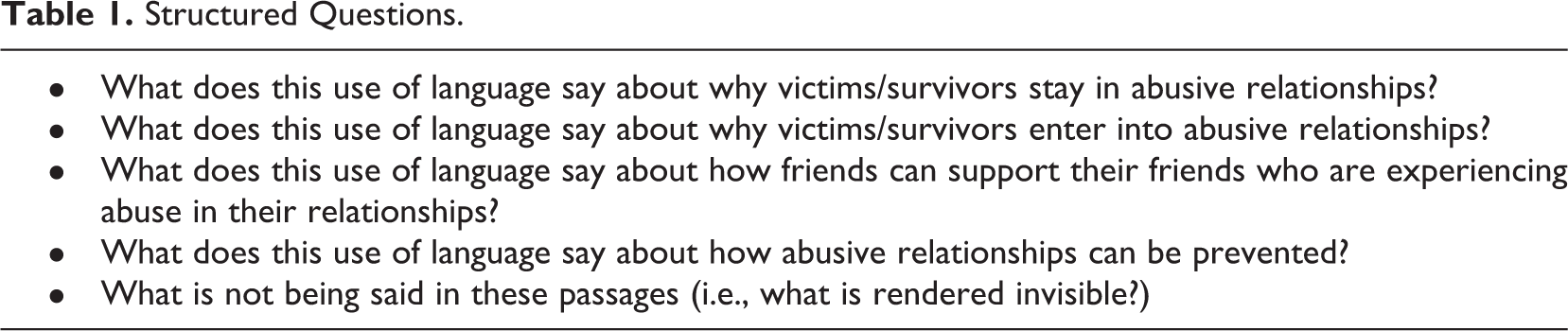
The themes generated from the thematic content analysis formed the starting place for conducting the CDA. This step of the analytic process is what differentiates a CDA from a thematic content analysis. Thematic content analyses seek to describe the primary domains of a particular corpus of data (Braun & Clark, 2006), while a CDA interrogates the function of language and makes a claim regarding how particular subject identities are constructed to replicate systems of power and oppression (Fairclough, 2015). In order to move from the thematic to the discursive, we used LeGreco and Tracy’s (2009) process of discourse tracing that involves using “structured questions” to interrogate the body of data. This process helps sensitize the analysts to the various functions of the employed language. For this study, we placed each primary theme in a table and included exemplary passages below each identified theme. This methodological process has been employed previously in the lead author’s other CDA of dating abuse (authors masked), and elements of this staged approach to analysis have been described in the CDA methodological paper (authors masked). The content of the structured questions (Table 1) was specifically influenced by CDA methodologist James Paul Gee’s (2011) work on how language-in-use constructs various situated identities and meanings, reifies social practices, and contributes to notions of what is “expected,” “appropriate, “normal,” or “the way things are.” The content of the structured questions was also influenced by the lead author’s reflections captured in her analytical memos. We then looked for patterns across the answers to these structured questions and identified specific discursive constructions of the experiences of dating abuse. The ultimate goal was to identify discursive anchors of postfeminism and describe how this patterning of language serves to construct survivors of dating abuse.
Structured Questions.
Reflexivity
Reflexivity is a critical step in the qualitative research process, where authors are transparent about how their individual lived experiences may have influenced the analytical processes (Stige et al., 2009). It is important to mention that at the time of data collection, the lead author was working on her dissertation, which focused on describing how postfeminist and victimology discourses have influenced the media’s framing of teen dating abuse. Therefore, she was sensitized to this discourse during data collection and initial project analysis. At moments throughout this research projected, she remarked upon and expressed surprise at how neoliberal and postfeminist many of the teens sounded in their descriptions of experiencing dating abuse. These reactions were the initial genesis for this article. Since data collection, the lead author has coauthored numerous qualitative articles, including a critical discourse methods article (authors masked). Furthermore, the lead author’s prior work as a dating abuse advocate and community educator at a feminist-oriented mainstream domestic violence organization informs her overall framing of the causes and consequences of this social issue. Similarly, the second author has significant experience working with survivors of intimate partner abuse across systems and has been influenced by a feminist analysis of various forms of gender-based violence. Her subsequent direct practice work and research in relationship abuse prevention has formed a sensitivity to the ways in which gender and attribution of blame for abuse shape the way people talk about and understand domestic abuse.
Results
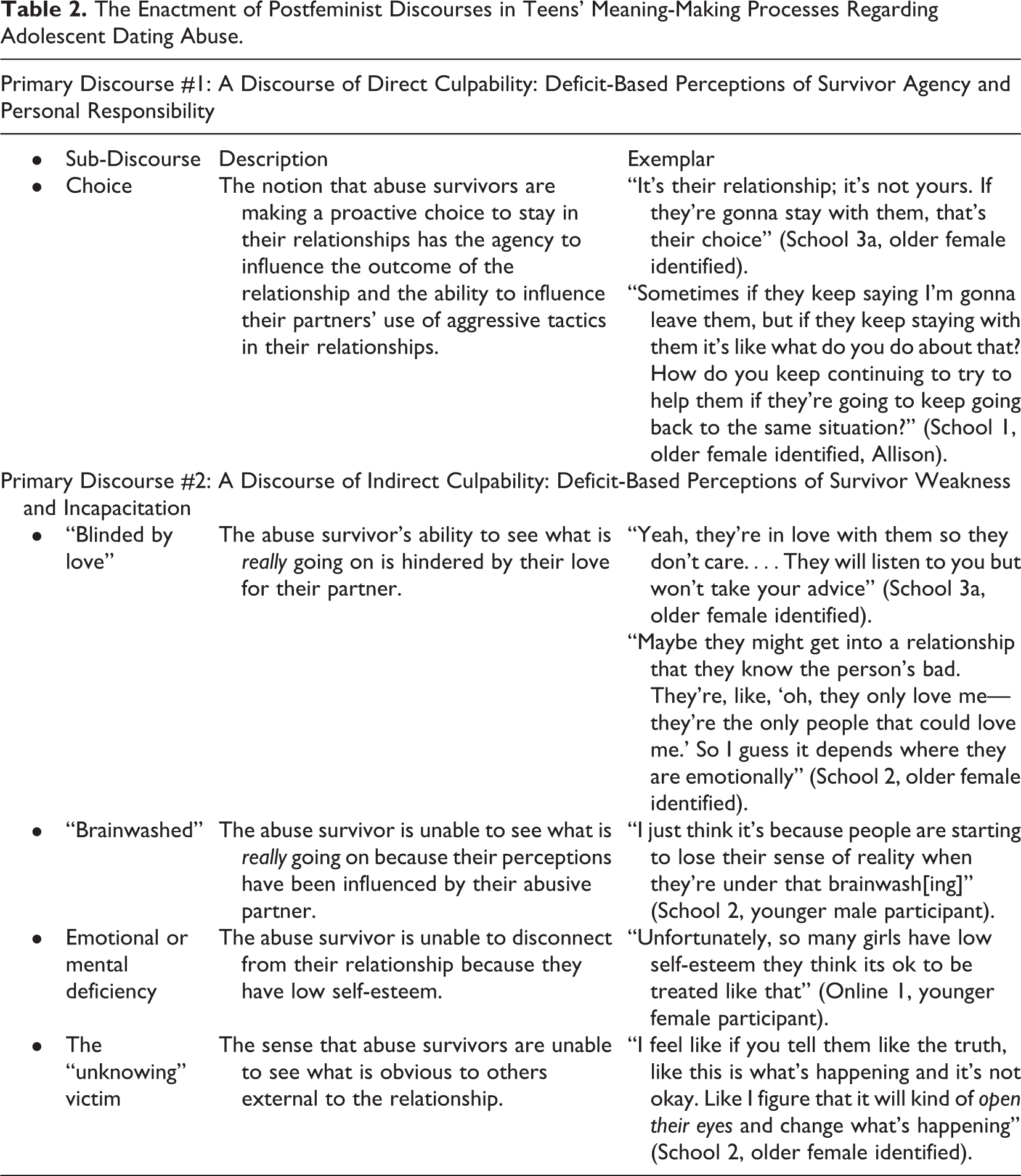
In the following section, we will describe the various ways that postfeminist discourse is enacted in teens’ use of language about dating abuse generally and about teen dating abuse survivors specifically. Across this sample of focus groups, dating abuse survivors were represented as being either directly or indirectly culpable for entering into and/or staying with an abusive partner. Furthermore, survivors were positioned as having the agency to discontinue an abusive relationship. The discourse of being indirectly culpable was illustrated through framing survivors as being “brainwashed,” “blinded by love,” or having personal deficits that hindered their interpretations of the events in their relationships. Absent from these discursive formations was any notion of resilience or survivor empowerment or any acknowledgment of the challenges of leaving abusive relationships. These discursive formations have been summarized in Table 2.
The Enactment of Postfeminist Discourses in Teens’ Meaning-Making Processes Regarding Adolescent Dating Abuse.
A Discourse of Direct Culpability: Agency, Personal Responsibility, and Choice
In several focus groups, participants enacted postfeminist discourse by representing dating abuse survivors as autonomous decision makers who have the agency to influence the outcome of their relationships. For example, in response to a question about what kinds of support would be offered to a friend in an abusive relationship, one female-identified participant replied that she would ask, “Why are you still with him? Or is it worth it?…What are you doing? Why aren’t you doing anything about it? Something like that” (School 1, younger female). The assumption in this statement is that abuse survivors have the ability to “just leave” an abusive relationship or to influence their partner’s use of aggressive behaviors. This assertion was reinforced by a female-identified participant in another focus group who stated, I feel like, mostly, it’s her [fault] for putting up with it for that long…It’s their choice to be in that relationship. If it was really that bad, they could walk away. Like, nothing is holding you there. (School 3, older female)
A Discourse of Indirect Culpability: Survivor Incapacitation and Personal Deficiency
Postfeminist discourses are further enacted in how abuse survivors are portrayed as being personally deficient or incapacitated by the dynamics present in their relationships. Focus group participants used predominantly deficit-based language to construct the archetype of an “unknowing” or deficient survivor who can’t see the abuse present in their relationship; a person “blinded” by love, who has a low self-esteem, or who has been “brainwashed” by an abusive partner. This rationale was provided for why it’s so difficult to support friends experiencing abusive relationships. As one participant shared, “Sometimes they listen to you, but most of the time they don’t” (School 2, younger female).
Depleted self-esteem or mental deficiency
Participants employed the language of self-esteem or mental deficiency (e.g., stupidity) to create meaning regarding why survivors remain in abusive relationships. For example, one participant shared, I didn’t understand why she would do something so stupid [engaging in an abusive relationship], because she wasn’t a stupid person…[and that her relationship was letting her] determine her worth and letting that determine who she was. (School 2, older female)
The “unknowing” dating abuse survivor
The participants’ use of language constructed a supposed “unknowing” survivor in opposition to themselves, who could see what was really going on. For example, one participant stated, “I would give the person who was being abused an [sic] understanding of what we see from the outside, in that they being in the relationship, they don’t see everything the way someone looking on would” (Online Group 4, older female). Similarly, in School 2, a participant stated, “I feel like if you tell them like the truth, like this is what’s happening, and it’s not okay. Like I figure that it will kind of open their eyes and change what’s happening” (younger male, emphasis added). The assumption in these passages is that the survivor needs an outside person to “open their eyes”; thus, peers position themselves as playing a critical role in helping survivors decipher what is really going on in an abusive relationship. For example, one participant reported that after becoming upset with a friend who returned to an abusive partner, she began ignoring the friend who finally came to her senses and understood that her boyfriend was “way too much for her and was controlling her” (School 2, younger female). What is absent or invisible from these descriptions is the acknowledgment that survivors are the experts in their experience. They have deep knowledge of the relationship’s complexities and may be navigating a host of interpersonal, systemic, and structural factors to keep themselves safer from potentially more injurious abuse.
The “blinded” or “brainwashed” abuse survivor
Rather than narratives of empowerment, focus group participants used deficit-based language to construct the image of abuse survivors who were “brainwashed” or “blinded by love.” In an attempt to create meaning regarding why abuse survivors stayed with aggressive partners, focus group participants enacted a discourse of the brainwashed survivor who was influenced by the sway of their abusive partner. For example, one participant shared that abuse survivors don’t get in their minds that that’s not how relationships should be…They become brainwashed and think that this is like the person I’m going to spend the rest of my life with even though they physically hurt me. (School 2, older female)
A handful of participants portrayed dating abuse survivors as being resistant to getting support from their friends because they are “blinded by love.” One student expressed that I feel like it would be harder to intervene in abusive dating. The person is like really in love with that other person and does not care they’re being treated like crap because they want to be with that person. (School 3b, older male) just kept on sticking up for him, like claiming that she loves him and all this stuff…there was no one to really coax her out of trying to find help about it…I felt like she was just in denial about it all. (School 2, older female)
Discussion and Implications for Practice
When refracted through a postfeminist neoliberal worldview, dating abuse survivors are constructed in strikingly stigmatizing ways. Rather than positioning dating abuse survivors as resilient experts of their own experiences, teens in this sample invoked myopic postfeminist cultural narratives that privilege individual choice and self-agency and assign culpability to survivors for being unable to avoid and/or leave an abusive relationship. Taken together, these framings contribute to constructing a “stigmatized identity” for abuse survivors wherein, unlike other survivors of crime, they are constructed as being at least partially responsible for the abuse endured in their intimate relationships (Hamby, 2014). Furthermore, as is consistent in postfeminist discourses, these representations disregard the myriad structural and systemic barriers that impede survivors’ ability to achieve safety, the necessity of collective responses to end dating abuse, and an examination of the role dating abuse perpetrators play in using aggressive behaviors.
The findings in this study reinforce the work of previous studies that have found the advice and support offered by survivors’ peers to be lacking in substance (Ahrens et al., 2007; Ocampo et al., 2007). Similar to other studies, participants held survivors responsible for discontinuing the relationship and minimized the complexity of factors that abuse survivors must weigh in their decision-making processes regarding the future of their relationships (Nabors et al., 2006; Storer et al., 2020). While they identified some of the internal challenges survivors face when considering terminating their relationships (such as having feelings of love for their partner), teens still viewed survivors as individually culpable or deficient for being unable to overcome these barriers. Teens’ framing of dating abuse is of critical importance because cultural frames not only provide evidence of existing societal-level attitudes and norms but also influence potential courses of future action (Chong & Druckman, 2007). When interpreted through a postfeminist worldview, possible courses of action for preventing or addressing dating abuse are focused on addressing such deficits, restoring survivors’ feelings of self-worth, or addressing immediate survivor needs rather than exploring the root causes of this complex social issue.
These findings extend previous scholarship on teens’ attitudes, perceptions, and norms regarding dating abuse by locating these beliefs within larger societal-level discourses that subvert the public’s understandings of this social issue. Postfeminist and “victim-blaming” discourses have been enacted in media representations of the causes, consequences, and lived experiences of dating and domestic abuse (Rothman et al., 2012; Storer, 2017; Thaller & Messing, 2014). Rather than condemning teens’ beliefs as problematic or as a sign of something inherently “morally corrupt” with this generation of teens, it’s important to realize that these attitudes and beliefs arise from teens’ broader worldviews. Evidence suggests that repeated exposure to cultural discourses over time reinforces perceptions and stereotypes regarding social issues (Dasgupta, 2013). Thus, as will be discussed below, it is important for the field to develop multitiered interventions that can interrupt these belief systems and equip teens with the skills and competencies to effectively “decode” the system (Stanton-Salazar, 2011, p. 1092.)
Implications for Research and Practice
The majority of existing TDV interventions are targeted at individual-level outcomes and behaviors and are not designed to address population-level drivers of inequities (Melzter-Graffunder et al., 2011). Despite significant public investment in developing such interventions, as the findings presented in this article reflect, there are still significant misconceptions regarding dating abuse among both the general public (Nabors et al., 2006) and social service providers (Thapar-Bjorkert & Morgan, 2010). The ubiquity of these attitudes and norms reflects the saturation of neoliberal and postfeminist worldviews into individuals’ meaning-making processes regarding complex social issues. Therefore, multifaceted interventions across the ecosystem are needed both to interrupt the destructive cultural narratives that are driving and reinforcing enduring belief systems regarding dating abuse and to bolster teens’ capacities to better support the needs of their peers experiencing abusive relationships.
In terms of the latter, given that teens primarily reach out to their peers for support, it’s critical that they have the tools to recognize problematic narratives about dating abuse and develop the skills to contest those by responding in more helpful and appropriate ways. While bystander intervention programs have focused on equipping teens with the tools and capacities to proactively intervene in instances of dating abuse among their peers (Banyard et al., 2007), it’s also critical that they have the tools to “decode” postfeminist discourses (Stanton-Salazar, 2011) and provide more empowering responses that take into account survivors’ perceptions of their own safety. While teens’ conclusions that survivors are “brainwashed” or “stupid” reflect “victim-blaming” and deficit-based viewpoints, they also sometimes reflect confounding behaviors that dating abuse survivors demonstrate. Therefore, teens also need comprehensive training on the complex dynamics of dating abuse in order to contextualize these confusing responses and respond with empathy rather than judgment. Similar to evidence-informed interventions such as teen mental health first aid, where teens are being trained to increase their understanding and identification of mental health problems, reduce the stigma associated with mental health issues, and make necessary referrals to mental health specialists (Hart et al., 2018), training teens as prepared “first responders” to dating abuse could help increase the quality and substance of teens’ support for their peers. Future research should explore how incorporating these types of skills could augment existing prevention programming.
In terms of addressing upstream determinants of postfeminist cultural discourses, social movement scholars use the phrase “flipping the script” to describe how one of the first tasks in dismantling entrenched social norms is to help individuals reimagine a new lifeworld (Pyles, 2014). Thus, future research needs to investigate participatory strategies to reframe dating abuse away from individual-level determinants and toward more collective and liberatory community level and structural interventions. Strategic frame analysis is one potential tool to facilitate identifying dominant “master frames” or “mental models” and mapping a prescribed process for dismantling those constructions (Bales, 2009). Although there has been research on how strategic frame analysis can be used to challenge public perception of education-related issues (Bales, 2009), future research should investigate the processes by which strategic frame analysis can be used to contribute to dismantling enduring social norms related to dating abuse and contribute to survivor liberation.
Burgeoning research investigates how feminist-based social movements such as #MeToo and #WhyIStayed are a “virtual commons” for survivors of gender-based abuse to subvert dominant (and often oppressive) narratives regarding gender-based abuse. For example, an investigation of the architecture of the #WhyIStayed hashtag identified elements in that dialogue by underrepresented minorities who described the structural and systemic barriers that impeded their abilities to leave abusive relationships—thus “flipping the script” regarding intimate partner abuse (authors masked). Although teens are one of the primary adopters of social media platforms (Pew Research Center, 2018) and have been integral in spearheading contemporary social justice movements (Conner & Rosen, 2016), there has been a limited examination of how teens specifically are employing social media to reframe dating abuse, engage in innovative virtual prevention and organizing activities, and ultimately understanding how social media can both replicate and subvert dominant understandings of domestic and dating abuse.
Limitations
There are several limitations worth noting in this study. CDA is a flexible method that builds on the inherently interpretive nature of meaning-making. Unlike in post-positivist research paradigms, CDA is not a “hard science” built on empirical assumptions. While every attempt has been made to conduct a rigorous CDA process, a limitation (and strength) of this method is its reliance on the researcher(s) as the key interpretive instrument. Thus, as noted in our reflexivity section, this analysis is a reflection of the epistemologies, ontologies, and positionalities of the researchers. Both authors have been trained in post-positivist and prevention science methodologies and, thus, have unknowingly internalized post-positivist worldviews (Ponterotto, 2005). Furthermore, our prior professional experiences working in mainstream domestic violence agencies have influenced our ontological assumptions regarding constructs such as “violence,” “survivor/victim,” and perpetrators. While we intentionally practiced reflexivity throughout our analysis process, these ontological constructions have inevitably influenced our constructions of the social phenomena present in this study. Another important limitation of CDA is it’s privileging the influence of “dominant discourses” such as postfeminism and neoliberalism while minimizing individual-level agency in resisting and deconstructing these discourses (Finn & Jacobsen, 2003).
The data analyzed in this article were collected to answer very specific research questions related to the teens’ willingness to adopt bystander intervention techniques. While this is often the case in CDA studies that analyze existing sources of data, it is worth noting that, like studies that utilize secondary data analysis, our study is influenced by the noted limitations of the original data collection. The limitations of that data collection and analysis effort have been described elsewhere (authors, blinded for review). One point worth noting is that the focus groups were not organized in similar ways across the in-person and online groups, sometimes they were organized by grade and sometimes by age. The researchers relied on input from our community research partners who supported our participant recruitment to help organize these groups. While this approach allowed us to recruit samples of teens beyond our initial high school sample, we are unable to distill whether the views expressed in this article are correlated by age or grade level. However, since grade level does not always correspond with age, we do not suspect that the composition of our focus groups dramatically influenced these findings. However, it should be noted that these findings may only be transferable for high school-aged teens, not a specific age-group or grade level.
Conclusion
Given that adolescent dating abuse survivors primarily reach out to their peers for support, the substance of teens’ responses can be of critical importance to survivors’ well-being and liberation. Evidence in this study underscores that teens’ belief systems regarding dating abuse reflect larger postfeminist discourses that privilege individual-level agency and personal accountability while minimizing structural and systemic determinants. One of the strengths of CDA is its ability to shed light on the unspoken and commonplace nature of our collective social practices and belief systems. The worldviews present in this study are indicative of larger societal discourses. Thus, interventions to address dating abuse need to support teens in unpacking and decoding dominant discourses that stigmatize constructions of dating abuse survivors while concomitantly challenging the supremacy of postfeminist discourses that hold survivors culpable for abuse and decenter structural explanations of dating abuse.
Footnotes
Authors’ Note
The content is solely the responsibility of the authors and does not necessarily represent the official views of the funding agencies.
Declaration of Conflicting Interests
The author(s) declared no potential conflicts of interest with respect to the research, authorship, and/or publication of this article.
Funding
The author(s) disclosed receipt of the following financial support for the research, authorship, and/or publication of this article: Research reported in this publication was supported by the National Center for Advancing Translational Sciences of the National Institutes of Health under Award Number (TL1TR000422) and the University of Washington Royalty Research Fund.