




Abstract
This research study is informed by anticarceral feminism to understand and highlight the experiences of violence and oppression that individuals in the sex trade experience as a result of police stings, raids, and incarceration. We present findings from 23 in-depth, qualitative interviews with men, women, and trans individuals who were arrested in the Los Angeles sex trade. More specifically, we explore experiences of violence that occurred interpersonally, systemically, and institutionally. Such experiences examine police violence, arrest and incarceration, coercion, and client violence. The findings from this research shed light on the impact the criminalization of sex work has had on research participants in terms of their physical health and mental health, economic security and opportunities for growth and education, and their sense of freedom and autonomy. We also attend to the role that intersecting identities might have played during their encounters with the police. This study explored these aspects while being mindful that the policies and procedures followed by the police are born out of a carceral state. We conclude with antioppressive and antiviolent implications for social work practice, policy, research, and education as we imagine the next decade of social work in relation to sex trade.
The criminalization of sex work and subsequent policing and incarceration practices create unsafe work environments and impair access to needed social services for sex workers. There has been a wide range of police tactics intended to intimidate and harm sex workers, including threat of false arrests, constant searches and scrutiny, and physical and sexual violence (Boittin, 2013; Dewey & St. Germain, 2014; Jayasree, 2004; Krusi et al., 2014; Nichols, 2010). The deployment of such tactics by police can leave sex workers feeling powerless before, during, and after encounters with the police (Armstrong, 2017; Vanwesenbeeck, 2017). Frustratingly, ample research has demonstrated the ways that youth and adults involved in sex trade have faced institutional violence when trying to access support through health care systems, housing and shelter systems, social services, and law enforcement.
Of particular vulnerability to systemic and institutional violence are queer, trans, black, indigenous, people of color (QTBIPOC), and nonbinary people. The Young Women’s Empowerment Project (YWEP, 2012), an organization led by youth working in survival street economies and the sex trades, conducted research about the experiences of their members encountering violence across multiple social service systems. Their findings led to the development of a “Bad Encounter Line” to document the bad experiences that youth in the street economy and who were trading sex experienced when they tried to access help. Overall, they found that bad encounters increased when social services collaborated with law enforcement (YWEP, 2012, p. 16). Similarly, Dank and colleagues (2014) found that law enforcement often saw QTBIPOC youth on the street as troublemakers heading toward a life of criminality and rarely viewed them as in need of actual help. In response to the surveillance of QTBIPOC, sex work activists and sex workers themselves have organized and protested for decriminalization and anticriminalization (Black Sex Workers Collective, 2020; Panichelli et al., 2015), which would allow people engaged in sex trades more autonomy, safety in workspaces, and the removal of constant surveillance and threat of arrest.
In this article, we examine the policing and incarceration practices that have led to violence against sex workers interpersonally, systemically, and institutionally. Here, we share findings from a qualitative research study that explored encounters between sex workers and police, with particular focus on the consequences of arrest and criminalization. The research questions we sought to answer were (1) what were the lived experiences of our participants when they encountered law enforcement and (2) how did those experiences impact them physically, mentally, and economically. Notably, our research occurred in the United States, in Los Angeles, CA, where sex work is deemed unlawful per California penal code 647(b). Through the use of an anticarceral feminist approach and feminist narrative methods, we aspire to amplify the voices of research participants who identified the impact of criminalization on their physical and mental health, economic security, opportunities for growth, education, and autonomy.
Literature Review
Police Violence in the Carceral State
Studies have shown that police violence and abuse toward sex workers are expected, validated, and systemic (Cepeda & Nowotny, 2014; Dewey & St. Germain, 2014; Nichols, 2010). In some instances, sex workers recognized that the criminal justice system was designed to exploit and victimize them and that they were not privy to being believed or protected by the system (Dewey & St. Germain, 2014; Nichols, 2010). Furthermore, in a study by Rhodes and colleagues (2008), participants expressed a fatalist acceptance that the police had a right to victimize them. Overall, violence from the police led sex workers to feel isolated from help or support because they internalized the idea that they were not “true” victims.
When sex workers internalize stigma, violence, and abuse, they are unlikely to feel that they deserve help and are unlikely to report their experiences (Klambauer, 2018). In some cases, internalizing the violence has led to sex workers discounting anything other than brutal beatings as violence or abuse. Coercion to have sex, sexual assault, rape, extortion, harassment, manipulation, and threats of arrest were not viewed as violence or abuse, rather these experiences were viewed as normative (Lunze et al., 2016).
The neoliberal expectations of individual responsibility have influenced some sex workers to believe that they deserve the violence and abuse they encountered by police. Under neoliberalism, the “undeserving” are abandoned and considered unworthy of help because they did not “win” the race to the top by overcoming systemic oppression. In other words, they have not surpassed the inequitable barriers of classism, racism, sexism, transphobia, and beyond to rise above their marginalization. Therefore, violence toward them is not only normative but becomes justified (Springer, 2012). This has left them feeling devalued and undeserving of support from the police because of their sex worker identity (Klambauer, 2018). Sadly, neoliberal messaging is so deeply embedded in the United States that some sex workers felt that police had the right to beat them as part of a moral punishment for their involvement in the sex trade (Lim et al., 2015; Rhodes et al., 2008; Simic & Rhodes, 2009).
Intersectional Oppression in a Carceral State
Various studies found that the intersecting identities of sex workers often exacerbate their encounters with the police which leads to the multiplicity of inequality. For example, homelessness and lack of access to drug treatment programs were associated with gender-based violence at the hands of the police, thus creating an atmosphere of structural violence and inequality (Shannon et al., 2009). Another study concluded that marginalized identities, such as gender and sexual identity, increased the risks for police violence, resulting in economic insecurity and potential incarceration. In fact, some participants felt the need to hide their gender identity in order to avoid being targeted by the police, who are working within a carceral state.
Similarly, other studies found that the police particularly target transgender sex workers of color (Sears, 2010–2011), who experience police violence, not only while working but also outside of work, as the intersection of their gender and race mark them as deviating from hegemonic race and gender norms (Collins, 2005; Nichols, 2010). Among those most marginalized, trans BIPOC sex workers bear a significant brunt when it comes to being targeted for violence and humiliation. Overall, institutional oppression keeps sex workers with intersecting marginalized identities in never-ending cycles of oppression such as being blocked from accessing legal living wage work and affordable housing. It is partially due to these types of institutional barriers that make sex work a viable option for the economic survival of those most marginalized.
Within the carceral state, violence and abuse can take the form of verbal, physical, sexual, and financial abuse, leaving sex workers with two choices: comply or risk arrest (Dewey & St. Germain, 2014; Lim et al., 2015; Lunze et al., 2016; Nichols, 2010; Odinokova et al., 2014; Rhodes et al., 2008; Sears, 2010–2011). For some, the extortion of bribes and confiscation of condoms by police led to the need for sex workers to urgently make money and more likely to agree to sex without condoms (Erausquin et al., 2011). In fact, some sex workers view exploitation, violence, and abuse as an occupational safety hazard related to the cost of doing business (Lunze et al., 2016). When examining the interactions between the police and sex workers facilitated through raids and stings, scholars have concluded that police arrests were intended to identify traffickers, yet arrests served to further perpetuate a cycle of power and control that the police hold over sex workers. This power allows the police to decide who is a victim and who is not, all while profiling the marginalized who are then labeled with criminal status rather than victim status.
Carceral Feminism
In 2010, drawing on the work of antiviolence activists and scholars of color, sociologist and feminist scholar, Elizabeth Bernstein, coined the term “carceral feminism” (Davis, 2003; Falcón, 2006; Koyama, 2006; Law, 2014; Mohanty, 2003; Roberts, 2004; Smith, 2006; Sudbury, 2006; Sudbury, 2014; and others). Bernstein (2010) asserts that “carceral feminism” describes the influence of second-wave feminism to encourage women’s reliance on law enforcement for violence intervention. In other words, the threat of being incarcerated is intended to deter violence from taking place, and law enforcement is used in the form of rescue feminism, whereby law enforcement is positioned as the savior of women. Bernstein (2012) critiques carceral feminist policies stating that they are grounded in neoliberalism and heteropatriarchy, which bolster structural inequality and coercive power dynamics designed to criminalize sex workers. Carceral feminist policies link the welfare and the carceral state which depend by creating an interdependent relationship that depends on the criminalization of poverty (Gallo & Kim, 2016). Given the failure of the welfare state to sufficiently meet the needs of people, many risk arrest by turning to illicit economies for survival and income (Gallo & Kim, 2016). At the same time, those trading sex for money are targeted as either criminals or victims to be “helped” by being arrested (Musto, 2013).
Poignantly, one carceral feminist policy that often leads to the arrest or incarceration of people engaged in sex trade are raids and stings conducted by a collaboration of law enforcement and social service providers. Carceral feminism positions law enforcement as protectors and rescuers of those that have been victimized in the sex industry (Anasti, 2020; Musto, 2013). For instance, the federal government’s funding of antisex trafficking initiatives, like FBI’s Operation Innocence Lost and Found, is touted as an intervention to rescue child victims of commercial sexual exploitation. Under the guise of working on human rights causes, social service agencies collaborate with police departments around the country to identify children who have been exploited. In effect, these groups reproduce the dangerous consequences of carceral feminism as social service providers have the power to decide what is best for those who have been identified as exploited. Police have shifted toward arresting sex workers under the assumption that they are victims of sex trafficking and then hold them until a determination of their victim or agent status can be made (Farrell & Cronin, 2015).
Carceral feminist logic emphasizes that if innocent people are rescued by law enforcement through raids or arrest, they can be saved from violence. However, when women of color, who hold multiple marginalized identities, turn to the police for help, they risk being labeled as criminals opposed to victims. Scholars and activists across disciplines have documented the disproportional experiences of black women being arrested due to institutional racism, classism, transphobia, and xenophobia labeling them as criminal instead of innocent (Crenshaw, 2011; INCITE!, 2016, 2017; Ritchie, 2012).
The harmful effects of criminalization do not rest in arrest or imprisonment, and other harmful consequences include loss of parental rights, access to housing, welfare, employment, and education (Mogul et al., 2011). The impact of institutional oppression dictates a lack of access to affordable housing, social services, health care, employment opportunities, and other basic needs. Important to note is that carceral interventions employed by antisex trafficking activists aimed at removing people from the sex trades or eradicating the sex industry all together have made many communities such as youth and adults of color, transgender women of color, and undocumented workers further vulnerable to violence. Research has found that those who have been trafficked are often imprisoned and disconnected from their families and communities even further (Brennan, 2008; Ditmore, 2009). Imprisonment leads to disenfranchisement, lack of access to rights, which leads to the increased need to engage in sex work and potentially being incarcerated again, and disconnection from family and community impedes recovering from trauma and violence. The consequences of incarceration contradict the purpose of removing people from the sex industry to rescue them from violence.
Theoretical Framework: Anticarceral Feminism (AF)
Along with the ever-expanding influence of neoliberalism on the U.S. society, family, and economy, the drive to incarcerate sex workers has permeated feminist agendas with justice being defined by penal codes. While the term “carceral feminism” has been framed as a critique of feminist agendas in relation to gender-based violence, it provides a useful lens for exploring collaborations between police and social services to rescue those who are labeled as victimized. Even if sex workers have experienced victimization, they may face further trauma at the hands of the State. In the 1970s, grassroots feminists came together to contest the “liberal feminist demands for more criminalization of rape and battering that were increasingly met by a carceral state” (Thuma, 2015, p. 28) as they knew that increased criminalization would serve to put survivors of color at risk of arrest. This anticarceral feminist work has continued through the efforts of various community organizations, activists, and publications throughout the United States. 1
AF which can also be referred to as “feminist abolition” is described as “a feminist politic and praxis that explicitly rejects any form of arrest and incarceration as legitimate; aims not to reform but rather to dismantle jails, prisons, and policing; and actively works to build a liberated world without prisons” (O’Brien et al., 2020, p. 6). Additionally, AFs expose the deep ties between the social welfare and carceral states through analyzing social work practices and policies (O’Brien et al., 2020).
Informed by the work of scholars who write about prison abolition as it intersects with gender and antiviolence, an anticarceral feminist lens offers an intersectional and liberatory approach for critically exploring the sex trades. AF illuminates the impact of police violence during antitrafficking stings and identifies alternatives to the criminal legal system, like mutual aid, community accountability, a focus on systemic change, decriminalization of illegal sex trades and drugs, harm reduction tools, and linkage to the self-identified needs and resources of people in the sex trades.
AF links critical feminist goals, like self-determination, disrupting the gender binary, centering intersectionality in praxis, examining the impact of globalization on marginalized people (and in this case, people working in the sex trades), in addition to limiting dependence on state governance for protecting people in the sex industry and liberation. Incarceration and criminalization of sex workers impose huge barriers to getting needs met. For example, many employers will not hire someone with a criminal background, making it hard to advance economically in a formal work sector. In turn, many people will access survival economies to make money. For transgender people, prison is frequently a site of violence (Stern, 2012) where they experience threat of death and where they are unable to receive appropriate health care. Furthermore, a reliance on carceral intervention to rescue or help people who work in the sex trades may very likely end in violence, trauma, and a return to poverty and oppression (Lutnick, 2016).
Utilizing AF as the theoretical framework that informs this research allows us to engage with the many faces of oppression (Young, 2013) that mark certain bodies as criminal and deviant. An anticarceral feminist lens help us make meaning of the violence experienced by our research participants. Research that engages with processes of criminalization warrants critical feminist methods inclusive of exploratory and emancipatory aims. Overall, AF illuminates the interwoven complexities of oppression, trauma, and violence that regulate and criminalize those who receive help and those who are punished through social institutions.
Locating Ourselves
Collectively, we embody diverse social locations along the lines of race, sexuality, age, social class, and ability status. As cisgender women, we embody queer, heterosexual, white, ethnic/non-white, disabled, and middle-class identities, with all of us holding the privilege of U.S. citizenship status. Los Angeles was selected as the site for this research since it was the home city of the first two authors. We each have diverse relationships to the sex industry as activists, allies, and sex trade workers as well as lived experience of violence by the carceral state. Collectively, we have a decade of experience with harm reduction and sex workers’ rights activism. While we acknowledge that sex trade involvement can be a form of empowerment as well as a form of survival, and some individuals lack choice, experience exploitation, and coercion, we have seen firsthand the negative effects of criminalization of sex trade workers’ lives. We are committed to advocating against the criminalization of trans, queer, nonbinary youth, and adults engaged in sex trade; sex workers of color targeted for arrest through commercial sexual exploitation of children rescue interventions; and to teaching social work students about the range of lived experiences, strengths, skills, resources, and challenges experienced by people working the sex trades.
Qualitative Methodology
Our feminist values informed our desire to highlight marginalized voices of individuals working in sex trade and to prioritize their lived experiences through in-depth narrative feminist interviews and life time lines with each participant. This research project was part of a larger qualitative research study that explored the ways in which diverse individuals working in the sex trade managed their personal life and their work in the sex industry. 2 We detail our methodology to contextualize the types of qualitative research interviews that we conducted and then we describe our recruitment, data collection, and analysis process.
Narrative Feminist Research Interviews
This research study utilized a narrative feminist research approach with diverse individuals working in the sex trade. Narrative approaches to qualitative research use storytelling as a tool for meaning-making (Moreton-Robinson, 2000) and adhere to the centering of marginalized voices being heard (Davis, 2002/2014). Feminist approaches to narrative research have the potential to challenge androcentrism, which acknowledges the historical tendency to focus on men’s experiences at the expense of disregarding and omitting women’s voices and lived experiences (Hesse-Biber, 2008). However, using a narrative feminist approach to research does not mean that the research has to exclusively focus on women (Fraser & MacDougall, 2017); the focus is on amplifying marginalized voices. This research study included the diverse experiences of cisgender and transgender sex trade workers as individuals who face oppression and stigma due to the intersections of their gender, sexuality, and sex work.
Narrative feminist approaches encourage participants to be active agents in exploring the subjective meanings behind their experiences through in-depth interviews, while engaging in the co-construction of knowledge with the researcher (Fraser & MacDougall, 2017). In the process of cocreation, stories manifest through the interplay of telling, listening, and dialogue. Similar to other narrative approaches, narrative feminist research interviews may explore a single event, an experience or an entire life while attending to the interplay between the story and the storytelling (Riessman, 2013). Through this process, attention is paid to how stories are told as well as the content of these stories (Andrews, 2013). The journey of storytelling can be linear, circular, or thematic (Fraser, 2004; Fraser & MacDougall, 2017; Riessman, 2013). Engaging in narrative feminist research means being intentional in linking the personal with the political and understanding the effects of social problems in ways that do not stereotype, denigrate, or pathologize people who experience them (Fraser, 2004; Fraser & MacDougall, 2017).
A narrative feminist approach to research is particularly useful for understanding the lived experiences of sex trade workers whose experiences are often generalized, stereotyped, and stigmatized. Narratives are empowering because they allow individuals to “construct who they are and how they want to be know” (Riessman & Quinney, 2005, p. 394). This can provide individuals working within the sex trade with the opportunity to have control of their own narratives and resist the fragmentation of their lives. Narrative feminist researchers attend to the events described in stories in addition to how the storyteller feels about the story being told. The emotions of the participants in the retelling of the stories are critical to the analysis process and the multilayered understanding of lived experience.
Life Time Lines
In addition to capturing the narratives of the participants through in-depth interviews, life time lines were completed at the end of the interview with each person to augment and contextualize the interview data. Life time lines involved the drawing of a horizontal line on a blank sheet of paper with “birth” written on the left side (at the start of the line) and the participant’s age written at the end of the right side of the line (at the end). Using a pencil, the participant was asked to map out important life events, from geographical locations and physical moves to tragedies and deaths, births, unions, separation, special events, and significant issues that occurred throughout their life. This process served to (1) provide a chronological context for the stories and experiences shared in their narrative interview, (2) assist with creating awareness of earlier life events played out in the participant’s life, and (3) ensure that major life experiences were included in the interview. Including life time lines was useful in the interviewing process because there were certain events that participants had the opportunity to share that were not always asked about in the narrative interviews. This process also provided a visual aid for documenting and reflecting on lived experiences over the course of a lifetime.
Recruitment, Data Collection Process, and Analysis Process
After receiving institutional review board human subjects ethics approval, we began the recruitment and data collection process. Participants were recruited through purposive and snowball sampling. Specifically, we engaged in outreach at various strip clubs, we posted a study flyer online, we invited personal contacts to participate, and we shared the flyer with a local organization that provides services to sex workers.
Once interested individuals contacted members of the research team (first two authors of this article), we went over the purpose of the research and the informed consent process. We set up a time and place most convenient for each participant to hold the in-depth interviews. The interviews were held in various places including a private room at the public library, coffee shops, the agency where some participants received services, and at a participants’ apartment. Each individual selected a pseudonym and shared their intersecting identities prior to engaging in the interview and co-constructing their life time line to highlight the major events in their life over time. The in-depth interviews and life time lines with each participant lasted between 1 and 3 hr long, with an average time of 2 hr. We provided a list of free mental health resources to participants after their interview, in the event that any of the questions were triggering since they involved recounting experiences of arrest and criminalization.
We transcribed each interview while documenting our initial reactions to the interviews, words and quotes that stood out for us within the interview and life time line. A thematic analysis process focuses on the reduction of the data through the process of data segmentation, categorization, summarization, and reconstructed (Ayers, 2008). Through this process, we formed codes that were documented in the margins for each individual transcript. We engaged in a thematic analysis within each case and then a cross-case analysis among all of the interviews. This process involved coming together and collectively comparing findings and searching for patterns of experience within each interview and then identified overarching themes among all of the interview data. It was through this process that we jointly found that many of the participants had experiences of criminalization and incarceration as a result of experiencing police stings and raids. This unanticipated finding that surfaced across all of the cases served as the rationale for exploring the detrimental phenomenon of carceral feminism on the lives of sex trade workers.
Research Rigor and Trustworthiness
To ensure research rigor and trustworthiness of the research data, we built trust with our participants through transparency about the purpose of our study and our identities as researchers. We immersed ourselves in the data that we personally collected, transcribed, and analyzed. We triangulated our data sources through comparing the in-depth qualitative narrative interviews with the life time lines for each participant and the reflective notes from our journals about each participant after their interview. A graduate student who was familiar with the topic of sex work reviewed the raw data to assess whether the findings were plausible based on the data we collected. We also offered the opportunity for member checking; however, only one participant reviewed their transcript and provided their feedback.
Portrait of the Participants
A total of 23 men, women, and trans individuals working in diverse areas of the sex trade in Los Angeles participated in this research study. Of the 23 participants, 15 identified as cis female, two identified as cis males, five identified as trans women, and one identified as a trans man. Six participants identified as white, and 17 identified as people of color (five identified as black, 10 identified as Latinx, one identified as mixed race, and one identified as Indian). Their ages ranged from 19 to 56 years (the mean age was 29 years; half of the participants were between the ages of 25 and 35 years). Twelve participants identified as single, and 11 were in some form of a relationship. Eight of the participants had children (some were living with them while some were in the child welfare system). Their education status ranged from completion of ninth grade to pursuing a doctoral degree. The types of sex work included street work, online work, escorting, stripping/exotic dancing, webcam work, phone sex, dominatrix work, erotic massage, sugar baby/sugar daddy, and erotic nude modeling. The years of working in the sex trade ranged from 4 months to 40 years. Three participants shared that they were unauthorized with approximately one third of the participants having been born outside of the United States. Table 1 presents the demographic data of the participants whose quotes are featured in the findings section.
Participant Demographic.
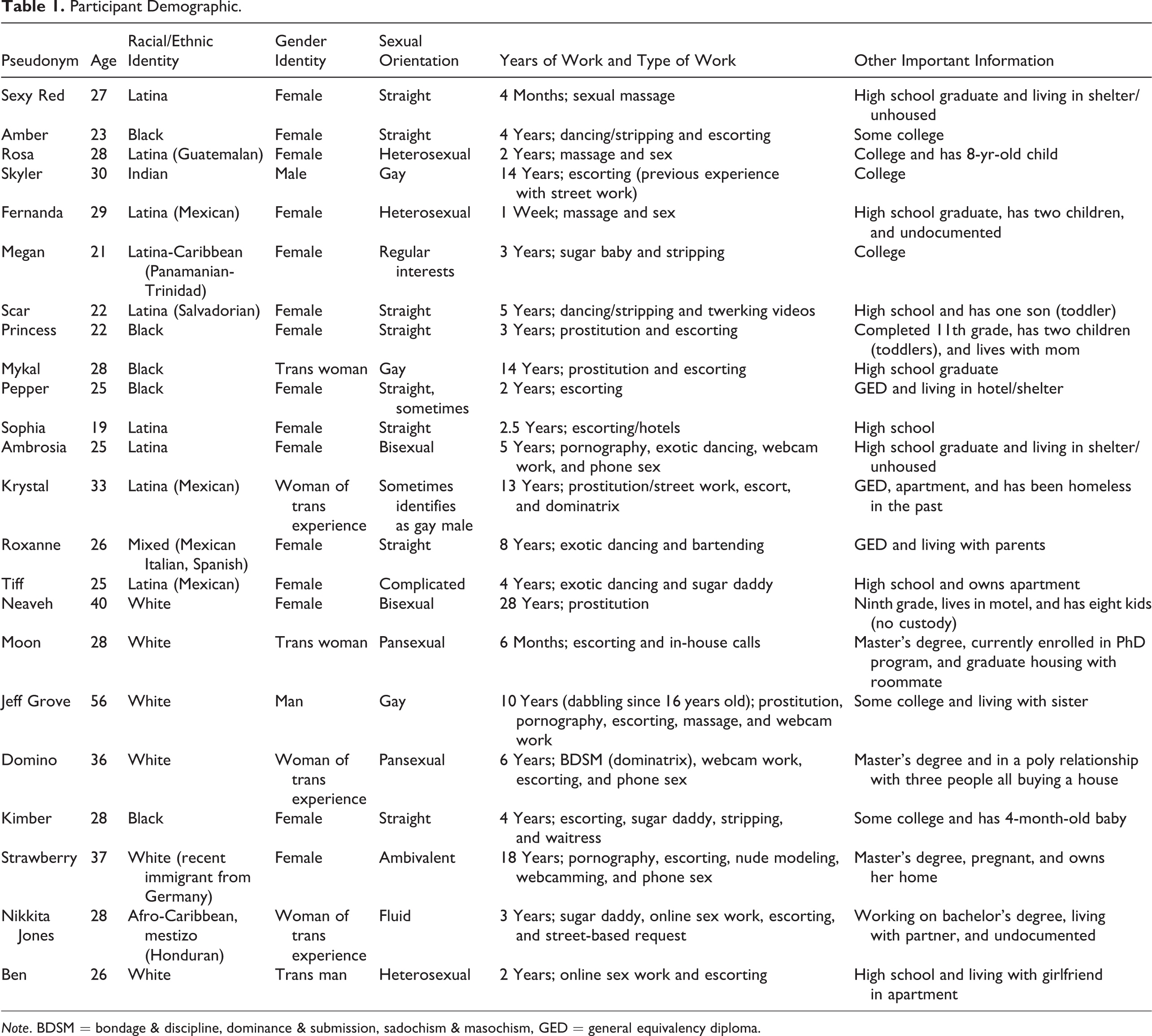
Note. BDSM = bondage & discipline, dominance & submission, sadochism & masochism, GED = general equivalency diploma.
Findings
Through the data analysis of the interviews, we identified two main themes that materialized from the participants related to their experiences of working in the sex trade in Los Angeles: (1) experiences of arrest through police raids and stings and (2) effects of incarceration on the lives of sex trade workers.
Experiences of Arrest Through Police Raids and Stings
Many of the participants in this study described their traumatic experiences of police arresting them for prostitution in great detail. A common feature of their narratives was the experience of police deception during the sting and the use of police squad intimidation during the raid. There was a common theme among the participants of encountering an undercover cop who would pose as prospective client interested in their sexual services. These undercover sting operations took place during in-house calls, during outcalls at hotels, and at their places of work. The participants shared how many law enforcement officers used the same websites, such as backpage, where sexual services were advertised, to find sex trade workers to set up for arrest, as well as the same tactics. For example, Sexy Red (27-year-old Latina female) shared her experience of getting arrested during an in-house call that was instigated via backpage. She shared: That client ended up being an undercover cop, so I didn’t even know. He looked like a regular person to me and I was just telling him—I just remember having a conversation with the man and he asked me if I was going to give him a happy ending. I told him “yes, but before we do anything, I need you to take a shower.” I checked the water and he asked me if I was gonna go in there with him. I said “no, you take a shower and I’ll be out here waiting for you.” He said “oh the water is too hot.” So I turned around and I was adjusting the knobs. I turned around and the guy disappeared. I was like, where did he go? Then all of a sudden, as I noticed he was gone out of the bed, I heard a whole bunch of cops rushing through the apartment and saying “police, you’re under arrest!” And I just look out of the bathroom and all these cops just have guns pointed at me and saying that I was arrested and that I was being arrested for prostitution. I ended up going to jail, getting fingerprinted and everything. Escorting, I think I’m just scared every time I do it…just thinking everyone’s a cop…I was doing an in-call…I should have known because he took long to come, first of all. Then, when he said that he was here, he took long to come up. I was already feeling suspicious because he wouldn’t take his clothes off or anything. He wouldn’t show me his penis because I usually ask that because cops can’t show you their penis, but there’s so many crooked cops these days that you never know. I was fully dressed and I was sitting there. I didn’t even do anything. They just came in the room and it’s so crazy because I was fully dressed when I got arrested. I didn’t touch the money. I didn’t touch anything and they arrested me. And they lied. I didn’t say anything about sex. When I get to court, the statement is lying and it said I told him to pull out his dick and I was rubbing on his thing. When he arrived, I asked if he was the police and he told me that he wasn’t, and he said “How can you think, mammy, that I am a police?” Well, then I trusted him. He arrived, he came in, he came to my apartment and he asked if he can use my bathroom. I said “yes.” He asked how much is it, I said, “whatever I told you.”…. from there he said “take off your clothes” and I said “no take yours off first” and he said “no, I want you to take off your clothes and kneel down on the bed and open your behind because that’s how I get excited” and I said “no…I’m not going to do that, first off you take off your clothes and then I will.” Then he said “well then I’ll just leave” and I said, “well then leave” and when he opened the door and three policemen came in. First of all, he was insanely good looking. I was just like, something’s up here. He was young. He was really young and really good looking. He was in a suit, but there was this dirty backpack. Because now the cops are figuring out that you have to stage the room, right? You have to put luggage or whatever in the room. He had a dirty backpack in the room and I was thinking like, a man like that is not going to travel with that backpack, you know what I mean? I smiled as I possibly could and he asked me if he could fuck me. I don’t think I answered that immediately. He asked me again, and I was trying not to answer it. I was just hoping that question would go away. I literally said, I stated to the undercover cop, “I’m not here to have sex for money.” But he asked me if he could fuck me, and I said, “yes.” Then he asked me how much was the donation or something, “He’s a $300?” I was like, “yeah.” Then I was like, “But I’m not here—the money is not for sex.” At that point, he just walked out of the room, and then they all came busting in. They didn’t put that in the report. The report’s completely different from what actually happened. When I arrived there [hotel], I presented myself with a hand shake…the only thing that I did was greet the person. I sat down on the chair, and that was it. He told me, “can you stay 2 hours with me?” I told him “yes…. we can talk, what do you want to do?” So when he put the money—he was giving me money—I told him no, I didn’t touch the money at all, or anything. And that’s when he started to ask me questions like, sexual questions, then I got up and got my purse and he said relax, he said it’s nothing bad. And I told him “it’s because you are confusing me, you invited me here for something else,” and that’s when he got close to me and he began to touch me, my breast. Then I said, “what’s going on?” and when he saw that I got my purse he said, “give me a minute I am going to the restroom,” but that’s when he opened the door and that’s when the police officers came in. But not in any moment did I touch him, not in any moment did I caress him.
Like Skyler, Fernanda also had a premonition that something was odd in the interaction with the “client,” and she, too, was very careful with the type of language she used to avoid arrest. The same caution was used by other participants who shared how they were arrested at their places of work. Another participant, Megan, stated that she was humiliated when (as part of an investigation) cops took pictures of her stripping at her job but later pressured her to have sex for money. When she accepted the offer, she was arrested. Megan (21-year-old Caribbean-Latina female) shared: I was working at the [strip] club one night and an officer came in and he started throwing money at the stage. I was the only one who was there…I feel like I was targeted in this situation because a gentlemen walked in but I did not know it was a cop…he basically persuaded me, throwing money at me, asking me what I could give him…the only way to really get these guys to actually give you money is to sell them the idea of sex, right? That’s why you’re in a strip club, that’s why you’re taking off your clothes. Well, that’s what I did. I sold him the idea of sex and I agreed that I would have sex with him, but not with the intention to. I just wanted to sell the idea, but I was arrested…basically they took pictures of me without my permission. I guess it was all part of an investigation so they had to, but without my permission. I was humiliated. The cop pressured me, even if he didn’t force me; he pressured me into agreeing with him that I would have sex with him. That one day just came to happen and I asked the guy, “If you give me $200, we can do VIP and we can have sex,” I told him. I just kept going with it, even though I had a bad instinct. I still kept going and saying that I would do it for $200 because I needed the money. He said that he was going to the ATM and that he’d be back. I was dancing on stage and by the time he came back, two cops come in. I had never been through that. It was so embarrassing. He was an undercover cop. I have never been through shit like that. Immediately, I was like damn, I fucked up. I’m a prostitute. It’s on my record still that I’m a prostitute, you know, so it makes me feel like, fuck, it needs to come off my record. Whenever I get arrested, it’s going to say right there. It’s going to say that she’s a prostitute when I only did this one time. It was only one time. I didn’t even have sex with him. I just said it. But he recorded me.
Effects of Incarceration on the Lives of Sex Trade Workers
The effects of criminalization on the lives of the sex trade workers were severe and impacted various aspects of their work and personal lives. These issues included, but were not limited to, struggles with mental health issues and living in fear, navigating tumultuous relationship issues in personal and professional life with clients, troubles of finding and holding alternative forms of employment, losing custody of the children, disruptions in educational aspirations, the loss of personal belongings, financial burdens, and having to engage in mandatory prostitution diversion programming. For example, Scar shared that the arrest led to the loss of custody of her children and mandatory prostitution diversion classes. She expressed: How I got into those classes at [name of prostitution diverse program] is because I got into trouble, I ended up doing something that I wasn’t supposed to do. My son got taken away, too. When I went to jail, they let me go with a promise to appear in court and I never went back thinking that they were gonna let it go. I had never done shit like that. Hell no, they arrested me again and I was in jail for a whole week. When I was there, they were like ok, we are gonna let you go, but you need to do some classes. At the beginning, even the girl was like ok, he [cop] recorded you…I couldn’t believe the guy recorded me. I was like FUCK. I can’t believe it. So I got a lawyer for the arrest. I paid for a private lawyer, so I was just struggling all the way around…. after I got this lawyer, he got me a deal. He told me that the report didn’t look good with what the cops were writing but he said “the deal that I made with the judges, you’re gonna have to complete your classes for eight sessions and he referred me to [name of prostitution diverse organization]. So I just have to show up to my classes and they’re gonna dismiss the charges and stuff like that…. That’s how I started going to the classes…this year, I’ve been unhappy. My situation with being homeless, being thrown out of my mom’s house, not having my family to be around….
Several of the participants recounted their experiences with the police amid stings and raids. In many cases, the police coerced and intimidated the participants into a narrative that the participants did not intend which ultimately ended with the participants’ arrests. One participant, Rosa, shared that she was traumatized by abusive police behavior. She is now afraid of the police and hypervigilant that she will be caught up in a sting again and further harmed. In fact, she routinely experiences panic attacks and stress. She also talked about being sentenced to attend a mandatory prostitution diverse program and shared the effects of trauma due to being arrested. She expressed: The judge that I got didn’t…didn’t judge me. Oppositely, he told me you’re going to go to this place, you have your eight classes and you come back on this date and you have 1 year of probation. It was a longer time that I was in there than the time I spoke with him. Now, if I had the police and front of me, I would tell them that they traumatized me…they were so abusive…I get really stressed out, I live stressed out all the time…for the reason that I don’t leave the condom wrapper or the paper or anything because they are going to discover me…now, I’m scared of the police, I have panic attacks because I feel that they don’t protect us in that aspect. They [the client] never got there, but they were watching me. They thought I was an undercover police, until they realized that I was not the police well then they spoke to me. I went to jail, but I didn’t have money or nothing…. That’s when my mom found out because I finally wanted her to be in court with me, so that’s how she found out. I was working two jobs but I just lost one of my jobs because of this prostitution thing…. I got to jail, never to see my kids again… I told my mom after I got arrested because I had to…because my boyfriend had already told her. My mom she was devastated. She was hysterical. I don’t have a rap sheet, I didn’t have a history of anything, so she was broken and that broke me. Seeing her broken is what really broke me because she means a lot to me, and like my sister, she’s in the industry…. My boyfriend, telling him, he didn’t know how to deal with it, so he took out all of that frustration and lack of experience on me, and it was terrible. There was a lot of verbal abuse; there was a lot of putting me down. There has been times where I have had all my luggage, and for whatever reason, I had to check into this $40 hotel room real quick and I’m just going to go out to work real quick so that I can go get a better room. But I end up getting busted. The managers of the $40 room, they didn’t know me and there’s been times where I’ve seen plenty of girls walking around with my stuff, because the managers just throw it the back into storage and then the girls hop over, or they just leave it in the room, and the girls break in. Whatever the case is, it’s like my whole life is in that luggage, you know what I mean? After I came out of jail, I started looking for a job and I found one, but got let go like 2 months later, so now I’m not working again…I worked my ass off at that job. I was heartbroken when they let me go. They still can’t even tell me why they let me go. So, it’s very emotional things like that, that make you wanna say, “Fuck it” at least I know if I’m working at the [strip] club, I’m working for myself. I don’t have to worry about people judging me for what I look like, or how I do things…that was more emotional for me than getting arrested because I knew I was getting arrested for, but I didn’t know what I was getting fired for. You know? It’s less emotional to go back to stripping than to try and put my whole life and dedication into a franchise business that gives no fucks about me. When you google my name, a whole bunch of shit pops up. Not necessarily arrest stuff, well there’s an article on there that, well pretty much makes it sound like I’m a molester because my case had a minor in it. It said on there that I orally copped her, or whatever. So like if people google my name, then that would definitely be a way that they’ll judge me. Call me sex offender, pedophile, all kinds of stuff like that…They [cops] arrested me as a suspect and then they added victim later on, but I still got charged as a suspect. I was in jail for 7 months…I was 21 years old…I used to have so much money for me but I wasn’t doing anything for myself. I went back to school to try to finish up beauty college, but then I couldn’t get it because of my felony, so I was just like fuck it, so I stopped going. I got arrested three times. If I didn’t come here [mandatory diversion program], I would still be out there and another arrest, another arrest, another arrest because the first one, I’m like, I’m going back to work. I’m mad because they [cops] took my money. This is the thing, they took my money every time I got arrested and I always had, like, $600 on me. They took my rent money that was due that week that I worked so hard that month. I’m working for the money to survive and it’s like, jail is not gonna change me because I spent time in jail like a couple of times, and it didn’t stop me. I wasn’t scared…It felt like the cop disrespected me because he was just like, something like, “you would do anal for money?” Like what? And the same guy arrested me twice.
Discussion
The participant narratives in this study reveal the ways in which control by the criminal legal system, the social welfare state, and direct interaction with law enforcement cause sex workers extreme harm. The set-up and entrapment strategies used to facilitate raids and stings proved to be central to the policing of sex work in our participant narratives and led to emotional, physical, and psychological harm. Due to deeply embedded policies and practices that target individuals at the intersections of race, class, gender, and sexuality, sex workers are extremely vulnerable to processes of criminalization. Policies and procedures grounded in neoliberalism, heteropatriarchy, and that of carceral feminism create an atmosphere that perpetuates structural inequality and coercive power dynamics designed to criminalize sex workers in the margins. The neoliberal and hegemonic practices carried out by law enforcement against participants in this study only served to reproduce the intersections of oppression they faced while navigating and interacting with the fused carceral and social welfare states.
The PDP that participants discussed at length was court-ordered, and the number of mandatory classes for each participant varied per court (typically eight classes but can go up to 25 classes). The topics covered in the PDP range from building self-esteem to HIV training to healing trauma through art. After completing the PDP, the case manager wrote a letter of completion that was submitted to the judge, further emphasizing how neoliberal policies that negatively impacted the participants are linked to carceral feminism. The curriculum was determined based on paternalistic ideas of what would be best for the participant’s own good. When participants in this study were mandated to complete PDP, they lost employment, custody of children, the inability to attend school, and affordable housing. Such losses resulted in the need to trade sex more frequently to make up their lost income from having to attend the mandatory 8-week diversion program. Furthermore, these consequences are often ignored and invisiblized by the carceral system and social workers employed within the prison system (Missari & Zozula, 2012). Given the neoliberal context of the carceral and welfare state, sex workers are often expected to have found a different way to earn money and are deemed lacking individual responsibility if they do not. However, due to the hegemonic approaches and practices of the police, the participants were relegated to remaining in or returning to sex work.
Although the police drew on tactics (stings and raids) intended to identify and incarcerate traffickers, the participants in this study were individuals who chose to participate in sex work of their own accord and were harmed. Ironically, the whole purpose of such an intervention is to remove sex workers from exploitation, coercion, and danger. Notably, these arrests not only harmed the participants physically, psychologically, and/or emotionally but also economically. They lost money due to time spent in jail and not working, encountered difficulties securing employment outside of the sex industry, and lost secure housing due to lack of rent payment. Some even had their children taken away by the state. This cycle of arrest, the loss of income and access to employment, and the subsequent need to engage in sex trade again to earn income and provide for basic needs and survival, is intrinsic to the criminalization process. There is always some connection to the legal system, whether it is inside jail or prison walls, through the legal system mandate to prostitution diversion, or surveillance through probation, child welfare, or other services.
Tragically, some participants in this study shared how through arrest they lost custody of their children, lost relationships with mothers and other family members, and experienced verbal abuse from their intimate partners. These particular losses further emphasize the power of carceral feminism over the carceral and social welfare system. The participants in this study were placed in the position of having to prove to a social worker that they were deserving of help. Yet, carceral feminist interventions that focus on rescuing women and girls from the sex trade and use arrest as a way to identify and save them from victimization so often result in punishing sex workers with jail time, losing custody of their children, and the loss of housing.
Implications for Practice, Policy, and Research
A feminist abolitionist framework (Richie & Martensen, 2020) should be utilized in social work when working toward decarceration and liberation for marginalized clients. The social work profession is called to work toward social justice, the eradication of poverty, and advocating on behalf of oppressed clients, as such caring through prison walls drastically fails at all of these efforts. Richie and Martensen (2020) highlight feminist abolition praxis as a way of thinking about social justice that takes into account the damaging and traumatic aspects of incarceration, which serves to create oppression rather than safety and protection. They assert that intervention programs and advocacy initiatives must avoid any reliance on punishment and punitive approaches with individuals, groups, and communities. Therefore, alternative approaches must be developed that are grounded in AF and feminist abolitionist praxis.
Practice approaches with individuals working in the sex trade can be informed by adopting principles of survivor-centered advocacy. Wood, Clark, Heffron & Schrag (2020) maintain that survivor-centered advocacy starts with the premise that survivor’s perspectives, lived experiences, and knowledge of their own situation are the key in the work that is done with them. They are the expert in their own lives, and any practice approaches should be created jointly with sex workers from a place of nonjudgment as well as honest and respectful dialogue. The focus of practice approaches should be on the relationship and partnership between service providers and individuals in the sex trade, with a focus on their strengths and self-defined needs (VonDeLinde & Sussman, 2017). It is also imperative to note that sex work is not always static; someone could be working voluntarily but at some point experience a period of trafficking or coercion to work for someone else with limited control of their situation. Also, an individual could be a survivor of trafficking and, due to criminal records they received while being trafficked, find that now sex work is the best way to support themselves financially. Social workers must be informed about the long-term consequences of carceral punishment in the lives of sex workers. As such, another part of their work should be advocacy as the systemic level. When their agencies suggest helping sex workers by collaborating with law enforcement to rescue “sexually exploited children,” they can turn to research to indicate the harm perpetuated upon all people engaged in sex trade. Social workers can reference documents like YWEP’s “Bad Encounter Line” (2012) to reflect on the institutional violence they themselves are guilty of and work to change organizational and professional approaches that are interconnected with the legal system. Social workers can also be aware of the various circumstances and intersecting identities of their clients and how they influence their options in life. For example, perhaps a social worker’s client identifies as transgender or does not hold citizenship status, thus they may be actively discriminated against with regard to other forms of employment and must turn to sex work to make ends meet. Social workers and advocates must be receptive to the diverse circumstances of individuals working in the sex industry, no matter what the reason. Social workers can work to mitigate the intersectional oppression trans and undocumented people encounter.
Policy approaches to support individuals working in the sex trade can include policy advocacy for affordable housing, affordable child care, public health responses to criminalized activities (less or no police intervention), and postconviction resolutions (such as record expungement) that address barriers to obtaining other forms of employment. Social workers could join efforts to defund the police, work toward abolition, and anticriminalization policies that seek to address the whole person’s vulnerability to incarceration (not just participation in sex trade). Additionally, we must learn from sex worker communities themselves and the innovative ways that groups like Whose Corner is it Anyway, National Stripper Strike, Black Sex Workers Collective, SafePhila, Best Practices Policy Project, Desiree Alliance, and the New Jersey Red Umbrella Project. These national grassroots organizations are led by sex workers who work to organize and request support, accountability, and change from social workers.
While narrative feminist interviews and life time lines serve to center the voices of marginalized individuals, research that is led by the participants themselves has the potential to be liberatory and support collective efforts for change. Research approaches should be informed by antioppressive, arts-based, community-based, and participatory action methods that allow individuals working in the sex trade to participate in the research process. Antioppressive approaches to research challenge oppression in its multiple, intersecting forms (Mullaly, 2002) and attempt to analyze how power can be used to both marginalize people and liberate people across a wide range of social settings, relations, environments, and systems (Baines, 2011). Arts-based research approaches make use of diverse ways of knowing and experiencing the world (Finley, 2008). Community-based participatory research is a partnership approach to research that equitably involves community members, researchers, and participants in all aspects of the research process, with all partners in the process contributing their expertise and sharing in the decision making and ownership (Israel et al., 1998). Similarly, participatory action approaches involve collective participation of researchers, participants, and other important key players with a focus on research that results in social change and that promotes democracy and challenges inequality (Maguire, 1987). Incorporating and combining these approaches provide new ways to look at the complexities of oppressions operating within neoliberal social structures and serve to mobilize peoples’ imaginations and resources for social change. These approaches advocate for research to be done with sex workers, not on them, and should incorporate their voices in the research process. Incorporating methodologies that place the power of knowledge construction and representation in the hands of sex workers themselves has the potential to empower communities, challenge stigma and assumptions about the sex trade, educate the broader public, and facilitate policy changes to enhance the livelihood of sex workers.
Limitations
While the findings from this study cannot be generalized due to the limited number of participants from a specific city in Southern California, another limitation of this research is the bias of self-selection into the study. These findings do not capture the experiences of individuals working in sex trade who may not want to share their story or those who may have experienced sex trafficking. The inclusion of more voices from men and trans individuals would have provided a more intersectional understanding of diverse experiences in the sex trade.
Furthermore, while narrative approaches center the voices of participants, a participatory or arts-based research to research approach with sex workers as co-constructors of knowledge and co-researchers strengthens the potential for policy change. Furthermore, it was difficult to identify specific patterns of difference by specific identity categories, other than understanding that the participants who had marginalized identities experienced more oppression as their identities intersected. Also, these narratives represent one moment in time, with a focus on the participants’ experiences of arrest and the effects of criminalization, without any insight into the long-term effects of arrest and criminalization on their lives.
Conclusion
This research highlights the impact that criminalization of sex work has on individuals in the sex trade within an oppressive carceral state. Drawing upon the relationship between neoliberalism and the implicit punitive and violent experiences that our participants encountered with the police, we have revealed the dire consequences that sex trade workers faced, not only legally but also physically, mentally, socially, and economically. The negative impact of these consequences also created barriers to education and autonomy. Through the lens of AF, this article offers alternate views on the possibilities available to law enforcement as well as social workers when addressing the sex trade industry, alternatives that focus on harm reduction approaches as opposed to criminalization. The intersecting identities of our participants emerged as a significant element when related to their interactions with the police. The sex trade workers’ testimonies highlight the varying levels of systemic and institutional oppression each individual encountered depending upon their respective social locations.
One key distinction highlighted in this article is that carceral feminist policies and procedures were implemented to target and incarcerate sex traffickers, yet our participants all worked in the sex trades by choice or because other alternatives were unavailable based on their marginalized identities. This distinction counters neoliberal ideology rooted in individual responsibility—when these sex workers took responsibility for themselves they were harassed, assaulted, and incarcerated. To aid in the reduction of harm and stigma, we argue that social workers and advocates must approach those engaged in sex trade from a survivor-centered and strength-based position. Social workers and policy makers must include sex workers in discussions surrounding the ways in which policies are constructed, implemented, and enforced.
Footnotes
Declaration of Conflicting Interests
The author(s) declared no potential conflicts of interest with respect to the research, authorship, and/or publication of this article.
Funding
The author(s) received no financial support for the research, authorship, and/or publication of this article.
