




Abstract
Native Americans experience disproportionate referrals to law enforcement and arrests in public schools in Montana. The study uses U.S. Office of Civil Rights data reported at the school level (n = 822) for the 2015–2016 school year, which is aggregated by race and gender. All students in schools with school resource officers (SROs) and/or security guards (SGs) present have higher total numbers and rates of referrals and arrests. Native American female students are twice as likely to be referred to law enforcement (p < .001) and 2.5 times more likely to be arrested when SROs and/or SGs are present at the school (p < .05). Native American male students are 2.2 times more likely to be referred to law enforcement (p < .001) and 1.7 times more likely to be arrested when SROs and/or SGs are present at the school (p < .001). Native American mean rates of referrals and arrest are higher in urban and reservation contexts (p < .05). Native American student disparities in referrals and arrests mirror disproportionate percentage of Native American female and male adults incarcerated in Montana. Native American students are more likely to experience the school-to-prison pipeline unless SROs and SGs are removed from Montana schools.
Keywords
Native Americans in Montana are incarcerated at a ratio of 3.3 times the percentage of the Native American population in the state (Bokenkamp & Walker, 2019; Prison Policy Initiative, 2010). Native American students were also arrested at 3.7 times their percentage of enrollment in Montana’s public schools during the 2015–2016 academic year (Bokenkamp & Walker, 2019). Nationally, Native American students had the highest rate of school-based referrals to law enforcement and share the highest rate of arrests in 2014 with Black students, yet Native American referral and arrest disparities in school contexts were less researched (see Table 1; Brown, 2014; Martin et al., 2016). Native Americans are 9% of the population in South Dakota, yet 40% of youth arrests (Redfield, 2016). Rolnick (2016) assert that a 2014 report on the Wisconsin juvenile justice system found that Native youth are nearly twice as likely to be arrested and nearly twice as likely to be detained following arrest compared to white youth, with little change in the disparity between 2006 and 2012. (pp. 58–59)
Office of Civil Rights Referrals to Law Enforcement Number of Times More Likely in 2014.

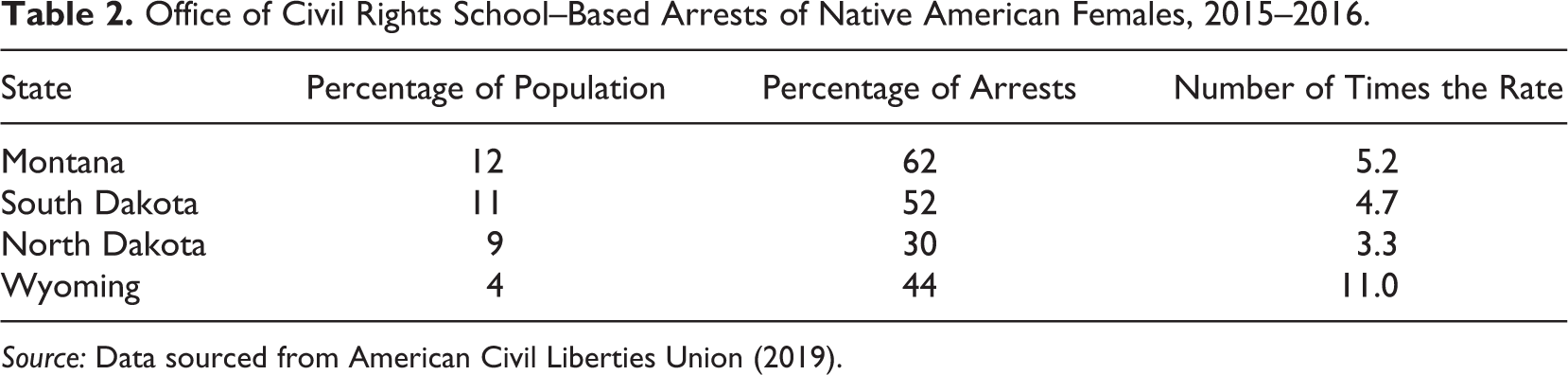
The percentage of Native American females in Wyoming, Montana, South Dakota, and North Dakota were arrested at school at 3.3–11 times their percentage of enrollment during the 2015–2016 academic year (see Table 2). School collaborations with school resource officers (SROs) and security guards (SGs) may have a disproportionate impact on Native American female students who are already disproportionately represented in adult incarceration rates in South Dakota and Montana at nearly twice the rate as males (4–5 times for Native females vs. 2–3 times the percentage of incarceration rate for males vs. the percentage of population; Ross, 2016).
Office of Civil Rights School–Based Arrests of Native American Females, 2015–2016.
Source: Data sourced from American Civil Liberties Union (2019).
Native Americans are rarely studied in the existing criminal justice research and essentially invisible in education equity and juvenile justice literature despite the high rates of incarceration and school-based arrests (Campagna, 2016; Rolnick, 2016), meaning they are represented by an asterisk in large and crucial data sets, many of which are conducted to inform public policy that impacts our/their lives…the sample size can appear negligible when compared to the sample size of other/race-based categories…In United States educational research in particular, Indigenous peoples are included only as asterisks, as footnotes into dominant paradigms of educational inequality in the United States. This can be observed in progressive literature on school discipline. (Tuck & Yang, 2012, p. 22)
This study utilizes Indigenous research methods (IRMs) to offer a rereading of history that is a counternarrative to existing SRO literature that attempts to argue the insignificance of disparate outcomes for Native American populations with regional or national data sets due to small numbers of students enrolled (Tuhawai Smith, 2008; Walter & Anderson, 2013; Wilson, 2008). The study community–based organizational partner utilized relational Indigenous approaches to proposing recommended interventions grounded in democratizing and restoring practices that are further explained in the Method and Discussion sections (Tuhawai Smith, 2008; Wilson, 2008).
Native American students experience ongoing disparities in school-based criminal justice system involvement, yet are entitled to an equitable education (Brown, 2014). Martin et al. (2016) assert the need to, “interrogate the notion that schools are neutral, fair, and equitable spaces, where all students are treated equally and can expect they be offered the same chance at success” (p. 30). Research focused on Native American student criminal justice involvement at school can help describe how disparities like the school-to-prison pipeline are created and maintained (Walter & Anderson, 2013). As a result, this study includes four specific research questions focused on Native American students in Montana schools during the 2015–2016 academic year. The specific research questions are as follows: Are referrals and arrests of Native American students and other students of color to law enforcement disproportionate in Montana schools? How are the referrals and arrests of Native American students to law enforcement differentiated by gender? How are the referrals of Native American students to law enforcement impacted by reservation, border, urban, or rural contexts? How are student referrals to law enforcement and arrests affected by the presence of an SRO or SG?
This study begins with a critical analysis of: (a) school and law enforcement roles in the social construction of Native American criminality; (b) the disproportionate outcomes for Native American students; (c) and the use of SROs and SGs in the context of ongoing settler colonial systems and structures (Jarldorn, 2020; O’Brien et al., 2020; Richie & Martensen, 2020).
Social Construction of Native American Criminality
Indigenous disparities in criminal justice systems have historical and structural causes in all settler colonial nations including the United States, Canada, Australia, and New Zealand (Smith et al., 2018; Tuhawai Smith, 2008). The historical and structural causes of the criminalization of Native Americans originate during the formation of the settler states (Smith et al., 2018). United States settlers socially constructed the criminality of Native Americans labeling them deviant, bad, inferior, criminal, and delinquent (Rolnick, 2016; Ross, 1998, 2016; Tuhawai Smith, 2008). Criminal justice practices seek to control Black, Indigenous, and People of Color (BIPOC) by pathologizing individual behaviors that do not align with white middle class, heterosexual, and cisgender norms asserted by colonial values (Morris, 2016; O’Brien et al., 2020; Pollack, 2020; Richie & Martensen, 2020). Racial bias was built into criminal justice and education systems by design to control BIPOC behavior via specific slave codes that outlawed reading and writing and Code of Indian Offenses that outlawed practicing traditional religion and medicine as alleged reasons for Indigenous resistance to assimilating via Indian boarding schools (Morris, 2016; O’Brien et al., 2020; Richie & Martensen, 2020). In many courtrooms, Indigenous testimony was not historically allowed in cases with white defendants (Lowery, 2010, 2018; Ross, 1998). Juries would also rarely convict charges related to crimes against Indigenous people (Lowery, 2018). Contemporary carceral systems produce corporate profits while maintaining settler colonial social control of BIPOC and women in a manner that is racist, anti-Indian, sexist, and homophobic (Morris, 2016; Pollack, 2020; Ross, 2016).
Structural and Environmental Theories of Native American Criminality
Structural or environmental explanations of Native American criminality focus on aggrieved actors who experienced one or more unjust experiences with overvictimization and incarceration (Deer, 2015; Morris, 2016; O’Nell, 1996). Structural explanations of the overincarceration of Indigenous people include institutional racism, sexism, homophobia, unconscious bias, self-defense labeled assault, Native women being charged with crimes committed by others who held power over them or had better access to legal counsel, discrimination resulting in sentencing disparities for the same charges or convictions, Native youth facing state and federal justice systems handled locally for non-Native youth, and higher recidivism rates (Campagna, 2016; Morris, 2016; O’Nell, 1996; Rolnick, 2016; Ross, 1998, 2016; Smith et al., 2018). Disparities within criminal justice systems in Montana include over 80% of Native Americans in prison for a technical violation of probation rather than committing new crimes (American Civil Liberties Union [ACLU] of Montana, 2018).
Law enforcement and colonial military had historic and contemporary social control role in Indigenous communities (Jarldorn, 2020; Pollack, 2020; Richie & Martensen, 2020). Native American children were historically frequently removed from their families and experienced confinement in boarding schools (Campagna, 2016; Cunneen & Tauri, 2016; French, 2016; Rolnick, 2016; Ross, 1998; Tuhawai Smith, 2008). Boarding schools included forced enculturation, assimilation, and acts of cultural genocide that asserted white supremacy and Indigenous inferiority (French, 2016; Rolnick, 2016; Tuhawai Smith, 2008). Indigenous people often have a high mistrust of police due to (a) police functions as truancy officers that abducted and forcibly removed children from their families in boarding school era (Cunneen & Tauri, 2016; French, 2016; Rolnick, 2016; Tuhawai Smith, 2008) and (b) according to Campagna, 2016, simultaneous over- and under-policing, and thus law enforcement is not perceived as reliable or trustworthy. This distrust discourages many victims from reporting to the police or turning to legal authorities for assistance…this leaves victims, particularly those of sexual violence, with little alternatives for seeking help, including emergency medical or psychological care. (p. 50)
Native Americans historically and presently were and are also confined in, “orphanages, jails, prisons, on reservations, and in institutions” (French, 2016; Rolnick, 2016; Ross, 2016, p. 1). Native American experiences with confinement to reservations include the pass system that policed their movements in their home territories and required requesting permission to leave the reservation (Ross, 1998, 2016). Additionally, in 1883, the U.S. federal government created the Indian Police through implementation of the Code of Indian Offenses to outlaw Native Americans’ spiritual and cultural practices even on their own reservations. Native Americans were put in prison, murdered, and forced to maintain any cultural practices in secret or not at all, which continues to have an impact on not only access to spiritual practices that contribute to identity preservation but also the negative connotations with policing.
Federal criminal justice system laws simultaneously created complicated federal, state, and tribal jurisdictional systems for crimes committed on reservation lands (Deer, 2015; Rolnick, 2016; Ross, 1998). For example, in 1953, the federal Public Law 280 was implemented in some states, which resulted in establishing state jurisdiction over Native Americans accused of specific crimes that result in harsher punishments for the same crimes (including juvenile justice systems) while also requiring federal investigation and prosecution for Native Americans who are harmed by non-Native perpetrators of crimes (Deer, 2015; Rolnick, 2016; Ross, 1998). Crime definitions and criminal justice processes are fluid across time and include different processes and outcomes for Native Americans depending on where the alleged crime occurs and who is the alleged perpetrator and victim of the crime (Deer, 2015; Richie & Martensen, 2020). Criminal justice systems often aggravate trauma for Indigenous people who may have personal or intergenerationally traumatic experiences with systems that work against and not often for their well-being (Deer, 2015).
Impact of Criminal Justice Outcomes as a Consequence or Symptom of Colonization
Native American alleged criminality is a symptom and ongoing impact or consequence of colonization (Campagna, 2016; Tuck & Yang, 2012). Native Americans experience higher rates of incarceration (932/100,000) than non-Natives (747/100,000; Mercato & Rojas, 2012). As a result of criminal justice disparities, Native American students commonly have familial experiences with bias and discrimination in criminal justice systems including discretion in arrests, courts, treatment while incarcerated, and probation and parole systems (ACLU of Montana, 2018; Ross, 1998, 2016). Native American experiences with criminalization and harsh punishment of behaviors are often related to forced assimilation to colonial society rules and expectations as well as the associated historical and intergenerational trauma outcomes (i.e., mental health, alcohol and drug use, turancy; Ross, 2016). Indigenous experiences of criminal justice system disparities follow similar patterns across the globe. For example, Australia has an incarceration rate that is over 12 times the rate of their First Nations Peoples (Jarldorn, 2020). Anti-carceral feminist scholars assert the connection between the prison industrial complex and patriarchal attempts at enforcing racist and sexist societal norms (Pollack, 2020).
Native American Female Experiences of Victimhood and Criminalization
Nationally, Native American females had a higher likelihood of referrals to law enforcement and arrest than males in 2014 (Martin et al., 2016). Cunneen & Tauri (2016), Pollack (2020), Ross (2016), and Smith et al. (2018) note similar patterns of Indigenous female incarceration in the United States (including Montana), Canada, New Zealand, and Australia where intersectional analysis of Indigenous and female identities is associated with higher rates (typically 50% higher for Indigenous females than Indigenous males) and paces of growing incarceration populations. The percentage of Native American females in prison in Montana has increased exponentially from 7% between 1911 and 1941 to 25% between 1944 and 1966, 30% between 1967 and 1977, and 36% in 2016 (Ross, 1998, 2016).
McClintock (1995), Deer (2015), Campagna (2016), and Pollack (2020) explain the roots of Indigenous female incarceration are patriarchal views that depict Indigenous women as overly sexualized and objects to be possessed, controlled, and penetrated much like colonial views of land. As a result, Native American females still disproportionately experience high rates of violence including intimate partner violence, rape, sexual assault, and sex trafficking (Campagna, 2016; Deer, 2015; Pollack, 2020; Rolnick, 2016). Deer (2015) describes an unspoken sadness and silence among Native American females who have experienced at least five generations of violence, kidnapping, and rape. One in three Indigenous women have experienced rape, which is likely an underestimate given structural barriers to reporting and convictions (Deer, 2015). Indigenous people who experienced sexual assault between 1978 and 2013 had no jurisdiction to hold non-Indians accountable despite violent crimes commonly committed by non-Indians (Campagna, 2016; Deer, 2015). Recent and contemporary barriers to accountability for non-Indian perpetrators of violence on Indigenous female bodies are an ongoing legacy of colonial views of possessing and controlling Indigenous females like their justifications and impunity in the processes of asserting individual property/land ownership in Indigenous territories (Campagna, 2016; Deer, 2015; McClintock, 1995).
Criminal justice systems often equate Indigenous women’s experiences with sexual violence, other disparities, and the associated consequences with assessing higher risks of criminal behavior in sentencing, probation, and parole (Jarldorn, 2020; Pollack, 2020). Tuck and Yang (2012) critique the language of a population being at risk, which Jarldorn (2020) describes as contemporary form of oppression. Ross (1998) analyzed existing court documents of Native American female criminal cases and assessed that intersectionality including conformity to gender stereotypes and roles is a known factor in disproportionately harsh court sentencing, even in cases where the accused acted in self-defense of themselves or their children (Ross, 1998).
School Bias Against Native American Students
The implementation of Public Law 280 in Lake County, Montana, in 1965 was the result of white settler fears of their Native American neighbors, as white people resided on the Flathead Reservation (Ross, 1998). Lake County, Montana, has Native American disparities for criminal justice system involvement compared with other Indigenous communities in Montana (Ross, 1998, 2016). Naturally, socially constructed and ongoing views of Native Americans, as deviant or criminal, have an impact on referrals to law enforcement and arrests of Native Americans in schools with SROs (Martin et al., 2016; Richie & Martensen, 2020; Rolnick, 2016; Ross, 1998). Nationwide, over 60% of schools have an SRO including approximately one third of elementary schools, yet program evaluation of SROs is rare (Fisher & Devlin, 2019). Program evaluation could determine whether the cost (national estimates at US$90,000 per year on average per officer) and the benefits outweigh the unintended consequences, such as aggressive punishment and criminalization resulting in increased incarceration (Fisher & Devlin, 2019; Richie & Martensen, 2020). Many schools received federal funding to begin the practice of SROs, which then required the allocation of other funds to sustain the practice (Shaver & Decker, 2017). Federal tough-on-crime policies and the associated funding of surveillance, law enforcement, and the prison industry are associated with decreased funding allocated to education, prevention programs, and mental health (Jarldorn, 2020; O’Brien et al., 2020; Richie & Martensen, 2020). School use of SROs to address general fears regarding violence and safety and the associated zero tolerance policies are not situated with a critical historical and contextual analysis of the reconstruction of the need to fear and control Indigenous people with targeted surveillance and discipline when Native American students are enrolled in schools and frequently encounter juvenile justice systems (Fletcher, 2008; Rolnick, 2016; Tuck & Yang, 2012; Tuhawai Smith, 2008; Walter & Anderson, 2013).
Native American students often experience higher rates of referrals to law enforcement and arrests that commonly include interrogation and investigations by school employees who collect confessions and signed statements prior to the reading of their Miranda Rights by law enforcement (Fletcher, 2008). The systematic bias in Native American student discipline results in higher rates of discipline (Fletcher, 2008). SRO, SG, administrator, and teacher implicit biases subjectively evaluate the behaviors of Native American students through socially constructed images of deviance (Ross, 1998; Tuhawai Smith, 2008). As a result, Native American student behaviors are often subjectively labeled disobedient, disrespectful, disruptive, criminal, or a threat to the physical safety of the school (Brown, 2014). However, Native American students are often excluded from evaluation and monitoring of disparities (Brown, 2014).
Method
The study is a modified transformative design that includes simultaneous/circular rather than sequential quantitative data analysis and the ongoing community-based advocacy in a local organization with an Indigenous justice coordinator who coordinates with local leaders across the state (Plano Clark & Creswell, 2008). The IRMs incorporated throughout the article include practices focused on rereading history, democratizing, and restoring that aligns with the Indigenous research principles of respect, reciprocity, and relationality (Kirkness & Barnhardt, 1991; Tuhawai Smith, 2008). This study centers Indigenous understandings of history and names the origin of ongoing discipline disparities for BIPOC as a consequence of colonial beliefs about deviance (Fletcher, 2008; Morris, 2016; Ross, 1998). Rereading history in a culturally relevant manner is a respectful way to approach the literature review, discussion, and conclusion of this article (Tuhawai Smith, 2008; Wilson, 2008). Ross (1998), as a local critical Indigenous criminal justice-focused scholar, names schools as a system of assimilation for Native American students who were forced to take on colonial values and behaviors in boarding schools. The rereading of history explains how colonial processes criminalize Native American peoples via the contemporary western school system and criminal justice system collaborations (Ross, 1998). Colonial systems socially construct disparities, and as a result, the responsibility and accountability for addressing barriers to equitable education requires structural/institutional changes to education and criminal justice systems (Fletcher, 2008; Martin et al., 2016; Vincent et al., 2012; Walter & Anderson, 2013).
The authors include recommendations created in reciprocal engagement with the local community-based organizational partner of this study and local Indigenous families and leaders. The collective recommendations in the discussion focus on: (a) democratizing by encouraging broad engagement of Indigenous parents in school advisory processes that revise school plans annually to address local issues with mutually agreed-upon solutions that have a collective accountability and (b) restoring via restorative justice processes rooted in circle practices focused on reconnecting and healing relationships and repairing harm done in order to bring about holistic rather than punitive approaches to managing student behaviors at school (Billiot et al., 2019; Tuhawai Smith, 2008; Wilson, 2008).
The study design is also informed by Indigenous statistics: A quantitative research methodology in the measurement, analysis, and interpretation approaches (Walter & Anderson, 2013). Western researcher data analyses typically include school discipline data as the total number and rate and often do not include (a) ratios of student enrollment by group versus discipline by group; (b) geographic location (reservation, urban, border town, or other rural contexts); and (c) presence or absence of an SRO and/or SG (Walter & Anderson, 2013). IRM inclusion of ratios is important because colonization processes decreased the total number of Indigenous students via genocide in an effort to erase their presence, and therefore, Native American students can become an asterisk in typical western research methods that make student disparities undetectable due to low enrollment numbers rendering them statistically insignificant (Tuck & Yang, 2012; Walter & Anderson, 2013). IRM includes geographic and institutional context because Native American students’ families frequently live in places with higher levels of surveillance, policing, and discrimination including reservations and cities (Reinschmidt et al., 2016). The Urban Indian Relocation Act of 1956 was an ongoing assimilation effort, which by 2010 resulted in 78% of U.S. Native Americans living in urban neighborhoods that commonly have high concentrations of poverty and low educational outcomes (Reinschmidt et al., 2016). IRM situates Native American students in context and incorporates a critical multicultural analysis that includes gender (Ross, 1998; Tuhawai Smith, 2008; Walter & Anderson, 2013). The study had an exempt status with a university institutional review board.
Study Sample and Measures
The study sample includes all 822 of Montana public schools who reported school-level aggregate data on discipline to the U.S. Office of Civil Rights for the 2015–2016 academic year, as well as the reported presence of SROs and/or SGs (U.S. Department of Education, 2016a). The discipline data are reported as both the total number of arrests and referrals to law enforcement reported by Indigenous and racial categories in order to provide local context, the proportional percentage of enrollment and percentage of arrests and referrals, and the rate of referrals per 10,000 students and arrests per 1,000 students in order to identify higher numbers and rates for Native Americans in comparison with all students and students of all races (Walter & Anderson, 2013). Ratios and proportional measures of data are common when groups are smaller in number (enrollment by race) and higher in disparities (discipline) particularly in contexts comparing differing practices, such as the presence of SROs and/or SG versus schools without SROs and/or SG (Walter & Anderson, 2013). The discipline rates are also analyzed as reservation, urban, border towns (within 20 mi of a reservation boundary) and other rural communities as a means of analyzing school discipline in context because the majority of Indigenous students attend school in urban contexts (Tuck & Yang, 2012; Walter & Anderson, 2013). If a school is not on a reservation or in a border context, then it is labeled urban or rural based on the population of the town or city.
Discipline data
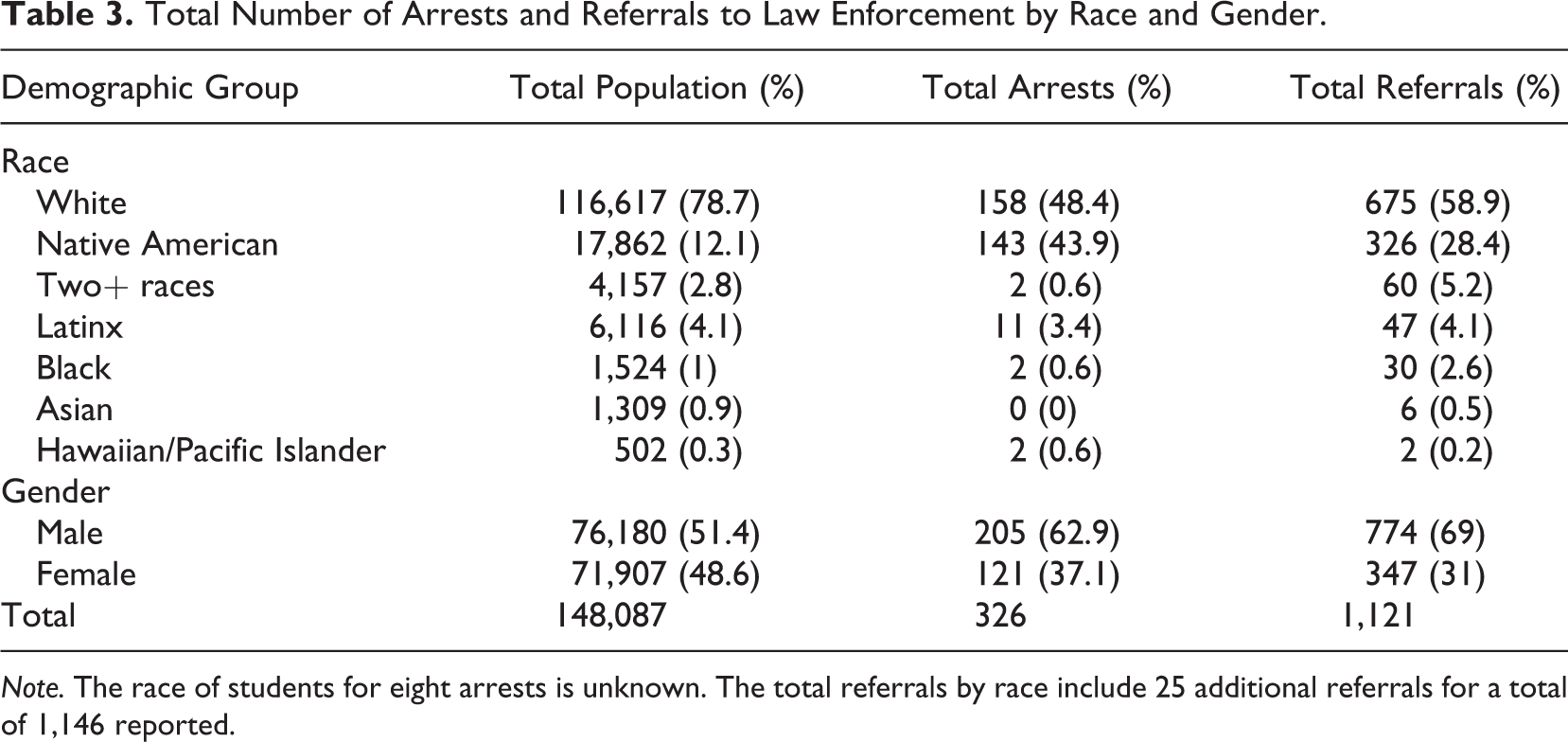
The study uses U.S. Office of Civil Rights data tracking arrests and referrals to law enforcement data for the 2015–2016 academic year (U.S. Department of Education, 2016a, 2016b). The total number of arrests (n = 326) and referrals (n = 1,121) during the 2015–2016 academic year are reported by race and gender (see Table 3).
Total Number of Arrests and Referrals to Law Enforcement by Race and Gender.
Note. The race of students for eight arrests is unknown. The total referrals by race include 25 additional referrals for a total of 1,146 reported.
Arrests include students: (a) arrested during school, (b) arrested during a school-related events, or (c) arrested after a referral from a school employee (ACLU, 2019; U.S. Department of Education, 2016a). Arrest data include Montana elementary, middle, and high schools. Referrals include students reported to school or local law enforcement for incidents that occurred at the school, a school event, or school transportation (ACLU, 2019). Referrals may result in a citation, ticket, referral to court, or arrest (ACLU, 2019). SROs who are sworn in and have similar duties as local law enforcement with a focus on the local school(s) are able to arrest students (ACLU, 2019). Fifteen percentage of Montana’s schools have an SRO. SGs focus on violence and theft protection, as well as ensuring compliance with school rules (ACLU, 2019). Two percent of Montana’s schools have an SG. Sixteen percentage of Montana’s schools have an SRO and/or SG.
Data Analysis
One-way analysis of variance (ANOVA) calculated the mean school score and whether or not the schools with SRO(s) or SG(s) had statistically significant differences in discipline (arrests and referrals). ANOVAs for the total number of referrals and arrests, as well as the rates, are calculated as a means of creating equitable comparisons for populations with lower enrollment (Walter & Anderson, 2013). Binary logistic regression was calculated to predict referral and arrests with and without SRO(s) and/or SG(s) presence in schools.
Results
Referrals to Law Enforcement
Mean total school referrals to law enforcement by Native American/race
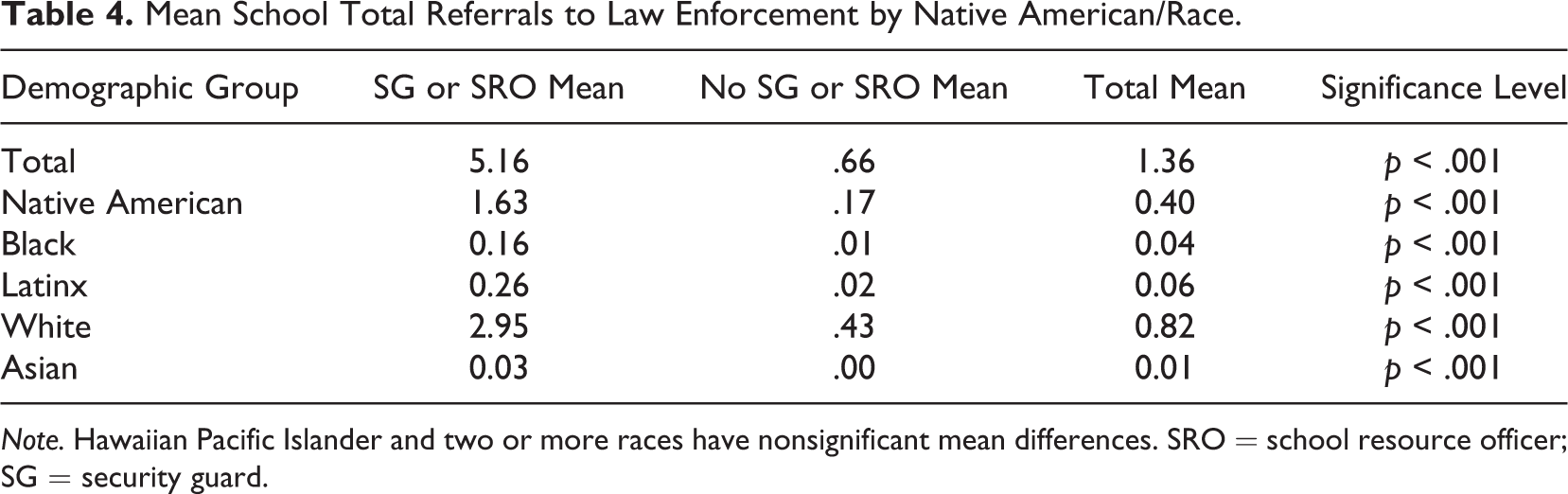
Montana schools have a mean of five referrals to law enforcement per school when an SRO and/or SG are present and less than one when an SRO and/or SG are not present (p < .001; see Table 4). Native American students in Montana schools have an average of two referrals to law enforcement per school when an SRO and/or SG are present and less than one when an SRO and/or SG are not present (p < .001). Black, Latinx, white, and Asian students experience more referrals to law enforcement when an SRO and/or SG are present at statistically significant levels. Students who are Hawaiian Pacific Islander and students of two or more races also experience more referrals to law enforcement when an SRO and/or SG are present; however, not at statistically significant levels. The disproportionate number of referrals to law enforcement is present for Native American (almost 10 times the number of referrals than when an SRO and/or SG are not present), Black (16 times the number), and Latinx (13 times the number) when compared with white students (almost 7 times the number).
Mean School Total Referrals to Law Enforcement by Native American/Race.
Note. Hawaiian Pacific Islander and two or more races have nonsignificant mean differences. SRO = school resource officer; SG = security guard.
Mean school referrals to law enforcement/10,000 by Native American/race
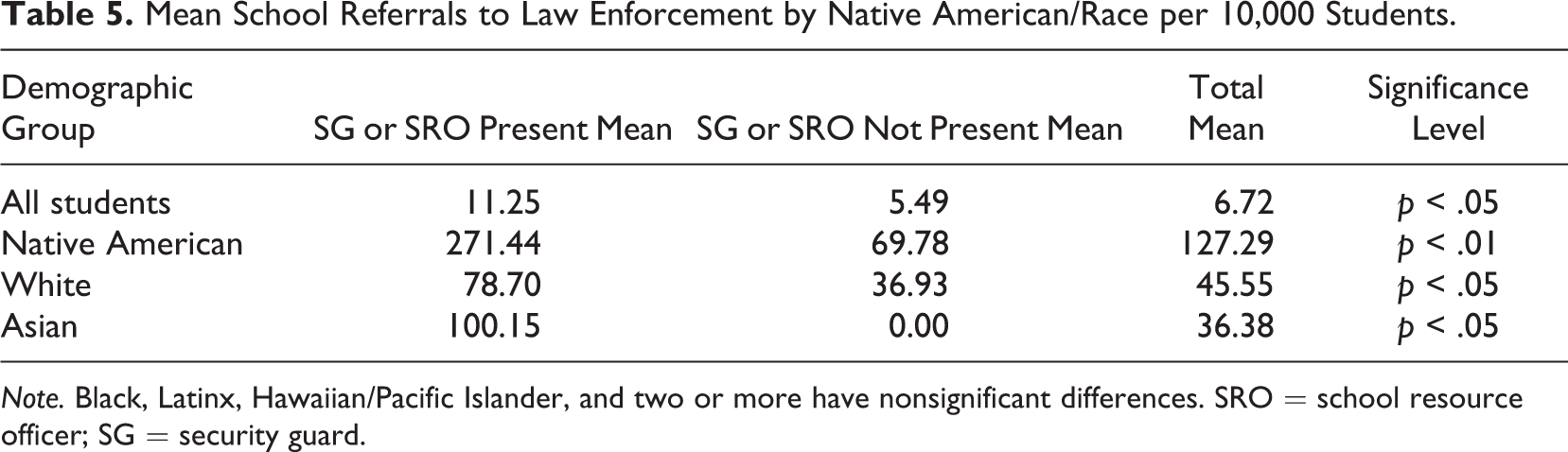
Montana schools have a rate of 11 referrals to law enforcement per 10,000 students when an SRO and/or SG are present and five when an SRO and/or SG are not present (p < .05; see Table 5). Native American students in Montana schools have a rate of 271 referrals to law enforcement per 10,000 in Montana schools when an SRO and/or SG are present and 70 when an SRO and/or SG are not present (p < .01). Native American students in Montana schools have almost four times the rate of referrals to law enforcement per 10,000 in Montana schools when an SRO and/or SG are present. White students experience about twice as many referrals to law enforcement per 10,000 in Montana schools (n = 79) when an SRO and/or SG are present than when SG and/or SRO are not present (n = 37; p < .05). Asian students also experience more referrals to law enforcement per 10,000 in Montana schools when an SRO and/or SG are present at a disproportionate rate (p < .05).
Mean School Referrals to Law Enforcement by Native American/Race per 10,000 Students.
Note. Black, Latinx, Hawaiian/Pacific Islander, and two or more have nonsignificant differences. SRO = school resource officer; SG = security guard.
Mean school total referrals to law enforcement by Native American/race and gender
Native American female and male students experience a mean of approximately one referral to law enforcement per Montana school when an SRO and/or SG are present compared with an average of no students when an SRO and/or SG are not present (p < .001; see Table 6). Native American females (32 times the rate when an SRO and/or SG are not present) and males (15 times), Latino males (20 times), and Black males (13 times) experience a disproportionate increase in referral to law enforcement per Montana school when an SRO and/or SG are present compared with white females (10 times).
Mean School Total Referrals to Law Enforcement by Native American/Race and Gender.
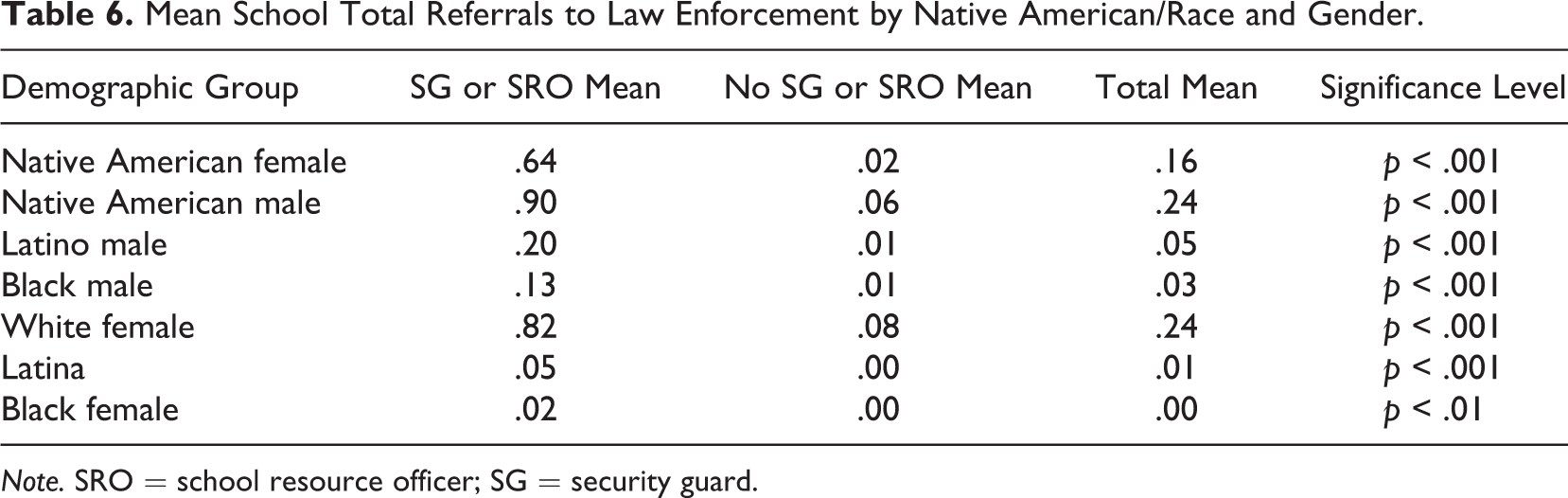
Note. SRO = school resource officer; SG = security guard.
All students and Native American student referrals to law enforcement per 10,000 students in reservation, border, urban, and rural contexts
Students attending schools on reservations in Montana experience higher rates of referrals per 10,000 students (23.8/10,000) when compared with urban (11.5/10,000), rural (4.3/10,000), and border contexts (3.8/10,000; p < .001; see Table 7). Native American students attending schools on reservations (326.2/10,000) and urban (235.7/10,000) in Montana experience higher rates of referrals per 10,000 students when compared with rural (86.3/10,000) and border contexts (44.7/10,000; p < .05). Native American students experience much higher rates of referrals than students of all racial groups across all school contexts.
Student Referrals to Law Enforcement/10,000 Students in Context.

Note. p <.001; * p<.05
Predicting referrals to law enforcement with SRO or SG presence
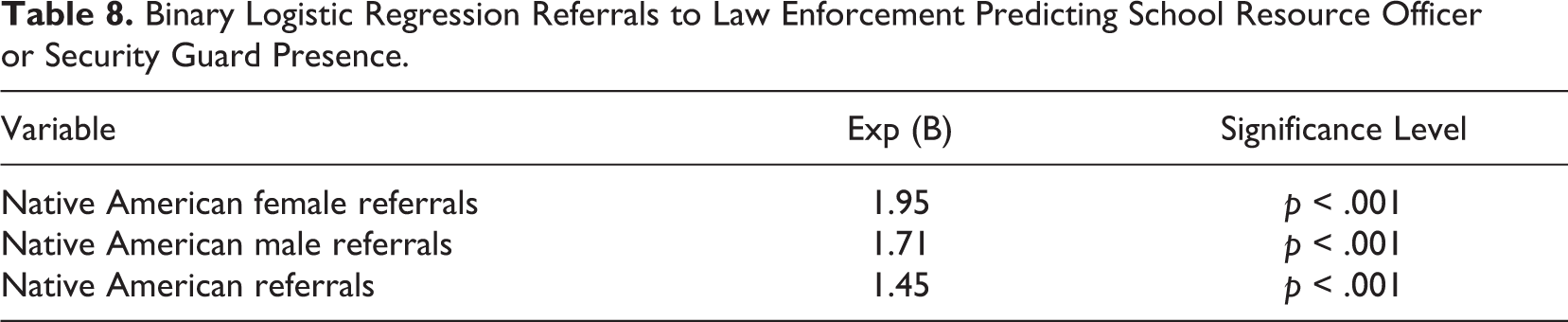
Native American female students experience 1.95 times higher odds of referral when an SRO and/or SG are present in their school (p < .001; see Table 8). Native American male students experience 1.71 times higher odds of referral when an SRO and/or SG are present in their school (p < .001). Native American students as a whole experience 1.45 times higher odds of referrals when an SRO and/or SG are present (p < .001).
Binary Logistic Regression Referrals to Law Enforcement Predicting School Resource Officer or Security Guard Presence.
Arrests
Mean school arrests per 1,000 students by Native American/race
All Montana students experience a higher mean rate of school arrests when an SRO and/or SG are present (p < .01; see Table 9). Native American students experience a higher rate of arrests per 1,000 students compared with all other groups (p < .01) when an SRO and/or SG are present (6). Three racial groups (Hawaiian Pacific Islander, Latinx, and Black) only have arrests when an SRO and/or SG are present and no arrests when an SRO and/or SG were not present.
Mean School Arrests/1,000 Students by Native American/Race.
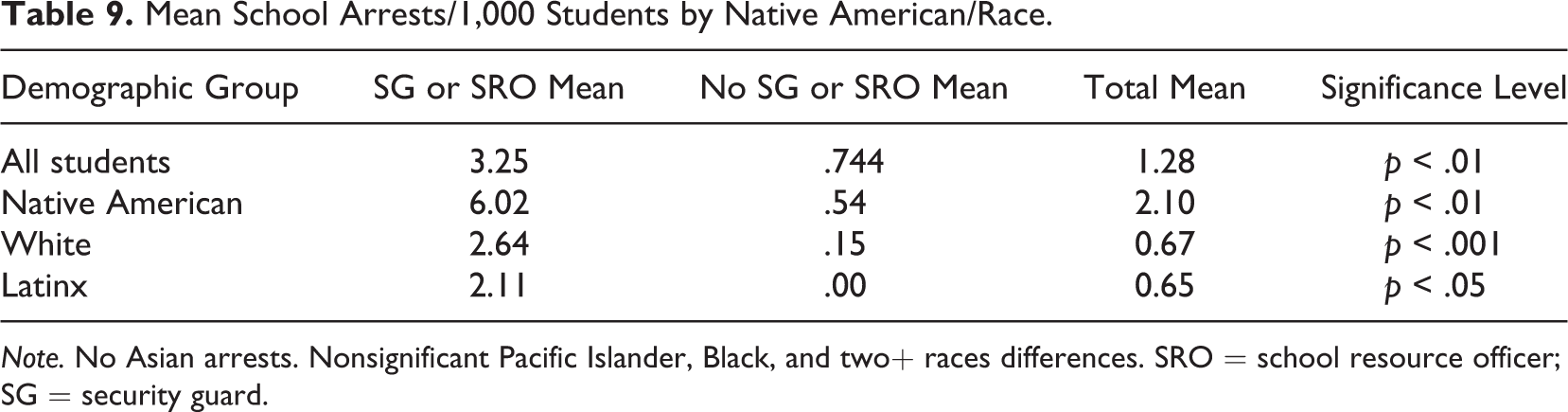
Note. No Asian arrests. Nonsignificant Pacific Islander, Black, and two+ races differences. SRO = school resource officer; SG = security guard.
All students and Native American student arrests in reservation, border, urban, and rural contexts
Students are arrested at a higher rate per 1,000 in reservation (5.4) and border communities (2.8) than urban (0.6) and rural communities in Montana (0.6; p < .001; see Table 10). Native American students are arrested at a higher rate per 1,000 in urban (7.5) and reservation communities (5.8) than in border (0.6) and rural (0; p < .05).
Student Arrests/10,000 Students in Reservation, Border, Urban, and Rural Contexts.

Note. p < .001; * p < .05
Arrests predicting SRO or SG presence
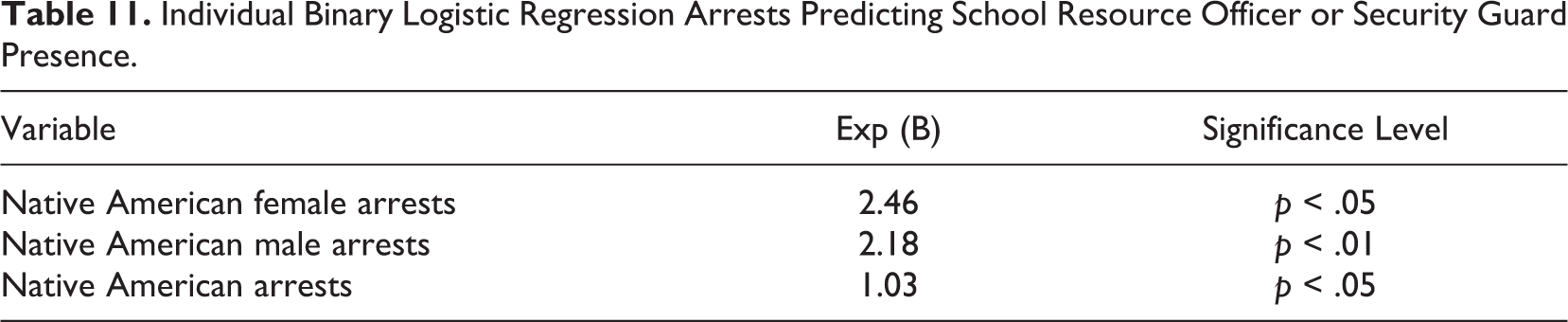
Native American female students experience 2.46 times higher odds of arrest when an SRO and/or SG are present in their school (p < .05; see Table 11). Native American male students experience 2.18 times higher odds of arrest when an SRO and/or SG are present in their school (p < .01). Native American students as a whole experience 1.03 times higher odds of arrest when an SRO and/or SG are present (p < .05).
Individual Binary Logistic Regression Arrests Predicting School Resource Officer or Security Guard Presence.
Discussion
Native Americans disproportionately experience school-based referrals to law enforcement and arrests in the United States (Brown, 2014; Martin et al., 2016). Native American students in Montana’s public schools experience disproportionate referrals to law enforcement and arrests regardless of whether data are analyzed as the total number, the percentage of enrolled compared to the percentage of referrals and arrests, or the rate. The numerous means of reporting the data are included to dispel common myths regarding inflated rates for groups like Native Americans with lower enrollment numbers.
Intersectional Analysis of Settler Colonial Criminal Justice and Education Systems
Native American students’ referrals and arrests within Montana’s schools are contextualized within historic and contemporary settler colonial and anti-carceral feminist perspectives (Pollack, 2020; Smith et al., 2018; Tuhawai Smith, 2008). Boarding schools and criminal justice systems in settler colonial nations, like the United States, were built with surveillance, discipline, and policing of Indigenous populations as a means of subjugation, assimilation, and social control (O’Brien et al., 2020; Richie & Martensen, 2020; Rolnick, 2016). SROs and SGs in school settings in Indigenous contexts should be situated within critical historical and contextual analysis of targeted surveillance and discipline when Native American students are enrolled (Fletcher, 2008; Tuck & Yang, 2012; Tuhawai Smith, 2008; Walter & Anderson, 2013). The quantitative results of this study provide evidence that federal tough-on-crime policy initiatives and fear-based narratives justifying the use of SROs and SGs in schools support funding the ongoing surveillance and criminalization of Native American students, which continues to disproportionately have an impact on Native American students particularly in reservation and urban contexts (p < .05; ACLU, 2019; Jarldorn, 2020; O’Brien et al., 2020; Reinschmidt et al., 2016; Richie & Martensen, 2020).
Montana Native American male and female students are twice as likely to be referred to law enforcement than white students (p < .001) and Native American students are also about twice as likely to be arrested (males are 1.7 times and females are 2.5 times more likely; p < .05) when a SROs and/or SGs present at the school. Native American student referral and arrest disparities when a SROs and/or SGs present mirror the disproportionate percentage of Native American adults incarcerated in Montana (Ross, 2016). Educational and criminal justice systems assess Native American female behaviors as criminal, while criminal justice systems simultaneously do not hold the perpetrators of violence against Native American females criminally accountable (Campagna, 2016; Deer, 2015; Pollack, 2020; Ross, 2016). Most SROs in Montana are male and are present in higher numbers in reservation and urban settings where Native American students attend school (Reinschmidt et al., 2016). The male and often non-Native SROs likely have an impact on referral and arrest dynamics particularly for female Native American students who are unconsciously viewed as bodies to control (McClintock, 1995; Ross, 2016). Ross (2016) tells stories of fear of local white male and tribal law enforcement on the Flathead reservation due to family members’ personal experiences with local police and incarceration for crimes they did not commit, as well as local law enforcement involvement in sexually abusing youth.
Western school and court systems also have known biases and harsher punishment of Native American women particularly when, like Black females, present outside white middle class, heterosexual, and cisgender feminine norms to be quiet, subordinate, cooperative, and respectful (Morris, 2016; Ross, 1998). Morris (2016) asserts that Black females learn at a young age that they will be punished at school if they are involved in a conflict, even as the target, as the incidents are often labeled disruptive and are stripped of context. A large portion of Native American students in Montana will likely experience school-to-prison pipeline unless law enforcement is removed from schools and support staff are funded to implement prevention and mental health supports at recommended student to social worker, psychologist, and counselor ratios (ACLU, 2019; Jarldorn, 2020; O’Brien et al., 2020; Richie & Martensen, 2020).
Recommendations
SROs and SGs should be removed from schools, particularly because their presence is associated with increased rates of referrals to law enforcement and arrests of Native American students. If SRO(s) or SG(s) are used in schools, then draft Memos of Understanding with SRO(s), SG(s), and local law enforcement should limit SRO(s) and SG(s) roles and clearly define training requirements (Shaver & Decker, 2017). School districts should fund education, prevention programs, mental health, and Native American identity development initiatives that are culturally relevant and community-based to help schools meet student needs via support staff and “expanding opportunity and creating equity” (Richie & Martensen, 2020, p. 13; Vincent et al., 2012) rather than invest in social control and punishment via law enforcement in schools (Richie & Martensen, 2020; Smith et al., 2018). Native American student ongoing criminalization is consequence of colonization that can only be addressed via sustained input and genuine reciprocal relationship building between schools and Native American communities that build a sense of respect, belonging, representativeness, responsibility, and responsiveness for Native American students (Jarldorn, 2020; Martin et al., 2016; O’Nell, 1996; Walter & Anderson, 2013). Brown (2014) asserts a need for specific and ongoing professional development for administrators, teachers and staff…[with] expert trainings brought in from the American Indian community…[with] positive interventions for discipline issues that include family and community members. Community members can actively help school staff to understand American Indian students’ needs. (p. 43) teacher education programs must be revamped to include critical multiculturalism (including gender issues) and the interrogation of white supremacy in schools and in society…We must also defy the notion that lack of student success…is the fault of students, their parents, their home cultures, and their communities. (Martin et al., 2016, p. 29)
Higher education institutions should incorporate Indian Education for All within the core curriculum as a proactive approach to preparing educators within the public education system. Schools should annually train administrators and teachers on awareness and knowledge of Native American culture, unbiased discipline, and implicit bias including, “how they perceive American Indian students” (Brown, 2014, p. 42; Vincent et al., 2012). Schools should fund and closely monitor state-mandated Indian Education for All implementation including initial and continuing education for administrators, school board members, teachers, and school staff in order to center Indigenous culture, experiences, and work to create more relevant curriculum and more equitable outcomes (Martin et al., 2016; Tuck & Yang, 2012; Vincent et al., 2012). Schools should also review and revise codes of conduct to (a) remove zero tolerance policies; (b) remove subjective or vague language that enables biased implementation; (c) draft clear appeals and complaints processes for students; (d) keep detailed records of alleged behaviors and actions taken that communicated with guardians; (e) establish transparent and publicly available annual reports at the school level of student referrals and arrests aggregated by race with an explanation of reasons for referrals and arrest by race to monitor unequitable treatment and outcomes (Martin et al., 2016); (f) actively engage Indian Parent Advisory Councils at the school level who at least annually review policy revision drafts, reports on referrals and arrests, and school Indian Education for All implementation plans, activities, and outcomes as a form of democratizing with reciprocal and shared responsibility; and (g) implement restorative justice practices with circle facilitators who are local Indigenous leaders who can help maintain healing relationships that address any harm done in a holistic and healing manner (Martin et al., 2016; Tuhawai Smith, 2008; Vincent et al., 2012; Wilson, 2008).
Conclusion
Native American student experiences with referrals to law enforcement and arrests in Montana public schools mirror national trends that disproportionately have an impact on Native American students generally and Native American female students more specifically (Brown, 2014; Martin et al., 2016). Critical theorists assert that the contemporary use of law enforcement in schools cannot be decontextualized from the intergenerational trauma of Indigenous populations experience in settler colonial systems including boarding schools and criminal justice systems designed to create impunity for non-Native perpetrators of disproportionate discipline and assertion of the criminality of Native American males and females (Campagna, 2016; Deer, 2015; Pollack, 2020). SROs and SGs in Montana’s public schools should be replaced by school support staff who engage Native American students, families, and communities in implementing culturally relevant and community-based programming (Jarldorn, 2020; Martin et al., 2016; O’Brien et al., 2020; Richie & Martensen, 2020; Vincent et al., 2012). Social workers can work collaboratively to contextualize, disrupt, and dismantle the school discipline practices that criminalize BIPOC female students and perpetuate racism and sexism (Morris, 2016; Ross, 1998).
Footnotes
Acknowledgments
The authors would like to acknowledge the Indigenous land we reside on that embodies the strength and resilience carried on by our Indigenous women even in times of adversity and loss. To the matriarchs of our Indigenous communities who continue to be severely impacted by these colonized systems every day, we see you, we hear you, and we thank you for giving us life. The corresponding author would like to thank Dr. Luana Ross for her seminal book Inventing the savage: The social construction of Native American criminality, her editing of the Settler Colonialism, and the Legislating of Criminality special issue of American Indian Culture and Research Journal, and ongoing mentoring. The authors also would like to acknowledge the contributions of Affilia: Journal of Women and Social Work Special Topic: Anti-Carceral Feminisms: Imagining a World Without Prisons, which also had an impact on the theoretical framing of this article.
Declaration of Conflicting Interests
The author(s) declared no potential conflicts of interest with respect to the research, authorship, and/or publication of this article.
Funding
The author(s) received no financial support for the research, authorship, and/or publication of this article.
