




Abstract
Teen dating violence (TDV) is a significant social justice issue. The prevention of TDV requires interventions across ecological systems levels including the macro-level. The media has been implicated as influencing societal-level narratives about TDV. Using critical discourse analysis methodology, the purpose of this study is to unpack the dominant cultural narratives about TDV in young adult (YA) literature, a media genre that is marketed to adolescents. Data include YA novels with a central focus on TDV (n = 8). Through these novels, the language of gender inequality was supplanted by a postfeminist rhetoric of choice, personal responsibility, and self-help.
Keywords
Words are about the world but they also form the world.
Prevalence of Teen Dating Violence (TDV)
Adolescents experience abuse at an alarming frequency. Although there is no universal definition of adolescence, generally speaking, it can be understood to be a critical period of socioemotional development between childhood and adulthood and is inclusive of teens aged 10–19 (Blakemore & Mills, 2014; Brenhouse & Andersen, 2011). Estimates suggest that between 10% and 25% of adolescents have reported enduring some form of physical violence within a dating relationship (Centers for Disease Control and Prevention, 2009; Coker et al., 2014), and 33% of adolescents are estimated to have experienced nonphysical types of abuse such as mental or verbal abuse (Coker et al., 2014). Male and female identified teens have reported roughly equal rates of physical violence in their relationships (Chiodo et al., 2012); however, women have reported feeling fearful of their partners and experience more injurious assaults including homicides (Basile & Black, 2011; Hamby, 2014). TDV impacts teens from all demographic groups; however, evidence suggests that young women from underrepresented minority race and sexual minority groups (Dank, Lachman, Zweig, & Yahner, 2014; Malhotra, Gonzalez-Guarda, & Mitchell, 2015; Racine & Zeytinoglu, 2012) are at disproportionately higher risks for victimization. Therefore, an attention to constructions of gender—including intersections with race and sexual identity—are of critical importance to contextualize the diverse experiential realities associated with dating and DV.
Although macro-level factors such as the media have been identified as important locations for primary prevention approaches to reducing dating and DV, they have been underinvestigated compared to individual-level correlates and risk factors (Taylor, Sullivan, & Farrell, 2015). Furthermore, young adults (YAs), like adults, subscribe to beliefs that attribute responsibility to TDV victims for leaving abusive relationships. In a representative sample of college students, for example, 77% of survey respondents reported that women could find a way to get out of an abusive relationship if they really wanted to (Nabors, Dietz, & Jasinski, 2006).
The Media and Dating and DV
The media has long been implicated as a societal-level determinant of dating and DV, because of the ubiquity of media images that portray women as highly sexualized, as subordinated to men, in gender stereotypical ways and for reinforcing permissive attitudes about the appropriateness of using violence against women (Bronstein, 2008; Collins, 2011). For example, recent scholarship has documented that Meyers’ The Twilight trilogy, a top-grossing series of novels and films which was initially marketed to YAs but has experienced crossover appeal across age-groups, has normalized and romanticized abusive relationships (Borgia, 2014; Collins & Carmody, 2011), justified men’s use of controlling tactics against their female partners, and reinforced that violence was an inherent part of masculinity (Durham, 2012). Across media genres (including newspapers, magazines, and television), domestic and dating violence has been portrayed as blaming victims for their perceived role in the abuse, downplaying the potential seriousness of abuse, insinuating that controlling and abusive behaviors are part of all romantic relationships, and focusing on the pathology associated with the individual behaviors of perpetrators (Storer & Strohl, 2016). Such portrayals have the potential to influence societal-level attitudes about violence against women, and teens may glean their social scripts about dating from the popular media (Bryant, 2008). As Bonomi et al. (2014) state, “problematic depictions of violence against women in popular culture—such as in film, novels, music, pornography—create a broader social narrative that normalizes these risks and behaviors in women’s lives” (p. 720). Therefore, the media, as a contemporary “storyteller” in modern society, is a powerful source of messages about what is socially acceptable.
Postfeminism and Media Culture
Media and feminist scholars have asserted that Western society has entered a postfeminist historical and cultural moment, where rather than a mainstream attack or “backlash” to feminism, societally we have evolved to a point where feminism is regarded as anachronistic and therefore unnecessary (McRobbie, 2009). Second-wave feminism sought to expose how societal structures and institutions, such as domesticity and discrimination in the workforce, reified women’s subordination to men while also perpetuating systemic gender inequality. With popular culture as one dominant means of transmission, McRobbie (2009) asserts that postfeminism is serving to dismantle second-wave feminism “not in favor of re-traditionalization, [where] women are being pushed back into the home, but instead the process which says feminism is no longer needed, it is now common sense, and as such it is something young women can do without” (p. 8). Gill (2007) outlines the elements of a postfeminist “sensibility,” which include an emphasis on stringent maintenance of women’s physical selves; a focus on individual choice and empowerment; lack of acknowledgment of gender differences; and the liberation from “feminist watchdogs” that stigmatize women’s “true” feminine desires such as marriage, male protection, and motherhood under the guise of political correctness. Dovetailing with tenets of neoliberalism where citizens are encouraged “to see themselves as individualized and active subjects responsible for [autonomously] enhancing their own well being” (Larner, 2000, p. 11) within a postfeminist neoliberal infused worldview, women are “self-making, resilient, and flexible” subjects whose “failures are attributed to poor choices, [and] insufficient effort” (Harris, 2004, p. 9) rather than structural or systemic inequalities. Therefore, postfeminist discourse operates as a tool to control and oppress young women by promoting the ideology that even “small bad decisions can become major life-mistakes” (Harris, 2004, p. 27).
Specifically in reference to dating and DV, scholars have documented how elements of postfeminist and neoliberal discourses abound across popular culture. Thaller and Messing (2014), for example, reported that musical performers Eminem’s and Rihanna’s song and music video “Love the Way You Lie” reinforced direct or indirect victim blaming tactics because they insinuated that victims play an active role in their abuse or in some way reduce perpetrators’ responsibility for their use of aggressive behaviors because they were drinking or angry. Similarly, in an analysis of the same song, Enk and McDaniel (2012) assert that it minimizes the seriousness of DV and deploys a rhetoric of victim culpability that excuses perpetrators and reinforces hegemonic masculinity. This characterization of Rihanna is consistent with Patterson and Sears’s (2011) analysis of celebrity culture, particularly through media blogs and websites in which they uncovered a “bitch” rhetoric which focuses on what victims do to provoke their partner’s abuse and reduces men’s accountability for their use of violence. Therefore, these representations of dating DV, which reinforce notions of victim culpability and individual responsibility (while omitting references to structural drivers of abuse), exemplify many of the elements of postfeminist discourse.
The Power and Potential of YA Literature
Within the larger domain of media markets, novels, in particular, have a persuasive power to construct “possible worlds” (Bruner, 1986) that create and replicate societal norms and attitudes about seemingly everyday constructs such as victim, perpetrator, “at risk,” and “vulnerable.” YA novels have been found to be particularly persuasive with young audiences because their use of first-person narration and confessional tones fosters a sense of “narrative intimacy” where the reader feels a sense of connection with the fictional protagonist (Day, 2013). Furthermore, developmentally, adolescents are undergoing a process of identity formation during which they may be particularly attuned to cultural scripts about the dynamics of healthy relationships, gender roles within the context of dating relationships, and the usage of violent behaviors (Exner-Cortens, 2014; Sanders, 2003).
YA novels are the fastest growing sector of published books in the United States (“Publishers posted solid 2014 sales gains,” 2015), with YA novels such as The Fault in Our Stars, Divergent, and Hunger Games grossing record-breaking national and international sales. On average, teens spend 25 min a day reading books for pleasure, with young women reading more than playing video games (Kaiser Family Foundation, 2010). The primary market and consumers of this genre of literature are YAs (predominantly girls) ages 12 and older (Nilsen, Blasingame, Donelson, & Nilsen, 2013). As a result of its ubiquity and capacity to influence young readers, YA literature has received considerable attention for its potential to raise teen readers’ awareness about social issues and facilitate critical thinking about the societal structures and institutions that both foster and perpetuate those issues (Curwood, 2013). This discussion is not meant to imply that young readers are passive recipients of media messaging but to underscore the persuasive pull of the media to influence public perceptions of complicated social issues (Kuypers, 2009).
Purpose of the Study
This study is grounded in a critical constructivist epistemology that acknowledges that meaning making is the product of human beings’ interpretative interactions with their environments (Crotty, 1998). Hence, a study of the use of language—and discourse specifically—is not only “about the world but…form[s] the world” (Wetherell, 2001, p. 16). I intentionally used the term critical to denote that this process of knowledge construction is indelibly influenced by systems of oppression, marginalization, and social inequality (Crotty, 1998). Therefore, the purpose of this study is to explore how the causes, lived experiences, and repercussions of TDV have been discursively represented, constructed, and interpreted in YA literature.
Method
Research Design
This study employs a critical discourse analysis (CDA), which will be described in detail in the following sections. It is important to mention at the outset that this study employed an inductive design where I sought to surface themes and societal-level discourses from the ground up. Therefore, it was never my intention to deductively confirm the presence of a certain societal-level discourse, such as postfeminism, in this sample of YA novels.
Reflexivity
Since reflexivity is an important benchmark of rigor in qualitative research (Stige, Malterud, & Midtgarden, 2009), it is important to mention at the outset how my personal, professional, and academic backgrounds have informed how I have conceptualized and executed this project. Inevitability, my positionality as a cis-gendered middle-aged White woman has influenced my framing of this study. This project is also strongly influenced by my practice experience as a community-based social worker partnering with teens on the primary prevention of dating violence and sexual assault. Through this work, I became attuned to the influence the media has on youth’s conceptualizations of social phenomena, including dating violence. The domestic and dating violence organizations where I worked were strongly rooted in the language of second-wave feminism, and thus, my early understanding of the root causes of DV was influenced by a feminist DV discourse that included attention to issues of structural inequality, patriarchy, and “power and control.” As a graduate student and junior faculty at a research-intensive university, I have read many counternarratives about DV but still my core assumptions (however hard I may try to bracket them) about DV stem from this early feminist socialization about the causes, consequences, and “appropriate” responses to DV.
I entered the world of YA literature specifically when a family member who is a YA librarian in a large urban library system observed an increase in YA novels that had a central theme related to TDV. Knowing that I had a professional background working on TDV prevention, she asked me to review these novels and give my “professional” opinion on which books she should recommend to teen readers. This experience precipitated my journey into the world of YA literature and catalyzed the research questions that guided this study.
What Is a CDA?
Discourse can also be understood as a “system of representation” (Greckhamer & Cilesiz, 2014; Hall, 2001) by which individuals develop shared meaning-making processes and by which knowledge is reified. Rather than the literal meaning of a phrase or sentence, discourse is the shared understanding of a phrase that hovers “above the sentence or above the clause” (Stubbs, 1983, p. 1).
Grounded in postmodern, poststructuralist, and constructionist epistemologies, the primary goal of CDA is to unpack the construction of everyday social practices through an interrogation of the various unspoken but actionable tasks or functions that language is enacting (Gee, 2011; Greckhamer & Cilesiz, 2014). CDA methodology calls attention to and investigates how language functions in ways to recapitulate dominant knowledge systems and ideological interests and goes beyond studying the structure of language to distill how language enacts and reproduces larger systems of social inequality. Therefore, the study of discourse demonstrates how these knowledge systems and interests have become cloaked in invisibility and relegated “commonplace.”
Study Context
The data in this study were drawn from a subgenre of YA literature titled “realistic” YA literature or what is colloquially called the “problem novel.” Realistic YA literature is one of the most frequently consumed and reviewed type of YA fiction in the United States (Koss & Teale, 2009). The problem novel aims to chronicle “true-to-life” social issues such as eating disorders, family violence, bullying, and TDV (Bucher & Hinton, 2010; Nilsen et al., 2013). These books seek to facilitate meaning making about real-world issues, educate about social issues, and help young readers feel like they have the agency to initiate change in their own lives (Bucher & Hinton, 2010). To accomplish these aims, the novels generally follow similar narrative structures that include first-person narration, teens solving their own problems independently from adults, and the protagonists going through a transformative process (Bucher & Hinton, 2010; Pace Nilsen, Blasingame, Donelson, & Nilsen, 2013). It should be noted that Children’s Literature, including YA literature, has been critique for their overrepresentations of White protagonists and marginalizing the diverse demographic and experiential realities of young readers (Pace Nilsen et al., 2013). Specifically, problem novels with a predominant focus on dating violence have been found to predominantly portray White middle-class protagonists (Storer & Strohl, 2016).
YA novels, particularly problem novels, are ideal for performing CDAs because they exemplify how a multifaceted social issue such as TDV is messaged to youth audiences. They are inevitably the reflection of the Western society that produced them. Furthermore, it is important to incorporate multilevel approaches—societal as well as individual and social group foci—in guiding the development of interventions to prevent TDV. An analysis of societal-level discursive threads about this issue is an important component in understanding how TDV is messaged in adolescents’ broader social environments.
Data and Sample
No preexisting list of YA novels that focus on TDV is available. To develop a sample of TDV-focused YA novels, I used three strategies: (1) searching academic databases including EBSCO, PsycINFO, and Social Work Abstracts which contain Kirkus reviews of YA literature; (2) combing online compendia of popular fiction; specifically, Amazon.com and two YA-focused websites, teenreads.com, and School Library Journal; and (3) consulting with a YA librarian at the Seattle Public Library and a Research librarian at the University of Washington. For the first two approaches, I used the following search terms: YA literature, dating abuse, TDV, relationship abuse, and partner violence. For the third approach, after providing a working definition of dating violence, I asked for recommendations on different strategies to identify these novels and suggestions of titles I may have inadvertently missed.
All books that met the date of publication requirements and the following criteria were included in the sample: Were written and published in English. Were published in the United States, because that is my country of origin and residence. I made this decision because I wanted to share the same cultural context that the books were created in so some of the culturally situated “high inferences” were not lost in translation (Gee, 2011). The central plot of the novel focused primarily on the experience of TDV.
The novels were catalogued as YA and were in circulation in at least one of the five largest public library systems in the United States. I defined large by the number of volumes in circulation in the branches and research collections (American Library Association, 2012). I focused on books in circulation at large library systems because they are likely to be books that many libraries hold and therefore that many teens would have access to and potentially read.
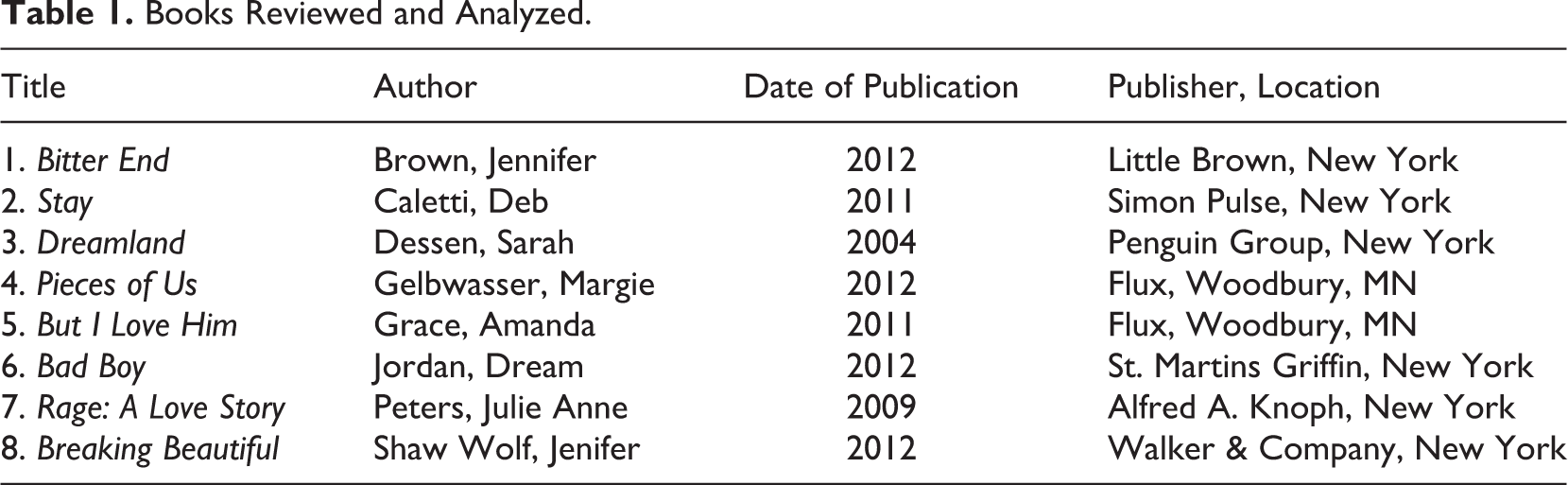
Novels were excluded if they failed to meet the above criteria. Initially, I identified 13 books that met these criteria. Three books were excluded because they did not directly explicitly address dating violence. The structure of “the problem novel” genre of YA fiction generally focuses on one central issue that the protagonist is working through; therefore, it is fairly easy to determine the focus of each novel. An additional two novels were excluded because they were self-published and not in circulation at one of the five largest library systems. In total, eight novels met these inclusion criteria, and their names, titles, and publishers can be found in Table 1.
Books Reviewed and Analyzed.
Data Analysis
The data analysis was an inductive process where I allowed the codes, themes, and discourses to emerge organically. The analysis process unfolded across four distinct steps. The first reading sensitized me to the broad understanding of the plot, characters, and general themes of the book. I memoed throughout the reading to document preliminary thoughts and reactions to each book. The second reading involved in-depth inductive coding of the key concepts within the novels and the clustering of concepts into categories (Saldana, 2009). For example, one of the categories was “Characteristics of Victims,” and the related codes within this domain were wallflower, low self-worth, innocent, first love, and “good girl.” I developed and continually amended a codebook that included all codes and categories and definitions of these concepts. Through using Saldana’s (2009) process of “code weaving,” where I grouped like codes and categories together, I was able to identify the primary themes. To ensure that these themes were present across all of the novels, I generated tables so I could systematically account for them both within and across all of the novels (Ayres, Kavanaugh, & Knafl, 2003). Examples of types of themes include: the antecedents of TDV were portrayed as being related to victim vulnerability and poor decision-making, men were positioned as being responsible to protect women, and there were limited portrayals of social system involvement.
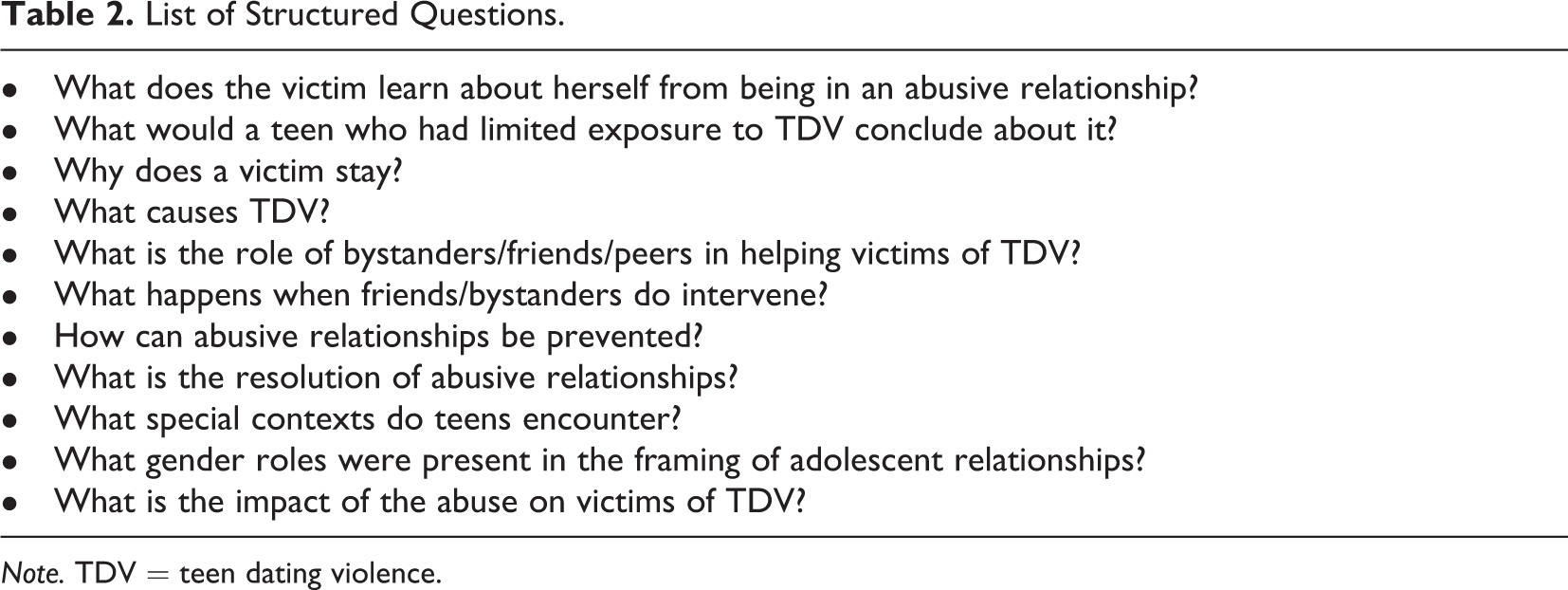
For the third step, I returned to the novels and employed “structured questions” (LeGreco & Tracy, 2009) to unpack the larger social discourses and ascertain how language was used and to what end. I was also interested in identifying what is specifically said and what is omitted or rendered invisible (Wood & Kroger, 2000). The development of the structured questions was inspired by the themes that emerged from the initial thematic content analysis described in Step 2 and reflections that were captured in my analytical memos (please see Table 2 for a detailed list of structured questions). It was through the process of writing responses to these questions that I was able to sensitize myself to the larger functions these discourses serve through their framing of this social issue.
List of Structured Questions.
Note. TDV = teen dating violence.
The fourth step involved linking the thematic patterns present across my answers to the structured questions to specific societal-level discourses on what identities, social relationships, and versions of TDV were being enacted via societal discourses in these novels (Gee, 2011). This process was informed by my own experience as a TDV researcher, educator, and former social work practitioner. Additionally, I immersed myself in the academic and practice literature on the societal and media framing of DV, including victimhood and perpetration. Through my own process of becoming familiar with postfeminist and neoliberal discourses, I was able to describe how language was operating in these novels and to what end. By reading, free writing, and memoing about my personal thoughts and reactions, I was able to move from the thematic/descriptive to the discursive.
In order to address the potential for other interpretive viewpoints of these novels, I did two things. First, I partnered with a second researcher (a master’s in social work student) who analyzed a subsection (n = 3) of the books. The second researcher coded all of the books by hand using the codebook I had generated. She also took meticulous notes on her interpretive impressions of the books. Although we had no significant differences in interpretations, we were struck by different elements of the novels which we discussed in depth. Second, I met regularly with colleagues who had familiarity with dating violence and CDA to discuss my evolving interpretations and approaches to data analysis. These collaborations helped me in considering alternative viewpoints, interpretations, and encourage a rigorous analytical process.
Results: The Enactment of Postfeminist Identities
In the following section, I will describe the various ways that a postfeminist discourse served to explain the causes, lived experiences, and aftermath of TDV in the lives of the protagonists in YA literature. In order for a theme to be represented in this section, it had to appear in the majority of novels. Outlying findings will also be noted.
Entry Into and Experience of TDV: “A Year of Bad Choices”
The protagonists in this sample of YA novels all are represented as autonomous postfeminist subjects whose individual choices, not structural inequalities, contributed to the outcomes of their relationships. For instance, in Bad Boy, the protagonist Kate’s foster care caseworker chastised her for walking into her “relationship with her eyes closed.…This isn’t about luck, it’s about poor choices” (pp. 173–174). The use of the language of personal choice is significant because it so closely echoes the postfeminist rhetoric of personal responsibility. While Kate’s caseworker could have made reference to how her identity as a foster youth created structural impediments that contributed to some of her personal hardships, this critical analysis was not present in this novel.
This element of personal choice inherent to postfeminist discourse is further illustrated in Clara’s, the protagonist in Stay, description of her self-perceived role in her abusive relationship. As she described, “I had stepped in, and I had willingly given myself up to the waves that carried me out. I had let him take me up and keep me in the ways he’d wanted. I had let this happen” (Caletti, 2011, p. 297). The repeated use of I statements in this passage underscores how a postfeminist discourse of choice is being leveraged to explain the agency victims have in their romantic relationships.
Postfeminist discourses are further enacted in how the protagonists Ann in But I Love Him and Kate in Bad Boy framed their roles in their relationships. Ann described her yearlong relationship with Connor as a “year of choices” (p. 112) where she silenced her own needs in favor of her boyfriend’s. Kate in Bad Boy is also portrayed as taking personal responsibility for the outcome of her relationship. She, for example, emphatically asserts: “I got myself into [this relationship]. Now I had to get myself out” (Jordan, 2012, p. 163). Additionally, after spending time in the hospital after an episode of serious physical abuse, she described how she “didn’t hang with anybody right away. I needed some time to myself, time to figure out why I kept getting involved with the wrong people” (p. 189). Just like the previously described representation of Clara in Stay, Kate is framed as having some kind of agency in the outcome of the relationship, and had she made better decisions, she could have avoided being involved with an abusive partner.
Constructing the protagonists as agentic and independent underscores the high regard postfeminism holds for the capacity of young women to independently control their future destinies. While positioning victims as having control over the outcomes of their relationships could be interpreted as celebrating victim resiliency and strength, these are not straightforward narratives of personal empowerment. These renderings of TDV victims can be construed as myopic cultural narratives which blame victims for their entry into abusive relationships. This is not to say that victims are passive and lack agency, but rather underscores the feminist notion that DV is perpetuated by structural and systemic inequalities.
Impact of Abuse: Blighting Postfeminist Identities
Postfeminist discourses were further reinforced in the portrayal of how TDV victims are impacted by abuse. Rather than positioning TDV as a societal-level issue that impacts entire communities, it was framed in very individual terms as negatively impacting the protagonists’ postfeminist identities. Due to the strain of their abusive relationships, for example, the protagonists were described as having difficulty satisfying the multiple demands of school, work, and their afterschool jobs—and thus descended into the status of being “at risk.” The following passage from Stay is illustrative: “My grades in her class were slipping. I was so tired. Acceptance letters were coming in the mail, colleges at home and away, but I missed the deadlines for mailing anything back” (Caletti, 2012, p. 230).
In addition to facing challenges at school, the character Ann in But I Love Him was asked to relinquish her position as co-captain of the track team for missing too many practices, and the protagonists in Pieces of Us and Dreamland were also dismissed from their respective cheerleading teams. Even Caitlin, the lead character in Dreamland, described how cheerleading provided “some semblance of a normal life. But now, I was just a girl with a boyfriend who beat her [and] who smoked too much” (Dessen, 2004, 180). This passage illustrates how cheerleading was her last tie to her previous thriving postfeminist identity and now she is represented as an emblematic troubled or “at-risk’ teen (i.e., smoking marijuana and cigarettes, skipping classes, and lying to her parents).
The only novel that deviated from this portrayal of victimhood was the protagonist Kate in Bad Boy. While Kate was described as having been disempowered by her abusive relationship, there was not the same language employed regarding her getting educationally derailed. The fact that Kate was also the only African American character represented in these novels makes this finding even more compelling. This finding could be interpreted as reflecting differing societal expectations about African American young women’s long-term trajectories or an implicit assumption that they are already “at risk.”
Exiting Abusive Relationships
Consistent with postfeminist discourses that minimize the role of the state, across these novels, there is a privileging of “self-help” responses to exiting abusive relationships coupled with an underrepresentation of external systems such as the CJS.
Exiting abusive relationships: The role of the CJS
Overall, across this sample of novels, the CJS was displayed as playing a marginal role in victims’ experiences of TDV and exiting their respective relationships. The perpetrators in Bad Boy, Bitter End, and Dreamland were arrested; however, these were very minor references at the end of the novels. The two more in-depth descriptions of the resolutions of the criminal cases against the perpetrators occurred in Dreamland and Bitter End. In Dreamland, the protagonist explained how the perpetrator’s lawyer “brokered a deal for the charges against him for hitting me, so he was spending the weekend in jail and doing a lot of community service” (p. 244).
The protagonist in Stay was discouraged from involving law enforcement and securing a restraining order, implying, perhaps correctly, that the CJS can actually exacerbate abuse. As the following passage illustrates: A restraining order, you hope, would give me some sense of peace and safety. Finally, someone is doing something, here, right? Capt. Branson knew what he was talking about all along. A bundle of paper is not a defense against someone’s will. Protection orders are rational documents served to irrational people, a sometimes dangerous solution to a problem there is yet no answer for. (Caletti, 2011, p. 302)
Leaving an abusive relationship: An issue of personal readiness
The decision to leave an abusive relationship was positioned as a personal choice, where victims had to muster the internal courage to exit their relationship. For instance, the character Kate in Bad Boy described how “something inside me flipped, like a courage switch. Percy’s words were so hurtful, so dead wrong; I had no choice but to find my own voice” (Jordan, 2012, p. 165). Therefore, courage is constructed as the barrier to leaving abusive relationships. With the exception of Stay and Breaking Beautiful (where the relationship officially ended with the perpetrator’s demise in a car accident), all of the relationships simply resolved once the victim decided to end the relationship, underscoring the poplar contention that the primary barrier for ending an abusive relationship is the victim’s personal readiness, not structural barriers or legitimate safety concerns.
Men as “desired” saviors
Across the majority of YA novels, there was a consistent representation of men, particularly fathers and male friends, as playing the role of “desired savior.” Young women are positioned as secretly hoping to be “rescued” by their fathers or male friends rather than by formal support of social services. For instance, the character Caitlin states, “I closed my eyes, willing [my father] somehow to look through the dark car windows and rush out and save me from Rogerson, and from myself. But he didn’t” (Dessen, 2004, p. 156). The only novel where this theme wasn’t evident was Rage: A Love Story, which featured a same-sex couple and the protagonist’s father was deceased.
Similarly, the protagonist Clara in Stay exemplified this desire for male protection by stating: I wanted to stay right there [in the arms of her new boyfriend], because it was so safe. I don’t know if it’s what every girl wants, but it’s what I wanted, that feeling, being held firmly, the sense that any storm could come and blow the roof right off but in his arms there’d be shelter. (Caletti, 2011, p. 213)
In summary, this section on the enactment of postfeminist discourses across these novels demonstrated how postfeminist discourses constructed agentic heroines that independently navigated their abusive relationships and are ultimately responsible for securing their own safety. Rather than framing TDV as a violation of young women’s human rights or as an issue of gender equality, the repercussions of TDV were filtered through a distinctly postfeminist lens. Thus, experiencing TDV was described by how it could derail young women’s future goals, including pursuing higher education. As is consistent with the neoliberal undercurrent of postfeminism, the role of the state and broader community is overshadowed in favor of representing women as being independently responsible for securing their safety—or potentially to be in the arms of a “good man.”
Discussion and Implications for Social Work Practice: A Postfeminist Retelling of TDV
Within a Western postfeminist cultural discourse, the efforts of feminist activists to call attention to the structural barriers that impede dating and DV victims’ ability to safely leave abusive relationships have been attenuated. Refracted through a postfeminist lens, the root causes of DV/TDV and the lived experience of enduring an abusive relationship are internalized and reduced to issues of victims’ poor decision-making, choice, and personal responsibility. Similar to the work of Patterson and Sears (2011), Thaller and Messing’s (2014) and Enk and McDaniel’s (2012) analysis of the framing of DV in various media genres, companion discourses of postfeminism and neoliberalism function to assign culpability for victims’ inability to avoid entry into risky relationships. The following section will both discuss how TDV has been reinterpreted through postfeminist discourses and elucidate how the persuasive sway of postfeminist cultural narratives have permeated social work practice, particularly with DV victims and survivors.
Recasting the Harm of TDV: Blighting Young Women’s Future Identities
While there is research to support the contention that experiencing TDV affects victims’ academic performance (Hanson, 2002), self-reported emotional well-being, and self-esteem (Ackard & Neumark-Sztainer, 2002; Howard, 2007), this construction of what it means to be “at risk” is noteworthy within the context of a postfeminist discourse that privileges individual responsibility and ignores structural and systemic explanations of social problems. None of these novels discuss what victims have to do in terms of negotiating attending school with one’s abuser, changing one’s living situation when living with parents, or acquiring an order of protection when abuse escalates after the termination of the relationship. In fact, only one novel (Caletti’s Stay) referenced that perpetrators’ abusive tactics can continue well after the victim terminates the relationship.
Because young women are expected to have “self-determining agency” (Stringer, 2014, p. 5), it is fundamentally their “fault” if they fail to reach socially approved ideas of successful adulthood or do not exhibit good decision-making skills (Gill, 2007). Notions of being “at risk” are intentionally manufactured and disseminated, via the media, to adolescent young women as something to be feared and avoided. For example, the lead characters Ann in But I Love Him and Clara in Stay were well on their way toward achieving their ideal postfeminist identities by having plans to attend a “good college”; however, these plans were derailed by their making the wrong choice in romantic relationships. Across these novels, TDV victims were framed as agentic participants in their relationships, and the experience of TDV was positioned as another road (like teen pregnancy) toward being “at risk.” These novels function as potential cautionary tales for what can happen when young women make “bad choices” in their dating partners.
Privileging “Coping on One’s Own”
Similar to other media genres, victims in this sample of YA literature were positioned as being independently responsible for exiting their abusive relationships (Enk & McDaniel, 2012; Thaller & Messing, 2014). Kozol (1995) describes this tendency in the media of framing abuse victims as “lone heroines fighting lone villains” (p. 237). The underrepresentation of the vital role of broader social services counters the feminist discourses of a coordinated community response. Although critiques of the current tools for promoting victim safety and enforcing perpetrator accountability are warranted, these novels did not offer alternative solutions or potential policy responses, instead they positioned victims as independently extricating themselves from their relationships.
Consistent with postfeminist discourses, leaving an abusive relationship was largely framed as an issue of personal readiness and courage. While the internal strength of victims in leaving their abusive relationships is undoubtedly important to underscore, what is potentially problematic is the lack of critical analysis across these novels on the challenges of safely doing so. Without companion discourses on structural inequality, and with gaps in the coordinated community response to TDV, young readers are left with the moral judgment that individuals who stay with their abusers must be in some way deficient.
Implications for Practice: Postfeminism and Domestic and Dating Violence Service Provision
While contemporary dating and DV activists and service providers continue to challenge societal-level misconceptions about the causes and consequences of dating violence and the responsibility that the entire community plays in preventing and ameliorating abuse, it is important to reflect on the ways that service delivery has potentially been influenced by the powerful sway of postfeminism to reinterpret social issues as personal ones. For instance, Hall (2001) documented that postfeminist and neoliberal conceptualizations of individual responsibility and risk management have been infused into the messaging of contemporary rape education programs by emphasizing strategies victims can employ to avoid being assaulted. Bumiller (2008) observed that self-sufficiency programs have been synthesized into “standard” support services offered at DV agencies and shelters. Lastly, Thapar-Bjorkert and Morgan (2010) reported that staff at DV agencies believed that DV victims were “deserving their fates” (p. 32) and employed societal discourses of blame and responsibility to describe how their clients continue to endure abusive relationships. This research points to the need to critically analyze how mainstream constructions of victimization, risk management, and choice are infused into the organizational practices and treatment modalities of DV agencies. For example, TDV service providers could evaluate how a rhetoric of personal responsibility and choice influences the types of services that are offered to abuse victims (e.g., financial management, self-defense, etc.) and hold staff development sessions on evaluating how their own approaches to working with clients has likely been influenced by these discourses in unexpected ways.
Implications for Research and Practice: Developing Counternarratives About TDV/DV
Given that the media continues to be a primary purveyor of cultural messages that run counter to feminist-based structural analyses of DV, these findings provide a critical opportunity for discussing how social issues, such as TDV/DV, are fundamentally influenced by social and political environments. While implications for the development of TDV prevention programs have been discussed elsewhere (see blinded author, 2016), it is important that TDV prevention programming be inclusive of discussions on identifying dominant misconceptions of dating violence, a structural analysis of TDV that moves beyond identifying individual-level risk and protective factors, and tools to be critical and discerning consumers of the media.
While there has been considerable attention in the field of public health to the potential for novels, in the form of narrative interventions, to be employed as tools for promoting health-enhancing behaviors (Hinyard & Kreuter, 2007), this approach has been less examined in social work. For example, public health practitioners have couched health messages within first-person narratives and stories, rather than just distributing statistics, and used them in prevention trainings for teen audiences around issues of substance abuse (Miller-Day & Hecht, 2013). Therefore, there is considerable potential to explore how novels, via narrative interventions, can be used as tools to initiate critical conversations between parents, youth workers, educators, and youth about the representation of gender-based violence in popular culture (Curwood, 2013).
Conclusion
In summary, Gill (2007) argues that narrow and reductionist framing of social issues such as TDV/DV has turned the feminist idea of “the personal is political on its head” (p. 259), and reinterpreted the very notion of victimhood that second-wave feminists advocated for (Stringer, 2014). Rather than DV being conceptualized as a larger societal issue that is the product of the institutionalization of patriarchal social norms and gross violations of human rights, it has been reduced to stemming from individual failings or poor choices—it becomes, once again, a personal, not a political issue. This myopic cultural narrative has not only infused the general public’s meaning-making processes about who becomes a victim of dating violence but has also potentially been infused into social service delivery in response to violence against women and girls.
Footnotes
Author’s Note
The content is solely the responsibility of the authors and does not necessarily represent the official views of the National Institutes of Health.
Acknowledgment
The author would like to acknowledge the insights and revisions provided by the dissertation committee: Taryn Lindhorst, Erin Casey, and Diane Morrison.
Declaration of Conflicting Interests
The author(s) declared no potential conflicts of interest with respect to the research, authorship, and/or publication of this article.
Funding
The author(s) disclosed receipt of the following financial support for the research, authorship, and/or publication of this article: This research was supported by the National Center for Advancing Translational Sciences of the National Institutes of Health under award number TL1TR000422.