




Abstract
In this brief, the authors examine Russian media discourses on domestic violence during the COVID-19 global pandemic. With the introduction of restrictive measures against the virus, such as physical distancing measures, cordoning off cities, a 2-week travel quarantine, and others, media reports started to emphasize growing numbers of domestic violence cases and the insufficiency of measures to help the victims. Russian media frequently linked the incidents of violence under lockdown to the absence of adequate legislative measures. Importantly, Russian media reports referenced a proposed draft law on domestic violence that had been actively debated throughout the second half of 2019 but was not adopted. Traditionalist groups, who believed the special law was not necessary, countered media reports insisting that family remained the safest place for people under the pandemic. Drawing on a constructivist paradigm and using critical discourse analysis and content analysis, this article examines media representations of domestic violence during the COVID-19 health pandemic, as well as media narratives over the perception of the state faced with the two insurmountable tasks: to contain the epidemic and protect the most vulnerable members of the society. We argue that despite the increasing influence of traditionalist ideas in Russian foreign and domestic policy-making, the COVID-19 pandemic can provide human rights activists and social workers with a renewed opportunity to frame the necessity of a special domestic violence law as means to protect the interests of the most vulnerable members of the society during crisis situations.
Domestic Violence During the Pandemic: “An Emergency Within an Emergency”
In Spring 2020 with the gradual introduction of lockdown measures around the globe, reports of domestic violence and other forms of abuse started to circulate in international media and on the agenda of international intergovernmental organizations. In late March 2020, Marceline Naudi, Council of Europe’s President of GREVIO, a group established to monitor the implementation of the Council of Europe Convention on Preventing and Combating Violence Against Women and Domestic Violence (the Istanbul Convention), issued a statement where she stressed that restrictive measures to combat the pandemic offered the abusers “additional power and control” (Naudi, 2020). On April 6, 2020, UN Secretary-General Antonio Guterres emphasized that a “horrifying global surge in domestic violence” was taking place and that “healthcare providers and police are overwhelmed and understaffed…local support groups are paralyzed or short of funds. Some domestic violence shelters are closed; others are full.” Various measures were reportedly taken by countries to address this problem. However, measures to deal with this “emergency within an emergency” (Vitale, 2020) have largely been considered inadequate by the international media with governments disoriented and unprepared (Maher, 2020).
Examining how media reports presented Russia’s measures to deal with this “emergency within an emergency” helped shed light as to which societal groups struggled to put forward their understanding of certain phenomena and what rhetoric they used while doing so. The media frequently linked domestic violence under lockdown to the lack of a special law, and this became a divisive point for the liberal-oriented and traditionalist groups that sought to defend their own visions of how this calamity must be addressed. And while attempts to introduce a special law to combat domestic violence began in Russia already in the early 1990s (Usanova, 2020), in 2019, Volodina v. Russia decision at the European Court of Human Rights (ECtHR) became a catalyst of a renewed public debate over the necessity of a special law to combat this crime. A draft law was prepared and presented by a special working group that included, inter alia, famous human rights lawyers, researchers, and other public persons, and a heated discussion ensued throughout the second half of 2019 on the website of the Federation Council (the upper house of Parliament) and in the media. With the COVID-19 pandemic, however, this work came to a halt. COVID-19, therefore, became a turning point in Russia’s debate over the draft law on domestic violence in a sense that it reactivated the confrontation between human rights organizations and traditionalist groups that began in 2019.
Examining Russian media discourses on domestic violence during the COVID-19 pandemic enabled us to see how different social groups constructed their own versions of domestic violence in Russia and how they perceived the role of the state, represented by the president, the government, legislative/executive authorities, the army, and the police. While the topic of media representation of domestic violence has been extensively covered in academic publications (Chesney-Lind & Chagnon, 2017), the 2020 pandemic has yet to receive scholarly attention. Research is likely to emerge over the next few years examining media depictions of lockdown effects and the role of states in protecting the victims. Looking at the example of Russia, we add to this emerging literature by focusing on media depiction of domestic violence during quarantine in the conditions when special protection measures are not available and the influence of traditionalist groups in family matters is on the rise. Traditionalist agenda urging to preserve heteronormativity and natural parenthood that has become part of Russia’s domestic and foreign policy-making will most likely continue to attract supporters in Western and non-Western countries alike in the aftermath of the COVID-19. By looking at this universalist–traditionalist divide over domestic violence under quarantine, as it is represented in the media, we contribute to scholarly understanding of the “illiberal wave” that calls into question the idea of universality of human rights and gender equality. This “illiberal wave” of which Russia is a part is already recognized as a crucial phenomenon in contemporary European politics (Kuhar & Paternotte, 2017) and, thus, deserves closer examination.
Domestic Violence in Russia: From Decriminalization Law to Volodina v. Russia and Beyond
As researchers observe, contemporary family policy in Russia must be understood under the backdrop of the Soviet legacy, when the family as a societal institution was considered an object of state protection. The paradox, however, is that the state is no longer capable of maintaining the same level of social and economic assistance to the family as in the time of the Soviet Union, which leads to the so-called paradox of paternalism. This paradox refers to dissatisfaction with the “social contract” on the part of the citizens who expect support from the state (mostly, financial), but the state cannot satisfy these paternalistic expectations due to limited resources. Even if direct monetary payments to families with children and other forms of support are provided, they are perceived as insufficient by the citizens. As a result, people are reluctant to alter their reproductive behavior, making demographic policies largely ineffective (Chernova, 2013, p. 261).
And while the vision of a modern, emancipated woman who can successfully balance between her family and her career is rather widespread and accepted by the general public, concepts such as gender equality, and equal involvement of men and women in family planning and child-rearing are not, they are seen as Western experience, alien to the Russian culture (Chernova, 2013, p. 267). At the same time, in Russia, as in many other postindustrial societies, there are a growing number of parents’ organizations who insist on reducing the state’s interference in family matters. These organizations believe the state violates a certain tacit agreement when it should abstain from interfering in private and family lives in exchange for the citizens’ noninvolvement in politics (Mayofis & Kukulin, 2010). Thus, traditionalists believe that violence committed against family members should be seen as a private issue; hence, the state’s attempts to punish the wrongdoers are often regarded as unwelcome and detrimental. In addition, state demographic policies aimed at increasing the birth rate are often perceived as blind to the specific context of modern families. In this sense, human rights groups are more cooperative with the state than various parents’ organizations and other groups promoting traditionalist agenda in that they seek to engage with the state, calling for the observance of certain international treaties or domestic laws (Muravyeva, 2020).
The problem of domestic violence in Russia came to the fore of public discussions around 2017. At the time, changes were introduced to the country’s criminal and administrative codes decriminalizing certain behavior such as nonaggravated cases of first instances of battering. While this reform was presumably introduced to liberalize Russia’s criminal laws, it was criticized by some experts as dangerous, pointing to the requirement that the aggrieved party initiates a case. Referred to the so-called private proceedings, this was in contrast to public proceedings when the police can initiate a case. Such proceedings take a lot of time and require special skills and knowledge on the part of the victim, thus discouraging her to proceed. Indeed, this initiative reportedly led to an increase in the cases of domestic violence (Bakin, 2018), though it must be noted that this kind of crime remains hidden in Russia and reliable statistics are very difficult to obtain (Muravyeva, 2020).
Valeria Volodina, a 34-year-old woman from a Russian city of Ulyanovsk, launched her complaint at the ECtHR in Strasbourg (App.no.41261/17; July 19, 2019), after several failed attempts to obtain protection from the state against her abusive partner who constantly resorted to beatings, verbal abuse, stalking, and other forms of violence. In the ECtHR judgment, delivered in July 2019, the Court found a violation of Article 3 (prohibition of torture) and Article 14 (prohibition of discrimination). Given that the possibility of a restraining order was not envisaged in Russian laws, the Court found that this gap disproportionately affected women and, thus, constituted discrimination.
This, in turn, led to an unprecedented mobilization over a draft law on domestic violence prepared by the Federation Council and actively debated on the Council’s website and in the media throughout the second half of 2019. While initially this law was seen as a breakthrough that would put Russia on par with many other European countries that signed and ratified the Istanbul Convention, in Autumn 2019, this universalist human rights discourse came under attack from traditionalist groups that saw this law as a threat to family values. The state, caught between a rock and a hard place, sought to maneuver between these two camps by introducing various changes to the text. These changes, however, were seen as unacceptable by both human rights defenders and proponents of conservative values. The draft law was denounced by both human rights defenders and supporters of the traditionalist agenda as too vague, and the very definition of violence was subject to intense criticism as well. The main problem of the draft lay in the very understanding of “domestic and family violence” as “an intentional act which causes or poses a threat of causing physical and (or) mental suffering and (or) property damage but does not contain elements of an administrative or criminal offense” (Draft Law, 2019). The most obvious question asked by the experts was: How can domestic and family violence not constitute an administrative or criminal offense? Secondly, the focus of the draft gradually shifted from punishment to prevention, which caused fears that the parties in domestic violence cases would be forced to reconcile (Muravyeva, 2020). Traditionalists, who believed existing laws sufficed to protect victims of violent crimes, saw the law as a threat to family values. One of the most common fears was that the law would be used opportunistically and selectively in order to take children away from their parents by the representatives of the state’s juvenile justice or poorly monitored nongovernmental organizations (NGOs; Narod prishel v uzhas ot novogo zakonoproekta o semejno-bytovom nasilii, 2020).
With the introduction of pandemic-related quarantine measures, work on the draft law came to a halt. Valentina Matvienko, the Chairperson of the Federation Council, announced that it had to be postponed until health measures were lifted. She was quoted as saying that quarantine measures would not lead to more abuse but, on the contrary, would consolidate family members (“Ugrozhaet nozhom,” 2020). Her optimism, however, was not shared by the media, which started to report on the growing incidents of wife battering, physical, sexual, and verbal abuse and murders. They raised the question of the necessity of a special law to combat domestic violence once again.
“Traditionalist Turn” and AntiGender Manifestations During the “Fourth Wave” of Feminism
In 1998, when American scholars Margaret Keck and Kathryn Sikkink wrote their seminal book on transnational advocacy networks, it was generally presumed that only liberal norms can “cascade” (Sikkink & Finnemore, 1998), that is, going beyond the borders of a particular state and even a particular region, leading to democratization, particularly in countries undergoing transition and “heightened global awareness.” This research framework, inspired by constructivism, was frequently applied to explain a whole array of phenomena, for example, the inclusion of gender crimes in the Rome Statute of the International Criminal Court. This line of reasoning came under critique from scholars starting in the mid-2000s. Some sought to explain very strong reactions—or “backlash”—by states to certain decisions of international organizations or international courts (Madsen et al., 2018). Critical studies scholars challenged the idea of cascading liberal norms by pointing to U.S. hegemony, Big Power politics, and egoistic interests of the imperialist world (Rogers, 2018). Scholars have also noted the rise of right-wing movements in particular countries and on the global scale more generally, including antigender campaigns (Pankowski, 2010; Payne, 2020). Even though the phenomenon of illiberal “norm cascade” is still very poorly researched, Kuhar and Paternotte (2017) show how antigender campaigns have extended beyond Western Europe to other parts of the world. Examining their rhetoric is important because it can help shed light as to the frames they use to mobilize supporters against the idea of reproductive rights, marriage equality, antidiscrimination, and the very concept of “gender.”
While some of these movements draw inspiration in religious ideas, many of them are nonreligious and demonstrate against what they perceive to be a neoliberal ideology; and even though there are country-specific features, they nonetheless share similar slogans and visual symbols (Pető, 2016). For these movements, gender becomes a “symbolic glue” that unites representatives of conservative political parties, activists, and intellectuals.
While the exact terminology and chronology of these phenomena is still debated, postfeminist narratives have been willingly embraced by celebrities, politicians, and representatives of academia. As Rivers (2017, p.15) shows, postfeminism is associated with “a time after, or even a reaction against, feminism.” Representing feminist political movement as irrelevant and outdated because women allegedly enjoy equal rights with men and can fully realize their potential, proponents of this thinking have increasingly sought to promote their views on various public platforms and in popular culture (Rivers, 2017). And while the metaphor of feminist “waves” is a Western idea and might not be accurately applied in other parts of the world, the backlash against feminism taking place during the “fourth wave” is not confined to Western Europe or the United States only. As Grzebalska and others (2017) point out, the attractiveness of this kind of rhetoric lies not just in the disappointment with traditional, mainstream politics, but also because its proponents offer a liveable and viable alternative centred on family, nation, religious values and freedom of speech, one which is attractive because it rests on a positive identification of an individual’s own choice, and one that promises a safe and secure community as a remedy to individualism and atomization. We know that there are more and more people in the world who support our position on defending traditional values that have made up the spiritual and moral foundation of civilisation in every nation for thousands of years: the values of traditional families, real human life, including religious life, not just material existence but also spirituality, the values of humanism and global diversity. (Presidential Address to the Federal Assembly, 2013)
As researchers note, Russian traditionalist forces share many similarities with their Western counterparts, from their openly homophobic stance to the disregard of gender studies as a research field. There are important differences, however, both in terms of agenda-setting and tactics. First of all, Russia lacks an organized mass civil society, whether liberal or otherwise, and the possibilities of street protests are significantly narrower, making protest more an online phenomenon. Secondly, traditionalists lack a common “condensation symbol,” that is, a certain event/issue that evokes emotions and “provokes mass responses because it condenses threats or reassurances into one symbolic moment” (Sikkink and Keck, 1998, p. 181). The reason is simple: There are no laws permitting same-sex marriages or adoption by same-sex couples, sex education at schools, or gender programs in academia. And thirdly, there is a paradox which is quite difficult for the traditionalists to avoid: On the one hand, they share many ideas promoted by antigender activists globally, but at the same time, they constantly attempt to portray themselves in opposition to the rest of the world, especially to the morally corrupt “West,” even though the boundaries of this “West” are very fluid and uncertain (Temkina, 2020).
In the conditions of the ongoing constitutional reform, however, traditionalist values have come to the fore once again. One of the amendments to the new constitution defines marriage as a union between a man and a woman (Article 72). This definition is not Russia’s invention and can be seen even in the European Union member states, such as Hungary (Atol, 2013); what is worrisome, however, is that in the conditions of the ongoing health crisis and the constitutional reform, traditionalist discourse will continue to attract many supporters and eventually manifest itself in legal developments. In other words, using the concept of “traditional values” as historically legitimate and appropriate for the solution of current social problems by legal means, that is, by using law to enforce certain types of behaviour (heterosexual and procreative) results in the further traditionalisation of the law as a specifically “Russian” value system. (Muravyeva, 2017)
Method
This research employs critical discourse analysis (CDA) and content analysis to examine media discourses on domestic violence under COVID-19 in Russia (Fairclough & Wodak, 1997; Mayring, 2014). We do so within the constructivist paradigm. The proponents of the “social construction of reality theory” suggest that media not only participate in framing particular stories, they also “create the meaning of particular events” (Hatcher, 2018, p. 57). Examining discourse in this way enables us to identify actors who seek access to media platforms and to analyze their rhetoric. Our article selection included 103 publications for the period from March 11, 2020, when the World Health Organization declared COVID-19 a pandemic, to the end of April 2020, when some of the restrictive measures were gradually eased in certain Russian regions. We searched Google and Yandex (a Russian search engine), using the key words “domestic violence,” “domestic and family violence,” and “draft law on domestic violence” in both federal and regional media outlets, as well as radio and TV programs. Then, we formed the sample corpus of 72 texts (28,181 word forms) and analyzed it using qualitative and quantitative content analysis, and later, CDA for the interpretation of the results. The selection of media outlets was informed by their position in Russian media rating Medialogia (www.mlg.ru/ratings) and included popular online editions such as Snob, Esquire, and Lenta.ru; online versions of newspapers; radio and television channels, such as Moskovsky Komsomolets, Radio Komsomolskaya Pravda, Russia24, and RT; business outlets Forbes and Kommersant; news agencies TASS, Interfax, and Znak; specialized media, for example, Chips Journal, Wonderzine, and Orthodoxy and the World; sociopolitical media, for example, Rossiyskaya Gazeta, and opposition media, such as Novaya Gazeta and Meduza. Editions famous for their conservative views (ruskline.ru, soroksorokov.ru, tsargrad.tv, regnum.ru, and rossaprimavera.ru) were also included in the selection. We excluded repetitive articles and articles that merely contained the news, offering no assessment of the situation. The texts selected for the research were all in Russian. When translating them into English, we sought to preserve the emotional and pragmatic information of the original source and to achieve the semantic accuracy of the translation. We attempted to convey the author’s modality of the text and capture the communicative intentions in media discourses. It was important for us to objectively show the current situation in Russia and take into account the situational context of the original source and to maintain the consistency of translation in general.
It is beyond the scope of this research to give a detailed characteristic or classification of Russian media outlets, but we have to note that the distinction between the universalist and traditionalist discourses was done inductively, with a special emphasis not on particular outlets but on the narratives they use. Given that the state plays an increasingly intrusive role in regulating media in Russia, it appears impossible to clearly divide outlets into any categories, that is, liberal versus traditionalist or right-wing versus left-wing. Sometimes researchers use terms such as “independent media” or “nonstate media” to indicate their liberal political learning (Kim, 2017), but such labeling remains intuitive and requires further research.
The main CDA terms include the following: frame—a mental structure for representing events in discourse, lexeme—a basic structure of vocabulary, topic—a semantic structure of discourse, subtopic—a particular variation of a semantic structure, and word form—a particular grammatical instance of a lexeme. Focusing on frames, topics, and lexemes, we analyzed linguistic structures to investigate how discourses polarized and divided people and which societal groups were behind these structures by expressing themselves directly or indirectly in the text (van Dijk, 2000). Bearing this in mind, we posed several research questions: How did the media represent domestic violence under COVID-19 restrictions? How did the media see the role of the state faced with the double calamity? How did the news agenda on domestic violence under quarantine change?
We used qualitative content analysis to identify and track the major categories: traditionalist and universalist approaches to domestic violence as a social problem and the related categories, for example, victims, aggressors, defenders, the role of the state in helping victims of aggression, and so on. Content analysis enabled us to identify different stages of the discussion over the necessity of state assistance to victims and the need for a special law on domestic violence. In addition, with the help of CDA, we were able to examine the actors who oppose domestic violence law and the peculiarities of their argumentation.
Media Discourses in the Conditions of Quarantine Restrictions
The peak of media reporting on the topic of domestic violence under pandemic can be dated back to March 25, 2020, when Vladimir Putin signed a decree declaring the week of March 30–April 5 a nonworking week. Measures known by different names regionally like “regime of self-isolation” or “measures of heightened preparedness” mostly included restrictions on people’s movement. This included, for example, a 2-week quarantine period for persons arriving from abroad or from a different region, prohibition of movement for persons over 65 or persons having certain chronic health conditions, introduction of quick response codes (QR codes) for persons employed in essential service provision, a ban on public gatherings including cultural and religious events, and closing down of nonessential services, shops, and entertainment facilities. The strictness of the measures depended on the epidemiological situation in Russia’s regions and could be lifted or renewed by regional and local authorities taking into account the RO value of the virus and the availability of hospital beds and staff for coronavirus patients.
During this initial phase of March–early April, Russian media frequently quoted representatives of international intergovernmental organizations and international media reports that emphasized the dramatic increase in the incidence of domestic violence during mandatory lockdown (Merkulov, 2020). It was common to come across alarming reports in Russian media outlets that countries such as China, the United States, and many European Union member states were struggling, being unable to find adequate measures to protect the victims. These early publications put Russia on par with other countries and warned that a similar predicament would not take long to emerge. Human rights advocates and social workers, quoted by the media, in rather harsh terms, characterized the situation in Russia as very serious and the authorities as ignorant and risk-aversive. Mary Davtyan, a famous human rights lawyer, for example, pointed to the multiple obstacles for the victims during the lockdown regime: Policemen were reluctant to respond to the cases of battering or other forms of abuse since domestic violence was not seen as a priority during quarantine and no training was organized to explain to them that such cases required immediate attention. The majority of hotels/hostels were closed and bus/train routes were canceled, making it impossible to escape. In addition, victims were afraid to leave the house at all fearing fines and other penalties for breaking the self-isolation regime (Mikhalchenko, 2020). Experts frequently pointed out that the resources of support centers were very limited and inadequate and the lack of a special law on domestic violence made it difficult to offer protection to victims (Vladimirov, 2020).
Feminist activists and human rights advocates frequently appealed to the state, urging it to respond to an imminent danger, while at the same time deconstructing the idea of home and family as a secure place. Moreover, the virus itself was presented as a catalyst of domestic violence, and victims were shown as people faced with a double predicament: If they stayed at home, they had to “hide in toilets” being terrified of abusers, if they went outside or were thrown out of their house, they risked getting sick (“Iz-za karantina kolichestvo,” 2020). Interestingly, the media did not extensively narrate the actual stories of violence, they rather covered the activities meant to prevent it and help the victims. For example, the coverage featured different initiatives undertaken by NGOs, help line counselors, lawyers and social workers, and frequently provided useful information and advice, for example, instructions on how to properly formulate a complaint to the police (Rukov, 2020).
Meanwhile, conservative media presented their vision of domestic violence under COVID-19, criticizing feminist and volunteer organizations. On March 14, Russkaya Liniya declared that there was no valid reason to assume that domestic violence was widespread (Ovchinnikov, 2020). They resorted to the same tactic as their opponents: They started interviewing experts, lawyers, and celebrities in order to express their disagreement with the draft law on domestic violence, calling it “an ideal weapon that would bury the Russian Federation” (Timoshina et al., 2020). It is very difficult to assess the reliability of these experts, but it is worth noting that regardless of how reliable they were, they were presented in the media as opinion leaders. They often came forward with careful assessment of the problem, commenting on the ECtHR position on domestic violence and questioning the validity and neutrality of NGO reports.
Feminists were presented in very negative terms, both as a group and as individuals. For example, MP Pushkina was described by traditionalist media as an unpleasant, power-hungry, and opportunistic woman, who used these tragic circumstances to her advantage to “push the law through” (Obukhov, 2020a). In late April, another conservative outlet, Krasnaya Vesna, reported on the “feminist lobby” and appealed to the conservative public to protest against the adoption of restraining orders, which were meant to “isolate one spouse from another” (Karev, 2020). The publication proceeded with a conspiracy-inspired narrative about a March 8 feminist rally in Madrid, “a feminist sabbath,” which was allegedly to blame for the spread of the pandemic.
Analysis of the main thematic structures of the publications showed that media outlets focused on the topic of domestic violence under lockdown (Figure 1) and several subtopics such as the breach of lockdown rules and the actions of the authorities, and human rights defenders, women, and victims.
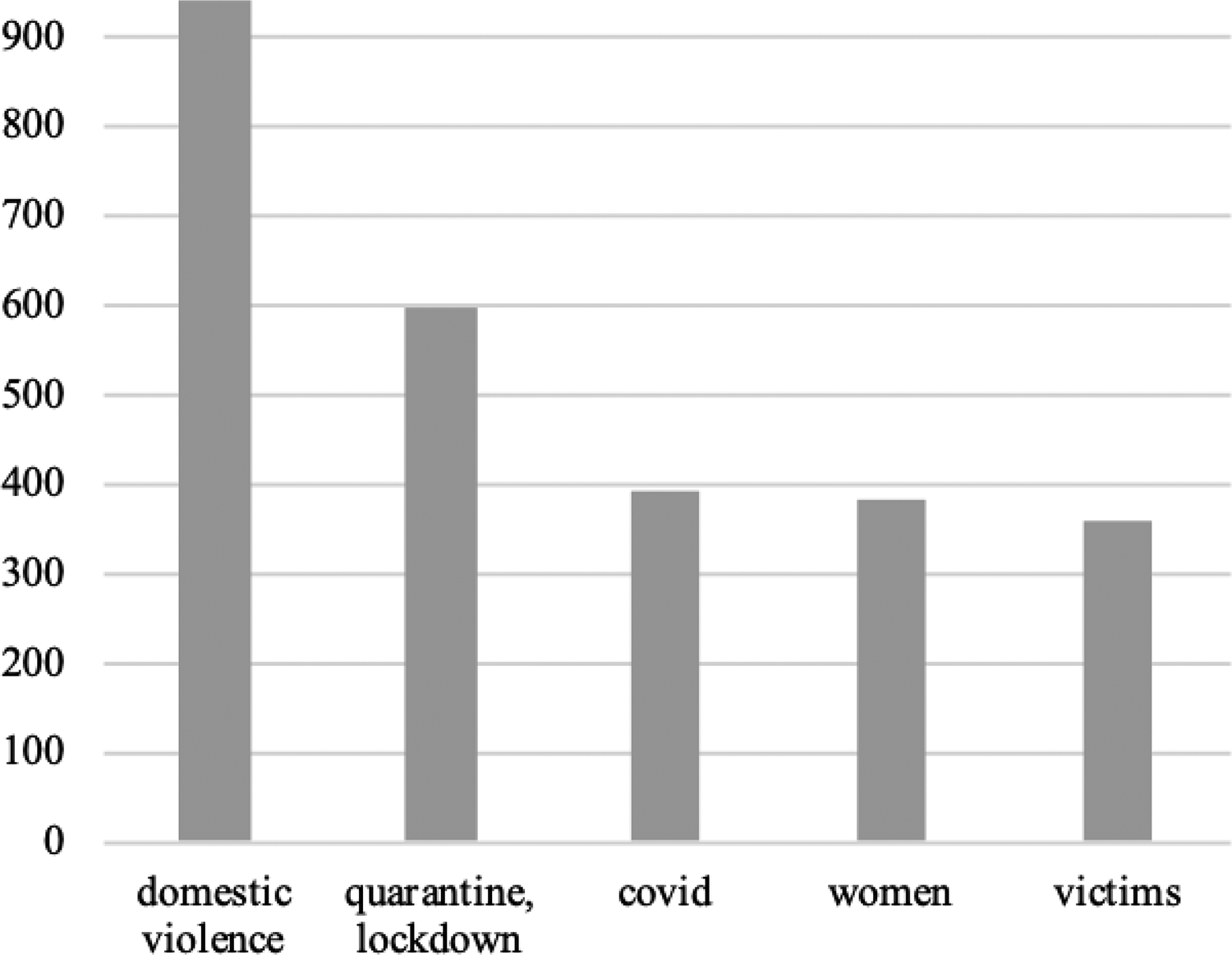
Lexemes indicating the main topics in domestic violence/lockdown discourse.
While speaking about domestic violence, the authors introduced several major actors: the state, Russian authorities, the police, human rights defenders, women, and the general public (Figure 2).
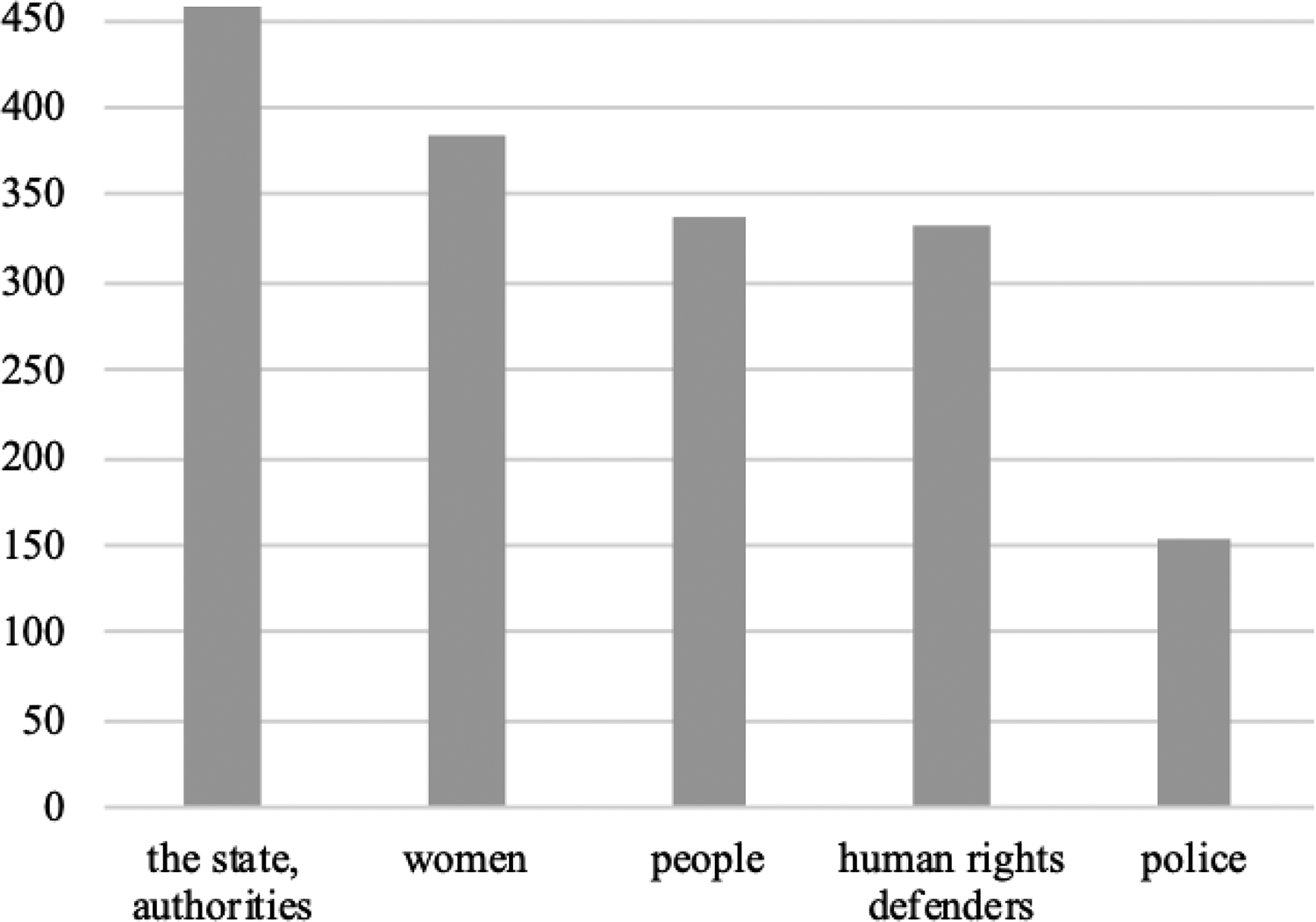
Lexemes indicating the main actors in domestic violence/lockdown discourse.
Minor actors (Figure 3) operate within the family and home.
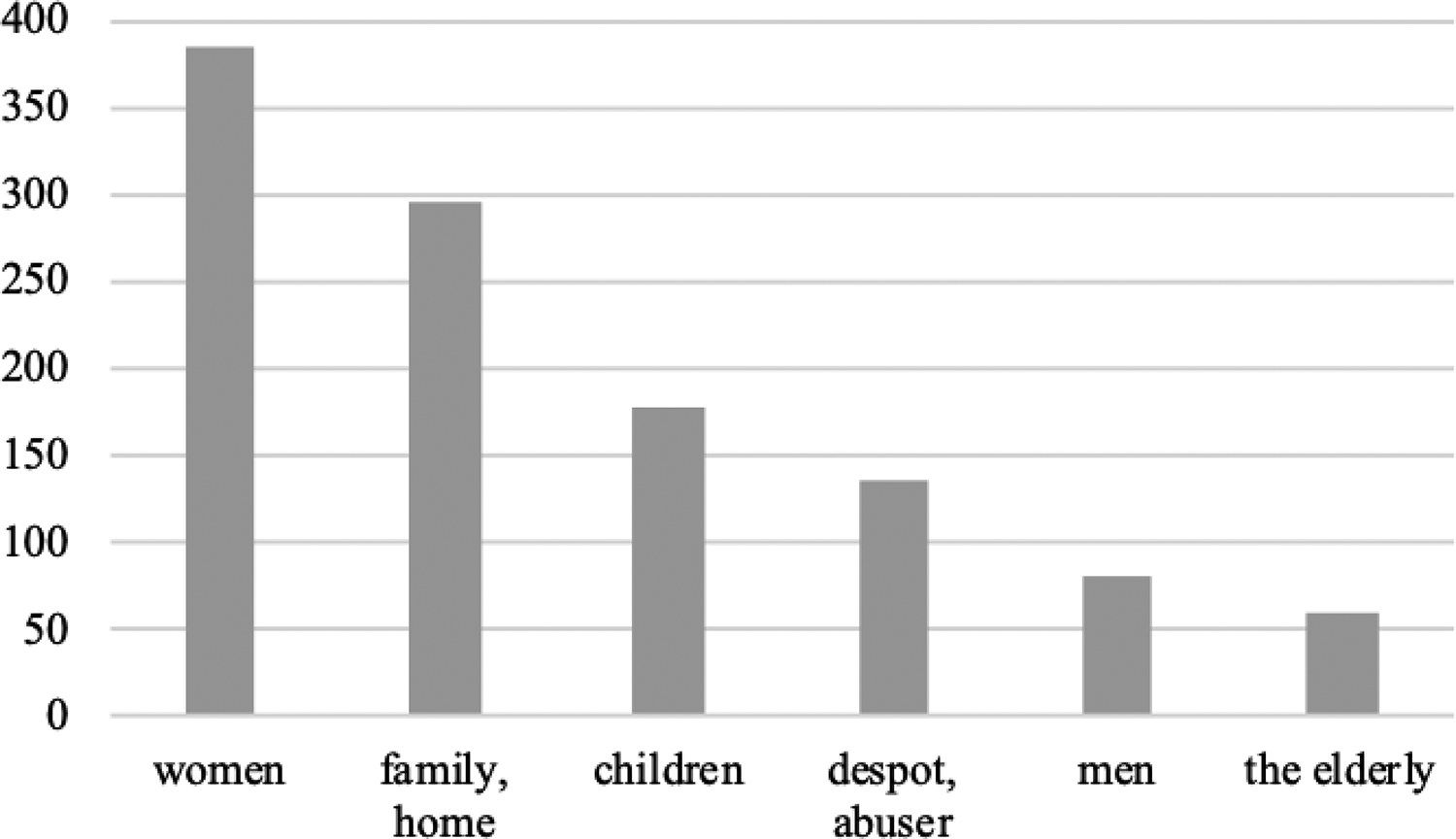
Lexemes indicating minor actors in domestic violence/lockdown discourse.
Representation of domestic violence under lockdown includes three major frames: family/home insecurity, authorities versus both human rights activists and the general public, and inactivity of the state.
Frame “Family/Home Insecurity”
The first frame, family/home insecurity, manifested itself through the series of statements characterizing quarantine restrictions: People are stuck at home, they cannot leave home, and home is in danger. On the other hand, the family environment increased aggression and tension, and abuse in the family was steadily growing. Lexemes nominating “violence,” “aggression,” and “threat” prevailed in the texts (Figure 4), while, on the contrary, lexemes nominating “peace,” “calmness,” “happiness,” and “love” were nearly lacking in discourse.
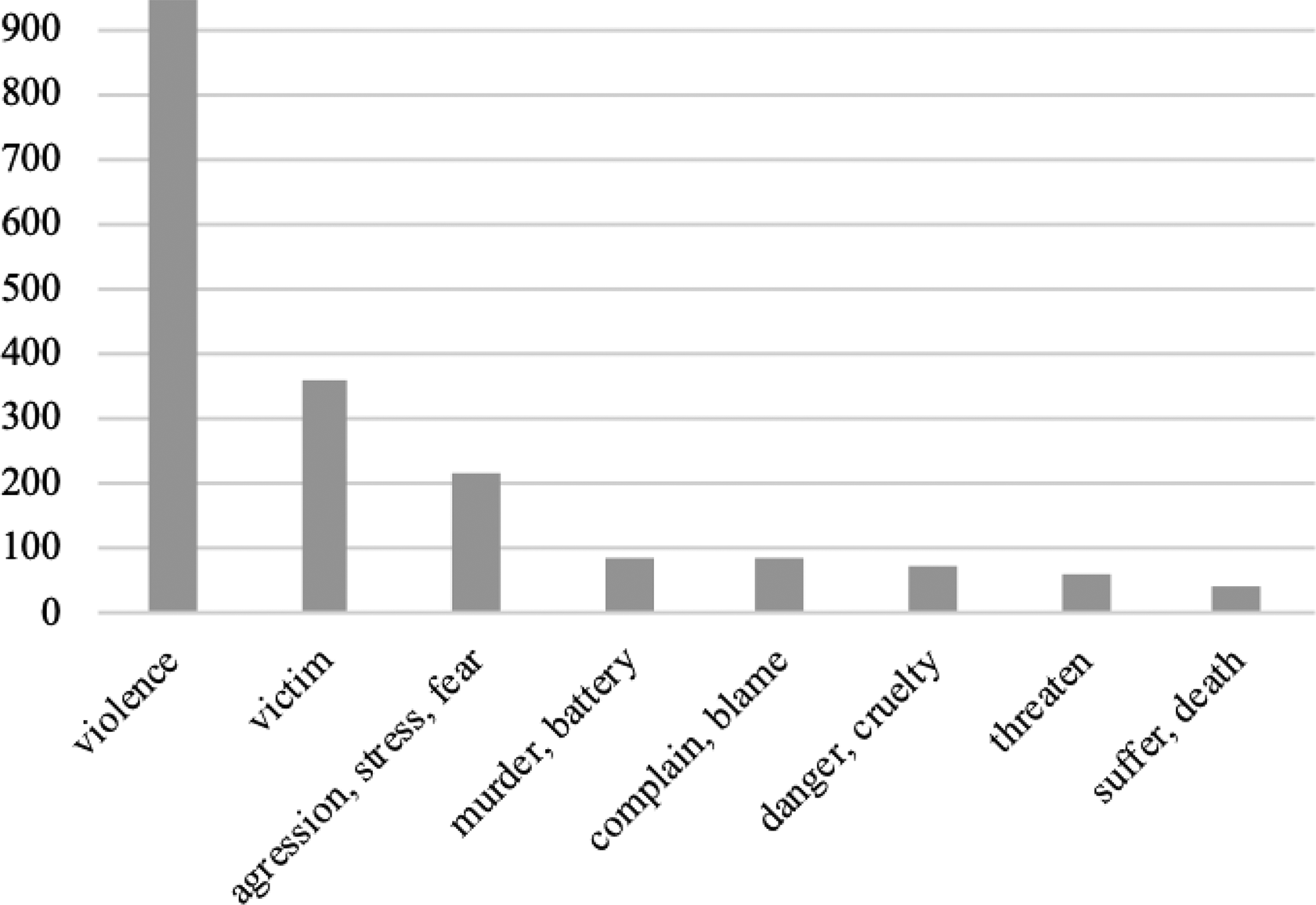
Lexemes indicating types of violence in domestic violence/lockdown discourse.
The second phase of media reporting started in early April when the “regime of nonworking days” declared by Vladimir Putin was renewed for a month, and it became clear that these measures might last much longer. This phase can be characterized by the active engagement of human rights activists and volunteers who used media platforms to raise awareness not only among the general public but also among the government. We identified two new frames during this phase: authorities versus human rights activists and the general public and inactivity of the state.
Frame “Authorities Versus Human Rights Activists and the General Public”
The frame authorities versus human rights activists and the general public manifested the standoff of the law enforcement agencies, people in general, and the human rights activists. The media reports showed that the authorities controlled and decreed; people (including women and children) were dependent on the state, limited in their actions, and thus seemed socially deprived; the human rights activists appealed to take urgent measures against domestic violence. The entire police force was busy tracking down pensioners without QR codes in the capital or guarding borders “from Muscovites” in other regions. The media were highly critical of the police inertia: They did not react to the victims’ complaints, they did not properly document domestic violence cases and were not able to control the situation in general. Now, all policemen have been thrown into the fight against quarantine violations, so the police may just not come. If the police do come, it is not certain that the aggressor will be taken to the police station, probably they will talk to him and leave you alone with him. (“Kak obezopasit’ sebya,” 2020)
This period also saw growing dissatisfaction with the state on the part of human rights defenders. On April 2, 2020, Kommersant reported on the public appeal of nine Russian organizations working with victims of domestic violence, who asked the government and regional administration to take urgent measures to ensure protection and assistance to victims under lockdown. The media believed that the regime of self-isolation “has locked millions of families on the same territory in a 24/7 regime” and predicted an outburst of domestic violence in Russia, similar to that already recorded in China and several European countries (Mishina, 2020).
Interestingly, the correlation between law enforcement agencies and human rights groups’ activities differs. Overall, while human rights supporters were portrayed as active by media reports in 62% of cases, the police, on the contrary, were presented as inactive in 81% of cases, regardless of the outlet’s political leaning (Figure 5).
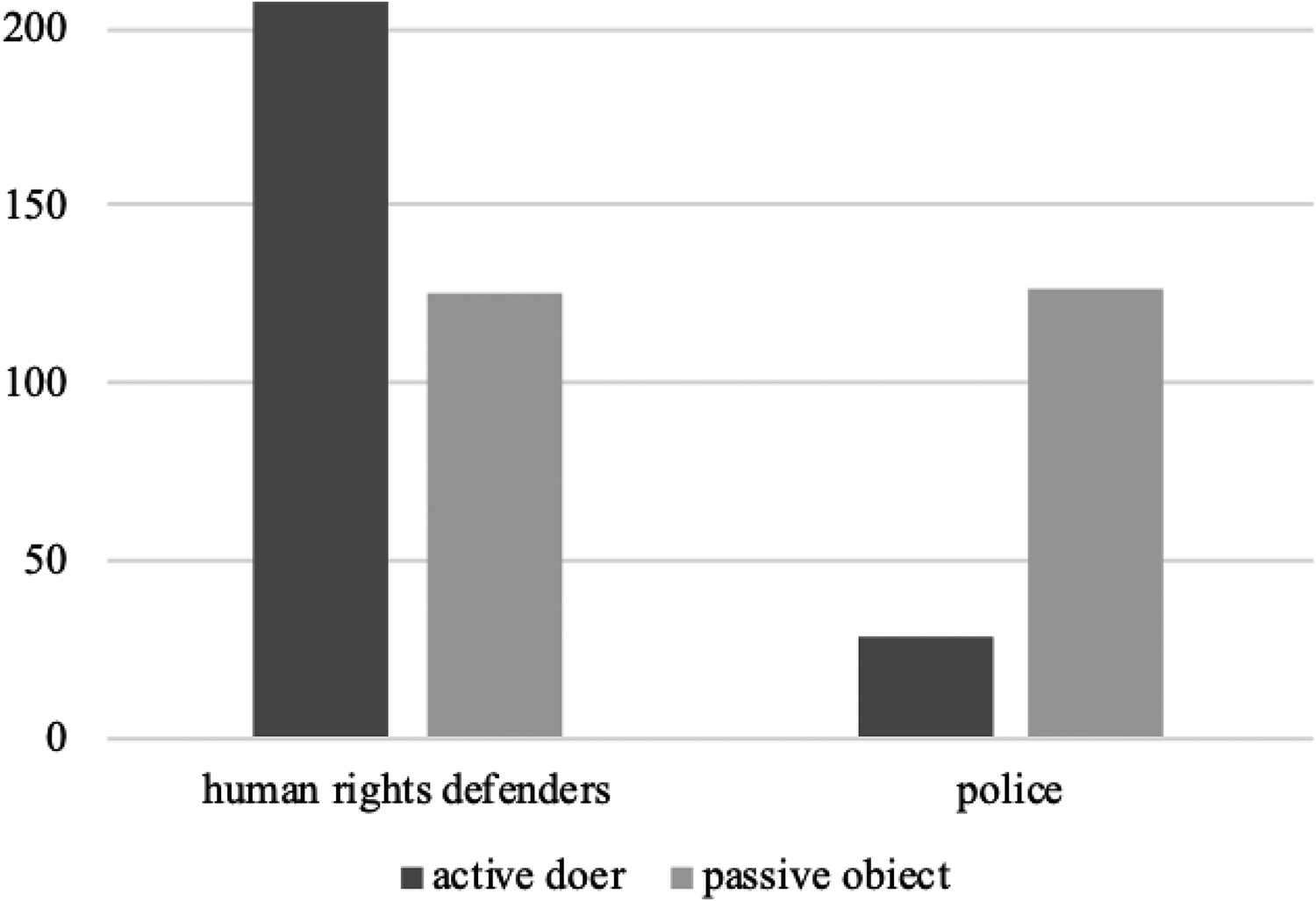
The functions of the subject/object of the terms “human rights defenders”/“the police.”
The frame authorities versus human rights activists and the general public brought the traditionalist versus liberal agenda into focus. An interesting point is that in the traditionalist narrative, there was also a link between domestic violence under COVID-19 restrictions and the draft law: For the traditionalists, the pandemic was an opportunity their opponents would not miss. Despite the fact that the pandemic put an end to preparatory works on the draft, traditionalist groups believed it was necessary to remain vigilant and not to let this law slip through. As IA Krasnaya Vesna declared, The law on domestic violence is not necessary…This, as well as the coronavirus epidemic, is only a visible part of the iceberg and the real goal is to reformat the world, to destroy social ties and human relations and, as a result, to radically transform the institutions of governance of society and transfer of power into other hands. (Karev, 2020)
A similar viewpoint that feminists acted maliciously using COVID-19 to their own interest was expressed by a religious activist, This feminist [MP Pushkina] decided to use the coronavirus epidemic to push through the so-called domestic violence law…She and her team…are ready to use the trouble to realize their dirty plans…But most of the crimes are committed outside the family. The family remains the safest place for children, women, for all people…At the same time, when crimes are committed against children not by family members (and there are a lot of such cases in orphanages and schools), they are not so interested. They need to present the family as a source of danger…lobbyists do not just lie, they…distort the real statistics. (Obukhov, 2020b)
Traditionalist media outlets also criticized both the authorities and human rights defenders. Digital tracking system, introduced in Moscow during COVID-19, was particularly targeted as an example of a “digital concentration camp. “In the same article, the author expressed a view that after the statistics on domestic violence was made public, All kinds of juvenile justice supporters, feminists, “children’s rights” defenders and other human rights defenders, such as Oksana Pushkina or Irina Rodnina, who squeal about the need to adopt a law on domestic violence as soon as possible, will be coming out of cracks again. Already, in parallel with the pandemic, false polls are being initiated, according to which the majority of “dear Russians” allegedly support the adoption of a law on domestic violence. (Soshenko, 2020)
Frame “Inactivity of the State”
The third frame inactivity of the state is supported by arguments both from the traditionalist-oriented and liberal media. Traditionalist-oriented publications blamed the authorities for not knowing how to communicate with people, they were seen as indecisive and ignorant, and this, in turn, emboldened human rights defenders and lesbian, gay, bisexual, transsexual (LGBT) activists who were ready to impose foreign laws against the sacred nature of the family. Liberal discourses, in their turn, contained criticism of the authorities who were reluctant to adopt the law on domestic violence and did not have a clear strategy on how to address the problem of domestic violence during the lockdown. They believed that self-isolation would not strengthen the family and that the authorities who believed it would, lived in ivory towers, far removed from people’s real lives. The government, the President, and the State Duma were seen as inactive during the crisis, busy with other priorities like oil prices, coronavirus-related deaths, and the World War II commemoration parade. Thus, the state found itself at the center of a divisive political fault line: For the traditionalists, it did not act when foreign laws were imposed on it; and for the universalists, it did not act because it could not pass a law against domestic violence.
In late April–early May, some of the restrictions were gradually eased (though they remained in place in Moscow until June 9, and in some regions, even beyond that date), and a new phase of discussions began. This phase involved celebrities who came forward with their misogynistic views and blamed the victims for provoking the aggressors. There were also those who confessed of being victims themselves and expressed support of the feminist cause, or both, as was the case with a blogger Regina Todorenko, who after being stripped of her title “Woman of the Year” by Glamour magazine, changed camps and shot a documentary about domestic violence victims.
Conclusion
As this research shows, already in the early stage of the pandemic, the media actively involved experts in the discussion of domestic violence. Public debate centered on the question of whether or not the family was indeed a safe place, as vigorously promoted by the state, with such slogans as “better at home,” “stay at home,” and so on. Strict quarantine measures were scrutinized and criticized. The problem of domestic violence in the media was initially constructed through the presentation of home and family as a source of danger for victims of violence during the period of self-isolation. Practical work of human rights and feminist organizations in addressing domestic violence was presented in a favorable light if compared to the perceived inaction of the state that lacked a clear strategy on how to deal with the problem.
As can be seen from the above findings, the crisis reactivated the debate between traditionalist and liberal groups that began in 2019 over the measures necessary to combat domestic violence, as well as the role of the state faced with a looming social and economic catastrophe. While traditionalist groups remain fragmented in Russia, opposition to the draft law on domestic violence seemed to be a unifying factor that brought together these groups in the second half of 2019 and continued to consolidate them during the COVID-19 pandemic. The renewed debate on domestic violence draft law during COVID-19 between conservative and liberal forces showed dissatisfaction with the state’s family policy. At the same time, if feminists used the rhetoric of concern and offered practical advice to the victims, the conservative forces directed their efforts to discredit their activities and represent feminism and feminists in a negative light.
Implications of this study can be 2-fold: On the one hand, researchers should recognize that traditionalist discourses are likely to persist in the public domain attracting more and more supporters in different parts of the world in the conditions of “the end-times of the liberal world order,” characterized by nationalism and the resurgence of populist groups (Duncombe & Dunne, 2018, p. 25). Therefore, it is important to give them full consideration, taking into account specific settings they operate in and specific issues that enable them to mobilize. Secondly, on a practical note, COVID-19 pandemic revealed appalling circumstances of the victims during mandatory lockdowns, and this can be an additional argument for human rights activists and social workers who struggle to promote legislative and other measures meant to ensure support of the victims.
Footnotes
Declaration of Conflicting Interests
The author(s) declared no potential conflicts of interest with respect to the research, authorship, and/or publication of this article.
Funding
The author(s) received no financial support for the research, authorship, and/or publication of this article.
