




Abstract
This study examines university student attitudes concerning social justice and their perceptions of inequality. In this article, we explore how gender shapes students’ understanding of issues of inequality, sexism, racism, classism, and their inclinations to act against these issues. This research seeks to explore how gender shapes students’ understanding of social justice. Moreover, it seeks to answer the following questions: Are women or men more willing to engage in social justice actions? Are women or men more likely to recognize and perceive inequality? Lastly, are women or men more determined to do something to achieve social justice? Results show that women students are far more likely to identify inequality and engage in actions to achieve social justice.
Social justice is a core tenet of professional social work practice. It is directly stated in all international professional codes of ethics (Orme, 2002), as well as being mandated for social work education. Therefore, it is not surprising that social work students would express attitudes favorable toward social justice ideals. Since the majority of social work students identify as women (Schilling, Morrish, & Liu, 2008), there is likely a correlation between gender and social justice values. However, what is unknown is whether it is the social work education’s influence or the student’s gender that has the greater impact on her or his progressive views.
Globally, and specifically in the United States, male-dominated societies perpetuate an inequity in power, wealth, and influence resulting in the subordination of women and noncisgender men (Unterhalter, 2007; York, 2011). Patriarchal societies socialize children to adhere to traditional gender roles, so boys and girls are dressed differently, given gender-specific toys, taught different skills, and schooled in different roles (Martin, 1995; York, 2011). Children are more likely to imitate adults of the same sex, who often consciously or subconsciously behave in a manner that reinforces gender role expectations (Block, 1984). Throughout childhood and beyond, social interactions commonly consist of doing gender. In other words, men and women conform to their prescribed gender norms based on the socially constructed gender binary, feminine and masculine, that is typically associated with the sex they are assigned at birth. The gender binary is intimately tied to the reinforcement of patriarchy, and individuals participate in the regulation of these gendered norms through social interactions in and out of school (West & Zimmerman, 1989; York, 2011). In adolescence, boys and girls are socialized to adhere to traditional gender roles as they relate to division of labor within the home, vocation, and sexuality, differences that are conditioned by race, class, and ethnicity as well (York, 2011). Women are encouraged to be nurturers and supportive, which may lead them to be more willing to take action against inequality to help others. Since women commonly experience gendered discrimination at home and in public that is often combined with economic discrimination and possibly compounded by race, this, arguably, could lead women to be able to better recognize inequality and more likely to take action against it.
White men are hyperprivileged in society, and Cabrero (2012) found that, even though white men in college recognized inequality, they were apathetic toward taking action to end the differential treatment of women and minorities or unconsciously reinforced the oppression that they sought to end. Similarly, Robbins (2016) found that white women taking diversity courses could identify inequality, but some continued to participate in their white privilege in a way that did not manifest in social justice action. Cross-racial experiences and multicultural education are more likely to lead to selfless action to achieve equality, but there is the risk that it can cause students to exhibit microaggressions due to racial dissonance (Cabrero, 2012; Robbins, 2016). The literature shows that to effectively educate students about social justice and inspire meaningful action, a true understanding of the dynamics of privilege and power as it relates to gender, race, and socioeconomic status is critical (Cabrero, 2012; Robbins, 2016; York, 2011).
These circumstances beg for exploration of the role that gender plays in determining one’s attitudes toward issues of inequality and in engaging students in action for positive social change. Arguably, those who experience more inequity and inequality in their own lives may be more likely to hold more social justice–oriented beliefs and participate in activities aimed at advancing social justice. Although Stake and Rose (1994) found that women’s studies courses have greater impact on students than nonwomen’s studies courses in terms of creating understanding about gender discrimination, limited research addresses the influence of gender on social justice attitudes more broadly (Houston & Todd, 2013; Rubenstein, 2016; Todd, McConnell, & Suffrin, 2014). Therefore, this research seeks to explore how gender is related to students’ understanding of social justice by collecting information from undergraduate students in majors in the liberal arts to determine their attitudes concerning social justice in general as it relates to inequality, sexism, racism, and classism in particular as well as their inclinations to take action against these issues. The research seeks to answer the following questions: Are women or men more likely to recognize and perceive inequality? Are women or men more determined that change is necessary to achieve social justice? Lastly, are women or men generally more willing to engage in social justice actions?
Defining Social Justice
One of the challenges involved in researching social justice entails the lack of a commonly agreed upon definition of social justice. Different definitions can create confusion, and the competing approaches that underlie these different definitions may prevent the achievement of social justice. Broadly, social justice advocacy can be conceptualized as actions taken to overturn the marginalization and oppression of those affected by society’s systemic inequalities (Vera & Speight, 2003). Most definitions focus on the equitable distribution of resources among groups with varying levels of power (Constantine, Hage, Kindaichi, & Bryant, 2017; Cook, 1990) or a more equitable distribution of bargaining powers to gain access to resources (Prilleltensky, 2001). Prilleltensky (2012) refines the definition further by positing that social justice is actually synonymous with distributive justice in that each person deserves their fair and equitable due.
Other definitions position communication and human interaction at the center by suggesting that access to decision-making or fostering positive attitudes toward subordinate groups are stronger factors in achieving social justice (Cook 1990; Toporek & Williams, 2006). These views essentially argue that rather than changing political and economic power structures, greater equality will be achieved when people better understand and engage with each other. Although Torres-Harding, Siers, and Olson (2012) view social justice as the belief that people should have access to resources and that structural barriers to power and other social inequities should be minimized, they also insist “participation, collaboration, and empowerment are all key components of social justice work” (p. 78). In this regard, social justice exists in “a world in which individuals are both self-determining (able to develop their full capacities) and interdependent (capable of interacting democratically with others)” (Bell, 2016, p. 3). In this study, we follow Bell’s definition because it represents a broad approach that includes both understanding about and action to alleviate social injustice. Bell’s (2016) definition of social justice, “involves the recognition of inequity, agreement that something should be done, and a willingness to engage in action to make a difference” (p. 1). With these dimensions, personal agency is also a key component of establishing social justice in this view, as individuals may exhibit concern for others at both the individual and societal levels. Successful social justice efforts also arguably involve activism. Moving beyond the mere recognition of injustice, social justice is argued to involve action against the nefarious effects of racism, sexism, elitism, classism, religious intolerance, homophobia, ageism, and other types of intolerance and imbalance (Fouad, Gerstein, & Toporek, 2006).
Recognition of inequality
Social inequality is pervasive throughout society in housing, employment, education, income, and political influence and appears to be increasing (Leicht, 2016). Public recognition of the problem is important because the problem cannot be addressed until one recognizes a problem exists. Persons who recognize inequality are more motivated to become engaged in action to address these issues (Cameron, 2001). However, not all members of society recognize that these inequalities exist or the extent to which they exist. For example, although income inequality has increased in recent years, the public’s perception of the problem has remained unchanged for more than three decades (Franko, 2017). Typically, those who are affected by inequality are more likely to recognize its existence. For example, women are more likely than men to recognize that gender inequality exists (S. N. Davis & Greenstein, 2009), and whites are less likely than blacks to recognize that racial discrimination and inequality exist (Hunt & Wilson, 2009). A study by the Pew Research Center (2016) found that those who are white were significantly less likely than blacks to believe that those who are black are treated unfairly in the workplace, in the courts, in situations involving the police, and in stores or restaurants.
This point suggests the importance of educating the public about inequality to create an understanding of its lived impact. For example, research shows that social justice beliefs are a precursor to believing that something must be done. One instrumental study on student attitudes toward educational attainment studied how abstract versus concrete attitudes impact behavior (Mickelson, 1990). Abstract attitudes, such as the ideological components involved in achieving the American Dream, differ from concrete attitudes, which reflect one’s lived racial, gender, and class experiences. Concrete attitudes “display neither adherence to ideological shibboleths nor hopes for the future. Instead, they essentially reflect material realities in which education may or may not lead to social mobility” (Mickelson, 1990, p. 46). In other words, concrete beliefs may lead members of some groups to believe, based on personal experience or observation, that inequities are real and insurmountable or that they do not exist at all.
Grayman and Godfrey (2013) found that some factors, including race, impact these beliefs. They found that black and Asian adolescents were more likely than white adolescents to support governmental financial support of citizens. They extend the earlier work of Mickelson (1990), examining abstract and concrete attitudes. Ultimately, they conclude that, “abstract social justice attitudes, like support for racial and gender equal opportunity, are social justice attitudes that express judgments about abstract principles without endorsing specific solutions to or representations of inequality” (p. 436). As a result, determining that something must be done relies upon a combination of abstract and concrete beliefs.
Determination that something must be done
Although recognizing inequality is a first step, achieving social justice requires a society that decides change is necessary. Persons must determine that inequality is unacceptable and that things need to be different. As a result, as reflected by this dimension, individuals need to develop a critical consciousness that causes them to determine approaches to alleviate injustice and the resolve to follow through with action. This step establishes empathy and/or a willingness to respond in a more urgent fashion than warranted by recognition of the problem. Artz (2017) recognizes this distinction when he notes recognition is an important but “insufficient” way to address injustice (p. 370). Referring to communication activism pedagogy, Artz argues “students must move away from symptoms to diagnose social causes, including discourses, structures, and social practices that normalize inequality” (p. 370). This step is important, of course, for the ability to create agents who can “confront the actual condition as of contemporary life” (Artz, 2017, p. 370). Del Gandio (2017) also supports this stance, when explaining that as important as it is to teach students to act, value also exists in helping students cognitively process what they see and how they might think strategically about social change. In short, Del Gandio argues that physically enacting change or participating in interventions suggests a “narrow” model for social change, as there are multiple ways to enact change without an “interventionist model” (p. 376). Donovan and Tracy (2017) concur when they acknowledge that activist pedagogies help students develop agency (and confidence) needed to solve problems by “moving people from merely knowing what can be done in a situation, to the act of doing what should be done” (p. 379).
Willingness to engage in action
Once a student has an awareness of inequality and has determined that change is necessary, the student may become willing to engage in social action to create change. Action may take several forms, from civic engagement, in which persons become involved in activities that improve communities (Rossi, Lenzi, Sharkey, Vieno, & Santinello, 2016), to a more activist or interventionist model (Frey, 1998; Frey & Carragee, 2007; Frey, Pearce, Pollock, Artz, & Murphy, 1996). Consequently, by this standard, social justice entails more than an understanding or the recognition something must change.
As Bell (2016) explains, social justice work requires “social actors who have a sense of their own agency as well as a sense of social responsibility toward others” (pp. 1–2). These social actors find action compulsory, and they see social justice as an unrealized aim until someone does something to mitigate inequality (Frey, 1998; Frey & Carragee, 2007; Frey et al., 1996; Vera & Speight, 2003). This stance is confirmed by Clark-Taylor (2017) in her case study and analysis of student–community engagement. Through a feminist lens, she determined that the experiences of activism deepened student understanding of power differentials and the lived experiences of those who are oppressed, and as a result, students committed to social action. Thus, a common goal of college diversity and social justice courses is to help students gain social action engagement skills (Adams, Bell, & Griffin, 2007), which prepares them for engaging in their communities to develop efforts to end social injustice. Frey and Palmer (2014) explain how this might work for communication educators, though of course, the strategy holds true for those in all academic disciplines. They explain that educators should teach students how to use disciplinary “knowledge and resources (e.g., theories, research methods, pedagogies, and other practices) to work with community members to intervene into and reconstruct” the injustices they see (Frey & Palmer, 2014, p. 8).
Social Justice and Education
Universities have had a long-standing, crucial role in advancing social justice initiatives. The Association of American Colleges and Universities (AACU, 2018) identifies one of its goals as advancing “equity across higher education in service to academic excellence and social justice” (p. 5). Consequently, AACU positions the work of social justice as a key concern of higher education, one on par with intellectual rigor and cognitive achievement. University and school experience can teach students both directly and indirectly to recognize inequality and to work toward social justice (Brinkman, Jedinak, Rosen, & Zimmerman, 2011; Stake & Rose, 1994; Vergara & Hartlep, 2015). Pascarella and Terenzini (2005) find that those who have a bachelor’s degree or beyond are up to 30% more likely to engage in community activism. Higher education, then, is more than providing knowledge; higher education provides opportunities to explore and alter the social conditions that permeate society. Education facilitates the exploration of unearned privilege and disadvantage and provides a way to deconstruct both by enhancing the understanding of powerful, socially constructed systems that contribute to social injustice. Indeed, many academic programs, particularly those in the liberal arts, include awareness of, and propensity to take action against, social injustice as a key learning outcome for their students. Some disciplines have made prominent moves in establishing social justice goals as central to their programs of study, or they have launched programs, courses, and activities that assist with advocacy-based approaches to social justice and actions that realize these advocacy positions. These approaches to education are consistent with critical pedagogy as outlined by Freire (1970, 1985), Giroux (1992), and Hooks (1994), among others. In particular, Prilleltensky (2001) proposes praxis connecting awareness and action. Intellectual curiosity should not be satisfied with confirmation that inequality exists but in pursuing remedies using an evidence-based approach as well.
Unfortunately, changes to promote social justice in higher education overall have often been slow to emerge. As Grumet (1995) observes, most educational reform is steeped in programs to improve subject-based curriculum and learning outcomes rather than developing people’s character and nurturing human relationships through pedagogical practice. Shields (2004), building on the work of Buber (1987) and Noddings (1986), suggests that relationships are the building block for learning as they provide the motivation for learning. Shields argues that by fostering strong relationships that can nurture moral dialogue, educators can challenge beliefs and practices that set criteria for social (in)justice. This moral dialogue is the process for challenging institutional practices, reshaping organizational structures, and guiding policy that permits social justice education.
In addition to these institutional challenges, personal circumstances effect a student’s understanding about social justice as well as power imbalances. Women and men may have different perceptions of social justice because of their social location and experiences with inequality. Todd, McConnell, and Suffrin (2014) studied social justice attitudes of students at a private, religious, Midwestern College and found that women were more interested in social justice and more willing to confront white privilege than men. Accordingly, women had more white privilege remorse than men. In another study conducted by Houston and Todd (2013), women were significantly more likely to participate in social justice action both inside and outside of the religious congregation. Rubenstein (2016) studied adolescents from a public high school in Toronto and found that girls were more aware of inequity and social disparity; they were more aware of sexism than boys and exhibited higher rates of empathy, which could be attributed to experiences with sexism. Boys became more aware of social justice issues with age, but their male privilege may have affected their perspectives, making it easier to justify disparities. These past studies do not identify the types of social action or methods to achieve social justice that may differ by gender, and both the Todd et al. (2014) and Houston and Todd (2013) studies took place in religious organizations (university and church).
Of course, other factors also influence attitudes about social justice. Students from privileged populations—those often isolated from the economic, gender, and racial imbalances inherent in social injustice—may resist such education even if they may benefit greatly by their exposure to the conditions of those more disadvantaged or oppressed (T. Davis & Nicolazzo, 2006; Singleton & Linton, 2006). Because they see themselves as unaffected, they may find issues of oppression easy to ignore (Singleton & Linton, 2006). This experience contrasts with that of women, people of color, or others who have faced disadvantage (Stromquist, 2006). However, for social justice education to garner the most impact, it must engage all participants in meaningful dialogue despite discomfort (Singleton & Linton 2006). As Grumet (1995) explains, “curriculum is never the text, or the topic, never the method or the syllabus…” but it is the “conversation that makes sense of things.…It is the process of making sense with a group of people of the systems that shape and organize the world we can think about together” (p. 115). To understand how student attitudes toward social justice develop, experiences both before and throughout the college years must be considered.
Furthermore, as Broido and Reason (2005) remind us, students enter college with various preexisting beliefs, positions, and experiences that influence how they feel about social justice. Francis and Skelton (2005) suggest that education at an early age can deconstruct gender and have an impact on how individuals understand gender and relationships. By broadening definitions of femininity and masculinity, children are less likely to see behavior as gendered, they argue. In addition, social justice scholars have argued that K–12 schools can also help students recognize, resist, and confront gendered prejudice (Brinkman, et al., 2011; Vergara & Hartlep, 2015). Grayman and Godfrey (2013) studied ninth-graders to evaluate the nature of existing social justice attitudes and found that gender played a role in determining social justice attitudes. Specifically, they found that girls were more likely to perceive gender and racial equality; however, they are less likely to observe educational inequities than boys. As Bottia, Giersch, Mickelson, Stearns, and Moller (2016) assert, understanding this precollege context is valuable in rethinking higher education’s role in social justice education.
Once students pursue higher education, they face additional experiences that can shape attitudes about social justice and gender inequity. Stake and Rose (1994) found that 44% of college students completing a women’s studies course had greater awareness of discrimination in daily life. They also show that women’s studies coursework that explicitly addresses ways to improve the lives of women and empower them to make change has greater impact on gender discrimination than nonwomen’s studies courses. They suggest that such learning sustained over an academic semester period does not end when the semester is over, but course content becomes a frame for continued understanding about gender, gender discrimination, and women’s lives.
Given the research on the influence of gender (Houston & Todd, 2013; Rubenstein, 2016; Todd et al., 2014) and education (Brinkman et al., 2011; Stake & Rose, 1994; Vergara & Hartlep, 2015) on social justice attitudes, this research seeks to explore how gender is related to students’ understanding of social justice. Moreover, it seeks to answer the following questions: Are women or men generally more willing to engage in social justice actions? Are women or men more likely to recognize and perceive inequality? Lastly, are women or men more determined to do something to achieve social justice? Based upon the literature regarding gender and social justice, the researchers hypothesized that persons identifying as women would be more likely to recognize and perceive inequality, do something to achieve social justice, and engage in social action than persons identifying as men. They also hypothesized that women would rate higher than men in their beliefs and actions regarding gender equality.
Method
In order to identify social justice attitudes among college students, data from this study were obtained using the survey method. The dimensions in Bell’s (2016) definition of social justice were used to develop 27 questions for three Social Justice Scales: Willingness to Engage in Action, Recognition of Inequality, and Determination That Something Must be Done (p. 1). Since few studies have quantitatively examined all three of these aspects of social justice, the survey questions were based on similar studies conducted by Moely, Mercer, Ilustre, Miron, and McFarland (2002) and Grayman and Godfrey (2013), but additional questions were used to tap all three dimensions of Bell’s definition. The scales included 27 statements regarding attitudes toward specific aspects of social, racial, and economic justice.
The first scale, Recognition of Inequality, uses items from Moely et al. (2002)’s Social Justice Attitudes Scale, such as “I don’t understand why some are poor when there are opportunities” and “Individuals are responsible for their own misfortunes.” Items representing each of the four areas of Grayman and Godfrey’s (2013) Social Justice Attitude Scale, which are “Perceptions of Inequality of Educational Opportunity,” “Government Responsibility for Individuals’ Economic Needs,” “Support for Racial Equal Opportunity,” and “Support for Gender Equal Opportunity” were also used. The items in this scale include the following statements: “Certain groups have fewer opportunities to get a good high school education,” “women should have the same chance to get a good job for the same pay as men do,” “the poor and elderly have the same access to health care as everyone else,” and “racial inequality is no longer an issue in the U.S.”
The second scale, Something Must Be Done, borrows items from Grayman and Godfrey’s (2013) Social Justice Attitude Scale area “Government Responsibility for Individuals’ Economic Needs.” They are “the government should reduce differences in income and wealth among people” and “the government should provide basic health care for everyone.” This scale also includes items from Moely et al.’s (2002) Social Justice Attitudes Scale such as “it is important that equal opportunity be available to all people.” The third scale, Willing to Take Action, includes items drawn from Moely et al.’s scale of civic action in regard to social justice.
The researchers conducted a factor analysis to confirm the internal validity of the items. Some adjustments were necessary to the scale groupings to insure they were measuring what was intended. In addition, 5 items were eliminated based on the factor analysis. Those items were too ambiguous and did not capture social justice. For example, two of the statements were regarding the person knowing politicians’ stances on social issues. Persons in favor and against social injustice may be equally knowledgeable of politicians’ views on the issues, so those items and other similar ones were removed. The researchers calculated Cronbach’s α scores for each of the newly grouped subscales. The first, Willingness to Take Action, included 7 items with a Cronbach’s α of .817. The second scale, Determination that Something Must Be Done, had an α of .702 and included 8 items. The third scale, Recognition of Inequality, had the lowest Cronbach’s α of .677 and included 7 items from the survey.
All items were rated based on level of agreement with the item with the highest score being 5.0. In order to create the scales, the data were transformed so that negative items were scored in reverse. Therefore, for all items, regardless of wording, a higher score represents a more progressive view on the issue.
Prior to data collection, the researchers gained approval from the university’s human subjects internal review board to survey students from a Midwestern university regarding their social justice attitudes. Survey instruments were distributed in introductory and capstone classes over the course of 2 years (2016–2017) in programs of study for Communication, Criminal Justice, Gender Studies, Psychology, Social Work, and Sociology, collecting data from 1,033 students. The researchers used a nonprobability sampling method of convenience, by selecting as participants those students who were enrolled in the targeted courses and were present in class on the day the surveys were distributed. The researchers contacted the professors that were teaching the introductory and capstone courses, seeking permission to distribute the surveys to their students during class time. The researcher implementing the survey read the informed consent form to the class of students prior to distributing them. Students were informed that their participation was voluntary and that they were not receiving any extra credit for participating. The faculty teaching the class stepped out of the room during administration of the instrument, so they would not know which students chose to participate. The students were told not to put any identifying information on the survey itself, so that the data would remain anonymous. The survey included demographic questions about gender, age, race, class standing, majors and minors, and parental education level. The data revealed that there were other majors represented within the sample because introductory courses in areas such as psychology and sociology are commonly required by other majors.
Results
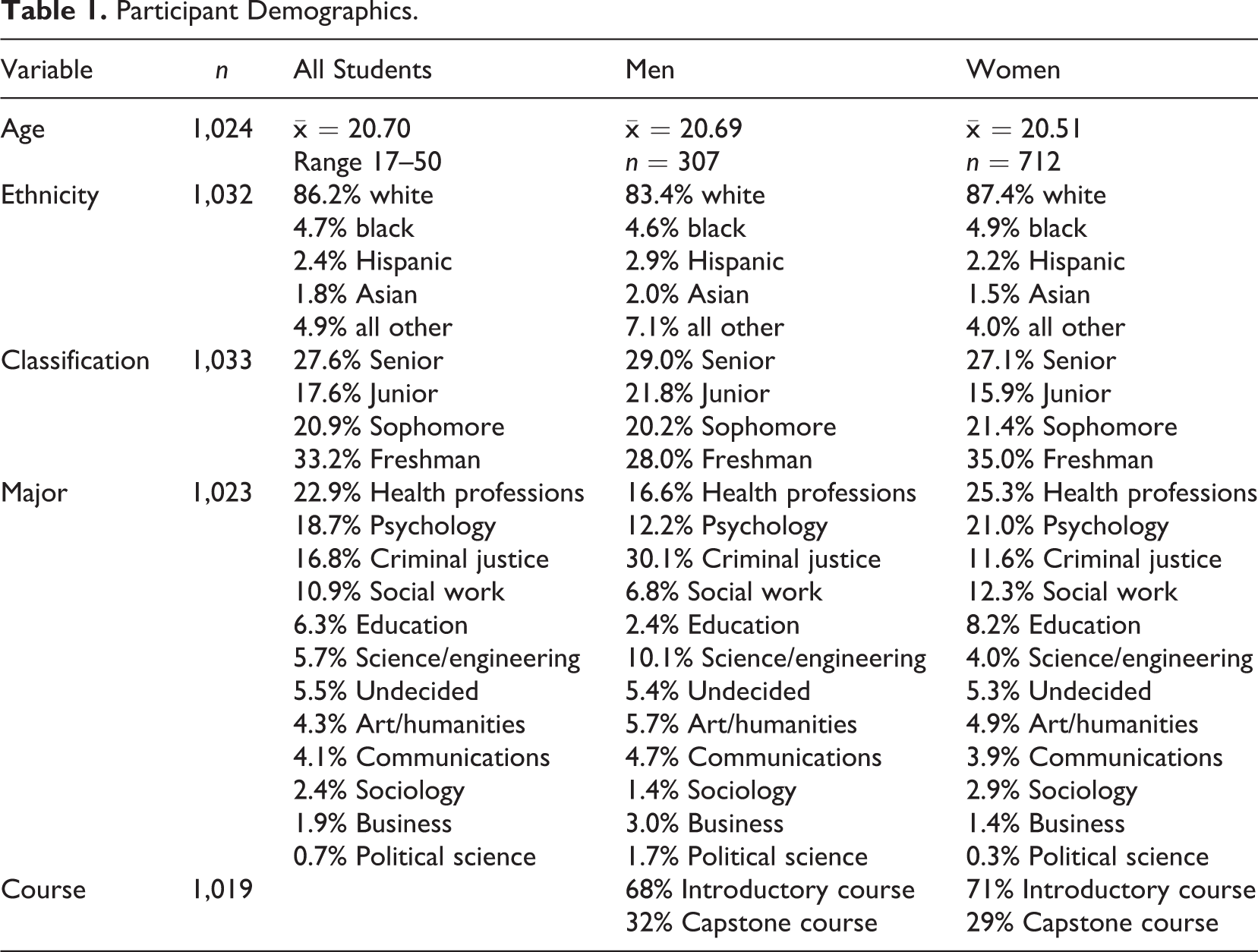
Data analysis procedures include descriptive statistics and mean comparisons between genders by combining the samples obtained from introductory and capstone courses. Demographic characteristics of the sample are reported in Table 1 and reveal that the sample had a mean age of 20.7 years old (SD = 3.25); age did not differ across gender, t(1,003) = −.800, p > .05. Women comprised over 70% of the respondents. Only five students indicated a nonbinary gender identity, so those cases were excluded from analysis due to generalizability concerns. The majority of students identified themselves as white (86.2%), with 4.7% indicating black, 2.4% Hispanic, and 1.8% Asian. The group of men was more ethnically diverse than the women, χ2 = 56.364, p < .000, but there were no significant differences between the ethnicities (F = 1.641, p > .05) on any of the scales. Although all four classification levels were represented, the largest groups of students were seniors and freshman. This outcome was expected since the classes surveyed were introductory and capstone courses; capstones courses are usually among the classes a student takes immediately prior to graduation. Sophomores were almost exclusively in the introductory courses, while juniors were largely in the capstone courses. Men and women did not differ significantly regarding the proportions of students in capstone or introductory courses, χ2(1,016) = 11.007, p > .05.
Participant Demographics.
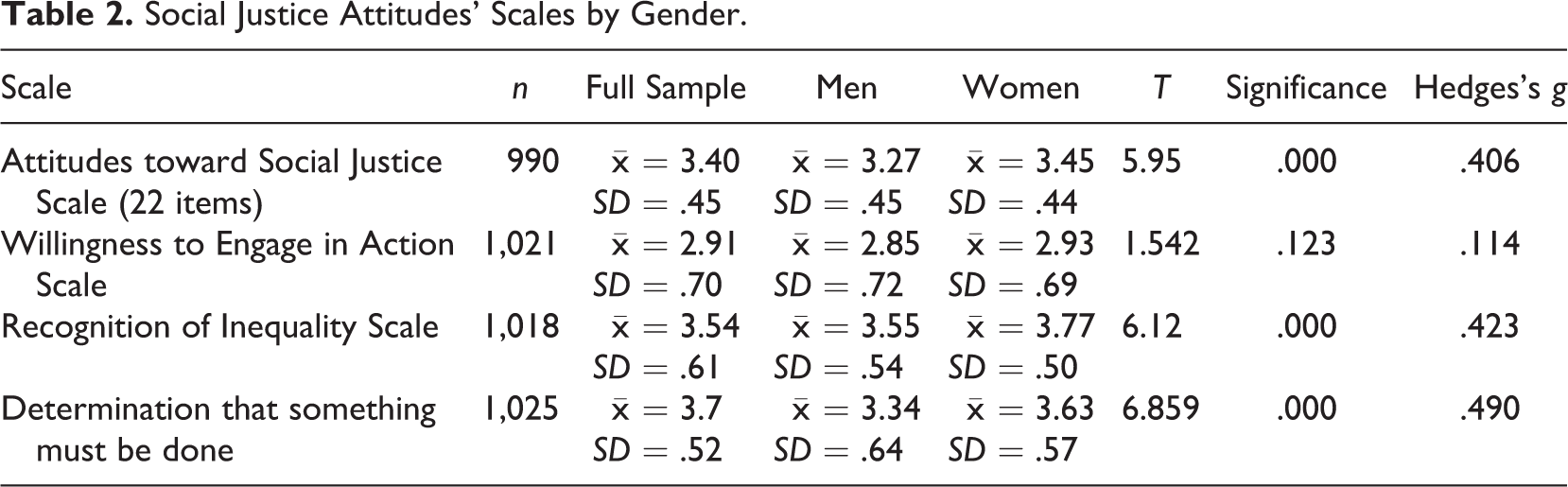
The sample reported statistically significant differences among men and women in their attitudes toward social justice issues and actions. The 22 scaled items were computed collectively and excluded any cases with missing data for any of the variables to form the Attitudes Toward Social Justice Scale. The average score for all was 3.40 out of a possible 5.0 (see Table 2). An independent t test based upon binary gender measured whether men and women differed overall in their attitudes toward social justice. Women reported statistically significant higher levels of social justice agreement with the statements within the scale, t(990) = 5.946, p < .000. Scores were also computed for each of the subscales, and independent t tests calculated any differences between the genders. Results for two subscales, Recognition of Inequality, t(1,018) = 6.138, p < .000, and Determination that Something Must Be Done, t(1,025) = 6.859, p < .000, showed statistical significance in the differences between men and women. Although the means differed on Willingness to Engage in Action, t(1,021) = 1.542, p > .05, the difference was not statistically significant. In addition to t tests, the researchers measured effect size between the groups using Hedges’s g. These results yield medium effects in all except the Willingness to Engage in Action (see Table 2).
Social Justice Attitudes’ Scales by Gender.
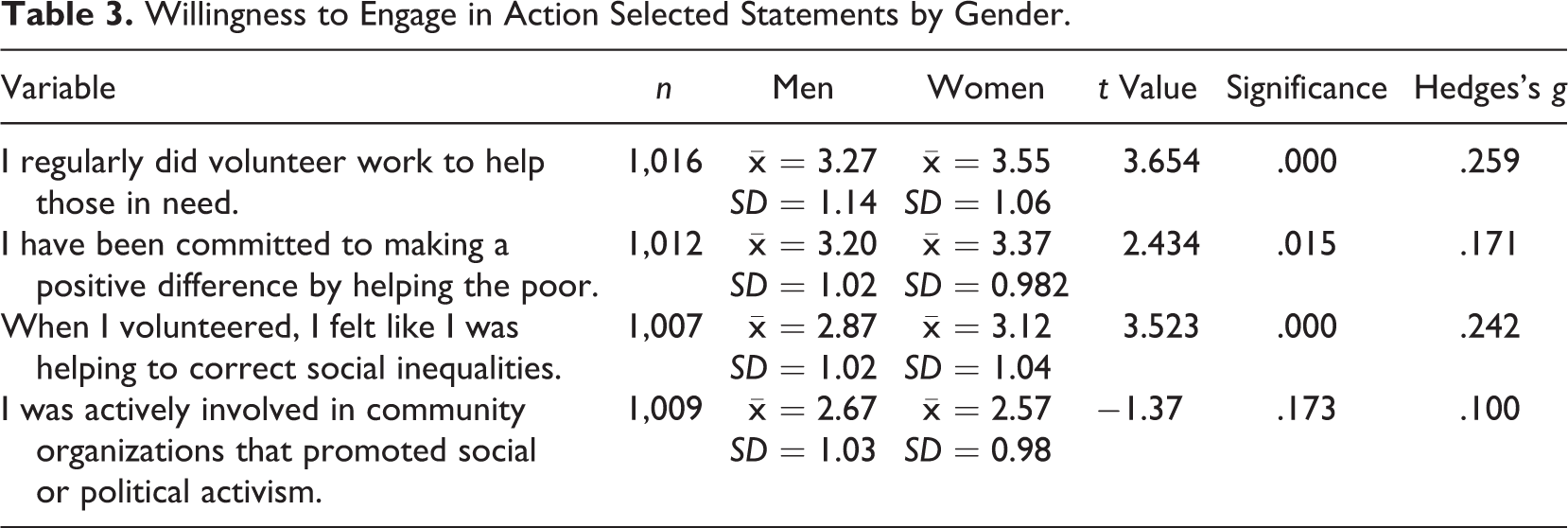
Some specific items from the Willingness to Engage in Action Scale demonstrated statistically significant differences utilizing independent t tests (see Table 3). Women indicated more volunteer work prior to college, t(1,016) = 3.654, p < .000, and a greater sense of responsibility to helping those in poverty, t(1,012) = 2.434, p < .05, and in volunteering to correct social inequalities, t(1,007) = 3.523, p < .000. Although not statistically significant, men scored slightly higher than women in their engagement with organizations that promote social or political activism (
Willingness to Engage in Action Selected Statements by Gender.
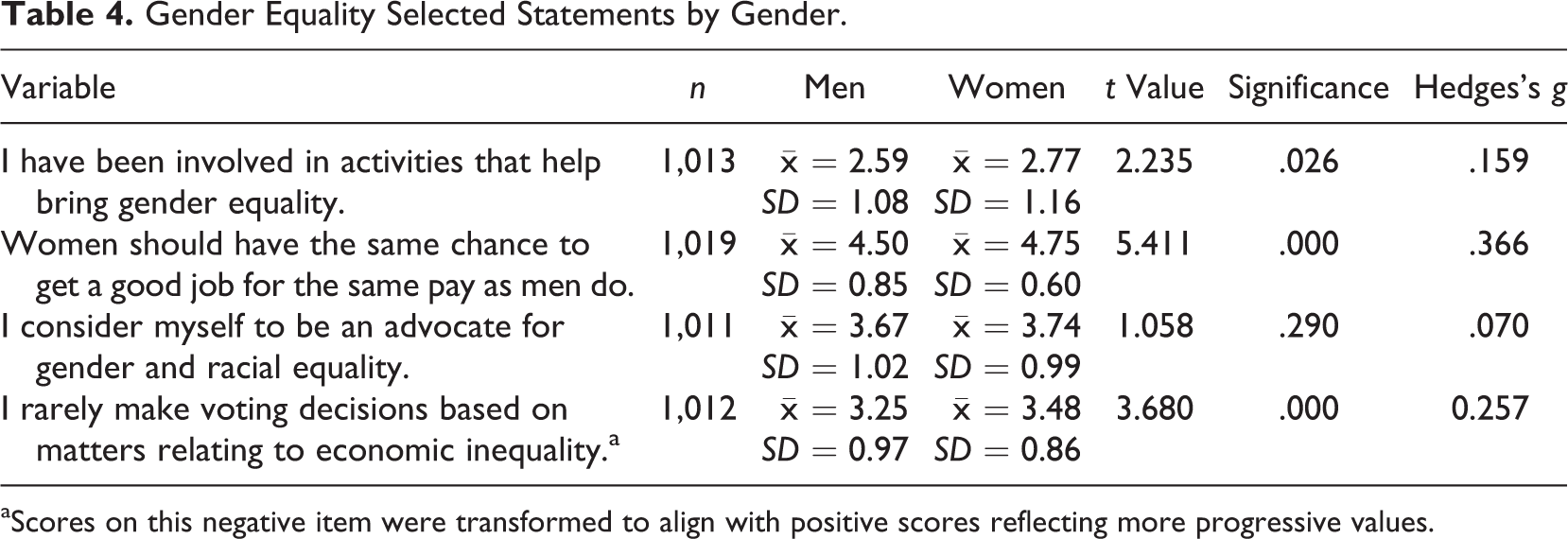
In terms of gender issues, Table 4 illustrates that women were more involved in activities to establish gender equality, t(1,015) = 2.235, p < .05, more strongly believed in equal pay and employment for women, t(1,019) = 5.411, p < .000, and were more likely to vote in favor of income equality, t(1,012) = 3.680, p < .000. Women were also more justice-oriented regarding issues of social class and race (see Table 3). One area in which men rated higher levels of agreement than women related to their knowledge of the positions of national politicians, t(1,016) = −3.575, p < .000. Effect sizes, as measured by Hedges’s g, were also small on these variables (see Table 4).
Gender Equality Selected Statements by Gender.
aScores on this negative item were transformed to align with positive scores reflecting more progressive values.
To further assess the impact gender has on the attitudes of social work students, the researchers compared the mean scores of men and women students in social work. In their overall Attitudes Toward Social Justice [t = 2.605, p < .01] and Recognition of Inequality [t = 3.483, p < .001], women scored significantly higher than men. The effect size was medium for Attitudes Toward Social Justice (Hedges’s g = .665) and large for Recognition of Inequality (g = .868). The effect size was small for the other two scales, and the t tests did not reveal significant differences.
Although there were not enough participants who identified as nonbinary to be included in the statistical analysis of the impact of gender on social justice attitudes, it is still important to represent their voices. There were five participants who did not identify as either women or men on the survey. Their average score on the overall Attitudes Toward Social Justice Scale was higher than for the other groups (
Discussion
This research sought to determine whether gender shapes students’ understanding of social justice. Our results suggest that women students in a broad range of liberal arts disciplines are more likely to recognize inequality and make the determination that something should be done about injustice. This finding is consistent with the literature on social justice attitudes and behaviors (Brinkman et al., 2011; Houston & Todd, 2013; Rubenstein, 2016; Stake & Rose, 1994; Todd et al., 2014; Vergara & Hartlep, 2015). The women in this study were more likely to say they understood why some people are poor and believe that the government should reduce differences in income and wealth among people. They also were more likely to think it was important that equal opportunity be available to all people and to believe certain groups have fewer opportunities to get a good high school education or to obtain access to health care. This counters the research of Cozzarelli, Wilkinson, and Tagler (2001) that found no gender differences in attitudes toward the poor and the factors that lead to poverty such as lack of health care, social welfare, and childcare.
In addition, the findings revealed that women students had participated in more volunteer work to help those in need prior to college (freshmen students) or while in college (capstone students), and they believed that it was their responsibility to improve their communities through activism. Women were also more involved in activities to advance gender equality prior to and during college, and they were more likely to vote in favor of income equality. This may be explained by Cabrero’s (2012) argument that even though white men, who are hyperprivileged, may recognize inequality, they are less likely to do something about it if it does not benefit them. Furthermore, women students indicated that women should have the same chance to get a good job for the same pay as men and that the government should provide basic health care for everyone. In some ways, these findings adhere to centuries-old (Western) biases about work and how it is gendered. For instance, women—largely responsible for housework, childcare—work in poorly paid jobs, while the role of men is viewed as the “breadwinner” for the family unit (Belknap, 2001; Lorber, 2001). The differences reflect a traditional tendency for women to do good works and volunteer, while the men do the real work of making money. Social justice–oriented positions and nonprofits often pay meager wages; therefore, such positions unfortunately are often not associated with real work. Presently, women disproportionately hold positions in less desirable and low paid employment with little to no benefit packages (York, 2011). Although women are undoubtedly in a better position today economically and legally, gender inequality remains prevalent in the United States (Walker, Spohn, & DeLone, 1996). For these reasons, it may seem unsurprising that women tend to express opinions more consistent with social justice sympathies and to act in furtherance of social justice principles.
However, the women in this study were not more likely to have engaged in actions to bring about change, overall. Since the majority of students in this study were white, their white privilege may have caused cultural or racial dissonance that inhibited social justice action (Cabrero, 2012; Robbins, 2016). An alternative explanation is tied to the literature reporting that women are less involved in politics (Mariani, Marshall, & Mathews-Schultz, 2015). Women in the United States have only had the right to vote for 98 years, and women leaders are grossly underrepresented in U.S. national political races and seats, although the 2018 election showed an increase in women running for political office. Since men have had the most access to and influence over American politics, it is not surprising that men in the study seemed to be more interested in their political representatives.
In applying these findings to the field of social work, it is important to recognize that students in other majors share the same values of social justice. Social workers are not alone in their views and should remain open to collaboration with persons in other fields and disciplines. Additionally, although social work students recognize inequality and believe that something should be done to address it, the results suggest they may carry the same reluctance as other liberal arts majors to engage in social action. The Council on Social Work Education requires that accredited programs achieve the nine competencies set in the Educational Policy and Accreditation Standards (EPAS). Competency 2 specifically dictates that students should “engage diversity and difference in practice.” Competencies 5 and 8 also dictate that students should be capable of engaging in policy practice and interventions with groups and communities. Therefore, it is not enough that social work students recognize inequality and believe that something should be done. They should also be learning how to engage in social action. This can be challenging since, as was noted in the literature, many women were raised within family structures that do not encourage action among girls (Martin, 1995; York, 2011). Educators should incorporate service-learning or other classroom activities that engage students in the social change process, which also involves multicultural (Cabrero, 2012) and multigendered experiences. Finally, social workers must be aware of how one’s gender may impact his or her recognition of inequality.
The researchers note several limitations to this study. First, the study utilized convenience sampling to obtain the participants. This nonprobability method does not ensure a representative sample from each major; however, the researchers took steps to control for that. An additional limitation is that the survey was originally intended to measure growth in attitudes between introductory and capstone courses within specific majors. Therefore, the findings cannot be generalized to all college students and are limited to just those majors targeted by the study. Furthermore, the population of students represents undergraduate students at a public university in the Midwest. Students at this university tend to represent the more conservative values of the community, which could be a factor in these findings. The limitations to this study should be addressed in future research. The authors are currently examining how the various academic disciplines (Communication, Criminal Justice, Gender Studies, Psychology, Social Work, and Sociology) frame social justice and develop coursework that encourages student understanding of social justice and the ways to mitigate social injustice. That multidisciplinary study includes examining the differences in social justice attitudes across the programs in this study. In addition, scholars should examine the relationship between social justice attitudes and social justice–related programs in order to determine whether social justice–oriented students choose social justice–related fields of study and what impact their time in those programs has in changing or enhancing their inclination toward social justice. The current study surveyed students in Communication, Criminal Justice, Gender Studies, Psychology, Social Work, and Sociology courses because of their focus on social justice issues, but a comparison with students in classes not typically associated with social justice could be insightful. Future research might also compare the results of students in social justice–oriented courses and nonsocial justice–related courses to see whether there are gendered differences in students’ ability to recognize and respond to inequality across a broader array of majors. This study combined all students in these social justice–related courses, but future research should compare the differences between freshman and seniors to better understand the influence a social justice–oriented major has on students’ social justice attitudes.
Footnotes
Declaration of Conflicting Interests
The author(s) declared no potential conflicts of interest with respect to the research, authorship, and/or publication of this article.
Funding
The author(s) received no financial support for the research, authorship, and/or publication of this article.
