




Abstract
Female faculty may experience disproportionate caregiving-type responsibilities in the academy and at home. A web-based survey inquired about the impact of childcare responsibilities on research-related travel. A convenience sample of full-time faculty participated (n = 127). From the overwhelmingly female faculty respondents (81.3%), results show that childcare issues impact their ability to plan research travel, submit to professional conferences, and travel to give an invited talk. Faculty rank, discipline, and whether their partner was employed at the same university negatively impacted their ability to travel. Work/life travel policies may reduce barriers to travel, hence reducing a type of cumulative disadvantage.
Introduction
The standard tenure-track career trajectory for faculty is characterized by uninterrupted, high research productivity. Faculty members are expected to engage in externally funded quality research projects that are presented nationally and internationally and published in top-ranked journals. This article examines how caregiving responsibilities impact female faculty’s ability to engage in research-related travel. Conference travel, particularly in the early phase of one’s academic career, is vitally important, as it provides peer feedback, visibility, networking opportunities, and social support (Mata, Latham, & Ransome, 2012; Thorlakson, 2009). Nonattendance at professional conferences and/or being restricted in terms of the time at conferences could also affect women’s abilities to identify potential external reviewers for their research portfolio or find research collaborators, ultimately restricting or affecting their publication rates, research funding, and even bid for promotion.
Research indicates that caregiving (even among social work faculty) remains the purview of women (Holley & Young, 2005) and childcare issues can affect a woman’s decision to serve as an invited speaker at a conference (Schroeder et al., 2013). Few studies have examined the link between faculty research travel and childcare responsibilities. Therefore, we rely on literature both within and beyond social work. Furthermore, this exploratory study seeks to describe barriers to travel for faculty caregivers across a single university. This current work addresses the questions “Do caregiving responsibilities limit faculty member’s ability to engage in research-related travel?” If so, “which types of research-related travel (e.g., attending a conference or accepting an invitation to give a talk) are most affected by childcare issues”? “Does academic discipline, sex, age of children, type of partner employment, contributions to overall household caregiving, and/or academic rank predict those most affected by childcare issues”? “What work-life policies might reduce some of the barriers to work-related travel”? This article explores these questions and how the inability to engage in work-related travel may contribute to the subtle and insidious penalties female faculty accumulate throughout their careers (Valian, 1998).
The Academy as a Microcosm of Society: Gendered Institutions
According to Stainback et al. (2010), organizations “are the primary site of the production and allocation of inequality in modern societies” (p. 226). Building on Acker’s classic 1990 work, our approach is grounded in organizational studies that explore the gendered nature of organizations and the degree to which gender shapes organizational life. Roos (2008) explains that gender inequity continues because “nonconscious gender biases get mapped onto organizational interactions and decision making, or historical legacies or policies” (p. 197).
Gendered Workers
An ideal scientist (and by implication an academic) is portrayed as “the dedicated intellectual, who lives and breathes academia, and is engaged in his [emphasis added] studies practically 24 hours a day” (Benschop & Brouns, 2003, p. 200). Female social work faculty describe the academic trajectory as following a “male model of adult development” (Young & Holley, 2005, p. 149) where childbearing is expected to be postponed until after tenure, and work obligations intrude on family time.
Many scholars link the gendered origins of academic life to ongoing gendered academic inequity (e.g., Krefting, 2003; Wolfinger, Mason, & Goulden, 2008). The overall consequence is that “women’s progress has been slow across professions because of the way gender affects assessment of merit” (Krefting, 2003, p. 262). Co-occurring gender discrimination has been reported with race (Bent-Goodley & Sarnoff, 2008), age (Carr et al., 2000), and sexual orientation (Woodford, Brennan, Gutierrez, & Luke, 2013). Yet, merit appears to be gender neutral. Thus, women and minorities accumulate disadvantage but are seen as lacking in individual merit.
Cumulative Disadvantage
Valian (1998) theorizes that women and other underrepresented groups experience small setbacks in their careers. Early career disadvantages can compound over time, resulting in important disparities in career advancement, compensation, and opportunities. Generally speaking, minor advantages experienced by men or disadvantages experienced by women may be difficult to identify without looking back over their complete employment history. Faculty, including social work faculty, even with the best intentions, may perpetrate cumulative disadvantage when they participate within and accept oppressive structures. Feminist social work scholars offer two frameworks—critical reflection and intersectionality—as tools to recognize cumulative disadvantage before there is an opportunity for the setbacks to accumulate. Mattsson (2014) suggests that intersectionality may help focus critical reflection on the multiple and often contradictory identities women hold and to uncover and confront oppressive power relations.
Gendered Consequences
Attaining a tenure-track position is significantly less likely for married women and women with children under 6 years old compared to their male counterparts (Wolfinger et al., 2008). For social work faculty, this may be explained by Holley and Young’s (2005) finding that men were significantly more likely than women to seek tenure-track positions upon completion of a PhD. Women completing a PhD in science, technology, engineering, and math (STEM) fields are significantly more likely to become contingent faculty—adjuncts, lecturers, or instructors (Wolfinger, Mason, & Goulden, 2009). These positions provide lower compensation, limited job security, and fewer options for career advancement.
Traditional gender roles dictate that women support their partner’s career, even at the expense of their own. These expectations can also make it difficult for women to consistently prioritize their research needs over the needs of their families (Sallee & Pascale, 2012). Professional women may temporarily exit the workforce, downsize their careers, or attempt entrepreneurship (Alkadry & Tower, 2014). These temporary exits can end academic careers.
Similar to women in other parts of the labor force, female faculty experience disproportionately more career and personal penalties than their male colleagues. Gender plays a role in the type of work that women conduct in the academy as well as how it is devalued, invisible, or unrewarded. Studies show that female faculty tend to spend more of their time engaged in teaching and service related activities versus research than their male counterparts do (Barrett & Barrett, 2011; Misra, Hickes, Holmes, & Agiomavritis, 2011). Female faculty provide a disproportionate amount of “institutional housekeeping” (Bird, Litt, & Wang, 2004) for their institutions. While this work is critical to the functioning of a unit (e.g., searches, admissions, or advising/mentoring students), institutional housekeeping activities are less likely to be significantly rewarded by the promotion system. Critical reflection reminds us to ensure the promotion system values institutional housekeeping, and we advocate that it be equitably distributed.
Female social work faculty, compared to their male counterparts, are more likely to work at “less prestigious” universities and in “less prestigious” positions. For example, female social work faculty are less likely employed at Carnegie “Research University—Very High” universities, larger universities, and schools of social work with a PhD program (Sakamoto, Anastas, McPhail, & Colarossi, 2008). More prestigious universities tend to have more generous travel support, salaries, or both. Female social work faculty are less likely to be Deans and Directors but more likely to be Chairs (Patrick & Colby, 2011). Higher level administrators tend to have more control of budgets that may be allocated to travel. The gendered division of labor in the academy is a reflection of societal norms.
Travel, fieldwork, and conferences are experienced as more stressful by female faculty with children, compared to male faculty with children (Mason & Goulden, 2004). After all, female faculty are more likely than male faculty to have an employed spouse (and they are more likely to be academic spouses). Thus, female faculty must negotiate research travel with another employed adult who also engages in work-related travel. In addition, women spend more time caregiving—children or other family members—compared to their male counterparts (Holley & Young, 2005). Educated women are more likely than women with lower education to initiate and sustain breastfeeding (Li, Darlin, Maurice, Barker, & Grummer-Strawn, 2005).
Method
Sampling and Participants
A nonrandom sample of full-time faculty and staff at a large land-grant institution located in the Mid-Atlantic Region of the United States participated in the survey. The university, we will refer to it as Appalachian Mountains University (AMU), is classified by the Carnegie Foundation as a research-high university. It aspires to attain the higher Carnegie research ranking by 2020, so there is a strong emphasis on increasing faculty research productivity. There are approximately 29,000 students and 1,700 full-time faculty members. Although the institution has a variety of progressive work/life policies in place for faculty (e.g., paid parental leave, extension of the tenure clock, and paid leave for eldercare issues/personal health issues), there were no family travel resources at the time of this study.
Invitations to the survey were circulated through various university-wide Listservs. The electronic survey was administered using an online data collection platform. It is clear from the responses that only respondents who currently have or have had childcare and/or eldercare concerns completed the survey. A total of 238 respondents completed the survey, including 127 1 faculty and 111 staff. The analyses are restricted to faculty respondents only.
Instrumentation
A brief childcare/eldercare needs survey was developed to understand childcare and eldercare responsibilities and its potential impact on work-related travel. The instrument was piloted (n = 15). Minor modifications were made based on the pilot data (e.g., items were revised for clarity). The final questionnaire consisted of demographic variables (e.g., sex and children’s age[s]) and professional items (e.g., rank and discipline). Because the university is overwhelming white, non-Latino, we did not ask respondents to identify their race and/or ethnicity. This was done to protect the anonymity of faculty of color.
Dependent variables
The dependent variables included are as follow: (a) research travel measures whether or not a faculty member was unable to plan/attend research-related travel due to a childcare issue, (b) conference submission measures whether or not a childcare issues affected a submission to a conference, and (c) speaking invitation measures whether or not a faculty member turned down an invitation to give a talk because of a childcare issue.
Independent variables
A number of variables were used to identify variations in the impact of childcare issues on research travel. Participants were asked to identify their sex and academic discipline. The academic discipline variable originally included 10 potential responses but was recoded into a dichotomous variable: STEM faculty and arts/humanities/social sciences faculty. The academic rank variable was recoded, so that the impact of childcare issues for untenured faculty (lecturers and assistant professors) could be compared with faculty at higher ranks (Promoted faculty).
Control variables
One control variable (partner employed) measures whether or not the respondent’s partner was employed at the same university. 2 In addition, we used a variable (equal caregiver) that measures the caregiving contribution to the household: at least 50% of caregiving in their household. 3 We also used the research travel dependent variable as a control variable for the conference submission and speaking invitation models. Including these variables allows the assessment of long-term career impacts of early childcare decisions and to empirically measure cumulative disadvantage.
Data Analysis and Results
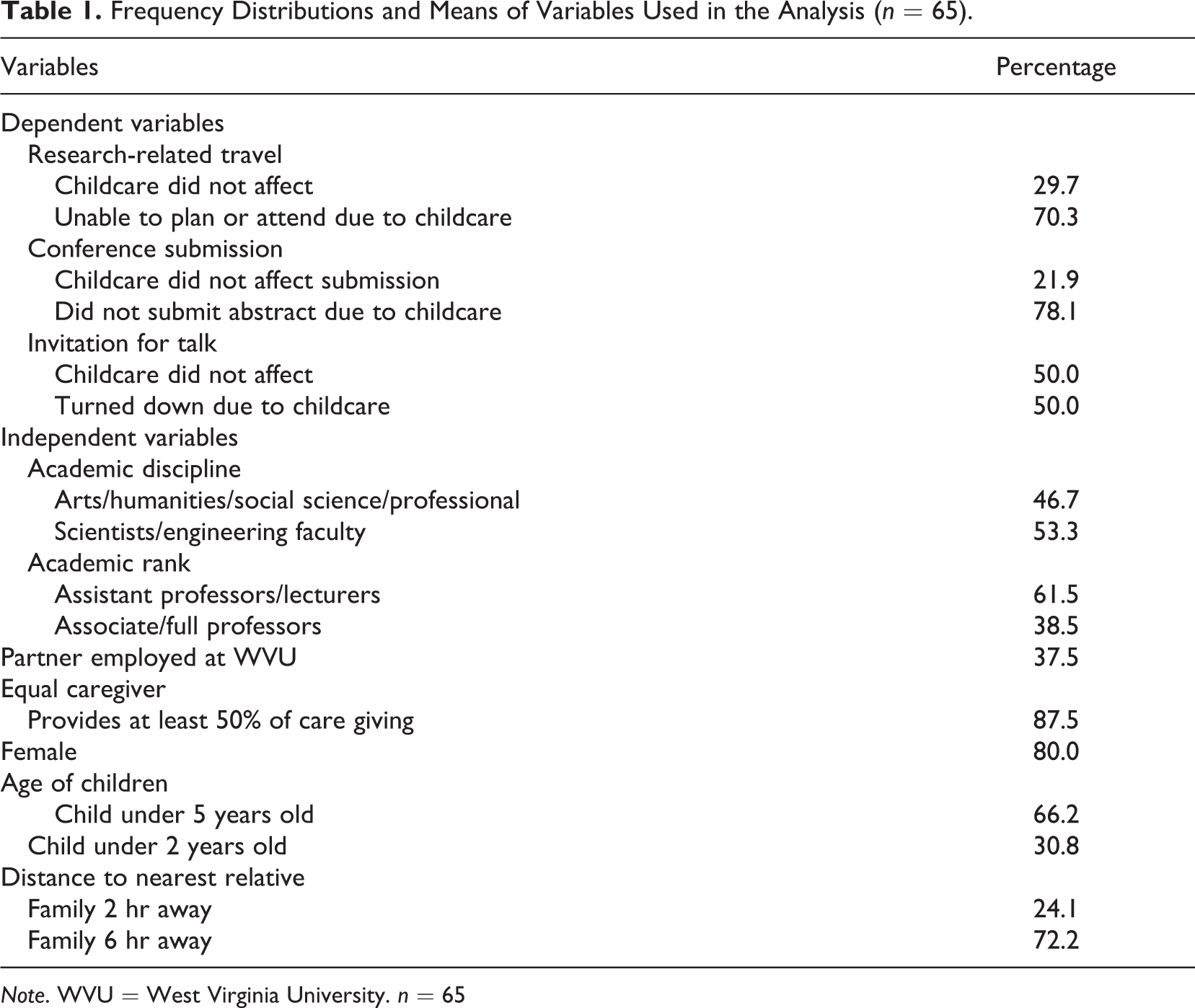
A total of 127 faculty members completed the survey. Ninety-three (74.4%) of these faculty members indicated that they have a child(ren) and thus represent faculty who could potentially be affected by childcare issues. As Table 1 indicates, at least half of the faculty with children reported that they were unable to plan or attend research-related travel due to childcare issues, they did not submit to a conference due to childcare issues, and/or they turned down an invitation to give a talk due to childcare issues.
Frequency Distributions and Means of Variables Used in the Analysis (n = 65).
Note. WVU = West Virginia University. n = 65
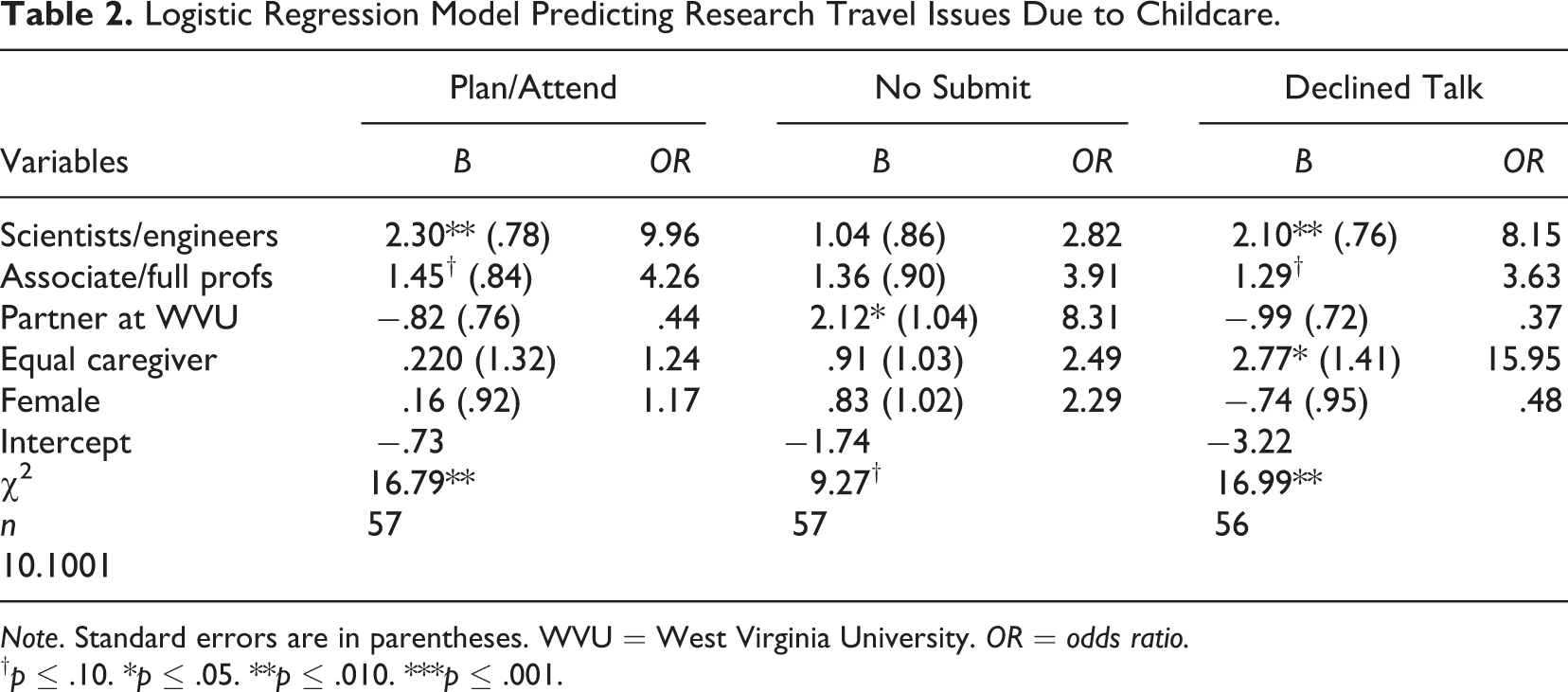
Logistic regression was used to conduct the analyses. The results from the three logistic regression analyses may be found in Table 2. The results demonstrate that not all faculty who have childcare issues were equally likely to be affected, and when affected, not in the same ways. For example, academic rank affects the odds of faculty indicating that childcare issues had affected their ability to plan/attend research-related travel. Specifically, associate and full professors were 4.26 times more likely than assistant professors to indicate that childcare issues had affected their ability to plan and/or attend research-related travel. In addition, STEM faculty were 9.96 times more likely than arts, humanities, social science, and professional faculty to indicate that childcare issues had affected their research-related travel. No other variables were significant.
Logistic Regression Model Predicting Research Travel Issues Due to Childcare.
Note. Standard errors are in parentheses. WVU = West Virginia University. OR = odds ratio.
† p ≤ .10. *p ≤ .05. **p ≤ .010. ***p ≤ .001.
The results from the conference submission model indicate that faculty with a partner employed at AMU were 8.31 times more likely than those without an AMU-employed partner to indicate that childcare issues had affected their ability to submit to a conference. No other variables were significant.
Three variables were significant in the speaking invitation model. Similar to the research travel model, both academic rank and discipline were significant predictors in terms of faculty indicating that they had turned down an invitation to give a talk due to childcare issues. Associate and full professors were 3.63 times more likely to have turned down a talk than their untenured colleagues. STEM faculty were 8.15 times more likely than their arts/humanities/social science faculty colleagues to have turned down a public lecture because of childcare issues. In addition, faculty who indicated that they provide at least 50% of the caregiving in their household were 15.95 times more likely than unequal childcare providers to turn down a talk due to childcare issues.
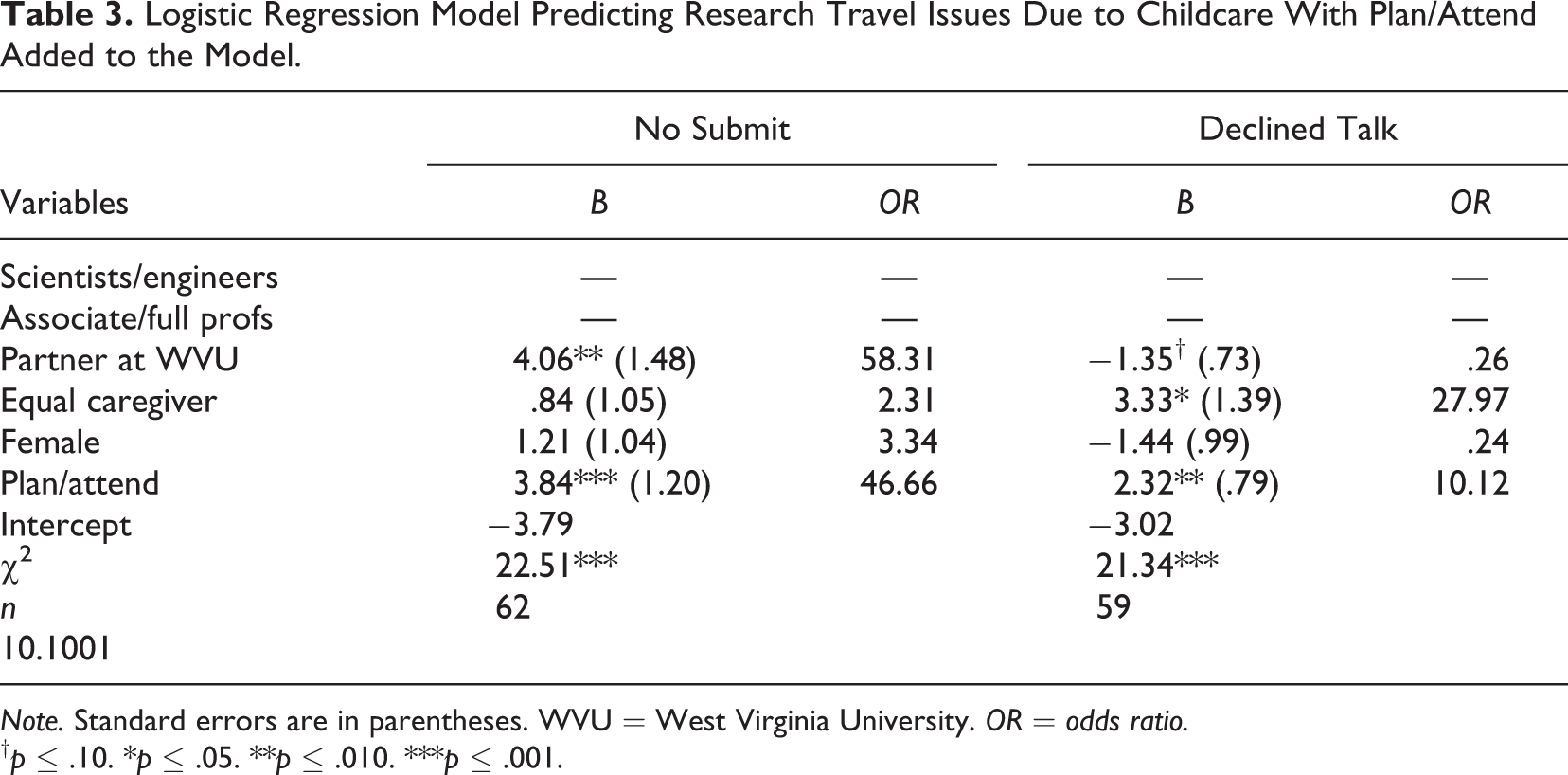
Removing the academic rank and discipline variables 4 and adding the research travel variable to the second and third models likewise yielded interesting results (Table 3). Compared with findings in the original Conference Submission model, having a partner employed at AMU significantly increased the odds of a faculty member not submitting to a conference due to childcare issues. In fact, faculty with a partner at AMU were 58.3 times more likely than those without an AMU-employed partner to indicate their research had been affected in this way. There also appear to be long-term career impacts of early childcare decisions. Faculty who indicated that childcare issues had affected their ability to plan and/or attend research-related travel were 46.6 times more likely than those without this childcare issue to indicate that they likewise had not submitted to a conference due to childcare issues.
Logistic Regression Model Predicting Research Travel Issues Due to Childcare With Plan/Attend Added to the Model.
Note. Standard errors are in parentheses. WVU = West Virginia University. OR = odds ratio.
† p ≤ .10. *p ≤ .05. **p ≤ .010. ***p ≤ .001.
For those who turned down an invitation to give a talk, equal caregiving remains a significant predictor with faculty providing at least 50% of the caregiving in their household, 27.97 times more likely than unequal childcare contributors to turn down a talk due to childcare issues. The long-term career impacts likewise appear in this model with faculty who indicated that childcare issues had affected their ability to plan and/or attend research-related travel 10.1 times more likely than those without this childcare issue to indicate that they likewise had turned down an invitation to give a talk because of childcare issues. In addition, having a partner at AMU becomes significant where faculty who have a partner employed at the same university are 3.86 times less likely than their colleagues whose partner is not employed by the same university to have turned down a talk due to childcare issues.
Discussion
Our results of an overwhelmingly female faculty sample indicate that childcare issues impact faculty members’ ability to plan and/or attend research-related travel, submit to professional conferences (involving travel), and travel to give invited talks. It is clear that faculty decisions around research are indeed impacted by childcare responsibilities. When the realities of childcare demands disproportionately affect faculty women, those women accumulate disadvantage. Without critical reflection and intersectionality frameworks, these women will be seen as simply lacking individual merit, thus the reasons for the disadvantage remain invisible. Because the intersection of early life cycle patterns with career expectations can impact research productivity, the timing and quality of institutional support for faculty are critical.
Conference travel, particularly in the early phase of one’s academic career, is extremely important, affording a host of benefits (Schroeder et al., 2013; Thorlakson, 2009). Professional conferences promote robust exchanges of ideas and questions by peers that may strengthen the work and spark new ideas. Conferences also promote personal connections and networks. Conferences and presentations can give scholars visibility and credibility because colleagues tend to use presentation quality to form their opinion about scholars (Thorlakson, 2009). Conferencing may offer respect and opportunity to speak with authority about disciplinary developments (Tomaszewski & McDonald, 2009). These interactions that take place at conferences likely have bearing on article citation.
The benefit of conference visibility is not limited to one’s career but also influences how knowledge is created. Sarigol, Pfitzner, Scholtes, Garas, and Schweitzer (2014) found citation rates could be predicted by social influence or bias, rather than solely on academic merit. If female faculty are not able to consistently travel to disseminate their work at international, national, or state conferences, faculty women’s voices are being stifled in the academy and in practice. Faculty, who have the financial and familial freedom to travel, garner priority and privilege in the realm of knowledge creation and dissemination.
When interpreting the data, it is important to remember that the sample is comprised of a self-selected sample of women and men similarly situated in terms of their childcare issues. Those who responded may have been motivated to participate because they had caregiving responsibilities and may have been interested in more support services. The finding that faculty members providing at least 50% of the childcare were 27.97 times more likely to turn down an invited talk due to childcare issues than those providing less childcare is interesting in that it implies that sex may be less important than one’s role in providing direct care for others. These findings are consistent with Sonnert and Holton’s (1995) early research that documented that the productivity of both male and female faculty with heavy parenting responsibilities was significantly affected when the parenting demands were the greatest.
Rank and discipline negatively impacted a faculty members’ ability to plan research-related travel as well as give a professional talk. We found that associate and full professors were more likely to have childcare issues related to planning travel and accepting an invited talk than those at lower rank. While at first glance this finding may seem counterintuitive, we concluded that faculty, who have been at AMU longer, have had more opportunity for a childcare issue to arise (e.g., more issues may arise in 2 vs. 7 years of service). As well, higher ranked faculty may be more likely than faculty at lower ranks to receive an invitation to give a talk.
Academic discipline also negatively impacted travel. We found STEM faculty’s research travel is consistently affected by childcare responsibilities. Grant, Kennelly, and Ward (2000) explain that the “organizational aspects of scientific careers make them especially problematic for women who want to marry and/or have children” (p. 65). Because of their low representation in the science disciplines, female faculty have high visibility and may “feel obligated to assimilate to the dominate culture of the discipline” (Sallee & Pascale, 2012, p. 136) by working long hours and delaying family formation. More research is needed to identify norms and practices that make a discipline more or less friendly to faculty with children.
Having a partner employed at the same university negatively impacted faculty members’ submitting to professional conferences but positively affected their decision to give an invited talk. One possible explanation is that academic partners understand that some aspects of research are more flexible than others (i.e., travel to conduct research can be rescheduled and there are a multitude of conferences to submit one’s work to vs. visiting another location to give an invited talk). Previous research by Schiebinger, Henderson, and Gilmartin (2008) may also shed light on this finding. Schiebinger et al. (2008) found that compared to couples with a nonacademic spouse or a stay-at-home partner, academic couples were the most likely to equally value their partner’s career but men placed their professional success over their partners, regardless of the type of couple.
Future research is needed to understand nuances in dual career academic couples. For example, does the capacity in which a member of a couple (e.g., another faculty member vs. staff role or rank) is employed at the same university make a difference? Regardless of whether the partner holds an academic appointment, working in a university setting helps him or her understand that opportunities for conference presentations in many disciplines are plentiful, therefore he or she may push for his or her partner to pass on the opportunity.
Another question for future research relates to how academic and nonacademic couples negotiate caregiving responsibilities and travel. How do these negotiations vary by the intersecting identities of each member of the couple (sex, race, class, and sexual orientation) and power relations each holds in their place of employment and society at large (e.g., academic rank)? Focus groups may reveal more on this complex topic.
It was surprising that distance of the nearest relative able to help was not significant in a faculty members’ ability to travel. It is the culture of the academy that most new scholars cannot attain a tenure-track position at the institution where she or he earned a doctoral degree. Future research might explore how relocation impacts couples with different ethnic backgrounds. AMU is located in a predominant rural state and most of the faculty do not have family located within a distance where they could assist daily with care of their grandchildren. Also, the parents of the younger faculty are at an age where they are still fully engaged in labor market employment and thus would need to take leave in order to provide childcare to their grandchildren.
The age of the children was not related to the ability of a faculty member to plan travel, submit to a conference, or decline an invitation to give a talk. This may be an artifact of the questions we asked. The questions asked the current age of the child, but the dependent variables asked if the participant “ever” experienced the phenomenon. Therefore, faculty may have declined an invitation when their child was 4 years old, but their child is currently 25 years old.
A number of limitations to this research need to be reiterated. First, this is a convenience sample at a single land grant, research-high university. The sample is relatively small and important demographic variables were not solicited, so it is not possible to determine the representativeness of the sample to the university community. Second, the questionnaire was not designed to reconstruct complete work and family histories and their intersections. While the ability to generalize the findings is limited, this is one of the first empirical articles on this topic.
Implications
According to Kossek et al. (2011), more and more workers bring “their family demands with them while they are on the job” (p. 306). Yet, little has been done to help academic parents, particularly women, more fully integrate their work and family life. Until academic workplaces become more supportive of work/family integration, a large percent of this workforce will also be struggling with work/family conflict, which “is associated with many health, well-being, and organizational outcomes” (Kossek et al., 2011, p. 306). Summarizing the link between stress and health outcomes in academia, Hendel and Horn (2008) found that stress affects productivity, job satisfaction and success, and retention. They conclude that optimizing faculty well-being will promote the overall well-being of the institution.
When ideal worker norms, gender, family formation, academic discipline, and rank intersect to shape career decisions, these intersections can ultimately affect career development and success, especially if there are no institutional policies and practices in place to help manage work and family choices. Changes in both policy and practice are needed to help faculty achieve both career success and family satisfaction, as the two are inextricably bound. Tower, Faul, Hamilton-Mason, Collins, and Gibson (2014) argue that social workers have the knowledge, values, and skills to advocate for work/life policies, and ought to do so. They further suggest applying for external dollars to garner institutional leverage. A number of internal and external policy changes can help support the ability to attend national conferences by reducing the barriers to travel.
Internal Change
Over the past decade, we have seen an increase in work/life policies in higher education, often beginning with elite institutions. Some work/life policies may not be as effective as proponents had hoped, because the academy often lacks a supportive culture that expects faculty to utilize these policies (Drago et al., 2005; Hendel & Horn, 2008). In a recent meta-analysis, Butts, Casper, and Yang (2013) report, “ … that there is utility in providing work-family support policies even when use is low, as availability was more strongly related to work attitudes than was use” (p. 13).
Institutional changes in work/life travel policies may reduce barriers to traveling for faculty with dependent caregiving responsibilities. Universities and other entities should offer funding to offset incremental caregiving costs, including childcare, care for adult dependents with special needs, and eldercare costs. Such programs should be flexible to accommodate a variety of caregiving needs and preferences, including the ability for family members to assist in caregiving. Anecdotally, there is concern that faculty may use professional travel as a way to fund a family vacation. We argue that travel grant policies that approve reasonable expenses on a case-by-case basis can be successful. For example, a female faculty member who is nursing an infant may feel more comfortable bringing her partner to a conference than bringing a paid caregiver. This arrangement also saves the expense of paid labor as well as additional hotel accommodations. Grants should be open to post-doctoral scholars as well as faculty at all ranks to allow for the broadest impact. Such policies should be a standard campus-wide benefit.
Barriers to institution policy change may emerge internally or externally. O’Connor (2015) comments on the difficulty that social work faculty may be experiencing in trying to sustain their social work and feminist values with the corporatization of the academy (e.g., reduction in faculty governance). Administrators may not be aware of the importance of a travel support policy that reimburses incremental caregiving expenses. Tower (2015) describes 10 strategies for successfully changing policies in institutions of higher education.
Another barrier may manifest at the state level. In some states, state-level policy may preclude the reimbursement of “personal” costs. Public universities should work with their state’s postsecondary education planning commission as well as state legislators to change state policy. Although we encourage faculty from all disciplines to affect change, social work faculty have the ethical imperative and expertise to affect policy change. Social work faculty may explore alternative funding mechanisms to support their work as change agents. We are confident that social work faculty are engaging in this type of work. Faculty from our sister disciplines and more broadly have been successful at this feat (e.g., Bird et al., 2004; Butts, Casper, & Yang, 2013; Sallee & Pascale, 2012; Valian, 1998). It is time for social work faculty to also transform this type of institutional housekeeping into a research agenda that will have the dual effect of supporting one’s career. For example, the Elsevier Foundation’s New Scholars Program awards start-up dollars for entities, typically universities, to begin programs that will support early and mid-career scientists to better balance family responsibilities. A few examples include, “enabling scientists to attend conferences, meetings, workshops, and symposia that are critical to the development of a career in science by helping with childcare and other family responsibilities when attending scientific gatherings” (Elsevier Foundation, n.d.). As another example, AMU has a giving circle with the goal of supporting women pursuing careers in STEM. Universities have professional fundraisers with the expertise to design such a program.
An approach utilized by National Science Foundation’s (NSF) ADVANCE institutions is to bring opportunities for research networks to faculty. Some have created a speaker series where outside lecturers are invited to the university, with the specific goal of networking with female faculty. Other institutions may replicate this, without funding, by purposely inviting role models when they consider candidates for lecture series. In doing so, it is essential to make time for junior faculty to meet with the esteemed scholar.
AMU’s ADVANCE Center has a unique sponsorship program. The program offers career development by pairing a faculty member with an external sponsor who is a leader in their field. As part of the project, the “sponsor” and the mentee (the “associate”) work on a project together. Sponsors may provide mentorship, feedback on ideas, training (grant writing, patenting, and specific skills), and facilitate collaborations in the associate’s field. Sponsors can be key in identifying potential external reviewers and facilitating research collaborations with other scholars.
External Change
External policy changes can help support the ability to attend national conferences by reducing the barriers to travel. The next two sections explore the role of grant funding entities and professional organizations that hold national or international conferences.
External Funding
The U.S. Department of Health and Human Services (DHHS) offers grants to support conferences relevant to its mission. Conferences seeking support from National Institutes of Health (NIH), for example, must “ … identify resources for childcare and other types of family care at the conference site to allow individuals with family responsibilities to attend” (U.S. Department of Health and Human Services, 2010). This will help underrepresented groups attend these conferences because they may better plan for their family responsibilities.
Grants awarded by the DHHS allow grantees to be reimbursed for childcare costs related to conference travel along with traditional travel expenditures (DHHS, 2011). More recently—December 2013—the Office of Management and Budget (OMB) guidelines clarify that incremental caregiving costs are allowable costs to NSF and NIH funded projects to the extent they are reasonable and consistent with written institution-wide policy. For faculty to be able to charge incremental caregiving costs directly to their grants or for reimbursement from one’s overhead account, universities may need to modify their internal policies.
While more guidance on how to do this is forthcoming, it appears that the Michigan Technological University has a faculty travel grant policy that not only reimburses traditional travel expenses, such as hotel and transportation costs, but also incremental dependent care costs. Such a policy normalizes incremental dependent care expenses. Normalizing dependent care costs will help to reduce stress and barriers to work-related travel for scholars with caregiving responsibilities. Moreover, it may remove an important type of early career disadvantage that accumulates and compounds over time (Valian, 1998).
Conferences
There are a number of academic conferences that provide free or subsidized childcare to attendees, unfortunately, social work conferences are not taking the lead on this. Conferences that offer on-site childcare tend to outsource childcare to KiddieCorp, who provides childcare at 175 meetings and events (Kiddie Corp, n.d.). While social work conferences tend to acknowledge childcare in their conference materials, conference hotel childcare offerings tend to be expensive. Social worker faculty must advocate for childcare and eldercare support at our national conferences.
In sum, work-related travel is a critical piece of developing a successful academic career. We found that caregiving responsibilities can be a significant impediment to travel, particularly for female faculty. Funding incremental caregiving costs may help reduce travel barriers. We challenge institutions of higher education to prioritize inclusive travel policies and fill policy and funding gaps to support talented scholars, regardless of gender.
Footnotes
Acknowledgment
Any opinions, findings, and conclusions or recommendations expressed in this material are those of the author(s) and do not necessarily reflect the views of the National Science Foundation.
Declaration of Conflicting Interests
The author(s) declared no potential conflicts of interest with respect to the research, authorship, and/or publication of this article.
Funding
The author(s) disclosed receipt of the following financial support for the research, authorship, and/or publication of this article: Partial support for this work was provided by the National Science Foundation’s ADVANCE IT Program under Award HRD-1007978.