




Abstract
We are at a critical time in determining the trajectory of the discipline of Women’s and Gender Studies (WGS). This article explores how WGS programs are marginalized within the academy, and alternately, by what means they have succeeded. We additionally take stock of predictions for the future of this highly dynamic discipline, drawn from the perspectives of those uniquely positioned to carve out these spaces and new territories—the directors of WGS programs. Data were gathered through a census of WGS programs at large 4-year institutions across the United States and Canada and supplemented by 24 in-depth follow-up interviews.
Keywords
If feminist studies are to remain vital…we have to recognize and resist defensive refusals to be moved out of entrenched positions, whether disciplinary or political…Where, when, under what conditions does the demand for excellence and visibility give way to an effort to interact and build the intellectual connections, with all their pleasures, that women’s studies once promised, and at times, has even delivered?/With these questions, we end this book, leaving readers…on the edge. This edge is defined as a place of indeterminacy, at once exciting and precarious. Exciting because to be on the edge is to be on the verge of discovering new possibilities for a field that may only seem to be exhausted and new ways to disrupt prevailing arrangements and relationships of power. Precarious because in the quest for an as-yet-unimagined future there are never any guarantees. (Scott, 2008, p. 13)
As Joan Wallach Scott (2008) points out, we are at a critical time in determining the trajectory of the discipline of Women’s and Gender Studies 1 (WGS). Despite its relative youth, and perhaps in part because of it, predictions for the future of the field have instigated much discussion (Aaron & Walby, 1991; Allen & Kitch, 1998; Baca Zinn, Cannon, Higginbotham, & Thornton, 1986; Bargad & Hyde, 1991; Boxer, 1982; Brown, 2008; Dölling & Hark, 2005; Hatton, 1994; Orr & Lichtenstein, 2004; Patai & Koertge, 1994; Reynolds, Shagle, & Venkataraman, 2007; Scott, 2008; Stimpson & Cobb, 1986; Zimmerman, 2005). The very role of WGS programs within the university is hotly debated. Kaplan and Grewal (2002, p. 67) write that within their own institution, and, “in many others, Women’s Studies is embattled, ridiculed, dismissed, and marginalized.” At the same time, Orr and Lichtenstien (2004) point out that there is much to be celebrated in Women’s Studies achievements, and lament the focus on the “declarations of Women’s Studies’ failures” (p. 1).
The Relevance of WGS to Social Work Practice
WGS courses provide the theoretical basis for feminist activism and often work hand-in-hand with women’s centers and social work programs on campuses to support awareness-raising events (i.e., on gender-based violence) and service-learning opportunities (e.g., internships in women’s shelters) for students wishing to engage directly with the community (Kasper, 2004). Social work and WGS are natural allies in the university system, drawing both faculty and students oriented toward social justice and service. Social work educators and students with feminist orientations benefit from the resources and collaboration with WGS faculty and students and thus will likely have interest in the trajectory of the field.
Before speculating about the future of WGS, one must understand the historical context of WGS as an academic discipline. Women’s Studies was born out of the grassroots activism and consciousness-raising groups of the Women’s Liberation Movement, with the first courses and programs being established in the late 1960s and early 1970s. Feminist activism on the parts of students and faculty led to the cobbling together of interdisciplinary courses to challenge traditional canons of knowledge that left out women’s voices (Howe, 2000). Funding was quite difficult to attain, but with great effort Women’s Studies slowly became institutionalized as a field, although little formal graduate school training existed (Hatton, 1994). As such, many WGS faculty today have formal training in another academic field, with a specialization in women or gender-focused work, including feminist social work educators (Kasper, 2004). As more WGS PhD programs appear, although, this is changing. The most pressing issues facing the field today appear to revolve around questions of how to harness its potential, respond to constraints (institutionally and internally), secure establishment without losing its revolutionary edge, and responding to what appear to be inevitable pressures of redefinition (Kasper, 2004). In light of these concerns, it is our intent to explore how WGS programs have been marginalized, and alternately, by what means they have succeeded. Perhaps most importantly, we seek to uncover the predictions for the future of this highly dynamic discipline.
Program directors are uniquely situated to play important roles in the process of influencing the future of WGS programs. This article explores what the future of the discipline looks like according to those who are currently positioned to carve out these spaces and new territories. Another purpose of this study is to explore the challenges that directors of WGS programs face in developing the types of programs they envision and the strategies they employ as they attempt to overcome the barriers they face. It is our hope that sharing the creative ways in which directors embrace potential barriers and overcome them will inspire other directors who face similar daunting situations, as well as alert potential allies and administration to the unique constraints faced by WGS programs. Our broad research questions can be summed up by the following: First, where do program directors believe the field is headed and where should the field be headed? second, what barriers and constraints complicate the process? and finally, what are the strategies for overcoming them?
Method and Data Analysis
Our study used a mixed-modes survey methodology, involving both online surveys with closed- and open-ended questions, as well as in-depth qualitative interviews with a subgroup of self-identified willing participants of the initial survey. By exploring knowledge relevant to women’s voices, and particularly WGS programs, that is often left unexplored by traditional academic disciplines, we engaged in a feminist approach to mixed methods research as outlined by Hesse-Biber (2014). We conducted a census, meaning that we solicited responses from directors of WGS programs from all large (over 10,000 students) 4-year and above universities in the United States and Canada (N = 158) through an invitation to complete an online survey. This population was generated with information from an online list of Women and Gender studies programs (http://userpages.umbc.edu/∼korenman/wmst/programs.html, last updated January 18, 2012) and official Carnegie classifications (http://classifications.carnegiefoundation.org, accessed January 12, 2012) for U.S. institutions, as well as information provided online for each potential Canadian respondent on official institutional websites. To be included in the sample, the institution also had to meet the criteria of offering some type of WGS program (at any level, including minors, bachelor’s, graduate certificate/minor, master’s, and PhD). This included directors of programs from 133 institutions across the United States and 25 Canadian institutions (see Table 1). Given that this is a relatively small population with data that will be largely descriptive in nature and because we patterned it after a similar study of WGS programs (see National Opinion Research Center Project 6433.01.62, 2007), a census (or attempt at a complete count of all programs) appeared most appropriate.
Response Rate.
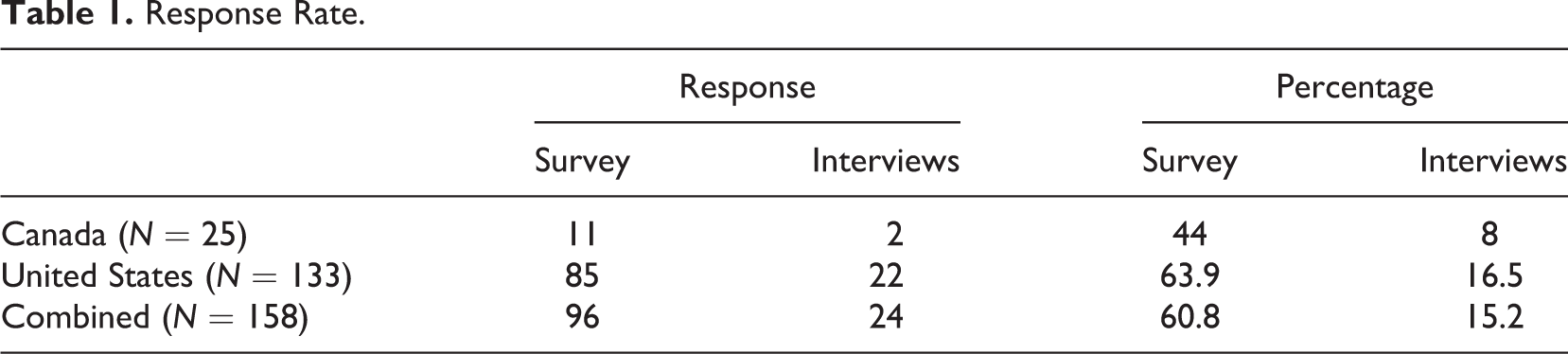
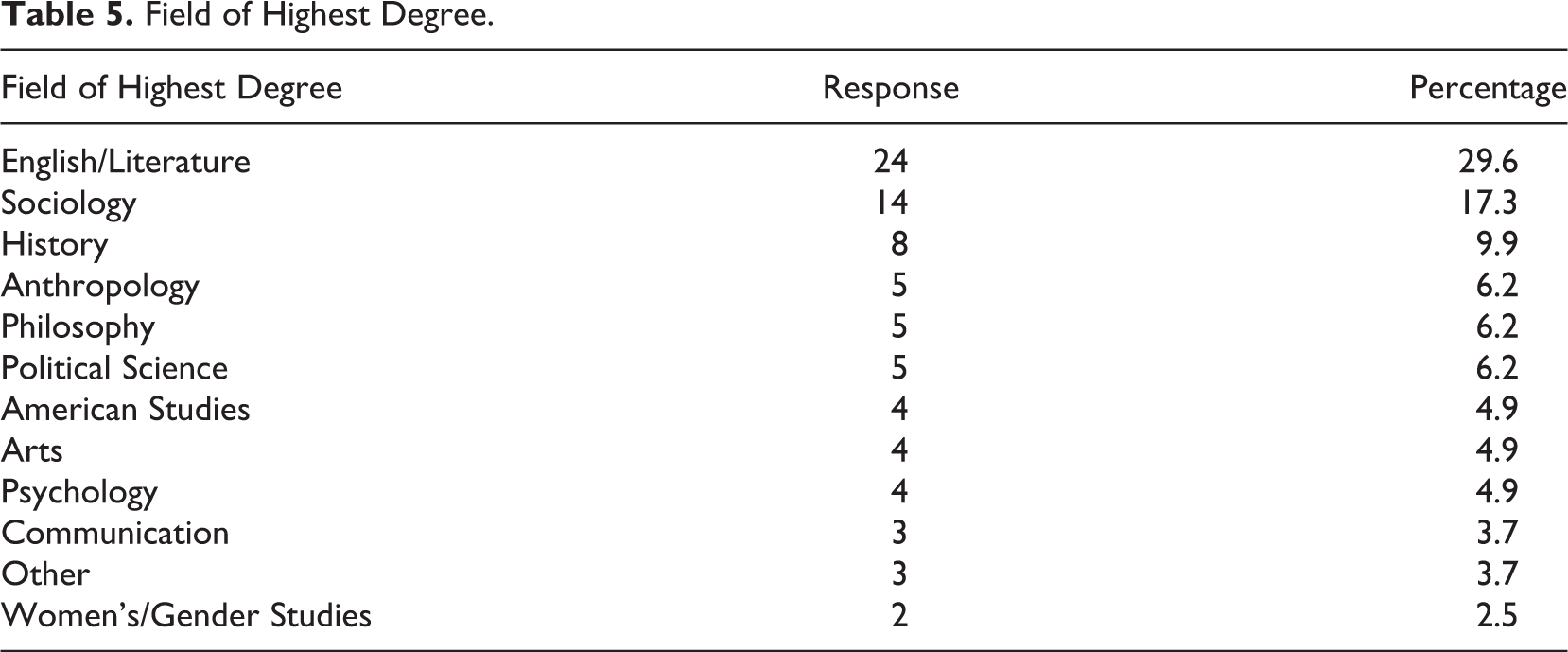
Each potential participant received a personalized e-mail request to participate in the survey, with a link to the survey powered through Survey Monkey and an attached Letter of Information. Patterned after Dillman, Smyth, and Christian’s (2008) Total Design Method, follow-up e-mails were sent to nonrespondents at weeks 1, 3, and 7 after initial e-mail requests had been made. Identifying information has been removed from all data in an effort to ensure the anonymity of respondents. Questions included in the survey consisted of basic demographics of the director, program specifics including enrollment, curriculum, departmental status, and so forth, as well as open-ended questions pertaining to difficulties experienced by programs and predictions for trends in the field. The surveys were used as a means for providing descriptive information of programs (as shown in Tables 2through 6). In addition, answers to open-ended questions were coded in the same manner as the transcripts from the in-depth follow-up interviews (see details in the following paragraph).
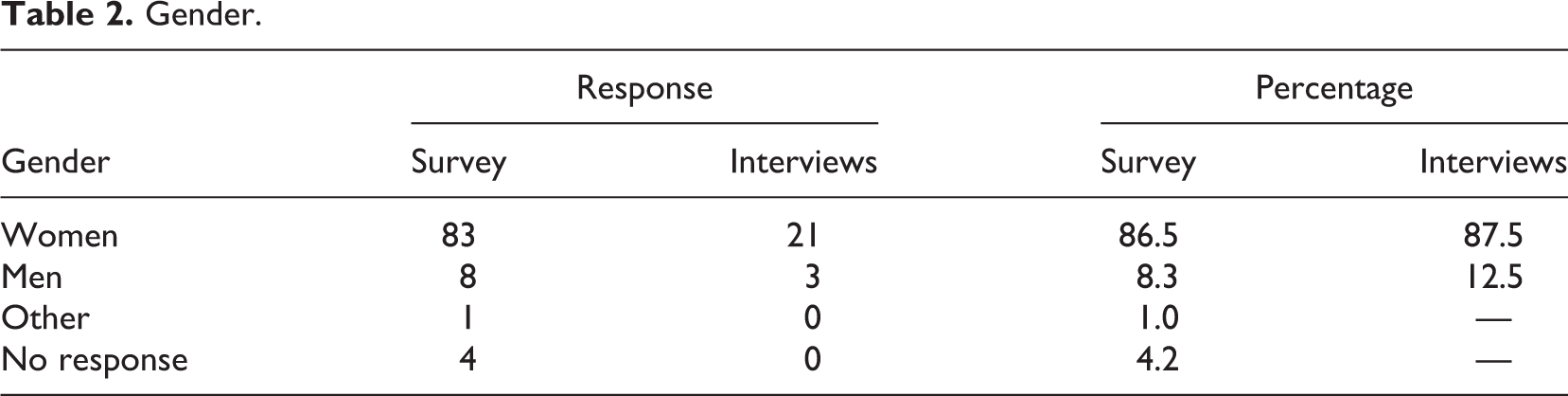
Gender.
Race.
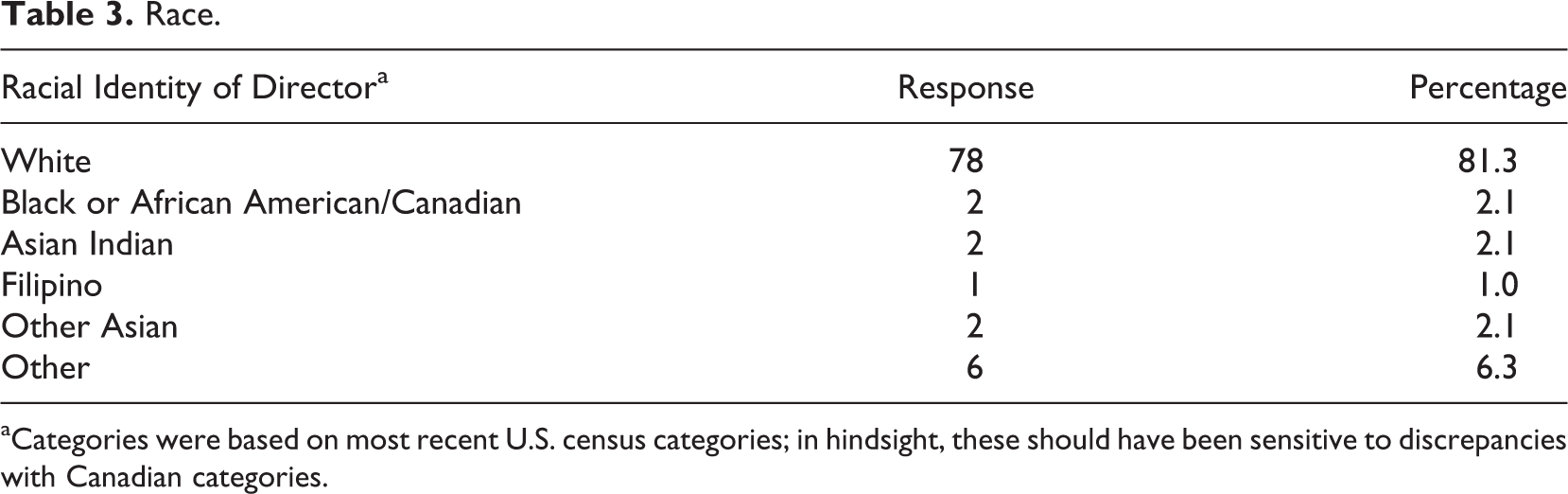
aCategories were based on most recent U.S. census categories; in hindsight, these should have been sensitive to discrepancies with Canadian categories.
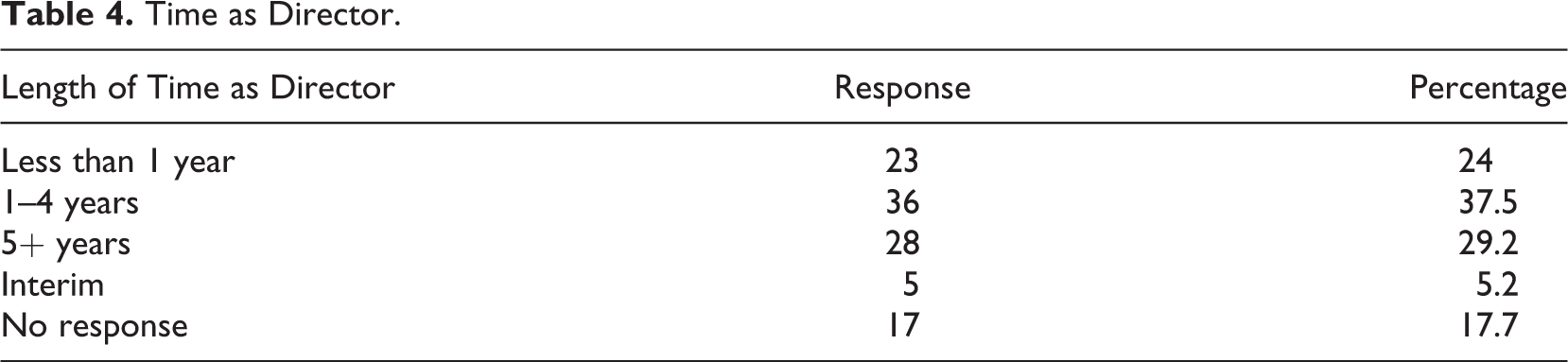
Time as Director.
Field of Highest Degree.
Program Names.
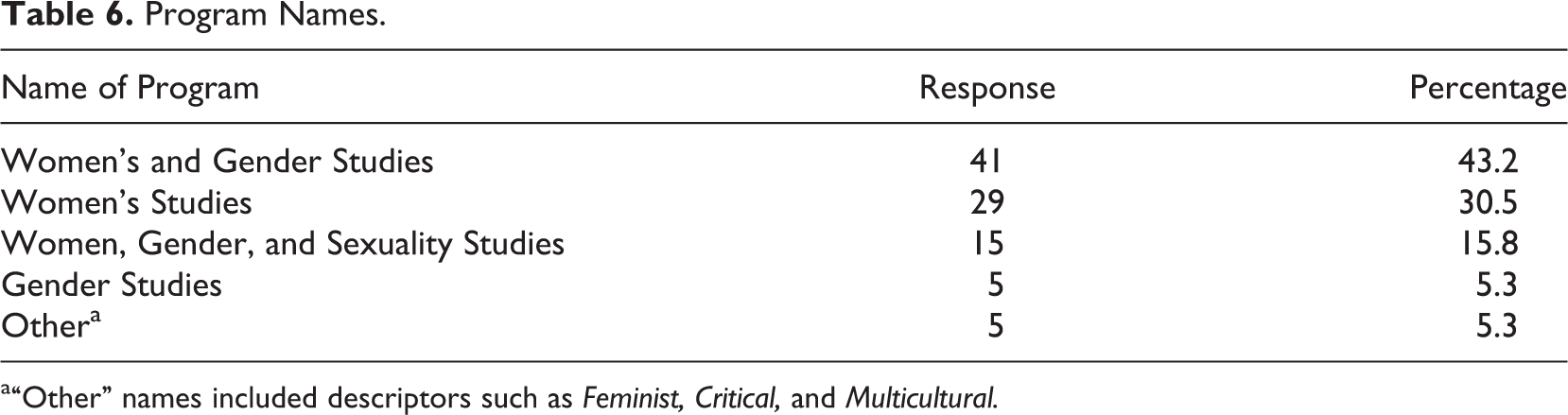
a“Other” names included descriptors such as Feminist, Critical, and Multicultural.
From those surveyed, only the directors who indicated their willingness to participate in an additional in-depth qualitative interview over the phone were contacted for follow-up interviews. The majority of interviews were conducted over the phone (21) and lasted anywhere from 30 to 90 min in length, with an average of 50 min. A small number of program directors (3) elected to provide detailed responses to additional questions by e-mail as opposed to phone interviews. Follow-up interview questions probed for additional information about answers directors provided in their surveys, as well as information regarding the experience of directors, program specifics, how their role has affected their careers, and so on. Phone interviews were recorded, transcribed verbatim, and coded for themes relating to barriers, strategies, and trends. Each transcript was read through a minimum of 3 times in an effort to increase reliability and consistency. The first reading helped establish initial general themes and a framework from which to guide subsequent readings. This exercise of open coding was followed by axial coding, which is defined by Strauss and Corbin as “[t]he process of relating categories to their subcategories” (1990, p. 123). Themes and subthemes were discussed and honed in relation to theoretical implications with others familiar with the project. Thick description in the form of respondent’s own words and experiences is used to explore this topic, as it is our goal to illustrate the meaning behind responses (Strauss & Corbin, 1990).
Quotes that either provide confirmation or add complexity to the themes uncovered during analysis are included as passages in the body of the text. While a census does not provide statistically generalizable information, we are pleased with our response rate and feel confident that these data provide a useful foundation for pointing toward current trends in the field from the perspective of directors of WGS programs at large North American institutions of higher education.
Profile of Respondents
This section provides a brief snapshot of our respondents. To begin with, Table 2 identifies the gender of the program directors included in this study.
While program faculty may be increasingly diverse, the position of director—and its accompanying “status”—is still largely held by white women (at least among our respondents).
As a reference for the qualifications of respondents in providing relevant strategies and observations based on experience, Table 4 provides information on the amount of time that individuals have served in their current position as program director.
Reflecting the interdisciplinarity of the field, Table 5 provides information on the disciplines from which program directors earned their highest degrees (and most commonly, are also tenured in at their institution). Notable are the small minority of program directors with degrees in Women’s Studies. This is understandable considering the relative youth of PhD programs in the field, and the likelihood that directors are drawn from more advanced ranks of professorship. Still, it provides an insight into how the field may change as more and more PhD’s in WGS are granted and potentially advance into these positions.
Indicative of another strong shift in the field is the number of programs that have transitioned to more “inclusive” names (notably Women’s and Gender Studies). These name changes reflect curricular developments, broadening faculty and student research interests, student body composition, and communicate philosophical shifts in identity as a field. This trend is discussed in more detail in our findings.
Depicted in Table 6 are the most common names for current programs in the field. The lack of a uniform name for programs suggests the relative youth of the discipline. Program names are shown in descending order according to their prevalence. From those respondents who completed the questionnaire, only 15 (15.8%) programs continue to be called strictly Women’s Studies. All others had revised or added at least Gender to the title of the program.
Findings
Based on the data obtained through our survey and in-depth interviews, findings have been organized to answer the following three broad questions: (1) Where are we headed? (2) What’s in our way? and (3) How can we get to where we want to be?
Where Are We Headed?
Despite barriers facing programs today, the majority of respondents were optimistic about the future of the field (65% of respondents). When asked about her predictions for the trajectory of the field, one director simply replied, “Bright!” While many acknowledged that their predictions were merely predictions, there was a general consensus among directors that the field is increasingly moving toward expansion, integration, and a stronger institutional presence. 2 As the following responses indicate, program directors had a range of predictions for the future of WGS.
Expansion and integration were spoken of specifically in terms of widening the scope of curricular topics to include not just women-focused courses, but masculinities, sexuality, transgender, and transnational studies. As one director explained, I think that this discipline is both becoming mature as a subject area of study, coming into its own, and becoming more complex, encompassing more areas of research and perspectives.
Another elaborated in a similar vein, predicting that she saw the field as expanding from its political base, from its attention to curricular revision and critique of disciplinary knowledge. I see it going more international, sustaining its commitments to the active relationship of academy/world, of knowledge/activism. I see a rise in the centrality of masculinity and sexuality studies.
This movement from debates over curriculum and a feeling that the discipline is reaching some sort of maturity is also expressed in the idea that WGS will increasingly become recognized as an important element to a liberal arts education and essential programming at institutions of higher education. Perhaps reflective of conflicted feelings toward the common dependence upon other departments to offer coursework (especially programs yet to achieve departmental status), one director predicted that “[w]e will be seen as a central discipline, without the need to link to other fields as often.” Another predicted shift was related to the growth of graduate degrees offered in WGS. One director indicated that she was aware of some PhD programs receiving “100 applicants for 4 to 5 positions.” Clearly, the interest in pursuing graduate degrees in the discipline is exceeding the spots within programs. This will change the face of departments, as more and more faculty will likely be trained in WGS degrees, rather than coming from various disciplines.
A notable percentage of respondents would fall into the cautionary optimists category (31.6%). Their predictions for the future of WGS were more nuanced and conditional upon several elements. For instance, one director cautioned that the trend toward increasing numbers of programs acquiring departmental status may produce either a desire or a pressure to hire faculty with a Ph.D. in both Gender & Women’s, and Feminist studies, so I think you’ll actually see kind of a reduction in kind of the intellectual diversity, but also a more solid disciplinary identity as they become kind of more self-sustaining academics.
Another director predicted almost an opposite trajectory for the discipline, explaining programs will, and must, continue to reflect and respond to developments in feminist and related thought, analyses and activism. But I think Women's Studies will disappear—either through closure or through renaming and redirecting.
New areas of scholarship were predicted by many to pose significant changes to WGS as we know it—specifically in the area of transgender studies. When asked for her predictions for the future, one director who references the changing nature of the field in addition to the associated political and economic challenges said, I foresee…the actual substantive analysis around gender is transformed by transgender studies…there’s a kind of continued renovation of the fundamental categories of analysis and questions being asked at the core of the field keep transforming…I think we’ll be challenged to continue to refind ways to do critical work, critical feminist studies, critical analytical work about our world rather than just churning out useful knowledge to whoever pays for it.
What this director fears is that the nature of academia will lead to WGS programs seeking “grant and contract funded work in the service of knowledges that state wants and needs” rather than pursuing fundamental questions and categories of analyses that are being asked at the field’s core. Another director also addresses issues of financial difficulty while simultaneously discussing the increasing global nature of the field with the following prediction: Assuming no radical changes in higher education, I believe that WGS is positioned to be a leading force in creating a more diverse and globally educated student. The problem is decreased funding can result in fights over resources and can lead to the abandonment of interdisciplinary fields like WGS.
While a minority, the remaining respondents were less optimistic of the future of the field. For instance, one director explained that she suspect[s] institutional challenges will increase enormously. There will be pressure on identity based programming to be collapsed into `interdisciplinary studies’ type departments, etc. And as with all humanities subjects, we will go on seeing very significant assaults on our supposed relevance from corporate administrations.
Although issues of institutional buy-in and unstable finances are not new to the world of WGS programs, the shifting economic climate might be placing these ongoing issues for the field in a new light. In an era of shrinking public finding for institutions (O’Dea, 2013) that is placing an emphasis on the assessment of “competency-based learning” outcomes rather than a liberal arts curriculum (Slaton, 2013), these struggles look different. However, WGS has achieved a degree of institutionalization (Hatton, 1994) and is now dealing with new possibilities, such as curricular expansion. The issue is no longer making sure some women are included in disciplinary cannons, but rather staying on the cutting edge of multiple women, gender, and sexuality-based theories and practices. The specific barriers that program directors spoke of are explored in more detail in the following section.
What’s in Our Way?
As an attempt to understand what may prevent WGS programs from harnessing their potential, we explored some of the forces that work against directors in their efforts to build up and sustain their programs. While the particulars of certain institutions were reported and nuanced arguments made, there remained several common themes running through the data, largely revolving around the lack of sufficient funding and other institutional constraints. In rare circumstances, directors shared difficulties with “internal” politics, as well as personal costs to program directors (including stress, disillusionment, and stalled research programs). These themes are explored in the following paragraphs.
Overwhelmingly, respondents reported a lack of sufficient numbers of faculty to support their program as being the largest barrier they faced. Most programs operate on very tight or in some cases nearly nonexistent budgets, leaving faculty and directors feeling stretched thin. To complicate matters, faculty who teach in WGS programs are most often in joint positions (if on the tenure track at all) with the attendant commitments and responsibilities of two departments.
This position leaves faculty with unclear markers of success and fuzzy questions regarding requirements for successfully achieving tenure. Other programs are completely dependent upon faculty housed in separate disciplines altogether because they lack departmental status. While being low cost for the university, this arrangement also presents significant challenges. For example, lack of control over when courses are offered was a concern expressed by many. And in some instances, directors also dealt with problems regarding course content, in the sense that although “women” may substantively be a part of course discussions and topics, the course was not always taught from a feminist perspective. These problems with correlation of programming are difficult to overcome when lacking core faculty. To further explore the complications of such arrangements, one director explained, It used to be that a director might have trouble getting volunteers for something, but there was a good group of people who were really committed and worked hard. But in the last year, with the kind of changes that have been going on in the university, people are less and less willing to do work that they don’t get a sort of direct reward for. They’re doing less and less service, and especially less service outside their home departments. So because we don’t have any core faculty hired in women’s and gender studies, I’m starting to see this withdrawal, where faculty—they wanna help, and they’ll still volunteer for things—but they won’t volunteer for the big projects…people are asked to do a lot of, you know, essentially volunteer work for very little credit, you know, when their teaching loads have been raised? They’ve been pressured to produce more scholarship…I just don’t see things going in a good direction with a program that’s not a department and doesn’t have its own faculty.
In an era of budget cuts and insecurity, professors will likely, and understandably, approach their work with self-preservation in mind. Another director expanded on this theme, sharing that the problem is decreased funding can result in fights over resources and can lead to the abandonment of interdisciplinary fields like WGS. It is amazing, and shocking, to me how quickly allies can turn away when their disciplines seem threatened by interdisciplinary work.
In connection with budgetary constraints and loss of allies, several directors admitted to feeling “burned out.” Feelings of being overwhelmed were not limited to those who had been serving in the position for several years. Interim directors, and even those newly instated, reported stress associated with their new positions and the resources they were (or were not) provided to complete the tasks required of them. Although the effects of the situation varied according to the stage of career in which directors found themselves, nearly all program directors reported a sacrifice to their own research programs due to their service. This phenomenon is not limited to service within WGS, but it does complicate the traditionally held view that program director positions in WGS should be held by women considering the relative lack of prestige garnered by service versus research in the academy. As research indicates, women tend to take on many more service activities than men in the academy, which can ultimately hinder their research programs and professional advancement opportunities (Carrigan, Quinn, & Riskin, 2011; Misra, Hickes Lundquist, Holmes, & Agiomavritis, 2011; Park, 1996; Porter, 2007). Moreover, many directors described their reliance upon intrinsic motivation for the work associated with the program, which can be sapped after many years, especially in the face of impending program dissolution and/or merging.
These concerns point to a general lack of institutional support in the form of funding. When asked about the barriers to achieving the goals they would like for their respective programs, 80% of respondents indicated that lack of monetary resources was highly influential. If we extend this measure to include those that indicated lack of resources was somewhat influential, we capture 96.5% of respondents. As one director put it very simply, “[w]e have been put on a starvation diet. Asked to do more with fewer resources. This has really hurt morale.”
Clearly, these are financially insecure times within the university as a whole—both in Canada and in the United States. However, we were also interested in whether directors felt that their programs had been disproportionately affected by budget cuts and monetary constraints in comparison to other programs on campus. This question was posed to directors who completed our in-depth interviews. While we make no claims of being representative given the small sample, directors did provide interesting insight into this question. For instance, one director—frustrated with her administration’s allegiances to the hard sciences and more applied programs—described the dilemma in the following terms: [I]t’s always a negotiation, and it’s a delicate I need this—universities say they don’t have money, and it’s true, they don’t have money, but they do have money—they have choices…they have plenty of money for some things, but they don’t have money for Arts & Sciences, and not for Gender and Women’s Studies.
It is important to note, although, that the majority of directors indicated that they had not felt unfairly treated in reference to similar programs, given this era of tight money across the board. As one director shared, We certainly haven’t been singled out to be treated worse than everybody else. I mean, everybody’s certainly taken a hit, and we’ve taken our share…there’s actually no operating budget from the university [laughs]. But that’s the same for us as it is for, you know, the sociology department.
While many felt that cuts were proportional or similar to other smaller liberal arts programs in their institutions, the realities of those cuts, and the ability to function as an academic unit in spite of them, have huge impacts upon the health and strength of both the program and its faculty. This speaks directly to concerns that directors had over harnessing the potential of WGS programs in a climate of uncertainty. Although in the minority, there were a handful of programs facing the prospects of being shut down completely. While some directors, such as the subsequent one, have been able to save their programs for at least the time being, not all are successful in that endeavor. There’s been a massive restructuring at the university, and they’ve been closing down programs, and their intent was to close down our masters program and use that as a reason to move our undergraduate minor into another department, like sociology. And then to, you know, fire our secretary essentially, and just get rid of all our programming—because we do a lot of outreach and programming, like Women’s Studies programs generally do. So, we fought off that, and now our master’s program is supposed to be restructured.
Several respondents expressed concern and frustration over demonstrating the relevance of WGS and its utilitarian function as a program. For example, as one director described, I think the field faces some serious challenges—as do most humanities/liberal arts fields—in the wake of the economic downturn. We need to be able to realistically describe our relevance to the most pressing concern of most of our students: how they will get jobs. This is, I believe, a challenge that the field has not been particularly willing to face.
In a similar vein, another director explained that she sees the main barrier to WGS programs as being the same one facing feminism in general—that so many people think feminism is an old topic, already addressed and passe, and also, that young women have little or no memory of the battles of the past, so they often take for granted the gains won. I fear that that memory loss could lead to a loss or reduction of those gains.
Another director described the difficulties of, “continuing to struggle with being part of institutions that it fundamentally critiques (tension of institutionalization vs. social change).” At the heart of this comment is the predicament of ensuring institutional stability, without conforming to its demands, but instead, continuing to push the boundaries. It likewise illustrates the fear of losing the energy and power of an interdisciplinary perspective if moved into disciplinary status. But, without stability and recognition, WGS is at the mercy of potential co-option by merging with arguably similar departments. Again, concern over how to harness the potential of WGS—and how this potential is differentially conceptualized—is paramount. The ultimate fear is a loss of the historical roots of Women’s Studies and its feminist founding. This fear also surfaces in discussion revolving around what a program should be named. Achieving consensus in this arena can be a large hurdle from programs to overcome. To provide some context for the arguments surrounding name changes, the following response demonstrates a reticence toward changing. If the drift continues away from WS toward WGS and GS, then I fear that the feminism at the core of the field will be watered down to the point of irrelevance. I absolutely value gender and sexuality studies, but while they may largely have grown out of feminist theory & women's studies, they can be done without a feminist grounding. Thus, I hope to see Women's Studies remain intact and distinct, and Gender & Sexuality Studies forming as a separate, overlapping and complementary field.
On the other hand, if programs fail to officially change their names, they potentially risk being misunderstood by outsiders and relegated to positions of irrelevance or misrepresentation.
Another director shared her thoughts on the debate in the following way: I think that would be a minority perspective that we should just stay with women, period. And it was really faculty and students saying that this name doesn’t really reflect what is going on here, and we need to sort of pay attention to how “women” is also kind of exclusionary in many ways.
So, in light of these complex barriers, what is a program director to do?
How Can We Get There?
This section is an attempt to explore perhaps the most pressing question this study poses—how can we ensure the vitality of WGS programs in light of current constraints and barriers? How can the potential of WGS be realized and its potential harnessed? Program directors provided several creative suggestions, with the important caveat that there is no one-size-fits-all solution. One director shared the following advice in this vein: The most important lesson I have learned is figuring out how to work within the parameters of what is possible at my institution, with my program’s resources, and within this particular student body and community.
There were, however, several themes related to strategies employed by directors in efforts to best support and sustain their programs. These themes included increasing visibility through better marketing, making friends and recognizing allies on campus and in the community, casting a wider net over potential students, realistically addressing questions of relevance, and fighting for tenure lines and institutional stability.
To begin with, several directors mentioned the importance of increasing visibility through better marketing of what WGS has to offer. As one director explained, One of the challenges for all undergraduate [WGS] programs is that high school and community colleges don’t have gender studies programs on the whole. So when students come to a university like this, they have to find their way to us…we’ve really had trouble with the university advising service having us on the list of potentials.
Several respondents pointed to the necessity of making a concerted effort to reach out and talk to general education level classes about the options available through WGS. In relation to this, it was important to many directors to have very strong introductory courses (both in content and in competency of instructors) that also fulfilled general education requirements. By developing a reputation on campus of having excellent teachers, who conduct cutting-edge scholarship, they were able to draw in more students as majors and increase their respect among peers and administration. In addition, as we mentioned earlier, directors spoke of decisions to transition to more inclusive names for their programs (i.e., adding “gender” to the title), in part as a strategy for welcoming a more diverse set of students. Several also cited the importance of adding masculinity, sexuality, and queer studies courses to their curriculum to meet the demands of student interests, and to reflect growing trends in the field, even if these decisions were difficult ones to make. At the same time, one director urged that it is important to “know your context and your audience and craft courses appropriate to that context.”
Another strategy for increasing enrollment, supporting innovative and cutting-edge pedagogy and curriculum, and working toward more financial self-sufficiency was suggested through online programming. In response to a question about their online program, one director shared that she understands that there are conflicted feelings about online courses, but that in her department they have “worked really, really hard to think about…how do you do feminist pedagogy online?” Citing the fact their online courses tend to enroll to capacity, she additionally feels that they serve a population of students lack access to women’s studies majors because of their geographic locations. Moreover, they have been able to structure the budget in a way that the money generated by the online courses “largely comes back to us, and that helps a lot because that keeps the incentives pretty high.” Finally, she reiterated the point that “serious conversations about what feminist pedagogy looks like online” is a must, explaining that as you’re building the courses, you’re really thinking [it] through, so that it’s not the same as an on campus course but it’s the equivalent of it. And so I think that’s where people sometimes get uncomfortable because they want it to be the same, and it’s not going to be the same. But I think it can be equivalent.
With the right arrangement, online programming can be a strategy used to meet several worthy goals—reaching nontraditional or geographically bound students and contributing to program self-sufficiency, while still incorporating feminist pedagogical principles. Online programming for WGS should be approached with care. As indicated by the above-mentioned director, online education can be equivalent, but will not necessarily be equivalent. Like the director, teachers and scholars alike have discussed the challenges and benefits of online WGS education (Collingwood, Quintana, & Smith, 2012; Gajjala, 2012; Whitehouse, 2002). Program directors and instructors must interrogate questions of how such personalized course content translates to cyberspace and then must strive to maintain the integrity of the course content, particularly as online education is becoming more frequently perceived as a way to bolster program and university budgets.
The conversation revolving around efforts to increase program numbers and recruit more students, which would communicate a demand for WGS programming and increase institutional stability, also pointed to the suggestion that there is a need to realistically address questions of relevance. Some directors lamented the fact that there is still need for education among their peers, and administration, as to the merits of a degree in WGS. While this phenomenon is not unique to WGS but could be said of several nonapplied degrees, it still merits addressing. One program director spoke specifically about how to combat feelings of inferiority and marginalization in the academic community, positing that probably the thing I have seen that is most helpful for my colleagues who are also very successful, is be as good at everything you do, as people in the traditional disciplines are. So be an outstanding scholar, be an outstanding teacher, do the service work across the university, and approach it as if you belong there…And that has created this level of respect that situates us really well in the university, so we’ve never felt threatened when there were budget cuts, or you know, questions about who’s going to survive and who’s not. Yeah, it would be, it would be political I think, to try to get rid of us [laughs].
This type of no-nonsense advice may certainly work at some institutions for some individuals, but it is important to also contextualize it within the confines of a given situation (and as the director mentions, in this case a dismissal of the program would be considered politically unpopular—a status that not all programs enjoy). Adopting a positive attitude toward the work and drawing strength from an empowered position are without question worthy goals. Yet the danger of this line of advice lies in an amplification of agency over structure. While it can be intoxicating to internalize successes as internally driven and achieved, it is equally damaging to internalize programmatic failures as somehow indicative of personal shortcomings. Keeping perspective on the structural constraints that bind one’s agency is important—both for the resilience of the faculty member working hard to secure their place in the academy and for the resilience of a program seeking to establish itself as a discipline.
In regard to WGS’s relevance, most pressing is the issue of employment postgraduation, at both the undergraduate and graduate levels. Given the additional investment of graduate students in WGS, this is something that is especially important to address from an ethical sense. A director of a well-established undergraduate and graduate WGS program commented on this predicament, particularly how it relates to current trends in academic employment. [T]he other thing that we’re going to have to pay attention to is the question of oversupply. There are a large number of women’s studies Ph.D. programs and there isn’t an equally large growth in places for people to work in academia…I think one of the things that we have to look at is more focus on skill-based rather than knowledge-based education. It’s not either or, but…we have a significant number of both our undergraduates and our graduates that go into say, nonprofits or NGO’s or government agencies, and one of the things that those programs really demand is evaluation and grant-writing. And we don’t actually give people those skills very well. So, analyzing policy documents, or doing work in legal environments. So we’re having this conversation—lots of graduate schools are—trying to develop a sense of what’s the repertoire of skills that students need given the situation that they are in.
Engaging in serious conversations about how to prepare students for a wider range of employment—as opposed to the traditional academic route—is a strategy that may serve programs well when evaluated on the success of graduates posteducation.
Another strategy employed by directors is the effort to make friends and recognize allies—far and wide—both in the community and in the institution, between departments and within higher administration, among individual faculty and students. Cultivating these relationships and feelings of good will can be essential, especially in an era of programming cuts. Highlighting the importance for establishing a wide base of support, one director explained that As a historian, I know that fields such as ours wax and wane owing to social, cultural, and political change. This gives me hope. But I also think that we need to start devising ways to speak to a larger audience rather than to the usual “choir,” by demonstrating just how important our perspectives are to the modern workplace, political sphere, academy, etc.
As an example, a director faced with imminent prospects of her graduate program being completely cut was able to draw on relational resources of advocates far and wide in a time of need. She describes her strategy subsequently: The way I got them to not cut our program and absorb it was I contacted the National Women’s Studies Association and got a letter in support of us, I contacted our external advisory board, donors, former students—and attached the email to the higher administration. And at the last minute they changed from closing our masters to restructuring it and I used that as leverage to keep open our office for next year.
While still in a precarious position, this director was able to at least buy some time through creative documentation of the program’s relevance, based on relationships with allies.
Welcoming men as directors of programs is another area which some program directors suggested may be important in recognizing and establishing potential allies. This is understandably a complicated issue, and a small but growing minority of men currently hold positions as WGS program directors (eight of our respondents). In reference to his position, one director shared that his “appointment was highly controversial” but that there were some who thought that…apart from whatever challenge I might or might not bring in, the association between identity politics and women’s studies was a good thing…over that time…we changed [our program name to include gender], and I think the openness to that change was in part to sort of think[ing] through what my presence meant, and it was really much more thinking about…gender rather than sort of identity politics.
At the same time, this director recognizes his privilege as a white man and how that privilege has translated into his position. He noted that “there is an unspoken truth that white men get heard better and women aren’t. And so, some people believe…[I] may be listened to by other white male administrators.”
Another man serving as director elaborated on his experience. He first addressed his challenges and stated, I think the challenge has been the folks who might say that I don’t understand, why can’t they find a good woman to do this job? kind of thing. So what I’ve always said is that I don’t want my presence here to hurt or harm the institute. If people think that a person who is the director needs to be a member of an underrepresented group, or a minority, a woman of color.
However, he went on to discuss how he believed those wanting a woman or member of an underrepresented group as the director might be misconceptualizing the role. While a woman might serve as a positive role model as the director, he believes the position is about more than being a role model. Because there’s so much administrative crap—you can quote me on that [laughs]—that really has everything to do with being an advocate for faculty and for your students, and for your program. And I have absolutely no problem defending the interests of this place and what it does.
While further research is necessary for any sort of definitive statements, clearly there appear to be some advantages to welcoming a man as a program director of WGS. For one thing, as discussed earlier, the majority of program directors experienced significant disruption to their personal research programs, which could potentially stall their careers. Sharing the service requirements that such positions hold with men who are committed and willing to act as advocates, while additionally drawing on the power they may hold in relation to their identity statuses, could be considered a strategic move.
As a final piece of advice shared by program directors, several strongly encouraged others to fight for tenure lines committed fully to WGS. In light of the difficulties faced by conditional or joint appointments, it is understandable that this goal would be part of a long-term strategy for insuring the vitality of the field. As one director explained, [i]f you don’t nourish a program and give it young faculty, then the bridge is in such decay that when the pioneers leave, there’s nobody there to take it over. And maybe ultimately universities want that …
The idea this director presented touches on many themes addressed in this article. With the proliferation of WGS PhD programs, there will be new generations trained in these newly emerging WGS directions. They will be the leaders in the field who ultimately decide the field’s direction. Yet it falls on the current program directors and faculty who are often joint appointed and potentially overworked to continue working to create the space and financial resources for these emerging scholars and the interdisciplinary programs they will inherit. The above-mentioned director postulates about what universities might want. We cannot assume to know what universities want. But we can work to convince them of what they want.
Conclusion
This study began as an effort to explore questions about the trajectory of WGS—its evolution, its constraints, and its estimated trajectory in the face of barriers. The overwhelming response of directors currently leading their institutional programs was concern of harnessing its potential, responding to constraints in creative ways from empowered positions, fighting for establishment or institutionalization and all the perks that come with it (e.g., secured tenure lines, funding, and recognition as a stand-alone interdisciplinary discipline) but without losing momentum and/or the possibility of redefinitions as determined necessary by developments in the field. It is a tall order. And as stewards of such programs, directors of WGS hold a great weight. Several directors expressed exhaustion, frustration, and nearly all indicated that the role had consumed their time and stalled their own research programs. Still, the majority of directors were largely hopeful for the future of the field and saw WGS as being “bigger and better” in years to come and “positioned to be a leading force in creating a more diverse and globally educated graduate.”
Footnotes
Authors’ Note
This research was conducted while completing a postdoctoral research fellowship at the Center for Women and Gender at Utah State University, under the supervision of Ann M. Berghout Austin.
Declaration of Conflicting Interests
The author(s) declared no potential conflicts of interest with respect to the research, authorship, and/or publication of this article.
Funding
The author(s) received no financial support for the research, authorship, and/or publication of this article.