




Abstract
Involvement of women in commercial sexual activity (CSA) has always been viewed from a moralistic point of view in India, with legislations attempting to rescue and rehabilitate them. Some, however, look at this involvement as legitimate work. Agencies engaged in service provision align themselves to these differing ideologies. This article examines the organizational frameworks and ideologies of agencies engaged in service provision to women in or exiting from CSA, along with assessing women’s level of satisfaction and the duration of services received from these agencies. In doing so, 40 service providers from nine agencies across five major cities in India were interviewed, and 163 women receiving services from these agencies participated in a survey. The findings revealed that agencies differed based on their guiding principles, factors determining services, structure, involvement of peers/survivors, and decision-making process. The level of satisfaction with services, and duration of services received, was the highest for those in women-centric agencies and the lowest in government state protective homes. Agencies assisting women in CSA must consider adopting non-institutional-based and women-centric service approaches, as this would make a real difference to those being assisted.
Keywords
Agencies providing various types of services have long worked with women engaged in or exiting from commercial sexual activity (CSA; Raghavan & Pawar-Kate, 2009; Sanjog, 2010; United Nations Office on Drugs and Crime [UNODC], 2008). Studies have examined how useful these services are to those in CSA (Dandurand et al., 2015; Ferguson et al., 2009; Oselin, 2014; Wahab, 2006), but very little work has been done in India to systematically understand the utility of these services to the women themselves. Moreover, many of the studies conducted with women in CSA are solely focused on assessing the effectiveness of interventions in preventing HIV (Sherman et al., 2010; Swendeman, Basu, Das, Jana, & Rotheram-Borus, 2009). Few are concerned with addressing the needs of women living in such circumstances, needs such as providing stability, gainful employment, support, motivation, respect, and equal treatment (Wilson, 2017). The International Organization for Migration (IOM, 2010) highlighted their concerns about the effectiveness of rescue types of interventions in a report describing the number of women reentering the sex industry for lack of other viable options. Therefore, even from a resource utilization point of view, there is a need to target interventions that truly benefit those engaged in CSA. This article analyzes the services offered to women in CSA in different cities of India and the social service agencies’ (hereafter referred to as agencies) ideologies and framework. We also present the levels of satisfaction expressed by women who use the services provided by these agencies. The findings of this study have implications for assessing the effectiveness of agency interventions. The study is limited to understanding the satisfaction of cisgender women, given their preponderance in CSA. We did not interview male or transgender participants in CSA.
CSA
CSA refers to the commodification of a person’s body for sexual purposes through trafficking, prostitution, pornography, and sex work, where involvement could be by way of coercion, circumstance, or choice. In India, the only statistics available regarding the prevalence of this phenomenon is a report prepared by the Ministry of Women and Child Development (2008) a decade ago. This report acknowledged the involvement of 3 million women and girls in CSA. Studies exploring the reasons for entry of women and girls into CSA in India reveal that the vast majority enters due to poor economic conditions, peer pressure, and the lack of family support (Karandikar & Prospero, 2010; Silverman et al., 2007; Vindhya & Dev, 2011; Wilson & Nochajski, 2018). Also, researches documenting the experience of women engaged in CSA describe the overwhelming presence of violence, victimization, captivity, criminalization, and commoditization, which characterizes life in that world (Gupta, Raj, Decker, Reed, & Silverman, 2009; Karandikar & Prospero, 2010; Panchanadeswaran et al., 2010; Vindhya & Dev, 2011). The cumulative negative consequences on physical and mental health are well-documented (George & Sabarwal, 2013; Suresh, Furr, & Srikrishnan, 2009). These consequences are not limited to women’s experiences while in the sex industry but also impact women’s lives prior to entering it, with continuing debilitating effects after exit (Wilson & Butler, 2014).
The laws related to CSA in India are ambiguous. Although prostitution per se is not illegal, trafficking for sexual purposes and activities such as living off the earnings of a prostitute, soliciting in public places, running a brothel, or pimping are considered as contravening the law (Bhatty, 2017; Immoral Traffic (Prevention) Act [ITPA], 1956). The ITPA, 1956, previously named the Suppression of Immoral Traffic in Women and Girls Act, further amended in 1986, and the Indian Penal Code, 1860 (IPC), are the legislations that deal with CSA in India. Involvement of women and girls in CSA has traditionally been viewed through a moral lens as being objectionable and thus the State emphasizes rescue and rehabilitation of those involved (George, Vindhya, & Ray, 2010; Nair & Sen, 2004). Presently, the country is in the process of passing the Trafficking of Persons (Prevention, Protection and Rehabilitation) Bill (2018). This Bill is seen as a way to address the phenomenon of trafficking more comprehensively (Ministry of Women and Child Development, 2018). The Bill was passed in the Lok Sabha (lower house of parliament) on July 26, 2018, and is due to be placed and passed in the Rajya Sabha (upper house of parliament) before becoming an Act. The intent of the new Bill is to come down heavily on the prosecution of offenders as well as to provide care, protection, and rehabilitation to victims of trafficking. However, it has been heavily criticized by activists in the field for its sole emphasis on institutional-based rehabilitation (The Navhind Times, 2018).
Agencies Assisting Women in CSA
Agencies that assist women in CSA often find themselves dealing with two opposing ideological camps—neo-abolitionists or neo-regulationists. Neo-abolitionists equate sex trafficking with prostitution and consider both to be gender-based violence that preys on economically and socially marginalized women (George et al., 2010). Neo-regulationists believe trafficking and sex work to be different, wherein the former involves force and coercion, while the latter is seen as being a choice that women make over the use of their bodies, thereby making it legitimate labor (George et al., 2010). Moving beyond these binaries of neo-abolitionist and neo-regulationist thinking would allow feminist researchers to observe, listen, and participate in more complex realities (Gringeri, Wahab, & Anderson-Nathe, 2010). Homogenizing women’s experience into these binaries disregards what women are saying they need in service delivery. These ideological differences impact agencies’ approaches to service provision.
Studies show that the mere knowledge that there are agencies willing to assist them with meeting their needs bolsters women’s courage while in CSA as well as during the recovery process (Arz, 2008; Crawford & Kaufman, 2008). Agencies assist women with their care and protection not only while they are engaged in CSA but also post exit, enabling them to recover and preventing reentry back into CSA (Arz, 2008; Caliber, 2007; Hotaling, Burris, Johnson, Bird, & Melbye, 2003; Mayhew & Mossman, 2007; Sanjog, 2010). Assisting women in CSA is difficult and complex work, requiring a variety of resources and a multiagency approach (Wilson, Critelli, & Rittner, 2015). Lack of adequate and continuous services has been identified as having a negative impact on service users, resulting in their incarceration or their returning to the sex industry (McNeece & Arnold, 2002).
The services offered by agencies are influenced by factors such as guiding principles and values of the organization, leadership teams, and organizational structure (Aborisade & Aderinto, 2008; Oselin, 2009). For instance, studies suggest that a mixed leadership model, consisting of peers (survivors of CSA) as well as professional service providers, is more effective than other models (Aborisade & Aderinto, 2008; Wahab, 2006). And yet, many organizations are structured around dichotomous models featuring either peers or professionals, but not both (Hotaling et al., 2003; Oselin, 2009). The structure and activities of such organizations are perceived as restrictive and rigid, leading to discontent among service users (Aborisade & Aderinto, 2008; Oselin, 2009). Furthermore, inadequate resources or a lack of services limit the support and benefits that women engaged in CSA can access, leaving them frustrated with service organizations (Caliber, 2007).
It is critical that researchers understand the nuances of each agency’s ideology and framework vis-à-vis service provision, and how it impacts the level satisfaction, or lack thereof, existent among women engaged in CSA. Keeping this in mind, our research examines three predominant aspects of service provision by agencies and levels of satisfaction expressed by women who used their services. We gathered data on (1) the types of agencies engaged in service provision for women in CSA, their organizational ideology and framework, and how do they differ from each other; (2) the level of satisfaction among women engaged in CSA with the services received from agencies; (3) the effects of service duration on user levels of satisfaction with services. In taking this approach, by triangulating data from both the women receiving services and the service providers, this article seeks a holistic understanding of the utility of the services offered to women in CSA.
Method
Design and Sampling
The study adopted a mixed methods design, integrating qualitative data (through interviews) from service providers about their services and organizational framework and quantitative data (through a survey) from women in or exiting from CSA about their satisfaction with the services provided by these agencies (Creswell & Plano Clark, 2011; Johnson & Turner, 2003). Agencies that work with women engaged in CSA were identified in five major cities (Bangalore, Mumbai, Delhi, Kolkata, and Goa). The researcher approached agencies using information available on their websites, through personal contacts, and by using snowball sampling. Purposive sampling techniques were adopted to ensure the inclusion of agencies that aligned with different ideological camps (assuming that agencies are aligned to either neo-abolitionists or neo-regulationists groups). The agencies provided varied types of services to women in CSA, ranging from protecting the human rights of women active in the sex industry to facilitating exit and rehabilitation of those exiting. After repeated attempts at contacting these agencies, 9 (38%), of the 24 that were approached responded positively, allowing the researcher to visit the agency and interact with staff and clients. Participating agencies were requested to make announcements about the research to their staff and women receiving services, so that the researcher could proceed to ascertain their willingness to participate in the proposed study. The researcher (who is multilingual) discussed the study with anyone who expressed an interest in participating. In each organization, a closed space was made available, so that interviews would be confidential.
Data Collection
The data were collected in accordance with the code of ethics approved by the institutional review board. No identifying details were gathered from participants, and they were assured that if any question caused discomfort, they were free not to respond or to end the interview. Staff engaged in service provision within these agencies was interviewed for around 45 min each. The interviews with staff were predominantly conducted in English, but for those not comfortable with English, they were conducted in Hindi, Kannada, or Bengali as needed. Each interview was audio-recorded and transcribed verbatim (translated and transcribed into English in the case of Indian languages). An interview schedule was prepared with open-ended questions on certain organizational factors and services offered, with cues to elicit certain theme-based information such as values/structure of the organization, approaches adopted to address CSA, involvement of peers/survivors, and decision-making process among others.
A survey was administered to the women receiving services from these agencies. Participants were assured through an information sheet that the researcher was in no way connected to the agencies and that their responses would not be shared with the agencies. The survey was developed primarily in English and then translated into two Indian languages—Hindi and Kannada (and back translated)—and administered in an interview format (in person) due to the low literacy level in India. Although many standardized instruments and close-/open-ended questions were administered to participants, the information used in this article is based on only two—a Likert-type scale format questionnaire and a close-ended questionnaire. The women receiving services from these agencies were requested to rate their satisfaction with the services on a 6-point Likert-type scale (1 = very dissatisfied, 2 = fairly dissatisfied, 3 = little dissatisfied, 4 = little satisfied, 5 = fairly satisfied, and 6 = very satisfied). Duration of services received from the participatory agencies was recorded in terms of days/months/years. However, the information from the larger data did assist in interpreting some of the finding in this article.
Analysis
The transcript of each service provider interview was reviewed several times for clarity. Variations of thematic and content analysis were conducted. After familiarizing with the data, codes were affixed to passages; reflections were noted; the material was sorted and sifted through to identify important phrases, patterns, and themes (Miles & Huberman, 1994). All interviews were coded by hand. While trying to understand the organizational services and framework, certain themes such as guiding principles, factors determining services, structure, involvement of peers/survivors, and decision-making process were examined across all interviews (Braun & Clarke, 2006). The codes within these themes revealed different sets of information based on the organization type; thus, organizations with similar phrases were collapsed together to form six types of agencies—women centric, second-generation prevention centric, HIV prevention, legalization, private shelters, and government state protective home.
Responses from the survey and the demographic data from interviews were analyzed with the help of various statistical packages (IBM SPSS, PSPP, Python SciPy library). There was 100% response rate, which may be attributed to the interview format of survey administration. Frequencies, percentages, means, and standard deviations were computed to understand the demographic profile of the sample; differences in the mean satisfaction between these six organizational types were explored using one-way analysis of variance (ANOVA), Levene’s test, Welch test, Eta Square (η2), Games-Howell post hoc analysis, and Cohen’s d; linear regression was performed on the duration of services scores.
Sample Description
The data reveals that the average age of the staff from these agencies that participated (n = 40) was 38.6 years (SD = 11.8), with ages ranging from 23 to 64 years. The majority of staff were female (73%); however, there was male (25%) and transgender (2%) representation as well. Although more than half the sample (62%) had postgraduate degrees, there was also a small group (7%) who had never been to school or had only a few years of schooling. The average years of experience (working with women in CSA) was 9.3 (SD = 7.4), with years of experience ranging from less than a year to 25 years. Most of the staff who participated in the study (n = 28, 70%) worked directly with the women as counselors, therapists, social workers, lawyers, or field-workers (these persons are not professionally qualified but rather they assist women in CSA through outreach work). Of the remaining staff, some were founders/presidents (n = 7, 17%) and the rest were support staff (n = 5, 13%) including physical trainers, wardens, and nurses. Support staff was only present in shelter-based agencies. They engaged women in exercises, provided health care, and met other basic needs.
The survey gathered data from 163 women currently in, exiting from, or who had already exited CSA. All were currently receiving services from the participating agencies. The mean age of participants was 32.94 years (SD = 11.04), with ages ranging from 16 to 65 years. The majority of participants (n = 104, 64%) were in the 16–35 years age-group. Fifty-seven percent (n = 93) were single (including unmarried, divorced, widowed, and abandoned). More than half the women in the sample (n = 89, 55%) had exited CSA or were forced out due to age factors (women aged 30 years and above have less demand in the sex industry). However, examining the employment situation revealed the sad reality that only 25% (n = 40) were legally employed in full-time or part-time jobs. The mean number of years of schooling for participants was 3.45 years (SD = 3.84), with 47% being illiterate and 44% having had some form of schooling.
Findings
Organizational Framework
Exploration of the agencies engaged with women in CSA revealed different ideologies and frameworks that influenced service provision. Five aspects of organizational framework were identified. These include (i) guiding principles (which refer to the fundamental doctrine that the organization adheres to while providing services, which broadly categorize them into the two ideological camps, neo-abolitionists and neo-regulationists), (ii) factors determining services (which are the elements that contribute toward the organization deciding on the types of services they offer), (iii) structure (which covers the type of service delivery arrangement the organization had—whether women/girls could live in a place of their choice in the community or had to live in the institution in order to receive services), (iv) involvement of peers or survivors (which refers to the level of engagement of peers i.e., women who were still involved in CSA, or survivors i.e., women who had already exited, as staff), and (v) decision-making (whether the agency treated women as individuals or as a group while meeting their needs, and whether it was a collaborative or a top-down approach).
Agencies with similar patterns on each of the five aspects of organizational framework were grouped together. Six different types of agencies (government state protective homes, private shelter, legalization groups, HIV prevention agencies, second-generation prevention-centric agencies, and women-centric agencies) were identified through this classification (see Table 1 for a comparison of these agencies on different organizational framework aspects). Although the organizational features of these agencies overlapped, as described in more detail below, certain distinctive characteristics and ideologies were observed in each type.
Organizational Framework for Each Type of Agencies.
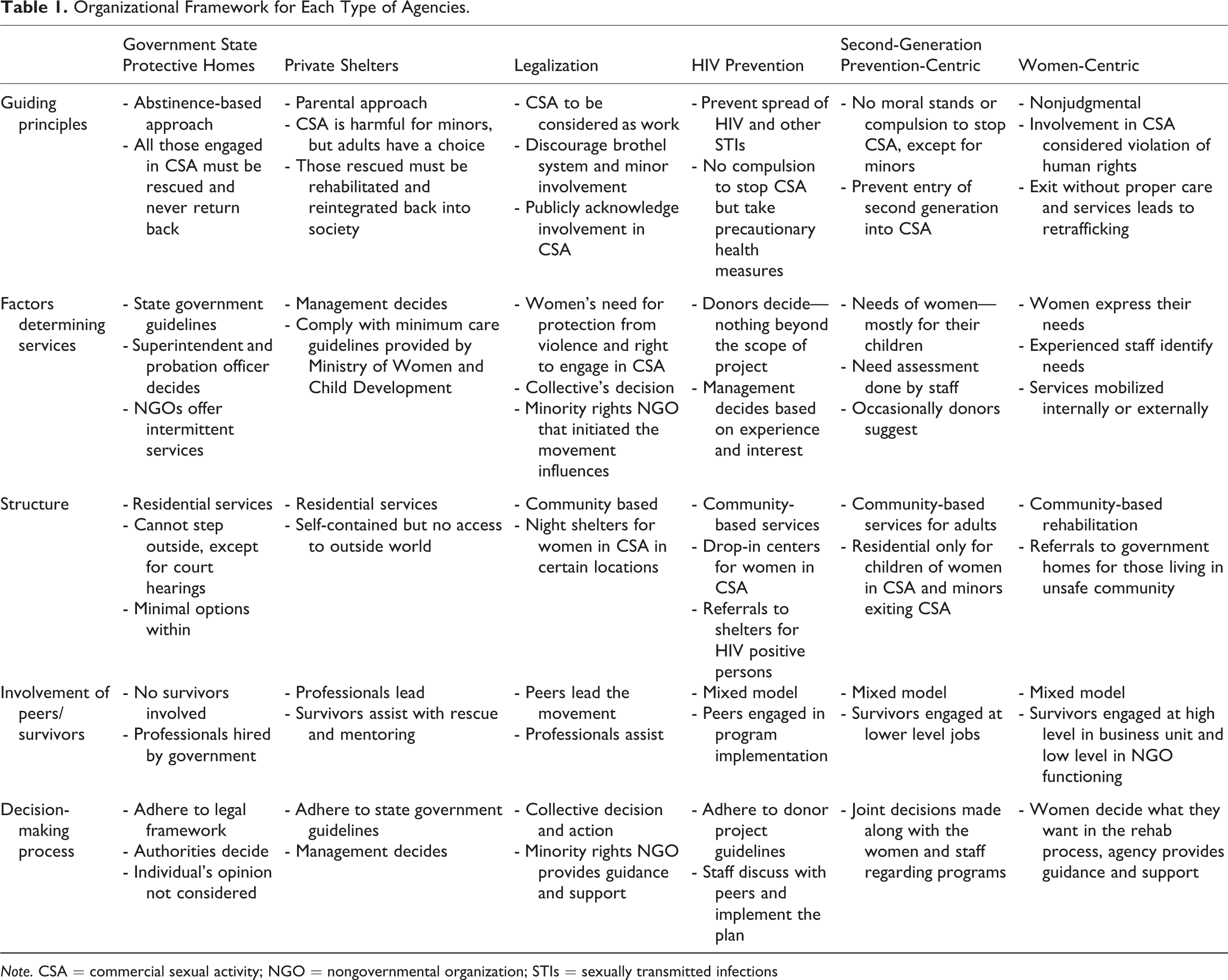
Note. CSA = commercial sexual activity; NGO = nongovernmental organization; STIs = sexually transmitted infections
Government state protective homes
Women rescued from the sex industry by law enforcement agencies are placed in government-run protective homes for the duration of the investigation process, which could last anywhere from weeks to months and even years in the case of foreign nationals. During this period, the women are not allowed to leave the premises or make contact with anyone except family, subject to the perceived role of the family in the engagement of women in CSA. The choice of entering these institutions or continuing to reside within them is not based on the needs of the women but rather on the investigation and trial process. The magistrate decides the fate of the person by talking to her for 2-3 minutes, that’s not correct…there is only one home [government run] in the whole of Maharashtra [one state] and the ratio here is 1:90 [staff to women]. The services offered here is only as per the rule. There is no human angle to the whole process. (Service provider) In a way its not [good to rescue] but if you don’t [rescue] they are raped day and night, rape after rape. We are not able to achieve much in providing post rescue care, but the rescue? Yes, it is useful and acts as deterrent for others too [not to engage]. (Service provider)
Private shelters
Girls and young women, mostly below 23 years, rescued from CSA by law enforcement agencies (sometimes through involvement of NGOs) are given shelter in these private shelter homes. These homes are managed by NGOs and partially funded by the government, in addition to support received from private donors. These agencies emphasize rescuing minor girls and young women forced into CSA and providing them with a safe space during investigation and rehabilitation. These homes align with an abolitionist ideology and provide institution-based rehabilitation. Service users are required to completely exit the sex industry and stay within the homes to receive services. The entry into these homes and the duration of services are often determined by court order. Most service users are not permitted to leave the premises, except for a handful of young women who received court orders to stay in these homes for rehabilitation purposes. They may leave the institution for vocational training or employment. Our main focus is to remove them from there [sex industry] and do proper social integration, be it marriage, returning home or acquiring a new skill for a career…. Being here [shelter home] helps them to become disciplined, acquire talents, and the girl totally transforms between the time she comes and leaves [from the home]. Residential care is very good to bring changes. (Service provider) The biggest benefit of taking survivor is that, the rest of the girls look up to her, they say this girl was also like us, but today she has reached here, its natural…. At the higher level where decisions are made you need professionals, you can’t do without them, since survivors don’t have the ability, and management skills. (Service provider)
Legalization group
The main focus of these organizations is to protect and advocate for the human rights of the women engaged in CSA. The ideology of these agencies aligns with a neo-regulationist perspective. They believe that the abolishment of the sex industry is impossible. These are community-based agencies where women are free to live with their partners or families; however, to get assistance, women need to be part of the sex workers union and pay a nominal amount. No one can stop sex work. If I stop today, new girls are going to come in tomorrow; they come in for various reasons. Our goal is just that our girls shouldn’t have problems, that they should live well, they should not get into any issues, they should not run around having to deal with court cases. (Peer leader of sex workers union) There isn’t anyone to ask for sex workers’ rights, there isn’t any organization that is coming forth to ask about the problems and difficulties of sex workers. When funders provide money, NGOs have to listen to what they say. So they [funders] decide what services to provide, they don’t do what women need…. A sex worker can be assisted only by another sex worker, someone else cannot come and help. So we established our union, and formed a collective. Our main goal is to recognize sex work as a profession. (Peer leader of sex workers union)
HIV prevention agencies
The key focus of these organizations is to address the health-care concerns of women engaged in CSA, especially those who are younger, as they encounter more men seeking sexual services and can play a vital role in preventing the spread of HIV/AIDS. In terms of ideology, they align more with the neo-regulationists perspective and do not compel women to exit the sex industry to receive services. We don’t have the right to judge them, we don’t have the right to say, “do this work or that work” because it is their preference, they could do whatever they want. Now they think of this as a profession…Even if they are in this, it’s ok, we don’t have anything [to say]. What we say is “well you are in sex work, we are not saying you are wrong, but use [a] condom for your health.” We are concentrating on their health. (Service provider) They [peers] are good in reaching out, it is sex workers community, they know their background, they can talk their own language, using slangs and all, we are not used to it. It is good, but certain weaknesses are there, they are not able to do the documentation like us. They are not educated, so we have to do their documentation. (Service provider)
Second-generation prevention-centric agencies
These organizations focus on preventing the children of women engaged in CSA, or other minor girls, from entering the sex industry. However, there is no compulsion for women to exit CSA in order to receive services from these agencies. Thus, although they lean more toward a neo-abolitionist ideology, they do engage with and assist women who are still in CSA. When I asked them what kind of services would you like to have, they [women in CSA] said help our children, we started the drop-in-centers and educational programs for children, it was working out well. Then we added lots of games, dance, karate classes and whatever we could for children…. We wish that the second generation don’t come into this trade [CSA]…so that’s why we focus on children and see that they don’t do [engage in CSA]. (Service provider) Its not a question of what type of services are better [residential or non-residential], it’s a question of what somebody needs. There are families that need shelter support, and there are families that don’t. When a woman has a 13 to 14 year old child, girl or boy, she cannot entertain her customers in the room, so she prefers to put her kids in the shelter. But if it is a younger woman with a small baby, and she has a new boy friend, she’ll keep the child with her…. We are constantly in conversation with the kids [of women in CSA] telling them to treat their mothers with compassion, to understand the fact that she’s not doing something because she wants to, but because she has to, for your [child’s] survival, your upkeep, your care and because she does not have other opportunities. (Service provider)
Women-centric agencies
These organizations adopt a human rights–based service approach, where involvement in CSA is considered as a violation of women’s rights. There is an emphasis on treating each and every woman in or exiting from CSA with dignity and respect. Although these agencies do not support neo-regulationists ideology, they do not cease to engage with women still in CSA and assist them with the services they need. At the same time, they believe that forced rescue or self-rescue, without proper services post exit, will result in women returning to the sex industry. These agencies treat both adults and minors involved in CSA with similar care and urgency, providing services based on their needs rather than offering a standardized set of services. Our belief is that whatever the woman want[s], if it is required to be done, we provide them. Every individual has different kind of experiences, so we need to be open to individual needs and accordingly provide services. That’s what we’ve been doing. (Service provider) A survivor knows best what is good for other survivors. We [professionals] may be sensitive, but when survivors play a key role in deciding the policy of organizations, the policies are more victim-friendly. (Service provider)
Satisfaction
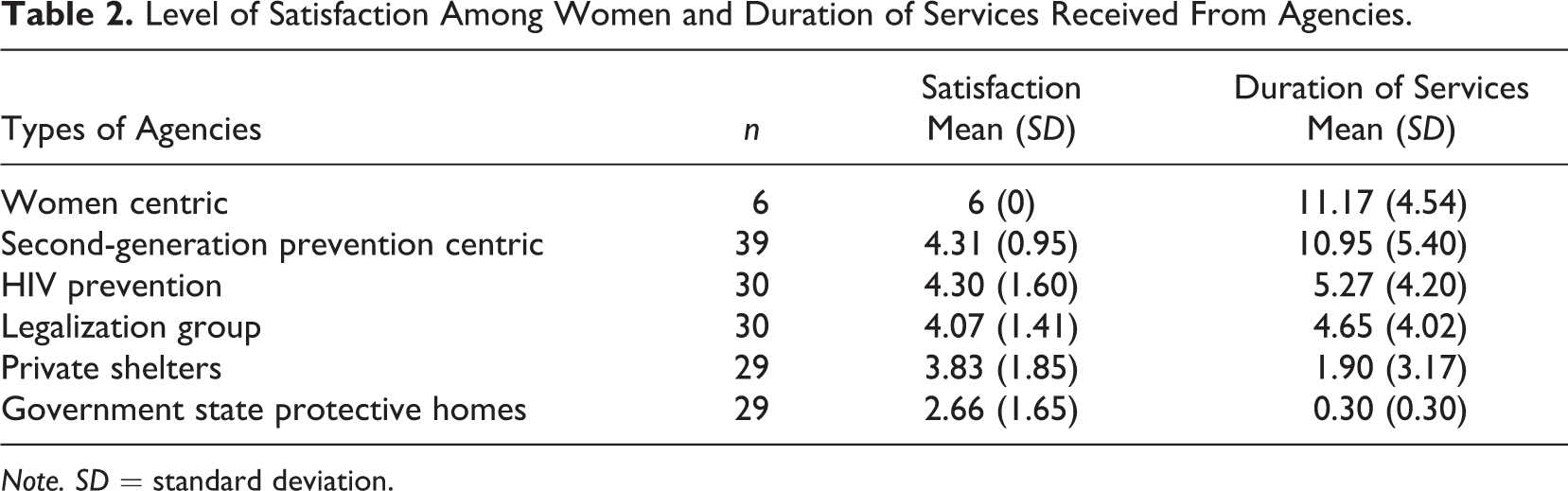
Once the six types of agencies (government state protective homes, private shelters, legalization group, HIV prevention, second-generation prevention centric, and women centric) working with women in or exiting from CSA were determined, it was important to examine the satisfaction of women with services received at each of these agencies. A one-way ANOVA was performed, with the types of agencies as the independent variable and the score women assigned to their level of satisfaction with the services received from their respective agencies as the dependent variable (see Table 2 for the means and standard deviations of satisfaction for each type of agency).
Level of Satisfaction Among Women and Duration of Services Received From Agencies.
Note. SD = standard deviation.
Levene’s F test revealed that the homogeneity of variance assumption was not satisfied (p = .000), which could be due to the unequal sample sizes of the groups as well as the lack of variance in scores among respondents when assessing the women-centric group. As such, Welch’s test was employed. An α level of .05 was used for all subsequent analyses. The one-way ANOVA of women’s average score on level of satisfaction with the services revealed a statistically significant main effect, Welch’s score = 2.78, p < .01, indicating that not all types of agencies had the same average score on the level of satisfaction. The estimated omega square indicated that approximately 20% of the total variation in the average score on level of satisfaction is attributable to differences between the types of agencies serving the women in CSA.
Post hoc comparisons, using the Games-Howell post hoc procedure, were conducted to determine which pairs of the six types of agencies’ means differed significantly. These results are given in Table 3 and indicate that women receiving services from women-centric agencies (M = 6, SD = 0) had a significantly higher average level of satisfaction than women receiving services from legalization groups (M = 4.07, SD = 1.41), HIV prevention (M = 4.30, SD = 1.60), shelter-based homes (M = 3.83, SD = 1.85), government state protective home (M = 2.66, SD = 1.65), and second-generation prevention-centric (M = 4.31, SD = 0.95) agencies. The effect sizes for these five significant effects were 1.93, 1.50, 1.66, 2.86, and 2.51, respectively. Additionally, women at the government state protective homes (M = 2.66, SD = 1.65) had a significantly lower average satisfaction score than women receiving services from the legalization groups, HIV prevention, and second-generation prevention-centric agencies, with an effect size of 0.92, 1.01, and 1.22, respectively.
Post hoc Results for Level of Satisfaction Scores by Types of Agencies.
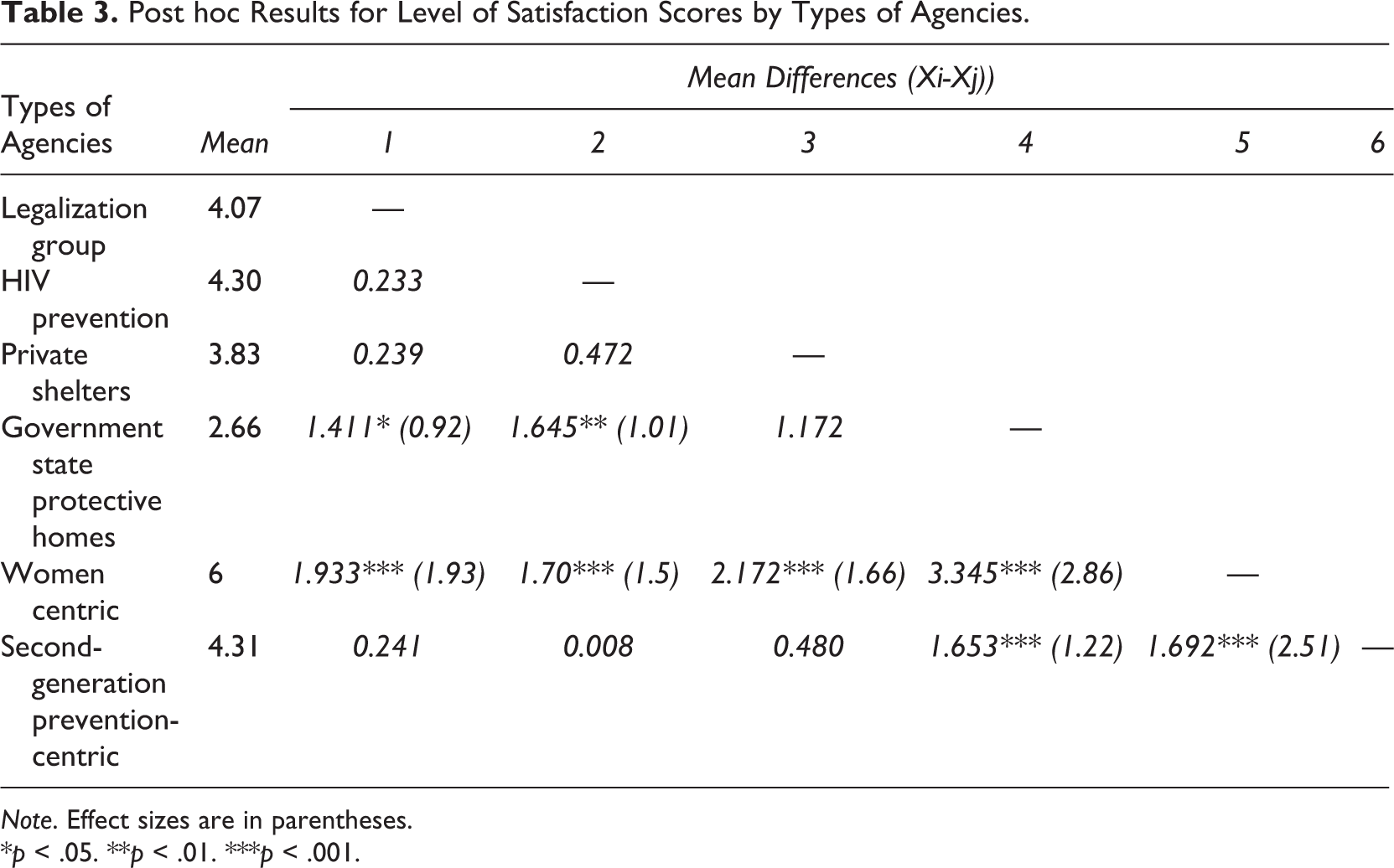
Note. Effect sizes are in parentheses.
*p < .05. **p < .01. ***p < .001.
Duration of Services
The duration of services in each of these types of agencies helps us understand the amount of time invested in the women by these organizations. The mean and standard deviation of duration of services for each type of agency is presented in Table 2.
Linear regression was used to predict the level of satisfaction among women in CSA based on duration of services received. The results indicated that the predictor did explain 6% of the variance, R2 = .06, F(1, 161) = 10.52, p = .001. It was found that duration of services significantly predicted level of satisfaction (B = .07, t = 3.24, 95% CI [.028, .116], p = .001), indicating that as the duration of services increased, so did the level of satisfaction among women receiving services at each type of agency.
Discussion
This study examined the different types of services offered by nine agencies to women in or exiting from CSA in India and the level of satisfaction expressed by those receiving services from these agencies. Interpreting levels of satisfaction experienced, along with duration of services received, by service users from agencies with differing organizational ideologies and frameworks helps us to better understand the variance we found in levels of satisfaction.
Government protective homes and private shelters align with a neo-abolitionist ideology, wherein women engaged in CSA are forced to stop their involvement in the sex industry immediately if they are to be rescued. The model focuses on abstinence, where involvement in CSA is seen as a form of gender-based violence and not to be tolerated (George et al., 2010). The solution is rescue and detention of women in rehabilitation settings. The model leaves no room for women to exercise discretion in making that choice. Such forced interventions, which are often State sponsored, disregard women’s “Stage of Change” along the continuum of exit and are known to cause more harm than good to those rescued (Wilson & Nochajski, 2018). Further, the State dictates what type of services the women receive, and the duration of their stay within the homes is fixed, stripping them of any freedom to make individual choices, while confining their movement to within residential institutions. The duration of services received in these agencies is very short compared to that of community-based agencies. The level of satisfaction with services is the lowest among women surveyed in this study. Government protective homes have significantly lower levels of satisfaction compared to all other types of agencies. There is a need for change in legislation and legal procedures that govern the functioning of government homes, which currently compel unwilling individuals to stay confined, calling them victims while treating them as offenders. Therefore, the new trafficking Bill 2018 must shift from an institutional to a community-based rehabilitation approach. Shelters are a preferred choice when women choose to disengage from CSA, but it must provide a safe and friendly environment for the rehabilitation and recovery process to occur (UNODC & National Institute of Mental Health and Neuro Sciences, 2011).
The legalization groups and HIV prevention agencies align with a neo-regulationists ideology, wherein they believe that involvement in CSA is legitimate labor (George et al., 2010) and that the sex industry is here to stay. Their concern about the well-being of women in CSA is seen in the preventive health-care services they offer and in the way they raise their voice against violence perpetrated on these women by the community, but they fail to see the needs of women beyond this point. Women’s needs for assistance to exit the sex industry, or their ability to earn a living through alternate sources, are not addressed. Thus, although satisfaction with services in these agencies is higher than that found in government protective homes and private shelters, it is significantly lower than that found in women-centric agencies. However, it was interesting to note that the level of satisfaction among women receiving services from legalization groups, HIV prevention, and second-generation prevention-centric agencies did not differ significantly. This may come as a surprise to many anti-trafficking agencies or abolitionist groups in the country, who assume that legalization groups do not benefit women. If the interventions only emphasize preventing children of women in CSA from entering the sex industry, then satisfaction is similar to that of women receiving services from legalization and HIV prevention agencies. Such services are limited and do not seem to be enabling.
From a feminist standpoint, moving away from binaries of abolitionist and regulationist ideologies while interacting with and providing services to women would assist in better understanding the complexities (Gringeri et al., 2010) involved in meeting the needs of women in or exiting from CSA. Women-centric agencies follow a nonjudgmental human rights approach to service provision where, although these agencies consider involvement in CSA as a violation of human rights, they do not discriminate against those still involved in CSA. The women receiving services from these agencies have complete freedom to make their own choices, decide on the kinds of services they need, and stay in a place of their choice rather than being detained in a residential type setting. The emphasis here is on the well-being of women, giving them the opportunity to take control of their lives and be truly empowered. That the level of satisfaction with services, as well as the duration of services received from these agencies, was significantly higher compared to that found among the rest of the agencies suggests that there is a marked difference in what these agencies are doing. Women in CSA need agencies that can provide prolonged dependable care, due to the experience and challenges encountered in the industry and the exit process. The focus must be on what they need rather than what the organization determines for them. Such an orientation requires immense time and resources. This might be the reason why these agencies serve fewer women.
Limitations
This study has several serious limitations. First, research studies conducted with vulnerable, stigmatized, or hidden populations—especially those in or exiting from CSA—generally face certain methodological challenges (Shaver, 2005), and these challenges were encountered in this study as well. The hard-to-reach nature of women currently in or exiting from CSA makes it difficult to adopt random sampling techniques. Therefore, the study obtained data only from those agencies that were willing to participate, and thus, we could not ensure that there was fair representation of more than one agency in each category of agency. Second, the sample size in each category of agencies was small, especially for the women-centric agencies, causing issues with meeting the test of homogeneity of variance. Nevertheless, the women-centric agency was included as a separate group in the analysis as the qualitative data from service providers suggested marked differences in their organizational framework compared to the rest of the agencies. The study could have benefited from a larger sample size of women in each type of agency to better understand differences in levels of satisfaction. Third, since this study adopts a cross-sectional view, it limits our understanding of how transitions might occur in the level of satisfaction among women engaged in CSA. This shortcoming can be alleviated in future research through the use of longitudinal data.
Implications
Despite the limitations stated above, this study has several important implications for interventions that are directed toward women engaged in or exiting from CSA. First, academics and practitioners have expended a lot of effort in debating the legal paradigms for addressing the needs of women in CSA, such as criminalization versus decriminalization versus legalization (George et al., 2010). However, findings from this study show that these ideological debates serve no purpose unless service provision is women centric, nonjudgmental, and empowers women so that they can make decisions about whether to be involved in CSA or not. Therefore, more effort and resources need to be invested in promoting a women-centric service provision approach, along with evaluating and identifying the components within such agencies that are effective. Second, agencies must consider providing long-term services to women in CSA, assisting and enabling them as they transition through different phases. Third, more community-based interventions need to be developed. Women seem to respond more positively to such programs as compared to residential or institutionally based interventions. These findings have direct implications for the rehabilitation models offered in the trafficking Bill 2018 passed in the Lok Sabha, which solely focuses on institutional-based rehabilitation. In addition, the provisions in the Bill could be modified to allow for a model, currently operating in the United States where women going through rehab are provided a safe space to stay rather than being confined to shelter homes. Women come into these residential programs by choice or through diversion programs. Once in, they are allowed to go out into the community with varying degrees of freedom attached to them depending on how each woman transitions through the rehab program. For instance, initially women are allowed to step out with a chaperon, then without a chaperon, and finally letting the woman make her own decisions, along with constant efforts by staff to influence her thinking and behavior (Oselin, 2009).
Conclusion
Exploring the organizational framework and ideologies of agencies assisting women in or exiting from CSA provides insight into the reasoning behind the provision of services by these agencies. The binaries of neo-abolitionist and neo-regulationist ideologies limit the agencies’ abilities to identify and provide what women in CSA need. Adopting a women-centric approach would empower women to make decisions about their lives (whether to be involved or not in CSA) and suggest the type of assistance needed, be it shelter, health, children’s education, or alternative livelihood options. Being involved in CSA has multiple implications for the individual options available to women. To make informed choices and lay the social and economic foundations for a viable future, women involved in CSA need varied support mechanisms over a prolonged duration of time, which the State can offer. In sum, instead of adopting a moralistic position, the State needs to examine what is best for the women involved in CSA and offer appropriate assistance, respecting their dignity and rights.
Footnotes
Declaration of Conflicting Interests
The author(s) declared no potential conflicts of interest with respect to the research, authorship, and/or publication of this article.
Funding
The author(s) disclosed receipt of the following financial support for the research, authorship, and/or publication of this article: Fahs-Beck Doctoral Dissertation Grant, Gender Institute, University at Buffalo.