




Abstract
Whether and how social service providers use practice strategies that address racism is critically understudied, particularly with people who are at risk of sex trafficking. The purpose of this article is to understand (1) the perceptions of racial disparities in sex trafficking (as learned from sex trafficking education), and (2) the strategies used to address racism in practice (color-evasiveness, anti-oppressive practice [AOP]). We used a directed content analysis approach to analyze 24 semistructured, in-depth interviews of providers who knowingly encounter sex-trafficked young people in a majority white region of a Midwestern state (census indicates that minority populations include African American, Native American, and Hispanic/Latino people). Findings suggest that providers perceived sex trafficking education (e.g., trainings they attended) as predominantly focused on economic standing and family risks, rather than racial disparities and roles of structural racial oppression. They also experienced challenges in naming the racial identities of clients and addressing racism in practice. Implications for implementing critical consciousness and AOP strategies as well as future research directions are discussed.
Social service providers who work with people at risk of sex trafficking must provide inclusive services, while also seeking to acknowledge and dismantle structural oppression and racism (Bryant-Davis & Tummala-Narra 2017; Gerassi, 2019). Without implementing a critically conscious, anti-oppressive practice (AOP) approach to purposefully address racism and reject color-evasiveness (Danso, 2009, 2015, 2018; Dominelli, 1998), providers risk-taking an “everyone at risk” approach that further perpetuates racialized assumptions that sex trafficking occurs predominantly to young white girls and women (Nichols, 2018; Peffley & Nichols, 2018). Research that explores providers’ perceptions of racial disparities and the use of critical consciousness and AOP approaches in sex trafficking practice is limited. The current study draws from semistructured interviews with 24 social service providers in a Midwestern region to understand (1) the perceptions of racial disparities learned from sex trafficking education and (2) the strategies used to address race and racism in social work practice.
Background
Racial Disparities in Sex Trafficking Victimization
Sex trafficking occurs when (1) a minor exchanges a sex act (e.g., prostitution, pornography, stripping) for financial compensation (e.g., food, money, clothing, housing, drugs) or (2) an adult (over the age of 18) is induced through force, fraud, or coercion to perform a commercial sex act (Clawson et al., 2009; Nichols, 2016).
Racial Disparities in Sex Trafficking Victimization
Although the exact prevalence of sex trafficking is unknown, sex trafficking research using law enforcement, social service, and high school data in the United States suggests that people of color, particularly African American/Black, Latino/a/x, and Indigenous/Native American/First Nation people, 1 are at elevated risk of sex trafficking (Dank et al., 2015; Franchino-Olsen, 2019; Martin & Pierce, 2014). In the Midwest, Nichols and colleagues (2019) found that trafficked youths in Missouri and East St. Louis area (Illinois) are more likely to be Black or Latinx when compared to their white counterparts. A Minneapolis study using police records found that approximately half of sex-trafficked victims (n = 73) were African American or African born (Martin & Pierce 2014). New research using representative samples in Midwest high school settings suggests that students who report sex trading are more likely to be Black, Latinx, and Indigenous (Martin et al., 2020). Such overrepresentations of Black, Latinx, and Indigenous people are due to structural oppression, resulting in the disproportionate economic standing, unequal opportunities, and disproportionate incarceration rates, which further increase vulnerability to exploitation (Dank et al., 2015; Gwadz et al., 2009; Nichols, 2016).
It is also important to note that studies have shown an intersection between oppressions across race, gender, and sexual orientation, particularly among homeless and housing-instable youths. For example, a study in New York found that LGBTQ+ youths were seven to eight times more likely to trade sex than non-LGBTQ+ youths (Alessi et al., 2020). Dank and colleagues (2015) found that Black and Latinx, LGBTQ+ youths are more likely to be engaged in survival sex than white LGBTQ+ youths. A study of 10 North American cities found an overrepresentation of trafficking among Black, Indigenous, multiracial, and Latinx youths as well as LGBTQ+ youths, further underscoring the intersection of gender, sexual orientation, race, and trafficking (Murphy, 2017). Consequently, scholars, practitioners, and survivor activists recommend that sex trafficking education (including provider and community trainings) addresses race and racism (as well as other intersecting structural oppressions; Bryant-Davis & Tummala-Narra, 2017; Nichols, 2018; Gerassi & Nichols, in press).
Social Service Providers’ Knowledge of Sex Trafficking
An “everyone-at-risk” approach
Sex trafficking education often falsely advances the idea that everyone is at risk of sex trafficking (regardless of race, economic standing, and sexual orientation), thereby ignoring the roles of structural oppression in heightening risk (e.g., racism, classism, heterosexism; Peffley & Nichols 2018). Discussions of sociodemographic risk factors often focus on sex (e.g., differentiating people as “male” and “female” without attention to gender diversity) and runaway status/socioeconomic standing only (Peffley & Nichols, 2018). Proponents of an “everyone at risk” model suggest that this approach is useful to raise general public awareness and financial or political support (Nichols, 2016). However, this approach may add to racialized assumptions or stereotypes that sex trafficking predominantly impacts white females. Racial coding of white victims who are trafficked by Black men has a long-standing history, which enforces racist ideas of white superiority and the sexualization of women and girls of color (Bryant-Davis & Tummala-Narra, 2017; Musto, 2009; Peffley & Nichols, 2018). Commonly viewed images of Black men’s hands covering young white girls’ mouths perpetuate white slavery ideas (Peffley & Nichols, 2018), while images promoting the sexual immorality, promiscuity, and aggressiveness of women and girls of color suggest their willing participation (Bryant-Davis & Tummala-Narra, 2017). These images further perpetuate racism and ignore the roles of structural oppressions that heighten the risk of sex trafficking. Lack of inclusive images across gender, race, and sexual orientation can also be a barrier for people to access services (Peffley & Nichols 2018; Gerassi & Skinkis, 2020). Thus, service providers must be inclusive of diverse racial groups while acknowledging and working to dismantle structural oppressions and racism.
Approaches to Practice
Color-evasiveness in practice
Color-evasiveness refers to the ideology that one does not notice color or race and, as such, one treats everyone the same regardless of race or ethnicity (Annamma et al., 2017; Bonilla-Silva, 2006). In line with an everyone-at-risk approach of trafficking, color-evasiveness ignores structural determinants of oppression that impact individual circumstances and create unequal access to opportunities, choices, and advancements (Bonilla-Silva, 2006; Holoien & Shelton, 2012). Color-evasive approaches can decrease individuals’ sensitivity to racism and discrimination and have negative implications for interracial interactions in organizations (Holoien & Shelton, 2012; Plaut et al., 2009, 2018). As such, the systemic factors that may contribute to sex trafficking risk are unacknowledged in a color-evasive approach (Bryant-Davis & Tummala-Narra, 2017; Gerassi & Nichols, 2017). For example, there are racialized stereotypes of promiscuity and sexualization, particularly among Black, Asian, and Latina women (Anderson et al., 2018; Bryant-Davis & Tummala-Narra, 2017). These stereotypes may create barriers for individuals of color who are at risk of sex trafficking when working with social service providers, as people of color are not recognized as sexually vulnerable or potentially victimized. Given that social service providers in this field are overwhelmingly white women (Bent-Goodley, 2005; Salsberg et al., 2017), avoiding color-evasive approaches is especially imperative to adequately address the needs of people of color who are at risk of sex trafficking. Therefore, practice frameworks that avoid color-evasiveness and foster critical consciousness of race and racism in social services are recommended.
Critical consciousness and AOP
In contrast to color-evasiveness, AOP is the reflective and critical process of actively challenging domination and structural oppression at an interpersonal and structural level (Dominelli, 1998). AOP recognizes that “oppression is a system of domination that denies individuals dignity, human rights, social resources, and power” (Dominelli, 1998, p. 15) and considers how structures (e.g., institutions, laws, policies) favor groups that hold power at the expense of those who do not (Cohen & Mullender, 2005; Dominelli, 1998). In order to engage in AOP, providers must engage in critical consciousness or the processes by which self-reflection is focused on social positionality, power differences, and subsequent action to address social injustice (Fook, 1993; Sakamoto & Pitner, 2005). Critical consciousness is an important part of AOP because it prepares providers to address complex power dynamics that manifest in microlevel practice (see Fook, 1993; Pitner & Sakamoto, 2005; Sakamoto & Pitner, 2005; Suárez et al., 2008). Critical consciousness and AOP require service providers to move beyond considering “everyone is at risk” of sex trafficking and work to destabilize the power systems that cause disproportionate harm to certain groups over others (Bryant-Davis & Tummala-Narra, 2017; Valandra, 2007). Instead of seeing social identities as individual risk factors (e.g., race), AOP uses critical consciousness processes to consider broader systemic inequities (e.g., racism) and how they intersect with each other in increasing the risk of sex trafficking.
Current Study
The extent to which providers understand sex trafficking risk within the context of racial oppression and integrate color-evasive or critically conscious approaches into their work with people at risk of sex trafficking remains critically understudied. Drawing from the perspectives of social service providers who knowingly encounter sex trafficking in a majority white region of a Midwestern state, the purpose of this article is to understand (1) the perceptions and lessons learned regarding racial disparities from sex trafficking education (e.g., provider trainings) and (2) the strategies used to address race and racism in practice.
Method
This qualitative study used a community-based approach to develop research questions in partnership with the regional Department of Health and Human Services Youth and Family Services (YFS) in a Midwestern state in 2018. According to the census, this region is mostly white with minority populations in the region include African Americans, Native Americans, Hispanic/Latino, and Asian people. At the time of the study, YFS was in the process of creating, disseminating, and implementing a regional response protocol for suspected and confirmed trafficking cases for the region of the Midwestern state. The first author, YFS anti-trafficking program coordinator, and regional child protective services (CPS) caseworkers collaborated on the larger study’s research questions, interview guide, and overall design. The larger study aimed to (1) understand the use and feasibility of evidence-informed practices among social service providers who encounter diverse sex-trafficked individuals and (2) identify how providers address the needs of diverse people who are at risk of sex trafficking (e.g., race, gender, sexual orientation). The first author presented major themes, including themes used for analysis in this article, to the YFS anti-trafficking coordinator, supervisors, and caseworkers multiple times throughout data collection and analysis to contextualize findings and discuss the resulting action steps. Institutional review board approval was obtained from (the University of Wisconsin-Madison).
Sample and Recruitment
A total of 24 social service providers representing multiple social service organizations across a 17-county region in a Midwestern state participated in this study. First, the research team conducted a content analysis of websites from all organizations in the area that encountered sex trafficking in practice, such as services that addressed homelessness, foster care, mental health, intimate partner violence (IPV; Gerassi & Skinkis, 2020). The content analysis allowed us to identify those organizations that directly or indirectly provided services to sex-trafficked people (minors and young adults). The content analysis and resulting discussions with YFS and CPS caseworkers generated a list of key informants. These data were also compared to organizations most commonly utilized by community partners for case referrals (e.g., particular homeless and runaway youth providers). Approximately 28 social service providers from 25 organizations were identified as providers who encountered sex trafficking in practice, all of whom were contacted for the present study.
Of the 28 potential participants who were contacted via email for recruitment, 24 responded and agreed to be interviewed, the other four did not respond. Collaboration with YFS was clearly stated in the email and informed consent documents. Importantly, the materials made clear that YFS would only receive a summary and de-identified data from the study and that the participation would be confidential. Potential participants were asked to schedule a phone or videoconferenced interview. Study participation was open to any regional social service provider who had provided services to individuals (minors or young adults) who they suspected or confirmed to be sex trafficked. Sample characteristics (n = 24) are summarized in Table 1.
Participant Demographics.
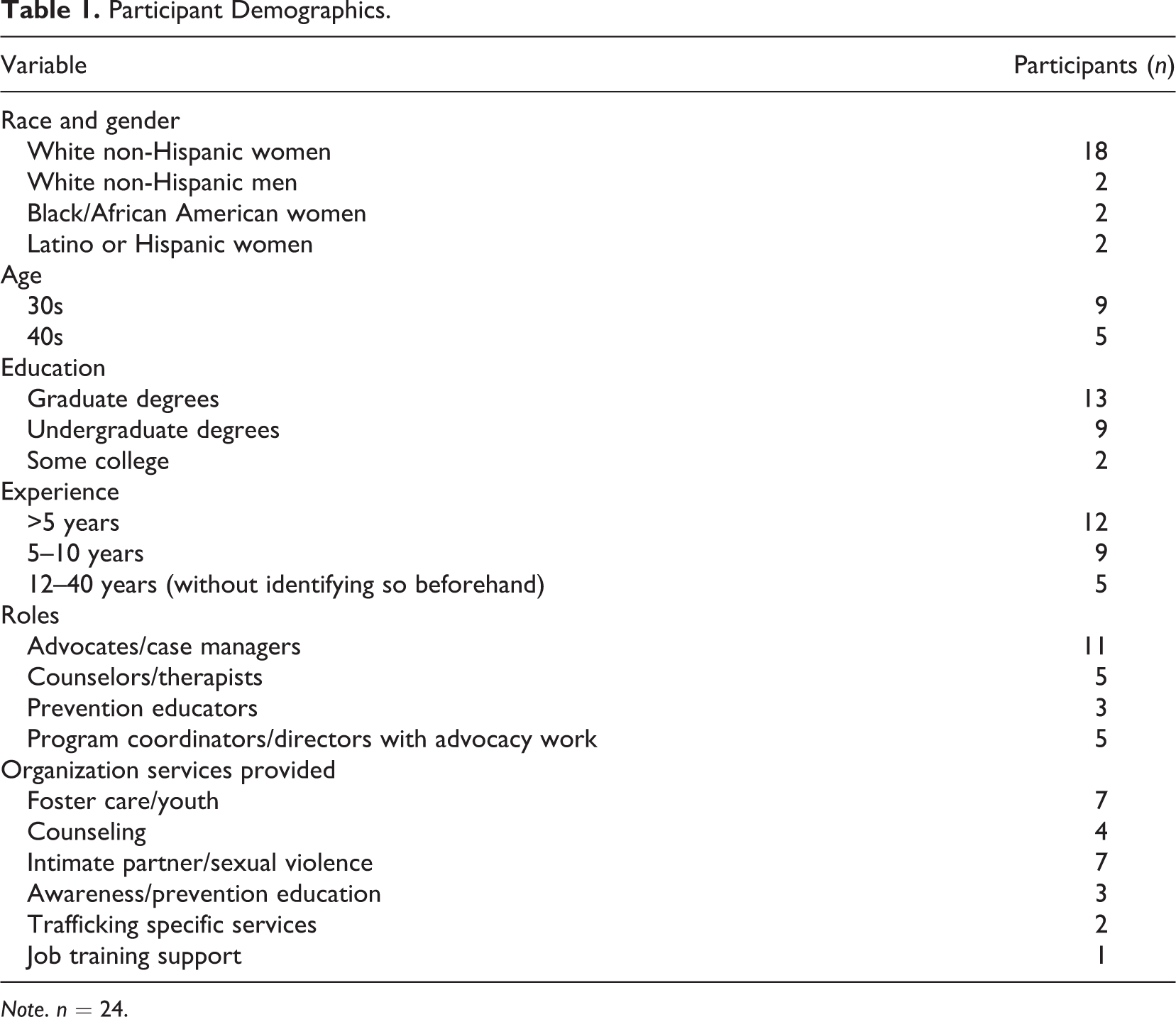
Note. n = 24.
Data Collection
Per participant preference, all interviews were conducted by phone by the first author. Most interviews lasted about an hour but ranged from 40 to 90 min. The first author e-mailed the informed consent to the participants and reviewed the study information by phone. She also provided a brief description of her social work practice and research background, noting her interest in improving the quality and inclusiveness of social services for people of diverse races, genders, and sexual orientations who are at risk of trafficking. Participants were then asked for permission to record the interview and provided their oral consent.
The interview guide explored participants’ perceptions of sex trafficking education and the practice strategies used with different subpopulations of people at risk of sex trafficking (i.e., immigrant victims, people of color, and LGBTQ+ people). Questions about sex trafficking education began with exploring whether participants had received sex trafficking education and how helpful they were. We explored providers’ perceptions of whether and how the trafficking education discussed race (e.g., “How did trainings discuss populations of people who were at risk of sex trafficking?”). If race was not described, we further prompted (e.g., “Did trainings discuss the disproportionate risk of particular groups of people?”), and, if further needed, we asked specifically about whether and how trainings addressed the impact of sex trafficking on Black, Latinx, and Indigenous subpopulations. Another set of questions focused on the participants’ perceptions of the demographic trends on their caseload (including prompts about racial groups, as needed) and practice approaches to addressing the needs of Black, Latinx, and Indigenous subpopulations of survivors. Such questions were tailored according to the social service provider’s role and organization type (i.e., “How do you address race in your sex trafficking prevention materials, if at all? How diverse would you describe the people featured in your prevention materials?”). After the interview was completed, participants were asked to complete a demographic questionnaire verbally or via email.
Data Analysis
The research team, consisting of the first author and a research assistant, used a directed content analysis approach to conduct multiphase independent co-coding (Hsieh & Shannon, 2005; Potter & Levine-Donnerstein, 1999). Selective coding was first used to identify patterns from the interview guide, which related to use, applicability, and feasibility of direct practice strategies with multiple populations, including people of color. Inductive analysis was used to identify latent, emerging themes, which included discussion of racial disparities in sex trafficking education, recognizing race in practice, and avoiding discussion of race in practice. Key themes regarding color-evasive practice and/or the avoidance of discussion of race or integration of racially diverse individuals in case materials were identified through an independent, open-coding process and developed throughout the course of interviews. The team discussed changes to coding schemes and were consistently agreed upon through the data analytic process. It is important to note that the members of the team responsible for the analysis and writing of this article identify as white/Hispanic cisgender woman (first author), white/Latinx queer nonbinary femme, and Latinx queer woman. The first author sought feedback throughout data collection and analysis from key stakeholders of color in the area who indicated that the findings here were generally reflective of their perceptions of social service providers’ discussions (or lack thereof) on race and racism.
Findings
Findings suggested that participants predominantly attended trainings that highlighted an “everyone-at-risk” or color-evasive approach, without recognizing and acknowledging the racial disproportions in sex trafficking (n = 20). Most participants (n = 19) struggled to describe their caseload in terms of racial trends but rather focused on characteristics of low economic standing or homelessness. Five providers (e.g., three providers of color as well as two white providers who sought sex trafficking trainings specifically within Black, Latinx, and Indigenous communities that were led by Black, Latinx, and Indigenous leaders), highlighted critically conscious, AOP approaches. These consisted of recognizing the intersecting structural oppressions (i.e., racism) that impacted their Indigenous and Black clients and taking actions to address such inequities.
Sex Trafficking Education
Providers described a wide variety of sex trafficking information sources ranging from trainings (e.g., courses or local trainings conducted by state or nonprofit organizations) to reading the news. There were vast differences in service provider perspectives on whether the trainings they received focused on the disproportionate impact on people of color.
“Everyone-at-risk” trainings
Most providers (n = 20) in our sample received trainings that, to their recollection, did not focus people of color’s disproportionate risk or vulnerability to sex trafficking. For example, Eliza, a white therapist, took two human trafficking courses at different points of her college and master’s education. When asked about whether the trainings she attended addressed the disproportionate risk of particular communities, such as people of color, in sex trafficking, she replied “Not a whole lot that I can remember.” When trainings discussed disproportionate impact, there was less of a discussion of structural racism and its impact on people of color, but rather a focus on their circumstances, such as runaway and homeless youths. For example, Bonnie, a white advocate/administrator at a youth program was asked specifically about whether and how sex trafficking education discussed disproportionate risks specifically among people of color, she replied that the trainings “did not…. They very briefly touched on the unaccompanied youth, but it wasn’t a huge conversation about those risks.” Mila, a Latina IPV advocate, expressed frustration with how trainings did not address the impact of structural racism at all, As far as [trainings addressing] racial disproportions, no. I live in a really white area, and typically I know this isn’t going to be popular, but that bias and that white supremacy is very evident even within that social work with the trainings and certain things that we’re not talking about. As a POC [person of color] …I’m like, “Oh, why aren’t we talking about these other things or how are we seeing this or is there bias in the study or is there bias in here?”…. It just is ignored. I think ignoring it is just the same as allowing it to keep happening. Those biases that we have or being like, “Oh, well, that’s why their more at risk, because they’re POCs,” and it’s like no…. Especially in our field. We don’t limit any ethnic background or anything, or sexual orientation or anything. We take the position that it could come from anywhere. We’ve seen it come from anywhere, so we address it from every aspect that we can…. In doing that, it crosses all those backgrounds, because it covers different areas and different people. Trafficking is not a local problem, it is a world problem and it crosses every ethnic background, socioeconomic status, anything you can think of that you think might pigeonhole people…. I know that people like to believe that [race] has a whole lot to do with it, but traffickers are just like any other businessmen…. People like to believe that it’s a racial issue and there are a lot of African American girls from the inner city that are involved in human trafficking, and yes there are. But there are a lot of girls in the suburbs that are involved in trafficking, and there are a lot of housewives that are what we would identify as a soccer mom that are involved in trafficking. Really, really, I want people to understand that this is a human problem, and I really wish they would stop pigeonholing it into specific races, because then that allows us to approach it from a different area. We need to approach it as a global person problem, which is what it is.
Critically conscious trainings
A small group of providers (n = 4), however, described attending trainings that showed the disproportionate impact of sex trafficking risk, including people of color, thus raising critical consciousness and discussing how they applied it in their practice. For example, Ellen, a white sexual assault counselor, indicated that her framework for practice involved disproportionate risk among people of color, It seems to really be the prominent overtone in a lot of areas, I mean, women of color, just individuals of color, being more subjected to being in prison or subjected to all these different things…basically moving forward and working with that. The [Native] population is at higher risk for victimization. So if you have an understanding of that, before even doing a webinar, listening to something like that or an in-person training is even more helpful…. So, I guess just having that background already has helped me a lot.
Approaches to Sex Trafficking Practice
Participants held a wide range of understanding of the racial demographics of their caseload and how they addressed racism in practice.
Color-evasive approaches
When asked about demographic trends in their caseload, most providers (n = 19) typically first avoided describing race and focused on the overrepresentation of women and girls at risk of sex trafficking. For example, as a white youth program therapist, Eliza first indicated that her caseload was mostly female, before recognizing the whiteness of her caseload, I don’t know if I’ve really noticed a whole lot. It’s mainly females…. I assume [many people who] may be in a survival sex stages, are male…[pause] No specific ethnicity, although our ethnicity is mainly Caucasian. Well, in our training…we keep it pretty simple [or]…basic…we don’t want to single out any one race in particular or any ethnic group. We don’t want to do that. Our schools are so diverse right now so we basically, our focus is the emphasis on girls and boys…. And we purposely, when we put our presentation together, we did not want to use any kind of strong cultural person, African American or Asian [for the video]. We did not want to have any stereotyping for either the victim or the pimp because I think…the adult generation remembers…everything being culturally different, it wasn’t that “it was the Black race they were the pimps they were the ones doing the trafficking” well not so!…we wanted to appeal to a larger audience and…everything we keep it pretty white…because I don’t want anybody to feel that we’re picking on any one race…. You know we are a smaller community, we’re not like the big city…. Bigger cities are you’d think, “it always happens there” but the rural communities they think they’re isolated and excused from it…. That’s why the film speaks…to all communities.
Critically conscious and anti-oppressive approaches
Although color-evasive approaches were more commonly discussed, a few providers (n = 5) acknowledged the intersections between racism and classism, in accordance with a critically conscious approach, and the description of the overrepresentation of people of color among their clients. Jessica, a white counselor, suggested that “so many times women of color in our area are at poverty. Anybody that’s at poverty can be at a higher risk.” Though this reflection began similarly to Betty and Eliza, she went on to describe this heightened vulnerability, [Women of color] are much more likely to be vulnerable because you’re a minority. There’s a lot of biases, maybe, that people have. Definitely because when we’re looking at the women of color in our area, many times they are earning the same amount. So now you’ve got a mom that has three or four children, and you’re going, “I know that she’s a prostitute.” I’m quoting, “And why is she doing that?” So we’re going, “Whoa, whoa, whoa, whoa, whoa, she is not a prostitute. She is being prostituted. Somebody’s exploiting her because she doesn’t have the income to take care of her children.” Most of the women that I meet in the sting…. Once I make that initial jail visit and I talk to them…then once I ask a couple of questions, they start talking to me and seeing that I’m somebody that…can help and possibly trust, then it’ll come out, “Well, I’ve been doing this since I was 12 and my dad started me in the trafficking life.” But it just takes that time to work with them and get them to feel comfortable with talking to me. One of the ladies, she was a native, and she told me about how she was trafficked…she had assumed I was native, because I am Latina. We didn’t really go into that. She didn’t ask me. Then, probably 3 months in, she saw me pretty regularly, and she didn’t really trust many people. She was asking me what tribe I was in, and I told her, “I’m not native. I’m actually Latino.” She was like, “Thank God. You didn’t tell me 3 months ago, because I would have never told you anything.” I was like, “Oh, my gosh.” Just knowing that it’s so needed that there are different people that people can feel…that will understand you culturally or understand the different dynamics in order to be able to disclose. So, I do think that that’s positive in having POCs in different aspects of these…sensitive topics. I would say it would be a rarity.
Two white providers, such as Claire, the sexual assault provider who received training about the dynamics about sex trafficking among Native communities, reflected on the connection to her work. She reflected, Me, being a Caucasian, white woman and walking into that community, without already the approval of somebody who was Native American that maybe invited me in or came with me, I would not get a lot of respect in that community. Having a collaborative partner in that community that you are meeting with, that you are getting an understanding of the pulse of that community, what some of their struggles are, is super important before you do anything, thinking you’re just gonna walk in and save that tribe. I currently have a relationship locally with the [Tribal Reservation]. I have spent time fostering that relationship and we’ve done some collaborative things together. If I needed to…. I could reach out to including tribal law enforcement. I could say, I’m seeing this as an issue, I have community members that are coming to me with this issue, what can we do to better address it? I think our proximity to the reservation and we do have some grants…for working with that specific kind of groups, we might have more outreach in those areas, but we do serve everybody. We have a weekly women’s group that is open to everybody [and] blends of the native traditional healing medicine, so we will have tobacco on hand. The curriculums that we use that are geared toward Native Americans but, again, can be for anyone. A lot of [Native Americans are] dealing with historical or generational trauma…. We have a holistic healer on staff who does Shamanic healing and Reiki and does a lot of smudging and burning sweetgrass and things like that…there’s kind of the underlying approach, I guess like a cognizance of historical trauma and Native healing practices with that in our…curriculum.
Discussion
Our study suggests that providers may struggle with emphasizing critically conscious, AOP approaches to social work practice with people at risk of sex trafficking, which is only further emphasized by the takeaways of their own color-evasive sex trafficking education. This study holds some important implications for social work training and practice. Given the predominantly white social service workforce (Salsberg et al., 2017) and overrepresentation of people of color among people who are at risk of sex trafficking, an effort to integrate critically conscious, AOP approaches, particularly among white providers, is crucial.
Training
Our study found that providers perceived the trainings they attended on sex trafficking typically focused on risk factors, such as homelessness, socioeconomic status, and unaccompanied minors, rather than specifically addressing the structural elements of racial oppression. Furthermore, reflections on trainings that were led by providers in our sample suggested that they similarly used an “everyone is at risk” model to avoid stereotypes. This may be particularly difficult for trainers like Dawn, whose trainings aimed to both avoid racialized assumptions about Black urban youth and indicate that trafficking can occur to those with more privileged identities (e.g., white) and in rural contexts. Such concerns are certainly valid, as stereotyping can occur when discussing risks of trafficking and other social problems that impact mostly the people of color (Mulvey et al., 2010; Rattan & Ambady, 2013; Stevens et al., 2018). Using a critically conscious approach could describe the roles of white supremacy and oppression that result in the overrepresentation of Black, Latinx, and Indigenous communities in sex trafficking. This can be critically important in training about sex trafficking risk without stereotyping or perpetuating racialized assumptions about Black, Latinx, and Indigenous communities. An alternative approach of focusing on socioeconomic status without critical consciousness of race is, in fact, perpetuating white supremacist norms (Blacksher & Valles, 2021). Practice examples could address case examples in which clients of color encounter racism in addition to classism, heterosexism, and sexism (as relevant) or experience disproportionate rates of incarceration and other implications of systemic racism (Gwadz et al., 2009). For example, “In Their Shoes” is a simulated training experience for intimate partner/teen dating violence, which allows participants to walk through the choice points for economically disadvantaged survivors (Earlywine & Stohl, 2005). The discussion guide instructs facilitators to “confront oppression in the group” by helping participants to understand that “the dynamics of oppression that support and uphold domestic violence, economic injustice, racism, xenophobia, able-bodyism, 2 heterosexism, and all of the ways that privileged groups maintain their power and control over others” (p. 40). Sex trafficking education must implement similar approaches and future research should evaluate the extent to which such trainings impact providers’ perceptions of racism in their work and actions taken to address structural oppression in their work.
Practice
Most of the white providers did not offer descriptions of racial demographics among clients and, when prompted further, typically pointed toward demographic trends of economic standing, poor family relationships, and/or runaway or homeless youth status. Only when prompted to specifically discuss the racial demographics of their caseload that they, in some cases, offered observations about the race trends of their caseloads. This hesitation may have been because of a concern of stereotyping or discussing race, which may further underscore the need for social service providers to practice how to talk about race in relation to their work. The inability to use a critically conscious approach to name and acknowledge race and racism (Sakamoto & Pitner, 2005) translated to their sex trafficking prevention and intervention practices, as prevention curricula were made to be white and the general discussion of race suggested that victims could be anyone. This could suggest that local prevention curricula were seen as safer not to include diverse people in order to avoid stereotyping. Indeed, providers’ attempts to avoid stereotyping, though possibly well-intentioned, only further erased race in a color-evasive narrative, which has been shown to potentially cause harm to people of color (Apfelbaum et al., 2008; Holoien & Shelton, 2012; Rattan & Ambady, 2013). Recognizing these intersections is critically important to providing anti-oppressive advocacy and culturally relevant services for people who are at risk of sex trafficking (Apfelbaum et al., 2008; Corneau & Stergiopoulos, 2012).
Though few service providers in our sample identified as people of color, our study also found that they had experiences that gave them unique insight that the white service providers in the sample did not have. For example, service providers of color discussed how their clients would perceive that they shared an ethnicity, even if they did not. Due to this affinity, their clients of color might share more or different kinds of information with them than they would with white service providers. Furthermore, most of the richer narratives and themes related to using and engaging in critical consciousness came from the providers of color in this sample. Though we cannot know from these data whether such critical consciousness translated into AOP, we do know that critical consciousness is needed in order to fully integrate an AOP framework into practice. Taken together with differences among white providers, these findings underscore the need for critical reflexivity in social work to raise critical consciousness and move toward an AOP framework, particularly among white providers (Brown, 2012; Fook, 1993; Sakamoto & Pitner, 2005; Suárez et al., 2008). Without doing so, social workers risk reproducing dominant social discourse and further perpetuating white supremacist culture. This can range in many forms from lack of deconstruction of the concept of race and increasing invisibility to lack of advocacy of stronger policies that support people of color in the criminal justice system or immigration systems to through lack of purposeful efforts to recruit, retain, and support people of color across levels of the social service organization (Corneau & Stergiopoulos, 2012). Such policies may impact individuals of color who are at risk of sex trafficking. Additionally, future work should explore the perspectives of providers of color who work with people at risk of sex trafficking, specifically about their perceptions of critically conscious, AOP practice and any resulting challenges in working with white colleagues.
Limitations
Our study’s findings and implications should be taken within the context of its limitations. First, providers’ perceptions of the discussion of race and racism in past trainings are subjected to recall bias, as participants may not have accurately described the discussion of race and racism in the training. Future research should use a content analysis approach to understand whether and how issues of race and racism are discussed in sex trafficking education and evaluate their impact on social work practice. Second, this study examined provider perceptions through semistructured, in-depth interviews only. Future research should examine the perceptions of clients of color who interact with such providers.
It is also possible that providers’ responses reflected discomfort with the interviewer or study participation rather than discussing race or racism. However, these providers did not exhibit discomfort when answering other study questions (e.g., questions about the extent to which service providers implemented evidenced-based practices in the work with people at risk of sex trafficking). This study was unable to fully understand the role of racist attitudes nor did the authors ask if providers received specific anti-racism or AOP trainings outside of sex trafficking education. Though every effort was made to thoroughly exhaust potential participants in the region who knowingly encounter sex-trafficked people, it is possible that some providers were missed (and therefore not contacted) in our community-engaged purposive sampling process. This may be important to particularly capture the perceptions of providers of color. However, the racial demographics of our sample reflect the racial demographics of the social service workforce in the United States (Salsberg et al., 2017) and specifically in this region. This analysis also did not examine how providers addressed intersecting identities, such as gender and sexual orientation, along with race. Salient findings regarding gaps in providers’ knowledge of and practice strategies with LGBTQ+ people emerged in the larger study and therefore merited a different paper. Future work should use an intersectional approach to examine how providers address race, gender, sexual orientation, and (dis)ability status, for people with intersecting, oppressed identities. It is also possible that the relationships between potential participants (including the four who did not respond to us) and the anti-trafficking coordinator influenced our findings. Finally, future research should explore how these dynamics emerge in other geographic contexts, particularly in locations that are more ethnically and racially diverse.
Conclusion
This article sought to understand how providers perceived sex trafficking education that focused on race and racism, and whether and how providers integrate a critically conscious, AOP lens stemming from their sex trafficking education and practice. Given the domination of white people providing social work services to disproportionately Black, Latinx, and Indigenous groups among other oppressed racial groups, it is essential that sex trafficking and broader social service and social work trainings address race and racism, and implement an AOP practice approach that is tailored toward the racial identity of the provider (i.e., language used to address race may differ for a provider of color as compared to a white provider). Future work should examine the extent to which such differences in practice approaches increase positive outcomes of social service engagement, particularly among clients of color who are at risk of sex trafficking.
Footnotes
Acknowledgments
We are deeply grateful to our community partners as well as the participants of this study for sharing their time and experiences with us.
Ethics Approval
University of Wisconsin–Madison IRB.
Declaration of Conflicting Interests
The author(s) declared no potential conflicts of interest with respect to the research, authorship, and/or publication of this article.
Funding
The author(s) disclosed receipt of the following financial support for the research, authorship, and/or publication of this article: Baldwin Wisconsin Idea Endowment Fund.
