




Abstract
This article, written by two Indigenous female identifying social work practitioners, academics, and researchers with lived experience of violence, is based on a preliminary research project with survivors of trafficking and those who offer them support services. It includes the voices of women, two-spirit, and trans women who have been trafficked, tackle the issues of the current impacts of colonization and structural racism as the root of gender-based violence, and offer pathways forward at the grassroots and systemic levels. The authors also argue that research into gender-based violence toward Indigenous women, girls, two-spirit, and trans women be controlled and owned by Indigenous peoples and communities.
Keywords
Violence toward Indigenous women, girls, two-spirit, and trans women is systemic in nature and has its roots in Canada’s colonial history. Women have always been specifically targeted for violence through federal policies and legislation, such as the Indian Act of 1876, which were created to undermine family, community, and political structures (Hargreaves, 2017; Lavell-Harvard et al., 2016; Smiley, 2016). The intent was to make Indigenous cultures disappear by disappearing the ones who bring life into the world and who pass on the values and cultural teachings. This historical and ongoing persistent violence continues as a tool for Canada to control land and resources. It is further enabled by collusion of police forces, the judicial system, and an indifferent Canadian public.
Contrary to non-Indigenous women whose homicides are most likely to be caused by intimate partners, Indigenous women are just as likely to be killed by a white male stranger or acquaintance (Standing Committee on the Status of Women, 2011). Yet there is a reluctancy on the part of society to acknowledge this fact as questioned by Kwagiulth scholar, Dr. Sarah Hunt, (2014): Why are we so hesitant to name white male violence as a root cause, yet so comfortable naming all the ‘risk factors’ associated with the lives of Indigenous girls who have died? Why are we not looking more closely at the ‘risk factors’ that lead to violence in the lives of perpetrators?
Background: How Serious Is It?
As a result of their dehumanized status within Canadian society, Indigenous women, girls, two-spirit, and trans women experience disproportionate rates of violence over the course of their lifetimes. Although the Royal Canadian Mounted Police (RCMP; 2013) have recorded 1,181 cases of murdered and/or disappeared Indigenous women and girls over a 30-year period, according to the Ontario Native Women’s Association (ONWA; 2017), this number is more like 4,000. As well, even though Indigenous Peoples only make up 4% of the Canadian population, Indigenous women and girls represent 50% of all sex trafficking victims (Newton, 2016). This scenario is replicated in the United States. For example, Abigail Echo-Hawk, of the Pawnee Nation and Chief Research Officer at the Seattle Indian Health Board and director of the Urban Indian Health Institute, released a survey in 2018 with the startling statistic that 94% of Indigenous women in Seattle had been raped or coerced into sex at least once in their lives (Pepitone, 2018). This finding gained nationwide attention and led to the revelation that this statistic represents Native American women across the United States (Pepitone, 2018).
Many factors increase the vulnerability of Indigenous girls to trafficking with studies showing that most are abused as children and many have been taken into the care of the state through Children’s Aid Societies (Grant, 2016). Other contributing factors include the collective trauma that resulted from the residential school system, systemic racism, and crushing poverty, along with inadequate housing, limited educational opportunities, high rates of violence more broadly, and a lack of culturally safe support services (Grant, 2016).
Because traffickers follow the money, there are several corridors where they bring girls, such as up and down the highways from Thunder Bay to Toronto and Duluth, MN, Winnipeg to North Dakota, and Vancouver to Washington (DiBiase, 2017; Johnson, 2019; Porter, 2013). Alberta has been a favored destination in recent years, with Calgary and Edmonton longtime hot spots (DiBiase, 2017; Johnson, 2019). Secondary routes lead to resource towns, such as Fort McMurray, Alberta, where young men with cash in hand are far from home. According to Rosalind Currie, director of the BC Office to Combat Trafficking in Persons, “the issue has been raised with us…the luring of aboriginal girls and women from reserves, from areas that are very close to these resource-based industries or camps” (Grant, 2016). Problematically, these factors are not what are looked at when considering the category of trafficking and “thus, things that happen to [these women and girls] are not viewed as exploitation or trafficking in persons, but rather as a natural consequence of the life that she has chosen to occupy” (Sikka, 2009, p. 2). Such a perspective, however, raises some obvious questions: How is it possible that someone would choose to occupy the position of being trafficked? Why are the “lifestyles” of women seen as a “choice” which holds them responsible for the violence perpetrated toward them? Why is the focus on Indigenous women and girls without any mention of the men who are perpetrating such violence? As Strega et al. (2014) state about their work with street sex workers, “framing street sex work as a lifestyle choice effectively disappears the roles of structural inequalities, colonialism and marked inadequacies in the social safety net” (p. 24).
The Trafficked
Formal statistics reflecting the number of trafficked Indigenous women, girls, two-spirit, and trans women are inadequate for many reasons including the underground nature of this violence, the underreporting by victims due to fear and coercion, the moving around of those being trafficked, and the lack of understanding of this violence, particularly the Canadian political tendency to focus on international trafficking while downplaying domestic trafficking.
As Indigenous legal scholar Victoria Sweet (2014) argues, the trafficking of Indigenous women and girls is simply a new name for a historical problem: colonization and exploitation by outsiders. Other scholars argue that since domestic trafficking has not received the same attention as international trafficking in Canada, “the trafficking of indigenous women and girls has remained largely invisible” (Bourgeois, 2015, p. 1432). Because of this invisibility and lack of attention, Indigenous women and girls are extremely vulnerable to being targeted for human trafficking with the average age of recruitment at 13 years old (Ferland et al., 2012; Rocke & MacKenzie, 2017). The ongoing colonial racist and sexist stereotype of dirty, promiscuous, and deviant Indigenous women and girls, in other words the “squaw,” provides validation that these women and girls are sexually available which enables trafficking. Such stereotypes and lack of police concern make it appear as though it is not against the law to traffick an Indigenous woman, girl, two-spirit, or trans woman. These attitudes show that they are far from being a priority of Canadian society and the value of their lives means little.
It is important to remember that settler colonial domination requires violence against Indigenous women and girls. Colonial policies of seeing Indigenous Peoples as inferior to everyone else were used to justify land theft, which denied their prior existence on these lands, but also their humanity which continue to impact Indigenous Peoples to this day. As Lawrence (as cited in Bourgeois, 2015) writes, “the only way in which Indigenous peoples can be permanently severed from their land base is when they no longer exist as peoples” (p. 1432). As Bourgeois (2015) further explains: The Canadian state used exclusions enshrined in Canadian law to effectively traffic untold millions of indigenous women and children (and grandchildren, and so on) out of indigenous nations to be subsumed within the colonial Canadian nation state. The benefits secured for the state were multiple, including reducing government expenditures on treaty and Indian Act obligations, providing a massive influx of exploitable labour for the capitalist economy, removing these bodies from indigenous lands to ensure access for the rapid influx of white settlers, and suppressing indigenous resistance. The specific targeting of indigenous women struck a serious blow to the ability of indigenous nations to regenerate themselves. (p. 1457)
In addition, under the Canadian state, when Indigenous women’s status under the Indian Act was revoked because they married non-Indigenous men or Indigenous men without status, Indigenous women were typically denied access to personal property willed to them and evicted from their homes, often with small children and no money. These exclusions were exemplified when these marriages broke down thereby sending generations of Indigenous women and their children toward economic marginalization and poverty, both of which are, of course, present-day risk factors for being targeted for human trafficking.
State officials, clergy, and staff of the residential school system, known as boarding schools in the United States, can also be viewed as traffickers of Indigenous children because, as is well-documented, physical, and sexual abuse and gross neglect were widespread in these schools. The system clearly displayed the key mechanisms of Canada’s current understanding of human trafficking: forced relocation and forcible confinement of Indigenous children who feared for their lives within this violent system. When the schools began to close, the child welfare system continued to apprehend Indigenous children, remove them from their families and communities, and confine them in state care. Involvement with child welfare agencies has also been shown to be a risk for trafficking (Bourgeois, 2015).
Thus, with violence against Indigenous women and girls as the norm, they as well as their families and communities, live in a constant state of fear. There is, therefore, no need to prove that trafficked Indigenous women, girls, two-spirit, and trans women are typically living in a state of fear resulting from Canada’s violent colonial founding that continues in the violent occupation of today.
Risk Factors for Indigenous Youth in Sex Trafficking
Trafficking of Indigenous girls specifically has been an issue that has included discussion and exploration from a variety of agencies, nongovernmental organizations, community groups, and government bodies. Although trafficking of Indigenous girls is an underground and relatively underreported phenomenon, it has received special focus and attention in the helping fields, specifically in the areas of health, social services, and justice. Our research indicated that all human trafficking victims were targeted as youth, some by family members and others by strangers.
We utilized a two-pronged approach to seeking out literature, including a search of relevant databases such as the Northeastern Ontario Research Alliance on Human Trafficking, ONWA, and the Standing Committee on the Status of Women, as well as general internet searches. A brief internet search, using terms such as vulnerability of Indigenous girls, human trafficking of Indigenous girls, and sexual exploitation of Indigenous girls, yields a wide selection of special reports, research, and documents pointing to trafficking of Indigenous youth across Turtle Island, including reports speaking to larger issues such as missing and murdered Indigenous women, the vulnerability of Indigenous girls, and violence against women and human sex trafficking in general (Office of the Children’s Advocate, 2016; ONWA, 2016; RCMP, 2013, Saraceno, 2010; Sethi, 2007). However, there is a limit to both quantitative and qualitative peer-reviewed articles looking specifically at the issue of human sex trafficking as it pertains to Indigenous girls as a specialized group.
In terms of risk factors present for marginalized Indigenous girls to become involved in human sex trafficking, five significant studies are represented in peer-reviewed journal articles tailored to this topic. Of these, two of the studies are specific only to Indigenous communities and one of the studies is Indigenous-led. It is notable that other significant work exists around the phenomenon of sexual exploitation of Indigenous people, however for the purpose of this review “human trafficking” is a key area of focus. A search of two major databases yielded limited Indigenous-led research looking at the risk factors for Indigenous girls to become involved in human sex trafficking. The articles and their findings on risk factors are outlined in Table 1.
Indigenous Led Research on Trafficking.
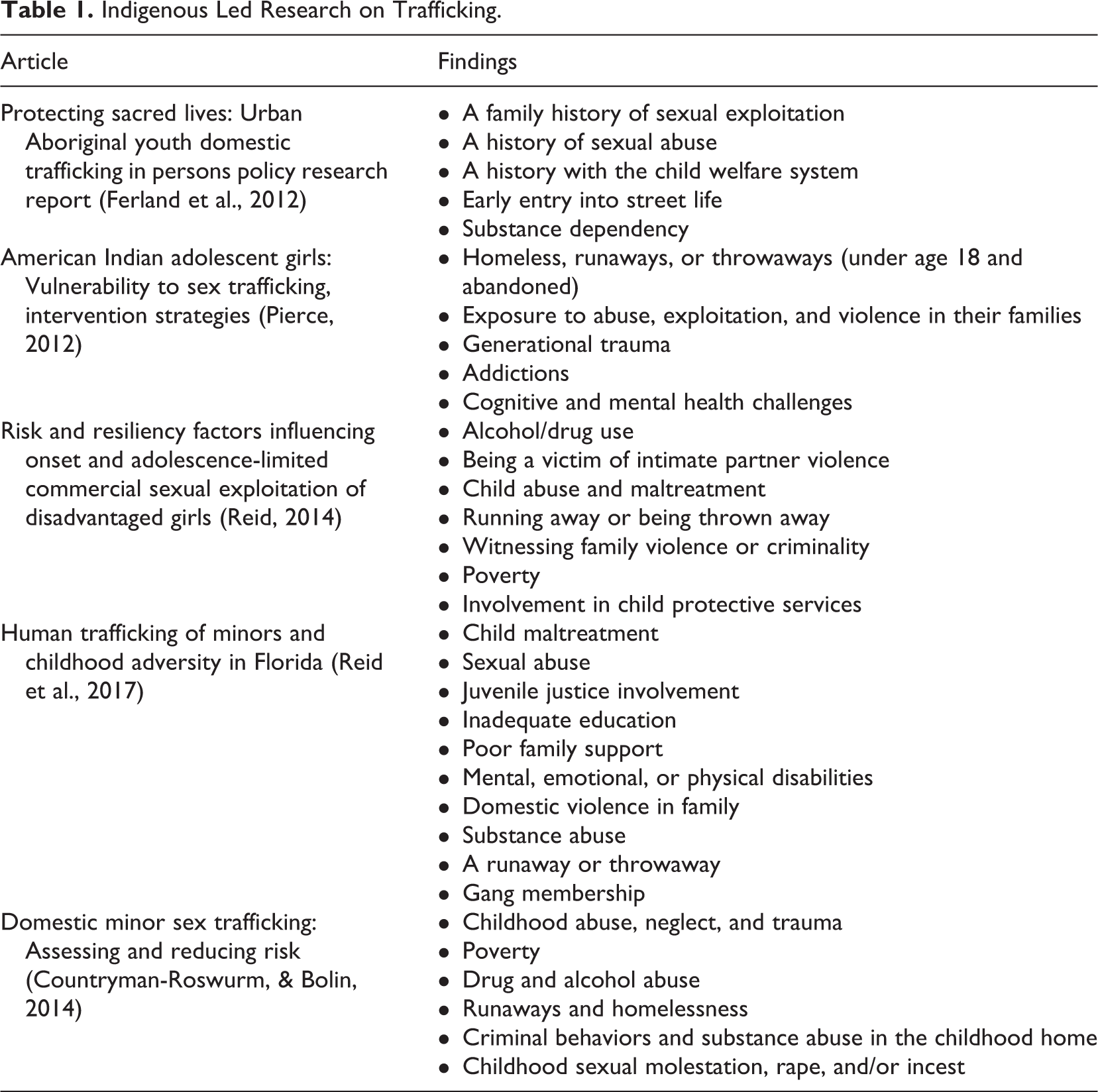
The research conducted by Ferland et al. (2012), Pierce (2012), and Countryman-Roswurm and Bolin (2014) are valuable because of their use of qualitative measures to capture the stories of the participants or “informants” as Ferland et al. references. Much like our research project, several of these studies provided an outlet for Indigenous girls’ unique narratives while coinciding with group supports in which the participants were engaged. Both Pierce’s (2012) study and Ferland et al.’s (2012) report reflect the less than seen narrative of Indigenous women and girls who face a pervasive lack of representation in society. Research combined with Indigenous principles when working with Indigenous women and girls in human trafficking could provide a supportive and transformative research paradigm for future projects.
Studies by Ferland et al. (2012), Pierce (2012), and Countryman-Roswurn and Bolin (2014) reveal similar outcomes regarding risk factors for marginalized girls to be sex trafficked, and the study by Reid et al. (2017) provided the most reliable data as a quantitative analysis with both a large sample of participants and longitudinal studies. It also includes a small sample of Indigenous youth, thereby offering some data which could be useful for Indigenous communities. Risk factors that were specific to marginalized youth included childhood mistreatment such as physical, sexual, and emotional abuse; physical and emotional neglect; and exposure to family violence, all of which were also identified in our research (Reid et al., 2017). In addition, this project included more specific data about female youth which found that neglect was also a major predictor for girls to become involved in human trafficking (Reid et al., 2017). Sexual abuse is the biggest predictor for both boys and girls (Reid et al., 2017). The research study by Ferland et al. (2012), being both Indigenous-led and relevant to the region and territory of Canada, is helpful in framing the realities for Indigenous youth here in relation to human trafficking as a social reality. Although sparse, this information is crucial as it adds to the current body of research and may in turn be helpful in informing policy and shaping political will. It is necessary for Indigenous communities to have research information that is applicable and reliable and would be helpful in informing future services.
Centering Indigenous-Led Approaches to Addressing Trafficking
Trafficking of Indigenous women, girls, two-spirit, and trans women is receiving some attention in the helping fields, specifically in the areas of health, social services, and justice (Kingsley, & Mark, 2000; Saraceno, 2010; Sethi, 2007). More specifically, trafficking is a topic that has found more focus in Ontario, as it is one of the three provinces (along with British Columbia and Manitoba) that are working to combat it. The Ontario Ministry of Children, Community and Social Services’ (2019) strategy to end human trafficking states that “in Ontario, Indigenous women and girls are one of the most targeted and over-represented groups that are trafficked.” How exactly this trafficking and exploitation manifests for Indigenous youth, what it constitutes, where it takes place, and what are the risk factors need to be further elaborated through research projects led by Indigenous Peoples. Historical implications are one significant part of such research when looking at the impacts of trafficking. However, even the term “human trafficking” itself has been criticized for overlooking the complex historical and social conditions Indigenous women and girls face. According to Boyer and Kampouris (as cited in ONWA, 2016), “the definition is not broad enough to encompass the living conditions of exploited Indigenous women and girls,” including “the complex overlapping vulnerabilities of poverty, living conditions and victimization background of some First Nations, Métis and Inuit women, which can severely limit their options.”
The need for Indigenous specific research is clear. Dedicated organizations such as ONWA, the Union of Ontario Indians in partnership with Northeastern Ontario Research Alliance on Human Trafficking (2019), Ontario’s “Long-Term Strategy to End Violence against Indigenous Women” (Government of Ontario, 2019), and the Native Youth Sexual Health Network (2016) are making headway in spearheading research and literature to address the crisis at hand. However, communities currently facing the brunt of this crisis face the daunting task of not only addressing the overrepresentation of violence but also face the almost insurmountable tasks of assembling a research team, bidding on available mainstream research funds, and having their research deemed as credible by mainstream academia. In addition, Indigenous-led research is consistently at the whim of whatever political party heads governments, whose interest in human trafficking research may or may not be a priority.
One research pitfall that continues to replicate itself is the tendency for non-Indigenous researchers to take up the call to conduct research in Indigenous communities. This phenomenon exists in human trafficking with research opportunities that can appear as both lucrative and admirable. There has been a historic tendency within research calls to allow non-Indigenous researchers the space to apply for research funds, and because of social location, tenured status, and well-established research capacity, these opportunities are often taken on by non-Indigenous researchers/academics rather than led by Indigenous communities themselves. For example, Status of Women's (2019) call for proposals outlines the criteria for non- Indigenous researchers to apply for gender-based research funding within Indigenous communities emphasizing four relevant themes for non-Indigenous researchers. First, researchers work closely with First Nations, Inuit and Métis communities in collaborative relationships. Second, they implement cultural safety practices in their work or education with these communities. Third, researchers analyze their research findings from an Indigenous perspective. And finally, they promote and build the capacity of Indigenous research trainees and researchers.
These safeguards ensure that non-Indigenous researchers are accountable for their work with Indigenous communities, however, a critical analysis questions the continued centering of non-Indigenous methodologies and research leads as the only pathway to validate Indigenous stories and information. However, these types of approaches are being challenged by Indigenous researchers who emphasize that control and ownership of research need to be in the hands of them and their communities (Baskin, 2016). Indigenous-led research allows for nuanced, regionally specific Indigenous methodologies that can be healing, transformative and a path forward for decolonization and self-determination.
Our Research Methodology
In the preliminary Indigenous-led research on which this article is based, the authors explored existing information and conducted interviews with Indigenous human trafficking survivors and those who offer support services in Toronto. The researchers recruited participants using purposive, snowball sampling and required extensive community engagement in order to build trusting relationships due to the subversive, underground, and traumatic nature of human trafficking. Once one person was interviewed, they referred others who agreed to participate after their peer vouched for the project and the researchers. Four helping agencies were engaged to understand the issues around human trafficking, build relationships with survivors, and engage in reciprocal relationships based on Indigenous worldviews and ethics. Engagement took 5 months to create which was followed by interviews with five trafficking survivors and three community professionals.
This project has also led to a responsive community need through the authors’ relationship building and support with grassroots initiatives on the North Shore of Lake Huron, the traditional territory of the Anishinabek Nation. Through these relationships, the authors have been afforded a deeper understanding about the nuances and regionally specific experiences of human trafficking and gender-based violence, as well as the structural and systemic barriers that the communities face in terms of finding support for solutions.
Many grassroots individuals and organizations dealing with the daily realities of human trafficking and exploitation are emboldened to build and create their own Indigenous specific coalitions and task forces. Examples of this include the Indigenous-led Anti-Human Trafficking ACTION Committee in Ottawa, Ontario, and the Anti-Human Trafficking Network in Sault Ste. Marie, Ontario. These Indigenous-led taskforces and coalitions work to address the Indigenous specific definitions, approaches and nuances of human trafficking, and lobby for government funding and include the historical and ongoing impacts of colonization that contribute to the issue. Such an approach attempts to address critiques heard throughout the authors’ engagement by Indigenous grassroots people that mainstream human trafficking coalitions consistently tokenize or undervalue the unique experiences and contributions of Indigenous Peoples, lack a critical context of colonization, and, in many cases, are abolitionist and faith based in nature, (anonymous, and personal communications (Johnson, 2019). Therefore, the centering of Indigenous approaches to addressing human trafficking holds the promise of mobilization through the creation of Indigenous-led taskforces and coalitions which can lead to more solid ground for research opportunities and sustainable funding.
The participants in our research project were made up of two groups: three professional social services providers who support Indigenous women, two-spirit and trans women victims of human trafficking and five victims/survivors. Of the service providers, one is Mi’kmaq and the other two are Anishinaabe. All have worked in violence against Indigenous women for at least 7 years, two within Indigenous agencies and one in a mainstream, non-Indigenous agency. Of the victims/survivors, two are Nêhiyaw, one from Saskatchewan and the other from Alberta; one is Anishinaabe from Manitoba; and two are Anishinaabe from Ontario. All of them reside in Toronto, Ontario, with the number of years varying from 2 to all their life. They range from ages 18 to 30, three identify as cis-gendered heterosexual, two as two-spirit, and one as a trans woman. Four of the participants are children of residential school survivors and one is a survivor.
Individual interviews in a storytelling format were implemented with each participant which is an Indigenous research method that allows for the sharing of oral histories without any direct questioning unless needed. All interviews were audio-recorded and transcribed. We looked at the lived experiences of the participants and found themes that were relevant to all of them. These then became the final topics that we share in this article.
Experiences of Human Trafficking by Indigenous Women, Girls, Two-Spirit, and Trans Women
According to the findings of our research conducted with three agencies engaging with Indigenous women, two-spirit and trans women survivors of human trafficking, all reported that Indigenous women were the most vulnerable population, accessed mainstream services the least, and presented with the most complex trauma and life circumstances. These agencies are in supporting relationships with adult populations but are also including prevention work with youth to mitigate the devastating impacts of human trafficking and better equip Indigenous communities to protect their most vulnerable members. Maya Chacaby, an Indigenous skilled practitioner in the area of anti-trafficking, laid bare this disturbing trend that “Indigenous women are in the deepest underbellies of trafficking. There is a place between missing and murdered, this is where Indigenous women being trafficked are” (personal communication, May 2, 2019).
Through the stories of Indigenous women, two-spirit, and trans women, five topics of discussion stood out: Pathways Into Trafficking; Collective/Intergenerational Trauma Caused by Systems of Colonization; Uniqueness of Two-Spirit/Queer/Trans Experiences; What Helped Victims Get Out; and Healing Journeys.
Pathways Into Trafficking
As the literature indicates, there are various routes into trafficking. Indigenous girls who are forced into trafficking often come from families where they have been abused and neglected, particularly sexually abused, and this was true for the participants in our research project. Other girls were recruited by older ones who they did not know, a tactic frequently used by traffickers. As adults, some of the participants had significant insight into the structural reasons for being forced into trafficking, another prominent factor that is connected to the literature. Participant A: I was staying with a Native family that wasn’t my own. I started getting abused there, sexually abused by the brothers. They used to bring in different guys, that’s how they would get their money and party. They would get me drunk and do things. Participant B: I got back into crime and into prostitution to help make ends meet for me and my kids. Then I got into abusive relationships and before I knew it, I was back into drugs and being sold again just like my mother did with me when I was young. Participant C: I was 12 and myself and a friend [were at] McDonalds…some white girl [at] least 19 said to us “you guys come out with me.” She took us out with this group of older men, and we went to a gaming place, then she’s like “meet me again at McDonald’s. I’ll take you for drinks”…neither one of us had ever drank before…we went to this house with these old guys and started drinking…I was drunk and I started vomiting…. Someone said, “we’re going out…you stay and rest.” But they left me there with three of the guys…it was brutal, my clothes were gone, I was beaten up. It went on from there…. Participant D: You have no other options but trafficking yourself for survival, but I don’t think it necessarily is being trafficked by other people. It’s being trafficked by colonization, lack of resources; it’s being trafficked by lack of community supports, not understanding and knowing your culture. Participant E: I was about 9. [My] uncle…started it. From there, I was traded between communities for sex.
Collective/Intergenerational Trauma Caused by Systems of Colonization
A prominent arm of colonization was the residential school system whose impacts continue to reach into the present day. The collective and intergenerational trauma caused by those who ran the schools did not end with the children who attended them. Survivors’ children, as well as grandchildren, carry the psychic and spiritual wounds that were inflicted on the generation before them. All the participants in our research project were children of survivors, with one being a survivor herself, who were able to make the connection between the schools, trauma, sexual abuse, and trafficking. Participant E: I’m a fifth-generation residential school survivor, so for me, that’s how it started. Participant B: My mother is a residential school survivor and she’s really traumatized. She wasn’t given the right tools to be a mother, and she thought that chaos was a normal thing. I didn’t understand why she was doing the things to me that she was doing. I knew they were wrong, but she was my mom, so I used to try to figure out why she trafficked me. Participant D: I always hated Native people because of residential school for my mother, my uncles, and I hated Native child welfare. It’s colonization, assimilation, and internal oppression. Everything that the government has instilled in us. From Day 1, they came here and set us up for failure systematically. Participant C: I think it began in residential school. The kids were forced to have sex with the priests or nuns. Participant D: I was raped by Calgary City police and beat by them, hospitalized. Participant A: It just starts with vulnerability you know? And who is more vulnerable than young Aboriginal girls who are on the streets? Or taken away from their families by CAS [Children’s Aid Society]?
Another devastating outcome of the institutional abuse was the abuse of children toward other children in the schools, an issue that continues to pervade our communities today as sexual abuse from our own members is a sad reality (TRC, Survivors Speak). In other instances, children were coerced into abusive situations with the promise of food and trinkets (TRC, 2015, Survivors Speak).
An overall severing of the children from their cultures and communities was the goal of the residential schools, a similar theme mentioned by the survivors. An extension of the residential school era has manifested in the child welfare system, where Indigenous children today find themselves severed from their cultures, communities, identities, and traditions. The sheer breadth of child welfare and its impacts on Indigenous children is described by the Chairman of the TRC as being a contemporary manifestation of residential schools in this country (Krugel, 2018). All survivors mentioned residential schools or child welfare as a root of the human trafficking and abuse that they experienced. The themes of child sexual abuse, poverty, luring, familial abuse, and disconnection from culture and supports are shared by both the human trafficking survivors and in the stories of residential school survivors.
Uniqueness of Two-Spirit/Queer Experiences
Even though the literature states that Indigenous two-spirit and trans women are specifically targeted because of their gender, sexual orientation, and race, there is limited research and information that speaks to their experiences of being trafficked. According to the participants in this research project, the needs of two-spirit and trans women are rarely understood by either their communities or services that are supposed to support them. Participant A: For years, I was told cuz of my sexual orientation, I chose that life [of being trafficked]…. That blame game was on me. And I was telling them when I was growing up “who chooses to be targeted?” when I would come forward after the abuse that’s when, [I’d hear] “well did you invite it?” or “maybe you didn’t stop it cuz you liked it?” and I was like “no I was forced.” Participant C: These westernized programs for trafficking, you know for me I look at the whole queer, lesbian, bi, trans, it’s like westernized terms for sexual identities, but I look at two-spirit as a cultural identity. They don’t understand where I’m coming from: it confuses them and what confuses them they don’t wanna talk about.
What Helped Victims Get Out
Many Indigenous Peoples, communities, and the agencies that represent and service them have repeatedly revealed how law enforcement does not take their concerns seriously, properly investigate when women, girls, two-spirit, and trans women disappear and discriminates against them (Bourgeois, 2015; Chartrand, 2019; Cunneen & Tauri, 2019; ONWA, 2016; Rudin, 2018). Despite this reality, some of the participants in this project shared that it was law enforcement that played a role in their escape from trafficking. Participant C: There was a police investigation. There was like five undercover cops that came and took me and the person [who was trafficking me] into interrogation. That’s when I first started finding out about services and I use them now as a backup tool. Participant B: I was angry, and got into coke, heroin, just thinking whatever I could do to kill myself. I ended up in cardiac arrest, but I survived, and then I asked, “God why, (crying), can’t you just take me?” Later, I ended up in jail and I think that’s what saved me. Participant E: The ring that I was in got taken down and I was lucky to get taken out. Participant D: My husband, the kid’s dad, took me off the streets, that helped me.
The Healing Journey
A significant amount of literature has been published over the past 25 years about the success of Indigenous-led, culture-based services in the helping professions. Within areas such as child welfare, justice, and family violence, evaluations overwhelmingly emphasize service users’ support of cultural and spiritual teachings and practices as what is the most beneficial to them in their healing journeys (Absolon, 2009; Baskin & Sinclair, 2015; Braveheart, 1999; Duran & Duran, 1995; Lucero, & Leake, 2016). The responses from the participants in this project were no different, unanimously citing Indigenous specific agencies that include practices such as sharing circles and ceremonies. Participant A:…agencies where I can do ceremonies and I still talk to my therapist. Participant C: There’s like pretty much no support for me out there besides Native Women’s [Resource Centre of Toronto]. Participant B: Native Women’s [Resource Centre of Toronto] has helped me on my healing path. Participant D: I created a buddy system with the workers [where I got help]. Participant B: I’m just glad I’m here today, I’m alive, I’m sober, I do my sweat lodge ceremonies, shake tent…. And now I’m gonna be a ceremonial pipe carrier and making ceremonial pipes for people. Participant A: Now that I’m doing my traditions, I find they consume so much of me. Every time I do one, it helps me heal myself. And the way things are being two-spirit in the city, I can attend the female circles and the male circles and have that balance. Participant E: For years, I almost had this veil over my face, like different layers, and over the years each time I do a circle or ceremony, it’s like one veil gets taken off and I can see more clearly that none of it was my fault.
Ending the Violence
“We’re paying the consequences for the treaties that haven’t been implemented” stated a wise Indigenous youth who was a focus group participant in a research project on trafficking by Ferland et al. (2012, p. 45). Ending the trafficking of Indigenous women, girls, two-spirit, and trans women requires the Canadian state to take a hard look at itself and examine its complicity in this violence. It means dismantling the colonial domination which makes violence possible. It also means the restoration of Indigenous sovereignty with careful attention to not replicating dominant systems of oppression. This requires the leadership and full involvement of Indigenous women. As Jiwani (1999) called for two decades ago, “Without a structural transformation that effectively addresses poverty, the sexualizing of youth and children, male power to purchase sex, intra-familial violence, and youth unemployment, the community and government-based efforts remain band-aid solutions” (p. 13)
There is finally national and international awareness about disappeared and murdered women and girls in Canada and a report with recommendations, which is of critical importance, but the reality is this will not necessarily lead to decreased violence. It must be kept in the Canadian consciousness that public inquiries and human rights reports have tended to teach “that Indigenous women need merely to be better included in dominant paradigms” and to remember that, “without a sense of history, location, or responsibility, we learn that colonialism is a historical phenomenon to learn about, rather than an ongoing set of relationships to be transformed” (Hargreaves, 2017, p. 166).
We must stop looking to the Canadian legal system to do something meaningful about the violence toward Indigenous women, girls, two-spirit, and trans women, advocating for more policing and better laws while, at the same time, knowing full well that this system is set up to oppress rather than assist us. This system refers to the horrific acts of colonization as “unfortunate mistakes of the past” (Robinson as cited in Hargreaves, 2017, p.144) and “a sad chapter in our history” (Younging, Dewar, & DeGagne as cited in Hargreaves, 2017, p. 144) as though this colonial past has no impact on the present. What is needed is to accept the limits of the very system that is the cause of the violence and turn to the leadership and authority of Indigenous women to initiate real change. It also means taking a critical look at the roles of non-Indigenous “allies” who are, as noted by Hargreaves (2017): “(often self-declared)” and examining what they “want or expect from solidarity work,” when in fact, they need to be “working, learning, and showing up without expectation of approval, recognition, or gratitude. It means taking direction and leadership from Indigenous organizers and communities.” (p. 184)
An example of Indigenous women taking up this work is the Ginoozi (“She Is Tall” in Anishinaabemowin) Sexual Violence Response Team (GSVRT) at the Native Women’s Resource Centre of Toronto (NWRCT, n.d.). The first of its kind in Canada, GSVRT uses a wholistic or wrap around approach to assisting women, girls, two-spirit, and trans women who are, or have been, trafficked. Helpers provide culturally safe services and preventative strategies that address the high risk of sexual violence and trauma that Indigenous women, girls, two-spirit, and trans women face. This approach came out of consultations with 40 community members including families, caregivers, survivors, those with lived experiences of being trafficked, and traditional Knowledge Keepers to ensure that the program fits the needs of those impacted. GSVRT’s blanket of services includes referrals to trauma therapy, addictions support, health care, access to Elders, traditional healers and ceremonies, housing, food, clothing, and personal care. All of these institutional supports provide a safe space and wholistic services that create a path for healing for women, girls, two-spirit and trans women who have experienced trafficking. The program also supports parents and caregivers of young women who have/are experiencing sexual violence as well as information on prevention strategies, such as how girls are lured into trafficking, what they need to be looking for, and how to communicate with girls about sexual exploitation.
The program also offers training services to various support services within the city of Toronto because the agency believes that the mainstream community needs to understand the story of Indigenous women, girls, two-spirit and trans women. In addition, the voices of the team are well represented at the policy level through participation at various tables such as the Human Trafficking Intervention Prevention Strategy, the Toronto Counter Human Trafficking Network, and the Sex Trafficking Service Collaborative. The program, which began in 2016, is also undergoing an evaluation of its services. However, the findings from the research that this article is founded on clearly illustrates that NWRCT is of help to the participants as it was the only agency referred to as helpful in the interviews.
Conclusion
This preliminary research project is limited in its findings due to the small number of interviewees who participated in it. Thus, the findings are not generalizable to all Indigenous women, girls, two-spirit and trans women who have been or are trapped in trafficking. The authors of this article continue their research. However, through this project, and that of other Indigenous researchers as seen in the literature, it is glaringly obvious that the disappearance, trafficking, and murder of Indigenous women, girls, two-spirit and trans women are systemic issues. These issues stem directly from the colonization and genocide of Indigenous Peoples and their worldviews and practices, as well as the theft of their land, poverty, and economic dependence.
Collective traumas caused by the impacts of colonization and structural racism, whether that materializes in the extreme desperation of families who traffick their own children or in the blatant exploitation of them by non-Indigenous perpetrators, are at the root of this gender-based violence. Such violence continues due to a lack of effort from governments, and the commissions they create, but fail to put into action. Meaningfully engaging with Indigenous Peoples and communities, respecting their beliefs, and integrating Indigenous approaches into the solutions are the ways forward. Canada is currently able to begin to make true structural change in terms of the barriers faced by Indigenous women, girls, two-spirit and trans women if it makes the choice to impactfully implement the recommendations of the National Inquiry’s Final Report on Missing and Murdered Indigenous Women and Girls (2019) now.
Further, all levels of government, institutions, and the public need to educate themselves in order to stop blaming Indigenous women, girls, two-spiri, and trans women for the violence perpetrated against them. Until such mindsets and the systemic issues are properly addressed, Indigenous Peoples will continue to experience various forms of violence and trauma, with the ongoing result that women, girls, two-spirit and trans women will continue to disappear, be trafficked and murdered.
Footnotes
Declaration of Conflicting Interests
The author(s) declared no potential conflicts of interest with respect to the research, authorship, and/or publication of this article.
Funding
The author(s) received no financial support for the research, authorship, and/or publication of this article.
