




Abstract
Research scales developed in one society are often validated in another society to determine the factor structure and measurement equivalence of the scales. Using a convenience sample of 378 respondents from two cross-sectional studies, the present analyses examined confirmatory factor analysis (CFA) and gender invariance in the Illinois Rape Myth Acceptance (IRMA) Scale in Nigeria. Specifically, the analyses examined whether the scale holds similar factor structure, whether the latent means can be compared, and whether respondents interpreted items similarly or ascribed the same meaning to them across gender. Based on the analyses, CFA results validated the hypothesized multidimensional four-factor structure of IRMA, namely, “she asked for it,” “he didn’t mean to,” “it wasn’t really rape,” and “she lied.” Similarly, the IRMA measurement was invariant (partial scalar invariance) across gender, suggesting that men and women interpreted IRMA’s items and constructs similarly. Results of an independent-samples t test suggested that women were more likely than men to reject the myth that female victim of rape “lied.” In general, preliminary findings indicated that IRMA is suitable for research on rape myths in Nigeria. Knowledge generated from its use may enhance understanding of rape myths, rape-supportive behaviors, and rape prevention and victim intervention programs.
Keywords
Despite the high prevalence of sexual violence and rape against women, knowledge about underlying beliefs, misconceptions, and myths remains sparse in many regions of the world. Although research on rape-supportive beliefs has increased in recent decades and new scales are being developed and modified (see Flood, 2008), many societies lag in developing culturally specific scales or in validating existing scales for research and practice. The problem is particularly pronounced in certain regions. For example, despite Nigeria’s high prevalence of rape (NOIPolls, 2013; Olaleye & Ajuwon, 2012), empirical knowledge has been limited to prevalence reports. Prolonged discourse about attitudes and beliefs underlying rape focuses more on theoretical speculation than on empirical verification. With conceptual and theoretical focus on definitional issues rather than empirical focus on attitudinal and behavioral issues, empirically validated scales measuring rape-supportive beliefs and myths remain outside the scope of empirical research.
Theoretically speaking, many factors have been attributed to prevalence of sexual violence and rape in Nigeria. These include media influence, laxity in laws, myths about sex, alcohol and substance abuse, pornography, and sexual promiscuity (Chiazor, Ozoya, Udume, & Egharevba, 2016). In a recent poll, 34% of respondents attributed prevalence of rape to indecent dressing (NOIPolls, 2013), although alcohol was found to be associated with perpetration of rape among students (Olaleye & Ajuwon, 2012). Ubiquity and universality of sexual violence and rape presuppose that underlying beliefs, misconceptions, and myths common in one society are likely to be common in another society. For example, themes that have been associated with rape and rape myths, such as lack of empathy, minimization of experience of victims, attribution of blame to victim, exoneration of perpetrator, lack of believability of victim reports (Fakunmoju, Bammeke, Oyekanmi, Temilola, & George, 2016a; see also McMahon & Farmer, 2011) have also been noted in Nigeria.
Patriarchy, Feminist Theory, and Rape in Nigeria
Nigeria is the most populous country in Africa and has over 300 ethnic groups that are generally categorized under three major tribes (often addressed with the acronym WA–ZO–BIA), namely, the Yorubas (situated in Southwestern Nigeria), the Hausas (situated in Northern Nigeria), and the Igbos (situated in Southeastern Nigeria; Chigozie, n.d.). Patriarchy, an institutionalized system of male domination and female subjugation (Hartman, 2003; Hunnicutt, 2009) pervades all spheres of life in Nigeria and its knowledge may help contextualize the cause and widespread occurrence of rape and shed light on the need to understand and measure its associated myths.
In Nigeria, women are exposed to oppressive laws, cultural norms and traditions, and religious values that objectify their body as a tool of sexual pleasure and predispose them to physical and sexual victimization. Sexual violence and rape that used to be limited to the marital institution in Nigeria now persists outside marriage (Eze, 2013; Makama, 2013; Olukemi & Folakemi, 2015); intersectional feminism has ascribed this change to the impacts of interlocking systems of power on women (Crenshaw, 1991). For example, both married and unmarried women are susceptible to abduction and rape during war and political crisis in Nigeria. Reports abound about rape and sexual exploitation by Boko Haram fighters and Fulani herdsmen as well as by militia and military men assigned to rescue the victimized women from crisis.
Socially constructed masculinity and power inequalities engendered by patriarchy encourage the perpetration and endorsement of rape in ways that minimize women’s reactions to experience of rape (Makama, 2013). For example, stigmatization associated with disclosure of rape, fear of not being believed, fear of retaliation by perpetrators, lack of credible response by the police, low possibility of legal repercussions for perpetration of rape, and possible revictimization from navigating the corrupt justice system limits women’s ability to report rape and predisposes them to bearing the psychological burden of rape in silence (Aborisade, 2014; Sable, Danis, Mauzy, & Gallagher, 2006). Instead of disclosing rape, women often remain silent in order not to tarnish their family’s image or put their family to shame (Aborisade, 2014; NOIPolls, 2013; Peterson & Muehlenhard, 2011). In many rape cases, lack of consent is hard to prove, physical injury is often lacking, and rape is often perpetrated without a witness. This realization makes it easy for those who have the tendency to perpetrate rape and sexual violence against vulnerable women to commit the acts with minimal self-restraint.
Surprisingly, a rape culture, sustained by religious values of submissiveness of women to men and reinforced by supremacy of men in marriage, prevails in Nigeria (Makama, 2013; Olukemi & Folakemi, 2015). Many people believe that men have the prerogative to sexuality of women and a husband cannot rape his wife. In many cases where male perpetrators of rape demonstrated sexual indiscretions, the victimized women often end up being blamed. Many people believe that women are expected to be sexually submissive to men and deem it appropriate to portray women as objects that must be sexually available at the beckon of men. In addition to being perceived as mere agents of procreation, women are accorded a high standard of moral expectation through religious beliefs. Their appearance and mode of dressing is expected to conform to strict religious beliefs and their victimization experience of rape may be attributed to seductive and sexually provocative dressing. Through local movies (e.g., Nollywood) and music videos, prejudices against women are steadily reinforced in Nigeria (Chiazor et al., 2016; Okenwa-Emegwa, Lawoko, & Jansson, 2016). These mediums are often used to steadily expose men to sexualized and demeaning messages about women, which provide the fertile ground for perpetration of rape and propagation of rape myths. These narratives are abundant in Nigeria, yet their empirical measurement is lacking.
Defining Rape Myths and Determinants of Rape Myth Acceptance
Rape myths have been defined and described in various ways. They may be regarded as subtle attitudes and beliefs regarding who and what are responsible for rape, as well as judgments about who is to blame for occurrence, perpetration, or victimization through rape. From enduring decades of controversies and criticisms, rape myths have emerged with varied definitions. For example, these myths been defined as “attitudes and beliefs that are generally false but are widely and persistently held, and that serve to deny and justify male sexual aggression against women” (Lonsway & Fitzgerald, 1994, p. 134). They have also been defined as “prejudicial, stereotyped, or false beliefs about rape, rape victims, and rapists—in creating a climate hostile to rape victims” (Burt, 1980, p. 217). Thus, they reflect inaccurate beliefs and views that are often used to justify perpetration of rape and that are often helpful in understanding the rationalization behind responses to reports of rape. They are “descriptive or prescriptive beliefs about rape (i.e., about its causes, context, consequences, perpetrators, victims, and their interaction) that serve to deny, downplay, or justify sexual violence that men commit against women” (Bohner, Eyssel, Pina, Siebler, & Tendayi Viki, 2009, p. 19).
Inherent in the definition of rape myths is the assumption that people make judgments about rape. In the body of research, some personal, psychological, and cultural factors have been attributed to this judgment. These factors include age, gender differences (i.e., men are more likely than women to endorse rape myths), apportioning of judgment (i.e., the male perpetrator is more likely to be exonerated and blame is more likely to be attributed to the female victim), racial differences, men’s insatiable sexual urges, negative stereotypes and beliefs about women, gender role stereotyping, self-reported physical aggression, endorsement of interpersonal violence, adversarial sexual beliefs (i.e., the notion that sexual relations are by its nature “fundamentally exploitative”), and violation of traditional gender roles and norms (e.g., Ben-David & Schneider, 2005; Burt, 1980; Hockett, Smith, Klausing, & Saucier, 2016; Iconis, 2008; Suarezi & Gadalla, 2010; van der Bruggen & Grubb, 2014).
People not only endorse rape myths but also act in ways that are proportionate to the myths that they hold. It has been suggested that these myths are instrumental to actual perpetration or propensity to perpetration of rape (Hinck & Thomas, 1999). They influence decisions about reports of rape (Dinos, Burrowes, Hammond, & Cunliffe, 2015) and invariably shape responses and behavior patterns of sexual violence against women. From examining sexual assault records of police, Shaw, Campbell, Cain, and Feeney (2017) found that “statements in police records drew upon rape myths that denied or justified the assault on the basis of specific circumstances of the assault (i.e., circumstantial statements) and specific characteristics of the victim (i.e., characterological statements)” (p. 602). However, Waterhousea, Reynolds, and Egan (2016) did not validate rape myths after examining records of United Kingdom police forces. A recent systematic review also suggests that victim credibility rather than rape myth acceptance influences case decisions by the police (Sleath & Bull, 2017). In general, it is reasonable to suggest that victim blaming may be more pronounced in societies with a high prevalence of rape and low perpetration prevention or victim intervention efforts.
Beyond victim blaming, knowledge about rape is not widespread in many regions and failure to acknowledge rape victimization has implications for endorsement of rape myths. For example, a common challenge in reporting rape was attributed to the fact that some women did not perceive their experience as rape (Aborisade, 2014). This is because “labeling their experience as rape may be adaptive for some; for others, it may be unhelpful or even harmful” (Peterson & Muehlenhard, 2011, p. 558, emphasis added). When victimization experience is not acknowledged as rape, defining and reporting of rape remain shrouded in cultural and psychological domains of victims, perpetrators, and observers of rape. For example, many people endorse cultural beliefs about sexual intercourse in intimate relationship in Nigeria: a husband has the right to use force to get sex from his wife, a woman should not deny her husband sex in marriage, a wife cannot claim her husband raped her, a woman must always satisfy her man’s sexual desires, a woman should not refuse the sexual demands of her man, when a man pays the dowry of a woman, he owns the woman, and so on (Aborisade, 2014, 2016; Achunike & Kitause, 2014; Arisi, 2011; Fakunmoju, Bammeke, Oyekanmi, Temilola, & George, 2016b). These general beliefs have the implications of preventing women from recognizing that they have been raped when their male partners forced sex on them or prevent men from acknowledging that they have raped their partners.
Rationale for Validating the Rape Myth Acceptance Scale (RMAS) in Nigeria
Despite Nigeria being a high-risk country for sexually aggressive behaviors against women, empirical knowledge about associated attitudes and beliefs is in its infancy. Qualitative-descriptive reports attribute underlying beliefs to religion, cultural practices, and psychological factors (Eze, 2013; Olukemi & Folakemi, 2015); studies utilizing standardized measures with validity information are lacking. For example, recent studies examining rape and rape myths in Nigeria (e.g., Aborisade, 2014, 2016) relied on unstandardized measures that produced qualitative reports and prevalence data rather than quantitative data that are amenable to robust analysis. While suitable for gaining insight about a phenomenon, prevalence reports complicate the challenge of generating objective knowledge that is suitable for international comparison. For example, prevalence reports enable one to gain widespread knowledge of rape but provide limited insight about variables associated with perception, perpetration, and rape victimization. Through the use of empirically validated scales, objective knowledge about rape and associated factors beyond prevalence reports could be generated to inform practice and policy decisions.
To generate objective and transferrable knowledge, empirically validated standardized measures that capture rape-supportive beliefs and myths are necessary. These measures (e.g., RMASs) are useful for research and practice and have been utilized in basic and applied research. For example, they have been used to examine determinants of rape myth acceptance and have been utilized to evaluate the efficacy of sexual violence prevention programs and bystander or victim education or intervention programs (Baldwin-White, Thompson, & Amanda Gray, 2016; McMahon, 2010). Nevertheless, knowledge about their measurement equivalence in different societies, especially societies with high prevalence of sexual violence, is generally sparse, thereby excluding those societies from accumulated knowledge about rape-supportive beliefs and myths. By examining the factor structure and measurement equivalence in different societies, transportability of the scales can be established and global comparability of knowledge gained can be enhanced. Such examination can also provide validity and reliability information that may serve as a benchmark for future basic and applied research on rape-supportive myths and beliefs.
Beyond examining factor structure and measurement equivalence, it is crucial to gain knowledge about gender differences in rape myth acceptance in Nigeria owing to myriads of sex-related beliefs and practices (e.g., belief that a man owns a woman on whom he paid dowry, belief that a typical Nigerian woman may refuse her man’s sexual advances but expects him to force her for sex, and belief that a woman should be sexually submissive to her man) that may influence endorsement or rejection of rape myths between men and women. These cultural values, practices, and beliefs engender in men and women rape-supportive values and beliefs and predispose men to perpetration of rape and women to rape victimization. By examining gender differences in rape myth acceptance, one would know the extent of the effects of these cultural factors on endorsement of rape myths between men and women and the extent of their similarities and differences with findings of studies conducted outside Nigeria.
Current Measures of Rape Myths and Studies on Rape Myths in Nigeria
Psychometrically sound measures of rape myths have been developed in the past four decades. These include the Attitudes Toward Rape Scale (Feild, 1978), the RMAS (Burt, 1980), the R Scale (Costin, 1985), the Illinois Rape Myth Acceptance (IRMA) Scale (Payne, Lonsway, & Fitzgerald, 1999), and the Acceptance of Modern Myths about Sexual Aggression Scale (Gerger, Kley, Bohner, & Siebler, 2007). Among these scales, IRMA (Payne et al., 1999) is one of the most frequently used and has been updated (McMahon & Farmer, 2011) and adapted outside the United States (e.g., China; Xue et al., 2016). McMahon and Farmer (2011) confirmed first-order four-factor structure of IRMA with minor modification and also examined second-order five-factor structure. Regrettably, only one study is known to have used the scale in Nigeria (Fakunmoju et al., 2016a), as few studies that have examined rape myths in Nigeria have been descriptive in nature (e.g., Aborisade, 2014, 2016). In a recent study by Fakunmoju and colleagues (2016a), IRMA was used to determine convergent validity of new instruments that are designed to measure beliefs about violence against women and gender stereotypes and beliefs. In the study, IRMA correlated moderately (.46–.52) with gender stereotypes and beliefs (i.e., beliefs about sexual submissiveness of women, emotional stereotypes about women, and sexual stereotypes about men). Similar results of meta-analysis have identified correlations between rape myths and sociodemographic factors (e.g., racism, heterosexism, classism, and ageism; Suarezi & Gadalla, 2010), suggesting that knowledge derived from rape myths can enhance understanding of these factors and vice versa.
In order to utilize scales across societies, it is often necessary to determine the factor structure and measurement equivalence of scales in a different society because of differences in perceptions of phenomena across societies. Without evidence of validation, interpretations of findings from utilizing scales in different societies are often greeted with skepticism (Byrne & Watkins, 2003). Due to lack of cross-cultural validation, many psychometrically sound scales continue to suffer from widespread use in different societies, thereby impeding knowledge about their cross-cultural applicability. For example, in addition to language and translation challenges, researchers in a different society (i.e., a society that is different from the society in which the scale was developed) may be dissuaded from utilizing scales developed in another society when knowledge of measurement equivalence of the scale is lacking in the different society.
Present Study
To address the above gap in knowledge about factor structure and measurement equivalence of rape myth acceptance, the present analyses examine confirmatory factor analysis (CFA) and gender invariance of the revised IRMA in Nigeria. Specifically, the analyses examined (a) whether the hypothesized four-factor structure of the scale fit the data well, (b) whether the scale is hierarchically structured with a higher order single-factor solution, (c) whether the factor structure is equivalent across gender, and (d) whether latent means can be compared across gender (whether males and females differ in their ratings of the scale).
Method
The data for this analysis were derived from two studies conducted in Nigeria. The first study included 261 participants and the second study included 193 participants from diverse ethnic backgrounds who completed an anonymous online survey that included questions on rape myth acceptance. Respondents in both studies were recruited at universities in three southwestern regions of Nigeria. Internet cafe operators were also contracted to recruit participants from outside the universities. Investigators sent the survey link to potential respondents who were encouraged to share it with others. Verbal and electronic solicitation was used to recruit respondents and consent was provided online. Additional information about the first study may be obtained from Fakunmoju and colleagues (2016a). The institutional review board of Westfield State University, Massachusetts, USA approved the study.
Demographic Characteristics
Respondents were 378 adults with an average age of 30.56 years (SD = 8.08). More than half were male (n = 235, 62.2%). There were more single respondents (n = 286, 75.7%) than married, separated, divorced, or widowed (n = 92, 24.3%) respondents. Slightly more than half self-identified as having less than a bachelor’s degree (n = 198, 52.4%); almost half (n = 166, 43.9%) reported being students.
Measures
The updated IRMA Scale (McMahon & Farmer, 2011; see also IRMA-SF, Payne et al., 1999) is a 22-item measure of rape-supportive beliefs, clustered in four factors (dimensions): “she asked for it,” “he didn’t mean to,” “it wasn’t really rape,” and “she lied.” Response choices, using a Likert-type scale, ranged from 1 = strongly agree to 5 = strongly disagree (The 22-item IRMA Scale was updated to reflect common terms and language that respondents can relate to in modern time, thereby enhancing cross-cultural applicability and minimizing respondents’ burden.). Preliminary efforts in Nigeria included interview of respondents to determine readability, understandability, and relevance of the items and pilot testing to determine validity and reliability. Additional details of the preliminary research are reported in Fakunmoju and colleagues (2016a). Items reflecting each dimension are reported in Table 1. Higher scores connote greater rejection of rape myths and lower scores connote greater acceptance of rape myths. Internal consistency estimates (Cronbach’s α; i.e., how closely related the set of items are as a group) of the four factors are as follows: “she asked for it” = .81, “he didn’t mean to” = .77, “it wasn’t really rape” = .72, and “she lied” = .79. Previous studies reported Cronbach’s α ranging from .74 to .91 (Fakunmoju et al., 2016a; McMahon, 2010; Payne et al., 1999).
Items, Means, and Standard Deviations of the Rape Myth Acceptance Scale.
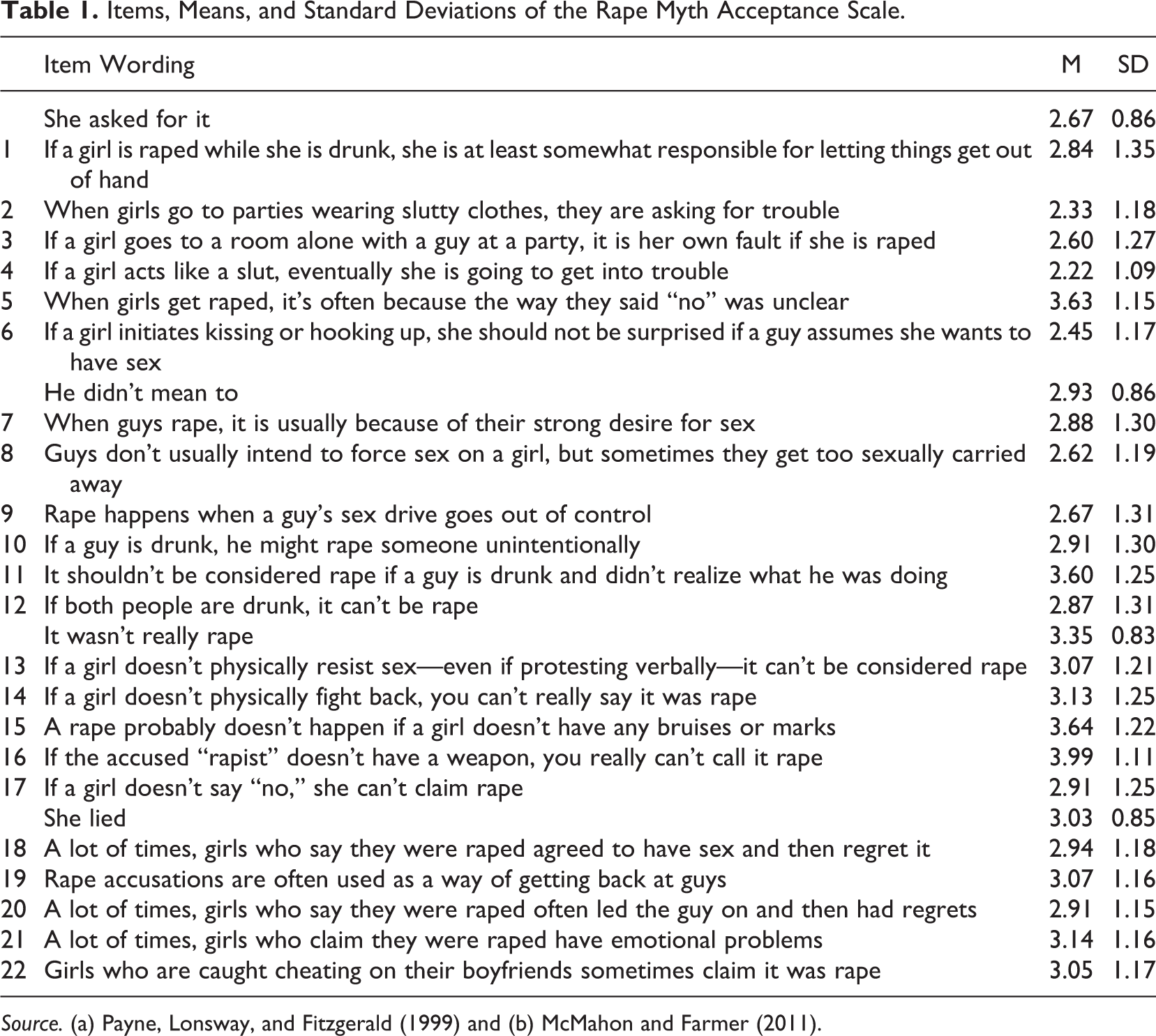
Source. (a) Payne, Lonsway, and Fitzgerald (1999) and (b) McMahon and Farmer (2011).
Data Analysis
Preliminary analysis included examining data for blank and duplicated cases. Seventy-six blank cases were identified and deleted. (The majority included cases in which respondents did not proceed beyond the first consent page.). Thereafter, a total of 378 response sets remained for data analysis. Using SPSS 20™ (IBM Corporation, 2011), exploratory factor analysis (EFA) was performed to identify the underlying latent constructs of IRMA. Thereafter, Stata 14 (StataCorp, 2015) was used to validate the factor structure of IRMA and to determine its gender invariance. Three CFAs were run to examine the first- and second-order factor structure and identify the best model fit for IRMA. The three models were Model 1 (22-item first-order CFA with no error correlation), Model 2 (19-item first-order CFA with two error correlations), and Model 3 (19-item second-order CFA with two error correlations).
Before validating the structure of IRMA, four multigroup models of measurement invariance were examined to determine whether the first-order factor structure was equivalent for males and females (Schoot, Lugtig, & Hox, 2012). The four models were Model 1 (configural/pattern invariance), Model 2 (metric/weak factorial invariance), Model 3 (strong/scalar invariance), and Model 4 (partial strong/scalar invariance). Model 4 was examined to improve the fit of the model by allowing the intercept of Item 3 (in the factor “she asked for it”), Item 10 (in the factor “he didn’t mean to”), and Item 14 (in the factor “it wasn’t really rape”) to vary due to lack of attainment of scalar invariance. To accept or reject the null hypothesis of gender invariance, the change in χ2, the confidence interval (CI) of root mean square error of approximation (RMSEA), and the change in comparative fit index (ΔCFI), which should be “smaller than or equal to −.01” (Cheung & Rensvold, 2002, p. 251), were considered. Maximum likelihood with the missing values option was selected to address missing data.
Using SPSS 20™ (IBM Corporation, 2011), descriptive analysis was conducted to determine the items’ means and standard deviations and to determine internal consistency estimates of the scale. An independent-samples t test was used to examine gender differences in rape myth acceptance, excluding Item 3 (in the factor “she asked for it”), Item 10 (in the factor “he didn’t mean to”), and Item 14 (in the factor “it wasn’t really rape”). Ipsative mean imputation was applied to cases that had less than 25% missing data.
Results
Preliminary EFA
A preliminary EFA to identify the underlying latent constructs of IRMA using varimax rotation and principal axis factoring and coefficient value cut-off set at .30 identified five factors by eigenvalues. As expected, majority of items clustered under their respective hypothesized four-factor structure. The fifth factor comprised Item 5 (“When girls get raped, it’s often because the way they said “no” was unclear”), Item 15 (“A rape probably doesn’t happen if a girl doesn’t have any bruises or marks”), and Item 16 (“If the accused ‘rapist’ doesn’t have a weapon, you really can’t call it rape”). The five-factor solution explained approximately 58.46% of the variance in the overall IRMA, whereas the hypothesized four-factor structure explained approximately 53.56% of the variance. Intercorrelations among items were noted and Bartlett’s test of sphericity was significant, χ2(231, N = 342) = 2,800.55, p < .0005, suggesting that the correlation matrix was not an identity matrix. Measures of sampling adequacy (Kaiser–Meyer–Olkin = .88) was higher than the recommended value of .6, confirming that the sample size was adequate for the analysis.
CFA Factor Structure
Table 1 describes items, means, and standard deviations of the 22 items of four-factor IRMA Scale. Table 2 describes the results of whether the hypothesized four-factor structure of the scale fits the data well (first-order CFA model) and whether the scale is hierarchically structured with a higher order single-factor solution (second-order CFA model). A less than optimal fit was indicated for the 22-item first-order CFA model. However, the model fit improved through modification indices that comprised two error correlations for the 19-item first-order CFA (i.e., excluding Items 5, 15, and 16 based on the results from EFA): RMSEA = .061, CFI = .916, and TLI = .900. Correlations among factors are as follows: between “she asked for it” and (a) “he didn’t mean to” = .75, (b) “it wasn’t really rape” = .55, and (c) “she lied” = .50; between “he didn’t mean to” and (a) “it wasn’t really rape” = .62 and (b) “she lied” = .59; and between “it wasn’t really rape” and (a) “she lied” = .54. An examination of the second-order CFA also maintained improvement in model fit: RMSEA = .061, CFI = .915, and TLI = .900. Factor loadings ranged from .40 to .82 (Figure 1).
Rape Myth Acceptance Scale Goodness-of-Fit Indices for First-Order and Second-Order Confirmatory Factor Analysis (CFA) and Measurement Invariance Across Gender for First-Order CFA.
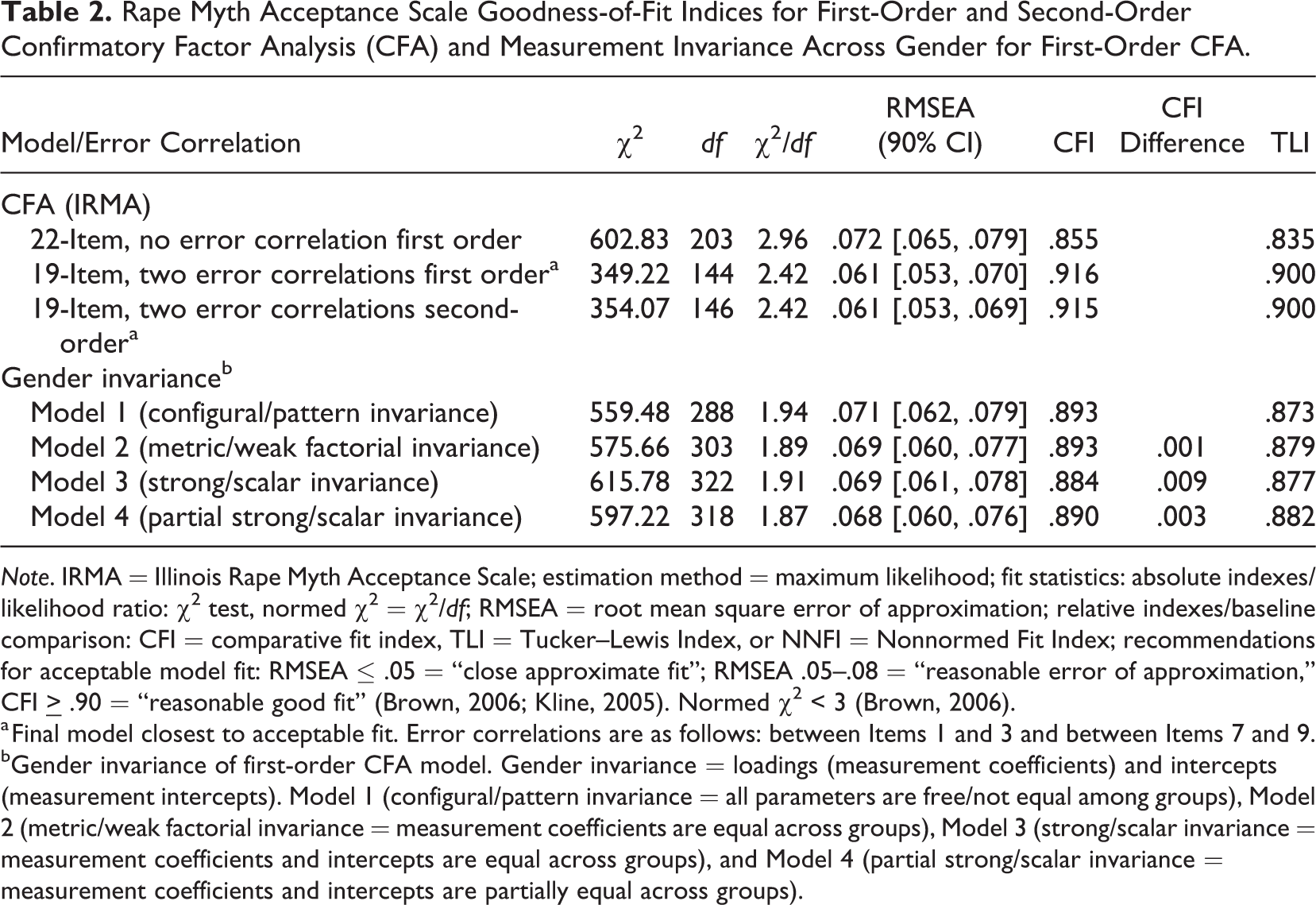
Note. IRMA = Illinois Rape Myth Acceptance Scale; estimation method = maximum likelihood; fit statistics: absolute indexes/likelihood ratio: χ2 test, normed χ2 = χ2/df; RMSEA = root mean square error of approximation; relative indexes/baseline comparison: CFI = comparative fit index, TLI = Tucker–Lewis Index, or NNFI = Nonnormed Fit Index; recommendations for acceptable model fit: RMSEA ≤ .05 = “close approximate fit”; RMSEA .05–.08 = “reasonable error of approximation,” CFI
a Final model closest to acceptable fit. Error correlations are as follows: between Items 1 and 3 and between Items 7 and 9.
bGender invariance of first-order CFA model. Gender invariance = loadings (measurement coefficients) and intercepts (measurement intercepts). Model 1 (configural/pattern invariance = all parameters are free/not equal among groups), Model 2 (metric/weak factorial invariance = measurement coefficients are equal across groups), Model 3 (strong/scalar invariance = measurement coefficients and intercepts are equal across groups), and Model 4 (partial strong/scalar invariance = measurement coefficients and intercepts are partially equal across groups).
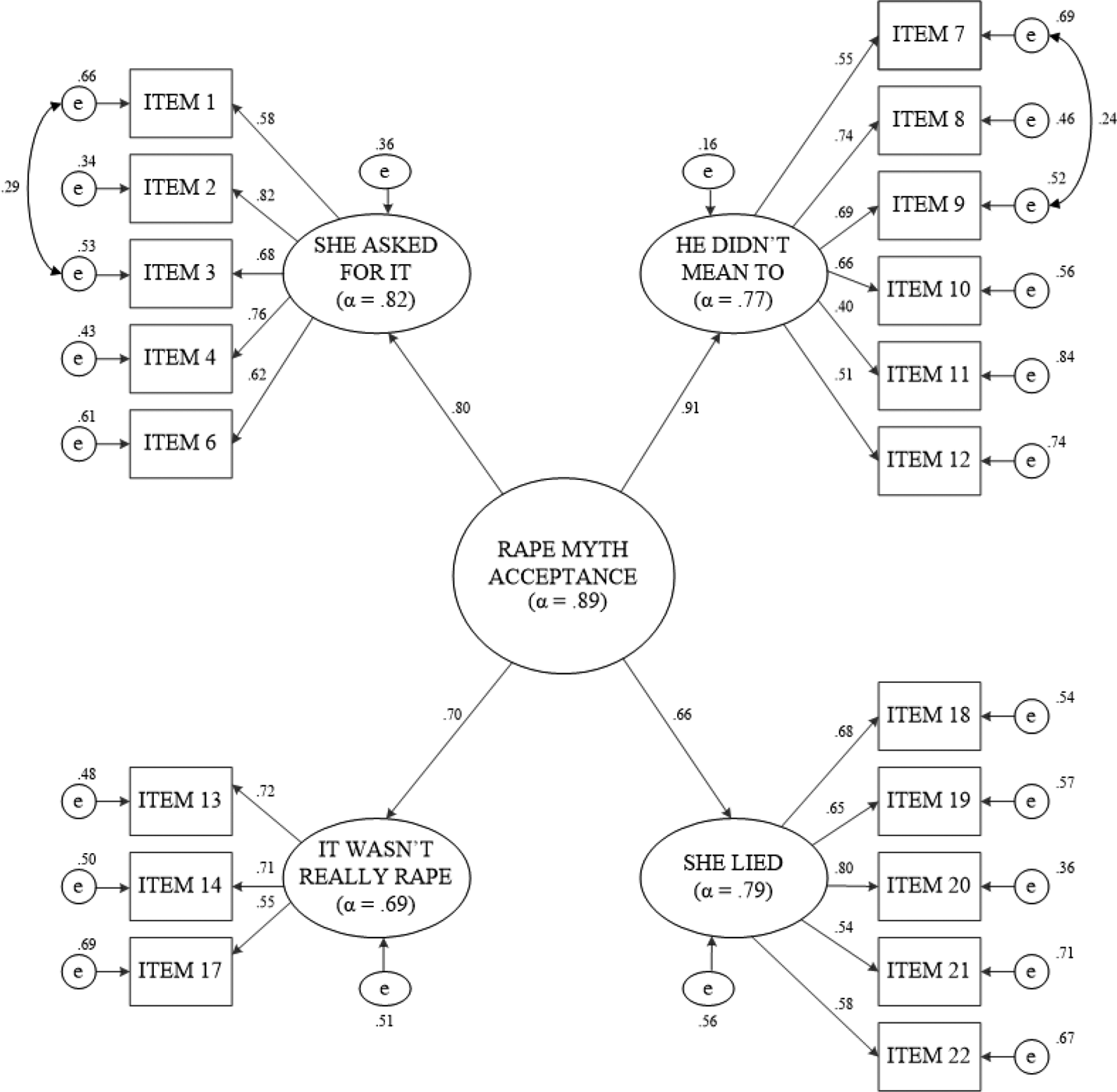
Second-order confirmatory factor analysis of the Illinois Rape Myth Acceptance (IRMA) Scale. Standardized estimates reported. All loadings are statistically significant (p < .01). e = ∊ = error. IRMA (M = 2.87, SD = 0.71), she asked for it (M = 2.49, SD = 0.93), he didn’t mean to (M = 2.93, SD = 0.87), it wasn’t really rape (M = 3.04, SD = 0.98), and she lied (M = 3.03, SD = 0.86). Male: IRMA (M = 2.83, SD = 0.69), she asked for it (M = 2.46, SD = 0. 91), he didn’t mean to (M = 2.89, SD = 0.87), it wasn’t really rape (M = 3.02 SD = 0.99), and she lied (M = 2.93, SD = 0.85). Female: IRMA (M = 2.93, SD = 0.72), she asked for it (M = 2.53, SD = 0.97), he didn’t mean to (M = 2.97, SD = 0.86), it wasn’t really rape (M = 3.06, SD = 0.95), and she lied (M = 3.18, SD = 0.85).
Gender Invariance
As shown in Table 2, measurement invariance describing whether the factor structure is equivalent across gender was established. The change in χ2 was nonsignificant for metric/weak factorial invariance (Δχ2 = 16.18, df = 15, ns), the difference in CFI did not exceed .01, and the RMSEA values fell within the CI of values for configural/pattern invariance (Cheung & Rensvold, 2002). This suggests that the model in which the factor loadings were constrained to be equal across gender was equally as fitting as the model in which all parameters were allowed to vary freely. However, instead of scalar invariance (Δχ2 = 40.12, df = 19, p = .003), partial scalar invariance was established by freeing from constraints Item 3 (“if a girl goes to a room alone with a guy at a party, it is her own fault if she is raped”), Item 10 (“if a guy is drunk, he might rape someone unintentionally”), and Item 14 (“if a girl doesn’t physically fight back, you can’t really say it was rape”). Thereafter, the change in χ2 between metric/weak and partial scalar invariance became nonsignificant (Δχ2 = 21.56, df = 15, ns) and the ΔCFI was equally smaller than the critical value −.01 (Cheung & Rensvold, 2002), suggesting that the latent means of the remaining invariant 16 items could be compared across gender.
Gender Differences
Results of the independent-samples t test (excluding Item 3 in the factor “she asked for it,” Item 10 in the factor “he didn’t mean to,” and Item 14 in the factor “it wasn’t really rape”) to determine whether there is a statistically significant difference between the means across gender suggest that a facet of rape myth acceptance differed by gender. Specifically, women (M = 3.17, SD = 0.85) were more likely than men (M = 2.93, SD = 0.85) to reject the myth that the female victim of rape “lied,” t(374) = 2.73, p = .007. The mean difference in “she asked for it,” “he didn’t mean to,” and “it wasn’t really rape” across gender was statistically nonsignificant.
Discussion
The present analyses examined the factor structure and gender invariance of IRMA in Nigeria. Specifically, the analyses determined whether the scale is hierarchically structured with a single underlying factor, whether the hypothesized four-factor structure fit the data well, whether the factor structure was equivalent across gender, and whether the latent means could be compared across gender (whether males and females differed in their ratings of the scale).
Factor Structure
The EFA identified five subconstructs for IRMA, although Items 5, 15, and 16 converged as a separate subconstruct. It is notable that Items 5 and 15 were also dropped from analysis by McMahon and Farmer (2011). Similarly, the hypothesized second-order five-factor model by McMahon and Farmer (2011) fits the data well when second-order five-factor CFA model was examined: χ2 = 353.31, df = 146, χ2/df = 2.42, RMSEA (90% CI) = .064 [0.056, 0.073], CFI = .907, and TLI = .892. Beyond the exploratory statistical observation, we currently lack empirical or theoretical basis for considering Items 5, 15, and 16 as a separate subconstruct in Nigeria, as their inclusion in a separate subconstruct did not result in marked improvement in the model. However, we plan to consider these options in future replication.
Nevertheless, the results of first- and second-order four-factor CFA model suggested that IRMA is multidimensional and the hypothesized interrelated four-factor structure as conceptualized is plausible in Nigeria. The first-order CFA model with two error correlations provided the best possible four-factor structure of IRMA in Nigeria. Thus, the validation lends credence to facets of rape myths (e.g., blame attribution to rape victim and inanimate objects [e.g., alcohol], propensity to exonerate perpetrator, minimization of rape victimization, and believability of the dilemma of the rape victim [Fakunmoju et al., 2016a] that lead to understanding rape-supportive beliefs in Nigeria.
Results of second-order CFA model support the notion that the four distinct but related subconstructs (i.e., “she asked for it,” “he didn’t mean to,” “it wasn’t really rape,” and “she lied”) can be accounted for by a common higher order construct titled Rape Myth Acceptance (i.e., IRMA) and suggest that Rape Myth Acceptance can be used to explain the pattern of relations among the subconstructs. However, with factor loading as high as .91, it is noteworthy that “he didn’t mean to” commands the strongest association in this pattern of relations, suggesting that judgment about the underlying motive for rape (e.g., beliefs about strong sexual desire and sexual weakness of men and effects of alcohol in lowering sexual inhibition of men and resistance of victims) may be given more consideration in understanding endorsement of rape myths (e.g., perception of rape, rape-supportive behaviors, attitudes, and beliefs, or response to rape) or misconceptions about rape or rape myths in the region.
Gender Invariance
Examination of gender invariance and verification of partial scalar invariance supports that IRMA is devoid of “any gender-based differential item functioning” (McMahon & Farmer, 2011, p. 79). Although configural/pattern invariance and metric/weak factorial invariance were established, the inability to establish strong/scalar invariance suggested that latent factor means of the 19-item IRMA may not be comparable across gender. However, by excluding Items 3, 10, and 14, which were variant, a validation of partial scalar invariance suggested that the latent means may be deemed as invariant across gender for the remaining 16 items. It also supports the conclusion that latent means were comparable across gender, as men and women appeared to ascribe the same meanings to IRMA’s constructs and interpreted the 16 items similarly.
The lack of strong scalar invariance in the present analyses is not surprising; it is a common occurrence in scientific research (Joshanloo et al., 2014; Torsheim et al., 2012). In social research, it is often the case that cultural norms may predispose a population group to respond in ways that systematically differ from the ways another population group would respond (Gregorich, 2006). For example, moral beliefs about the inappropriateness of women being alone in rooms with men, beliefs about impairing effects of alcohol on sexual judgment of men, and a tendency to presume a woman’s refusal to forcefully, physically resist sexual advances of men as consent may have predisposed men to endorse rape-supportive beliefs in ways that systematically differ from those of women. Similarly, the religious beliefs that women should be sexually submissive to sexual urges of men may have predisposed men to be more likely to endorse these aspects of rape myths than women. Nevertheless, the lack of scalar invariance across gender may suggest that identified items may need alteration or modification in future studies (Lugtig, Boeije, & Lensvelt-Mulders, 2012).
Gender Differences
Following the comparability of rape myths across gender through partial scalar invariance, results of an independent-samples t test suggested that rape myths differed by gender. Specifically, women were more likely than men to reject the myth that the female victim of rape “lied.” This finding is particularly consistent with existing knowledge about gender differences in endorsement of rape myths in the United States (McMahon, 2010; McMahon & Farmer, 2011) and validates explanations of why many rape victims fail to report their victimization experience. Although female respondents were more rejecting of all aspects of rape myths than male respondents in the U.S. sample by McMahon and Farmer (2011), the only gender difference in the present study was on the subconstruct “she lied.” This realization that women and men did not differ in other three aspects of rape myths in Nigeria is perhaps indicative of psychological assimilation of gender-based violence (Fakunmoju et al., 2016b) and internalized oppressive beliefs that women carry in Nigeria. Observation of gender differences in rape myths between the U.S. sample (McMahon & Farmer, 2011) and present sample is perhaps more tenable when one realizes that the U.S. respondents were more rejecting of all items of rape myths (McMahon & Farmer, 2011) than respondents in the present study.
Nevertheless, several cultural and religious factors may shed light on why men were less likely to believe female victims of rape than women in Nigeria. Visualization of women as sexual objects for pleasure of men, lack of witness or physical injury from rape, and religious obsessions about female purity and modesty are realities that often complicate the propensity of women to report rape and decrease the likelihood of men to believe reports of rape in Nigeria. In addition, some women do not recognize that specific sexual violation against them constitutes rape and some families of rape victims prevent them from reporting rape because of the perception that such reports will bring shame and embarrassment to the family (Aborisade, 2014; NOIPolls, 2013; Peterson & Muehlenhard, 2011).
Despite the rarity of false reports of rape, reports of rape are often met with skeptical responses. Apart from not believing reports of rape by women, many men believe that women should be sexually available to them and that consent for sex should be automatic. Similarly, in considering whether to report rape, many rape victims ruminate over whether their experience would be perceived as false, especially since the consequence of reporting may be perceived to be greater than the actual victimization of rape. For example, apart from stigmatization associated with reporting rape in Nigeria, Aborisade (2014) identified “fear of retaliation” by perpetrators, “lack of confidence in the criminal justice system, social stereotypes and prejudice against victims” (p. 1) as barriers to reporting rape. Sable, Danis, Mauzy, and Gallagher (2006) reported similar barriers in the United States, identifying “(1) shame, guilt, embarrassment, not wanting friends and family to know; (2) concerns about confidentiality; and (3) fear of not being believed” in addition to “fear of retaliation by the perpetrator” (p. 157) as barriers to reporting victimization. These myriad barriers have implications for predisposing men to doubt the authenticity of rape reports and to have a lower likelihood than women to believe reports of rape.
Strengths and Limitations
The studies for these analyses have both strengths and limitations. The major strength relates to the validation of the factor structure of IRMA in Nigeria, which has implications for research and practice. By validating the factor structure of IRMA, comparable knowledge about other regions where validation has been established may be generated through future research. Similarly, the ability to obtain anonymous responses on the sensitive issue of rape is a notable strength of the studies. By collecting data in three southwestern regions of Nigeria and, through analyses, validating the factor structure of IRMA, suitability of IRMA for examining rape myths or rape-supportive beliefs in Nigeria is preliminarily established.
Despite the above strengths, the studies have limitations. The major limitation relates to the limited geographical coverage of respondents, thereby minimizing the generalizability of findings to other regions. As a result, the validation identified in these studies must be deemed tentative, as rape myths or rape-supportive beliefs may differ across regions and urban versus rural centers of the country. Because respondents completed the survey online, it is possible that respondents with access to the Internet may differ in significant ways from those without access to the Internet.
Implications for Theory, Practice, and Research
The validation of the factor structure of IRMA and the finding of comparability of latent means across gender presupposes that the scale may be utilized for both males and females to determine the degree of acceptance of rape myths or the proclivity to rape, identify possible relationships of rape myths with other rape-supportive beliefs and behaviors, and implement rape prevention and victim intervention programs. For example, McMahon (2010) examined the relationship between bystander attitudes and rape myths and concluded that rape myths should be integrated in bystander intervention programs. By identifying the effects of rape myths on willingness to protect victims of rape, utilizing IRMA in Nigeria may enhance research and practice in rape prevention and intervention program. Similarly, because male and female respondents interpreted to IRMA items equally or ascribed the same meaning to them, it can be stated, albeit prematurely, that knowledge generated from utilizing the scale will be relevant to rape prevention or intervention in Nigeria.
However, the finding that women were more likely than men to reject the myth that female victim of rape “lied” presupposes that rape prevention programs for first responders to reports of rape may be conducted separately for men (see McMahon & Farmer, 2011). Similar separate training for men may enhance the sensitivity that is needed for believing and treating fairly reports of rape by female victims. The uniqueness of IRMA in terms of being updated to reflect universally applicable language makes its diverse use plausible in Nigeria and enhances the possibility of generating meaningful comparative knowledge.
Future research may focus on establishing the factor structure in other regions of Nigeria, especially in rural regions that are not covered in the cited studies. By identifying rape myths across regions of the country, it will be possible to determine their relevance to rape-supportive behaviors. Knowledge generated from such studies may be crucial for rape prevention and intervention programs and may enhance comparisons with other regions of the world.
Footnotes
Authors’ Note
A part of this article was presented at the Society for Social Work and Research 22nd Annual Conference (January 2018), Washington, DC.
Declaration of Conflicting Interests
The author(s) declared no potential conflicts of interest with respect to the research, authorship, and/or publication of this article.
Funding
The author(s) received no financial support for the research, authorship, and/or publication of this article.
