




Abstract
Trans feminine individuals are at a higher risk of sexual victimization than any other subset of the U.S. population. This New York City (NYC)-based study employed an intersectional framework with a phenomenological interview format to explore the experiences of trans feminine adult study participants with sexual victimization. A total of 10 in-depth interviews with a diverse sample of trans feminine individuals were conducted. Analysis revealed themes specific to (1) the diversity of experiences within sexual victimization, (2) transmisogynistic sexual victimization, (3) internalized transmisogyny and cissexism, and (4) the health consequences of sexual victimization. Recommendations for policy and programmatic enhancements, future research directions, and implications for social workers are provided.
Transgender individuals are at a heightened risk of sexual violence across a lifespan compared with the general U.S. population (Stotzer, 2009). Research indicates that approximately half of transgender individuals have experienced unwanted sexual contact (Stotzer, 2009). Kenagy (2005) found that sexual victimization rates were higher for transgender male-to-female respondents (69%) compared to female-to-male respondents (30%). Comparatively, estimates indicate that 27.3% of women and 10.8% of men in the general U.S. population have experienced unwanted sexual contact (Basile, Smith, Breiding, Black, & Mehendra, 2014). Thus, the evidence points to trans feminine individuals as being at a higher risk of sexual victimization than any other subset of the U.S. population.
Despite evidence of this higher risk of sexual victimization, trans feminine individuals continue to face stigma and discrimination when seeking support within substance abuse and mental health treatment facilities, rape crisis centers, domestic violence shelters, and other health-care settings (Grant et al., 2011; Kattari & Hasche, 2016; Kattari, Walls, Speer, & Kattari, 2016; Seelman, 2015; Stotzer, Silverschanz, & Wilson, 2013). Barriers to accessing health-care services are found to correspond with providers’ lack of skills, knowledge, and trans affirmative attitudes when working with diverse transgender populations (Institute of Medicine, 2011; Poteat, German, & Kerrigan, 2013). This is particularly concerning considering research that indicates that sexual violence exposures and experiences with provider-based stigma contribute to the development of health, mental health, and substance use issues in sexual and gender minority populations (Fergusson, Swain-Campbell, & Horwood, 2002; Herbst et al., 2008; Nguyen-Feng, Baker, Merians, & Frazier, 2017; Walsh, Galea, & Koenen, 2012).
While emerging literature has attempted to examine the prevalence, risks, and consequences of sexual violence against transgender individuals, there has been scant research that has sought to establish a deeper understanding of how the presence of multiple marginalized identities corresponds with experiences of sexual victimization among trans feminine individuals. This study seeks to fill this gap in the literature by applying an intersectional framework to explore the lived experiences of a diverse small sample of trans feminine individuals (N = 10) with histories of sexual victimization.
Literature Review
Current estimates indicate that transgender individuals comprise of approximately 0.3–5.0% of the U.S. adult population (Gates, 2011; Trotter, 2010). The term transgender refers to an individual whose gender identity does not align with the sex they were assigned at birth. A transgender woman is an individual who was assigned the male sex at birth and identifies as a female. Trans feminine is a term used to describe individuals who were assigned the male sex at birth but identify as having dominant feminine characteristics while refraining from characterizing themselves as “women.” In this study, trans feminine is used to describe all participants who identify within the feminine side of the gender spectrum, including trans women and nonbinary individuals who identify predominantly as feminine.
The gender binary system describes gender as male (masculine) or female (feminine; Richards et al., 2016). However, there are those who identify with both or move fluidly between masculine and feminine identities (e.g., androgynous, gender fluid); have multiple genders (e.g., bigender, pangender); are intersex, identify with an additional gender (e.g., third gender), or do not identify with either gender (e.g., agender, gender neutral). These individuals can be categorized as having a nonbinary identity.
Cissexism involves perceiving cisgender identities as superior to transgender identities. Transphobia can be described as the irrational fear of transgender identities that manifests in “attitudes, beliefs, and behaviors that devalue, stigmatize, or render invisible” transgender populations (Elze, 2006, p. 52). Misogyny involves an intense dislike and/or dismissal of those who are feminine. Transmisogyny refers to the intersection of transphobia and misogyny (Serano, 2007, p. 15).
Sexual Victimization and Trans Feminine Individuals
Sexual victimization, involving sexual violence and unwanted sexual contact, is a widespread public health and safety issue in the United States (Krebs, Lindquist, Warner, Fisher, & Martin, 2007) that has received a proliferation of recent attention due to extensive media coverage of high-profile sexual victimization cases largely involving cisgender men in positions of social and economic power. Sexual violence is defined as nonconsensual attempted or completed sexual contact (e.g., rape, sexual assault; Basile et al., 2014). Unwanted sexual contact may involve intentional nonconsensual touching in a sexual manner (e.g., fondling), unwanted exposure to sexual experiences (e.g., exhibitionism), and verbal sexual harassment (e.g., sexual comments; Basile et al., 2014).
Sexual victimization remains a significant issue among women with nearly 1 in the 5 women (20.0%) compared to 1 in the 59 men (1.7%) in the United States experiencing an attempted or completed rape in their lifetime (Basile et al., 2014). Approximately one quarter of women (27.3%) report experiencing unwanted sexual contact in their lifetime (Basile et al., 2014). Rates of sexual victimization among trans feminine individuals range significantly based on methodological variations within studies, while the most common rate is around 50.0% (Stotzer, 2009). Kenagy (2005) found that trans feminine individuals experience increased rates of sexual victimization (69.0%) compared to trans masculine individuals (30.0%).
Factors associated with sexual victimization
The literature indicates several intersecting factors that are associated with the sexual victimization of trans feminine individuals including transphobia, racial/ethnic minority status, homelessness, survival sex work, age, employment status, health insurance access, history of sexual and physical violence, and citizenship (Bradford, Reisner, Honnold, & Xavier, 2013; Chávez, 2011; Grant et al., 2011; Kattari & Begun, 2017; Meier & Labuski, 2013; Mizock & Hopwood, 2018; Sutter & Perrin, 2016). Transphobia is one of the driving motivations for the sexual victimization of trans feminine individuals (Witten, 2003; Xavier, Bobbin, Singer, & Budd, 2005). Trans feminine individuals may be particularly vulnerable toward experiencing the intersections of transphobia and misogyny in the form of transmisogyny (Serano, 2007, p. 15). There remains a dearth of research examining the lived experience of transmisogyny and its associations with sexual violence and health outcomes among trans feminine individuals.
Transgender individuals are twice as likely to be homeless due, in part, to the effects of transphobic discrimination (Grant et al., 2011). For example, employment discrimination on the basis of gender identity (Grant et al., 2011; Ng, Schweitzer, & Lyons, 2012) can lead to survival sex work among transgender individuals to meet their basic needs (e.g., food, shelter; Deutsch, 2014; Gorton & Grubb, 2014; Warf et al., 2013; Watson, 2011) which, in turn, can render them vulnerable toward sexual victimization. A study on the relationship between homelessness and survival sex work among transgender individuals found that those who had experienced homelessness were twice as likely to have engaged in sex work than those who had never been homeless (Kattari & Begun, 2017). In addition, Kattari and Begun (2017) found that homeless transgender individuals are at risk of sexual violence in the shelter system, with 21.7% of respondents reporting they were sexually assaulted in a shelter. Age is also indicated to be associated with homelessness and sex work, with youth and young adult transgender individuals having a particular vulnerability toward sexual violence (Kattari & Begun, 2017). Furthermore, the literature indicates that a history of violence may place trans feminine individuals at a higher risk of sexual violence (Bradford et al., 2013), indicating a cycle of victimization.
Trans feminine individuals of color experience violence at a disproportionate rate than white trans feminine individuals (Grant et al., 2011; Sutter & Perrin, 2016). In addition, race/ethnicity is found to be associated with sex work with one study finding that black/African American transgender individuals are 4 times more likely to have engaged in survival sex than white transgender individuals (Kattari & Begun, 2017), placing them at increased risk of sexual victimization. There is also evidence that the intersection of race/ethnicity, gender identity, and citizenship status increases the risk of sexual victimization among trans feminine individuals during migration (Chávez, 2011). These findings elucidate how the possession of multiple marginalized identities may increase vulnerability toward sexual violence based on societal and institutional mechanisms of oppression rooted in racism, sexism, transphobia, and xenophobia.
Due to the effects of employment discrimination, transgender individuals experience poverty and unemployment at alarming rates, particularly among transgender individuals of color (DeFilippis, 2016). There is currently no federal law that explicitly protects transgender individuals from employment discrimination (Bailey, 2014). Ninety percent of transgender individuals surveyed in the National Transgender Discrimination Survey (N = 6,436) reported experiencing employment-based discrimination, with 47.0% of respondents reporting they had experienced negative employment outcomes (e.g., being fired, not being hired) because of their gender identity (Grant et al., 2011). Based on the high rates of antitransgender employment discrimination (Grant et al., 2011; Ng et al., 2012), transgender individuals may seek to avoid workplace discrimination by route of “passing” so as to not be identified as transgender, including through the use of gender affirmation surgeries (Clair, Beatty, & Maclean, 2005). Gender transition is the process of changing one’s gender expression or sex characteristics through social and/or medical transition (Levitt & Ippolito, 2014; Wong, 2013). Gender affirmation surgeries involve medical transition procedures through which an individual can align their primary and/or secondary sex characteristics with their gender identity (Coleman et al., 2012; Deutsch, 2014).
Studies indicate that openly disclosing one’s gender minority identity is associated with having a greater risk of victimization (Gardner, de Vries, & Mockus, 2014; Ryan, Huebner, Diaz, & Sanchez, 2009). Thus, gender affirmation surgeries are found to enhance safety from discrimination and violence due to the reduced visibility of gender minority status (Meier & Labuski, 2013). Transgender individuals who do not (or cannot afford to) undergo costly medical transition may be particularly vulnerable toward discrimination and sexual victimization (Bockting, Miner, Romine, Hamilton, & Coleman, 2013; Bradford et al., 2013; Meier & Labuski, 2013; Miller & Grollman, 2015). On the other hand, transgender individuals who can afford gender affirmation surgeries are discussed as more likely to be employed and Caucasian (Meier & Labuski, 2013; Mizock & Hopwood, 2018).
There is a contradiction within the literature related to how transgender individuals who are more “passable” (i.e., individuals who may not be perceived as transgender according to sociocultural gender norms) experience greater safety and less discrimination than those who are more visibly transgender. The social, health, and economic consequences of being perceived as transgender or gender nonconforming within a transphobic and cisnormative society indicate that in order to increase safety, transgender and gender nonconforming individuals may choose to conform with sociocultural expectations of gender (Kattari & Begun, 2016; Miller & Grollman, 2015). However, conformity within a gender binary system that does not recognize and/or affirm your identity can be construed as anything but “safe.” Therefore, the concept of passing for transgender individuals can be understood as linked to transphobia and cissexism, whereby the perception of cisgenderism is construed to be preferable and in alignment with societal expectations of gender. Concealment of gender identity is a coping strategy used to increase a transgender individual’s ability to pass (Mizock & Mueser, 2014). While this strategy may help to reduce incidences of physical, verbal, and sexual violence, it may not alleviate psychological distress (Bockting et al., 2013; Mizock & Mueser, 2014) and may create issues with internalized stigma rooted in transphobia, transmisogyny, among other factors.
Health consequences
There are several consequences of discrimination, victimization, and violence against transgender populations related to negative health and mental health outcomes, including related to HIV/AIDS (Herbst et al., 2008) and issues with depression, anxiety, posttraumatic stress disorder, and substance use disorder (Fergusson et al., 2002; Mustanski, Garofalo, & Emerson, 2010; Nguyen-Feng et al., 2017). The prevalence of depression among transgender individuals is found to be more than 3 times that of the general U.S. population (Nuttbrock et al., 2010). In addition, transphobic discrimination and violence are found to be associated with high rates of suicidal ideations in the transgender population (Nuttbrock et al., 2010). These findings reflect the serious consequences of transphobic discrimination and victimization in the lives of transgender individuals.
Social support
Social support is a resilience factor that has been identified as buffering the effects of transphobic stigma, discrimination, and violence on the health and mental health of transgender individuals (Grant et al., 2011). Evidence points to the utility of support networks in helping to reduce some of the consequences related to chronic exposures to stigma, discrimination, and violence among transgender populations. Notably, there is consistent evidence about the benefits of social support networks to mediate the link between victimization and negative psychological outcomes (Friedman & Morgan, 2009; Teasdale & Bradley-Engen, 2010; Williams, Connolly, Pepler, & Craig, 2005), decreasing the risk of depression and suicidal behaviors and increasing self-esteem. A study of transgender female immigrants found that the use of social supports helped to foster resilience to cope with discrimination and violence (Cerezo, Quintero, Morales, & Rothman, 2014).
Theoretical Framework
Crenshaw (1991) coined the term “intersectionality” to describe the interconnectivity of oppressive societal and institutional structures and their effect on individual and collective experience. Intersectionality derives from women of color feminism which focuses on investigating the relationships between different oppressive systemic forces (e.g., racism, classism, sexism, homophobia) and their interlocking influence on diverse feminine experiences. Over the years, intersectional analysis has become a widely accepted framework for examining how sociocultural, economic, and political structures of power and oppression construct individual and group identity (Ferguson, 2007; Warner, 2008) while deepening systems of inequality (Collins, 2002; Crenshaw, 1991; Shields, 2008; Zinn & Dill, 1996).
Within this study, an intersectional framework is applied to explore whether and how the intersections of race/ethnicity, gender, sexuality, employment status, housing status, and the ability to “pass” influence study participants’ experiences with sexual victimization. Specifically, it acknowledges how power and oppression intersect based on the possession of multiple identity statuses, creating risks of and protections from victimization. The use of an intersectional framework stretches beyond a gendered focus to examine how discourses rooted in cis-heteropatriarchy, transphobia, racism, and classism position trans feminine individuals (particularly those of color) to be vulnerable toward uniquely denigrating types of sexual victimization. This study integrates the shared values of the feminist and social work traditions related to the promotion of human rights and social justice issues through person-in-environment empowerment frameworks.
Method
This study employed a phenomenological approach to inquiry (Moustakas, 1994; van Manen, 2014) to study and describe experiences related to a sensitive subject matter (i.e., sexual victimization) within a vulnerable minority population (trans feminine adults). A hermeneutic phenomenological method was selected based on the understanding that lived experience can be captured within language (van Manen, 2010). Several methods of hermeneutic phenomenology guided this study, including (1) identification of a phenomenon of exploration, (2) the use of interviews to collect data related to the lived experiences of trans feminine individuals in relationship to the phenomenon, (3) thematic data analysis to uncover meaning from the textual representations of participants’ lived experiences, and (4) a rich description of the meanings uncovered in the data analysis. The product of the interviews included the production of interview transcripts which were transcribed verbatim.
Based on the phenomenological assumptions, this study accounted for the effects of the researcher’s positioning and potential biases as a Japanese American, cisgender, queer, social worker. Rigor was enhanced through the use of member checking, an audit trail, peer debriefing, and reflexivity to counter researcher biases (Lincoln & Guba, 1985). Specifically, data analyses were provided to all participants for member checking and input, an audit trail was maintained with a transparent log of research procedural decisions and reflexive processes, and peer debriefing with a PhD-level social worker with fluency in sexual and gender minority issues was used to further protect against the influence of biases.
Sampling Procedures
This article presents data collected from a qualitative study involving trans feminine individuals recruited in the NYC area. In February 2018, 10 participants engaged in a qualitative study either in-person or by video telephony (i.e., Skype, FaceTime). The study was approved by the Fordham University Institutional Review Board.
The study used a purposive nonprobability snowball sampling to recruit participants. Participants were recruited through the support of key informants within the New York Trans Advocacy Group (NYTAG). NYTAG is a transgender-led NYC-based social justice and advocacy organization dedicated to the empowerment of lesbian, gay, bisexual, transgender, and queer (LGBTQ) people from diverse backgrounds. Snowball sampling was selected based on the challenges associated with engaging members of a marginalized minority group. Specifically, this sampling strategy was based on a recognition of how the intersections of identity statuses related to gender identity and sexual victimization history, among other factors, might reduce the accessibility of this population.
Eligibility for participants included that they be at least 18 years of age, identify as having a gender identity within the trans feminine spectrum, speak English, and have some experience with sexual victimization (defined as “unwanted sexual attention or contact”). Incentives for participation included a USD $20 Amazon gift card upon completion of the interview. As an additional incentive as part of the snowball sampling strategy, a $10 Amazon gift card was provided to each participant who has completed their interview and made subsequent effective referrals to peers (i.e., completed interview).
Interviews
Interviews were conducted in-person at a NYTAG-affiliated office space (n = 5) or by video telephony (n = 5) upon participant request. Prior to the interview, an informational letter was provided to participants detailing the aims and procedures of the study. During the interview, participants reviewed their rights within the study, including related to confidentiality, the right to withdraw at any time, the procedures and intent of audio-recording and transcription, and whom to contact should they have any questions or concerns. Each interview ranged from 45 to 60 min. At the beginning of each interview, demographic information was qualitatively collected with regard to gender identity, sexual orientation, age, race/ethnicity, and employment status. In addition, each participant was provided with a definition of sexual victimization as including “any unwanted sexual attention or sexual contact.”
A semistructured interview schedule was used with open-ended questions such as “What experiences, if any, have you had with sexual victimization?” “How do you feel those experiences, if at all, related to race/ethnicity?” and “What health or mental health issues, if any, have you experienced as a result of your experiences with sexual victimization?” Participants were asked one close-ended question: “On average, how frequently do you experience sexual victimization: daily, weekly, twice-a-month, monthly, every couple of months, every 6 months or more?” All interviews were conducted and transcribed by the principal investigator (PI).
Data Analysis
Data were analyzed using thematic analysis (Braun & Clarke, 2013). This included the use of line-by-line analysis of the transcripts to identify descriptive categories/initial codes followed by the reduction of initial codes into potential shared themes and the refinement of final themes. Data saturation was reached when no new themes emerged in the interviews. Data were coded by hand by the PI. Computer-assisted qualitative data analysis software was not used for the study based on the small sample size. A second coder was not used based on the availability of resources which is recognized as a limitation as relates to potential bias. To protect against this bias, through each step of the coding process, data were provided to all participants for member checking with any suggested refinements incorporated into the analysis. In addition, a PhD-level social worker reviewed and provided input throughout the coding process. The result was the identification of 32 initial codes and four overarching categories.
Results
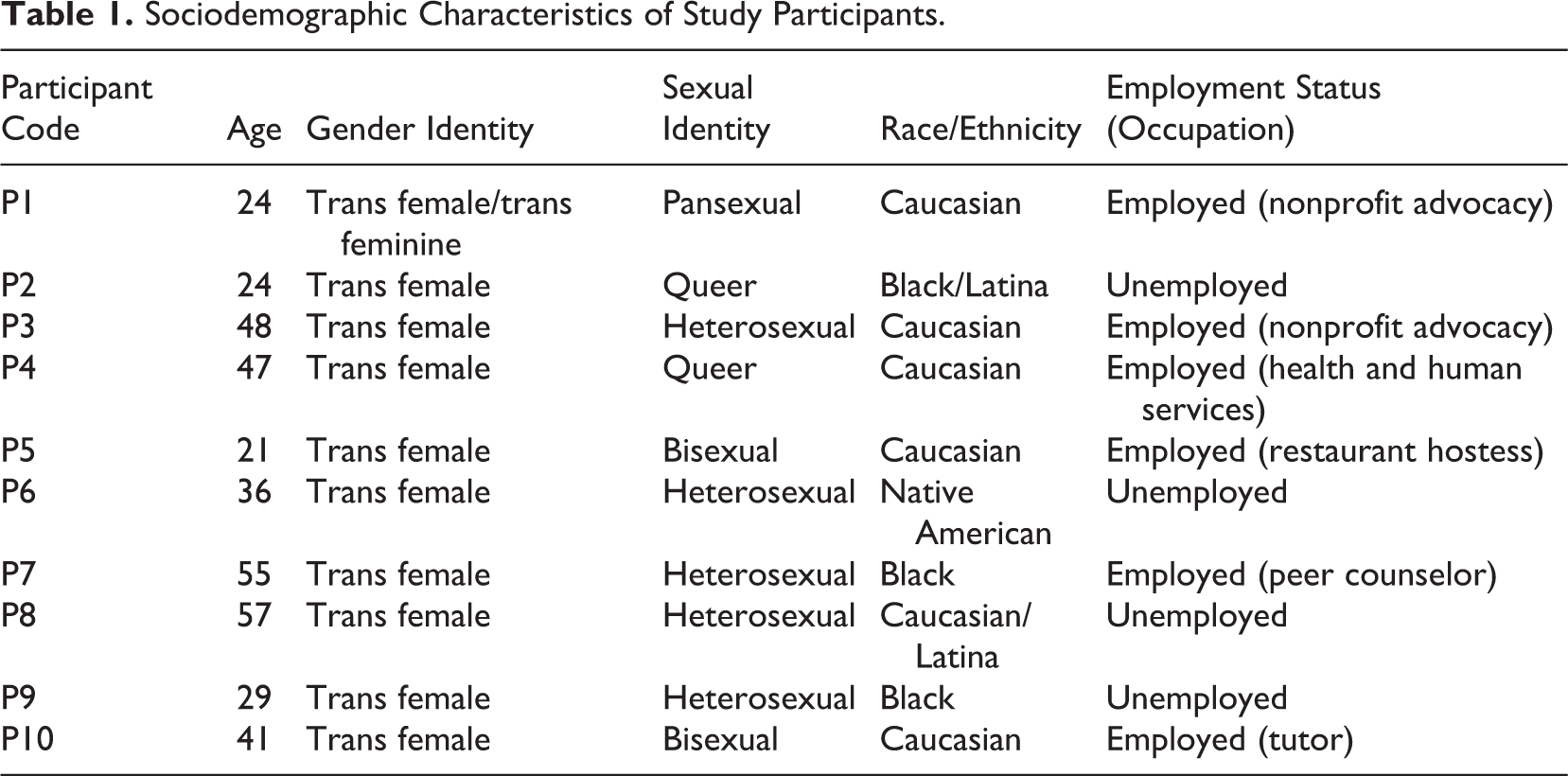
The sample comprised 10 trans feminine individuals whose sociodemographic characteristics are captured in detail in Table 1. The mean age of participants was 37.8 years old (SD = 13.7; range = 21–57). Nine of the participants identified as exclusively trans female with one participant (P1, age 24, Caucasian) identifying as trans female, but exploring adopting a trans feminine identity. The participants’ racial/ethnic backgrounds were diverse with five of the participants identifying as Caucasian, two as black, two as Mixed Race (Caucasian/Latina, black/Latina), and one as Native American. Participants varied in how they identified their sexuality with five identifying as heterosexual, two identifying as bisexual, two identifying as queer, and one identifying as pansexual. Sixty percent of the participants reported being employed with the remaining participants reporting being unemployed.
Sociodemographic Characteristics of Study Participants.
Using thematic analysis (Braun & Clarke, 2013), 32 initial codes were identified that were grouped into four overarching thematic categories, including (1) diversity of experiences within sexual victimization, (2) transmisogynistic sexual victimization, (3) internalized transmisogyny and cissexism, and (4) health consequences of sexual victimization. See Table 2 for the comprehensive categorized list of codes with notations of the frequency of quotations.
List of 32 Code Categories Within Four Overarching Themes.
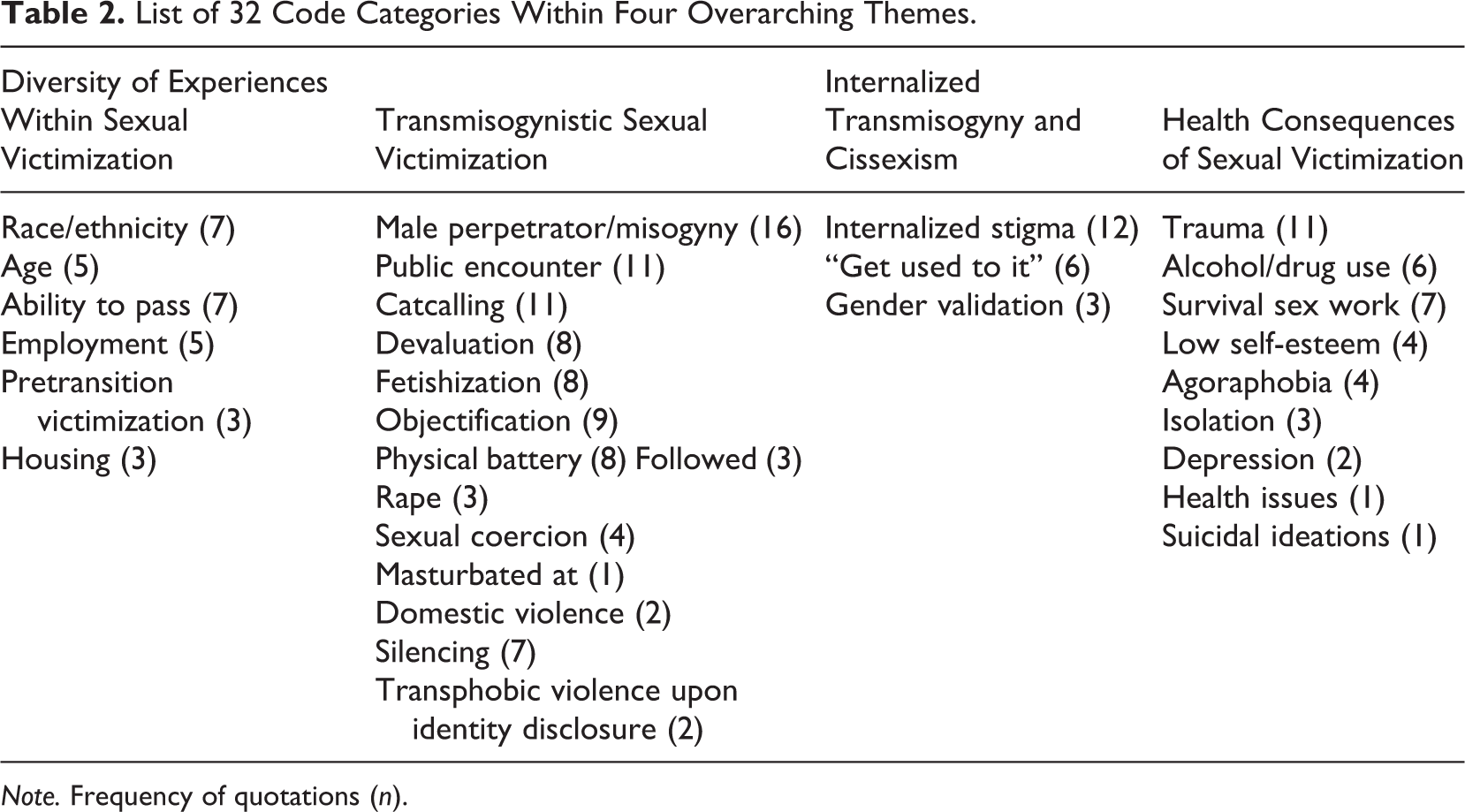
Note. Frequency of quotations (n).
Diversity of Experiences With Sexual Victimization
Participants reported a range of experiences with sexual victimization based on their sociodemographic characteristics, ability to pass, and pretransition histories. Sociodemographic characteristics such as race/ethnicity, age, employment status, and housing status were highlighted within participant accounts of sexual victimization. Ability to pass was discussed as influencing the types of sexual victimization experienced by participants and their perceived threats of harm related to transmisogyny. Furthermore, pretransition history with sexual trauma and/or other forms of trauma were mentioned within participants’ accounts of lifetime sexual victimization.
Race/ethnicity
Race/ethnicity was articulated by several participants (n = 4) as influencing their sexual victimization experiences. For example, some participants who identified as individuals of color described feeling ostracized from their racial/ethnic communities based on transphobic (and conflated homophobia) attitudes and beliefs about transgenderism. For example, Participant 9 (age 25, black) recounted the transphobia and homophobia she has experienced within her racial/ethnic community: “I feel like a lot of trans that come out in the black urban community go to prostitution because they don’t have the support to make it in the world…. You come out as trans. You’re shunned.” Similarly, Participant 2 (age 24, black/Latina) described her perspective on the subordination of trans women with intersecting racial/ethnic minority identities by claiming, “In America, we’re at the bottom of the barrel of what’s not accepted.”
Participant 7 (age 36, Native American) exemplified the influence of sociocultural beliefs and practices related to sexual victimization by discussing the views and practices within her Navajo Native American community toward sexual victimization and domestic violence: “Growing up on a reservation, almost every woman that I’ve known has been in abusive relationships with alcoholics and are being raped. There’s not enough support.”
Age
Age was highlighted by one participant (P6, age 55, black) as a factor in the variability of perspectives on sexual victimization. For example, she described the conflicts between elder and younger transgender women of color within her trans-affirmative church community with regard to perspectives on disclosure of their trans identities to avoid violence within sexual encounters. She explained: The young girls were like, “We disagree. We don’t feel like if we’re dancing and the person is just buying us drinks then we don’t have to announce our status.” And we were like, “Are you for real? Hands may go to places…and you still have male parts. This cis man assumes you are a cis woman.”
Employment status
Some participants (n = 4) situated their sexual victimization experiences in the context of their employment statuses. Specifically, this related to unemployment as contributing to their placement in environments (e.g., shelter) and behaviors (e.g., sex work) where they are vulnerable to sexual victimization. Chronic unemployment due to transphobic employment discrimination was discussed as influencing the decision of many transgender women to engage in sex work, rendering them vulnerable to sexual victimization. Participant 10 (age 41, Caucasian) discussed engaging in escorting services due to chronic unemployment and her experience with transmisogynistic sexual victimization by a patron: I was so desperate for money. I didn’t have a job. I applied to an escort agency. This particular client wanted to just sit and talk, but then all of the sudden he jumps on top of me and pins me to the bed. He said, “Drop your pants. I want to see what you have between your legs. I think you’re not who you say you are.” I said, “It’s none of your business what’s between my legs.” He said, “Either you drop them, or I drop them for you.” I was sexually assaulted where I worked. There was a male employee who took an exception to my being in the men’s room. It was about power more than anything else. I didn’t bother reporting it because the HR person was so horrible to me. In the end, it became, “You and I agree to no longer work here.”
Housing status
Two participants reported currently residing within a housing shelter related to issues with unemployment. One participant (P9, age 25, black) discussed being sexually coerced by a cisgender male patron within her men’s shelter. She reported that she felt unsupported by staff within the shelter upon disclosing the incident.
Pretransition sexual victimization
Pretransition sexual victimization refers to experiences of sexual victimization that participants survived prior to “coming out” as a transgender woman. Three participants discussed experiences of pretransition sexual victimization in the form of sexual coercion, being followed, and being drugged, mostly within gay establishments (i.e., bars and nightclubs). One participant (P7, age 36, Native American) disclosed having been sexually molested as a child and elucidated how this experience influenced her decision to enter a lifestyle of sex work with other trans feminine individuals.
Ability to pass
Ability to pass refers to the ability of a transgender woman to be recognized as a cisgender woman according to societal norms. The ability to pass was mentioned by several participants (n = 6) as influential in shaping the experience of a transgender woman with sexual victimization. For example, trans feminine individuals who pass were described as being victimized in the same manner as with that of a cisgender woman. Participant 4 (age 47, Caucasian) explained, “For somebody who has passing privilege, the person that’s harassing them is treating them exactly the same as they treat other women.” She added, “More recently, the more I’ve been passing, I’ve constantly gotten catcalled with unwanted advances. I had to change my route walking to and from work.’” Conversely, trans feminine individuals who do not pass were described as having greater vulnerability to being fetishized, objectified, sexualized, devalued, and to experiencing transmisogynistic aggression by cis men particularly upon identity disclosure. Participant 3 (age 48, Caucasian) explained, “Some people I know are fetishized or victimized because people make fun of them or harass them because they read them as trans.”
Transmisogynistic Sexual Victimization
All participants reported having experienced sexual victimization in their lifetime as well as in the last 12 months. When asked to qualitatively identify the frequency of their exposures to sexual victimization, participant responses ranged from “weekly” (n = 4; P3, P4, P6, and P7), “twice a month” (n = 3; P1, P5, and P8), “monthly” (n = 1; P9), “every couple of months” (n = 1; P10), and “every 6 months” (n = 1; P2). In other words, participants varied in the frequency with which they experience sexual victimization, with a majority indicating that they experienced sexual victimization at least twice a month.
Several participants discussed their experiences with sexual victimization as involving transmisogynistic undertones related to the intersection of transphobic and misogynistic behaviors. Participants discussed incidences of sexual victimization as being entirely perpetrated by cis men and occurring within both private and public spaces.
Within private spaces (home, shelter, work, and health services locations), half of the participants discussed cis men perpetrating sexual violence in the form of rape, sexual coercion, physical battery/unwanted touch, domestic violence, or transphobic aggression upon identity disclosure. Participant 8 (age 57, Caucasian/Latina) described her experience with unwanted sexual contact and the threat of harm by a cis male patron within her health services day program: “About a month ago, in my day program, a guy grabbed my butt and went up my skirt. Then I went in the ladies room and he came in and locked the door behind him.”
Within public spaces (i.e., on the street, bathrooms, and social media), all participants discussed cis men enacting sexual aggression in the form of catcalls, physical battery/unwanted touch, rape, targeted masturbation, or following them. Participant 1 (age 24, Caucasian) recalled her experience of sexual harassment within a public encounter by saying: One time I was sitting on a bench…this guy sat next to me and was like, “Hey, I wanna suck you off. Hey, where do you live? What stop are you getting off at? Do you have a partner? Can I fuck you?’ Honesty, those kind of experiences are almost countless…
Cis female and trans feminine experiences
Participants varied in their perspectives on how trans feminine experiences with sexual victimization differed from those of cisgender women. Half of the participants (n = 5) discussed their perspectives around the sexual victimization of trans feminine individuals as differing from those of cis women. Specifically, they characterized trans female experiences with sexual victimization as featuring transmisogynistic undertones related to devaluation, fetishization, and objectification. Participant 7 (age 36, Native American) discussed the phenomena by explaining: I think that a lot of trans women are looked at for sex, a fetish, showgirls, or anything but a normal person in society. When I walk into a room, they don’t see me. They don’t see my personality. They see a transgender woman or however they view me—as a man in a dress. We’re more targeted because men think they can do whatever they can do with us. A lot of men think if they get a transgender woman, they can get freaky with them. They think we will do anything to be with a man—be degraded and abused—it’s not the case. A woman who passes, who has had the final surgery, if she is sexually victimized and she is seen as a cis woman, the attacker has no indication that she is anything but a cis female. If it’s a trans woman who does not have the final surgery, if it’s exposed, we can be not only sexually victimized, but mutilated.
Invalidation and silencing
Most participants (n = 7) described feeling invalidated and silenced by authorities as well as trans feminine individuals and cis female peers upon disclosure of their incidences of sexual victimization. For example, Participant 9 (age 29, black) described the response of a worker in her men’s shelter after she disclosed that she was sexually victimized by a cis male resident: …the workers had told me, “It’s in your best interest if you get transferred now, because, in this facility, it’s a men’s shelter, and there’s basically only two options when a man comes up to you and forces himself up on you—you either gonna take it or you’re gonna fight. Those are your only two options.”
Regarding the experience of invalidation by peers, Participant 6 (age 55, black) mentioned, “It’s horrifying and I’ve spoken to people who have said, ‘You should toughen up a little.’” Such incidences of invalidation were repeatedly reported by participants to be internalized in the form of self-blame, depression, or shame (n = 4; P7, P6, P9, and P10).
Internalized Transmisogyny and Cissexism
A few participants (n = 3) articulated their conflicts around experiencing gender identity validation upon incidences of sexual victimization in the form of unwanted (and wanted) sexual attention (e.g., verbal harassment, behavioral harassment). They specifically noted that such incidences were unwanted in that they were cognizant of the transmisogynistic undertones within the behaviors. However, such incidences were also wanted in that cis male attention was construed as an indication of their ability to pass as a cis woman. Participant 5 (age 21, Caucasian) illuminated this conflict by saying: It’s like, “Oh, I guess I do look like a woman,” which is really fucked up and confusing. I think this random straight man on the street thinks I look like a woman so I must be one. Then I realize what I’m saying and it’s so weak. Why do I need that kind of validation? I’ve watched a lot of my friends think, “If he’s harassing me, I’m accepted as a woman.” It sends a horrible message. I’ve heard it time and time again if a man says something inappropriate to you then it’s a sign that you’ve now arrived. No, it’s not that you’ve arrived! It wasn’t just me as a person, it was just the fact that I’m a woman with a penis and that this person really fetishized that part of me. I felt ashamed that I thought someone could be attracted to me without fetishizing me.
Health Consequences of Sexual Victimization
Several common consequences of exposures to sexual victimization were highlighted, including related to symptoms of trauma (n = 8), substance abuse (n = 2), agoraphobia (n = 3), depression (n = 3), isolation (n = 3), low self-esteem (n = 7), survival sex work (n = 2), health issues (n = 1), and suicidal ideations (n = 1).
Participant 10 (age 41, Caucasian) highlighted her mental health disturbances resulting from experiencing sexual victimization by a cis male coworker: Ever since that day, I never went back to work. I had flashbacks. I started having nightmares. Screaming in the middle of the night. I was crying hours on end in the middle of the day. I was contemplating suicide. I experienced rape, I was fourteen when I found out I was HIV positive, and I ended up almost dying because of my drinking and the drugs. I believe that a lot of what I went through had to do with being molested.
These qualitative accounts highlight the significant health, mental health, and behavioral health issues faced by participants who have repeatedly experienced various forms of transmisogynistic sexual victimization.
Discussion
This study explored the experiences of trans feminine individuals with histories of sexual victimization. Overall, the responses of the participants within this qualitative study provide preliminary support for transmisogynistic sexual victimization as a phenomenon experienced uniquely by trans feminine individuals, with negative implications to their health, mental health, and view of self. Consistent with the literature, the findings illustrate how differences in sociodemographic characteristics may influence the experience of sexual victimization among trans feminine individuals, particularly as relates to race/ethnicity, age, employment, housing, ability to pass, and pretransition histories with violence.
Diversity of Experiences With Sexual Victimization
In alignment with the intersectionality framework used within this study, the experiences of participants with sexual victimization appeared to vary based on the diversity of their identifications according to race/ethnicity, age, employment status, housing status, pretransition experiences, and ability to pass. Race/ethnicity and/or employment status, in particular, appeared to influence (1) engagement in survival sex work and related experiences with sexual victimization, (2) extent of support or marginalization from their racial/ethnic cisgender community, and (3) financial capacity to undergo gender affirmation surgeries which influences ability to pass which, in turn, can shape experiences with sexual victimization. These findings are consistent with the literature indicating associations between survival sex work, race/ethnicity, employment status, and sexual victimization (Gorton & Grubb, 2014; Kattari & Begun, 2017).
In addition, two participants reported experiencing sexual violence in the workplace with one of these participants reporting experiencing loss of employment based on gender identity. This was consistent with the literature indicating the prevalence of antitransgender bias in employment decisions (Grant et al., 2011). There is a need for further research to examine the intersections between race/ethnicity, transmisogyny, and employment discrimination against trans feminine individuals. Only one participant alluded to the higher risks that younger adults face related to sexual victimization which is somewhat consistent with the literature which indicates that younger transgender individuals may be at a higher risk of victimization (Kattari & Begun, 2017).
Consistent with the literature, the study found support for the associations between sexual victimization, housing status, homelessness, the use of shelters, and survival sex work (Kattari & Begun, 2017). Two participants reported experiencing sexual discrimination in the shelter system and related to survival sex work, unemployment, and homelessness. One participant discussed her experiences with sexual victimization, substance use, homelessness, and survival sex work in the context of her background as a Native American growing up on a reservation and experiencing childhood sexual abuse. This was also consistent with the literature indicating that a history of violence may be a risk factor for sexual victimization (Bradford et al., 2013). There is a need for additional research to further test these associations.
Transmisogynistic Sexual Victimization
Descriptions indicate that participants viewed trans feminine experiences with sexual victimization as differing from those of cisgender women based on the added presence of transmisogynistic undertones. Specifically, participants highlighted their victimization experiences as involving misogynstic attitudes and behaviors combined with transphobic exhibitions of devaluation, fetishization, and objectification. Participant experiences with transmisogynistic sexual victimization did not appear to vary based on race/ethnicity, age, employment, housing, or pretransition violence histories but did appear to vary based on ability to pass. Visibility of their transgender status was noted by participants as a particular vulnerability to experiencing a risk of transphobic violence, beyond solely misogynistic violence. Overall, this finding expands on previous literature providing qualitative evidence citing transphobia as a reason for the sexual victimization of trans feminine individuals (Bradford et al., 2013; Wyss, 2004), indicating that the phenomenon may also be transmisogynistic in nature; this should be further examined, particularly as relates to the ability to pass.
In addition, most of the participants reported feeling invalidated upon disclosure of their incidences of sexual victimization either based on stigma and discrimination by providers (i.e., housing, law enforcement) or desensitization toward sexual violence among their trans feminine and cis female peers. This finding aligns with the literature indicating a high prevalence of provider-based transphobic stigma and discrimination (Fergusson et al., 2002; Herbst et al., 2008; Nguyen-Feng et al., 2017; Walsh et al., 2012). Participant experiences with invalidation upon disclosure of their experiences did not appear to vary based on race/ethnicity, age, employment, housing, pretransition histories with violence, or ability to pass. Furthermore, this finding highlights the deficits in support that trans feminine individuals may experience despite evidence indicating that the availability of support is critical to reducing the negative outcomes of sexual victimization (Cerezo et al., 2014; Friedman & Morgan, 2009; Teasdale & Bradley-Engen, 2010; Williams et al., 2005). The role of transgender-based social support in recovering from sexual victimization experiences should be examined in future studies.
Ability to Pass and Internalized Transmisogyny/Cissexism
Passing emerged as a consistent theme within participants’ responses. Some participants expressed internal conflict related to their view that incidences of sexual victimization by cisgender men serve to validate their female gender identity and their ability to pass. In this sense, passing was consistently referenced by participants as a desirable trait. It is noteworthy that none of the participants of this study mentioned a desire to not pass (i.e., remain visibly transgender). Passing, as validated by cis male sexual attention, appeared to be a means of gaining gender validation regarding their femininity, perhaps related to issues with internalized transmisogyny/cissexism.
Passing was described as a mechanism (often achieved through gender affirmation surgery) through which the participants protected themselves against the threat of antitransgender violence (Gardner et al., 2014; Grant et al., 2011; Ryan et al., 2009). Half of the participants discussed the threat of harm upon disclosure of their gender identity. This phenomenon again relates to the concept of passing whereby for trans feminine individuals to be targeted by transmisogynistic forms of sexual victimization, there is an implicit assumption that they be identified as transgender by their perpetrator. On the other hand, the threat of harm to a trans feminine individual upon identification of their transgender status implies their capacity to initially pass until the occurrence of gender identity disclosure.
From an intersectional perspective, passing denotes that an individual is capable of veiling their marginalized identity statuses to increase the perception of their membership to more privileged statuses. For example, a trans feminine individual who has undergone a variety of gender affirmation surgeries may be less likely to be subject to transphobic victimization because she may pass as a cis female. Furthermore, this individual’s access to gender affirmation surgeries may be due to her privileged economic and social status. Thus, there is an opportunity to further investigate the concept of passing from an intersectional perspective, particularly as it relates to how it is associated with access to gender affirmation surgeries and how this varies by race/ethnicity, citizenship, class, and relationship/marital status. Taken together, these findings reinforce the links between sexual victimization and power, privilege, and oppression, with trans feminine individuals being vulnerable to violence based on their multiple marginalized identity statuses.
Health Consequences of Sexual Victimization
Consistent with the literature (Fergusson et al., 2002; Nguyen-Feng et al., 2017; Walsh et al., 2012), participants discussed issues with depression, trauma, substance abuse, anxiety, sex work, suicidality, and HIV in association with their exposures to sexual victimization. These specific issues were not further investigated within the scope of this research. Therefore, the study does not account for other factors that may have potentially contributed to the development of health, mental health, and emotional health issues among the participants (e.g., stigma and discrimination, poverty, and adverse childhood experiences). Thus, there is a need for studies that examine the mechanisms by which sexual victimization is associated with each of these outcomes among trans feminine individuals. Furthermore, there is a need for further inquiry into how experiences with stigma and discrimination within health care and social services specifically impact trans feminine individuals who have experienced sexual victimization.
Limitations
This study presents with several limitations that should be considered when interpreting the results. First, the use of snowball sampling and one informant organization may have led to oversampling within a particular network of individuals who are engaged in nonprofit advocacy. Second, the specification that the participants speak English may have omitted the participation of individuals who have particular experiences with sexual victimization that are influenced by their intersecting identities related to citizenship, race/ethnicity, among other factors. Third, this study was limited to a dominant sample of trans female-identified individuals and could have benefited from the recruitment of more trans feminine/nonbinary individuals. Finally, there were limitations within the study related to the use of a cisgender female PI without the use of a second coder. Replications of the study are recommended within additional geographies outside of NYC, using trans feminine investigators, and accommodating for bilingual interviews. Despite the limitation of this research, it contributes insights about the diversity of trans feminine experiences with sexual victimization based on intersecting minority statuses. In addition, it provides preliminary data around the phenomenon of transmisogyny and its impact on trans feminine individuals.
Future Research Directions
There is an opportunity for several studies that investigate some of the data yielded within this study. This includes examining how sexual victimization differs between trans feminine, trans female, and cis female populations; what supports and resources trans feminine individuals can use to cope with sexual victimization; what role economic status (intersected with race/ethnicity) plays in the vulnerability of trans feminine individuals to sexual victimization; and how ability to pass influences the frequency and types of sexual victimization experienced by trans feminine individuals. In addition, there is an opportunity to investigate the sexual victimization experiences among important transgender segments, including, but not limited to: trans feminine individuals who do not seek to medically transition, transgender male and trans masculine individuals, trans feminine individuals from rural communities, trans feminine older adult women, and undocumented immigrant trans feminine individuals. Finally, in the context of the growing discourses within the MeToo Movement, there is an opportunity to explore the perspectives of trans feminine individuals related to the extent to which they perceive MeToo as including/excluding trans feminine experiences with sexual victimization.
Implications
The results of the study illuminate the potential for social workers to assume several roles (e.g., advocate, case manager, and organizer) as part of prevention and treatment efforts related to the sexual victimization of trans feminine populations. The unique ability of social workers to examine client issues from a person-in-environment perspective and to galvanize social action at the community-level positions its practitioners to support the needs of vulnerable trans feminine populations at multiple levels of intervention. Policy, program, and practice recommendations are provided for social workers to support the unique needs of trans feminine individuals who are at heightened risk of experiencing sexual victimization compared to the general U.S. population.
First, in accordance with the values of the social work profession related to social justice and dignity and worth of the person (National Association of Social Workers, 2008), there is a need for social workers to advocate for the implementation and/or maintenance of state- and federal-level policies that protect transgender individuals from discrimination that renders them vulnerable toward sexual victimization. This includes nondiscrimination policies protecting transgender individuals from discriminations in employment, public accommodations, and housing. In particular, a lack of protections for transgender women against employment discrimination contributes to disproportionate rates of unemployment (Grant et al., 2011), which decreases their access to the health insurance coverage needed to access mental health and medical transition services that could provide protections against transmisogynistic sexual violence as well as the exacerbation of mental health issues.
Second, there is a need for more a more consolidated policy and programmatic response at state and federal levels that increases access to transgender-affirmative treatment solutions for transgender women with substance abuse and mental health issues resulting from sexual victimization. This includes the implementation of programmatic policies within treatment facilities that address barriers to transgender treatment engagement related to the anticipation of provider-based stigma. Such programmatic policies would aim to enhance the ability of staff to work with diverse transgender individuals, prohibit discrimination of staff and clients based on gender identity, and eradicate any existing stigmatizing policies around gender segregation.
Finally, there is a need for social workers to enhance their skills, knowledge, and attitudes when working with transgender individuals. This involves moving beyond “cultural competence” which has been criticized for its tendency to essentialize (Tsang, Bogo, & George, 2003) and “other” cultural groups while assigning a dominant status to the social worker (Sakamoto, 2007). This is supported by the findings of this study which elucidate the diversity of subjective interpretations and experiences with oppression among its participants. Azzopardi and McNeil (2016) propose an alternative concept, “cultural consciousness,” which embraces an intersectional understanding of identity formation, acknowledges multiple subjective realities, recognizes socially constructed and institutionally sanctioned power differentials based on identity statuses, and de-situates the social worker from a dominant positioning.
In addition, a culturally conscious approach involves the use of empathic understanding (Constantine, 2001) by the social worker while building self-awareness about their own positioning and potential biases (Azzopardi & McNeil, 2016). Thus, the emphasis on promoting social justice needs and using a person-in-environment framework makes cultural consciousness directly applicable toward trans affirmative feminist social work practice. Based on the increasing cultural diversity and corresponding social, political, and economic inequities in the United States, there is an opportunity for social work administrators and educators to use this or an alternative approach to prepare social work students for effective work with transgender clients.
Footnotes
Declaration of Conflicting Interests
The author(s) declared no potential conflicts of interest with respect to the research, authorship, and/or publication of this article.
Funding
The author(s) received no financial support for the research, authorship, and/or publication of this article.