




Abstract
At present, there are about 4,500 Palestinians detained in Israeli prisons and jails. This study explores Palestinian women’s experiences with sexual violence by prison personnel as they visit their detained loved ones. In interviews with 20 participants, the prevalence of, type of, and reaction to sexual violence were explored. Nineteen of the 20 participants stated that they experienced some sort of unwanted verbal and nonverbal sexual comments or gestures, forced nudity, or forced touching by prison personnel. The women talked about how the experiences have harmed them as well as the strategies that they use to overcome their experiences. The findings are contextualized within international law and describe the implications of sexual violence within a culture that links modesty with religious beliefs and honor. The implications of as well as strategies to address sexual violence are discussed at micro-, mezzo, and macro level.
Sexual violence is weaponized in conflict, occupation, and war zones across the world (Buss, 2009; Farwell, 2004). The United Nations (UN) defines sexual violence in these areas as a form of political violence that not only maims individuals but is also used to intimidate entire populations (UN Office of the Special Representative of the Secretary-General on Sexual Violence in Conflict, 2010). In its 2018 resolution designed to end sexual violence, the UN General Assembly (1993) defined violence against women as any type of gender-based violence that results in, or is predicted to result in, physical, sexual, or psychological suffering. The effects of sexual violence are well-documented and can impact all aspects of one’s life, including mental, physical, and behavioral health, family functioning, and economic and social well-being (Brison, 2019; Ministry of Women’s Affairs, 2008; World Health Organization, 2002).
The International Protocol on the Documentation and Investigation of Sexual Violence in Conflict (2014) found that ethnic minorities, religious minorities, original inhabitants, and civilians are the primary targets. It is additionally known that sexual violence is a particularly powerful weapon when it is used against cultures that link modesty with religious beliefs, cultural norms, and honor (Al-Jarbawi & Al-Khalil, 2008; Daher-Nashif & Shalhoub-Kevorkian, 2015). Sexual violence has been weaponized against Palestinian women since the founding of Israel in 1948 (Pappe, 2006) through the present military occupation of 5 million indigenous inhabitants (Palestinian Central Bureau of Statistics, 2019).
This study explores Palestinian women’s experiences with sexual violence by Israeli prison officials while visiting family members who are detained or sentenced in Israeli prisons. Specifically explored are the types of violence experienced, the lasting effect of this violence on the women’s psychosocial functioning, and the resistance strategies that women have developed as a way of coping. We begin with a literature review that explores sexual violence in conflict zones, sexual violence within the Israeli–Palestinian context, and more general issues related to visitation between Palestinians and their loved ones detained in Israeli prisons. We then describe the mechanics of visitation and report on data derived from interviews with 20 women about their experiences visiting loved ones. The discussion includes recommendations, next steps, and study limitations.
Literature Review
Sexual Violence in War and Conflict Zones
Farwell (2004) writes that sexual violence in war and occupation zones must be understood within the context of power and militarization. Foucault (1975) explains that “[t]he body is directly involved in a political field; power relations have an immediate hold upon it; they invest it, mark it, train it, torture it, force it to carry out tasks, to perform ceremonies, to emit signs” (p. 25). These acts help turn the body into one that is surveilled, monitored, and dominated. At the same time, the body holds experiences, which are passed down generationally. The body then can be seen as a historical document that helps to shape laws of custom, moral views, and the memory of society and culture. It is also a vector for intergenerational trauma. Thus, the body becomes an important site of control in war and occupation, as controlling the body helps to control the whole of society, including its norms (Abed Al-Athem, 2011). For example, Ahmed (2010) argued that the American occupation in Iraq helped introduced the concept of brothels and prostitution, which worked to undermine Iraqi values, ethics, and social structure.
During armed conflicts, bodies are transformed into battlefields. They can be used as effective and fateful weapons (Leiby, 2009; Leatherman, 2007). Foucault (1975) and others saw the body as a site for control. Indeed, bodies are rich in war spoils, as women may be sold and otherwise traded between warring sides. In Israel, the bodies of Palestinian martyrs of both sexes are placed in what has been referred to as permanent “detention,” which are either numbered shallow graves in the desert or refrigerators in the state of Israel. By holding bodies this way, the body remains imprisoned past death, as they are unable to be transported from these points and cannot remain in repose in their homeland, while family members are deprived of opportunities for visitation (Daher-Nashif, 2016; Daher-Nashif & Shalhoub-Kevorkian, 2015).
Sexual Violence and Israel/Palestine
Sexual violence was used in the 1948 Arab–Israeli War by those supporting the founding of the state of Israel. For Palestinians, 1948 is considered the Nakba (translated as “the catastrophe”), as 700,000 Palestinians were expelled from their homes and land through force, fear, and flight. These 700,000 people became refugees, some in camps in what is now the West Bank and Gaza and others in surrounding countries. One tactic used by the Israeli military to invoke fear and flight was to spread rumors of rape or threaten and participate in actual gang and individual rapes among the Arab population (Pappe, 2006; Zinngrebe, 2016).
Examples of these tactics are found in several places. A Red Cross report tells of an incident that began on December 9, 1948, when two Israeli soldiers stormed the house of Haji Suleiman Daoud, abducting his 18-year-old daughter. The daughter was missing for 17 days. While it is impossible to know what happened to the girl during the days of the kidnapping, within the village, there was the assumption that rape had occurred. There is also a report of a 1949 rape of a young Palestinian girl in the Negev by 20 Israeli soldiers. The rape was part of a celebratory ceremony by the soldiers and their commander. After the girl was raped, she was taken to the desert and shot (Tahhan, 2015).
These reports are two of the few publicly accessible documents indicating sexual violence as part of the Nakba. It is expected that more evidence of rape and sexual violence can be found in the large number of wartime documents that are locked in archives in Israel. The Israeli newspaper Haaretz helped to expose the existence of these hidden materials with the following headline to a 2019 story: “Burying the Nakba: How Israel Systematically Hides Evidence of the 1948 Expulsion of Arabs.” The article states that, since early last decade, the Ministry of Defense has “removed troves of historic documents to conceal proof of the Nakba” (Shezaf, 2019). Additional support of the widespread use of sexual violence is found in the work of scholar Shalhoub-Kevorkian (2005), who explained that stories of rape and sexual violence were often told by the Palestinian women that she interviewed when discussing their experience of fleeing their homes in 1948. Israeli historian Benny Morris was able to review some of the documents in the locked archive and was quoted in the newspaper Alarabiya as being “surprised” by the many reported rapes (Tahhan, 2015). While the above examples are from the founding of Israel, sexual violence is still used as a military tool against Palestinians. Siniora (2003) argues that Israel has developed policies that exploit concepts of sex and honor to stem Palestinian women’s political activity. For example, during periods of uprising like the first Intifada between 1987 and 1993, threats of sexual violence were used by Israeli occupation forces to coerce women to collaborate. Violence and threats of sexual violence against women detained in Israeli prisons and jails, and their family members are used by the Israeli security forces to obtain confessions, ensure silence, and end activism (Al Issa-Abed Rabo, 2017; Keller et al., 2006). Interestingly, Al-Talaa’s (2010) study on the coping strategies among women detained in Israeli jails showed the opposite effect on activism; in some cases, she found that participation in public life and the sense of belonging enhanced women’s well-being, and their imbued feelings of patriotism were associated with resilience (Al-Talaa, 2010).
While most commonly defined as being outside the realm of sexual violence, women who are forced to give birth at checkpoints (at present, there have been 55 documented cases) often experience this as sexual violence. Mayson Al-Hayek, a 23-year-old, went into labor after soldiers at the Huwwara checkpoint opened fire, killing her husband and injuring his father. Al-Hayek explained her feelings of humiliation and disgrace as the Israeli soldiers forced her to strip naked in front of passersby and her father-in-law. She pleaded for privacy and medical help but was made to stay at the checkpoint for hours (Amnesty International, 2005). Her mother, when interviewed, described Al-Hayek’s experience as worse than death. Kanaanah (2016) helps explain the gravity of Al-Hayek’s experience, noting the combined impact of guilt with feelings of helplessness and frustration, which are associated with shame.
The term “bad apples” is often used by occupying or aggressive powers to describe the actions of a few outliers when incidents of sexual violence are discovered (Leiby, 2009). The phrasing then explains away sexual violence as unfortunate incidents rather than the consequence of militarization, patriarchy, and strategy. In the case of sexual violence in Palestine, it is clear that it is larger than a few bad apples, as both historically and presently, it has been supported by Israeli leadership. For example, David Ben-Gurion, who is considered one of the founders of Israel and is its founding Prime Minister, called on Israeli soldiers to rape Arab girls, as “Arab women are slaves to the Jews” (Shalhoub-Kevorkian et al., 2014). University faculty and journalists have shared similar views. In 2014, the Israeli newspaper Haaretz reported that Mordechai Kedar, a lecturer at Bar-Ilan University, called for the rape of women whose family members are members of Hamas or participated in actions against the Israeli occupation. He is quoted as saying, “The only thing that can deter terrorists, like those who kidnapped the children and killed them, is the knowledge that their sister or their mother will be raped” (Mahjneh, 2014).
In another example, the journalist Ben Caspit called for the rape of 17-year-old Ahed Al-Tamimi, who is shown in a YouTube video slapping an Israeli soldier following the shooting of her cousin in the head with a rubber bullet. Caspit is quoted in a story for Aljazeera news as saying, “in the case of the girls, we should exact a price at some other opportunity, in the dark, without witnesses and cameras” (Love, 2018). According to the online news magazine The Electronic Intifada, Rabbi Samuel Eliyah argued that the Old Testament permitted sexual violence and the rape of non-Jewish women during war, explaining that women should be considered war booty and be thankful to not to be killed nor kept as sexual slaves (Shaeen, 2017). Haaretz reported that Rabbi Iyal Krim argued that rape of non-Jewish women during wars was allowed: “although fraternizing with a non-Jewess is a very bad thing, it is allowable in the war out of consideration for the difficulties of the fighters” (Cohen et al., 2016, p. 1). In other examples, the Israeli human rights organization B’Tselem (2017) continues to document settler attacks including verbal and sexual abuse and the threat of sexual assault and rape.
Political Detainees and Visitation
The Israeli occupation of the West Bank rules every aspect of West Bank life; however, the degree to which depends on if someone lives in Areas A, B, or C. As part of the Oslo accords signed in 1993, the West Bank was divided into three sections. Area A is 18% of the West Bank and is “fully” under Palestinian control, with notable exceptions such as access to water, land, and air rights and collection of export taxes, as these are all controlled by Israel. Sixty-one percent of the land, known as Area C, falls under Israeli control, and 21% is jointly controlled by Israel and the Palestinian Authority. Because Area A is not contiguous, movement around the entire West Bank is tightly monitored, interrupted by separate road systems, and difficult, which adds a greater level of complexity to those seeking to visit a loved one in an Israeli prison or jail (Giacaman & Johnson, 2013). A checkpoint or road blockage erected in Area B or C can thwart movement and end access to the one road that leads toward visitation, even for people who reside in Area A (Khalidi, 2020). Given the limited mobility and Israel’s total control of 80% of the West Bank, residents often feel as if they are living in an open-air prison, which leads those traveling to a prison visit to feel as if one is being moved from one prison to another, or what Giacaman and Johnson (2013) call “the dynamics of Israeli securitization and geographic incarceration” (p. 54).
Equally capricious and with devastating effects is Israel’s ability to detain Palestinians in prisons and jails for years without a charge or trial (Khalidi, 2020). Because these detentions are based on actual or alleged acts against the Israeli occupation forces or against the occupation itself, the men and women in these prisons and jails see themselves, and are viewed, as political prisoners. Given the number of detainees without charges, Saleh et al. (2019) use the phrase “political detainees” to describe Palestinians held in Israeli prisons and jails.
Since 1967, 750,000 Palestinian citizens have been detained in Israeli prisons, some for decades. In 2017, 6,742 Palestinians were arrested by the Israeli occupation authorities in the West Bank and the Gaza Strip. This included 156 women and 1,467 children (Commission of Detainees and Ex-Detainees Affairs, 2017a). Each year, Israel arrests and prosecutes between 500 and 700 children (Defense for Children International Palestine, 2020). Given these very high numbers, it is difficult to find a Palestinian family that has not been affected by imprisonment or engaged in the process of visitation.
The right to visit a loved one in prison or jail in times of international armed conflict and occupation is guaranteed by the Geneva Convention. Thus, each month, except for the period of time in which the detainee is first arrested and under interrogation, family members are supposed to receive one or two 45-min visits per month. The International Committee of the Red Cross (ICRC, 2017) is charged with organizing and coordinating visits of Palestinian detainees in Israeli jails and detention centers. The nature of the occupation, the complex division of power following the Oslo Accord, and Israeli settlements on Palestinian land add layers of complication to visitation. While the Fourth Geneva Convention prohibits the transfer or deportation of individuals from occupied territories to the territory of the occupying power, this transfer is common practice in Israel. Individuals living in the West Bank and Gaza must have permits to enter Israel, and these permits are very difficult to get. In the case of prisoners, Israel will consider permits only for nuclear family members, with the exception of males who are between the ages of 16 and 35 who do not have any access to visitation (Al-Dameer, 2014). Thus, most visitors are older adults, women, and children.
For people living in the West Bank, a prison or jail visit begins at 4 or 5 a.m. when family members assemble in front of the ICRC offices in major West Bank cities. The ICRC staff first ensures that family members have their necessary identification papers that will allow them to enter Israel. Once everything is confirmed, family members board the bus that will take them to their visit (B’Tselem, 2020a; Wahba, 2011). While on the bus, family members pass numerous Israeli checkpoints located in Areas B or C and must leave the bus with each stop. At the first checkpoint upon entering Israel, family members’ documents, clothing, and bodies are inspected. This process may take between 2 and 3 hr. Once cleared, family members return to the bus, where they will ride for several more hours until they are transferred to a second bus that takes them to the perimeter of the prison and another checkpoint. For family members living in Jerusalem, their day commences at the prison gates, where they begin the security protocol. Once on the prison’s grounds, family members pass through electronic gates. At this point, some can be stopped from visiting for a variety of arbitrary and not always specified reasons. Those permitted to proceed are made to wait in a crowded yard outside the prison for another inspection to begin, after which the family members will proceed through metal detectors. At this point, each family member must be strip-searched and personally inspected. As part of a study on voice therapy, Shalhoub-Kevorkian (2005) reported that women visiting their loved ones in prison experienced humiliation during these inspections and described an incident in which a woman had to show her menstrual pad. In their study of children of Palestinian political detainees, Saleh et al. (2019) reported that children were afraid to enter the inspection room because when they did they would see people crying from the humiliation. Each visitor must quietly put up with the humiliation or risk being denied visitation. Moreover, if a visitor complains or resists, they also risk that the visits of the whole group will be stopped as a form of collective punishment.
Next, families proceed to a small room where they will again wait. Once the doors are closed, they are not allowed to leave the cramped and hot waiting area. From there, they will enter the visiting room, where they will be separated from their loved one by a glass barrier and communicate by phones, assuming that the visit is able to be completed. Also threatening visitation are the actions of Israeli extremists who have been known to storm busses (Commission of Detainees and Ex-Detainees Affairs, 2017b).
Purpose of the Study
While examining other aspects of the effects of Israeli imprisonment on Palestinian families, scholars Giacaman and Johnson (2013), Saleh et al. (2019), and Shalhoub-Kevorkian (2005) make clear that sexual violence is a part of the women’s experience when they seek to visit loved ones detained in an Israeli prison. The work of these scholars suggests the need for a study that centers the sexual violations experienced by women visitors and its impact. As an exploratory descriptive study, this article focuses on sexual violence. As we will show, the first author was able to open up space for women to talk about taboos and humiliating experiences. These interviews offer insight into the experiences of sexual violence among Palestinian women who visit loved ones incarcerated in Israel.
Method
Recruitment, Sampling, Instrument, and Procedure
After receiving IRB approval, the first author recruited and trained an interview team. The team consisted of three older female students who were from the geographic areas of Jerusalem, Bethlehem, and Hebron. Participants were recruited with assistance from the Commission of Detainees and Ex-Detainees Affairs, which is a ministry-level commission charged with protecting the rights of detainees and their families. The first author worked with an employee from the commission to identify potential participants. Purposeful sampling was used to ensure that the overall sample included individuals who (1) held a range of roles within families (e.g., sisters, mothers, grandmothers), (2) were from 18 to 60+ years old, and (3) visited more than one family member across their life span, in either the same prison at the time or across prisons and years. Additionally, given the sensitive nature of the subject, it was determined that participants would likely feel more comfortable talking with someone whom they knew and was from their own community. Thus, each of the potential participants needed to be familiar with one of the interviewers or their family. Given the close bonds of neighbors and the custom of extended family members living in the same area, it was not difficult to meet this criterion.
The first author reached out to participants by phone and described the aim of the study. While she did not openly share that she visited a loved one in detention from 1982 to 1991, her history and experience helped her connect with participants and engender trust. All of the women contacted agreed to be interviewed or to at least have an initial meeting with the interviewer. Participants were given the choice to meet with the interviewer in their own home or at a local community organization. Each interview lasted between 60 and 70 min, with one exception in which the participant chose to stop the interview.
The interview protocol consisted of questions about participants’ experiences during the round-trip visits to see their loved ones and with prison personnel, including sexual inappropriateness and assault. In cases in which there had been sexual violence, participants were asked how it affected them and to discuss any coping mechanisms they might have used. The women were told that they could stop the interview whenever they wanted and were assured that they had the right not to answer any questions that made them feel uncomfortable.
Data Analysis
The interviews were conducted and written in Arabic. Based on the participants’ requests, tape recorders were not used, but notes were taken during and after the interview. Once saturation was reached, the notes were then translated into English by the bilingual first author. Both of the authors reviewed the data and worked together to analyze the findings by using an open coding technique that allowed for constant comparison (Glasser and Strauss, 1967). Because the study design is exploratory and descriptive, the categories tended to reflect the interview protocol. The early findings were shared with researchers in the field of gender, mental health, psychology, and social work for their feedback on the study analysis and findings. The categories that emerged from the data included the following: The types of sexual violence experienced during visits. Women’s discussion of the psychological and social effects of exposure to sexual violence. Strategies used by women to deal with the effects of sexual violence.
Each of these categories is explored in the following sections. With the exception of one participant, each of the women in the study experienced some form of sexual violence.
Demographic Data
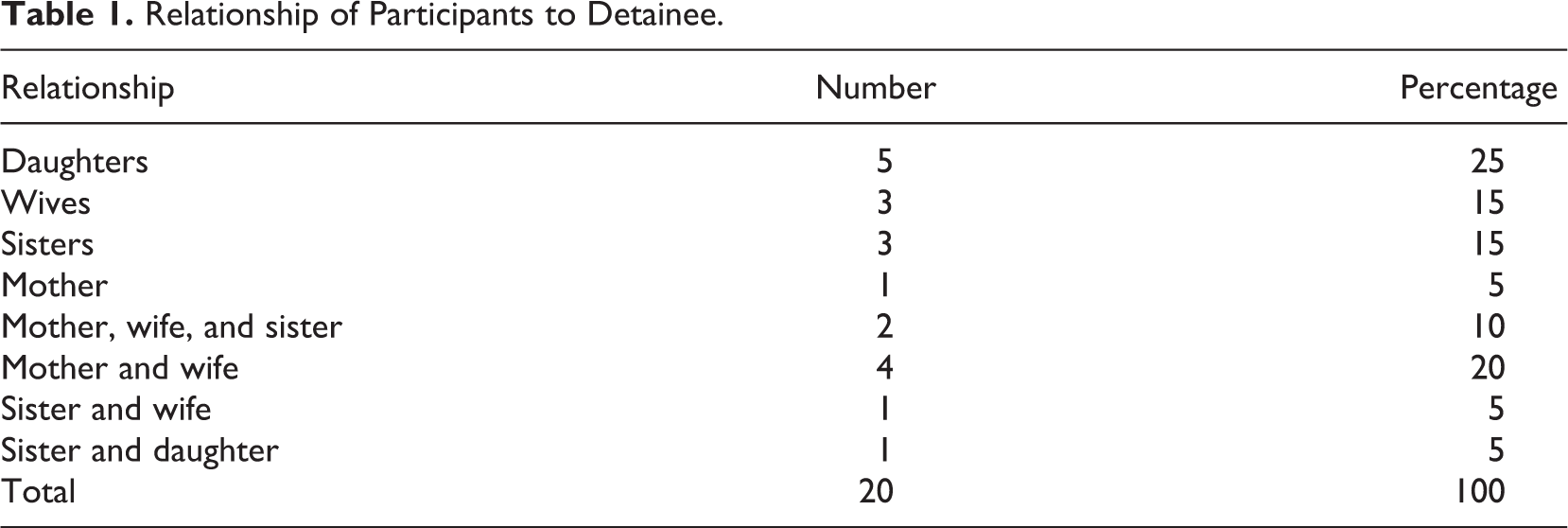
The women interviewed were between 19 and 62 years old. Ten were 19–39 years old, eight were 40–60 years old, and two were more than 60. Twelve of the participants were from the West Bank: six from the Bethlehem area and six from Hebron. Six of the participants were from Jerusalem. Three of the women had not finished secondary school, ten had completed secondary school, and seven had completed their undergraduate degree. Twelve of the women visited only one relative and eight visited more than one. Most family members visited their loved one for a period of 1–5 years (N = 11). Four visited for 6–10 years, two for 11 to 15 years, and three for more than 16 years. Table 1 shows the breakdown of relationship(s).
Relationship of Participants to Detainee.
Results
Of the 20 women, 19 experienced sexual violence including verbal and nonverbal comments and gestures and physical touching and forced nudity. The consistent nature of the abuse led many of the participants to believe that sexual harassment, and at times violence, is official Israeli police policy.
Types of Sexual Violence
Verbal and nonverbal comments and gestures
Nineteen of the women experienced verbal and nonverbal violence such as degrading comments and sexual gestures and movements made by the prison staff who used their hands and tongues. A 22-year-old sister and daughter of a prisoner, a 23-year-old sister, and a 43-year-old wife of one of the prisoners explained some of their experiences with verbal violence: The guards describe the bodies of the women to each other using hateful and derogatory terms, especially against young girls. The police insult us, they order us to show our identity cards, then if we do not reply to them immediately, they use dirty words, they use those words whenever they talk to us, they humiliate women in front of other visitors. We are frequently subjected to verbal abuse, bad abusive words, and being yelled at during visits. They often used dirty words against me. As you see, I am a committed Muslim and I wear a veil. The police women use bad words against Islam and my honor. They know this is a very sensitive issue for us. They are the one who touch our bodies and use bad words, telling me you hide forbidden things in your body, they describe my shape and body to the male police and they laugh about it.
Physical Touching and Forced Nudity as a Form of Sexual Violence
Of the women, 19 women experienced unwanted touching of their bodies, forced nudity, and body searches. One woman reported: We were prevented from sitting in the last row of the chairs in the court hall, so the soldiers sat behind us. I felt someone was touching me from behind, I was scared to move, so I stayed quiet so they wouldn’t deprive us from visiting or punish my brother. She kept touching with her bare hands my breasts while she was making jokes with another policeman. [They] were talking in Hebrew so I cannot understand but I can feel they are talking about me. When I was visiting Ber Alsaba prison, I felt like the police women there had raped me by her touching…she was touching my breasts many times while pretending that she was just searching for illegal objects, at that time I was 13 or 14 years old, I was not aware that it is called sexual abuse. They disliked my sister more than any of us. I do not know why. They touch her body, even the intimate parts. She was asked to take off her clothes and to move her body around, like to sit and walk while she is naked. On one visit, they forced a woman to take off her clothes in front of all visitors because her blouse had metal. She was asked to take off her blouse and the soldier gave her a mop to cover herself with. They often asked us to enter a room specially prepared for body searching, they ask us to take the clothes off…they show the underwear and your bra to the men and women who waited to visits their relatives…they touch our breasts and legs…. Sometimes they do body search for two women at the time and they asked them to take off their clothes. It is not enough to be naked in front of the guards, they want us to be naked in front of each other…how can we look at each other’s eyes after that…. We were even asked to let our hair down so it could also be searched, the female police officer always showed us how disgusted she felt from us. I think what we experience during the visits to jails is humiliation, they touch our bodies in a sexual ways, I cannot think what I will hide between my legs and in my bra to make her touch me or order me to take it off. During one of the visits, I was very angry. At the time, I was very fat and tall compared to my age group, the police women asked me to go into the room alone and asked me to take off my clothes. I tried to refuse to take off my underwear, then she said take off all your clothes because you are fat you can hide anything between your leg and on your body…all the time they do sexual harassment against us. In one visit, I was forced to remove the sanitary pad under the excuse of inspection.
Women’s Responses to Sexual Violence
The women in the study experienced negative effects from the violence and displayed resiliency. Some described trauma symptoms, including anxiety and depression, and in some cases, there were negative impacts to the family structure. Other women placed their experiences of violence in a larger context both citing their love for their family members or their commitment to political struggle. In many cases, the women experienced both sets of feelings.
Negative Effects
Family members experienced both short- and long-term negative effects. A mother explained her short-term reactions to visitations: When I would go home from my son’s visit, I would not be able do anything or talk to anyone…exhaustion and humiliation, my temper is bad and I do not accept any requests from my husband. After a day or two, things return to normal. My daughter was sexually abused by the policeman. He gets very close and touched her body, she was crying the whole day. I am very nervous; I have difficulties in sleeping, I am very alert, sometimes I cry for no real reasons, sometimes I feel sad and depressed. I feel angry at my mother. One time she asked me to shut up, even though she was next to me when a soldier touched me, in fear we would be denied the visit. I was subjected to sexual harassment and when I told my husband what had happened, the result was that the arguments between us had reached to divorce. This is a temporary thing and it’ll pass…. We have no other hope but for his release so we won’t have to do the visits anymore.
Resilience
Despite the psychological and social effects of the sexual violence, a number of women saw their participation in visitation as an act of resistance and love. Others saw their decision to stop visiting as a form of resistance.
A mother shared her pain and resilience. In spite of the humiliation during the visit, I was thinking all the time how much I miss my son, and how much I love him, I just forget the tiredness when I see him, even if the visit is for a very short time, my feelings as a mom help me to keep going. Also, I believe of our rights and the legitimacy of our struggle as Palestinians, I think they are our occupiers, so we have to stay strong and solid. Nothing can prevent me from visiting my family members. I have a very strong personality. I am a kind of person who never breaks down. These acts create more hate toward them and more love and respect to my family, we will never be defeated, I believe this is my duty, I have to keep going, I will never stop visiting. I keep my promises to them, I will never let them down, on the contrary, I will take care of them and support them, they are the most important people in my life. I believe in their choices even it is difficult choice. I am strong for them, this my role in the struggle against the occupation. I believe in God and my faith, this is the God’s will. The struggle is part of our life, we get used to it, our loved ones are the main resource of strength…. They need our help to inform the rest of the world about their rights. I am not scared and I am not allowing any of them to treat me badly. I resist being touched by the soldier. I refuse to keep silent if he touched me, even if we were denied the visit. I have a message to show the whole world what we’re being subjected to. I now refuse to visit. I’m more mature and if any of them touched me I would say no and create a problem. Before, I used to just walk and shut up, but now I know what sexual abuse is and I will not keep quiet about it.
Discussion and Recommendations
Previous studies explored the implications of detainees’ imprisonment in Israeli jails on Palestinian family members with an emphasis on wives and, to a lesser extent, mothers. Each of these studies explore hardships associated with imprisonment such as financial, emotional, and social burdens and indicate that sexual violence does occur as part of the experience (Daher-Nashif & Shalhoub-Kevorkian, 2015; Gicaman & Johnson, 2013; Segal, 2015). This study centers sexual violence and asks readers to place the implications of sexual violence on other financial, emotional, and social hardships associated with a family member’s imprisonment (c.f. Giacaman & Johnson, 2013; Segal, 2015; Shalhoub-Kevorkian, 2005) while also thinking about the implications of sexual violence within a culture that links modesty with God and occurs against a backdrop of war and occupation. Finally, the study also explored the ways in which some women visitors viewed their hardships within a framework of resiliency and in support of a national struggle.
Nineteen of the 20 participants experienced multiple incidences of sexual abuse. The abuse ranged from verbal and nonverbal comments and gestures that often included religious slurs, yelling, and making jokes at the women’s expense. Each of these 19 women experienced physical touching and forced nudity, which was often accompanied by humiliating and derogatory remarks. Many of these women indicated that they were also forced to watch as their family members were subjected to such abuse. Additionally, family members had to wrestle with the complicated issue of whether to speak out against the sexual violence they or a loved one experienced with the likelihood that they and even their group might lose the chance to visit that day and in some cases well into the future if not permanently. All but two of the women complied rather than place themselves and the rest of the visitors at risk.
The level of sexual abuse and the impunity of its use gives strong support to the idea that during times of war—and in the case of Palestine war, conflict, and occupation—bodies indeed are transformed into battlefields. The act of visitation becomes a battlefield, in which women’s bodies are placed in the center as they are forced to either comply with sexual abuse or risk visitation. Based on its pervasive nature, women in this study saw sexual violence as policy, thus suggesting that these actions are not the actions of a “few bad apples” but an integral part of war and occupation.
Following visits, family members reported a range of strong emotional responses including anger, anxiety, and nonstop tears, which tended to last for a few days. The women’s experience of powerlessness during their visits combined with the fear and/or horror of the sexual abuse created the context for traumatic effects including strong postvisit emotional responses and in one case divorce, a rarity among Palestinians.
However, the participants’ comments related to negative effects can be viewed as a bit thin in relation to research on sexual violence conducted on Westerners. This finding is consistent with the work of Hobfoll et al. (2012), who found that Palestinians’ experience of distress is very high and yet they remain engaged in life and its responsibilities. This orientation is expressed in Palestinians’ colloquialism as there are several terms used to describe their particular strength. The words include kawaye, which means strength with resoluteness, and alqudra ala attahamul, which describes Palestinians’ capacity to withstand.
Both kaweya and sumud are used to describe Palestinians’ safeguarding of the land and are evident in the women’s responses. In most cases, the women saw their exposure to sexual violence as part of a national fight for freedom. For example, the act of showing up for visits is an act of defiance itself, and some recognize it as their duty to the national cause to support their loved one who is in prison for being a freedom fighter.
Recommendations
In this section, we offer some recommendations related to policy changes and individual support. The clearest way to address the sexual violence occurring in Israeli prisons and jails is by ending the 47-year occupation of Palestine for nationhood. important that readers bear in mind the ethics of prolonged military occupation in general, as that sets the backdrop for all aspects of Palestinian life, including everything from movement, military detention, and day-to-day needs such as access to potable water.
Short of ending the occupation an interim strategy would be to end the human rights violations associated with prolonged detention and the flagrant disregard for the Geneva Accords with respect to imprisonment by occupation forces (Khalidi, 2020). To place the violations in context, B’Tselem (2020b) reported that between 464 and 491 Palestinians, who constitute approximately 10% of the jail and prison population, were held in administrative detention during 2019.
The abuse of power associated with violations of the Geneva Convention helps to create and perpetuate misuses of power that can translate into sexual violence. The findings of the study support the need to protect Palestinian women under occupation. An international awareness campaign needs to be established to advocate the rights of Palestinians in general and the rights of women in particular as well as the abuses associated with detention. Additionally, the issue of strip searching in prison and jails needs to be viewed as a human rights abuse, given the literature that identifies it as state-inflicted sexual assault (Hutchison, 2019).
On an interpersonal level, one strategy to stem the harm from sexual violence is a cultural shift that would reduce stigma and allow space for women to openly acknowledge sexual assault, challenging the viewpoint that women’s bodies are linked to shame and guilt. This in turn would allow Palestinians to experience far greater levels of social support. This support is important, as in their study of over 1,000 West Bank Palestinians, Hobfoll et al. (2012) highlight the importance of social support in maintaining resilience and vigor within a context of omnipresent violence.
Study Limitations and Implications for Future Research
The study is limited by the size of the sample. Quantitative data could be collected to further understand the nature and scope of the problem. The largest limitation of the study is its context. The women’s experiences with sexual violence need to be understood within the additional experiences of violence or traumatic stressors that they also experienced (Hobfoll et al., 2012). Thus, future research might look at the impact of sexual violence in constellation with other traumatic stressors and within the context of resilience. Another area for research might be related to how detainees’ concerns for their loved ones’ safety and integrity during visitation impact their own well-being. Finally, a network analysis of family members of detainees from randomly selected areas could show the scope of detention in a way that takes into account the collateral consequences of detention, including family members’ experiences with sexual assault.
Footnotes
Declaration of Conflicting Interests
The author(s) declared no potential conflicts of interest with respect to the research, authorship, and/or publication of this article.
Funding
The author(s) received no financial support for the research, authorship, and/or publication of this article.
