




Abstract
The United States is one of the few countries in the world without national paid parental leave benefits. The lack of a universally available policy drives women out of the paid labor force, with a disproportionate impact on low-income women. In this article, I illuminate the mechanisms by which structural inequality reproduces class inequality across the transition to motherhood. Between 2012 and 2015, I interviewed 44 first-time mothers from diverse class backgrounds. From their narratives, I identify three typologies of working women—professional, pink-professional, and low-wage workers—and show how formal workplace policies and informal practices, coupled with women’s cultural knowledge, shape new mothers’ employment trajectories when they have their first child. Policy makers and social workers serving new mothers need to be attuned to how women’s occupational group may facilitate or inhibit access to parental leave, in order to pave the way for more equitable paid family leave for all women.
I mean, I took disability. I took family medical leave. I had saved vacation time and sick time, so I was able to use that, and then, actually I got really lucky—the next three months, I worked from home for four out of the five days. I never received not one benefit, and you’re supposed to get your benefits after 90 days. I didn’t receive any benefits.
The United States is the only industrialized nation in the world without paid parental leave for new mothers (Addati, Cassirer, & Gilchrist, 2014). Under current policy, over half of U.S. women are ineligible for even unpaid time off following the birth of a child (Rudd, 2004). Among private industry workers, only 13% of Americans working full-time—and 4% of those working part-time—are eligible for paid parental leave (Van Giezen, 2013). With no federal, universally mandated parental leave policy, women who get even a couple months off, often without pay, consider themselves “lucky.” This was a term used not only by the mothers I interviewed but also throughout popular media: “I felt very lucky to have an employer who was understanding and let me have, like, four months with my baby before I had to go back to work,” said a celebrity in a popular women’s magazine (Connor, 2016). “She was lucky to have a few weeks of paid vacation,” reported NPR (Ludden, 2016), about a new mother working at the Hilton Hotel chain.
Indeed, compared to the millions of women who get little to no time off and minimal flexibility at work, American women with any amount of job security or paid time off after childbirth are fortunate. But, as I argue in this article, access to formal and informal parental leave benefits is not a matter of luck, but a product of systematic social and economic inequality, which protects privileges for the elite while denying benefits to low-wage workers. In this article, I draw on data from interviews with 44 first-time mothers to demonstrate how differences in access to benefits are exacerbated by differences in cultural knowledge among the women themselves, reproducing both class- and gender-based inequalities.
Research on Women and Work
Over the past 70 years, the presence of women in the workforce has risen steadily. Today, women comprise 47% of the paid labor force in the United States (Bureau of Labor Statistics, 2015). From 1960 to 2011, the proportion of households with a woman as the primary or sole breadwinner rose from 11% to 40% (Wang, Parker, & Taylor, 2013). Fifty-eight percent of women with children under one work for pay (Bureau of Labor Statistics, 2015). Among mothers of young children, employment rates vary by women’s education level and occupation type. One study found that 62% of college-educated women with babies worked, compared to only 43% of women with high school diplomas, and 20% of women without high school diplomas (Waldfogel, Higuchi, & Abe, 1999). Among mothers of preschoolers, 15% of professional/managerial women leave the workforce, compared to 23% of service/office workers and 32% of women in physically demanding occupations like farming, construction, and transportation (Bureau of Labor Statistics, 2015). Of course, not all women with children want to work outside the home. But for many American families, having two incomes has become an economic imperative; over 60% of married couples in the United States reside in dual-income households (Pew Research Center, 2015).
Meanwhile, class inequality in the United States is steadily on the rise, at least in part due to the shift to a postindustrial, service-based economy (Ryscavage, 2015). Low-wage work is characterized by high turnover, and a decline in protections afforded unionized workers in the post-Depression era (Pugh, 2015). A rise in nonstandard employment, including temporary, short-term, and part-time work means less mutual responsibility between employers and employees (Kalleberg, 2000).
Parental Leave in the United States
Parental leave policies around the world are built around job protection and/or income replacement. Job protection means guaranteeing an employee’s job for the period of time during which she or he is home caring for an infant. Income replacement means supplementing all or some of the income lost during that time off. In most industrialized nations, and many developing nations, new parents are eligible for both job protection and income replacement; benefits range from 16 weeks of paid leave at full pay, to in-home help for the first month, to free or low-cost childcare, to up to three years off (Addati et al., 2014). Paid parental leave is linked to many benefits, including increased labor force attachment, breast-feeding duration, and childhood vaccination rates (e.g., Khanam, Ngheim, & Connelly, 2016).
As of 2016, the United States offers no compulsory income replacement for new parents and only minimal job protection (Low & Sànchez-Marcos, 2015; White, 2009). Under the 1993 Family and Medical Leave Act (FMLA), eligible employees may take 12 weeks of unpaid leave for significant family and medical reasons, including the birth of a newborn. During this time off, employees are entitled to continued health-care benefits and the promise of the same or equivalent job when they return. However, to be eligible, a worker must be employed at a public or education agency or a company with over 50 employees (within 75 miles), for over one year, for at least 1,250 hours annually (United States Department of Labor, 1993). Fewer than half of American women are eligible for the limited benefits offered by FMLA, and that proportion is estimated to be as low as 20% for new mothers (Fass, 2009; Rudd, 2004). Low-wage workers, with high turnover and part-time hours, are particularly hard hit by this policy, and many who are eligible cannot afford to take FMLA for a full 12 weeks because it is unpaid (Earle, Heymann, & Mokomane, 2011). Among elite employers in the United States, there is evidence that parental leave for both mothers and fathers is expanding: large, global corporations like Google, Yahoo, and Netflix routinely offer three or more months of paid time off for mothers and fathers (Miller & Streitfeld, 2015; Steel, 2015). Yet benefits like these seldom extend to low-wage workers.
Social Policy, Socialization, and the Reproduction of Social Class
The history of the United States is replete with policies that, by design, extend privileges to some groups while denying them to others—from restrictive housing covenants, to the G.I. bill, to inequitable voting practices. For example, Roosevelt’s New Deal policies of the early 20th century, widely credited with helping to build America’s middle class, were intended specifically for whites and systematically excluded people of color (Desmond & Emirbayer, 2009). Policies like these reproduce race, class, and gender inequality while maintaining the illusion of equal opportunity for all (Hochschild, 1996). Title VII of the Civil Rights Act (1964) and the subsequent Pregnancy Discrimination Act (1978) prohibit discrimination against, among other groups, pregnant women. Legally, women cannot be denied work due to pregnancy, nor can they be fired while pregnant or on maternity leave. However, equality in theory may be undermined by inequality in practice.
Scholarship on class reproduction has shown how wealth is passed down not just through social policy or exchange of money but also in the form of social capital and cultural knowledge (Bourdieu, 1986). Lareau (2003, 2015), for example, has shown how upper-middle-class adults rely on the cultural knowledge they acquired in their youth to help them navigate “complex, bureaucratic, and unclear” educational institutions in adulthood. In contrast, working-class and poor adults confronting these institutions “often felt uncomfortable and did not seek help, nor were they usually offered help. In some cases, they were overwhelmed or confused” (Lareau, 2015, p. 21). Lareau explained: These forms of cultural knowledge are not the same as academic knowledge […] Rather, they consist of knowledge of the informal and formal rules of institutions, strategies for gaining individualized accommodations, and the timing and requirements for implementing any request for accommodation (2015, p. 21).
Method
To learn more about how women experience the transition to motherhood, I interviewed 44 first-time mothers between April 2012 and September 2015. I recruited new mothers, aged 18 and over, in and around Southeast Michigan. After an initial round of snowball sampling, I recruited participants online (using Craigslist, Facebook, and parenting groups) and through flyers posted in doctor’s offices, social service agencies, and baby stores. Early recruitment efforts yielded a sample that was disproportionately white, highly educated, and married; as I began to reach saturation with that group (Glaser & Strauss, 1967), I made a more concerted effort to reach out to organizations serving low-income and nonwhite mothers, although these women proved somewhat harder to recruit. I ceased data collection when I felt I had reached saturation, based on the patterns of similarity in the women’s narratives.
Participants were asked to complete a brief demographic questionnaire, followed by a one- to two-hour-long interview. They were compensated with a $20 Visa gift card for their time. I told participants that I was interested in learning more about how women experience the transition to motherhood; if asked, I disclosed that I am not a mother, but have worked closely with mothers in various settings, including a homeless shelter for teen mothers, a support group for single mothers, and as a nanny for upper middle class New York City families. Overall, participants seemed grateful to have the opportunity to talk about some of the joys and challenges of their first year as a mother, although some also seemed nervous about how they would be perceived and expressed relief when I normalized their feelings. We discussed conception, pregnancy, childbirth, social support, employment, emotional and physical impacts of having a child, and ideas about what it means to be a “good mother.”
Participants ranged in age from 18 to 41, with a median age of 29.8 at the time of first birth, slightly higher than the national average of 26.3 (Mathews and Hamilton, 2016). Twenty-four participants were white; 20 were women of color—of whom 16 identified as black or African American, two as Asian, and two as Hispanic/Latina. At the time of the study, 32 participants were married, five were cohabiting, two were partnered but did not cohabit, and three were unpartnered. While I did not ask explicitly about their sexual orientation, all of the respondents had male partners (or no partner) at the time of the interview.
All participants had been working and/or in school at least part-time when they became pregnant. At the time of the interview, roughly one-third were not working, because they had not yet returned to work, did not plan to, or had lost or quit their job. The average age of their babies was seven months, although the youngest was two weeks old and the oldest was 18 months. Thirty-two women had completed a Bachelor’s degree, including 19 who had a master’s degree or higher. Nine had started college but had no degree, two had just a high school diploma, and one had not finished high school. Overall, my sample was older, more educated, and more financially secure than the national population. This reflects both the population of the university town where I recruited many of my respondents and the fact that I did not interview mothers under 18. Despite this limitation, the data capture patterns of difference among women across the socioeconomic spectrum.
Interviews were recorded, with participants’ written consent, and were transcribed by a third party. In this article, I use pseudonyms to preserve confidentiality. In addition to audio interview recordings and transcripts, I also took extensive field notes during and after the interview; together, these formed the basis of my data for analysis. Using a grounded theory approach (Glaser & Strauss, 1967), I open coded transcripts and field notes, initially by hand and then using Dedoose, a mixed-methods qualitative coding software. I also created color-coded spreadsheets, highlighting demographic information and access to various benefits to denote trends among respondents. Noting patterns in inequitable access to workplace benefits, I then created typologies of occupational groups and moved to closed-coding, analyzing trends in access to benefits among women with common occupational types.
Occupational Group and the Transition to Motherhood
While I was initially interested in class differences among women, explicit social class categories proved hard to define and also failed to capture more nuanced patterns of variation I observed among my participants. For example, two women could both identify as middle class and have relatively equal household incomes but have access to very different parental leave benefits based on their occupational group. Likewise, the terms “white-collar,” “pink-collar,” and “blue-collar” were also inadequate to describe the variation I saw in my data; after all, this was not a story about prestige of work per se, but rather the categories of benefits that were associated with different types of work. Instead, I clustered women’s type of employment into three occupational groups, or archetypes, that arose inductively from my data. I call these groups: professional/ managerial; pink-professional; and low-wage (see Table 1). In the sections that follow, I describe differences observed between these groups in three key areas: (1) access to formal benefits (e.g., paid or unpaid time off and health care); (2) access to informal benefits (e.g., flexible hours and ability to work from home); and (3) cultural knowledge shaping employment outcomes. These benefits tend to exist on a spectrum, with professional women typically having the most access to formal benefits, informal benefits, and the cultural knowledge to navigate them; low-wage workers having less access to all three; and pink-professional workers falling somewhere in between. Taken together, policy, practice, and women’s own cultural knowledge significantly impact women’s employment trajectories and access to benefits when they become mothers.
Occupational Group and Employment Factors.
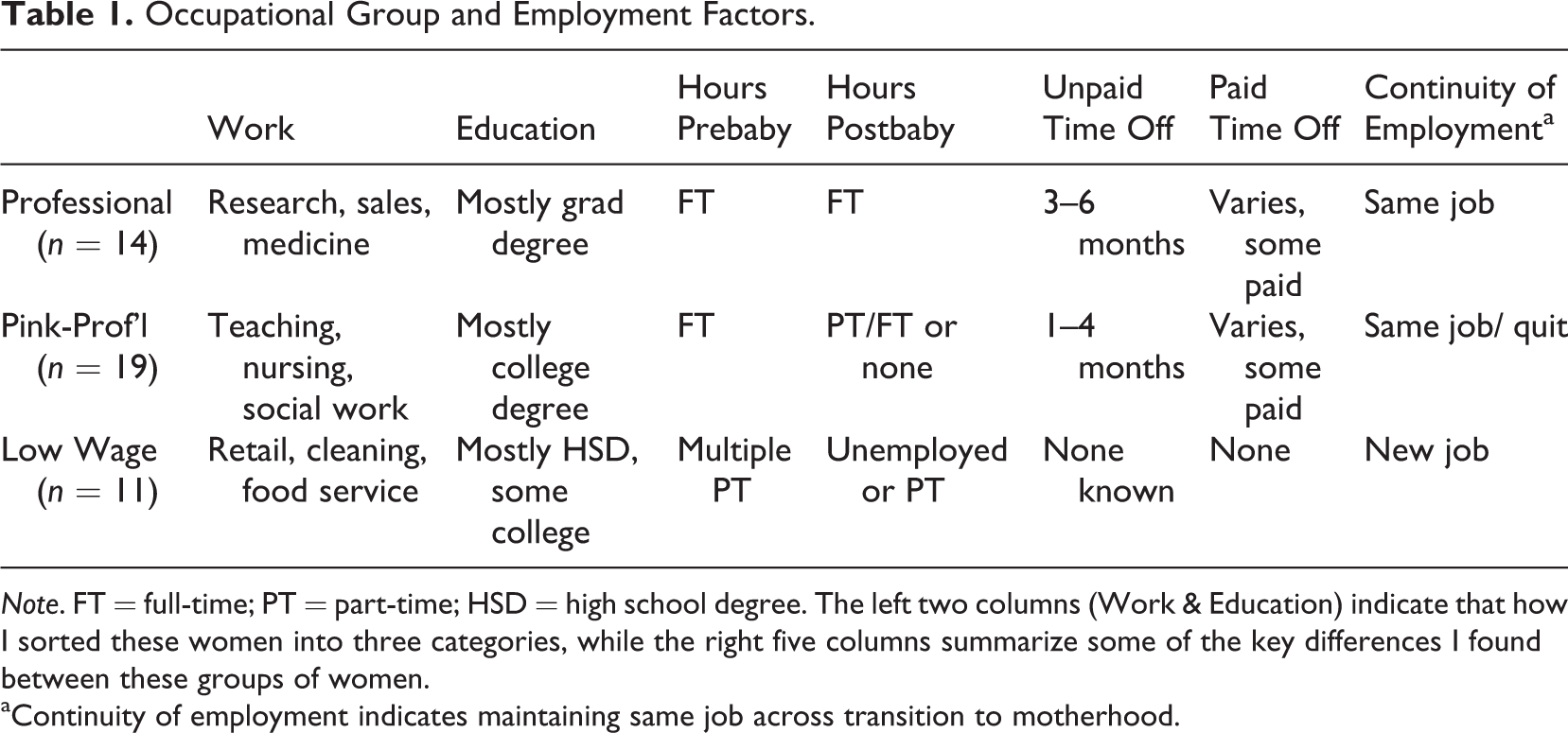
Note. FT = full-time; PT = part-time; HSD = high school degree. The left two columns (Work & Education) indicate that how I sorted these women into three categories, while the right five columns summarize some of the key differences I found between these groups of women.
aContinuity of employment indicates maintaining same job across transition to motherhood.
Formal Benefits for New Mothers
While the professional working women I interviewed were almost all able to secure several months off, often at full or partial pay, not a single low-wage respondent received paid time off. Pink-professional mothers fared somewhere in between. The 12 weeks of family leave under FMLA were seldom sufficient, even for first-time mothers with professional/managerial jobs, given that the time off is unpaid. Most professional mothers received at least eight weeks of paid time off, some as long as six months, through patching together various forms of leave, including FMLA, vacation days, and sick days, which they had often saved for years in advance. Nearly all of the professional women I interviewed were eligible for at least 12 weeks of time off. While not all of that time was paid, most professional women were able to secure at least partial pay during their time off. Leah, a sales operations director, secured 12 weeks of paid leave. Christy, a research administrator, received five months of paid time off—six weeks of medical leave, two weeks of sick leave, and ten weeks of saved vacation time. Tina, a team leader at a large, global corporation, received a total of six months of paid leave, including four weeks before her daughter’s birth.
One notable exception among professional women was Natalie, a project manager at a research hospital. Her employer had recently changed its policy, requiring that women work there at least two years to qualify for paid maternity leave, rather than the previous 1-year requirement. Under the old rules, she would have been eligible for six weeks of paid time off following a vaginal birth or eight weeks for a cesarean-section. However, because she had only been there for a year, she received 15 paid vacation days; yet, as I will discuss in the following section, she still received other informal benefits.
Women who were able to enjoy paid time off at home with their infants used the time to build new routines, get to know their baby, and attend to other complications such as breast-feeding difficulties, postpartum health concerns, and finding reliable childcare. They were spared the expense of paid childcare during those months. Some women described a sense of indebtedness to their employers for permitting them to stay home with pay. Tina, who received six months of paid time off, said: Because [my employer] does have such an amazing maternity package […] I almost feel like I owe it to the company [to go back]—because they have supported me and given me that much time. I had girlfriends who go back to work 12 weeks in, or even sooner. I can’t imagine that. [My daughter] just had a fair amount of issues. She had acid reflux and colic and stuff, so I am just so grateful, because I could not imagine going back to work at that time. Luckily my boss, the CEO of the company, is German. He’s got two small kids. He’s close to my age. And I worked out this sweet deal, where I would take two weeks of my own vacation time […] and then I got 12 weeks at 100% pay, and I would come in ten hours a week. The dynamics that play out in the office when you announce a pregnancy—you know, what kind of things people say…. I guess probably what made me a little nervous is the person in my position before me got pregnant and never came back. So I’ve probably been influenced subconsciously, thinking that I would do that, too. To be honest, I didn’t know if I was going to come back. I had no idea what mommyhood would be like.
Not all pink-professional women benefitted from the same degree of accommodations. Because of the constraints of FMLA, women who had been at their jobs for a shorter duration were less “lucky.” Kristina, a social worker, had been at her job for a few months when she disclosed her pregnancy. She was eligible for just four weeks of unpaid time off, plus one week of paid vacation; her job security was not guaranteed. Severe morning sickness caused Kristina to lose weight and experience near-blackouts. The day she was supposed to sign up for benefits— following a 90-day trial period without insurance—her supervisors gave her the “opportunity to resign.” Kristina thinks they chose their words carefully, given the legal ramifications of firing someone for being pregnant, but the message was clear: She was told to empty her desk immediately and was not permitted to finish the cases she had been working on that day. Kristina tried looking for a new job but said most employers were not interested in hiring someone who was six months pregnant: “Every phone interview I had, if I let them know, like, hey I’m expecting-- because at that point I was really showing, so I thought this is probably something I should tell them—I never got a second interview.” Unable to find another job, she and her husband relocated hundreds of miles to move in with her mother and younger sisters. Although she was in a pink-professional job, Kristina’s story resembles stories I heard again and again from low-wage mothers.
In contrast to most professional and some pink-professional women, low-wage mothers were least likely to have any formal benefits, paid or unpaid. In fact, not a single low-wage woman I interviewed had the benefit of paid time off. Of the 11 low-wage women in my sample, five were working full-time when they became pregnant, while six had one or more part-time jobs. Of the 11, four were also in school. All but two ended up leaving their jobs during pregnancy. Reasons for leaving varied: Some were let go or phased out of the work schedule. Their bosses cut their hours or refused to accommodate their medical need for bed-rest. Others chose to leave due to the physical toll of pregnancy or the health hazards associated with their jobs: three women worked with toxic chemicals, two had jobs that required heavy lifting, and two worked overnight shifts. Only two women took formal unpaid leave from their jobs—both had been at the same job, full-time, for over two years—but at the time of the interview neither had returned to her job. One found part-time work elsewhere, since she lacked reliable full-time childcare; the other was struggling with severe postpartum depression and decided not to return to work yet, since her company would not allow her to work part-time.
Trish was working 40-hour weeks on the overnight shift as a patient attendant at a hospital when she became pregnant. Having already suffered three miscarriages (including two stillbirths), she was faced with another high-risk pregnancy and asked to be moved to daytime hours. She was told her schedule would be changed in two weeks, but instead, her hours were gradually cut. She later applied for unemployment, only to be denied, accused by the Unemployment Office of lying, and hit with a $1,400 fine that she could not afford to pay; she is now accruing late fees on the fine.
Low-wage women described a mutual lack of loyalty between themselves and their employers. When hit with the physical toll of pregnancy and the financial and relational changes it brought to their lives, and without the safety net of parental leave, low-wage women were quick to leave or lose jobs before they reached the point of giving birth. Most would have been ineligible for FMLA anyway because they were employed part-time, had not been at their job long enough, or worked for too small of a company, but many of them never found out because they left before they gave birth.
Under FMLA, employees with stable, long-term employment are entitled to 12 weeks of unpaid time off, but for women already living paycheck to paycheck, 12 weeks without pay is almost impossible to sustain. Postpartum depression and the high cost of childcare pose two additional obstacles. Due to the lack of reliable income and job security, many low-wage women found that their pregnancy and postpartum period was marked by a string of changes: new jobs, new homes, and new communities. Unlike professional women, for whom welcoming a child was a period of nesting, for many low-wage women, it was a period of heightened geographic and social instability.
Informal Benefits for New Mothers
In addition to difference in formal policies, occupational group also impacted women’s access to informal benefits, including both flexibility and autonomy at work, and the freedom to take sick days as needed. I define flexibility as the ability to dictate one’s own schedule, take time off when required, and work from places other than at a job site, and autonomy as ability to work without direct supervision. Professional women tended to enjoy more autonomy and more flexibility before and after childbirth compared to pink-professional and low-wage women. But both professional women and pink-professional women frequently described their bosses as “understanding,” or “nice,” or “supportive” which I came to see as a code for privilege or access to benefits beyond those formally sanctioned. Although pink-professional occupations lacked the autonomy and flexibility of professional jobs, I group them together in this section because women in both groups described their benefits in similar ways. While these benefits were not available to all women in these groups, what is important to note is the myriad ways in which formal policies were supplemented by informal practices which helped professional and pink-professional women retain their jobs, while making it nearly impossible for low-wage women to retain theirs.
Informal benefits became critical during pregnancy, particularly in the first and last trimesters when health problems tended to spike. The physical toll of pregnancy varied greatly. Some women were hardly sick at all and were able to store up sick days to use for paid time off postpartum. Others felt awful, and, if they had the privilege and agency to do so, cut back on their hours or worked from home. Melissa, a PhD student who struggled with nausea, vomiting, gestational diabetes, and preterm labor, reflected back on the privilege of flexibility during her pregnancy: I was just really nauseated 24/7. I was throwing up a lot; luckily for me though, I was on fellowship. […] I really was able to kind of stay on the couch for like three months; most women can’t do that. [ . . ] If I had to get sick, it was sort of in the best way it could’ve happened, I guess, because I was able to be on the couch. But it was really not good at all. I mean, I hadn’t expected that I would feel as bad as I did.
For example, Lakeisha, a low-wage rehabilitation associate who worked with survivors of traumatic brain injuries, suffered from morning sickness for the duration of her pregnancy; she also had a flare-up of scoliosis. She postponed notifying her employer of her pregnancy, however, until she was bit by a client who was infected with Hepatitis C, which posed an immediate risk to her baby. I asked: “How did your work respond when they found out you were pregnant? Did they have any accommodations?” No. They did nothing. […] They treated me like I was not pregnant, basically. I still had to work my hours. I was like, ‘This is exhausting,’ but they just moved me to a different unit just so I wouldn’t sue them. I was like, ‘I’m kind of tired. You have me working 18 hours a day, 12 hours a day sometimes.’ […] I’m lifting clients, moving them. If it’s wheelchair clients, you have to take them to the bathroom. Sometimes that was just breaking on my back. […] I was so exhausted. I was either oversleeping, missing my alarm clock to get into work on time, or falling asleep at work. […] Work was like, “If we catch you sleeping we have to let you go.” So I just put my two weeks [notice] in right then and there.
For professional and pink-professional women, flexibility and autonomy continued after their babies arrived. Besides getting paid or unpaid time off, they often had more flexibility when they returned to work, such as coming in late or leaving early, working from home, or taking a day off to attend a doctor’s appointment. Gina, the social worker quoted in the opening paragraph of this article, recalled that careful strategizing on her part, coupled with an “awesome” boss, enabled her to work primarily from home for three months, following three months of paid leave. Similarly, Christy, a research administrator, was also permitted to work from home part-time after her five months of parental leave ended. She said: I work from home on Mondays, which is nice. Which really means I work about four hours on Sunday night after he goes to bed, and then work a couple hours during each of his naps during the day and work a little bit on Monday night, because…it’s kind of impossible to do anything while he’s awake. (Laughs.) But that is also a nice perk of where I’m at. And it makes it easier to be a single parent…. It helps that one of the women that I work really closely with did the same thing. She has a daughter that just turned 11, and she’s a single mom by choice, and so she also understands.
Even when policies were relatively inflexible, professional and pink-professional women still discussed ways that their bosses or colleagues accommodated them. Joy, a medical resident, was unable to be excused from long days at the hospital, routinely working 60–80 hours per week but said her supervisor told her, “‘Oh, I’ll hook you up’ kind of deal, so he made my schedule better.” She explained: There are rotations that fit the less-than-12-hour rule they could have put me on that would have been harder, but he specifically chose much easier rotations for me. So instead of being always at the university, he put me at the VA, which is much lighter, and then I don’t have to walk through the halls. Because the university hospital is super huge and very hard to walk around…and imagine if you had to see like 30 patients, then you’re going to go through four to five floors. The hospital doesn’t have a work-from-home policy. I’m technically not allowed to work from home. I think [my boss] had to fight for me to do that. He fights with everyone about everything, so no one was surprised. I have been at my job six years. I have a relationship with my boss. If I have to leave early, or stay home with [the baby], it’s okay, we’re going to work it out, because we have this relationship. I mean, there’s been times I’ve worked from home because he was sick, or I can just leave early on a last-minute notice to take him to a doctor’s appointment if he’s sick. And, God, I don’t love my job, but we get freaking 25 days of vacation time a year, which gives a lot more flexibility. I think it’s just kind of [assumed] that when faculty have children, they’re unproductive and they’re not taking it as seriously as they were before, because they’re moms now. They’re not academics anymore…I feel like I have been more productive [since having my son]-- and not in a good way. Kind of in a neurotic sort of way. Like, when I’m home with my son, I’m trying to do a million things while I’m playing with him, so that I can make sure to account for all this time I’m ‘wasting,’ according to them, being home with my son. I definitely feel like I have to overcompensate quite a bit, [even though] I wasn’t productive all the time before he was born.
Because low-wage women rarely returned to the same job post-pregnancy, I found limited examples of informal benefits they enjoyed. Angel, who worked part-time as a maid, recalled that, after she vomited in a kitchen sink, her coworkers offered to swap kitchen duty for bedrooms, so she would not have to contend with nauseating smells while pregnant. Rosie, a florist who had worked at her job for eight years, was offered an extended period of job protection following her baby’s birth. She said: If you’re a good employee, you can leave and always come back. […] Like right now, I just have to go in and give them my availability; they’ll work me in. I might not get the same position depending, but you’ll always have a job. […] It’s like -- I don’t even know what the official policy is, but if you’ve worked there a long time, and you’re a good employee, and they like you, they’ll work with you. They’ll just do what they have to do.
“I wasn’t going to argue”: Cultural Knowledge and Job Retention Among First-Time Mothers
By highlighting the benefits or lack of benefits available to new mothers, I do not mean to suggest that professional women did not work hard for the benefits they received or that these privileges came without a cost. Indeed, many of the mothers I interviewed planned ahead for months or even years to maximize the amount of time off they could enjoy after giving birth. The timing of their first child was often (though not always) carefully strategized, childbearing was delayed, and women strove to prove to their bosses, colleagues, and themselves that having a baby did not make them any less dedicated to their jobs. As shown in the preceding sections, professional women not only had employers who offered better formal and informal benefits—they also had the cultural knowledge to identify and capitalize on those benefits. Professional and some pink-professional women relied on insider knowledge from colleagues and supervisors about how to use the system to their advantage. They knew that the high-skill, specialized work they did was valued by their employers who had a vested interest in keeping them, rather than taking the time to recruit and train someone else. They could leverage this interdependence as a bargaining tool to secure the benefits necessary for them to maintain their job.
For example, Libby, a speech pathologist, negotiated a way to work part-time despite her employer’s demands to the contrary:
I worked out with my boss that I was going to go back part-time, 20 hours a week, which I started when [my son] was about four months. And then two weeks in—my boss was great, but her boss had decided that she didn’t want anyone part-time in our clinic. She agreed to it initially, and I don’t understand her reasoning about the whole thing, [but] she came back to me and said we have to do full-time. I fought her on it, and I told her that I was going to – Fought your boss’s boss? Yeah, and I told her I was either going to leave or stay part-time, and she agreed to it staying part-time. I went back to part-time.
Likewise, as discussed previously, Natalie convinced her boss to buy her a laptop so that she could work from home, although it was technically a violation of hospital policy. Barb, an office manager whose baby was born with birth defects requiring multiple surgeries, was permitted extra time off to be by her baby’s side for his surgeries. Alice, a copy editor, was able to secure five months off and later fought to change her employer’s leave policy—an effort ultimately met with success. For these women, formal policies were something to challenge and work around rather than barriers to accept unquestioned.
Whether professional or pink-professional, women doing more specialized work were better-positioned to negotiate with their employers to find a workable solution. When unable to secure the benefits they needed, however, pink-professional women were the most likely to leave the workforce and opt into stay-at-home motherhood, at least short term. Of the 19 pink-professional women in my sample, seven decided to quit their jobs to stay home. These mothers tended to describe their decision to stay home as a choice. They talked about the importance of being their child’s primary caregiver, and the investment of time in these early years. However, those who opted to stay home were also constrained by several common factors: inflexible jobs with little to no paid time off; child care costs that would come close to or exceed the woman’s income; and a partner who had a demanding, hard-to-compromise job. This left the bulk of parenting on the mother’s shoulders. Therefore, while some pink-professional women were able to leverage their cultural knowledge to secure a more manageable work schedule, those who were unable to do so often framed their decision to stay home as a choice, despite describing workplace or family constraints that made juggling both quite challenging. In contrast, those pink-professional women who were able to build more flexible schedules or who were dependent on their jobs for income or health-care benefits tended to continue working.
Not one professional woman I interviewed chose to stay home. At least two professional women had partners who stayed home for several months or longer, since the women had higher incomes and better benefits. None of the low-income women saw stay-at-home-motherhood as a viable option, although some said they would prefer to stay home for their baby’s first few months. However, for most low-income mothers, economic imperatives drove them back to work sooner than desired.
In contrast with professional and pink-professional women, low-wage women seldom described the same level of commitment to their jobs. Most of the low-wage women I interviewed had already left their jobs by the time they gave birth. The process of their leaving work reveals the tenuous nature of their relationship with work and their employer. With few, if any, benefits and limited cultural knowledge about navigating bureaucratic institutions, low-wage women were rarely able to negotiate benefits in the way that professional and pink-professional women were. Therefore, they felt little incentive to stay at their job and did not seem to feel entitled to take advantage of FMLA, if they knew about it at all. Angel, for example, had several part-time jobs and was in school at the time she became pregnant. She quit her retail job and her job at a new restaurant but kept her job at a home cleaning agency. She said, “I went on maternity leave, and it wasn’t paid. [….] I had my doctor write down that I need maternity leave, but I would say [my boss] didn’t actually say anything like, ‘You can come back. You get your job back,’ or ‘If you come back I will hire you.’ It wasn’t anything said, it was just, ‘Here’s my maternity leave. Bye.’” Rather than view maternity leave as a negotiation between herself and her employer, Angel saw it as an order from her doctor. Working in low-wage, short-term jobs where she did not feel valued, she left her job without trying to bargain for any benefits, since she did not expect to get them anyway.
Daisy, a housekeeper at a hotel who had held the same job for two years, described a mutual lack of support at her job. She was fired following a dispute with her manager about hours; she recalled:
The head housekeeper, she went to the main boss and said because I was pregnant I wanted to be part-time—I never told her I wanted to be part-time. So they had me working like one day out of the week. […] And I was mad, and so me, him, and her sat down, and she was like well, ‘You asked me to be—.’ I was like, ‘No, I never asked you.’ I was like, ‘You came and told me—,’ and then she like tried to make herself look good, but I was like—I wasn’t going to argue. You said you weren’t going to argue. You did not push back? Yeah, well, kind of. But I wasn’t going to argue with her, because she’s been there for a while, and I was like, there’s no point if you’re not going to believe me.
Daisy tried to remain at the job but ended up quitting a couple months later following a second dispute about hours. By then, Daisy was in her third trimester of pregnancy. As with other interviewees, she said her visibly pregnant body seemed to be a deterrent to prospective employers: I was like eight months pregnant, and in the interviews, I’m like, who is going to hire me, because I’m about to be taking maternity leave anyway. […] Yeah, I went to a couple interviews. [….] One of them I went to, I had a second interview with them, and at that time I was really close to my due date. […] They’re like oh, thank you, we’ll just be in touch with you. They didn’t call.
Discussion
While women’s opportunities in the paid labor force have grown exponentially in the last century, accommodations for American women to balance their work and home lives remain limited. A lack of formal, federally mandated policy around parental leave has created a stratified system of benefits whereby “lucky” women are afforded a growing (though still limited) array of options, while less privileged women are pushed to the margins with little structural support. Occupational differences in access to benefits are exacerbated by differences in cultural knowledge on the part of women themselves.
For professional working women, although family-friendly policies in the United States still lag behind those of most other countries, work–life balance is becoming more attainable: The combination of formal policies and informal practices, understanding bosses, and cultural knowledge about navigating bureaucracy helped the women in my sample to maintain consistent employment across the transition to motherhood. Benefits when they returned to work were still limited, but the initial period of time off, often paid, allowed them time to acclimate to this new role and set up the supports they may need when they returned to work. Furthermore, their cultural knowledge helped them to navigate complex bureaucratic systems and secure benefits beyond those formally offered.
For low-wage women, however, this support harder to attain. There was a mutual lack of loyalty between low-wage workers and their employers. Feeling undervalued and dispensable, and without the promise of any formal benefits after their baby’s birth, low-wage women had little incentive to stay at their jobs as they transition to motherhood. Furthermore, the work itself may pose risks to women’s health, due to harsh chemicals, heavy lifting, or overnight shifts. Yet, leaving jobs mid-pregnancy necessitated job hunting before or shortly after childbirth, limiting a mother’s time to invest in breast-feeding and caregiving, find affordable, high-quality childcare, and recover from the physical and emotional toll of childbirth. High turnover, dispensability of low-skilled employees, and limited cultural knowledge about navigating institutions drove the low-income women in my sample out of work at alarming rates. On the rare occasion that low-wage women did try to stand up to their employers and advocate for themselves, they were more often penalized than rewarded.
Pink-professional women, although better off than low-wage women, tended to lack formal benefits such as paid time off or extended job security afforded professional women. They were also less likely to benefit from the autonomy and flexibility enjoyed by professional women. However, compared to low-wage women, they were more likely to have the buffer of a partner with a financially secure job. Therefore, while they may leverage cultural knowledge when possible—to work from home short-term, or negotiate some workplace flexibility—they were also more willing to opt out of paid work, given the high costs and low rewards, when not financially dependent on their income or healthcare benefits.
This study has several limitations. In part because recruitment centered around a Midwestern university town, participants were older and more highly educated than the average American mother. Low-income women are underrepresented in this sample, as are very poor or nonworking women; therefore, the challenges facing poor and working-class mothers may be understated. Second, it is impossible to fully disaggregate the effects of occupational group from other factors, such as women’s education, age, race, ethnicity, marital status, and work experience; occupational group is one part of the story, but it is certainly not the whole story. Furthermore, this study is not longitudinal, and it included only first-time mothers; therefore, it is impossible to predict how these women’s trajectories will shift over time or what will happen if and when they welcome a second or third child. I hypothesize that the effects of occupational group would be exacerbated by the birth of another child, with women in the precarious pink-professional sector (and perhaps even some professional women) being driven out of work at higher rates due to the exorbitant costs of child care. Finally, every qualitative study is, to some extent, a social construction cocreated between interviewer and interviewee at a particular time and place. Due to the complex nature of human subjects, it is impossible to know the one “true” story. Perhaps on a different day, or with a different interviewer, the participants would have told a different story, or perhaps some employers would contest my interviewees’ versions of what happened. However, the data I rely on here are the narratives of first-time mothers, as they understood and described their access to both formal and informal parental leave benefits when they welcomed their first child. While they may not tell the whole story, they reveal an important part of it, showing how privilege operates at a key point of transition in women’s lives to reproduce social stratification.
Implications
In this article, I have shown how women’s occupational type interacts with their cultural knowledge to reproduce class inequality among new mothers. While highly skilled, specialized workers are seen as valuable and worth holding onto—and are equipped with more cultural knowledge to negotiate working while parenting—low-wage workers often lack the structural and cultural support to keep working when they have children, despite the economic necessity to do so. In an economy that offers coveted jobs for the few and menial jobs for the masses, these differences will only be exacerbated.
Women’s ability to access these formal and informal benefits has implications for both their personal and professional lives as they transition to motherhood. While for the professional women in my sample, the addition of a baby—the sleepless nights, the struggles with breastfeeding, the emotional demands of caring for an infant, and the physical toll of pregnancy and childbirth—was often the biggest challenge posed by the transition to motherhood, for low-wage women, the transition came with a host of other challenges, of which caring for a newborn was only one small part. Without flexibility or understanding bosses, low-wage women were less likely to retain their jobs when they became parents. Lacking reliable income and job security, many low-wage women found their pregnancy and postpartum period were marked by a string of other changes: new jobs, new homes, new neighborhoods. Unlike professional women, for whom becoming a mother marked a period of nesting, for many low-wage women, motherhood brought a period of geographic and social upheaval. While some might blame these challenges on low-wage women’s choices—after all, they were more likely to have children young, to have had shorter tenure at their jobs, and newer relationships at the time of conception—occupational group served as a buffer for professional and pink-professional women regardless of other considerations. That is, even when professional or pink-professional women had unplanned pregnancies, new jobs, or were unmarried, they still often reaped the benefits of their occupational group, just as low-wage women who were married, stably employed, or had planned pregnancies, still reaped the consequences associated with their occupational group.
These findings offer several implications for policy makers, social workers, and other practitioners who work with new mothers. First, policy makers should be aware of the ways in which existing policies may reproduce class inequality as well as the way that tacit cultural knowledge may be deployed to facilitate access to policy. Social workers should be aware of the significant challenges facing new mothers who do low-wage part-time work. These challenges are not just the result of individual behaviors but are a product of structural inequalities that systematically privilege some groups of women over others. Practitioners should also be attuned to the way that privilege operates, in that it not only offers disparate formal benefits to women of different socioeconomic means, but also inequitable informal benefits. Finally, social workers and maternal health-care providers should help educate women about their legal rights during and after pregnancy and help them to access implicit cultural knowledge as they navigate complex social institutions across the transition to motherhood. Demystifying the way that privilege operates can help level the playing field for all women.
Footnotes
Acknowledgments
I would like to thank Karin Martin, Katie Richards-Schuster, Fatma Muge Gocek, Robert Jansen and my peers in the Graduate Writing seminar as well as two anonymous reviewers for their feedback on this paper. I am also indebted to my research assistants: Stephanie Olson, Jacinth Lin, Kali Vitek and Amanda Rose-Horne. And of course, to the women who shared their stories with me at a particularly vulnerable time in their lives—I could not have done this without you.
Declaration of Conflicting Interests
The author(s) declared no potential conflicts of interest with respect to the research, authorship, and/or publication of this article.
Funding
The author(s) received no financial support for the research, authorship, and/or publication of this article.