




Abstract
Healthcare settings are often one of the primary touch points for sex workers connecting with social services. This places social workers in hospital settings in an important role, using their clinical and social work training and education to make case recommendations based on the immediate needs of sex workers in their care. This qualitative study uses interviews to examine the decision-making processes of social workers in a hospital setting when making case recommendations for sex workers, as well as their attitudes towards sex work as a profession. Findings reveal how social workers, through their navigation of complex institutional networks, often employ decision-making tactics that reflect carceral social work logics and gatekeeping. We also find how other important factors, such as a social workers own professional experience, play an important role in these decision-making processes. We conclude by discussing how social work practitioners can critically interrogate their role within oppressive and carceral state structures to promote an anticarceral social work field that reflects the needs of sex workers in their care.
Social workers in the United States are guided by the NASW Code of Ethics, which provides a set of ethics and values that affirms individual dignity and is shaped by a vision for social justice (NASW, n.d.). Despite these lofty goals, social work has been critiqued for using tactics that do not align with their vision of social justice. More critical authors have pointed to tendencies in the field to use tactics rooted in carceral logics more reflective of coercive state power (Dettlaff et al., 2020; Jacobs et al., 2021). Carceral logics is generally understood as the act of pointing to the criminal justice system as a way of solving social problems rather than interrogating the material conditions of social inequity (Anasti, 2020; Musto, 2013). For example, a critique that has gained traction in the wake of increased attention to police brutality in the US is a critical view of social work's partnerships with police and whether they are reflective of social work values (Abrams & Dettlaff, 2020; Jacobs et al., 2021).
Another such critique of the carceral logics in social work is in how social service agencies police clients seeking their services. Human-service nonprofit organizations (HSNO) have historically been associated with playing an important role in the creation of organizational responses to the social needs of the time (McCarthy, 2003). Through fostering public-private relations in funding mechanisms, HSNO's were able to provide social services as a response to human needs while also leveraging their funding to promote and influence social policy (Hasenfeld & Garrow, 2012). In order to maintain their standing, however, HSNO's often closely collaborated with the state through public welfare departments (Hasenfeld & Garrow, 2012). Through this collaboration, social services organizations often reinforced white supremacist ideologies and the social exclusion of service seekers who were deemed ‘unworthy’ of services (ex. sex workers, substance users, immigrants, queer-identifying communities, Black communities) (Jacobs et al., 2021). Social workers, whose profession was founded largely within these institutions, were thus bound to these same reinforcement mechanisms that perpetuated surveillance, categorization, and exclusionary benefit allocation as part of normalized administrative life (Delgado & Stefancic, 2001).
Discourse on the professional relationship between social workers and vulnerable communities often leave out the experiences of sex workers. Sex workers are particularly vulnerable to violence, both interpersonally and at the hands of the carceral state (Anasti, 2020; Preble et al., 2019; Wahab, 2002). In her book, Playing the Whore: The Work of Sex Work, Melissa Gira Grant (2014), discussing how sex work is policed, states: “People who are profiled by cops as sex workers include, in disproportionate numbers, trans women, women of Color, and queer and gender nonconforming youth. This isn’t about policing sex. It's about profiling and policing people whose sexuality and gender are considered suspect” (2014, p. 9). As with many vulnerable populations, health services and police systems are typically the first entry point for sex workers in need of social services (Vitale, 2018). Although coercive policing by the state has come under more intense scrutiny in recent years, there is a more limited body of research on how sex work is being policed by social workers (Anasti, 2020; Bromfield, 2016).
Existing research on the sex working community does not often include the ways sex workers engage with social workers (Anasti, 2018, 2020; Wahab & Panichelli, 2013). This research largely focuses on mental health, substance use, and victimization, highlighting the potential risks in the sex trade without providing a nuanced understanding of how sex workers are viewed by social workers and how those views may shape the services they receive (Anasti, 2018; Wahab, 2004; Wahab & Panichelli, 2013). At the institutional level, research points to the need for a deeper interrogation of the ways institutional discourses play out at the level of service recommendation (Dall, 2020; Sam, 2019).
This manuscript adds to this limited literature on the interactions between sex workers and social workers. It does so by attempting to understand hospital-based social workers’ attitudes towards sex workers and how this influences their professional decision-making processes. Secondly, due to the neoliberalization of the social welfare field, this manuscript hopes to understand the effect of how the institutional ideology of the hospital plays a role in these professional case recommendations. We begin by reviewing the existing literature on social work and the sex working community and then describe the macro-institutional context in which social workers are nested. We then describe the current study, a multi-method qualitative study which includes interviews of 14 social workers employed by a hospital in the Northeast US and a content analysis of the hospital's employee handbook. The discussion examines how social workers often navigate complex institutional networks embedded within the ideology of neoliberalism while attempting to provide the best possible care and provides implications for social work moving forward.
In this manuscript, we use the gender-neutral umbrella term “sex worker” to define “people who work in all aspects of the sex trades, indoor or street-based, legal and criminalized, and can include people who trade sex for money as well as safety, drugs, hormones, survival needs like food, shelter or clothing, or immigration status or documentation” (INCITE, n.d.). This usage is based on the suggestions of sex work advocacy groups such as the Sex Worker's Outreach Project to highlight both the agency of sex workers and their labor and is meant to be inclusive of all forms of sex trade, including exotic dancing and pornography.
Literature Review
Institutional Engagement
Institutional engagement for service-seeking individuals has long-been complicated by the reinforcement of white supremacist and carceral attitudes towards service-seeking individuals by social service agencies (Anasti, 2018; Jacobs et al., 2020; Wahab, 2002). The equitable distribution of social services became further complicated by the neoliberal form of governance and its effect on institutions. Neoliberalism is the promotion of free-market ideals beyond the typical economic sectors of society and the insistence on individual responsibility (Marthinson, 2019; Pollack & Rossiter, 2010). For social work, this neoliberal shift is seen in the embrace of austerity, decreased funding for public-sector facilities, and the promotion of private-sector, profit-driven facilities (Marthinson, 2019). Social workers operating in this context report tension between meeting the complex needs of clients and providing quick, cost-effective interventions (Mitendorf & Ewijk, 2019). Rather than push back against the ‘marketization of welfare’, the field of social work has historically accepted this changing landscape, choosing to fight for reforms that presuppose the dominance of neoliberal economics (Gronbjerg & Salamon, 2002; Reisch, 2013).
Despite the rhetoric of ‘choice’ surrounding neoliberal discourse, many vulnerable populations seeking social services do not get to choose their social service provider and can have varying experiences depending on the type of agency they have access to. Historically marginalized communities experience discrimination in access to mental health, substance use, domestic violence, and/or sexual assault services (Weng & Gray, 2020). Service seekers who perceive social workers to be biased often report a weakening of trust and rapport with social workers (Weng & Gray, 2020). Weakening rapport between service provider and service seeker can often lead to service seekers removing themselves from care (Constantine, 2007; Shaw et al., 2016). Dewey and St. Germain (2014) have also reported how service seekers are often tasked with showing active engagement and documentation of their own treatment due to the external pressures of facilities needing to justify continued funding. These negative experiences can further the harm perpetuated by service seekers through not reporting experienced harm and the loss of potential for future, continued care that may be necessary to their health and well-being (Constantine, 2007; Shaw et al., 2016).
Although in theory the stated goals of neoliberalism seem antithetical to punitive state power, in practice these two forces tend to work together. Wacquant (2012) argues that public welfare and criminal justice are “two modalities of state policy towards the poor” (p. 39) focused on behavioral control on already-marginalized communities necessitated by the economic consequences of neoliberal ideology (such as the divestment from marginalized communities and the reduction in welfare programs). As such, social institutions have often adopted tactics that endorse the punitive and hierarchical nature of the state by employing legitimizing myths, or ideological beliefs that promote or maintain inequality between groups (Pratto et al., 1994; Sidanius et al., 1994). These legitimizing myths may be expressed by employees that make treatment recommendations for their clients, affecting historically marginalized communities the most (Pratto et al., 1994; Sidanius et al., 1994; Wacquant, 2012).
Carceral logics has been described as a significant legitimizing myth employed by social workers (Anasti, 2018; Dettlaff et al., 2020; Jacobs et al., 2020). Within the field of social work, carceral logics may not always be explicit; instead, it appears in acts such as microaggressions or stereotyped services based on client demographics (Weng & Gray, 2020). This coercive tendency by the field of social work has been defined by Jacobs and colleagues (2021) as carceral social work, or the deployment of tactics that are both dependent on and in collaboration with the system of policing. Sex workers are particularly susceptible to the punitive tactics of carceral social work. Research, such as that by Anasti (2018) and Wahab and Panichelli (2013), found that social workers lack a thorough understanding of the sex work community. Furthermore, as most sex work is illegal, those in the sex trade face the fear of potential harm in disclosing their work to social workers and other social service workers (Anasti, 2018, 2020; Bromfield, 2016; Wahab, 2002; Wahab & Panichelli, 2013). Bernstein (2010) reasons that this is in part due to what she calls “social justice as criminal justice” (p. 58) and increased attention on human trafficking in the United States, which has led to increased police crackdowns on sex workers of Color in the name of rehabilitation (Musto, 2013).
Sex Workers’ Engagement in Social Services
Majic (2014) discusses through their case example of a non-profit occupational health organization in San Francisco that non-profit organizations, when accompanied with a legacy of activism, can be positioned to be agents of change in changing dominant victim-criminal dichotomies for sex workers. However, this can be a difficult process when placed against the complicated history of sex worker engagement in social services. Wahab's (2002) history of sex workers’ engagement with social workers and social service agencies adds valuable insight into the potential reasons for the trepidation of sex workers who may need social services. Wahab's (2002) work shows how social workers have historically viewed sex workers as moral failures, weak, and victims rather than agential. This discourse promotes patriarchal responses by social workers, framing sex workers as in need of social control “for their own good” and in favor of dominant social and class values (Anasti 2018; Wahab, 2002). Historically, sex workers have reported similar experiences with both police and social workers. Much of this may be attributed to the role of social workers in child protection that often requires them to be the agents responsible for child removal from the homes of sex workers (Wahab, 2002). Social workers have also shifted their discourses of sex workers away from individual failings and towards victimhood in their justification of aligning with law enforcement (Anasti, 2018, 2020; Wahab, 2004; Wahab & Panichelli, 2013). Fear of incarceration, losing their housing or children, and/or being ‘outed’ to their community may thus prevent sex workers from seeking healthcare and social services (Anasti, 2020; Platt et al., 2018). Additionally, Fuentes (2023) has found that these inherent carceral logics reinforce hierarchical tendencies within sex work communities, colloquially referred to as the ‘whorearchy’, and can disrupt the ability of sex workers to form peer networks of collective care.
As an example, Anasti (2020) conducted a qualitative study of 30 frontline service providers whose work includes direct engagement with clients who work in the sex trade. Through semistructured qualitative interviews, Anasti (2020) found that many frontline service providers often worked in close collaboration with law enforcement in the provision of their services. While the criminalization of the sex trade often makes these relationships unavoidable, frontline providers often viewed these relationships to be a necessary part of service provision that could be mitigated through proper training on behalf of the police that saw sex workers as traumatized clients in need of being ‘rescued’ (Anasti, 2020).
Similar research on sex worker engagement in social services also shows how broadly these diversion programs rely on law enforcement arrests for eligibility while offering dismissal of charges for their participation in services (Anasti, 2020; Baylson, 2018; Robbins, 2014; Wahab & Panichelli, 2013). This is known as the ‘arrest-to-rescue’ pipeline, where social workers perceive sex workers as in need of ‘rescuing’ and thus see law enforcement as the best avenue for connecting sex workers to services (Anasti, 2020; Baylson, 2018; Robbins, 2014; Wahab & Panichelli, 2013). Musto (2016) refers to these types of interventions as ‘carceral protectionism’, where the employment of victim-centered language in social policies is often used to employ arrest and incarceration in order to protect those who are ‘at risk’. These instances reinforce the carceral logics behind much of social service provisions, in that it relies on coordinated relationships between law enforcement and social workers instead of challenging the legality of sex work. These programs often rely on inherent power imbalances between social worker and client, and are antithetical to the ethical standards and values that social workers tie themselves to, including the denial of services for ineligible individuals and the circumventing of informed consent procedures (Anasti, 2020; Wahab & Panichelli, 2013).
Although there is a growing body of research with social workers who work primarily with sex workers (frontline social workers at domestic violence shelters, for example), there is little research that seeks to understand the perception of social workers working in hospitals, agencies, and child protection roles (Anasti, 2020). The hospital is one of the primary touch points for individuals from historically oppressed and disadvantaged communities connecting with social services (Vitale, 2018). Street-level sex workers and sex trafficking survivors can often experience a wide range of physical and mental health problems through violence, unsafe physical interactions, and psychological abuse by clients and traffickers alike (Goldberg et al., 2017; Macy & Graham, 2012; Rapoza, 2022). Social workers in hospital settings are tasked with clinical and social work training and education to make case recommendations based on the perceived immediate needs of the clients. However, sex workers and sex trafficking survivors are often not having their needs recognized in these settings, or worse face stigmatization from healthcare providers (McGuinness & Newby, 2012; Sawicki et al., 2019; Rapoza, 2022). This can perpetuate cycles of abuse and mistrust in healthcare settings as well as the ‘social service fatigue’ of having to consistently prove need (Dewey & St. Germain, 2014; McGuinness & Newby, 2012; Sawicki et al., 2019; Rapoza, 2022).
The neoliberalization of social work has created conditions where social workers are needing to make decisions quickly in order to save money and resources for the institution. Hospital-based social workers are thus placed in an important position of having to balance the needs of their patient and the policies of the institution. As such, we believe it is important to understand the ways in which hospital-based social workers make case recommendations for clients who are sex workers, and the extent to which these clinicians employ carceral logics in their decision-making process.
Theoretical Perspective
This study is rooted in abolitionist and feminist epistemologies that view individual engagement with social services as the result of systemic factors that maintain racial, ethnic, and gender-based hierarchies rather than individual shortcomings. Feminist epistemology contends that we cannot critically engage with institutional oppression without also emphasizing how oppression exists differently across racial, ethnic, and gender identities (Crenshaw, 1991). Feminist scholars such as bell hooks (1984) and Judith Butler (1988) describe how the construct of gender, and its performative expectations, influences our understanding of need and power at an individual level. For example, sex workers perform their gender in ways that are unacceptable to social and state institutions, which then informs our view of them as powerless and without agency. Feminist epistemologies also relate the exploitation of sex workers with the exploitation of all labor in that each are turned into commodified objects, flattening any distinction between forms of labor (Wahab, 2004). Special attention is paid here to the way discussions around how treatment decisions are made concerning sex workers are embedded in our conceptualizations and assumptions around gender and class, particularly in the way substance use and trauma are centered in reflecting on sex workers.
Abolitionist perspectives of feminism rely on the conception of intersectionality that is distinctly distant from Liberal feminism's embrace of carceral politics (Bernstein, 2010). Abolitionist perspectives of social work necessitate a realignment of social workers away from systems of policing that reinforce the mechanisms of punishment, and towards mechanisms of liberation (Brock-Petroshius et al., 2022; Critical Resistance, 2021; Jacobs et al., 2021; Rasmussen & James, 2020). Abolitionist feminists such as Angela Y. Davis also focus on how the state mirrors mechanisms of intimate partner violence through strategies of punishment towards survivors of sexual violence (Davis, 2011). The goal of abolitionist feminist praxis in social work is thus to reorient ourselves towards alternative approaches to intervention and advocacy away from mechanisms of punishment (Richie & Martensen, 2020). The interest of this study follows these lines of critical examination by attempting to understand the perceptions of social workers at the frontline stages of service provision.
Methods
Procedures
In order to address the current gap in literature, this research aims to interrogate how direct care social workers in a medical setting interpret institutional directives and how they perceive and make recommendations for clients who engage in the sex trade. The current study asks: (1) How do social workers describe their decision-making process when making treatment recommendations for sex workers, and (2) How are social workers influenced by the policies and procedures of their organization? This qualitative study utilized semi-structured in-depth interviews with 14 social workers aimed at understanding the decision-making processes of frontline social workers. Approval for this research was granted by the Boston College Institutional Review Board in February 2021.
Research with marginalized groups, including sex workers, may perpetuate stereotypical tropes and other harms if it does not thoughtfully center those most marginalized (Wahab, 2004; Wahab & Panichelli, 2013). Thus, centering sex workers at the beginning stages of this study was important to ensure that the study protocol did not perpetuate such stereotypes (Cornwall & Jewkes, 1995). The second author, themselves a former sex worker, acted as gatekeeper and key informant to the community and helped develop a series of case vignettes for this study. This allowed the first author to conduct member checks of the case vignettes. The second author reviewed and offered suggestions to ensure the vignettes were reflective of their experiences, thus strengthening the rigor and trustworthiness of the study (Sandelowski, 1993).
Sample and Recruitment
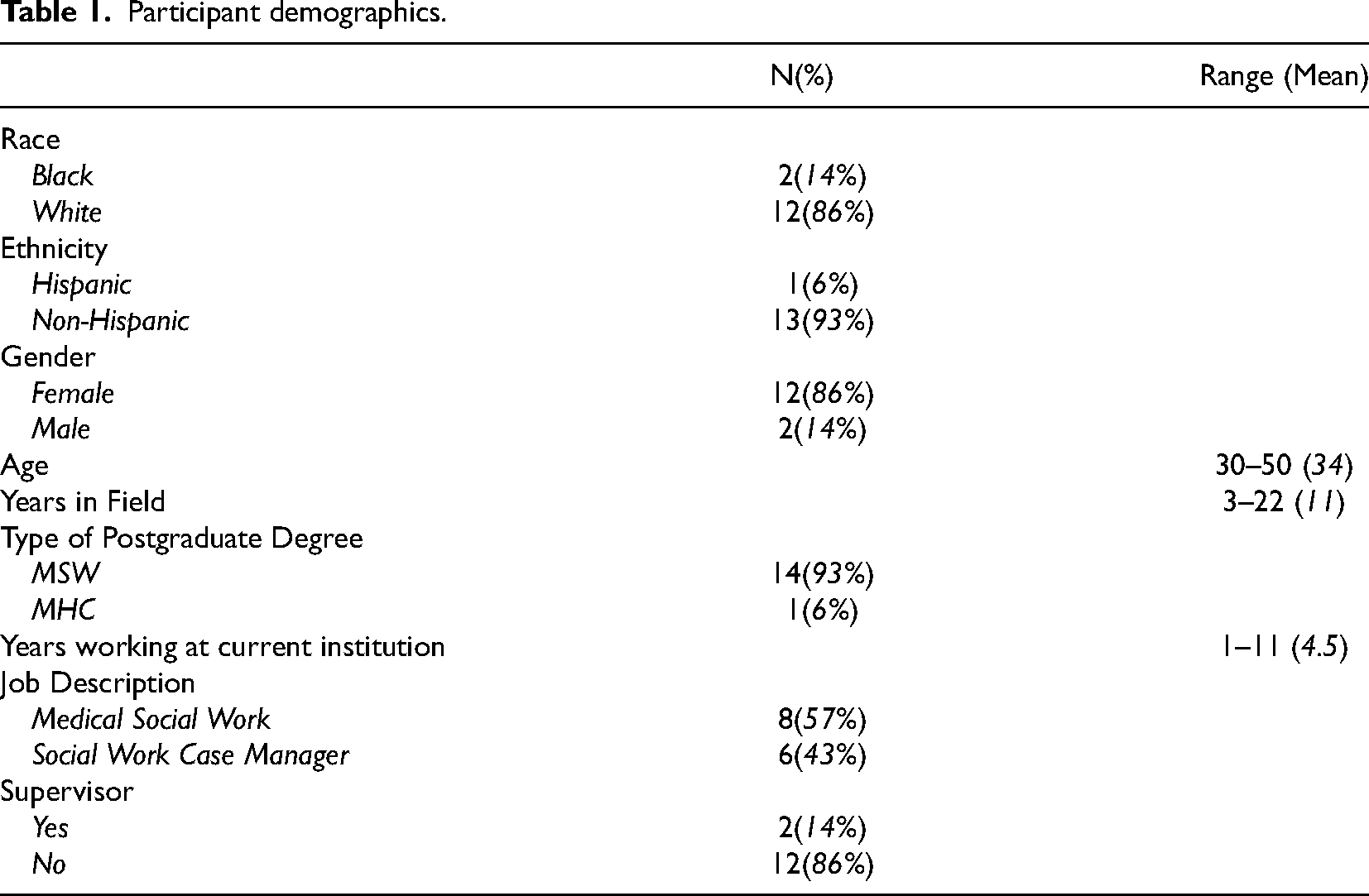
Participant demographics.
Interview Protocol
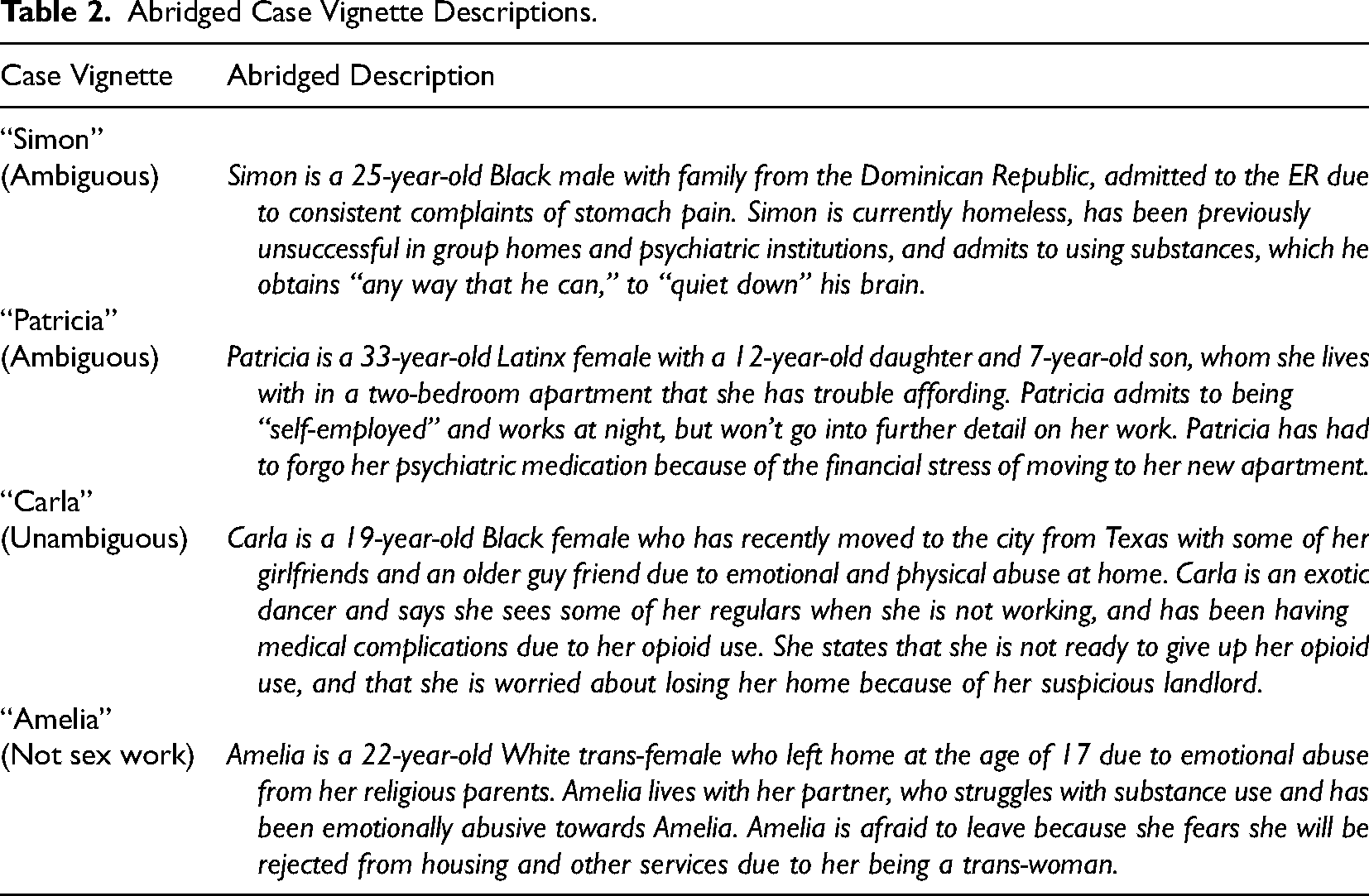
Each interview lasted between 30 min and one hour and was conducted over the phone during Spring of 2021 (interviews were intended to be in person but were remote due to Covid-19). The interview protocol consisted of four case vignettes and five follow-up questions to explore social workers’ immediate reactions to complex, realistic clients presented in the vignettes and the decision-making process they used to make service recommendations. Each interview participant was given the same four case vignettes. The four case vignettes followed the framework of MacIntyre and Green Lister (2010), drawing on the professional experience and lived experience of the second author, and aimed to reflect the varied experiences within the sex working community (Crenshaw, 1991; Grant, 2014). Of the four vignettes, two were ambiguous in presentation of characteristics of sex work, one was unambiguous, and one did not present any characteristics (see Table 1). Ambiguous vignettes presented characteristics of sex work without explicitly stating it (e.g., Simon admits to using substances, which he obtains “any way that he can” but does not go into any further detail). Unambiguous vignettes, however, presented characteristics that explicitly referenced sex work (e.g., Carla is an exotic dancer who sees some of her regulars when she is not working).
Abridged Case Vignette Descriptions.
The ‘thinking-aloud’ method of interviewing was employed, wherein participants were asked to read vignettes aloud and then talk through the decision-making process on their treatment recommendations (Ericsson & Moxley, 2011). Interviews were recorded over the phone and the first author transcribed them verbatim. The first author took notes and used written memos following each interview to reflect on important phrases and words, as well as intuitions, hunches, and connections to other interviews as they related to the project as a whole (Saldaña, 2013).
Data Analysis
Prior to analysis, the first author created a set of codes drawing on the Legitimizing Myths established by Shaw et al. (2016), as well as Anasti's (2020) description of carceral logics. For example, one such code was “characterological” which we used when a statement indicated that the participant attributed an individual's service seeking to particular attributes of the individual (e.g., race, class, profession). Following the vignettes, participants were asked a series of follow-up questions about their experiences and case recommendation influences. Participants were first asked if they had ever “knowingly worked with a client who engaged in sex work”. If they had, they were asked to talk more about that experience.
Next, participants were asked to discuss how much influence they would attribute to (1) the policies of the hospital, (2) the NASW code of ethics, and (3) their professional experience on their decision-making process. The question of influence was asked by researchers to determine if social workers identified any conflicts between the different levels of institutional and personal influence on their decision-making. Finally, participants were asked to tell the interviewer their thoughts on statements such as: “Decriminalizing sex work is the same as legalizing sex trafficking” and “Many sex workers fear engaging with social welfare services for fear of losing their housing or their children”. Here, semi-structured qualitative interviewing was used to promote deeper answers that aimed to ‘apprehend the phenomena’ of sex workers’ engagement with the social welfare system (Beven, 2014; Kvale, 1996; Reinharz, 1992).
The first author returned to the memos during the coding process to triangulate the data; using the memos as a reference point allowed them to reflect and refract on the pre-established codes, the developing codes, and themes within the transcribed interviews (Anasti, 2018; Saldana, 2013). Once the codebook was created, the first author used open coding to capture new insights and to allow for further exploration (Saldaña, 2013). For example, the code “sex work without sex” was created as we observed participants alluding to a client's potential engagement in the sex trade without stating it outright. Using Miles and colleagues’ (2014) guidelines, we also engaged an external code auditor, a social work student, who read three interviews and audited specific identified codes and coding procedures, after which collaborative discussion was had between researchers on agreements and disagreements between codes and themes. The first author then undertook second cycle coding to condense codes into broader themes (Saldaña, 2013). We sought to keep the participants’ words intact to ensure that the focus remained on the meanings that the participants convey from their experiences and that their words are present throughout the analysis (Charmaz, 2006).
Researchers’ Positionality
The first author of this study recruited participants and conducted the interviews as part of this study. They are a white, straight, cis-gendered male. They spent years as an activist working in housing access and safety, harm reduction, and justice for current and formerly incarcerated individuals. Additionally, their previous experience working with children in the foster care system and providing emotional first aid to newly incarcerated men and women has provided them with insight as to the impact of engagement with the carceral system, as well as the importance of social welfare workers’ perceptions, on the well-being of individuals from marginalized and vulnerable communities. Finally, their insider status as a social worker could have allowed a sense of comfortability with social workers who were participants in this study where they felt more comfortable sharing their decision-making process in a less-judgmental environment.
The second author of this study acted as a key informant and assisted in developing the case vignettes and interview protocols. They are a white, cisgendered, queer female with over a decade of experience in various aspects of sex work, as well as a survivor of sex trafficking. They have worked with Sex Workers Outreach Project and Decrim Now! to assist in legislation in the state of New Hampshire to protect sex workers and trafficking survivors reporting abuse to law enforcement without fear of repercussion.
The third author of this study assisted with the analysis of the findings as an external auditor. They are a white, cis-gendered female raised in a low-income household. They have a background in state program evaluation with a focus on legally protected groups. Their research examines governmentally subsidized healthcare programs’ inequitable service of individuals with marginalized racial, ethnic, and legal statuses.
Findings
This study sought to understand the decision-making processes of social workers on the treatment recommendations of their clients who are sex workers. Social workers employed a variety of tactics when talking through their decision-making process for sex workers and described how the information they gleaned from each vignette guided their case recommendations. Through the analysis of the transcripts, two major themes were revealed. The first is carceral social work, i.e., treatment recommendations that either involve or reflect the punitive nature of the justice system. Here, we also discuss a sub-theme of gatekeeping, i.e., when a social worker presumes to know better about the needs of the client than the client themselves. The second theme we discuss is institutional influence, i.e., the degree to which the policies of the hospital and their own social work profession influenced their decision-making. Within this theme, we discuss the two sub-themes of systemic double-bind, or the way hospital policies can sometimes conflict with social work ethics, and professional experience, or how social workers describe the influence of their time in the field.
We present findings that capture the complex ways social workers make decisions about the well-being of their clients, and the consequences this process may have on their service recommendations. We begin by examining individual-level decision-making processes and then add context by discussing the institutional systems in which they are nested.
Carceral Social Work
Carceral social work is defined as the deployment of tactics that are both dependent on and in collaboration with the system of policing within the field of social work (Jacobs et al., 2021). Although participants often approached engagement in sex work from the position of acknowledging its legal standing, most did not choose to involve the justice system or the police in their decision-making and expressed that both were either unhelpful or actively harmful. One participant, who had 10 years of experience, described sex workers who: …have experienced law enforcement being those also engaging in, in trying to access umm…sex workers I guess. […] But I guess, even in trafficking situations the police weren’t a safe place to go to in my experience with working with children who were exploited. So I can definitely see [arrest] as a real fear.
Most social workers who participated in the study also expressed their disapproval of having people who engage in sex work arrested for breaking the law. As one participant who had worked in the field for 14 years noted: I mean, I would tend to say no. That's just me. Ummm…I, I would tend to want to ummm kinda throw a lot of support and resources at them instead as a response.
Most participants followed this line, believing that engagement in social services and support were more appropriate than arrest. When explaining why services would be more appropriate than arrest, however, social workers, such as those quoted above, often repeated discourses surrounding sex workers as being victims of adverse life experiences that resulted in their engagement in the sex trade.
Although participants often expressed a distrust of the involvement of law enforcement in sex work engagement, they were also more ambivalent towards the idea of decriminalization. As another participant with 14 years in the field responded to the question of decriminalization: “… it sounds like if you’re going to decriminalize something, um, that is a negative thing, you are in one way promoting it, umm promoting's not the right word…then you are allowing something.” Here, we can see in this response the social worker attempting to navigate the complexity between the legality of sex work and the reality of sex worker needs. This would be further reflected in their response to whether or not they felt as though sex workers should be arrested for breaking the law: Hmm…that's a really hard thing. Ummm…I honestly don’t, I don’t know. I think more often they need treatment and help. Umm there's, there are reasons that they are doing that. Umm psychiatric reasons or you know mental instability, financial, there are so many reasons ummm…I don’t know that…treating them as criminals is going to make it any better, or different.
Though participants were not employing carceral logics in employing police and the justice system, they frequently invoked other social welfare systems, such as mandated reporting to state departments for children and families, as a means of policing clients. Of the 14 social workers who participated in this study, 13 of them endorsed carceral logics in this way. This form of carceral social work was typically not discussed with the same hesitancy as the use of police or the justice system, despite the potential for similar punitive consequences. By distinguishing between these two forms of carceral logics, we are able to see how social workers employ one form of policing with the justification that it is in service of the client, while the other is viewed as a punitive response. This can be seen most explicitly in participants’ response to the vignette of Patricia, who was classified as ambiguous regarding the language used to describe their engagement in the sex trade and was also described as a mother to two children.
Social work participants often described their difficulty in navigating the case of Patricia, and their decisions often reflected the difficulties social workers have balancing the needs of the client with their professional duties to the state. One participant who had been in the field of social work for 7 years, outlined this complication: Umm… as a social worker, umm…we do get into the gray area of needing to file a [abuse and neglect report] with [state child and families department]. And so I would probably, being an employee of the hospital, and due to being a social worker, I would have to file a [abuse and neglect report], since she disclosed that information.
The above participant also describes the difficult position service-seeking clients can find themselves in: disclosing particular information to social workers could open them up to further contact with the state and the other carceral systems. In a similar way, another participant, a social worker with three years in the field, explicitly cited Patricia's potential sex work as a reason to investigate for neglect on behalf of the children: So I would try and assess that further and ask her you know what do you do? … and she has a 7- and 12-year-old, and she's struggling to pay rent which could lead to housing instability … And like that could be really telling depending on how open she is with you know given history and like information … And I think that if I suspected that she was doing some sort of “self-employment” that could be…like, if she isn’t open about it, I mean…maybe based just based off of, that…I don’t know. I would assess this case for suspected like, possible like, um…like I wouldn’t be like abuse, I don’t think she's like abusing her kids, but neglect, by having to work…
As noted, the tendency for participants to employ tactics of carceral social work was not expressed evenly across case vignettes. This can also be shown in the differing responses to the cases of Carla and Amelia. Each vignette described a familial history of trauma, however Carla was unambiguously a sex worker, i.e., the vignette described Carla as an “exotic dancer”, and Amelia was not a sex worker. Although each vignette depicts past trauma, only four participants noted this for Carla, while all of them noted it for Amelia. As a result, Amelia was recommended counseling and community supports, while Carla was only recommended counseling by those who, with the exception of one, noted her past trauma. Instead, Carla was most often recommended resources that would have her leaving her current home and line of work, neither of which were expressed to be dangerous nor problematic for Carla.
Despite the employment of carceral logics, most social workers made the distinction between sex work and sex trafficking. For many of the social work participants, sex work was understood as a choice, even if it was a choice made as the result of adverse life experiences. Sex trafficking, on the other hand, was explicitly represented in a lack of choice on the part of the individual being trafficked, though it may often lead to engagement in the sex trade. One participant who had been working as a social worker for more than 20 years attempted to navigate their distinction between sex work and sex trafficking: I mean I, I mean I wouldn’t be a proponent for either, but…I would…I guess my thought … is that, umm…sex work could be something that could be…driven by free will? Not always. I know it's not. But there could be much different level of choice and free will in that versus trafficking. We know in trafficking that's not the case at all. So…umm…yeah, so I don’t think it's the same.
The above quote encapsulates how many of the social work participants attempted to navigate the social work imperative of seeing individuals through a person-in-environment lens and their own personal beliefs about the legalities of sex work and their duties to the state. Carceral logics often came through in the language social workers used to describe sex working vignettes, as well in the way they employed carceral powers of the state through reporting mechanisms. Another way in which this manifested, however, was in the way social work participants would gatekeep, or withhold, particular services based on the client meeting their recommendations.
Gatekeeping
Gatekeeping became a common theme uncovered through the free coding process. Gatekeeping came to be identified when participants employed language that indicated that they were the expert on the needs of the client. This often came through in the transcripts of social work participants when they would make case recommendations counter to the clients stated need. It was also identified in the inverse, as how they described withholding of these services until the client agreed to follow the social workers’ own guidelines. These guidelines appeared to follow the implicit moral beliefs on the part of the social worker, and they followed characterological descriptions of the client. This can be seen in the following quote from a participant with 15 years of experience as an inpatient social worker describing Carla's desire for further education: [I would want to know more about] her opioid use. You know, is it just dabbling, how much, what are you doing, do you wanna stop? Exploring that if she does wanna stop you know maybe even discussing Job Corps, where she could uh go learn a skill, you know get credit, graduate, and uh you know go on to college.
The participant describes granting access to educational opportunities as a condition of Carla abstaining from her current substance use. In doing so, they are implying that Carla would have to choose between substance use and educational opportunities. Another social worker employed gatekeeping in a common trope that sex workers who feel empowered by their work need to be convinced otherwise: …obviously the client would, in the moment, would feel [empowered] and believe that, and I would support that, but they would obviously need help and work to realize that, you know, they are so much more than that.
The implication here is that assisting a sex worker is conditional on the realization that their sex work is a characterological flaw the social worker could help them to overcome.
Social workers who did tend to embrace carceral logics, either as an individual choice or as an institutional necessity, also frequently employed gatekeeping in their case recommendations. The shared usage of gatekeeping and carceral social work indicates that these two processes are linked together in their deployment as well as their outcomes. The deployment of both of these processes was most often used when making recommendations on the vignette featuring Patricia.. One participant, a social work case manager, in employing these two processes, described ambivalence in her decision making: My first instinct is it's not safe for a 12-year-old to be watching a 7 year old often at night. Um […] if she's refusing to tell me what she does for work then I would kinda push her on “ok but I would need to know, you know, how your kids are being taken care of.” Um if she wouldn’t give me a good answer on that and it feels like the kids are just kinda on their own all the time, then I think I would file with [child protective services report] um on the basis of neglect. Not necessarily to punish her, but just to…maybe they can get some more services, childcare, um…you know…
This quote is illustrative of the responses of most participants, in that the deployment of punitive social systems was described as a necessary evil, or at the very least a condition of their employment (i.e., mandated reporting). These more punitive responses also tended to follow the logic of protecting the client from a perceived harm, either to protect the client from themselves or from something external to them. This process can be understood as a ‘double bind’ social workers find themselves in – weighing their own beliefs about the best treatment of a client against their professional duties towards mandated reporting and the expectations of the institution they work for. The next section shows how individual social workers’ decision-making processes are shaped by social structures outside of their control.
Institutional Influence
One of the aspects of social workers’ decision-making processes we were interested in understanding was where they attributed their influences. Throughout the interviews, social workers described a complicated relationship between the influence that the hospital policies had on their decision making against the NASW code of ethics. When these two came into conflict, social workers consistently rated their own professional experiences as being the most important factor in mediating these conflicts. Below, we outline how social workers described what we called the ‘systemic double bind’ of working within an institution, and how they attributed their own professional experiences as mediating these conflicts.
Systemic Double Bind
Participants were asked three separate questions about where they attribute their decision-making: the policies of the institution, the NASW, and their own personal experience. Of the 14 participants, 11 (79%) reported that the policies of the institution are not a driver of their decision-making. On the contrary, social workers noted the policies of the institution as being one of the greatest barriers to their decision-making, highlighting the time constraints, the focus on medical interventions, and focus on cost-saving measures as being the greatest barriers to providing adequate care to the clients that come into their care.
These complications spoke to how social workers often have to navigate the needs of their clients over the carceral logics inherent to neoliberal social service institutions. The shortened time-frame social workers have to make case-recommendations may have the tendency to reinforce the employment of characterological assumptions about clients. In the case of vignettes that described sex workers, either ambiguously or unambiguously, this meant that social workers relied on characterological assumptions about sex workers. As one participant described while thinking through the case of Carla: I’m concerned about her high-risk behavior. Ummm…that she does the exotic dancing, sees some of the regulars but doesn’t go into further detail. You know again maybe there's some shame there or just fear of umm…you know disclosing that she may be doing something…ummm…with those people.
When reflecting on the NASW's ethical guidelines, most (85%) referenced that these guidelines at least form the “background” in their decision-making, if not an important factor. At the same time, participants largely attributed the ethical guidelines to their duty to mandated reporting, with only two (15%) participants referencing ethics or values explicitly outlined in the code of ethics. References to mandated reporting arose most often when participants discussed the safety of children, as was the case for Patricia. All but 2 participants referenced an immediate need to create a child safety report through the state when thinking through Patricia's inability to find an adequate babysitter for her children, most directly referencing her potential sex work as a worry. However, participants who reflected on the need to file a child safety report did so with hesitation and with a worry that this may complicate services. The example below elicits this uncertainty while also referencing how “vulnerable populations” are most often at the receiving end of these reports: I’d say that's my first thought. Like, ok are there any vulnerable populations here that would require mandated reporting and just kinda, I mean I don’t mean just kinda get that out of the way first, but that's just the first order of business … and then once I, ummm…kinda suss those out then I can move on to like, uhhh like helping, you know, like brainstorming what would be best for the patient. But I would say that in my line of thinking the first thing is like what am, what am I kinda mandated to do here … I think that is kind of [the institution's] policy but it's also kinda a social work responsibility I would say.
Professional Experience with Sex Workers
When asked about their decision-making process, all participants described their professional experience as the greatest influence on their recommendations. Despite their range of professional experience, the decision-making process towards the vignettes described by each was similar. Participants who had prior professional experience working with sex workers, however, tended to employ decision-making processes rooted in understanding sex work as inherently harmful, making case recommendations that reflected carceral social work.
All but three of the participants had some professional experience with sex workers. For participants who have worked with sex workers this experience primarily came from working in substance use treatment, domestic violence shelters, or state child protective services, thus intimately tied with sex trafficking, trauma, and substance use. One participant, a supervisor who worked in the field 22 years, talked through a particular case that stood out to them when thinking about sex work: You know it's interesting. She would say “I convinced myself I wasn’t prostituting myself” because um…you know she was only like 13 or 14 when she started having sex with older men in order to get drugs. […] [She] didn’t think that she was prostituting herself until she was maybe a young adult, and she’d been engaging in the behavior for a long time and then she realized “oh actually I’m doing this. Like it's not just like I’m having fun and doing drugs” you know…which makes sense if you start that young that you probably wouldn’t have um….that kind of label to put it on it.
The tendency towards punitive responses to sex workers was shared among all who had had prior experience with clients who were sex workers. The type of experience, however, seems to matter as well. For example, one participant described how, for a past client, …engaging in sex work kind of made her feel empowered. She was not only sexually desirable to someone, but also like she was in control and able to manipulate that situation where before she was the one that was manipulated.
Discussion
Anasti (2018) suggested that future research into sex worker engagement within social services must interrogate how social workers perceive clients in the sex trade. This study aimed to fill this gap through its assessment of social workers in a medical setting. Grounded in critical feminist epistemology, this study shows how social workers employed at a hospital make decisions about clients who engage in the sex trade and contributes to the growing body of literature on the use of carceral logics within the social work profession (Anasti, 2020; Jacobs et al., 2021). Interview analysis found that sex work was indeed an important factor in participants’ treatment recommendations, and that their decision-making process was often rooted in carceral social work, such as gatekeeping resources. Similar to Anasti (2020), participants in this study also attributed engagement in the sex trade to trauma and substance use. Much of these assumptions were not based explicitly on the information provided in the vignette themselves, and instead was a result of prior experiences with sex workers in their practice.
Our findings differ from prior research, however, when it comes to participants’ perceptions of policing. With the exception of one, participants did not support police intervention in the care of sex workers. Two possible reasons for this difference is: (1) while Anasti (2020) conducted her research across multiple settings, this study engages solely with social workers in the medical field, and (2) the current historical moment this research is being conducted in is one where conversations about the role of the police are happening at a national level following the historic Black Lives Matter protests of 2020.
Participants did, however, employ tactics similar to policing presented in the guise of social work ethics and described as necessary for the safety of the client(s). Where Jacobs and colleagues (2021) defined carceral social work as both in collaboration with and employment of tactics similar to the police, collaboration with law enforcement was generally not promoted by participants in this study. By expanding the definition of carceral social work we can interrogate how the field tends to support punitive state measures as both separate and interdependent with systems of policing.
The external pressures of funding and abiding by cost-saving measures due to the neoliberalization of social service provision should be considered here. Dall (2020), when studying social workers’ decision-making for complex cases within welfare-to-work institutional settings, found that social workers were inclined to err towards the policies of their institution over their professional code of ethics when the two came into conflict. As with Dall's (2020) research, participants generally reported strong endorsement of social work ethics, but erred on the side of institutional policies when the two came into conflict with one another. Participants also cited the pressures of having to intervene quickly due to hospital cost-saving measures, a result that supports the work of Mitendorf and Ewijk (2019) who found that social workers struggled to effectively serve clients in an increasingly neoliberal social welfare context. These results show that the need to make quick and cost-effective decisions often results in making characterological assumptions about clients. We follow Shaw and Campbell (2016) in our findings where these characterological assumptions were often used to minimize the experiences of clients and tend towards carceral social work in their recommendations.
Implications for Abolitionist Social Workers
This study presents important implications for social workers because it sheds light on the importance of ethical decision-making regarding the care of their clients within complex institutional networks. The findings suggest that participants’ professional experiences with sex workers shaped their views, often in negative ways, of their clients who are sex workers. These findings also suggest that there is an important need in more critically incorporating the complicated breadth and depth of the experiences of sex workers within legal and welfare systems into social work education. Our research concludes similar recommendations by Wahab (2004) and Preble and colleagues (2019) that social workers abandon commonly-held stereotypes and judgements and instead adopt strength-based approaches sensitive to the varied experiences of individuals in the sex trade (Wahab, 2004; Preble et al., 2019). But it's important that this is done with care and includes the lived experiences of sex workers. As Anasti (2020) suggests, by engaging with the sex work community outside of service provision, social workers can learn what equitable service provision looks like from the perspective of the community themselves.
It would be a mistake to claim that individual bias is the sole, or even most important, problem facing social work. Mandated reporting and other state and institutional policies may not provide the nuance necessary to support those seeking treatment. This study shows how institutional and state policies have direct and indirect effects on how social workers engage with sex workers at the level of treatment recommendation. This study also provides further evidence to support the growing movement for the social work field to assess how the institutions social workers’ work within may align with oppressive and carceral state structures (Jacobs et al. 2021; Abrams & Dettlaff, 2020). Abolitionist frameworks within the field of social work and child welfare, such as the upEND movement, provide options for social workers hoping to challenge the carceral structures within the field (Dettlaff et al., 2020). The upEND movement is a collaborative movement that aims to push the field away from mandated reporting and towards ‘mandated supporting’, a movement that would put the well-being of individuals outside of the scope of family policing and surveillance (Copeland & Pendleton, 2021; Dettlaff et al., 2020).
Limitations and Future Directions
While this study provides important insights into social workers’ decisions about the welfare of their clients who are sex workers, it is not without limitations. First, this study is not intended to be generalizable. Hospitals do, however, exist throughout the US and it is likely that these findings are transferable to other settings where social work and the medical field intersect. Another limitation in this study is the lack of sex worker voices. While I worked with a key informant who identified as working within the sex trade, the voice of sex workers who have engaged with the social welfare system was not a part of this study.
We join with Anasti (2018, 2020) in recommending that future research should include the voices of individuals in the sex trade as part of their research. Such work could explore sex workers’ thoughts on what appropriate service responses are to similar case vignettes and whether their recommendations might differ given their lived experience. This study provides an exploration of the ways social workers engage with sex workers in a medical setting, where sex workers are most likely to have initial contact with social service agencies. As social work continues to turn a more critical gaze towards our place within historically marginalized communities, we must continue to push against the policing involved in our own profession and interrogate the existence of our profession as working within and for the state.
Another aspect of the findings that should be given more attention in future research is the gendered component of the participant responses. Although both the cases of Carlos and Patricia referenced sex work in the same ambiguous way, none of the participants referenced the potential for Carlos to be a sex worker. The “risky behavior” noted most often for Carlos was his substance use, whereas for Patricia the “risky behavior” most often referenced a potential for engaging in the sex trade in some form. Research and news articles that explore sex work often do not include the engagement of male-identifying individuals in the sex trade. By overlooking the ability for men to enter the sex trade, we may be missing a significant piece of exploring how male sex workers experience their engagement in social services. Future research should explore this population as part of a wholistic understanding of sex workers engagement in social services.
Finally, the process of framing the interviews around case vignettes that attempted to accurately represent clients they may see in their care and asking participants to “think aloud” in their decision making allowed for nuanced understandings of the difficulties social workers find themselves in when making case recommendations. Although participants often employed characterological presumptions in their case recommendations that reinforced carceral logics and gatekeeping, the language that surrounded these decisions would often reflect an ambivalence towards these decisions. Future research on the relationships between institutional engagement with historically oppressed communities and social work should engage with these multi-method analyses that frame the context of social workers’ decision-making within the larger restrictions of institutional policies.
Footnotes
Acknowledgements
The author's would like to provide a special thanks to Dr. Samantha Teixeira, PhD, for her commitment and guidance throughout this project.
Author note
K. Megan Collier is currently affiliated with Policy Impact Center, Vanderbilt University.
Declaration of Conflicting Interests
The authors declared no potential conflicts of interest with respect to the research, authorship, and/or publication of this article.
Funding
The authors received no financial support for the research, authorship, and/or publication of this article.
