




Abstract
This article challenges the assumptions in social policy and practice of how the combination of youth and motherhood is problematic and morally wrong. Using an intersectional approach, this study uncovers how young mothers’ social categories of youth and motherhood collide, concur with, or reinforce each other. The research question is the following: What are young mothers’ perceptions and practices of youth when combining youth with motherhood? The research methods include 18 months of participant observation and 41 semi-structured interviews with young mothers in the Netherlands. Analysis shows that young motherhood should not be conflated with problematic motherhood. Young mothers position themselves as “new” parents, single mothers, and working parents. Their motherhood practices illustrate adherence to an ideology of child-centered, omnipresent, and responsible motherhood. They might not be good girls, but they show they are good mothers. Young mothers navigate intersecting dimensions of youth, age, motherhood, and gender through (1) discontinuing youth practices, (2) alternating between motherhood and youthfulness, (3) transforming youth practices into young motherhood practices, and (4) reinforcing youth through young motherhood. Professionals can use the strengths of these practices more to the advantage of the youth to provide support that is tailored to clients’ needs.
This study analyzes young mothers’ practices of young motherhood in the Netherlands. Young mothers have received extensive policy, professional, and academic attention, which often highlights how the intersection of youth and motherhood is problematic. Policy makers and social professionals typically portray young mothers as poor, working-class, welfare-dependent, socially excluded, and unambitious; rarely are they depicted as motivated, socially engaged, focused, active, and skilled women (Greene, 2007; Levac, 2013; Nayak & Kehily, 2014). Hence, social professionals and policy makers construct young motherhood as a social, economic, or moral problem (Duncan et al., 2010; Macleod, 2014; Rudoe, 2014). Similarly, academic studies examine parental support programs to strengthen young mothers’ parenting skills and prevent child maltreatment (Bogat et al., 2008; Schrag & Schmidt-Tieszen, 2014). This reinforces the professional attention for problems associated with young motherhood.
However, young mothers’ challenges are intensified when social professionals construct young motherhood as problematic and reinforce stigma and dominant norms (SmithBattle, 2013). A dominant norm in neoliberal Western societies in particular is that young people should first finish school, become employed, live independently from their parents, have a stable partner relationship, and then start having children (Geronimus, 2003; Singh & Darroch, 2000). Even though sexual mores for girls are ambivalent and dynamic (Bay-Cheng et al., 2018; Vanwesenbeeck, 2011), an enduring norm is that “good girls don’t get pregnant” (Kulkarni, 2007). Youth and motherhood thus seem to be a problematic combination: Youth disqualifies women from being a “good” mother, and motherhood disqualifies them from being a “good” girl.
Social work scholars argue for employing intersectional and feminist social work practices to promote social inclusion for clients and create a better understanding on how interconnected systems of inequality affect marginalized people on multiple levels (Dominelli, 2002; Mehrotra, 2010; Van Mens-Verhulst & Radtke, 2009b). Intersectionality was coined by Crenshaw (1991) in critical race and legal studies in the Unites States and identifies the interplay of gender, ethnicity, and, increasingly, other social categories (Crenshaw, 1991; Lutz et al., 2011; Mehrotra, 2010; Phoenix & Pattynama, 2006). Since its inception, the concept of intersectionality has traveled through times, places, political, and disciplinary contexts to become a widely used theory, method, or approach (Davis, 2008; Smiet, 2017). We refer to intersectionality as an analytical disposition that calls into question and invokes certain dimensions of identity to analyze connections and co-construction of inequalities (Smiet, 2017). It entails unraveling identity categories that are done or performed at the individual and institutional levels, are scripted in social norms (Butler, 1988; West & Fenstermaker, 1995), and intersect, concur with, or collide with each other (Moser, 2006). The intersecting categories in this study are age, youth, gender, and motherhood. These categories are considered to be continuous, socially guided, and interactional accomplishments rather than individual attributes that simultaneously reproduce and legitimize institutional structures (Butler, 1988; West & Fenstermaker, 1995; West & Zimmerman, 1987). Throughout the article, we use the phrase “doing youth” to express the performative nature of young women’s intersectional experiences of motherhood.
We argue that young mothers do not see age as the category that makes young motherhood difficult. Rather, they point to other variables in the sociocultural construction of young motherhood. Our aim is thus to move beyond representations of young motherhood as problematic, by uncovering whether and how the categories of motherhood and youth intersect and collide or reinforce each other. The main research question is as follows: What are young mothers’ perceptions and practices of youth when combining youth with motherhood? Through in-depth interviews and participant observation among young mothers in the Netherlands, data were collected that show young mothers’ perceptions and practices of their young motherhood.
Conceptualizing Youth: Scholarship on Age and Young Motherhood
Youth is a central concept in research on young motherhood. In international academic and policy discourse, youth is commonly defined in terms of age. Young motherhood is mostly seen as teen(age), early, and adolescent motherhood (Jacobs & Mollborn, 2012; Singh & Darroch, 2000; Spear & Lock, 2003), which identifies mothers in their teens or early 20s and emphasizes young mothers’ unfinished development phase. Age is often linked to characteristics that appear to be universal and natural (Geronimus, 2004; Lesko, 1996).
However, other studies show that characteristics that determine youth and childhood differ socioculturally (Jansen & Driessen, 2016; Montgomery, 2009). Youth and childhood have multiple meanings in diverse contexts. Children, for example, are perceived in a range of ways, including as economic and future investment; innocent and pure; incompetent and inferior; a means to enhance one’s status, especially sons; or individual, autonomous persons (Jansen & Driessen, 2016; Montgomery, 2009). Defining youth merely as age in years denies such sociocultural diversities (Geronimus, 2004; Lesko, 1996).
Furthermore, the characteristics of youth differ according to who defines it. Naezer (2018), for example, found that the social category of age had little meaning to the young people she studied. Scholars increasingly urge professionals and policy makers to start from emic perspectives of young people to avoid listening to young people in a tokenistic manner and setting up inappropriate interventions for them (Bordonaro, 2012; Payne, 2012).
Young people’s perceptions, particularly their notions of youth, cannot be overlooked in research and practice. Youth, therefore, is not a static concept with supposedly inherent problems due to its intersections with motherhood. Youth is considered as more than a chronological age in years (Utrata, 2011). It is conceptualized as a socioculturally constructed and dynamic category, shaped by the norms and expectations for youngsters, and by young people’s own perspectives and practices. This means exploring young people’s gendered age performances (Utrata, 2011) or how young mothers “do” youth in combination with their motherhood.
Conceptualizing Motherhood: Scholarship on Gender and Young Motherhood
Women are generally expected to become mothers and perform reproductive, productive, and community tasks. Gendered roles, practices, identities, and responsibilities of motherhood have been extensively studied (Laney et al., 2015; Malacrida & Boulton, 2012; Phoenix et al., 1991; Smyth, 2012).
Motherhood is a construct with different connotations across political contexts (Davids, 2017). In Western societies, women negotiate multiple gender roles and the responsibilities of motherhood in various ways: from rationally planning childcare and work to pragmatically adjusting goals and practices according to maternal experiences (Smyth, 2012). Laney et al. (2015) state that maternal identity surpasses other identities and that women give up other needs. Malacrida and Boulton (2012) find a gendered moral imperative for women to be selfless as a “core attribute of femininity and motherhood.” The gendered norm of an “intensive motherhood ideology” is evident through child-centered mothering practices and the notion of omnipresent mothers as the primary caretakers of their children, even when mothers are employed and share parenthood with fathers (Arendell, 2000; Johnston & Swanson, 2006). These studies show that, while women in Western societies negotiate gendered norms on childcare, employment, and housework in multiple ways, motherhood is still an identity and social category that surpasses most others.
The gendered construction of motherhood has particular implications for young women. In contemporary capitalist societies, young women are pressured to be successful (Harris & Dobson, 2015). Young women are expected to be ambitious, independent, empowered, choice-making agents who make conscious life decisions (Harris & Dobson, 2015). Even for young women who are considered “empowered,” their independence clearly has (normative) limits, as motherhood is not seen as a “right” choice for them (Bay-Cheng & Goodkind, 2016). Popular opinion and policy discourse do not recognize young mothers’ agency (Duncan et al., 2010; Keinemans et al., 2018; Nayak & Kehily, 2014). Similarly, few studies address young mothers’ ambitions to develop activities to simultaneously achieve success as mothers and paid employees or community leaders (Greene, 2007; Levac, 2013). However, gender expectations for young mothers can lead to conflicting identities as caregivers, employees, and students because young women should not (yet) be mothers (Kloosterman & Moonen, 2016; Zhou, 2017).
Uncovering practices of young mothers entails learning how they navigate intersecting social categories. We conceptualize young motherhood as a dynamic spectrum of ways of (un)doing, conforming with, and contesting categories of gender and age. This includes unpacking the aged and gendered practices of young mothers and in relation to whom and which settings and norms their categories are (re)constructed.
Socioeconomic Context of Young Motherhood in the Netherlands
The Netherlands is seen as a liberal country with a high level of sexual and reproductive health and rights (Cense & Ganzevoort, 2019; Schalet, 2010). Birth control for women up until the age of 18, legal abortion, and maternity care at home are financially covered by mandatory, basic health insurance (Cense & Ganzevoort, 2019). Schools offer comprehensive sex education that includes pleasure, self-confidence, and empowerment, and parents are generally supportive of youngsters being sexually active in steady relationships (Naezer et al., 2017; Schalet, 2010). However, in this open climate, sexual health policies reflect the neoliberal discourse that presents teenage pregnancies as adverse outcomes that can be avoided (Cense & Ganzevoort, 2019). Sex education is predominantly developed from an adult, heterosexual perspective that focuses on risks but insufficiently includes diverse perspectives from youngsters themselves (Naezer et al., 2017). Moreover, sexual double standards label boys who have sex as “cool” and girls as “sluts” (Naezer, 2018; Vanwesenbeeck, 2011).
Employment is also gendered. Common in the Netherlands is a 1.5 wage earner model, which means that usually women are employed part-time and men full-time (Merens & Van den Brakel, 2014). Likewise, a “mother contract” of working during children’s school hours is common among families (Benschop et al., 2013). A total of 75% of Dutch women in paid jobs work part-time, which is significantly higher than the average of 32% in the European Union (EU; Portegijs & Van den Brakel, 2018).
Women in paid employment are entitled to 16 weeks subsidized maternity leave, which is limited relative to other EU countries (Addati, Cassirer & Gilchrist, 2014). Child-rearing students in higher education can apply for funding to financially compensate 4 months of study delay, following EU equal treatment policy (Eleveld et al., 2016). The Netherlands only has private day care centers. Day care is proportionally state subsidized according to a household’s income. This liberal system is less effective in attracting poorer families than a more comprehensive welfare system (Vandenbroeck & Lazzari, 2014).
Women in the Netherlands have been bearing children at increasingly later ages, due to family planning education, women’s higher prioritization of educational attainment, and women’s greater labor market participation (De Graaf & Beets, 2015; Portegijs & Van den Brakel, 2018; Singh & Darroch, 2000). The mean age of childbearing increased from 24.3 in 1970 to 29.8 in 2017, among the highest ages in the world (Central Bureau of Statistics, 2018b). Moreover, the Netherlands has one of the lowest fertility rates among teenaged women (<20 years) and young women (20–24 years), with, respectively, 2 per 1,000 women and 22.2 per 1,000 women (Central Bureau of Statistics, 2018b; United Nations, 2017). Although the Netherlands is often seen as an emancipated country (Cense & Ganzevoort, 2019; Schalet, 2010), elements like the high mean age of childbearing and the conservative view on the role of women as parents may contribute to making young motherhood less accepted and supported in Dutch society than in some other societies.
Research Methods
Participants
This article draws on semi-structured interviews with 41 young mothers and participant observation in two “young mother groups” of two welfare organizations in Parkstad, in which young mothers met weekly to learn from each other and from professionals. Access to these groups and to individual interview participants was obtained through contacts with professionals, snowball sampling, Facebook messages, peer contacts, and flyers. The first author contacted two youth workers, who introduced her to the mother groups. We chose 27 as the maximum age of the women because Dutch social policy considers all people until the age of 27 as young people (Inspectie SZW, 2014). We chose 23 as the maximum age for childbirth because Dutch welfare and youth organizations consider mothers up until the age of 23 to be young mothers.
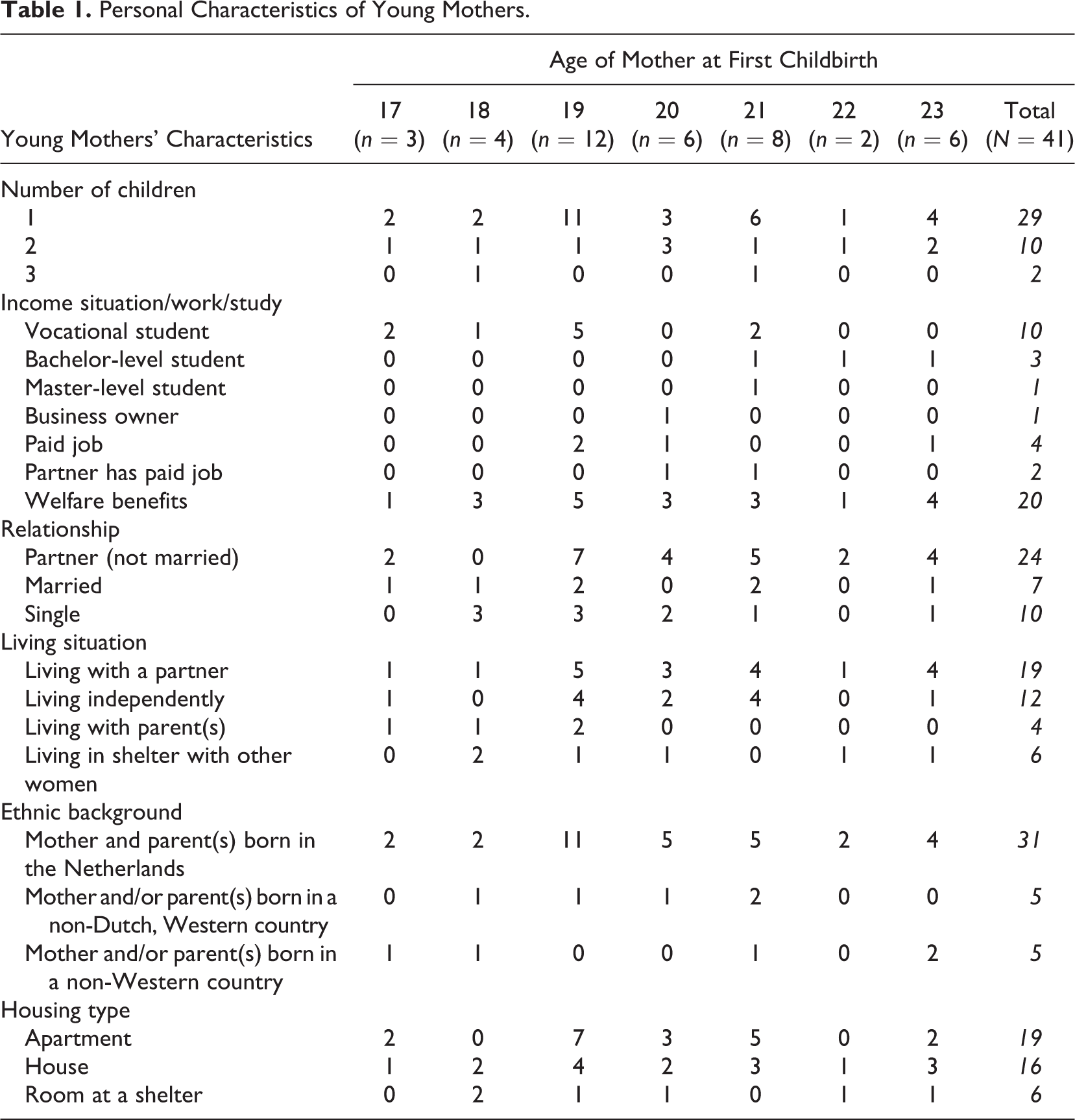
A total of 46% of the interview population had given birth to their first child before the age of 20 (see Table 1). In comparison, 2.8% of mothers in Parkstad’s main city were under the age of 20 and 14.5% under the age of 24 (Central Bureau of Statistics, 2018a). The interview population (41) included 20 women receiving welfare benefits and 2 women dependent on their husbands’ income, who all considered themselves stay-at-home moms. It also included 1 woman in a master’s program, 3 in a bachelor’s program, and 10 attending vocational programs (see Table 1). Furthermore, one woman owned a business, and four worked part-time in care services, administration, or a restaurant. Ten women were single, and 31 were in a relationship, 7 of whom were married. All the women lived with their children; 12 lived independently, 19 with partner, 4 with parents and siblings, and 6 lived in women’s shelters. All the women lived in Parkstad, a region with eight municipalities. Most lived in the largest towns of Heerlen (21 women) and Kerkrade (8 women). Parkstad is in socioeconomic decline, influenced by higher unemployment and lower educational levels than the national average (Marlet & Van Woerkens, 2015; National Institute for Public Health and the Environment, 2013). This fact is reflected in the research population: Half of the population depended on welfare benefits, and few women worked or were studying at the bachelor’s or master’s level. In this study, 31 women were native Dutch and the remainder had a (Dutch-)migrant background. Even though teenage mothers in the Netherlands more frequently have a (Dutch-)migrant background (Central Bureau of Statistics, 2017; Wijsen & Van Lee, 2006), the research population reflected the ethnic homogeneity of Parkstad’s population (Central Bureau of Statistics, 2014).
Personal Characteristics of Young Mothers.
Data Collection Through Interviews
The first author conducted all interviews. Interviews and participant observations took place only after informed consent. To ensure anonymity, all the names are pseudonyms and the type of work/education or ethnic background in relation to the residence are not specified.
Most interviews took place in the women’s homes, with their children, partners, parents, or friends present while everyday life continued. For example, the interviews occurred while the women cared for their children or prepared meals. This allowed for an emic, or inside, perspective of their daily lives (Kottak, 2006; Spradley, 1980). Some interviews took place in other spaces where the women felt comfortable, such as a coffee shop or room in the mothers’ group building.
We designed an interview guide with topics and key questions to steer the interviewer and to give informants enough space to take charge (Robson, 2011). The main topics were family, partner, father, friends, living situation, childcare, education, employment, housework, daily activities, leisure, youth, motherhood, life changes, and future. The interviews were audio-recorded and transcribed verbatim, except for one, because this participant did not agree to get the interview recorded. The first author wrote down the answers during that interview and typed them out immediately afterward.
Data Collection Through Participant Observation
Participant observation is a method in which a researcher observes and participates in people’s activities in a social situation, to gain tacit, inside knowledge and learn about cultural rules (Spradley, 1980). The first author conducted participant observation once every week in two mothers’ groups of welfare organizations, alternating between the groups for 18 months. During every meeting, she joined the women for tea, chats, playground visits, workshops, handicraft sessions, cooking sessions, or presentations of invited experts. She combined small talk and informal conversations, which are crucial in establishing rapport (Driessen & Jansen, 2013), with home visits to learn about the everyday events and issues of the young mothers. The participant observation was overt because the researcher told the women who she was and why she was there; every time a new woman joined the groups. Participant observation also took place during the interviews in the women’s homes, work, and school spaces. These occasions allowed the researchers to learn about the women’s lives in contexts other than mothers’ groups. The researcher wrote short observation notes during all meetings, which she developed into extended observation reports after every meeting.
Data Analysis
Interview transcripts and participant observation reports were imported in the qualitative data analysis program ATLAS.ti (version 7.5.16) for coding and data structuring to establish a connected network of relations between codes and to develop concepts (Huberman & Miles, 2005). The first author analyzed the data in several steps. The second author then validated the data analysis process of coding and clustering that led to the development of concepts. First, open coding was carried out on all interview transcripts and observation reports (Robson, 2011). A long list of codes was established, based on the women’s words (e.g., playing like children, carefree behavior) and codes based on theory (e.g., leisure events, educational ambitions, work strategies). Then, we compared codes and identified recurring themes that emerged from the data. To reduce the diversity of codes, we clustered them according to themes (e.g., young, motherhood, activities, or strategies). For example, the theme young includes codes of playing like children, carefree behavior, leisure events, and attending education. In line with our intersectional and constructivist approach, the next step entailed uncovering the intersections of youth and motherhood. We therefore organized the data around concepts of continuing, discontinuing, alternating, transforming, and reinforcing practices of youth that intersect with motherhood practices. Since practices can differ from perceptions, we distinguished between the two by organizing the findings section into one subsection focused on discursively positioning youth (perceptions) and another on navigating intersections of youth and motherhood (practices). The first and second authors selected quotes they judged to be the most representative of all the mothers while paying attention to key divergences.
Findings
Young Mothers Discursively Positioning Their (Young) Motherhood
We analyzed how young mothers discursively position themselves, after being asked what difference their age makes, if any, in their motherhood. We found that age differences do not directly speak to young motherhood. Rather, our participants’ narratives demonstrate which intersections they do acknowledge as relevant to their lives.
First, almost two thirds of the women positioned themselves as “new,” or first-time, mothers. Daniëlle (18, 4-month-old child) feels that motherhood is difficult for all women who have their first baby: It really doesn’t matter whether you are young or old. It’s a whole new life, even for someone who is 30 and has a first baby, for someone who is married, has a house. For them it’s all new and it will be hard.
Second, 8 of the 10 single young mothers place the challenges of mothering within the context of being single. Floor (27, 6-year-old child) said: I think it doesn’t depend on being a young mother. What matters is whether you have a partner who supports you. That is how I experienced it myself. Someone who can take over for you and sometimes say, “You’re also a good mother when you take time for yourself. Relax and recharge, to get enough energy again, for your child.” But I didn’t have that, so I think, for me, it was hard, but not because I was a young mother. He picked up [my child] from day care, came home, put [my child] in the playpen and started gaming. […]. He was always doing nice things, he went to his friends, he was always out. And I was sacrificing myself. I had to stay at home for my child, because he had plans. (Femke’s emphasis)
Third, 18 of the 21 studying/working mothers discursively positioned themselves in a working parent context. For working or student mothers, arranging childcare during work/school hours is often difficult. Agnes (23, with 2-year-old child) explained her complex childcare and education schedule: Four days a week [my child] is with a babysitter, actually three babysitters. Monday is for my mother-in-law. Tuesdays and Thursdays, my grandfather and grandmother babysit. Wednesday morning my partner has parental leave, well, parental leave, he is an entrepreneur, he can plan his morning off himself. On Wednesday afternoon, [my child] goes to my mother, because she has the afternoon off from her job, and Friday is for me. And when I have class on Friday, I ask a friend to babysit for that period. So, they all help us with childcare, and [my child] does not have to go to day care.
The examples above show that young mothers perceive that it is not their age that creates the challenges of motherhood but, rather, the combination of managing working life with gender norms of being home for your child. By presenting certain difficulties as similar to those of new, single, or working parents, young mothers use these categories to make sense of their experiences while downplaying their age as category.
Young Mothers Navigating Intersections of Youth and Motherhood
Although almost all interviewees framed their youth as less relevant to the difficulties they faced, they nevertheless described practices illustrating how youth does play a role. Our analysis challenges an assumed problematic, namely a dichotomized relationship between youth and motherhood. We instead argue for a dynamic, contextualized range of intersections of youth and motherhood. Our analysis identified four variations: discontinuing youthful practices, alternating youthful and mothering behavior, transforming youthful practices, and reinforcing youthfulness through motherhood.
Discontinued youth: Living carefree and acting impulsively
Regarding the practices of youth intersecting with motherhood, several interviewees said, “It is only the little things, I can move around less easily when I have the little one with me” (Esther, 20, 8-month-old child). These women did not consider their motherhood as significantly interfering with their youth. These women continued their youth after becoming a mother. For the majority, however, youth contradicted motherhood. These women discontinued their youth practices. They gave examples of “doing” youth before they had children, by “living carefree.” For them, this meant living “at home together with parents and siblings” where “parents take care of things.” Sabine (20, 1-year-old child) mentioned how “as a young person you (…) should be happily ignorant and not worry too much.” Likewise, Floor (27, 6-year-old child) explained: Because you are 21 and have a child, suddenly you cannot go out anymore. You’re stuck at home. You have a child you need to feed and change and care for. You must do laundry, because your child needs clean clothes. You have to worry about different things. I paid bills before, living in a dorm, but you can’t compare. You have to manage things, apply for child support. […] These are completely different things to worry about. If you have a child, you always have worries. You always want them to do well.
Acting impulsively is another way of “doing” youth that collided with motherhood. Irene (21, 4-year-old child) stated that before she had her child: “I was always out, doing things with friends. I was very impulsive. I never thought about anything.” Floor (27, 6-year-old child) recognized this in her classmates: All of my fellow students are like, “I’m going out, come on, join us, just for fun, with friends.” Yes, I want to come but my child needs to eat in half an hour and I have to be back then and then, because she needs to drink again.
Alternating youth and motherhood: Having fun with friends
Unlike the participants who discontinued youthful practices, some of our participants described alternating practices between youth and motherhood. As the previous examples show, an important element of doing youth for most women involved going out, hanging out with friends, and doing fun and exciting things. A few women explicitly mentioned how they love amusement parks with carrousels, roller coasters, and life-size cartoon figures. Three women saved their money for yearly trips to special parks. However, the town center served just as well as a space for having fun with friends, on a budget: Sometimes I just don’t want to think and want to act crazy just like my classmates. Playing pranks, just hanging around town and only later picking [my child] up from the babysitter. But then when I pick up [my child], I’m just a mum again, an adult. (Sabine, 20, 1-year-old child)
Another example of alternating between mothering and youth behavior was given by Emily (24, 3-year-old child). She described how, a year before our interview, she went to a discotheque that she used to go to before she had her child. She described how she struggled to enjoy going out again: My dad wanted to babysit, no problem at all. He said [my child] was really sweet, ate very well, didn’t protest, nothing really. It was the first time after a year or two that I was in that discotheque. It was really strange. (…) I felt, well, I needed to reboot, yeah, it took a few drinks. My friend had to do her best to get me switched off [from motherhood]. I couldn’t get it out of my system. It took me a while to loosen up.
Transforming youth: Seriousness, homemaking, and motivation
Whereas women such as Sabine and Emily changed their company and context in order to alternate youth with motherhood when these intersected, other women transformed their youthfulness by redefining what it meant to act youthful. A majority of the interviewees noted how they started to “lead a different life from friends” (Eveline, 27, 6-, 4-, and 2-year-old children). Bianca (26, 6- and 4-year-old children), for instance, said that since she had children, she “found a different type of friend to do other things with.” Agnes (23, 2-year-old child), like several other women, described how her way of going out had changed: The real going out is different […] it used to be until four of five in the morning. But instead we now just, very boringly, go out for dinner and drinks at a café. I prefer that over drinking too much alcohol until 3 a.m. and then waking up with a hangover. I mean, a hangover does still happen sometimes, but then at the cafeteria after a soccer match. But when in a student society, you know, I got invited to their party Thursday, which seems fun. But I have a toddler Friday morning who calls me at eight: “Mummy, I’m awake.” Then you notice the difference in going out and being more serious and aware of certain things.
Other women provided examples of transforming common practices of youthfulness into acting like a homebody when motherhood and being young interfere. They adapt their youth practices by incorporating their motherhood practices. They redefine acting youthful by spending leisure time at home. Mothers who work/study particularly seem to value their scarce family time, which explains their preferences for staying at home and creating a cozy atmosphere. Moreover, Patricia (24, 5-year-old child), who is married and receives welfare benefits, often spends time with her family and prefers to buy her own alcohol for home because “at home I can party and decide what to do, and I can care for [my child].” She combined some of the practices of young people, such as consuming alcohol and partying, with family time and staying home. Patricia transformed the common practice of young people of going to a discotheque into partying at home. Providing childcare herself and being there for her child are her reasons for staying home. Our participants who engaged in transforming practices often invited friends over, including during interviews or participant observation at their homes. Friends or relatives showed up, mostly after the children had gone to bed, to chat, play cards, check their smartphones for funny pictures and videos, play computer games, or watch movies. These women still had fun with friends, and their mothering practices continued when their friends were around. Motherhood transforms their youthful behavior into playful but domestic behavior to align childcare possibilities with friends and family time.
In addition to transforming a youthful social lifestyle into one that fits with motherhood, some educational practices were also transformed. Even though deadlines, presentations, exams, and arguments with teachers generated experiences similar to those of students without children, most participants experienced differences in how motivated they were in their education due to having to divide their time between childcare, household, and homework. For instance, Manon (26, 5-year-old child) said, “So much more depends on it, I have a totally different responsibility. But other students don’t seem interested [in school].” Manon explained how her motivation was determined by feeling responsible for her child’s future. This distinguished her from students without children. Likewise, Sabine (20, 1-year-old child) stated: I started mothering my classmates. I was saying things like, “You have to attend school, because I didn’t finish three other studies.” I thought, come on, I know exactly what you’re doing, I did the same. So I said: “You must attend.” I was very strict for them. I really wanted them to do it, but they thought they could just hang out.
Reinforcing youth: Playing like children and bonding with (grand)children
The previous examples showed that young mothers transformed practices of youth, such as going out with friends and attending school, into behavior that expressed their seriousness, domesticity, motivation, and responsibility as mothers. These contrasted with a fourth practice, namely reinforcing youth, defined as practices where motherhood and behaving young did not collide but rather reinforced each other.
One way in which the young women’s motherhood and age reinforced each other is through playfulness. The women who participated in the mothers’ group meetings enjoyed the handicraft sessions during the meetings, where they drew, painted, and decorated items such as jewelry boxes and photo frames, which they then displayed in their homes. A few women became absorbed in coloring, making puzzles, and playing house with their children. The act of playing like children was also seen during participant observation on trips to playgrounds when these mothers joined their children on the swings, trampoline, or slide. Nicole (23, 1.5-year-old child) said: “I’m a bit of a child myself. So, when I’m at the playground, I’ll run with her and jump with her, and I see those parents look at me, but I don’t care.” These women raced each other down the slide or dared each other to have a ball fight, but they also helped their children onto a slide to make sure they did not trip over the steps. Sabine (20, 1-year-old child) stated: “They’re running around with their children on their back, that’s what younger mothers do instead of older mothers. Then you notice the difference. They are still young themselves. They’re more or less the child’s brother or sister.” In some ways, Sabine considered young mothers to be children themselves, instead of their mothers. A few women said they play like children inside their homes as well. Bianca (26, 6- and 4-year-old children) explained: My sister has a child the same age as mine, but my sister is seven years older than me. And I see the difference in how I play with my children, run around the house, play hide and seek. My sister wouldn’t do that. I even hid on top of a cupboard once and my husband had to come and take me down, because I couldn’t.
Another way in which age and motherhood strengthen each other is in anticipated bonding with (grand)children. A majority of the young mothers perceived youth as an advantage “because when I’m 36, [my child] will be 18. So, you’re not an old mother. You can develop a bond with your child, like going to the movies, talk about girlfriends” (Daniëlle, 18, 4-month-old child). Young mothers felt an ease of bonding with their children because parent and child did not differ much in age: “I’m still young when my children have grown up. When they’re 16, I’m 36, that’s still very young. So, you can do what you want. They will have children and I’ll be a young granny, that’s nice too” (Bianca, 26, 4- and 6-year-old children).
Young mothers such as Bianca often said that they had their whole lives ahead of them. A future as a young grandmother, which Bianca mentioned, also emerged when the women in the mother group made a collage of their dreams for the future. Apart from a handsome boyfriend, house, car, driving license, and holidays, most women wanted to become a (young) grandmother. These women cut pictures out of magazines of smiling ladies with gray hair and fancy clothes. Looking forward to being young grandmothers could imply that they assumed their children will be (young) parents as well and that they do not regret their own young motherhood. Their young motherhood allowed them to extend their youth through redefining grandmotherhood from old-fashioned and distant into fun, fancy, involved, and vital. They extended a perceived ease of bonding with children to bonding with grandchildren, which is another example of how age reinforces their (grand)motherhood.
Discussion and Concluding Remarks
This research shows that young mothers’ (re)construct their youth and motherhood in different context. First, the results show that young mothers do not position themselves as mothers with problems due to their age, contrary to what social professionals and policy makers perceive (Duncan et al., 2010; Macleod, 2014; Rudoe, 2014). From young mothers’ perspectives, the difficulties they experience relate to their educational or employment context, lack of partner support, or being a parent for the first time. They discursively position themselves as new parents, single mothers, or working parents, with whom they share similar parenting experiences. Adding to research on employed mothers who often have trouble combining family responsibilities with employment outside the home (Smyth, 2012; Zhou, 2017), for young mothers who are students, the combination of school and childcare produces similar problems. Mainly for single young mothers, but also for young mothers with partners who do not contribute in childcare and household tasks, the challenges lie in managing childcare, household, and education/employment rather than in age.
Furthermore, the results demonstrate that a motherhood ideology, in terms of being there for one’s children, taking responsibility, and planning, is pervasive among young mothers. Their all-embracing motherhood identity and responsible motherhood practices confirm for young mothers what other studies have determined for all mothers, irrespective of age, which is an intensive, child-centered, and omnipresent motherhood (Arendell, 2000; Johnston & Swanson, 2006; Laney et al., 2015; Malacrida & Boulton, 2012; Smyth, 2012). Nevertheless, young mothers’ experiences show that they must contend with the Western norm that the so-called good girls do not become mothers (Kulkarni, 2007; Wahn et al., 2005), and moreover, that not being a good girl transfers to not being a good mother. The women we interviewed and observed thus repositioned themselves, based on their motherhood identity, highlighting the responsibilities of mothering moving beyond moral condemnation due to a supposed lack of sexual morality as youngsters (Bay-Cheng, 2015; Geronimus, 2003; Jacobs & Mollborn, 2012; Vanwesenbeeck, 2011). In other words, they might not be good girls, but, through their motherhood perceptions and practices, they showed they are good mothers.
Additionally, young mothers’ narratives illustrated a dynamic, contextualized spectrum of intersections of youth, motherhood, and gender in which the dimension of motherhood predominates. The results show four kinds of intersections: (1) Young mothers described discontinuing youthful practices of living carefree and impulsively when these collided with mothering practices. Instead, they acted in a responsible, serious, domestic, and motivated manner. This phenomenon, we argue, shows how the mothering aspect takes over when young mothers experience a dichotomy of youth versus motherhood. (2) Some interviewees alternated between youth and motherhood practices. Changing company and settings and arranging childcare allowed them to switch between mothering and youth behaviors, temporarily undoing motherhood to be young. (3) Young mothers transformed youth practices into practices of young motherhood. Instead of drinking and dancing at a club, they went out for dinner or spent time with friends at home, so they could look after their children at the same time. In such instances, motherhood dominates youthful behavior but does not fully take over. (4) Mothering also reinforced youthful practices. Playing like children and the promise of bonding with future (grand)children could only happen because the women were young mothers.
Our analysis builds on the intersectional literature of (un)doing identity categories across multiple realities (Moser, 2006; West & Fenstermaker, 1995; West & Zimmerman, 1987). Young mothers express multiple, concurrent dimensions of identity, such as new, working, or single motherhood, along with discontinued, alternating, transformed, and reinforced practices of young motherhood. Nevertheless, in their narratives and practices, the identity category of motherhood prevailed, and, unlike youth, motherhood cannot be fully undone. It counters dominant fears that young mothers are still children themselves and thus inadequate mothers. This adds to research that denaturalizes concepts of adolescence and youth and shows the impact of practices and norms in defining “young motherhood” (Geronimus, 2003, 2004; Lesko, 1996). Just as women who redefine themselves through motherhood once they become mothers (Laney et al., 2015), these young mothers simultaneously redefine youth and grandmotherhood to include elements of bonding, vitality, and playing like children while playing with children.
Our analysis also has provided insight into dominant Western contemporary and neoliberal understandings of “youth” and of “motherhood.” Young mothers’ success as parents ties in with access to resources and a reliable social network (Geronimus, 2003). Young mothers’ narratives reveal dominant values in a society in which success is closely tied to control, planning, structure, and responsibility instead of playfulness and impulsiveness. The shift in Dutch social policy from a welfare state to a neoliberal support system has led to a focus on active citizenship and individual responsibility (Meeuwisse & Swärd, 2007; Van Ewijk, 2010; Vitus, 2017). This individual responsibility ties in with the sex education discourse that labels teenage pregnancy as avoidable risk and that still identifies the women as solely responsible for managing birth control (Bay-Cheng et al., 2018; Cense & Ganzevoort, 2019; Kulkarni, 2007; Vanwesenbeeck, 2011). These combined discourses fueled young mothers’ pressure to identify themselves as responsible, caring, and successful mothers who participate in society and to downplay their carefree, impulsive, and playful youthful behavior that might be seen as risky, irresponsible, and sexually promiscuous. Although some of these characteristics of youth and motherhood seemed to collide, the women in our study did find ways to redefine themselves as responsible, caring mothers, countering stereotypes of young mothers as disadvantaged, or careless youngsters in the process.
The young mothers in this study navigated intersections of youth and motherhood in different ways, which illustrates that being young is not problematic per se when intersecting with motherhood. Young mothers perceived their age as constructive, rather than problematic, in navigating the categories of youth and motherhood, which adds to notions of young mothers’ agency of rearticulating and reappropriating representations of young mothers (Duncan et al., 2010; Greene, 2007; Levac, 2013; Nayak & Kehily, 2014). They project themselves into the future through anticipating their role as grandmother. This could also lead to additional research that builds on doing gendered age (Utrata, 2011) to further deconstruct the concepts of “grandmotherhood” and “old.” Moreover, their anticipation of grandparenthood could refute dominant notions that young mothers lack ambition or a purpose in life.
Working toward social inclusion for clients, such as young mothers, is an aim of social work practice. Adopting an intersectional approach in social work can be fruitful because it involves learning about clients’ social categories and which categories intersect with norms and structures (Mehrotra, 2010; Van Mens-Verhulst & Radtke, 2009a). In our research, we saw how, instead of the category of “age,” for the youth themselves, more relevant categories were, for instance, being a single mum or being a studying mother, as those categories were hard to combine in the present Dutch welfare system. In this way, social professionals can gain a deeper understanding of their clients’ life paths amid institutional structures and norms to appropriately attune their service provision to clients’ everyday realities. This avoids pushing them toward solutions that professionals find appropriate or necessary (Macleod, 2014; Van Mens-Verhulst & Radtke, 2009a, 2009b). Moreover, by focusing on how the young mothers themselves combine different elements of their identity, professionals can use the strengths of these categories more to the advantage of the youth, for example, by using their playing as children as strength. This could help provide support that is tailored to clients’ needs.
A limitation of this study is that we have not been able to divide the research population into comparable categories with specific characteristics to find systematic variations. To add depth, one could further explore the impact of the women’s pregnancy experience, relationship status, or role of the father and grandparents on the intersections of youth and motherhood. Moreover, unlike young mothers, young fathers receive less specific attention in welfare and care (Quinton et al., 2002), and young fathers are said to have less say in their fathering roles and tasks (Beggs Weber, 2012; Sipsma et al., 2010). Thus, there is a need for studying the emic perspective on fatherhood and their practices and how they combine their role as father with their youth. Indeed, the body of research on young parenthood could benefit from examining other identity categories of young parents that are navigated through different practices.
Social policy implications of this study are that young motherhood should not be confused with problematic motherhood because the problems that young mothers experience are nuanced, can vary according to their lived realities and local specificities (Macleod, 2014), and relate to other social categories intersecting with motherhood rather than their age. Adopting an emic perspective in, for example, problem analyses or action plans could help professionals to further attune these to their clients’ practices rather than to what is expected on the basis of stereotypes of young motherhood (SmithBattle, 2013). Similarly, rather than exerting control of young mother’s socioeconomic pathways through certain social support conditions (Geronimus, 2004), increased awareness of how youthfulness and motherhood can be transformed can help professionals in supporting young mothers to exert their agency and to explore alternative ways of handling young motherhood. This involves spending time with clients and unconditionally listening to their stories to increase mutual trust and reduce stigma.
Footnotes
Acknowledgments
We would like to thank all the young mothers for sharing their stories and lives. We are also grateful for the helpful comments of Prof. Willy Jansen, Dr. Nol Reverda, and Prof. Marieke van den Brink on earlier versions of this article. Lastly, we want to thank the three independent reviewers for their valuable comments.
Declaration of Conflicting Interests
The author(s) declared no potential conflicts of interest with respect to the research, authorship, and/or publication of this article.
Funding
The author(s) received no financial support for the research, authorship, and/or publication of this article.
