




Abstract
While more doctoral students are pregnant and/or parenting in their doctoral programs than previously, little research has focused on their experiences. This qualitative study (N = 28) explored the experiences of female doctoral students who were pregnant during their doctoral program (in a health-care field) and their decision-making about careers postgraduation. This study examined participants’ perceptions of the implicit and explicit culture, professional expectations, and the role of these experiences on career goals and trajectories. Participants described an academic culture of high expectations, in which mothers could be successful if they maintained a silence about their identity as a mother and ensured that their family life did not negatively impact their work productivity. Some perceived lost opportunities in graduate school and/or on the job market due to pregnancies and parenting during graduate school. The impact of these experiences on postgraduate careers was diverse, but the majority spoke of wanting to find a position in a family-friendly organization where family was valued and work life balance was possible. For some, this was an academic position, while for others this was a full-time practice position or part-time work.
Every year, many students study and work in doctoral programs across the United States. In 2015, U.S. doctoral programs awarded 54,999 doctoral degrees, primarily (41,256) in STEM (science, technology, engineering, and mathematics) fields (National Science Foundation [NSF], 2017). Only 5,599 were in humanity fields such as philosophy, English, history, and sociology. An even smaller percentage were awarded in health-care professions such as clinical psychology (1,179), nursing (536), social work (308), developmental psychology (190), and behavioral analysis (63; NSF, 2017). Doctoral programs in health care have unique characteristics. They may require an internship and many students are already licensed practitioners. In these fields, practitioners are predominately women, but men are overrepresented among administrators (McPhail, 2004).
Historically, doctoral education was accessed predominately by men. In 1965, women earned only 11% of all doctoral degrees (National Science Foundation (NSF), 2017). Although more women enrolled in doctoral programs in traditionally female health-care fields, men were still overrepresented in these programs. In the 1970s, 38% of social work doctoral graduates were female (Anastas & Kuerbis, 2009). In the past 30 years, more women have accessed doctoral education in all fields. Currently, women earn 46% of doctoral degrees (NSF, 2017). While men still outpace women in STEM fields, earning 66% of doctoral degrees in physical and earth sciences and 75% in mathematics and computer science, in other fields, women now earn more doctorates than men. Women significantly outnumber men in health-care doctoral programs, earning 69% of the doctorates in nursing, 72% in psychology, and 79% in social work. These gender shifts in doctoral education have occurred in faculty positions as well. In 2006, 46% of assistant professors were women, 38% of associate professors, and 23% of full professors (American Association of University Professors (AAUP), 2005). Women are still underrepresented in more prestigious programs; while half of community college faculty members are women, only 33% of faculty at universities with doctoral programs are female. These statistics vary by discipline. In social work programs, 71% of full-time faculty are women (Council on Social Work Education [CSWE], 2015).
Today, doctoral students are now more likely to be female, older, and have work experience than in prior generations (Gardner, 2009). More women are enrolled in doctoral programs in their late 20s and 30s. While previous generations were encouraged to delay childbearing until posttenure (Lynch, 2008; Mason & Goulden, 2004; Mason, Wolfinger, & Goulden, 2013; Ward & Wolf-Wendel, 2004; Young & Wright, 2001), for current doctoral students, this time line may not be feasible or desirable (Tower, Faul, Hamilton-Mason, Collins, & Gibson, 2015). While the exact number of women who become parents while in graduate school is unknown, the findings of several studies on doctoral education suggest that approximately 14–16% of female graduate students are mothers. In a survey of more than 8,000 doctoral students in the University of California system, Mason, Goulden, and Frasch (2009) found that 12% of men and 14% of women in the study were parents. A more recent study of doctoral program graduates from 2000 to 2005 (N = 2,994) found that 15% of the study participants had children (Kulp, 2016). Another survey of doctoral students (N = 4,114) in the humanities and sciences (e.g., English, biological sciences, mathematics, chemistry, geosciences, history, and philosophy) found that 16% of female students were mothers (Golde & Dore, 2001). These studies, however, did not distinguish between students who entered their programs with children and those who became parents while enrolled in their programs nor did they explore differences between disciplines.
Doctoral student mothers, especially those with young children, are underrepresented in tenure-track positions. A mother with a young child is 21% less likely than a childless male and 16% less likely than a father to obtain a tenure-track position (Mason et al., 2013). These statistics differ by discipline. Kulp (2016), in a study of recent PhDs (N = 2,994), found that mothers were 5 times more likely to be hired into a tenure-track position in the social sciences than in the physical sciences. Mothers in tenure-track positions are more likely to take positions at teaching universities and community colleges than more prestigious research-intensive universities (Gerten, 2011; Golde & Dore, 2001; Kulp, 2016; Mason et al., 2013).
A large body of research has explored the experiences of faculty mothers across different disciplines, especially in STEM fields where women continue to be underrepresented. Little research has explored this topic at a doctoral student level. While, like faculty, doctoral students work in an academic context, their experience is distinctly different. Doctoral students are in positions of little power in academic settings. They are just beginning to gain critical knowledge and skills and being socialized to academic norms and culture. Women who have children in doctoral programs experience this socialization to academia and to motherhood simultaneously; a unique experience due to the intersection of their identities as doctoral student, woman, and parent. The cultural and climate in their programs may shape their beliefs about their roles as academic and parent, their ability to fulfill these roles successfully, and their desire to do so. In an organizational context-like academia, in which fewer women than men achieve prestigious positions including full professorships and tenure-track positions at research universities (AAUP, 2005), it is critical to understand how this initial experience with academic culture impacts women’s career trajectories. This is both a social justice issue and a practical concern as health-care professions like nursing and social work have a dearth of qualified applicants for academic positions (Anastas, 2006; Berlin & Sechrist, 2002).
Literature Review
Academic and Social Context
The academic and social context in which women in academia live and work is a critical component of understanding their experiences, both as doctoral students and as faculty. Tower and Latimer (2016) describe the academy as “a gendered institution” in which the concept of the ideal worker is based on the idea of an academic who is completely devoted to academic work (p. 318). This need for long work hours, uninterrupted by personal or family demands, has been further emphasized by the globalization of postsecondary education, which has increased the emphasis on productivity, especially the pressure to produce scholarship (Acker & Armenti, 2004). Disadvantages that mothers experience in this system have a cumulative effect on women’s careers over time (Tower & Latimer, 2016). Research has not explored if this cumulative effect begins during doctoral education programs for doctoral student mothers.
Along with broader societal and academic cultures, each program has its own organizational structure, climate, and culture that influence faculty and students. Mallinger, Starks, and Tarter (2017) describe the impact of organizational climate, a shared understanding of policies, procedures, rules, expectations, norms, and definitions of success, and organizational culture, the beliefs, assumptions, and values held by the individuals within the institution, on female social work academics’ experiences and ability to be successful. The authors emphasize the flexibility and plasticity of organizational climate, which can be easily manipulated and influenced by faculty and administrators in positions of power in the department and compare it to organizational culture, which is much less tractable. Even when structures are in place to support academic mothers, such as maternity leave and childcare, the department’s climate and culture impact both mothers’ use of these supports (Khadjooi, Scott, & Jones, 2012; Lynch, 2008) and their ability to achieve success within the program.
Mattson (2014) uses the concept of intersectionality to understand the experiences of female faculty mothers. Their multiple identities as mother and worker lead them to experience the pressure for constant productivity differently than male academics. Raddon (2002) highlights the challenge women encounter in academia as they try to meet the standards of an “ideal academic” and a “good mother.” The broader cultural definition of motherhood sets the expectations that mothers should be intensely focused on their children, putting their own needs second (Gillespie & Temple, 2011; Sallee & Pascale, 2012). Within academia, women continue to have more caregiving responsibilities than men (Young & Holley, 2005), which can lead to guilt over their inability to meet the expectations of ideal academic and ideal mother (Ward & Wolf-Wendel, 2004; Young & Wright, 2001). Although research demonstrates that female faculty are impacted by these multiple identities, it is unclear how doctoral students experience these conflicting expectations within their program’s culture and climate.
Academic Careers for Doctoral Student Mothers
Women obtain tenure-track positions at lower rates than men (Wolfinger, Mason, & Goulden, 2008), and these disparities are greater for doctoral student mothers of young children (Mason et al., 2013). The reasons behind this gender disparity are yet not fully clear. Some research suggests that women self-select away from academic positions, especially those at research intensive universities. Golde and Dore (2001) found that female doctoral students were significantly less likely to desire a faculty position than men (60.1% vs. 67.3%, respectively). van Anders (2004), in an online survey of graduate students (N = 468), found that more men than women intended to pursue an academic career. Mason et al. (2009), in a large survey of doctoral students, found that while more than half of doctoral students started their doctoral programs with a goal of academic careers (67% of men and 71% of women), many students experienced a shift in goals during their program. While the percentages of men and women wanting an academic career remain equivalent (58% and 59%, respectively), only 27% of women versus 36% of men desired an academic position in a research-focused university.
The reasons behind these differences are not fully understood, but the research suggests many doctoral students, especially women, have concerns about trepidations about having an academic career and a family. In the study by Mason and Colleagues (2009), both male and female doctoral students were concerned about whether academia was family friendly, but more women (84%) than men (74%) expressed this issue. Both men and women perceived teaching universities to be more family friendly than research-focused institutions. Women were more likely than men to cite “issues related to children” (46% vs. 21%) and “geographic location issues (40% vs. 28%)” as impacting their career decisions. Golde and Dore (2001), in a survey of 4,114 doctoral students in both humanities and STEM fields, found 32% of the students were less interested in an academic career than they had been previously because of concerns around their ability to “raise a family and live a balanced life.” Other reasons given for a lack of interest in an academic position included “geographic restrictions” (27.7%) and “work load expectations” (31.9%). In their survey of graduate students (N = 468), van Anders (2004) found that men were more likely than women to agree that “having children is compatible with pursing an academic career.” Women were significantly more likely to say that plans for a family, mobility, and the academic environment and lifestyle made them less likely to desire an academic position.
Bias Against Motherhood in the Academy
There is an historical bias against motherhood in academia which has remained present despite more visibility of female faculty mothers (Armenti, 2004). There is a perception that doctoral student mothers are less committed to their work, progress more slowly, drop out at greater rates, and perform less well than academic fathers and childless women (Brus, 2006; Kmec, 2013; Mason & Goulden, 2004; Mason et al., 2013; Trepal, Stinchfield, & Haiyasos, 2014). These biases can make female doctoral students reluctant to take time off to attend to pregnancy-related health issues or for a maternity leave (Khadjooi et al., 2012; Lynch, 2008).
Role models of academic mothers can be scarce in academic settings, as some women in previous generations chose not to have children (Armenti, 2004). Faculty mothers tend to struggle with work life balance, especially pretenure (Ward & Wolf-Wendel, 2004; Wilton & Ross, 2017; Young & Wright, 2001) and are more likely to experience stress managing the dual roles of an academic and parent than fathers. In a qualitative study of faculty parents (N = 21), Wilton and Ross (2017) found that while all parents face challenges balancing family and work responsibilities, mothers reported more “stress and pressure” than fathers. Another qualitative study (N = 22) by Young and Wright (2001) reported that for academic mothers, “the balance of family and work was exhausting and overwhelming under the best of circumstances” (p. 560). The stigma around motherhood leads to a silence about the struggle of maintaining the dual identities of mother and academic (Leonard & Malina, 1994; Young & Wright, 2001). It is unknown how female doctoral students, particularly mothers, perceive the experiences of female faculty or how they make meaning of their faculty members’ experiences.
Understanding the impact of women’s doctoral program experiences on their career decision-making is critical when even in traditionally female dominated health-care fields, like nursing and social work, women continue to be underrepresented in tenure-track and tenured faculty positions (Mackie, 2013; Munroe Cohen, 2011; Sakamoto, Anastas, McPhail, & Colarossi, 2008). When mothers are underrepresented in faculty positions, especially in leadership positions, mothers’ unique experiences and perspectives are missing from the academic discourse. Students, from undergraduates to doctoral students, do not have access to mentors who are mothers and academics. In predominately female health-care fields like social work, nursing, and clinical psychology, many students may be attempting to navigate the balance of motherhood and academic pursuits and would benefit from the perspective of faculty and mentors who have their own lived experience. This research study explored pregnant and parenting doctoral students’ perceptions of academic culture and motherhood and the impact on their career paths.
Method
Participants
Individuals were eligible to participate whether they had a PhD or were currently enrolled in a PhD program, in a health-care field (e.g., social work, nursing) and experienced a pregnancy during their doctoral program within 10 years (2005–2015). Women who experienced a pregnancy but not a birth during their program were included.
Recruitment and Procedures
The study advertisement was shared among the researchers’ personal and professional networks including social media pages and listservs. Colleagues and participants shared the advertisement with others. Interested participants e-mailed the researchers and were screened for eligibility. Semistructured interviews were conducted. The interview included questions such as “How would you describe the culture of your doctoral program in terms of the perceptions of women with children in doctoral education and in academia?” “Did your pregnancy alter your view of this culture in any way? If so, how?” and “Has your experience with pregnancy and/or your transition to motherhood informed/impacted your careers choices?”
The interviews lasted 30–45 min, were audio recorded, and transcribed verbatim. Twelve interviews were conducted via Skype, 10 over the telephone, and 6 face-to-face. All participants consented to be audio recorded. Participants were informed that their identities, including their doctoral programs, would remain confidential. This study was approved by the institutional review boards at both universities where the researchers are affiliated.
Data Analysis
Results of this article are from a larger study of interviews on women’s experiences with pregnancy in their doctoral education. This study analyzed responses from questions aimed at participants’ experiences within their doctoral program including their perceptions of academic culture and the impact of their pregnancy and/or parenting on their career choices after graduation. These questions were taken from interviews, which covered additional topics. Thematic analysis (Braun & Clarke, 2006) was used to analyze the data and occurred concurrently with data collection. After the authors were familiar with the data, both authors conducted an independent line-by-line review of three randomly assigned interviews to establish an initial coding structure. Once all the data had been coded (each author completed half of entire data set), overarching and underlying themes were identified and then reviewed for depth including frequency of code use and variability across transcripts and to assess bias in code assignment. Finally, the level of connection between themes was assessed to ensure an accurate representation of the entire data set and determine main themes. At each stage, the codebook was modified or adjusted as recoding was needed.
To enhance the rigor and trustworthiness of the findings, member checking was attempted on separate occasions. First, participants were provided an outline of preliminary results and invited to provide feedback. Second, all participants were encouraged to contact the researchers at any point following the interviews with additional or clarifying information. Finally, an in-depth audit of field notes and analysis process from each stage of this study, and all results were included in the data for analysis.
Results
Participants
The sample consisted of 28 women ages 29–46 (M = 36). Thirteen (46%) were doctoral students and 15 (54%) had doctorates. More than half (n = 16, 57%) were in social work and four (14%) in psychology. The remaining were in nursing (2), health-care communication (2), occupational therapy, audiology, nutrition, and behavioral analysis. All participants were married when they became pregnant, and 93% (n = 26) identified as white. Twenty-two (79%) attended their doctoral program full-time and six (21%) part-time. Twenty (71%) were enrolled in research-focused programs, six (21%) in programs focused on practice, and one (4%) in a dual research/practice-focused program. Thirty-nine percent (n = 11) experienced multiple pregnancies and 11% (n = 3) gave birth to twins during their program. Two (7%) experienced only pregnancy, not a birth, in their doctoral program. Eight of the doctoral program graduates were in tenure-track or tenured positions, and three more participants had accepted tenure-track positions to begin the following year. Five of the graduates had full-time practice positions, while one was a full-time parent, and one worked in an unrelated field.
Findings
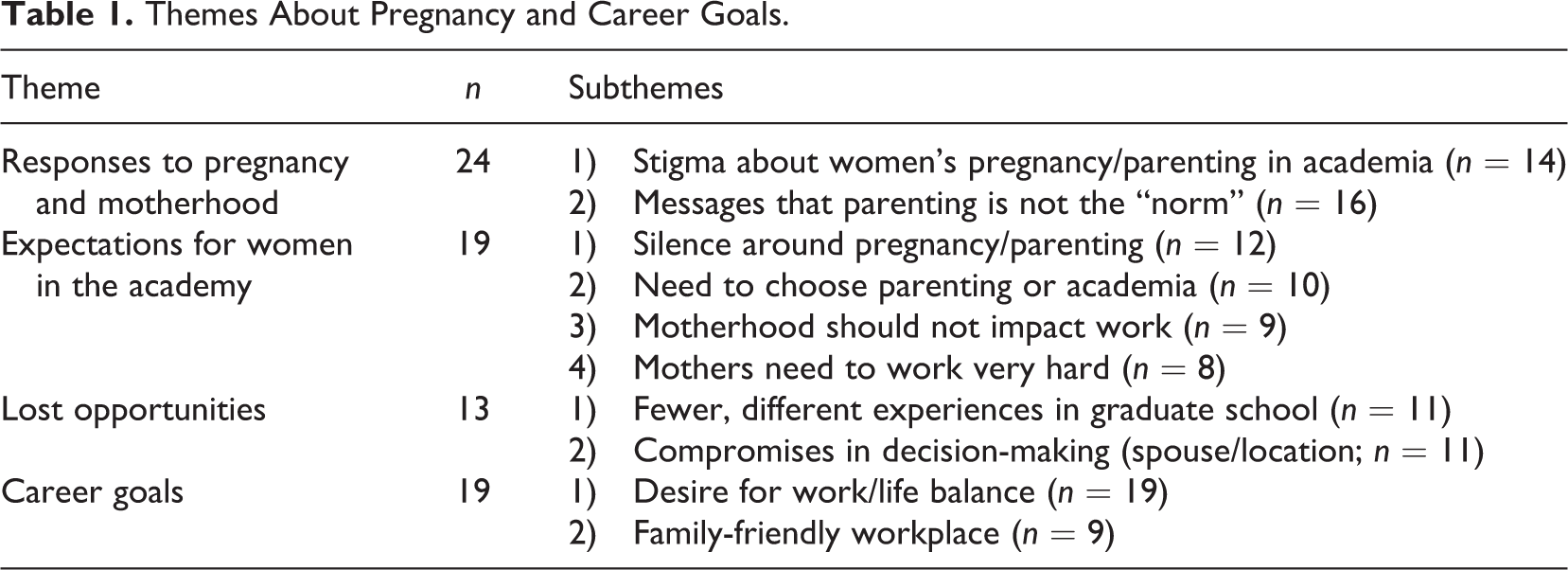
Across disciplines, participants described the specific responses to their pregnancies (n = 24) and expectations around women in academia (n = 19) in similar ways. Some participants (n = 13) described lost opportunities due to pregnancy and parenting, such as missed professional development opportunities like teaching and publishing, or limitations in the postdoctoral program positions. For many (n = 19), these perceived ideas and assumptions about motherhood and academia impacted their career goals (n = 19; see Table 1).
Themes About Pregnancy and Career Goals.
Responses to Pregnancy and Motherhood
The majority of participants (n = 24) provided examples of how peer, faculty, and administrators’ responses to participants’ pregnancies taught them about perceptions and beliefs around motherhood in academia. These responses occurred in various settings including classes, advising, dissertation committee meetings, and informal conversations. Participants perceived a stigma around pregnancy and/or parenting in academia and received the message that pregnancy and parenting is not the typical experience for doctoral students.
Some participants (n = 14) experienced negative feedback from their program, advisor, or chair when they announced their pregnancy or decreased their workload after having a baby. One mother of two described the strong message that she should not be pregnant: …[I] got a tremendous amount of backlash from the administration, from the program director…that my priorities weren’t intact…that…this [pregnancy] may not have been the best course of action…the message was that…my professional training should have come well before—and without question before any kind of family development. They tried to withdraw my funding for my third year…thinking that I wasn’t pulling my weight. So there was definitely this attitude of, “Well, you may have rocked out the first year, but you fell down the second year and so our investment in you has been not worth it.” (mother of two)
Many participants (n = 16) explained being the first and/or only woman in their cohort to have a child, which created a sense of separation from their peers and the “typical” trajectory of a doctoral student. One participant portrayed this sense of difference from her doctoral peers: One of the things that parenthood in general did to me as a doctoral student is it really took me out of my cohort…I didn’t do all the group bonding things that people do because I had to go home…when people went out for drinks after classes or would go hang out and do all these things…I never did all of that because I had a child at home…I didn’t have close friends…I had a few friends, people I had as officemates and stuff like that. But, for the most part, I didn’t hang out with people. (mother of three)
Expectations for Women in the Academy
Many participants (n = 19) described implicit and explicit messages about expectations for women in the academy. One expectation (n = 12) was that women should be silent about pregnancies, children, or struggles with work life balance. One participant described her understanding of this message of silence: From some of the faculty, there was the sense that you couldn’t be a dedicated academic if you had children and family in your lives…There was this general culture…if you’re really an academic, you shouldn’t be doing that, but if you are, then we don’t need to know about it. We need to know about your being here and being dedicated and that shouldn’t interfere. (mother of three) You have this whole group of people, clearly many of them are partnered, many of them are of reproductive age. This is like the elephant in the room. Why is no one talking about it? Because even the men, their wives were getting pregnant. So why is nobody talking about this? And yet we didn’t. All of a sudden somebody breaks down in class or shows up for orientation like, pregnant…So it just seems like this really obvious thing to talk about and yet we don’t.
Participants described their understanding of expectations about motherhood in the academy including the understanding that a balance between work and family responsibilities was difficult to achieve. Participants (n = 10) heard messages that women may have to “choose” between children and academic success. One participant highlighted her struggle with this idea: Academia being such a male-dominated environment, and…because of that, women feel like they have more to prove and that they have to make a choice between their career and family. I feel like myself and a couple of my other friends who…have kids, are saying, “We can have both. And that has to be a possibility.” But I think we’re still getting a lot of backlash from the women who disagree…I think that you either make one choice or the other. I think that’s…little bit of what I’ve seen with my chair…and some of the other women that are in the department that did one or the other and it’s impossible to have both. And I disagree. (mother of twins) Even the male professors I had who were incredibly supportive and there were some, they have wives at home taking care of the kids so they were like…“Yes, but academia is an ideal place to have a child because you can have a fairly flexible schedule.” and I was like, “You have a wife at home taking care of the children…. I’m glad you enjoy your flexibility so maybe once in while you can get to a soccer game. My husband doesn’t have any flexibility and he has to be at work every day ‘cause we need this money and so I don’t have that flexibility.” (Mother of two) I think regardless of how supportive your…faculty is…You still feel a little bit of pressure to kind of separate your academic life from your personal life. And so, it’s like while you’re there [at work] it’s all business. (Mother of two) I also think that women who do have children in their doctoral program have this idea that they have to work like ten times harder. I always feel…when I’m at work, I have to be insanely productive, and if I’m not insanely productive, then somehow the whole day was just a waste, like I shouldn’t have even gotten out of bed. (mother of one) I get a feeling from [female faculty] that you shouldn’t talk about this too much. It shouldn’t be too much a part of your professional identity when you’re presenting yourself. I think in general there’s a sense that…we totally support you having kids, but maybe that shouldn’t be a huge piece of your professional identity when you’re presenting yourself at interviews or in different settings.
These expectations for women in the academy extend beyond the rigor of becoming a competitive scholar and include a requirement that they minimize the impact of pregnancy and children on their work, even as doctoral students.
Lost Opportunities
Some participants (n = 13) described lost opportunities in graduate school and/or on the job market due to the responsibilities and demands of their pregnancies and parenting. Some participants (n = 5) reported they had missed occasions for professional development, either because it was not offered to them or because they had chosen not to take advantage such as teaching, professional conferences, mentorships, and research projects. This mother of two discussed how the responsibilities of parenting had limited her opportunities: When I initially considered entering a doctoral program, I thought, “I’ll try to get a grad assistantship somewhere and get a lot of teaching experience,” and I have not done that. Other than get a little bit here and there, I haven’t gotten the traditional graduate student experience that would allow me to be more ready for an academic job…And I think that certainly was affected by having a baby…because I wanted to make sure I still had a salary and maternity leave…[My peers] were more privileged to be free to take grad assistantships and not worry about living in student housing or those kinds of things. They were able to live a more traditional graduate student life than I was. There was a lot of mentoring going on. I know that my chair had another woman that she was working with, a young woman, and she was mentoring her to go and do a post doc…But no one ever talked to me about any of those things. I think that they were surprised that I did go on the job market as quickly…and I presented at [a premiere research conference in the field]. And, I think they were a little surprised that that sort of worked out for me. I think…they knew that I…had this whole other life…I think in their minds sort of getting in the way of my doing something like that.
Some participants (n = 11) felt they had lost job opportunities because of the need to balance career and family needs, such as ruling out jobs based on geographical location, wanting to remain close to extended family or a spouse’s job. Others searched for academic positions with institutional supports for faculty with family. One participant described how she balanced the needs of her young child and family with her career needs as she embarked on a national job search for a tenure-track position, highlighting the personal and professional compromise that was necessary: We needed to pick a place that was going to be good for our family and good for my son in addition to good for me…I think that really impacted the kinds of schools I was willing to consider in terms of the final decision…I interviewed at…an awesome school, an awesome position.…and really great faculty and a really nice area but…we ended up deciding because it’s just too far…we’d have to move [my son] across the country, away from all of his family…and it wouldn’t have worked. It would have been a great opportunity for me, but not so good for the rest of my family. (Mother of one)
Career Goals
The majority of participants (n = 19) reported that their experiences with pregnancy and/or parenting within their doctoral program impacted their career goals because they were searching for positions at family-friendly programs which would allow them to achieve a balance between academic demands and family responsibilities. For some, this desire for balance meant their original career goals were no longer feasible. One participant described a shift in the type of academic position she wanted after having three children: If I didn’t have children I’d be looking at doing like a Research 1 school or focusing on…a really prestigious university. Once I had kids I was like…I want to maintain this work life balance and have time with the kids and also have my career at the same time. I want some place that values me as a person and…honestly, it was a conversation that I had with [faculty member] during my campus visit. She was like, “…they want to hear about you and your children and it’s a place that values family”…That was the only place I have ever heard that. Ever. And so, I really, really, really struggled with that because…where am I going to fit that I am not going to go crazy, where I can balance being a mom also doing what I want to do in terms of teaching and research and that sort of thing. It was a struggle. It was a real struggle.
This search for balance sometimes made tenure-track positions seem unappealing. One participant, who experienced a pregnancy but not the birth of a child during graduate school, responded to the expectation for academic women to work incredibly hard by deciding not to apply for academic position: It seemed that only the most driven and energetic people could possibly manage to have kids at the same time as being a professor on the tenure track…. It didn’t seem possible for me and maybe that’s partly why I didn’t want to pursue being a professor. Maybe I would have tried it out if it seemed like an easier thing to do. But, it seemed so stressful and so…not cut-throat in that people were mean to each other, but the field seemed cut-throat and it asked so much of men and women that I didn’t see how it could easily be possible to have kids and do that.
Several participants expressed the desire for nontraditional options, such as part-time work or time off between graduate school and a tenure-track position in order to spend more time with their children after struggling to balance school and family during their doctoral programs. One participant, pregnant with her second child, described how the lack of work life balance in graduate school had made her feel an academic position was untenable, saying, We’ll see how this year [clinical internship] goes but I’m feeling kind of burnt out already. I haven’t even started working and I’m feeling kind of burnt out.…I would love to find a part-time job and I don’t see myself working full time for a little while, just because I would like to be able to focus on my family and be there for everybody. So, if I can’t find a part-time job then I think I’ll take some time off after I graduate because…it’s been so stressful with everything.
Limitations
Almost half the participants in this study are social workers, so these findings may say more about social work doctoral students than students in other types of programs. There are some significant structural differences between doctoral programs; for example, some of the health-care professions like clinical psychology require a full-year clinical practice internship, which impacts the type of challenges that pregnant and parenting mothers experience in those programs. While this is a limitation for readers outside of social work, for those in social work education, the findings are informative about the range of experiences that mothers have in their social work doctoral programs.
This study only reflects the experiences of women who have remained enrolled in their doctoral programs postpregnancy or successfully completed their doctorate and the voices of women who have left their program are not represented. In addition, it is possible that other aspects of participants’ narratives may be missing or altered slightly. Although participants did not express any concern about how their responses might reflect on their program or impact their standing in their program, even with reassurances about confidentiality some participants might have had these concerns and left out some details from their responses.
While the findings explore the ways that intersecting identities of mother, doctoral student, and health-care professional impacted participants’ experiences and their thoughts on their career trajectory, very few women of color participated in this study. The findings primarily reflect the experiences of white female doctoral students. As the participants were very similar in age and all married, it is critical that future research begins to explore the experiences of health-care professional doctoral students of color, those who are single mothers, and those who are older or younger mothers. Those intersecting identities will likely shape their experiences differently than those participants in this study.
Discussion
Participants described receiving implicit and explicit messages about mothering in academia during their doctoral programs. Some described stigma around mothers in academia and negative assumptions about women’s capabilities and commitment to academia once they had children, supporting previous research that suggests these ideas have lingered in academia (Armenti, 2004; Brus, 2006; Kmec, 2013; Mason & Goulden, 2004; Mason et al., 2013; Trepal et al., 2014) while others encountered messages stating motherhood should come second to academia and students should not emphasize motherhood and family, talk about it, or let it interfere with their work. Some researchers have suggested academia has become more welcoming to pregnant and parenting women (Mason, Goulden & Frasch 2009; Trepal et al., 2014; Wolf-Wendel & Ward, 2015), and certainly, many of the participants were able to be successful while juggling doctoral program requirements and parenting responsibilities but many participants still perceived motherhood as an atypical experience for doctoral students. Across disciplines, participants described an implicit culture in which pregnancy and/or parenting is not the “norm” for doctoral students and their need to work harder to ensure—and prove to others—that parenting responsibilities will not interfere with academic success.
Acker and Armenti (2004) have described a shift in the discourse around motherhood in academia. Female academics who obtained tenure a generation ago focused on structural supports for female faculty (e.g., maternity leave, childcare) and prioritized the timing of pregnancies to limit the interference with their work (i.e., “May babies”). Many of these women are now role models for current and recently graduated doctoral students, like the participants in this study. They may advise students based on their own experiences, which may not be a good fit with current students’ experiences. They may have chosen not to have children, which may influence their advice and/or opinions on the feasibility of having families in academia. Participants in this study described both of these types of feedback from female faculty.
Acker and Armenti (2004) suggest that recent female graduates of doctoral programs have much greater access to the structural supports for which the previous generation of female academics advocated, and instead of focusing on the timing of pregnancies or ability to access leave, push back against the pressure to achieve a level of productivity which leaves them perpetually exhausted. Junior faculty mothers also still experience delays in promotion which comes from a “gendered institution” (Tower & Latimer, 2016, p. 318) like academia, where the benchmarks for success may be very difficult to achieve for those women who experience pregnancy and have family responsibilities. For example, pregnancy and small children can be barriers to conference attendance, especially when conference childcare or funding for childcare is not available (Tower & Latimer, 2016). Participants in this study recognized the intense drive, dedication, and effort required to achieve academic success and raise a family and some found academic less attractive and/or less feasible for them due to this phenomenon. Once this decision is made, women may find it very difficult to reenter academia. The lack flexibility of the academic trajectory may contribute to the low rates of diversity in faculty (Mason et al., 2013).
The participants in this study described receiving clear messages that their dual identities as mother and academic were not valued within the academic setting. Instead, they described a culture of silence around pregnancy and parenting which reflects the implicit expectations of a clear division between work and family lives, echoing previous findings on this topic (Leonard & Malina, 1994; Young & Wright, 2001). As one participant described, pregnancy was “the elephant in the room” in her predominately female doctoral program, a topic which was not discussed. Unlike previous generations of female academics, who demanded structural supports so that they could be successful within this system (Acker & Armenti, 2004), many participants in this study were unhappy or uneasy with these expectations, and instead wanted to change the organizational climate so that both aspects of their identities were recognized. Participants described the desire to have programs and faculty celebrate their growing families with them while supporting their development into successful scholars; in other words, to see them and value them as scholars and mothers together versus needing to choose between the two identities.
The participants in this study observed female faculty and heard implicit and explicit messages about parenting and academia, which, for many, influenced their decision-making about their career. Overall, many participants, especially those who did not feel their programs recognized or valued their identity as a parent, seemed unsatisfied or unsettled with their experiences in their programs as doctoral student mothers. For some, these feelings influenced their decision-making about their postgraduate careers. They searched for “family-friendly” program, which valued families and had productivity expectations which would allow them to meet their family responsibilities. Some decided not to remain in academia. In this study, five (18%) participants chose practice positions versus academic positions. While precise statistics with which to compare this number are not available, within social work, the largest field represented in this study, only 7% of doctoral graduates take private clinical practice positions (CSWE, 2015).
Some participants believed they had missed out on important academic opportunities due to having children during their doctoral program. This finding suggests that the cumulative disadvantages that academic mothers sometimes experience (Acker & Armenti, 2004) can begin in doctoral programs. While one missed opportunity, such as the loss of a teaching opportunity one semester, a missed mentorship opportunity or the inability to attend a conference, might have a small impact on a woman’s career long-term, over time these lost opportunities add up and create a larger, cumulative effect (Acker & Armenti, 2004). A few participants felt they were less qualified for tenure-track positions because of these missed opportunities.
Implications
Social work education programs can use the findings of this study to consider their own doctoral programs and pregnant and parenting doctoral students are supported. This support can be structural, such as funding for childcare so that a doctoral student can attend a professional conference, or it can be a cultural and/or climate shift in the program. Participants in this study wanted to be valued for their identities as doctoral student mothers not just as doctoral students. Mallinger et al. (2017) identify the fluidity and malleability of the climate of a program, which can be easily changed and manipulated by senior faculty and administrators in positions of power in the program. Changing the climate in doctoral programs, so that female faculty and doctoral students alike are valued for their identities as parents will benefit both doctoral students and faculty. This would also make it easier for both faculty members and doctoral students to take advantage of structural benefits versus being concerned that using them might jeopardize their trajectory within the program (Khadjooi et al., 2012; Lynch, 2008). Along with encouraging the use of structural supports, acknowledging and valuing parenthood allows women to be able to openly discuss the challenges and pleasures of parenting in academia, without feeling pressure to hide this aspect of their identities. The first step toward making these changes would be for senior faculty and administrators to consider the organizational climate of their own program, and its assumptions and implicit messages about mothers in academia.
Academic programs, including those in social work education, can actively recruit mothers by explicitly addressing and discussing work life balance. This includes not just highlighting formal family-friendly policies, such as tenure clock stoppage, part-time tenure-track positions, and family leave (Quinn, Lange, & Olswang, 2004) but also explicitly talking about work life balance, children, and families during the interview process. While programs cannot ask applicants about their own children, they can open the door to these conversations, sharing important information about the program culture toward families, and, in talking about families, send the message that the program values its employees’ personal lives as well as their professional lives. In this study, one participant described her relief when, during a campus visit, a faculty member described how welcoming the program was to mothers. Silence about motherhood during the interview process can be challenging and anxiety provoking for women who are searching for a program which will value their dual identities as mother and academic. Programs will then benefit from a more diverse faculty who can role model the balance of work and family responsibilities to their undergraduate, graduate, and doctoral students. While previous research has shown that family needs for time and energy are one of the primary reasons women leave academic positions (Armenti, 2004), these findings suggest that an understanding of these issues also prevents women from applying for and entering these positions.
Conclusion
While doctoral student mothers in this study demonstrated their ability to be successful in health care–related doctoral programs while parenting, the study participants described implicit and explicit messages about their intersecting identities of mother and academic, even in these female dominated fields. This occurred even within social work doctoral programs, although social work as a field has embraced feminist, empowerment, and strengths-based perspectives and these perspectives are taught in many social work classrooms.
These experiences demonstrated to participants that only their identity as an academic is recognized in many academic settings and that success as an academic mother requires dedication and significant effort. These experiences informed participants’ decision-making about future career trajectories as many are unsettled by these implicit and explicit messages and search for a position—either academic or nonacademic—where the organizational climate values family. This is to the detriment of academic programs, especially research intensive programs, who lose the opportunity to hire many doctoral student mothers. Academic institutions lose important diversity when mothers are not present on undergraduate faculties, in graduate programs, and in training doctoral-level scholars in health-care fields as mothers provide a diversity of perspective, experience, and ability to role model success that is missing without their presence on campus.
Footnotes
Declaration of Conflicting Interests
The author(s) declared no potential conflicts of interest with respect to the research, authorship, and/or publication of this article.
Funding
The author(s) received no financial support for the research, authorship, and/or publication of this article.