




Abstract
In this article, we analyze the importance of the face as the expression of stigma for incarcerated women. Using a methodological model of body mapping, we carried out a qualitative analysis from an intertextual perspective on self-portraits. A specific case study was selected: an imprisoned Andean woman (named Satu for the purpose of this research) serving a 10-year sentence in a Chilean prison for drug trafficking. Among the most relevant conclusions, is the expression of the good/evil dichotomy recorded as the manifestation of bitterness and guilt in a moral and institutional penalty system that doubly punishes women offenders, particularly at two levels: a symbolic and imaginary one because of their involvement in criminal activity dominated by males, and the second a real one that strips away their natural right to function in their maternal role, producing extreme guilt.
Keywords
Introduction
This article presents the narration that Satu (an Andean woman serving a 10-year sentence) constructs of her face and describes what she represents regarding her imprisonment experience in a jail in northern Chile. The face is understood as a visible, unique, and valuable part of a human being. We chose to focus on the face of a specific woman through her self-portrait, by using corporeal mapping analysis. Firstly because her face represents the cultural amalgamation of the northern Chilean population: Aymara, Atacameño, and Andean-European mestizos, and secondly, through the face mask of this woman, understood as a stereotyped cover, we can understand feminine suffering marked by guilt, coming from religious beliefs and the sense of having failed her maternal duty—culturally and personally.
The Concept of a Face Mask
When we refer to the notion of mask, it is understood as that which conceals part of the singularity and contemplates the face as a stereotype, something interchangeable, erasable, and replaceable. In that sense, Aumont (1992, p. 58) states, “The mask tends to produce a contracted typology, social, differentiable, communicative or symbolic, which makes the perception of the individual, innate, personal, expressive, projective and empathic face difficult.” In the analysis of the face, we are able to focus—with more clarity—on the intensity of living imprisoned, by understanding the face in its uniqueness, and not only through the mask.
To see other people in their social mask is a common phenomenon, but to see only the social mask or its stereotype, regardless of the unique, personal face is the root of all racist, classist, sexist, and ethnocentric attitudes. To look at a person and see his or her crimes, ethnic origin, dark skin, or sexual orientation instead of his or her individual face fosters discrimination and social violence and places tension on social interactions. In different societies and cultures, the face and sexual attributes are the most important parts of the body. They are the poles of one’s personal identity and feelings. In this manner, “the face appears as a capital of the body, a subtle hierophany, whose loss (disfiguration) frequently deprives all reason of living, deeply frustrating the sense of identity” (Le Breton, 2003, p. 141).
Levinas (1961) uses a critical position to observe the individual and unique face and a type of generic face. Therefore, we need to be aware of the powerful classificatory and conceptualizing ideas that describe the face. Thus, as reported, we generally see faces as masks, hidden and disfigured by cultural norms, and the prejudice and stereotypes that become ideological guidelines to classify others. These are ways to hide the face, while the real face according to Levinas (1961)—the one that “expresses and signifies itself” and “visits us”—would be naked. The author intends to conceive the face of others as infinite and something with an irreducible uniqueness. The face is as a stage where the soul is revealed and embodied and helps to guide who studies it. Le Bretón (2011) mentions that the face is positioned as the key holder of the soul, of the truth, written in an unclear language that believes it is safe behind its features, appearances, or masks.
From the ancient Greeks (who did not discern between face and mask) comes the term prosopon (what we see), and it is possible to access the concept of appearance (mask). The face, then, is revealed as lateral mirrors of others, of those similar, where one sees and perceives himself or herself with a convinced identity, which facilitates the feeling of belonging. From this perspective, the prosopon mask would be the same as the prosopon face: what is presented for others to view. Furthermore, the face is the nakedness that precedes the covered body.
The Face of Stigma
Goffman (1987) defined the concept of stigma as an attribute that strongly discredits. However, it is important to take into account relationships, given that an attribute—depending on the context—that stigmatizes one type of possessor can confirm the normality of the other. Stigma has a dual perspective: the discredited, whose disabilities are known or noticeable in the act (signals throughout the body, disability, or any type of deficiency) and those whose discredibility and differences are unknown or hard to perceive. Goffman proposes two types of stigma—physical deformities and deviation in personal traits seen as unwillingness, uncontrolled passions, dishonesty, among others—vulnerable to be transmitted by inheritance and contaminate family members.
Following Goffman (2008), stigmatization is the discredit of a person in a social context. Both stigmatized individuals, as well the rest of the society, share the idea that the former has an attribute (or brand) that distinguishes them from the rest but also causes them to be undervalued at the same time. According to Major and O’Brien (2005, p. 395), the attributes of stigma indicate that the stigmatized (a) are unreliable partners in social exchange, (b) carry an infectious disease, or (c) are members of a group that can be exploited for the benefit of the dominant group. Similarly, Goffman (2008) explained that companies commonly construct a theory of stigma to explain the inferiority of those who are being stigmatized, often sustained on the risk they represent to society. Members of society justify this exclusion and thus distrust certain marked or contaminated individuals (Major & O’Brien, 2005, p. 396). Moreover, stigma also operates when it is associated to value more the “whiteness” in people. This is important in a social dimension which fosters values such as status, access to power and legitimacy, and stability within a social situation and social category (Tajfel, 1984).
Women Offenders
Regarding stigmatization, women involved in criminal activities are negatively criticized, especially regarding what a normative society calls double deflection: (a) law breaking and (b) gender role violation. This double rupture positions women in a role that society mainly attributes to men. Also, from an androcentric hierarchy, women offenders are accused of taking on men’s abilities and strategies when offending. This in turn forces them to participate in a symbolically masculine universe, sharing language, gestures, movements, and territorial behavior that are unexpected in women. In the case study, the woman who was interviewed had a conjuncture of ethnic, gender, and social stigma (especially from the Chilean point of view), because she is not only a woman but also a mother, a trafficker, and Bolivian.
Considering feminism, the gap in criminal re-offense rates between men and women is articulated from the roles they occupy in society and their different worlds within the social structure (Rodríguez, 2009). Studies related to female crime sustain that prison for women is doubly stigmatizing and painful, considering that the effect of being incarcerated for each woman is different; moreover, most of these women are self-supporting, single mothers (Antony, 2007; Bastick & Townhead, 2008; Quidel, 2007). To be a woman and in prison goes beyond just being a criminal, “a woman in prison […] is acting against her responsibility as wife and mother, submissive, dependent and docile” (Quidel, 2007, p. 8). From this point of view, Simon says “Feminine crimes start with subjective changes: women abandon their passivity to become more attentive and aggressive or as the result of greater access to the labor market and public space, where crime takes place” (1975, p. 10).
In Latin America, the main reason for women in prison is involvement in drug trafficking. In these countries, compared to developed countries, women’s participation in drug trafficking is based mostly on economic reasons and not consumption, since only some consume drugs (Azaola & Yacamán, 1996; Salazar, 2008). A percentage of women are known for participating in large drug trafficking organizations, however, their role is secondary.
In this sense, we were concerned about feminine imprisonment, given that it is lived not only as a lack of personal liberty but also as a process that modifies substantial aspects of their affective, psychic, and sexual life. Principally, because the majority of inmates are the caretakers and sole support for their families. This is different from male incarceration, given that they usually are not the principal caregivers for their children (Lagarde, 2001, 2006).
This period of emotional change is marked by the lack of reinsertion programs in the Chilean prison system. Furthermore, the experiences related by this study place an even greater urgency to create prison systems that encourage autonomy and empowerment of women, and such programs are mentioned recently by Scheuler, Diouf, Nevels, and Hughes (2014).
Characterization of the Study Context
From the beginning, the configuration of the Great Chilean North was built as a border convergence with deep sociocultural roots associated with native people of the region: Aymara, Quechua, and Atacameño among others (Murra, 2002). Nowadays, estimates by the Ministry of the Interior regarding foreigners demonstrate that the total regional population is 6.66%, the highest nationally, followed by Arica and Parinacota with 6.10% (Gobierno de Chile, 2010). Moreover, the 2006 National Socioeconomic Characterization survey established that 25% of the Bolivian population in Chile live in Tarapaca, 23% in Arica and Parinacota, and 31% in Antofagasta (Corder & Ruiz Tagle, 2013).
In this sociocultural and multicultural stage—the Great Chilean North—Do the Andean and European beliefs and practices merge? A mixture of culture across the entire territory and models of masculinity and femininity have expanded over ancestral generations. These models were linked to the purpose of accepting socialization, breeding and education with traditions, and historical stereotypes of ethnic and gender segregation. It is a culture—dominated by family provision—in which men are paid for work, and women are mothers and wives (Lagarde, 2006; Spivak, 2010). These models even with current transformations, in terms of rights and citizenship, are fed with imaginaries that exist since the period of the Pacific War (Salazar & Pinto, 2002; Sergio González, 2006), articulating symbolic elements and practices of the different coexisting cultures.
Studies on gender relations in the Andean space center on complementary or subordinate relations (equal or hierarchical; Carrasco, 2007). In addition, all the symbolism of experiences, space, and objects of the surrounding world are commonly represented. Relationality and reciprocity 1 are linked to the socialization and breeding from the beginning of life. These cultural categories are represented by traditional and religious ceremonies (baptism, marriage, birth, etc.) physically expressed through rites (Arnold, Yapita, & Elvira, 2008; Morales, Araya, & Silva, 2013). Thus, we can understand what implications exist between the symbolism, emotions, and practices located in the Andean worldview. This worldview is “a portrait which means that things are in its pure effectiveness; this is the understanding of nature, of people, and society. The worldview contains the most general ideas of order of those people” (Geertz, 1987, p. 118).
The “European” models, due to the features that the Anglo-Saxon culture and saltpeter business owners have imposed on the region, displaced the indigenous identity models in northern Chile. This re-elaboration was built against “Andean Indian” and “Afro-Latinos” (Tijoux, 2013), and it generated processes of segregation with a political, scientific, and academic ideal, in which Europe was associated with white racial connotations of superiority.
While the original people of Chile are praised as mythical heroes in historical events, the permanent and ongoing indigenous resistance in southern Chile has increased the tension between “whites” and “nonwhites.” That is, the latter being men and women with dark faces, larger heads with prominent cheekbones, thick bodies, and short legs, in contrast to the taller, longer legged image that represents the “white” civilization (Portocarrero, 2013). Corporal aesthetics, beliefs, and traditions are in constant tension and are manifest in the disdain for Andean cultures or Afro-Latino people (Silva & Lufin, 2013).
Starting from the reflection about these problems, we aim to answer the following question: How is institutional moral order inscribed onto the expression of an imprisoned Andean female face? In order to answer this, we explored the potential that corporeal maps methodology possesses to carry out antistigma interventions of social workers. Following Campbell and Gibbs (2009), these interventions are performed in order to improve the life circumstances of disempowered women, through building more positive social identities and increasing women’s agency. Through the construction of body maps, positive attitudes of identity can be developed as well as an increasing women’s agency. This practice is exemplified through the analysis of Satu’s case, a woman incarcerated for drug trafficking. This felony is highly stigmatized, in multiple overlapping symbolic representations, such as the condition of poor woman, having an ethnic background, her involvement in a felony, all of them are normative faults that underscore her lack of power.
This model offers diverse strategies to social work, such as the analysis of the face as the first presentation of the social subject with its relational environment, which allows us to work with the strengthening of the identity process and the empowerment of vulnerable women, since it facilitates identifying weakened aspects, sufferings, and distressing processes. Used in action research, the autobiographical story, the graphic exercise, and the reflective synthesis open a window, so the social worker can share the subject’s inner world and work over those stigmatization processes.
Method
From an interpretative paradigm, a method called “body mapping” was used for this research (Devine, 2008; Gastaldo, Magalhães, Carrasco, & Davy, 2012; MacGregor, 2009; Silva, 2012; Silva, Barrientos, & Espinoza-Tapia, 2013; Silva & Méndez, 2013). This method meshes together the meaning and purpose of oneself. Similarly, corporality is expressed as a language enforced in the biography of each person. We take into consideration the biographic experiences and concerns about the sense of the body, as one of the more enigmatic and constant interrogations of our existence. Thus, this research emphasizes what Le Breton establishes as visualization, objectification, and externalization of the face itself, so that the experience is positive to encourage self-consciousness (Le Breton, 2011).
Data collection for this research was done by the psychologist and social worker at the department of study and work from the female prison of Antofagasta. A woman’s case was chosen from the group of volunteer participants of the project, who were condemned to 5 and 10 years in prison. We chose Satu because her story presents triple stigmatization: gender, class, and ethnicity. Also, she offered her work to be published and signed an informed consent. Work sessions were held from 8:30 to 10:30 in the morning in a big room equipped with tables and chairs. In Session 1, each inmate introduced herself freely. They expressed their emotions, feelings, and the concept of time and freedom according to their own experiences. Sessions 2, 3, and 4 were generally based on biographical notes, mainly developed during the workshop. In this event, writing started by identifying their childhood, youth, and latest events. In order to protect the inmate’s privacy, the notebooks were put away after each session. The main topic of Session 5 was about time and freedom related to the body and biographical prints. Session 6 focused on the body mapping structure, with significant characteristics related to their own biography. In addition, the inmates expressed sadness, anger, humor, dreams, and the emotional attachment toward family members. Sessions 7 and 8 focused on graphic art, paint, color, and forms. Sessions 9 and 10, the last two sessions, were about voluntary interpretation of their body mapping, colors, forms, and self-image. Finally, each inmate evaluated the global process among their peer group (Figure 1).
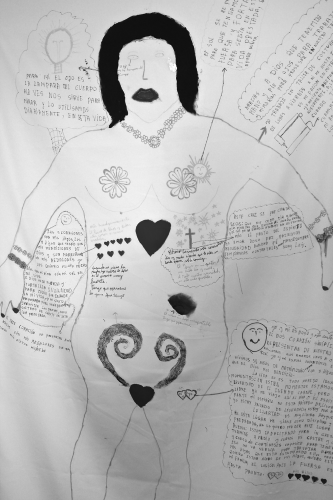
Example of Satu’s full corporeal map.
Even though the analysis focuses on the ethnic features of Satu’s face, and on her life experiences, reflected in it, we consider fundamental to use the narrative of other aspects of her corporeal map, in order to account for the intertextuality, which also reflects in the face. Thus, we exhibit the full corporeal map and, although we focus mainly on the expressions imbued in one part of the body, we can understand the full map as one territory.
Using these strategies is relevant for the social worker and psychologist, taking into account that the model offers the opportunity to work with the experience of ethnic diversity, since sharing cultural particularities that are expressed in the body allows the resignification of their place in the world and rethink, understand, and face the links that could exist with the possible life experiences of discrimination, stigma, racism, classism, and gender discrimination. In this sense, the work carried out in this prison has served as a lesson, mainly about corporeal experiences reflected in the face, and likewise these suffering and discomfort experiences are also expressed in diverse parts of the body. On this subject, Satu voluntarily offered her experience as a contribution to this work.
Intertextual Analysis
The interpretative analysis is based on three dimensions: narrative, graphic, and projective from an intertextual comprehension inspired by the work of Kristeva (1967), Derrida (1971), and Barthes (1987). They use intertextuality to describe the multiple possibilities of using language games. The text has no beginning, different routes of access, and none of them can be considered as principal.
Interpretation and analysis of the body maps from the participants, and the interviews, both in group and individually, were carried out using the following processes: (1) recognition of products with a global and symbolic value of the autobiographical process and selection of significant microtexts according to the search criteria and dimensions of study; (2) organize emergent categories from the informants; (3) elaboration and organization in articulated matrices with questions; (4) theory counterpoint; and (5) integration and systematization of microtexts and body maps together with the elaboration of a significant intertextual networks composed of colors, shapes, and icons. Figure 2 offers a graphic representation of the intertextual model (Silva & Méndez, 2013).
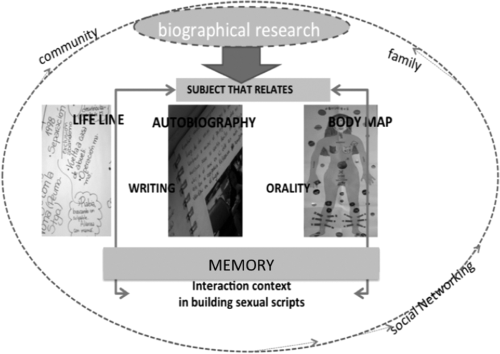
Example of an intertextual model analysis.
Results and Discussion
In this section, Satu’s face is analyzed as a case study, which includes the analysis of body mapping by Satu, a woman together with her husband and son is serving a 10-year and 1 day term in prison for drug trafficking and recidivism. Satu belongs to the lowest class of the Chilean society. She was born in Bolivia and immigrated to Chile at the age of 8 years. At the time of the study, she was 44 years and married to a Bolivian. Between the age of 16 and 26 years, Satu had five children. She had not completed high school and said she is Evangelical (Protestant).
For the intertextual analysis, we articulated autobiographical fragments, self-interpretation, and reinterpretation of the graphic expressions used to elaborate the face.
Face Lamp of the Soul
In Satu’s body map, she identifies within her face, the eyes as the “body’s lamp.” From her interpretation emerges the metaphor of the mirror of the soul. Her face says, “You see me.” What can we see from her? The hidden or shown? In ancient times, the Romans considered the face and the mask as two different realities, which could even be opposite. These two realities were given the names vultus and facies. Within time, these two words became to be used together or alone to refer to face, mask, or person. These two distinctions are mentioned, due to the power of representation that Satu’s face shows in her body map: In the face everything is significant and articulated to an emotional, discursive, and corporal positioning (Altuna, 2010; Le Bretón, 2009). Satu’s face can be seen in Figure 3.
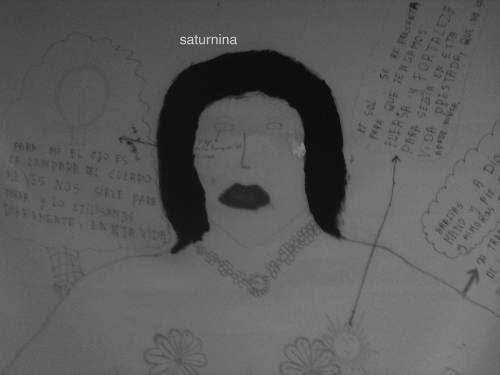
Satu’s face.
Satu is an Aymaran woman. Because of the history of violence during the Spanish conquest, Bolivian men and women still show distrust in the face for occidental whites. Satu, as a poor Aymaran woman living in Chile, has experienced a triple discrimination, due to a structural violence anchored in colonial practices within social interactions in the current Chilean context. The relevance of this study is that through Satu’s story, a reality of social injustice is underscored, one which holds through the history of the relationship between Bolivia and Chile.
From a critical perspective, we consider that living on ethnic frontiers should not create conflicts, mainly because of the history that we share as Andean countries, unless they are implemented to establish social or ethnic discrimination, as in contemporary Chile (Silva & Lufín, 2013). These data can be related to what Satu expresses in her map “eyes are made to look […] we use them in our daily life.” She draws an eye that represents a finger in position of “I am looking at you,” suggesting distrust.
Related to the given information, in the creation of the eyes, they look straight, small, and not very clear. The only part of the body without color, a simple small stroke of pen, the pupil placed on the center as a dot, shows a suspicious look understood as a revelation of her distressing emotions and distrust. The eyes also express signs of perplexity and insecurity in the face of what is to come.
Golden Tears
Satu expresses religiosity and feelings of guilt in her self-interpretation. She writes, “Jesus died for our sins,” next to the eye, and she draws a golden tear. The golden color is understood as mercy in her specific religious beliefs. In the Andean world, gold represents the blood of the Sun, and as a holy element, it never loses value. Satu’s golden tear suggests that her suffering is a valuable sacrifice and as such it can bring pride. My children suffered when I got into jail, with my husband and older son […] I had four smaller kids […] Thank God my life is going to start from zero […] I am going to be happy with my kids and grandsons, I will become a mother again. I want to take care of my children, take my little daughter to school. I am ready to do it. Time is gone and I have grown up as a person and mother. Now I am going to be patient and more tolerant. I am a humble person that is something I was missing. When I went to prison for the first time, it was painful, it was in the year 2000. In the second conviction, I spent 10 years and one day […] I abandoned my little kids, I knew the oldest could take care of them but still made me suffer every day.
The Mouth
Satu’s face highlights a big red mouth opened at the start and then faded and colored. The bitter gesture located in a large head with high cheekbones and Andean features: a short, thick neck. Her red mouth covers an important part of her face. In Andean culture, red color has a symbolic value of sacrifice, associated with bleeding and offering, which is linked to her suffering. Karsten (1930, p. 45) regarding red says, “Red cloths are offered to the Pachamama (Mother Nature), as a sign of protection against loss, and a sign of return.” In Satu’s report, this color can be understood as her desire to be recognized again by society, as somebody with the capacity to rehabilitate and as a good woman. I regret being involved in drug trafficking, because it destroys the organism and family. I did not want to abandon my children; that hurts me […]. One day I will be released, and I feel that I am ready to go back to society.
The Hair
Long, black, and combed straight hair frames her face. The long hair is understood by Machoever (1949), Knapp (1995), and Perrot (2009) as a women’s sexual and attractive characteristic. It is interesting to observe Satu’s graphical hair representation, which in comparison to her report establishes, “I am not desirous […], I am loving but not horny.” The shape and color that Satu’s face presents can be articulated with her cultural aspects. In her culture, it is important to protect sexual honor, taking special care of the way women are seen and evaluated by others. This is necessary to be respected and considered decent by the community (Morales, Araya, & Silva, 2013). From another point of view, Perrot establishes that historically: The discipline in prison becomes the discipline of the body, by controlling appearance, of which the hair is the most sensitive part […]. Also, hair loss is particularly sensitive for women […] because this is the symbolic reference to femininity. (Perrot, 2009, p. 42)
In Satu’s map, the colors of the mouth and hair are given high intensity: red and, respectively. In her map, the use of red can be analyzed as ambivalent, in terms of law enforcement, the recurring of drug trafficking and black as a negative symbol of pain and depressive thoughts, according to the chromatic interpretation of Turner (1999). These chromatic forms lead us to the ambivalence between good and evil, with which Satu seems to struggle, her religious attachment, a game between showing and hiding and speaking and keeping silent in prison.
Life as an Individual Woman in a Male Prison System
For Satu, condemned to 10 years, to be in prison means to bow down and have a docile behavior in order to survive and receive better treatment and benefits. The way of dealing with the stigma of being Bolivian and trafficking in Chilean territory has taken shelter in her maternity and religiosity. Her autobiography is in accordance with the Evangelical values, which fill gaps, guilt, and hopelessness. Moral correction based on Christianity is oriented to reinforce the role of woman/mother, which is represented as a cornerstone that holds and keeps steady the conservative and social growth of the Chilean society. This position along with obedience to other prisoner’s authority and correction officers helps her to avoid stressful situations. Likewise, Andean masks that protect Satu from revealing her identity are part of herself, maintaining a protective distance; however, she is always “watching.” In silence, she keeps the “good behavior” that consists of ironing the clothes of uniformed personnel, workers, cooks, cleaning staff, or babysitting the children of the uniformed staff, among others. At the institutional level, the guards and prison authorities know who obeys and who does not. Satu shows through her face the way she lives this experience: her red and bitter mouth and her weak eyes reveal traces of mistrust and dark emotions.
In summary, the illustration of Satu’s face offers her social mask and ethnic Andean assignment, as an individual inserted in a Chilean group society, categorized by a stereotype: a Bolivian woman offender. Nevertheless, it also offers the individual analysis of the face that represents the desire for maternity, with the valuable singularity of its emotions and thoughts. Most inmates living with Satu are mothers who consumed drugs while being free and committed all types of robbery, used different weapons, were involved in petty trafficking, and spent long weekends partying. For their criminal activities, they settled in public spaces and drifted off from the social order established to their gender. Most were household providers, associating maternity with the satisfaction of material goods of their children. Now, in prison, nostalgia is exacerbated by affection and redefines nurturing from a hegemonic gender discourse. Time that slowly passes leads them to set their emotions on the affections they consider “safe,” like their maternity and the desire to return as good mothers to their children.
Conclusion
This research aims to contribute to the complexity and stigmatized world that women in prison go through. Thus, the use of body mapping is proposed as an emancipatory perspective that facilitates understanding the pain and suffering of women in prison, with a feminist approach. By using body mapping, the social worker can recognize the suffering and socioeconomic and educative distinctions of women in prison. Moreover, through this methodology, it is possible to approach women’s own self-image, experiences, decisions, and their future expectations.
The face of Satu emerges as a privileged place for the appearance of the “other” (mother, poor, Bolivian who commits crimes in Chile). In her face, we can see the expression that lets us see the pain from exclusion and the marks from the obligations of a segregated culture.
In the emergent theoretical analysis matric (see Figure 4), a proposal of knowledge emerged from the intertextual analysis that will structure the results is shown. This theoretical analysis emerges as findings of the articulation of each element elaborated from Satu’s map, nonetheless, what we want to highlight is the pain induced by the discrimination and the classism that this woman has experienced, because of being an immigrant woman living in a Chilean prison.
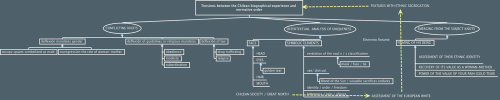
Emergent theoretical analysis matrix.
In the contemporary immigration scenario in Chile, Bolivian nationals, like Satu’s, are assigned a mark or stigma of discrimination (negative), along with social class, gender, and age. These stigmas frame the current migratory experience in the north of the county. Peruvian, Bolivian, and Colombian immigrants are the ones who suffer the most severe discrimination, because of their ethnic features that are symbolically placed as opposition to the desire for whitening among the Chilean society members. In contemporary Chile, there is a xenophobic sentiment rooted within society, linked to the desire for inclusion as a developed country, related to white Europe. This xenophobia further affects native persons, with dark skin and in social exclusion situation.
This problematization is necessary in the projects and programs of any social worker who enters these labor and intervention spaces. It is required that those in charge design inclusive policies from an intercultural perspective that contribute to reverse discriminatory practices and discourses in prison, for professionals as well as for the authorities who manage these spaces.
This study presents the limitations that a case study has referred to the possibility of presenting comparative experiences of class, race, and gender discrimination that other women, from other cultures, could live. Otherwise, focusing only on the face leaves aspects about maternal or bodily experience unlighted.
Footnotes
Declaration of Conflicting Interests
The author(s) declared no potential conflicts of interest with respect to the research, authorship, and/or publication of this article.
Funding
The author(s) received no financial support for the research, authorship, and/or publication of this article.