




Abstract
Addressing social injustice is an integral aspect to social work; however, the challenge lies in the fact that society is stratified by sociodemographic characteristics creating power and privilege for some and oppression for many. Understanding how biases that support this social structure are interrelated further elucidates the systemic nature of biases. This study examined the extent to which sexist beliefs would help explain ageism. Results indicated that benevolent sexism was associated with positive ageism, and hostile sexism helped explain negative ageism. These findings contribute to theory development on interlocking prejudices and inform pedagogical approaches that help address biases.
Introduction
Social justice issues are at the forefront of the social work profession, and its mission is to influence a social structural system that contains inherent disadvantages. Society is stratified by false dichotomizations based on sociodemographic characteristics, and this binary system creates groups (e.g., male/female), which are then associated with privilege, producing a context for valuation of one group over another. The power, resources, and rewards attributed to certain members of society are used to maintain this privileged status through the creation of social policy to support it and the reinforcement of social norms that legitimize it. This system of stratification is unified in its function of privileging some while oppressing many.
Age is one way in which people are socially stratified. Given the high priority of economics in capitalistic societies, a hierarchy of privilege is associated with chronological age whereby performance is the domain of the young (Hopkins, 1980). Older people are stereotyped as physically and mentally slow, rigid, or obsolete, and these beliefs form the basis of ageism or prejudice against older adults (Butler, 1969). The rewards associated with age stratification are the direct benefits of ageism (Calasanti, 2005). Thus, “old age does not just exacerbate other inequalities but is a social location in its own right, conferring a loss of power for all those designated ‘old’ regardless of their advantages in other hierarchies” (Calasanti, Slevin, & King, 2006, p. 17).
Gender operates in this same fashion as biological characteristics are associated with socially ascribed responsibilities and attributes, which have in turn uniformly limited or excluded women from the paid labor force. Both ageism and sexism reinforce male power and privilege, and these socially constructed statuses intersect at the microlevel to produce a double (or more) oppression that can have cumulative effects. For example, the intersection of age and gender is illustrated in the lower socioeconomic status of older women compared to older men. But this intersection is realized in other ways too. Feminist writers have long pointed out that sexism and ageism also intersect to create a double standard of aging whereby women lose social value more quickly than men (e.g., Calasanti & Slevin, 2006; Cruikshank, 2009; Sontag, 1972, 1997), and the booming antiaging industry targeted toward women reflects this double standard.
As a basic tenet of feminist theory, intersectionality informs both research and practice and elucidates the way in which social identities have meaning in relation to one another (Shields, 2008). Research, particularly quantitative methodologies, has struggled to capture intersectionality in the development of research questions, despite the use of the theoretical framework to contextualize the study (Shields, 2008). The challenge of studying intersectionality remains an important area to focus both theoretical and empirical efforts; however, attitudinal research that seeks to understand how multiple biases based on these social identities are related to one another remains relatively unstudied. If social identities are operating in such a way that multiple oppressions are created, then understanding the associations between the biases that help to propel a hierarchical system is warranted. Oppression is systemic and identity is not monolithic; thus, it seems logical that prejudice should be considered and studied in a similar way (Samuels & Ross-Sheriff, 2008). This type of research can highlight the way in which rigid adherence to a set of socially constructed ideas may be associated with multiple biases.
The current study seeks to explore this interrelationship by investigating the role of sexist beliefs in explaining age-based biases. Understanding the association between these biases among social work students can inform the curriculum and ways to address it, and feminist social work educators who seek to teach students about the lived experiences of women (Freeman, 1990) may find that the research adds another facet of that story. This article begins with an exploration of the theoretical underpinnings of ageism, including positive and negative stereotyping and terror management theory, and concludes with a review of the theoretical and empirical work focused on the association among different prejudices. These theories along with the empirical findings provide the context for the current study, and the hypotheses under investigation are detailed in the final section.
Ageisms: Positive and Negative Stereotyping of Older Adults
Ageism is often compared to other forms of biases such as racism. But ageism is actually unique, given that it is something everyone faces (Cruikshank, 2009). Age-based prejudice is rooted in stereotypes, both positive and negative (Palmore, 1999). Positive stereotypes (e.g., kind, cute, or wise) may appear to be empathetic, but they are actually paternalistic in nature and support ageist behaviors, which can be detrimental to older adults. For example, in one study, elderspeak (i.e., speaking to older people like a child) was found to cause older adults to question their ability to complete a task and lowered self-esteem (Kemper, Vandeputte, Rice, Cheung, & Gubarchuk, 1995). However, positive ageism may actually help explain time spent with older adults. In one study, it was found that when positive ageism decreased, participants were less comfortable spending time with older adults (Chonody, Webb, Ranzijn, & Bryan, 2014). Cherry and Palmore (2008) theorize that people perceive these behaviors as “courteous or thoughtful, and not ageism per se” (p. 856). Even though at face value these behaviors appear to deferential to age, they have the potential to “undermine the status and treatment of older persons in society” (Cherry & Palmore, 2008, p. 857) and support a limited view of older adulthood. However, positive ageism is not studied as often as negative ageism; thus, explanatory factors are not as clearly established.
Negative stereotypes include beliefs about cognitive decline, grumpiness, and lack of libido, just to name a few. These negative beliefs also act to homogenize older adults and can create a context for legitimization of prejudice and discrimination. But ageist beliefs are often seen as natural (Calasanti, 2005). In a study of undergraduate students’ attitudes toward sexuality in older adults, Allen and Roberto (2009) found that students were not even aware of the embedded sexist and ageist myths incorporated into their beliefs. Nonetheless, these beliefs do influence behavior. Chonody, Webb, et al. (2014) found that negative and positive ageisms were significantly correlated and helped explain comfort in spending time with older adults. Allport’s (1954) contact theory suggests that exposure to member(s) of an out-group can help improve attitudes toward that group, and past research supports its influence on ageism. Specifically, both the frequency of contact and the quality of the relationship were found to be associated with less (negative) ageism (Anderson & Wiscott, 2004; Tan, Hawkins, & Ryan, 2001).
Death anxiety may also be a contributing factor for ageism, in particular avoidance behaviors. Terror management theory (TMT) provides a foundation for its role in ageism. TMT is based on the writings of Ernest Becker (1973) who explored the precarious position that humans find themselves in terms of death—they are simultaneously aware of their mortality and yet they are driven to avoid it. The aging process itself is a reminder of death because the decline of the body is a signal that mortality is inevitable (Martens, Goldenberg, & Greenberg, 2005). In some studies, an association between aging anxiety and ageism was found (Anderson & Wiscott, 2004; Chonody & Wang, 2014). One way to suppress the knowledge is to avoid older people who are reminders of death (Martens et al., 2005). In studies where respondents were primed to think about death, ageist beliefs were stronger compared to those who were not primed (Martens et al., 2005). Thus, death anxiety appears to be a factor in ageism.
Furthermore, death anxiety can “undermine confidence in one’s ability to continually acquire self-esteem via attainment of cultural standards” (Martens et al., 2005, p. 228), but religious and cultural beliefs may act as protective factors by supplying a value system that provide meaning and order (Greenberg, Schimel, & Martens, 2002). In other words, culture provides outlets for achieving “enduring significance,” such as being a “good Christian” or “successful,” and allows us to “psychologically elevate ourselves above mere mortal animal existence” (Martens et al., 2005, p. 224). Research supports the role of meaning making and self-esteem in death anxiety (see Martens et al., 2005), and one study found that those who reported greater religiosity had less ageist attitudes (Anderson & Wiscott, 2004).
Interlocking Biases: The Prejudiced Personality
Psychological theory offers insight into the way prejudice interlocks at the cognitive level. That is, prejudices may be held against multiple minority groups due to a rigid thinking style that “others” anyone outside the norm. Thus, prejudicial thinking is not limited to a negative attitude toward one specific group but rather a way of thinking about others and the world around them (Allport, 1954). Allport (1954) refers to this as the prejudiced personality, and while the extent to which a person may have this type of personality falls along a continuum, “…prejudice is…unlikely to stand isolated from the process of cognition in general” (p. 175). This prejudiced cognition rests in a tendency toward the bifurcation of others (e.g., good/bad) and people in general (e.g., young/old). This in turn promotes a rigid adherence to an in-group/out-group type of thinking (Allport, 1954). Therefore, prejudicial thinking is not likely limited to just one group; rather, it has an interlocking nature that may be spread across many groups.
While the research in this area is not extensive, some findings do support these types of interconnections among biases. For example, an association between sexism and antigay bias (Chonody, Woodford, Brennan, & Newman, 2014) and racism and sexism (Glick & Fiske, 1996) has been found. In a study that sought to explore Allport’s theory more extensively, significant correlations were found between sexism, ageism, antigay bias, racism, classism, and religious intolerance (Aosved & Long, 2006). However, findings from one study did not support these associations. Chonody and Wang (2014) found that neither sexism nor antigay bias significantly added to the explanation of ageism. Nonetheless, a theoretical relationship appears to underlie different types of prejudices, and further examination of their association is warranted (Aosved, Long, & Voller, 2009). To this end, two hypotheses were proposed in this study. First, positive and negative ageism will have different explanatory variables. Second, sexism will significantly add to the explained variance for ageism after controlling for known correlates.
Method
Paper-and-pencil surveys were administered to students from September 2010 through December 2011. Eight universities were included, six in the United States, one in England, and one in Australia. Participants were recruited from undergraduate and graduate social work courses once approval was received from institutional review boards (or their equivalents). Attempts to recruit from many classes were made, but students were instructed to only participate once.
Measures
Cherry and Palmore’s (2008) Relating to Older People (ROPE) scale was used to measure positive and negative ageism. Items include, “I compliment old people on how well they look despite their age (positive)” and “I talk louder or slower to old people because of their age (negative).” A 6-point Likert-type scale was utilized (1 = strongly disagree to 6 = strongly agree) for the 20 scale items (6 positive and 14 negative) along with the other standardized scales, unless noted. By summing scale-specific items, a total score can be achieved, and higher scores indicate greater ageism. Cronbach’s αs were acceptable (positive α = .63 and negative α = .77).
The Ambivalent Sexism Inventory (ASI) was chosen for this study because it has two subscales—benevolent and hostile sexism (Glick & Fiske, 1997). Benevolent sexism measures positive—albeit sexist—attitudes with items such as, “A good woman should be set on a pedestal by her man.” Hostile sexism measures the negative aspects of patriarchy with items such as, “Most women fail to appreciate fully all that men do for them.” Both subscales cover aspects of paternalism (protective or dominative), beliefs about women (idealization or derogatory), and heterosexuality (intimate or hostile). These were important aspects to include in this study, given that both positive and negative ageism are under consideration, and it is hypothesized that different variables would be useful in understanding each. The ASI is a 22-item scale that is evenly divided between benevolent and hostile items, and higher scores indicate greater sexism. Cronbach’s αs were good (benevolent α = .81; hostile, α = .82).
Several variables were included to measure TMT variables. The 15-item Templer Death Anxiety Scale was utilized to measure death anxiety (Lonetto & Templer, 1983). Higher scores indicate greater anxiety. Cronbach’s α was good (α = .79). The 12-item Hope Scale (HS) measures the degree to which participants exhibit hope in terms of goal-directed determination and goal planning with items such as, “There are lots of ways around any problem” (Snyder et al., 1991). The HS was used to measure one of the protective factors of TMT in that confidence for goal attainment is one way to acquire self-esteem via cultural standards (e.g., successfulness). A 4-point Likert-type scale (1 = not true to 4 = very true) was employed, and higher scores indicate greater hope. Cronbach’s α was acceptable (α = .70). Aging anxiety and religiosity were included as facets of TMT. For aging anxiety, participants were presented with this author-created statement: “It doesn’t bother me to think about myself old.” Religious importance was measured by a single-item indicator: “How important are religious or spiritual beliefs in your life?” (1 = very important to 5 = unimportant).
To assess the role of contact theory, a series of questions were posed. First, participants were asked to rate the frequency (1 = never to 6 = very frequently) of time spent with an older adult. Next, a dichotomous item inquired whether the respondent had a personal relationship with an older adult. Finally, participants were asked to rate this relationship with a 7-point semantic differential (1 = very poor to 7 = very good). Demographic framing variables included respondents’ gender and age. Gender was reported as male or female. Age was reported in years. Social desirability was found to be a key issue in one study with participants underreporting negative ageism (Cherry, Allen, Denver, & Holland, 2013). Thus, a portion (12 items) of the Balanced Inventory of Desirable Responding (BIDR; Paulhus, 1984) scale was employed. These items were specifically designed to measure social desirability in attitudinal research and can be used without the rest of the BIDR scale. For each extreme response on the Impression Management Scale (IMS), one point is assigned with higher scores indicating more social desirability. Cronbach’s α was acceptable (α = .68).
Data Analysis
Preliminary data analyses were used to test for systematic differences in the outcome variable based on country and to determine the associations among standardized scales. To determine whether sexism played a role in explaining ageism, ordinary least squares regression was utilized. A two-step hierarchical regression was tested with positive ageism as one outcome variable and negative ageism as the other. For both variables, the analysis was the same. In Step 1, demographic variables (gender and age), contact variables (time spent with older adults and personal relationship with an older adult), and TMT variables (hope, religiosity, death anxiety, and aging anxiety) were entered. In Step 2, benevolent and hostile sexism were added.
Results
Demographics
A total of 1,042 students participated in this study. Respondents ranged in age from 18 to 64 years and were mostly from U.S. universities. The sample was predominantly comprised of female and Caucasian students. Table 1 provides additional information about the sociodemographic background of the sample.
Demographic Characteristics of the Sample.
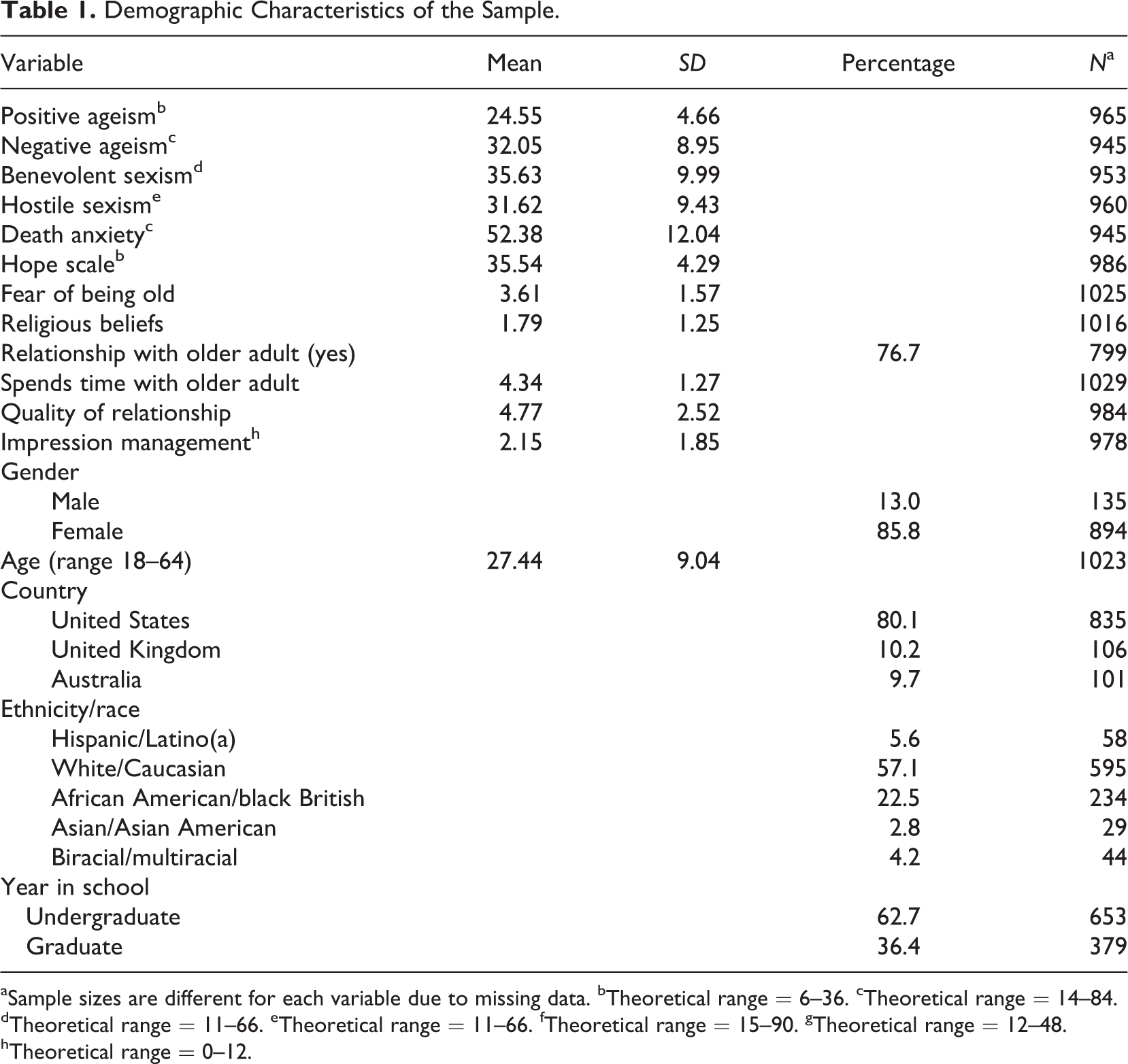
aSample sizes are different for each variable due to missing data. bTheoretical range = 6–36. cTheoretical range = 14–84. dTheoretical range = 11–66. eTheoretical range = 11–66. fTheoretical range = 15–90. gTheoretical range = 12–48. hTheoretical range = 0–12.
Preliminary Analyses
A one-way analysis of variance was conducted to determine any differences by country for the dependent variables. Results indicated that students from U.S. universities (M = 24.87, SD = 4.52) were more positively ageist than students from the English university (M = 22.50, SD = 4.88), F(2) = 11.90, p<.01; however, no statistical difference was found for negative ageism. Participants’ country was included in the regression to control for any differences.
Pearson product moment correlations were conducted for the standardized scales, including the IMS (social desirability). Although the effects sizes were small, results indicated four statistically significant relationships. Therefore, the IMS was included in the analysis to control for social desirability. Table 2 provides the coefficients.
Correlations Among Scales.
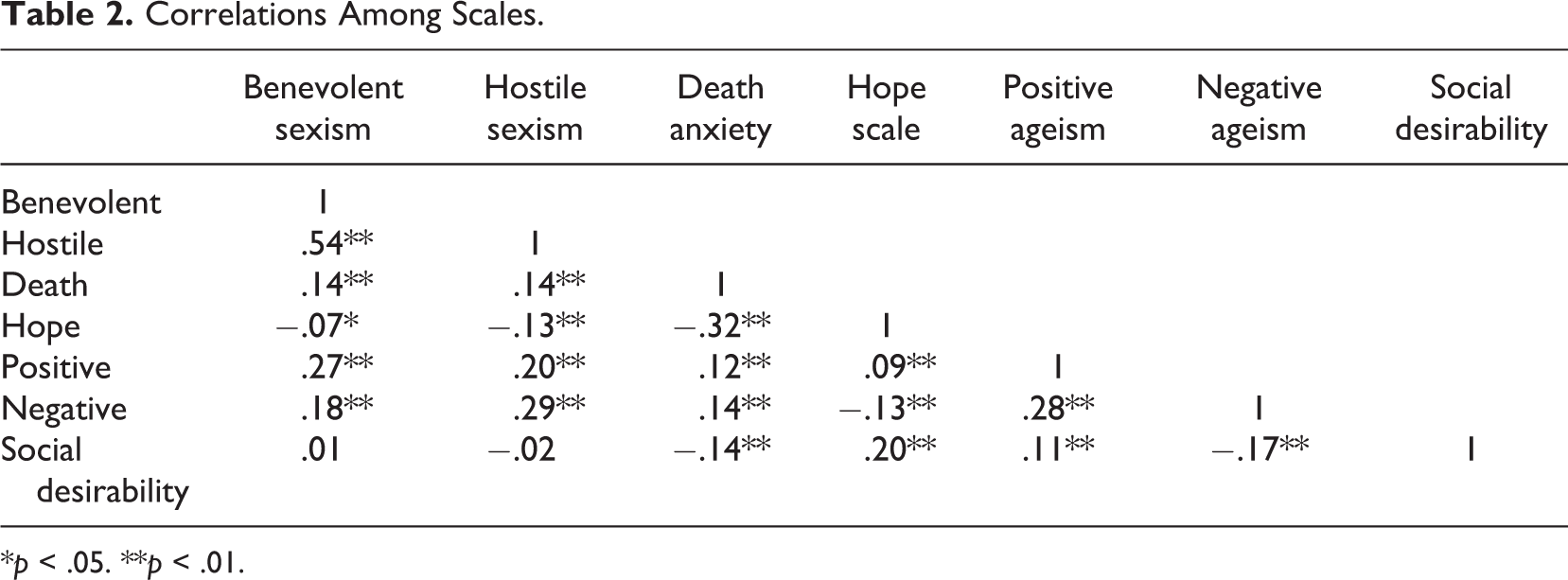
*p < .05. **p < .01.
Ageism: Multivariate Results
The final model for positive ageism had six significant variables and explained 14% of the variance. The addition of sexism variables (Step 2) significantly increased the amount of explained variance. Students from U.S. universities, those who spent less time with older adults, those who indicated a better relationship with an older adult, and participants with greater death anxiety reported more positive ageism. Also participants who held more sexist attitudes—both benevolent and hostile—exhibited greater positive ageism. Based on Cohen’s (1988) guidelines, effect sizes were small, and benevolent sexism had the largest beta weight. Full results are provided in Table 3.
Summary of OLS Regression for Positive and Negative Ageism.
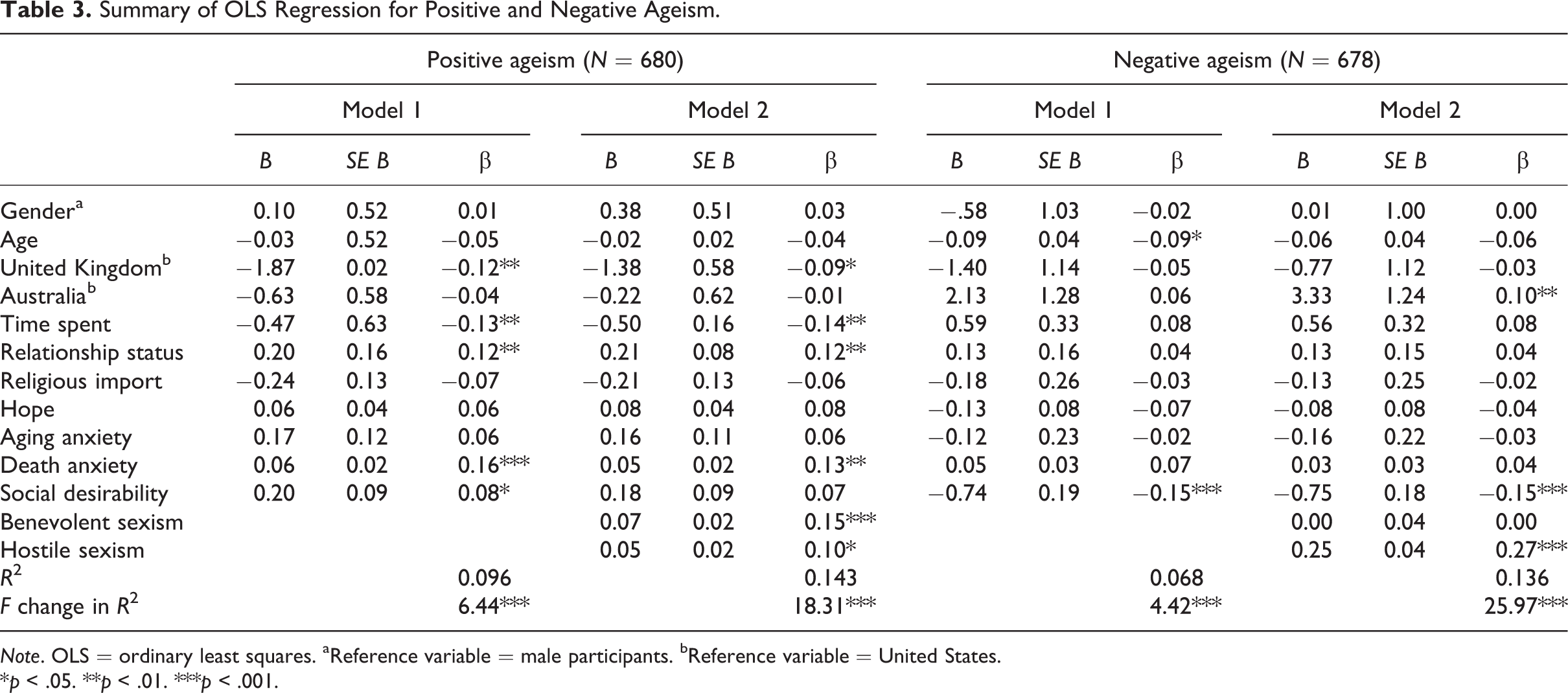
Note. OLS = ordinary least squares. aReference variable = male participants. bReference variable = United States.
*p < .05. **p < .01. ***p < .001.
In the final model for negative ageism, three variables were significant and nearly 14% of the variance was explained. Students from the Australian university and those who reported more hostile sexism reported more negative ageism. As negative ageism decreased, social desirability increased indicating some degree of underreporting. The effect size for hostile sexism was moderate, and the others were small (see Table 3).
Discussion
Moderate levels of positive ageism and sexism were found in the overall sample, but negative ageism was relatively low. Many of the items on the positive ageism scale were highly endorsed, such as “I compliment old people on how well they look despite their age.” This is consistent with the past findings where positive ageism was higher than negative ageism (Cherry & Palmore, 2008). However, these “positive” beliefs and behaviors have the potential to undermine the self-worth of older people making these results particularly salient for social work educators who hope to train students to work from a position of empowerment and strengths. Similar results were found for sexism in that benevolent sexism was endorsed slightly more than hostile sexism. Again these findings are indicative of biases that subtly suggest that women are weaker and are in need of care, which promotes dependency and adherence to traditional gender role norms.
Study hypotheses were supported. Positive and negative ageism were explained by different variables, and sexist attitudes uniquely contributed to the explanation of ageist beliefs, which is consistent with the association between ageism and sexism found in Aosved and Long’s (2006) study. For both regression models, the amount of explained variance significantly increased with the inclusion of sexism variables; however, a key difference emerged in these two models in terms of the two sexism variables. While benevolent and hostile sexism were both significant in the positive ageism analysis, benevolent sexism had a larger effect. This is of note because both benevolent sexism and positive ageism have paternalistic components highlighting an association between beliefs that women need protected and so do older people.
Similarly, hostile sexism was associated with negative ageism, which also overlap in sentiment in that items on these scales contain negative stereotypes. Perhaps a shared cognitive style is uniquely associated with paternalism and hostility as directed toward different groups. In other words, individuals may have a tendency toward hositility or paternalism, particularly if it is consistent with cultural beliefs and social norms. To the author’s knowledge, this is the first study to look at these two different aspects of ageism and sexism and to explore their associations. Future research should seek to replicate these findings to determine how these associations may be relevant among a community sample and untangle the way these types of thinking may be related to one another.
Surprisingly, no gender differences were found for either positive ageism or negative ageism. Gender is often found to play a role in studies of ageism with men expressing greater negative ageism (Gellis, Sherman, & Lawrance, 2003) and women indicating more positive ageism (Cherry & Palmore, 2008). It should be noted that the number of men in the sample was small (n = 135) and were drawn from a liberal discipline, and this likely contributes to these results. Similarly, TMT variables were not significant with the exception of death anxiety for positive ageism. Based on theory (Martens et al., 2005), it was expected that death anxiety would also be associated with negative ageism; however, underreporting of negative ageism, which was also found in another study (Cherry et al., 2013), may play a role in these findings. Relatedly, contact with older adults was only significant for positive ageism, but in past studies (e.g., Tan et al., 2001), it has been found to help explain negative ageism. Further research with the ROPE and other scales that measure ageism may shed light on how different aspects of attitudes (e.g., emotional, cognitive, and behavioral) are related to these theoretical and sociodemographic variables.
Limitations
The findings from this study should be viewed within the context of study limitations. First, a student sample limits generalizability, as does the fact that it was a convenience sample; however, the sample was drawn from international social work programs, and participants were diverse in nature. Second, only a small proportion of the variance was explained, which indicates that other variables relevant to ageism were not included. Third, while the standardized scales had acceptable to good Cronbach’s αs in this study (.7 to .8; Kline, 2005), one scale (positive ageism) fell below this range (.63), which indicates that its reliability for this sample may be problematic. Relatedly, several author-created items were included, and these single-item indicators have not undergone psychometric testing.
Implications
This study provides additional support for Allport’s (1954) cognitive model of prejudicial thinking, and understanding the link between ageism and sexism is important, as it helps further elucidate the systemic nature of biased beliefs. Expansion of Allport’s (and others) theoretical and empirical work supports the idea that addressing just one element of prejudicial thinking (e.g., sexism) may not resolve biases toward other groups (e.g., ageism) because the underlying belief system or style of thinking supports a worldview that separates people based on finite group membership. But the link between paternalistic beliefs for ageism and sexism as well as the pattern for hostile sentiments is particularly noteworthy, given that this may help account for a specific aspect of prejudicial worldviews. These components of prejudice should be investigated for other groups to determine whether similar patterns emerge. For example, sexism has been linked to antigay bias (e.g., Chonody, Woodford, et al., 2014), but does paternalism and hostility play a similar role in these associated biases? Studying how paternalism and hositility impact attitudes and behaviors across groups adds to the substantive literature and facilitates opportunities to address specific types of prejudicial thinking.
Research indicates that perspective taking and building empathy help to reduce biases through intergroup contact (e.g., Pettigrew & Tropp, 2006). Perhaps if this can be accomplished across different types of group membership (e.g., gender, age, and race), then the underlying (prejudiced) cognitive style will begin to shift and broaden to include a more nuanced perspective of the world. Future research should seek to test this theory, and Intergroup Dialogue (IGD) may provide an avenue for such an investigation. IGD organizes participants of different positions of privilege and oppression so that these hierarchies can be explored (Dessel, Rogge, & Garlington, 2006) and can be used to process difficult emotions, which creates a context that promotes positive dialogue and experience (Khuri, 2004). Further deconstruction of identities across membership could contribute to the blurring of in-group/out-group thinking.
Investigating the association between biases is also important to social work, which is charged with addressing social injustice, including within the curriculum (Council on Social Work Education, 2014). These results advance knowledge that can be utilized in social work education. First, understanding the association between ageism and sexism as well as other oppressions may help educators create pedagogical strategies to address these issues. The use of IGD may be one avenue, but other approaches have evidence to support their use, such as analyzing sketches of older people (Barrett & Pai, 2008), or journaling in response to reflexive questions after watching a topic-specific film (Allen & Roberto, 2009). Through such activities, students may come to appreciate the relationship between sexist and ageist beliefs and how those belief systems impact the self and others at the micro-, mezzo-, and macro levels.
Second, these results are consistent with feminist perspectives that seek to elucidate intersectionality and the impact of oppression (Samuels & Ross-Sheriff, 2008). For example, the results of this study may be used to further the dialogue regarding paternalism. Students and practitioners may be approaching clients from this perspective, which can be detrimental to their self-esteem. If older women are considered from this paternalistic perspective, then the approach to treatment planning may be too focused on dependency issues. In other words, if subtle ageist and sexist beliefs that promote the idea that women and older people are in need of additional care and protection are espoused by practitioners, then empowerment strategies that seek to sustain independence may be overlooked. Future research should seek to investigate the practice theories and approaches utilized by social workers that have clients who are older adults to determine whether their frameworks are promoting strengths. Moreover, it is likely that social work education could incorporate more feminist theory into the curriculum and direct pedagogy that promotes further understanding around intersectionality and interlocking prejudices. In terms of the classroom, experiential activities, such as role-playing different types of client scenarios, and critical deconstruction of closely held beliefs (e.g., women should be put on a pedestal), attitudinal change may occur, which in turn, would be beneficial to clients. Appreciating the nuanced way that these prejudices may interact can create additional avenues for self-reflection and change.
Footnotes
Declaration of Conflicting Interests
The author(s) declared no potential conflicts of interest with respect to the research, authorship, and/or publication of this article.
Funding
The author(s) received no financial support for the research, authorship, and/or publication of this article.