




Abstract
This article reports secondary analysis findings that categorized the content on women of color in 17 selected social work journals over 10 years. Included are the number of articles per journal containing content on women of color, referents to their social identities, themes, curricular areas, authors’ analytical methods, and the amount and degree of feminist content. Data are compared to women overall. In most areas, the content on women of color was proportionate to women overall with some noted exceptions especially in social identity, and feminist and human rights content. Implications for social work are discussed.
The Council on Social Work Education (CSWE) prescribes that social work programs enable students to “engage diversity and difference in practice,” which includes the practice behavior, “recognize the extent to which a culture’s structures and values may oppress, marginalize, alienate, or create/enhance privilege and power” (CSWE, 2008, Educational Policy 2.1.8., pp. 4–5). In order for social work programs to fulfill this competency, students as future practitioners must be provided with a curriculum, a faculty, an educational context, and a knowledge and practice base that is sufficiently reflective and representative of the diverse society it will serve. Arguably, it cannot do so adequately if any aspect of diversity is omitted, excluded, or incomplete from the educational context or from the profession’s knowledge base.
Numerous studies have emerged over the years to quantify the marginalization of women as a disenfranchised group in the social work literature (Abramovitz, 1978; Barretti, 2001, 2011; Deanow, 1986; Gringeri, Wahab, & Anderson-Nathe, 2010; Nichols-Casebolt, Krysik, & Hamilton, 1994; Quam & Austin, 1984; Rose & Hanssen, 2006). Many of these studies included coding for a gender or feminist perspective, ultimately finding that these analytical frameworks were infrequently used (Barretti, 2001, 2011; Deanow, 1986; Gringeri et al., 2010; Nichols-Casebolt et al., 1994; Rose & Hanssen, 2006, 2010). Less widely documented, however, is the scarcity of content on women of color. Gutierrez (1990) asserted that the unique needs of women of color were rarely presented in the social work literature. Johnson (1991) noted that the contributions of African American women were omitted from social work history and that many social work texts addressed the limited inclusion of African Americans in the literature by “lumping together all minorities of color as persons with special needs” (p. 2). Morris (1993) similarly argued that while the social work literature included much theoretical and practical information on working with specific racial and ethnic minorities, much of this literature did not “address the particular issues faced by women” (p. 100). Morris added that when the 1982 CSWE curriculum standards included mandates to provide content on women and minorities, efforts to respond to the standards resulted in a bifurcation of women and minorities in the curriculum and in the literature. Additionally, Vakalahi and Starks (2010) assert that the literature does not reflect the “richness of experiences of women of color in social work education … ” (pp. 110–111). The history of feminist social work too has been primarily chronicled by white middle-class women’s activism that marginalized and failed to include the participation and contributions of women of color (Kemp & Brandwein, 2010). Although many of the critiques mentioned previously address the relative omissions of women of color from the social work literature, curiously, with the exception of Nichols-Casebolt, Krysik, and Hamilton’s (1994) study, no other study can be located to date that specifically quantifies these omissions or describes qualitatively what exists in the social work journal literature pertaining to women of color. Nichols-Casebolt et al. (1994) found that women of color were vastly underrepresented in the social work literature between 1970 and 1990, which included a scarcity of theoretical literature utilizing a race and gender analytic framework. When the researchers searched “anywhere” in the abstract within the Social Work Abstracts for “African American women” from 1982 to 2002, they located only 64 articles responding to the term out of 15,655 articles.
Though no recent studies were located in social work that quantified or characterized scholarly content on women of color, one study (Clark & Nunes, 2008) was located in sociology that replicated and updated a previous study (Ferree & Hall, 1990) that examined the way gender and race were constructed through pictures in introductory sociology textbooks. Clark and Nunes (2008) viewed 3,085 illustrations from 27 textbooks published primarily from 2002 to 2006 and found an increase in the number of pictures depicting women, with the portrayal of minority women rising from 11% to 22% from 1990 to 2008. They also found that while women of color were characterized only by race in the 1990 study, they were instead categorized by both gender and race in the 2006 sample. Clark and Nunes (2008) concluded that while nonwhite women were “much more evident in sections on sociological methods than they were in the 1980’s,” they were far less visible than they were earlier “in sections devoted to theory, despite their evident contributions to feminist theory” (p. 236).
Though no evidence can be found that the social work profession is rigorously documenting the relative invisibility of women of color in the social work literature, much of the current journal literature discussing race and gender as overlapping categories seems to agree that an intersectional perspective is the preferred application for addressing the lack of theory building, research, and practice (e.g., Hulko, 2009; Mattsson, 2014; Mehrotra, 2010). Intersectionality is originally identified with Crenshaw (1989) and refers to the intersecting “or codeterminative forces of racism, sexism and classism in the lives of black women” (Alexander-Floyd, 2012, p. 4). The term is now widely accepted as not just applicable to all women (Hancock, 2007), but also to the whole of social work education, scholarship, and practice, as intersectionality promotes “greater understandings of how interconnected systems of inequality operate on multiple levels to affect marginalized people” (Mehrotra, 2010, p. 419).
Arguably, a profession’s journal literature identifies the most critical issues and populations of concern, suggests a level of commitment to them, and documents how the profession responds or should respond to them (Zimbalist, 1978), while also disseminating knowledge and maintaining a historical record (Lindsey & Kirk, 1992). An analysis of the social work journal literature might answer if there is a distinct body of literature on women of color in social work or if women of color are located at the intersection of two disparate bodies of knowledge: one on race and one on women (Morris, 1993).
Initially, an overall electronic search (August 2012) was conducted to find articles on women of color in social work journals using the Social Work Abstracts Database (SWA) and SocIndex (1988–2012). Table 1 reflects the number of abstracts found in SWA and SocIndex containing the search terms in the abstract, and then in the title. In order to qualify for the title column in SWA, the search criteria required that the first part of the search term, for example, “women of color” be present in the title, but “social work” could be present anywhere in the article, because assumedly the article was about or for social work if it was abstracted in SWA. For SocIndex, the first part of the term had to be present in the title, and the second part, “social work,” had to be present in the abstract to distinguish it from nonsocial work–related articles. The results are shown in Table 1. The number of hits in SWA reflecting the presence of the search words in the abstract was 3½ times as many as the number of hits with the search words present in the titles. In SocIndex, the number of hits reflecting that the search words were present in the abstract was twice as many as the number of hits with the search words present in the title. These numbers reveal that the journal literature on women of color in social work is certainly not vast. Further, the disparity in numbers between the title and abstract categories implies that though women of color are “present” in the article, the discussion is not “central” to them. Thus, the numbers suggest a lack of representation of these populations in the literature, while also signifying that the literature as a whole fails to meet an explicitly expressed criterion in social work; that in order to fully understand and give voice to a population’s reality, their social position or standpoint be duly explored with regard to the intersections between their “gender, culture, color, ethnicity, class, and sexual orientation, and how these factors interact and affect one’s everyday world” (Swigonski, 1993, p. 172). Instead, women of color in the literature, arguably as in social work and in society, seem hidden under layers, marginalized or absent from the primary discourse.
Number of Abstracts Found in SWA and SocIndex Containing Search Terms in Abstract and Title (1988–2012).
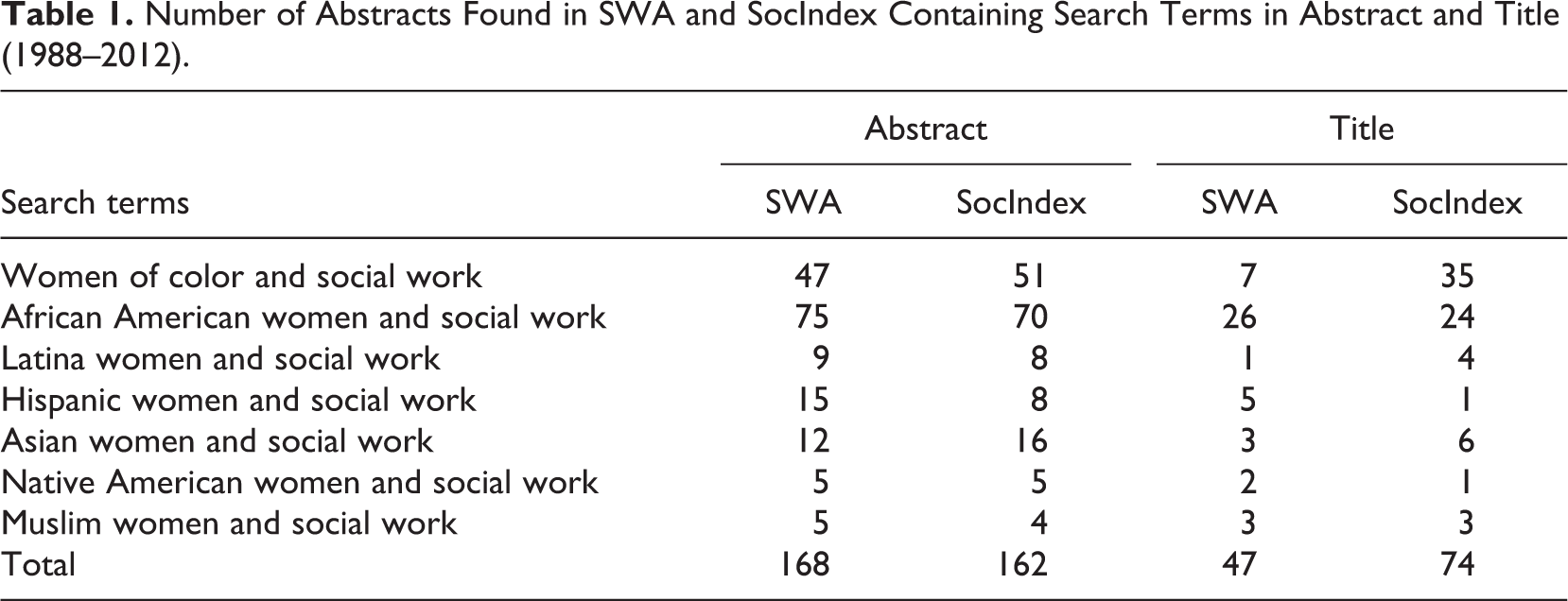
The disparities in the number of hits between databases also indicate that not all electronic databases abstract equally; the SWA tallies are slightly higher than SocIndex in the abstract category but notably lower in the title category, though admittedly, the articles found in SocIndex were not all from social work journals. However disappointingly low these numbers may be overall, they reflect only quantity and as such, are insufficient in telling much about the nature of this literature to an interested academic or practitioner seeking to access it.
Alternately, in order to more thoroughly characterize the quality of literature that included women of color, a secondary analysis was conducted of available data that were previously collected for a content analysis on women and social work in the social work journal literature (Barretti, 2011). The purpose of the original 2011 study was “to characterize the articles on women and social work from 17 social work journals that were abstracted in the Social Work Abstracts Database [SWA] from 1998 to 2007, report the findings, and compare them to the findings from a content analysis (Barretti, 2001) conducted in the previous 10 year period [1988-1997]” (Barretti, 2011, p. 266). The following seven questions guided the studies for both time periods: How many articles on women did each social work journal contain? In which journals was women’s content most likely to appear? What social identities or roles were most frequently used to depict women? Which themes pertaining to women captured the most attention? Which social work curricular areas were most frequently mentioned? Which analytical methods were used by the authors? To what extent was the article feminist or reflected a variation of feminism?
Three additional questions were addressed in the updated (1998–2007) study: Were women used as research participants in the articles coded as empirical? Did the abstract specifically state that it included women of color? Did the author employ a human rights perspective or use human rights language?
With regard to Question #9; “Did the abstract specifically state that it included women of color,” the category women of color included any racial, ethnic, cultural, or religious minority. There were three possible answers/codes to this question: (1) yes, (2) no, and (3) color or diversity implied (the abstract employed language such as “diverse women” or “international women”). I found that out of a total of 505 articles that responded to the search words “women and social work” in the 17 qualifying social work journals from 1998 to 2007, only 151 (or 29.90%) of all abstracts fell into the “yes” category as explicitly including women of color. Another 15 or 2.97% of all abstracts met the criteria for “color or diversity implied.” The two categories collapsed (included women of color + color or diversity implied) totaled 166 or only 32.87% of all 505 abstracts on women and social work. I concluded that the social work journal literature addressed women of color/diversity only in about a third of all abstracts on women during 1998–2007. The majority of abstracts (n = 339 or 67.13%) sampled from 1998 to 2007 did not include women of color or imply color or diversity (Barretti, 2011).
This article presents and discusses the results of an analysis of the 151 abstracts that explicitly included women of color. The nine research questions stated previously that guided the original study were slightly adapted to specifically include “women of color” instead of simply “women” for the secondary analysis. The nine sets of findings correspond to the nine research questions and are presented, compared, and discussed for women overall (Barretti, 2011) and for women of color.
Brief Overview of the Method for the Original Data Collection
Journal abstracts that were indexed in the SWA database and that responded to the search words “women and social work” for the search period (1998–2007) were included in the original data set (Barretti, 2011). The content analysis method was utilized to analyze the abstracts. Content analysis was chosen because this method allows the researcher to classify and characterize the journal literature by using the actual language employed in the title or abstract, and then numerically quantify the categories. I utilized previously established and pretested categories and codes that were derived from the manifest language used in the abstract and that corresponded to the research questions. I then searched the qualifying abstract for this information (e.g., what social role is used to identify women, mother; what is the focus or theme of the article, violence, and what perspective is utilized, feminist). Manifest coding is particularly useful when coding for nuanced phenomena, like feminism, when the concept under investigation is open to wide interpretation (Barretti, 2011; Neuman, 2000).
The 17 professional journals chosen for the sample (Barretti, 2001) were guided by information about their impact on social work’s knowledge base in prior studies (Baker, 1992; Lindsey & Kirk, 1992) and included Affilia; Administration in Social Work; Clinical Social Work; Families in Society (formerly Social Casework); Smith College Studies in Social Work; Social Service Review; Journal of Social Work Education; Social Work; Social Work with Groups; Social Work Research; Journal of Baccalaureate Social Work; Journal of Gerontological Social Work; Health and Social Work; Journal of Multicultural Social Work; Journal of Progressive Human Services; Research on Social Work Practice; and Social Work in Health Care. (It is recommended that the reader view the original studies (Barretti, 2001, 2011) for a more detailed account and justification of the methodology.)
SPSS was used to record and analyze all data concerning each of the 505 qualifying abstracts for the 1998–2007 time period. In order to answer each of the research questions mentioned previously, as they pertained to women of color, frequencies, and cross tabulations were computed with the original data in SPSS and reported for each question/category.
Limitations
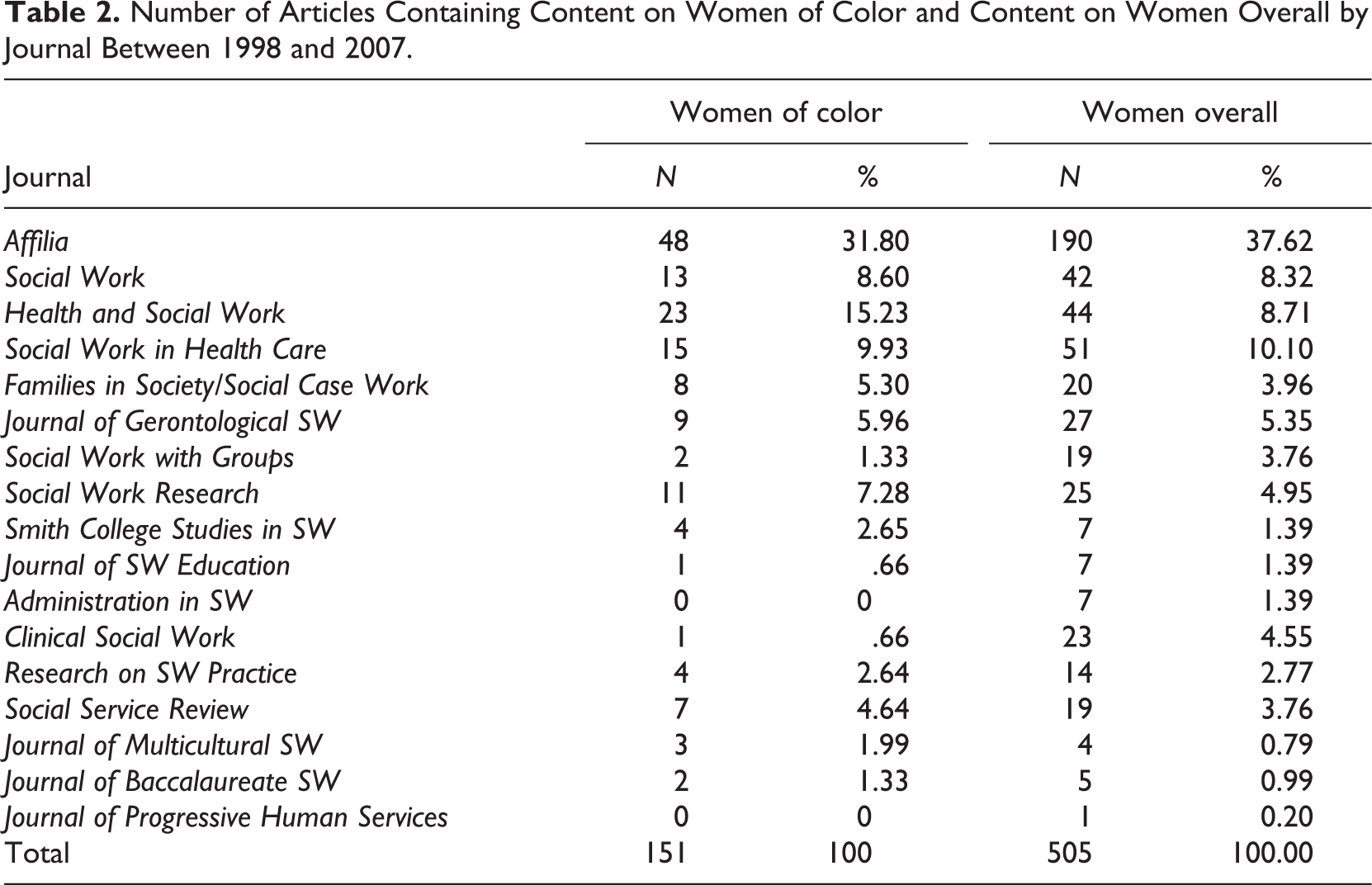
The limitations that applied to the original studies (Barretti, 2001, 2011) also apply to the secondary analysis of the data for women of color in this study. First, the individual journal’s rate of publication for women of color relative to the overall number of articles the journal published from 1998 to 2007 was not tabulated (Barretti, 2011). Second and most critically, the search engine for the data in this study, SWA, may not serve as a reliable repository of all published social work journal content (Holden, Barker, Covert-Vail, Rosenberg, & Cohen, 2008), or of all articles about women. However, the study’s aim was not to test SWAs reliability but rather to report what is available to academics, practitioners, and students searching for content on women of color and social work in social work’s signature database (I did attempt to compensate for some of SWAs abstracting limitations when collecting my data; see Barretti, 2011, p. 267). Third, it should also be noted that the 151 abstracts containing content on “women of color” are a subset of the 505 articles on “women overall” and have not been separated from the “women overall” category when analyzed. Thus, the numbers in the “women of color” column should be read as a proportion of the numbers in the “women overall” column (e.g., in Table 2 on the next page, Affilia published 48 articles on women of color out of 190 articles on women overall or 48/190.) Fourth, the categories for this content analysis were derived from the emergent language present in the abstracts. By coding for manifest language used by the authors, this study tacitly allows the “expert” to determine how women (and by extension, their issues) should be referenced. This raises the dilemma of whether or not social workers should be permitted to determine women’s identities, as doing so may further marginalize the very population they seek to empower. Alternately, though some have criticized a quantitative approach as incompatible with an intersectional view of women’s identities, McCall (2005) argues that a categorical approach is necessary to capture the full spectrum of complexity and inequality among women of color. Finally, the methodology of this study is limited in what it can capture. Although it was not the author’s intention to conflate, distinct groups of minority women were combined into one amorphous category (Kanuha, 1996) for the purpose of determining the extent of “their” representation in the literature. Thus, the reader is advised to keep this in mind when viewing the data and the conclusions made from them.
Number of Articles Containing Content on Women of Color and Content on Women Overall by Journal Between 1998 and 2007.
Findings
The findings in this section are organized according to the research question. 1. How many articles on women of color did each social work journal contain? 2. In which journals was content on women of color most likely to appear?
Table 2 reports the number and percentage of articles containing content on women of color and content on women overall found in each of the 17 social work journals in the sample between 1998 and 2007. As mentioned earlier, abstracts that explicitly stated that they included women of color totaled only 151/505 (29.90%) or less than a third of all articles on women. It is worth noting that Affilia accounted for 48 or 31.80% of all content on women of color in this study. Viewed another way, 48 of the 190 (25.26%) or about a quarter of all women’s content published by Affilia between 1998 and 2007 included women of color. The second highest journal in terms of providing content on women of color was Health and Social Work, which contributed 23 articles or 15.23% of all content on women of color during 1998–2007. Health and Social Work contributed a greater percentage of articles on women of color (15.23%) during 1998–2007 than for women overall (8.71%). These two journals, Affilia and Health and Social Work, contributed almost one half (n = 71 or 47.03%) of all content on women of color during 1998–2007. The remaining 15 journals together contributed the remaining 52.97% of the articles. This includes the Journal of Social Work Education that contributed only .66%, and Social Work that contributed only 8.60% of the articles in the women of color category (yet 13/42 or 30.95% of all abstracts on women published by Social Work included women of color). 3. What social identities or roles were most frequently used to depict women of color?
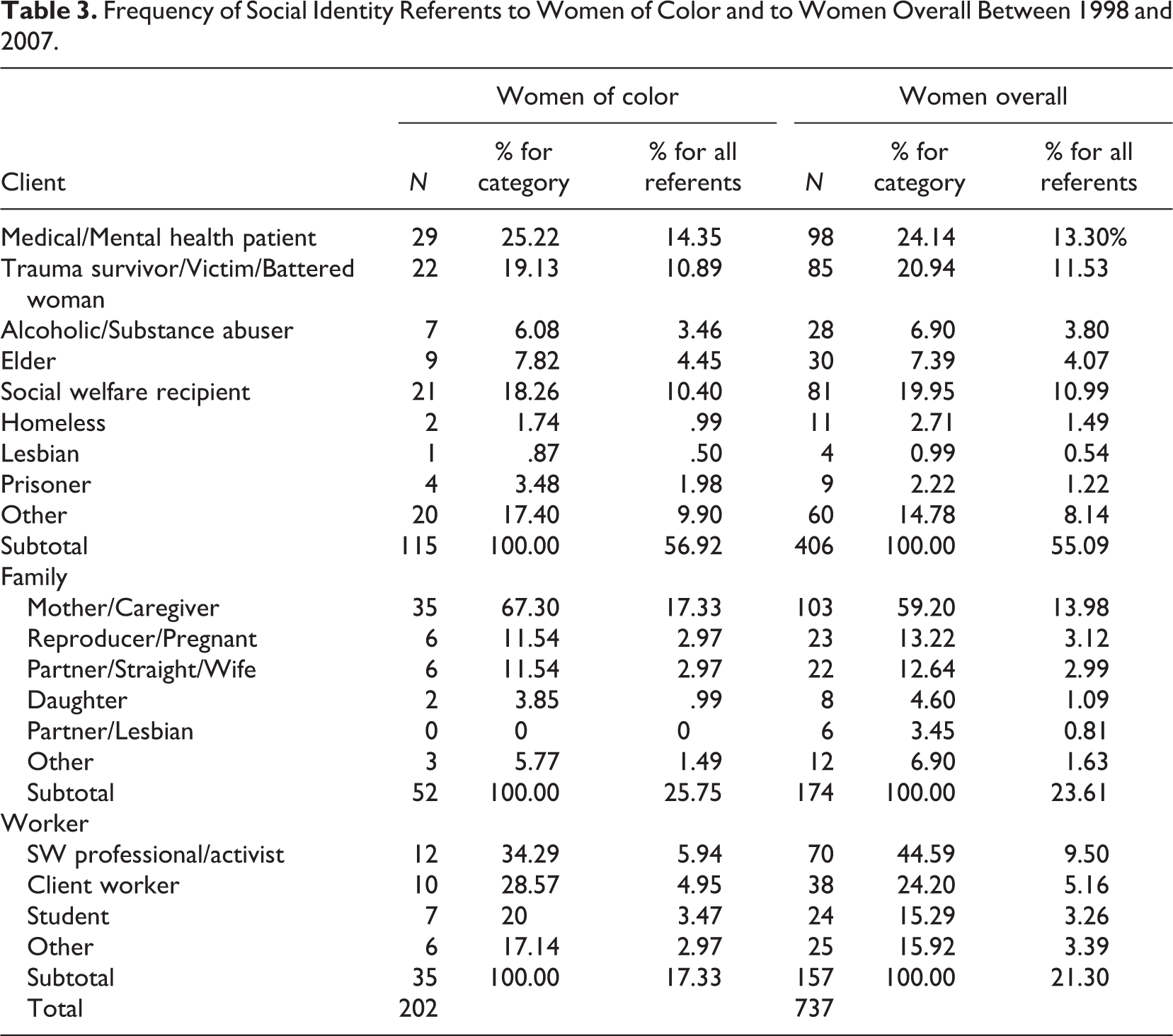
Table 3 indicates the number of referents made to women of color’s social identities and women overall between 1998 and 2007. Referents were placed in three categories: Client, Family, and Worker. Since many of the articles contained more than one social identity, all the referents were counted. Thus, if the woman (or women) in the article was referred to as homeless and mentally ill and a mother; all three referents were counted. Thus, the total number of referents exceeded the total number of abstracts in the study. In the 151 abstracts that explicitly included women of color, 202 referents were made to their social identities. The highest number of referents for women of color fell in the Client category with 115 or 56.92% of all referents. Similar to the data for women overall in the Client category, the medical/mental health patient category was highest of all (n = 29 or 25.22%), comprising about a quarter of all referents for women of color. Also reflective of the women overall category, women of color who were Clients were next likely to be referred to as trauma survivors/victims/battered women (n = 22 or 19.13% of category) and third likely to be referred to as social welfare recipients (n = 21 or 18.26% of category). These percentages closely approximated those of women overall. These three client categories comprised 62.61% of referents in the Client category and a little more than a third (35.64%) of all referents made to women of color. Fifty-two referents or 25.74% of all referents were made to women of color in their Family roles. As with women overall, women of color are most likely to be referred to as mothers/caregivers (n = 35 or 67.30% of category). When considering all three categories of Client, Family, and Worker, the mothers/caregivers referent is the highest for both women of color and women overall. However, this subcategory is somewhat disproportionately higher for women of color representing 67.30% or more than two thirds of the Family category, whereas for women overall, mothers/caregivers represent 59.20%, or slightly more than half of the Family category. Referents to women of color as Workers are the lowest of the three categories, representing 35 or 17.33% of all referents (compared to 21.30% for women overall). A mere 12 referents (34.29% of category and only 5.94% of referents overall) were made to women of color as social work professionals/activists as compared to 44.59% of the category and 9.50% of all referents for women overall. In sum, women of color are more than twice as likely to be referred to in their Client roles (n = 115 or 56.92%) than in their Family (n = 52 or 25.75%) and Worker roles (n = 35 or 17.33%), respectively. Though women overall are also more than twice as likely to be referred to in their Client roles than in their Family or Worker roles, the disparities between the Family (23.61% of all referents) and Worker (21.30% of all referents) categories for women overall is not as great as it is for women of color (Family = 25.75%; Worker = 17.33%).
Frequency of Social Identity Referents to Women of Color and to Women Overall Between 1998 and 2007.
4. Which themes pertaining to women of color captured the most attention?
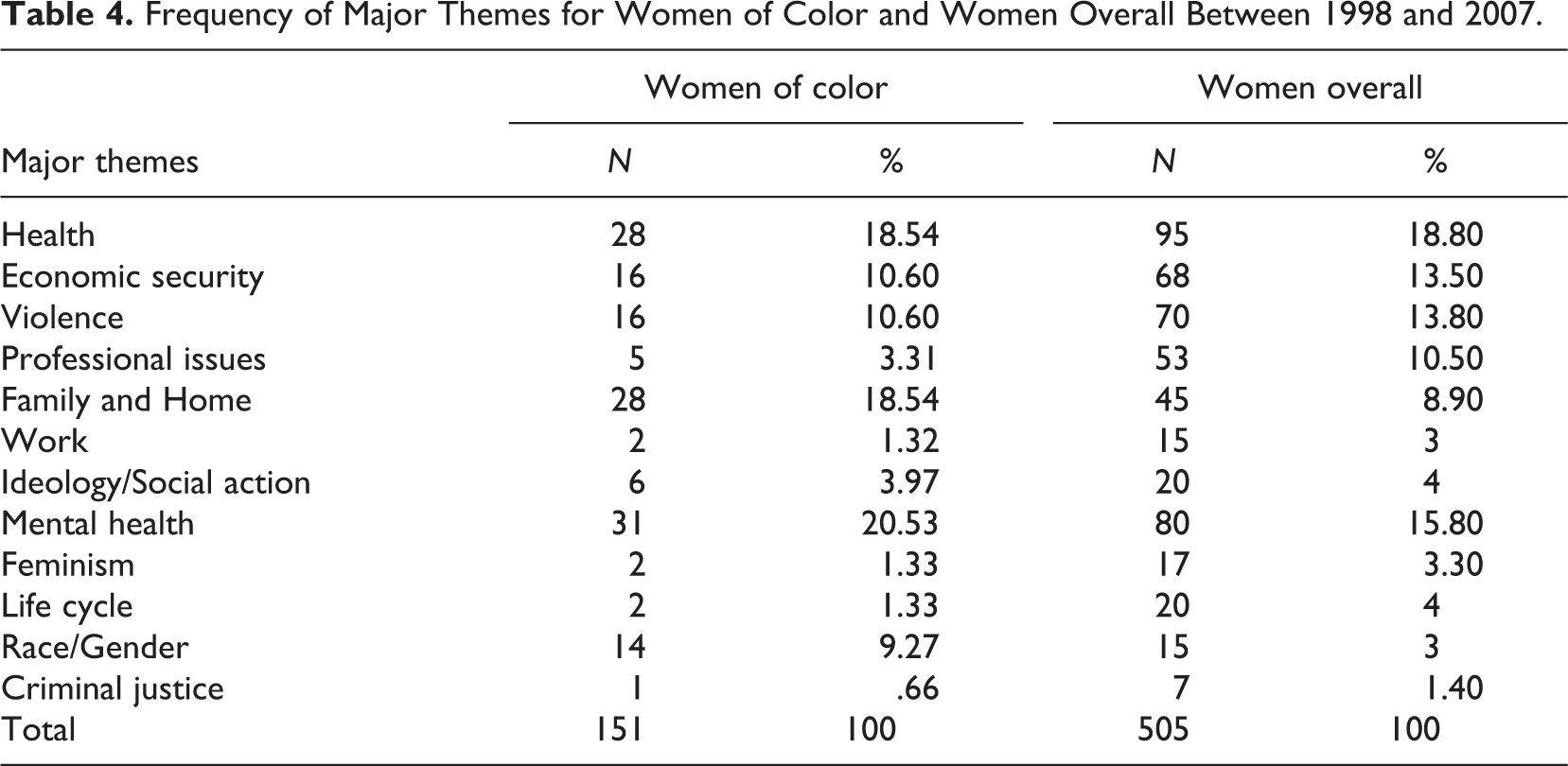
Table 4 reports the frequency of the prevailing social issue or theme related to women of color and women overall as discussed in the abstract. The most frequent themes for women of color came from Mental Health (n = 31 or 20.53%), Health (n = 28 or 18.54%), and Family and Home (n = 28 or 18.54%) which combined comprised over half of all abstracts on women of color (57.61%). The percentage of Mental Health abstracts for women of color (20.53%) was slightly higher than for women overall (15.80%). Viewed another way, 31 of the 80 abstracts in the Mental Health category (38.75%) included women of color. Twenty-eight of the 45 abstracts or 62.22% of all articles in the Family and Home category included women of color, making it disproportionately higher than for women overall (18.54% vs. 8.90%, respectively). Other disparities were also evident. The Economic Security and Violence category contains a slightly lower percentage of articles (10.60% each) for women of color than for women overall (13.50% and 13.80%, respectively.) Perhaps most striking is the disparity in the Professional Issues category between women of color (3.31%) and women overall (10.50%). Only 5 of the 53 articles on Professional Issues in this study (or only 9.43%) included women of color. Percentage wise, women overall have about twice as much content than women of color in the Work (3% vs. 1.32%, respectively), Life Cycle (4% vs. 1.33%, respectively), and Feminism (3.30% vs. 1.33%, respectively) categories. Only 2 of the 17 articles on Feminism in this study included women of color (11.76%), 2 of the 20 articles on Life Cycle (10%), and 2 of the 15 articles on Work (13.33%). Perhaps not surprisingly, 14 out of a total of 15 articles (or 93.33%) in the study that fell in the Race/Gender category contained content on women of color.
Frequency of Major Themes for Women of Color and Women Overall Between 1998 and 2007.
5. Which social work curricular areas were most frequently mentioned or represented in articles about women of color?
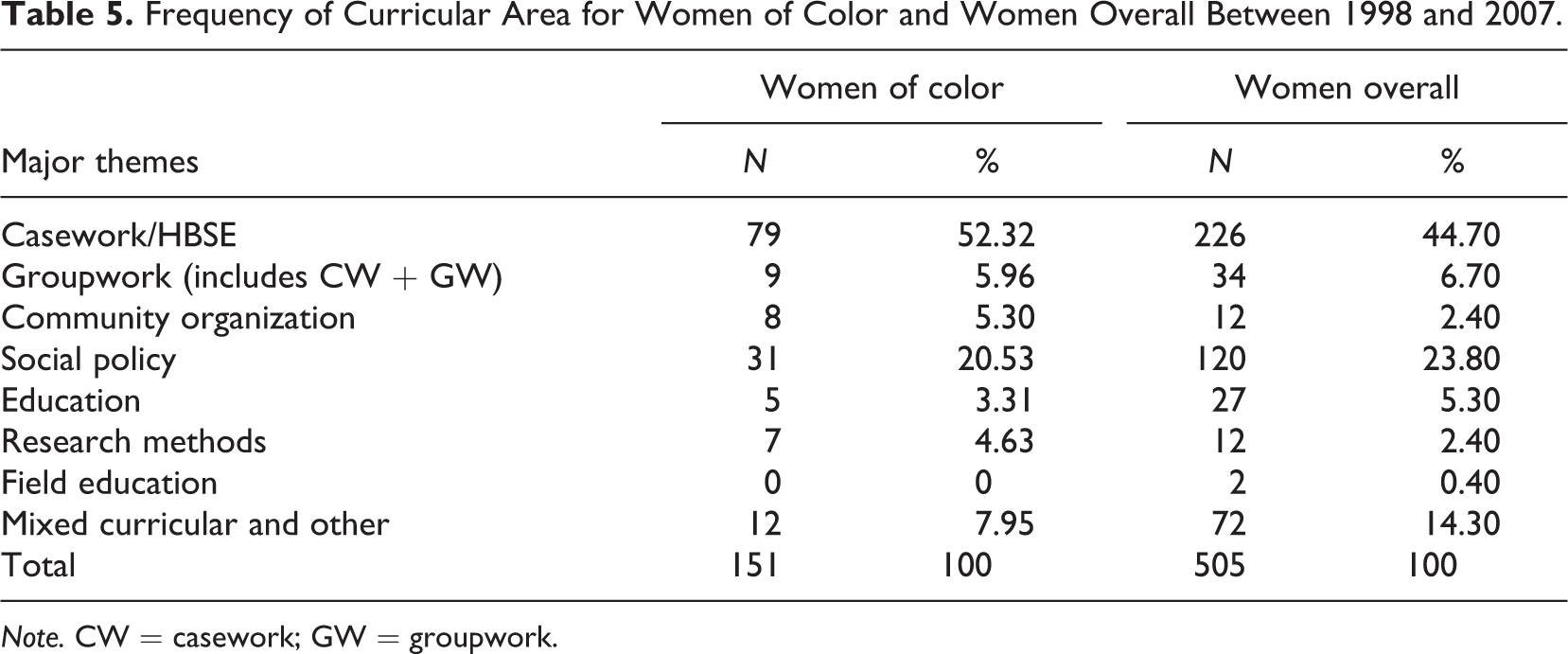
Table 5 reports the frequency of curricular area in abstracts for women of color and women overall between 1998 and 2007. Casework (CW)/Human Behavior and the Social Environment (HBSE; n = 79 abstracts or 52.32%) and Social Policy (n = 31 or 20.53%) led as the most frequently represented curricular areas for women of color, a trend also noted for women overall (CW/HBSE: n = 226 or 44.70%; SP: n = 120 or 23.80%). For women of color, these two categories combined totaled almost three quarters of all articles (72.85%). However, where CW/HBSE accounted for slightly more than half of all articles (n = 79 or 52.32%) for women of color, they represented slightly less than half for women overall (n = 226 or 44.70%). Of special interest is that most of the articles in Community Organization (n = 8/12 or 66.66% of all articles categorized as community organization included women of color) and Research Methods (n = 7/12 or 58.33% of all articles categorized as research methods included women of color). Percentage wise, the women of color category contains only about half as much content in the Education (3.31% vs. 5.30%) and Mixed Curricular (7.95% vs. 14.30%) categories than women overall. Only 5 of the 27 Education articles (or 18.51%) and only 12 of the 72 Mixed Curricular articles (or 16.66%) contained women of color.
Frequency of Curricular Area for Women of Color and Women Overall Between 1998 and 2007.
Note. CW = casework; GW = groupwork.
6. Which analytical methods were used by the authors in articles about women of color?
Table 6 reflects the frequency of analytic perspective for women of color and women overall for 1998–2007. As defined in the earlier studies (Barretti, 2001, 2011), the Empirical category includes quantitative and qualitative studies and mixed quantitative/qualitative studies where original data were collected by the author for the purpose of the article, or a secondary analysis of previously collected data (e.g., national data). The Nonempirical articles include those of a conceptual, theoretical, or practical nature; including narratives, nonempirical case studies, literature reviews, historical studies and program descriptions (where the unit of analysis is a specific program, model, or treatment approach but empirical data are not collected or the data collected are not the focus of the article). Where the Empirical (n = 277 or 54.90%) and Nonempirical articles (n = 228 or 45.10%) are almost evenly split for women overall, there is an almost 2:1 ratio between Empirical (n = 102 or 67.55%) and Nonempirical (n = 49 or 32.45%) articles for women of color. A closer look at the Empirical category breakdown reveals that for women of color, the quantitative studies represented 36.42% (n = 55) of all articles; qualitative studies 28.47% (n = 43); and mixed quantitative + qualitative 2.64% (n = 4). For women overall, quantitative studies represented 28% of all articles, qualitative studies represented 24.2% of all articles (Barretti, 2011; and quantitative + qualitative represented 2.7% of all articles). Therefore, there is a higher percentage of quantitative (+8.42%) and qualitative studies (+4.27%) in the articles that include women of color than for women overall. Viewed another way, women of color are included in a little over a third of all empirical articles (102/277 or 36.82%) and in less than a quarter of all nonempirical articles (49/228 or 21.49%) for women overall (n = 505) between 1998 and 2007. 7. To what extent was the article feminist or reflected a variation of feminism in articles about women of color?
Frequency of Analytic Perspective for Women of Color and Women Overall Between 1998 and 2007.
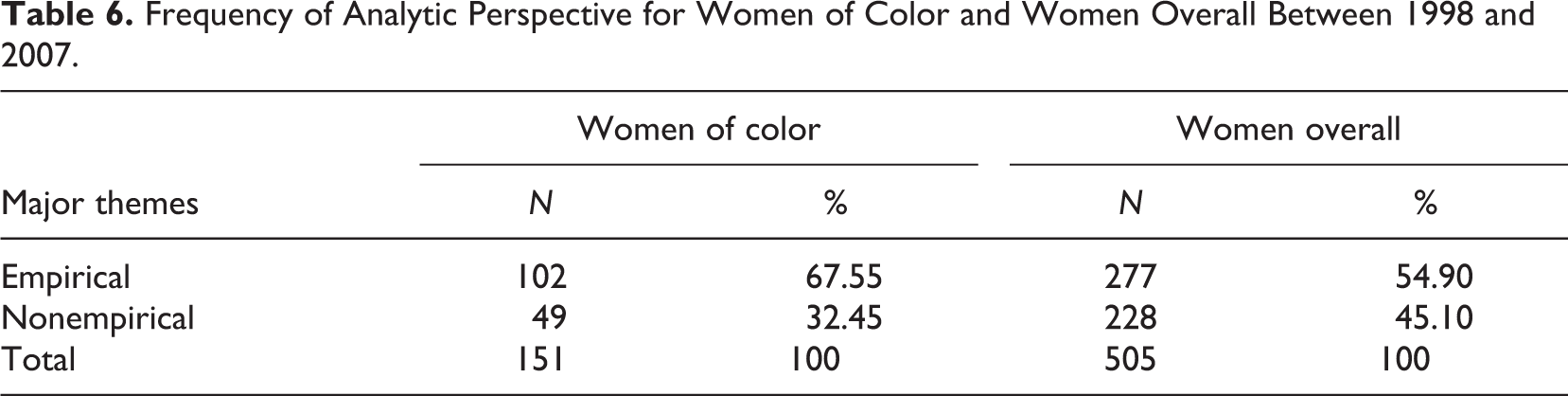
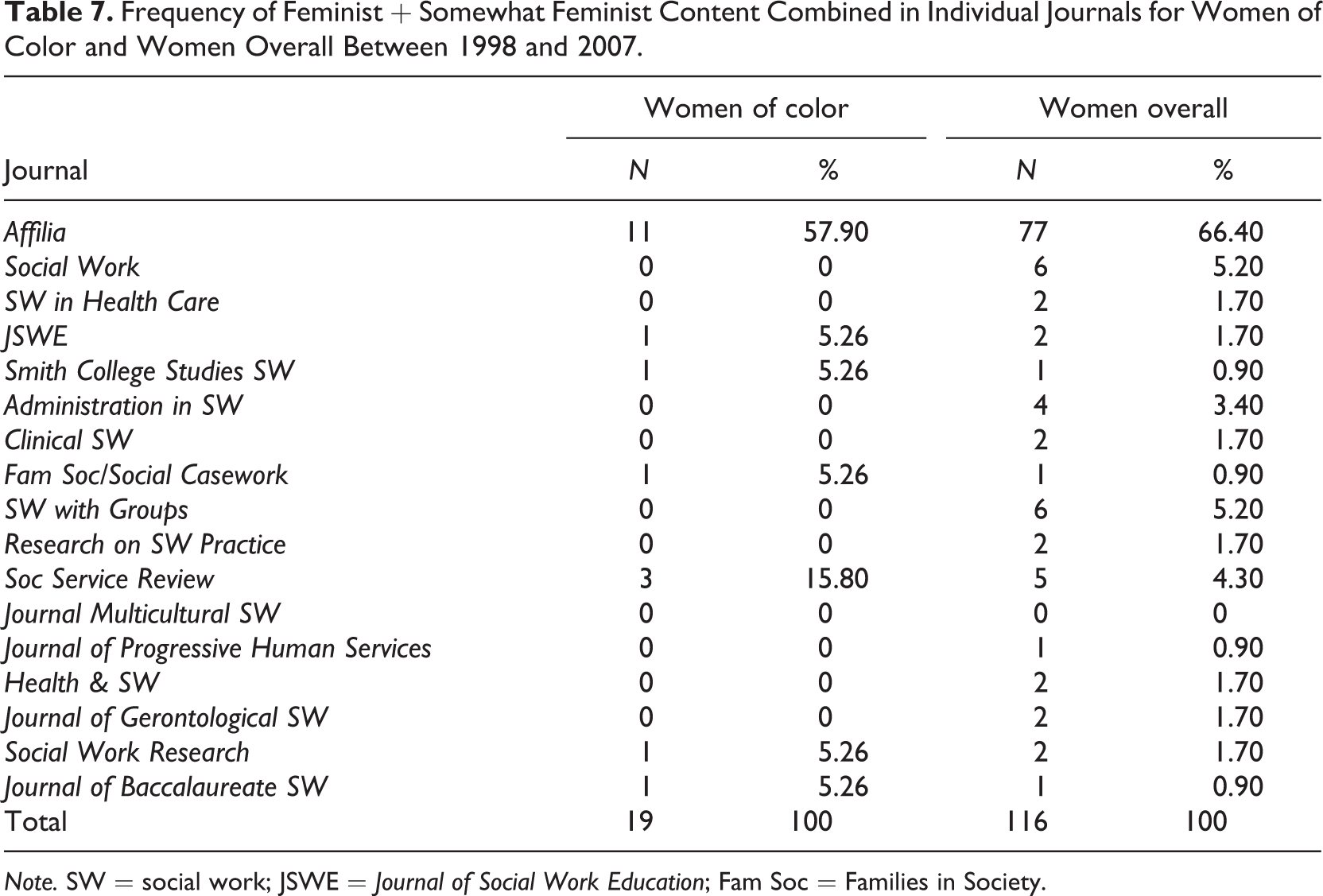
Table 7 indicates the frequency of feminist + somewhat feminist content combined in individual journals for women of color and women overall during 1998–2007. As stated earlier, all abstracts were coded by manifest language; thus, no predetermined definition of feminism was utilized to assess the abstract’s degree of feminism. Abstracts were classified as self-identifiably feminist when the title or abstract specifically stated the word “feminist.” Abstracts were classified as somewhat feminist when the abstract did not include the word “feminist” but employed language such as “patriarchy, gender oppression, gender justice, gender inequities, women’s rights, sexism, regulation of women’s behavior, or gender biases,” (Barretti, 2001, p. 285). All other articles that were about women but lacked either the word “feminism” or a gender-lens perspective were classified as not feminist (Barretti, 2001, 2011). The data reveal that only slightly more than one tenth or 19 of the 151 articles (12.58%) that explicitly stated it included women of color also contained at least some feminist content. (Eight of these 19 articles were self-identifiably feminist, 11 were somewhat feminist, and 132 were not feminist.) In contrast, 116 of the 505 articles (or 22.96%) contained at least some feminist content for women overall as compared to 19 of the 151 (or 12.58%) that contained at least some feminist content for women of color. The 19 articles containing some feminist content and women of color represent only 16.37% of all feminist articles (n = 116) and only 3.76% of all articles (n = 505) analyzed in this study.
Frequency of Feminist + Somewhat Feminist Content Combined in Individual Journals for Women of Color and Women Overall Between 1998 and 2007.
Note. SW = social work; JSWE = Journal of Social Work Education; Fam Soc = Families in Society.
Affilia published more than half of the feminist + somewhat feminist articles (n = 11 or 57.90%) that explicitly included women of color (7 were self-identifiably feminist and 4 were somewhat feminist). However, this percentage was still notably lower than for women overall (57.90% for women of color compared to 66.40% for women overall). Thus, of all articles containing feminist content published by Affilia between 1998 and 2007, only 14.28% (11 out of 77) included women of color. Social Service Review contributed three articles (or 15.80%) including feminist content in the women of color category. Thus, 60% (3 out of 5) of all articles containing feminist content published by Social Service Review included women of color. Five other journals only contributed one article that included both feminist content and women of color. 8. Were women of color used as research participants in the articles coded as empirical?
In addition to coding for referents to women’s social identities (see Table 3), the author coded each abstract for whether or not women were utilized as research participants/subjects (Yes/No). The purpose of adding this category was to follow up on an observation from the earlier study (Barretti, 2001) that found that women were increasingly being used as research participants in empirical studies carried out by the authors, rather than being treated as clients for the problem under discussion in the article. The articles that were coded as empirical for the analytic perspective category (see Table 6) were not sufficient to answer this question, as some of the authors conducted a secondary analysis of available (e.g., national) data in their studies and thus did not employ human subjects in their research. The data for this category reflected an almost even split between women as research participants (n = 255 or 50.49%) and women not used as research participants (n = 250 or 49.50%) in the 1998–2007 sample for women overall (n = 505). In contrast, women of color were used as research participants in 100 of the 151 (66.22%) abstracts and not used as research participants in 51 of the 151 (33.78%) abstracts in their category. In sum, 15.73% more articles in the women of color category included women as research subjects than did the women overall category during the study period (66.22–50.49%). 9. Did the author employ a human rights perspective or use human rights language in articles containing women of color?
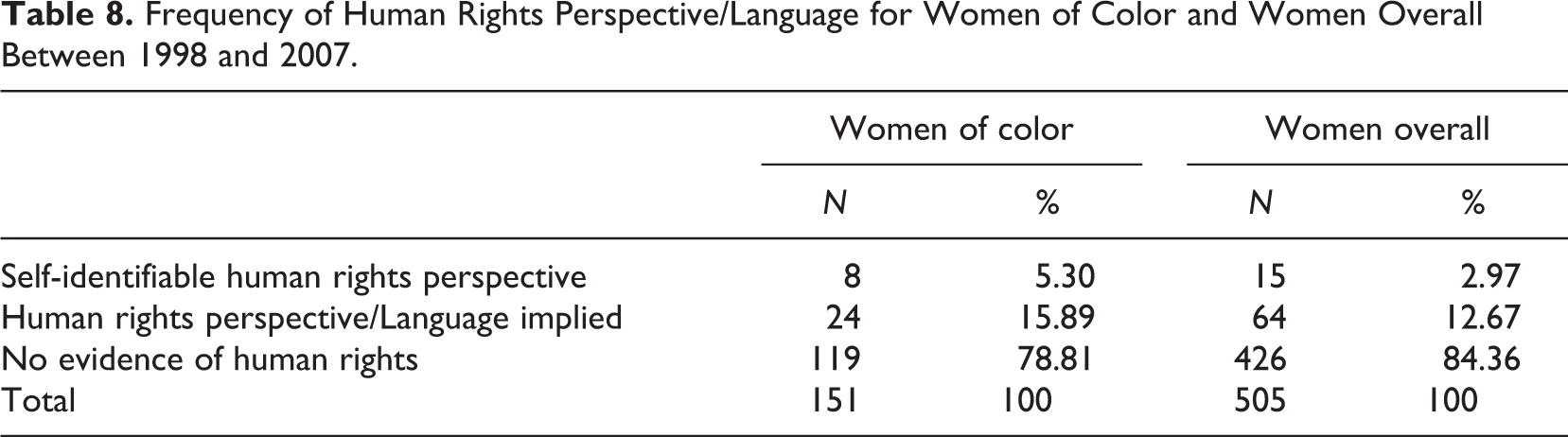
Table 8 indicates the frequency of a self-identifiable human rights perspective and human rights language for women of color and women overall during 1998–2007. The author added the previously mentioned question to the study to find out if a human rights perspective was supplanting a feminist perspective in the literature; a hypothesis that was not supported by the data. The abstracts were analyzed to answer the question, “Did the author employ a human rights perspective or use human rights language in the abstract?” The following three codes were used for this category; (1) yes, self-identifiable human rights perspective (article specifically states that the issue, theory, intervention under investigation is a human rights issue); (2) no evidence of a human rights perspective or language; and (3) human rights perspective/language implied (author utilizes terminology such as anti-oppressive practice; economic, social, and cultural rights; [protection against] discrimination based on race, color, sex, language, religion, political opinion; civil and political rights against arbitrary powers of the state; equal protection under the law; rights to due process; inalienable rights; freedom of speech, belief, the right to assembly, education, work, liberty, freedom from torture; international law/justice; Barretti, 2011). Only 15 (or 2.97%) of a total of 505 abstracts employed a self-identifiable human rights perspective for women overall during 1998–2007. Sixty-four abstracts (or 12.67%) utilized implied human rights language or perspective. When the two categories mentioned previously were added together, a total of 79 or 15.64% of all abstracts included some human rights language or perspective for women overall, leaving 426 abstracts or 84.36% of all abstracts with no mention of a human rights perspective or human rights language. For women of color, a self-identifiable human rights perspective was present in only 8 or 5.29% of all articles on women of color and an implied human rights perspective was present in 24 articles or 15.89% of all articles on women of color. Thus, the journal literature during the study period that contained at least some human rights content was slightly higher proportionately in the women of color category (21.18%) than in the women overall category (15.64%). However, slightly more than half (53.33%), or 8 out of 15 articles with a self-identifiable human rights perspective, and a little over a third (37.50%) or 24 out of 64 articles containing some human rights language included women of color, although articles containing at least some human rights content and women of color combined represented only 6.33% of all articles in this study (32 out of 505).
Frequency of Human Rights Perspective/Language for Women of Color and Women Overall Between 1998 and 2007.
Discussion
Some troubling findings emerged from this analysis raising a number of unanswered questions warranting further attention and investigation. First, there remains a general paucity of social work journal literature that includes women of color. Despite social work’s iterated value on integrating diversity in practice and scholarship, publications including women of color do not just remain disappointingly scant, but also poorly represented and distributed throughout the major journals in our profession. Articles on women of color abstracted from 1998 to 2007 represented less than a third of all articles on women overall in 17 social work journals in what is already a shrinking pool of articles on women as compared to the previous 10-year period (Barretti, 2001, 2011). Additionally, just as women’s content, in general, has been provincialized to Affilia, so has content on women of color, when in fact, women of color should be an integral part of all scholarship that includes women in social work. This content should not be relegated to a separate journal, a “special issue,” or a “special section.” Though the categories “women of color” and “women overall” were separated artificially for analytical purposes in this study, in actuality, there is only one journal literature on women in social work. However, the inadequate representation of women of color in an already shrinking women’s scholarship renders it even further incomplete and invalid. Women’s literature can only be comprehensive when it contains representations of all women of all origins, colors, ethnicities, classes, gender orientations, disabilities, and abilities. It fails to represent women when it fails to represent any woman for whom gender is part of her identity or of her marginalized status in society. This poses distinct problems for social work educators.
Morris (1993) notes that in order to obtain content on women of color, most social work educators must draw on two distinct bodies of literature: one on gender and one on race. Vakalahi and Starks (2010) point to the “lack of conceptualization of the intersectionality between gender and race/ethnicity” in the literature (p. 111). A cursory look through a number of randomly selected social work texts confirms this assertion; a separate section often exists for “racial/ethnic minorities” and a separate section exists for “women,” but no section was located for “women of color.” Does this lack of attention to the paucity of a connected scholarship (Hill-Collins, 2003) reflect social work’s inability to recognize the problem or its inability to recognize women of color? Are articles containing content on women of color infrequently written or infrequently published, or both? One way to respond to this question is to investigate who does submit articles that centralize the experiences and standpoints of women of color.
Schiele (1992) contends that when social work faculty of color publish, they are most likely to write about issues of importance to their racial/ethnic group, and thus, their higher publication rates ensure a more diverse social work knowledge base. However, Schiele (1995) found in his study of submission rates among a national sample of 264 full time African American social work faculty that submission rates were significantly associated with being male and having a doctorate, suggesting “the existence of an unequal influence … in shaping social work’s knowledge base, especially about people of color” (p. 51). He cites a number of studies in social work that found lower productivity rates among women, even when race and ethnicity are controlled. These findings imply that the academy reflects, if not reproduces the existing social stratification in America, where race and gender don’t just marginalize diverse faculty from a lack of participation in the educational hierarchy, but from representation in theory building and practice as well. Schiele (1995) recommends that women, African American faculty, and faculty of color submit more manuscripts to peer-reviewed journals in order to generate greater diversification and lessen inequality in knowledge production and dissemination. However, Schiele’s (1995) recommendations provoke the question of whether faculty of color should assume prime responsibility for boosting scholarship on women of color. Although the literature indisputably benefits from diverse authorship, it requires a commitment from all members of the profession to include women of color, whenever women are the topic or unit of analysis in the article. As previously alluded to in the Introduction of this article, exclusion cannot and should not be measured in lack of quantity, but in lack of centrality. The relatively high number of hits containing the generic “women of color” relative to the low numbers of hits containing specific populations of color in the search terms (see Table 1) suggests that women of color are added and stirred in articles, sometimes as part of convenience samples in program evaluations, or sometimes as part of an amorphous tagline; for example, that the problem or issue under study affects “diverse” women or all women “regardless of race.” Kanuha (1996) argues that the resultant absorption of distinct groups of minority women into one amorphous category where they are assumed to be equal to or at equal risk of some problem as all women trivializes the nuances of their experience, obstructing a true understanding of who these women are and how they are affected. She attests that the use of the tagline is not only a token attempt at inclusion of diverse perspectives but also evidence of sloppy research and theory building. Conflating women of color’s unique experience with “the dominant group only maintains its hierarchical status and accompanying power and privilege … and also structurally mitigates any claims for a redistribution of resources and power in the [racial] hierarchy” (Kanuha, 1996, pp. 40–41). Exclusion then cannot merely be defined as the relative absence of women of color from the social work literature, but also perhaps the failure or reluctance of the profession to enter into a meaningful dialogue about this critical paucity and its broader implications.
Second, women of color are almost twice as often to be referred to in their Client roles than in their Family and Worker roles respectively and somewhat more likely to be referred to as mothers/caregivers, with caregiving/parenting/adoption as the most highly ranked thematic subcategory. Women overall and women of color are disproportionately represented in the literature as clients. In the client category, women are most frequently referred to as medical/mental health patients, trauma survivors/victims/battered women, and social welfare recipients. In addition, the literature most frequently refers to women in their traditional roles as caregivers, while scant attention is paid to other aspects of women’s experiences or identities; for example, as lesbians, homeless, prisoners, partners, workers, professionals, or students. Further investigation is needed to determine whether the high numbers of referents to women of color as caregivers represent a higher prevalence of caregiving issues in the lives of women of color, or an overemphasis on the traditional aspects of their roles, possibly to the negligence of others. The emphasis on client status suggests dependent, deferential roles for women, deemphasizing other more empowering roles. Since most of the articles fall into the CW/HBSE curricular areas and many fall under the theme of Mental Health, the implication is that women in the literature are “likely to need or receive therapy” (Barretti, 2001, p. 289). However, our profession endorses applying an empowerment perspective when treating clients who are women of color (Gutierrez, 1990). Therefore, in addition to accepting women’s definition of the problem (p. 151), perhaps we should accept their self-referents as well. How would women construct their own identities in the literature? Proponents of intersectionality would probably argue that this construction should reflect intersectionality among their many aspects and roles. Emerging from feminism (Mattsson, 2014), and applied and utilized widely by feminist academics (Wagner, 2010), intersectionality’s liberal overuse and misuse has been criticized by some as divorced from the experiences of black women who organized and originated the term, and for erasing “black women as knowledge producers and subjects of investigation” (Alexander-Floyd, 2012, p. 1). Alexander-Floyd (2012) argues that intersectionality’s “catch-all” and “anybody can play” usage in the social sciences that allows any scholar to claim expertise in intersectionality serves to decontextualize, diminish, and commodify black women and their experiences. Social work has a duty to responsibly critique the theories it so readily embraces, as there is some danger to an espoused intersectionality that only focuses on multiple marginalized identities (Nash, 2008), especially since many of the referents to women of color in this study disproportionately represent aspects of an oppressed or dependent status.
Gutierrez and Lewis (1999) address the historical, cultural, political, and socioeconomic factors contributing to the problems, challenges, and needs of women of color and offer a strengths-based model that social workers can use to empower clients against systematic oppression. The language of empowerment, with its roots in community organization, feminism, and political science (Gutierrez, 1990), offer many possible alternatives such as consumers, activists, organizers, collaborators, participants, facilitators, advocates, and change agents. Although a low number overall, two thirds of the articles categorized as Community Organization in this study included women of color. Would more published articles on community organization add to the tally of more empowering referents yielding a more empowering literature for women overall?
Third, women of color are disproportionately less likely to be referred to as social work professionals/activists than women overall. Professional issues represented less than a third of all articles on women of color and there is little representation for women of color in the Work category. Practice/research/educational issues ranked low in frequency for women of color in the thematic subcategories (data not presented here). Women in social work education generally lag behind men (Holley & Young, 2005). Women of color are particularly underrepresented in the academy (Vakalahi & Starks, 2010), facing particular obstacles including pay discrimination, racism, a paucity of full professor positions (DiNitto, Grant, & Vakalahi, 2007) and mentoring opportunities to assist them in fully developing and fulfilling professional goals and serving as future leaders and administrators (Simon, Perry, & Roff, 2008). A growing body of scholarship confirms the ongoing marginalization of women of color in the academy (e.g., Monture, 2010; Smith, 2010; Vakalahi & Starks, 2010). Three books incorporate research with women’s narratives about their challenges and successes in rising to leadership (Gutierrez y Muhs, Niemann, Gonzalez, & Harris, 2012; Vakalahi & Peebles-Wilkins, 2009; Vakalahi, Starks, & Hendricks, 2007). This substantive literature on women of color as educators, while indicating progress in helping to fill a gulf in the literature, must not be interpreted as progress on eradicating the problem it explores. Women of color were also infrequently referred to as students in this analysis (though this category is higher proportionately for women of color than for women overall). There are only a tiny number of articles in the Education category and none in Field Education that include women of color. As it is, very little rigorous, grounded inquiry has been conducted on the socialization of students to the social work profession (Barretti, 2004). An exploratory, inductive inquiry into this process reveals a differential process for female students of color who report having generally few or no faculty members of color to provide mentoring and critical role modeling for them (Barretti, 2003). Surely, our profession can benefit from knowing and understanding more about how “race and gender intersect to construct differential socialization experiences” (Barretti, 2004, p. 23) to ensure the successful preparation of a diverse and competent cadre of future professionals in practice and in social work education.
Fourth, empirical articles, and the frequency of being used as a research participant was higher for women of color than women overall. In a proportionately greater empirical literature that includes women of color, women of color are more frequently than women overall to be utilized as research participants. The implications of these findings are arguable. In my earliest study (Barretti, 2001), I argued that an increasing empirical literature and a decreasing practice literature was problematic for a profession whose purpose was to proactively intervene in the lives of (women) clients and in society. I also argued that women’s inclusion as research subjects in empirical studies only signifies that they are being studied, not that they are receiving needed interventions. Alternatively, research is critical for the development of theory and knowledge so that the profession can better intervene on behalf of clients.
Including race and gender as variables in a quantitative study (and more of the articles that include women of color are quantitative than qualitative) does not make the study women centered. As a profession, we must acknowledge and take responsibility for the limitations of our constructs, samples, theories, and frameworks for analysis when they fail to fully illuminate and contribute to our knowledge base on any population, including but not limited to women of color. Hill-Collins (2003) argued for reconceptualizing race, class, and gender as categories of analysis, for seeing the connections between these categories, especially in our scholarship, and for acquiring new theories on how this triumvirate has shaped women’s experiences, and that of all groups. However, as argued previously, it behooves our profession to include all the strengths and facets of a woman’s self-identity, and not just the intersections of her oppressions if that scholarship is to be considered truly woman centered.
Fifth, there is little representation for women of color in the Feminism category. The number of articles containing some human rights content was slightly higher in the women of color category, though still a very small percentage of all articles in this study. As mentioned previously, less than a quarter of all articles on women and social work between 1998 and 2007 contained at least some feminist content (Barretti, 2011), while this analysis revealed that only slightly more than one tenth of articles that included women of color also contained at least some feminist content. As evidenced in the data, a human rights perspective does not appear to be supplanting a feminist one. Arguably, the low numbers of articles containing feminist content for women overall and for women of color may reveal tensions not just between women and feminism, but between social work and feminism as well, the latter has been widely discussed. Rose and Hanssen (2010) argued that the profession is losing its feminist perspective; that social work education places little emphasis on feminist ideology; that curricula follow a conservative trend; and that college age students are increasingly resistant to feminism (see Barretti, 2011, for discussion on social work and feminism). What is less explored, however, is whether or not those topics of concern to feminist authors and readers are presented as of concern to and including women of color.
Is the relative omission of women of color from the journal literature’s feminist content a symptom of a problematic history between feminism and women of color? Kemp and Brandwein (2010) note that despite an ethos of equity and empowerment, racial and class biases stubbornly persisted toward women of color in the most seemingly inclusive activist efforts for gender equity throughout most of the first and second wave of the women’s movement, and in the foundational years of the social work profession as well. Until the 1980s, women of color were largely excluded by white feminists, prompting them to organize separately yet successfully, often interweaving unique cultural and spiritual aspects of their heritage and political oppression into their activism (Kemp & Brandwein, 2010). Over the past several decades, women of color have challenged not just feminism’s underrepresentation of race/ethnicity as confluences of gender discrimination, but also the shortage of race/ethnic perspectives in theory building (e.g., Mohanty, Russo, & Torres, 1991; Moraga & Anzaldua, 1983) and the exclusion of women of color in feminist leadership and scholarship (Hill-Collins, 1990, cited in Kanuha, 1996), favoring instead a womanist perspective. Womanism posits that the oppression of women of color is bound up with both race and gender and cannot be addressed by a white, liberal, middle-class feminist agenda that is ignorant of how racism and sexism intersect in their lives (hooks, 1990).
This analysis did not include coding for a womanist perspective, but it is likely that any articles written from a womanist perspective were included in this sample. With womanism’s roots in black feminist theory (Hill-Collins, 1990), the relative absence of women of color in feminist content in this study is curious. This chasm may reflect the need for a more explicit articulation of common struggles and oppressions between womanists and feminists that do not diminish awareness of real and important differences in their standpoints or interests.
Conclusion and Recommendations
It is unlikely that social work will be able to adequately address the relative invisibility and lack of centrality of women of color in the social work literature until it addresses the underrepresentation and lack of centrality of women of color as social work educators and scholars. As a result of the academy’s delegitimation of a publication agenda on minority issues, the devaluation of activism in minority communities, and the stubborn pattern of institutional oppression and struggle that recursively continues for generations of women of color (Vakalahi & Starks, 2010), women of color are tacitly encouraged to leave the academy or remain invisible, and if they stay, openly discouraged from increasing the visibility of their unique standpoints. These barriers hinder both the advancement of women of color in the academy and in scholarship. In sum, as long as women of color stagnate in the academy, so shall the professional literature. Wagner (2010) notes that though anti-oppressive frameworks are increasingly adopted in social work programs, departments have not developed effective strategies for eliminating the hidden, pervasive influence of race privilege. To address this, social work academics must take critical steps toward policies that would (1) collectively advocate for the employment and promotion of women of color in their departments and academies, (2) draft personnel guidelines and advance policies that encourage research agendas that include scholarship on minority issues and specifically women of color, (3) incentivize doctoral research and agency-based program evaluations that specifically centralize the experiences of women of color, (4) create and endorse grants and funding opportunities for research that specifically aid in theory building and practice knowledge as it concerns women of color as practitioners and clients, and (5) require content in all concentrations of the social work curriculum that include women of color; not just as clients, but as theory builders, organizers, and reformers as well. CSWE might mandate specifically that content be included in the curriculum standards specifically on women of color.
Collaborative research efforts with communities of color are needed to fully develop a knowledge base on diverse women, and also, “to inform community practice that is culturally relevant and effective” (Vakalahi & Starks, 2010, p. 121). It is a widely held myth that women of color are unorganized or need organizing (Grahame, 1998). Indeed, much can be learned from the collective empowerment gained through communitarian movements of diverse, working-class union women fighting on both basic bread and butter survival issues, and freedom from harassment and discrimination (Chandler & Jones, 2003). Although arguably invisible to mainstream academic communities, diverse women are highly visible in the leadership of their own issues in their own communities. Inviting participation on publications relating to social issues of importance to diverse women is not just good community collaboration for the academy, but good social work and good knowledge building as well. The methods needed to gain understanding, build theory, and inform practice must be participatory, empowering, and whenever possible, based in a community action model. In this way, the experiences of women of color will be represented and included in scholarship and theory building. However, this implores the question of whether or not this type of inclusive collaboration could possibly occur without a supportive, activist social work context to spawn and nurture it. Tensions already exist within the profession between political activism and academic publishing, the latter of which carries more status and esteem (Wagner, 2010), and which may ultimately work against marginalized faculty who are more likely to integrate political work into their scholarship (Vakalahi & Starks, 2010).
As long as there is a continuing diminishment of community organizing and activism in the social work profession and by extension, its literature, it seems there is little encouragement or incentive for the kind of representative, successful partnerships that could trigger the changes needed in scholarship, the profession, and society overall. Hence, the final implication from the data presented in this study is this, that is, if the literature continues in the direction of failing to centralize diverse women and their experiences, then the profession stands to be diminished by a deficiency in theory, knowledge, and practice building that remains critical to the advancement and realization of a truly inclusive and socially just society.