




Abstract
The past decade has seen growth in the international and interdisciplinary literature about competency-based education (CBE). With the passage of the Council on Social Work Education’s Educational Policy and Accreditation Standards (EPAS) in 2008, the U.S. social work education enterprise joined other professional groups in embracing CBE. This article analyzes the positions of both proponents and critics of CBE. It reviews the core competencies for social work identified in the EPAS and explores challenges and opportunities that CBE and the competencies present to feminist pedagogy. It concludes with a classroom exercise that is used to integrate feminist pedagogy and the core competencies.
In 2008, the Council on Social Work Education’s (CSWE) Educational Policy and Accreditation Standards (EPAS) shifted from program objectives to a competency-based approach to social work education in the United States, identifying 10 core social work competencies. Although this shift was neither sudden nor peculiar to social work education, it raises important questions about the nature of the curriculum, pedagogy, and methods of assessing students in programs of social work education. This article puts this shift into a broader context of growing international enthusiasm for competency-based education (CBE) and considers some implications of the shift for social work education. It presents a brief history of CBE and an overview of the international literature on the benefits and pitfalls of this educational model. It also analyzes the challenges and opportunities that CBE poses to feminist pedagogy that aims to create social change by focusing on transformative learning approaches and student-led learning. We conclude with one author’s experience trying to integrate CBE and feminist pedagogy.
The CBE Approach to Education
CBE focuses on the outcome rather than the process of learning. It strives to ensure that students attain prespecified levels of competence in a given field by breaking real-world tasks into their component parts, which are identified as competencies for performing the tasks. Therefore, CBE should be thought of as a norming approach to education, an approach that seeks to identify, promote, and evaluate the competencies that are involved in performing tasks according to desired standards. Quality control is the goal. This approach to education has been referred to by different names at different times by different actors, including competency-based, outcome-based, and standards-based education. It is now considered to be part of an accountability movement.
Writing for social work educators in 1976, Arkava and Brennen identified three elements of CBE:
Explicit specification of educational goals in terms of competencies that learners are to acquire
Procedures for assessing achievement of competencies
Learning experiences designed to enable students to attain those competencies. (p. 17)
Some analysts have suggested that CBE has its roots in classical management theory, more specifically in the influential scientific management approach advocated by Frederick W. Taylor (1911) in the early 20th century (Frank et al., 2010; Pillay, 2010; Smith, 2010). Taylor, a mechanical engineer, was interested in maximizing the efficiency of factory workers and saw enforced standardization (norming) as the sure way to accomplish this goal. One of his recommendations was that work tasks should be broken into their component parts and that each part should be improved by rational design and measurement. It is this aspect of Taylor’s work—breaking tasks into component parts for the purpose of standardization—that some analysts see as a forerunner to contemporary competency approaches to education. In the context of the current discussion, it is interesting to note that, in his own time and beyond, Taylor was criticized for limiting human creativity in his drive for standardization (Greenwald, 2008).
Calls for a competency-based approach to vocational education and training were recurrent in the United States throughout the 20th century as politicians, managers, and educators looked for more efficient and effective ways to prepare the workforce. CBE became popular in vocational education circles in the United States in the 1970s (Kerka, 1998). In a related movement, “outcome-based” education became popular in other educational circles in the United States and other countries in the 1980s (Frank et al., 2010). In the 1990s, CBE gained international prominence in vocational education as governments around the world became concerned about producing a workforce that could compete in the global economy. At the same time, the “standards-based” education movement took hold in the United States, resulting in state legislation in several states and culminating in the passage of the federal No Child Left Behind Act in 2001. In the first decade of the 21st century, CBE was embraced by a number of professions, including chiropractic, medicine, nursing, pharmacology, physical therapy, public health, and teacher education (Frank et al., 2010).This movement took root in professional schools in a number of countries, such as Australia, Canada, New Zealand, the United Kingdom, and the United States.
The social work profession and the social work education enterprise in the United States have been interested in a competency-based approach to the education of social workers at least since the 1960s, the decade following the creation of the National Association of Social Workers (NASW) in 1955 and CSWE in 1952. According to Middleman (1984), NASW appointed a Committee on the Study of Social Work Competence in the 1960s to deal with “the component parts of competence, how these parts are acquired, and how they may be demonstrated by fulfillment of specified criteria” (p. 150). Competency-Based Education for Social Work, by Arkava and Brennen, was published in 1976, and a few articles about CBE for social work education appeared in social work journals during the late 1970s and early 1980s (Gross, 1981; Larsen & Hepworth, 1978; Shepard & Wahle, 1981). For the next three decades, the social work education enterprise, like the educational systems of other professional groups, became increasingly focused on knowledge, behavioral and attitudinal objectives, outcomes, and competencies. CSWE’s development, in 2008, of a list of 10 core competencies as the expected outcome of social work education in the United States was a continuation of the movement toward CBE that had begun almost five decades earlier.
CBE gained international prominence over the past two decades, but it has not been without controversy. Proponents have written enthusiastically of its benefits, and critics have written, often disparagingly, of its limitations as an approach to education.
Praise for and Criticism of CBE
Praise
The critics as well as the proponents of CBE have suggested several benefits of the approach. The proponents have argued that CBE is a way, perhaps the way, to improve the connection between education and the demands of the workplace (Kerka, 1998). They have suggested that CBE will produce a more uniform educational product because it provides clear expectations for the outcomes of education and clear standards for measuring these outcomes, thereby, making for a more unambiguous curriculum (Albanese, Mejicano, Anderson, & Gruppen, 2010; Pillay, 2010). The proponents have also suggested that CBE allows for flexible pathways for achieving outcomes, consequently leading to individualized learning and the possibility that students can learn at different paces (Iobst et al., 2010; Taber et al., 2010). It seems that the proponents have promised a greater standardization of outcomes as well as flexibility of process, something the critics have suggested has been difficult to achieve.
Perhaps the most compelling argument for CBE is one about which its proponents and critics agree: CBE satisfies a legitimate public demand for accountability (Taber et al., 2010; Talbot, 2004; Weinberger et al., 2010). This argument has been put forward most clearly by medical and social work educators, who have noted that we are living in an era of greater societal demand for public accountability, which is one of the forces driving the CBE movement (Lymbery, 2003; Middleman, 1984; Weinberger et al., 2010). Writing about social work training in Ireland, Wilson et al. (2005, p. 722) suggested that CBE helps to “ensure that service users’ rights are safeguarded and the general public protected.” In the United Kingdom, Lymbery (2003, p. 106) argued that “the people who receive social services have a right to expect that practitioners are able to justify the forms of intervention that are carried out.” Jani, Pierce, Ortiz, and Sowbel (2011) made a similar argument about the shift to CBE in the 2008 CSWE EPAS in the United States. Among some medical and social work educators, CBE has been seen as a way to provide greater credibility to professional education, which is often viewed with skepticism and cynicism (Holmboe, Sherbino, Long, Swing, & Frank, 2010; Lymbery, 2003).
Criticism
There is also a growing multidisciplinary literature that is critical of CBE; some critics have argued that it is a flawed philosophy of education, and others have argued that it is a limited approach at best. The arguments of critics are more wide ranging than the arguments of proponents, and much of the criticism has come from Australia and the United Kingdom, where CBE has a longer history in professional education than in the United States.
In the early days of CBE, competencies were conceptualized in behavioral terms, and the early criticisms were directed at the behavioral framework. These critics argued that the identified competencies were “excessively reductionistic, narrow, rigid, atomized” (Kerka, 1998, ¶3). They suggested that competencies were too often stated in terms of what is easy to measure, rather than in terms of what needs to be learned (Merenstein & Schulte, 1990). They further criticized behaviorally based CBE for ignoring ethical issues, the connections between tasks, the contexts in which the tasks are performed, and the complexities of real situations. They argued that behaviorally based CBE fails to take account of knowledge and values and cannot promote critical thinking about the social and political issues involved in professional practice situations (Kerka, 1998).
Over time, the proponents of CBE moved from behaviorally based approaches for defining competencies to more integrated approaches that recognize a complex mix of knowledge, attitudes/values, and skills (Goudreau et al., 2009; Kerka, 1998). But these more integrated approaches have not been without criticism. The major thrust of this criticism is that CBE is not well suited to a rapidly changing world that is economically, politically, socially, environmentally, and culturally interconnected.
A good example of contemporary criticism of CBE can be found in a position statement about competency-based medical education by the Australian Medical Association (2010). This statement concluded that CBE can be an effective component of medical education, but it also has significant limitations. It argued that “Observing [trainees’] proficiency in individual competencies is not adequate for ensuring that they are capable of integrating these skills into comprehensive care of a wide range of patients and in varying settings” (¶11). The point about integration that the statement made is that it is not enough to integrate knowledge, values, and skills into any statement of core competencies, but it is also important to remember that practitioners must integrate a number of individual competencies into their moment-by-moment practice in a manner that is appropriate to the specific situation. The statement further stipulated that the care of patients is complex, requiring practitioners to “prioritize and synthesize information” (¶12) while operating in uncertain circumstances.
Writing about CBE in social work education programs in the United Kingdom, Lymbery (2003) offered a similar criticism. He contended that the “essential characteristics of social work are complexity, ambiguity and the recognition of uncertainty” (p. 100) and argued that the quest for certainty that underpins CBE is not a good fit for the demands of social work practice. Lymbery proposed that any statement of competencies will oversimplify the nature of social work, which requires a “sophisticated repertoire of responses to adjust to a more or less infinite range of circumstances and the ability to judge what responses are appropriate to a given set of circumstances” (p. 105). He noted that much of social work activity is carried out in unpredictable situations in the absence of complete information. Lymbery further argued that technical skill will be sufficient in some social work practice situations, but most situations require both intellectual rigor and creativity. Therefore, he suggested that CBE can be one component of social work education but is not a sufficient model of education for the profession, the same conclusion that the Australian Medical Association reached regarding medical education.
Lymbery’s call for creativity in social work practice echoed an earlier article by Bricker-Jenkins (1990) that critiqued competency-based training for child welfare workers in the United States. Bricker-Jenkins noted that competencies are typically identified through task analyses of “what is” rather than “what needs to be.” Writing about medical education, Talbot (2004) used more disparaging language, entitling his article “Monkey See, Monkey Do: A Critique of the Competency Model in Graduate Medical Education.” He warned that CBE can easily become stuck in a pattern of authoritarian certainty in which the curriculum is unable to adapt to changing knowledge.
One important criticism of contemporary CBE is found in the international literature that has indicated that, to date, CBE has been unable to fulfill the promise of clear methods of evaluating competencies (see Gross, 1981; Holmboe et al., 2010; Iobst et al., 2010; Taber et al., 2010; Weinberger et al., 2010). The reasons for this failure are unclear, but some medical educators have speculated that competency-based assessment requires a greater involvement by faculty because it necessitates the direct observation of students in the clinical setting as well as frequent formative feedback (Iobst et al., 2010; Weinberger et al., 2010). These medical educators have also contended that competency-based assessment faces the challenge of analyzing students’ performance in the context of the clinical system and what it contributes to students’ performance (Holmboe et al., 2010). The issue of the evaluation of competency is an important one, but beyond the scope of the current discussion. Another criticism from the international literature is that although proponents of CBE tout individualized learning as one of the benefits of the approach, in reality CBE has not found a way to manage the logistical challenges presented by students who are learning at different paces and with different styles in professional education (Frank et al., 2010; Taber et al., 2010). These critics have suggested that CBE has not yet found a way to fulfill the promise of increased flexibility in the process of learning.
Core Competencies for Social Work
The 2008 CSWE EPAS stated that “Competencies are measurable practice behaviors that are comprised of knowledge, values, and skills” (CSWE, 2008). Indeed, a review of the 10 core competencies identified in the EPAS (see Table 1) reveals a careful integration of knowledge, values, and skills. This statement of competencies avoids some of the early criticisms leveled against CBE that conceptualized competencies purely in behavioral terms. Especially noteworthy is the inclusion of competencies related to ethical practice, critical thinking, and the contexts of practice, which were all seen as neglected areas in the early behaviorally based statements of competencies.
Core Competencies in the 2008 Educational Policy and Accreditation Standards.
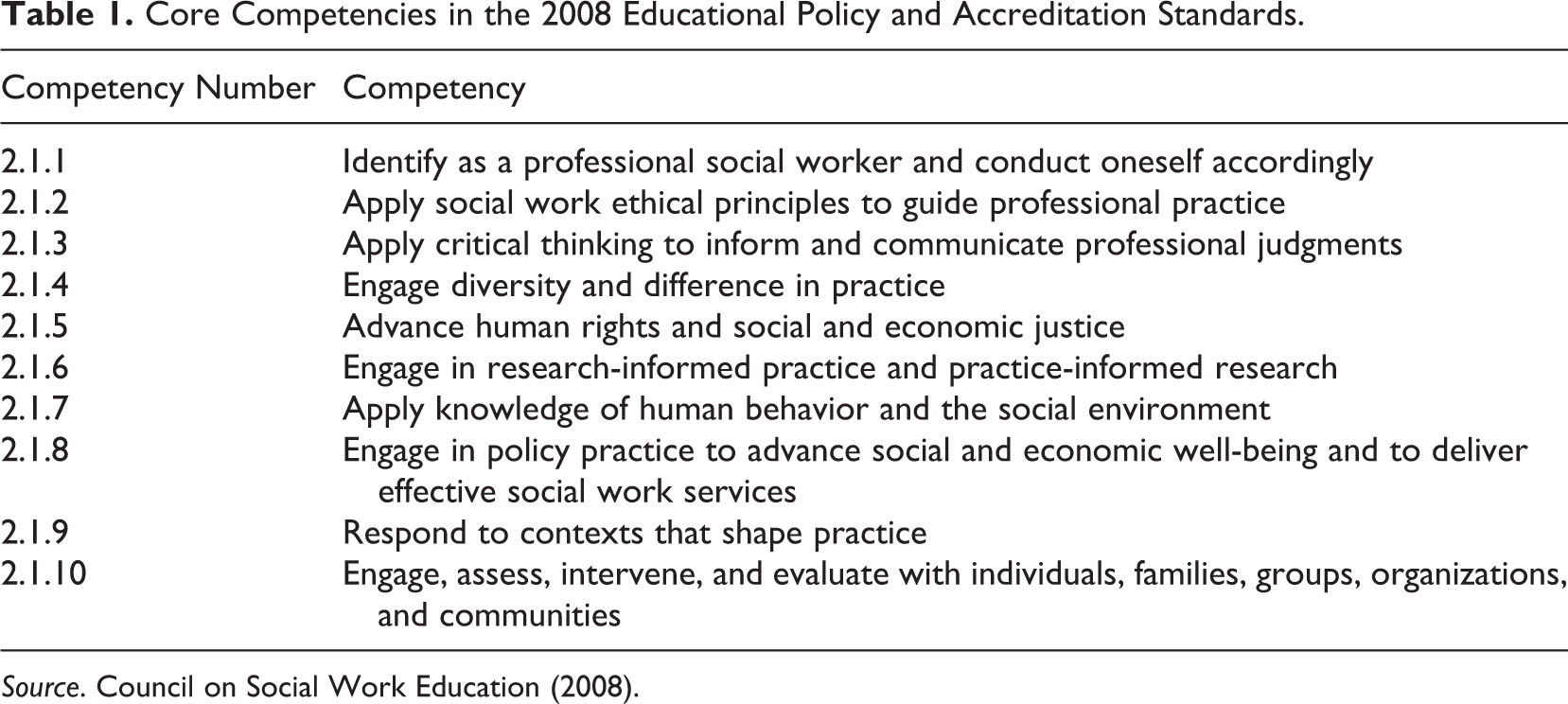
Since the 1960s, social workers have recognized the tension between the desire for accountability that CBE can provide and the difficulty of defining and measuring social work performance in multifaceted, complex, ambiguous, and unpredictable practice situations (see Bricker-Jenkins, 1990; Galambos & Greene, 2006; Jani, Pierce, Ortiz, & Sowbel, 2011; Lymbery, 2003; Middleman, 1984; Shepard &Wahle, 1981). Some have expressed this tension as the dilemma of searching for certainty in an uncertain world (Jani et al., 2011; Lymbery, 2003). In a recent analysis of the diversity standards in CSWE educational policy over time, Jani et al. (2011) made the astute observation that the 2008 EPAS tries to come down the middle of this tension, balancing accountability with the complexity and ambiguity of social work practice. For the first time in social work educational policy, it requires social work education to be designed around measureable competencies, a modernist idea, while incorporating “the subjectivity of postmodern thought” (p. 184) in its standards on diversity, which use the language of “culturally appropriate engagement,” rather than the language of “cultural competence” used in earlier policy statements.
Jani et al. (2011) noted both the challenges and the opportunities that are opened up for social work education by juxtaposing the modernist ideas of certainty (competencies) with the postmodern ideas of complexity and ambiguity that are found in the new diversity standards. They applauded the “ethical responsibility to clients and the need for accountability to funding sources and accrediting bodies” that CBE may provide, but also noted that the quest for certainty may lead to “a certain degree of prescriptiveness and discourage the emergence of more transformative social work education and practice” (p. 297). This statement echoes some of the concerns raised by the Council on the Role and Status of Women in Social Work Education about the challenges of integrating CBE with feminist pedagogy (Hutchison, Collins, & Kovacs, 2008).
Integrating Feminist Pedagogy and CBE
Feminist pedagogy is the infusion of feminist values into the process and methods of teaching. CBE is a norming approach to education, an attempt to standardize learning outcomes. Feminist and other liberatory pedagogies strive to create learning communities that transform, rather than reproduce, the status quo (Forrest & Rosenberg, 1997), just as feminist social work practice aspires to be transformative, rather than normative. In feminist pedagogy, education is a collaborative process between the instructor and the students. All are engaged; all take responsibility for and share equally in the learning process. Group problem solving is a common experience, and a diversity of ideas is sought and respected. New ways of thinking and behaving are examined in a collaborative process of creating knowledge (Dore, 1994; Forrest & Rosenberg, 1997; Tower & Gray, 2005). Students and instructors seek to understand and be responsible for the positions they espouse, taking note of the social, political, and economic assumptions undergirding ideas, theories, and actions. Such education seeks to empower students and avoid reinforcing oppressive social arrangements.
Accountability for the effect that one’s thoughts, values, and actions have on others is also a feminist value, as is ethical responsibility to clients and society. To the extent that CBE leads to greater accountability to clients and society, social work educators should embrace it. The question of whether CBE leads to such accountability is an important one for social work research, but the connections are not yet clear. In the meantime, as social work educators address the core competencies, they must find ways to balance the need for accountability with the need for creative and transformative approaches to practice that are responsive to diverse and ever-changing contexts. The core competencies adopted by CSWE present both a challenge and an opportunity for liberatory education. On one hand, it is possible that as social work educators seek ways to teach and measure competencies, they will rely on methods and measures that reinforce the status quo, rather than pursue a transformative agenda. On the other hand, the core competencies can be used to begin a meaningful discourse about such questions as these: Why these particular competencies for social work? What are examples of how each competence is relevant in practice? What is needed to develop specific competencies? How can I demonstrate a specific competence? How are the competencies related to each other? Are the competencies equally relevant in all contexts? These questions and more can be a part of liberatory education.
Examples From One Classroom
Here, in her words, are examples of how one author attempted to integrate feminist pedagogy with the new core competencies. The 2008 EPAS and the core competencies were introduced in our school of social work at the time that our program was engaged in self-study for reaccreditation. The competencies appeared midyear replacing the course objectives in the syllabus in my two-semester second-year master of social welfare (MSW) clinical practice course. Resisting the urge to lecture about them, but feeling a need to acknowledge their presence in the syllabus, I wanted to introduce this new content in a manner that was consistent with the principles of feminist pedagogy that I aspire to incorporate in my teaching. These principles include a collaborative process between the instructor and the students, group problem solving, seeking and respecting a diversity of ideas, and encouraging new ways of thinking. I asked the students to work in small groups of three or four. Each student had a copy of the competencies in the syllabus, and each group was given about 15 minutes to discuss the competencies and collaboratively draw a picture of how its members understood the competencies to be related to each other, as well as how the competencies relate to their learning and professional development. A large-group discussion followed as the small groups shared their pictures, their understanding of how the competencies were related, and the possible relevance of the competencies to their education as social workers.
The students used some great metaphors to illustrate the relationship among the various competencies. One group drew a car with a person at the steering wheel. The driver represented the first competency (2.1.1), identifying and practicing as a professional social worker. Ethics (2.1.2) was represented by a speed limit sign; the gas tank—the fuel that kept the car going—was critical thinking (2.1.3). The rearview mirror reflected the importance of looking back and all around and symbolized the students viewing themselves as learners about diversity and difference in practice (2.1.4). The headlights, guiding the car in the dark, were symbolic of social and economic justice (2.1.5). The tires that kept the car rolling down the road represented research (2.1.6). The windshield through which the driver saw the whole road symbolized human behavior and the social environment (2.1.7). The road on which the car was driving stood for policy (2.1.8) and illustrated how instrumental policy is to the delivery of direct services to clients in practice settings. And the traffic light—symbolizing stop, caution, and go—stood for the competence about how context shapes practice (2.1.9). For these upper-level MSW clinical concentration students, the entire vehicle stood for the final competency: engage, assess, intervene, and evaluate with individuals, families, groups, organizations, and communities. This model generated much discussion about how all the competencies are important to social work practice and fostered conversation about integration—how values and ethics, assessment and intervention, and research and policy are important components of effective social work practice, which pulls more from some competencies than from others, depending on the setting and client’s situation. Understanding of the interconnectedness was probably higher in this advanced practice class than it would have been with first-year students; however, the exercise could be used to help introduce these concepts in the foundation year.
Although the models produced by the other groups had less detail about each competency, several provided good metaphors and images for keeping the competencies aspirational, rather than framing them as measures by which to be judged. For example, one model incorporated the traditional Jeffersonian style architectural structure with columns. The first competency (2.1.0), about identifying as a professional social worker, served as the foundation; the roof, or the top of the building, was the final competency of engage, assess, intervene, and evaluate (2.1.10); all the other competencies were the pillars or the structures that support the building.
Another model used a pyramid with the foundation building blocks labeled HBSE (Human Behavior and the Social Environment) (2.1.7), social justice (2.1.5), ethics (2.1.2), and diversity (2.1.4); the middle three blocks were research (2.1.6), policy and practice (2.1.8), and systems/context (2.1.9); and the top of the pyramid was the social work professional (2.1.1). The entire pyramid had a circle drawn around it with the words Critical Thinking in the space surrounding the building blocks that represented the other competencies.
The second year when I engaged a new group of students in the same exercise, I was careful not to lead them with past examples, wanting their responses to be as fresh and unique as the first group of students. However, this group had some prior exposure to the core competencies in their previous courses, which perhaps gave them greater familiarity with the purpose and language of the competencies. The students in this class generated six new and different models and, again, easily engaged in thoughts about why the competencies were in the syllabus and how they related to each other and to our learning. One group traced two hands, one at each side of the paper, reaching toward each other in the middle. The left hand had words that the students described as focusing more on clinical practice: biopsychosocial framework, HBSE, ethics/values, critical thinking, cultural competence, and client focused. The right hand included the words research and policy, professionalism, theories, and social justice and repeated cultural competence and ethics/values, indicating that these concepts are important in all aspects of practice. The group spoke about everything “going hand in hand” and working together.
Another group drew a vine with many circles, looking like grapes or another fruit growing on the vine with many little leaves, some interconnected and others out to the edge a little more; however, they chose not to add words. The students in this group spoke about not wanting to “label” the pieces of the drawing because the pieces are all related and none is more important than the other. They acknowledged, however, that sometimes you focus on one competency more than the other depending on your goal. This drawing had a “growth model” image, a theme that carried over into their discussion.
Pieces of a puzzle served as the various competencies for another group, suggesting again, that no one piece is more important, but that they fit together as a whole. This group added extra words related to culture, reminding us that regardless of the focus of practice, we need to consider culture and other important elements of an individual, family, or community.
Another group drew the characteristics of a competent social worker, rather than the specific competencies. These students drew a male social worker with four hats stacked on top of his head symbolizing social workers’ multiple roles. The social worker was wearing a tie (for professionalism) and running shoes to “get everywhere in a day.” He was drawn with a big heart and was holding four little flags representing diversity/multiculturalism in one hand and a book with the word ethics in the other. He was stretching, showing his flexibility, and had a lightbulb glowing above his head to the right for new and bright ideas and an open bubble to the left, implying room for lots of discussion. The words self-aware, competent, and professional were in front, guiding him.
The third year, I was more familiar with the competencies as were the students who had seen them in all their foundation-year courses and on their field evaluation. Five groups of five students generated five new models, one involving puzzle pieces and another involving a heart in the center of the page and some symbols that were not unlike those in the models described earlier. The other three generated new metaphors: a compass with the words it’s always spinning, referring to the need to include all the competencies in our work; a world globe surrounded by images and the language of each competency, adding that they preferred calling them “elements,” rather than competencies. The third new model had an animal kingdom theme, with a tall giraffe munching on the tree of knowledge full of the words diversity, critical thinking, engage, assess, intervene, and evaluate supported with a trunk labeled “research theories.” Under the tree were other animals reflecting great diversity; nearby was a cage from which the animals had escaped in order to explore and learn. Again, I was attentive not to provide too much direction or influence, and the students easily engaged in discussions about the competencies. This year, however, several groups critiqued the overall concept of competencies, suggesting that this approach may be setting a “low bar,” not unlike the standardized tests in public schools or that they could be a cage that limits growth, as was noted by the group with the animals. Perhaps this comment addressed the notion of achieving a norm in their learning, rather than the transformational aspect of feminist pedagogy that aspires to transform learners who go on to learn at their next, higher level and to create change. It generated a discussion about how best to use the competencies, perhaps as a place to start and to refer back to, rather than a measure of students’ learning, since each student had unique aspects depending on his or her field placements, level of experience, learning styles, and other personal factors. The students were getting at some of the same concerns raised in this article, a discussion that reflected their use of critical thinking skills (2.1.3).
The goal of the exercise was for the students to engage in the process of thinking collaboratively and critically about social work competencies in relation to the complexity of social work practice, a tension addressed by social work scholars over several decades (see Bricker-Jenkins, 1990; Galambos & Greene, 2006; Jani et al., 2011; Lymbery, 2003; Middleman, 1984; Shepard & Wahle, 1981). Given the linear and repetitive appearance of the competencies in each syllabus, I wanted to engage the students in an exercise that helped to clarify that the development of competence as a practitioner is a process that may not be the same for every student, despite the students’ common aspirational goals and exposure to the same content. Although I was more interested in the process than in any particular models the students developed, the students’ creative products were engaging and provided useful metaphors for learning. In addition, the group exercise worked well to help the students get to know each other the first day of class and, I hope, modeled the benefits of group problem solving and the collaborative creation of knowledge. The students’ creativity and engagement fostered meaningful discussions about what competence looks and feels like and how the core competencies can be a starting point for the lifelong journey of developing as a competent professional. For some, the competencies were, thus, seen as aspirational goals, something to help them grow or transform, rather than outcome measures for their learning in the MSW program.
Conclusion
Social work’s embrace of CBE has been five decades in the making. It has been motivated in large part by the profession’s commitment to accountability, to protecting clients and the public. It also seems to have been motivated by a sense that CBE meets a pressing need to shore up the credibility of the profession, a recurring theme in the social work literature for the past century. The CSWE EPAS present a set of core competencies that include modernist ideas of standardization and postmodern ideas of complexity and diversity. The competencies, both as a set and individually, can be interpreted in different ways by different analysts. They can be used to justify the status quo, and they can be used to justify creativity and transformation. Social work educators must be attentive to which way the balance tilts. Feminist pedagogy can be used to help students think critically about that balance and to begin to imagine creative ways to evaluate competencies—to answer the question, “How will we know when we are there?” This issue of the competency evaluation is one that has eluded the CBE movement across disciplines to date.
Footnotes
Declaration of Conflicting Interests
The author(s) declared no potential conflicts of interest with respect to the research, authorship, and/or publication of this article.
Funding
The author(s) received no financial support for the research, authorship, and/or publication of this article.