




Abstract
This study explores how formerly incarcerated women define success. Qualitative analysis of data from in-depth interviews with 30 women who had been released from prison at least 3 months prior to the interview suggests that avoiding recidivism is only one aspect of success for this population. Success is defined as having their own place, helping family members and others, living free from criminal justice surveillance, persevering through challenges, and living a “normal life.” Ways in which these conceptualizations expand traditional notions of success for this population are discussed. Limitations and suggestions for future research are offered.
Since 1980, the number of women incarcerated in U.S. state and federal prisons has increased by 840% (Gilliard & Beck, 1994; West & Sabol, 2010). As their proportion in the general prison population grows, women’s representation among paroled and probationed populations is also growing (Glaze, 2002; Glaze & Bonczar, 2011). When all forms of correctional supervision—probation, parole, jail, and state and federal prison—are considered, more than 1 million women are currently under the control of the U.S. criminal justice system (Lapidus et al., 2005).
The vast majority of women incarcerated in the United States will eventually be released (Visher & Travis, 2003). Hoping to build a new life for themselves and their children when they come home, formerly incarcerated women (FIW) instead return to their communities to face an array of barriers to successful reentry, including barriers to employment, housing, education, civic participation, and income assistance, and difficulties reuniting with children and families (Arditti & Few, 2006; Legal Action Center, 2004; O’Brien & Young, 2006; Petersilia, 2005; Richie, 2001; Travis, 2005). These barriers contribute to a staggering rate of recidivism. The California Department of Corrections and Rehabilitation (CDCR) reports that 38.3% of females released from California (CA) prisons between July 2006 and June 2007 had returned to prison within 1 year, and by 3 years that number rose to 55.1% (CDCR, 2011).
Research on the “gendered pathway” to criminal justice involvement (Daly, 1998) highlights incarcerated women’s pre-prison social disadvantages (addiction, mental illness, victimization, economic marginalization, and dependent caretaker responsibilities), their relational motivations for crime, and the differential effects of prison life on their psychosocial adjustment (Jiang & Winfree, 2006; Lewis, 2006; Steffensmeier & Allan, 1998). As pathways into criminal justice involvement are gendered, so too are the pathways out of prison and back into the community. Stigma and internalized shame present unique obstacles for women being released from prison, who are often seen as irrevocably “fallen” women who have violated the social contract and transgressed fundamental moral principles of womanhood (Davis, 2003). Labels typically given to them—offenders, criminals, convicts, and felons—give the impression that they may never overcome their past (LeBel, 2011). This form of social exclusion has dire consequences for women’s self-esteem and ability to successfully reintegrate into the community (Dodge & Pogrebin, 2001).
Visher and Travis (2003) note that the literature on prisoner reentry has traditionally focused on recidivism as the primary, if not the only, indicator of success for formerly incarcerated people. Indeed, a meta-analysis of reentry interventions for women found, such as a lack of outcome measures other than recidivism (such as well-being, self-esteem, psychological symptoms, or substance use), that no analysis could be performed on these other variables (Heidemann, Soydan, Xie, & Martinez, under review). Even some of the feminist research examining FIW’s experiences of reentry has either imposed a definition of success or allowed participants to simply self-identify as “successful” without exploring what that means to them. For example, O’Brien (2001) interviewed FIW to identify the resources, capacities, and resiliencies necessary for successful reentry and recruited participants, “who, by their own definition, identified themselves as successful after incarceration” (p. 288). Bui and Morash (2010) sought to explore the “experiences of a sample [of formerly incarcerated women] who were successful on parole for at least one year” (p. 2). Specifically, they explored how social networks can help FIW “avoid crime after release” (Bui & Morash, 2010, p. 1); that is, they viewed recidivism as the definitive indicator of success.
It is important to note that the studies cited above, along with numerous others, actively solicit the affected populations’ experiences of reentry while highlighting its multifaceted nature. In doing so, they have contributed much to our understanding of the phenomenon. The FIW in O’Brien’s (2001) study identify finding shelter, obtaining a legitimate source of income, establishing connections with others, participating in the community, and having confidence in themselves as crucial factors in reentry. Participants in Bui and Morash’s (2010) study report that dissolving negative relationships, conscious efforts to improve current networks, and engagement in prison programming are critical to facilitating their successful reentry. Other scholars point to the caretaking roles reentering women must reassume—including those as mother, daughter, and sister—and how these roles shape and inform, facilitate, and hinder their process of reintegration (Brown & Bloom, 2009; Leverentz, 2011). Scholarship on desistance (Maruna, 2001) further explores how formerly incarcerated women and men exit their once “deviant careers” and develop reformed identities to remain free over the long term from further criminal activity. This is often done through work, establishing prosocial relationships, and engaging in other forms of “making good” (Maruna, 2001). Opsal (2011) specifically highlights the efforts of FIW to resist a stigmatized “felon identity” and pursue new lives and identities on their own terms as recovering substance abusers and good mothers.
The studies cited above highlight the multifaceted and gender-specific nature of the reentry process for women, moving the body of literature beyond a focus exclusively on recidivism as the only or the primary indicator of success. Our discussion on imposed definitions of success is thus not intended to be critical of the extensive and informative body of scholarship on the issue of women’s reentry and desistance but rather identify an important gap, the lack of empirical data regarding what constitutes success in the eyes of members of this population. Even the desistance literature typically focuses on those individuals who have chosen to pursue a reformed identity that involves long-term disengagement from criminal justice involvement, which may or may not be desirable or possible for all FIW. Given the economic marginalization, disenfranchisement, stigmatization, social exclusion, and ongoing surveillance that result from criminal justice sanctions that are sometimes imposed even long after release (Christian & Thomas, 2009; LeBel, 2012; Travis, 2002), it seems critical to identify how FIW conceptualize success.
This study adds to the existing literature on women’s reentry from prison by listening to how previously incarcerated women define success for themselves. Our intent is to engage the body of literature on women’s reentry and desistance to promote a more nuanced approach to understanding outcomes for this population. A single research question guided our study: How do FIW define success? It is critical to gain a broad understanding of what success means to this population if we wish to develop practices and policies that help to facilitate their successful reentry. This study is the first we are aware of to elucidate what success means to FIW.
Method
Design
The data for this study were drawn from a larger mixed methods project that explored the barriers to and facilitators of success among FIW as well as their definitions of success. Qualitative data from in-depth semistructured interviews were used to address this study’s research question. Approval was obtained from the University of Southern California Institutional Review Board (IRB).
Participant Recruitment and Screening
A purposive sample of 30 FIW were recruited primarily from agencies that serve this population and through direct contact with FIW known to the principal investigator (PI). The purposive, maximum variation sampling strategy sought inclusion of FIW into the study who varied in terms of offense type, number and duration of previous incarcerations, and length of time living in the community since last release. Initial contact was made with the directors of agencies serving this population, the purposes of the research project were explained, and directors were provided with a recruitment flyer and the study’s IRB approval letter. In some cases, directors assigned staff to help recruit participants. In other cases, the PI was invited to come and speak to clients and recruit them directly, and in other cases, a flyer was posted and potential participants contacted the PI. Ultimately, the following number of participants were recruited through these agencies: (1) a sober living home for women (13 participants), (2) a resource and support center for women living with HIV/AIDS (8 participants), (3) a supportive housing facility for people living with HIV/AIDS (1 participant), and (4) a drop-in center for homeless young persons (1 participant). All of these agencies are located in Los Angeles County, CA. In addition, seven FIW personally known to the PI agreed to participate in this study.
Eligibility screening was conducted with all potential participants based on the following five criteria: (1) the participant is female; (2) she resides in Los Angeles County; (3) she has been incarcerated at least 1 time in state or federal prison; (4) her last release from prison was at least 3 months prior to the date of the interview; and (5) there have been no arrests, parole violations, or reconvictions since then (all based on self-report). As the larger project aimed to understand the barriers to and facilitators of success among FIW, we felt that women who had been living at least 3 months in the community since release would best be able to speak to those factors that were facilitating and those that were hindering their reentry.
Data Collection
Once eligibility was established, the PI/investigator scheduled an appointment to meet with the participant at a location of the participant’s choosing. Typically, this was in the participant’s place of residence or work; in a few instances, it was in a private room at a public library or social service agency. Each participant was provided with an information sheet explaining the purpose of the study, its voluntary nature, and the benefits and risks. Consent was obtained verbally. Interviews lasted between 45 minutes and 1 hour and explored women’s feelings on the day of their release, the barriers they have faced in their reentry, their definitions of success, and the “ingredients” they felt were necessary to become successful. Interviews were audio recorded. Upon completion of the interview, participants completed a structured survey, which included pertinent demographic data and a number of standardized scales. The survey took participants 1 hour on average to complete. Participants were compensated US$50 for their participation. Data collection was completed between June and December 2012.
Data for this study are drawn from the in-depth interview portion of the larger project and specifically from responses to questions such as “How do you define success?” “Do you feel that you have been successful?” “What would success mean to you?” and “What goals are you pursuing that will allow you to become successful?” Other topics covered in the interview are discussed elsewhere (Heidemann, 2013; Heidemann, Cederbaum, & Martinez, 2014). In some cases, additional portions of text are included to provide context related to an individual’s definition of success.
Data Coding and Analysis
Interviews were transcribed verbatim by a professional transcriptionist and were subsequently reviewed and corrected by the PI. All participants spoke English as their first/primary language; thus, translation was not necessary at this or any stage. Data were then entered into the qualitative software package ATLAS.ti, version 6, for purposes of organizing the data during the coding process. Thematic analysis (Braun & Clarke, 2006) was employed to analyze data and present findings relative to FIW’s definitions of success. Thematic analysis is used to identify, analyze, and report patterns or themes that recur across a data set (Boyatzis, 1998). It is not wedded to a preexisting theoretical framework and thus can be used flexibly (Braun & Clarke, 2006).
Analysis began by reducing the data, a process of selecting, simplifying, and transforming the data (Miles & Huberman, 1984). The PI and a master’s level research assistant together then read and reread the transcripts and noted initial observations. These initial observations were reviewed and revised through further rereading of transcripts and were used to develop an initial codebook that captured the themes that were emerging from the data. Braun and Clarke (2006) assert: “A theme captures something important about the data in relation to the research question, and represents some level of patterned response or meaning within the data set” (p. 82). This was our primary guidepost for determining themes in the data. We selected those elements that were repeated by several women, that were given ample space within each data item, and that were viewed as relevant to the research question. The codes were reviewed for consistency with the data extracts (i.e., were all the data extracts coherent and related and did they collectively represent the theme) and for validity in relation to the data set (i.e., did the identified themes accurately represent the data as a whole; Braun & Clarke, 2006). Finally, each theme was given a name that reflected its content and a definition. The PI and research assistant then independently and systematically applied the refined codebook to six randomly selected transcripts. The percent agreement was measured and was found to be 82%. The most common discrepancies were related to the amount of text included for a given theme. In rarer cases, it was discovered that two or more themes overlapped; thus, they were subsequently collapsed. The final codebook was then systematically applied to the entire data set to identify all data extracts associated with the codes.
Sample Description
The sample for this study consists of 30 FIW who participated in in-depth, semistructured interviews. Table 1 displays the participants’ demographics. Their ages ranged from 25 to 65 years; the average age was 47. Most women identified as African American (26 women; 87%), three women (10%) identified as white, and one woman as Latina. The average amount of time participants had been living in the community since release was four and a half years, with a range from 3 months to 16 years. Thirteen participants (43%) had most recently been convicted of a drug offense, 10 (33%) of a violent offense, and seven (23%) of a property offense. Three women were most recently in prison for a parole violation. At the time of the interview, majority of the women (68%) were not under any form of criminal justice supervision, while 18% were on parole and 14% were on probation. Half of the women had only been incarcerated 1 time, while four had been incarcerated twice, three had been incarcerated 3 times, four had been incarcerated 4 times, and the remainder had been incarcerated 5 or more times. Typically, those women convicted of drug-related crimes had cycled in and out of prison several times serving short sentences, while those convicted of more serious or violent crimes had served longer but fewer sentences.
Participant Demographics.
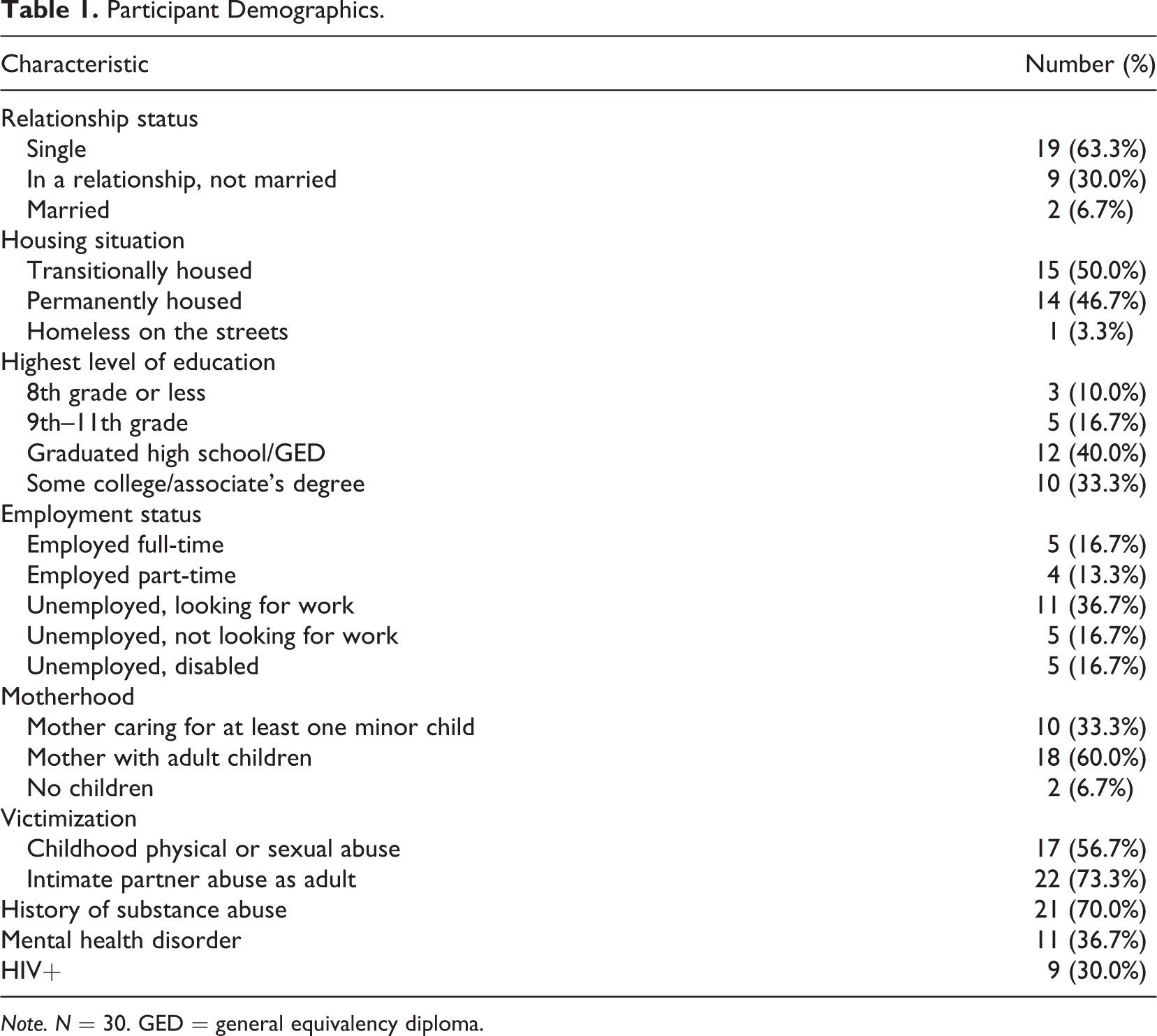
Note. N = 30. GED = general equivalency diploma.
Findings
Women’s responses to probes regarding what success means to them were classified into five distinct themes, which are reported below. To allow readers to assess the evidence themselves, direct quotes from participants are included throughout the analysis below. Participants are signified by aliases assigned by the PI.
Theme 1: Success Is Having My Own Place
Participants’ responses indicate that having their own place is an important aspect of success. Varied meanings were ascribed, however, to having one’s own place. For some women, it meant having a place of one’s own (i.e., a place to be by herself), while for others, it meant having a place on one’s own (i.e., paid for by herself). For many of the women we spoke to, the possibility of acquiring market housing was out of reach due either to mental disability that prohibits them from working or the lack of and barriers to living-wage employment. Desire for a place of one’s own was often articulated by these women.
Tyra, for example, who resides in a sober living home, reported: I’m tired of the institutional-type settings. I’m tired of living with others. I’m tired of the bathroom sharing and all of that …. I need a home. I’m getting old. I don’t wanna be going through this when I’m like sixty, if living is the Lord’s will, if I’m still alive, to be not having my own place or whatever, living in different places, shelters, and stuff.
Other women specifically articulated a desire to have a place on their own; one that they paid for by earning a living. Yolanda, a 41-year-old African American woman, intends to utilize her time in temporary housing to get an education and find work. “I need a roof over my head ….while I’m here I just wanna try to find a job and just get stable, like get a foundation going like for when I go to school.” Flora, a 65-year-old African American woman, was one of 25 students at her college to be selected to participate in a special computer science program. After completing her associate’s degree, she hopes to open her own consulting business and then move into her own place. Terri, a 46-year-old African American woman, lives in the sober living home and works part time as an in-home care provider for an elderly woman. She articulated her plan for saving money and moving into her own place. Success for me would be to find a full-time job, having my own apartment, and a car. I already have a bank account, so I started saving and just having my own place. I am really, really excited about having my own place … it would be nice to put my own key in the door, you know what I mean? I look forward to that.
This theme was the only of the five in which FIW identified a specific outcome (having their own place) as indicative of success. The remaining themes do not involve outcomes but rather are more process oriented.
Theme 2: Success Is Helping Family and Others
The FIW in our study identified the ability to care for family members and others who have been incarcerated or are in need as an important aspect of success. Tyra, a 48-year-old African American mother, spoke at length about her relationship to her two teenage sons and about how bad she felt for leaving them in a position where they had to fend for themselves while she was incarcerated. As she reports, “I worried about them constantly. And then I came to find out that they were actually sleeping in a garage on a dirt floor so I was just … It was just horrible.” When asked what success would mean to her, she responded, What will give me peace is being able to help my sons out. So I’ll see that they’re grounded and they don’t have to be straggling and struggling for everything and we have to monitor this amount that we pay for a pair of jeans and they’re not in their own car, things like that. That would make me happy. Success would mean where I can help take care of my older children, my grandkids, with the monetary gain. I would like to do that and to be able to say, “Here, do things.” … Like if they need a little car fixed. I ain’t talking about buying no house or nothing like that, just helping them out. That’s all. Pay a bill or two. “You can keep that money in your pocket, I’ll pay the bill.” Something like that, that’s all.
These examples highlight how, for FIW who are also mothers or grandmothers, success is deeply connected to their ability to provide basic care for their children and grandchildren, often in ways that they were unable to in the past. Reentering mothers often face stigma and informal sanctions for being “bad” mothers (Brown & Bloom, 2009; Kennedy, 2012). Yet resuming motherhood may provide FIW with a catalyst for identity change and desistance (Giordano, Cernkovich, & Rudolph, 2002; Opsal, 2012) and is cited in literature as central to their sense of self (Brown & Bloom, 2009; Leverentz, 2011). Thus, being able to provide for their children and grandchildren in small but meaningful ways may be a gender-specific aspect of success for this population.
Yet success was not limited to helping the members of participants’ immediate family. Many of the women we spoke to were volunteering or working in some capacity helping others and defined success by their efforts to assist these other people. Florence heads up a group that advocates for the rights of lifers and assists their family members to cope with having a loved one serving a life sentence. She reported feeling successful when she won an award for her work. Maxine founded a nonprofit organization that provides an array of services to women coming home from prison and had this to say: “Making positive contributions from myself to the community, that’s success.” Henrietta organizes an event each year that takes children to see their mothers in prison on Mother’s Day. When asked what goals she has that will allow her to feel successful, she said, “I want to always be a part of a movement. I never want to work for a for-profit place ever. I do know that, because I like to help people, especially incarcerated and formerly incarcerated people.” Tina, who was incarcerated for 16 years for murdering the man who had repeatedly molested her as a child, also included helping others in her definition of success. [Success is] being able to help people, not only people who have been abused but women who have been in prison, you know, people who just have it hard, you know, ‘cause I know what it’s like having it hard.
This theme is one that lacks a specific marker or indicator of success. Participants’ responses did not indicate that they were seeking a certain outcome—such as greater connection, love, or respect—from those they help. Rather, our findings indicate that success is achieved through the good feeling FIW get from being able to give something back to others, a finding echoed in existing literature on formerly incarcerated people as wounded healers (Heidemann, Cederbaum, Martinez, & LeBel, 2015; LeBel, 2007; LeBel, Ritchie, & Maruna, 2015).
Theme 3: Success Is Living Free From Criminal Justice Involvement
The traditional focus on recidivism would have us believe that simple avoidance of further criminal justice involvement is, itself, an indicator of success. Our participants’ voices reflect a much deeper and nuanced conceptualization of this outcome, one that paints a picture of freedom not as an outcome at all, but as a process and an opportunity to live more fully and freely. Approximately one third of the study participants were still under criminal justice supervision at the time of their interviews and these women often identified a desire to no longer be on parole or probation and how this desire is connected to their ability to live autonomously. Cathy, a 32-year-old African American woman who is serving Post Release Community Supervision—California’s new system of probation for nonviolent offenders—said that she will feel successful “once I get my number back and I’m just living life and being happy.” “Getting their number back”—a colloquial term for discharging parole/probation—is often viewed as a right of passage and a signifier that they are finally free to lead their lives without being under the constant surveillance of the criminal justice system. Tina who was still on parole at the time of her interview had this to say about what it would mean to her to finally discharge parole: It means that I am completely free. I’m free now, but I’m not free, ‘cause I still have to report to them. I have to, every month, go see a parole officer, pee in a cup, you know, she has to come out here and make sure I’m still living here and I’m not trying to flee and, you know, it’s just, I’m still under the system. So to get off of parole, not like I’m going to go and say, “Woo! I’m off of parole, now I can do drugs and now I can do this.” No, now I can just really live my life. I don’t have to answer to nobody like in that authority, you know, and that would be a wonderful feeling.
Although continued freedom from criminal justice involvement was expressed as a desire, as well, for those women who had already discharged parole/probation, what they reported would indicate success was something more internal. Abbey, a 59-year-old African American woman who had just discharged parole a month before her interview, expressed the following: What success means to me is that first of all I am not in prison and I’m never going back. I’m successful because I don’t have to feel enslaved to leading a life filled with crime. I’m successful because stuff that used to be important to me is not and it’s okay. That I have peace, I have a peace that nothing and nobody can take. That is what success looks like to me. I’ve seen my life. Like I can always guarantee to go back to that life, right? It’s always a guarantee. Like prison will always be there, the dope will always be there, liquor stores will be on every corner, but there’s not always a guarantee that I’ll make it back. You know what I mean? Like here’s the alternatives, I’ve seen that, I’ve never seen this, why not go for this? You know what I mean?
Theme 4: Success Is Persevering
The women in our study identified having made it through other challenges they have faced and continue to face—particularly interpersonal violence, trauma, homelessness, mental illness, and substance abuse—as part of their conceptualization of success. Although their individual circumstances varied, many of them expressed that they feel successful simply by virtue of the fact that they have not given up; that they are moving forward, being positive, and coping with the challenges of everyday life. As Beverly puts it, “I feel successful versus before, because before I wasn’t doing nothin’, now I am doing it. Success for me now would be for me to be doin’ just what I’m doin’.” When she says, “doin’ nothin’,” Beverly is referring to years of spiraling depression, drug addiction, and homelessness that occurred after the deaths of both of her parents and the father of her children—all of which occurred after her last incarceration. Now she resides in Section 8 housing with her daughter with whom she recently was reunified. Beverly communicated with pride how she had finally picked herself up and began moving forward and that this was sufficient for her to feel successful.
Other women in the study reported having survived trauma and defined success in relation to it. Robin, a 52-year-old African American woman, is a survivor of domestic violence. At one point, her boyfriend fractured her nose and tore 10 ligaments in her face. Having survived the abuse, Robin reported, “what success means to me is standing solid, you know … to keep on keeping on.” Natasha, a 32-year-old African American woman, suffers from bipolar disorder and post-traumatic stress disorder subsequent to having been raped at gunpoint by her own father whom she met only as an adult. Her struggle to cope with the effects of the trauma can be heard in her definition of success. Success would be um … learning how to deal with my emotions, learning how to deal with um … things that aren’t easy, um … and persevering and get through them instead of like always like opting out.…[Today] I deal with life on life’s terms and, like, when I hurt, just get through it, when I’m upset, just get through it, when I feel insecure, just get through it. … accomplishing a little a day, it is not accomplishing nothing big, it is just … to me success is just everyday making it through the day, whatever your struggles are, and getting over it every day … I struggle with addiction and being a Mom. If I can make it through the day, I’ve succeeded. I’m not successful, yet.… I don’t have all of the money yet that I want. I’m not living the way I want to live, but it’s definitely better than it was 6 months ago, two and a half years ago …. [I] just keep going to meetings, talking to my sponsor, working hard, studying hours a night when I don’t want to, when I have to be up at 5 a.m. and I’m still studying at 2 a.m. But it’s worth it, you know? It’s worth it.
Our respondents have and continue to struggle with addiction, homelessness, mental illness, chronic health conditions, and intimate partner violence. Many of them will continue to confront these challenges for the rest of their lives. Our sample is not unique in this regard; literature has documented high rates of mental illness, substance abuse, and victimization among this population (Harlow, 1999; James & Glaze, 2006; Maruschak, 2012; Mumola & Karberg, 2006; O’Brien & Young, 2006). Success, therefore, is defined in relation to these ongoing challenges and is indicated by having made it through the day and by moving forward one step at a time. In some ways, this component of success might be seen as a supplement to or elaboration upon FIW’s desire to remain free from criminal justice involvement through long-term lifestyle choices (Theme 4). The forces that once kept them enslaved were elaborated here in women’s descriptions of continually addressing the consequences that violence, mental illness, and substance abuse have on their lives. Here, again, success was conceptualized as a process as opposed to an outcome.
Theme 5: Success Is the Elusive “Normal Life”
Having a normal life—one that was often difficult to define and that felt a long way off—was identified as an indicator of success. Tyra, who was disturbed that her teenage sons had been living in a garage while she was incarcerated, expanded on the life that she hopes she and her sons can enjoy in the future as part of her definition of success. It’s like God, did you really just waste all that time, miss out on all of that important stuff with your sons? How do you even go about making that up? So that’s why I just strive, I’m just striving to try to get to that place where they can come home whenever they need or want to and we can start having a normal life. I just want to live a normal life, do normal things, and just enjoy my sons because who’s to say how long you have left on this earth? I just want to have a real life. I just want my family all together and live like normal people, however that is. What normal is, I want that. I don’t know what that is but I want it. Whatever it is, I want it. These people that are running around here, they’re 60 and 80 years old and still together and happy and healthy and that’s what I want. … women who have been incarcerated might not have ever known those things, they might be altogether foreign from the places that they’ve derived from and the journey that they’ve had …. I didn’t feel safe and I had never felt safe, so how do you build relationships, how do you have trust if you don’t feel safe in the world, if you don’t ever know it or even know that it is there? I mean if you never been hungry, you don’t know what it is like to be hungry … [There is] a void and a yearning to actually be fulfilled, but you don’t know what that is until you start, until you begin to build it and access it.
Discussion
The literature on prisoner reentry has often focused on recidivism as the primary, if not the only, indicator of “success” for this population (Visher & Travis, 2003). To date, the extent to which FIW themselves identify recidivism or something(s) else as indicative of their success has been unknown. In this study, we aimed to elucidate what success means to FIW through in-depth interviews with 30 members of this population. Five themes were identified in our analysis, only one of which included a specific, external indicator of success and the other four of which were more process oriented.
Success was defined by FIW as having their own place, whether a place of one’s own (by herself) or a place on one’s own (paid for by herself). Participants’ responses implied that living in temporary and shared/group environments was undesirable. A feeling of accomplishment and pride could be achieved by acquiring housing either through self-reliance or through government-sponsored programs like Section 8. Minimally, FIW identified acquiring housing that affords them privacy and autonomy as indicative of their success. Previous literature cites safe and stable housing as one of many factors FIW need to be successful in their reentry (O’Brien, 2001). Our findings suggest that it is not merely a factor in successful reentry but part of the definition of successful reentry. It is an outcome unto itself, as identified by FIW. This finding is, to our knowledge, one that has not been previously elucidated.
Success was further defined by being able to help family members and others. This component of success was indicated not by a specific outcome but rather by FIW’s desire for “generativity” through giving back to the next generation—either their own family members or individuals like themselves with histories of incarceration and substance abuse in need of support (Maruna, 2001). This gender-specific component of reentry is consistent with literature on women’s desistance and their quest to amend for prior wrongdoings by engaging in a maternal or caretaking identity script (Heidemann, Cederbaum, Martinez, & LeBel, 2015; Leverentz, 2011; Opsal, 2011). This finding is also consistent with literature that highlights the important role of caretaking and the resumption of the mothering role in facilitating the process of reintegration (Brown & Bloom, 2009; Leverentz, 2011). While previously considered a factor that promotes successful reentry (i.e., avoidance of recidivism), our findings again and instead point to caretaking and “giving back” as part of the definition of success. FIW define themselves as successful when they are able to enact the identity script of mother and caretaker (Brown & Bloom, 2009).
National organizations of formerly incarcerated people, such as All of Us or None (All of Us or None, n.d.) and the Formerly Incarcerated and Convicted Peoples Movement (FICPMovement, n.d.) as well as local examples in Los Angeles like A New Way of Life Reentry Project (A New Way of Life, n.d.) and Homeboy Industries (Homeboy Industries, n.d.) are models for how formerly incarcerated people can not only support one another but also unify behind reentry policy reforms. In these groups, which are comprised predominantly of formerly incarcerated persons, members treat their peers not as “ex-prisoners” but rather as essential actors who have the political power to confront the oppression in our current prison and reentry systems. As Brecht (1913, p. 219) reminds us, “The compassion of the oppressed for the oppressed is indispensable. It is the world’s one hope.” Indeed, these groups of formerly incarcerated persons are enacting their own definition of success by organizing for collective action against the systems that once kept them confined.
While a third definition of success most closely resembled the traditional focus on recidivism, our findings reveal that FIW do not define success directly as avoiding further criminal justice involvement. Although a desire to discharge probation/parole and not return to prison was indeed important to them, a deeper desire to be the prime agents of their own lives emerged. Success was conceptualized as an internal “shift” away from a previous lifestyle and toward a new one comprised of actively and continuously freeing themselves from forces that once kept them enslaved. In order to fully enact this new lifestyle, FIW require freedom from the ongoing surveillance and control of criminal justice authorities. The heavy hand of the so-called prison industrial complex in surveilling, policing, criminalizing, confining, and punishing poor women of color has been widely discussed (Golden, 2013; Sudbury, 2014; Wacquant, 2009). It is no surprise to discover that FIW deeply desire and even define success for themselves as the ability to live free from these confining, pervasive forces that have so greatly impacted their lives (Opsal, 2015). What is new about this finding is that it places FIW squarely in the center of their own lives where they are defined not in relation to their criminal justice involvement but as completely autonomous beings actively choosing their own life path. This definition of success rehumanizes this population too often defined by their past mistakes and stigmatized as irrevocably fallen women (Davis, 2003; LeBel, 2011).
Fourth, FIW defined success as persevering through challenges, namely, substance abuse, mental illness, trauma, and violence. Empirical literature confirms high rates of as well as the devastating consequences of these conditions among this population (Harlow, 1999; James & Glaze, 2006; Maruschak, 2012; Mumola & Karberg, 2006; O’Brien & Young, 2006). Self-help and 12-step models of recovery from substance abuse and mental illness often characterize the recovery process as a lifelong one that occurs “one day at a time.” This focus on getting through a 24-hr cycle is thought to diminish the overwhelming feeling that might accompany never being able to drink again, for example, or having to live with severe mental illness for the rest of one’s lifetime (Deegan, 1988; Valverde & White-Mair, 1999). Again, a classical view of “successful reentry” as one that avoids recidivism would view engagement in recovery processes as a factor that might help facilitate success. Our findings point, however, to this process of daily meeting the challenges posed by substance abuse, mental illness, and the effects of trauma and violence as part of FIW’s definition of success itself. They do not view their recovery as a means to an end. Rather, the process is its own reward. They feel successful each day they are able to “make it through” and to take a step forward in a positive direction.
Finally, success was defined as living a “normal” life. Although elusive in many ways, the normal life FIW desire included such elements as togetherness with family members and long-term residence in the community. These are things that have been absent from their lives up to this point. While appearing rather modest on its surface, the elusive quality heard in this conceptualization of success is quite understandable when viewed in light of the many obstacles placed in FIW’s way (e.g., stigma, discrimination, barriers to housing, income support, civic participation, and reunification; LeBel, 2011, 2012; Legal Action Center, 2004; Petersilia, 2005; Travis, 2005) as well as the previously discussed lifelong challenges of substance abuse, mental illness, and trauma. A normal life might actually be far off or even out of reach for some. Alternatively, the elusive normal life might be considered the ultimate outcome for this population. When they finally have their own place, when they are taking care of family members and others, when they are free from criminal justice surveillance and other “enslaving forces,” and when they are actively choosing a new life path and persevering though life’s challenges, perhaps the elusive normal life will be experienced.
Researchers, criminal justice authorities, community and social services organizations, and entities that study and serve FIW should consider these findings when seeking to evaluate outcomes for this population. Although our findings might be considered preliminary given the exploratory nature of the study and its limitations (discussed below), they reveal five categories that might be considered as guideposts when attempting to evaluate reentry outcomes. Although success was often defined by FIW as a process rather than an outcome, when viewed from the perspective of providers, the first four of our themes might be roughly summarized as (1) safe and permanent housing, (2) opportunities to care for family members and help others, (3) autonomy and freedom from surveillance, and (4) an environment that supports recovery from substance abuse, mental illness, and trauma. The fifth theme might be considered an outcome that will naturally occur if FIW are provided an opportunity to experience the other four.
These findings may or may not correspond to societal expectations for this population. Since this was not the focus of the present study, future research might seek to fill this gap by comparing FIW’s definitions of success with those of criminal justice authorities, policy makers, community service providers, or others. Here, we sought to elucidate FIW’s definitions of success to expand traditional conceptualizations of what that might be, given the lack of empirical data in the literature on the topic. We hope researchers, program evaluators, and decisions makers who study and evaluate outcomes for this population look beyond recidivism as the only or the primary indicator of FIW’s success.
Study Limitations
Our findings related to FIW’s definitions of success should be viewed with caution, considering the study’s limitations. Our recruitment strategy yielded a sample comprised largely of heavily service-connected women, many of whom were residing in a sober living home, and was also comprised disproportionately of women of color. The sample was further restricted geographically. The women in our sample thus may be qualitatively different from those who opted not to participate, who were more transient or isolated, who do not reenter through sober living facilities, or who reside in rural locales. Thus, we cannot deduce how generalizable our findings are to the broader population of FIW. However, we were successful in recruiting a group of FIW who were diverse with regard to type of prior conviction and amount of time they had been living in the community since release. Many women had cycled in and out of prison due to a drug addiction; others had served longer (and fewer) sentences for violent or serious crimes. Similarly, some women had been released as few as 3 months ago, while others had been successfully living in the community for more than a decade. This diversity allowed us to capture a broad range of perspectives, which are reflected in our findings.
Conclusion
As municipalities strive to address the growing number of women being released from prison, the finding that recidivism is not the only (or even most important) piece of the “success puzzle” for FIW should be taken into consideration. Factors such as housing status, self-acceptance, resilience, reunification, recovery, perseverance, and caretaking should be considered as additional and equally important indicators of success. There may be others, as well, which are elucidated through future research on this question. Given complex histories and a host of internal challenges and external barriers, a focus predominantly on recidivism obscures those outcomes FIW desire most for their own lives. Defining success simply in relation to criminal justice outcomes such as rearrest or re-incarceration may further be dehumanizing to this population. FIW exist within an intricate web of individual traits and circumstances, familial and peer relationships, community characteristics, and social policies (Visher & Travis, 2003). To view them as anything less than that is to deny the complexity and the truth of their lives. Considering the multifaceted and nuanced nature of their own conceptualizations of success would be a modest effort toward recognizing and honoring the full personhood of this oft marginalized and oppressed population.
Footnotes
Acknowledgment
The authors wish to acknowledge the John Randolph Haynes and Dora Haynes Foundation for the provision of a 2012 Haynes-Lindley Doctoral Dissertation Fellowship that helped to make this work possible.
Declaration of Conflicting Interests
The author(s) declared no potential conflicts of interest with respect to the research, authorship, and/or publication of this article.
Funding
The author(s) received no financial support for the research, authorship, and/or publication of this article.