




Abstract
Transgender (trans) and gender diverse (TGD) people continue experiencing profound expressions of stigma and discrimination in their attempts at accessing care, including support from the social work profession. Incorporating the lived experience of TGD people as practice knowledge in social work may serve to enhance the profession's relationship with TGD communities and mitigate historical barriers of this population to relevant services. In this study, we draw on qualitative data based on individual interviews with 20 TGD people and 10 social workers in a Western Canadian province to explore the potential of leveraging the lived experience of TGD people as practice insight in social work. Our analysis, which is supported with the tenets of feminist standpoint theory, reveals that incorporating the lived experience of TGD people in social work as practice knowledge may inform and catalyze interventions that (1) validate TGD bodies, identities and experiences; (2) contribute to networks of advocacy and support founded on shared community knowledge and (3) promote resistance and transformation. In our discussion, we explore practical implications of our research for practice at multiple levels, including the potential of engaging TGD ‘peers’ with relevant lived experience in the direct delivery of certain psychosocial interventions.
Introduction
Feminist traditions in social work scholarship have long foregrounded the importance of contextualizing, recognizing, and valuing the lived experience of women and other marginalized groups as a basis for practice (Kemp & Brandwein, 2010; Swigonski, 1993; Theobald et al., 2021). This attention to lived experience as a relevant source of practice insight in social work is perhaps not surprising. Contemporary social work has often been concerned with the pursuit of social justice, and scholars and practitioners within the discipline have increasingly recognized the importance of meaningfully learning about and accounting for lived experiences of marginalization as a cornerstone of promoting equity (Doherty et al., 2021; Ramon et al., 2019). The profession's articulated commitment to social justice has often been contextualized against its historical complicity with systems of oppression such as colonialism, racism, misogyny, and other forces (Shelton et al., 2019; Watts & Hodgson, 2019). Despite the valuing of experience in feminist social work scholarship and practice, often as a means of reflexively and critically accounting for social and historical context, there continues to be a dearth of literature exploring the potential of leveraging the lived and living knowledge of people with shared lived experience to address the issues and needs of transgender (trans) and gender diverse (TGD) people. This gap exists despite growing scholarship on the value of psychosocial support provided by ‘peers,’ meaning those employed by healthcare, social service, and research institutions to offer expertise and guidance primarily from a position of shared social location and/or experience with service users (Tseris, 2020).
TGD populations experience prominent expressions of violence, stigma, and discrimination across healthcare and social service settings. For example, in a recent rapid systematic review of the literature on trans people's experiences with healthcare systems in the United States, Kcomt (2019) found that 19–40% of those in this population may have been denied care by service providers at least once in their lifetime, that 1 in 20 may have experienced harsh or abusive language by healthcare providers, and that 1 in 50 may have received physically rough or abusive treatment by care professionals. Relatedly, in a national study of TGD people across the United States, 16% specifically reported experiencing some form of discrimination related to gender identity and/or expression when accessing social services (Klein et al., 2018). In a national Canadian survey of trans and non-binary people, 45% of respondents reported unmet healthcare needs (Scheim et al., 2021; Trans PULSE Canada, 2020). Expectedly, TGD people commonly report avoiding healthcare and social services for fear of experiencing violence and mistreatment by providers (Kcomt et al., 2020). TGD people who are racialized, living with disabilities, and/or in conditions of socioeconomic precarity report distinctive and particularly prominent social and health inequities (James et al., 2016; Wesp et al., 2019). For this reason, researchers have encouraged the incorporation of an intersectional lens to account for the role of multiple, interlocking systems of oppression in shaping the social context and experiences of TGD populations (Wesp et al., 2019).
In recent years, scholars and clinicians have increasingly recognized the relevance of gender- or trans-affirming care as an interdisciplinary model for equitably supporting TGD people across the life course. Among its many attributes, this model of care involves: knowledge and use of appropriate terminology, support for patient-led care, ongoing reflection on beliefs, biases, and attitudes about TGD people among service providers, active pursuit of enhanced TGD inclusion and affirmation across practice settings, and support for service users to define their gender (Lacombe-Duncan et al., 2020; Lightfoot et al., 2021). Despite the promising scholarship on gender- or trans-affirming care, including its impact on improving the social and health outcomes of TGD individuals (Lightfoot et al., 2021), uptake of this approach across formal systems of support remains limited. This is, indeed, apparent in the continued reports of stigmatization and unmet service need among TGD populations against a backdrop of literature promoting the use of this model (Kcomt et al., 2020; Scheim et al., 2021). Incorporating peers meaningfully in the delivery of services intended for TGD populations may not only serve to enhance the safety of healthcare and social service contexts for these groups, but may also function to address the immediate needs of TGD people and contribute to structural change across systems of care, including greater incorporation of gender-affirming approaches.
To explore the transformative potential of TGD peer inclusion, in this paper we present the findings of a qualitative study to highlight the potential of mobilizing the lived experience of ‘peers’ as practice knowledge in social work. Conceptualized through feminist standpoint theory, we draw on the accounts of participants in this study, the majority of whom identified as TGD people accessing social services, to highlight the distinctiveness and irreplaceability of lived experience, and thus the potential strengths of engaging peers in social work practice with TGD populations. After briefly reviewing the limited existing literature, we discuss the theoretical and methodological underpinnings of this study. Then, we highlight the findings of our research, which reveal the promise of peer-led social services in not only meaningfully addressing the needs of TGD social service users, but also in promoting broader structural change. We conclude our paper with relevant implications for social work scholarship and practice, and in particular highlight opportunities, challenges, and ethical questions reflected in our findings for ongoing consideration.
Incorporating Lived Experience in Social Work Practice: A Brief Review
Social work scholars concerned with recognizing the value of lived experience as knowledge have most commonly leveraged traditions of feminist thought to conceptually and empirically centre the accounts of marginalized (often cisgender) women. For example, in her critical study on the experiences of female sex workers, Wahab (2003; 2004) engaged participants in extended individual and group dialogue sessions to explore their experiences, observations, and thoughts, and drew on these narratives to develop critical considerations for social work practice. Implications of the research included a call for social workers to challenge their normative preconceptions of what is best for female sex workers, and to reprioritize the voices of sex workers as foundations for informing practice with this group.
More recently, the potential of harnessing the lived experience of peers has been acknowledged in domains of social work practice beyond those specific to the experiences and needs of marginalized women. For example, the work of Tseris (2020) has revealed that peer advisors in the field of homelessness can introduce knowledge of critical importance to service providers, including rich insight on the many complex barriers to securing stable housing among those experiencing homelessness. To highlight another example, Ramon and colleagues (2019) have explored the value of service user involvement in social work education by focusing on exemplars of such initiatives across four countries (Israel, Italy, Slovenia, and the UK). In each case, the authors indicated that service users supported students in enhancing their awareness of specific social justice issues, recognizing community strengths, promoting possibilities for change in structural conditions, and learning how to meaningfully build on service users’ experiences to inform practice. Beyond social work practice, recognizing the experience of people living with disabilities has been acknowledged as elemental in developing policy that meaningfully promotes inclusion and equity, and comprehensively addresses the marginalization of those in this group (Löve et al., 2017). Despite the strengths of meaningfully incorporating the lived experience of peers in social work practice and other contexts of professional practice, it is important to also acknowledge ethical questions associated with this work (Doherty et al., 2021; MacKinnon et al., 2021; Tseris, 2020; Voronka, 2017). For example, MacKinnon and colleagues (2021) have discussed the tendency for peers to receive alarmingly inequitable compensation when they are engaged in the design and execution of research involving communities with which they identify. Voronka (2017) has additionally highlighted that as service systems increasingly incorporate and commodify the affective labour of peers to achieve neoliberal ends of cost containment, “professionalized” peer support risks being integrated into the very regimes of power that leave systems of structural violence intact. Although the scholarship does, indeed, illustrate the advantages of incorporating lived experience to inform social work and other professional practice with marginalized women and other communities affected by systems of oppression, the precarity and – interestingly – the professionalization of ‘peer employment’ are often foregrounded as issues requiring attention as sites of reflection, analysis, and change.
Though the scholarship on harnessing the lived experience of service users to address the issues and needs of TGD people is limited within social work specifically, there is a rich interdisciplinary literature that is emerging on the promise of such community-based knowledge. For example (Kia et al., 2021), along with Harner (2021), have conducted scoping review studies examining the significance and functions of peer-based and intracommunity social support in addressing the priorities of TGD people. The work of Kia and colleagues (2021) has revealed the potential for peer support to attenuate suicide risk, while Harner's (2021) study has substantiated the role of intracommunity knowledge in supporting identity development and transition, among other themes. Despite the expanding literature, more attention is needed within social work, specifically, to explore the promise of leveraging the lived and living knowledge of peers to inform practice within the profession.
Feminist Standpoint Theory as a Guiding Theoretical Framework
Standpoint theory has commonly been used in social work scholarship concerned with highlighting the role of lived experience in informing practice (Kemp & Brandwein, 2010; Ramon et al., 2019; Theobald et al., 2021). Standpoint scholarship, within social work and beyond, is a reflexive-materialist theoretical tradition and methodological orientation concerned with contextualizing and situating the lived experience of marginalized subjects against relevant systems of power (Haraway, 2004; Harding, 2011; Smith, 2005). By centering descriptive accounts of lived experience, standpoint projects aim to explicate practices of power that reinforce systems of oppression and, in so doing, build knowledge that potentiates transformative change (Harding, 2011). To highlight a contemporary application of standpoint theory in social work, Theobald and colleagues (2021) have recently drawn on this tradition of thought to centre the experiences of service providers and users, in the context of women's refuges, to build practice insight on opportunities and challenges for social justice-oriented social work in these settings.
In this study, we use standpoint theory to substantiate the importance of our primary research objective, namely that of centering the lived experience of TGD social service users as a source of social work practice knowledge. We also draw on standpoint theory to highlight how recognizing the insight of TGD service users may broker opportunities for building practice that reflects a fulsome vision of social justice work with TGD communities. As a measure of credibility, standpoint theory often necessitates a reflexive positioning of those involved in the production of knowledge vis à vis those whose lived experiences are centred as foci of analysis, which we offer below in our statement on reflexivity (Linabary & Hamel, 2017). Critically, we conceptualize ‘lived experience’ as a subjective and direct experiencing of the world that grows in interpretive significance as meaning is assigned to memory ‘through meditations, conversations, day dreams, inspirations, and other interpretive acts’. (Van Manen, 2016, p. 37). We draw on this definition of lived experience to attend closely to data that reveal the relevance and applicability of TGD people's direct experiencing (and interpretation) of the world as sources of knowledge for social work practice. While we do not examine the contents of TGD people's lived experience specifically, we use scholarship on lived experience to identify the promise and potential of direct experience as practice insight.
Methods
The analysis presented in this article is based on a secondary analysis of qualitative data collected as part of a grounded theory study (Charmaz, 2006) on how TGD people and social workers perceive equitable and effective social work practice with TGD communities (Kia et al., 2022). Given that the study's participants often discussed the importance and irreplaceability of lived experience as a relevant source of knowledge for social work practice with TGD people, in this paper we specifically draw on these data to explore and substantiate the potential of leveraging this insight to inform practice.
A Community Advisory Board (CAB) was struck at the start of the study, which provided guidance on key aspects of research design, including recruitment and data collection. The CAB also provided feedback on our analysis when we first began interpreting the data. Though the CAB was not directly involved in the secondary analysis we present in this manuscript, we consider the feedback they shared during our primary analysis by attending especially closely to specific data sources (i.e., select participant accounts) that CAB members felt were most compelling as sources of insight on TGD perspectives. Given past harms inflicted on TGD populations by researchers (Travers et al., 2013), we incorporated the CAB to ensure our research process remain ethically responsive to the perspectives and needs of the community. CAB members were engaged once every three to four months, often by way of meetings or by e-mail correspondence, and were at these times asked to provide feedback on aspects of the research process that would require their input.
Statement on Reflexivity
The authorship team comprises the lead author, a trans woman of Iranian descent, along with an independent researcher who describes themself as a white transmasculine person (KRM), and a PhD student who identifies as non-binary person of Turkish origin (KG). All on the authorship team are affiliated with large public Canadian universities. The CAB that was originally convened at the start of the study encompasses one cisgender social worker, along with two individuals with lived experience as TGD people. To safeguard the privacy, confidentiality, and safety of CAB members, we do not share additional details about the identities of CAB members.
Given the positionalities of the authors as individuals who identify with TGD communities, we acknowledge that while we draw heavily on the data and adjacent scholarship to reach our inferences, our collective firsthand experiences may have influenced the interpretations we present. We also note that while our experiences as TGD individuals may have enabled us to appreciate certain nuances in the data, our social locations as scholars with university affiliations may have represented sources of power and privilege unavailable to many of the participants in this study. As such, we present our analysis with a recognition that our conclusions may warrant refinement and redevelopment as insights regarding the strengths and limitations of peer knowledge continue to emerge and evolve from within TGD community contexts.
Statement on Ethics
The research ethics board associated with the lead author's institution reviewed and provided approval for the current study. All participants in the research provided informed consent prior to their involvement in the study.
Recruitment and Sampling
The study's sample consisted of 20 TGD participants with experience accessing social services in a Western Canadian province, as well as 10 social workers qualified to practice in this jurisdiction. The lead author recruited TGD participants with the support of the CAB, along with assistance from local and regional community-based organizations serving TGD populations. She also relied on social media, including Facebook groups and virtual communities on Reddit, to disseminate recruitment materials. To promote the study among social workers, the lead author disseminated materials with support from regional social work associations, as well as alumni listservs of local schools of social work. Table 1 provides an overview of the demographic composition of our sample.
Participant Characteristics.
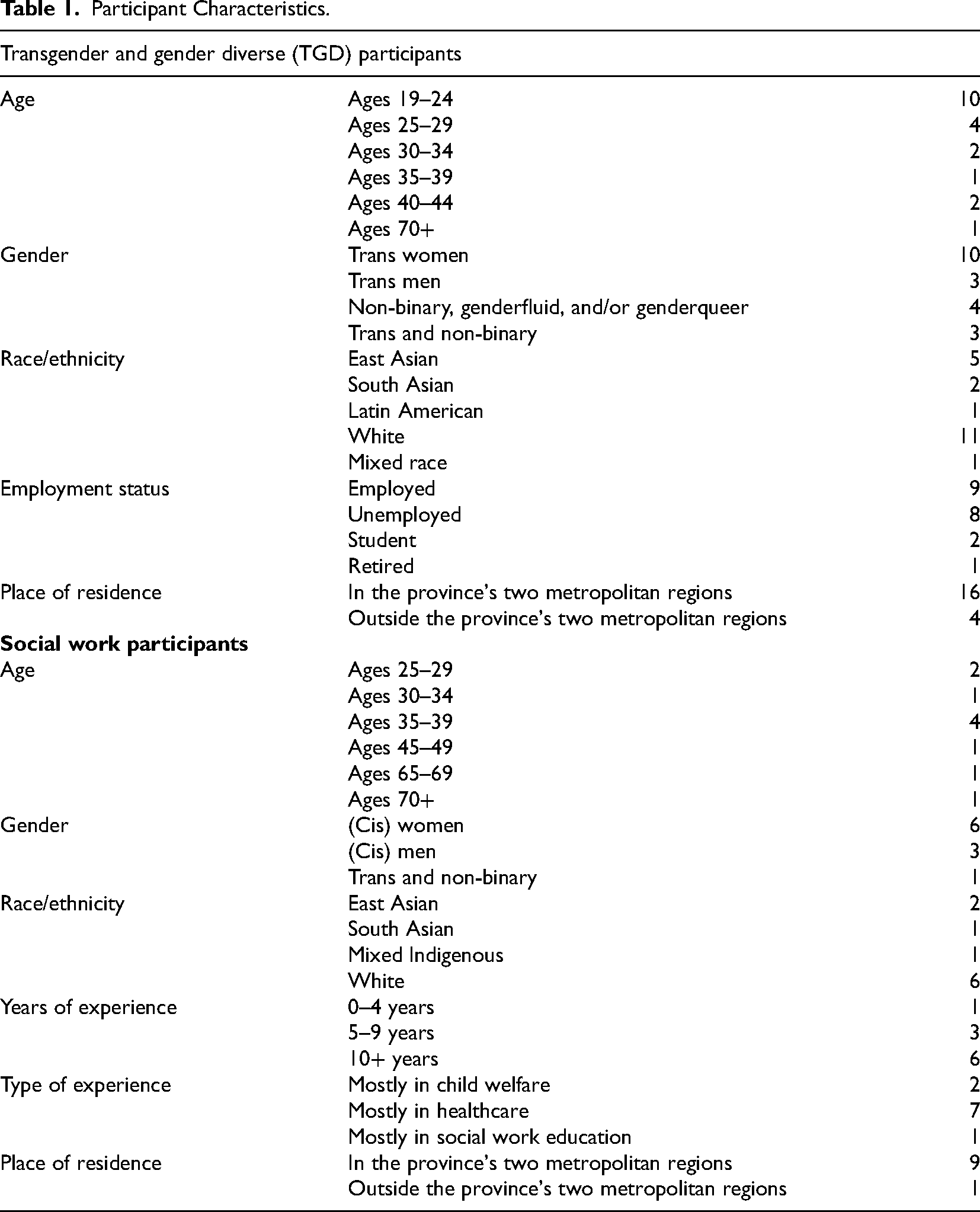
Given that racial, gendered, socioeconomic and age-related inequities are often recognized as salient axes of stratification within TGD communities (Fredriksen-Goldsen et al., 2014; James et al., 2016; Wesp et al., 2019), the team incorporated sampling procedures, including screening questions, to promote heterogeneity along these dimensions of difference. Our resultant sample of TGD participants was racially diverse, with eight racialized as East Asian, South Asian, Latin American and mixed race. Though half of the TGD participants were trans women, a substantial number (seven) identified as non-binary, genderfluid, and/or genderqueer, or as a combination of trans and non-binary, and three identified as trans men. While the age range of TGD participants was broad (19 to 70), half were between the ages of 19 and 24. Participants described having experience accessing a variety of social services, including in the context of child welfare, mental health and hospitals.
With respect to the demographic composition of social work participants, the majority reported having more than 10 years of professional experience in settings such as healthcare, child welfare and higher education. These service providers ranged in age from 27 to 73. Two identified as East Asian, one as South Asian, one as mixed Indigenous, and six as white. The majority of social workers involved in the study identified as cisgender (non-trans) men and women, but one identified as trans and non-binary. The majority of both TGD and social work participants reported residing in the two metropolitan regions of the province in which the study took place.
Data Generation
The first author, who led the data collection process, invited participants to take part in individual semi-structured interviews that were approximately an hour and a half in duration. Each interview began with a series of questions intended to gauge participants’ reactions to a case vignette involving an exchange between a trans-identified service user and a social worker. These questions specifically invited participants to reflect on the service user's experiences and needs in this practice context. Following this activity, the lead author prompted participants to discuss social work practice with TGD communities. Specifically, she invited both TGD and social work participants to discuss (1) their perceptions of social workers’ knowledge gaps in the context of practice with TGD communities, and (2) their insights on what would constitute equitable and effective social work practice with TGD people. The team recorded and subsequently transcribed each interview verbatim, and compensated each participant with CAD $50.
Data Analysis
We drew on constructivist grounded theory to inform data analysis (Charmaz, 2006). Given the original aims of the study, initially the objective of the analytical process was to construct theory on constituents of equitable social work practice with TGD communities. To this end, two members of the authorship team (HK, KG) began by reading and re-reading interview transcripts, developing preliminary descriptive (open) codes to categorize units of meaning reflected in the data, and then consolidating open codes into higher-order axial themes intended to explain how TGD people and social workers in our sample may have conceptualized equitable practice with TGD populations. Of note, during our preliminary analysis, we invited participants to review their interview transcripts for feedback. As the transcripts contained the lead author's live interpretations of participant accounts, and we specifically directed the attention of participants to these reflections for their input, this review process constituted a form of member checking. The results of our primary analysis are presented elsewhere (Kia et al., 2022).
Given the salience with which both TGD and social work participants discussed the relevance of incorporating TGD people's lived and living knowledge to inform practice, we revisited the data to explore and substantiate the potential of leveraging TGD people's lived experience as social work practice knowledge. To achieve this aim, the lead author started with an in-depth review of all interview transcripts and the open codes developed at the beginning of the study's analytical process. Then, she consolidated the open codes into different higher-order axial categories that specifically pertained to the promise and potential of lived and living knowledge of ‘peers’ for informing social work practice. Finally, using standpoint theory (Haraway, 2004; Harding, 2011) as an overarching conceptual framework, the lead author, with support, collaboration and feedback from the full authorship team, used the yielded axial categories to construct a theoretical picture of how TGD people's lived experiences (including those of formally and informally recognized ‘peers’ in social service settings) may be leveraged in the context of practice with TGD communities. More specifically, the team incorporated standpoint theory by identifying participant accounts, particularly those of TGD participants, that held insights on how lived experience could function as socially and politically transformative knowledge, and selected axial codes associated with these data as key components of the presented analysis. Secondary analyses of data, as described here, are common in grounded theory research, particularly when issues adjacent to a study's original research questions emerge organically in the analytical process and promise to address relevant gaps in the literature (Dufour et al., 2019; Whiteside et al., 2012).
Findings
We have developed three central themes, based on our re-reading of the data, to conceptualize participant insights on how the lived experience of ‘peers’ may be harnessed as knowledge for social work practice with TGD communities. These include: (1) drawing on lived experience to validate TGD bodies, identities, and experiences; (2) building networks of advocacy and support founded on shared community knowledge and (3) leveraging collective insight to promote resistance and transformation.
Drawing on Lived Experience to Validate TGD Bodies, Identities, and Experiences
TGD participants frequently discussed drawing on their lived experience to recognize and validate the often marginalized bodies, identities, and experiences of their peers. Similarly, many in this group described feeling affirmed by other TGD people who would disclose their lived experience and use it to empathically acknowledge shared realities. For example, one white trans woman in her 20s, who described a growing weariness of approaching cisgender service providers for support after repeatedly encountering antagonistic attitudes and behaviours, mentioned feeling safety and comfort among other TGD people as a result of an assumption of shared lived experience and, in turn, the likelihood of a rich mutual understanding: I have found over the past three years of being out, that if I'm talking to another trans person, I immediately feel safe and comfortable and I don’t have to police anything that comes out of my mouth. Whereas if I'm talking to a cis person, I have to think, like, okay, hold on, how much do cis people know about this issue? What's on my mind right now is just trying to think through the way that – I'm trying to remember five years ago, how I viewed trans people, versus how I view other trans people now, because I have met so many different people over the past few years, and it's been a really fantastic experience for me. I now view my friends and other trans people in such a different way, that it feels like – I don’t know, it's almost a fear that cis people couldn’t ever really get it, not in the same way that – just because you're not in it. Like what? Okay, you're cis, you have one or two trans friends maybe, and what do you think of them? I don’t know, I'm struggling to put this into words. I feel like there's an admiration that I have for all the other trans people in my life, that I think that's probably lacking amongst cis people. And I don’t think you can teach that.
Similarly, some participants described providing and experiencing bodily affirmation and normalization through learning about, engaging with and knowing other TGD people in shared community spaces. This notion was particularly prominent among participants with experience of seeking and receiving medical gender-affirming interventions, including hormones and surgeries. To highlight an example of a relevant account, the participant below (another white trans woman in her 20s) explicitly discussed experiencing validation by way of learning about other TGD people at different stages of medical transition, who served as models for her own journey: Yeah and I find it does give me a sense of validation to see other people in different stages. It's quite helpful to see people who are not just completely on the other side but who are halfway through, [which was helpful] when I was waiting to start. I’ve been on hormones for three and a half months now.
Although both TGD participants and social workers remarked on the potential of lived experience to inform and shape processes of validation, these accounts were particularly salient in the data of TGD people in our sample. Nonetheless, it is important to explicitly acknowledge the accounts of some social workers who explicitly corroborated the insights held in this theme. For example, one social worker, who reported having 10 years’ experience in healthcare, discussed challenges she had felt in responding meaningfully to the experiences and needs of a trans service user who had recently experienced an amputation, and recognized the value and importance of connecting this individual with another TGD person who had experienced limb loss, and who could in turn potentially function as a rich source of support: I also wanted to match-up with someone who might have a better understanding of what her experience currently was going through something as traumatic as limb loss in conjunction with exploring a transition which she wasn’t quite – like she knew that she was now identifying as a woman but she just wasn’t quite sure what she wanted to do about that, right, like whether she was going to go through gender reassignment or not at all. So I didn’t know, like I really didn’t know anything. I didn’t know anything.
This account is significant in that it highlights the relevance of specific lived experiences, for example, those located at the intersection of TGD identity and disability, in serving as particularly rich sources of validation for TGD people who share experiences at the nexus of multiple, interlocking systems of oppression.
The data associated with this theme substantiate the potential viability of social workers, particularly those without relevant lived experience, supporting peers to offer a range of micro-level psychosocial interventions ordinarily falling within the scope of direct social work practice. Given, in particular, that participants commonly described the irreplaceability of lived experience as knowledge that can be leveraged to validate TGD bodies, identities and experiences, this notion may be of great relevance to cisgender social workers.
Building Networks of Advocacy and Support Founded on Shared Community Knowledge
TGD and social work participants commonly discussed the potential for shared community knowledge to promote the development of robust networks of advocacy and support among TGD people. Many, in particular, acknowledged the structural impediments to service access among TGD individuals across mainstream systems of care, including exposure to stigma and discrimination, and noted that collective ‘peer’ knowledge can not only inform service users of safer and more appropriate options for care, but also equip them to challenge barriers they encounter. For example, one participant, a South Asian non-binary person in their 20s, mentioned that in helping to run a virtual peer group of TGD students in their university, they had come to appreciate the role of this group in serving as an important source of information on safe and accessible services in their city: So if you need – for example, if you need a trans positive service … we have a few. We have heard from each other's experiences on how certain services in the community are and exactly how much and what they do for us. And I have personally not needed anything but I know that they exist and we are helping each other find them. So I’m just glad that I have a safety net within there. When I was looking for that therapist, I was just like looking for people who actually do trans things ideally. And then that turned out poorly, so I almost needed to depend on reviews from other people. I'm in a Facebook group for queer people, like queer, disabled people in Vancouver and people will post like, “I'm looking for a massage therapist that's trans competent. Does anyone know anyone?” and looking through those kind of posts and making posts of my own if necessary.
Of note, both participants above reflected on the need for networks of advocacy and support for racialized TGD people, and the latter participant specifically also discussed the significance of these resources for TGD people living with disabilities. Both accounts highlighted the importance of resources that are responsive to the intersectional experiences, priorities, and needs of diverse TGD individuals.
Participants, both TGD people and social workers in our sample alike, commonly discussed the importance of collective knowledge in serving to help TGD social service users navigate care systems and, in turn, address their own needs more fully. They also discussed the importance of these group and community spaces in more informally supporting TGD service users with articulating and asserting their needs in healthcare and social service settings. The findings associated with this theme substantiate the relevance of social workers creating conditions that favour the organic development of such collectives and, in turn, incorporating the knowledge that develops within these contexts to respond to the needs of service users at individual and meso levels of practice. Such conditions may include, among others, the allocation of space intended for the gathering of peers, along with resources such as equitable compensation to support skilled facilitators.
Leveraging Collective Insight to Promote Resistance and Transformation
Participants in our sample prominently discussed the role of collective insight, which was often described as the product of mutual support exchanged between TGD people in group and community contexts, in promoting resistance and transformation to address systems of oppression shaping the realities of TGD communities. This theme was particularly salient in the accounts of TGD participants, though non-TGD social workers occasionally discussed the potential power of collective knowledge in effecting structural change. One participant, who identified both as a trans and non-binary person and a social worker, was especially explicit in describing the importance of social workers connecting TGD people to peer-based group and community support to facilitate their access to such transformative knowledge. They discussed group and community support, in particular, as being critical in enriching TGD people's awareness of historical counternarratives developed among peers, which could then be leveraged among service users to question and challenge discursive systems of injustice operating in their lives. Of note, this participant (whose quote also appears in Kia et al., 2022, p. 3184) stressed the non-substitutability of such support when considering mainstream treatment approaches commonly used to inform professional social work practice: For a lot of folks I think the most profound intervention is access to community, access to counter narratives, right access to that sense of belonging which is why I just would love it if there were more trans folks in these positions because I think that there's probably nothing more therapeutic than that sense of like actually you belong to something, you belong to a community and there's a certain, you know not complete, but there's a certain level of understanding that other trans folks are going to have to your experience. And I think that that's just, there's nothing, there's no round of CBT, there's no therapy that's going to be more important than accessing your community, accessing your history, accessing the counternarratives that we’ve built as a community over all these years because it's one of those things where your parents are unlikely to share that experience. Your family of origin is unlikely to share that experience with you so you need to go out and find that somewhere else which is why I think group work is really key. And group work that also looks into history and does book clubs or whatever you know. Especially when you know that this particular service is being accessed quite a bit by these kinds of vulnerable populations … we need to make sure that this is a safe place for those services to be accessed by those people. Well, why don’t we talk to people like that and pay them for their labour and see what is actually going on and, you know, do some of this kind of work that we’re doing right now per organization, right, so that these can be provided. So, like workshops and training days and then having access to even like an online training component that could be like an ongoing process through a period of time or whatever would be really great.
It is important to note that this participant remarked explicitly on the need to incorporate educators with diverse experiences of oppression and resistance, including those located at the intersections of racism, classism, and ableism, among others. Social workers, who may continue being recognized for their knowledge of social justice issues in a variety of contexts, may need to recognize the irreplaceability of lived experience as a source of insight and, as such, encourage their employers to invite TGD people with group and community engagement experience to function as compensated educators and change agents.
Discussion
Our findings support the notion that the lived and living knowledge of TGD service users holds great potential for informing social work practice. Based on the conceptualization of our data through standpoint theory, this knowledge can specifically be used to deliver peer-led interventions that validate TGD bodies, identities and experiences, that contribute to networks of peer advocacy and support, and that promote processes of transformation and resistance within TGD communities. The participant accounts on which we rest our analysis contain a diverse range of insights about how lived experience may be incorporated to inform social work practice. Despite variability in our findings, however, our data broadly substantiate peer service delivery models in which cisgender social workers ensure they complement the care they provide with that of peers, particularly (but not exclusively) at the level of direct practice. Relatedly, the data also support the need for measures that promote the entry and retention of TGD-identified practitioners within the social work profession, who may be able to draw on lived experience directly in the provision of care.
Our findings both substantiate and expand on the existing adjacent scholarship. Most notably, our work reveals that despite the dearth of literature on integrating TGD people's lived experience to inform social work practice, peer-led care may hold great promise as a foundation for strengthening the profession's capacity to address the issues, experiences, and needs of TGD communities. Scholars have argued that, historically, the discipline and profession of social work has been complicit in the pathologization and marginalization of TGD communities, since researchers and practitioners have frequently adopted clinical texts such as the Diagnostic and Statistical Manual of the American Psychiatric Association to inform their assessments and interventions in practice with TGD people, particularly in clinical settings (Kia et al., 2022; Shelton et al., 2019). Based on this history, TGD service users may understandably doubt social work's capacity to address their priorities and feel reluctant to engage with practitioners who do not share their lived experience (Austin, 2018; Blotner & Rajunov, 2018; Kia et al., 2022; Shelton et al., 2019). Given the promise that peer-led interventions can hold for bridging historical tensions between social work and TGD communities, the substantiation of peer-held knowledge as a valid foundation for informing certain psychosocial interventions warrants serious consideration. Scholarship on social work practice with TGD communities may, accordingly, need to consistently incorporate attention to peer knowledge as a source of insight on the planning and delivery of interventions intended to serve TGD people.
In addition to contributing to the scholarship on social work practice with TGD populations, our analysis also pushes on the boundaries of the extant literature on incorporating peer knowledge as a basis for informing social work practice with different marginalized groups. This body of literature has highlighted the role of this insight in building awareness of pertinent social justice issues and community strengths among practitioners (Ramon et al., 2019), enhancing practical knowledge of barriers and other challenges experienced among members of a population (Tseris, 2020), and challenging normative assumptions about a group (Wahab, 2003; 2004). Our research adds to this literature by additionally revealing the non-substitutability of lived experience as a source of validation for members of a particular marginalized group, and as an invaluable catalyst for building organic networks of mutual advocacy and support, and driving systemic change. Relatedly, our work suggests that variable lived experiences, particularly those reflecting differences in race, (dis)ability, and class, may function to validate the issues diverse TGD people, and to inform community mobilization activities that address the issues of TGD populations affected by multiple, intersecting systems of oppression (Wesp et al., 2019). Our work also contributes to the scholarship on standpoint theory (Haraway, 2004; Harding, 2011; Linabary & Hamel, 2017), since it substantiates its relevance for recognizing the lived experience and embodied knowledge of marginalized people (Hatsock, 2006) in social work as a basis for resistance and transformation. Indeed, given the historically inconsistent incorporation of standpoint and other feminist scholarship within the social work discipline and profession (Charter, 2021; Kemp & Brandwein, 2010), our work challenges social work researchers and practitioners to more fully engage with this conceptual literature as a relevant analytical foundation for integrating community knowledge to effect change.
Several implications for social work practice are reflected in our findings. First, at the direct practice level, we believe our findings support the notion that non-TGD social workers need to account for important limits in their capacity to independently address the issues, needs and experiences of those in this population. Although our data certainly do not suggest that cisgender social workers should be precluded from supporting TGD service users, such practitioners should explore opportunities to collaborate with either TGD peers or TGD-identified social workers in more comprehensively meeting service users’ needs surrounding validation and safety. Striking such partnerships could entail, for example, people with lived experience facilitating non-directive conversations with service users intended for them to safely explore and gain insight on their gender. Similarly, at group and community levels of practice, we believe our findings justify the need for interventions that aim to promote the development of informal mutual support networks among peers, and that support such networks to engage in resistive and transformative work initiated by the membership. Social workers should additionally maintain a commitment to addressing transphobia and cisnormativity within the profession (Shelton et al., 2019), which function as systemic barriers for TGD people wishing to enter the profession, and affirm TGD individuals considering social work as a career. Social work educators should, relatedly, commit to centering TGD experiences more meaningfully in curricula across schools of social work.
Such implications for practice are consistent with social work's overarching and ongoing commitment to social justice (Watts & Hodgson, 2019), since they entail leveraging the process and product of social work interventions to pursue wider systemic change. Across healthcare and social service organizations, particularly those mandated to address the issues of TGD people, and including those whose focus is clinical and concerned primarily with brokering access to gender-affirming care, programming should include peer-led group work and community development. For example, organizations need to provide resources (including equitable compensation) to peers to run mutual support groups and events intended for community-based knowledge exchange, activism, and mobilization. Given, in particular, critical concerns surrounding the staggeringly inequitable compensation of peers in certain domains (Ibáñez-Carrasco et al., 2019; MacKinnon et al., 2021), questions of remuneration are particularly salient.
Some important limitations of our work warrant consideration. First, as our study is based on a sample of primarily younger (age <30) TGD people overwhelmingly located in urban regions of a Canadian province, we believe our findings may be limited in transferability to older TGD adults, as well as TGD individuals located in rural regions and other potentially dissimilar geopolitical contexts. Future inquiry on the significance and functions of lived experience as practice knowledge, specifically as perceived among TGD people underrepresented in our study, would greatly strengthen and close important gaps in the literature. Next, although we have explored the potential and promise of incorporating the lived and living knowledge of peers to inform social work practice, our reliance on a secondary analysis of qualitative data meant we were limited in developing greater insight on potential challenges involved in harnessing lived experience. As others have noted (MacKinnon et al., 2021; Theobald et al., 2021; Tseris, 2020; Voronka, 2017; 2019), the leveraging of peer knowledge in practice often involves mitigating numerous challenges and limitations and, as such, we believe studies dedicated to more comprehensively mapping both the strengths and difficulties associated with incorporating TGD peers in service delivery are needed. In particular, issues related to compensation (MacKinnon et al., 2021), as well as the consequences of ‘professionalizing’ and potentially commodifying peer support (Voronka, 2017), require greater attention in future inquiry addressing peer-based care among TGD people. Such work would provide a clearer picture of potential barriers and risks involved in mobilizing peer knowledge and, as such, refine our insights on materializing the insights reflected in our findings. Critically, we note that while we explored the potential of lived experience in this study, we drew on secondary data analysis to conceptualize findings of a study on perceptions of equitable and effective social work practice with TGD people, and as such were limited in first gaining rich, descriptive insight into the actual contents of lived experience. Given the promise of lived experience as practice knowledge, we hope our study catalyzes phenomenological studies to investigate the essence of the lived experiences on which our analysis is based.
In this article, we have utilized data from a study originally aimed at investigating the constituents of equitable social work practice with TGD communities to conceptualize the potential of leveraging peer experience as relevant practice insight in this area. Our analysis has highlighted the rich promise of TGD people's lived experience for informing social work practice at multiple levels of intervention and has additionally substantiated the irreplaceability of peer knowledge in this practice domain. Though we have highlighted the many opportunities and challenges for social work reflected in our findings, our work has also revealed the relevance of ongoing inquiry to refine our existing insights and to advance the bridging of TGD people's lived experience – as well as the experiences of other marginalized groups – into the discipline and profession of social work. We hope that researchers and practitioners alike can utilize our analysis to further explore possibilities of holding recognition and respect for the value of the lived experience of service users as knowledge, both within TGD communities and beyond, and draw on such inquiry to build approaches to social work that authentically centre service users’ perspectives as grounds for critical social work.
Credit Statement
Hannah Kia obtained research funding, collected and analyzed the data, conceptualized the manuscript and wrote the original draft and incorporated revisions. Kinnon Ross MacKinnon supported the conceptualization of the manuscript, provided feedback on data analysis, and conceptualization of findings. Kaan Göncü supported data analysis and conceptualization of the manuscript, and provided feedback on the original draft.
Footnotes
Acknowledgements
The authors would like to acknowledge the many contributions of the members of this study's Community Advisory Board (CAB), who generously provided feedback on the design of the study on which the secondary analysis presented in this paper is based.
Declaration of Conflicting Interests
The author(s) declared no potential conflicts of interest with respect to the research, authorship and/or publication of this article.
Funding
The author(s) disclosed receipt of the following financial support for the research, authorship and/or publication of this article: This work was supported by the University of British Columbia (grant number SPARC-Hampton New Faculty Grant).
