




Abstract
Previous research has examined many aspects of ambivalent sexism theory, although there has been an overall dearth of research conducted on its potential relationship to abortion attitudes. This study aims to compare the extent to which hostile and benevolent sexism, the two primary components of the Ambivalent Sexism Inventory, predict antichoice attitudes. Data were collected at six U.S. colleges and universities (N = 627), and findings generally support the hypothesis that higher endorsements of either form of sexist beliefs are linked with antichoice attitudes.
Introduction
Abortion is currently one of the most contentious issues in American society, even though the occurrence of abortion is quite common. Nearly half of all pregnancies in American women are unintended (Finer & Zolna, 2011), and excluding miscarriages, nearly one fourth of all pregnancies end in abortion (Jones & Kooistra, 2011). Approximately 1.2 million women obtain a legal abortion in the United States each year (Jones & Kooistra, 2011), and nearly one third of all American women will have an abortion by age 45 (Finer & Henshaw, 2006).
In the landmark U.S. Supreme Court decision, Roe v. Wade (1973), a woman’s legal right to seek an abortion in the United States was affirmed. Although Americans’ abortion attitudes have been stable over the last four decades (Bolzendahl & Myers, 2004; Jelen & Wilcox, 2003; Strickler & Danigelis, 2002), views have grown increasingly complex as polarization within groups’ attitudes has deepened (Bolzendahl & Myers, 2004). Furthermore, most Americans rate the issue of abortion as personally important to them (Coleman & Nelson, 1999; Jelen & Wilcox, 2003), and abortion-related advocacy activity has continued to increase in both pro-choice and antichoice groups (Jelen & Wilcox, 2003).
The debate extends beyond personal viewpoints and is also hotly contested on the macro-level stage. Proposals of federal- and state-level abortion rights restrictions have been brought forward each year—many of which have been passed into law—seeking to diminish abortion rights following the Roe v. Wade decision (Guttmacher Institute, 2013a; Jackson, 2007; Medoff, 2010, 2012). For example, in the first 6 months of 2013, 106 family planning provisions were enacted upon by states, 43 of which were actions that further restricted abortion access. Such efforts are second only to 2011, the year in which the most challenges (in history) to abortion rights and access were brought forth (Guttmacher Institute, 2013c). Violent or obstructionist acts toward abortion facilities, providers, and patients are prevalent (Guttmacher Institute, 2013b; Norris et al., 2011; Rubin & Russo, 2004), with one study finding that 87% of women report encountering antiabortion protesters while approaching a medical facility for abortion counseling or services (Cozzarelli, Major, Karrasch, & Fuegen, 2000).
Just as with abortion, opinions exist across the spectrum of attitudes toward women. Ambivalent sexism theory (Glick & Fiske, 1996) provides a framework for evaluating the complex nuances of sexism, which is comprised of old-fashioned, hostile forms of sexism, as well as modern, benevolent forms. This study explores how ambivalent sexist attitudes correlate with attitudes toward abortion. First, a review of the ambivalent sexism literature will be provided, followed by an overview of what is currently known about attitudes toward abortion. Finally, analyses will examine relationships between the key components of ambivalent sexism and abortion attitudes.
Literature Review
Ambivalent Sexism
Sexism, like prejudice and stereotyping, is a concept perhaps most commonly associated with negativity and hostility. For example, Allport’s (1954) foundational definition of prejudice suggests it is “thinking ill of others without sufficient warrant” (p. 6). More recently, however, scholars have argued that prejudice may be shown through less negatively or even positively valenced attitudes. The nature of prejudice is perhaps evolving, however, as overt (and negatively valenced) prejudice may be on the decline due to perceived social pressures to appear more egalitarian and supportive of historically marginalized groups (Bolzendahl & Myers, 2004; Swim, Aikin, Hall, & Hunter, 1995). While prejudice is not gone, societal shifts have induced changes in rhetoric to support prejudicial beliefs and behavior—but in more subtle, almost affable ways. Sexism is one of the forms of prejudice that has experienced this transformation; as pressure to eradicate old-fashioned sexism has transpired, a modern sexism has moved into its place (Glick & Fiske, 1996).
Ambivalent sexism borrows some of its theoretical roots from ambivalent racism theory (Gaertner & Dovidio, 1986; Katz, Wackenhut, & Hass, 1986) but is particularly unique in the sense that males and females are often intimately connected to one another, frequently procreating and coexisting with each other within family structures (Glick & Fiske, 1996; Jackman, 1994). While dyadic relationships have formed across gender identities, they often complement each other through interdependent professional, social, and reproductive roles, while also spawning competition, resentment, and pressure to conform to socially constructed role expectations (Lee, Fiske, & Glick, 2010). As such, gender roles have historically played a major part in maintaining gendered power structures across cultures (Lee Fiske et al., 2010).
Attitudes toward women are complex; women have often been represented through stark dichotomies—admired or admonished akin to a pedestal-gutter syndrome and revered or reviled analogous to a Madonna-whore juxtaposition (Glick & Fiske, 2001). Through these binary viewpoints, women are either cherished (e.g., deemed worthy of placement upon a pedestal) or viewed as sacred (as in a religious Madonna), versus loathed (e.g., relegated to gutter placement, and deserving of offensive labels such as whore). Further, research supports that individuals’ attitudes toward women are typically neither purely positive nor purely negative (Eagly & Mladinic, 1994; Glick & Fiske, 1996, 1997). Both men and women have been shown to endorse varying degrees of sexist beliefs (Becker, 2010; Becker & Wagner, 2009), and such beliefs are further reinforced as men and women have also been shown to exhibit varying degrees of attraction to romantic partners who endorse, exude, and match societally prescribed gender roles (Bohner, Ahlborn, & Steiner, 2010; Chen, Fiske, & Lee, 2009; Lee, Fiske, Glick, & Chen, 2010; Travaglia, Overall, & Sibley, 2009). To better understand such complexities, Glick and Fiske (1996) developed ambivalent sexism theory, which can be thought of as a two-sided coin. On one side lies hostile sexism, and on the other side lies benevolent sexism. Both sides reflect concepts of paternalism, gender differentiation, and heterosexuality but in bifurcated and oppositely valenced ways.
Hostile sexism represents the overtly negative pole of the ambivalent sexism continuum and is comprised of several concepts—dominative paternalism, competitive gender differentiation, and heterosexual hostility (Glick & Fiske, 1996). Dominative paternalism espouses opinions of women as lacking competence and justifies men as the rightful holders of superior social status and decision-making reins. Competitive gender differentiation, through its derogatory beliefs toward women, enables its subscribers to endorse negative characterizations of women; this strategy thereby allows males to elevate in-group self-esteem while robbing females of prestige in a zero-sum power transfer. Finally, heterosexual hostility reduces women to mere sexual objects, with a keen eye kept on a pervasive fear that women are inherently self-interested in using their sexuality to seize social, political, and emotional power from men.
Benevolent sexism, conversely, illustrates how sexism does not always produce blatantly negative or hostile views of women. Benevolent sexism is represented through alternative concepts such as protective paternalism, complementary gender differentiation, and heterosexual intimacy (Glick & Fiske, 1996). Protective paternalism advocates for men as protectors and providers for women, particularly given perceptions of men’s status as stronger, more powerful, and authoritative members of society. Complementary gender differentiation views women as nurturing, gentle, and pure; deemed favorably, women exhibit nurse-like and maternal qualities. In this depiction, the positive and traditional traits of women make them men’s better halves. Heterosexual intimacy portrays women as needed and cherished sexual objects, the requisites of any so-called complete man.
Although conceptually dichotomous, hostile, and benevolent forms of sexism intermingle in complex ways; the concepts intertwine to maintain stratified systems of gender-based power (Lee, Fiske et al., 2010). Hostile sexism denounces women’s involvement at the top of the power structure by alleging women’s inability to function at prominent, societally guiding levels, while benevolent sexism augments the hierarchy by offering conciliatory but diminished roles to women with aims of mollifying females’ desires to remonstrate or rebel. As a result, the most distinctly gender-nonconforming women in this structure are the most vilified. As Eckes (2002) illustrated, ambivalent sexism yields feelings of likeability and warmth toward gender-conforming females—such as housewives, wallflowers, and secretaries—while ratings of competence for the same group are quite low. Conversely, gender-nonconforming women—such as feminists, career women, and intellectuals—receive low ratings in warmth and likeability categories, while levels of competence are acknowledged as high.
Benevolent sexism works in conjunction with hostile sexism in men (Glick & Fiske, 2001), although there is also a high level of acceptance of sexism among women when evaluating in-group stereotypes regarding their own gender (Eagly & Mladinic, 1994). While women have been shown to endorse forms of hostile sexism somewhat infrequently, women’s endorsements of benevolent sexist beliefs are quite common (Fowers & Fowers, 2010; Sibley, Overall, & Duckitt, 2007). In this structure, women are also encouraged to display disdain for gender-nonconforming women, and this compliance is met with rewards of increased power within the benevolent sexism construct (Fowers & Fowers, 2010).
While women continue to face hostile sexism (Eagly & Mladinic, 1994; Fiske & Glick, 1995; Swim et al., 1995), it may appear that social progress is occurring due to the shifts away from overtly hostile toward benevolent forms of sexist attitudes. Although seemingly benign, benevolent sexism is deceptively oppressive and more dangerous than its old-fashioned predecessors of prejudice, as the emotional suffering of women has been found to be greater in response to exposure to benevolent sexist acts. In a large representative undergraduate sample, a survey about sexism toward women found that respondents not only underestimated the negative impacts of benevolent sexism but also found that women’s recovery durations following encounters with benevolent sexist acts are longer than those following hostile events (Bosson, Pinel, & Vandello, 2010). Through forms of benevolent sexism, even the individuals who endorse very few hostile sexist beliefs of any kind can play an important role in maintaining gender stratification (Walls, 2009). For the most nonhostilely sexist members of society, a dangerous lack of attention is thereby paid to gender inequalities due to falsely inflated perceptions of equality (Swim et al., 1995). Gender-based inequalities may thus become viewed as obstacles faced by only individual women, in “outlier” events, rather than as a societally pervasive phenomenon of oppression. Such perceptions could reduce advocacy efforts toward the social and political changes that are necessary to truly yield equality and increased opportunities for women (Swim et al., 1995).
In summary, the outcome of ambivalent sexism that is created by the fusion of hostile and benevolent underpinnings may be gender equality’s greatest menace yet, as hostile and benevolent sexism strengthen each other in a duplicitous manner. By partitioning women into categorizations of liked and disliked, the ambivalent sexist is able to preserve personal stereotypes and convictions regarding women without being held accountable or admonished for purporting gender-based injustices (Glick, Diebold, Bailey-Werner, & Zhu, 1997).
Abortion Attitudes
Abortions are obtained by a broad cross section of American women in terms of age, marital status, economic condition, religious affiliation, and whether or not a given woman currently has a child or children (Jones & Kavanaugh, 2011). Yet, attitudes toward abortion are very complex, as sharply polarized views exist within the many intersecting sociodemographic categories by which a given individual identifies.
Individuals tend to endorse pro-choice abortion attitudes as personal or family income levels rise (Cook, Jelen, & Wilcox, 1992; Ellison, Echevarría, & Smith, 2005) and as educational attainment increases (Jelen & Wilcox, 2003; Strickler & Danigelis, 2002; Walzer, 1994; Wang & Buffalo, 2004). As individuals’ knowledge of abortion increases (such as details regarding the actual procedure of abortion, personal experience or knowledge of other individuals who have obtained an abortion or related procedure), acceptance of abortion also increases (Carlton, Nelson, & Coleman, 2000; Esposito & Basow, 1995).
Prior research has also shown that religious affiliation is a strong indicator of abortion attitudes, with Catholic and evangelical Protestant adherents typically demonstrating the least support for abortion rights and legality (Bolks, Evans, Polinard, & Wrinkle, 2000; Esposito & Basow, 1995; Hess & Rueb, 2005; Walzer, 1994). Conversely, highest levels of support for abortion rights and legality have historically come from Jewish (Cook et al., 1992; Hoffman & Miller, 1997; Walzer, 1994), mainstream and liberal Protestant (Cook et al., 1992; Esposito & Basow, 1995; Hoffman & Miller, 1997), and individuals identifying with no form of organized religion (Cook et al., 1992; Esposito & Basow, 1995; Hoffman & Miller, 1997).
While in the last few decades, the net effect of religious affiliations’ impact on abortion attitudes appears to be stable, some interesting nuances of change within groups have occurred. More recently, Catholic youth have begun to demonstrate more tolerance toward abortion, which may be interpreted as a by-product of the Catholic Church’s increasingly permissive attitudes toward divorce, remarriages, and contraception (Sullins, 1999). Conservative Protestant youth, however, are increasingly siding against abortion rights and legality (Sullins, 1999). In aggregate, however, the predominant view of both groups remains antichoice (Hess & Rueb, 2005).
As one’s religiosity (the frequency at which an individual attends religious services or participates in religious activities) increases, support for abortion rights and legality appears to decline (Bahr & Marcos, 2003; Cook et al., 1992; Esposito & Basow, 1995; Hess & Rueb, 2005; Walzer, 1994). In a cross-cultural study, Bahr and Marcos (2003) compared Americans’ and Greeks’ attitudes toward abortion. In both Greek and American samples, acceptance of abortion was negatively impacted by high levels of religiosity, regardless of respondents’ religious denominations. Religiosity may also override culture or ethnicity, as Bolks, Evans, Polinard, and Wrinkle (2000) found that Latinos/Latinas’ abortion attitudes were no differently structured than those of whites. The only intraethnic differences found were attributed to two factors—religiosity and education levels. Cuban participants, who showed lower levels of religiosity and higher education levels on average, were found to be more supportive of abortion rights and legality than Mexican Americans who identified as higher in religiosity and reported lower average levels of education (Bolks et al., 2000).
Other sociodemographic categories, however, have not displayed clear relationships regarding abortion attitudes. Age, for example, has not been shown to accurately predict abortion attitudes (Esposito & Basow, 1995). Although many have offered the hypothesis that young people are increasingly pro-choice, findings show ambivalent attitudes toward abortion remain in place across age-groups (Carlton et al., 2000; Hess & Rueb, 2005). Measurements by race are similarly inconclusive. For example, black samples do not consistently generate predictive attitudes toward abortion; black women generally hold accepting attitudes toward abortion, but attitudes of black men have been shown to vary greatly (Walzer, 1994). Research has shown, however, that blacks in aggregate tend to identify as pro-choice more frequently than do whites (Strickler & Danigelis, 2002).
Perhaps most surprising are attitudes toward abortion when sorted by gender identification. Historically perceived as a women’s issue, Walzer (1994) noted that while most abortion activists are women, policy-making efforts regarding the subject are predominantly controlled by men. Furthermore, males hold the majority of antichoice movement leadership positions (Baumgardner, 2001). Some studies have indicated very little difference between men’s and women’s attitudes toward abortion (Bailey, 1993; Carlton et al., 2000; Esposito & Basow, 1995; Hess & Rueb, 2005; Strickler & Danigelis, 2002), and others have actually shown men as more pro-choice than women, although only by a slight margin (Bolzendahl & Myers, 2004), with women as leaning slightly more toward an antichoice stance than expected (Carlton et al., 2000).
There are seemingly countless factors that may undergird individuals’ attitudes toward women and abortion. Since demographic identities do not occur in isolation, most factors are probably more intertwined than what any act of research could hope to unravel, and results likely need to be interpreted through a lens of gestalt. Theoretically, however, there are many reasons to expect that both benevolent sexism and hostile sexism will demonstrate relationships with antichoice attitudes. For example, research has shown that the endorsement of traditional gender roles is associated with abortion opposition (Sahar & Karasawa, 2005; Strickler & Danigelis, 2002; Wang & Buffalo, 2004). Just as motherhood is a gender-conforming ideal of benevolent sexism, the hostile sexist typically vilifies women for acts in which they use their sexuality (Glick & Fiske, 1996). In both cases, either form of sexism likely corresponds with antichoice beliefs, even if for different reasons (such as advising women to carry out their pregnancies, whether through glorifying motherhood, vs. enforcing women’s accountability to the “ramifications” of their sexual power and actions).
Additionally, Osborne (2009) conducted research regarding ambivalent sexism’s relationship with attitudes toward elective (e.g., abortion that has not been deemed medically necessary) versus traumatic abortion (e.g., abortion to save the life of the mother or in cases of severe birth defects), grounding their research in social dominance theory (Sidanius & Pratto, 1999). Osborne (2009) argued that individuals who preferred a group-based hierarchy—or social dominance orientation—used beliefs about gender roles as a justification of their abortion attitudes. After administering the Ambivalent Sexism Inventory (ASI; Glick & Fiske, 1996) and the Social Dominance Orientation Scale (Pratto, Sidanius, Stallworth, & Malle, 1994) to a large, representative sample, Osborne (2009) found that higher endorsements of social dominance were significantly associated with negative attitudes toward both elective and traumatic abortion (Osborne, 2009; Osborne & Davies, 2012). Moreover, ambivalent sexism was a mediator, with both benevolent and hostile sexism mediating the relationship between social dominance and elective abortion attitudes, whereas only benevolent sexism served as a mediator between social dominance and attitudes toward traumatic abortion (Osborne, 2009; Osborne & Davies, 2012).
This study aims to add to sparse but burgeoning research on the subject of how components of ambivalent sexism may relate to antichoice attitudes. Similar to Osborne’s (2009) findings, we expect that as the endorsement of either form of ambivalent sexism increases, so do antichoice attitudes. Building upon this, and given what prior research has found regarding links between various sociodemographic categories (such as race, religion, religiosity, age, and gender), such classifications are included in this study as nuanced ways by which the possible overarching relationship between ambivalent sexism and antichoice attitudes might be further dissected. While this study is highly exploratory in nature—and thus seeks to investigate whether there is in fact a plausible relationship present—it may be argued that such preliminary research is needed as a launching pad from which a deeper understanding of these concepts may be deemed deserving of future research attention.
Method
This study uses data collected from prior research conducted by Walls (2005) and was approved for secondary data analysis by the institutional review board at the University of Denver. Participants in the study were undergraduate students from six U.S. colleges and universities. As one of the students’ options to complete a requirement for social sciences courses in which they were enrolled, students could opt to participate in a web-based study. The students accessed the survey through unique identifiers and passwords in an effort to eliminate the likelihood of sample contamination.
Participants
Five of the six schools represented in the study were private universities, two of which were Catholic affiliated, one was Mennonite affiliated, one was Baptist affiliated, and the remaining private institution was unaffiliated with a religious denomination. The sixth and final school was a public, medium-sized school in the Midwest. The differences in demographics across the schools added some variability in the sample. The full sample was comprised of 651 students, however, only 627 (96.3% of full sample) respondents provided answers to all of the questions of interest in this study and are included in the analyses.
The age of the respondents ranged from 18 to 56, with a mean age of 20.4 years (SD = 4.5). About 70% identified themselves as female and 30% as male. Racially, the sample was 81.1% white, 6.1% Latino/Latina, 5.1% black/African American, 3.8% Asian/Asian American, 2.4% biracial, and l.4% identified as Native Americans or other races. Slightly more than one third (38.1%) of the sample represented Catholic religious affiliations, 33.6% identified with conservative Protestant denominations, 14.3% reported no religious affiliation, 11.9% classified as mainstream or liberal Protestant, and 1.7% reported other non-Christian affiliations (Table 1). Despite the small number of participants represented in some of the sociodemographic group subsamples (e.g., race and religious affiliation), these subgroups were maintained in the analyses to avoid obscuring potential nuances. Additionally, as demographic variables were not the primary focus of the study’s research question, they were also maintained for purposes of statistical control of variability that might correlate with demographic differences that is not represented by available variables for inclusion in the model.
Sample Descriptives and Frequencies.
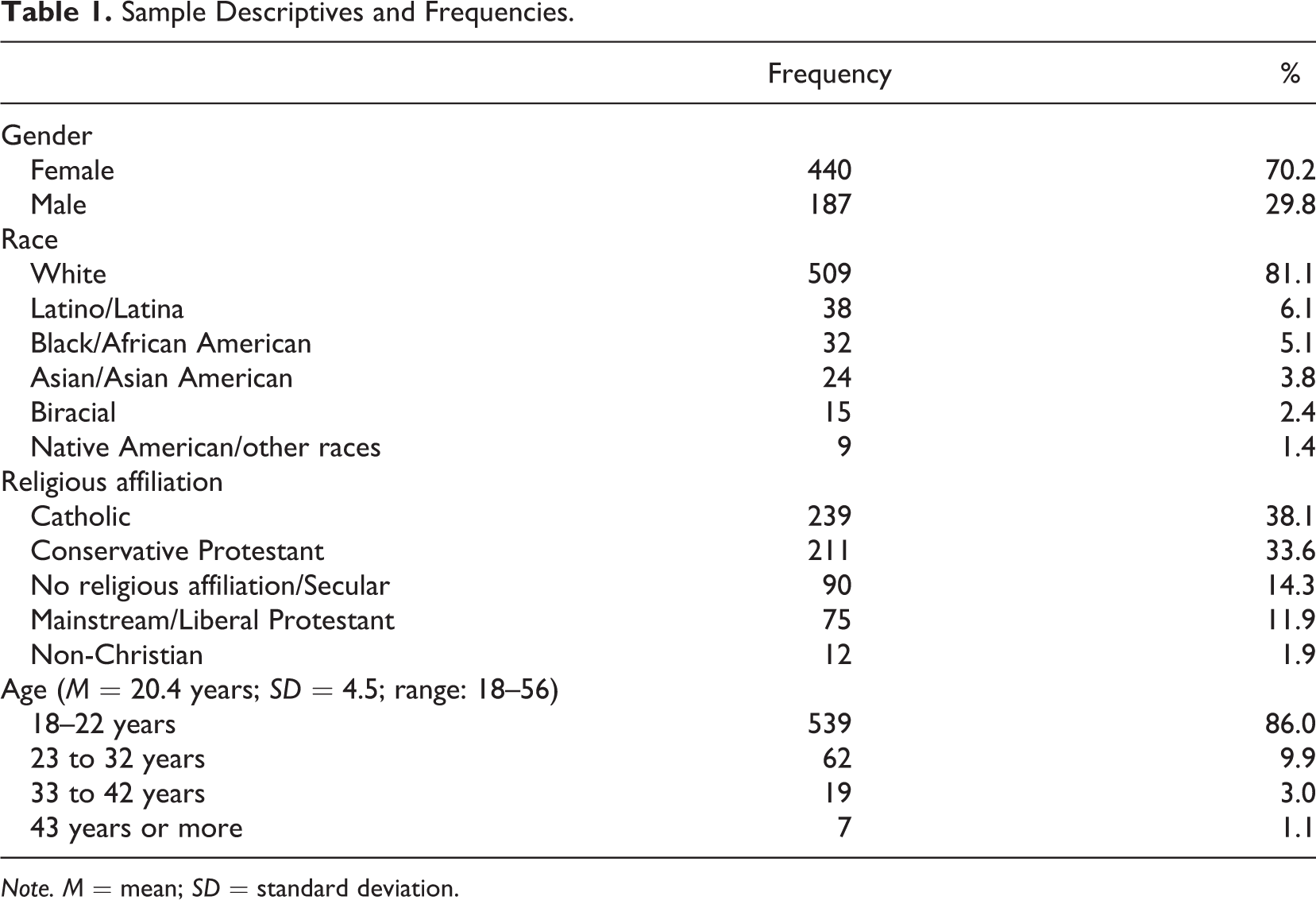
Note. M = mean; SD = standard deviation.
Procedure
Participants were given a survey of both demographic and attitudinal questions, based on the General Social Survey (National Opinion Research Center, 2004) and demographic questions from social science literature that evaluate social attitudes, beliefs, and public policy endorsement. The demographic measures included typical items such as age, race and ethnicity, gender, religious affiliation, and religiosity. Other measures used in these analyses included five questions on reproductive rights, used to create the dependent variable, and the ASI (Glick & Fiske, 1996). Additional measures were included on the survey but are not used in this study.
Measures
Age, gender, and race/ethnicity were asked in standard ways. Those who selected more than one racial category were recoded to bi-/multiracial. Religious tradition was derived from three separate questions. Respondents were first asked, “What religion do you consider yourself?” The response set included options for Buddhist, Hindu, Christian, Muslim, Jewish, No religious belief/Agnostic/Atheist, and Other. Respondents who chose other were asked to name their religion. Second, respondents who were Christian were asked to further classify themselves into one of five Christian traditions: Catholic, Conservative nontraditional (Jehovah’s Witness, Mormon, Christian Science, and so forth), Evangelical Protestant (Baptist, AME, Church of God in Christ, Pentecostal, Assembly of God, and so forth), Liberal nontraditional (Unitarian, Unity, Humanistic, Spiritualists, New Age, and so forth), Mainline Protestant (Methodist, Presbyterian, Episcopal, United Churches of Christ, Disciples of Christ, and so forth), and Nondenominational. Finally, as an additional check on religious tradition, all respondents were asked to name the specific church they attend, if they do attend, “What is the actual name of the church you attend or consider yourself to be a part of (this information is for denominational classification purposes only)?” Based on responses to these three questions, the respondent was classified into religious tradition categories of Catholic, Liberal/Mainline Protestant, Conservative Protestant, Other Christian, Other non-Christian, and secular. Religiosity was captured using three questions, “Would you say your religion provides little or no guidance, quite a bit of guidance, or a great deal of guidance in your day-to-day life?” “Do you go to religious services more than once a week, once a week, almost every week, once or twice a month, a few times a year, or never?” and “Outside of attending religious services, do you pray several times a day, once a day, a few times a week, once a week or less, or never?” When the 3 items were factored into a singular religiosity scale, a high level of internal consistency reliability was indicated (α = .92).
As the primary independent variable of interest, this study specifically focuses on the evaluation of participants’ responses to ASI items (Glick & Fiske, 1996). The ASI is a tool that has demonstrated high reliability for measuring the main concepts of ambivalent sexism in past research studies (Glick & Fiske, 2011). Throughout the scale development process, ASI scale reliability coefficients ranged from α = .83 to α = .90 across six separate studies (Glick & Fiske, 1996) The ASI has subsequently been used in the prediction of many associated concepts, including romantic partner preferences (Bohner et al., 2010; Travaglia et al., 2009), in marriage and close relationships (Chen et al., 2009; Lee, Glick, Fiske, & Chen, 2010), and regarding women’s endorsements of in-group sexism toward other females (Becker, 2010; Sibley et al., 2007), to name just a few examples. The ASI is constructed of a 22-question self-report inventory that uses a 7-point rating scale to measure strong agreement to strong disagreement with each given statement. Eleven of the survey items are used to capture hostile sexism, and the remaining half measure benevolent sexism.
Responses to the ASI questions were recoded such that higher scores indicated higher levels of endorsement for the given sexism domain. Responses were summed and then divided by the number of questions pertaining specifically to each subdomain, yielding a response output ranging from 1 to 7, where 1 represents the lowest endorsement of sexist ideas and 7 represented the highest endorsement of sexist ideas. In the current sample, the full ASI scale demonstrated a high level of internal consistency reliability (α = .91), with the 11-item hostile sexism (α = .89) and 11-item benevolent sexism (α = .86) subscales performing similarly.
For the dependent variable, five questions about abortion were used and summed to capture participants’ levels of support for or opposition to abortion rights. All of these questions also had 7-point rating scale response sets, allowing participants to indicate strong agreement to strong disagreement with each statement. Questions included (1) “late-term abortions should be illegal in the United States,” (2) “decisions to terminate a pregnancy should be a matter between a woman and her doctor,” (3) “the government should NOT cover the medical costs of abortions for poor women who cannot afford the procedure,” (4) “abortion should be legal under all circumstances,” and (5) “state laws should require parental consent before a teenager under 18 can have an abortion.” As with the ASI, responses to the abortion rights questions were recoded such that higher numbers represent endorsement of antichoice attitudes. The individual item scores were then summed and divided by 5 to yield an antichoice score between 1 and 7, with 1 being the least supportive of antichoice attitudes and 7 as the most supportive. When combined into a singular abortion attitudes scale, sufficient internal consistency reliability was demonstrated (α = .78).
Results
Three ordinary least squares (OLS) multivariate models were run with the demographic variables of gender, age, race, religion, and religiosity included in all models as control variables. Model 1 examines the full ASI scale as a predictor of antichoice attitudes. Following that, two OLS regression models were used to examine the relationships between hostile sexism and benevolent sexism individually with levels of antichoice attitudes. Employing this analysis strategy allows us to understand how each component of sexism differentially correlates with antichoice attitudes (Table 2).
Predicting Antichoice Attitudes Using the Ambivalent Sexism Inventory.
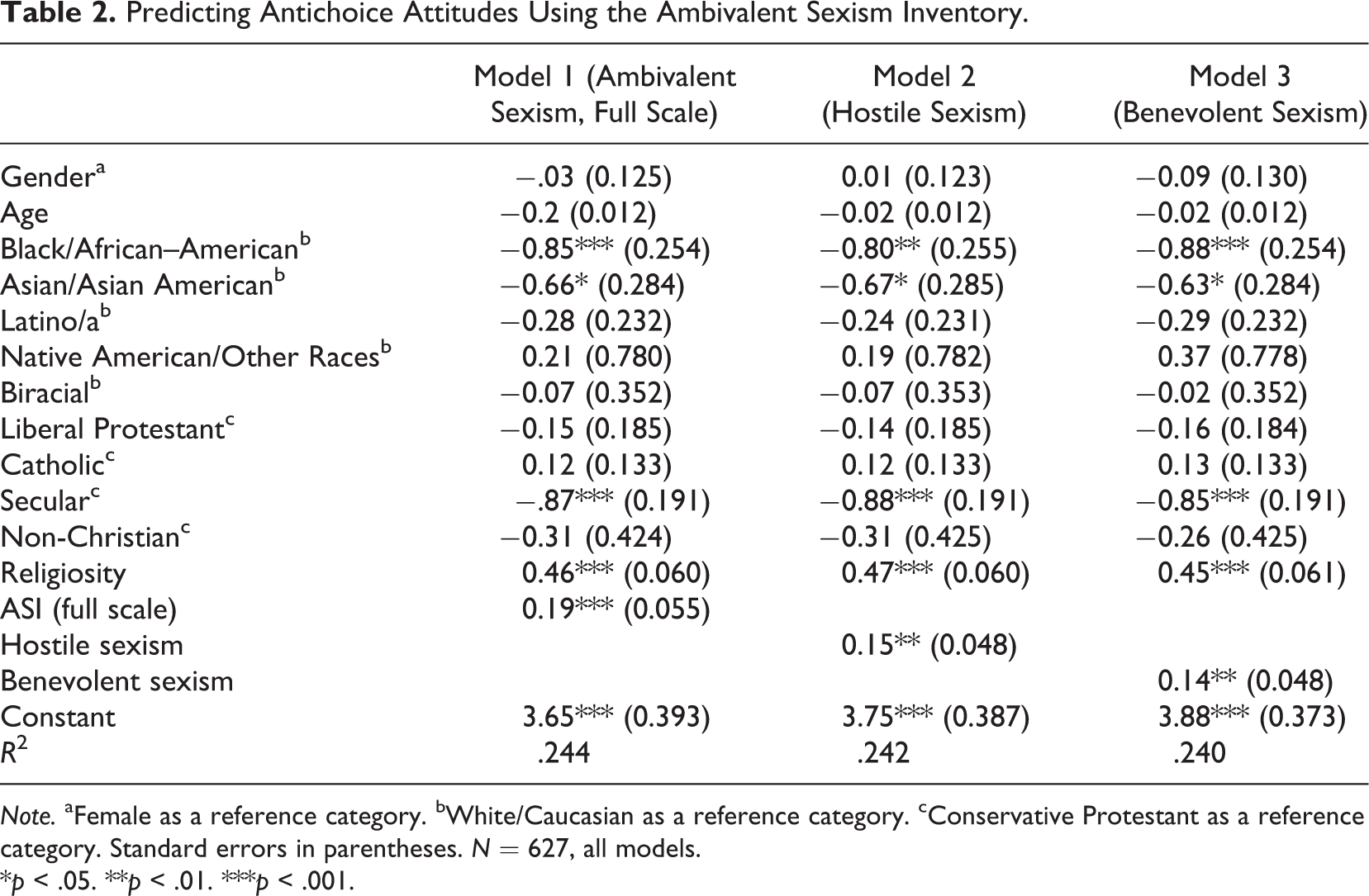
Note. aFemale as a reference category. bWhite/Caucasian as a reference category. cConservative Protestant as a reference category. Standard errors in parentheses. N = 627, all models.
*p < .05. **p < .01. ***p < .001.
Ambivalent Sexism and Antichoice Attitude Endorsement
The demographic control variables functioned in ways expected based on previous literature on abortion attitudes. Neither gender (female as reference category) nor age was significant predictor in the presence of the full ASI scale. African American and Asian American respondents were significantly less likely to be antichoice than were white respondents. African Americans scored, on average, 0.85 points lower on the 7-point antichoice scale than did whites ( p < .001), while Asian Americans scored, on average, 0.66 points lower than did whites ( p < .05). Latinos/Latinas, Native Americans, and bi-/multiracial respondents were not significantly different than white respondents. With regard to religion, seculars scored significantly lower on the antichoice scale than did conservative Protestants, by 0.87 points ( p < .001), while liberal Protestants, Catholics, and those of faith traditions other than Christianity were not significantly different than conservative Protestants. Those who reported higher levels of religiosity scored 0.46 points higher with each increase of 1 point on the religiosity scale, suggesting that those who received the most guidance from their religion were approximately 1.4 points higher on the antichoice scale than those who reported the lowest levels of religiosity. Turning to the ASI scale, Model 1 suggests that for every one point increase on the ASI scale (toward higher levels of sexism), antichoice attitudes increase by .19 ( p < .001). Model 1 explains 24.4% of the variability in antichoice attitudes.
Models 2 and 3 each examine one of the subcomponents of sexism using the same control variables. The relationships between the control variables and the various subdomains remain the same in both Models 2 and 3 as the relationship that emerged in Model 1. In Model 2, which examines the relationship between hostile sexism and antichoice attitudes, we find that with each point increase in hostile sexism there is a 0.15-point increase in antichoice attitudes. Model 2 explains 24.2% of the variability in antichoice attitudes. Similarly, in Model 3, examining the relationship with benevolent sexism and antichoice attitudes, we find that with each point increase in benevolent sexism there is a 0.15-point increase in antichoice attitudes. Model 3 explains 24.0% of the variability in antichoice attitudes.
Discussion
While abortion is stigmatized, it is also a common medical procedure in the United States, and little research attention has been devoted to examining the relationship between abortion attitudes and ambivalent sexism. The theory, developed by Glick and Fiske (1996), has been used as a framework by which many other women’s issues have been explored (Glick & Fiske, 2011). This study investigated potential relationships between the two subdomains of ambivalent sexism and antichoice attitudes.
Considerable research attention has been directed toward understanding abortion attitudes by sociodemographic identity categories, and many of the trends reported in past literature were similarly reflected in our results when pairing them with components of ambivalent sexism. By including the two subdomains of ambivalent sexism as an additional layer of analysis through which to consider abortion attitudes, findings supported our preliminary hypothesis that as individuals increasingly endorse sexist ideas—whether those are hostilely or benevolently valenced—they also tend to endorse increasingly antichoice attitudes; the aggregate ambivalent sexism scale as well as both of the two ambivalent sexism subdomains demonstrated statistically significant associations with antichoice abortion attitudes.
Sociodemographically, our results found that African Americans, Asians/Asian Americans, and seculars demonstrated the highest statistically significant negative correlations with antichoice attitudes across each of the models, results that are in line with past literature. Other racial and religious variables were not statistically different than whites and evangelical Christians, respectively. One departure from prior literature, however, was that neither liberal Protestants nor Catholics in the sample demonstrated statistically significantly different antichoice attitudes than their evangelical Protestant counterparts. This may have emerged as all models examined included both religiosity and some measure of ambivalent sexism, which potentially may undergird differences in the attitudes of these religious groups. In agreement with prior literature, however, individuals who identified as having the highest levels of religiosity displayed the most statistically significant positive correlations with antichoice beliefs even in the presence of measures of sexism, implying that abortion attitudes are perhaps not as much related to the specific religious tradition or denomination to which a person might adhere, but rather, to the level of influence or frequency of the person’s religious involvement. Neither age nor gender emerged as statistically significant predictor of antichoice attitudes.
We found statistically significant positive correlations between both of the ambivalent sexism subdomains (hostile sexism and benevolent sexism) and antichoice attitudes. This suggests that sexism, regardless of whether it is justified through traditional, old-fashioned misogynistic rhetoric or through a “kinder” or “more gentle” rhetoric, plays a continued and significant role in the opposition to abortion rights for women.
Limitations
A few limitations are worth noting. Even though demographic variability existed in the sample as it was drawn from six different university populations, it is still an undergraduate sample that relied predominantly on Midwestern regional convenience samples. Different sociodemographic compositions and nuances regarding results may have emerged if the sample had been drawn from different geographic regions, different sizes, types, or affiliations of schools, or if the study had been conducted in a setting outside of colleges and universities. Since a college student sample of convenience was used, the overall range of participants’ ages showed variability, but traditional students with a similar age range comprised a large proportion of the final sample. The sample also did not include large numbers of participants in some racial categories, but we felt it was important to retain such categorizations as control variables in our analyses and so that group-based nuances would not be obscured in collapsing the racial categories. We also ran the models (analysis not shown) with white respondents as the reference category and collapsing all other racial groups into a single variable for persons of color. In that analysis, the primary findings of the study were the same as the results reported here except that the racial differences that did emerge in our presented models were obscured. As such, we present the models with the racial groups differentiated. Given the small numbers in some of the racial categories and even though our findings are in line with the existing literature, the findings presented about racial differences should be approached with caution and warrant further investigation. Finally, the models examined in the study explain approximately one fourth of the variability in antichoice attitudes, leaving a large portion of the variability unexplained, suggesting that there are perhaps additional attitudinal constructs that could be added in future research efforts to further bolster our understanding of the relationship between these concepts.
Implications
Recent Supreme Court decisions and legislative actions have reinforced the notion that the battle for gender equality is far from over. While a Joint Resolution of Congress (1971), designated each August 26th as Women’s Equality Day to commemorate women’s suffrage in the United States, ongoing decisions by courts and policy makers offer a long and bleak list of reasons that suggest women experience a reality that is far from equality. For example, in 2012, the reauthorization of the Violence Against Women Act of 1994 was politically contentious, so much so that coverage under the Act was temporarily discontinued as it expired during congressional debate and reconciliation. While the Violence Against Women Reauthorization Act of 2013 (which primarily seeks to end domestic violence, dating violence, sexual assault, and stalking experienced by women) was eventually passed, a staggering 138 votes were cast against the reauthorization. Moreover, in 2014, a number of U.S. Supreme Court (SCOTUS) decisions were delivered that further infringed upon women’s reproductive rights and safety. First, through McCullen v. Coakley (2014), the SCOTUS struck down the protection of fixed abortion buffer zones around reproductive health care facilities, privileging free speech for antichoice protesters over female patients’ safety and accessibility of reproductive health services. Additionally, in Burwell v. Hobby Lobby, Inc. (2014), the SCOTUS also ruled that for-profit employers may be exempted from covering contraceptives under insurance plans due to corporations’ religious objections toward birth control and other family planning resources.
These recent examples—whether directly pertaining to reproductive rights or women’s rights, in general—highlight inequalities faced by women, themes that are echoed in the results of the current study. While we provide evidence that ambivalent sexism theory may be a useful lens by which the complexities of abortion attitudes could further considered, how can these theoretical concepts be practically applied, particularly in social work? Perhaps channeling the work of feminist scholar, bell hooks, is a philosophical starting point from which theory may be transformed into liberatory social work practice. hooks (1994) writes, I came to theory because I was hurting—the pain within me was so intense that I could not go on living. I came to theory desperate, wanting to comprehend—to grasp what was happening around and within me. Most importantly, I wanted to make the hurt go away. I saw in theory then a location for healing. (p. 59)
Accordingly, social work is uniquely positioned as a “location” for such forms of healing and could be an effective professional venue through which consciousness may be further raised to help “grasp” the sexism around (and within) us as individuals and as a society. Social work, an often interdisciplinary field, is also acutely aware of the complex intersectionality of cultures, beliefs, and attitudes that exist regarding an infinite array of topics, including sexism and abortion rights. As such, social workers should take on the task of understanding and further developing and extending theories—such as ambivalent sexism—that may be used as vehicles by which liberation may occur through both collective action and facilitating the process of naming and validating experiences of gender-based inequalities at the individual level.
For example, social workers, who play an important role in clients’ resource- and knowledge-acquisition, could further foster self-determination and social justice by sharing such theory-derived knowledge with clients, while also providing clients with medically and policy accurate, nonjudgmental information regarding reproductive health topics and resources. Social workers should also support political candidates and advocate for policies that do not embody the oppressive aspects of ambivalent sexist viewpoints. These advocacy efforts extend to all (regardless of gender identity) social workers, in their work with all policy makers and political candidates, and in their work with all clients and family members. Just as both women and men have paradoxically been shown to hold equally prejudicial attitudes toward women, feminist social work practitioners, in particular, should be called upon to lead this charge away from stigma and the endorsement of binary male/female power differentials, and toward self-determination and social justice, by modeling inclusive, collective strategies that further educate both women and men on women’s rights, worth, and history of inequality. Thus, there are merits to continuing past this study’s “jumping-off point,” because social workers can play a liberatory role in subverting the oppression of women by transforming views of women, while fostering access to women’s health and rights. Without a better understanding of the complex overt and covert attitudes toward women and regarding the issue of abortion, the impact of these polarized views currently will remain as contentious and oppressive to women’s rights and women’s lives as ever.
Footnotes
Appendix A
Appendix B
Declaration of Conflicting Interests
The author(s) declared no potential conflicts of interest with respect to the research, authorship, and/or publication of this article.
Funding
The author(s) received no financial support for the research, authorship, and/or publication of this article.