



Abstract
The amount households and individuals spend on transport can be a source of economic stress and vulnerability, especially for those who use a disproportionate share of their income to access services. Over the years, transport affordability has evolved from a broad indicator of inequality to a more refined concept that explains socioeconomic barriers. This paper examines how transport affordability has been defined and measured in Latin America and the Caribbean (LAC) in the past three decades. It also discusses the relationship between affordability, accessibility, and transport-related social exclusion. The paper concludes with reflections on future research in LAC and other regions in the Global South.
Keywords
Introduction: Transport Affordability as a Critical Social and Development Concern
The amount households and individuals spend on transport can be a source of significant economic stress and vulnerability, particularly for those having to use a disproportionate share of their income to access services (Litman 2025). Transport affordability research in Latin America and the Caribbean (LAC)—one of the world's most unequal regions due to class, gender, race/ethnicity, age, disability, and rural–urban disparities, among other factors—in the last three decades reveals a wealth of theoretical and policy evolutions on the capacity of all socioeconomic groups to afford transport services and access opportunities, interactions, and activities they might desire, as well as critical methodological reflections on affordability measures that can be instrumental for reducing urban poverty, inequality, and social exclusion (e.g., Gómez-Lobo 2011; Herszenhut et al. 2022; Rodriguez et al. 2017; Tiznado-Aitken et al. 2022; Vecchio et al. 2024).
An analysis of 12 countries in LAC found that private transport accounts for 76% of household transport expenditure, whereas public transport accounts for the remaining 24% (Gandelman, Serebrisky and Suárez-Alemán 2019). Despite comparatively lower expenditure on public transport than private transport, the former is often a necessity for low- and middle-income households, which make up a much bigger proportion of the total population (ibid.). High-income households, on the other hand, perceive public transport as an inferior, second-class good. Further, in LAC, transport expenditure as a percentage of income (relative to the average purchasing power) was 17% in 2010 (World Bank 2024). This was significantly higher than in other regions: 9% in Sub-Saharan Africa, 11% in Eastern Europe and Central Asia, and 5% in South Asia (ibid.). Together, these figures suggest that transport services in LAC are, on average, more expensive with low-income households and individuals bearing the highest economic burdens in accessing livelihood opportunities and essential services. An “outlier” in the region is Port-au-Prince, Haiti, where only 3.1% of total household expenditure is spent on transport (Sethi and Gorham 2018). Over two-fifths of households reported never using any motorized transport services, indicating widespread levels of deep poverty and deprivation (ibid.).
Time as a transport cost also warrants mention in the discussion of transport affordability since urban growth in the LAC is characterized by a disorganized horizontal expansion (Tirachini 2019). High-income households have conventionally concentrated in central areas and grow toward the periphery in specific axes in the form of gated neighborhoods, regenerated estates, and suburban developments (Gallego-Lizon 2023). In parallel, low-income households continue to locate themselves in historic quarters of the city center and in informal settlements at the urban periphery that tend to be established on deforested hill slopes, low-lying plains, landfills, and former industrial sites (ibid.). Such patterns of residential segregation result in low-income households and individuals experiencing uneven access to livelihood opportunities and basic services, as well as substantial waiting time at transit stops and/or during transfers due to the low level of transport service in peripheral areas while facing rising levels of congestion along with key traffic corridors (Rodríguez 2023).
Global agendas such as the United Nations’ Sustainable Development Goals (SDGs) highlight the policy significance of transport affordability for sustainable and inclusive development. Sustainable Development Goals target 11.2 states specifically to provide “[…] access to safe, affordable, accessible and sustainable transport systems for all” (UNGA 2017, 21, emphasis added). The distribution of transport expenditure can be a powerful indicator of the vast inequalities between households and individuals regarding income, mobility needs, choices, and preferences, as well as the availability of services and infrastructure (Valenzuela-Levi 2021). Intersecting differences in class, age, gender, race/ethnicity, disability, and employment further amplifies such inequalities, making transport affordability a complex social and development concern (Levy 2013). Additionally, the societal consequences of unaffordable transport are diverse, with evolving implications in the short-, medium-, and long-term (Schwanen et al. 2015). For example, the inability to pay for transport services can lead households and individuals with lower incomes to forgo trips (Motte-Baumvol and Nassi 2012; Vecchio et al. 2024). Those priced out of accessing transport services may become captive walkers, limiting their day-to-day destinations to those that are within walking distance and, consequently, experience varying degrees of social exclusion as trips related to employment, education, and basic maintenance of the household are prioritized (Herrmann-Lunecke, Mora and Sagaris 2020; Trichês Lucchesi et al. 2022).
Concerns about transport affordability have not been sufficiently present in LAC's planning debates in the last three decades (Gandelman, Serebrisky and Suárez-Alemán 2019; Gómez-Lobo and Serebrisky 2023; Peralta-Quiros and Rodríguez Hernández 2016). Lags in the localized introduction of affordability measures have led to stark inequalities across social groups, with low-income households and individuals making fewer trips while spending a higher portion of their incomes on accessing transport services (Oviedo et al. 2019; Suárez, Murata and Delgado Campos 2016). Moreover, persistent structural and institutional challenges at the city-level pose barriers to deliver affordable and inclusive urban transport systems. The former include rising levels of private motorization and car-oriented development, rapid growth of informal settlements at the urban periphery with little to no access to public transport, as well as a mismatch in household income, housing, and transport prices (Calatayud et al. 2021). The latter includes overcentralization, a lack of budgetary and technical know-how to conduct technical affordability studies, limited enforcement capacity, and a myriad of actors shaping (often conflicting) discourses on the distributional consequences of transport, hampering local policymakers’ ability to improve transport affordability for disadvantaged and marginalized populations (Bezerra, dos Santos and Delmonico 2020). Furthermore, the lack of fare integration is exacerbated by localized agendas advocating for the financial self-sustainability of public transport operations, resulting in fares remaining persistently high for households and individuals that need those services the most (Rodríguez 2023).
Conceptual Links with Accessibility and Transport-Related Social Exclusion
The concept of accessibility is an integral strategy for reducing poverty, inequality, and social exclusion in cities across LAC through transport policy reforms, investments, and research (e.g., Boisjoly et al. 2020; Levy and Dávila 2017; Rodriguez et al. 2017; Vecchio, Tiznado-Aitken and Hurtubia 2020). Defined within the scope of this study as “the ease of reaching desired destinations given a number of available opportunities and intrinsic impedance to the resources used to travel from the origin to the destination” (Bocarejo and Oviedo 2012, 143), interpretations of accessibility have evolved from a purely traffic-oriented approach to one that encompasses social justice concerns (Handy 2020). Transport affordability and accessibility are closely linked concepts as transport cost is one of the critical hindrances influencing households’ and individuals’ capacity to access goods, services, and activities, as well as their interactions with complex land-use systems in urban areas (Guzman and Oviedo 2018; Oviedo and Guzman 2020; van Heerden et al. 2022). Another key concept that has emerged from academic and policy debates is transport-related social exclusion (TRSE), which can be understood as “the process by which people are prevented from participating in the economic, political and social life of the community because of reduced accessibility to opportunities, services, and social networks, due in whole or in part to insufficient mobility in a society and environment built around the assumption of high mobility” (Kenyon, Lyons and Rafferty 2002, 210–11). Such definitions are critical in framing transport affordability as a social and development concern that precedes conditions of (in)accessibility and structural social exclusion observed in cities across LAC. More importantly, it demonstrates a two-decade-old paradigm shift in transport policy and planning—from centralizing economic efficiency to considerations of equity and addressing the distributional consequences of transport to reduce poverty and inequality.
Scope
This paper examines the evolving concept of transport affordability and its operationalization in relation to reducing urban poverty, inequality, and social exclusion in LAC. By building on the concepts of accessibility and TRSE, it summarizes the most relevant definitions and metrics applied to transport planning practices in cities across the region. While the paper examines affordability as applicable to all modes of urban transport, emphasis is given to public transport as a key mechanism to reduce (in)accessibility and social exclusion for disadvantaged and marginalized populations. The paper concludes by reflecting on future research on transport affordability in cities across LAC and its significance to other regions in the Global South.
Definitions and Measurements of Affordability
Transport affordability is often associated with the idea that there is some limit to what counts as affordable fare (Mitric and Carruthers 2005). It is expressed not merely in terms of a particular threshold/index value but often “by the political process or chosen arbitrarily by someone in the decision making process” (ibid., p. 3). According to Litman (2025, 11, emphasis in original), affordability “can be compared with gross (pre-tax) or net (after tax) incomes, or expenditures (budgets).” Transport affordability has, in the past decades, evolved from an indicator of macro-level inequalities and the performance of urban transport systems (Armstrong-Wright and Thiriez 1987) to a more refined concept that explains socioeconomic barriers to access transport and livelihood opportunities, with social categories such as income, gender, and age gaining more weight over time in analyses (Carruthers, Dick and Saurkar 2005; van Heerden et al. 2022). The short-, medium-, and long-term implications encompass disproportionate and unequal levels of transport-related expenditure, forgone trips, (im)mobility, social exclusion arising from limited access to economic, social, and/or cultural activities. Additionally, monetarist conceptualizations of transport affordability neglect the sociomaterial basis of transport (un)affordability, which is contingent on trip characteristics, personal/household budget practices, and technologically mediated transactions involving travel cards, contactless payments, and mobile applications (Dodel and Hernandez 2025).
Affordability also embodies a desirable outcome of urban transport decision-making processes in recent research and practice, giving rise to new pricing policies, fare schemes, and operational designs that seek to maximize social welfare (Jin, Schmöcker and Maadi 2019). The empirical advancement in the study of the concept is observed, from its initial development and application to transport policies in the Global North to a growing volume of literature adapting, redefining, and applying ideas of affordability to Global South contexts (Gómez-Lobo and Serebrisky 2023).
Improved understanding of the social consequences of transport unaffordability has, in turn, deepened theoretical and empirical contributions to the study of accessibility given that (un)affordability acts as an enabler and obstacle to accessibility. Likewise, the literature on accessibility followed a similar trajectory in the past three decades, where scholarship and policy discourses have shifted from the historical emphasis on urban transport's economic and environmental impacts (see Handy 2020 for elaboration) to include the social impacts of distribution in such systems and infrastructures (e.g., Borello Vargas, Spencer and Jones 2024; Niehaus, Galilea and Hurtubia 2016; Vecchio and Martens 2021). This trajectory was also marked by a transition in academic and policy debates from accessibility assessments at the city level (macro scale) to a more holistic understanding of the social and health impacts of transport within the neighborhood (meso scale) and for individuals and communities with various degrees of social and transport (dis)advantage (micro scale) (Levine 2020). At the same time, discussions of TRSE have enabled researchers, planners, and policymakers to understand better the differential social and equity impacts of new transport investments, mobility technologies, as well as policy changes and shifting attitudes in travel behavior across class, gender, race/ethnicity, age, disability, and other social categories (e.g., Lucas 2019; Luz and Portugal 2022; Yigitcanlar et al. 2019). Together, conceptual advancements in transport affordability, as well as accessibility and TRSE, are an essential lens to reach a comprehensive understanding of urban poverty, inequality, and structural social exclusion in cities.
This paper is based on a literature review of over 90 research articles and policy documents on the quantitative and qualitative approaches to transport affordability, of which nearly 70 are specific to the LAC context. The articles reviewed included one in Portuguese, 11 in Spanish, and 83 in English. Scientific search engines, including Elsevier, Google Scholar, JSTOR, ScienceDirect, Semantic Scholar, SpringerLink, Taylor and Francis Online, and with more limited relevant results, Latindex and SciELO, were consulted, and the review included the following keywords in English, Spanish, and Portuguese: affordability; affordable; transport affordability; social exclusion; accessibility; transport disadvantage; transport poverty; transport costs; and transport fares. The dominance of English publications reflects the geographical concentration of funding, researchers, and publishers in Anglophone countries. Regional institutions such as the United Nations Economic Commission for LAC publish most of their contents in both Spanish and Portuguese; the Spanish version was cited for this paper.
The initial literature review was conducted between April and June 2022, and 14 new sources in English were added in March 2025 as part of the review process. The research articles and policy documents mostly focused on transport affordability, accessibility, and equity impacts of transport and/or TRSE apart from a few sources detailing the overarching policy approaches to evaluate transport affordability and methodologies for pricing public transport services. Approximately 20 research articles and policy documents identified in the earlier stages of the literature review were excluded due to repetition, lack of relevance to the LAC and Global South contexts, and the unavailability of full texts.
Affordability Across Time and Space: Conceptual and Practical Evolution
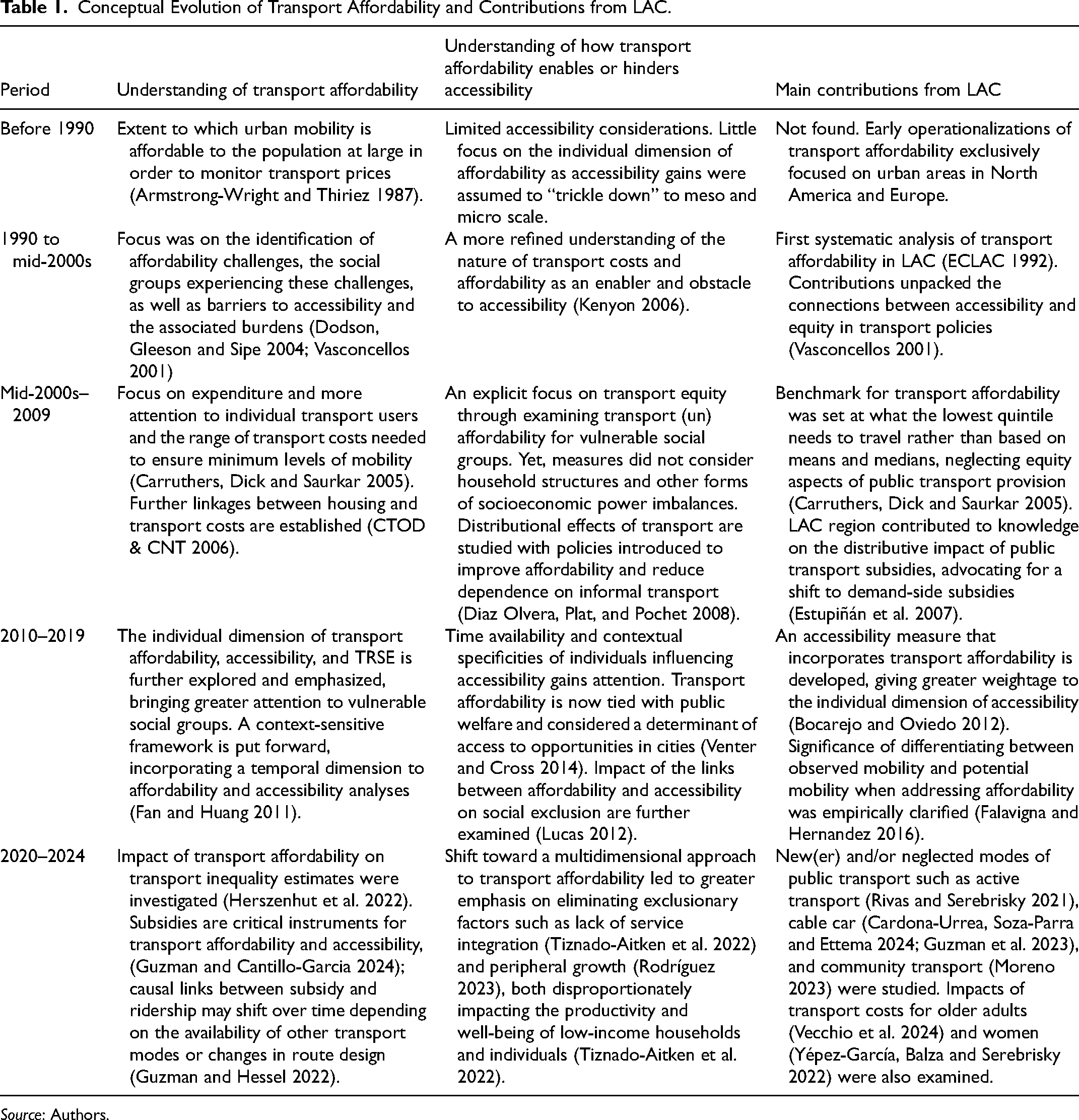
Table 1 presents a summary of the evolution of the concept of transport affordability, as well as the development of its linkages with accessibility and the main conceptual contributions from LAC. The geographical distribution of transport affordability and accessibility research, as well as the development of relevant indicators to inform policies, are highly uneven, with small states underresearched (Vecchio, Tiznado-Aitken and Hurtubia 2020). Furthermore, accessibility and mobility data tend to concentrate on megacities and metropolitan regions at the expense of small and medium-sized cities and rural and periurban areas (ibid.). The comparability of indicators across cities (e.g., housing and employment informality, level of potential or non-realized mobility, accessibility levels across specific socioeconomic groups) and the ease of implementation under different constraints of data availability (summarized in Table 1) are persistent practical challenges in LAC.
Conceptual Evolution of Transport Affordability and Contributions from LAC.
Source: Authors.
As shown in Table 1, different interpretations of transport affordability have given rise to diverse yet often complementary approaches. The chronological grouping of selected literature in Table 1 includes notable empirical and theoretical contributions from LAC. The following subsections present the evolution of affordability definitions and metrics across decades, spanning from pre-1990 to 2024.
Before 1990
Early operationalizations of transport affordability approached it as an indicator of city- and system-level inequalities, using the aggregate negative effects of pricing on the low-income population's share of public transport demand in North America and Europe. Transport affordability is conceived mostly as a benchmark of whether services are becoming too expensive (Armstrong-Wright and Thiriez 1987). An affordability issue emerges whenever a given share of the population spends above a threshold percentage of their income on transport services. For example, over 10% of households spent more than 15% of their income on work-related trips. Such monetarized interpretation of affordability, however, illustrates inadequate equity considerations as a definition that depends on a specific share of households or transport users as a target for defining whether transport services are too expensive for the poor, deliberatively excluding the most vulnerable from progressive action even though measuring the proportion of households or transport users spending more than a given percentage of their income on transport is in itself critical data for evaluating the effectiveness of policies and pricing mechanisms. In other words, if 9% of households spend more than 15% of their income on work-related trips, then there are “no affordability issues” using the current affordability threshold even though this 9% of households are likely to be from lowest income quintile group.
The use of arbitrary threshold/index values also precludes an accurate comparison of similar indicators across cities and countries. In the early decade of conceptualizing affordability, there was scant documentation of the criteria used for setting affordability threshold/index value, thereby failing to account for the exact distribution of transport and other household expenditures and the implications for social welfare in the medium- to long-term.
1990s to Mid-2000s
In the early 1990s, ECLAC (1992) evaluated transport affordability in cities across LAC using a fixed number of trips per month (i.e., 50 trips) and the minimum wage as a threshold to estimate the share of the population experiencing affordability challenges, applying a systematic analysis of affordability in the region for the first time. During the early 2000s, scholars remained preoccupied with presenting affordability as a barrier to access transport services or the financial burden associated with such access (Dodson, Gleeson and Sipe 2004; Vasconcellos 2001). However, with the theoretical advancements in accessibility, transport disadvantage, and TRSE at the beginning of the century (see Lucas 2019 for elaboration), interpretations of affordability and reflections on its implications became more refined, recognizing the role of transport costs as either an enabler or obstacle to access to opportunities for economic and social development (Kenyon 2006). In parallel, the use of arbitrary indicators of minimum of trips afforded with minimum wage in the previous decade evolved into estimates of minimum activities needed to be accessed per month with minimum wage. However, such estimates miscalculated the effects of informal transport and the extra costs imposed by transfers in the absence of fare integration. Moreover, conceptual and methodological advancements during this decade tend to ignore gendered patterns of mobility (Karla et al. 2020).
Mid-2000s to 2009
The fixed-trip basket definition of transport affordability by Carruthers, Dick and Saurkar (2005) constitutes the first breakthrough in redefining affordability from a more progressive perspective. It shifts the focus on expenditure to explore the notion of a minimum number of trips that represents “sufficient” mobility. In this vein, such a definition sets a target for the need for transport costs to enable a minimum number of trips for all. Affordability was defined as “the extent to which the financial cost of journeys put an individual or household in the position of having to make sacrifices to travel or the extent to which they can afford to travel when they want to” (ibid., p. 1). Operationally, Carruthers, Dick and Saurkar (2005) used the percentage of the monthly per capita income of the lowest quintile in a city needed to make 60 one-way 10 km trips per month. One advantage of the fixed-trip basket methodology is that it makes comparing transport affordability across different cities, regions, and countries possible, making it one of the most frequently used metrics for assessing the monetary barriers of transport. Nevertheless, the methodology ignores possible changes in fares due to supply responses needed to accommodate the fixed number of trips considered.
Around the same time, the housing and transportation (H + T) affordability index was introduced (CTOD & CNT 2006). It combines land-use and transport components of accessibility (Geurs and van Wee 2004) and is operationalized by computing the ratio of the combined costs of housing, transport, and household income. The H + T affordability index accounts for the location of activities and services, linking transport expenditure to residential choice and location, making it a very relevant indicator of accessibility inequalities for cities across LAC where high levels of sociospatial segregation persist (Oviedo et al. 2019; Quintero-Gonzalez 2019). The H + T affordability index assumes a trade-off between housing and transport costs, setting the foundation for more land-use-informed analyses of the economic burdens of urban mobility. This approach also has a larger potential for informing cross-sectoral policy, as it provides evidence of the need for better land-use and transport integration in the form of affordable social housing in accessible locations. The introduction of the H + T affordability index in interpreting transport affordability marked a turning point in the development and application of the concept, with a larger focus on establishing the links between affordability and accessibility. That is, the range of opportunities can be reached at an affordable cost.
One of the first assessments of public transport pricing policies from an affordability perspective in LAC involved a quantitative assessment of the distributive impact of subsidies introduced in various cities in the previous decade (Estupiñán et al. 2007). It concluded that, at the time of the research, attempts to improve affordability for the poor were insufficient and advocated for a shift away from supply-side subsidies (i.e., direct transfers of funds to operators) to demand-side subsidies (i.e., direct reductions in fares for individual users that meet specific requirements) (ibid.). The formal is regarded as a regressive, or at best, a neutral policy instrument. In contrast, the latter is regarded as a more progressive instrument even though it has yet been found to improve income distribution in the long term (ibid.). The increased focus on low-income and socially excluded groups led to a series of studies exploring the distributional effects of urban transport configurations, as well as critical assessments of public transport policies that explicitly aimed at improving affordability. For instance, the predominance of transport unaffordability across lower-income households who pay more in absolute terms for transport services than higher-income households highlights the former's high dependence on informal transport with unsubsidized fares. There are growing critiques toward using arbitrary threshold/index values, questioning their appropriateness in different social and development contexts (Carruthers, Dick and Saurkar 2005). The use of an arbitrary threshold/index value remained widespread throughout the 2000s as evaluation of transport policies and their affordability benefits aimed at improving the affordability–mobility relationship at the macro scale, that is, whether households and individuals facing affordability barriers can make as many trips as they would desire or need, rather than assess and address the distribution of affordability issues across the urban population (ibid.).
2010 to 2019
While the first decade of the century focused on city- and system-level analyses of transport affordability, marked by a critical examination of the links between the land-use and transport components of accessibility, the second decade saw a considerable shift in research attention to urban inequality and social exclusion. Refinements in definitions, metrics, and applications of affordability at the macro, meso, and micro scales, as well as new approaches to strengthen its links with individual dimensions of accessibility, led to further research on targeted cost-alleviating policies for low-income and socially excluded groups, and recognition of cross-sectoral collaboration given the structural limitations of transport policies for redistribution (Gómez-Lobo 2011; Guzman and Oviedo 2018; Oviedo et al. 2019; Rodriguez et al. 2017). For example, gendered impacts of transport affordability constrain women's mobility by keeping them away from livelihood opportunities and essential goods and services but it also impacts their dependents, illustrating the need for synergies between different development sectors (Uteng and Turner 2019). Research also recognized the significance of informal transport, employment, and housing as key determinants of affordability in cities across LAC (Moreno-Monroy and Posada 2018).
Bocarejo and Oviedo (2012) exemplified the need for improving existing understanding of the links between accessibility, inequality, and affordability by developing an accessibility measure that incorporates a component of affordability (expressed as the percentage of individual income spent on transport), allowing for the accounting of the individual component of the accessibility. The measure has been used in LAC to evaluate public transport pricing, subsidies, and functional configurations (Bocarejo et al. 2014; Guzman and Oviedo 2018; Vecchio, Tiznado-Aitken and Hurtubia 2020). Such an accessibility measure also illustrates research efforts in the region to quantify inequalities in accessibility across various income quintiles in different urban areas, thereby centering affordability as a significant driver of the phenomena. Another relevant approach is the development of the access envelope technique to evaluate the impacts of transport and spatial development strategies on the affordability of employment access for low-income households (Venter and Cross 2014). The technique was a leap forward in terms of incorporating travel costs into an accessibility measure. Similarly, building on the claim that mainstream transport planning approaches had hardly taken into account any affordability considerations, Panou and Proios (2013) suggested a metric to measure affordability on the basis of trade-offs households make between covering transport and housing costs. The benchmark for unaffordable transport and housing costs is if it exceeds a household's total expenditure by 20% and 30%, respectively (ibid.). Furthermore, advancements in understanding how intrahousehold differences impact affordability for individual households improved targeting mechanisms of subsidies and public transport fares (Falavigna and Hernandez 2016).
The increased awareness of the limitations of arbitrary threshold/index value to adequately reflect affordability challenges in different social and development contexts also led to questions about the data sources informing the analysis in the very first place. Venter (2011) argued that absolute or relative transport expenditures, subjective perceptions of unaffordability, and data on travel behavior and (im)mobility could not provide a complete picture of transport affordability on their own. Building on this line of criticism, establishing the link between affordability and social welfare and how it is affected by broader contextual factors such as the configuration of spatial development and transport supply captured researchers’ attention (Melo de Araújo et al. 2011; Venter 2011). At the same time, Fan and Huang (2011) developed a context-sensitive framework for affordability analysis after observing that transport affordability is determined not only by sociodemographic characteristics and time availability of individuals but also by the built environment and policy landscape. In their analysis of the links between affordability and accessibility in Montevideo, Uruguay, and Córdoba, Argentina, Falavigna and Hernandez (2016) emphasized the need to make a distinction between the use of observed mobility and potential mobility in future affordability studies.
Relying on user fees from financially constrained consumers (with few actual transport choices) to fund the operation of public transport in low-income neighborhoods can have detrimental effects on local transport provision (Aivinhenyo and Zuidgeest 2019). One pricing rule cities can consider is to set fares at “cost recovery” levels for majority of the population and introduce target demand-side subsidies to those who need them most (Peralta-Quiros and Rodríguez Hernández 2016). Low-income commuters deploy various individual and collective strategies to overcome being priced out of public transport services: fare evasion (with the associated risk of arrest or fines), forgoing the purchase of other essential goods and services, relying on household members, coworkers, and friends, depend on informal and/or nonmotorized transport alternatives, walk for one or more segment of the trip, and utilize free transfers and free fare cards provided by local and/or national government (Oviedo and Titheridge 2016; Perrotta 2017). These strategies may last for the short-, medium-, and/or long-term, with some trade-offs being conscious decisions and others unintended. Conversely, certain changes in public transport operations (that are not directly related to fares) can affect low-income households and individuals. For example, upgrades in payment technology discourage fare evasion and eliminate the conductor's/driver's ability to exercise discretion (Perrotta 2017). Solutions such as fare integration using a monthly travel card are not to be preferred by low-income groups as budgetary constraints prevent the acquisition of the travel card in the first place.
2020 to 2024
Energy consumption in the domestic and transport domains are conventionally analyzed separately. The linkages between transport affordability and fuel poverty through the lens of sustainability transition emerged as a research topic in LAC and other Global South settings (Furszyfer Del Rio and Sovacool 2023). This underscored the misalignments between income, prices, and energy efficiency, which further contribute to structural social exclusion, with low-income households and individuals often living in the least energy-efficient areas in the city. Additionally, Calatayud et al. (2023) estimated the cost of various decarbonization pathways and their medium- to long-term impacts on transport affordability, highlighting the exigency of the climate crisis, as well as the technical and financial challenges local and national governments face in achieving net zero by 2050. New(er) modes of transport touted as promising low-carbon solutions for cities in the region were studied through the lens of accessibility, affordability, and social exclusion: active transport (Rivas and Serebrisky 2021), community transport (Moreno 2023), and cable car (Cardona-Urrea, Soza-Parra and Ettema 2024).
Fare-free transport has generated considerable research attention globally (Kębłowski 2020), although it has yet demonstrated its effectiveness in LAC due to very few ex-post impact assessments being conducted (Basnak and Giesen 2023). In parallel, the effectiveness of demand-side subsidies in addressing transport affordability, accessibility, and travel satisfaction issues was investigated (Guzman and Cantillo-Garcia 2024). Guzman and Hessel (2022), however, emphasized the need for future research to interrogate the complex interplay of socioeconomic factors influencing affordability and cautioned that causal links between subsidy and ridership levels might shift over time depending on the availability of other modes of transport, travel satisfaction, and/or changes in route design. Through a comparative study of public transport in Medellín, Colombia, and Santiago, Chile, Valenzuela-Levi (2023) uncovered how income inequality shapes conflicting perceptions of equity, order, and working conditions of buses and trains and, more critically, the importance of unwritten rule systems and informal institutions in determining supply-side subsidies for public transport.
Zaio and Pineda (2021) estimated the additional subsidy required for fare integration of public transport services in Greater Santiago, Chile, with bus services running in seven periurban and rural communes adjacent to the administrative region. The proposed shift toward an integrated, multimodal transport system would entail a general reduction of 2.5% in travel time and an estimated USD$116 million social benefit (ibid.). The different distributive principles of ex-ante evaluations were further examined. Freiberg, Giannotti and Bittencourt (2024) analyzed proposed mass transit expansion projects in São Paulo, Brazil, and found significant disparities in their impacts on urban inequality along with the lines of income and race/ethnicity. Some of the proposed projects reduce different levels of accessibility between households, whereas other proposed projects worsen the different levels of accessibility, highlighting how transport-related inequalities are masked in the predominantly utilitarian criteria of ex-ante evaluations (ibid.).
Putting it Together: Drawing the Links Between Affordability and TRSE
Transport affordability is a prerequisite condition to achieve accessibility at the macro, meso, and micro scales. The two concepts are greatly intertwined; focusing on affordability enhances critical understandings of accessibility by identifying multidimensional barriers disproportionately faced by low-income and socially disadvantaged groups. The focus on affordability also enhances understanding of short-, medium-, and long-term travel behavior patterns based on financial considerations, thereby more effectively aligning transport policies with the economic realities of the population. Furthermore, the focus on affordability may also facilitate the creation of virtuous cycles in policy development and cross-sectoral collaboration to improve accessibility and vice versa. By building on the TRSE framework proposed by Church, Frost and Sullivan (2000) and the findings from decades of research and policy presented in the previous section, Figure 1 summarizes the main factors influencing transport affordability. Each color in the figure denotes one dimension of TRSE. Some factors of affordability are placed in larger boxes to graphically illustrate their connections to other factors; the dimension of the individual colored boxes in Figure 1 does not imply the order of significance of each factor in determining overall affordability.
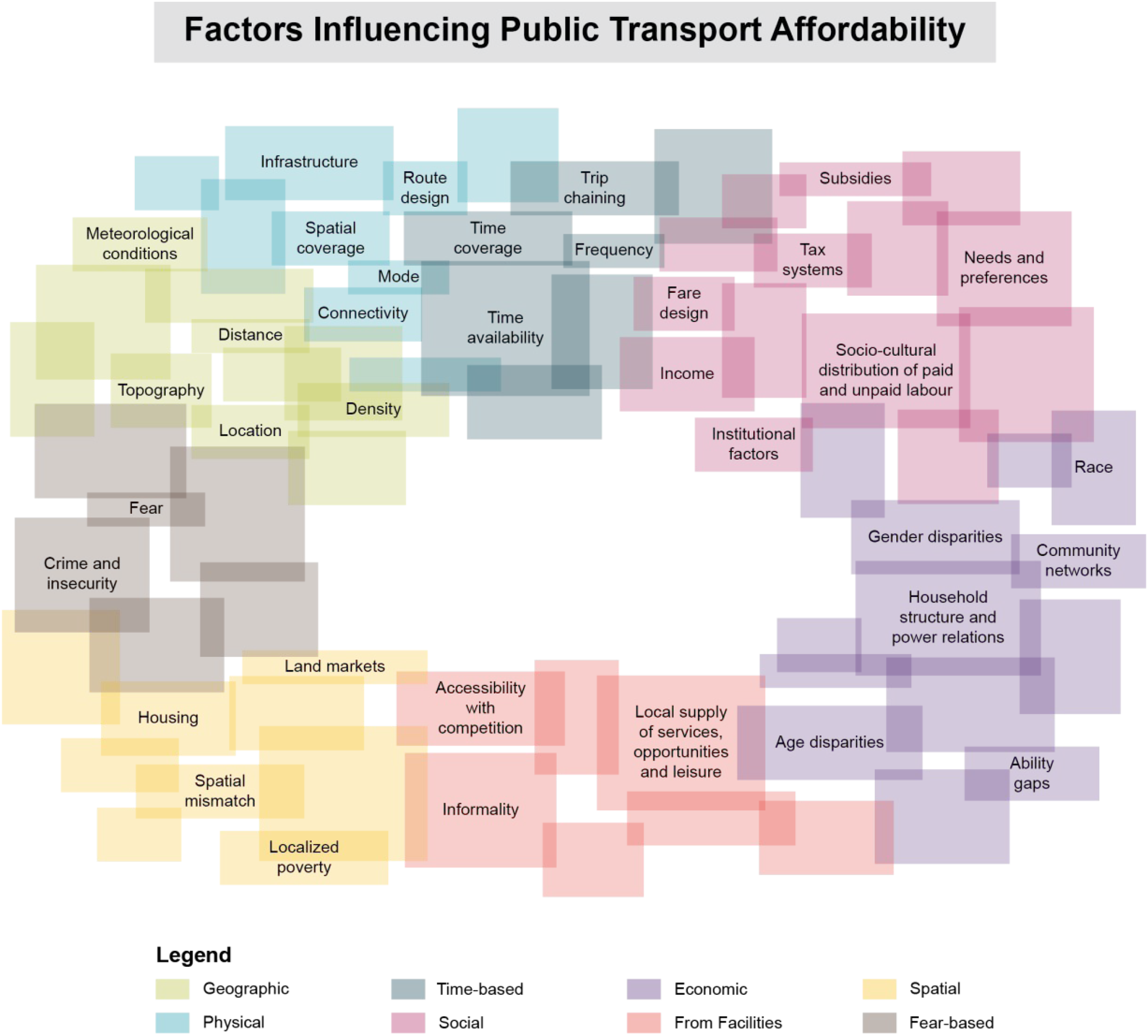
Factors influencing transport affordability categorized under the dimensions of TRSE.
Analyses of transport affordability in selected cities in LAC suggest that it is mediated by the strong links between income and sociospatial segregation (Borsdorf and Hidalgo 2010; Rodríguez Vignoli 2008; Tiznado-Aitken, Muñoz and Hurtubia 2020). The tendency of poverty to spatially concentrate and subsequently expand in the forms of low-income neighborhoods and informal settlements fuels much of the unplanned and unsustainable urban growth across LAC that is well-documented in the literature (Aguilar and López Guerrero 2023; Bayón 2008), alongside the high costs associated with long and expensive commutes (Guerra et al. 2018). Such high degrees of spatial inequality are cyclical; they engender the emergence of socioeconomic inequalities, which worsen existing patterns of spatial inequalities (Yépez-García, Balza and Serebrisky 2022). Taking the Buenos Aires Metropolitan Area as case study, Blanco and Apaolaza (2018) found that areas with high levels of spatial segregation exacerbate the marginalization of low-income and socially disadvantaged groups and can lead to further sociospatial isolation. There is also growing research attention on the differentiated effects of transport (un)affordability among low-income households where critical short- to medium-term trade-offs were made to maximize income and the ability to accumulate capital in the form of housing (Oviedo and Titheridge 2016). Studies on the social consequences of low accessibility demonstrated partial or total (im)mobility, disproportionate exposure to traffic risks, localized pollution, heat, and long walking times experienced by low-income individuals (Falavigna and Hernandez 2016; Peralta Castillo 2019; Rivas, Serebrisky and Suárez-Alemán 2018). The lack of transport affordability has been proven to limit accessibility to discretionary social and cultural activities critical for the well-being of individuals residing in low-income neighborhoods and informal settlements with a limited supply of local opportunities (Moreno-Monroy and Posada 2018; Oviedo and Guzman 2020). Furthermore, the increased investments in public transport systems in cities across LAC are juxtaposed with rising levels of road congestion (Rodríguez 2023). This has contributed to heterogenous perceptions of the performance of public transport services (Batarce, Muñoz and Torres 2022).
Gender plays a critical role in amplifying affordability inequalities with different dimensions of social exclusion in LAC (Fleischer and Sepúlveda Sanabria 2021; Karla et al. 2020). Monetary and time constraints, as well as unaffordable, unsafe, and poor quality transport services, limit women's mobility and keep them away from livelihood opportunities and essential services and goods associated with caregiving and household-related tasks, impacting low-income women disproportionately (Uteng and Turner 2019). This has long-term implications for their household, dependents, and the broader objectives of social development (ibid.). Consequently, women walk and use informal transport more frequently than men due to their complex mobility needs, and the added monetary and time resources spent on commuting negatively impact their accessibility to employment opportunities (Karla et al. 2020).
Figure 2 presents a summary matrix of the links between different factors influencing transport affordability (as illustrated in Figure 1) and the seven dimensions of TRSE. It highlights how transport unaffordability can represent a significant barrier to sociospatial integration and a compounding factor of other structural social exclusion for the poor and socially disadvantaged.
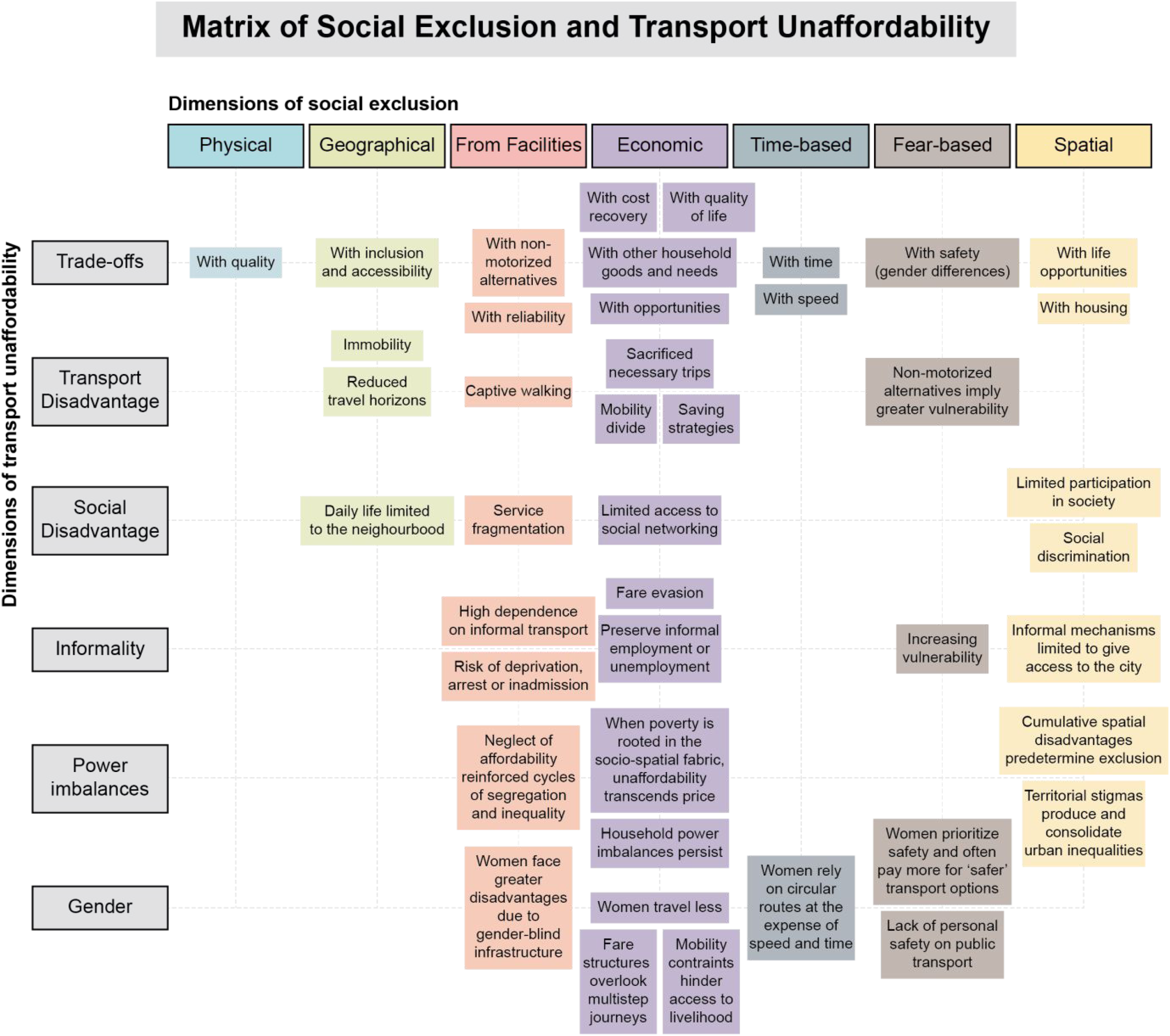
Links between affordability, (dis)advantage, and TRSE.
Thinking About Policy: Transport Pricing and Other Attempts at Improving Affordability in LAC
Transport policy and regulation in LAC have, in the last decade, shifted from the cost of investment and providing urban access to attaining affordability of consumption (Estache, Bagnoli and Bertomeu-Sanchez 2018). However, concerns about existing levels of transport unaffordability, particularly for the poor and socially disadvantaged, have not gained a sufficient presence in the region's transport planning debates (Gandelman, Serebrisky and Suárez-Alemán 2019). The persistent lack of adequate connectivity imposes excessive monetary and time burdens on low-income households and individuals, especially in areas where integrated ticketing systems are not available, thereby increasing the cost of each trip when transfer(s) are required (Oviedo et al. 2019; Suárez, Murata and Delgado Campos 2016). This problem has evidently grown in scale and complexity despite the substantial but uneven levels of increment in public transport investments across the region between 2002 and 2013 (Fay et al. 2017). Notably, public transport investments in Bolivia, Mexico, and Panama doubled between 2008 and 2015 (ibid.). Colombia, Nicaragua, Paraguay, and Peru followed investment trends in these countries with a moderate increase in public transport investments (ibid.). Majority of these investments were directed to improve service coverage in low-income areas, enhancing access to livelihood opportunities and essential services. In contrast, investments in public transport declined in Argentina, Guatemala, and Honduras (Serebrisky, Suarez Alemán and Pastor 2017).
There is little conceptual and empirical work assessing the efficacy of public transport pricing and an even more scant understanding of which pricing reforms yield the biggest welfare gains in cities across LAC (Parry and Timilsina 2010). Until recently, transport pricing strategies were not directly associated with affordability; rather, they were governed by principles of efficiency and financial sustainability (Jara-Díaz, Cruz and Casanova 2016). There is a policy preference in the region to attempt to cover operating costs with user fares, severely curtailing progress in developing and introducing differentiated pricing mechanisms for socially disadvantaged users. For instance, the bus rapid transit (BRT) systems in Quito, Bogotá, and Mexico City, Mexico, were implemented under financial models based on the assumption of covering operating costs with user fares, leading to higher single-trip fares when compared to other modes of public transport (Flores Dewey and Díaz 2019). The situation continued years after operation began, with greater fare hikes observed for BRT services than other modes of transport (ibid.). While increases in transport fares are controversial decisions that have led to mass protests, this has not stopped authorities from introducing fare hikes in cities across LAC (Díaz Pabón and Palacio Ludeña 2021).
In recent years, subsidies have become the most common policy solution in LAC to address many of the issues summarized in Figure 2 (Gandelman, Serebrisky and Suárez-Alemán 2019; Rivas, Serebrisky and Suárez-Alemán 2018, 2020). The inclination toward subsidies is rooted in economies of scale, that is, the Mohring effect, as well as the aim of tackling congestion through reducing car dependency (Calatayud et al. 2021). The efficacy of supply-side targeting students, older adults, people with disabilities, and other users most in need is hindered by the widespread use of informal transport in cities across LAC, even though they remain instrumental in integrating transport services in remote areas (Rivas, Serebrisky and Suárez-Alemán 2018). A notable example is the System of Identification of Social Program Beneficiaries (SISBEN or Sistema Nacional de Selección de Beneficiarios in Spanish), a unified household vulnerability index introduced across municipalities and districts across Colombia in 1995. According to Guzman and Oviedo (2018), Bogotá has utilized SISBEN since 2014 to design targeted subsidies to support low-income and socially disadvantaged groups to redress longstanding sociospatial inequalities. Technological innovations such as travel smart cards—bip! in Santiago, Chile, Bilhete Único in Metropolitan São Paulo, Brazil, CDMX (Ciudad de México) in Mexico City, Mexico, and STM (Sistema de Transporte Metropolitano) in Montevideo, Uruguay—have enhanced targeting mechanisms to reach social groups in focus and assess their usage of public transport services, thereby improving accessibility and livelihood opportunities in the medium- to long-term (Crotte Alvarado et al. 2018).
Conclusion and Ways Forward
Prior to 1990, transport affordability was framed as a city- and system-wide indicator of inequalities with an empirical focus on North America and Europe. The concept was initially limited to pricing considerations, and little attention was paid to equity aspects of such transport pricing strategies. Thresholds/index values were adopted in the 1990s to account for transport and other household expenditure as contemporary understandings of the critical links between accessibility, affordability, and social exclusion was first established in the literature. Throughout the decade and in the early 2000s, transport expenditure was understood as an enabler and obstacle to accessibility. The structural barriers associated with informality were underestimated, and gendered patterns of mobility were overlooked or ignored entirely, resulting in low-income and socially disadvantaged women experiencing excessive monetary and time burdens when accessing transport services.
By the turn of the century, research attention shifted from analyzing expenditure to developing indicators that can capture what sufficient accessibility is. Greater priority was also given to transport unaffordability as experienced by the lower income quintile groups, that is, affordability threshold/index value based on what these groups needed to access through transport at minimum, gradually shifting away from an arbitrary affordability threshold/index value. The H + T affordability index represented an emerging approach to better examine accessibility inequalities in the highly sociospatially segregated cities and regions across LAC by looking at housing and transport costs in relation to household income. Consequently, conceptual links between affordability and accessibility were strengthened, and transport pricing and subsidy strategies were further scrutinized, resulting in greater advocacy for demand-side subsidies that would more directly address transport affordability issues faced by low-income and socially disadvantaged groups. The call to move away from supply-side subsidies is pertinent to how limited public funding may be more equitably distributed in other Global South settings. However, as most demand-side subsidies have yet to be found to improve income distribution in the population it is being applied to, further research on integrating public transport subsidies and its targeting mechanisms with other pro-poor policy instruments is imperative in LAC and other regions in the Global South.
The 2010s saw multiple advancements in affordability definitions, metrics, and applications. This improved existing understandings of redistribution in public transport and how addressing transport unaffordability may reduce urban poverty, inequality, and social exclusion. The methodological inclusion of time availability, intrahousehold differences, and contextual specificities of individuals were observed in the literature. The decade also witnessed the development of an accessibility measure that incorporates affordability as a form of travel impedance, with affordability increasingly regarded as a determinant of access to opportunities. In conjunction, the distinction between observed mobility and potential mobility was further refined. Researchers approached affordability using intersectionality to understand structural inequality and social exclusion, making visible the additional monetary and time burdens disadvantaged populations are subjected to. The growing research and policy attention on the strategies deployed by individuals to overcome being priced out of public transport services was critical for advancing knowledge on the existing gaps in public transport provision in LAC. Such studies are urgently needed in Africa and Asia for local policymakers to develop targeted policy responses.
There is a burgeoning volume of scholarship that takes affordability to evaluate the effectiveness of public transport investments in reducing urban poverty, inequality, and social exclusion. Understanding the drivers and multidimensional implications of transport affordability issues in different urban contexts in LAC and for different socioeconomic groups can shed light on the profound ramifications of (im)mobility, captive walking, a lack of access to high-quality transport, regressive and nonintegrated fare policies, as well as the lack of participatory structures in transport and land-use planning. Despite evolving debates on transport affordability and a growing emphasis on demand-side subsidies for improving accessibility and mobility for low-income and socially disadvantaged groups, shared challenges in LAC and other regions of the Global South remain. For example, there are significant data gaps in the targeting, delivery, and funding mechanisms that could maximize the effectiveness of transport subsidies, fare integration, and other pro-poor policy instruments to reduce the monetary and time costs of accessing transport services. Strengthening institutional and technical capacities, as well as the regulatory landscape, to integrate new(er) and/or neglected modes of transport and reduce affordability inequalities while addressing broader climate and gender equality goals in line with the SDGs.
Affordability depends on the cost of transport as much as it does on the purchasing power of those using it. In this regard, affordability is a critical social and development concern, reinforced by decades of neoliberal policies in LAC that exacerbate cycles of sociospatial segregation and, consequently, vastly unequal access to livelihood opportunities and essential goods and services. Research efforts in the region to improve understanding of transport affordability for the poor and socially disadvantaged have not been sufficiently complemented with policy mechanisms to address informality and precarious work. Many governments in LAC strive to maintain low fares that can still contribute to covering some of the operation costs of the public transport system without a more ambitious long-term vision and/or targets to improve affordability and accessibility. Such vision and targets shift the discourse toward a progressive reduction of fare contributions to operational expenses and the active search for alternative funding sources from land value capture, parking fees, and congestion charges to earmarking a portion of local sales tax for public transport investments. Any long-term intervention to address affordability inequalities must be accompanied by short- and medium-term policy measures consistent with the trajectory of developing sustainable and inclusive public transport. For instance, for local governments implementing transport reforms geared toward integration and formalization, feasible affordability targets include reduction of transfer costs, recognition of negotiated/partial fares in informal transport, and cross-subsidization to raise operational efficiency.
The lack of consensus in mainstream research and policy debates in LAC on the definitions, metrics, and applications of transport affordability offers critical lessons for other Global South settings. It demonstrates a lacuna in innovative policy time frames, context-specific targeting mechanisms, and cross-sectoral collaborations to address the socioeconomic consequences of transport (un)affordability and its complex links with accessibility and TRSE in a way that is grounded in the diverse lived experiences of the local urban population.
Footnotes
Acknowledgments
This paper has been developed as part of the background work for the Flagship Study on Transport for Inclusive Development in LAC, funded by the Inter-American Development Bank. The full report can be found at:  . The authors are specially thankful to Lynn Scholl for her inputs and feedback on an earlier version of the manuscript.
Declaration of Conflicting Interests
The author(s) declared no potential conflicts of interest with respect to the research, authorship, and/or publication of this article.
Funding
The author(s) disclosed receipt of the following financial support for the research, authorship, and/or publication of this article: This work was supported by the Inter-American Development Bank.