




Abstract
Planners increasingly recognize connections between traveler constraints, automobile access, and travel behavior. The limited ability to travel via car—for economic or other reasons—greatly reduces mobility for many Americans, who overwhelmingly rely on automobiles for access. Yet public policy efforts to reduce excessive automobile travel often prioritize public transit, ignoring the high rates of private automobile sharing among U.S. travelers. Relatedly, few researchers have studied informal sharing and its relationship with traveler disadvantage, particularly for noncommute trips. To address this research gap, I analyze U.S. trip diary data from 2017. I use multinomial probit modeling to explore the relationship between disadvantage and informal automobile sharing. My definition of disadvantage includes people who have low incomes, travel-limiting physical conditions, and/or limited automobile access. I define several categories of informal automobile sharing to account for different dimensions of interhousehold and intrahousehold sharing. I find that transportation disadvantage is associated with most types of informal sharing, particularly borrowing cars and receiving rides from nonhousehold members. However, trip purpose—particularly noncommute trips—predicts the choice to share better than disadvantage does. Further, trip purpose has a stronger association with sharing among nondisadvantaged travelers. These findings suggest that informal sharing benefits disadvantaged travelers, but social and situational contexts also influence decisions to share transportation. I recommend policies to enhance automobile-based access for low-income travelers, including subsidies for carshare, ridehail, and private car ownership.
Keywords
For decades, transportation planners and policy makers have promoted vehicle-sharing, emphasizing its potential to replace single-occupancy vehicle (SOV) travel ( 1 ). Automobiles, which are expensive to own and operate, place heavy financial burdens on low-income people ( 2 ). Sharing vehicles may thus lower the individual financial costs of transportation. Vehicle-sharing may also reduce the negative externalities of private automobile travel, such as carbon emissions, air pollution, and congestion ( 3 ).
Studies of travel behavior, however, tend to emphasize formal shared mobility modes such as public transit, carshare, and bikeshare. Research attention to formal sharing often overlooks how frequently people travel in cars with family, friends, and acquaintances, particularly in the United States. When researchers and policy makers do analyze private vehicle-sharing, they tend to emphasize sharing for the commute, even though most trips serve nonwork travel ( 4 ). Furthermore, compared with the average U.S. nonworker, the average worker is more educated, wealthier, and less likely to have a disability ( 5 ). A research emphasis on work-related trips, then, may overlook the needs of disadvantaged travelers. The limited studies of noncommute trips in the United States – for example of shopping, medical, and chauffeuring trips – seldom directly compare how travelers use different types of sharing to complete different types of trips. These approaches to transportation-sharing thus fail to acknowledge the reality of shared travel in the United States and its potential benefits for disadvantaged travelers (6).
To address these gaps in the literature, I examine relationships between transportation disadvantage, trip purpose, and informal vehicle-sharing using travel diary data from the 2017 National Household Travel Survey (NHTS). I use multinomial probit modeling to test three primary hypotheses:
Disadvantaged U.S. travelers are more likely to share automobiles (including to carpool) than nondisadvantaged travelers.
Compared with other travelers, disadvantaged travelers are especially more likely to share automobiles between households.
Trip purpose better predicts sharing for nondisadvantaged travelers than disadvantaged ones, as the former often share because they want to, whereas the latter do so because they need to.
To examine different aspects of informal sharing, I propose five categories distinct from private SOV travel. They capture differences in sharing resources within versus between households. Further, I only analyze noncommercial trips in which travelers share the use of a private vehicle, excluding formal services like commercial carsharing (e.g., Zipcar) and ridehail (e.g., Uber). Although formal services may offer mobility benefits to low-income users, they have received attention elsewhere ( 7 ), and serve a small percentage of trips taken by U.S. travelers. I also analyze behavioral differences between disadvantaged and nondisadvantaged travelers. Combs et al. define transportation disadvantage as “a mismatch between the need for mobility and accessibility and the travel options available” ( 8 , p. 68). Informed by this description, my definition of transportation disadvantage includes people who live in low-income households, have medical conditions that constrain travel, or have limited automobile access.
I find that transportation disadvantage has a positive association with automobile sharing, especially in cases of external-to-household receiving (i.e., getting a ride or borrowing a car). Taking a nonwork trip also increases the likelihood of automobile sharing. This most likely occurs because compared to work trips, nonwork trips have greater temporal flexibility; further, people do nonwork activities together more often than they work at the same location. Finally, trip purpose better predicts sharing among nondisadvantaged travelers than among disadvantaged travelers. All of these relationships hold upon controlling for other factors (e.g., gender, race/ethnicity, and the built environment) that have documented relationships with mode choice. These findings have implications for transportation policies to encourage automobile sharing, both publicly and privately.
Literature Review
Researchers have identified various attributes – including demographic, built environment, and situational factors – that influence sharing transportation. These factors informed the variables included in the mode choice models presented below. Previous research also suggests relevant factors for which this analysis cannot account, given the data available. Below, I review two types of informal sharing in the travel behavior scholarship. I discuss cases of parallel sharing (i.e., when two people occupy the same vehicle) and serial sharing (i.e., when people share the use of a car at different times) ( 9 ). Owing to an established research focus on informal sharing for commuting (including in the form of carpooling), several of the studies presented here address high-occupancy vehicle (HOV) travel for that purpose in the United States.
Carpooling and Disadvantage
Previous research on transportation disadvantage indicates that household vehicle access ( 10 ), income ( 11 ), and health status ( 12 ) have positive associations with rates of informal vehicle-sharing, and especially carpooling to work. Using data from 2009, Blumenberg and Thomas examined rates of carpooling to work among U.S. residents who did and did not own vehicles and by income ( 11 ). Unsurprisingly, people without household vehicle access carpooled to work more often (19.7%) than people with vehicle access (12.2%). But even among those living in households with vehicle access, impoverished people carpooled to work far more often (26.0%) than nonpoor people (11.2%). In both cases, Blumenberg and Thomas defined carpooling as including both internal- and external-to-household HOV travel for the commute ( 11 ). These results suggest that both household vehicle access and income—particularly poverty status—influence how often people informally share private vehicles.
Beyond the costs of owning and operating a vehicle, factors like health and disability status affect the ability to drive ( 13 ). Owing partly to health issues, age has a unique, bimodal relationship with driving. The very young cannot legally operate vehicles ( 14 ) and older adults often cease driving because of health and vision issues ( 15 ). Age can also interact with automobile access in reducing mobility. For example, as U.S. residents age, especially above the age of 70, their rates of automobile ownership decline ( 16 ).
Borrowing Vehicles and Disadvantage
Relatively few studies have examined the practice of borrowing vehicles in the United States. The few that have suggest that vehicle-borrowing plays an important role for people facing disadvantage. For example, Blumenberg and Thomas found that 13.9% of Americans living in zero-vehicle households drove solo to work in 2009, using another household’s vehicle to do so ( 11 ). Qualitative studies have also found that constrained people frequently borrow vehicles. Via interviews, Clifton found that members of low-income families in Austin often borrowed vehicles from acquaintances to visit grocery stores ( 17 ). Via interviews with Mexican immigrants in California, Lovejoy and Handy found that they occasionally borrowed vehicles from family and friends ( 18 ).
Informal Sharing and Trip Purpose
As stated above, most studies of informal sharing and carpooling/HOV trips only examine the commute to work. This partly reflects the environments in which policy makers have framed carpooling as a way to reduce peak-hour congestion, particularly in the 1970s and 1980s ( 19 , 20 ). The research emphasis on commuting also reflects how many public datasets—such as the U.S. Census and American Community Survey and many regional surveys—only inquire about travel for the work commute ( 21 ).
To fill this knowledge gap, some studies have examined how travelers share automobiles to complete nonwork trips, for example, the study by Clifton examining informal sharing among Austin residents for grocery trips ( 17 ). Via interviews, Combs et al. examined how rural North Carolina residents caught rides to healthcare appointments ( 8 ). Arbour-Nicitopoulos et al. surveyed Toronto residents about carpooling to chauffeur children to school ( 22 ). None of these studies, however, directly compare the utility of informal vehicle-sharing for nonwork versus work trips. In the only quantitative national study of trip purpose and carpooling, Blumenberg and Smart found that compared with taking a personal trip, taking a work trip decreased the likelihood of carpooling with nonhousehold members ( 23 ).
Informal Sharing and Other Factors
Researchers have reached different conclusions about the relationships between informal sharing—especially carpooling—and other U.S. traveler demographics. In older studies, Teal ( 24 ), Ferguson ( 21 ), and Buliung et al. ( 25 ) found that demographics have little association with carpooling (defined both as internal- and external-to-household commute trips), apart from their correlations with automobile ownership. In a meta-analysis of more recent studies of carpooling in North America and Western Europe, Neoh et al. found a handful of demographic characteristics—including being female—associated with commuter carpooling ( 1 ).
Other characteristics, including immigrant status and education, appear to influence rates of carpooling. Using data from 2000, Blumenberg and Smart examined the role of nativity in carpooling for the commute among Southern California residents ( 26 ). They concluded that immigrants living in immigrant-rich neighborhoods carpooled at higher rates than native-born residents. However, they found the reverse for immigrants who lived in neighborhoods with fewer nonnative residents ( 26 ). Other studies have found that education level has an inverse relationship with rates of carpooling, even when controlling for income ( 25 , 27 ).
Several studies have identified relationships between the built environment and the choice to travel by modes like public transit ( 28 ). Researchers have similarly tested for associations between carpooling and the built environment, but their conclusions vary. Using 2017 data on U.S. workers, Benita identified a strong positive relationship between carpooling to work and population density at the county level ( 29 ). Using 1990 national data, Ferguson found a small positive relationship between population density and carpooling for the commute and a negative one between suburban residence and carpooling relative to driving alone ( 21 ). However, several regional and employer-based studies in the United States have found no association between residential or employment density and commuter carpooling ( 30 , 31 ).
Gaps in the Literature and Hypotheses
This analysis addresses several gaps in the literature on transportation disadvantage, informal sharing, and trip purpose. First, researchers who examine disadvantage and mode choice in the United States tend to emphasize the role of public transit (a formal type of sharing). I thus expand the body of research on informal sharing, testing the hypothesis that disadvantaged travelers disproportionately share automobiles in various ways. Some qualitative studies of carpooling, ridesharing, and equity—including those by Chatman and Klein ( 32 ) and Coren et al. ( 33 )—examine the roles of economic constraints and cultural norms in informal vehicle-sharing. These studies, however, examine individual regions and cannot make statistically significant claims about national behavior.
Second, several studies use the term “carpooling” to examine informal sharing between households and for the commute (see Neoh et al. [ 1 ] for a review of carpooling studies using this definition). On the former point, I diverge from these traditional approaches by comparing different types of internal- and external-to-household sharing and how they relate to mobility constraints. I do so because disadvantaged travelers may rely on household and nonhousehold resources differently from nondisadvantaged people. Indeed, studies suggest that interhousehold resource-sharing is a stronger source of support for people with low incomes than for people with higher incomes ( 34 ). Further, commutes comprise a minority of U.S. trips, even during peak travel hours ( 4 ). Studies of work travel fail to capture the behaviors of nonworkers, whose mobility needs may be unique. Other studies of travel serving nonwork purposes – such as shopping ( 35 ), chauffeuring to school ( 36 ), and healthcare ( 37 ) – seldom directly compare them to the work commute.
In studying noncommute travel, I also hypothesize that people share disproportionately for nonwork purposes, but that this relationship is stronger for nondisadvantaged travelers. This expands the research that tests the relative influence of long-term economic factors (e.g., resource access) and temporary needs (e.g., trip purpose); see, for example, work by Ho and Mulley ( 38 ).
Data and Methods
The following sections describe the data, construction of dependent and independent variables, and statistical model forms. I conclude by highlighting the strengths and limitations of this research approach.
Trip Data from the 2017 National Household Travel Survey
In this study, I rely on data from the 2017 NHTS. The U.S. Federal Highway Administration conducts the NHTS every few years, most recently in 2001, 2009, and 2017. Surveyors contact respondents and instruct them to keep travel diaries recording where, when, how, and why they travel in a single day. Respondents also self-report demographic data for themselves and other household members. In 2017, the NHTS recorded responses from 129,969 households, capturing data for 264,234 persons and 923,572 noncommercial trips. The weighted version enables users to produce population-level estimates. The version of the NHTS available to the public consists of files at the level of the household, person, vehicle, and trip ( 39 ). This analysis primarily uses data from the trip file.
Like in previous studies, I use discrete choice models to capture how individual travelers make rational and utility-maximizing choices among travel modes ( 40 ). In adopting this conceptual framework, I caution the reader not to overestimate the degree of “choice” that any individual traveler has. In keeping with this approach, I restrict the sample to trips made by people aged 16 and older. Modeling the behavior of very young people – for example, a 10-year-old child driven by her mother – may inappropriately represent choice, as parents or caregivers often make travel decisions for minors ( 41 ).
In this study, the trip serves as the unit of analysis. This approach occasionally leads to awkward phrasing. For example, should an independent variable have a positive association with sharing (relative to nonsharing), I may write that “traveler unemployment increases the likelihood that a trip was shared.” However, this does not necessarily mean that being unemployed increases the likelihood that a person took a shared trip—the traveler is not the unit of analysis. Although these sentences can seem clumsy, the reader may appreciate the effort to accurately report findings.
Defining Automobile Sharing
Via probit modeling, I predict the type of private automobile sharing used for a trip (which thus serves as the dependent variable). Of course, people also travel via nonprivate and nonautomobile modes. They may take public transit, walk, bicycle, or use taxi/ridehail. U.S. travelers, however, use nonautomobile modes relatively infrequently. Data from the NHTS illustrate this point. In 2017, almost 84% of U.S. noncommercial trips took place in private automobiles, followed by a notable proportion via walking (10.4%) and small proportions via modes like public transit (3.4%), bicycling (0.9%), and taxi/ridehail (0.8%) ( 4 ).
I do not analyze shared trips made outside of private vehicles (for example, via public transit or carsharing). Although these modes comprise an important aspect of travel, they fall outside of this research focus on automobile sharing and have received extensive research coverage elsewhere. Restricting the analysis to private automobile trips results in a sample of 737,812 trips (which, once weighted, represent a total of over 822 million trips). I further divide these private auto trips into six categories, shown in Table 1. Figure S1 in the Appendix provides a graphic representation of the relationships among the six categories.
Private Automobile Trip Categories and their Characteristics
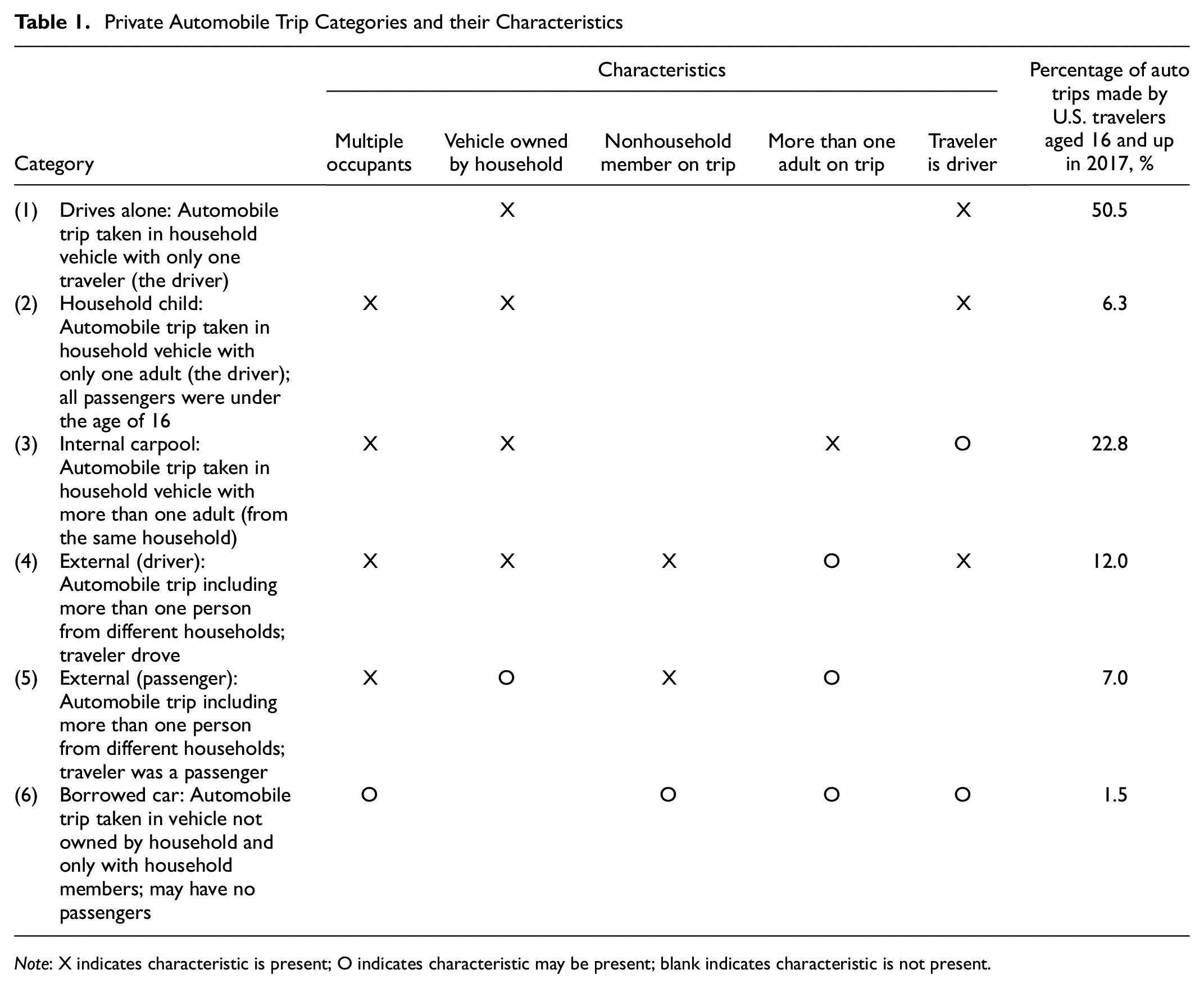
Note: X indicates characteristic is present; O indicates characteristic may be present; blank indicates characteristic is not present.
The six categories include five sharing categories and one nonsharing one (Drives alone). The categories capture different aspects of sharing. For example, in trips that fall into Categories 2 through 5, people engage in concurrent sharing (i.e., HOV travel). Category 6 (Borrowed car), however, include some SOV trips that are cases of sequential sharing (where property is shared). Further, Categories 4 through 6 require that people share across households; only in Categories 5 and 6, however, does the traveler receive transportation resources from a nonhousehold member. In Category 4, the traveler provides resources to another household (by driving a nonhousehold member). These distinctions are relevant to theories of resource exchange, including variations in sharing with close versus distant contacts ( 42 ). Finally, Household child trips (Category 2) have an ambiguous relationship with sharing, as child passengers may not voluntarily “share.”
The final column in Table 1 displays the proportion of all private automobile trips made via the six categories. In 2017, almost half (49.5%) of U.S. private automobile trips involved some sharing. Further, over 29% of all private automobile trips occurred via within-household sharing (i.e., Household child or Internal carpool), in which travelers and the vehicle belonged to the same household. The remaining trips (20.5%) occurred via interhousehold sharing (External (driver), External (passenger), or Borrowed car). Together with NHTS data on all trips, Table 1 illustrates the significance of private sharing for U.S. adult travel: in 2017, over 41% of trips occurred via inter- or intrahousehold sharing of private cars.
Model Forms
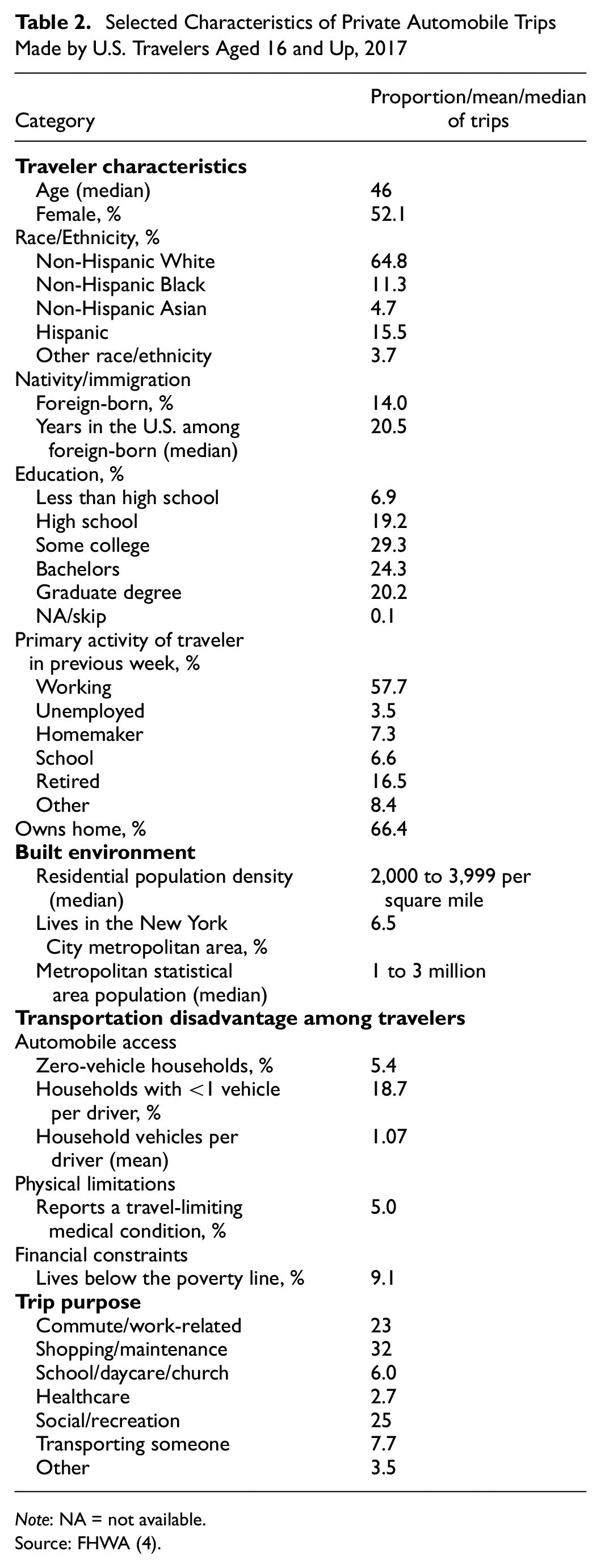
In testing the hypotheses about the relationships between disadvantage, travel purpose, and likelihood of sharing, I estimate a series of multinomial probit models to predict mode choice using the variables listed in Table 2. In various travel behavior studies, researchers have used discrete choice models to determine how individuals make rational, utility-maximizing choices ( 40 , 43 ). In these studies, researchers typically use multinomial logistic and probit regression models to compare the factors that influence the choice of one mode over another ( 40 ). From the models, I compute the average marginal effects to determine the relationship between the independent variables and the actual probability—rather than the relative probability—of sharing for an automobile trip.
Selected Characteristics of Private Automobile Trips Made by U.S. Travelers Aged 16 and Up, 2017
Note: NA = not available.
Source: FHWA (4).
I considered using multinomial logistic regression modeling, a less computationally intensive approach to modeling discrete choice. However, multinomial logistic regression models assume independence of irrelevant alternatives (IIA), that is, the choice of one alternative over another occurs independently of the presence of other choices ( 44 ). IIA is an assumption that is occasionally violated in studies of mode choice ( 45 ). Hausman tests of the IIA assumption suggest that this could be true with the NHTS data. I thus model auto-sharing mode choice via multinomial probit regression. Each model takes the form

where
Independent Variables
I use several independent variables to test the hypotheses described above. These variables fall into four general categories: personal/household socioeconomic factors, the built environment, transportation disadvantage, and trip purpose. Table 2 summarizes the self-reported characteristics of trips taken by persons aged 16 and over. As I noted earlier, the summary statistics and models address daily trips rather than travelers.
I proxy for transportation disadvantage by drawing on responses to different NHTS survey questions. For physical limitations, I use a binary variable capturing whether the respondent reported a travel-limiting medical condition. For household vehicle access, I cannot control for zero-vehicle household status, as this would perfectly predict the failure of some travel types (including driving alone). I thus use a binary variable capturing whether the trip-maker lived in a household with fewer than one vehicle per driver, or was “vehicle-deficient” (a term adopted from Scheiner and Holz-Rau [ 46 ]). Blumenberg et al. ( 47 ) suggest that people living in households with a less-than-one vehicle-to-driver ratio have limited mobility and flexibility in travel. This binary variable also includes people living in zero-vehicle households. Finally, for financial resources, I use a binary variable capturing whether a traveler lived below the poverty line, rather than for income at several ranges. I do so because travel behavior tends to be distinct at the bottom end of the income spectrum ( 11 , 48 ).
I also examine relationships between informal automobile sharing and trip purpose. To model trip purpose, I develop a variable with six categories using information from two codes provided by the NHTS (see Table S3 in the Appendix for the full set of categories). These collapsed categories distinguish among purposes directly related to work and/or commuting (Commute/work-related), household duties (Shopping/maintenance), social activities that often serve others (e.g., school, daycare, and church), nonoptional personal maintenance (Healthcare), social activities (Social/recreation), and providing transportation for another person (Transporting someone). Despite the strong research emphasis on this trip purpose, a notable minority (23%) of trips made by U.S. people aged 16 and older in 2017 served the commute or work. Per this typology, the two most popular trip purposes made via private automobile sharing were shopping/maintenance (32%) and social/recreation (25%), similar to the distribution of trips by all modes ( 4 ).
Strengths and Limitations of Research Approach
This approach to studying informal sharing has several strengths. The NHTS is a well-documented dataset with high external validity, given its large sample size and rigorous sampling methodology. Travel diary data also capture revealed behavior rather than general traveler impressions. When surveyed about their regular activities, people often overreport performing socially desirable behaviors ( 49 ). In surveys of recent actions (as with the NHTS), respondents provide more accurate information about their actions ( 50 ).
Further, I examine shared travel using multiple definitions of sharing. I do so because the utility of automobile sharing may differ by relationships between travelers. Carpooling researchers have focused on external-to-household sharing ( 1 ), which comprises a minority of informally shared auto trips (see Table 1). Alternative definitions of sharing may reveal how different types of travelers value different types of resource sharing. Further, the use of multinomial probit modeling allows me to control for several factors simultaneously. I can thus examine whether one aspect of disadvantage associated with sharing (e.g., income) actually reflects the influence of another factor (e.g., residential population density).
This analytical approach also has limitations. First, as with other statistical models, t-tests and multinomial probit models can conclusively establish associative, but not causal, relationships. For example, I may find that attending church has an association with car borrowing. Yet this modeling approach cannot determine whether (1) the desire to attend church caused a person to borrow a car or (2) the ability to borrow a car caused a person to attend church. Social scientists have used other methods (e.g., longitudinal data, random experiments, and natural experiments) to overcome this issue ( 51 , 52 ). These, however, are not reasonable alternatives for a national analysis of travel behavior. Further, whereas researchers sometimes use instrumental variables to better establish causal relationships in observational data ( 53 ), I have not identified any appropriate variables in the NHTS.
Finally, omitted variable bias can complicate assessing the social aspects of sharing transportation. Given data limitations, I cannot control for traveler attitudes toward vehicle-sharing. However, socioeconomic factors can function as proxies for traveler orientation ( 54 ). For example, researchers might assume that women have greater personal security concerns and use gender to proxy for their attitudes toward travel modes. Findings on demographic factors can thus provide insight into the influence of attitudinal factors. Further, for reasons stated above, I do not separately control for zero-vehicle and vehicle-deficient household membership. Some research suggests that vehicle-deficient households more closely resemble households with at least one vehicle per driver rather than zero-vehicle households ( 47 ). However, additional models that do not include zero-vehicle households produce similar parameters for transportation disadvantage (available on request).
Results
I present the results in two sections. First, I provide descriptive evidence of relationships between disadvantage factors and informal auto-sharing. Second, I present the results of the statistical models controlling for these and other factors.
Sharing Subtypes and Disadvantage
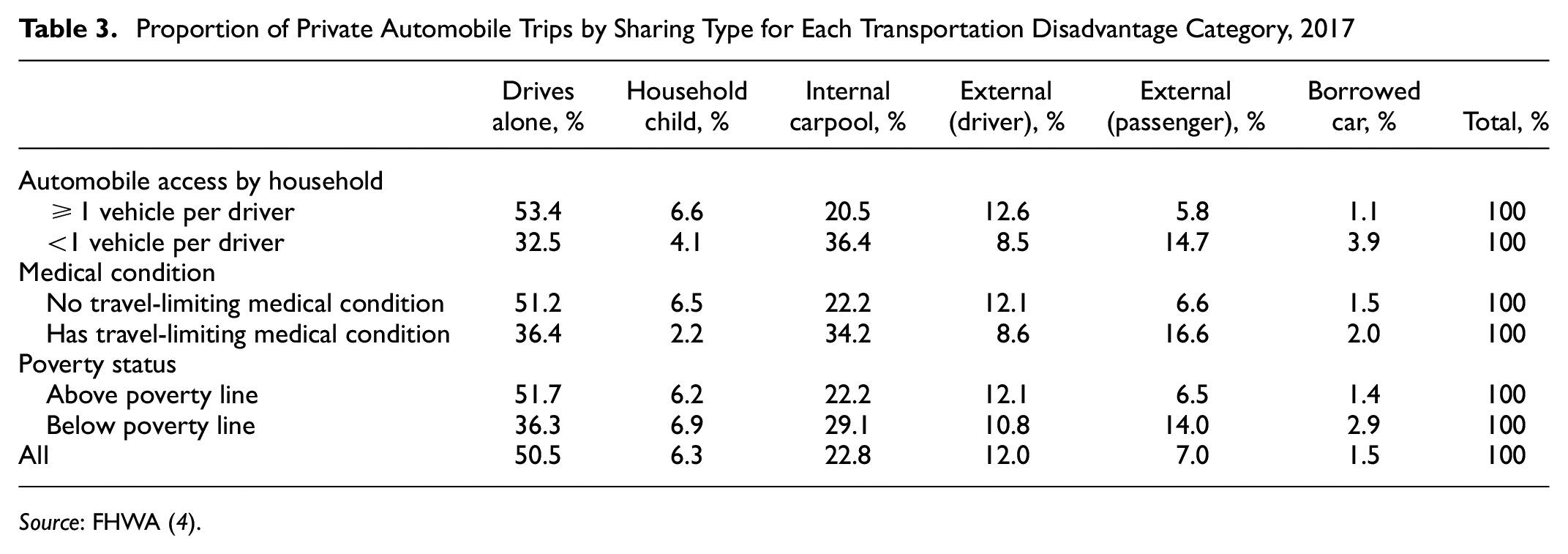
Consistent with the hypothesis about relationships between constraint and sharing, disadvantaged travelers shared automobiles more frequently than other travelers did. Table 3 shows the distribution of private automobile trips taken by travelers based on household vehicle access, medical status, and poverty status.
Proportion of Private Automobile Trips by Sharing Type for Each Transportation Disadvantage Category, 2017
Source: FHWA ( 4 ).
In the case of auto access, the data show differences between people living in zero-vehicle/vehicle-deficient households and fully equipped households; in the former case, a driver may lack access to a vehicle whenever they want it (as she has no car or must share it with another household member). Compared with those taken by people living in vehicle-deficient households, a greater proportion of trips taken by fully equipped travelers occurred via Drives alone (53.4% versus 32.5%), Household child (6.6% versus 4.1%), and External (driver) (12.6% versus 8.5%). The reverse is true for the other three categories: Internal carpool (20.5% versus 36.4%), External (passenger) (5.8% versus 14.7%), and Borrowed car (1.1% versus 3.9%).
Travel-limiting medical conditions also influenced rates of sharing. Compared with other trips, a greater proportion of trips taken by travelers without travel-limiting medical conditions occurred via Drives alone (51.2% versus 36.4%), Household child (6.5% versus 2.2%), and External (driver) (12.1% versus 8.6%), which mirrors the patterns observed with vehicle access. The reverse is true for Internal carpool (22.2% versus 34.4%), External (passenger) (6.6% versus 16.6%), and Borrowed car (1.5% versus 2.0%). Household child trips differed most dramatically by the traveler’s medical status. In many of these trips, parents drove children, and some of these parents were likely younger and healthier than the average traveler.
Financial constraints, particularly living below the poverty line, contribute to mobility challenges. Low incomes limit the financial resources available to spend on travel, such as auto-related expenses like fuel, tolls, maintenance, and insurance. Compared with those made by poor travelers, more private automobile trips by the nonpoor occurred via Drives alone (51.7% versus 36.3%) and via External (driver) (12.1% versus 10.8%). A similar proportion of private automobile trips made by poor travelers (6.9%) occurred via Household child compared to those made by nonpoor travelers (6.2%). Finally, a smaller proportion of automobile trips made by nonpoor travelers occurred via Internal carpool (22.2 % versus 29.1%), External (passenger) (6.5% versus 14.0%), and Borrowed car (1.4% versus 2.9%). As with vehicle access, the latter two cases are especially stark—and cases in which the traveler received external-to-household resources.
Some of these patterns may seem counterintuitive – for example, why did more trips by people with medical conditions take place via Internal carpool, compared with those taken by people without medical conditions? This reflects what is measured: for these estimates, the denominator is all private automobile trips taken by disadvantage status (and does not include public transit trips, for example). In the Appendix, Figures S2, S3, and S4 illustrate similar information in which the denominator is the total number of private automobile trips taken by each subtype, and the numerator is the proportion of trips made by travelers with each type of disadvantage status. Figure S3 thus shows that although 5.1% of all private automobile trips were taken by a person with a medical condition, 7.2% of Internal carpool trips were. Table S4 in the Appendix also includes a summary of the t-tests examining differences in rates of sharing by disadvantage status.
Altogether, these findings suggest that Drives alone trips have the weakest association with disadvantage, followed by somewhat ambiguous relationships between disadvantage and Household child and External (driver) trips. Internal carpool, External (passenger), and Borrowed car trips appear to have the strongest associations with disadvantage, particularly in relation to household vehicle access.
Multinomial Probit Models
I now present the results of two multinomial probit models testing the relationships between disadvantage and informal automobile sharing. They control for other factors like trip purpose, demographic, and built environment factors. In both cases, I model the likelihood that a trip took place via each subtype of automobile sharing, rather than via the reference category of Drives alone.
Modeling Sharing
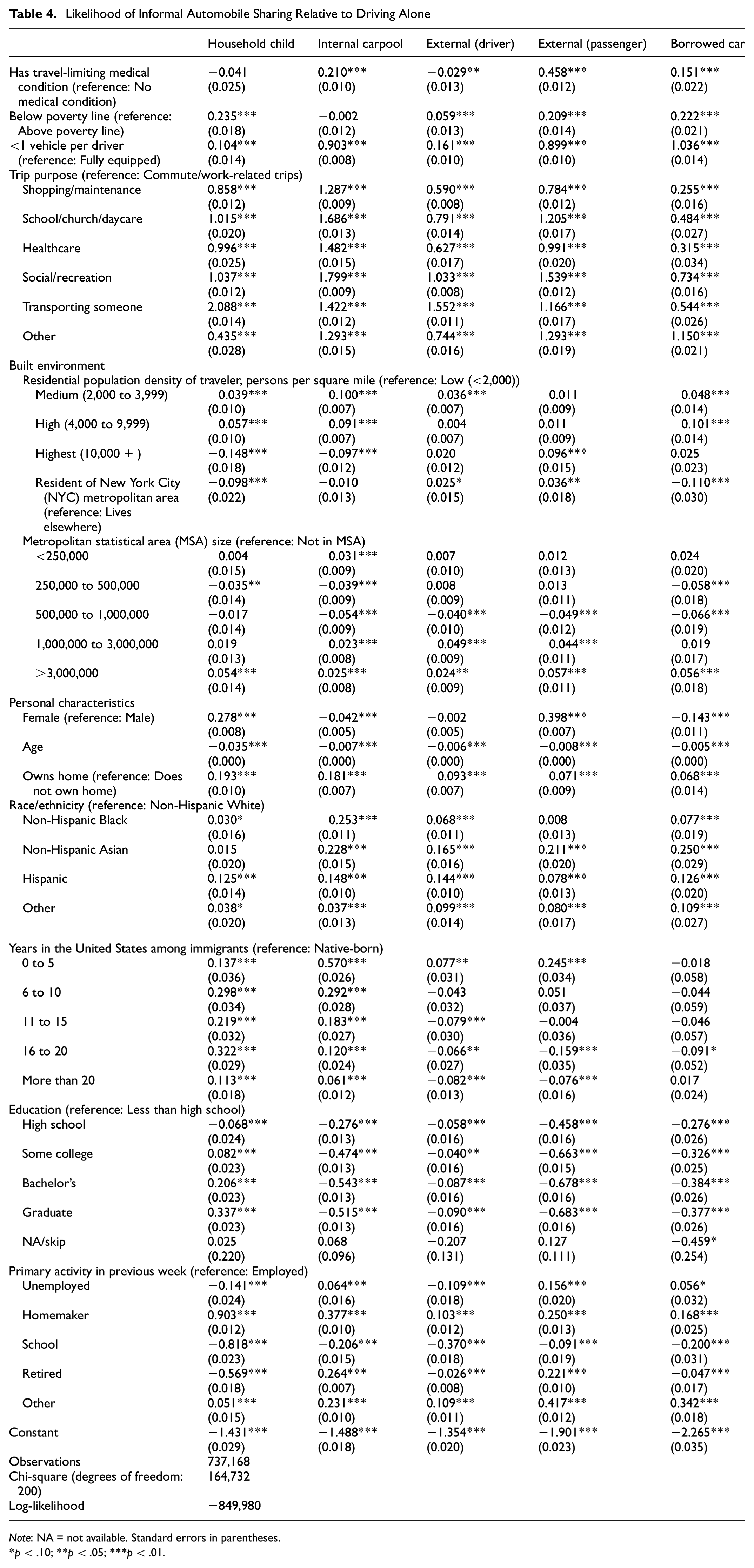
Model 1 (the primary model) includes the various factors presented in Table 2 that have documented relationships with mode choice: characteristics like gender, race/ethnicity, age, education level, immigrant status and years in the United States, and primary activity in the previous week. They also include built-environment factors such as residential population density, metropolitan statistical area (MSA) size, and residence in the New York City metropolitan area. Table 4 displays the model results. Multicollinearity is not an issue, with a mean variance inflation factor of 1.82.
Likelihood of Informal Automobile Sharing Relative to Driving Alone
Note: NA = not available. Standard errors in parentheses.
p < .10; **p < .05; ***p < .01.
Comparing and interpreting the results of the multinomial probit model is challenging. These parameters indicate the associations between the independent variables and the relative probability of an outcome, rather than its actual probability. Figures 1 and 2 thus display the marginal effects of the primary independent variables of interest (disadvantage and trip purpose) for the six nonsharing and sharing outcomes. The marginal effects capture how a one-unit increase in the variable changes the average probability of observing that outcome. In all cases, the variables are binary or categorical.
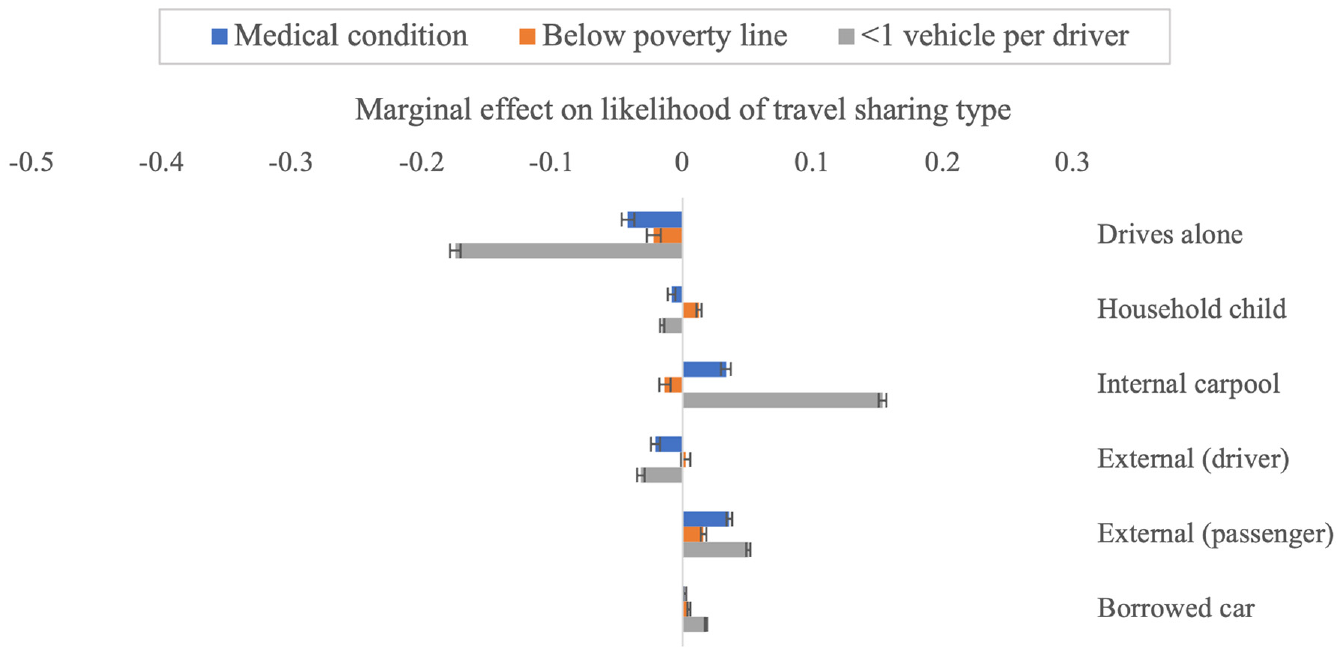
Marginal effects of transportation disadvantage on average probability of travel-sharing type.
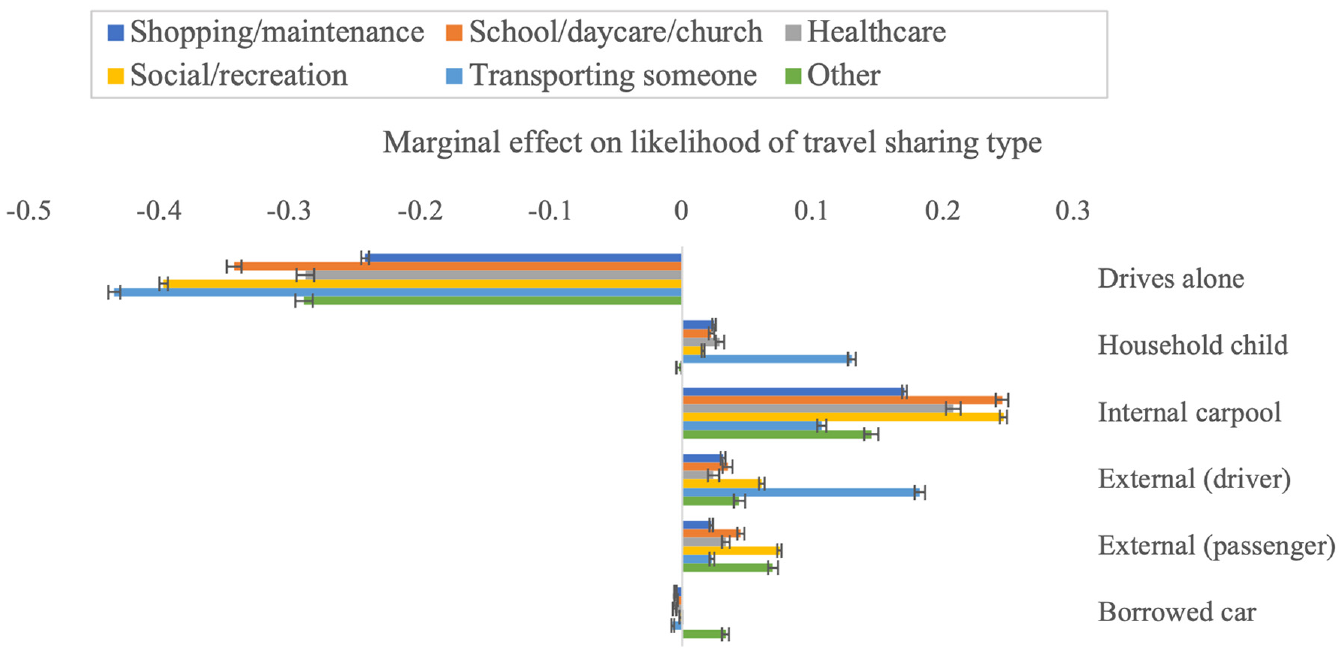
Marginal effects of trip purpose on average probability of travel-sharing type.
Figure 1 indicates that in the primary model, all transportation disadvantage factors have negative associations with traveling via Drives alone. All disadvantage factors are positively associated with External (passenger) and Borrowed car sharing. For the the latter category, these factors have relatively small associations, as few private automobile trips (1.5%) occurred via Borrowed car. Having fewer than one vehicle per driver in the household and a travel-limiting medical condition both decrease the likelihood of travel via Household child or External (driver) (cases in which the traveler also drove). Limited vehicle access and having a medical condition both increase the likelihood of travel via Internal carpool. Among the disadvantage factors, poverty status has the weakest association with sharing outcomes, all else equal.
In Figure 2, the marginal effects show the influence of trip purpose relative to the reference category of Commute/work-related trips. These effects are large, particularly for Drives alone, and all nonwork trips have strong negative associations with that outcome. Compared with work trips, nonwork trips have strong positive associations with travel via Internal carpool. All else equal, transporting someone has a strong positive association with travel via External carpool or Household child, whereas other trip purposes tend to have more modest effects. Trip purpose has the smallest marginal effects on the likelihood of traveling via Borrowed car, all else equal.
I also generated estimates of the marginal effects for all other variables in the primary model. Several of them are relatively small and/or not significant, and few hold the same magnitude as the coefficients for trip purpose or disadvantage. The slight exceptions to this are recent immigrant status (arriving in the previous 5 years), traveler education, and being a homemaker (rather than employed full-time). Figures S5, S6, S7, S8, S9, and S10 in the Appendix display the marginal effects for all variables.
Interacted Model
In assessing the relative impacts of the two primary independent variables of interest, I hypothesized that disadvantage may mitigate the relationship between sharing and trip purpose, reflecting the actual level of “choice” that an individual traveler encounters. To evaluate this hypothesis, I interact trip purpose with a composite binary variable for general disadvantage status. This binary variable—capturing whether the traveler had any of the three disadvantage qualities (medical condition, limited vehicle access, or poverty status)—is coarser than the separate measures of disadvantage. Yet a separate model of only this variable produces the expected results: having any source of disadvantage increases the likelihood that a trip was shared (of any subtype); this relationship is strongest, as suggested by Table 3, for Internal carpool, External (passenger), and Borrowed car trips. Table S5 in the Appendix includes the parameters for this model.
Table 5 includes the results of a model interacting disadvantage with trip purpose, which controls for all other factors shown in the primary model (Table 4). The coefficients and standard errors for the other variables are omitted due to space constraints; the full model results are available in Table S6 in the Appendix. The coefficients for the interaction terms indicate that although disadvantage still increases the likelihood of sharing, it tends to weaken the relationship between trip purpose and sharing. This mitigating effect is especially strong for Internal carpool and External (passenger) trips (but more ambiguous for Household child and External (driver) trips), relative to Drives alone trips. So, for example, compared with when taking a commute/work trip, a nondisadvantaged traveler’s social/recreational trip was 529% more likely to occur via Internal carpool, all things being equal. This discrepancy is only 256% for a nondisadvantaged person.
Likelihood of Informal Automobile Sharing Relative to Driving Alone based on a Binary Measure of Transportation Disadvantage, Trip Purpose, and Interaction of the Two
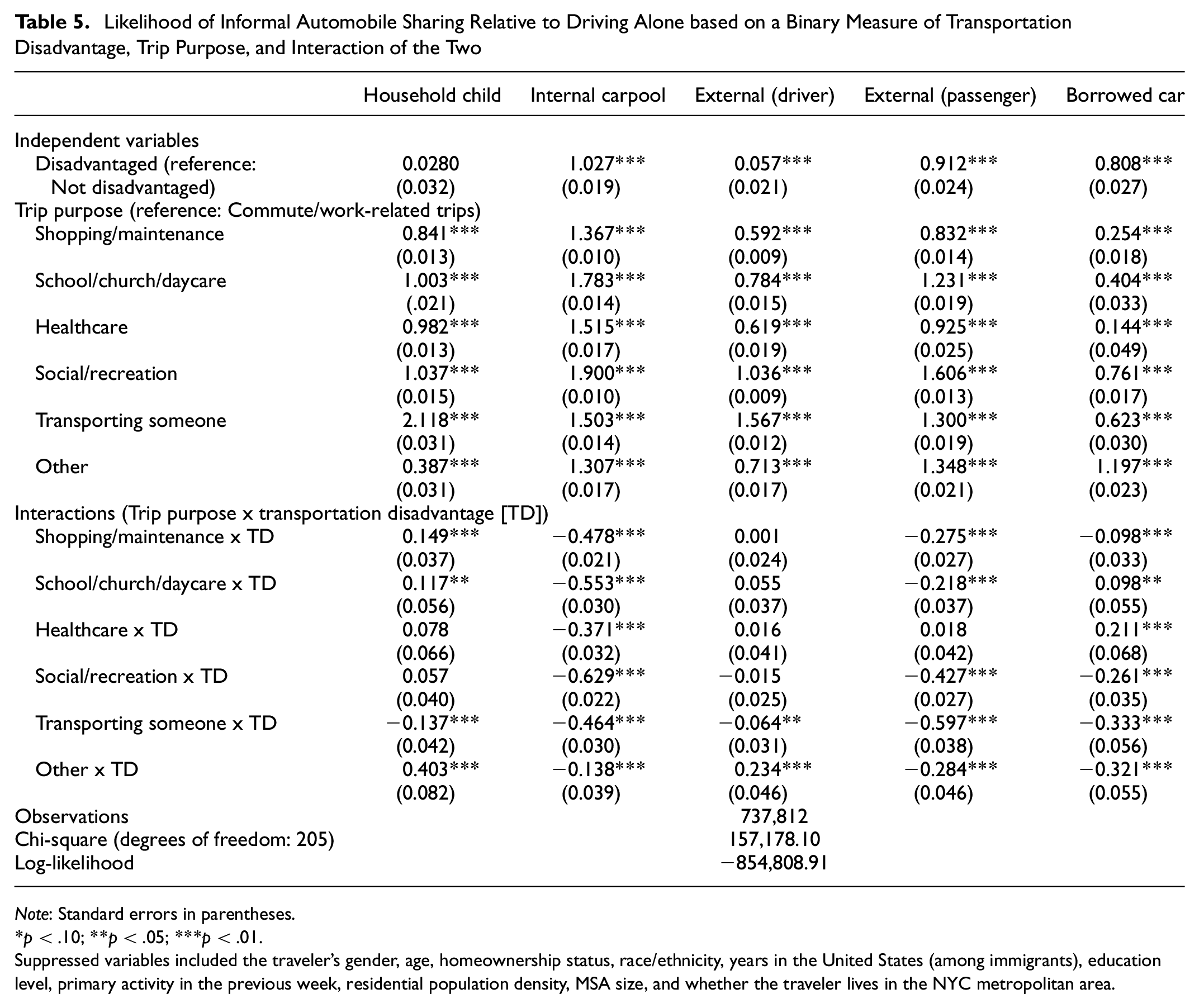
Note: Standard errors in parentheses.
p < .10; **p < .05; ***p < .01.Suppressed variables included the traveler's gender, age, homeownership status, race/ethnicity, years in the United States (among immigrants), education level, primary activity in the previous week, residential population density, MSA size, and whether the traveler lives in the NYC metropolitan area.
For ease of interpretation, I also generated two models of trip purpose, dividing the sample by whether a traveler experienced disadvantage. The full results are included in the Appendix (see Tables S7 and S8). To illustrate differences in the influence of trip purpose by travel constraint, Figure 3 shows the relative strengths of the coefficients by disadvantage status for the outcome of External (passenger), as one example.
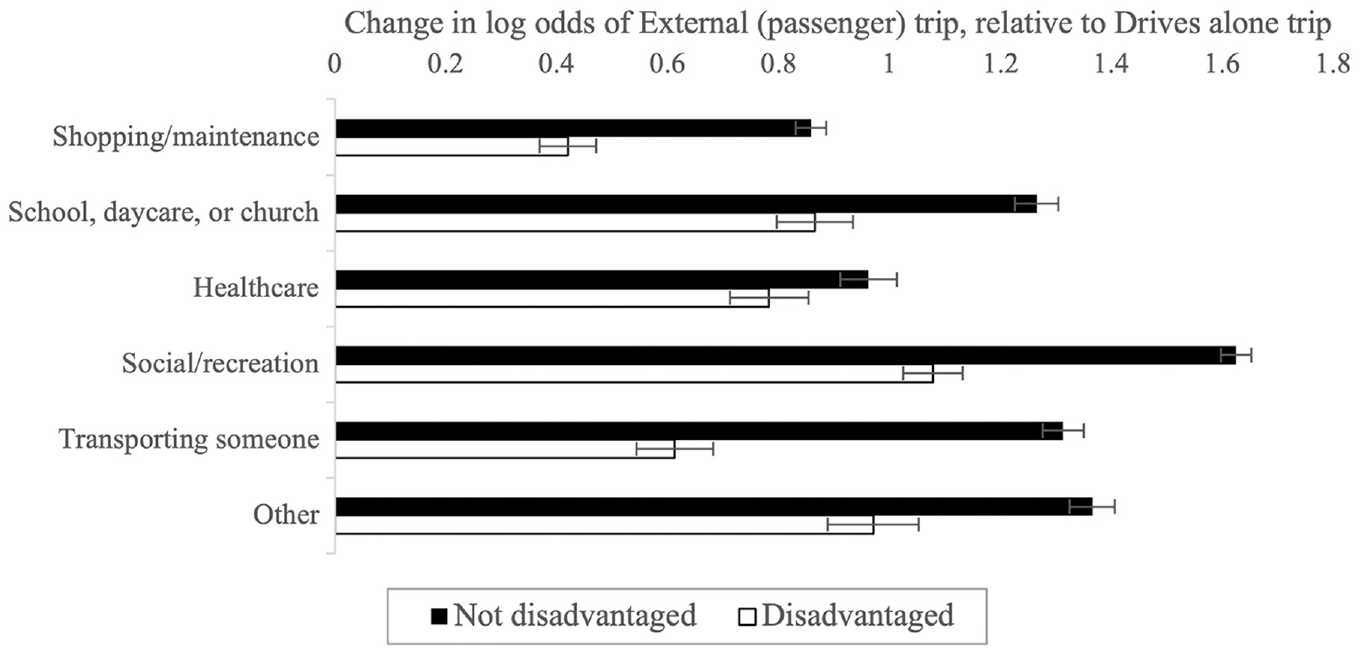
Influence of trip purpose on the log odds of likelihood of an External (passenger) trip, relative to a Drives alone trip.
Figure 3 indicates that trip purpose exerts a far stronger influence for nondisadvantaged travelers than for disadvantaged travelers on the sharing outcome of External (passenger). The same is true for other sharing outcomes (see Appendix, Figures S11 to S14). This is notable for Internal carpool (Figure S12) and Borrowed car (Figure S14): among nondisadvantaged travelers, nonwork trip purposes greatly increase the likelihood of traveling via these sharing subtypes more than among disadvantaged travelers (p < .05 in almost all cases). These differences, however, are ambiguous (and often not statistically significant at p < .05) for Household child and External (driver) trips. The types of sharing especially associated with disadvantage—Internal carpool, External (passenger), and Borrowed car—have unique, and somewhat weaker, relationships with trip purpose among disadvantaged travelers, when compared with those of other travelers.
Discussion and Implications for Scholarship
These results suggest several things about the value of vehicle-sharing in informal contexts. First, informal automobile sharing serves many Americans. Over 41% of all trips taken by U.S. adults in 2017 occurred via informal sharing of private cars, far greater than the 3.4% that took place via public transit ( 4 ). Informal sharing offers value to travelers that some transportation researchers and policy makers have failed to appreciate. This is especially true in the United States, given its uniquely automobile-oriented landscape ( 55 ).
Relevant to equity concerns, transportation disadvantage—particularly limited vehicle access—increases the likelihood of private vehicle-sharing compared with driving one’s car alone. This is especially true when sharing occurrs across households and when the traveler receives resources, including borrowing a car or getting a ride from a nonhousehold member. Interhousehold sharing may allow travelers to compensate for their limited travel options. This is consistent with the literature on poverty, transportation costs, and the mobility strategies of constrained people ( 18 ). Yet traveling with adult household members also has an association with disadvantage, suggesting that travelers similarly draw on household resources to cope with transportation challenges. This agrees with literature outside of the transportation field addressing poverty and resource sharing within households ( 34 ).
The relationships among other demographic factors, the built environment, and sharing are consistent with findings from previous research. For example, all else equal, women—even controlling for their tendency to be full-time caregivers—bore greater responsibility for trips serving the household’s children. This echoes the conclusions of several researchers, including Taylor et al. ( 56 ), Hsu ( 57 ), and Fan ( 58 ), who have all documented gender discrepancies in household- and child-serving trips in the United States. Higher education is positively associated with driving alone, similar to the findings of Ferguson ( 27 ). Further, the primary model suggests that recent U.S. immigrants were more likely to travel with others—both within and between households—than native-born travelers, echoing the conclusions of Blumenberg and Smart ( 23 ). Built environment factors have limited associations with rates of carpooling, all else equal. This agrees with previous studies that also identify small or insignificant relationships between the built environment and carpooling for the commute, particularly in the United States ( 21 , 24 ). Much of the previous research is quite dated, analyzing commuting behavior from the 1970s ( 24 ), 1980s ( 21 ), and 1990s ( 31 ); this analysis updates these findings to the current era. It also extends findings on demographics and the built environment to all types of shared trips (not just work-related trips).
This analysis also indicates strong positive associations between informal automobile sharing and nonwork travel. Few studies have compared the relative influence of traveler demographics versus situational factors (i.e., trip purpose) on vehicle-sharing. Results from the primary model (Table 4) indicate that among various factors, trip purpose tends to best predict the likelihood of sharing (particularly within the household) over driving alone. The decision to travel with household members may reflect temporary preferences, rather than the need to conserve resources. For example, relative to trips for commuting, a social/recreation trip strongly increases the likelihood that someone carpooled with a member of the same household. Two roommates attending a party may be able to drive alone but prefer to travel to a party together, relishing the opportunity to socialize during the trip. However, the reverse could be true. Perhaps someone wants to drink alcohol at the party and so asks his roommate for a ride; feeling grateful for the assistance, he extends the party invite. Disadvantaged travelers, however, see smaller associations between trip purpose and some types of sharing, including receiving transportation resources from outside of the household. These data do not conclusively establish causal relationships. However, these results suggest that nondisadvantaged travelers may opt in to sharing when they want to, whereas disadvantaged travelers do so because they need to.
The results also suggest that shared trips with household children differ from other private vehicle trips—both shared and non-shared. Nondisadvantaged travelers disproportionately made these trips. Unlike most other trip types, many trips with household children primarily served to transport them. Researchers interested in equity should continue to study these trips and the time burdens they impose on travelers, especially women. Yet extending conclusions about shared trips with household children to other types of private vehicle-sharing may be inappropriate. They may have ambiguous relationships with sharing, at least as a negotiated exchange between driver and passenger.
Policy Implications
These findings have policy implications for two types of strategies, including those that seek to (1) increase mobility among disadvantaged people and (2) increase vehicle-sharing among all travelers.
Policies to Increase Mobility Among Disadvantaged Travelers
To increase mobility for travelers facing financial and physical constraints, public efforts have often emphasized subsidized shared mobility services like public transit ( 59 ). But public transit only meaningfully increases access—for example, to employment—in a handful of U.S. neighborhoods and regions ( 2 , 60 ). In 2017, only 3.4% of trips made by U.S. adults used public transit ( 4 ). Since the start of the pandemic in 2020, transit ridership has captured an even smaller share of trips in the United States ( 61 ).
Meanwhile, disadvantaged U.S. travelers share automobiles (by getting rides and borrowing automobiles) far more often than they ride transit and more than nondisadvantaged travelers do. Policy makers should thus consider providing automobile-based support outside of the traditional shared mobility paradigm. For example, agencies could provide disadvantaged travelers with vouchers to compensate neighbors or friends who give them rides. Temporary Aid to Needy Families (TANF, also known as welfare) recipients can use cash payments for transportation ( 62 ). Further, in some states like Maine, newly employed TANF recipients may receive reimbursement for automobile travel in the 18 months after leaving TANF via the Transitional Transportation Program. This only applies to commute travel ( 63 ), so agencies might consider expanding reimbursement to include noncommute trips.
Other policies could increase travel options for disadvantaged travelers that more closely mimic private automobiles. Cities could provide subsidized carshare in low-income communities, as do existing programs in Los Angeles ( 64 ) and the San Joaquin Valley ( 65 ). Vouchers for ridehail or taxi services might similarly provide travelers with temporary access to the benefits of private automobile travel ( 66 ). Finally, efforts to facilitate automobile ownership for low-income people, although not always popular among advocates, would significantly increase access for disadvantaged travelers.
Strategies to Increase Sharing Among All Travelers
Findings on trip purpose can inform programs to increase transportation-sharing among all travelers. Most transportation planners and economists acknowledge that policies that make driving costlier increase rates of vehicle-sharing. Planners and policy makers could increase the cost of auto travel by reducing parking availability ( 69 ) or increasing vehicle registration costs or taxes ( 70 ). However, in the short term, such policies may impose additional financial burdens on people already grappling with mobility constraints ( 67 , 68 ). Policies from other countries such as Singapore, where travelers must bid on limited certificates of entitlement to own and operate cars ( 71 ), could inform efforts to increase shared travel in the United States. Policy makers should also consider congestion pricing, a strategy long endorsed by economists, to better match supply and demand for roads ( 3 ). To promote equity, cities implementing congestion pricing might also provide disadvantaged travelers with vouchers or toll credits ( 72 ). Yet beyond equity considerations, the political challenges to making vehicle ownership and operation more costly remain formidable, particularly in the United States ( 73 ).
Regarding previous policies to promote informal sharing, public programs have provided incentives to increase rates of carpooling for the commute ( 1 ). This is understandable, as public regulations can more easily influence the policies of large employers ( 1 ). Yet informal vehicle-sharing has an especially strong relationship with nonwork travel for U.S. travelers. New programs could thus offer incentives to promote vehicle-sharing for nonwork trips. For example, microtransit or subsidized micromobility from commercial locations to residences could enhance access for shoppers or medical patients. Enhanced sharing options might especially benefit disadvantaged travelers.
Future Research
To build on these findings, future research could directly evaluate the value that travelers—especially disadvantaged ones—place on different types of private versus public shared mobility. Recognizing the limited reach of formal shared mobility services like public transit in the U.S., this study examines trips made via private forms of sharing. It does not evaluate how commercial or public shared mobility modes directly compete with privately shared travel. It also does not fully capture the degree to which travelers “choose” one type of sharing over another. Targeted surveys of sharers would help address this issue. They could also capture how disadvantaged travelers make tradeoffs in choosing when and how to share. Further, surveys could address the direction of causality between different factors (for example, between trip purpose and mode choice). With additional data, researchers could explore this distinction at a national scale.
Supplemental Material
sj-docx-1-trr-10.1177_03611981241250338 – Supplemental material for Beyond the Company Carpool: Disadvantage and Informal Automobile Sharing Within and Between U.S. Households
Supplemental material, sj-docx-1-trr-10.1177_03611981241250338 for Beyond the Company Carpool: Disadvantage and Informal Automobile Sharing Within and Between U.S. Households by Julene Paul in Transportation Research Record
Footnotes
Acknowledgements
The author acknowledges helpful feedback and suggestions from Susan Handy of UC Davis and Evelyn Blumenberg, Michael Manville, Samuel Speroni, and Brian D. Taylor of UCLA, as well as the three anonymous reviewers.
Author Contributions
The author confirms sole responsibility for the following: study conception and design, data collection, analysis and interpretation of results, and manuscript preparation.
Declaration of Conflicting Interests
The author declared no potential conflicts of interest with respect to the research, authorship, and/or publication of this article.
Funding
The author disclosed receipt of the following financial support for the research, authorship, and/or publication of this article: This work was supported by a Dissertation Year Fellowship from the University of California Office of the President and an Eisenhower Fellowship the U.S. Federal Highway Administration.
Supplemental Material
Supplemental material for this article is available online.
References
Supplementary Material
Please find the following supplemental material available below.
For Open Access articles published under a Creative Commons License, all supplemental material carries the same license as the article it is associated with.
For non-Open Access articles published, all supplemental material carries a non-exclusive license, and permission requests for re-use of supplemental material or any part of supplemental material shall be sent directly to the copyright owner as specified in the copyright notice associated with the article.
