




Abstract
In the context of growing concern with violence in Latin American and Caribbean cities this paper offers an analytical synthesis of urban securitisation which involves the construction of issues, spaces and populations as security threats. The synthesis contributes to debates on urban studies and critical security studies, which focus on neoliberalism as the driver of urban securitisation and militarisation as its main expression, by highlighting the embedded, contextualised and historically situated nature of securitisation and its multiple manifestations. The paper proposes a framework for the socio-spatial analysis of securitisation processes focusing on their causes, manifestations and consequences, while capturing their dialectic relation with cities’ spatial characteristics. Bringing together Lefebvre’s conceptualisation of the social production of space with Wacquant’s analysis of the penal-assistential state, and using secondary sources complemented by primary data from our research, the paper shows that urban securitisation in this region is contingent to four socio-spatial dimensions common to Latin American and Caribbean cities – segregation, territorial stigmatisation, overlapping insecurities and territorial struggles. Using a multidimensional framework, the paper illustrates how unaddressed legacies of colonialism and notions of state power in the context of struggles with criminal actors have driven urban securitisation and diversified its targets and techniques beyond militarisation. Under a securitising logic, programmes which often appear progressive are also shown to prejudice marginalised groups and undermine democratic values. The paper concludes with a call for further multidisciplinary analyses that account for the socio-spatial and historical particularities of contemporary forms of urban securitisation in this and other regions.
Introduction
Global patterns of urbanisation have been accompanied by a growing concern with violence and conflict in cities (Beall et al., 2013; Davis, 2016, 2020; Graham, 2010; Kaldor and Sassen, 2020; Moser and Rodgers, 2012), particularly in highly urbanised or fast urbanising regions of Central and South America, the Caribbean and Southern Africa (Geneva Declaration Secretariat, 2015; Small Arms Survey, 2013). While policy-makers have implemented security initiatives in these regions since the 1990s, a significant increase in efforts to contain and prevent urban violence and crime has been registered since the mid-2000s (Muggah and Aguirre Tobon, 2018; OECD, 2011; UNDP, 2012). Given the complex interlinkages between developmental and security challenges in cities, unpacking how security responses are articulated, and their wider implications, is key to understanding contemporary urbanisation processes (Humansecurity-cities.org, 2006; Muggah, 2012; World Bank, 2011).
Security responses result from securitisation processes, by which certain issues or actors are framed as existential threats leading to the adoption and legitimation of urgent, exceptional and often aggressive measures by the state (Balzacq, 2011; Buzan et al., 1998). Drawing on debates from critical security studies, securitisation can be understood as a social process which defines who and what needs to be protected by state institutions, from what kind of threats and in which way. The ensuing security policies and programmes (which may include policing, penalties, military responses and so on) ostensibly seek to diminish violence and crime rates, but may also have implications for state–society relations and experiences of citizenship by different groups in urban areas. 1 These issues have been interrogated by scholars from diverse disciplinary perspectives, including anthropology, human geography and urban studies, alongside critical security studies. Analyses of how ‘securitised issues or actors’ are transformed into subjects of security thinking and policy action in cities have focused on neoliberal processes generated by capitalist accumulation at local and transnational levels (Becker and Müller, 2013; Gledhill, 2015, 2018; Humphrey, 2013; Wacquant, 2010). These processes are considered key drivers of urban securitisation, with militarisation seen as its primary manifestation or outcome (Graham, 2010).
However, for at least a decade urban scholars have insisted on the need to ‘look beyond neoliberalism’ to account for other processes involved in shaping urban environments, as part of a shift towards more global (or ‘postcolonial’) urban theory (Parnell and Robinson, 2012). The effects of neoliberalism have unfolded unevenly across different regions, countries and cities (Brenner and Theodore, 2002; Yates and Bakker, 2014), suggesting the need to consider other factors shaping approaches to urban securitisation and security policy. Moreover, militarisation, while significant, is often only one manifestation of securitisation processes and their effects, which may play out in more insidious, everyday ways among marginalised places and populations. Indeed, militarised responses have in some cases given way to a focus on social crime prevention and urban upgrading programmes to deal with security threats.
In this paper, we critically engage with framings of urban securitisation, which focus largely on neoliberalism as its primary driver and militarisation as its main manifestation, to argue for a more spatially and temporally contextualised understanding of such processes and their effects. Engaging with and extending debates from critical security studies and urban studies, this paper analyses urban securitisation in Latin America and the Caribbean (LAC), one of the most urbanised, unequal and violent regions in the world. 2 LAC has 8% of the world’s population, but experiences 33% of global homicides, with more than 144,000 people murdered every year (Muggah and Aguirre Tobon, 2018). Since the late 1980s, cities in this region have become epicentres of multiple forms of violence and criminality 3 (Briceño-León and Zubillaga, 2002; Koonings, 2012), impacting citizens differently along socio-economic, racial, gendered and spatial divides (Hilgers and Macdonald, 2017; Koonings and Kruijt, 2007). While repressive and militarised strategies have traditionally dominated security provision in the region, security responses have diversified in the last two decades as policymakers have combined law enforcement with crime prevention and upgrading programmes. Such policy innovations suggest that LAC offers a strategic site for analysing urban securitisation processes intersecting with neoliberalism and militarisation.
In order to contribute to these debates, we propose an analytical framework which captures the dialectical relationship between securitisation and security responses, and historically-situated spatial dimensions of cities. Drawing on Lefebvre’s (1974) understanding of the social production of space, and informed by his account of the state combined with Wacquant’s (2010) penal-assistential mesh, this approach offers a socio-spatial lens on urban securitisation that critically engages with processes of neoliberalisation and militarisation as well as a diversity of ‘exceptional measures’ and strategies within an expanding repertoire of securitising techniques. Our analytical framework explores four socio-spatial dimensions common to LAC cities – segregation, territorial stigmatisation, overlapping insecurities and territorial struggles – and uses them to analyse causes, manifestations and consequences of urban securitisation. Alongside secondary sources from relevant urban studies, critical security studies and other multidisciplinary literature on and from LAC, we draw on our own decades-long research engagement with these issues, employing primary data collected in cities across Mexico, Colombia and Jamaica to illustrate how securitisation processes are situated and contingent in these dimensions.
In this way, we make two contributions to wider debates at the nexus of critical security studies and urban studies. Firstly, by focusing on the mutually constitutive nature of urban space and securitisation processes, we show how causal factors for urban securitisation intersect with neoliberalism to encompass spatial considerations. Secondly, by illustrating these dimensions of the framework with empirical examples from cities and countries across the region, we show how securitisation outcomes are situated and highly diverse, extending beyond militarisation to encompass programmes which often appear progressive, but rest on processes which prejudice specific marginalised groups and places. Notwithstanding the diversity across cities in LAC, 4 two significant historical legacies with socio-spatial consequences underpin our regional analysis of securitisation processes: on the one hand, the way shared colonial histories have shaped urban contexts across LAC, and on the other hand, the influence of the United States’ policies on the orientation and performance of security, justice and penitentiary institutions in cities from Chile to Mexico. 5
Analyses of urban securitisation: A critical review
Focusing on the impact of capitalist accumulation at local and transnational levels, academics from various disciplines have identified neoliberal processes as the main driver of urban securitisation in the Global North and South (Becker and Müller, 2013; Gledhill, 2015, 2018; Humphrey, 2013; Wacquant, 2010). Studies in cities as diverse as New York (Low, 2013), Glasgow and Essen (Belina and Helms, 2003), Mexico City (Becker and Müller, 2013; Müller, 2012), Guatemala City (O’Neill and Thomas, 2011), Cape Town (Samara, 2010) and Kingston (Jaffe and Diphoorn, 2019) have shown how inter-urban competition, financialisation of local economies and implementation of urban regeneration projects – undertaken by coalitions of public actors and investors seeking to revitalise local economies through the creation of business districts and areas for tourism and consumption – often lead to the framing of vulnerable groups as threats to the urban order, as well as the implementation of security strategies that protect users of such neoliberal enclaves (Mitchell and Beckett, 2008).
These analyses show that neoliberal-led forms of securitisation construct categories of dangerous and undesirable citizens, justifying new techniques of regulating urban space and populations, and ultimately producing the privatisation of urban space (Lippert and Walby, 2013). As ‘anticitizens of a neoliberal social order’ (O’Neill and Thomas, 2011: 14), informal street vendors, homeless people and the poor in cities in the Global North and South have become subject to ‘clean up’ strategies, punitive policing ‘solutions’, the use of security infrastructure and surveillance (Doyle et al., 2012; Campesi, 2010), under the neoliberal penal state (Wacquant, 2010). This results in extreme social segregation that restricts movement of people and activities seen as threatening to real estate development, entrepreneurialism and consumption for the middle and upper classes (Beckett and Herbert, 2009; Low, 2013).
Notwithstanding its decreased legitimacy as an ideology (Crouch, 2011), such analyses highlight neoliberalism’s enduring global influence on urban policy experiments through command–control approaches to governing (Bang, 2011). Nonetheless, realities in cities in LAC and the Global South require a nuanced analysis of how neoliberalism is entangled with and influenced by other critical factors and contextual conditions, some of which predate neoliberalism and equally shape security responses. For example, colonial constructions of race, gender and class that still shape contemporary social and state–society relations in these cities (Moncada, 2010; Nemser, 2015); differentiated and ongoing processes of state consolidation; and the influence of criminal actors in social ordering.
The USA’s influence on social constructions of security threats in cities across Latin America and the Caribbean is another example of the importance of taking into account transnational discourses and practices that intersect with neoliberalism. The transnational, American-led war on drugs has framed sectors of (urban) populations living or working illegally as local and transnational enemies, and encouraged militarised responses of either incarceration or elimination. These populations, constructed as ‘punishable subjects’, are overwhelmingly poor, and vulnerable to multiple forms of discrimination (Macaulay, 2020). Similarly, pressure from the USA to halt migration at its southern border has contributed to the securitisation of migrants who endure increasing repression from security forces in Mexican cities in their journey northwards. Such cross-border control of movement is part of what Besteman (2019: S29) calls a new ‘militarised global apartheid’, which creates a racialised order and labour markets relying on the securitisation of migrants from the Global South. Rooted in forms of segregation and resource extraction established under colonialism and imperialism, this global apartheid evidences the pervasiveness of North-benefiting forms of exploitation which render life unsustainable in the South. These aspects are discussed further in the analysis that follows.
Militarisation and spatial outcomes
Debates from urban studies and geography have focused on militarisation as the primary manifestation of securitisation in cities (Graham, 2010; Henry and Natanel, 2016). As Graham (2012: 137) argues, neoliberal globalisation has fuelled a new military urbanism, or a ‘constellation of military and security doctrine and practice’ that considers ‘everyday sites, spaces and circulations of cities’ as the key security challenges of our age. The focus on militarisation has helped to demonstrate how the construction of cities, as the battlespaces for modern warfare – including urban and ‘slum’ wars (Beall et al., 2013; Rodgers et al., 2012)– leads to ‘performances of military visibility’ that reconfigure relations between state and urban citizens, offering protection to some and targeting others as threats (Volinz, 2017: 1).
Security provision, influenced by the US interventionism in LAC, has traditionally been dominated by militarism. It is seen in the influence of the military in decision-making; its political, economic and cultural prioritisation; and the promotion of military norms and practices across society (Graham, 2010; Hansen, 2013: 842). In cities in Mexico, Brazil, Honduras, Jamaica, Colombia, El Salvador, Chile and Peru, governments have increasingly relied on the armed forces for policing, to retake gang-controlled neighbourhoods, to fight drug trafficking organisations, to contain protests and social unrest, to deter migrants, and in the context of the COVID-19 pandemic, to enact lockdowns and crisis management. Nevertheless, in recent years, the portfolio of security responses has diversified beyond militarisation in the region, to include apparently more progressive practices, such as Medellin’s emblematic ‘social urbanism’ approach (Maclean, 2015); the Pacifying Police Units in Rio de Janeiro (Gay, 2017); and Jamaica’s Citizen Security and Justice Programme and Zones of Special Operations (ZOSOs), which combine police–military operations and social interventions (Weekes et al., 2019). Such programmes suggest that the repertoire of ‘exceptional measures’ to deal with urban security threats is shifting towards more subtle, but nevertheless still disempowering tactics. However, debates on securitisation have yet to explore how these potentially ‘progressive’ approaches may reproduce the social construction of marginalised places and groups as potential threats.
Finally, research on urban securitisation’s militarised outcomes emphasises spatial dimensions, including the ‘reconstruction of the cityscape’ in the service of a ‘militarised network of command and control’ (Sorkin, 2008: vii–ix), but falls short of explaining the complex and situated dynamics at play in LAC cities. Graham’s (2010) influential conception highlights the spatial consequences of ‘the new military urbanism’, such as the construction of ‘security zones’ in global cities. Such accounts are mainly concerned with the implications of these measures for urban space, including enclosure, gentrification and fragmentation (see e.g. Zamorano and Capron, 2013). However, they are less explicitly concerned with the mutually constitutive relationship between security measures and space, whereby the spatial characteristics of a given area may shape the specific materialisation or outcomes of securitisation processes.
Relevance of a dialectical approach in LAC context
We argue that this spatial dialectical relationship is key to understanding how securitisation unfolds in urban areas in LAC. Research on regeneration in the UK has shown that contextual and spatial factors are key to understanding securitisation’s processes and outcomes (Raco, 2003), while recent work on Mumbai and Cairo suggests exploring ‘the dialectics between urban form, violence and security’ to reveal the determinative role that urban space plays in shaping not only violence but also security responses, as well as the historically produced nature of that space (Gupte and Elshafie, 2016: 82). Yet despite the considerable literature on the interaction between urban space and violence in LAC (e.g. Davis, 2016; Koonings and Kruijt, 2007; Moser and Rodgers, 2012), it is only recently that the dialectics between space and securitisation have begun to take centre stage (e.g. Comelli et al., 2018; Jenss, 2019).
This is particularly relevant given the historical links between urban space and citizenship claims in LAC, which reflect changes in state–society relations. The notion of citizenship has normally been associated with equality, direct and indirect mechanisms of participation and democracy (Dagnino, 2005). These values have been engrained in struggles in Latin American cities for both political and public-space rights, including rights to basic public services, suggestive of the spatialised conception of rights in urban contexts, latterly under the banner of the right to the city (Merrifield, 2011). During the 1980s and 1990s, cities were the space where these demands culminated in policy (Escobar and Alvarez, 1992; Foweraker, 1995). Social movements’ struggles for rights to basic services have been important to understand democratisation and participation in the region as they reveal different levels of (spatialised) exclusion (Holston, 2008).
The universality of services, inclusion and participation to which citizenship struggles have aspired in LAC has been important in developing principles of urban democratic governance, but the latter has been constantly challenged by high degrees of social inequality (accentuated by securitisation), while underlining how the poorest strata ‘lack resources (information, money, sense of civic competence) to operate… as citizens’ (Bailey and Godson, 2000: 10). Since the new millennium, scholars began to underline how inequality was further reflected in the institutional weaknesses of judicial and regulatory systems (Davis, 2006; Goldstein, 2005), which progressively interweaved with security debates by national and extra national actors, in particular the USA and its war on drugs. The entwinement of a weak judiciary with securitisation materialised in a wide range of programmes implemented under the umbrella of ‘citizen security’ throughout the region, with spatial consequences. These programmes, promoting service provision through the collaboration of public, private and civil actors, signalled an important change in the meaning of urban citizenship, from the right to the city to the right to security. This shift, accompanied by practices of securitisation, has been unable to guarantee the democratic principles of equality and fairness that the right to the city originally pursued.
Building on these historical and recent debates, we propose a multidimensional approach to analyse urban securitisation which takes into account its multiple drivers, manifestations and outcomes. While not overlooking neoliberalism’s effects, the approach aims to foreground situated socio-spatial processes which have historically shaped cities and continue to do so, to highlight their contingent and reciprocal relationship with securitisation.
A socio-spatial framework to explore urban securitisation
Our analysis of the two-way relationship between space and securitisation processes draws on Lefebvre’s (1991) notion of space as mutually constitutive of social relations. Lefebvre highlights the different ways in which space is constructed by, and in turn constructs social relations (and by extension, social phenomena such as securitisation). If urban securitisation depends on the construction and handling of security threats in urban space, then how that space is produced and configured may have definitive consequences for such processes. Lefebvre’s dimensions of urban space – which may be perceived, conceived or lived – reveal the diversity of configurations and confluences among multiple actors and their spatial practices, representations and experiences (cf. Zamorano and Capron, 2013). This includes the state (whose role in the control and regulation of urban space is as significant as its apparent monopoly on violence), but also other actors such as urban residents, civil society, private enterprise and criminal actors.
We complement our analytical approach with Wacquant’s (2010, 2013) explanation of the penal-assistential mesh as characterising the neoliberal state, and its production of spatial meanings that accentuate or generate urban fragmentation and stigmatisation. Through this mesh, he shows how the bureaucracy can play a double role in controlling certain groups of the population (seen as threats). Penal policies (criminalisation and punitive control), that show the lethal side of the state against particular groups of the population, combine with its managerial–administrative side to target social policies against these groups, in order to discipline them in more consensual ways. These two sides of the state are continually entangled and constitute each other.
Drawing on this synthesised conceptual approach we argue that a focus on socio-spatial characteristics of Latin American cities – specifically, segregation, stigmatisation, overlapping insecurities and territorial conflict – deepens understandings of urban securitisation dynamics and their outcomes, while retaining sight of their historical trajectory. Below we illustrate the relationship between these four socio-spatial dimensions and urban securitisation in LAC cities, through a focus on securitisation’s causes (historic and contemporary evolution of each specific dimension), manifestations (framing threats and justifying securitising measures) and consequences (social and spatial policy’s differentiated effects) (see Figure 1). Throughout, we reflect on state–society relations, given the state’s central role in shaping urban space (through policy, bureaucracy, control mechanisms and capacity to delimit the exercise of citizenship), while remaining aware that the state is one among multiple actors implicated in urban violence, security and securitisation.
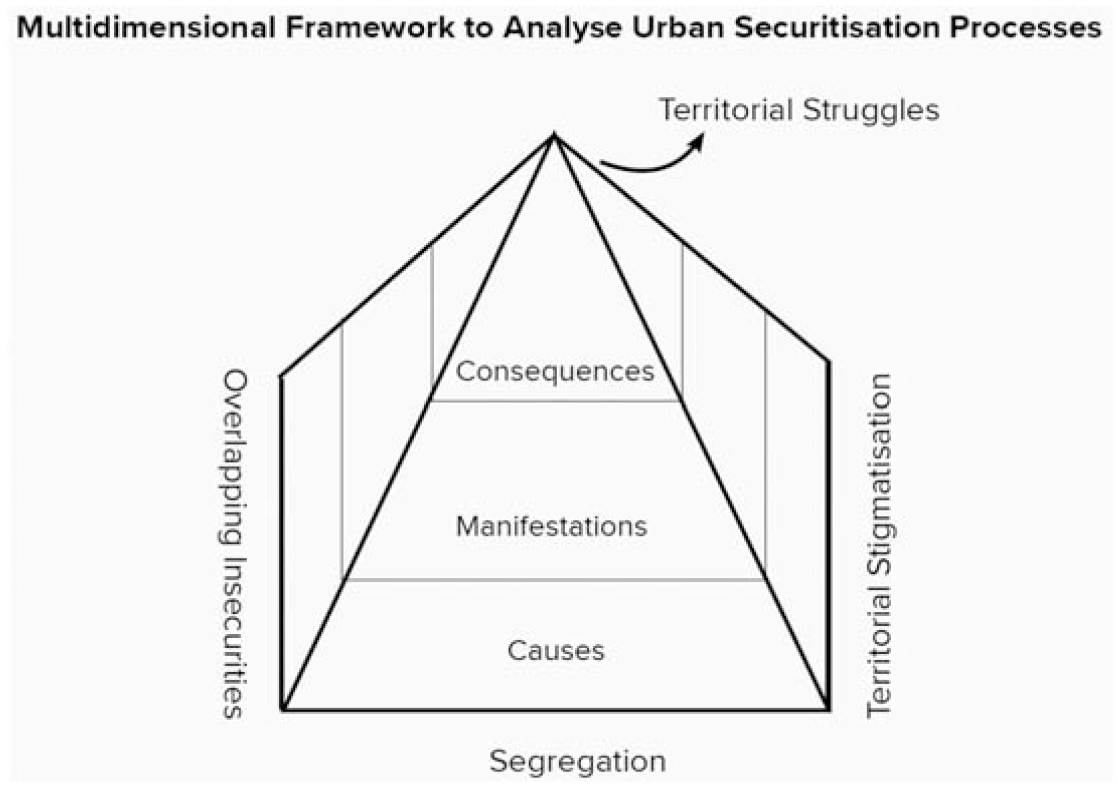
Multidimensional framework to analyse urban securitisation processes.
Urban segregation and fragmentation
Segregation of cities in LAC predates neoliberalisation, occurring since the colonial era, although it has become more entrenched in periods of increasing inequality, including the ‘lost decade’ of the 1980s associated with structural adjustment policies (Connolly et al., 2003). In addition to racialised segregation under colonial domination, pervasive segregation marks the division between the formal and informal city, which has shaped the dynamics of violence and securitisation. High levels of spatial (and economic) informality derived initially from rapid urbanisation and inadequate formal responses to housing and employment needs in the mid-20th century (Lombard, 2019). During this period, government support for modernist planning projects of large-scale infrastructure and industrialisation, at the expense of housing and employment for the poor majority, fostered the emergence of local informal and sometimes illicit economies linked to the relatively autonomous spaces of self-built neighbourhoods (Davis, 2014).
These patterns of urbanisation subsequently intersected with ‘[t]he process of social commodification that inspired the neoliberal experiment’ (Bayón and Saraví, 2013: 36). Newer forms of urban development, alongside older informal areas, led to further urban fragmentation. Mass housing shaped urban growth in Mexico, Brazil, Argentina and beyond, characterised by large-scale, peripheral estates of low-quality formal housing for mainly low-middle-income workers (Boils Morales, 2008). Meanwhile, the gentrification of central areas and emergence of business districts, exclusive residential areas, shopping malls and luxury shops re-shaped urban centres while poor peripheral areas (formal and informal) continued to grow (Bayón and Saraví, 2013). Amid this spatial fragmentation, extreme increases in violent crime and insecurity since the 1980s profoundly affected social interaction between classes in public space. Urban elites’ retreat into their fortified enclaves (Caldeira, 1999) deepened social and spatial fragmentation, as well as ‘discursive-representational divides’ between different social groups (Carnegie, 2014), fostering urban social relations dominated ‘by mistrust, stigmatization, and fear, urban crime and “securitization”’ (Bayón and Saraví, 2013: 2–36).
In LAC, urban segregation itself has become securitised, seen as a problem that justifies the use of exceptional measures. In Rio de Janeiro and Medellin, for example, the historical disconnection of marginalised favelas and comunas from the ‘formal’ city was problematised as a source of violence and a danger to the urban order (Abello Colak, 2013; Poets, 2015), leading to strategies of pacification, reinforcing the divide between the informal and formal city. The securitisation of segregation has also resulted in differential treatment from police and state officials based on urban citizens’ identity and place of residence. As Hilgers and Macdonald (2017: 1–2) argue, unbalanced power systems grant protection to some, and abuse and mistreat others, based on their access to specific urban spaces as well as to financial and institutional resources. These systems of power are rooted in colonialism’s socio-spatial structures, which entrenched racialised forms of differentiation, and repressive forms of policing designed to maintain public order and protect urban elite interests. Failed police reforms mean that such legacies still shape the practices of policing (Owen, 2016), and the growing private security sector (Jaffe and Diphoorn, 2019). In spatial terms, this results in fragmented security provision (Glebbeek and Koonings, 2016: 7), with resources dedicated to policing central, business and touristic districts, while security in peripheral areas remains inefficient, informalised, heavy-handed and abusive.
Social and spatial segregation therefore shapes and is shaped by urban securitisation, as it facilitates the normalisation of ‘extraordinary measures’ in poor communities, which are socially justified and spatially determined, and often infringe citizens’ rights. Such responses are both differentiated and differentiating, including the intermittent violent incursions by police in marginalised settlements in Managua and Buenos Aires (Auyero and Sobering, 2019; Rodgers, 2006); and the curfews, states of emergency and special operations by police officers and soldiers that urban poor residents of Kingston and Rio de Janeiro routinely experience as part of pacification strategies. Shaped by historical processes of socio-spatial segregation that predate yet interact with neoliberal policies, such securitising measures reinforce urban fractures and the isolation of communities.
Latterly, militarised tactics have been accompanied by socio-economic and urban upgrading programmes seeking to physically and symbolically integrate segregated territories. This diversification of securitisation techniques, together with citizen security strategies that emphasise preventive rather than reactive and punitive strategies to deal with violence, suggest that securitisation affects state–society relations not only through policing, but also through other changes in policy-making that lead to new forms of engagement with citizens. For example, arguing that bureaucrats are involved in the prosaic shaping of space, Emerson’s (2020) analysis of Mexico’s Programme for the Prevention of Crime (PRONAPRED), implemented between 2013 and 2018, underlines how state actors reinsert themselves into fragmented spaces. By classifying citizens through a series of statistics and risk-based measures, bureaucrats and citizens are encouraged to co-produce security governance through crime prevention policies that include training and self-awareness to reduce social vulnerabilities among citizens in these urban areas. 6 Nevertheless, classifying citizens as part of the securitisation of segregation may further reproduce stigmatising processes.
Territorial stigmatisation
In LAC, territorial stigmatisation is a key driver and a consequence of urban securitisation. Accompanying the securitised segregation of cities, territorial stigmatisation has fostered and reproduced fear of certain groups and places. Defined as the attachment of stigma to place, superimposed on existing stigma relating to poverty or race (Wacquant, 2009), this type of stigmatisation has led to the criminalisation of poverty as it ‘link(s) violence, crime, or insecurity to certain areas of the city and their residents, pathologizing peripheral areas inhabited by the most disadvantaged sectors’ (Bayón and Saraví, 2013: 47). Popular and media accounts play a significant role in deepening stigmatisation and subsequent securitisation processes (Gledhill, 2018), obscuring the more likely situation of residents being victims rather than perpetrators. In conflating risks from gang-related violence with ‘the alleged danger produced in and by favelas’, media accounts have ‘reinforced securitisation of social disadvantage, with racialized undertones that [distort] understandings of social life in favelas by erasing positive aspects such as a sense of community and neighbourliness’ (Gledhill, 2015: 49).
Territorial stigmatisation therefore intersects with racial discrimination, which in turn shapes and is shaped by urban securitisation. In Jamaica for example, state officials and the middle class associate increasing homicide rates, gang-related violence and organised crime with a supposed ‘violent subculture’ of poor communities (Campbell, 2020: 88). Constructing urban violence as a consequence of poor communities’ cultural traits justifies the implementation of special measures in their neighbourhoods. This form of securitisation is strongly linked to hierarchies of class, colour and place of residence rooted in the country’s colonial past and legacy of slavery, which entrenched racialised constructions of threats and deviance in society leading to the profiling of poor black men as the ‘archetypical security threat’ (Jaffe and Diphoorn, 2019: 922). Similarly, in Brazilian cities Gledhill (2015) highlights how ‘the young man from a marginal neighbourhood’ remains a key figure in the public imaginary of urban insecurity, despite evidence that only a small minority of favela inhabitants participate in criminal activity.
Such constructions are also suggestive of gender and generational dimension to territorial stigmatisation and securitisation, highlighted in Zubillaga et al.’s (2019) study of the mothers of young men caught up in armed struggle in Caracas.
7
The dominant perception that youth from marginalised areas represent a social threat is evident even where local authorities prioritise more integrating policies, such as in Medellin in the mid-2000s, seen as a forerunner in terms of progressive security policy. A Medellin metropolitan police commander at that time explained the need to discipline both young people and their parents in marginalised areas: From around 18,700 people we captured, 2493 are adolescents, this shows there is a huge problem with youth in this city, this generation has gone off the rails… parents have given up on their responsibility to control their children; we should create legal tools to put parents in jail too when their children are caught in illegal activities (interview with co-author, Medellin, 12 November 2009).
Even in more apparently progressive contexts, this perception of the need to ‘discipline’ deviant youth is common among authorities and municipal officials, but also among residents who see entire generations of young men and their families as trapped within poverty, unemployment and criminality (Parra Rosales et al., 2019).
This has resulted in policies which seek to discipline young people, which often include a military dimension among other more apparently progressive aspects. In Jamaica, where terrorism and youth radicalisation are key security concerns, a securitising logic has infiltrated youth programmes, such as the National Youth Club Movement. This strategy, which aimed to fight crime and violence by rebuilding communities’ social capital through reinvigorated youth clubs, has in fact focused on disciplining youth through militarised training and activities. The Ministry of Education, Youth and Information, in collaboration with the Jamaican Defence Force, prioritised the introduction of uniformed groups in primary, secondary and early years institutions (Davis, 2018)with the aim of including the Jamaica Combined Cadet Force in all high schools and increasing the number of students enlisted as cadet recruits (JIS, 2018). Rather than strengthening young people’s agency, the revival of such militarised strategies recalls the colonial era and reinforces the construction of youth unruliness as the main threat to society.
Place-based stigmatisation intersects with socio-economic marginalisation, as securitisation of youth from poor neighbourhoods reinforces difficulties in accessing employment, in contexts of job losses prompted by the neoliberal reorientation of local economies. In Mexico, where more than 60% of adults consider young people reckless, the poorest youth struggle to find employment because of racialised and territorialised forms of discrimination, alongside a lack of job opportunities (CONAPRED, 2017). 8 Common strategies used by young people to navigate stigmatisation, such as ‘borrowing’ someone else’s address when applying for jobs, are insufficient to counteract the marginalising consequences of securitisation.
Securitising strategies can also increase risks to young people within their neighbourhood, especially in areas with a strong presence of criminal groups. In Medellin and Kingston, participation in police youth clubs increases the risk of being targeted by gangs for allegedly acting as informants (author’s field notes Kingston, 2022; Medellin, 2010). Securitisation also makes it much harder to recognise and address the role played by the state in reproducing violence (Gledhill, 2015; Pearce, 2010) and the multiple forms of precariousness that lead to ‘juvenicidio’ (Valenzuela, 2015), or the systematic killing of socially discredited youth with impunity, seen most starkly in police violence against young residents of deprived neighbourhoods (OSH, 2014; Ward et al., 2017). In Rio de Janeiro, police killings reached a record high in 2019, when police killed about six people a day (Muñoz Acebes, 2020), most of whom were young black men. Urban securitisation leads the state to consider those (i.e. youth) who endure the consequences of urban segregation and stigmatisation as subjects to be controlled rather than as subjects whose rights need to be protected. This compound stigmatisation–securitisation has undermined the values behind the defence and extension of rights, which have been core for understanding urban citizenship in Latin America.
Overlapping and spatialised insecurities
While insecurity in LAC is often associated with high-profile drug-related violence and civil conflict, in many poor urban communities it is the everyday effects of structural and other forms of violence that affect people’s lives (Moser, 2004). Problems associated with insecure land or housing tenure 9 and precarious access to basic services, in contexts characterised by protracted poverty, gendered inequalities, unemployment and ineffective or abusive policing, result in high levels of human insecurity for residents (Kloppe-Santamaria and Abello Colak, 2019; OSH, 2014). These overlapping insecurities may be linked to urban violence, as Baird et al. (2022) show in Port of Spain where transnational drugs and arms trafficking overlay historically marginalised ‘social terrains’, sparking violence epidemics. Overlapping insecurities have arguably facilitated the expansion of illegal economies, increased violent actors’ influence, and perpetuated clientelistic practices and inequalities that fuel violence in informal contexts (Davis, 2014: 379; Hilgers and Macdonald, 2017).
In such contexts, the provision of urban services (such as water, sewerage, electricity and public lighting) is a critical point of contact between residents and the state (bureaucracy), with implications for state–society relations and securitisation. Debates on securitisation in Argentina (Auyero and Sobering, 2019), Bolivia (Goldstein, 2005), Chile (Luneke et al., 2022) and Brazil (Willis, 2014) acknowledge the relationship between the bureaucracy and citizens, but there is a tendency to focus mainly on bureaucrats pertaining to the security and judicial system – police, prosecutors, judges or the military – and the extent to which they contribute to the (in)security experienced by citizens. To move away from the judiciary-centred approach, Wacquant’s (2009) thesis on the neoliberal state is useful. Through the ‘penal-assistantial mesh’ it is possible to unpick how security discourses infiltrate social policies. As this infiltration of security expands, it becomes clearer that there is more to urban securitisation than the militarisation of public safety alone. As Wacquant (2013: 250) argues, and as suggested above, ‘penalisation’ also materialises in the management and governance of neighbourhoods.
The infiltration of security rationality into the bureaucracy can be observed in violence-prevention components of citizen security programmes in LAC. A case in point is the Mexican PRONAPRED programme (2013–18), mentioned above, which represented 13.7% of the federal security budget during its first three years. Implemented by local authorities through thousands of initiatives each year, in many municipalities PRONAPRED became the main, if not the only source of funding to deliver social programmes, including for young people and other vulnerable groups. In 2014, 72.8% of the 5000 initiatives implemented in more than 70 municipalities involved socio-developmental initiatives (México Evalúa, Centro de Análisis de Políticas Públicas, 2015).
Local precursors to PRONAPRED also reveal this tendency. In the Xalapa Metropolitan Area, Mexico, primary data collected in 2013 illustrates how urban securitisation led to the distortion and substitution of social policy by ‘citizen security’ programmes. The area has been hit by violence related to drug trafficking since the mid-2000s. The narrative of citizen security impacted frontline bureaucrats’ daily practices of service provision in different directorates of municipal governments, from urban works, family services, and street maintenance to trading standards, amid allegations of corruption and collusion between criminal groups and the mayor and police officers. Against this backdrop, when asked how their daily work contributed to citizen security, bureaucrats emphasised the orderliness and tidiness of public spaces, where the physical appearance of a place creates perceptions of (in)security. This interpretation overlapped with the narrative of assisting citizens through training on various topics, such as human rights, prevention of violence and substance misuse, alternatives to street vending and water scarcity. Through this training, attempts to promote values of conviviality and solidarity seemed to be part of a new security indoctrination in pursuit of social and spatial order in the urban environment.
This combination of order and assistance can be interpreted as a modified version of Wacquant’s penal-assistential mesh, applied in a typical peri-urban municipality affected by weak institutions, corruption and insecurity. This case presents a watered-down version of strategies seen in other cities such as Bogotá, Rio de Janeiro and Recife with more professionalised bureaucracies and robust budgets (Comelli et al., 2018; Hoelscher and Nussio, 2016; Hunt, 2012). Nevertheless, it shows how smaller municipalities with lower capacities and budgets are equally susceptible to the discourse of securitisation, with consequences for residents which are more complex and insidious than the simple militarisation of security.
However, Wacquant’s analysis is less helpful for understanding contexts where the bureaucratic field is shared with non-state armed actors who deliver services (Dewey et al., 2017), often due to the absence or inefficiency of public agencies. This is exemplified by neighbourhood kingpins’ intervention into inter-personal conflicts and domestic abuse in Medellin (Abello Colak and Guarneros-Meza, 2014), but also lynchings in Bolivia and Guatemala (Goldstein, 2005; Núñez, 2017). The role of non-state interlocutors and their capacity to establish localised and coercive social orders (Arias, 2017; Dewey et al., 2017) in the context of overlapping insecurities suggests a further shift in the ethos of service provision away from the rights-based approach discussed above. Moreover, as a consequence, struggles over service provision may interact with disputes over the control of territory in specific urban locations.
Territorial struggles
Territorial struggles between state and non-state actors have shaped urban securitisation in LAC, particularly in marginalised areas strategically important for illegal economies (for regional examples see Santamaría and Carey, 2017). While drug trafficking remains the main source of profit and competition, diversification has made other illegal activities such as extortion, smuggling, contraband and scamming extremely profitable (GITOC, 2019; Magaloni et al., 2020). Struggles over specific urban areas intensify as diverse actors try to ‘defend and expand individual territories’ to coordinate these economies and deploy rent-seeking activities (Moncada, 2016: 229). Residents are subject to different forms of exploitation and are often caught in the crossfire of disputes. Consequently, they live under a ‘pervasive sense of threat that may turn into a life-changing catastrophe’ (Gledhill, 2015: 197), for example as they are forced to navigate the perilous and intricate ‘invisible borders’ that divide their neighbourhoods into strongholds protected by warring gangs, limiting their movements and social interactions.
State actors may establish collaborative relations with non-state actors through corruption, collusion and clientelism (Arias, 2017; Auyero and Sobering, 2019; Hilgers and Macdonald, 2017); however, the state plays a key role in territorial struggles that produce ‘competing and overlapping scales of territorial governance’ (Davis, 2020: 207). In this context, urban securitisation in various cities is driven by attempts to consolidate state power privileging territorial control of spaces over the capacity to protect those who inhabit them. The presence of non-state actors in marginalised communities is constructed in dominant narratives as key security threats that justify exceptional forms of state intervention. Pacification strategies implemented in Rio de Janeiro, Medellin and Kingston – subsequently followed by social and urban upgrading programmes – are examples of interventions aimed at strengthening and defending state authority in the face of material and symbolic disputes for territory and legitimacy with non-state armed actors. Although regarded as progressive for including preventive components, and for their temporary reductions in homicides rates, these strategies nevertheless perpetuate the stigmatisation of vulnerable communities as sources of danger and instability.
Civil authorities and security forces implementing these strategies have argued that high levels of violence and criminal control of marginalised areas are consequences of institutional weaknesses, ‘governance voids’ (Koonings and Kruijt, 2007) or ‘unfinished processes of territorial occupation’ (Alcaldía de Medellín, 2009: 12), rather than structural problems based on unequal urban development. Through this diagnosis, communities are constructed as ‘ungoverned’ and dangerous (if not untamed) spaces produced by illegal actors and criminal practices that are sources of instability and danger to the urban order. In Medellin, policymakers considered these communities in need of being pacified and transformed through infrastructure, service provision, education and promotion of civic values. Yet the assumption that ensuring state territorial control in these areas will weaken the power of illegal actors is uncertain; indeed, criminal influence can actually increase despite state intervention (Blattman et al., 2021). More broadly, state legitimacy in the region remains very low, as abusive police practices continue and front-line officials and police officers establish more complex and collaborative relations with violent actors, allowing them to benefit from the injection of public resources into these areas (Abello Colak and Guarneros-Meza, 2014) or from state-sponsored protection rackets (Snyder and Duran-Martinez, 2009).
Indeed, in some cases, the state may itself be directly implicated in territorial struggles. For example, in the port city of Buenaventura, Colombia, mainly Afro-Colombian residents face threats of violent displacement due to territorial struggles between armed actors, which overlap significantly with areas of future port expansion (Lombard et al., 2021). Security infrastructure deployed in the city is unevenly concentrated around the port area, while peripheral neighbourhoods experience high levels of insecurity, withdrawal of security services, penalisation of poverty and stigmatisation with a strongly racialised dimension. In the local and national media, Buenaventura is routinely portrayed as a ‘dangerous, threatening place’, where poverty is the result of individual failings and violence derives from gang activity: in other words, as a type of ‘badlands’ surrounding the port infrastructure which links Colombia to global flows of goods (Jenss, 2020: 4–5). Such racialised stereotypes portray the city’s majority Afro-Colombian population as ‘folkloric [rather than] as citizens with political agendas’, depriving them of political agency (Jenss, 2020: 4–5). Meanwhile neighbourhoods subject to homicides, disappearances and forced displacement tend to coincide with those earmarked for redevelopment for port expansion (Jenss, 2020: 7), suggesting the state is at best tolerant of, and at worst complicit, in such struggles.
Conclusion
Bringing together debates in urban studies, critical security studies and other disciplines where scholars have studied security policies and their effects on urban space and citizens, this paper proposes a framework to analyse urban securitisation processes. By unpacking the dialectic relation between securitisation and key socio-spatial characteristics of cities in LAC, we demonstrate the importance of undertaking spatially contextualised and historically situated analyses of how actors, spaces and social issues are constructed as security problems in cities, while also critically engaging perspectives that emphasised the effects of neoliberalism and militarisation. Our approach to urban securitisation in LAC, based on four spatial dimensions – segregation, territorial stigmatisation, overlapping insecurities and territorial struggles – provides a more complex picture of the factors and processes driving social constructions of threats and insecurity, the kind of strategies deployed in response, and their multiple consequences.
The paper reveals that the diverse forms of urban securitisation in LAC have their roots in social and spatial segregation, racialised stigmatisation and uneven forms of development associated with colonialism, which accompany, and in some cases predate, problematic processes of neoliberalisation, state consolidation and transnational discourses that serve the interests of the United States. In terms of security responses (framed here as manifestations of urban securitisation), the analysis reveals that in addition to militarised strategies, the repertoire of exceptional measures used to deal with securitised groups and urban problems, such as segregation and poverty, includes combinations of socio-economic and urban upgrading programmes. While ostensibly more progressive than militarisation, these strategies nevertheless continue to target marginalised communities and groups as problematic and dangerous sectors in need of discipline and control, rather than protection and empowerment.
Our socio-spatial analysis of securitisation also reveals the consequences of securitisation and the important role played by the state in perpetuating fragmentation, segregation and marginalisation of specific groups and places in LAC cities, not only through security or planning policies but also through bureaucrats’ everyday administrative procedures. Alongside the role of the media, state officials’ preconceptions of who counts as a threat have been crucial in building discourses of racial and age-related stigmatisation that infuse both ‘mano dura’ (hard-line) responses, but also social interventions implemented under the banner of violence prevention. Unpacking the role of state through the lens of urban securitisation reveals that a shift from a rights-based approach to a securitised approach has been taking place in LAC, boosted for example by exceptional measures implemented to address security threats. This approach disempowers and increases risks for vulnerable groups, supports prevailing repressive state practices and underpins diminished interpretations of (urban) citizenship.
Given the increasingly problematic consequences of securitisation in other world regions beyond LAC, we call for a research agenda that leads to a better understanding of the rationalities behind new forms of urban securitisation, as well as their diversifying mechanisms and consequences for cities and their inhabitants. To advance such an agenda, we propose the need for nuanced and multidimensional analyses that take into account the spatial dynamics and local histories that continually interact with iterations of neoliberal statecraft in urban contexts to produce securitisation processes. Such nuanced analyses could focus on answering questions such as: What are the differences between securitisation process in the Global North and the Global South, in terms of causes, manifestations and consequences? How does urban securitisation affect the capacity of state institutions and society to cope and respond to phenomena that put urban systems under stress, such as epidemics, climate change, socio-economic shocks, migration and displacement of populations within and across borders? What are the consequences of urban securitisation for different groups, and how does it affect intersectional inequalities? How do those who endure the destabilising and marginalising effects of securitisation challenge it? And finally, are there processes of ‘de-securitisation’ or alternative forms of securitisation that might produce different outcomes to those evidenced in this paper? A research agenda along these lines, accompanied by multidisciplinary and comparative approaches within and ultimately across world regions, can, we argue, produce knowledge to support the identification of more democratic and human-rights alternatives to urban securitisation.
Footnotes
Acknowledgements
We thank the editor and the anonymous referees for their helpful comments on earlier drafts of this article.
Funding
The author(s) disclosed receipt of the following financial support for the research, authorship, and/or publication of this article: Alexandra Abello Colak would like to thank the Leverhulme Trust for her Early Career Fellowship (ECF-2018-370), which supported her during the writing of this article.
