




Abstract
Introduction
The UN Intergovernmental Panel on Climate Change (IPCC) 6th report 2021–22 was designated a “Code Red for Humanity” by UN Secretary-General Antonio Guterres. 1 The Lancet Planetary Health Countdown October 2021 report states “unmitigated climate change will exceed the capabilities of medical humanitarian relief actors and put not only health, but global security and the continued functioning of health systems at risk.” 2 Emissions must reduce by 45% of 2010 emissions by 2030 if we are to limit global temperature rise to 1.5°C above pre-industrial levels and avoid catastrophic climate change.1,3
Providing healthcare is energy intensive, accounting for 4–10% of total national greenhouse gas emissions in developed nations.4,5 Medical Imaging departments are known to account for a significant proportion of a hospital’s power use; a study at a Swiss teaching hospital estimated each CT scanner used the equivalent energy of five 4 person households per year. 6 Medical imaging departments can contribute to the transition to low carbon sustainable healthcare through judicious use of energy, powering equipment only when needed and limiting waste in non-operational time. A 2014 report from the National Renewable Energy Laboratory (NREL) postulated that simple interventions such as powering down of medical equipment not used throughout the night could save energy and should be examined more closely. 7 The power use of CT during idle time has been described elsewhere; however, we are not aware of any study which has quantitatively assessed energy savings by assessing CT power draw before and after such a shutdown. 8 Although the above studies indicate potential energy/cost savings at various power down modes of operation, the purpose of this study was to quantitatively evaluate energy/cost savings of a typical mid-life CT scanner to provide a working practical model.
Methods
REB (IRB) approval was waived as this project was considered a QA/QI initiative and had no impact on radiation dose, scan time, or image quality.
We evaluated the energy and cost savings of CT scanner system shutdown (computer off/gantry off) in non-operational hours, compared to system ON (computer on, gantry on) and computer ON (computer on/gantry off) outside of regular scheduled working hours. Three CT down time power settings were analyzed for energy consumption over a 9-week period April–June 2022. The study was performed on a dual source 128 slice CT scanner (Siemens Somatom Definition Flash 2014) in a hospital primarily serving outpatients. Down time power use was assessed outside of the usual scheduled work hours of 7:30
Our local electric utility provider installed temporary power data loggers (Dent ELITEpro XC 1 ) on power supplies to the main tube (PDCA) and the dual energy tube (PDCB). Power meter installation was done after hours, with no impact on patient care. The data loggers continuously measured power (kW) on the CT scanner equipment and the average power logged every minute. The logger data files were remotely downloaded via a cellular modem and Wi-Fi connection.
Data collection was performed for three different overnight 5 (1) System ON (computer on, gantry on) overnight/Sunday (2) Computer ON (computer on, gantry off) overnight/Sunday (3) System Shutdown (computer off, gantry off) overnight/Sunday
Morning start-up time from system shutdown mode to ready to scan mode was 5.5 minutes, during which time the technologists performed other morning duties. Daily 6 minutes scanner “checkup” procedure and weekly QC are unchanged between scanner at system ON or system shutdown mode. The CT technologists kept a prospective logbook for the duration of the study.
The energy analysis was conducted in Microsoft Excel. The 1-minute interval data was aggregated to 15-minute and hourly intervals to develop load profile charts and daily energy profiles, respectively. The data was reviewed, and anomalies removed, notably overnight periods when the scanner was left in an incorrect mode and earlier-than-normal scanner start-ups. To estimate the energy savings, the average baseline energy use during overnight hours and all-day Sunday was compared to the overnight and Sunday energy use for the other two operating modes. Ninety-five percent confidence intervals were estimated for each of different day types and operating modes based on the combined standard error of the measurement and assumptions of a metering error of 1.2% based on combined accuracy of the current transformers (1%) and meter (0.2%). To annualize the energy consumption, the daily energy consumption was multiplied by assumptions for a typical year in operation of 251 weekdays, 52 Saturdays, 62 Sundays, and statutory holidays.
Other key assumptions for cost savings and GHG emissions used were the site electricity blended rate of $0.0857/kWh (Cdn), 2 and a GHG emission factor of 9.7 tonnes CO2-equivalent per Gigawatt-hour (tCO2e/GWh). 10
Results
The daytime working hours, scheduling, patient volume, and scan types were constant over the study period. The CT technologists’ prospective logbook noted no disruption to their usual morning start-up time, scheduling, or routine daily morning quality assessment procedures.
Figure 1 indicates the CT scanner hourly average total power (kW) during the three studied periods. The spikes above 3 kW represent the data captured during the CT scanner morning start-up mode and regular CT scanner operation. In addition, Figure 1 shows that during the system ON overnight/Sunday period, the average hourly power use was 3 kW. During the computer ON overnight/Sunday period, the average total power use dropped to almost half compared to the system ON period. And lastly, in the system shutdown overnight/Sunday period, the average power use dropped to 0.5 kW resulting in more than 80% reduction compared to the baseline system ON period. CT scanner hourly average total power.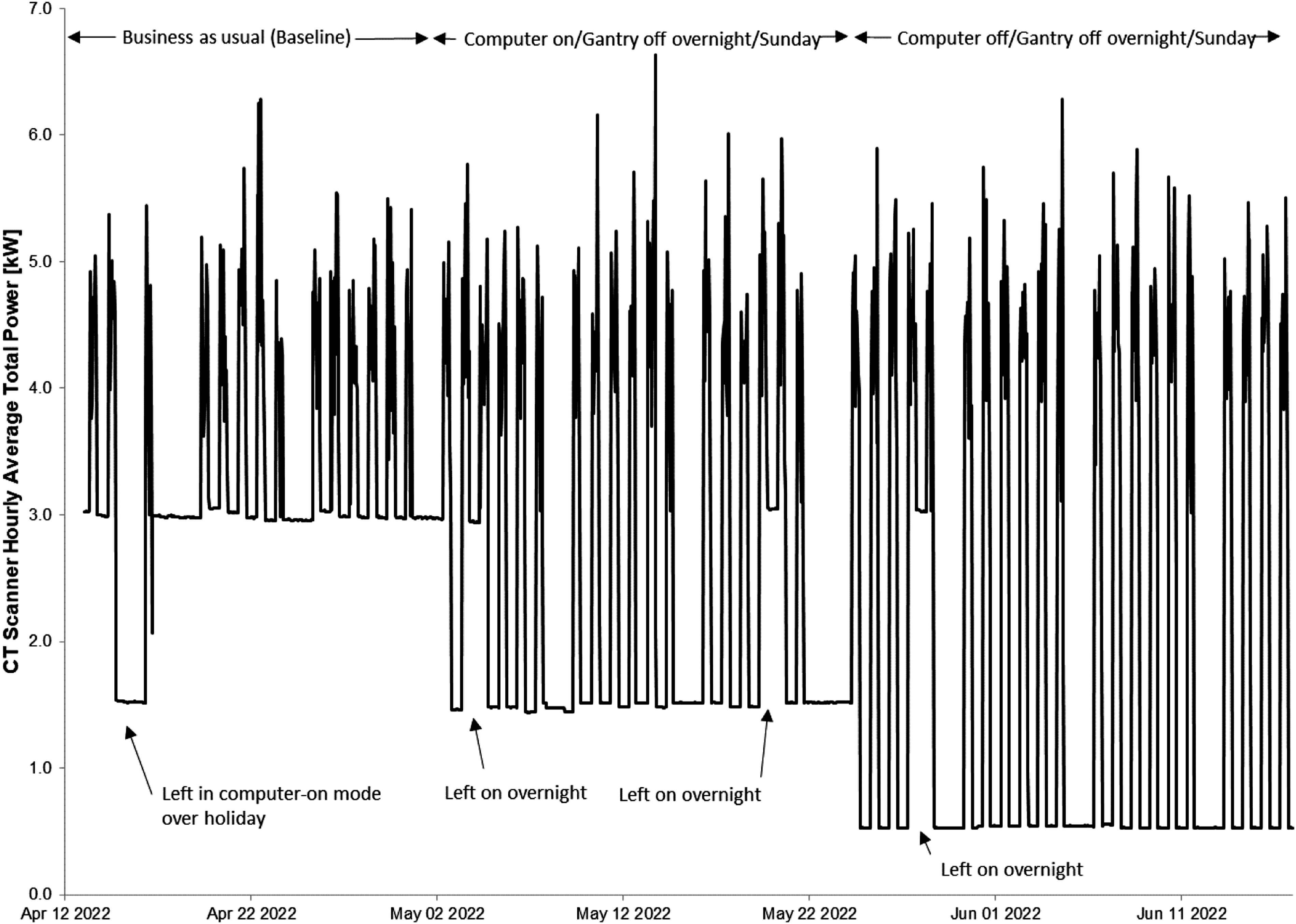
Some abnormal readings were observed during the three studied periods and are marked Figure 1. For example, during the second study period where the gantry was supposed to be off at night, for one night (in the first week of May 2022) the gantry stayed on mistakenly, resulting in higher readings.
Average Daily Energy Use By Power Saving Mode—By Day type.
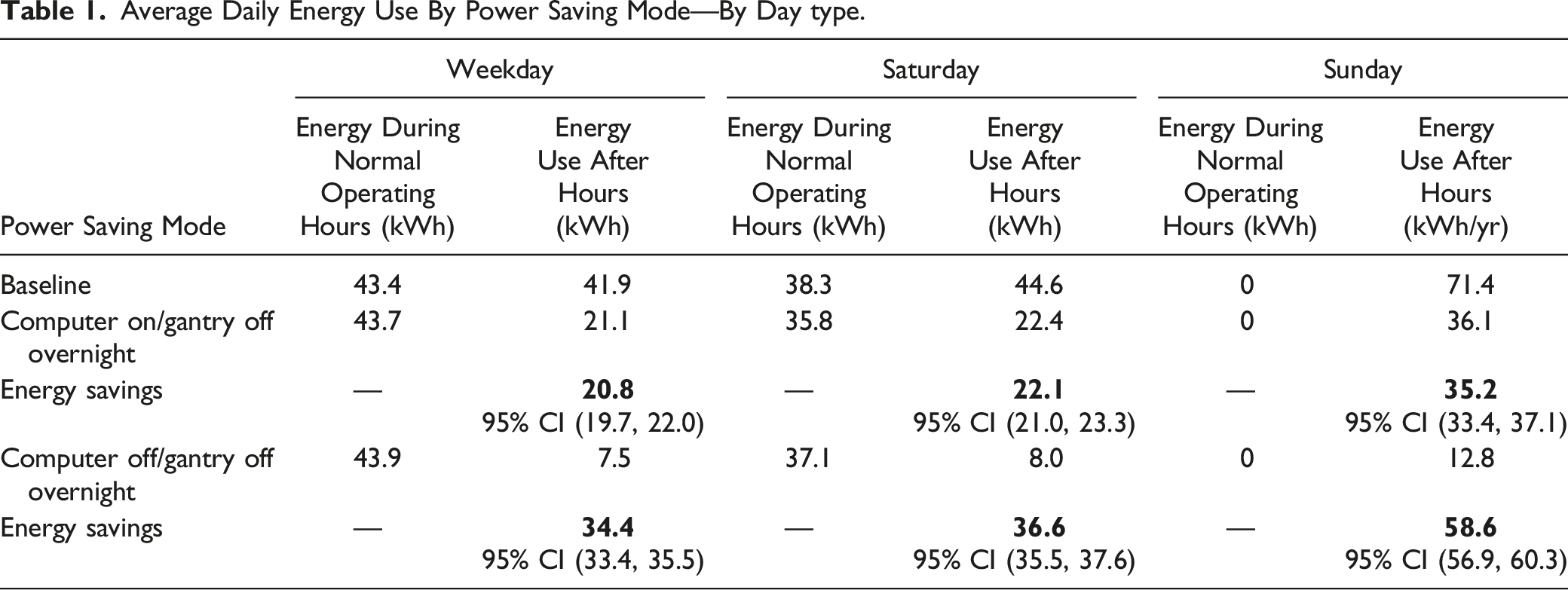
Figure 2 shows the average daily energy consumption of the CT scanner for each day type, separated by energy use during normal operating hours and after hours. Switching to the computer ON (computer on/gantry off mode) overnight reduced the total daily energy consumption on weekdays and Saturdays by 24-30% and almost 50% on Sundays. The system shutdown (computer off/gantry off) mode reduced consumption by 40 to 46% on weekdays and Saturdays, and over 80% savings over the system ON mode on Sundays when the scanner was never in use. Daily energy consumption by day type and power saving mode.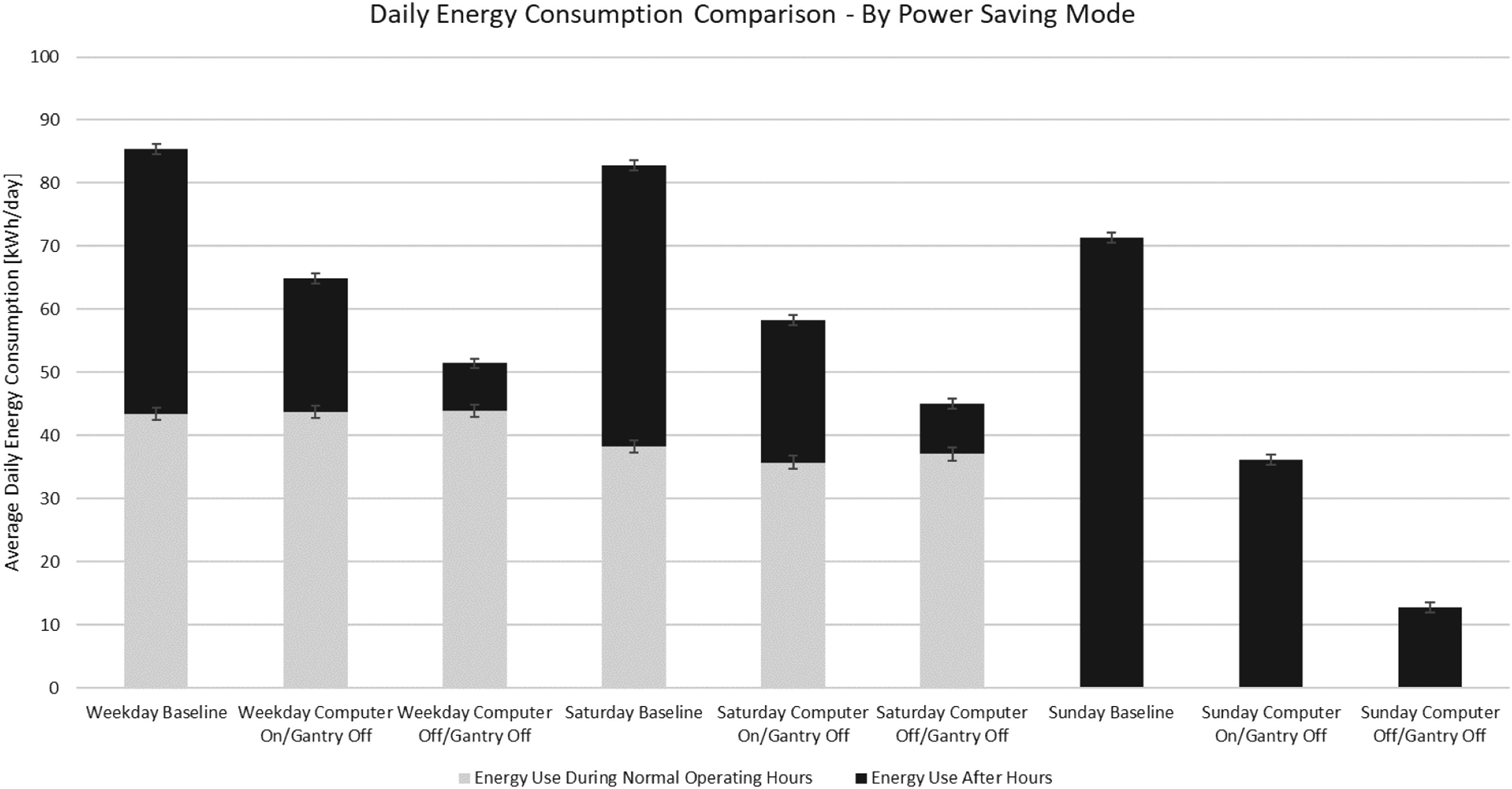
Estimated Total Annual Energy Use Based on After Hours Power Saving Mode—By Daytype.
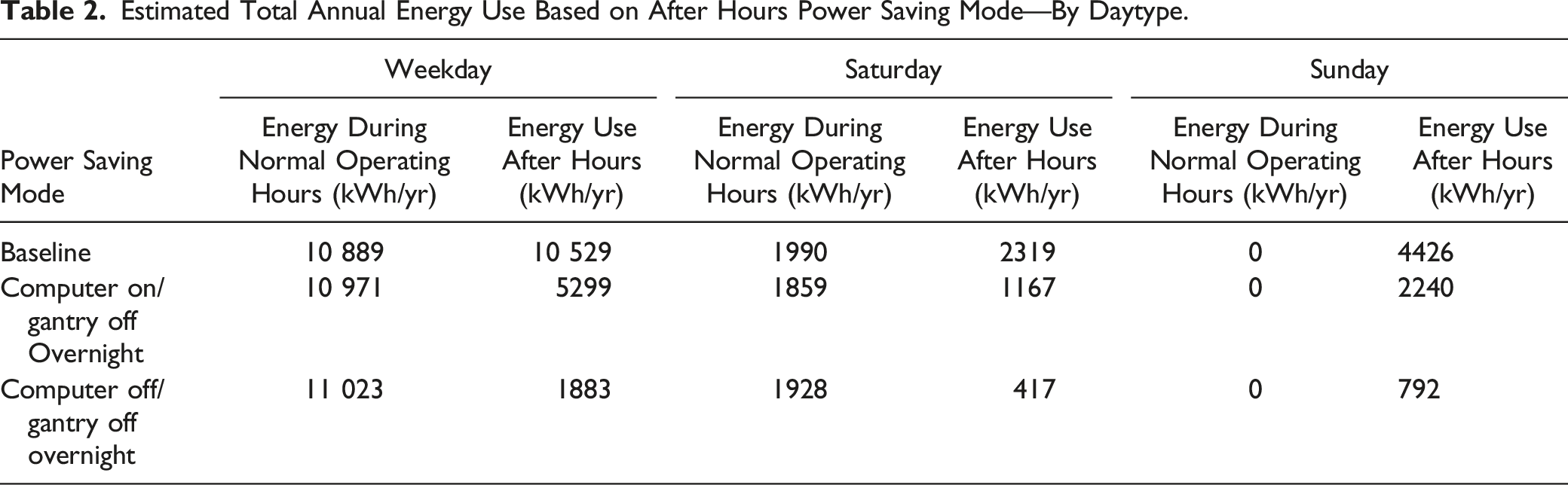
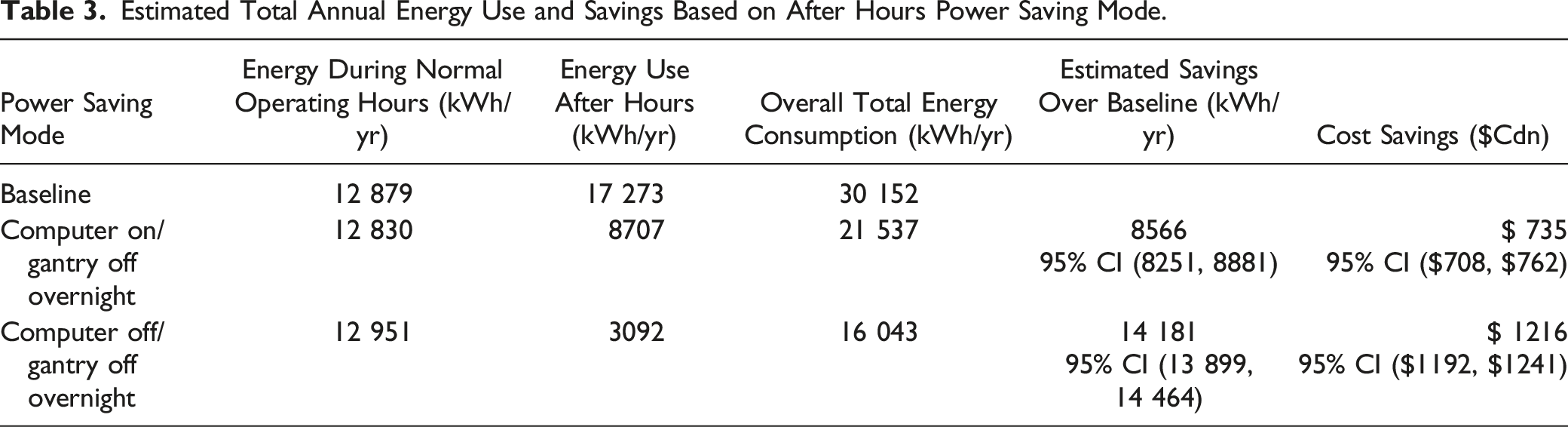
Estimated Total Annual Energy Use and Savings Based on After Hours Power Saving Mode.
In our region, almost all the CT scanners not used 24/7 were left overnight in stand-by mode (computer on/gantry off).
Discussion
The predominantly outpatient practice environment selected for the study provided an optimal scenario in which to demonstrate the energy and utility cost savings of downtime power off mode with no disruption to patient care.
Energy and utility cost savings are obtained when the CT scanner was partially shut down in the computer on/gantry off mode compared to system ON mode. However, the greatest energy and utility cost savings from system ON occur when the computer and gantry are both powered off in non-operational hours. On our scanner, this difference would save an estimated 14 180 kWh per year. For a health authority region with 25 CT scanners that could be powered off completely overnight, this would save an estimated 354 500 kWh/yr ($30 400) compared to system ON. This amount of saved electricity would power 190 average size electric cars driven 12 500 km/yr (average 0.15 kWh/km) or provide electricity for 32 homes. 9
Although newer equipment may use less energy, replacement of existing equipment has an environmental life cycle cost, and it is important to optimize existing equipment for continued use until end of life. We wished to quantify and draw attention to the considerable savings in energy and utility cost that can obtained with attention to minimizing power waste in non-operational hours. As older equipment may be less energy efficient than newer machines, powering off when not in use may have greater impact. 8
Electricity cost in our province is low in comparison to other jurisdictions. The cost savings would be greater in areas with higher electricity rates. Most of the electricity in our province is generated by renewable sources; therefore, the greenhouse gas emission savings are small. In jurisdictions where electricity is generated through burning of fossil fuels such coal and natural gas, greenhouse gas emissions savings would be greater, and the impact of energy savings of this study would be more significant from the environmental perspective. 10
This project in a specific clinical setting may serve to stimulate further discussion in radiology departments of our environmental impact and to explore potential areas of energy and utility cost savings. In our region, it is not policy for CT scanners to be powered off overnight. Other studies indicate potential power savings of CT with various power down modes. Our quantitative study confirms the energy and cost savings that can be obtained with overnight system shutdown mode.
It is important to note this project was initiated by radiologists and the plan formed by a unique collaboration between radiologists, the electric utility company, the vendor, and the hospital facilities energy management and operations and maintenance teams. Interdisciplinary collaboration across usual health care silos can stimulate innovation and new best practices where energy use is considered in all our decision streams and waste in minimized. Hopefully, this project encourages dialog at all levels within imaging departments to look for opportunities to power down equipment, limit overuse and reduce waste. Radiologists are well positioned to include sustainability in our role as consultants to encourage use of clinical decision support tools to ensure appropriate use of imaging resources. Additional measures to reduce waste of materials and energy in Radiology departments may include shutting off computers and printers out of hours, encouraging work from home when possible to limit vehicle emissions, recycling electronic equipment, and reducing use of single-use disposable plastics. Future goals may include work with vendors and regulators to establish Energy Star ratings for medical imaging equipment, and radiologists could advocate for purchasing decisions to include energy use criteria. 8 Rather than a standard cost-benefit analysis where value = outcome/cost the sustainable quality framework measures health outcomes against environmental, social, and economic costs. 11 Mitigating our energy use will involve integrating sustainability into quality improvement and decision-making processes as we consider the environmental impact of the services we provide.
This study was performed at a facility where overnight/Sunday system shutdown mode was possible without any impact on workflow or patient care. The extent of savings demonstrated in this study may not be achievable in other facilities with longer operating hours. However, the savings are significant and suggest that where possible when non-operational for a period of time, system shutdown (or vendor equivalent) of CT scanners will save energy and money. It is likely that many sites already do at least partial power down (computer on/gantry off) in non-operational times, in which case the savings to system shutdown will be less.
As this study was performed on a single CT scan unit and over a limited study period April to June 2022, results at other sites with other vendors and other energy providers may be expected to show more or less savings in energy and utility cost.
Although addressing energy consumption in low power/stand-by mode between patients is noted in previous publications as an important area to address, this was not feasible to perform on this older generation CT scanner.6,8 As identified in the 2014 NREL paper, all vendors should be encouraged to design controls that can reduce idle power used between patients, while ensuring fast response and emergency readiness. 7
Further assessment of the energy use during dual energy scan protocols would be of interest. In our study, we did have a power meter on tube B; however, as our practice performs few clinical scans with dual energy, we did not have sufficient data to comment on the amount of extra energy required. This may be an area for further study.
The environmental life cycle cost of medical imaging equipment is high; therefore, it is preferable to maintain and upgrade existing equipment whenever possible and for as long as possible. Future exploration with vendors will be helpful, to include life cycle assessments of their equipment (raw materials, manufacture, shipping etc.), refurbishment opportunities and expected operational energy use as information available to procurement teams
Our study demonstrates that significant energy and cost savings can be obtained through system shutdown of a CT scanner during non-operational time, with no adverse impact on clinical care or scanner function. Although the savings may not seem large with one scanner, in facilities/regions with a larger number of CT scanners, significant energy and cost savings can be realized. In our region, most of the CT scanners not used 24/7 were left overnight in computer ON (or vendor equivalent) mode. Our study indicates an opportunity for departmental review of current practice and implementation of overnight system shutdown procedures where appropriate would save energy, emissions, and cost.
The involvement of clinicians in the quest for lower emission opportunities in health care is of high value in breaking through traditional silos and building interdisciplinary problem-solving teams. Medical imaging is energy intensive, and radiologists are well positioned to advocate appropriate use of imaging studies, and for inclusion of environmental assessment in medical imaging equipment purchase and operations.
Footnotes
Acknowledgments
This study was supported by members of the Provincial Health Services Authority’s operations and maintenance team who played an integral role in making this study happen.
Declaration of Conflicting Interests
The author(s) declared no potential conflicts of interest with respect to the research, authorship, and/or publication of this article.
Funding
The author(s) disclosed receipt of the following financial support for the research, authorship, and/or publication of this article: This project was supported by BC Hydro and First Light Energy Solutions, and funded by the Energy and Environmental Sustainability team of the BC Provincial Health Services Authority utilizing operations fund (health authority’s internal project # B893-00).
Data Availability
The authors declare that they had full access to all of the data in this study and the authors take complete responsibility for the integrity of the data and the accuracy of the data analysis.
