




Abstract
In this article, I discuss the potential for quantitatively accounting of the social world as relationally constituted in both a topological and a temporal sense. As statistical procedures rest on underlying assumptions of the social world, I emphasise how multiple correspondence analysis (MCA) thinks relationally, as Bourdieu famously proclaimed, but to a lesser extent addresses the temporal pattering of social life. I point to the beneficial property of sequence analysis (SA) in thinking ‘processually’, and I argue that the combination of the two tools stimulates favourable opportunities for relational thinking in complementary ways. While adding SA to MCA inserts processual thinking into a relational space, the MCA helps embedding sequential patterns within a social structure. I critically assess this strategy by drawing on the diachronic underpinnings to Pierre Bourdieu’s oeuvre and empirically examine how his third dimension of social space – trajectory – might be ‘quantified’.
Introduction 1
While relational sociology encompasses a wide array of sociological contributions – as importantly proclaimed in Emirbayer’s (1997) programmatic manifesto – it is united by the premise that the social world is inherently made up of relations, rather than substances, and by the epistemological rejection of substantionalist reasoning where entities are held to be self-acting or engaging in inter-action due to their variable attributes (Emirbayer, 1997). Conversely, proponents of relational sociology appraise interactionist, stucturalist and processual modes of conceptualizing the social world. This body of work thus embraces methodological approaches for constructing complex relational patterns in data as opposed to linear readings of variables. Central to the burgeoning field of relational sociology is both the relational topology of the social world and a processual dimension to social life (Vandenberghe, 2018: 39).
In Pierre Bourdieu’s oeuvre, relationalism is first and foremost methodologically tackled by constructing relational oppositions in geometric spaces, so characteristic for his field analyses (Lebaron, 2018). Arguably, the centrality of temporal dynamism in his work has not seen a corresponding methodological translation. In this paper, I suggest a possible avenue to help remedy this shortcoming by drawing on Andrew Abbott’s (1995) introduction of social sequence analysis (SA). I suggest that the combination of SA and MCA facilitates a fruitful strategy towards a relational reading of the social world in complementary ways. SA thinks processually by accounting for similarities in the temporal structure of the whole list of events in time, whereas MCA thinks relationally through geometric representations of oppositions in large indicator matrices. I suggest combining these two modes of relational methodologies by using SA to detect sequence typologies that may be inserted as active or supplementary modalities in a geometric space. I highlight that this procedure not only helps inserting more dynamism into geometric data modelling, but that MCA helps remedy perhaps the most severe drawback of SA in its inability to account for the structural embeddedness of sequential patterns (Abbott, 2001: 123). 2
I exemplify this procedure by revisiting a study of class trajectories in the Norwegian upper class (Toft, 2019). Following the convention in class analysis, I study the relationship between class origins and class destinations, but employ sequence typologies for adding time sensitivity to both the construction of class origins (operationalized as a geometric space of ‘inherited’ capitals) as well as the class destinations (construed as a typology of different class careers). By projecting such destination careers onto the space of origins, it is possible to assess whether different careers are associated with the relational structure of ‘inherited’ capitals (Toft, 2019). I critically discuss the added value of this specific design by comparing how the projection of the sequence typology is differently situated in the cloud of individuals in comparison to analysing class destination as a one-year-snapshot.
While the statistical power resembles in both approaches, I detail that the sequence approach unveils how some individuals are on a downward trajectory and that the likelihood of descent is statistically patterned by the degree of privilege in one’s upbringing. Conceptualizing the destination class as a snapshot detects equally well a capital-specific logic to the reproduction of the upper class – following the opposition along the preponderance of economic to cultural capital – but fails to bring attention to additional temporal dynamics that are elucidated by the sequence typology. The snapshot approach therefore runs the risk of underestimating the endurance of privilege, particularly attributed to the inheritors in the economic domain.
The article is organized as follows. First, I pinpoint the relational properties of MCA and SA and argue that a joint application targets relational thinking in complimentary ways. Then I turn to the empirical example at hand; first, by highlighting topological and temporal elements in a Bourdieusian reading of upper-class reproduction; then by discussing the empirical strategy to conceptualise a dominant class by means of administrative registry data. Next, I delineate the methodological design and the operationalization of class destinations by means of SA and of class origins by means of MCA. I then analyse the added value of the SA construction of class careers by statistical criteria. I conclude by highlighting statistical and substantial benefits as well as caveats with the proposed design, yet emphasising that the procedure is only one particular example of how the joint application of MCA and SA may help to ‘quantify’ relational thinking.
Assessing relations: space and time
Any statistical approach brings with it not only statistical assumptions, but also philosophical assumptions about the social world (Abbott, 2001). Bringing to light which underlying notion of the social that is implemented in statistical techniques is therefore crucial to sociological reasoning. While most standard quantitative approaches assume what Abbott (2001) dubs a ‘general linear reality’ (GLR), relational sociology tends to stress methodological tools which bring to light a system of temporally constituted relations. To Bourdieu, the emphasis placed on studying a structure of objective relations of power (Wacquant, 1993: 20-21) lead him to geometric data modelling which allowed unveiling ‘a whole network of statistical relations’ (Bourdieu, 1984: 103; Lebaron, 2009). To Abbott, the tenet of how time matters for social life led him instead to advocate for bringing SA into the sociological toolkit (Abbott, 1995; Abbott, 2001; Abbott, 2016). With SA, one is offered a way of retaining sensitivity to temporal processes while maintaining the relational account of ‘social reality in terms of ‘events in contexts’ rather than ‘entities with variable attributes’’ (Abbott and Tsay, 2000: 24).
A relational structure of oppositions
A key deficiency with the GLR framework for statistical modelling, Abbott holds, lies in its inability to empirically analyse the sociological insight ‘that social determinants lie in closely related bundles’, key for instance to Weber’s concept of elective affinity and the related notion of ideal types (Abbott, 2001: 54). In a regression framework, one is allowed to include a few interactions that open a ‘single causal meaning of contextuality,’ but variables are mostly analysed ‘net of’ other effects (Abbott, 1997: 1152) and the contingencies of these related bundles are left undetected (Bourdieu, 1984: 103).
Conversely, multiple correspondence analysis ‘is a technique which ‘thinks’ in terms of relations’ (Bourdieu and Wacquant, 1992: 98). It offers a way of eliciting the main underlying dimensions in a large indicator matrix envisioned through geometric representations of both the row profiles (the cloud of individuals) and the column profiles (the cloud of categories) (Lebaron, 2018; Hjellbrekke, 2018; Le Roux and Rouanet, 2004). The technique is based on finding the patterning of data envisioned by the fewest dimensions that capture the variance of the points. In these spaces, distances refer to the level of affinities discovered in the matrix; individuals who are in close proximity in the cloud of individuals are typically similar in their attributes, whereas proximity in the cloud of categories reveals which categories typically characterize the same individuals. Thus, this technique allows detecting a relational structure of difference, taking account of the contingencies of every indicator recorded.
Adding holistic accounts of sequential unfolding
Most quantitative accounts of relational sociology aim at mapping a structure; whether consisting of structural positions – such like MCA – or patterns of interaction and relations – such like social network analysis. There seems, however, to be a relative lack of methodological interventions for accounting for dynamism and temporal order within such structural approaches and they may still be seen to ‘privilege topological patterns over narrative unfolding’, as Emirbayer (1997: 305) noted more than twenty years ago. 3
While MCA has many favourable features, temporality is arguably a troublesome caveat when aiming to account of the social world relationally. From a Bourdieusian perspective, this appears somewhat paradoxical given that key concepts like capital, field and habitus necessitate a diachronic approach (Bourdieu, 1984; Bourdieu, 1993; Bourdieu, 1990; Friedman and Savage, 2018; Rossier, 2019). There are some important efforts to incorporate more dynamism into an MCA framework such as for instance the projecting of coordinates of oppositions in one point in time onto a geometric representation of oppositions from another point in time (e.g. Coulangeon, 2013; Müller-Schneider, 1994; Rosenlund, 2019). Other efforts rely on summary measures of careers as active modalities (e.g. Bühlmann et al., 2018; Ellersgaard et al., 2013; Hjellbrekke et al., 2007; Lebaron, 2000) or using event history data as active points in an MCA (Martens, 1994). However, further attempts at incorporating more dynamism into geometric data analysis seems warranted to date and I suggest that categorical typologies construed from sequencing procedures may be fruitful avenues to consult to this end. SA offers a way of retaining sensitivity to temporal processes in a ‘holistic’ manner, by finding resemblance in complex sequences of events based on the whole list of states in a sequence.
The optimal matching algorithm, commonly employed in SA, seeks to assess the level of similarity between each pair of sequences based on edit distances. The level of similarity – and the corresponding level of dissimilarity – between sequence pairs is based on the least costly way of editing the one sequence into the other either by substituting or inserting and deleting elements. The result from the OM algorithm is a large matrix, dubbed a dissimilarity matrix, which returns a value that denotes the efforts implied in editing one sequence into the other. To reduce the level of detail, cluster analysis is customarily employed as a means of constructing typologies from these resultant matrices. As a result, we are offered a manner of grouping types of sequences that are similar – not only based on a singular temporal feature such as the duration of states, or a specific transition – but based on the whole list of states recorded.
Situating sequences in a structure of oppositions
SA is helpful when wanting to sketch out structural similarities in the pattering of events in time. A key reservation against SA, however, has been voiced by Abbott himself; while SA is beneficial in creating typologies that are sensitive to temporal processes, it fails to embed such temporal unfolding in the social structure. A sociological account of the social world should always acknowledge how action is situated in a societal structure of constraint, Abbott argues (2001: 123). Thus, a possible danger of sequence analysis is to flesh out narratives that are viewed independently rather than relationally vis-à-vis one another.
In a similar vein, Bourdieu (2000a: 302) warns against the biographical illusion of being blindsided by idiosyncratic – and thus substantialist – readings of narratives; one should therefore avoid trying to understand trajectories without ‘having previously constructed the successive states of the field through which that trajectory has progressed’. In his analysis of the scientific field, Bourdieu (1975: 27) points to, for instance, how different career trajectories need to be understood relationally as their social meaning is only grasped when each career is seen in relation to other possible careers. The sociological significance of different sequences may as such remain unaccounted for if we disregard the social structure in which they are embedded.
Arguably, the two tools of MCA and SA may be jointly applied in ways that are mutually beneficial when seeking to quantify social phenomena in a manner that remains sensitive to topological patterns and narrative unfolding. While SA may help remedy the relatively lack of temporal sensitivity in an MCA, the MCA may help remedy the relatively lack of attention to how sequences are situated within a structure in SA. Thus, not only does the combination of MCA and SA help introducing more temporal sensitivity into geometric data analysis, but the placement of sequences in a space of oppositions helps understanding the structural constraints and capacities that may have facilitated the divergent pathways.
The object of study – an empirical example
Class reproduction and the temporal underpinnings of habitus
Class reproduction – or rather, class immobility – constitutes a major research field in sociology. In Bourdieu’s oeuvre, it is affinities in the temporally constituted habitus that facilitate the tendency for a close association between class origins and class destinations in society (Bourdieu, 1984; Bourdieu, 1996). Time – in its past as well as in its future tense – is key to understanding this relationship.
Although the social milieu in one’s upbringing holds ‘disproportionate weight’ for the formation of habitus (Bourdieu, 1990: 54), habitus is never theorized to be a mechanistic concept reflecting parental class but is subjected to ‘permanent revision…in response to new experiences’ (Bourdieu, 2000b: 161, see also Wacquant, 2016). However, this dynamism of permanent revision never entails ‘radical’ transformations, Bourdieu maintains, as past experiences – which, above all, reflect the earliest experiences of one’s upbringing – always constrain or narrow in the field of possibles when encountering a new environment. Hence, the restriction of the ‘radical’ transformations of habitus lies in how revisions are made on the ‘basis of the premises established in the previous state’ (Bourdieu, 2000b: 161). Consequently, it is not only the different experiences that one encounters over time but also the sequencing of experiences over time that structures the habitus. Habitus is as such shaped by ‘chronologically ordered’ trajectories (Bourdieu, 1990: 60).
Bourdieu maintains that for every class, there exists a ‘modal trajectory,’ which tends to be actualized via habitus that facilitates the likelihood of ‘the causality of the probable’ (Bourdieu, 2014; Bourdieu, 1984: 109-112). Such modal trajectories are also class fraction-specific, with individuals hailing from families rich in economic capital typically pursuing different reproduction strategies from those hailing from families rich in cultural capital (Bourdieu, 1996; Bourdieu, 1984: 121-132; Bourdieu, 2014). 4 When individuals are not following the ‘probable career’ that is associated with their class of origin, such as through ascending or descending class mobility, a person’s ‘practical’ relationship with his or her class destination is affected through ‘a sense of being either at home in a group…or out of place’ (Bourdieu, 1996: 185-186). Thus, the degree to which a class consist of individuals of similar dispositions also adds to consolidate power and lubricate intra-class cohesion. In other words, class-based cohesion, mutual appreciation and recognition hinge on the levels of affinities between individuals’ habitus, which themselves are a product of biographical trajectory. Simply studying peoples’ class position at a given point in time thus only partly taps into inclinations for coherence and affinities, as group formation is contingent on whether the ‘trajectories which have brought them to these are themselves similar’ (Bourdieu, 1987: 5, see also Bourdieu, 2014: 244; Bourdieu and Wacquant, 1992: 99).
It follows that statistical techniques that share these underlying assumptions about the centrality of sequential unfolding are crucial for a quantitative mapping of class trajectories. Yet, the intragenerational pattering of class situations over time is not explicitly incorporated into the MCA framework. Possibly, combining MCA and SA might get us one step closer to sensitize relational class analysis to temporality.
The upper class: Conceptualizing divisions at the top
Administrative registry data: Possibilities and caveats
I empirical assess the joint application of MCA and SA for the study of upper-class reproduction by revisiting a recent analysis (Toft, 2019). The data are derived from Norwegian administrative registries. While not gathered for the purpose of scientific research, the data offer several advantages over sampled survey data (see also Savage and Burrows, 2007). In particular, the data (i) make it possible to study exclusive groups that are small in numbers and (ii) allow more contextualization.
First, it is well known that it is difficult to study the upper class or elites who are few in numbers with sampled surveys (Savage, 1997; Savage and Williams, 2008). This issue does not apply to the registry data as they encompass the total population. This enables studying mobility patterns in restricted reaches of the class structure quantitatively.
Second, the administrative register data also remedy another shortcoming of sampled survey data, namely, the selection of ‘representative’ respondents who are analysed abstracted from their social contexts (Abbott, 1997: 1162; Bourdieu et al., 1991: 39-40), and that neglects how social life is embedded within local contexts like families and workplaces (Bertaux and Thompson, 1997: 7). The register data contain information of group affiliations that enable e.g. studying everybody living within a specific geographical area, everybody working at a specific workplace, or individuals within kinship ties, such as linkages to siblings, parents and grandparents.
However, the register data also include important caveats and shortcomings. 5 At the most general level, social scientists should be vary of naïvely embracing the classificatory schemes that are meant for bureaucratic ends as opposed to social research. The danger is to forget that classifications employed by administrative officials are themselves objects of contestation and struggle for material and symbolic rewards (see e.g. Bourdieu, 1984: 151; Bourdieu, 1996: 121-123; Bourdieu, 2018: 27-29).
Another important caveat with the data at hand is the limited time frame for some variables. Occupational information, for instance, is available only in a ten-year period (2003–2012), which limits the opportunities for analysing intragenerational class careers. 6 Time also restricts the possibilities for constructing time-sensitive modalities in the MCA. In particular, parental occupational industry is only available from a point-in-time census. However, other forms of resources are measured at multiple times (parental income and wealth, as well as the level of affluence in the neighbourhood), which also facilitates introducing dynamism into studying class origins by creating sequence modalities from SA.
Another problem with the register data concerns the quality of the information that they contain. Although certain sources of data may denote comparatively better quality than what is usual in quantitative data (consider, for instance, the difference between self-reported income and tax-reported income), other sources may cause more difficulties. The construction of class careers relies on occupational information, and some occupational titles are fairly vague and are difficult to sort hierarchically. The occupational title of ‘consultant,’ for instance is hard to classify, and it is difficult to assess the level of homogeneity of work associated with such titles. Moreover, the emphasis on career induces vulnerability to erroneous reporting to the registers.
Perhaps more fundamentally, constructing typologies of class careers based on an occupational sorting may induce vulnerability to the changing social, material and symbolic significance of occupations over time (Abbott 2006; Bourdieu, 1984). The relational properties of states at different moments in time are not explicitly accounted for in the same sense as would be possible if separate MCAs were constructed for each year of observation. 7 While this is perhaps a general concern for sequence analysis, I do not think it offers a severe challenge to my design because I select four successive cohorts and thus measure their class affiliations at similar biographical ages (from ages 41-51 for the youngest birth cohort (1962) and 44-54 for the oldest birth cohort (1965)). Because sequence analysis also captures the timing of events, states are primarily seen in context of the same biographical age in historical time.
Upper-class fractions and an occupational class scheme
Before turning to the empirical demonstration of how SA and MCA can be combined as a means to study class trajectories, what is meant by upper-class positions and how such positions are construed should be clarified. Conventional class schemes, such like the much-applied Erikson-Goldthorpe-Portocarero-scheme, are unhelpful when wanting to analyse intra-class divisions within the dominant class. Such horizontal divisions are conceptualized in the Oslo Register Data Class (ORDC) scheme which is based on an occupational sorting on a very detailed level (Hansen et al., 2009). It is operationalized heuristically and aims to tap into different ‘conditions of existence’ based on the volume and composition of cultural and economic capital. 8 The class scheme with example occupations is visualized in Figure 1.
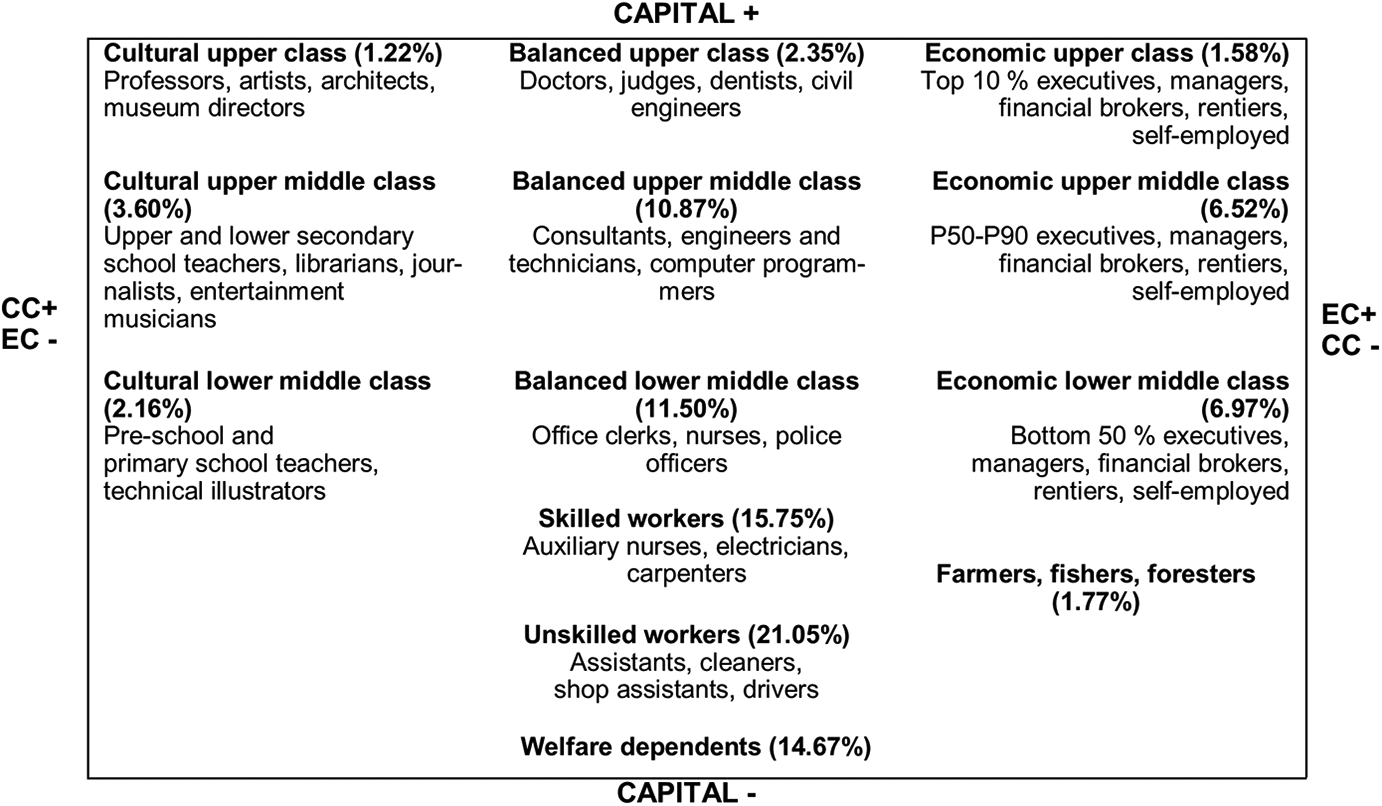
The Oslo register data class scheme with example occupations. Percentages for birth cohorts 1962-1965 in year 2003, ages 41-44
Whereas vertical divisions – the upper class, the upper and lower middle class, the working classes and farmers as well as welfare recipients – connote a division along capital volume, the horizontal divisions between fractions of the upper class and the middle classes reflect the relative composition of capitals. The right-hand side of the scheme sorts class situations that primarily rely on economic capital, whereas the left-hand side of the scheme identifies class situations that rely on cultural capital. Class fractions that rely on a mixed – or a balanced – composition of capital are placed in the middle. In addition to the occupational sorting, information about income is utilized to identify i) individuals relying on welfare transferences, 9 ii) individuals engaged in farming, fishery and forestry, and iii) an approximation of the self-employed, proprietors and rentiers (SPRs), as well as iv) to differentiate a vertical dimension in the economic domain of the space. Among everyone grouped in the economic fraction, a relative income criterion (based on summarizing earnings, capital income and self-employed income) differentiates the economic upper class (top 10% of income-rewarding individuals in the economic fraction), from the economic upper middle class (the following 40% of the income distribution) and the economic lower middle class (the 50% lowest income-rewarding individuals in the economic fraction).
The vertical differentiation within the economic fraction inevitably incorporates a level of arbitrariness into the continuation of individual class affiliation over time. Whether discontinuous and short spells of economic upper-class affiliation should be analysed as class mobility is therefore somewhat questionable, although this economic differentiation taps into different capabilities to retain and accumulate economic capital over time. However, while this caveat may have contributed to more heterogeneity in the sequences analysed, these deficiencies should be expected to have underestimated, rather than overestimated, the association between different destinations class trajectories and the origin space constructed.
There are three upper-class fractions identified. The economic fraction includes the dominant positions within business, such like managing directors, chief executives, financial intermediaries, and an approximation of self-employers, proprietors and rentiers (SPRs), defined as individuals living off large capital incomes rather than salaries. The other two fractions entail a high volume of capital but of a balanced or a cultural kind. In the balanced fraction of the upper class, this phenomenon often denotes occupations that are well-paid but that often require excessive elite credentials such as the elite professions and upper-level state bureaucrats. Thus, it is seen as ‘balanced’ in the mix of cultural and economic capital. The cultural fraction typically groups occupations that deal with the mastery of symbolic forms or that have definition of power over cultural expressions. Table 1 gives an account of the different types of occupations that dominate the fractions in the scheme.
Main occupational groups in the different upper-class fractions in year 2003, 41-44 years of age

A relational approach to upper-class trajectories
Linking class origins to class destinations
In Toft (2019), I suggested studying class reproduction relationally in a manner that is analogous to the locus of mobility studies on the correlation between an independent variable – class origin; here defined as ‘an origin space’ – that is associated with a dependent variable – class destination; here defined as ‘destination careers’. This analogy was approached by reading the relational structure of the origin space as a ‘predictive map’ (Lebart et al., 1984: 100-108) that is correlated with class destinations. By projecting a typology of destination class derived from a sequencing procedure, it was possible to analyse how the specific structure of the origins of the upper class is linked to their adult class careers. In this paper, I assess the added value of this procedure by comparing it to the projection of modalities that are based on a point-in-time measurement. Here, I study the same four cohorts as in Toft (2019), but I restrict the subpopulation to those who have an upper-class affiliation in year 2003, at ages 41-44. I construct the same geometric representation of capitals pertaining to their kinship ties (an ‘origin space’) and a sequence typology of their destination careers (2003-2012). I then map how the divisions in the ‘origin space’ relate to their class destination in year 2003 (a one-year snapshot) as opposed to their 10-year class career (sequence of class positions in year 2003-2012).
To statistically assess these relationships, I make use of test values that indicate whether the dimensions in the origin space are statistically associated with the mean points of the supplementary modalities of destinations (Lebart, 2006). I follow the convention of treating 0.5 standard deviations as ‘notable’ and 1 as ‘large’ when assessing the magnitude of the pair-wise distances in the space (Le Roux and Rouanet, 2010: 59). Digging further into the statistical associations between the destinations and the origin space, I make use of post hoc ANOVA tests of the mean points in the cloud of individuals as well as concentration ellipses to visualise the dispersal of each modality in the cloud (Hjellbrekke, 2018: 51).
What is a class destination?
The relative neglect of life-course variation has been a longstanding concern in the study of social mobility. Initially, this was perhaps most clearly expressed by Aage Sørensen (1986b) in his critique of the conventional mobility table. 10 The gist of Sørensen’s critique is that the dominant approach to social mobility relies on measuring two snapshots in time to assess a relationship between social origins and social destinations. 11 For instance, Sørensen criticizes the reliance on a point-in-time measurement of class destinations, given that it discards of the level of intragenerational mobility a person may experience (Sørensen, 1986b: 77). Indeed, deciding on the best time of measuring a person’s labour market affiliation has been a constant thorn in the side of mobility research, as it inevitably begs the question of ‘choosing the right point in their careers’ (Blackburn and Prandy, 1997: 498-499, see also Abbott, 2006; Bertaux and Thompson, 1997; Savage, 1997; Friedman and Savage, 2018).
The dominant strategy against this critique seems to rely on deciding on the right timing in the life-cycle for measuring a destination class. The likelihood of upward trajectories is, for instance, more persistent at younger age rather than older age. Thus, a notion of ‘occupational maturity’ around age 35 has been a custom, during which there is a ‘marked falling-off in the probability of job changes which involve major shifts of occupational level’ (Goldthorpe, 1987: 53). The Goldthorpian remedy to Sørensen’s critique of ‘arbitrary snapshots’ thus relies on measuring class destinations at their time of peak, reaching a biographical age of occupational maturity. 12
A viable option for taking account the duration of class positions when aiming to estimate careers would be event history analysis, which is generally a good way of including the duration in a regression framework. The drawback, however, is that rather than focusing on whole careers (‘whole’ relative to what data permits, naturally), it focuses on individual transitions. Also, while event history analysis allows for some sensitivity towards time in analysing intragenerational class careers, it is, as far as I know, not compatible with a social space approach to class origins and thus the exploration of the structured association between class origins and class destinations beyond the framework of ‘linear reality’ (Abbott, 2001).
Constructing sequence modalities
An alternative route to measuring a class destination is to construct a typology of class sequences ‘holistically’. 13 Within the field of class mobility, sequence analytical techniques are only scantly applied as an alternative to the mobility table, save for some important exceptions (e.g., Bison, 2011; Bühlmann, 2010; Chan, 1995; Halpin and Chan, 1998; Bukodi et al., 2016). In this paper, I offer a critical assessment of this option by systematically comparing it to the option of relying on one snapshot at a time well beyond ‘occupational maturity’.
As noted, the OM algorithm is designed to optimize the least expensive route to editing one sequence into the other, and the matter of which of the elementary operations – substitution, insertion/deletion (indel) – are deemed the costliest is modelled by the researcher. Whether making indels or substitutions costlier has implications for whether the matching procedure favours the occurrence of states or timing of states. Indel operations are less sensitive to the timing of elements than the substitution operation (Lesnard, 2014). As pointed out by Bukodi et al. (2016:5), whenever sequences consist of equal lengths and relatively long spells, the indel operation will play a minimal role in the matching procedure (see also Abbott and Tsay 2000:12). I follow the strategy of Bukodi et al. (2016) and set the indel cost to half the maximum substitution cost for the construction of destination sequences. The indel costs in the sequence typologies that are employed in the origin space are set by a statistical criterion based on observed transitions and a common future (Studer and Ritschard, 2016).
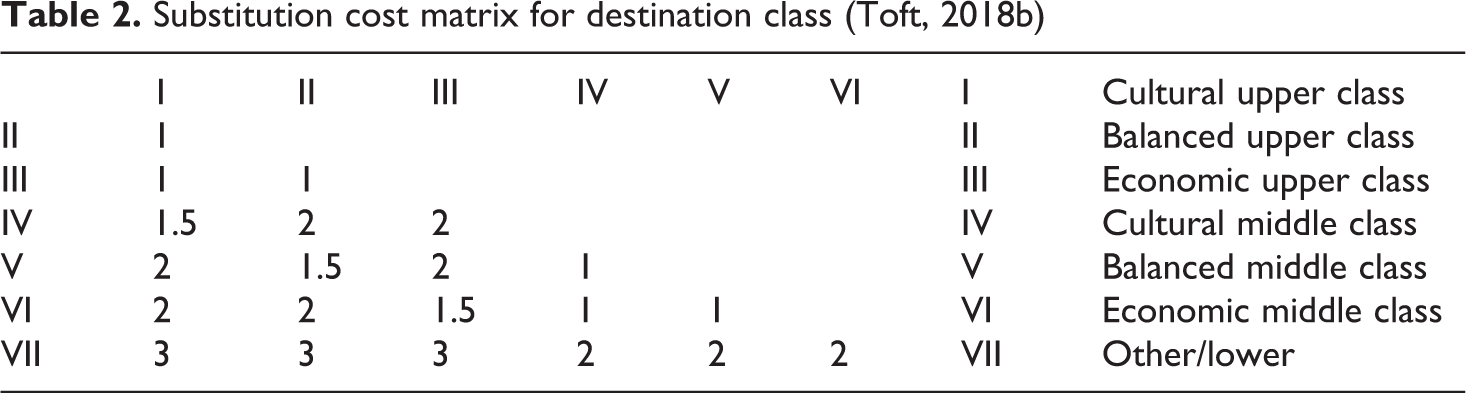
Setting the substitution costs has been seen as the most crucial methodological choice for SA, as well as the target of critics (e.g., Wu, 2000). Emphasising the pattern-tracing abilities of SA, Halpin (2014: 77-78) has argued for the view of SA as ‘a mapping of the state-space distances onto the sequence domain, yielding a set of sequence-space distances,’ which makes ‘state-space distances…just statements about differences between the categories of the state-space variable.’ Where feasible, theoretical considerations help in deciding on the plausible distances in the state-space. In my analyses of class careers, I rely on the ORDC class scheme to construct the substitution cost matrix as outlined in Table 2 (Toft 2018b; Toft, 2019). Doing so implies a theoretical difference between not only vertical class divisions but also horizontal class fractions. The application of theoretical concerns for setting substitutions costs is also prevalent in other studies that rely on an existing class scheme (see e.g. Bukodi et al., 2016; Chan, 1995; Halpin and Chan, 1998).
Substitution cost matrix for destination class (Toft, 2018b)
In my analysis in Toft (2019), I also employed sequence analysis for constructing time-sensitive modalities in the origin space. These analyses relied on statistical criteria for assigning substitution costs, as the sequences did not correspond to state-spaces that are easily conceptualized theoretically. Thus, the statistical developments by Studer and Ritschard (2016) helped guide the optimal solution for these matrices (see Toft, 2019 for further details).
In order to construct typologies from the dissimilarity matrices, I employ the Ward linkage in combination with the procedure of partitioning around medoids (PAM), as suggested by Studer (2013). This linkage seeks to minimize the weighted distance to the medoid, whereas the Ward linkage groups cases based on minimizing the within-group sum of squares (Ward Jr, 1963). The Ward linkage is beneficial in its ability to create clusters of fairly similar sizes. To decide on the number of clusters, I have primarily relied on the statistics provided by Studer, but I have also taken Cornwell’s (2015) advice in judging the meaningfulness of the clusters.
Figure 2 provides an overview of the constructed destination class trajectories. It gives an account of the most representative sets that are needed to cover at least 25% of the sequences within a cluster. Three types consist of stable affiliation to each of the three fractions. Two types depict mobile trajectories between the upper class and the upper middle class in the balanced and economic fraction, respectively. The last type depicts shorter spells of upper-class affiliations and a long-range downward trajectory. See Toft (2018b; 2019) for further details about the content of these upper-class careers. 14
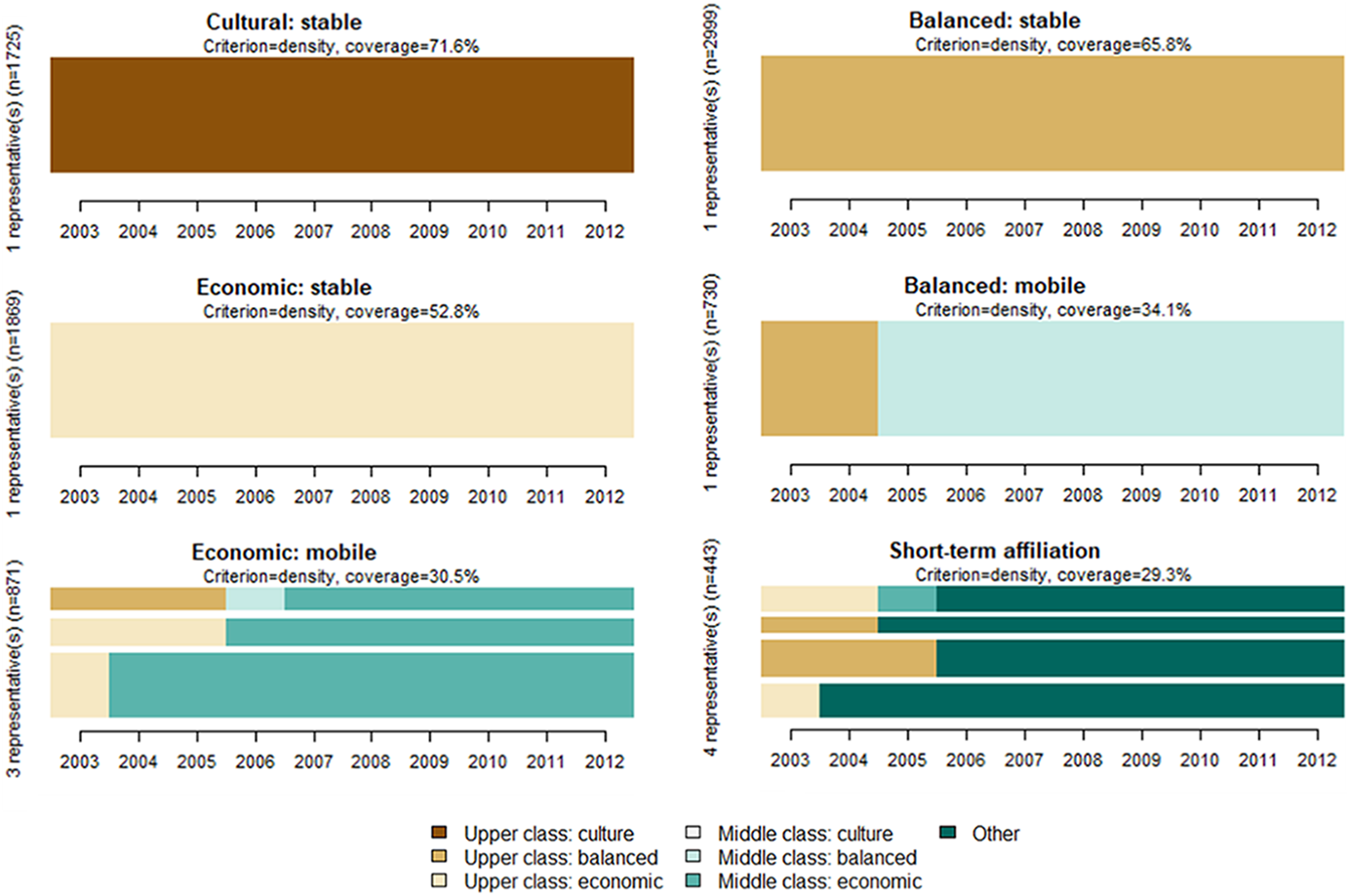
Representative sequences for the destination class trajectories
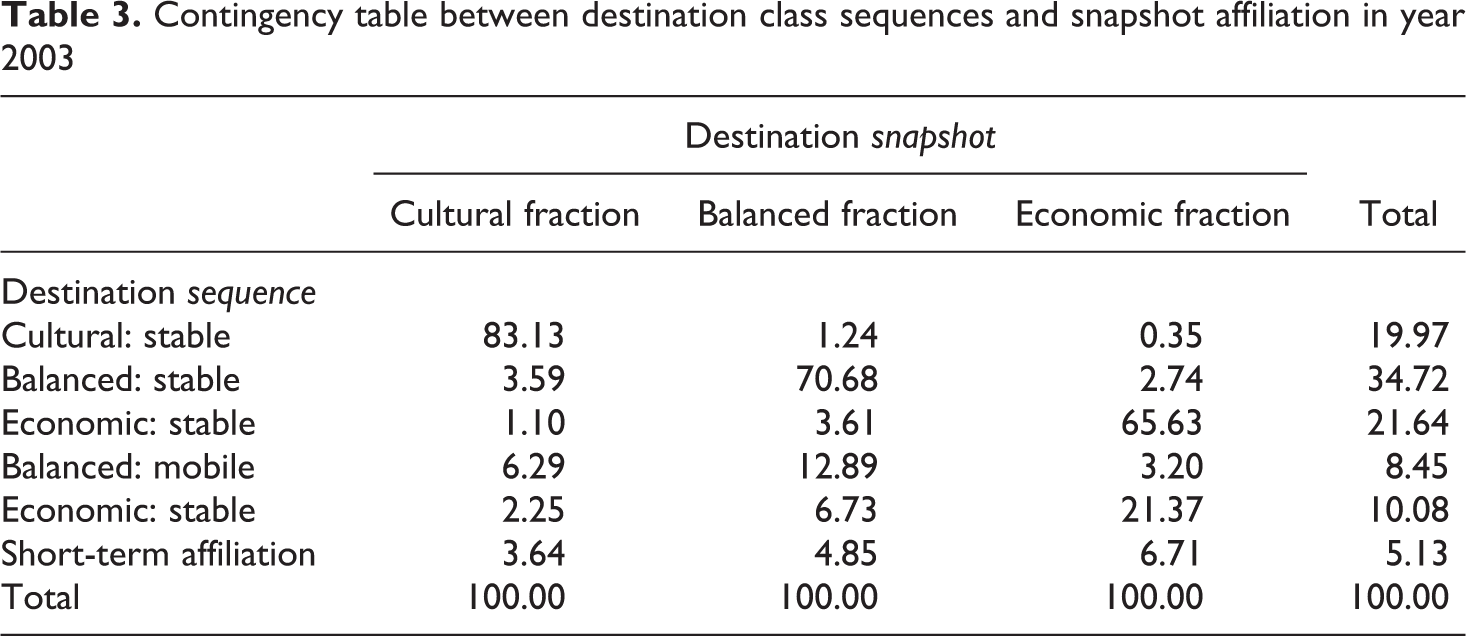
In Table 3, the sequence-typology of destination class is compared to the affiliation in year 2003. As seen, at those ages, there is merit to the notion of ‘occupational maturity’ – a large share of these individuals remains affiliated to the dominant class in this ten-year period. Nonetheless, the table also demonstrates that almost one quarter of those who reach dominant positions at a mature age in year 2003 also embark on a downwards trajectory during their fifties. These sequences also unveil how the economic and balanced fractions are entwined in career paths, while horizontal mobility barriers restrict the degree of circulation between the cultural and the economic fraction, as highlighted in Toft (2018b).
Contingency table between destination class sequences and snapshot affiliation in year 2003
The origin space and its key oppositions
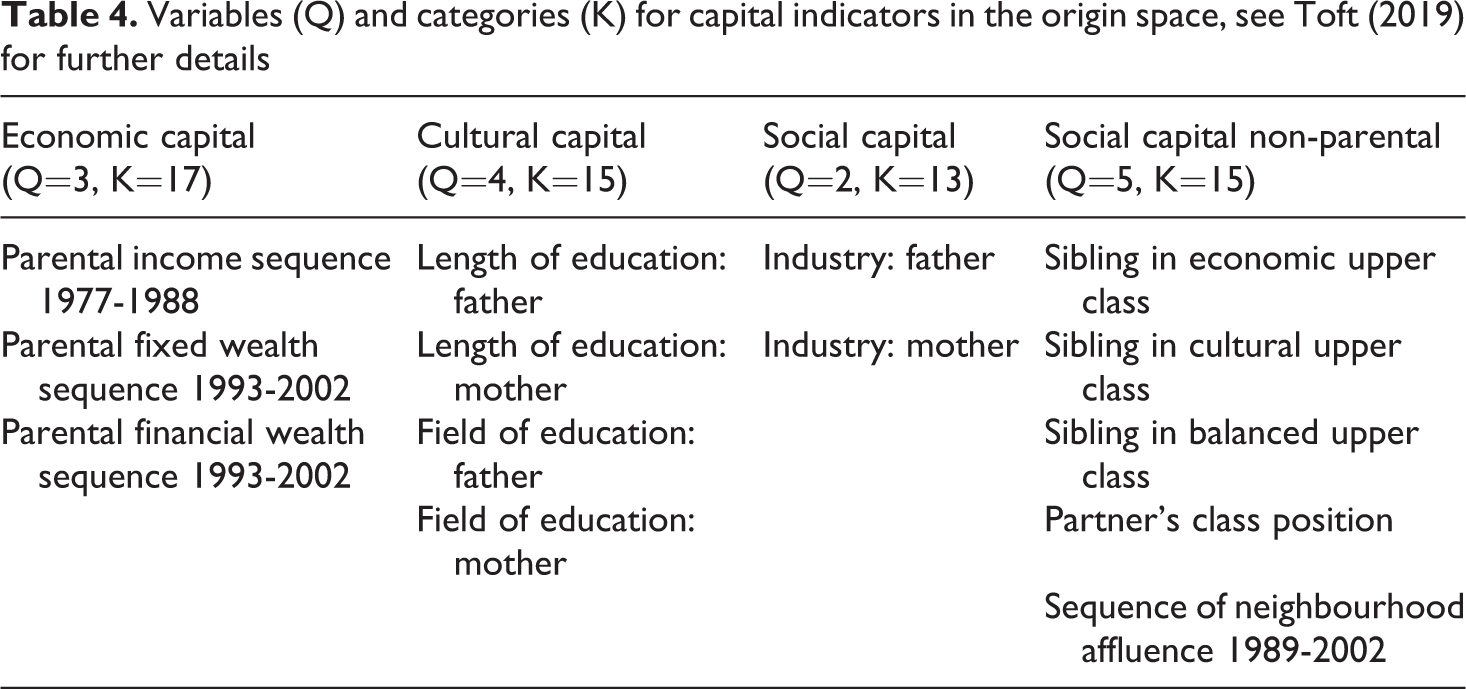
To construct the origin space, I employ specific MCA (Le Roux and Rouanet, 2010: 61-62). I follow the procedure in Toft (2019) and employ 14 variables, reflecting blocks of economic, cultural, social, and extended social capital (see Table 4). The latter block points to forms of capital that may be available beyond parental resources such like partner’s or sibling’s class affiliations. In addition, I include the level of affluence that has patterned the neighbourhood environment one has resided in over time (Toft, 2018c). The categories within these blocks are fairly ‘balanced,’ ensuring that none disproportionately dominate the analysis (Le Roux and Rouanet, 2010: 38). These blocks should be deemed heuristic, in the sense that some of these categories may entail different types of resources. In particular, the parental industry, which is classified under social capital, may just as much denote differences in inherited cultural capital.
Variables (Q) and categories (K) for capital indicators in the origin space, see Toft (2019) for further details
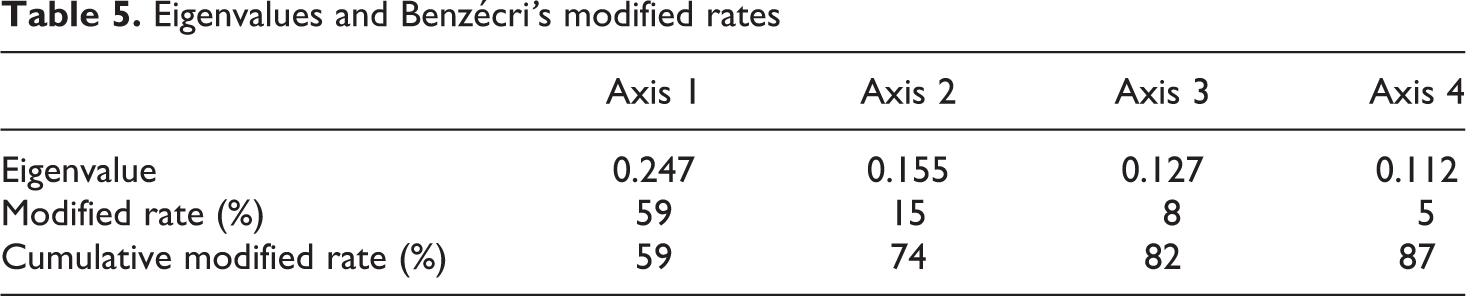
A two-dimensional space is retained for the analysis, given that the 1-3 plane displays a horseshoe-shaped cloud and connotes a Guttmann effect (Hjellbrekke, 2018: 96-97). Logically, the first dimension is dominant with a modified Benzécri rate of 59% while the second one amounts to 15%. Thus, the two dimensions combined amount to 74%. (see Table 5)
Eigenvalues and Benzécri’s modified rates
The structure of the origins of the Norwegian upper class is analysed in depth in Toft (2019) and may be summarized as follows: The first, horizontal, dimension connotes an opposition along the volume of capital in one’s origins. With a modified rate of 59%, this is the most powerful differentiation of the space. Along the left-hand side of the space, we find individuals who typically have parents with persistently low income and wealth trajectories and who lack educational credentials beyond compulsory schooling. The right-hand side features an inverse characterization with individuals tending to have parents with high volume of economic, cultural and social capital. The second, vertical, dimension may be interpreted as an opposition along the composition of capital. It differentiates individuals who hail from families typically relying on economic capital from those more characterized by cultural capital. In the upper regions of the space, we observe a tendency of having parents with favourable wealth and income trajectories, who hold business credentials and work within finance and banking or distributive trades, as well as a tendency for having economic upper-class siblings and having resided in very affluent neighbourhoods over time. While also the tendency of having non-educated fathers feature the left lower quadrant of the space, the lower segments clearly connotes the tendency of having highly educated parents who are engaged in the elite professions or academia (industries of health, law, social science etc.).
A key finding in Toft (2019) was the relationship between the two-dimensional structure of the origin space and the placement of the destination class trajectories. Statistical relationships were detected along capital volume – the upwardly mobile ‘newcomers’ displayed a relative tendency of having biographically late arrival in the upper class (having work-life experiences in the lower regions of the class structure), or short-term affiliations with discontinuous spells and unstable careers. The analysis also showed that the likelihood of having stable careers in the different class fractions were patterned along capital composition. Individuals hailing from families rich in cultural capital tended to be more likely to have stable affiliations in the balanced or the cultural fraction, whereas stable affiliation to the economic fraction was associated with origins from the economic domain. Drawing on Goldthorpian terminology, I suggested the cementation of class cores that are characterised by both a lifetime and a heredity affiliation. Contra Goldthorpe, I argued that the mobility patterns have clear capital-specific logics that differentiate the upper class in distinct fraction-specific upper-class cores.
Explanatory power and statistical validation
In Figure 3, I have projected the mean points of the destination class trajectories in stars and the mean points of the destination class snapshots in triangles (1 = cultural fraction, 2 = balanced fraction, 3 = economic fraction).
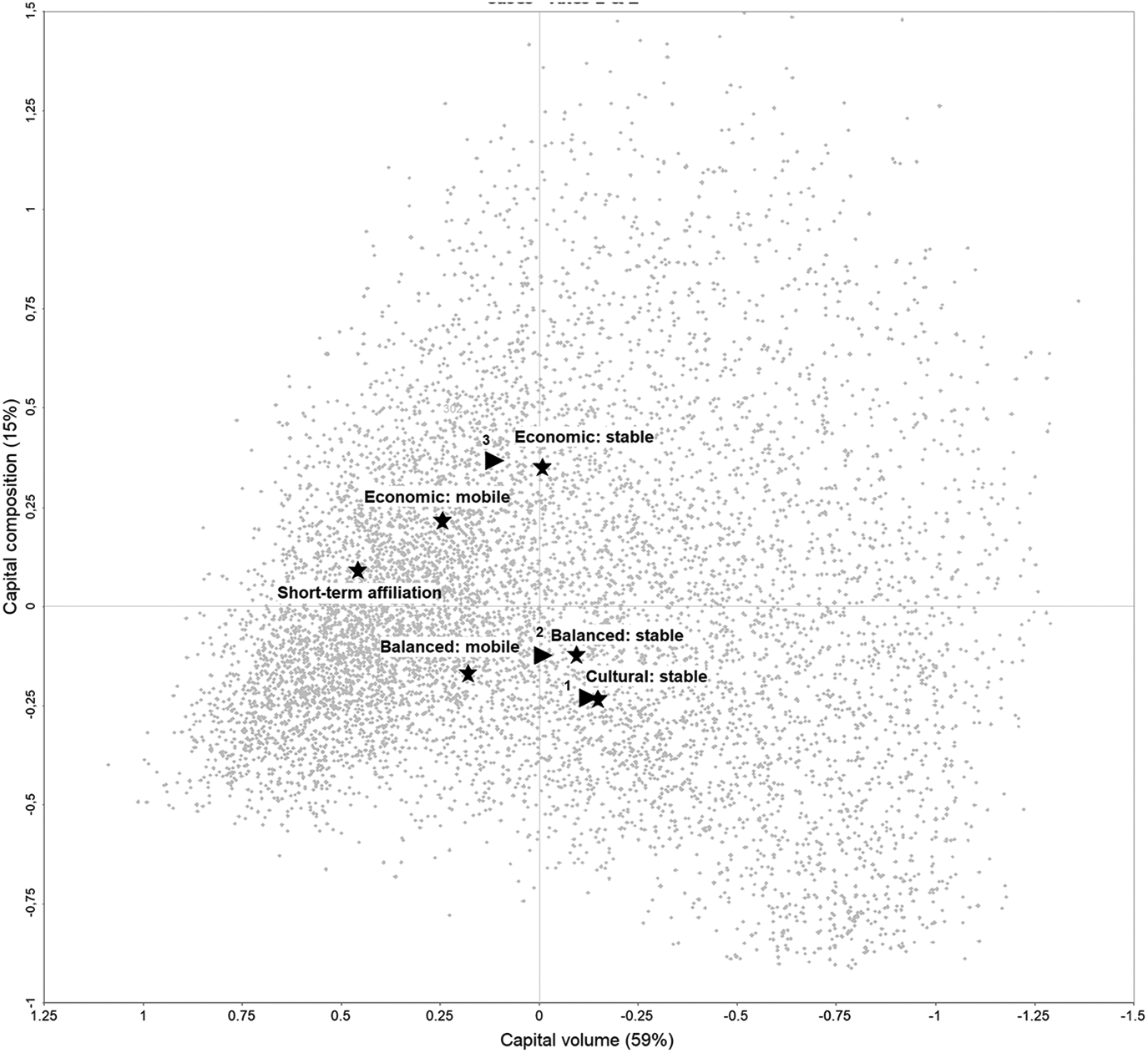
Cloud of individuals. Destination class sequence and destination class snapshot projected onto the origin space.
As seen, for the stable sequence modalities for the three fractions, the snapshot-operationalisation resembles the placement in the space of the sequence operationalisation. We see that the deviation between the snapshot points and the sequence points is slightly more pronounced for the economic fraction and very similar for the cultural fraction.
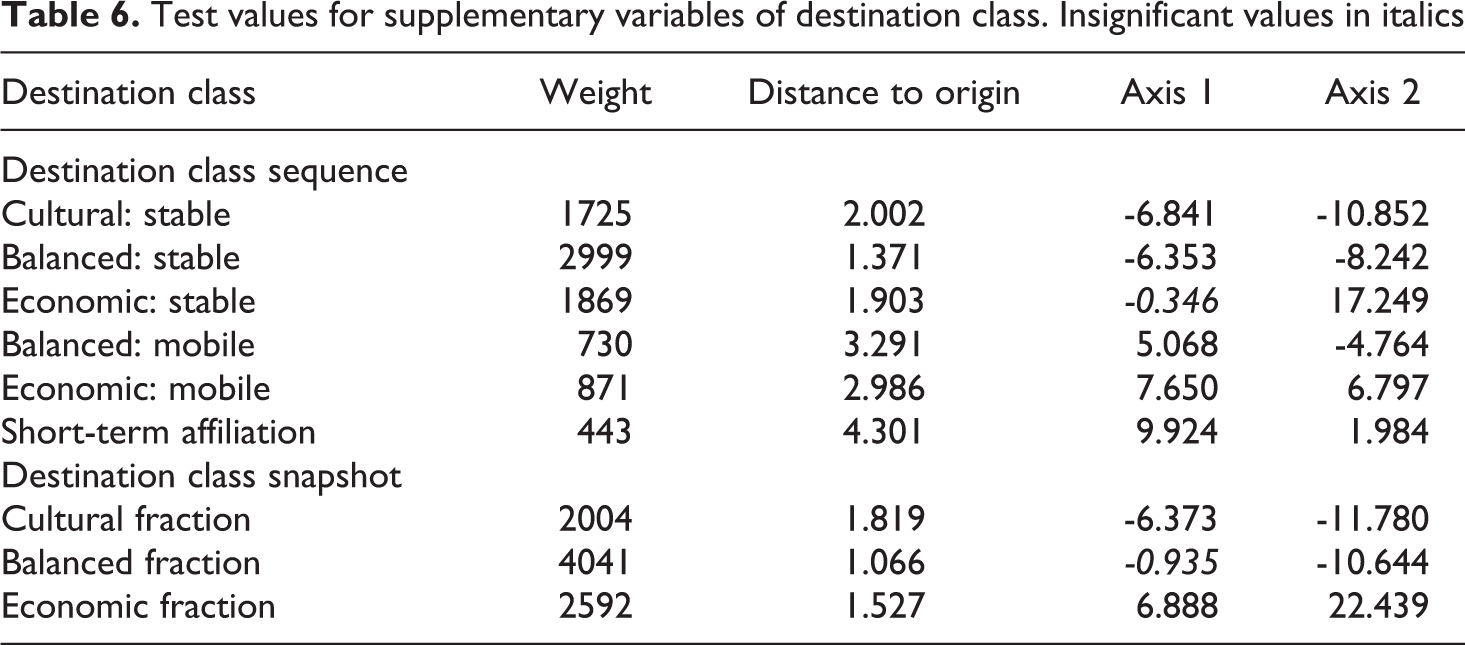
Table 6 provides information about the statistical properties of the placement of the mean points of both operationalisations along each axis. The test values indicate that the destination class modalities are mostly significantly structured in the origin space along both dimensions. We find that the destination sequence of short-term affiliation is only significantly structured by the divisions in origins along capital composition in a one-sided test, but significantly structured by the divisions in capital volume. We also see that the mobile trajectories are significantly structured in the origin space – indicating the tendency of not only being more likely to experience a mobile sequence when having less parental capital, but also that the type of capital in one’s origins is associated with the fraction one is pursuing such mobile trajectory within. The mean points of the destination snapshots are also significantly structured in the space, save for the placement of the balanced fraction along capital volume.
An interesting difference between these operationalisations is that the stable career in the economic fraction is not statistically patterned by capital volume when measuring intragenerational mobility, whereas the mere registration of economic upper-class affiliation in year 2003 suggests a relative tendency of economic-fraction affiliation and modest origins. This implies that the snapshot operationalisation of a destination class may fail to address the permeability of class boundaries and to overestimate the likelihood of upwards mobility into the economic upper class.
Test values for supplementary variables of destination class. Insignificant values in italics
Pairwise comparison of coordinates for supplementary variables of destination class. Notable distances in bold
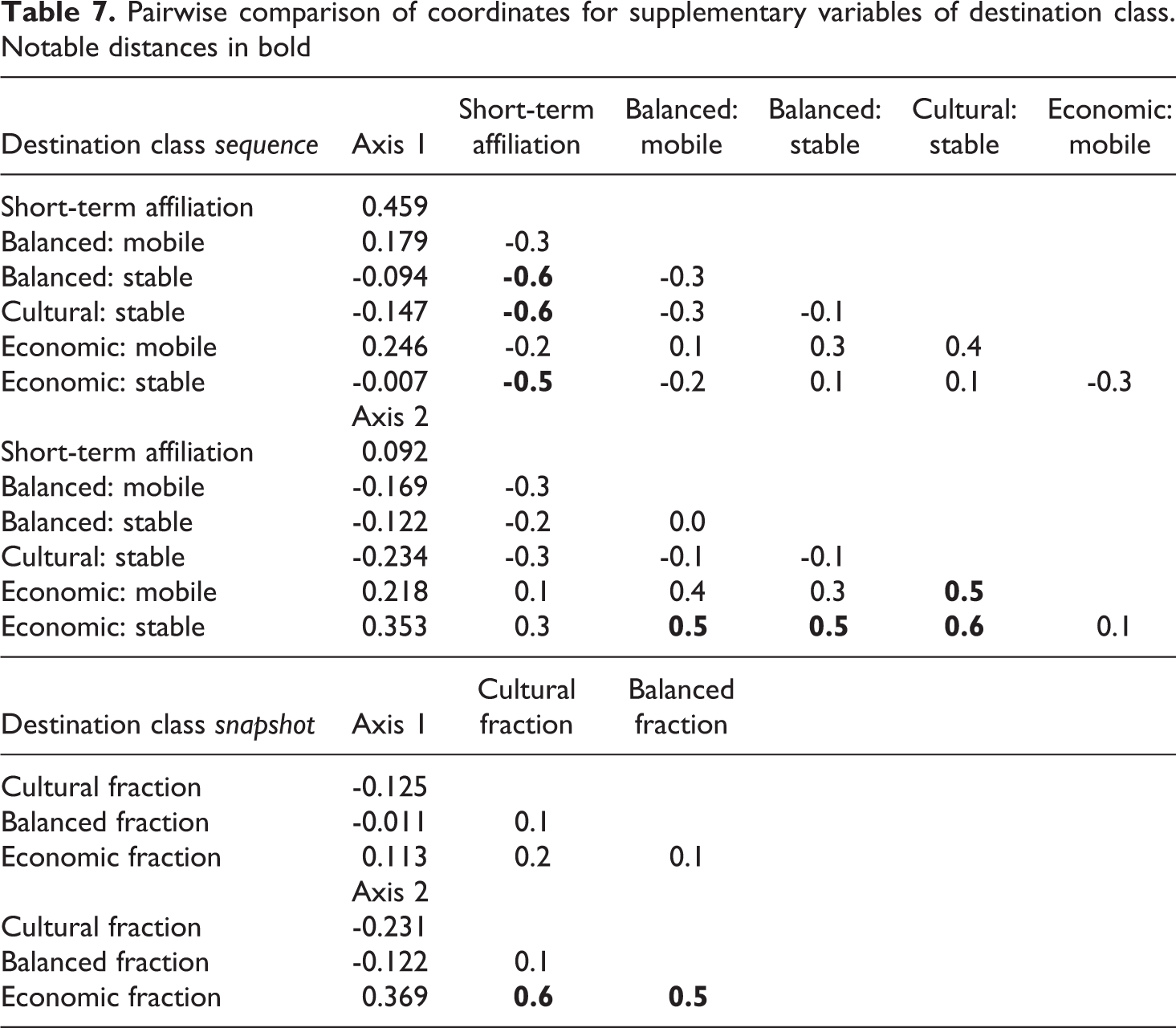
Although the placement of the mean point along each axis provides valuable information about the association of an origin space and destination class, the question of whether the points are sufficiently distant from each other arises. Table 7 accounts for the pair-wise distances in these relationships. As seen, the deviations in the space are not very large (none exceed 1), although notable distances are detected along both dimensions when destinations are operationalized as sequences. The level of capital volume in the origin space predicts notable distances in the tendency for short-term affiliations to the upper class versus stable affiliation in either of the three upper class fractions. In other words, capital volume in origins translates into differences in class affiliation durability. Crucially, this association between the most important division in origins (axis 1 holds a modified rate of 59%) and class destinations would be completely undetectable when failing to acknowledge intragenerational mobility. The tendency for fraction-specific reproduction, as evident along the second dimension, is equally discernible in the two procedures.
Post-hoc ANOVA tests, Bonferroni estimation
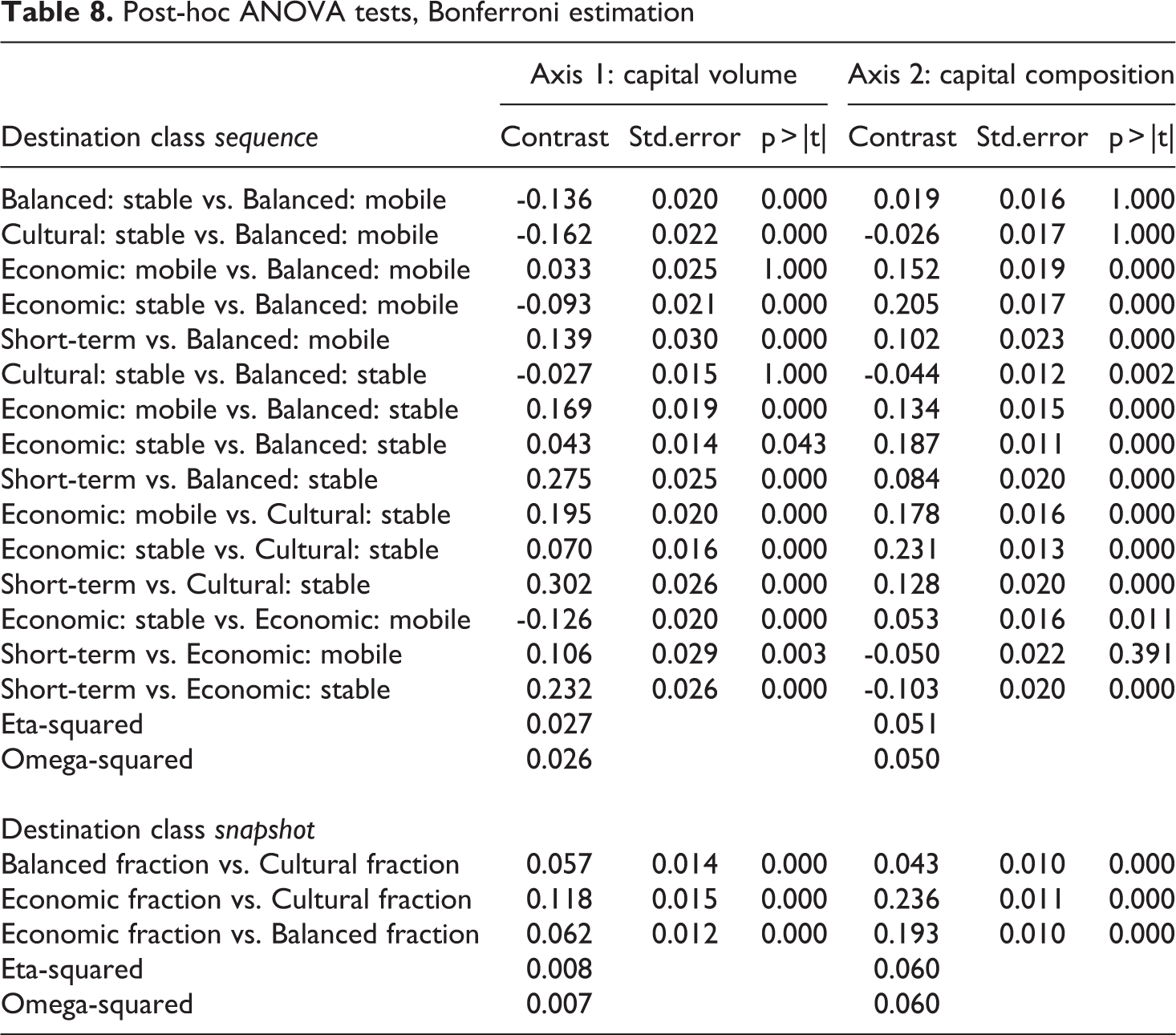
Table 8 tests group-wise comparisons of the mean points in the cloud of individuals, adjusted for the multitude of comparisons via Bonferroni’s estimation. These tests help corroborate that the pair-wise comparisons emphasised in the foregoing are statistically differently structured in the space. The table also demonstrates that while there is a statistical association between both destination class snapshots and destination class sequences and the origin space, divisions in destinations do not yield strong explanatory power in the dispersal of the cloud. As indicated by the eta-squared and the omega-squared values, analysing sequences is not more efficient when understanding the relationship between class destinations and an origin space along the dimension of capital composition. This is particularly interesting considering that the two options rely on different number of groups.
Along the dimension of capital volume, destination class sequences have more explanatory power in accounting for the dispersal of origins. These statistics also add to underline that the relationship between class origins and class destinations is not mechanistic; while significant relationships are detectable and yield sociologically meaningful results, the ‘explained variance’ is arguably quite limited – particularly along the capital volume dimension.
The degree of dispersal surrounding each mean point adds to corroborate this. In Figure 4, concentration ellipses are provided for the three stable career sequences, as well as for the short-term affiliation trajectory.
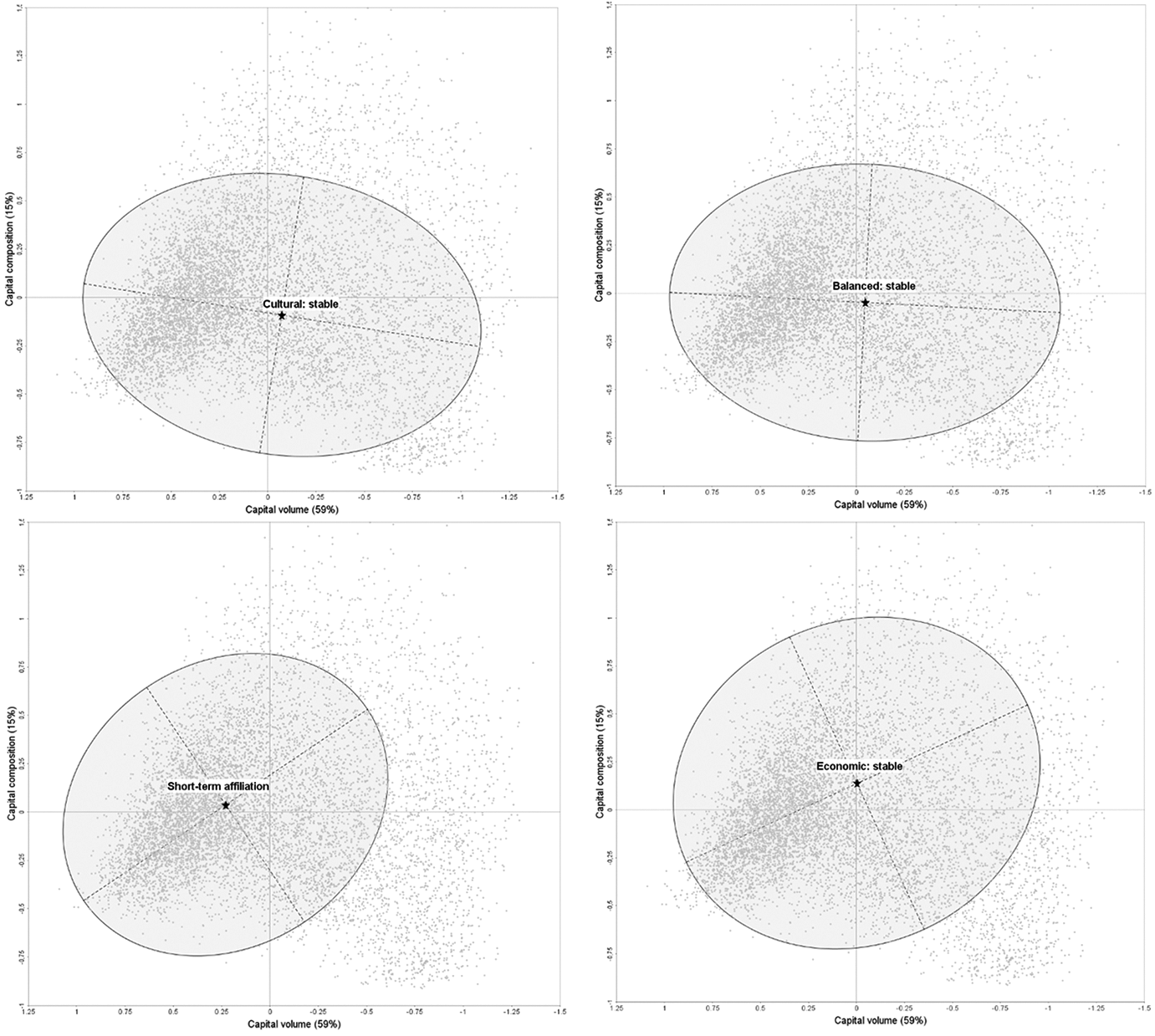
Cloud of individuals. Concentration ellipses for the stable and short-term trajectories.
The shapes and the angles of the ellipses differ between the stable trajectories in the balanced fraction and the cultural fraction, on the one hand, and the short-term trajectory and the economically stable on the other. This is corroborated by the eccentricity coefficients reported in Table 9. These coefficients indicate how much each ellipse deviates from a perfect circle. It ranges from 0-1 where 0 equals a perfect circle in the plane (i.e. equally ‘pulled’ by each dimension) (Hjellbrekke, 2018: 70-73).
Eccentricity coefficients for concentration ellipses
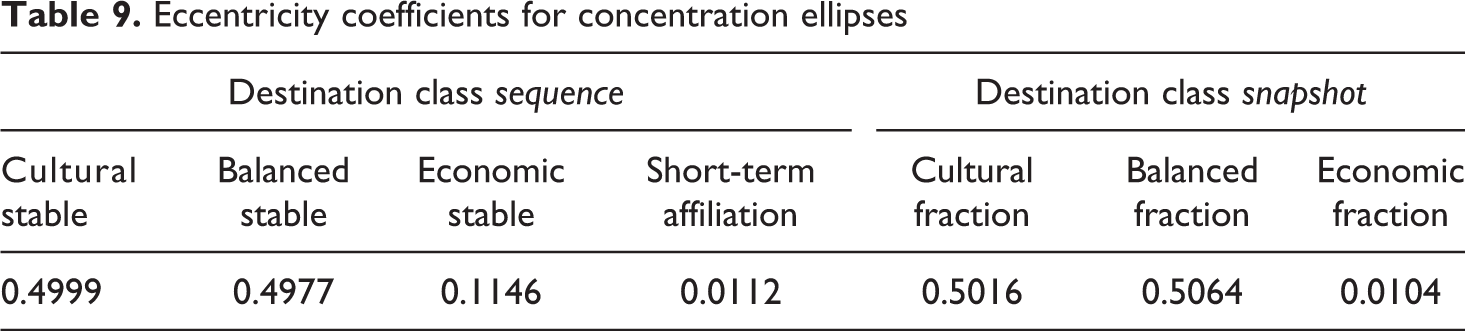
These statistics show that the cultural and the balanced fraction are more drawn along one dimension (primarily structured by the capital volume dimension) while the short-term affiliation sequence and the stable careers in the economic fraction are more structured by the dispersal in the forms of capital in the origin space. Comparing the coefficients retrieved from the snapshot approach, we observe again that the point-in-time option fails to appreciate the internal variation among those who become affiliated to the economic fraction of the dominant class.
Discussion and conclusion
At the crux of relational sociology lies the philosophical assumption that the social world is made up of relations and that analyses of such relationships require not only accounting for the topological pattering of relations, but also the unfolding of events in time. In this paper, I have suggested that the joint application of MCA and SA serves beneficially to this end, as each tool seems to tackle important caveats with the other. Inserting sequence typologies as (active and/or supplementary) modalities in MCA allows for more processual dynamism when studying structural oppositions. Situating typologies derived from SA within a space of oppositions brings attention to how the unfolding of careers is embedded in societal structures of constraint. 15
Taking the relationalism in Bourdieu’s oeuvre as a point of departure, I have argued that the study of class formation requires methodological designs that take seriously both sequencing as well as relational oppositions. The chief aim of the design is to approach class destinations as a sequence of events and to link different pathways in the adult career to divisions in class origins. The MCA of an ‘origin space’ allows for an understanding of ‘social determinants in closely related bundles,’ to paraphrase Abbott (2001), rather than one singular variable. In turn, situating the sequence typology in the origin space helps in understanding how various adult careers are linked to different forms and amounts of capital made available through kinship ties. This adds to circumvent the ‘biographical illusion’ of being blindsided by the idiosyncratic features of any career (Bourdieu, 2000a). Embedding career types in an origin space helps flesh out (some of) the structuring factors that lie behind class reproduction. It is when linked to the constraining or enabling capacities in different environments of upbringing we are offered the opportunity to give more satisfactory accounts of how careers become lubricated by intergenerational transmission of privilege. Finally, and perhaps most importantly, the sequencing procedure enables a strategy for taking seriously the temporal underpinnings to habitus formation as a chronologically structured phenomenon.
Substantively, this procedure unveiled that there are important divisions in origins that are linked to both a capacity to retain dominant positions in adulthood, as well as what species of privilege one enjoys. The upwardly mobile newcomers are statistically more likely to have brief and discontinuous affiliation to the upper class, while the ‘inheritors’ are internally divided along the fractions of economic and cultural capital (Toft, 2019). Statistically, I have assessed the added value of accounting for time ‘holistically’ via SA (a ten-year sequence typology) in comparison to the ‘Goldthorpian strategy’ by accounting for temporal variation in class destinations via the notion of ‘occupational maturity’ (one-point-measure in the first year).
The fraction-specific reproduction of the upper class – following the second dimension in the origin space – is equally detectable when approaching class destination as snapshot as when class destinations are conceptualized as a sequence. However, the temporal differentiation by parental volume of capital in the likelihood of retaining upper-class affiliations over time is completely concealed when discarding of the sequences these first-year observations are embedded in. Given that capital volume is by far the most important division in the origins of upper-class individuals, neglecting this differentiation seems worrisome for understanding Norwegian structures of power. Merely registering point-in-time access in adulthood may as such overestimate the degree of ‘societal openness’ that feature the class structure. In particular, the comparison of destination snapshots and destination sequences suggested that the economic fraction of the upper class may seem especially wrongfully ‘accessible’ when relying on point-in-time measurements.
Notwithstanding the sociologically meaningful patterns detected, it should be kept in mind that only relatively modest associations are discernible. The pair-wise distances between the supplementary points are never large, the effect sizes are small or modest, and there is substantial overlap in the concentration ellipses of the supplementary points. However, this specific example might seem a particularly restrictive ‘litmus test’ for the possibilities offered by a combined design of MCA and SA for a number of reasons; the population under study are all affiliated to the upper class at a mature age, making them a selective five percent of the adult population. This adds to limit the variation observed in class origins. In addition, the career sequences observed are at a window well-beyond any notion of occupational maturity in the conventional literature, thus limiting the variation in class destinations. In addition, the ten-year period is also likely to interfere, and it would be beneficial if the whole work-life career was subjected to a ‘holistic’ sequencing procedure.
Thus, the statistical power gained through the linkage of SA and MCA might be larger in alternative analyses with (even) more detailed data. The chief focus of this paper has been the sociologically meaningfulness of embedding SA in MCA, but it also relies on SA modalities in the MCA in the form of sequences of parental capital. Arguably, here lies further potential for not only situating sequences in a relational structure, but also building in dynamism in the active construction of geometric spaces (see e.g. Carlhed, 2017). 16 Crucially, the methods we apply should ‘think’ in accordance with our philosophical assumptions about the social world. Possibly, the combination of SA and MCA helps us getting one step closer to ‘quantifying’ the social world relationally.
Footnotes
Acknowledgements
I am grateful to Frédéric Lebaron, Johs. Hjellbrekke, Thierry Rossier, two anonymous reviewers and the editors of Bulletin de Méthodologie Sociologique for helpful comments and criticism on earlier drafts. Special thanks to Jacob Lunding for generously providing an R script for retrieving the eccentricity coefficients. Thanks to Statistics Norway (SSB) for providing the administrative registry data.
Declaration of Conflicting Interests
The author declared no potential conflicts of interest with respect to the research, authorship, and/or publication of this article.
Funding
The author(s) disclosed receipt of the following financial support for the research, authorship, and/or publication of this article: the author received a scholarship from The Science Studies Colloquium Series at the University of Oslo that aided her in this work.