



Abstract
This article reports on an investigation into the channels through which intellectuals have gained public recognition since the 1970s (quality press, intellectual journals, think tanks, conference venues, cultural radio and TV programs, publishing houses, etc.). Through the prism of field theory, we explored a space – that of the visibility of ideas – situated at the crossroads of several institutionally established fields (academic, intellectual, media, political, and economic). While the number of studies devoted to this type of interstitial space has multiplied since the 2000s, the focus has mainly been on their heteronomy through comparisons with autonomous fields. This approach tends to lose sight of the fact that they could neither emerge nor endure in the absence of stability. Based on the notion of the space of visibility of ideas, the present paper attempts to show that it is possible to apprehend the stability of these labile spaces by adopting an ethnographic approach, conducive to the articulation of micro/meso/macro levels and the mixing of methods. In so doing, we put forward the idea that interstitial spaces can ultimately be analyzed in terms of perimeters and capital, in other words, as fields.
Introduction
In the sense that they occupy a position at the crossroads of previously consolidated social fields, interstitial spaces (IS) are now familiar objects in the social sciences. Although they first came to light in the late 1980s (Memmi, 1989), it was not until the late 1990s that studies began to turn them into a sui generis category whose general properties needed to be determined (Topalov, 1999). Fields in which IS have been identified include: medical ethics (Memmi, 1989), urban policies (Topalov, 1999; Tissot, 2007; Payre, 2007; Ho-Pun-Cheung, 2021), social problems such as drug addiction (Mauger, 2001) and school failure (Morel, 2014), international expertise (Eyal, 2002, 2006; Dezalay, 2008; Stampnitzky, 2013a; Soussoko, 2022), European law and policy (Vauchez, 2008, 2011; Vauchez & Mudge, 2012; Lebrou, 2015), think tanks (Medvetz, 2012; Lepont, 2017), social work (Mauger, 2012; Rodriguez Blanco, 2023), social and cultural activities (Mauger, 2015), interdisciplinary sciences (Panofsky, 2011, 2014), government communication (Hubé, 2020), and diplomatic relations (Ferré, 2021). Pierre Bourdieu defined fields as spaces that, through processes of institutionalization, have grown autonomous around a specific interest (Bourdieu, 1971). Most research constructs an approach to IS from a more or less explicit comparison with this principle of field autonomy, centered on their heteronomy. In discussing academic output devoted to expertise, Lisa Stampnitzky neatly sums up this approach and its main findings (Stampnitzky, 2013b). First, we are dealing with spaces where the establishment of a new legitimacy is played out in close relations with the state and/or transnational governance frameworks. Second, what distinguishes these spaces is the porosity of their borders and the floating nature of their capital. Finally, their social strength lies in the hybridization of orders associated with different fields, enabling individuals and institutions to take advantage of strategies based on vagueness and intermediality.
This article is part of the themed “Micro-macro. methodological issues of multi-level analyses” section, coordinated by Claire Dupuy and Camille Hamidi, based on a panel which they organized on the topic at the 2019 conference of the French national political science associational and the discussion group that followed.
As far as theoretical knowledge of IS is concerned, only a few researchers have attempted to go beyond a simple comparison with the field. Among them is Gil Eyal. Informed by the IS of Middle Eastern expertise in Israel and autism therapies on which he worked, the author put forward the idea that the spaces between fields need to be analyzed by adding the notion of the actor-network developed by Bruno Latour (Eyal, 2012) to that of field. Despite its innovative and undoubtedly heuristic character, this proposal is nonetheless somewhat perplexing insofar as it is based on a relatively reductive conception of the field. By turning it into a more or less hermetic space of producers for producers, and ignoring the chain of notions that operationalize it (trajectories, positions, dispositions, etc.), the field appears far too rigid when it comes to apprehending a somewhat puzzling agency at the intersection of fields. This rigidity calls for the use of a more flexible approach, such as that of the actor-network, which consists of tracing the interactions and associations actors engage in with humans and non-humans in order to build efficient networks (Callon, 1986; Latour, 1988, 1989). Leaving aside the fact that the argument only focuses on the legal and, incidentally, incomplete dimension of the field, it remains to be seen how it can reconcile two such divergent agendas in practice. Admittedly, the American sociologist points to individual finalism at the heart of the actor-network, but he gives no indication as to how this postulate can be integrated into a system such as the field, which opposes it in every respect by inscribing action in a dialectical relationship between practical rationales and social structures (Bourdieu, 1980a).
Stanislas Morel put forward another theoretical reflection on IS. Supported by an investigation into the space of professions engaged in dealing with school failure, he attempts to show that to apprehend IS formed by professional competition around a social problem, the field needs to be combined with Abbott’s ecologies (Morel, 2016). His argument is based on a division of theoretical labor into which the issues of autonomy and heteronomy fall, alongside those of ecologies. Indeed, while the field is used to analyze the competition with regard to the accumulation of specific professional capital, ecologies are harnessed to apprehend the growing external demands facing the professions. In other words, in this division, while ecologies allow jurisdictional confrontations to be grasped between and within professions, the field only sheds light on conflicts internal to the latter and driven solely by their autonomy. Here again, the proposal seems innovative, but neglects certain aspects which are far from trivial. First of all, like Eyal, Morel fails to explain why we should abandon the tools of field theory (trajectories, positions, and dispositions) when we are no longer at the center but are instead at the periphery of fields or their intersections. If only in terms of empirical data production, it is hard to believe that their application in these areas would no longer be relevant. Another problem is that the question of the epistemological compatibility of the concepts of field and ecology is more or less ignored. Inscribed in an interactionist perspective that undermines the existence of an objective reality (Abbott and CoFSS, 2015), ecologies only tend to consider the heteronomous dynamics of more or less instituted entities (Abbott, 2003) and, by the same token, to neglect forms of socialization of which they are not the direct source. In this respect, it is hard to see how such a framework can coexist with the principles of field construction, for example, in terms of going beyond interactions, perimeters, and official categories to reconstruct the objective relations that apply to individuals and institutions, or to identify the impact of the dispositions brought into play by the protagonists of the space concerned through their socializing experiences.
So far, the literature has tended to characterize interstitial spaces negatively, insisting that they do not meet the structuring principles of a field. Moreover, while a few contributions to the study of IS assert that other approaches are better suited to capturing their heteronomy and completing the field, the combinations put forward are unconvincing in terms of theory. Whether based on comparison or hybridization, these different perspectives have one thing in common: they only consider IS from the perspective of their instability. In our view, this raises a structural question. How can we explain the fact that spaces are formed and then maintained over time without granting them a minimal degree of stability in terms of perimeters and capital? In this article, we want to turn the prism of IS instability on its head by considering their stability and the way in which boundaries and capital can be reconstructed. This is because examination of the structuring principles of heteronomous spaces comes up against a major methodological obstacle insofar as heteronomy, translated into systemic lability, complicates the conduct of all objectification operations, starting with the choice of institutions, populations, and periodization. Our paper attempts to show that this problem can be circumvented by articulating the micro (individuals), meso (institutions), and macro (fields) levels, and combining qualitative and quantitative methods in an ethnographic study of a field. This helped us to validate a theoretical proposition, namely, that despite their specificities, IS are indeed fields.
To this end, we drew on the case of a specific IS, that of the visibility of ideas, which was investigated in the course of a PhD thesis (Attencourt, 2021). The space draws its sources from the new circuits of cultural celebration (quality press, radio and television broadcasts, intellectual journals, think tanks, cultural institutions, speakers’ agencies, publishing houses, etc.) that have developed in France since the 1970s at the intersection of the academic, intellectual, media, political, and economic fields, combining scholarly legitimacy and an extended public. By the end of the 1980s, their gradual interweaving had made them venues where ideas and their messengers were publicly rated. Faced with an IS whose ramifications seemed interminable, we battled for some time with the issue of where to start. It was at this point that the circuit of scholarly conferences aimed at the general public appeared to us to be an ideal terrain to investigate the visibility of ideas. Not only did conferences offer largely accessible cultural event venues, they also evinced a certain centrality, involving several sectors such as the media, senior administration, and academia. Once embarked on, immersion in this field continually fostered empirical modes of investigation that were clearly in tune with the objectification of our IS in terms of its perimeters and capital. On the one hand, by lending itself to the technique of “tracking”, first used by ethnomethodology in the 1960s 1 and revisited since the 1980s by an anthropology of globalization 2 , the conference circuit allowed us to follow the dynamics of our IS as closely as possible, and to compensate for its disorienting effects. On the other hand, we were able to take advantage of its strong institutional underpinning, and the fact that all the stakeholders in the visibility of ideas chain (producers, intermediaries, audiences) interacted with it, deploying the full range of abstraction operators (serialization, temporal registration, and consideration of contexts) that ensure the passage between the micro, meso, and macro levels (Grossetti, 2006). The aim of this article is thus to demonstrate the contribution of these tracking and multi-level investigative modalities in an analysis of the perimeters and capital of the IS of idea visibility. In the first section, we look at how they enabled us to empirically delineate the institutions and the group of intellectuals that make up this space. In the second section, we attempt to set out their decisive contribution to reconciling geometric data and network analyses in order to identify the predominant role of social capital within our IS.
A study of the IS of the visibility of ideas and its main findings
The thesis we defended at EHESS in January 2021 investigated the social conditions through which contemporary intellectuals become well-known public figures in France. In developing this research object, we began to investigate the cultural celebrity circuits (press, radio and television broadcasts, intellectual journals, think tanks, cultural institutions, speakers’ agencies, publishing houses, etc.) that emerged at the crossroads of academic, intellectual, media, political, and economic fields at the end of the 1970s. By the mid-1980s, these circuits, which linked literate scholarly culture with mass dissemination strategies, had consolidated on the basis of the circular nature inherent in the media economy, to the point of delineating the space of the public value of ideas and their messengers. Our approach to this interstitial space (IS) enabled us to obtain findings on its institutions, producers, and reception.
First of all, the sociogenesis of the interstitial space in the visibility of ideas since the 1970s revealed the influence of conservative political/cultural networks (the “new philosophers”, the magazine Le Débat, the Fondation Saint-Simon, and the Editions Odile Jacob) in its rise to prominence on the intellectual scene. It also underscored the fact that, thanks to a policy of cultural decompartmentalization launched in the early 1980s, and to assets conducive to cultural marketing (events and by-products), the circuit of scholarly conferences for a cultivated general public has become a market in which most institutional players in the visibility of ideas invest. In parallel, the ethnographies conducted in several conference venues (Beaubourg, the Collège international de philosophie and the Université de tous les savoirs) show that institutions promoting the visibility of ideas are linked to the universes of power, and they play a key role in blurring the boundaries between autonomous and heteronomous intellectual production.
Secondly, an examination of the social trajectories of the group of visible intellectuals brought to light the formation of a new elite social group. While visible intellectuals share the social norms of the ruling elite (low feminization, upper social background, Parisian residence, etc.), they differ in that their educational and academic capital places them at the top of the cultural hierarchy. Omnipresent in the dissemination of ideas (media, conferences, social networks), they have also carved out a place for themselves at the highest levels of political and economic decision-making. In terms of its structuring principles, the career space of visibility bears witness to the ascendancy of relational capital and the economic rewards of notoriety over purely scholarly jurisdictions.
Finally, we studied the reception of visible intellectuals’ output. From this perspective, there is every reason to believe that their anti-academic form of accomplishment meets the expectations of those on the fringes of a cultivated general public who, due to social trajectories marked by educational and professional mismatches, have a tendency to over-invest in free culture, rejecting academia and its established hierarchies.
From localized studies to the perimeters of interstitial space
While the Parisian venues of widely circulated scholarly conferences placed us at the heart of the IS of the visibility of ideas, it remained to be seen how this investigative area would help us to understand its limits. In this respect, the investigative technique of tracking proved particularly effective in tracing the institutional channels of our IS, and then reconstructing the population of intellectuals who use them. As we said in the introduction, our conception of tracking predicates a dual contribution. The first contribution comes from representatives of the ethnomethodology movement who, in the 1960s, set out to track individuals in order to gain insights into the common factors underpinning their ways of being in different scenes of daily life (Zimmerman, 1969). The second contribution can be attributed to a series of studies on the anthropology of globalization since the 1990s that involve a detailed observation of human and material movements on a global scale in order to reconstruct their spatial dynamics (Marcus, 1995). We thus sought to place our tracking at the intersection of these two contributions, on the one hand, by adopting the principle developed by ethnomethodologists to track through survey situations and, on the other, by sharing anthropologists’ interest in the analysis of flows and the networks they create. In concrete terms, this tracking approach gave rise to a dual approach to the conferences: we went wherever the clues collected in situ led us (conference topics, speakers, recommendations, etc.), and we took into account anything that could help us to understand the visibility of ideas in terms of circulation.
Tracking institutions
Our choice of field was underpinned by the challenge to untangle the web of the visibility of ideas from the threads offered by one of its parts, namely, the conference circuit. Almost immediately we realized that by drawing together the academic, intellectual, media, political, and economic fields involved in our IS, the circuit condensed pretty much all the components of its interstitial nature. In fact, the terrain appeared to have every chance of giving us access to the institutional fabric of the visibility of ideas. All that remained was to take full advantage of it, and by expanding on two parallel tracking sequences, we succeeded in doing so.
The first sequence involved letting ourselves be guided by all that the field could offer when we attended the conferences. In this respect, the collection of documents made available to the public gave us a precious source of information, with data on the programming of the venue we were investigating, as well as that of previously unknown venues that were affiliated to the same cultural offer. The conference programs allowed us to identify the topics addressed, the names of the speakers and, through their repetition (usually within the space of a few months), to measure the circular messaging of information in a circuit driven by the quest for an audience (Bourdieu, 1996). The discussions we captured on the fly with conference organizers and audiences about past and upcoming events gave us another source of data. In addition, certain faces became familiar in the audience, as we recognized them from conference to conference, giving us the confidence that we were on the right track. 3 On more than one occasion, we also wandered off at a tangent, since leaving the beaten track is a good way to find where perimeters intersect. A case in point is the episode in which, following the recommendations of an interviewee we met at a Beaubourg conference, we found ourselves at the Théâtre Rond-Point in Paris, watching a journalist interview an actor in an intimate setting 4 . At the end of this event, we knew that we had reached a new level in terms of public awareness which, as a worldly variant of literary culture, was certainly close to the visibility of ideas, but a little outside its perimeter.
The investigations we began at the Collège international de Philosophie (thirty-six activities) and at Beaubourg (two conferences and two colloquia) were immediately extended to other venues such as the Université de tous les savoirs (twenty-two conferences), the Cité des Sciences et de l’Industrie (five conferences), the Bibliothèque Nationale de France (eleven conferences), Université Populaire du Quai Branly (one lecture), Église Réformée de l’Etoile (four lectures), Librairie Compagnie (one lecture), Unesco (two editions of World Philosophy Day), Rendez-vous de l’Imaginaire (three lectures), FNAC (a bookstore chain - two lectures), ENS-Ulm (Ecole normale supérieure, one of the most prestigious higher education establishments – one edition of the Night of Philosophy), Café des Phares (one debate), and Théâtre du Rond-Point (one meeting). After a year of tracking, an invariant became apparent in the way conference institutions sought to legitimize themselves. For the latter, it was important to situate their production between two repellent alternatives: on the one hand, the University, judged exclusive and sectarian for its legal adherence (diplomas, programs, exams, etc.), and on the other, an offer perceived as culturally unworthy and vulgar (so-called philosophical café, TV, an overly general public, etc.). Identifying this self-legitimization strategy gave us a glimpse of the force exerted by the fields of academia and large-scale cultural production on the conference circuit, but also, more broadly, on all the institutions of the visibility of ideas. We thus concluded that by polarizing the whole of our IS, these two fields actively participated in the construction of its perimeters.
In the second tracking phase, the aim was to reconstruct the political and economic networks surrounding the conferences. This involved first identifying the main funding bodies, most of which were cultural policy players (major public institutions, ministries, municipalities, etc.) that were also often involved in hosting conferences. Secondly, we looked at the transactions that conference institutions use by exploiting the register of events on the basis of their products. In analyzing the advertising resources used by the institutions (flyers, posters, websites, magazines, radio broadcasts, etc.), we were able to draw up a list of their partners. As illustrated (see document 1) by a flyer from the Université de tous les savoirs (Utls) announcing one of its conference programs for 2008, the institution’s main supporters included the State (Paris-Descartes University and Paris City Hall), major corporations (European Aeronautic Defence and Space company and Métrobus advertising agency), and leading media (Le Monde and Le Nouvel Observateur, the France Culture radio channel, and the Odile Jacob and Frémeaux & Associés publishing houses).
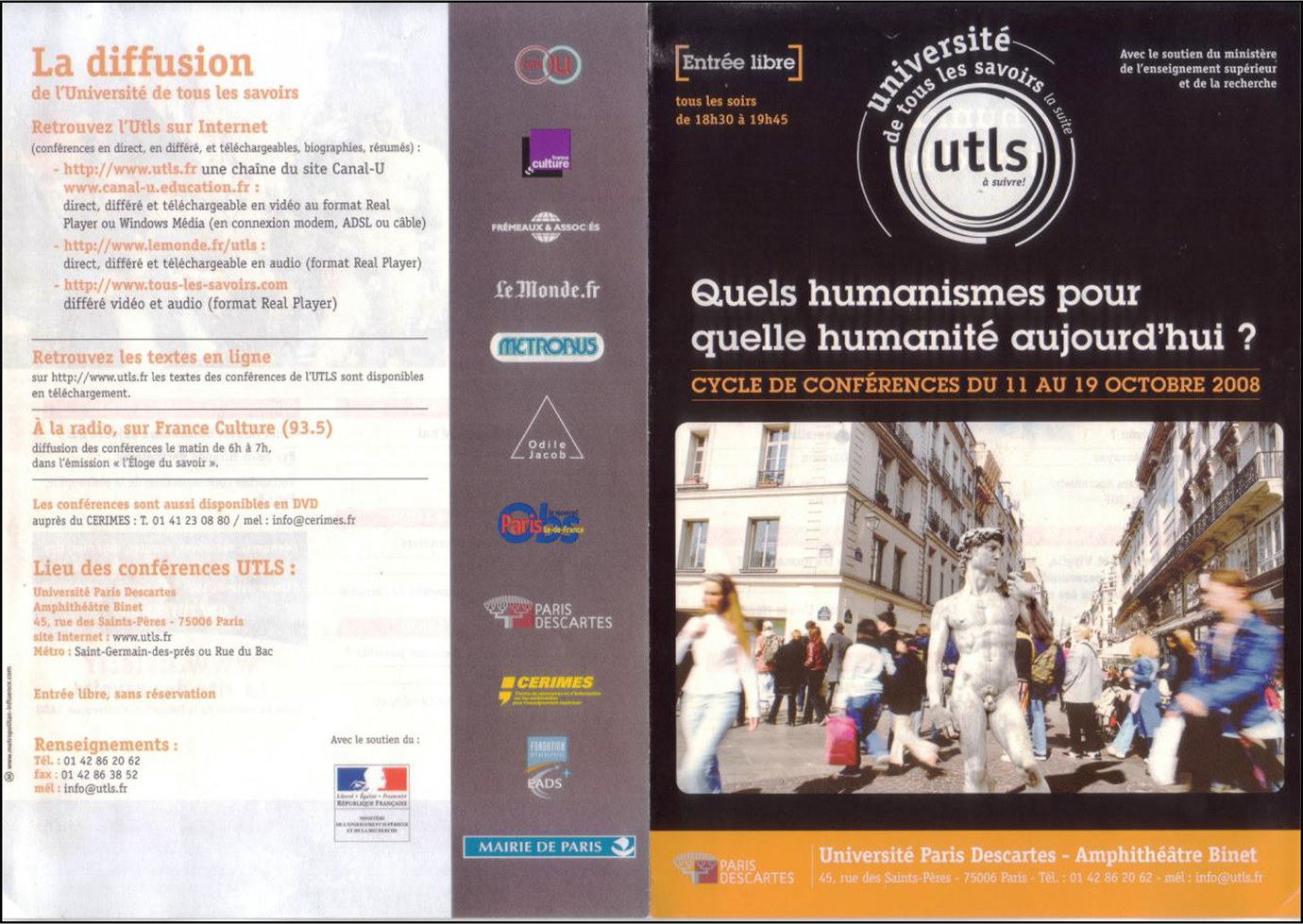
Flyer from the Université de tous les savoirs (2000-2013) for the lecture series “Quels humanismes pour quelle humanité aujourd’hui?” programmed from October 11 to 19, 2008.
Finally, by paying special attention to everything distinctive about the lecture attendees (way of being, remarks exchanged, clothes and objects worn), we gained access to the institutional provenance of their cultural consumption. The following observation of a seminar at the Collège International de Philosophie, an avant-garde philosophical institution located in the 5th arrondissement of Paris, is a perfect illustration. “When I arrived in one of the small amphitheaters (seating around 50) at the Ministry of Research a few dozen minutes before the seminar was due to begin, I immediately noticed from the confined and silent atmosphere that the listeners, no more than twenty at most, don’t know each other or, at best, only recognize each other. Seminar organizers Patrick Alac and Alexandra Richter seem rather nervous (in fact, they’re hosting philosopher and sinologist François Jullien, who’s returning to the Collège for the first time since his presidency). Seated at the entrance to the amphitheater, Alexandra Richter strikes up a conversation with a young listener, asking him in a very conventional tone what brings him to the seminar. We learn that he’s a PhD student from Paris 8. She pursues the discussion by asking him about his subject, but the questions she asks seem mainly intended to dispel the somewhat heavy atmosphere in the room. Meanwhile, the listeners exchange furtive glances as if to gauge one another. Likewise, every newcomer is the object of inquisitive glances from those already present. Many in the audience also take advantage of this moment to show signs of belonging to the serious game of intellectuality. On the tables, for example, are the Le Monde newspaper and the seminar organizers’ collective work on the German-language Romanian poet Paul Celan (“La bibliothèque de Paul Celan”). One listener flips through a book by Celan, then puts it down again several times (“Grille de parole”), while another has laid out in front of him his Collège program, covered with the labels the institution issues whenever activities take place on the premises of the Ministry of Research, attesting to his regular attendance”. Field notes, November 17, 2006. “Standing in the middle of the queue along the sidewalk leading to the bookshop, I carefully observe the people waiting with me. First of all, I notice a small group of Spanish-speaking students who’re delighted to be attending a lecture by an internationally renowned philosopher. Behind me, a woman in her fifties, wearing colorful, modern clothes, is immersed in a book by Jean-Louis Leonhardt entitled “Le Rationalisme est-il rationnel? A little further on, a fifty-something with long, shaggy hair, accompanied by his companion, tells a friend over the phone that they’re going to the Théâtre de la Colline to see Thomas Bernhard’s “Minetti”, then enthusiastically refers to the day’s “Libé” (Libération – French newspaper founded in 1973 by Jean-Paul Satre and Serge July), which he holds in his hand and in which the speaker of the day was the guest editor. The philosopher’s presence in Libé seems to have delighted him”. Field notes, January 27, 2009.
From tracking to population counting
With the IS of the visibility of ideas as the object of analysis, we had to find a way to identify the most representative population. We should make it clear from the outset that the representativeness we are talking about is not statistical in the sense of a sample constructed in relation to a parent population. In our case, it covers a set of informed choices designed to reflect the group of individuals most involved in terms of positions and stances within the IS under consideration. To define the perimeters of the group of visible intellectuals, we used the many signals of public renown, including being featured in Who’s who and/or the Bottin mondain, giving major lectures, signing press articles, taking part in TV and radio programs, or having a large number of subscribers on social networks. However, it was difficult to legitimize the samples we obtained from these different clues, taken either in isolation or in combination, which tended to result in partial groups of individuals without our being able to determine whether they cut across the core or the periphery of our population. This uncertainty about the quality of our sampling posed another problem as it meant we could not distinguish between samples needing to be rectified and those that could be used for rectification purposes.
The value of our sample ought to reside in the fact that we were following the group that best represented the population of visible intellectuals, and in this respect, conferences proved to be an entirely appropriate terrain for, as our investigation progressed, we found that few members of the group had not taken on the role of lecturer. Indeed, with such a widespread practice among visible intellectuals, we had every chance of obtaining a good sampling base by sifting through their frequentation of conference institutions. We were also supported in this approach by studies devoted to the professional identity of groups of artists in the 1980s (Moulin and Passeron, 1985) and the media’s treatment of contemporary celebrities by a weekly magazine in 2008 (Chenu), which had also used frequency-of-appearance calculations to construct their reference population. However, before counting the speakers, we had no choice but to restrict the confines of the institutions surveyed as their number exceeded the material means available to a research project conducted alone. By tracking the conferences, we identified around fifteen institutions that stood out from the rest by virtue of their centrality. Indeed, they appeared to be mandatory places of passage for intellectuals, had a large audience, and initiated most of the trendiest topics. Consequently, using this core of the most central institutions as a basis for our calculation enabled us to transfer their centrality to the sample of speakers and, consequently, to obtain the most representative ones, understood as those likely to have a high number of positions and pronouncements in our IS. By analyzing all the documents collected on site and/or via the website (presentation leaflets, programs, flyers, working documents, etc.) for eight institutions in this core group (i.e., Collège international de philosophie, Bibliothèque publique d’information, Centre Pompidou, Université de tous les savoirs, Cité des sciences et de l’industrie, Bibliothèque nationale de France, Université populaire du Quai Branly and Église réformée de l’Étoile), we recorded the number of speakers and their positions between the early 1990s and the mid-2000s (see Table 1 and Table 2). In line with the recruitment practices of this panel of institutions, each of them thus gave rise to an organized list of speakers according to the number of times they had spoken and held office.
Extract from the distribution of interventions at the Collège international de philosophie (1995-2008)
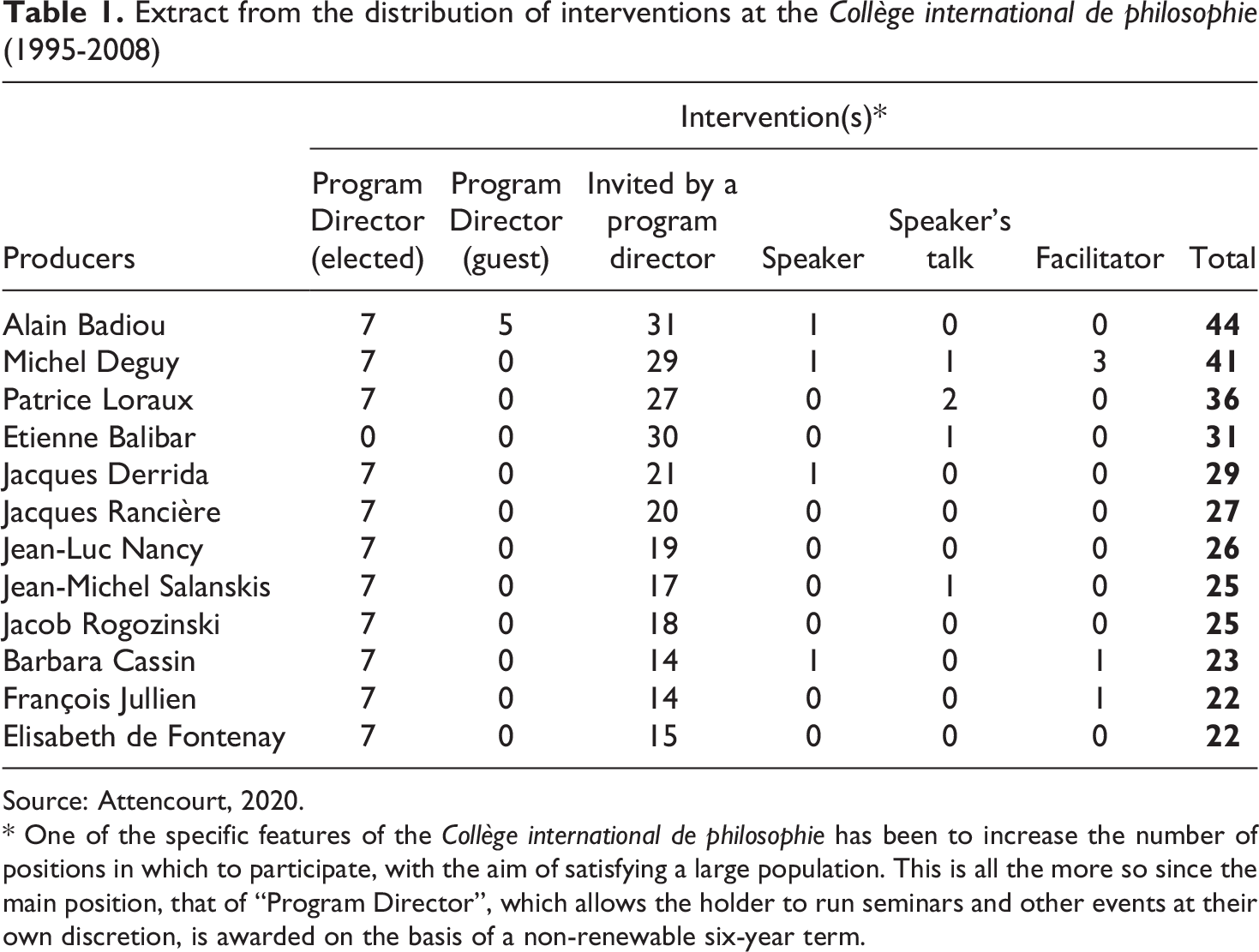
Source: Attencourt, 2020.
* One of the specific features of the Collège international de philosophie has been to increase the number of positions in which to participate, with the aim of satisfying a large population. This is all the more so since the main position, that of “Program Director”, which allows the holder to run seminars and other events at their own discretion, is awarded on the basis of a non-renewable six-year term.
Extract from the distribution of positions at the Collège international de philosophie (1995-2008)
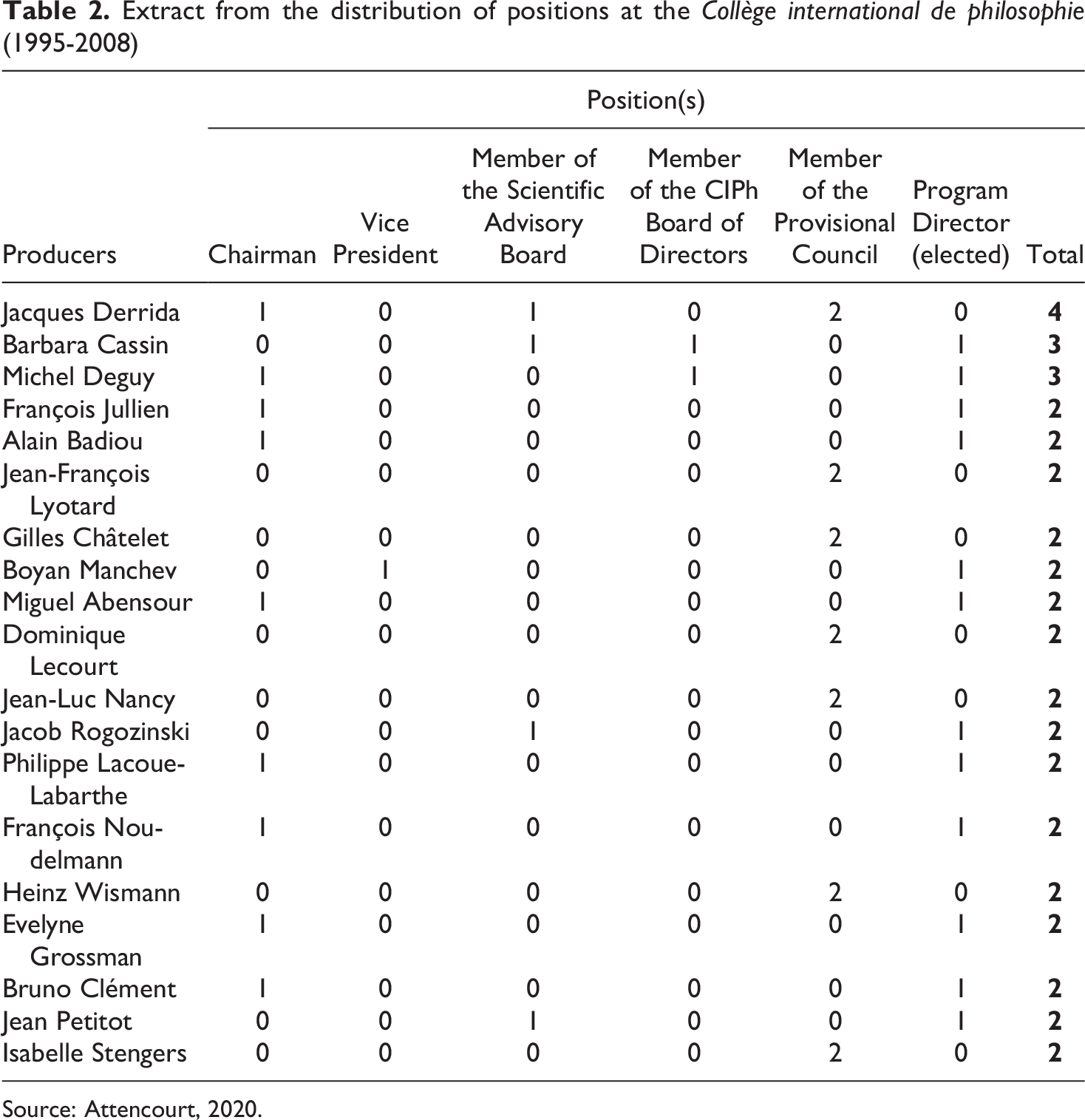
Source: Attencourt, 2020.
It was, of course, possible to aggregate these different distributions according to the overall volume of interventions and posts accumulated by each speaker. However, by opting for this type of aggregation, we introduced a bias. While the presence of speakers was measured in terms of intensity, it gave no indication of their ability to circulate. In our calculations, this meant that, for any given individual, four lectures at a single institution were worth as much as one lecture at four institutions. In order to take the differentiated levels of circulation among speakers into account, we devised two indicators – the number of interventions and the number of positions –, based respectively on multiplying the number of interventions and posts by the number of distinct institutions attended. The sum of the scores obtained on the basis of these two indicators for the eight institutions considered between 1990 and 2000 ultimately resulted in lists ranking speakers according to the value of their breadth of interventions and positions (see Table 3 and Table 4).
Extract of the distribution of interventions among intellectuals (1995-2008) for a panel of conference venues (N=8)
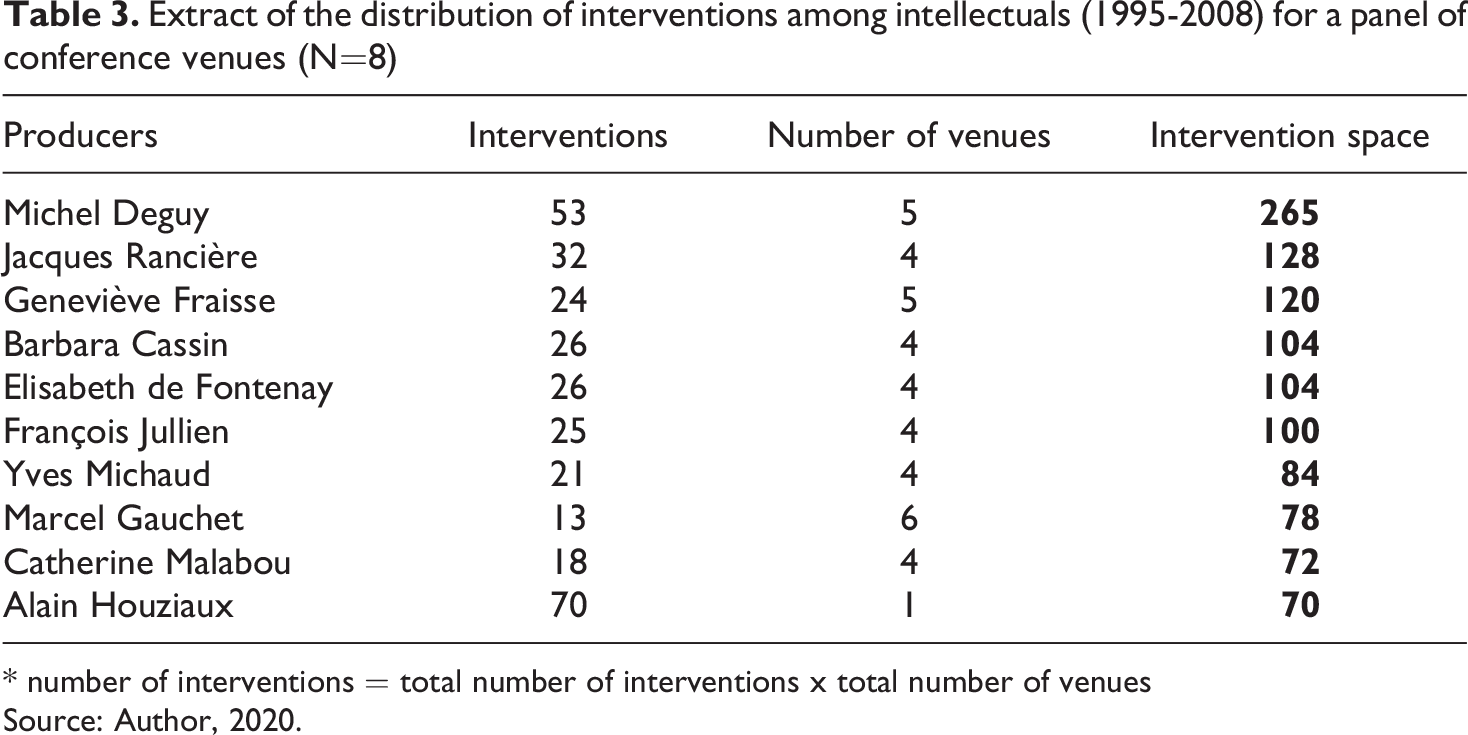
* number of interventions = total number of interventions x total number of venues
Source: Author, 2020.
Extract of the distribution of positions among intellectuals (1995-2008) for a panel of conference venues (N=8)
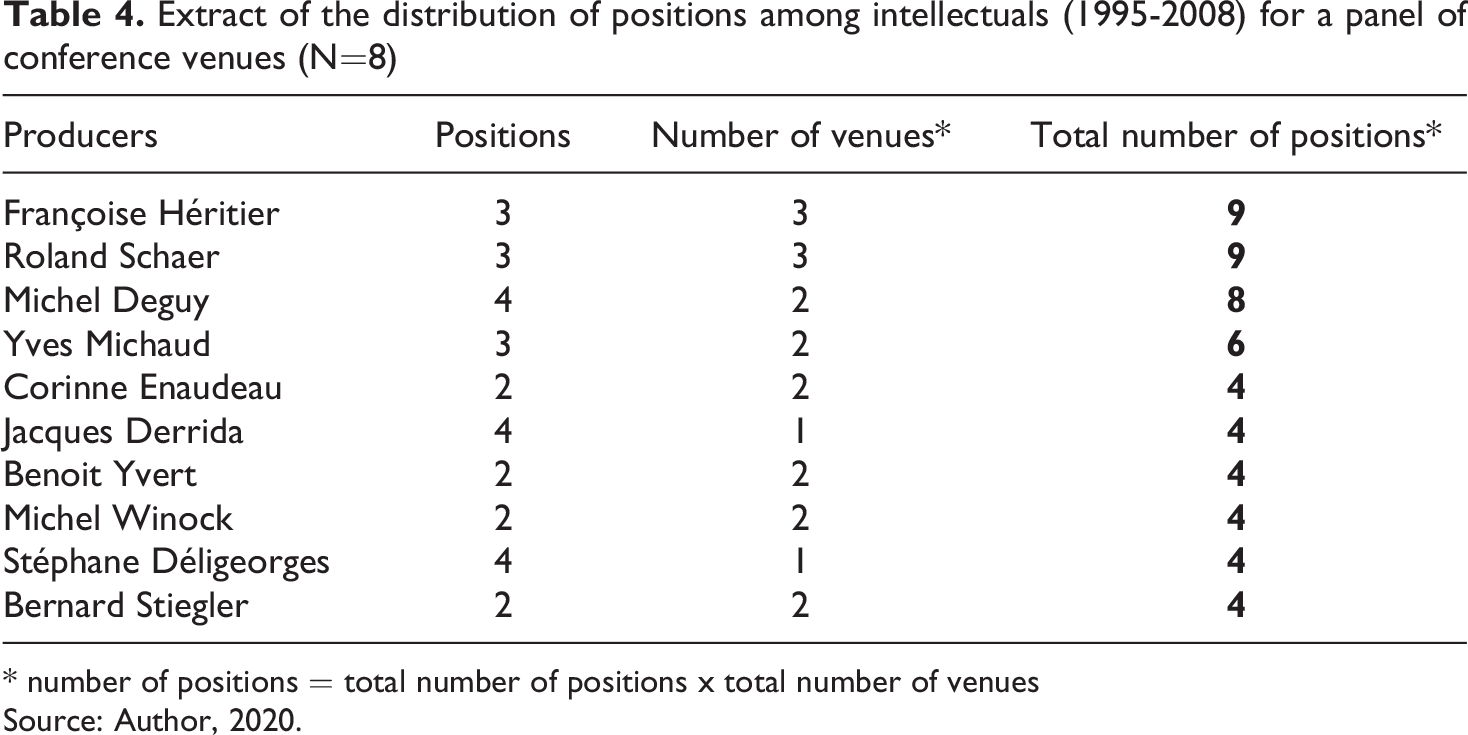
* number of positions = total number of positions x total number of venues
Source: Author, 2020.
We then needed to perfect the representativeness of these lists of visible intellectuals by seeking out those that our sampling from the institutional core of the conference circuit had not been able to capture. The lists were therefore completed taking into account the interventions and positions accumulated by intellectuals in other sectors of the visibility of ideas, especially those of cultural journalism (Le Monde, Libération, France Culture, France Inter, etc.), intellectual journals (Esprit, Commentaire, Le Débat, etc.), and publishing (Odile Jacob, Le Seuil, PUF, etc.). However, these readjustments ended up creating a sample which, in terms of numbers, was no longer really commensurate with the material resources of a single researcher, especially if we wished to conduct a prosopographical survey of the careers of visible intellectuals in as much detail as possible. One of the salient aspects of this vast sample was the fact that most of the individuals held permanent university positions. This over-representation of academics confirmed the centrality of this group on the IS scale of the visibility of ideas and, by the same token, the possibility to strip our ever-growing sample of its non-academic fringes (e.g. journalists, writers, essayists, etc.), without calling its representative value into question. However, while it considerably reduced the size of the initial sample, this criterion should not be the sole guide, at the risk of reverting to the positivist error of ignoring the rationale behind a field (Bourdieu, 1992: 213-216) and the specific choices that taking them into account requires in terms of individuals and institutions (Bourdieu, 1999: 5-6). As far as nonacademic fringes are concerned, we therefore took care to select all those for whom the positioning and the force exerted within the IS of the visibility of ideas made them unavoidable. In most cases, these were people who were eminently active on the essayist market, such as Jacques Attali, Brice Couturier, Raphaël Enthoven, Alain Minc, Michel Onfray, Éric Zemmour, and others. After this final rectification, the recurrence of names revealed a population of around three hundred individuals that we found to be particularly representative of the diversity and impact of academic disciplines involved in the visibility of ideas (philosophy, history, literature, economics, sociology, anthropology, psychology, geography, etc.).
In conclusion, we can say that our sample was based on a somewhat unusual methodology, since the population of visible intellectuals was reconstituted thanks to an interweaving of mixed approaches to the field of conferences that underpinned a whole series of surveys. While this sampling method has yet to be explicitly defined, one way of generalizing its scope would be to think of it as a process of inferences in which choices made at the micro and meso levels were used to consolidate results at the macro level.
Field-tested interstitial space capital
In the following section, we look at how the study allowed us to capture the IS of the visibility of ideas through the prism of its capital. To approach it from this angle, the field of conferences once again proved decisive. In fact, the further we explored the circuit and its institutions, the more we understood the importance of contacts for those who wanted to circulate easily. Moreover, the determination of visible intellectuals to maintain and extend their relational network, as revealed by our observation of the world of conferences, echoed the prosopography of their careers, marked by an accumulation of positions in the various sectors of power typical of the ruling class (Boltanski, 1973; Denord et al., 2011). While these empirical convergences point to an elite social capital (Bourdieu, 1980b; Cousin & Chauvin, 2012; Lenoir, 2016) as the central hub of the visibility of ideas, we still needed to understand how it polarized the IS under study. However, we soon found ourselves faced with a major methodological obstacle in that we needed to understand what the various quantitative approaches to prosopographical data on the positions marking the careers of visible intellectuals could or could not shed light on in the objectification of social capital at macro level. We thus found that the micro and meso levels of investigation of the conferences, focused on sociability and links between acquaintances, best informed the demonstration of a space shaped by social capital issues in the statistical exploitation of these data. We therefore begin by showing how immersion in the conference circuit protected us from the interpretative biases that can arise in examining the relational resources of a population of visible intellectuals. We then explain the decisive role played by ethnographic control of these biases in order to establish the primacy of social capital in structuring our IS, based on a mixed approach to geometric data analysis and network analysis.
A close-up of institutional and affinity networks
The conference circuit allowed us to rapidly appreciate the key issue of social capital for visible intellectuals when observing their positions and dispositions. On the one hand, by representing a wealth of positions to be filled (advisors, administrators, partners, curators, etc.), the circuit helped us to understand how intellectuals occupy such positions in practice with the aim of maintaining or extending their social position. On the other hand, the ethnography of a world where their reputation was at stake gave us an opportunity to observe forms of sociability specific to worldliness (address books, like-minded individuals, strategies of distinction, name-dropping, etc.). However, without access to these issues through the field of conferences, it would have been very difficult to grasp what the two types of network encountered (i.e. those formed by belonging to the same institutional environment, such as occupying positions in the same institutions, and those built by affinities in the sense that the individuals knew each other personally) actually covered with regard to the IS of the visibility of ideas.
While we had every reason to believe that membership to collective decision-making bodies within conference institutions (committees, governing bodies, etc.) developed interrelations between their members, our investigations indicated that such ties were far from obvious. The staff in charge of running the institutions we studied told us, for example, that many intellectuals who were members of these collective bodies attended few, if any, meetings. For this segment of the population, accustomed to opting out, participation was not, strictly speaking, a matter of acquiring a network of useful lasting relations among their peers (Bourdieu, 1980b). In the same way, our long-term immersive study suggested that these bodies mainly served to govern conference institutions, making them places where the main forms of power (academic, media, political, and economic) were represented. As we showed for the Collège international de philosophie and the Université de tous les savoirs (Attencourt, 2017, 2021), these meetings gave the institutions’ leaders social capital with different forms of legitimacy, i.e. not only material and symbolic benefits (scholarly endorsement, political support, access to the media, partnerships, etc.), but also immunity, conferred on the basis of the appearance of politico-ideological neutrality (Bourdieu & Boltanski, 1976). From this perspective, the participant observations made at these meetings were highly informative. What was established was not so much the relations between the different participants as the unshakeable reign of institutional leaders who, like the monarch of court society
5
, embodied the center towards which all ties had to converge. This is illustrated by the way a philosopher with a highly successful career of visibility described the “committees” he had to manage in the late 1990s to allocate academic credit to a vast scientific popularization enterprise, the Université de tous les savoirs. “[…] Look, they didn’t meet very seriously. There was the humanities [committee] that managed to meet once or twice. But the problem was that people didn’t come. They were never free at the right time. In general, […] we went to eat, we went to the restaurant, we had lunch, and then during lunch, we sorted things out. There were often direct appointments. Again, I don’t believe in committees because people never have the time, and then they often settle their personal issues, or they do their own thing, etc. so […] I prefer to deal with people individually. It’s not at all to manipulate them, but it’s mainly easier”. Interview, April 2, 2008. “For Bergounioux, we needed someone with experience…There’s a problem of psychology…You have to know who you’re inviting[…] I know that if I invited Alain Finkielkraut, I’d have a riot on my hands. There’s one guy I’d be happy to invite, Philippe Raynaud, who’s calm, composed, and argues on the merits. Žižek has also been put forward”. Interview, March 28, 2007. “I thought of inviting Bernard-Henri Lévy on the war because I had the impression that he’d done something that wasn’t too bad…. And then I was told it was phony. And then I don’t know what the occasion was…? What cycle it was…? I’d planned it. And then it didn’t happen, I don’t know why. […] On the other hand, I invited Claude Lefort, who very rarely gives lectures and who was a huge success that day. Nobody could get in. So you see. I made a little pantheon of the philosophers I usually invite. I think I invited Balibar, but he wasn’t free because I hold him in high esteem”. Interview, April 2, 2008.
Modeling social capital based on observed practices
The micro and meso perspectives on conferences enabled us to establish that the social capital of visible intellectuals, as presented to the world, might not reflect their real composition. By automatically converting mutual institutional adherence into links between acquaintances, we realized that there was a high risk of overestimating the official positioning of individuals. On the other hand, we were able to measure the extent to which the mingling effects induced by the influence of the worldly rationale in the conference circuit led to an underestimation of the personal positioning of individuals. However, we did not want to abandon the idea of clarifying the role of social capital on the macro scale of the IS of the visibility of ideas. One of the options open to us was thus to adopt statistical modelling tools. Two in particular appeared appropriate at the time. The first was geometric data analysis (GDA) as the preferred statistical technique for exploring fields, i.e. struggles around a specific issue where individuals occupy positions linked to the volume and make-up of their capital, i.e. a minimum degree of economic, cultural, symbolic, and social capital (Lebaron and Le Roux, 2013, 2015; Duval, 2013). The second tool was network analysis (NA), which helps shed light on the structures underlying different forms of co-affiliation that put social capital and its various usage strategies to work within elite social groups (Godechot and Mariot, 2004; Denord, 2015; Rossier, 2017; Hauchecorne, 2019).
We should first point out that our respondents’ confidences about their address books were far too incomplete for us to consider converting them into statistical variables. Nonetheless, they were invaluable in building the plausibility of our models and results, not only by giving us access to unsuspected connections between individuals, but above all, by giving us a perspective on the area under study that offered a notion of a global relational compatibility where we would otherwise have tended to see only blocks of relatively compartmentalized individuals. In terms of institutional membership, on the other hand, there were numerous options for statistical processing through the dichotomous membership variables that could be constructed for each institution. However, the category of institutional membership raised the issue of how geometric data analysis (GDA) and network analysis (NA) could fully exploit its informational content.
Designed to capture every type of capital, GDA appeared to be the most appropriate model for our IS relationship between social capital and other types of capital. GDA enabled us to show that our IS structure was based on two main axes (see Chart 1, Chart 2 and Chart 3): the first distinguishes visible intellectuals according to positions acquired in sectors of economic and political power (Sciences Po Paris, Grandes écoles d’ingénieurs, decorations in national orders, think tanks, employers, major media, etc.) or cultural power (avant-garde institutions and journals, marginal Parisian universities, agrégation du secondaire [the highest teaching diploma in France], etc.); and the second divides them into a fraction of the humanities who are academically and socially consecrated (khâgne, normalien [student at an Ecole normale supérieure, i.e. a highly selective university], agrégation du secondaire, Collège de France, CNRS gold medal, Institut de France, decorations in national orders, Who’s who, etc.), and those who are furthest removed from this in terms of accumulated capital (agrégation du supérieur, agrégation de science politique, company management, psychoanalysis association, etc.). According to the interpretation of the two axes, the IS of the visibility of ideas could ultimately be described as being underpinned by a social capital accumulation rationale which, depending on the volume and structure of the capital held, leads to two potential modes of achievement within the dominant class, one that assumes a leadership role and the other that involves a position of influencer.
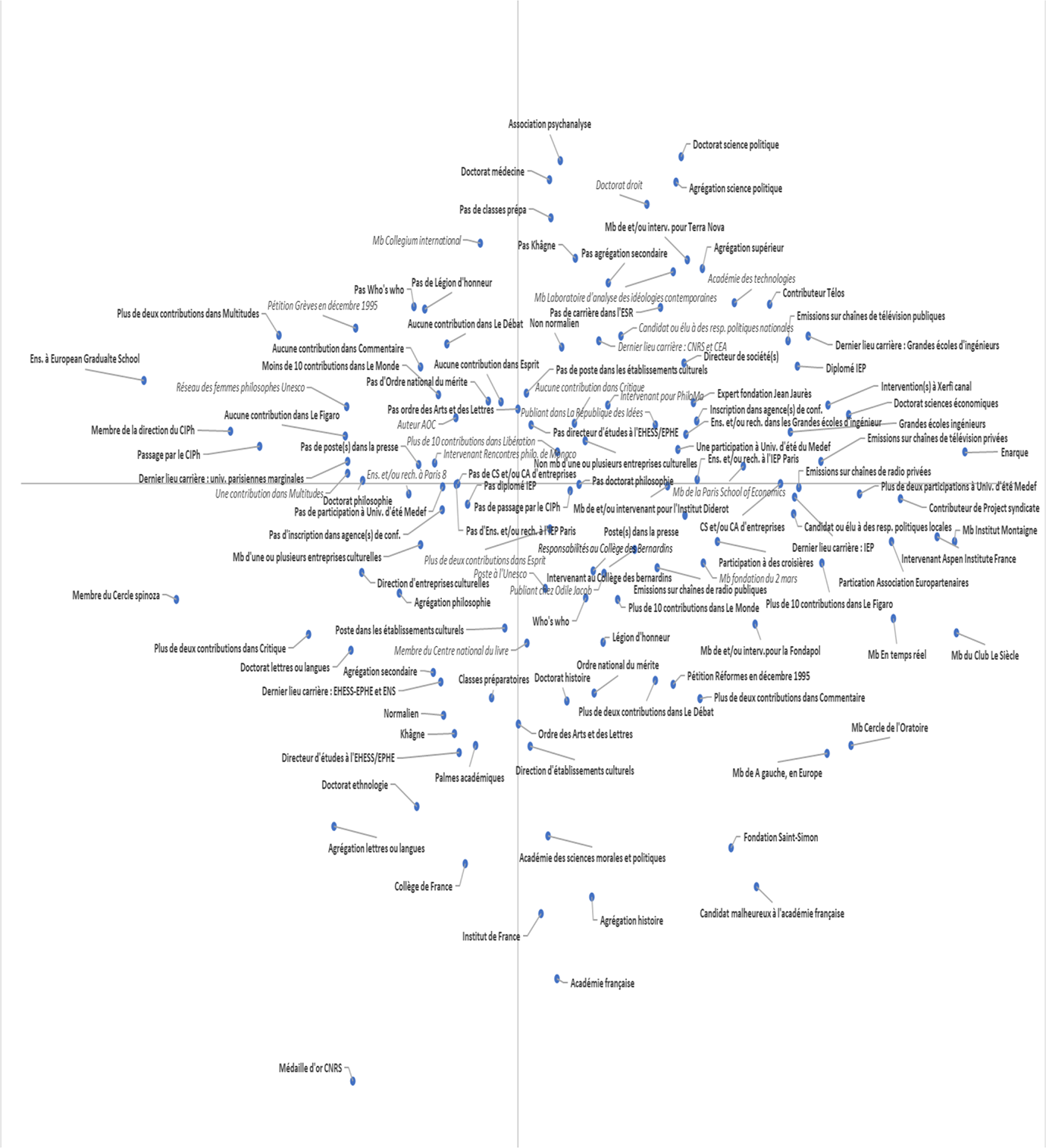
The space of visible intellectuals (N=262) based on active variables
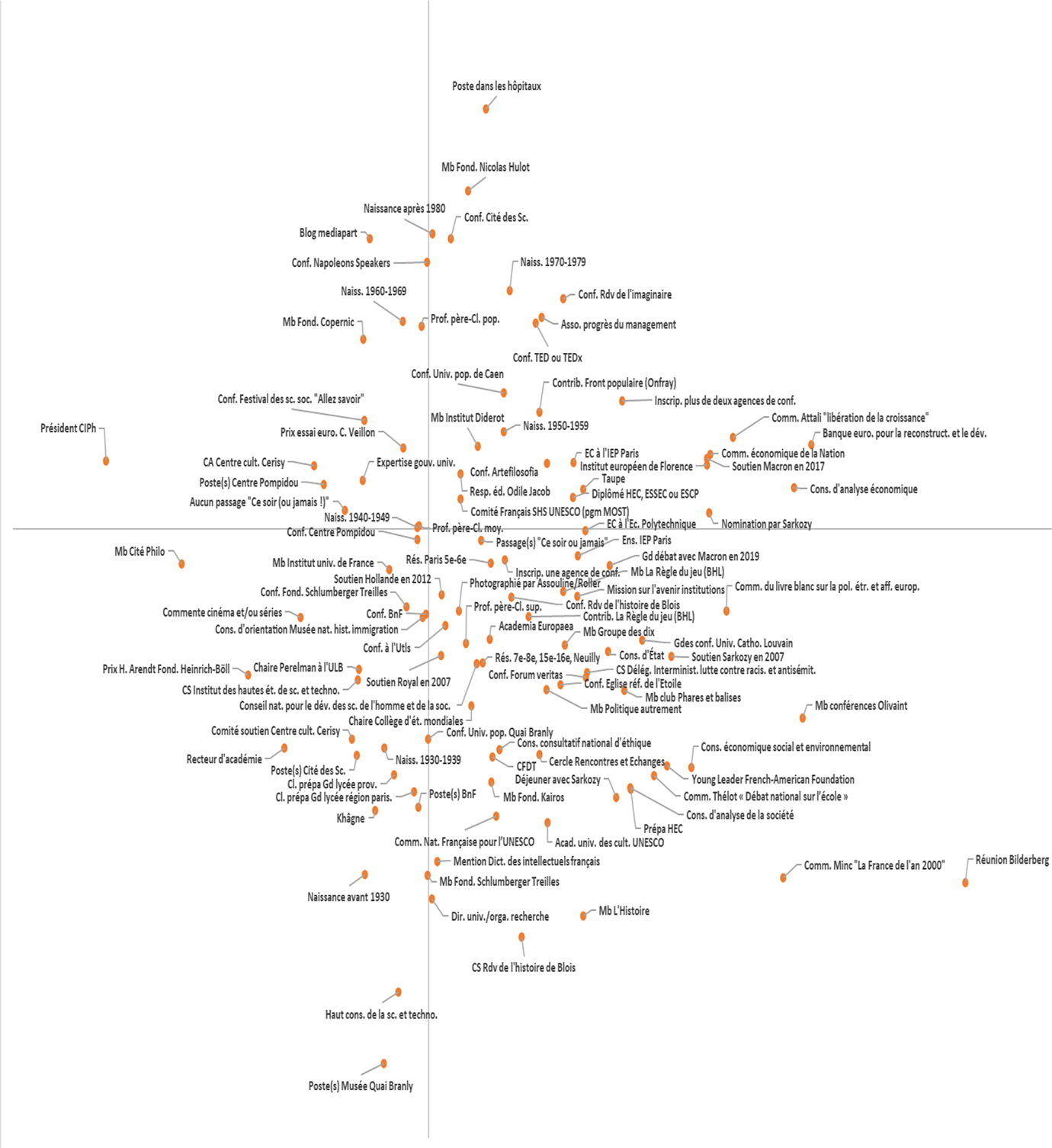
The space of visible intellectuals (N=262) based on additional variables
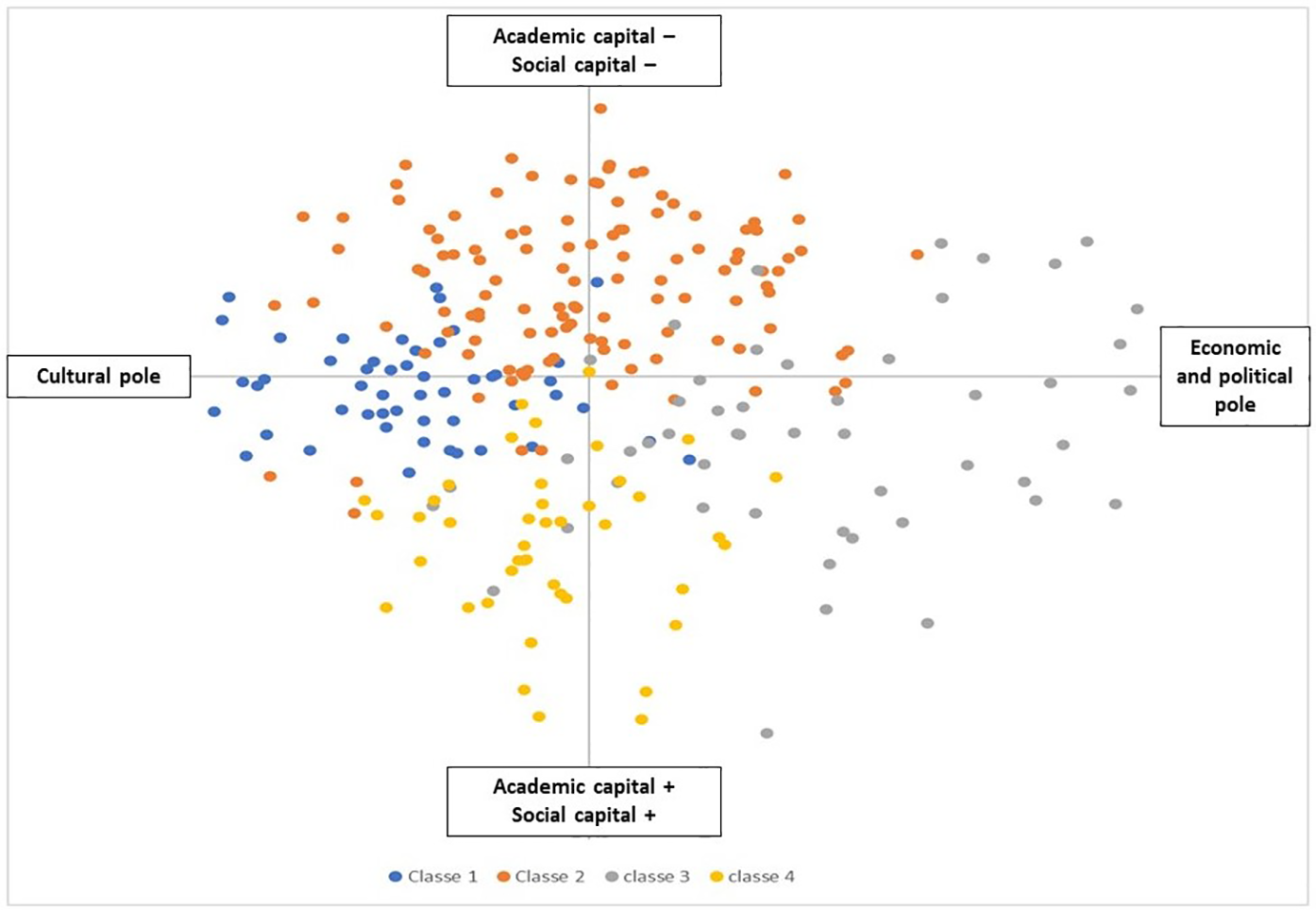
The space of visible intellectuals (N=262) based on hierarchical ascending classification (HAC)
The advantage of using GDA was that the bias of overestimating personal networks on the basis of institutional affiliation was neutralized by the very foundations of the method. Indeed, in GDA, the distance that separates individuals depends on the degree of correspondence between the latter, obtained from the characteristics of the variables selected to build the model. In other words, the closer the individuals are to each other, the stronger the correspondence between them. This means that the concept of distance in no way presupposes the existence of interactions within the population, even if small differences between individuals may be viewed as relatively significant chances of frequenting each other. Thus, there was nothing to prevent us from interpreting the proximities observed in the factorial space between visible intellectuals as probable inter-acquaintance networks, largely due to their institutional affiliation, on the understanding that such an interpretation did not necessarily represent the reality of their personal network.
However, despite its contribution to characterizing the way the visibility of ideas was built around social capital, GDA neglected two issues. On the one hand, it did not allow part of the information relating to the positions and stances of visible intellectuals to be processed since, while GDA is not statistically limited in terms of the number of variables, in practice it often requires a well thought through selection in order to obtain an interpretable model. For a number of variables related to institutional affiliation, especially those whose modalities were insufficiently represented in the population, the selection criteria meant that we did not include them in the model, or only included them in aggregated form. This was the case, for example, with most of the variables relating to participation in government committees, which were grouped on the basis of generic participation in this type of institution. On the other hand, the GDA failed to capture one of the findings of the ethnographic and prosopographical studies, namely, the integrative role played by a whole range of institutions in the IS of the visibility of ideas, which, as inescapable places of passage, draw together most of or a selection of the visible, fundamentally representative intellectuals in terms of social profiles. As a result, when converted into dichotomous membership variables, this type of institution could at times record a high attendance rate by the population, and at other times an attendance rate that was evenly distributed among its various fractions. In both cases, the modalities were rarely among those that made the largest contributions to the inertia of the axes, i.e. those that helped to interpret them by identifying discriminating differences within the population. A large number of the variables used for the GDA, such as membership to public policy committees (the French UNESCO Commission, the National Consultative Ethics Committee for Life Sciences and Health, etc.), cultural establishments (the Université de tous les savoirs, the Bibliothèque nationale de France, the Centre Pompidou, etc.), and media outlets (Le Monde, Libération, etc.) fell into this category and were within a radius fairly close to the center of the mapped spaces of positions and stances. Basically, what the GDA did not allow us to analyze in the centrality of these institutions was the fact that their frequentation by intellectuals tended to lead to diverse forms of social capital acquisition in the IS of the visibility of ideas, both in terms of economic and political power, as well as that of cultural power.
In turning to NA, which had previously shown its value in the study of social capital on the basis of systems of co-affiliation, the challenge was to avoid the pitfalls we encountered with GDA. First, we wanted to address the multi-positioning of visible intellectuals without having to forego the most detailed level of information on institutional affiliations. Secondly, we wanted to focus on institutions that incorporate the visibility of ideas, whose centrality partly eluded the explanatory principles of GDA, based above all on deviations from what is statistically most frequent. However, while offering alternative solutions for these two aspects, NA in turn raised a number of difficulties. To begin with, we had to eschew the comprehensiveness potentially offered by the method, since the only criterion available to define the link, namely that of a minimum degree of co-participation, meant that we had to exclude any institution with fewer than two individuals, in other words, those involving only one person. In addition, using the mathematical tools of graph theory (centrality and cohesion indicators), which can only be applied to unimodal networks, meant transforming the dichotomous incidence matrix (individuals x institutions) into two adjacent matrices (individuals x individuals and instances x institutions). While the matrix of institutions seemed able to produce a robust model, the matrix of individuals revealed a significant number of biases, making the results difficult to use.
In the case of the matrix of individuals, three factors led us to believe that the definition of the link was based on an overly forced interpretation. The first was a consequence of the conference fieldwork, which, as we said, showed that the conversion of institutional affiliation into relational resources was far from self-evident. The second reason had to do with the fact that we were dealing with a pre-established population. In fact, what was taken into account in determining institutional membership was not the relations between all the members, but simply among those in the population of visible intellectuals we had sampled. In order to capture the ego-network of each individual, we would have had to use a much more inductive sampling method to count all the individuals present in a set of institutions over a given period. This is because the quantitative value of relationships in an NA depends above all on the population within which it is applied. In other words, an individual who, within a given structured space, holds multiple positions, but whose positions are not shared with anyone else, would be assigned zero measures of centrality. With regard to the last reason, it related to the collection of empirical material which did not always offer the possibility to establish the synchronicity of institutional affiliation.
With the matrix of institutions, on the other hand, we had an interpretable measure of distance based on the number of visible intellectuals who had passed through a given institutions. This kind of definition had several advantages. It did not call into question the results of the ethnographic survey of conferences, nor did it pose a problem of data synchronicity. While the bias of an upstream population did not influence the definition of the link in the matrix of institutions, we took care to supplement the sample of visible intellectuals with another from an exhaustive network designed by listing all the individuals recognized through various kinds of intellectual award lists (press, intellectual journals, collective works, etc.) in the 1990s and 2000s. Whether using the sample already constructed or one derived from an exhaustive network, NA threw light on the same logic of institutional circulation among visible intellectuals. What they showed was the establishment of a division of labor between media forms with a more targeted public (conferences, publishing, etc.) that boosted public awareness, and others with a large audience that to some extent completed it (press, radio or television broadcasts, etc.). This network structure, based on a concentric mode in which intellectuals move from partial visibility (the margins) to full visibility (the center), revealed the prevalence of social capital and its multiplier effects in the way careers are built within the IS of the visibility of ideas (see Chart 4 and Chart 5).
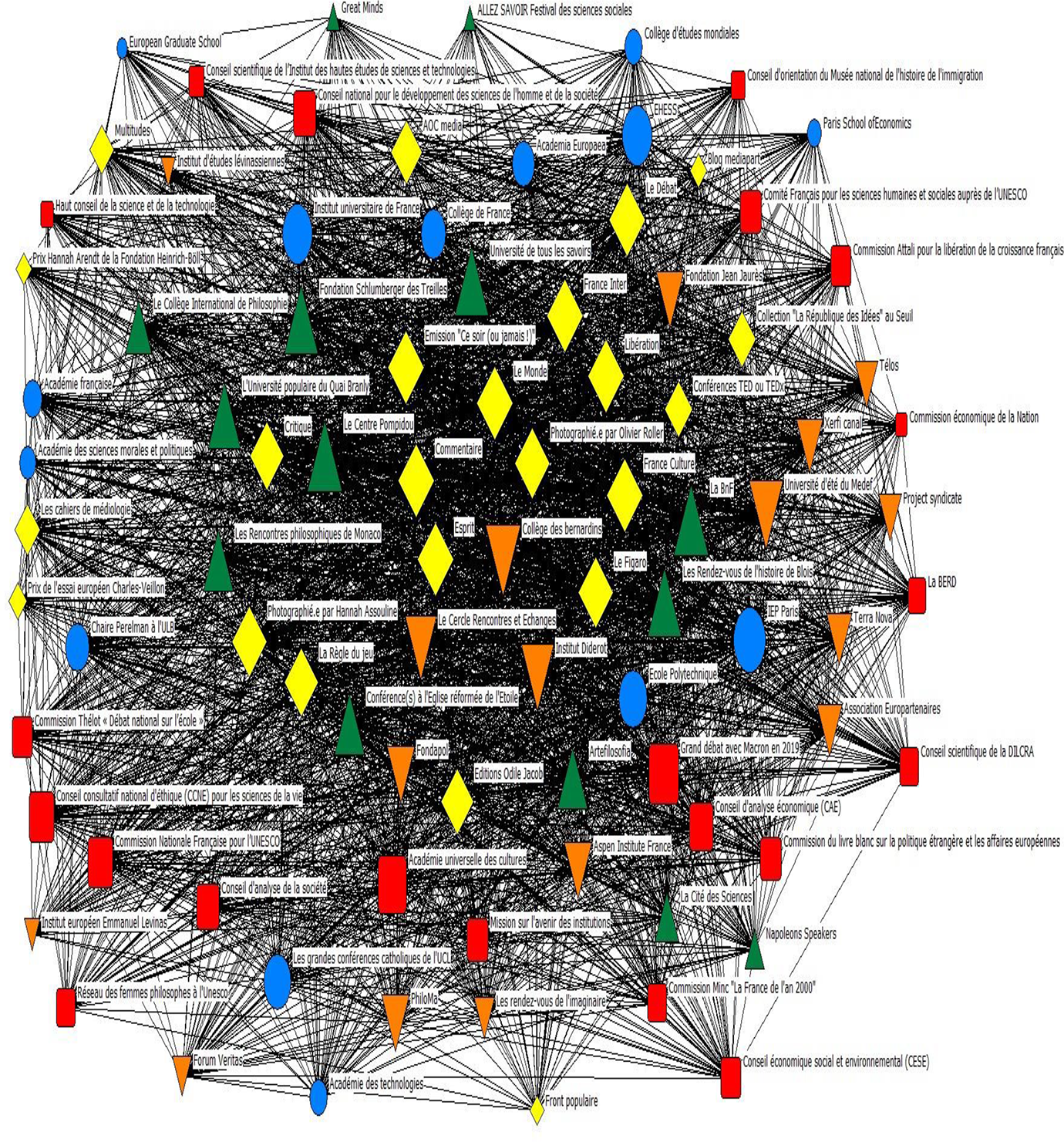
Networked institutions for the visibility of ideas
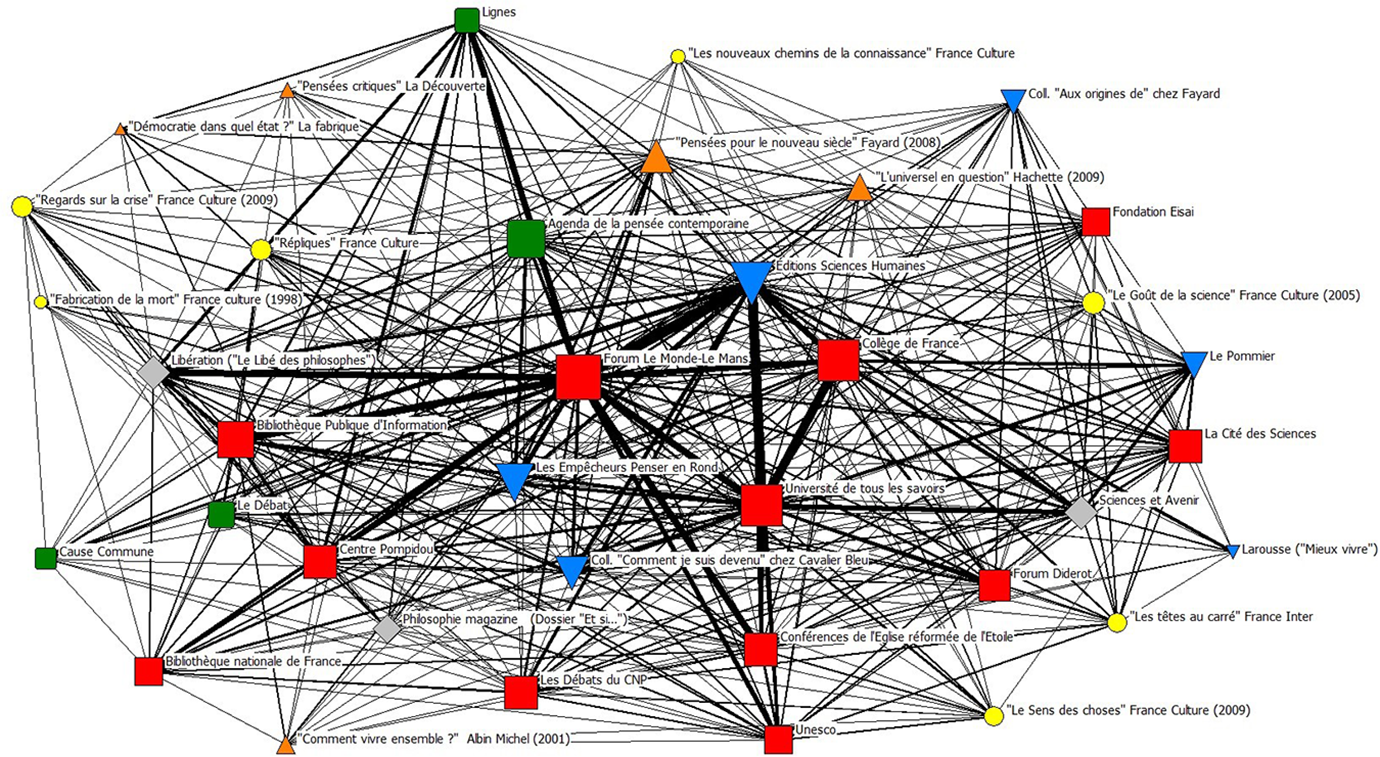
The awards for the visibility of ideas in networks
The contribution of the conference field to the analysis of the effects of social capital at the macro level of our IS thus supported a pragmatic conciliation of the GDA and NA methods which consisted of establishing their complementarity from the point of view of statistical efficiency in responding to what we sought to demonstrate in terms of sociological level (Denord, 2015; Rossier, 2019). After the GDA had been used to identify distinct multi-positioning strategies, depending on whether they were more affiliated to the cultural or the politico-economic sectors, the NA proved useful for relating the passage that occurs in an individual’s career towards wide circulation through the value and growth of relational resources. In short, this combined approach of GDA and NA shows that we are dealing with a space that, based on a kind of heteronomous capital – social capital – tends to be structured not around struggles for its capture like an autonomous field, but rather around opportunities for visible intellectuals to make it profitable and to grow it to the point of counting for and among the ruling elite.
Conclusion
As we said earlier, IS have mainly been studied in negative terms by comparing them to the functioning of autonomous fields. While this comparison is essential, it is not enough to explain the necessarily stable part of a space, however unstable it may be. Our analysis of the IS of the visibility of ideas shows that its borders and capitals can be understood beyond the blurring and fuzziness that characterize them, starting from the multi-level anchorage provided by the conference circuit. To grasp the perimeters of the IS under study, we tracked all the stakeholders in the conference circuit (venues, speakers, listeners, partners). This investigative approach enabled us to identify the institutions involved in the visibility of ideas through several of their underlying foundations, starting with those of engaging in a strategy of self-definition between two repellent entities – the University and mainstream cultural production – and participating in the production of events that drew together the sectors of academic dissension, journalism, bureaucracy, and business. In addition, by tracking conferences, we were able to identify a sample population of visible intellectuals based on scores of participation in conference institutions in terms of involvement and positions. The objectification of capital, on the other hand, was informed from start to finish by our immersion in the conference circuit. This fieldwork, which placed us at the heart of the institutions and as close as possible to the interactions, revealed two biases in the measurement of social capital, one stemming from an overestimation of institutional ties, and the other from an underestimation of personal ties. Taking these biases into account thus became central to an approach combining geometric data analysis and network analysis. Filling in the blind spots of each, the two types of modelling helped to demonstrate that social capital was indeed the driving force behind the IS of idea visibility. In the light of these findings, the present paper offers an original way to articulate the micro, meso, and macro scales in the field theory program defined by Bourdieu (Bourdieu, 2022).
Our approach to IS, as developed in this paper, thus appears to give rise to three more general reflections. First, it echoes the theoretical assemblages formulated by Gil Eyal and Stanislas Morel when they added Latour’s actor-network (Eyal, 2012) and Abbott’s ecologies (Morel, 2016) to the field, respectively. In our case, however, we only borrow from the micro-sociological traditions of ethnomethodology and the sociology of social networks in a strictly instrumental mode. In other words, freed from presuppositions that could conflict with field theory, they can complement our framework without disparity. Support for theoretical coherence in the articulation of levels is also found among representatives of microsociology, who endeavored to inscribe the aggregate of interactions at the foundation of a macrosociology (Collins, 1981; Cicourel, 1981). Secondly, a valid question is whether the investigative strategy of inferring the objectification of a space from the ethnography of one of its parts is not ultimately the best suited methodological option for the heteronomous dynamics of IS as, faced with spaces often metaphorically described as “nebulae” to signify their high degree of opacity (Topalov, 1999: 13), there is little alternative, at least initially, in narrowing the focus on a specific field. Finally, the NA analysis method used in this paper showed that it is possible to go back to objectivizing a field from the perimeters to the capital (Bourdieu, 1999). This tends to corroborate the hypothesis that these spaces, even if they are a species apart marked by functions of betweenness (Medvetz, 2022; Attencourt, to be published), are indeed fields (Bigo, 2008; Medvetz, 2022), and to argue for the extensive use of the notion of field, which should be conceived, above all, as a relational form of object construction (Joly, 2018; Mauger, 2022).
Matériel supplémentaire
Supplemental Material, sj-pdf-1-bms-10.1177_07591063241236068 - How to study the stability of interstitial spaces: an analysis based on the case of the visibility of French intellectuals
Supplemental Material, sj-pdf-1-bms-10.1177_07591063241236068 for How to study the stability of interstitial spaces: an analysis based on the case of the visibility of French intellectuals by Boris Attencourt in Bulletin of Sociological Methodology/Bulletin de Méthodologie Sociologique
Footnotes
Acknowledgements
I would like to extend my warmest thanks to Claire Dupuy and Camille Hamidi, who read and commented on early versions of this article as part of the workshop they set up to extend the Thematic Section Micro-macro. Enjeux méthodologiques des analyses à plusieurs niveaux at the 2019 congress of the French Political Science Association. I would also like to thank all the participants in the workshop (Marine Bourgeois, Vincent Lebrou, Francesca Quercia, Julie Testi, Ferdinand Teuber and Pierre Wokuri) for the stimulating debate on micro-macro issues that they generated each time I presented the progress of my manuscript there.
Declaration of Conflicting Interests
The author declared no potential conflicts of interest with respect to the research, authorship, and/or publication of this article.
Funding
The author received no financial support for the research, authorship, and/or publication of this article.
Matériel supplémentaire
La version française de cet article est disponible sur le site internet du BMS. Elle est téléchargeable en tant que “matériel supplémentaire” joint à l’article.
Supplemental material
The French version of this article is available on the BMS website. It can be downloaded as ‘supplementary material’ from the online version of this article.
Notes
References
Supplementary Material
Please find the following supplemental material available below.
For Open Access articles published under a Creative Commons License, all supplemental material carries the same license as the article it is associated with.
For non-Open Access articles published, all supplemental material carries a non-exclusive license, and permission requests for re-use of supplemental material or any part of supplemental material shall be sent directly to the copyright owner as specified in the copyright notice associated with the article.
