




Abstract
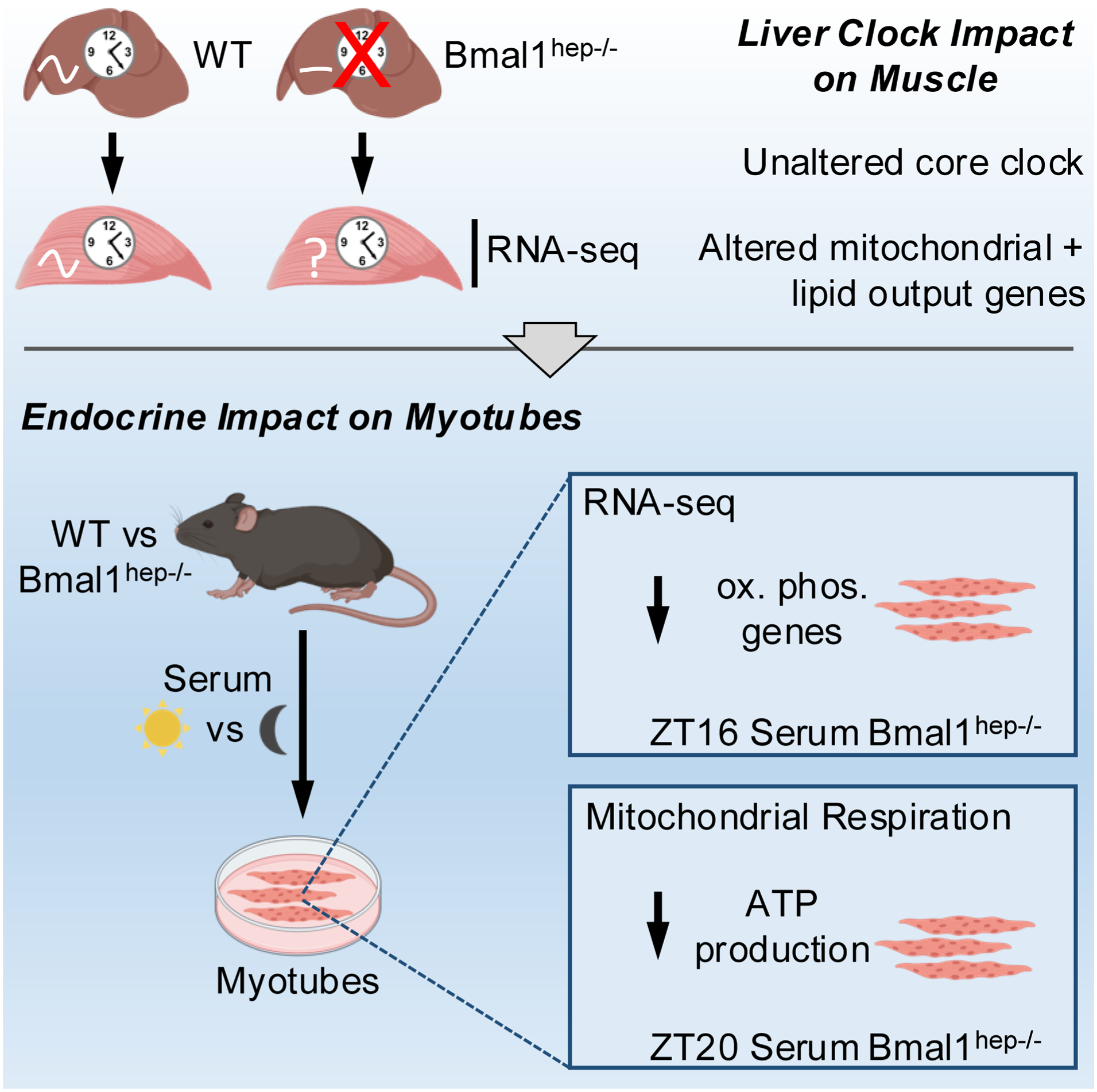
Circadian clocks present throughout the brain and body coordinate diverse physiological processes to support daily homeostasis, yet the specific interorgan signaling axes involved are not well defined. We previously demonstrated that the skeletal muscle clock controls transcript oscillations of genes involved in fatty acid metabolism in the liver, yet the impact of the liver clock on the muscle remained unknown. Here, we use male hepatocyte-specific Bmal1 KO mice (Bmal1hep–/–) to reveal that approximately one-third of transcript rhythms in skeletal muscle are influenced by the liver clock in vivo. Treatment of myotubes with serum harvested from Bmal1hep–/– mice inhibits expression of genes involved in metabolic pathways, including oxidative phosphorylation. Only small transcriptional changes were induced by liver clock-driven endocrine communication in vitro, leading us to surmise that the liver clock acts to fine-tune metabolic gene expression in muscle. Consistent with functional tuning, treatment of myotubes with serum collected from Bmal1hep–/– mice during the dark phase lowers mitochondrial ATP production compared with serum from wild-type mice. Overall, our results reveal communication between the liver clock and skeletal muscle, uncovering a bidirectional endocrine communication pathway that may contribute to the metabolic phenotypes of circadian disruption.
Keywords
Get full access to this article
View all access options for this article.
References
Supplementary Material
Please find the following supplemental material available below.
For Open Access articles published under a Creative Commons License, all supplemental material carries the same license as the article it is associated with.
For non-Open Access articles published, all supplemental material carries a non-exclusive license, and permission requests for re-use of supplemental material or any part of supplemental material shall be sent directly to the copyright owner as specified in the copyright notice associated with the article.
