




Abstract
Adolescents’ conflict between circadian rhythm and early school start time is more pronounced in evening chronotypes, who tend to reduce sleep duration during school days compensating during the free days by oversleeping (i.e., social jetlag). Cumulative weekly sleep debt may impair sport performance, which relies on physical and cognitive skills modulated by sleep. We hypothesized that chronotype predicts sport performance, and that it may interact with the day of the week. Moreover, given the role sleep plays in motor memory consolidation, we tested the hypothesis that school attendance, and the related chronic sleep deprivation, might be detrimental for participants in a training phase. Ninety-three adolescent male basketball players performed multiple free throw sessions (n = 7880) during both the school and holiday periods. Chronotype and its interaction with the day of the week significantly predicted shooting accuracy when attending school, but not on holidays. Evening types’ performance gradually decreased from Monday to Friday. Participants with a more unstable performance (i.e., who did not complete the acquisition of the free throw motor scheme) worsened their accuracy when attending school. Our results suggest that the impact of chronotype and day of the week on sport performance is related to the presence of an externally imposed sleep/wake schedule and is consistent with evening types’ increased likelihood of experiencing social jetlag. Possibly due to early school start time, attending school worsened the performance of participants in a training phase. Further investigations are required to assess whether reducing the mismatch between biological and social clocks might improve sport performance, along with other aspects of adolescents’ life.
Adolescents experience a physiological delay in sleep timing, often more pronounced in males, that spontaneously reverts in the third decade of life (Carskadon and Tarokh, 2014). This shift toward eveningness is so typical of this phase of development that its reversal has been proposed as a marker for the end of adolescence (Roenneberg et al., 2004). It is likely that this modification in sleep phenomenology is due to changes in both the circadian and the homeostatic sleep regulatory mechanisms (Carskadon et al., 1998). First, the transition to puberty is characterized by an increased sensitivity to the phase-shifting effect of evening light exposure (Crowley et al., 2015), possibly being accountable for adolescents’ delay in melatonin endogenous secretion (Carskadon et al., 1998). In line with this hypothesis, youngsters with a delayed circadian phase show a higher light-emitting device use in the evening compared with non-delayed peers (van der Maren et al., 2018). Second, a study conducted following a forced desynchrony protocol showed that adolescents have an internal period longer than 24 h (Carskadon et al., 1999). This finding could explain the apparent inefficacy of morning light in resetting young humans’ circadian internal period (Carskadon et al., 1998). Finally, sleep pressure seems to build up more slowly in teenagers compared with prepuberal or early puberal children, resulting in a facilitation of late bedtimes. No difference emerged in terms of sleep recovery speed, suggesting that the short sleep duration associated with the delayed sleep onset may not be sufficient to dissipate a cumulative sleep debt (Jenni et al., 2005).
Adolescents’ preference for late sleep timings conflicts with their social obligations. In most countries of the world, school attendance forces adolescents to wake up earlier than preferred, while their internal clock prevents them from anticipating sleep onset accordingly to achieve a sufficient amount of sleep (Tarokh et al., 2016). To manage early school start times (SSTs), teenagers tend to reduce the time devoted to sleep during school days (Hysing et al., 2013), compensating during the weekend by oversleeping (Owens et al., 2014). The mismatch between social and biological clocks, reflected by the discrepancy between sleep duration on school and free days, has been defined as social jetlag (SJL) (Wittmann et al., 2006). SJL is a form of circadian misalignment highly prevalent in this population (about 50% of a large sample of high school Japanese students reported more than 1 h of SJL) and associated with an impaired daytime functioning (Tamura et al., 2022). The evening drift associated with adolescence could explain the high prevalence of SJL in this population (Wittmann et al., 2006; Levandovski et al., 2011). Sleep debt, indeed, is likely to accumulate faster during the week in evening chronotypes compared with other circadian typologies: indeed, a delayed midsleep point was significantly associated with the increased likelihood of experiencing less than 8 h of sleep per night in a sample of high school students whose SST was 0730 h (Estevan et al., 2020). It is also likely that in evening types a greater sleep debt adds up to a higher degree of circadian misalignment, as eveningness has been associated with greater SJL (Wittmann et al., 2006). It is thus possible that the combination of a more severe chronic sleep deprivation and a higher degree of circadian misalignment leads evening types to a greater cognitive and academic impairment (Cohen-Zion and Shiloh, 2018). Plausibly because of the conflict between SST and circadian rhythm, chronic sleep deprivation affects most American adolescents (Buxton et al., 2015). Among cognitive functions, memory encoding and sustained attention (Lo et al., 2016) have been demonstrated to be impaired in adolescents due to chronic sleep deprivation, possibly explaining the association between SJL and poor learning ability and academic performance (Haraszti et al., 2014; Tamura et al., 2022).
Optimization of sleep quantity and quality is necessary to achieve an optimal sport performance in adolescent athletes (Copenhaver and Diamond, 2017). Results from a seminal work by Mougin showed how sleep-deprived athletes require an excessively high physiological demand for physical exertion that leads them to premature exhaustion (Mougin et al., 1991). Moreover, many sport-specific skills (e.g., shooting accuracy in basketball) are likely not to rely just on physical abilities, but also on neurocognitive dimensions such as alertness and motor planning (Fullagar et al., 2015). It is well known that sleep loss may impair those neurocognitive dimensions (Banks and Dinges, 2007). Conversely, sleep extension has been shown to improve, in a sample of collegiate basketball players, both athletic (i.e., sprint time and shooting accuracy) and cognitive performance (i.e., reaction time scores) (Mah et al., 2011). In addition, a recent work demonstrated that SJL may impair physical abilities, such as postural control (Umemura et al., 2018). Despite the raising awareness on how chronic sleep deprivation negatively affects student-athletes’ quality of life, mood, and performance (Bolin, 2019; Kroshus et al., 2019), reduced sleep duration is more common in this population compared with non-athletes of the same age (Fox et al., 2020). For instance, a study conducted on a sample of 82 Portuguese adolescent gymnasts showed that 91.5% of participants slept less than 8 h per night (Silva et al., 2018). The need of fulfilling both academic and training demands might play a role in reducing students-athletes’ sleep duration (Riederer, 2020).
Optimal sleep might also improve athletic performance, favoring the acquisition and refinement of motor schemes. Experience-dependent acquisition of motor schemes is paralleled by plastic cortical reorganization. Karni and colleagues (1995) demonstrated that an increase in speed and accuracy of motor performance is associated with an extension in the task-subserving area of the primary motor cortex. The authors also suggested that the expansion of movements’ cortical representation and long-term learning are consequences of the creation of new synapses (Kami et al., 1995). New synapses steadily form during wake, while during sleep a selective downscaling allows the acquisition of new information on the consecutive wakefulness period. Selection is based on use. Synaptic pruning, indeed, equally affects all neural connections, but the strongest are more likely to be retained (de Vivo et al., 2017). This phenomenon could contribute to explain sleep relevance for offline memory processing, which spans across several cognitive domains, including motor learning (Stickgold, 2005). A few studies demonstrated a rehearsal-independent post-training improvement in either a motor sequence test (Walker et al., 2002) or a motor adaptation test (Huber et al., 2004) after a night of sleep but not after an equivalent wake duration. The same studies also proved how post-training sleep deprivation interferes with the offline motor enhancement, and chronic sleep deprivation has been associated with an impairment in procedural learning (Curcio et al., 2006). Long-term memory consolidation might be mediated by the coordinated occurrence of sleep spindles and slow oscillations (Klinzing et al., 2019). Using a real-life gross-motor task (i.e., juggling), Hahn and colleagues associated improved task proficiency with overnight slow oscillation-spindle coupling precision in motor areas (Hahn et al., 2022).
The first aim of the study was to explore whether chronotype predicts a basketball-specific skill (i.e., the probability of a successful free throw) interacting with the day of the week, both during the school period and on holidays, in a sample of middle and high school students. We hypothesized that participants with the greatest propensity toward eveningness would experience a decrease in shooting accuracy throughout the week along with the accumulation of the sleep debt only when the sleep/wake rhythm is dictated by an externally imposed schedule (i.e., school times). The second aim was to test whether early SSTs negatively impact the shooting accuracy of participants in a training phase and not of those who already completed the acquisition of the free throw motor scheme. We hypothesized that the school schedule, critically reducing students’ sleep duration, would interfere with motor learning consolidation mechanisms.
Materials and Methods
Study Design and Participants
Ninety-three male basketball players (mean age, 15.44 years; range, 13-17) from 4 sport clubs from Pisa area (Italy) participated in the study. They performed multiple 10-free-throw sessions (overall number of free throws, n = 7880) both during the school period (n = 2720) and during the summer holidays (n = 5160). Free throws were performed in the last part of a 2-h training session. During each session, participants performed 5 pairs of free throws in a random shooting order. On average, each participant performed 75 free throws. Two experimenters, in their capacity of youth basketball coaches (F.F. and I.G.), assessed the number of successful throws and a number of session-related variables specified below. Participants also filled in a questionnaire exploring age and chronotype. During the school period, all participants attended school from 0830 h to 0130 h, from Monday to Saturday. Informed written consent from participants’ parents and assent from participants were obtained before joining the experiment. The study was conducted in accordance with the Declaration of Helsinki and received the approval of the Bioethical Committee of the University of Pisa on 10 April 2020, with protocol number 0036351/2020.
Measures
Within-session shooting accuracy was considered as an index of sport performance. An estimate of the probability of scoring was calculated by dividing the number of successful free throws out of 10 shots by the total number of free throws (i.e., 10). A high standard deviation of the shooting accuracy across sessions was treated as a proxy for being in a training phase. A high standard deviation reflects performance instability, which in turn is an index of not having completed the acquisition of a motor scheme (Wu and Latash, 2014). Therefore, we operationalized participants’ learning phase through the between-session standard deviation of shooting accuracy and participants’ performance through the within-session shooting accuracy.
Chronotype was assessed using the reduced version of the Morningness/Eveningness Questionnaire (rMEQ). rMEQ is the 5-item version of the questionnaire first validated by Horne and Ostberg. Its score ranges from 4 to 25; a high score stands for a great propensity toward morningness, while a low score for eveningness. The Italian validated rMEQ version was administered to participants of this study (Natale et al., 2006).
Session-related variables included the following:
The day of the week in which the session took place. As a regressor, it was converted into a quantitative variable reflecting the distance from Sunday expressed in days (i.e., Monday = 1, Tuesday = 2, etc.). No session was performed on Saturdays and Sundays.
The time of day in which the free throw session started. As a regressor, it was converted into a quantitative variable indicating the number of minutes between the previous midnight and the start of the free throw session (i.e., 0845 h = 525 min, 1910 h = 1150 min, etc.).
School attendance, that is, whether participants were attending school or were on holidays during the session, as reported by them before each session started.
Participants’ category, an index used by sport clubs to stratify athletes by age and expertise (e.g., U14 ELITE stands for Under 14 best players). Participants from categories U13, U14 ELITE, U15, U15 ELITE, U16, U17 ELITE, U18, and U18 ELITE took part in the study.
To explore possible differences in sleep-related parameters between school and holiday periods and their possible association with chronotype, a subsample of 39 participants continuously wore an actigraph (Fitbit Inspire 2) for 5 days on their non-dominant wrist, with the exception of 10 participants who took it off for 2 h during an official competition, as prescribed by the Italian Basketball Federation. Twenty-four participants wore the actigraph when attending school, 6 on holidays, and 9 during both school and holiday periods, for a total of 48 actigraphic recordings (33 during school, 15 during holiday). Sleep parameters (Total Sleep Time [TST]; Wake After Sleep Onset [WASO]; Sleep Efficiency [SE]; Sleep Regularity Index [SRI]; Littner et al., 2003; Phillips et al., 2017) were derived through the artificial neural network (ANN)-based validated algorithm Dormi by sleepActa s.r.l. (Banfi et al., 2021). Dormi is a medical, risk class I device registered within the Italian Ministry of Health Data Bank of Medical Devices (CND: 217 Z12030682).
Based on Ancoli-Israel and colleagues’ (2003) recommendations, participants’ circadian rhythm was assessed based on activity detected through accelerometric sensors using both parametric and non-parametric approaches. The cosinor method (Cornelissen, 2014) applied to actigraphy consists in fitting a 24-h period sine wave to activity data and computing the following metrics to describe the fitted curve:
The Midline Estimating Statistic of Rhythm (MESOR), that is, the rhythm-adjusted mean which represents the mean activity level;
The amplitude, that is, half of the peak-to-nadir difference. It ranges from 0 to 1, with higher values indicating greater rhythm robustness;
The acrophase, that is, the timing of peak activity, which depends on chronotype (Vitale et al., 2015; Roveda et al., 2017).
The following non-parametric measurements of rest-activity rhythms (van Someren et al., 1999) were computed based on accelerometry:
Interdaily stability (IS), an estimate of the variability in rest-activity patterns across all days. It ranges from 0 to 1, where higher values indicate higher rest-activity rhythm regularity;
Intradaily variability (IV), which measures circadian fragmentation within each day by quantifying rest-activity transitions. In healthy participants, it usually ranges from 0 to 2, where higher values indicate more frequent transitions (e.g., frequent naps, increased night-time awakenings);
Relative amplitude, measuring the robustness of the 24-h rest-activity rhythm by calculating the normalized mean difference in activity between the most active 10 h and the least active 5 h. It ranges from 0 to 1, where higher values indicate increased circadian pattern robustness.
SJL was computed as absolute values based on Jankowski formula (Jankowski, 2017), which adds a correction for cumulative sleep debt to the classic one. The sleep debt–corrected sleep midpoint was computed according to Roenneberg and co-workers (Roenneberg et al., 2007).
Statistical Analysis
Mean and standard deviation were reported for quantitative variables (i.e. age, rMEQ score, shooting accuracy, standard deviation of shooting accuracy, actigraphy-derived parameters), and frequency and percentage for categorical ones (i.e., sport category, time of day, day of the week). Student t test was used to compare quantitative variables between school and holiday period sessions; Fisher exact test was used to compare the categorical ones. Pearson test was used to correlate rMEQ score, sleep midpoint, and acrophase with SJL. A random-effects logistic regression model was fitted to identify predictors of shooting accuracy. Natural cubic splines, with a single knot at the median, were used to describe the effect of chronotype, the day of the week, the time of day, and the standard deviation of shooting accuracy. Moreover, some of the regression equations include the tensor product between 2 spline bases that defined an interaction term, as specified in the following sections. To test our first hypothesis, likelihood ratio test was used to compare 2 nested random-effects logistic regression models with and without chronotype and day of the week interaction. The analysis was repeated in the whole sample, considering only school sessions and considering only holiday sessions. To test our second hypothesis, likelihood ratio test was used to compare 2 nested random-effects logistic regression models with and without school attendance, standard deviation of shooting accuracy, and their interaction. Models were adjusted for the following covariates: age; sport category; chronotype, time of day and their interaction. Models on school attendance also included as regressors chronotype and its interaction with the day of the week. All analyses were conducted using R version 4.1.0. Parametric circadian metrics were computed using R package “cosinor”; non-parametric, using the “nparACT” R package (Blume et al., 2016). All tests were 2-sided, and the level of significance was set at 0.05.
Results
Descriptive statistics of the whole sample, as well as stratified by school/holidays, are displayed in Table 1. Athletes who performed the free throws when attending school were on average younger, with greater expertise and lower degree of eveningness. Moreover, since they were attending school in the morning, during the school period no data collection took place before 0200 h. Finally, a significant difference emerged also in the distribution of the free throw sessions across the days of the week. The models predicting sport performance were hence adjusted for all these potential confounders.
Descriptive statistics of the whole sample and of participants who performed the free throw session during the school and holiday periods.
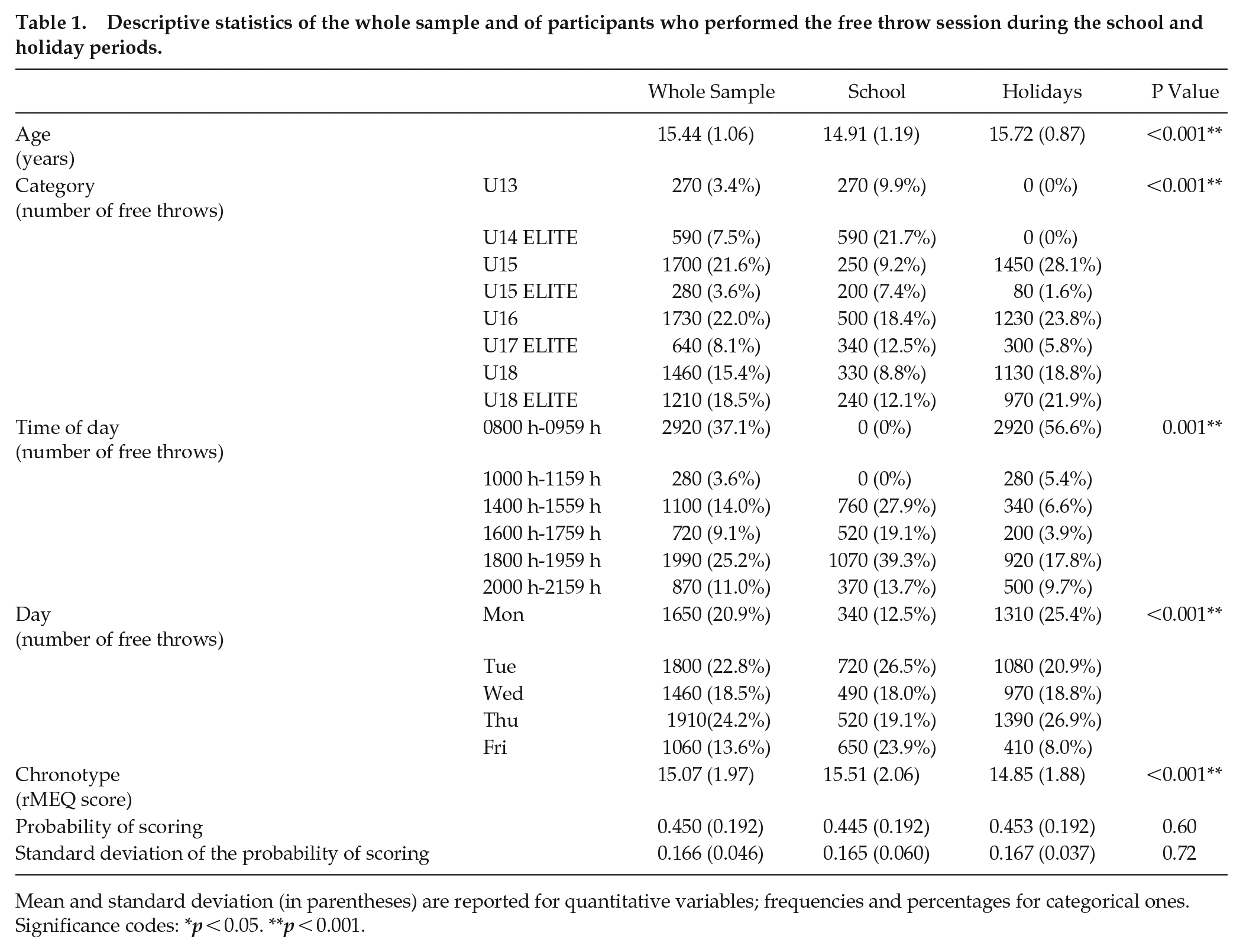
Mean and standard deviation (in parentheses) are reported for quantitative variables; frequencies and percentages for categorical ones.
Significance codes: *p < 0.05. **p < 0.001.
To identify predictors of shooting accuracy, we estimated a random-effects logistic regression model considering the binary indicator of scoring as dependent variables and including the following regressors: age, chronotype (rMEQ score), time of day, day of the week, sport category, attending school, and performance stability (standard deviation of the shooting accuracy). Sport category and chronotype emerged as the only significant predictors of sport performance (Table 2). In particular, shooting accuracy increased along with both sport expertise and morningness.
Logistic regression model testing the predictive power of age, chronotype, sport category, time of day, day of the week, school attendance, and the standard deviation of the probability of scoring on shooting accuracy.
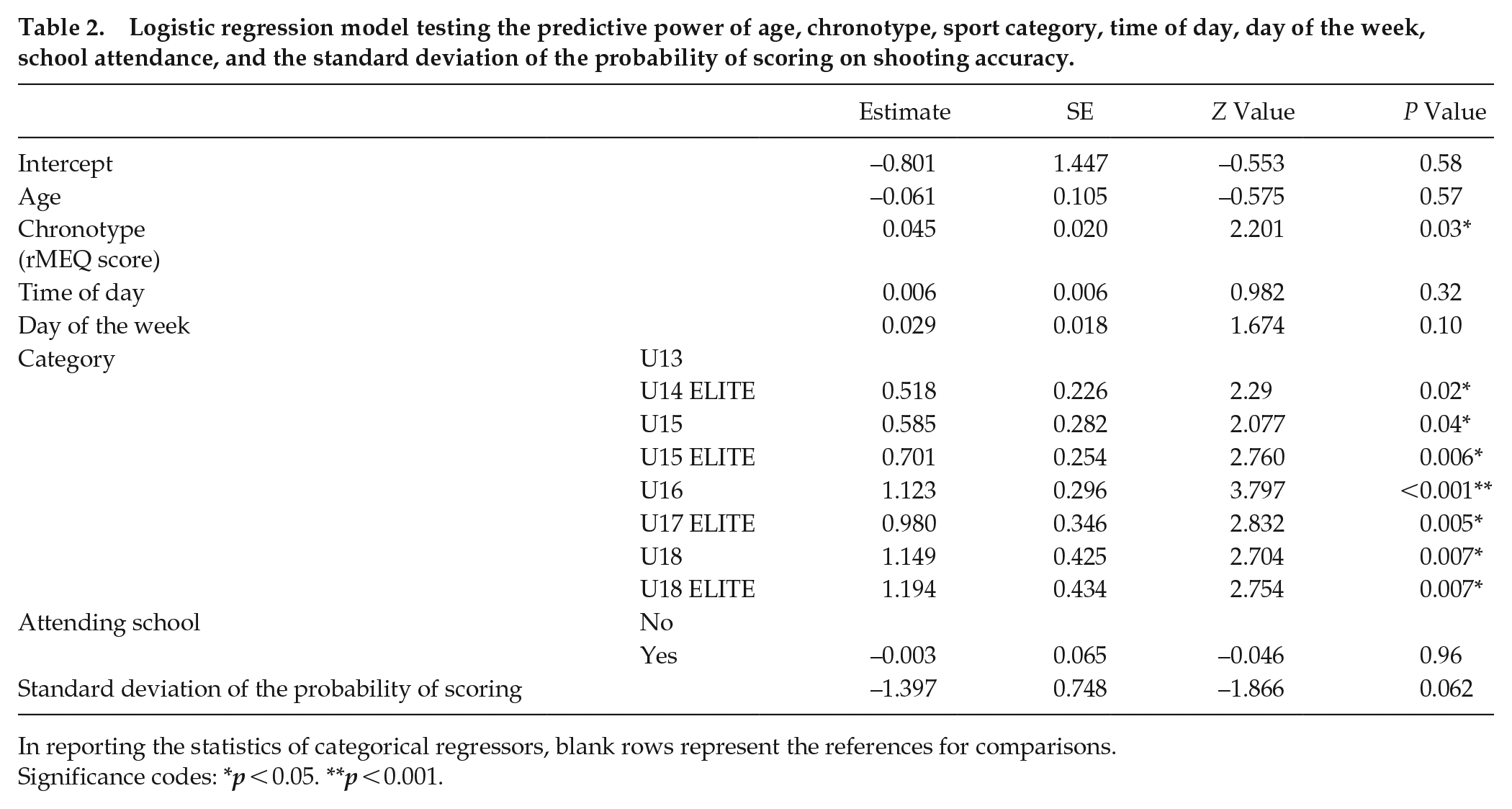
In reporting the statistics of categorical regressors, blank rows represent the references for comparisons.
Significance codes: *p < 0.05. **p < 0.001.
Table 3 summarizes regressors and samples of the models estimated in this study. All models were fitted considering shooting accuracy as dependent variable.
Predictors and samples of each random-effects logistic regression model fitted in this work.
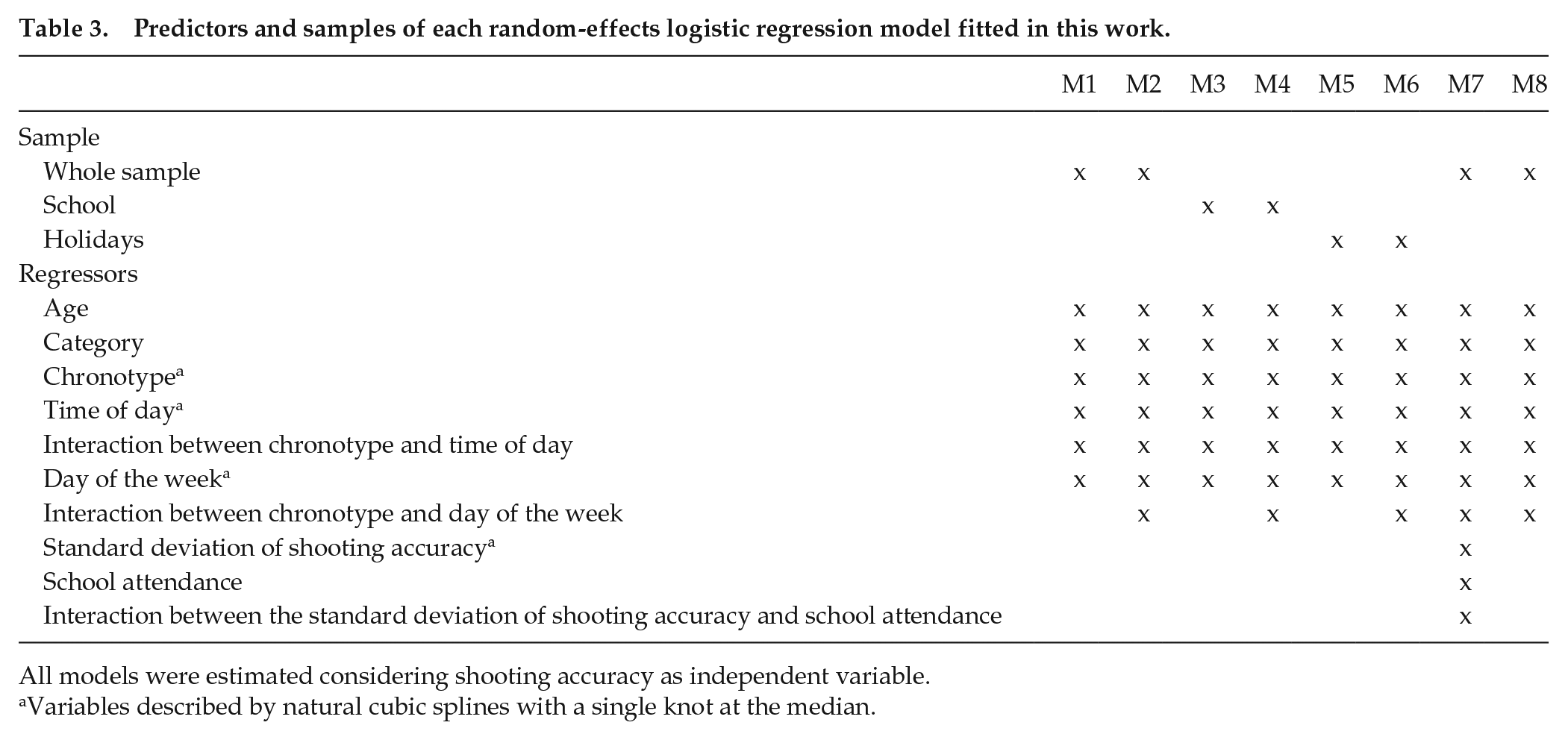
All models were estimated considering shooting accuracy as independent variable.
Variables described by natural cubic splines with a single knot at the median.
To further assess the role of chronotype and of its interaction with the day of the week in predicting scoring accuracy, we compared M1 and M2. The models were significantly different (p = 0.02), suggesting that chronotype significantly predicted sport performance interacting with the day of the week. Figure 1a illustrates the relationship binding chronotype, day of the week, and shooting accuracy in the whole sample.
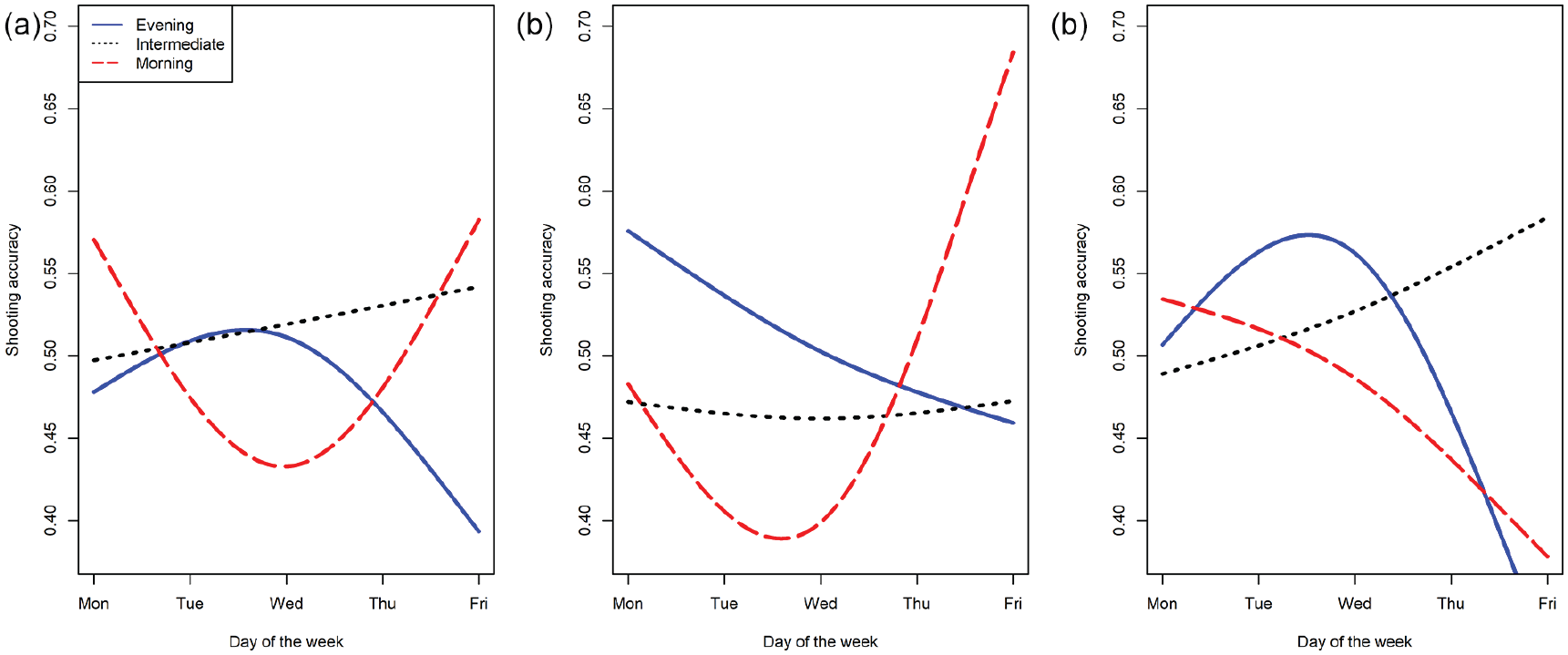
Chronotype, day of the week, and shooting accuracy. Figure 1 graphically displays the weekly performance trends of shooting accuracy predicted by our models in the whole sample (a), during the school period (b), and during the holiday period (c) for 3 rMEQ values (i.e., chronotype) representative of our sample distribution: the minimum (i.e., 10, Evening types), the median (i.e., 15, Intermediate types), and the maximum (i.e., 20, Morning types). Chronotype interacting with the day of the week significantly predicted sport performance in the whole sample (likelihood ratio test, p = 0.02; Figure 1a), during the school period (likelihood ratio test, p = 0.05; Figure 1b), but not on holidays (likelihood ratio test, p = 0.12; Figure 1c). Moreover, participants with the greatest propensity toward eveningness showed a weekly performance pattern consistent with a typical social jetlag weekly sleep pattern, but only when attending school (Figure 1b). Their shooting accuracy, in fact, gradually decreases throughout the week in parallel with their cumulative sleep debt; it achieves instead the peak on the first day after their free day (i.e., Sunday), when they had the chance to compensate for their school days’ chronic sleep restriction.
To clarify the role of school attendance in modulating the predictive power of chronotype on performance, we compared M3 with M4, and M5 with M6. Results showed that chronotype interacting with the day of the week held its predictive power only during the school period (p = 0.05), but not on summer holidays (p = 0.12). Figure 1b and 1c illustrates the relationship binding chronotype, day of the week and probability of scoring during the school period and during the holiday period, respectively.
To test the hypothesized influence of school attendance on SJL, and therefore on performance of participants in a training phase, we compared M7 with M8. Results showed that attending school predicted a significant drop in sport performance of participants with a high standard deviation of shooting accuracy (i.e., greater performance instability) (p = 0.02). Figure 2 graphically displays the relationship binding the predicted shooting accuracy and its standard deviation both during the school period and during the holiday period.
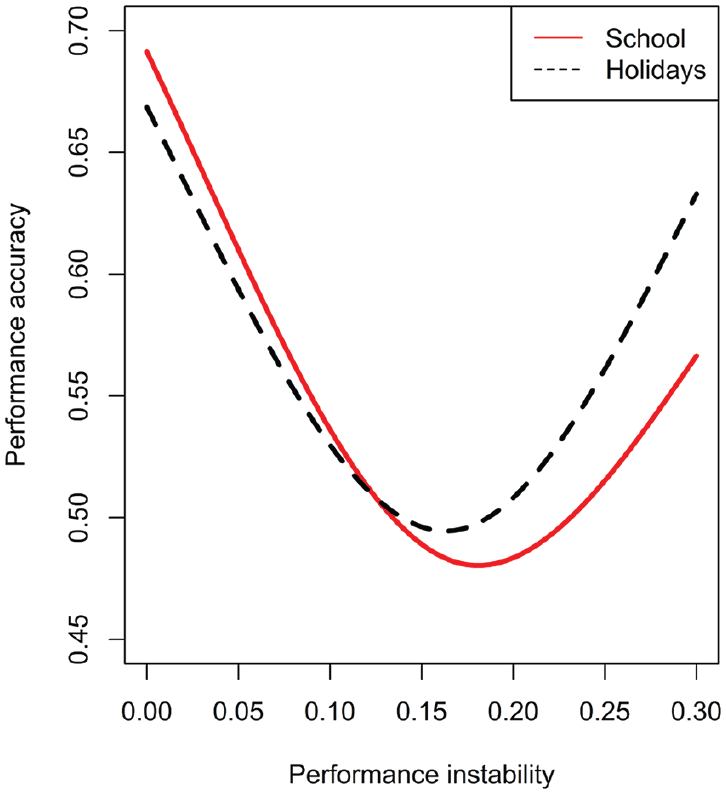
School, motor learning, and shooting accuracy. Figure 2 displays performance instability (standard deviation of the probability of scoring) and performance accuracy (probability of scoring) relationship during school period and during holiday period. Within the conceptual framework proposing motor learning as the acquisition of a motor scheme through practice, measured as the reduction of output variability, we considered performance instability as a proxy of learning. School attendance interacting with performance instability significantly predicted performance accuracy (likelihood ratio test, p = 0.02), suggesting that attending school did not equally affect the sport performance of participants in different learning phases. In particular, participants with a higher performance instability show a worse shooting accuracy during the school period compared with summer holidays. School-related chronic sleep deprivation interfering with motor learning processes might explain this finding.
To support our assumption that participants in school/holiday periods have different sleep/wake rhythms, we compared the actigraphy-derived metrics of participants who wore the device when attending school and of those who wore it on holiday. Overall, results suggest that on holidays participants experienced a delay in sleep/wake cycle (about 75 min, as measured both as the rest/activity acrophase and as the sleep debt–corrected midsleep point), which was paralleled by an increase in sleep duration (about 1 h), particularly apparent during weekdays. When attending school, participants increased sleep/wake cycle and rest/activity rhythm regularity while also increasing rest/activity fragmentation. Results are fully displayed in Table 4.
Descriptive statistics of actigraphy-derived sleep and circadian parameters in the whole sample and split by school/holiday periods.
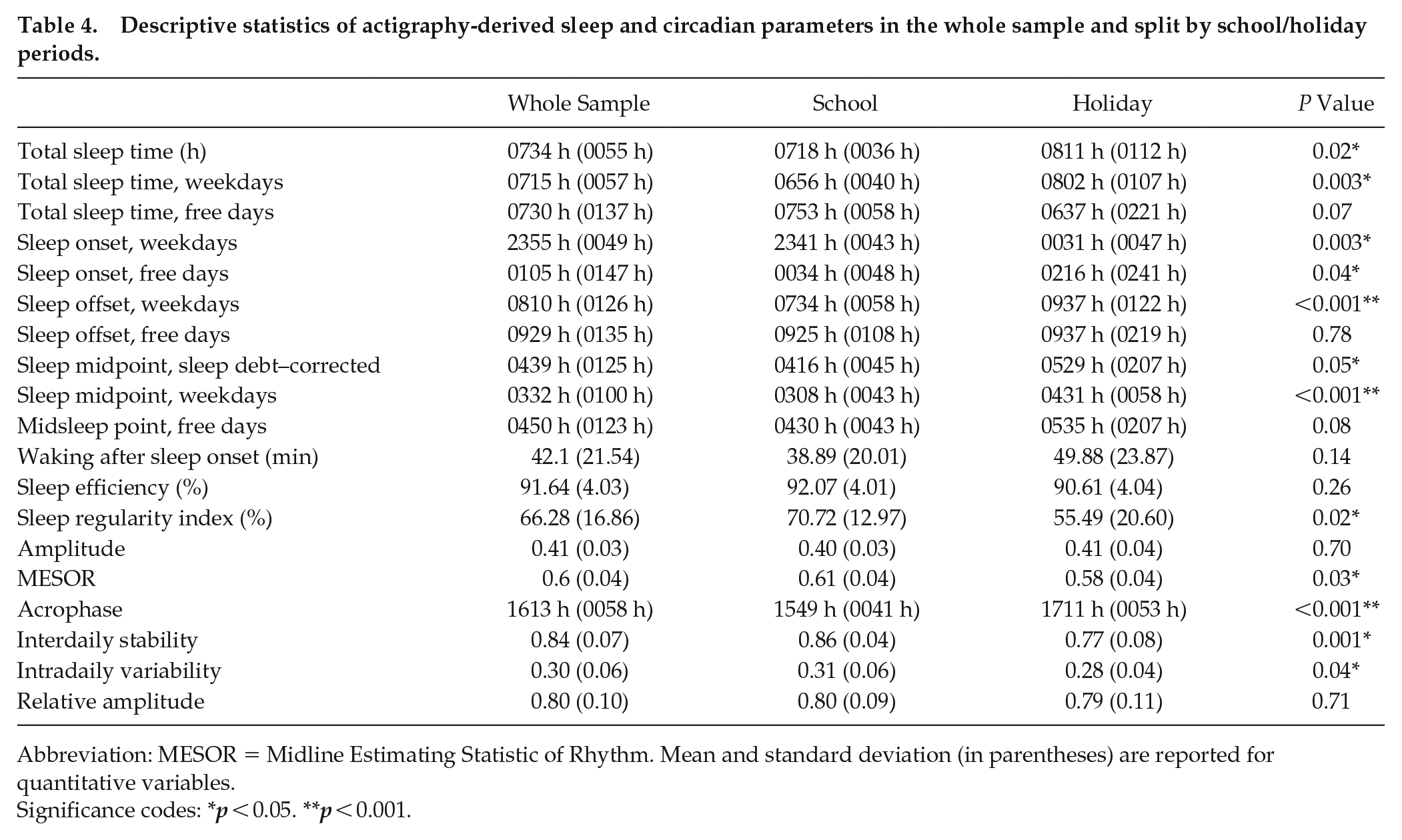
Abbreviation: MESOR = Midline Estimating Statistic of Rhythm. Mean and standard deviation (in parentheses) are reported for quantitative variables.
Significance codes: *p < 0.05. **p < 0.001.
Participants on average experienced 49 (41) min of SJL. To support our hypothesis that SJL might explain chronotype differences in sport performance across the days of the week, more specifically, that SJL might explain the decline in shooting accuracy from Monday to Friday associated with eveningness, we tested SJL correlation with both subjective (i.e., rMEQ score) and objective (i.e., sleep debt–corrected midsleep point and rest/activity rhythm acrophase) measures of circadian typology. SJL showed a negative, non-significant correlation with rMEQ score (r = −0.19, p = 0.30), a positive significant correlation with the acrophase (r = 0.30, p = 0.04), and a strong, positive, significant correlation with sleep midpoint (r = 0.80, p < 0.001). Although not fully conclusive, these results suggest that also in our sample eveningness is associated with a higher degree of SJL.
Discussion
In this study, we aimed at exploring the effect of chronotype and its interaction with the day of the week on sport performance in a sample of adolescent male basketball players, during both school and holiday periods. Moreover, we tested whether early SSTs might be particularly detrimental for participants in a training phase. Our results support the hypothesis that chronotype interacts with the day of the week in predicting performance only if participants follow an externally imposed sleep schedule (i.e., school attendance). We also found a drop in performance throughout the week in participants with the greatest propensity toward eveningness attending school, which is consistent with a cumulative sleep debt secondary to SJL. Finally, we observed a drop in the shooting accuracy of participants with a larger performance instability during the school period compared with the holiday period, thus confirming also our second hypothesis, claiming that school attendance, and the related chronic sleep deprivation, negatively interferes with motor learning.
Contrasting the nested models including or excluding chronotype and its interaction with the day of the week revealed a significant predictive power of the variables of interest on sport performance in the whole sample, only when considering participants attending school, but not when considering the same participants on summer holidays. This result suggests that the impact of chronotype in interaction with the day of the week on sport performance relies on externally imposed sleep/wake schedule. Moreover, taking into account the predicted values of chronotype, that is, rMEQ score, day of the week, and shooting accuracy, we showed that during the school period, participants with a greater propensity toward eveningness reached their performance peak on Mondays, whereas their shooting accuracy gradually decreased throughout the week reaching the minimum on Fridays. This weekly performance trend is absent in the same participants during the holiday period and in participants with a lower eveningness propensity during the school period, suggesting it is both chronotype- and school-related. The weekly performance pattern of participants with the lowest rMEQ score mirrored the typical SJL sleep pattern. Indeed, they achieved their best performance soon after their free days, after they had the chance to compensate for their chronic sleep deprivation. As the days of the week pass, sleep debt gradually accumulated again, causing cognitive and physical impairments (Suppiah et al., 2016) reflected by a decrease in shooting accuracy. The correlations between SJL and chronotype measures in the subsample that wore an actigraph, although not fully conclusive, seem to support our assumption. With respect to other circadian typologies, morning types showed a bimodal weekly performance pattern both in the whole sample and during the school period, with performance peaks on Mondays and Fridays. Participants with an intermediate rMEQ score, instead, seemed to be insensitive to the day-of-the-week effect. To the best of our knowledge, there is no strong theoretical background that could explain weekly performance fluctuations (or lack of fluctuations) across different chronotypes. However, Brooks and colleagues (Brooks et al., 2021) recently demonstrated, in a sample of young males, that morning types more effectively manage circadian rhythm transitions between free days and weekdays compared with evening types. Their findings might contribute to explain the shooting accuracy trajectories across the days of the week predicted by our model and their distribution according to rMEQ score. Indeed, it is possible that the performance peak showed on Mondays by both morning and evening types is due to the possibility of recovering on Sunday. As the days of the week pass, both morning and evening types pay, in terms of sport performance, the consequences of adjusting to the workday rhythm. Toward the end of the week, the differences between the most morning and the most evening participants become strikingly apparent. Having quickly adjusted to the new sleep/wake cycle, which is close to their individual preferences, morning types show an increase in shooting accuracy which peaks on Fridays; on the other hand, too slowly adapting to the new sleep/wake cycle, which works against their individual preferences, evening-type shooting accuracy keeps degrading, reaching the minimum on Fridays. Brooks et al. did not address intermediate-type sleep/wake cycle across the week. However, we might speculate that not having an extreme chronotype might make smoother the transitions between free day rhythm and weekday rhythm, which reflects on a more constant performance across the week. Further studies are required to explore whether more factors might contribute to explain weekly trends of sport performance according to chronotype.
The final models revealed a significant effect of the interaction between the standard deviation of the shooting accuracy across sessions and attending or not attending school in predicting the binary indicator of scoring. Several models of motor learning describe the acquisition of a motor scheme through practice as the reduction of output variability (Wu and Latash, 2014). It is thus likely that a high standard deviation of the shooting accuracy (i.e., an unstable performance) would identify participants who did not complete the acquisition of the free throw scheme. It is unlikely that attending school could directly interfere with learning processes. It is more probable that early SST acted as sleep and circadian disruptor for adolescents (Owens et al., 2014; Crowley et al., 2018), and that sleep disruption interfered with learning processes. Indeed, in the subsample that wore the actigraphs, participants on holiday slept on average 1 h more compared with participants attending school. In line with our result, 63.2% of a large sample of Suisse high school students declared their preference for a delay in SST of about an hour (Werner et al., 2022). Early SST-related insufficient sleep duration has been associated with poor academic performance in high school students (Wahlstrom and Owens, 2017). Conversely, several studies have proven the association between later SST and longer sleep duration (Gariépy et al., 2017), higher perceived quality of life (Lo et al., 2018), lack of SJL (Carvalho-Mendes et al. 2020), and improved academic performance (Wahlstrom and Owens, 2017) in adolescents from several countries. These results suggest that school schedule could be currently mismatched with students’ chronobiology, and that a delay in SST would grant them several benefits. Moreover, sleep plays a crucial role in motor learning consolidation (Walker et al., 2002). Sleep-related training-independent motor task proficiency improvements have been demonstrated for motor sequence tests (Walker et al., 2002), for motor adaptation tests (Huber et al., 2004), and, more recently, for gross-motor tasks, that is, real-life situations similar to the acquisition of abilities instrumental to optimize sport performance (Hahn et al., 2022). Early SST-related chronic sleep deprivation might hence interfere with students’ offline sport skill improvement, thus being accountable for their worse performance during the school period compared with the holiday period (i.e., when no external schedule determined sleep duration). If our interpretation is correct, this result would be consistent with previous works assessing the negative impact of SJL on learning and academic performance (Haraszti et al., 2014), translating this notion into the realm of sport science.
Our findings are based on a relatively large set of observations: the results of almost 8000 free throws have been fed into our models. Moreover, our study should be credited to be one of the few exploring the day-of-the-week effect in adolescence and, to the best of our knowledge, the only one stratifying for chronotype and focusing on sport performance. Before us, only Suppiah and colleagues (2016) reported that adolescent athletes’ reaction times in the second part of the week are slower compared with the reaction times in the first part of the week (Suppiah et al., 2016). Previous works focusing on individual chronobiology and basketball-specific skills, instead, mainly explored the effect of the interaction between chronotype and time of day (Pengelly et al., 2022). However, our study has limitations that should be discussed. To interpret our results, we made assumptions on participants’ sleep schedule. In particular, we hypothesized that on holidays participants had a longer sleep duration compared with school days and that evening types experienced a greater SJL compared with other circadian typologies. Even if our assumptions are solidly supported by the literature background, and also the actigraphic data we collected in a subsample of our participants seem to support them, these findings should have been coupled with a sleep/wake cycle monitoring in every student/athlete who took part in the study, making the interpretation partially speculative. Moreover, females were not included in the study, and we cannot exclude that SJL has gender-specific effects. Further investigations should assess the replicability of our results in a female sample. Finally, the difference between the time of day in which performance was addressed during school and holiday periods might have made comparisons a challenge. This difference is due to participants’ school schedule, which prevents them from engaging in sport activity in the morning during the school period. Nevertheless, this asymmetry in time-of-day distribution might have been a source of undesired heterogeneity, which we addressed by including the time of day and its interaction with chronotype as a regressor in our models. Adjusting the models for the time of day and its interaction with chronotype might have alleviated discrepancies in time-of-day distribution between school/holiday periods and improved generalizability of results .
In conclusion, the day of the week modulates chronotype predictivity on sport performance only if an externally imposed sleep schedule is present. Moreover, during the school period, evening types’ weekly performance pattern was consistent with their increased likelihood of experiencing SJL, suggesting that circadian misalignment negatively affects sport performance. Performance was also negatively affected by school attendance in participants who showed a highly fluctuating accuracy, confirming the role sleep plays in motor memory consolidation, in a naturalistic setting. Our results are in line with previous works demonstrating that, whenever possible, SST should be delayed to let students achieve a sufficient amount of sleep. Alternatively, sleep hygiene intervention aimed at advancing the circadian phase might allow a better match between students’ actual and preferred sleep timings. Finally, trainers and athletes should be aware that, according to chronotype, performance could be influenced by the day of the week, and not only by the time of day. Further investigations are required to assess whether later SSTs might improve sport performance along with other aspects of students’ life.
Footnotes
Acknowledgements
The present study was supported by Arpa Foundation (Sonnolab Grant to U.F.), by the Italian Ministry of Health Grant RC 1.21, and by the 5 × 1000 voluntary contribution to IRCSS Stella Maris.
Conflict of Interest Statement
The author(s) declared the following potential conflicts of interest with respect to the research, authorship, and/or publication of this article: U.F. is co-founder and president of sleepActa S.r.l., a spin-off company of the University of Pisa operating in the field of sleep medicine. All other authors declare no competing interest.
Data Availability
The data underlying this article cannot be shared publicly for the privacy of individuals who participated in the study. The data will be shared on reasonable request to the corresponding author.
