




Abstract
A robust body of evidence has demonstrated that the lunar cycle plays an important role in the reproduction of fish living in natural environments. However, little is known about the influence of the moon on tilapia reproductive activity in intensive fish farming systems. This study aims to evaluate the influence of the lunar cycle on the reproductive performance of tilapias in an intensive outdoor tropical production system in Latin America. Records of two tilapia strains (Nile tilapia [Oreochromis niloticus; n = 75] and Red tilapia [Oreochromis spp.; n = 1335]) reared in concrete tanks in a commercial fish farm were analyzed. Over a 3-year period, 60,136 captures were made in intervals of 12 to 14 days and 6,600 females were manually spawned. The number of females spawned and the volume of eggs collected from each tank (n = 9) were recorded. Data was analyzed by the general linear model and means were compared by least squares means method. A very slight or no variation was observed when the lunar cycle was split into two halves (crescent and waning). The proportions of females spawned and the volume of eggs per spawned female and per female in the tank varied considerably across the eight periods of the lunar cycle, with greater values in the waning than in the crescent phase. A significantly greater proportion of tilapia spawned and yielded more eggs around the full moon than around the new moon and remaining days of the lunar cycle. The moon cycle affected the reproductive activity of tilapia, which were more reproductively active around the full moon and most of the waning phase.
All life forms have adapted over time to different geophysical cycles (Raible et al., 2017), and usually have endogenous clocks that respond to the changes in light, temperature, and other environmental cues (Pittendrigh, 1993). Adapting to these changes occurs rhythmically in the environment and helps living beings adjust their biochemical, physiological, and behavioral processes (Pittendrigh, 1993). The lunar cycle has been observed to influence a broad range of organisms from different taxonomic groups, ranging from insects and fish to birds and mammals (Zimecki, 2006).
The moon’s biological clocks consist of circalunar (29.5 days) and circasemilunar (14.75 days) rhythms, which are important factors modulating the reproductive activity and behavior of most marine animals (Raible et al., 2017). This is a direct result of the lunar cycle’s correlation to both light availability and tidal fluctuations (Hanson et al., 2008). Out of these factors, the moonlight’s intensity and geomagnetic fields peak around the full and last quarter of the moon cycle, while the gravitational pull and tidal amplitude peaks during the new and full moon (Ikegami et al., 2014).
Research performed on numerous species of fish has shown physiological fluctuations influenced by the moon’s rhythm and its relationship to hormonal changes (Zimecki, 2006). Likewise, the abundance of certain species has been shown to change throughout the lunar cycle, whether they are most abundant during the full moon (sardines, mackerel), or new moon (barracuda, tuna) (Libini and Khan, 2012). The lunar cycle has also been linked to behavioral changes in arctic zooplankton, causing waves of vertical migration during the full moon phase in Winter, emphasizing the significance of moonlight as a light stimulant in that period (Last et al., 2016).
While many marine species respond to tidal changes, in aquatic animals that inhabit ecosystems with constant water levels, the occurrence of biological rhythms influenced by the lunar cycle has also been observed (Schwanck, 1987). In the European eel (Anguilla anguilla), it was documented that the downstream spawning migration is set off during the last quarter to the new moon, where the light availability is at its lowest (Miyai et al., 2004). A study in the freshwater cichlid fish (Neolamprologus pulcher) from Lake Tanganyika showed that female breeders developed more gonads, while male breeders exhibited an increase in androgens and sperm swimming speed during the first quarter moon (Desjardins et al., 2011). Some patterns also suggested that this species spawns just before or around the full moon (Desjardins et al., 2011).
Tilapia is the common name given to a group of freshwater tropical fish from the Cichlidae family, native to Africa and the southwestern Middle East, which due to the high tolerance to a variety of environmental conditions, and their importance as a source of protein, are intensively produced around the world as a food source for human consumption (Canonico et al., 2005). According to feeding and reproductive habits, tilapia species have been taxonomically classified into three genera: Tilapia, Sarotherodon, and Oreochromis. The latter genus includes the most commonly used species in intensive production: Oreochromis aureus (blue tilapia), O. niloticus (Nile tilapia), O. mossambicus (Mozambique tilapia), O. uroleps hornorum (Tilapia hornorum), and their hybrids (El-Sayed, 1999). Red tilapia is the product of crossing female O. mossambicus with a male O. niloticus (Hilsdorf, 2018).
In general, all Oreochromis genus species are mouth brooding. This is a reproductive strategy consisting in incubating the eggs inside the female’s mouth for several days once fertilization occurs, usually until the larval stage (Zimmermann, 2005). Once the males fertilize the eggs, the females collect them inside the mouth, leave the mating area and start the mouth incubation. During that time, Oreochromis females do not feed or eventually do with a few eggs or larvae, which leaves the female in a starved state, requiring many days of recovery before female tilapia can mate again (Zimmermann, 2005). Under intensive production conditions, tilapia spawning is periodically performed by hand to produce uniform groups of fingerlings. No studies were found on the effect of the lunar cycle on the reproductive activity of tilapia under intensive production systems. However, tilapia reared in glass aquaria (Oreochromis niloticus) or in a clear-water stream (Tilapia marinae) showed variation in spawning frequency by the influence of the moon (Schwanck, 1987; Kwon et al., 2010).
This study aimed to assess the influence of the lunar cycle on some reproductive features of tilapias (Oreochromis sp.) reared in an intensive outdoor tropical production system in Latin America.
Material and Methods
Study Location
This retrospective study was conducted in a fish farm located in Trujillo state, Venezuela, in a tropical dry forest area, at 45 meters above sea level. The annual average temperature and relative humidity were 29°C and 71%, respectively, whereas the annual rainfall averaged 1675.5 mm.
Fish Management
To evaluate the influence of the lunar cycle on reproductive performance, 852 records from two tilapia strains: Nile tilapia (Chitralada variety; O. niloticus; n = 73; 50 females and 23 males) and Red tilapia (Oreochromis spp.; n = 1335; 807 females and 528 males) over 3 years (2009-2011) were analyzed. Female weight averaged 312 ± 67 and 293 ± 67 g for Nile and Red tilapias respectively. Male weight averaged 352 ± 61 and 372 ± 35 g for Nile and Red variety respectively.
During the period studied, 60,136 captures were performed and 6,600 tilapia were manually spawned. Females and males broodstock were located in 9 rectangular concrete tanks (45 m3 each) exclusive for reproduction. A water flow rate of 50 L/min was used for each tank to renew 25% of water volume daily. In addition, a continuous aeration rate was maintained by a 2.5 HP blower (Sweetwater, Model S53-C, Pentair, USA). Water quality parameters were also monitored daily, with the following averages: oxygen, 5.18 ± 0.88 mg/L; temperature, 28.2 ± 0.36 °C; pH, 7.56 ± 0.09; turbidity, 38.2 ± 0.96 cm.
During the 3 years of study, the breeding stock was fed four times a day with a commercial feed (28% protein, 3% fat), and a mixture of Scott’s and Pentavival’s emulsion was added to the ration. The reproductive management was similar between strains, and for each one, the procedure consisted of stocking in broodstock in an approximate female-male ratio of 2:1. The female-male ratio averaged 1.70 ± 0.75, although varied slightly between tanks and over time.
Every 12-14 days (12.6 ± 4.1 days), all females were captured in the tanks with a nylon stell net with a mesh size of 2.5 mm, and the females were individually observed to determine the presence or absence of eggs or larvae inside the mouth. When eggs were detected in the mouth, a mouthwash was used to collect the eggs in plastic bowls. The volume of eggs manually spawned from each tank was measured in graduated cylinders (50 ml, 100 ml, and 250 ml according to the volume of eggs collected in each tank) and recorded. The number of female broodstock with and without eggs or larvae inside the mouth and the number of male broodstock on each evaluation day were recorded. For purposes of this study, the volume of larvae was not considered because under the experimental conditions the total capture of larvae could not be guaranteed.
Lunar Cycle Information
Data from the moon cycle on this region was obtained from the website http://.aa.usno.navy.mil/data/docs/MoonFraction.html. According to the luminosity percentage of the moon, the lunar cycle (29.53 days long) was split into two segments (crescent: from new moon to full moon, and waning: from full moon to new moon). In addition, the lunar cycle was split into eight periods: (1) from new moon to waxing crescent, (2) from waxing crescent to first quarter, (3) from first quarter to waxing gibbous, (4) from waxing gibbous to full moon, (5) from full moon to waning gibbous, (6) from waning gibbous to third quarter, (7) from third quarter to waning crescent, and (8) from waning crescent to new moon (~3.7-day length each) (https://solarsystem.nasa.gov/moons/earths-moon/lunar-phases-and-eclipses/). To better appreciate the influence of the moon cycle on the reproductive events, the lunar cycle was divided into three phases: (1) ~ 3.7 days before and 3.7 days after new moon (0% moonlight; 7.4 day length); (2) ~ 3.7 days before and 3.7 days after full moon (100% moonlight; 7.4 day length); and (3) remaining days of lunar cycle (14.7 day length). The study covered 37 lunar cycles during 3 years.
Variables Studied and Statistical Analysis
Variables analyzed were the volume of eggs per spawned tilapia (volume of eggs collected from each tank divided by the total number of spawned females in the tank); volume of eggs per total number of tilapia in tank (volume of eggs collected in each tank divided by the total number of females in tank); and percentage of females with eggs in the mouth (number of tilapia with eggs in the mouth divided by the total number of tilapia in the tank in each period of the lunar cycle × 100).
Data were analyzed by the general linear model (GLM), and means were compared using the least-squares means test of Statistical Analysis System (SAS®; Version 9.3; SAS Institute, Inc., Cary, NC, USA). The effects of the lunar cycle, tank (n = 9), year (2009-2011), season (established by accumulated rainfall [mm] as dry: January-April [337.5 mm], intermediate: May-August [485.0 mm] and humid: September-December [853.0 mm]), and interactions were included in the statistical model. The effect of strain was included as tank effect because the two varieties occupied different tanks. Significance was considered as p < 0.05, and p values between 0.051 and 0.1 were considered as tendency.
Results
The volume of eggs in the mouth per spawned female averaged 6.8 ± 0.3 ml and was affected by moon cycle (p < 0.0001), tank (p < 0.0001), season (p = 0.0229), year (p < 0.0001), and by interactions moon cycle × tank (p < 0.0001), moon cycle × season (p = 0.0028) and moon cycle × year (p = 0.0002). This variable showed important fluctuations during the lunar cycle, with values lower than 7 ml of eggs in periods 1 to 4, and two peaks greater than 9 and 11 ml of eggs in periods 5 and 7 respectively (Figure 1). The volume of eggs per spawned female was 0.8 percentage points greater in the waning than in the crescent phase of the moon cycle (7.2 ± 0.3 v. 6.4 ± 0.3 ml respectively; p = 0.1132).
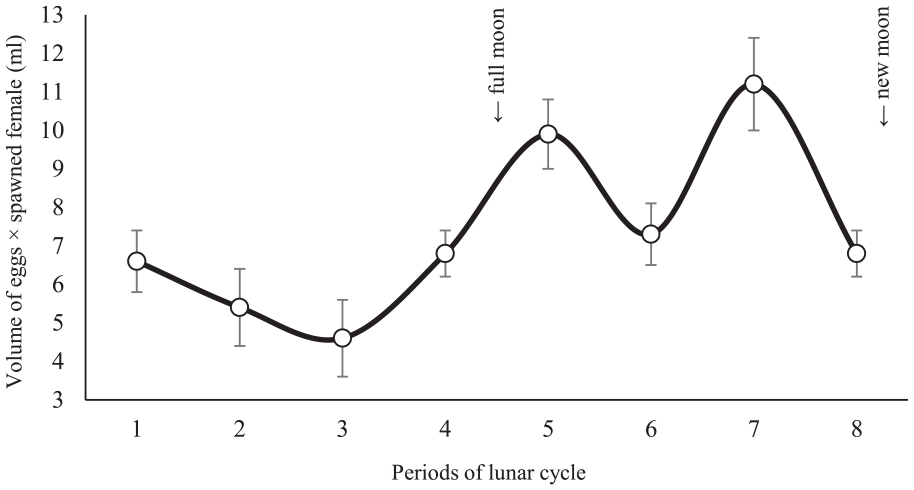
Variation of egg volume in the mouth per spawned tilapia over 8 periods (~3.7 days each) of the lunar cycle (Mean ± EE). Different number differ: 1-5 p = 0.0048; 1-7 p = 0.0013; 2-5 p = 0.0007; 2-7 p = 0.0002; 3-4 p = 0.0543; 3-6 p = 0.0418; 3-8 p = 0.0596; 3-5; 3-7 p < 0.0001; 4-5 p = 0.0043; 4-7 p = 0.0012; 5-6 p = 0.0317; 5-8 p = 0.040; 6-7 p = 0.0077 (p < 0.0001 for the main effect of the lunar cycle in the general linear model).EE: Standard error of the mean.
The volume of eggs per total tilapia in the tank averaged 0.61 ± 0.3 ml and was affected by moon cycle (p = 0.0009), tank (p = 0.0512), season (p < 0.0001) year (p < 0.0001), and by interactions moon cycle × tank (p = 0.0011), moon cycle × season (p < 0.0001), and moon cycle × year (p < 0.0001). The average values of this variable were < 0.65 ml during periods 1 to 4, increased above 0.79 ml in periods 5 to 8, with two peaks above 1 ml in periods 5 and 7 (1.25 ± 0.09 v. 1.12 ± 0.12 ml respectively), and decreased abruptly in period 8 of the lunar cycle (Figure 2). The volume of eggs per total tilapia in tank was greater in waning than in the crescent phase of the lunar cycle (0.67 ± 0.03 v. 0.55 ± 0.03 ml, respectively; p = 0.0103).
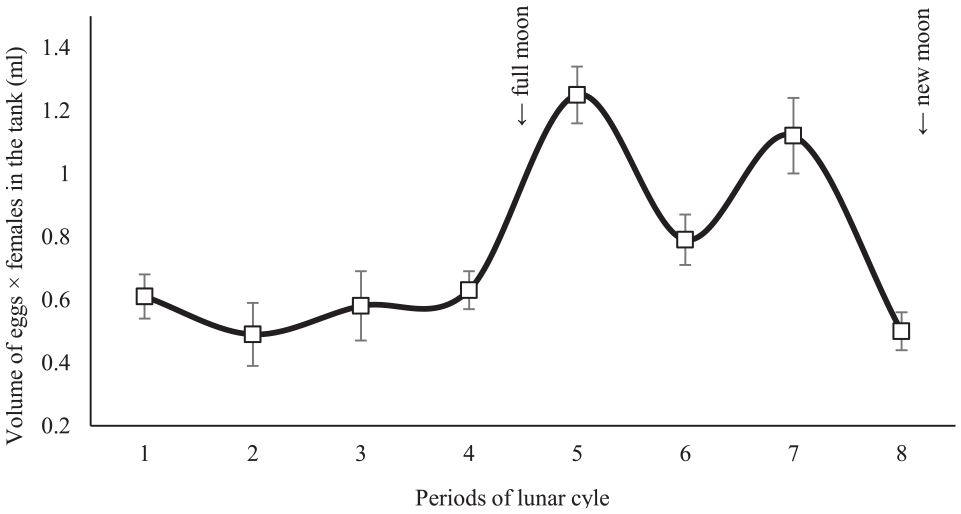
Variation of egg volume in the mouth per total tilapia in the tanks over 8 periods (~3.7 days each) of the lunar cycle (mean ± EE). Different number differ: 1-5; 2-5; 3-5; 4-5; 2-7; 5-8; 7-8 p < 0.0001; 1-7; 4-7: 5-6 p = 0.0004; 2-6 p = 0.0313; 3-7 p = 0.0010; 6-7 p = 0.0278; 6-8 p = 0.008 (p < 0.0001 for the main effect of the lunar cycle in the general linear model). EE: Standard error of the mean.
The percentage of females with eggs in the mouth averaged 10.0 ± 0.4 and was affected by moon cycle (p = 0.0004), tank (p = 0.0168), season (p < 0.0001) year (p < 0.0001), and by interactions moon cycle × tank (p = 0.0401), moon cycle × season (p < 0.0001) and moon cycle × year (p < 0.0001). This reproductive parameter ranged from 9.3% to 10.9 % in the first four periods of the lunar cycle, reached maximum values in period 5 (14.8 ± 1.1 %) and 7 (12.8 ± 1.4 %), and decreased to a minimum value in period 8 (8.7 ± 0.7 %) (Figure 3). The percentage of tilapia with eggs in the mouth did not differ between crescent (9.7 ± 0.4%) and waning (10.4 ± 0.4 %) phases of the lunar cycle (p = 0.2486).
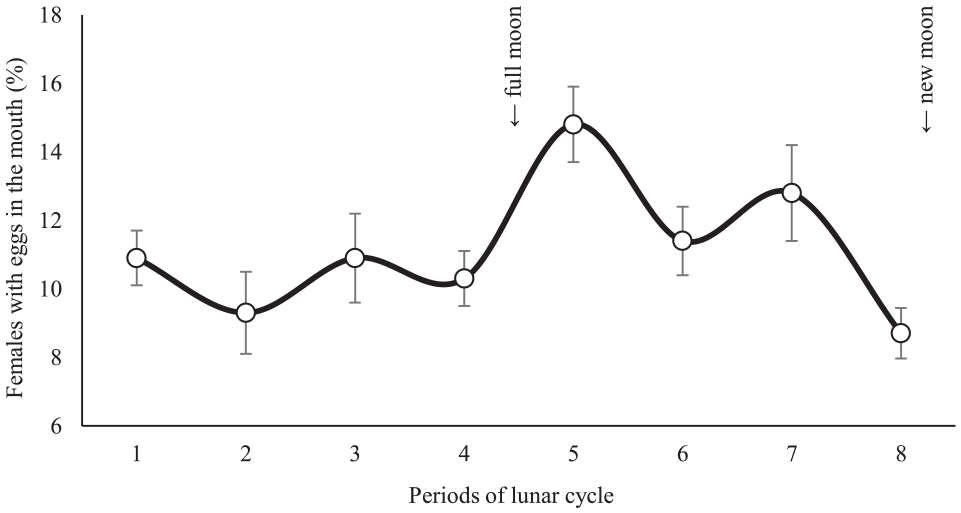
Proportions of tilapia with eggs in the mouth throughout 8 periods (~3.7 days each) of the lunar cycle (mean ± EE). Different number differ: 1-2, 1-5, 1-5, 1-8; 2-4; 3,4 p < 0.0001; 1-4 p < 0.02; 2-5; 3-5; 2-8; 3-8; 4,7; 4-8 p < 0.01; 2-7; 3-7; 4-5 p < 0.05 (p = 0.0009 for the main effect of the lunar cycle in the general linear model). Number of tilapia with eggs in the mouth divided by the total number of tilapia in the tank for each period of the lunar cycle × 100. EE: Standard error of the mean.
A significant greater proportion of females spawned 7.4 days around the time of full moon (phase 2) (p < 0.001) than those spawning around the new moon (phase 1) or in the remaining days of the lunar cycle (phase 3). Furthermore, tilapia spawned around the full moon yielded a significant greater egg volume (per spawned female and per total female in the tank) than those spawned around the new moon (phase 1) or through the remaining days of the lunar cycle (phase 3) (Table 1).
Effect of the moon cycle on egg production per female and the proportion of tilapia with eggs in the mouth.
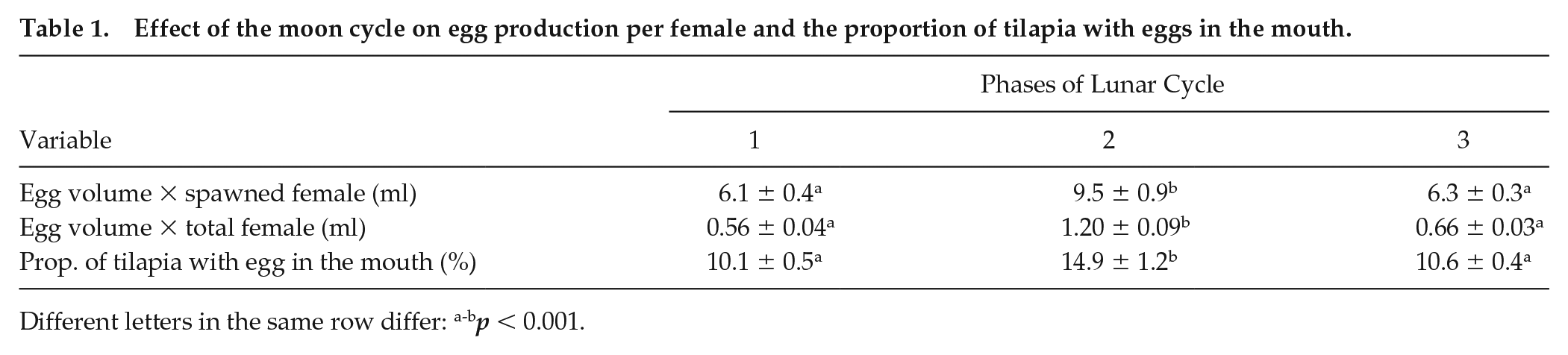
Different letters in the same row differ: a-bp < 0.001.
Discussion
This investigation assessed the influence of the lunar cycle on some reproductive variables of tilapia under intensive tropical production conditions. The results showed important variations of the reproductive variables across the lunar cycle. A very slight or no variation was observed when the lunar cycle was split into two phases. However, considering the eight periods of the lunar cycle, reproductive activity fluctuated considerably and was greater in the waning than in the crescent phase of the moon cycle. Furthermore, a greater proportion of tilapia spawned a greater volume of eggs around the full moon than on the remaining days of the lunar cycle.
While there is abundant information about the influence of the lunar cycle on the variation of reproductive activity in fish (reviewed by Ikegami et al., 2014), including some biological and molecular basis for such variation (reviewed by Ikegami et al., 2014; Andreatta and Tessmar-Raible, 2020), little or no published information is available on the effect of the moon cycle on the reproductive activity of tilapia under intensive fish-farming systems in tropical areas.
Two studies on the influence of the moon on tilapia reproduction have been found, but none under intensive production conditions. In a 2-year study in Nile tilapia (Oreochromis niloticus) reared in glass aquaria (n = 27), spawnings events were less frequent (15 ± 5.6) in the period of greater darkness of the moon (~3 days before and after new moon) than in the remaining days of the lunar cycle (22.9 ± 5.6) (Kwon et al., 2010). In a clear-water stream of Nigeria, Tilapia marinae, a substrate-breeding fish, showed lunar periodicity in reproductive activity over a 9-weeks study (Schwanck, 1987). An estimated 1200 tilapia females laid eggs more frequently (268/314 batches of eggs; 85.3%) in the 6 to 0 days before full moon, that is, in the last 6 days of the crescent phase of the lunar cycle (Schwanck, 1987). In agreement with the aforementioned findings, Okorie (1973) cited by Schwanck (1987) found greater proportions of Nilotic tilapia females (northern area of Lake Victoria, Uganda) in advanced gonadal stages in full moon than in new moon. These reports are consistent with some findings of our research. In this study, we found greater reproductive activity in the phase around full moon than in the other phases of the lunar cycle. Evidence under natural (Schwanck, 1987, controlled (Kwon et al., 2010) or intensive production conditions (this study) indicating more spawning events just before or during full moon, or in periods of greater moonlight may represent a strategy allowing better parental care during the critical phases of development of the younglings (Schwanck, 1987). This is the case for several other species of clearwater fish (Rossiter, 1991; Nakai et al., 1990).
The current study provides more detailed information on the reproductive performance of tilapia throughout the lunar cycle. Based on the 8 periods of the moon cycle, we found a pattern in which tilapias were reproductively more active during the period immediately following the full moon. During the waning phase of the lunar cycle, a greater proportion of tilapia were observed to have a greater volume of eggs in their mouths than during the crescent phase. It is noteworthy that the two peaks of maximum reproductive activity in periods 5 and 7 were followed by a drop in periods 6 and 8. It is important to consider that tilapia reproduce throughout the year, and under hatchery conditions have an asynchronous spawning behavior (Rana, 1988). Likewise, the interval between spawnings varies between 2 and 7 weeks depending on several factors, such as photoperiod, temperature, rainfall, density, and so on. (Coward and Bromage, 2000). Variation in spawning intensity was also observed regardless of the moon influence when manual spawning was performed at 7-day intervals (Perdomo-Carrillo et al., 2017). It is likely that because the female tilapia in each tank were at different stages of the reproductive cycle, they spawned at different times during the lunar cycle. This body of evidence may explain the variation in the tilapia’s reproductive performance, which was very pronounced in the waning phase of the lunar cycle and less evident in the crescent phase.
It is also important to highlight the interactions observed in this study between the lunar cycle and other factors such as year, season, and tank. In a previous study, a significant effect of these factors on the reproductive performance of tilapia was found (Perea et al., 2017), and might account the combined effect of these factors with that of the moon cycle.
Differences in the reproductive performance of Red and Nile tilapia have been previously reported (Perea et al., 2017; Perdomo-Carrillo et al., 2020). In our study, the two varieties of tilapia were in different tanks, which might explicate the effect of the interaction between the lunar cycle and the tank factor. Also, the age of the females (Ridha and Cruz, 1989), differences in the stocking density (Bautista et al., 1988), the female to male ratio (Akar, 2012), and the proportion of large and small females (Perdomo-Carrillo et al., 2020) among tanks, may have contributed to such effect.
Tilapia in a natural environment or under an intensive fish-farming system, both in the tropics, were more reproductively active in the drier and less warm season of the year (Admassu, 1996; Perea et al., 2017). In this study, the reproductive activity of tilapia showed considerable variability due to the moon’s influence in all three seasons; however, this effect was more evident in season 1 (January to April), when rainfall levels were lower, the wind speed was greater, and days cooler (Perea et al., 2017).
Patterns of spawning activity may vary by lunar influence even in fish species of the same genus (Takemura et al., 2010). Thus, marine fish species show synchronization with different phases of the moon. For instance, the golden rabbitfish (Siganus guttatus) (Takemura et al., 2004) and labyrinth rabbitfish (Siganus vermiculatus) (Popper et al., 1976) synchronize spawning with the first quarter of the moon, the forktail rabbitfish (Siganus argenteus) (Taylor et al., 2017) with the full moon, and spiny stickleback rabbitfish (Siganus spinus) (Harahap et al., 2001) and marine meadow rabbitfish (Siganus canaliculatus) (Hoque et al., 1999) with the new moon. In addition, variation in moonlight intensity possibly caused gonadal development and spawning during certain periods of the lunar phase (Takemura et al., 2004). Measurements of weekly changes in plasma steroids showed an increase in levels near the first quarter of the lunar cycle (Rahman et al., 2000).
In our study, the precise time of spawning was not identified. Reproductive activity was assessed by the presence and volume of eggs in the mouths. The stage of egg development was not determined either. As the female tilapia (Oreochromis spp) carry eggs in their mouths for 10-12 days, it is plausible that spawning occurred sometime during that time range. It is probably irrelevant to compare the spawning activity of fish in natural conditions and under intensive fish-farming systems. What is important to remark is the modulation of reproductive activity of fish by the influence of the lunar cycle, regardless of rearing conditions and location. However, it must be considered that in this case the tilapia females were subjected to a manual spawning regime of 12-14 days, to obtain uniform batches of fingerlings for commercial purposes. This manipulation with productive goals may have modified the spawning pattern compared to fish found in natural environments.
The biological basis of lunar influence on reproductive activity has been studied in depth in several fish species. Melatonin, a hormone proposed as a possible transducer in lunar rhythmicity of reproductive functions in fish, reached maximum plasma levels during the new moon (Takemura et al., 2004). Also, exposing the isolated pineal gland to moonlight during the full moon period suppressed melatonin synthesis (Takemura et al., 2006). Apparently, certain clock genes are involved in lunar rhythmicity (Ikegami et al., 2014), because weekly changes in mRNA abundance of Cry1 and Cry3 in the medial part of the brain showed a lunar phase variation, with low levels occurring around the full moon and high levels occurring around the first quarter moon (Sugama et al., 2008). In addition, abrupt interruptions of moonlight around the waxing gibbous moon upregulated nocturnal expressions of Cry1b and Cry2 in the diencephalon and pituitary gland, respectively, but did not affect expression levels of the other clock genes (Takeuchi et al., 2018). The moonlight and the earth’s geomagnetic field vary at a monthly interval, with maximum values at full moon and waning quarter moon respectively. The gravitational pull and the tide amplitude fluctuate nearly every 15 days, and are most intense at full moon and new moon. Apparently, one or more of these factors could cause changes in the pattern of melatonin secretion and gene expression associated with the variation of spawning frequency in fish (Ikegami et al., 2014).
Findings of this study may have practical implications for intensive tilapia production systems. As indicated, the efficiency of this fish-farming system involves regular manual spawning to maximize uniform egg and fry production, therefore, spawning could be timed to take advantage of the days of the lunar cycle favoring reproductive activity in this species. Furthermore, as the egg production in tilapia is also influenced by daylight length (Ridha and Cruz, 2000), season (Perea et al., 2017), and female to male ratio (Akar, 2012), consideration of these factors when scheduling the spawning regime could improve brood yield throughout the year.
As little is known about the influence of lunar cycle on fish reproduction under intensive production conditions, further research is needed. Available information on the influence of the moon on tilapia is scarce and not very detailed. Findings from this study are consistent with published data on the effect of the moon on tilapia reproductive activity. It must be considered that in intensive farming systems tilapia have better living conditions, as they are fed artificially, there is no predation in tanks and eggs are manually removed before mouthbrooding is complete, which has direct effects on spawning frequency. This may have changed the reproductive activity pattern in fish under these rearing conditions.
In conclusion, volume of eggs and proportions of female tilapia with eggs in the mouth were influenced by the moon, and show important fluctuation throughout the lunar cycle. Generally, tilapias were reproductively more active during the waning phase of the lunar cycle.
