



Abstract
It has been suggested that the timing of pollination in Ephedra foeminea coincides with the full moon in July. The implication is that the plant can detect the full moon through light or gravity and that this trait is an evolutionary adaptation that aids the navigation by pollinating insects. Here we show that there are insufficient data to make such a claim, and we predict that pollinations of E. foeminea do not in general coincide with the full moon.
Rydin and Bolinder (2015) observed peak pollination dates of Ephedra foeminea in Asprovalta, Greece, in 2011, 2012, and 2014. They performed a linear regression between 3 pairs of points recording the day of month (DOM) of the July full moon (x = 3, 12, 15) and of the peak of pollination (y = 1, 11, 14). The linear regression equation is y = −2.23077 + 1.08974*x. The authors relied on the correlation coefficient (r2 = 0.9996, p = 0.013) to claim an association between pollination and the full moon. However, the significance of the correlation coefficient in this context is meaningless. If pollination had occurred at other times (e.g., DOM 6, 24, 30), the correlation coefficient would indicate a perfect correlation (r2 = 1) despite the lack of any association with the full moon (i.e., DOM 3, 12, 15).
To properly assess the coincidence of an event with the full moon, a useful metric is the unsigned time interval Δ in fractional days between the event and the preceding or subsequent full moon. (A DOM time scale is not robust with respect to month boundaries or daylight savings time.) We can use the following notation to represent the authors’ data:
Likelihood of Observed Coincidence
The duration of the lunar cycle at the time of observations never exceeded 29.5 d. Therefore, Δ can take 1 of 15 values between 0 and 14. Let us draw 3 integers between 0 and 14 with replacement and calculate the corresponding value of
Impact of Missing 2013 Data and Future Observations
Rydin and Bolinder (2015) did not report a pollination date for 2013. In the absence of additional information, we can only assume that the corresponding Δ would take 1 of 15 values between 0 and 14. All 15 situations have an equal probability of 1/15, such that consideration of the missing 2013 data does not affect the overall probability of 1/96, as expected. If an additional data point becomes available, we can show that 4 outcomes
Observational Uncertainties
Although the authors did not specify uncertainties for the timing of the pollination peaks, the language in their article suggests that the uncertainty is no less than a day. (In 2011, “drop production peaked during the next couple of days.” In 2012, “production peaked during the first days of July.” In 2014, “peaked during this day and the next few days.”) How do these uncertainties affect the results? An offset of a single day in any one of the three observations yields
File Drawer Effect
Rydin and Bolinder (2015) reported a result that seemed, at face value, unlikely to be due to chance alone (i.e., 1/96, ignoring observational uncertainties). They may very well have “detected” an effect that is not present (a type I error). Studies affected by type I errors tend to be overrepresented in the literature because the studies that fail to show a connection are more likely to remain unpublished—a publication bias known as the file drawer effect. To evaluate the significance of the coincidence observed by Rydin and Bolinder (2015), the important question is not whether 1/96 is much less than 1 but whether N/96 is much less than 1, where N is the total number of similar studies in which a coincidence with the full moon could have been noticed or reported. The vast literature on plant phenology indicates that N/96 is larger than 1. One would therefore expect to see several instances of excellent correspondence between plant development phases and lunar phases, even if the moon has absolutely no effect on plants.
Examples of False-Positives
Table 1 lists the coincidence with the full moon, as measured by the
Phases in plant development and correspondence with the full moon.
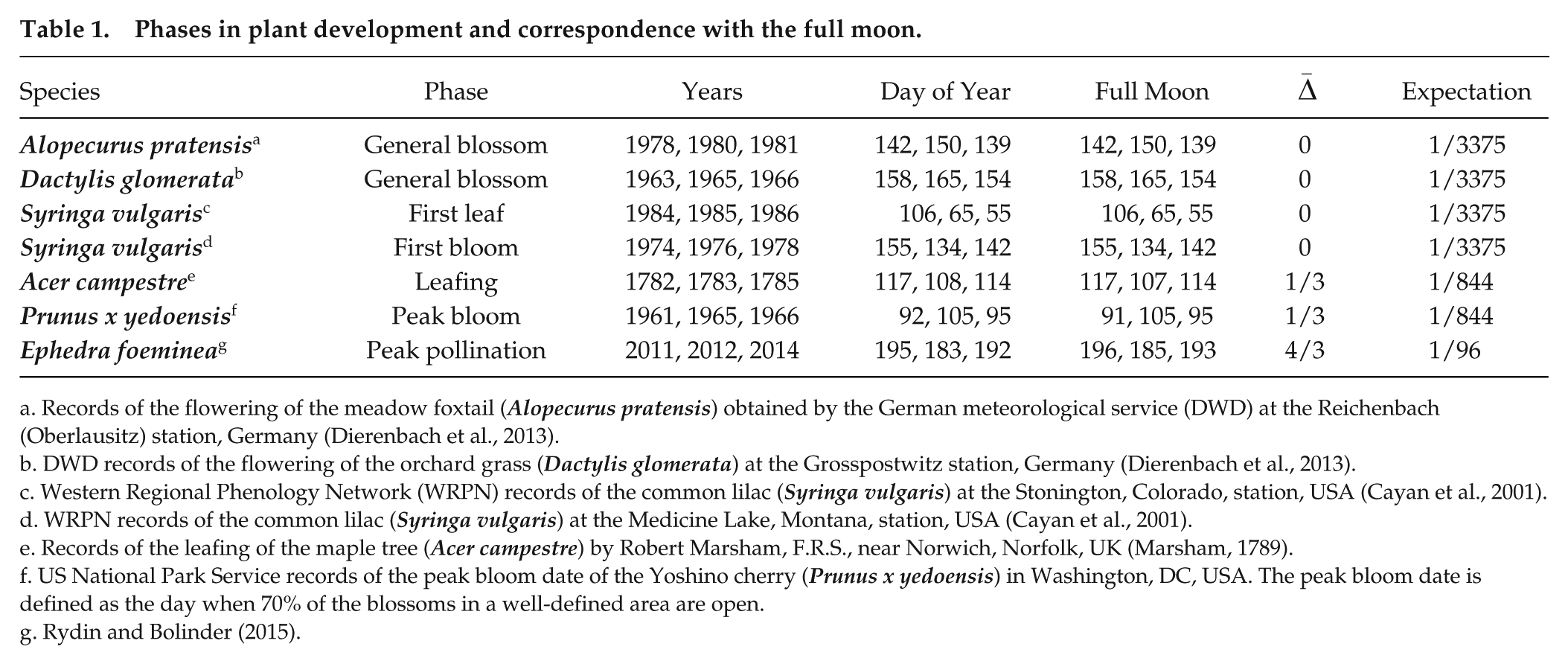
Records of the flowering of the meadow foxtail (Alopecurus pratensis) obtained by the German meteorological service (DWD) at the Reichenbach (Oberlausitz) station, Germany (Dierenbach et al., 2013).
DWD records of the flowering of the orchard grass (Dactylis glomerata) at the Grosspostwitz station, Germany (Dierenbach et al., 2013).
Western Regional Phenology Network (WRPN) records of the common lilac (Syringa vulgaris) at the Stonington, Colorado, station, USA (Cayan et al., 2001).
WRPN records of the common lilac (Syringa vulgaris) at the Medicine Lake, Montana, station, USA (Cayan et al., 2001).
Records of the leafing of the maple tree (Acer campestre) by Robert Marsham, F.R.S., near Norwich, Norfolk, UK (Marsham, 1789).
US National Park Service records of the peak bloom date of the Yoshino cherry (Prunus x yedoensis) in Washington, DC, USA. The peak bloom date is defined as the day when 70% of the blossoms in a well-defined area are open.
Can E. Foeminea Really Detect the Full Moon?
Rydin and Bolinder (2015) invoked the detection of lunar tides by E. foeminea as a possible mechanism for the observed coincidence, which reveals a common misconception about tides. Because of the form of the gravity potential, the gravity signals at new moon and full moon are roughly equivalent, and one would not expect a gravity trigger at full moon that does not also act at new moon. In addition, the lunar tidal signal is weak compared with that of ordinary objects in the vicinity (Margot, 2015). The strength of tides depends on the distance d and mass m of the tide-raising body, as follows (e.g., Murray and Dermott, 1999):

For instance, the effect of the botanist’s car parked 10 m away from the field site is ~1000 times stronger than the lunar tide:

and the effect of the botanist making an observation 1 m away from the plant is ~50,000 times stronger than the lunar tide:

The effect of lunar tides on plants has been studied (e.g., Vesala et al., 2000). Controlled studies could be perfomed by moving ordinary masses around a plant bed and recording gravimeter data.
Rydin and Bolinder (2015) also suggested that E. foeminea can detect the light of the full moon and produce pollination drops accordingly. Studies of the effect of lunar illumination on plant flowering have yielded conflicting results (e.g., Bünning and Moser, 1969; Kadman-Zahavi and Peiper, 1987). Ground illumination from a full moon at zenith is ~0.27 lux, whereas direct sunlight is ~105 lux (Seidelmann, 1992). Controlled studies in a laboratory setting could replicate appropriate illumination conditions and should be performed before a lunar influence is asserted.
Conclusions
The fact that 3 pollination peaks of E. foeminea coincided roughly with the full moon does not constitute sufficient evidence that the moon exerts any influence on the timing of pollination. Correlation is not causation, and this particular correlation is likely spurious. Additional observations of the pollination dates will settle the matter.