




Abstract
Evidence has accumulated over the years indicating that the moon influences some aspects of the reproductive activity in animals and humans. However, little is known about the influence of the lunar cycle on the reproductive performance of cows under tropical conditions, where the environment strongly affects reproduction. This retrospective study was conducted with the aim of assessing the influence of the lunar cycle on some reproductive traits of tropical crossbred cows managed in a pasture-based system. Data from 5869 reproductive records from two commercial farms localized in the Maracaibo Lake Basin of Zulia State, Venezuela, were analyzed. Variables studied were first service conception rate, calving frequency, first postpartum estrous frequency, and pregnancy frequency. In addition to the lunar cycle, the effects of farm, season, and predominant breed were also considered. Data were analyzed using logistic regression and general linear model from SAS. First service conception was affected by lunar phases and predominant breed, but not by farm or season. For frequencies of calving, first postpartum estrus, and pregnancy, there was no main effect of farm, season, and predominant breed, whereas the effect of lunar phases was highly significant. First service conception was significantly greater in waning than in crescent phase of the lunar cycle. Frequencies of calving, first estrus, and pregnancy were highly correlated and showed greater figures around full moon and new moon. In conclusion, lunar cycle influenced first service conception, attaining greater values in the waning phase of the moon cycle. Frequencies of calving, first postpartum estrus, and pregnancy in crossbred cows showed a clear bimodal rhythm, whose greatest values coincided with new moon and full moon.
The influence of the moon on various biological functions has been reviewed in humans and animals (Zimecki, 2006; Chakraborty, 2014; Andreatta and Tessmar-Raible, 2020). Certain physiological aspects of humans and animals are modulated by seasonal, circadian, and lunar rhythms (Zimecki, 2006). To study the influence of the moon on diverse physiological functions of animals, it is important to know in detail the lunar cycle. The moon completes an orbit around the earth every 29.53 days (lunar month). As the moon moves around the earth, the angle between the earth and the moon changes progressively. The moon’s phases depend on its position relative to the earth and the sun, and are related to the proportion of sunlight reflected by the moon. The four most relevant phases of the lunar cycle are the new moon, first quarter, full moon, and third quarter. From new moon to full moon, the moonlight increases progressively from 0% to 100% (crescent phase), and from full moon to new moon, the moonlight decreases progressively from 100% to 0% (waning phase).
In farm animals, the influence of the lunar cycle on some reproductive events has been described (Horák and Potucek, 1978; Subramaniam et al., 1991; Kollerstrom, 2004; Palacios and Abecia, 2014; Yonezawa et al., 2016; Chinchilla-Vargas et al., 2018). The analysis of 2724 artificial inseminations performed in Churra ewes either after natural estrus detection (n = 383) or following hormonal treatment (n = 2341) demonstrated an effect of the lunar phase on conception rate, showing a significant interaction with the type of estrus (Palacios and Abecia, 2014). Another study in sheep that included 9650 records from three flocks (Horák and Potucek, 1978) also found an effect of the moon on the onset of cyclicity of growing ewes, as well as on conception rate, number of lambs, and fertility. Thus, during full moon and third quarter moon, 33% of ewes came in estrus and about 60% of them became pregnant (Horák and Potucek, 1978).
In horses, a 14 years retrospective study (1986-1999; n = 4457) showed a maximum frequency of estrus and conceptions on the full moon and immediately after (Kollerstrom, 2004). Likewise, records of 4149 semen collections from boars of nine different breeds at one boar stud farm demonstrated a moon effect on the volume of ejaculates collected and the number of semen doses per ejaculate (Chinchilla-Vargas et al., 2018). There was an interaction between season and moon phase affecting the volume of ejaculate, sperm concentration, and number of doses obtained per ejaculate at both date of collection and day of initiation of spermatogenesis.
In cattle, analysis of the distribution of 13,493 artificial inseminations along the moon cycle showed a significant effect of the moon with 19.9% of artificial inseminations performed during the new moon and the full moon and 80.1% in the remaining days of the lunar cycle (Subramaniam et al., 1991). However, interactions between lunar phases and seasons were not significant, indicating that the frequency of cows inseminated during lunar phases were not affected by seasonal variations.
Another study assessed the influence of the lunar cycle on spontaneous deliveries in cows (Yonezawa et al., 2016). There was a uniform increase in the birth frequency from new moon to full moon, after which this decreased until the waning crescent. Furthermore, although the delivery timing among primiparous cows did not significantly change throughout the lunar cycle, there was a clear and significant relationship between delivery timing and the lunar cycle among multiparous cows (Yonezawa et al., 2016). In those cows, the number of deliveries was significantly greater between waxing gibbous and full moon compared with those occurring between the last quarter and the waning crescent phases (Yonezawa et al., 2016).
Taking all these evidences together, it is clear that the lunar cycle influences different reproductive functions in farm animals, although the mechanisms through which this occurs are still unclear (Chakraborty, 2014). Given the limited information of lunar effect on the reproductive activity of cattle in tropical areas, we aimed to study the effect of the lunar cycle on the first service conception rate and the frequencies of occurrence of calving, first postpartum estrus, and pregnancy in crossbred Brahman cows managed in a pasture-based system under tropical conditions.
Materials and Methods
Location and Environmental Condition of the Farms
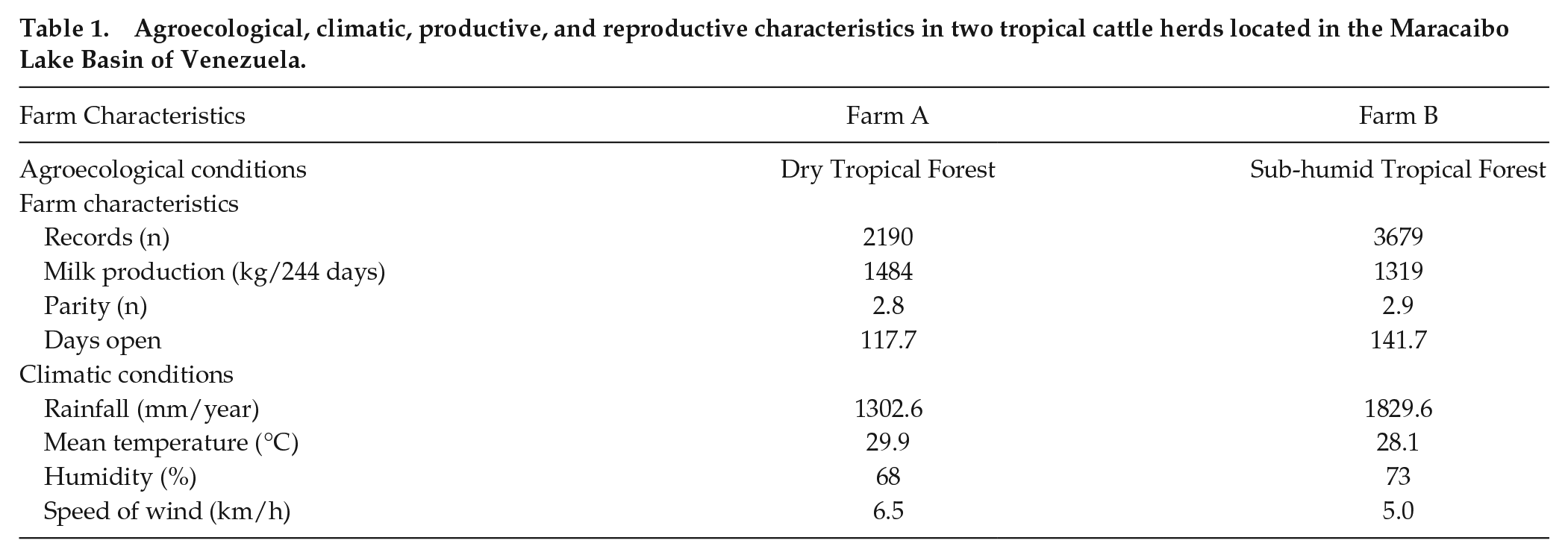
The retrospective data analyzed in this study correspond to 5869 reproductive records (1995-2001) from 2051 double purpose tropical cows from two commercial farms located in two different agroecological areas of Maracaibo Lake Basin of Zulia State, Venezuela. Farm data and agroecological conditions of each location are depicted in Table 1. Rainfall figures were obtained from rain gauges on each farm, while temperature, relative humidity, and wind velocity were obtained from official weather stations of the Ministry of Ambient and Natural Resources of Venezuela. The farms A and B are located in agroecological zones classified as dry and a sub-humid tropical forest, respectively. In both farms, there were three well-defined climatic seasons (dry, intermediate, and rainy). The dry season was from December to April, the intermediate season from May to August, and the rainy season from September to November.
Agroecological, climatic, productive, and reproductive characteristics in two tropical cattle herds located in the Maracaibo Lake Basin of Venezuela.
Breed and Cattle Management
Brahman crossbred cows on farms A (n = 782 cows; average parity 2.8) and B (n = 1269 cows; average parity 2.9) were a result of crossing Red Brahman and Red Holstein breeds conforming two genetic groups, one predominantly Bos indicus and the other predominantly Bos taurus. In both cases, the genotypic proportion of predominant breed (Brahman or Holstein) ranged between 9/16 and 5/8 from the sire breed.
Animals were managed using rotation grazing on pastures of approximately 12.5 acres with free access to natural shade of trees. On farm A, nutrition was based on freely grazed Guinea grass (Panicum maximum, 10% crude protein) and Brachiaria grass (Brachiaria humidicola, 8% crude protein); on farm B, cows grazed Aleman grass (Echinochloa polystachya, 12% crude protein). During the dry season, cows from the two farms received a nutritional supplementation of 50% Guinea hay, 30% chicken litter, 10% corn flour, and 10% molasses-urea mix (16% crude protein). In addition, cows had free access to mineral supplementation and water during both seasons.
Milking was performed by hand twice daily, and cows were suckled by their calf after each milking for a period of 1 h until weaning at 7 months of age. The reproductive management program was similar on both farms, and consisted of using artificial insemination and monthly gynecological examination of each cow beginning at 30 days postpartum until pregnancy was confirmed. Estrus detection was performed by visual observation from 0600 to 0700 h and from 1700 to 1800 h with the aid of teaser bulls that were surgically altered, so the intromission could not occur.
Cows were artificially inseminated by an experienced technician 12 h after first detected in estrus according to the AM-PM insemination rule (cows detected in estrus in the morning were inseminated in the afternoon and vice versa). After calving, the voluntary waiting period was 30 days, so that cows were inseminated from 30 days postpartum if uterine involution was completed and no signs of any ovarian or uterine pathology were found.
Cows requiring more than three artificial inseminations were assigned to controlled natural service by bulls of known fertility. Pregnancy diagnosis was done by rectal palpation by an experienced veterinarian after 45 days post artificial insemination in cows with non-return to estrus. The nutritional status of every cow was determined by body condition score (scale 1-5; 1 = very thin, 5 = very fat) (Edmonson et al., 1998) at calving and in each gynecological examination.
The herd health program was based on periodic deworming, screening diagnostic tests, biosecurity measures, and vaccinations to prevent common diseases affecting the herds in that region of Venezuela, such as brucellosis, leptospirosis, infectious bovine rhino-tracheitis (IBR), bovine viral diarrhea (BVD), campylobacteriosis, and clostridial diseases.
Lunar Cycle Information
Data about the moon cycle on this region were obtained from the US Naval Observatory (see Supplemental Material). According to the percentage of luminosity of the moon, the lunar cycle (29.53 days long) was split into two parts (crescent: from new moon to full moon, and waning: from full moon to new moon) and four quarters (first: from new moon to first quarter; 2: from first quarter to full moon; 3: from full moon to third quarter; 4: from third quarter to new moon; about 7.4-day length each). In addition, to better appreciate the effects of the moon on the reproductive events, the lunar cycle was divided into 30 periods (15 in crescent phase and 15 in waning phase) of 0.984 (~1 day) length each (Figure 1). Each 15-day period corresponds to the semilunar cycle (~14.8 days long), whose onset and end coincide with the full moon and the new moon, and the alignment of the moon with the earth and the sun (Andreatta and Tessmar-Raible, 2020). The study covered approximately 86 lunar cycles during 7 years.
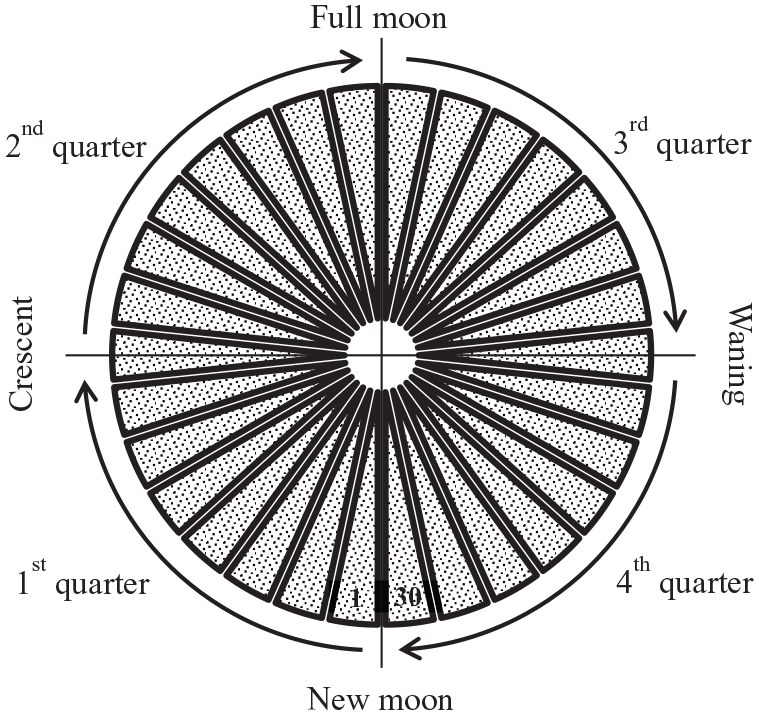
According to the percentage of moonlight, lunar cycle (29.53 days long) was divided into two phases (crescent: from new moon to full moon, and waning: from full moon to new moon), four quarters (first: from new moon to first quarter; second: from first quarter to full moon; third: from full moon to third quarter; fourth: from third quarter to new moon), and 30 periods (15 in crescent phase and 15 in waning phase of the lunar cycle) of ~1 day length each (designed by Fernando P. Perea).
Statistical Analysis
Variables studied were first service conception rate, calving frequency, first postpartum estrous frequency, and pregnancy frequency. For every period of the lunar cycle, first service conception was calculated as the total number of first service pregnant cows divided by the total number of cows receiving first service, and expressed as a percentage. Frequency of calving, first postpartum estrous, and pregnancy were calculated as the total number of each reproductive event occurring during every period of the lunar cycle divided by the total number of each reproductive event occurring during the complete lunar cycle, and expressed as a percentage.
Lunar variation of first service conception was analyzed using logistic regression (pregnant cows = 1; non-pregnant cows = 0) of the Statistical Analysis System (SAS; Version 9.3; SAS Institute, Inc., Cary, NC, USA). For frequencies of calving, first postpartum estrus and pregnancy statistical assumptions of normality and constant variance were assessed through Shapiro-Wilk’s and Levene’s tests, respectively, and an arcsine transformation was applied to these three dependent variables. Lunar variation of frequencies of calving, first postpartum estrus, and pregnancy were analyzed by general linear model (GLM) and means were compared using least squares means test of SAS. In both the logistic and the GLM models, the effects of farm (A and B), season (established by accumulated rainfall [mm] as dry: December-April, intermediate: May-August, and humid: September-November), and predominant breed (B. taurus and B. indicus) and interactions were included in the statistical model. In addition, Pearson’s correlation was performed for frequencies of calving, first postpartum estrus, and pregnancy. Statistical significance was considered as p < 0.05, and p values between 0.051 and 0.1 were considered as tendency.
Results
First service conception rate was affected by lunar phases (p = 0.0366) and predominant breed (53.1% vs. 61.3% for B. taurus and B. indicus, respectively; p < 0.0001), but not by farm (58.3% and 57.3% for farms A and B, respectively; p = 0.1297) or season (58.4%, 57.9%, and 57.0% for seasons 1, 2, and 3, respectively; p = 0.8898). There was no significant effect of interactions: lunar phase × farm (p = 0.4697), lunar phase × season (p = 0.2912), and lunar phase × predominant breed (p = 0.5818).
The variation of first service conception rate along the moon cycle was examined by splitting the lunar month into 30 segments of ~1-day length. As indicated in Figure 2A, first service conception rate varied considerably throughout the lunar cycle (p = 0.0366), and showed a clear tendency to increase from new moon to days 25 and 26 of the lunar cycle, when this reproductive parameter reached the greatest values (70.2% and 69.3%, respectively). Thereafter, first service conception rate abruptly decreased during the followings 4 days. First service conception averaged 57.9% and was greater during waning (59.9%) than in the crescent phase (55.8%; p = 0.0024). Accordingly, as the lunar cycle was divided in four quarters, first service conception rate was significantly lower in quarters 1 and 2 than in 3 and 4 (Figure 2B).
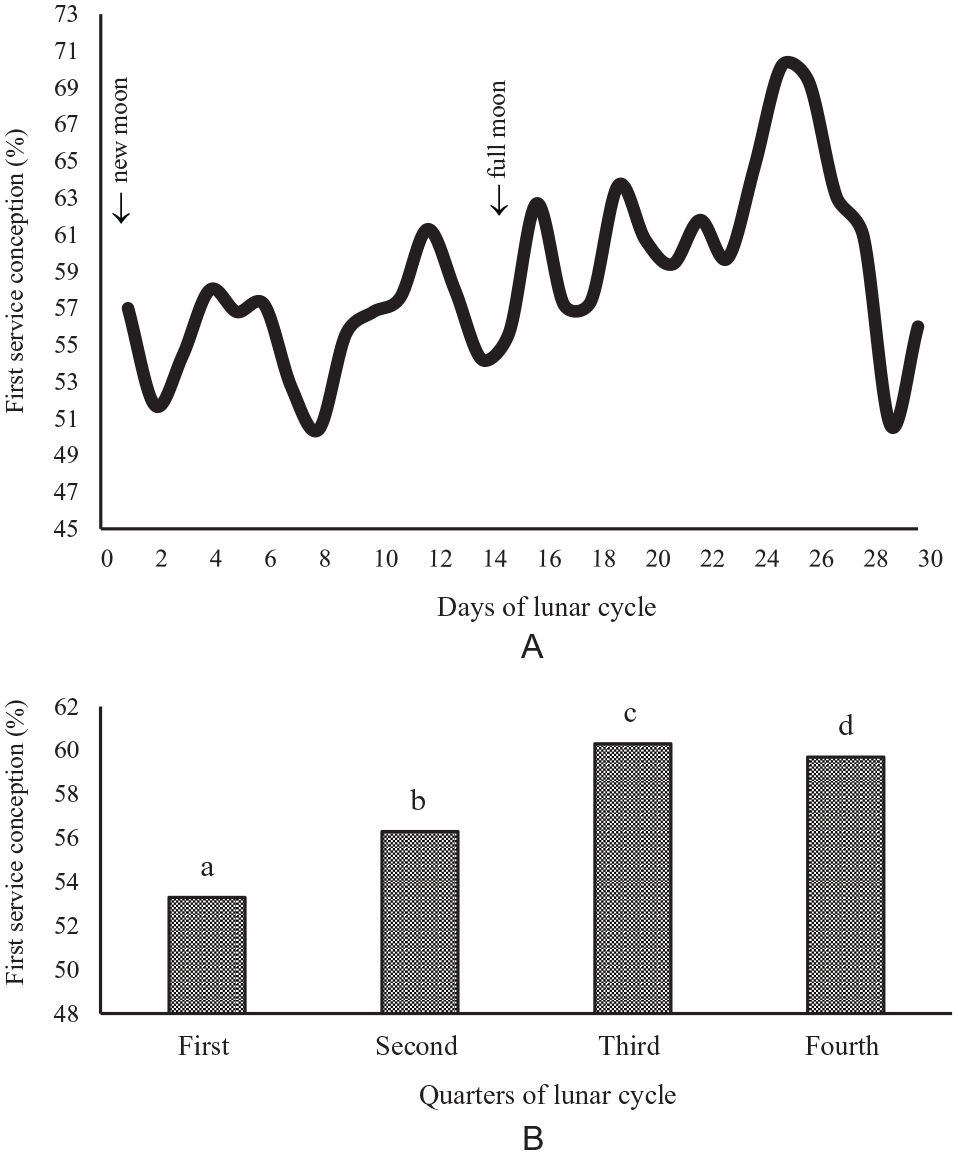
Influence of lunar cycle on first service conception rate in crossbreed Brahman cows (n = 5869). (A) Variation of first service conception throughout lunar cycle (p = 0.0366 for main effect of lunar cycle in the logistic regression model). (B) The percentages of first service conception according to quarters of lunar cycle (a-c p = 0.0111; a-d p = 0.0190; b-c p = 0.0398; b-d p = 0.0699) (95% confidence interval for first service conception [%]: first quarter: 48.9-59.0; second quarter: 51.8-61.9; third quarter: 53.7-63.7; fourth quarter: 55.0-62.4).
The lunar cycle significantly affected the frequency of calving (p < 0.0001), first postpartum estrus (p < 0.0001), and pregnancy (p < 0.0001). Nevertheless, there were no significant effects of farm, season and predominant breed on these reproductive events. To better appreciate effects of lunar cycle on the pattern of occurrence of calving, first estrus, and pregnancy, period 30 of the lunar cycle appears first in Figure 3A to 3C. The frequency of these reproductive parameters follows a similar pattern, with greater frequencies around the new moon and full moon (lapses encompassing ~1 day before and ~1 day after the moon reaches 0% or 100% of luminosity, respectively). Thus, Pearson’s correlations between frequency of calving, first postpartum estrus, and pregnancy were 0.80 (p < 0.0001), 0.77 (p < 0.0001), and 0.91 (p < 0.0001), respectively.
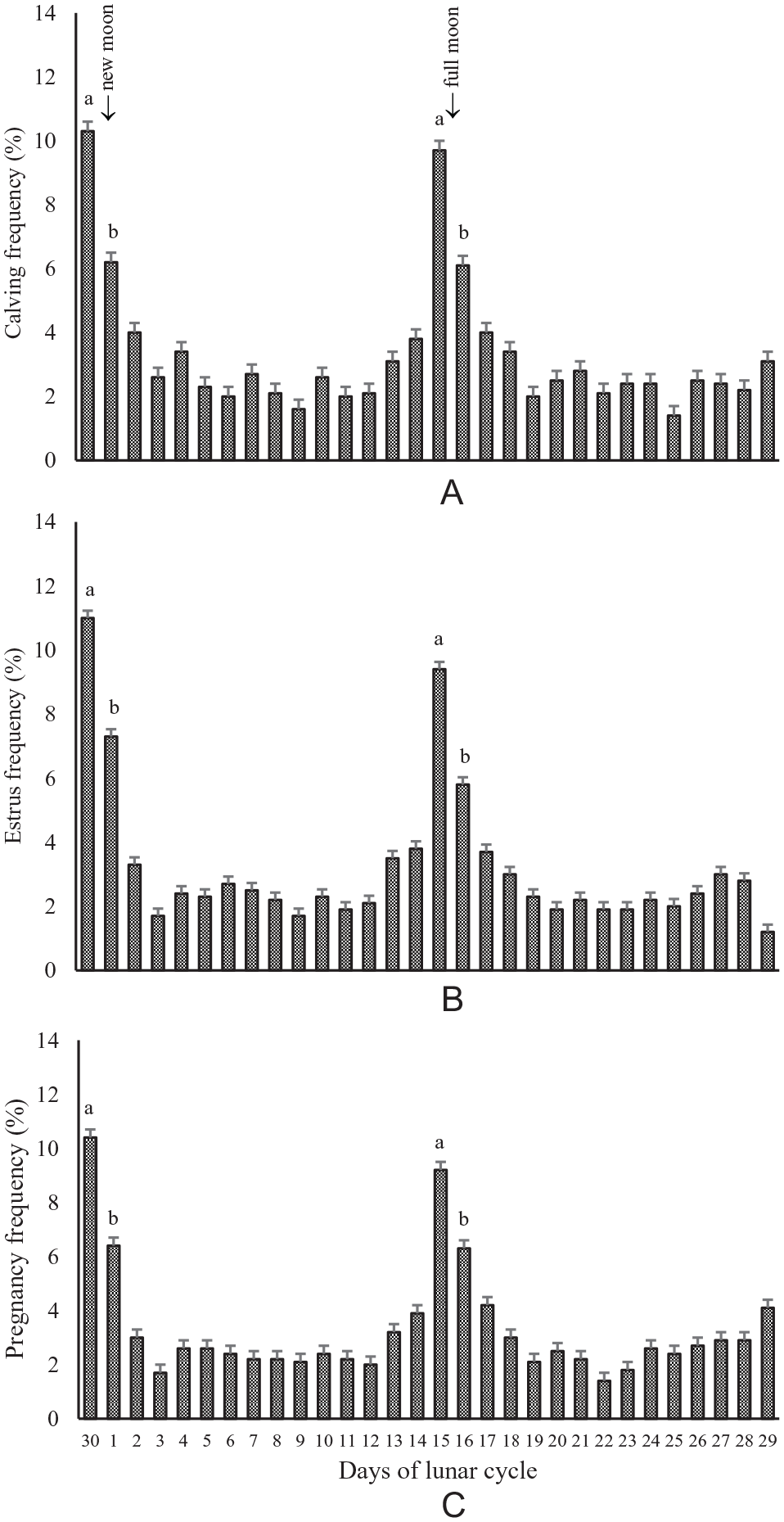
Frequency of calving (A), first postpartum estrus (B), and pregnancy (C) (mean ± standard error of the mean) in crossbreed Brahman cows (n = 5869) according to day of lunar cycle. For every histogram, days with a letter a or b differ from others days of lunar cycle (p < 0.0001).
Discussion
The purpose of this study was to assess the influence of the lunar cycle on certain reproductive outcomes of tropical crossbred Brahman cows managed in a pasture-based system. The results demonstrated that the lunar cycle influenced the reproductive performance of cattle under tropical conditions. Moreover, these results support previously published findings about the effects of the lunar phases on reproductive physiology in animals and humans (Law, 1986; Martínez-Soriano et al., 2002; Causeur and Charpentier, 2009; Palacios and Abecia, 2014; Yonezawa et al., 2016; Chinchilla-Vargas et al., 2018; El-Darawany et al., 2019).
The average of first service conception in this study is suitable for tropical crossbred cows (González-Stagnaro, 2001) under tropical conditions and similar to values reported elsewhere for dual-purpose cattle (González-Stagnaro et al., 1984; Soto et al., 1994; Atencio et al., 1995; Baca et al., 1998). In this type of cows, resumption of postpartum ovarian cyclicity and fertility were affected by several genetic and environmental factors such as predominant breed, parity, milk production level, season, month, postpartum period in which insemination is performed (Perea et al., 2005, 2006), as well as by the moon cycle, as previously shown (Perea and González-Stagnaro, 2005).
Even though no specific data have been published about the influence of the lunar cycle on first service conception in cattle, in mares, conception at first mating increased progressively from the first quarter and reached the highest value shortly after full moon, and then decreased (Kollerstrom and Power, 2000). In dairy sheep, fertility and fecundity were greater in ewes inseminated during full moon and waning moon (Palacios and Abecia, 2014). Additional findings in sheep showed that 33% of ewes came in estrus, and about 60% of them became pregnant during full moon and third quarter moon (Horák and Potucek, 1978). These cited findings together with those found in the current study may suggest that the waning phase of the lunar cycle could apparently be the period when females of these farm animal species are more fertile, and have more competent oocytes for fertilization and subsequent embryo development.
Analysis of the influence of the moon cycle splitted into four quarters showed that the differences in the first service conception were around 5 percentage points. Although these effects seem small, they may have a significant impact on herd reproductive performance and farm profitability. The reproductive activity of tropical cattle is influenced by numerous factors (Perea et al., 2005, 2006) that can be controlled by nutritional, sanitary, management and crossbreeding strategies (Soto et al., 1998; Perea and De Ondiz, 2014; Soto and Perea, 2014). Therefore, adequate reproductive performance results from efficient application of such strategies (Soto, 1995). The notable differences observed between the crescent and waning phases of the lunar cycle may represent a baseline information for future studies on the application of hormonal ovulation synchronization and timed artificial insemination protocols during the moon cycle periods of greater cattle fertility. A potential reduction of calving to conception interval and the number of services per conception may result from application of this approach, which may have significant economic benefits for cattle herds (Inchaisri et al., 2010).
In this study, frequency of calving, first postpartum estrus, and pregnancy were highly correlated and a significantly greater proportion of these reproductive events occurred around the new moon and full moon. If the frequency of these reproductive events during these two periods of the lunar cycle are considered together (which encompass roughly 4 days of moon cycle), approximately 33% occurred around the new moon (~17%) and the full moon (~16%), while approximately 67% took place in the remaining 26 days of the lunar cycle. This novel information could also be used in cattle farms as a reproductive management strategy. Since a considerable percentage of calvings occurs in these 4 days of the lunar cycle, a more accentuated supervision during those days could reduce losses due to intra-partum fetal death during dystocia.
As in our study, a clear effect of the moon on artificial insemination frequency was reported in dairy cattle from India, with 19.9% of inseminations occurring during full moon and new moon and 81.1% in the remaining days of the lunar cycle (Subramaniam et al., 1991). Although different from what was observed in our study, a cyclical pattern of first estrus, conceptions, and parturitions was also reported in dairy heifers (Roy et al., 1980). In that study, the reproductive events of 57 heifers occurred at four different peaks during the lunar cycle, approximately 2 days before each quarter of the moon cycle. In a more recent study in Holstein cows (n = 428), an effect of the moon was seen on the frequency of calving, with proportionally greater number of spontaneous deliveries around the new moon, which was evident in multiparous but not in primiparous cows (Yonezawa et al., 2016).
In our study, analysis of 5869 reproductive records and 86 lunar cycles demonstrated a bimodal pattern with greater frequencies of reproductive events occurring around the new moon and full moon, which coincides with the alignment of the sun, the moon, and the earth, and which causes the phenomenon of the tides (Neumann, 2014). During this time, the sun gravitational force strengthens with that from the moon and generates the spring tides (Andreatta and Tessmar-Raible, 2020). This cyclic phenomenon has a particular influence on the biological behavior and reproductive performance of many marine species (Raible et al., 2020), but an effect on farm animals has not been documented. It is possible to speculate that this bimodal pattern in the frequency of these reproductive events, which coincide with the full moon and the new moon, could be related to the transient increase in gravitational force and variations in the earth’s electromagnetic field during these two periods of the moon cycle (Bevington, 2015). However, further research must be conducted to elucidate this phenomenon in farm animals.
In a physiological context, parturition, estrus, and conception are complex processes involving hypothalamic, pituitary, and ovarian hormones, as well as growth factors and metabolites (Senger, 2012). Although the physiological basis of the environmental factors affecting the length of gestation, the occurrence and signs of estrus, and fertility are well known, little is known about the biological fundamentals of the lunar cycle’s influence on the reproductive activity of farm animals. These aspects have been studied in depth in diverse species of fish (Ikegami et al., 2014). As a result of numerous observations on gonadal development and spawning frequency (Takemura et al., 2004), endocrine profiles (Rahman et al., 2000; Takemura et al., 2006), gene expression (Sugama et al., 2008; Ikegami et al., 2014; Takeuchi et al., 2018), and other experimental evidence (reviewed by Andreatta and Tessmar-Raible, 2020), have led to the hypothesis of melatonin as a possible transducer in lunar rhythmicity of fish reproductive functions (Takemura et al., 2004). This body of evidence may serve as baseline information for the study of the effects of the lunar cycle on the reproductive functions of farm animals.
The moon motion around earth determines the lunar cycle, and causes periodic changes in night illumination (intensity of moonlight), geomagnetic fields, gravitational attraction, and amplitude of tides, all of which have wide influence on different biological aspects of living beings (Ikegami et al., 2014; Andreatta and Tessmar-Raible, 2020; Raible et al., 2020). Among these factors, the intensity of the moonlight throughout the lunar cycle could be crucial in modulating reproductive activity of mammals. However, variation in moonlight during the lunar cycle may not alone explain the changes in the reproductive performance described above. In a well-documented review, Bevington (2015) indicated that other factors related to the lunar cycle could also explain this phenomenon. Interactions between the Earth’s magnetic field, the solar winds in the magnetosphere, and the moon produce variations in the electromagnetic field of the planet modulated by the lunar cycle (Bevington, 2015). These electromagnetic variations seem to be responsible for several biological effects in birds and humans (Carrubba et al., 2007; Marino et al., 2009; Wu and Dickman, 2012). Moreover, variations in the magnetic field of the earth have been associated with changes in the pattern of melatonin secretion in humans (Weydahl et al., 2001; Iashmanov and Koshelevskiĭ, 2008; Burch et al., 2008).
From this body of evidence, it is possible that melatonin may be involved in the regulation of the reproductive changes influenced by the lunar cycle in farm animals, as shown in this and in other studies in mammals. However, as reproduction is a highly complex function modulated by the hypothalamic-pituitary-gonadal axis, and influenced by numerous environmental factors, it is likely that other molecules, pathways, and physiological mechanisms may also be involved. Further research should be conducted to elucidate this hypothesis.
In conclusion, the lunar cycle significantly influenced first service conception and frequencies of calving, estrus, and pregnancy in tropical Brahman crossbred cows managed in a pasture-based system, under tropical conditions. First service conception was greater in waning phase than in crescent phase, and in general, this trend was similar in different farms, seasons, and predominant breeds. Frequencies of calving, first estrus, and pregnancy were highly correlated, showing greater values around full moon and new moon.
Supplemental Material
sj-pdf-1-jbr-10.1177_0748730420983638 – Supplemental material for Lunar Cycle Influences Reproductive Performance of Crossbred Brahman Cows Under Tropical Conditions
Supplemental material, sj-pdf-1-jbr-10.1177_0748730420983638 for Lunar Cycle Influences Reproductive Performance of Crossbred Brahman Cows Under Tropical Conditions by Alejandro A. Aguirre, Roberto A. Palomares, Aitor D. De Ondiz, Eleazar R. Soto, Mariana S. Perea, Hugo J. Hernández-Fonseca and Fernando P. Perea in Journal of Biological Rhythms
Footnotes
Acknowledgements
Special thanks are given to farms “Agropecuaria Santa Ana” and “Agropecuaria Doña Blanca” for providing access to records and facilities. The authors also thank Dr. Rafael M. Roman, School of Veterinary Sciences, University of Zulia, Venezuela, for his advice in the statistical analysis. The author(s) received no financial support for the research, authorship, and/or publication of this article.
Conflict of Interest Statement
The author(s) have no potential conflicts of interest with respect to the research, authorship, and/or publication of this article.

Notes
References
Supplementary Material
Please find the following supplemental material available below.
For Open Access articles published under a Creative Commons License, all supplemental material carries the same license as the article it is associated with.
For non-Open Access articles published, all supplemental material carries a non-exclusive license, and permission requests for re-use of supplemental material or any part of supplemental material shall be sent directly to the copyright owner as specified in the copyright notice associated with the article.
