




Abstract
During adolescence, biological, psychosocial, and contextual factors converge in a “perfect storm” and have been put forward to explain the delay in chronotype observed at this age and the prevalence of disrupted sleep. This study provides evidence to support that chronotype and sleep patterns (particularly sleep duration) are socially constrained and to identify novel significant social predictors. Uruguayan public school activities are arranged in up to 4 shifts, creating a natural experiment to examine the effect of school timing on questionnaire-based assessments of sleep and chronotype. In this study, 268 high school students (15-18 years old) who attended school either on morning (0730 to 1130 h) or afternoon shifts (1130 h to 1530 h) responded to an adapted School Sleep Habits Survey. Students attending afternoon shifts had later chronotypes (a 1.5-h later midpoint of sleep on free days adjusted for sleep debt) than those attending the morning shift. Besides shift, evening social activities (including dinner time) were further identified as key predictors of late chronotypes, whereas age and gender were not. Sleep on school days was overall advanced and reduced with respect to weekends, and these effects were stronger in morning-shift students. Weekend sleep duration was similar between shifts, which probably caused the prevalence of reduced sleep durations (average weekly sleep duration, SDweek <8 h) to be higher in morning-shift students (almost 80%) than in afternoon-shift ones (34%). Reduced sleep duration was significantly higher in morning-shift students. In addition, age, chronotype, and dinner time became relevant determinants of sleep deficit only in the morning-shift students. Besides the important social constraint of early school start time, this is the first study to confirm the significance of other types of social pressures on both adolescents’ chronotype and sleep deficit, which can be useful as potential new targets for effective policies to protect adolescent sleep.
Three different clocks are known to regulate the daily pattern of activities: the biological clock, the solar clock, and the social clock (Roenneberg et al., 2003). Individual chronotype, a proxy for individual phase of entrainment (or how early or late an individual’s circadian system embeds to the 24-h light/dark cycle), has been proposed to depend on the interaction of these 3 clocks (Roenneberg, 2012, 2015). In large-scale studies, chronotype can be measured by questionnaires, with sleep behavior–based markers such as the mid-sleep on free days adjusted for sleep debt during work days (MSFsc) correlating fairly well with physiological parameters of the human circadian rhythm (Kantermann et al., 2015; Kitamura et al., 2014; Nováková et al., 2013; Roenneberg, 2015; Roenneberg et al., 2007a, 2019). Both progressive delays in human circadian melatonin rhythms (Crowley et al., 2014) and sleep timing–based data suggest that during adolescence, individuals become progressively later chronotypes and then reverse to earlier chronotypes as they end adolescence (Roenneberg et al., 2004, 2007a).
These changes in adolescent sleep timing are likely to contribute to the epidemic of short sleep in this age group over the past century, with nightly sleep durations now being 1 h shorter as result of a 0.75-min yearly decrease found by meta-analysis (Matricciani et al., 2012, 2017). While sleep durations between 8 and 10 h are recommended for adolescents between 14 to 17 years (Hirshkowitz et al., 2015), many of them sleep less than 8 h. Biological, psychosocial, and contextual factors have been put forward to explain the observed pattern of delayed and reduced adolescent sleep (Becker et al., 2015; Carskadon, 2011; Crowley et al., 2018; Gradisar et al., 2011; Owens et al., 2014; Tarokh et al., 2019). In addition to delayed sleep timing (Roenneberg et al., 2004) and circadian phase in the melatonin rhythm (Carskadon et al., 1997, 2004), adolescents also show a slower accumulation of sleep propensity (Jenni et al., 2005; Taylor et al., 2005). Furthermore, social factors, including early school start times, reduced parental monitoring, increased autonomy, peer interactions, and computer usage, are also reported as main contributors to a reduction in sleep duration (Bartel et al., 2015; Carskadon, 2004; Díaz-Morales et al., 2014; Maume, 2013; Owens et al., 2006). Reduced and disrupted sleep patterns in adolescence have been associated with impaired performance and cognitive function (de Bruin et al., 2017; Dewald et al., 2010; Shochat et al., 2014), higher prevalence of obesity (Miller et al., 2018; Shochat et al., 2014), behavioral symptoms such as risk-taking behaviors or drug use (Shochat et al., 2014; Weaver et al., 2018), and multiple health risk factors (Shochat et al., 2014; Weaver et al., 2018).
Most adolescents across the world face the conflict of dealing with early school start times while their circadian system gradually entrains to a later phase (Gradisar et al., 2011). Schools that impose early wake time during school days do not match the late circadian phase of most adolescents, and this situation constitutes one of the best described contributors to chronic sleep deprivation in adolescence (Carskadon et al., 1998; Wolfson and Carskadon, 1998). This misalignment between students’ chronotypes and school time was also associated with lower grades and performance ratings in 2 meta-analyses (Preckel et al., 2011; Tonetti et al., 2015). Social jetlag (SJL), a behavioral index of circadian misalignment (Wittmann et al., 2006), has been related to adolescent school performance (Díaz-Morales and Escribano Barreno, 2015; Haraszti et al., 2014) and cognition (Panev et al., 2017). Based on this evidence, there have been several attempts of delaying school start times and making them more flexible, some of which have resulted in reported improvements in sleep (increased sleep duration and reduced sleepiness), school attendance, performance, mood, and negative behaviors (American Academy of Pediatrics, Committee on Adolescence, and Council on School Health, 2014; American Medical Association, 2016; Bowers and Moyer, 2017; Dunster et al., 2018; Fischer et al., 2008; Kelley et al., 2015; Louzada and Pereira, 2019; Minges and Redeker, 2016; Watson et al., 2017; Wheaton et al., 2016; Winnebeck et al., 2019).
Latin American public schools usually arrange their activities in multiple shifts. In Uruguay, activities are organized usually in up to 4 shifts, lasting between 4 to 6 h, from 0730 to 2330 h. This scheduling maximizes school infrastructure usage and creates a natural experiment for studying the influence of the social clock on adolescent sleep and school performance. In brief, previous studies of adolescents attending different school shifts from Brazil, Mexico, and Uruguay have documented that (1) afternoon-shift students have significantly later chronotypes than morning-shift ones, (2) late chronotypes perform worse at school in the morning shift but not in the afternoon shift, (3) sleep is more advanced and shorter during school days in morning-shift students compared with afternoon-shift ones, (4) weekend sleep duration is similar among students of different shifts, and (5) morning-shift students have shorter average weekly sleep durations than afternoon-shift ones (Arrona-Palacios and Díaz-Morales, 2017; Carissimi et al., 2016; Estevan et al., 2018; Arrona-Palacios et al., 2015; Pereira et al., 2016; Valdez et al., 1996). Although it is generally accepted that cultural and social demands (entertainment, dinner time) influence circadian preferences and sleep (Owens, 2008), to our knowledge, no previous studies have examined social influences on chronotype and sleep duration aside from the school schedule. We thus evaluated whether and to what extent age, gender, school shift, and social activities, are responsible for students’ chronotype and reduced sleep in a double-shift educational system. We confirmed the importance of school shift as a chronotype predictor and found that engaging in evening social interactions implies a significant chronotype delay. We also found that in addition to chronotype and shift as important determinants of sleep deficit, the social habit of late dining is a significant predictor of reduced sleep.
Methods
Participants
Participants were fourth- to sixth-grade students from a public high school in Montevideo, Uruguay. Three hundred twenty-five students between the ages of 15 and 18 years voluntarily participated in the study. Informed consent was obtained from parents of underage students or from the students themselves if they were of legal age (>18 years). Participants under self-reported treatment with psychoactive drugs that could modify their sleep pattern were excluded (n = 14). Participants with missing data were excluded from the overall analysis (n = 43). Table 1 describes the sociocultural environment, age, gender, body mass index, and the distribution among school shifts of the 268 participants included in this study.
Participant characteristics by school shift.
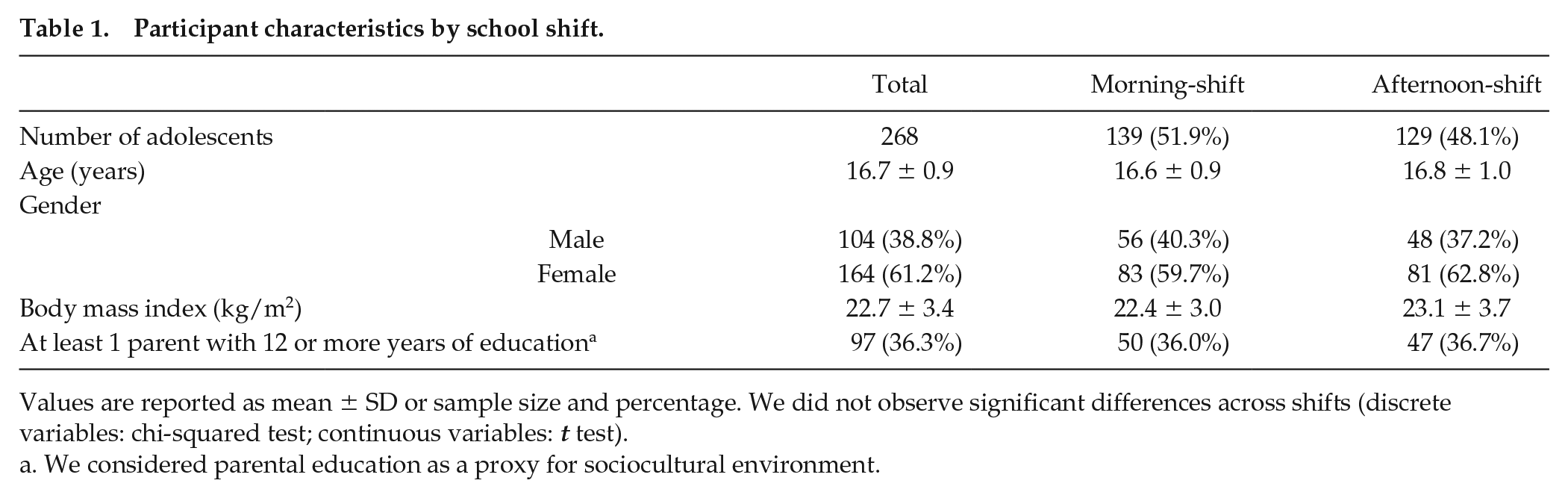
Values are reported as mean ± SD or sample size and percentage. We did not observe significant differences across shifts (discrete variables: chi-squared test; continuous variables: t test).
We considered parental education as a proxy for sociocultural environment.
Classes were taught from Monday to Friday (school days) in a regular schedule of 4 shifts (each lasting 4 h). We worked with students with similar sociodemographic background and morphometric parameters attending either the morning (0730 to 1130 h) or the afternoon shift (1130 to 1530 h; Table 1). At the beginning of each year, students are assigned randomly to each shift, with no consideration of individual circadian preferences. On weekends, students do not attend school and so these days are considered as free days.
During August 2016 and August 2017, informational flyers and informed consent forms were distributed among students and parents. In 2016, 193 fourth- to sixth-grade students from both shifts accepted to participate, and 75 new students from both shifts and the different grades were included in 2017. Enrolled participants answered paper-and-pencil versions of the questionnaires during school time from 20 to 27 September 2016 and 2017, using a cross-sectional design.
This study was approved by the Ethics Committee of the School of Psychology, Universidad de la República (Expedient 191175-000758-17) and complied with the principles outlined by the Declaration of Helsinki (World Medical Association, 2013).
Instruments
Students were asked about their sleep habits on school days and weekends using a translation of the School Sleep Habits Survey (SSHS; Wolfson and Carskadon, 1998). The SSHS was originally validated by comparing the sleep pattern reported with the one obtained using sleep diaries and actigraphy logs, obtaining good correlation coefficients, with higher values on school nights (Wolfson et al., 2003; Ziporyn et al., 2017). The SSHS includes multiple-choice questions asking about the reasons for bedtime and for waking up on school and free days. These questions represent the social constraints of interest and are used as predictors for sleep behaviors on school and free days. With respect to the variable reasons for bedtime (Table 2), a categorical variable “social constraint” was coded (yes/no) as the key predictor for sleep duration. With respect to the variable reasons for waking up, responses were categorized as forced (when participants were awakened up by parents or by alarm clocks) and spontaneous. In addition, we added a question about dinner time (“What time do you usually dine on school days/weekends?”), which is an important daily and delayed family event in Uruguay and thus may affect bedtimes and sleep behavior. Different parameters of sleep timing were used to characterize the student’s sleep pattern on both school days and weekends: sleep onset was calculated as bedtime plus the time needed to fall asleep; sleep duration and mid-point of sleep were estimated from sleep onset and end. We computed chronotype by mid-sleep on free days corrected for sleep debt on school days (MSFsc) and average weekly sleep duration (SDweek) according to Roenneberg et al. (2004, 2007a). For the MSFsc, we excluded students who reported a forced wake up on free days (morning shift: n = 29, afternoon shift: n = 41). We calculated SJL as the absolute difference between the mid-points of sleep on school and school-free days. Short sleep duration was considered when SDweek was <8 h, the lower limit for the recommended sleep duration in line with prior studies (Buxton et al., 2015; Hirshkowitz et al., 2015; Owens et al., 2014; Paruthi et al., 2016).
Sample size (percentage) of students indicating each reason for setting bedtime on school days and weekends for morning (n = 139) or afternoon school shift (n = 129).
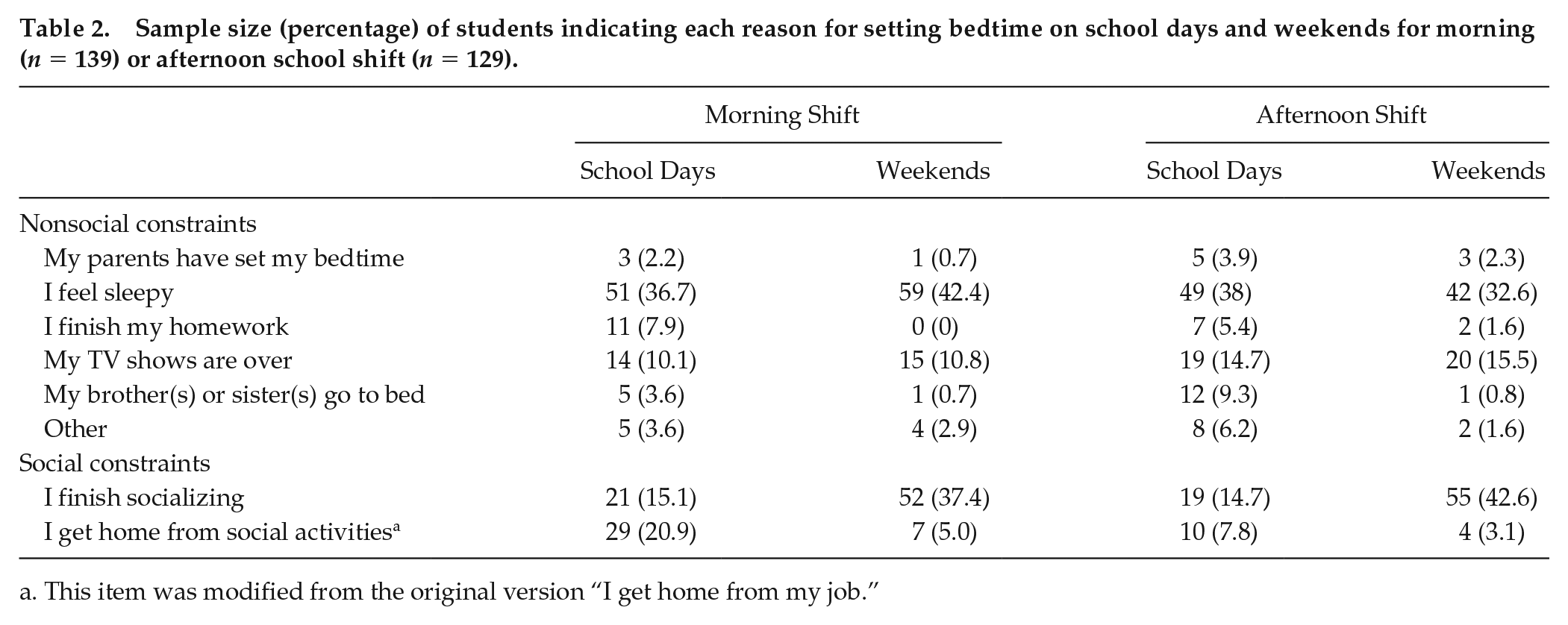
This item was modified from the original version “I get home from my job.”
Statistical Analysis
Statistical analyses were conducted in R Statistical Software (R Core Team, 2017) using RStudio as integrative development environment (RStudio Team, 2016). When characterizing the participants, the difference in discrete variables was assessed using the chi-squared test, the difference in continuous variables between groups was assessed using the t test, and the association between continuous variables was studied using Pearson’s correlation coefficients. Hierarchical regression analyses were performed to assess the influence of social and biological variables on short SDweek and MSFsc with the lme4 library (Bates et al., 2015). Continuous explanatory variables such as age were mean centered and standardized. The association of explanatory variables with MSFsc was studied using a linear model, whereas variables influencing weekly short sleep were studied with a logit model using the stats package (R Core Team, 2017). Different R2 values were computed for different models using library jtools (Long, 2019). For linear models, adjusted R2 values were calculated, which penalizes for adding variables. As mixed models include more sources of variability, marginal and conditional pseudo-R2 were computed. In the case of generalized models, pseudo-R2 for the explained deviance was computed using the Cragg-Uhler approximation. The MSFsc model was simplified excluding nonsignificant explicatory variables and comparing models using the likelihood ratio test. Outliers were removed for each model after analysis of residuals, and consequences of removal are described and discussed. Marginal means between levels of categorical variables or between slopes associated with continuous variables were compared using emmeans (Lenth, 2019).
Throughout the text, values are presented as mean ± standard deviation in descriptive statistics or marginal mean ± standard error for estimates. Time is presented in military time and was converted to hours for statistical analysis. The data and models that support the findings of this study are available from the corresponding author (B.T.) upon reasonable request.
Results
The age of participants attending the morning and afternoon shifts ranged from 15 to 18 years (Table 1). More females than males participated in this study (61.2%), with an even gender proportion between shifts (χ2 = 0.15, p = 0.70). Participants reported a mean dinner time of 2158 ± 0100 h on school days and of 2237 ± 0109 h on weekends (white dots in Fig. 1 represent mean and SD values for dinner on school days and weekends in students attending the morning vs. afternoon shift).
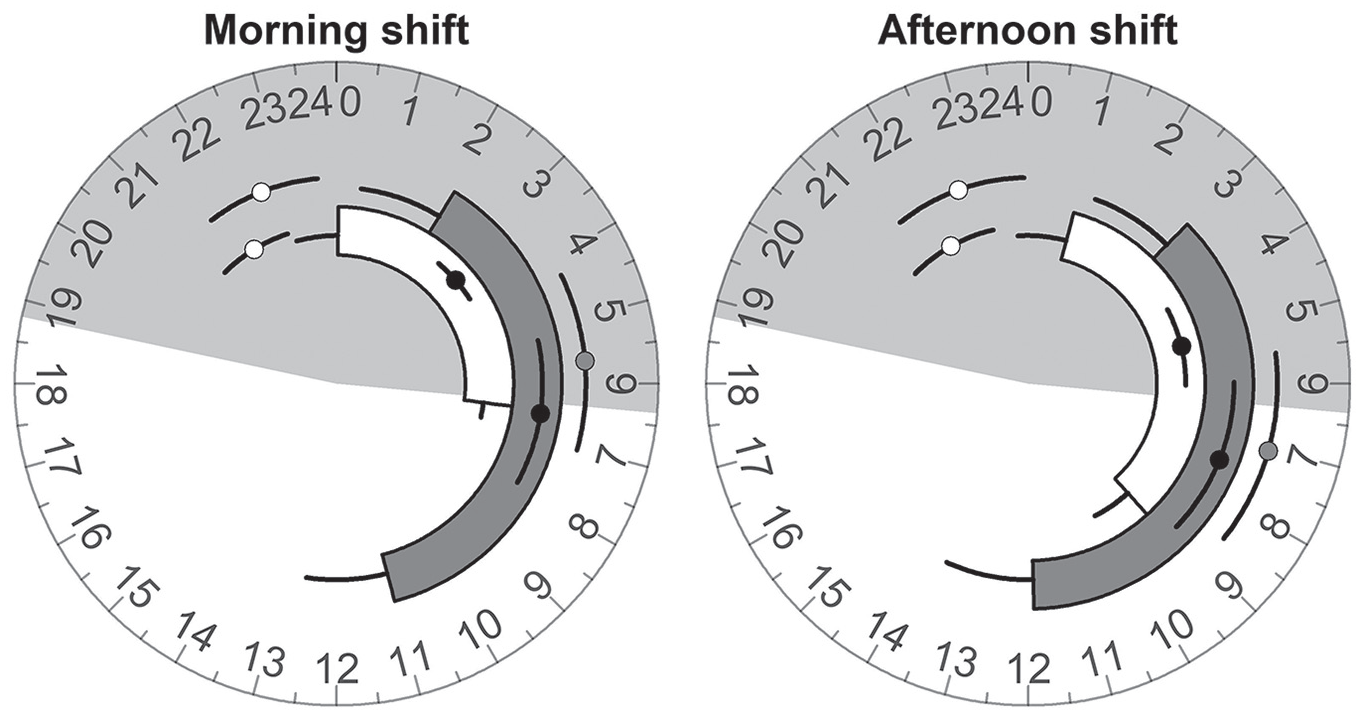
Sleep schedule on weekends (middle track, gray rectangle) and school days (inner track, white rectangle) in students attending the morning school shift (n = 139) afternoon school shift (n = 129). Each rectangle represents the mean sleep duration and extends from the mean sleep onset to the mean sleep end. Dots represent mean values: white, dinner time; black, mid-sleep point; gray, mid-sleep point sleep corrected (outer track). Lines represent standard deviations. Gray and white areas indicate the photoperiod on the spring equinox. Photoperiod was calculated from sunrise and sunset for 21 September (spring equinox for the southern hemisphere).
Individual Chronotype and Its Social Determinants
The average chronotype corresponded to an MSFsc of 0621 ± 0136 h, with significant differences between students attending the morning shift (0542 ± 0124 h) and the afternoon shift (0711 ± 0127 h; t = −7.3, p < 0.001, gray dot in Fig. 1). The Mean SJL was 2.9 ± 1.3 h, with students in the morning shift reporting higher levels of SJL than afternoon shift students (3.4 ± 1.3 h vs. 2.4 ± 1.2 h; t = 5.3, p < 0.001). MSFsc and SJL correlated as expected in both the morning (correlation coefficient = 0.88, p < 0.001) and the afternoon (correlation coefficient = 0.73, p < 0.001) shifts.
A 3-step hierarchical regression analysis was performed to identify significant determinants of individual chronotype (Table 3; Suppl. Tables S1-S3). A linear model of MSFsc using school shift as an independent variable explained 21.0% of the variance in students’ chronotype. Two students (with MSFsc higher than 12) were removed after inspecting the residuals of this model, increasing the adjusted R2 from 0.21 to 0.24. In a second step, we included gender and age main effects and their interactions with school shift, but none of these new variables remained significant after model simplification. In a third step, dinner time and the reasons for bedtime were tested (including 2-way interactions with school shift). Two-way interactions and the main effect of dinner time on school days were removed from the final model because they were not significant predictors. This third model explained 36.6% of the variance, representing an increase of 52.2% in explanatory power (p < 0.001). When we observed the influence of each factor included in the final model, students attending the afternoon shift had an estimated 1.5 h (95% confidence interval [CI]: 1.2-1.8) later chronotype. When social activities were reported as the main reason for bedtime on school days, MSFsc was shifted later by 0.5 h (95% CI: 0.1-0.9; marginal means: 0619 ± 0006 h vs 0648 ± 0010 h; t = 2.4, p = 0.02) and 0.7 h (95% CI: 0.4-1.1) on weekends (marginal means: 0612 ± 0008 h vs. 0655 ± 0008 h; t = 3.9, p < 0.001), respectively. Using the original scale, the delay of 1 h for dinner time on weekends was associated with 0.2 h (95% CI: 0.1-0.4) later chronotype. When comparing afternoon-shift students reporting social activities as the main reason for bedtime with morning-shift students who did not report social activities as the main reason for bedtime, the mean estimated chronotype difference was 2.7 ± 0.3 h.
Final linear model for factors predicting MSFsc (p < 0.001, adjusted R2 = 0.38) in students not reporting a forced wake up on weekends (n = 198).
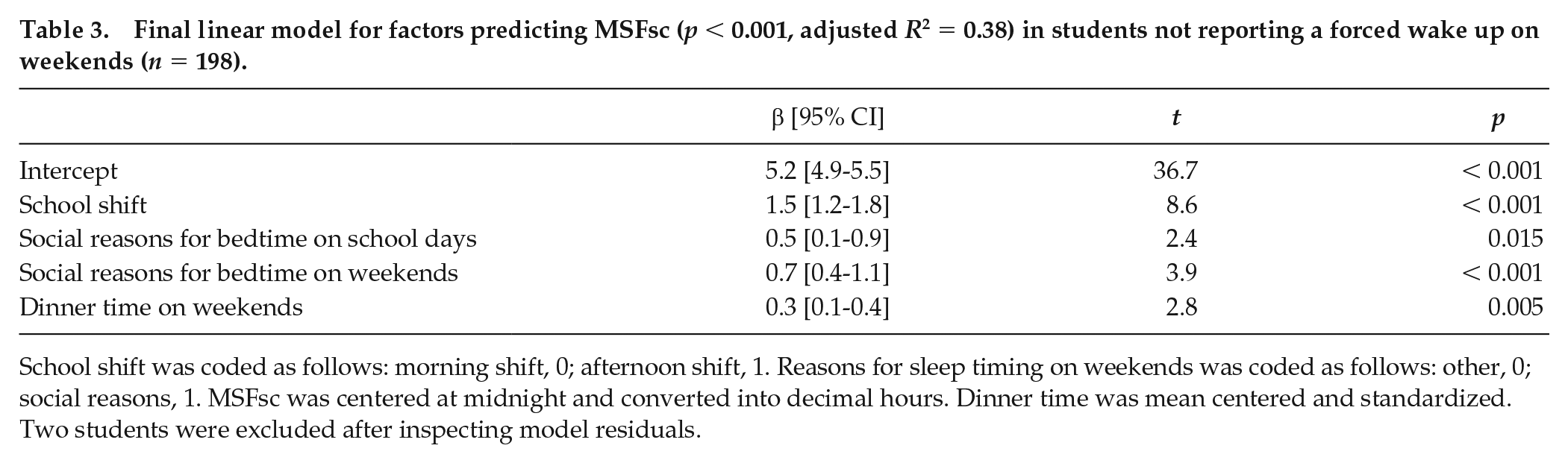
School shift was coded as follows: morning shift, 0; afternoon shift, 1. Reasons for sleep timing on weekends was coded as follows: other, 0; social reasons, 1. MSFsc was centered at midnight and converted into decimal hours. Dinner time was mean centered and standardized. Two students were excluded after inspecting model residuals.
Timing and Duration of Sleep
We found striking differences in the sleep patterns of participants between shifts as well as between school days and weekends (Fig. 1; Table 4; Suppl. Table S4). In short, changes in sleep patterns consisted in earlier and shorter sleep on school days as compared with weekends, especially in morning-shift students. Sleep always occurred later in afternoon-shift students with respect to morning-shift students, especially on weekends. Interestingly, no difference in sleep duration was observed across shifts on weekends.
Sleep timing and duration on school days and weekends for students attending the morning (n = 139) or afternoon school shift (n = 129).
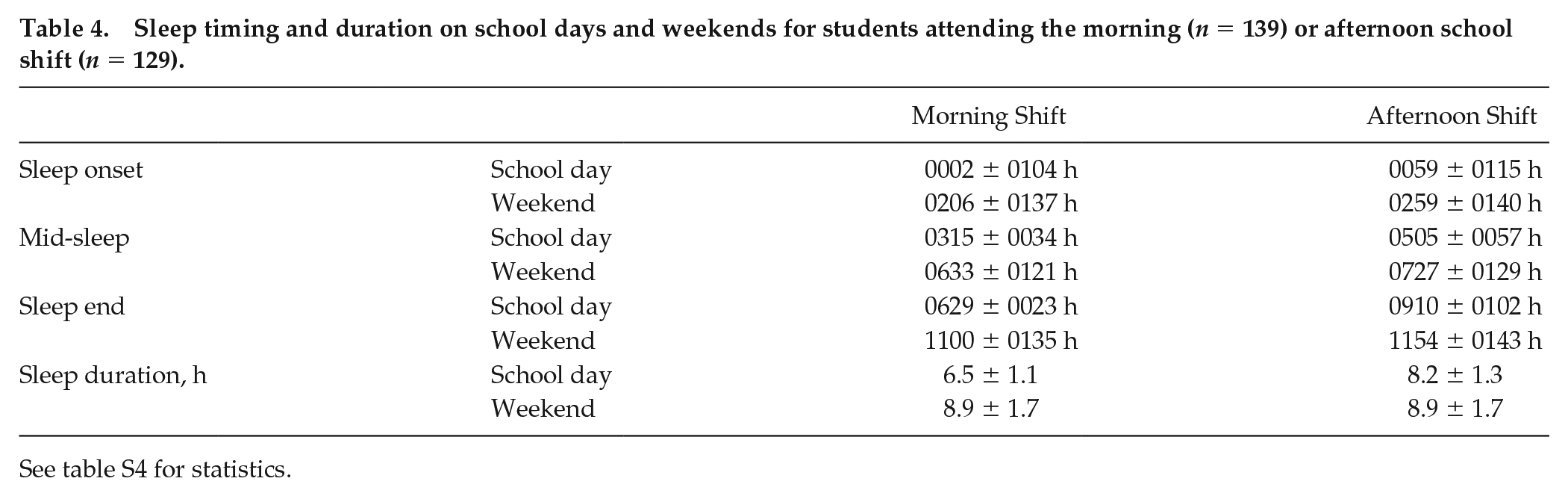
See table S4 for statistics.
Almost 30% of the students reported that social activities were a main reason for setting their bedtime on school days, with more morning than afternoon students selecting this option (36.0% vs. 22.5%; χ2 = 5.2, p = 0.02; Table 2). On weekends, a higher proportion of students reported social activities as the main reason for setting bedtime than on school days (44.0%; χ2 = 11.6, p < 0.001), with a similar proportion between school shifts (morning shift: 42.4%; afternoon shift: 45.7%; χ2 = 0.2, p = 0.68). On school days, most students reported forced a wake up, and this was more common in the morning- than in the afternoon-shift students (95.7% in the morning shift and 84.7% in the afternoon shift, χ2 = 8.3, p = 0.004). On weekends, the proportion of students forced to wake up decreased to 26.1% (44.0%; χ2 = 224.3, p < 0.001), with marginal statistical differences between shifts (morning- vs. afternoon-shift students: 20.9 vs. 31.8%; χ2 = 3.6, p = 0.06).
Sleep Duration and Its Constraints
As described above (Fig. 1; Table 4; Suppl. Table S4), morning-shift students slept significantly less during school days than afternoon-shift students did but not differently on weekends. It is thus interesting to observe that sleep duration was negatively correlated with mid-sleep in both shifts in school days but only in morning-shift students in weekends (Table 5). In addition, we found that only in the morning-shift students was sleep duration on weekends negatively correlated with mid-sleep on school days and sleep duration on school days with mid-sleep on weekends (Table 5).
Association between mid-sleep point and sleep duration on school days and weekends separately in morning-shift (n = 139) and afternoon-shift students (n = 129).
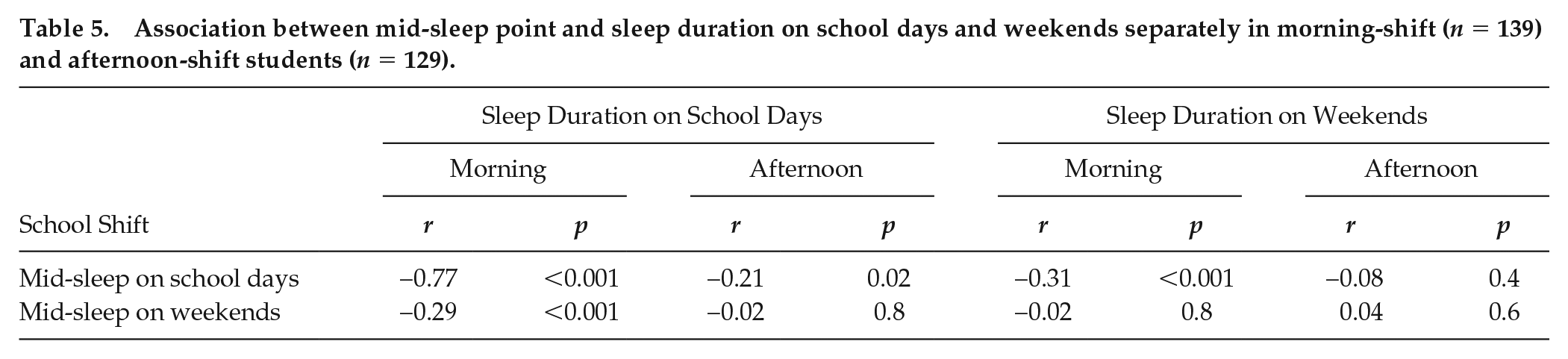
Morning-shift students had a mean SDweek of 7.2 ± 1.1 h with 78.7% of the students sleeping less than 8 h on average, while afternoon-shift students had a mean SDweek of 8.4 ± 1.2 h with 33.8% of the students sleeping less than 8 h on average (t = −9.0, p < 0.001, for the difference in SDweek; χ2 = 51.9, p < 0.001 for the difference in short sleep frequency). Considering together all the students of both shifts, almost 60% of the students reported SDweek values below the minimum recommended of 8 h per day. We performed a 3-step hierarchical regression analysis to identify predictors of individual short SDweek. The procedure was similar to the one performed for chronotype, but in this case, chronotype was also included as a predictor, and we studied each shift separately. In the morning shift, the deviance explained by MSFsc was 10.3% (χ2 = 14.7, p < 0.001). After age and gender were added in a second step, the model fit increased by 11.5% (χ2 = 14.6, p < 0.001). Last, main effects of bedtime reasons and dinner time on school days and weekends were added, increasing the model fit by 14.0 % (χ2 = 15.9, p = 0.003) and explaining 31.8% of the deviance (Table 6). In the final model, only MSFsc, age, and dinner time on school days were significant predictors of reduced SDweek (χ2 = 45.2, p < 0.001). In the morning shift and using the original scale, an hour delay in MSFsc increased the odds ratio (OR) for short SDweek by 2.1 times (95% CI: 1.3-3.9; z = 2.7, p = 0.007). A 1-year (original scale) increase in age increased the OR for short SDweek by 4.1 times (95% CI: 1.9-10.3; z = 3.4, p < 0.001). In the case of dinner time, the unstandardized coefficient indicated that an hour delay increased the OR for short SDweek by 3.6 times (95% CI: 1.6-8.9; z = 3.0, p = 0.003). In the afternoon shift, MSFsc was not a significant predictor of short SDweek (χ2 = 0.1, p = 0.7). After the second step, this model increased the model fit by 2.5% (χ2 = 4.1, p = 0.13). In the third step, bedtime reasons and dinner time on school days and weekends were incorporated, and model fit improved 3.6%, although this was not significant (χ2 = 4.1, p = 0.13). In the afternoon shift, only gender was a significant predictor, but model was not significant (χ2 = 10.1, p = 0.18; Table 6). Females were less sleep deprived than males, as they presented a decrease in the OR for short SDweek of 0.4 times (95% CI: 0.2-0.9; z = −2.2, p = 0.029). Chronotype, age, and dinner time were not associated with short SDweek in the afternoon shift.
Final logit model for predicting the odds of sleeping less than 8 h/week on average in morning-shift students (n = 139, χ2 = 45.2, p < 0.001, pseudo-R2 = 0.32, AIC = 113.2, AUC = 71.8%) and afternoon-shift students (n = 129, χ2 = 10.1, p = 0.18, pseudo-R2 = 0.06, AIC = 172.8, AUC = 34.5%).
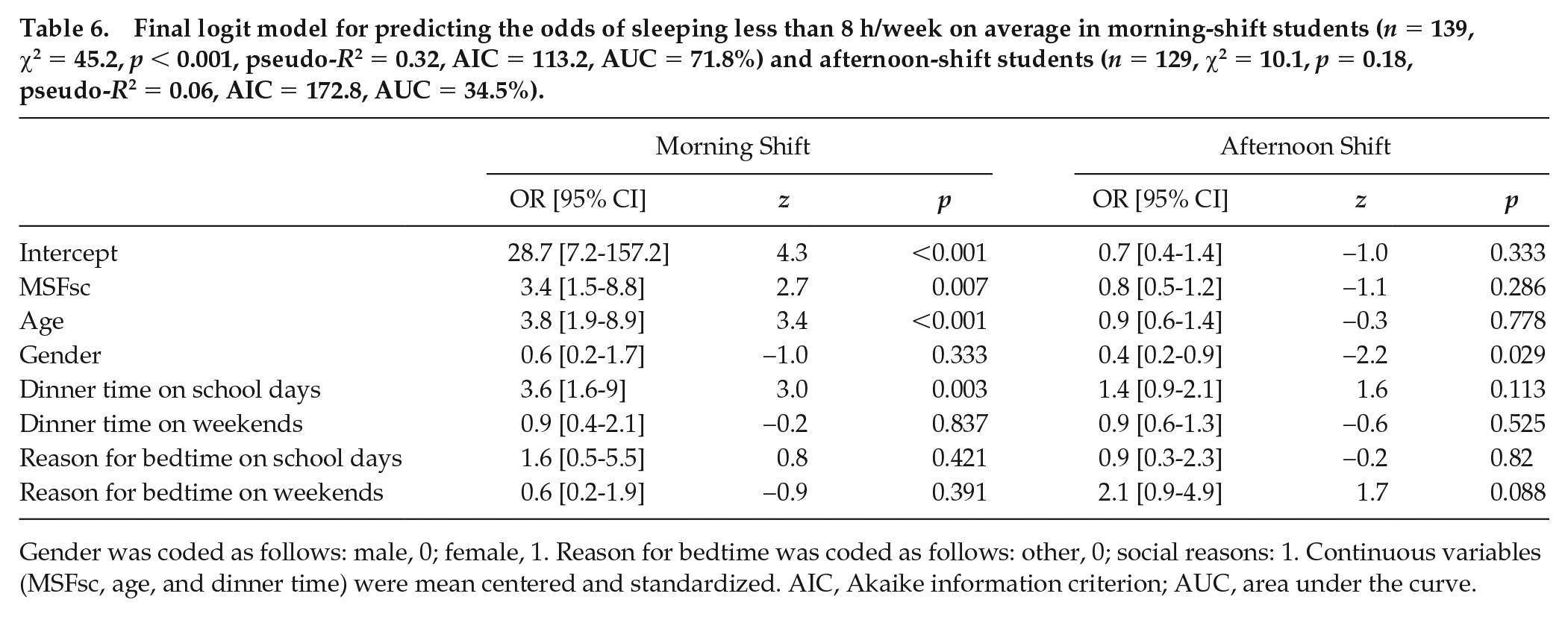
Gender was coded as follows: male, 0; female, 1. Reason for bedtime was coded as follows: other, 0; social reasons: 1. Continuous variables (MSFsc, age, and dinner time) were mean centered and standardized. AIC, Akaike information criterion; AUC, area under the curve.
Discussion
Early school start times are the best understood cause of adolescents’ circadian misalignment and chronic short sleep (Dunster et al., 2018, 2019). However, this strong effect could mask the identification of other potentially relevant factors that cannot be discerned when morning school is the only option. In this study, we took advantage of different school shifts to disambiguate the determinants of chronotypes and short sleep in Uruguayan adolescents. We found that attending afternoon school shift and social activities delayed chronotype by more than 2.5 h, which was also influenced by dinner time. Almost 80% of students attending the morning shift and 35% of afternoon-shift students slept less than 8 h per day on average. Besides school shift and gender, chronotype, age, and dinner time on school days were also significant predictors of short sleep but only in morning-shift students, suggesting that biological and social factors that tend to reduce sleep in adolescence are more pervasive when combined with an early school start.
Our study has several limitations. Self-report questionnaires may overestimate sleep duration compared with more objective measures such as actigraphy or sleep diaries (Arora et al., 2013; Jackson et al., 2018; Lauderdale et al., 2008), possibly underestimating the prevalence of short sleep duration in our sample. Although the SSHS has been validated with objective measures of sleep in adolescents and presented a good overall performance, particularly on schooldays (Wolfson et al., 2003; Ziporyn et al., 2017), further studies with Uruguayan adolescents should complement the usage of questionnaires with other objective measures. Another limitation is the cross-sectional design of our study, as it restricts the interpretation of the relationship among variables. However, studies using repeated measures with students attending morning school and comparing between vacations and school period have described the same pattern of reduced and advanced sleep as originating in the school time demands, both in adolescents (Agostini et al., 2018; Bei et al., 2014; Hansen et al., 2005) and in young undergraduate students (Korczak et al., 2008). In addition, it is unlikely that school shift attendance is influenced by prior sleep deprivation, as students cannot choose or influence the shift they will attend, minimizing concerns of reverse causation.
Extreme Chronotypes of Uruguayan Youth
The Uruguayan school system appears as particularly advantageous for chronobiological studies because students are randomly assigned into shifts, creating a natural experiment to compare between similar populations under different social pressures (Estevan et al., 2018). The chronotype distribution of Uruguayan high school students reported in this study (as well as in Uruguayan university students; Silva et al., 2019; Tassino et al., 2016) is extremely delayed, with some of the most extreme late chronotype values reported so far in the literature (Carissimi et al., 2016; Fischer et al., 2017; Masal et al., 2015, 2016; Pande et al., 2018; Porcheret et al., 2018; Randler, 2008; Randler et al., 2009; Roenneberg et al., 2007a; Vollmer et al., 2017). It is noteworthy that late chronotypes have also been reported in students from countries with very similar cultural practices such as Buenos Aires (Argentina) or Madrid (Spain) (Randler, 2008). It has been argued that chronotypes can also be influenced by latitude (Borisenkov, 2011; Masal et al., 2015; Randler, 2008) and that chronotype is on average shifted later when sunset time is delayed relative to a given time zone (Giuntella and Mazzonna, 2019; Masal et al., 2015; Roenneberg et al., 2007b), as is the case of Spain, Argentina, and Uruguay. None of these factors, however, can explain why Uruguayans exhibit such a late chronotype distribution, even when compared with similar populations from Argentina and Spain. Afternoon school attendance has previously been associated with a higher proportion of late chronotypes as compared with morning-school shift attendance in Brazilian (Carissimi et al., 2016), Mexican (Arrona-Palacios et al., 2015), and Uruguayan students (Estevan et al., 2018). In a recent conceptual review, Roenneberg et al. (2019) highlighted that chronotype may reflect state rather than a stable personality trait, in line with the dynamics of an entrained circadian system. In line with this conceptual framework, we found that in addition to the school shift, nocturnal social activities such as a late dinner also delayed students’ chronotype. Of note, high school students have little choice in terms of dinner time, as dinner is a highly social family event in Uruguay and its time is typically set by the family group. While we argue that social ties delay MSFsc, the opposite interpretation is also plausible; that is, being evening oriented enables students to enjoy a flourished social environment. However, more students in the morning shift selected social activities as the main reason to set bedtime on free days, even though later MSFsc was observed in afternoon-shift students, suggesting that social activities influence chronotype and not the other way around.
We did not find an influence of age or gender on MSFsc. Although variations in MSFsc between genders and along ontogeny had been reported (Fischer et al., 2017; Masal et al., 2015; Roenneberg et al., 2004, 2007a), this influence may be obscured in our population by the effect of school shifts, and a bigger sample may be necessary. Gender differences were also not observed in Brazilian students attending different shifts (Carissimi et al., 2016).
Sleep Patterns: The Interplay between the Effects of Shifts and Weekend Compensation
Based on several previous studies, adolescent sleep has been described as a perfect storm (Carskadon, 2011; Crowley et al., 2018), because in the same period of life in which chronotypes become later, school attendance is universally scheduled very early in the morning. Therefore, a great proportion of adolescents across the world experience a chronic misalignment between their inner and social clocks that results in a sleep deficit during school days and sleep compensation during weekends (Andrade et al., 1993; Arrona-Palacios and Díaz-Morales, 2017; Carissimi et al., 2016; Carskadon et al., 1998; Crowley et al., 2014; Hansen et al., 2005; Laberge et al., 2001; Lehto et al., 2016; Mello et al., 2001; Pande et al., 2018; Russo et al., 2007; Urner et al., 2009; Valdez et al., 1996; Wolfson, 1996; Wolfson and Carskadon, 1998; Yang et al., 2005). Although the sleep patterns of both morning- and afternoon-shift students followed the expected changes between school days and weekends, we observed 2 different scenarios. On one hand, students attending the morning shift were extremely sleep deprived and misaligned because (1) sleep duration was shorter on school days (6.5 h on average) than on weekends (8.9 h on average), even though this compensation was not enough to overcome the sleep deficit, as the weekly average of sleep resulted in 7.2 h per day on average; (2) they showed a strong SJL (more than 3 h on average); and (3) sleep was scheduled earlier on school days than on weekends (sleep onset was delayed by about 2 h and sleep end by about 4.5 h on average on weekends), with more than 95% of students reporting a forced wake up on school days. On the other hand, although afternoon-shift students showed the same trend, they were not actually as sleep deprived because (1) sleep duration was always greater than 8 h per day on average, although still shorter on school days (8.2 h on average) than on weekends (8.9 h on average); (2) they showed less SJL than morning-shift students (<2.5 h on average); and (3) although sleep was scheduled earlier on school days than on weekends, the effect was smaller than in morning-shift students (sleep onset was delayed about 2 h and sleep end by about 3 h on weekends), with 85% of students reporting a forced wake up on school days. This same pattern was observed in previous studies with students attending school in multiple shifts (Arrona-Palacios et al., 2015; Carissimi et al., 2016; Valdez et al., 1996). Although these and our results are based mainly on data obtained from auto-reported data, the companion article by Carvalho-Mendes et al., Accepted shows a very similar sleep pattern on adolescents attending morning or evening school shifts using actimetry-based data. Several studies that focused on delaying schools start times showed that when start time is delayed, adolescents sleep longer and sometimes less than the delayed time (Bowers and Moyer, 2017; Kirby et al., 2011; Minges and Redeker, 2016; Wheaton et al., 2016). However, this improvement in sleep duration has been challenged in a recent meta-analysis (Marx et al., 2017).
Although morning-shift students had an extremely short sleep duration on school days and a more dramatic change in their sleep schedule on weekends, they did not sleep more than afternoon-shift students during weekends. Accordingly, studies in Mexican and Brazilian teens also reported that sleep duration on weekends was similar when comparing students attending either the morning or the afternoon school shift, even though they did not consider the interaction between school shift and type of day (Arrona-Palacios et al., 2015; Carissimi et al., 2016; Valdez et al., 1996). In addition, previous studies in which students changed their school schedule from the afternoon to the morning detected a reduction in SDweek (because students advanced the sleep end but the sleep onset was not advanced proportionally), while a small or no difference was observed in the sleep duration in weekends to compensate for this deficit (Brandalize et al., 2011; Mello et al., 2001).
On school days, mid-sleep was negatively correlated with sleep duration in both shifts but especially in morning-shift students, whose sleep end on school days was more restricted. On weekends, though, we did not see an association between sleep timing and duration; all students slept significantly longer on weekends than during the school week, as we expected. However, sleep on the weekend was not unrestricted, as more than 25% of the students reported a forced wake up during weekends. In addition, although morning-shift students reported higher weekday sleep debt, we found no differences in sleep duration on weekends between school shifts, suggesting that other factors—including social ones—are preventing morning-shift students from entirely recovering the sleep debt. Together, this points to a higher burden of chronic sleep debt in the morning shift students.
Determinants of Short Sleep Durations
As previously reported (Gradisar et al., 2011), early school start times are associated with shorter sleep duration in adolescents. In addition to the strong effect of school start times (and, in our case, the school shift) on sleep duration, later chronotype, older age, and late dinner time increased the risk of inadequate sleep duration in morning-shift students. Interestingly, chronotype was not associated with sleep duration in students attending school in the afternoon, although the latest chronotypes were observed in these groups. We found that females were less sleep deprived than males, as reported in previous studies comparing sleep duration between genders (Collado Mateo et al., 2012; Olds et al., 2010), but only in the afternoon shift and with a small effect size. In general, inadequately short sleep duration was highly prevalent in morning-shift students, and this little variability might be the reason why we did not observe sex differences in this shift.
Our data indicate not only that morning-shift students were sleep deprived but also that they failed to compensate for their sleep deficit during weekends. These findings encouraged us to dig into the other putative causes of short sleep. In their meta-analysis, Olds et al. (2010) included studies from 4 continents and highlighted the influence of cultural practices on sleep differences in addition to school timing. Short et al. (2013) found that more frequent parent-set bedtimes, later school start times, and less extracurricular commitments partially mediated the longer sleep durations of Australian adolescents with respect to U.S. ones. Bartel et al. (2015) demonstrated that technology use was positively associated with bedtime and negatively with sleep duration. The cultural habit of late dinner times on school days (2130-2230 h), which in Uruguay is the time during which the family has their daily gathering, had a significant impact on short sleep in students attending either the morning or the afternoon shift. Although the association between dinner time and sleep patterns has already been suggested (Jenni and O’Connor, 2005), this is the first study to our knowledge to confirm its significance quantitatively. Social activities influencing sleep have been undervalued so far, and we need to have better approaches to test the way social ties might be preventing sleep duration, including sleep recovery during the weekends. In this regard, 30% of students reported that social activities delayed their bedtime on school days and almost 45% during weekends. In addition, reported social activities also had a significant impact on individuals’ chronotypes. Taken together, our data suggest that nocturnal entertainment and social networking may be strong influences on the moment adolescents decide to go to sleep and consequently may lead to chronic sleep deprivation. This is important when, for example, considering barriers for interventions aimed at lengthening sleep duration in adolescents.
Supplemental Material
Estevan_et_al_Revised-supplementary_tables – Supplemental material for Short Sleep Duration and Extremely Delayed Chronotypes in Uruguayan Youth: The Role of School Start Times and Social Constraints
Supplemental material, Estevan_et_al_Revised-supplementary_tables for Short Sleep Duration and Extremely Delayed Chronotypes in Uruguayan Youth: The Role of School Start Times and Social Constraints by Ignacio Estevan, Ana Silva, Céline Vetter and Bettina Tassino in Journal of Biological Rhythms
Footnotes
Acknowledgements
We are very grateful for the community of Liceo 10, Montevideo, Uruguay, for their collaboration in this study. We also thank Andrés Oliveri, Alejo Acuña, Julieta Pomi, and Julieta Castillo for their help in data acquisition. We finally thank Álvaro Cabana for his comments and suggestions on the statistics. The authors disclosed receipt of the following financial support for the research, authorship, and/or publication of this article: During the study period, Ignacio Estevan was supported by a scholarship from Agencia Nacional de Investigación e Innovación, Uruguay (POS_NAC_2015_1_109643); Ignacio Estevan also received support from Comisión Sectorial de Investigación Científica, Universidad de la República, Uruguay (Iniciación 2017 #361).
Conflict of Interest Statement
The authors have no potential conflicts of interest with respect to the research, authorship, and/or publication of this article.

Notes
References
Supplementary Material
Please find the following supplemental material available below.
For Open Access articles published under a Creative Commons License, all supplemental material carries the same license as the article it is associated with.
For non-Open Access articles published, all supplemental material carries a non-exclusive license, and permission requests for re-use of supplemental material or any part of supplemental material shall be sent directly to the copyright owner as specified in the copyright notice associated with the article.
