




Abstract
Information is provided about the Chronotherapy Network Netherlands (CNN).
In 1981, Professor Jürgen Aschoff wrote in his chapter “The Circadian System of Man” that “chronotherapy may soon become of general usage.....” It was not until 2017 before the field of chronobiology was given real credit when the Nobel Prize for Physiology or Medicine was awarded to 3 Americans for unraveling the molecular background of circadian rhythms. This is a milestone, but enthusiastic people are needed to spread the word and translate this knowledge to society so that, finally, a general use of chronotherapy can be stimulated.
An informal network of people exists in the Netherlands. This implies no official association or foundation, no statutes, no by-laws, no official president, no members, no fees, but therefore no treasurer either.
All participants are professionally interested and/or involved in the clinical applications of chronotherapy.
Since this network became active, many new initiatives of chronotherapy in practice and research programs have started, and the interest is growing tremendously. Here, we report how this network developed and became so successful.
History
The 4 Dutch founders (Y.M., E.V., H.-P.S., M.G.) met at 2 consecutive annual meetings of the Society for Light Treatment and Biological Rhythms (SLTBR), and they were surprised that they only met abroad, having the same field of interest and working in the same (small) country. Since they knew more people who had the same interest in the field of clinical chronotherapy, they organized a first national meeting in 2014, an initiative to meet with others more frequently in the Netherlands.
Mission
Their goal was to create a chronotherapy platform for people to meet and to share knowledge, enthusiasm, and work experiences from clinical practice. They defined chronotherapy as any treatment using knowledge on 24-h rhythmicity in humans with the purpose of achieving a clinical effect in patients to improve well-being or health. This definition is very broad and includes almost everything related to the 24-h rhythmicity in humans. To make a practical start of the network, the first invitation was limited to people who used chronotherapy in psychiatry, neurology, sleep disorders, gerontology, or for the treatment of tiredness in somatic diseases.
Methods
After a first founders meeting, everybody with a known interest in the field in the Netherlands was sent an email with the proposal to create a network of people working in or interested in the field of clinical chronotherapy. With the help of the employer of 2 founders, a founding afternoon symposium was organized in The Hague. The host institute covered the costs of the meeting room, catering, accreditation, and materials, so the meeting was free of charge for the attendees. This was done on purpose, to avoid creating participation thresholds. The first meeting was a great success; it attracted 127 participants and was attended by clinical (neuro)psychologists, cognitive neuroscientists, chronobiologists, neurologists, psychiatrists, pharmacologists, movement scientists, technical scientists, nurses, and many more.
An informal network was created named Chrono-therapy Network Netherlands (CNN). Everybody with an interest in this field was put on a mailing list and sent messages by email about related conferences, vacancies, questions about experiences or advice, collaboration in the creation of guidelines, and participating in conferences besides the annual afternoon meeting. Members organized or participated in well-attended workshops during psychiatric congresses or other meetings, and a Dutch-language review article was written (Meesters et al., 2016). CNN was presented at the SLTBR meetings of 2017 (Verwijk et al., 2016) and 2018. Every year from 2013 onward, the well-attended annual afternoon meetings (mostly about 100 participants) were organized by a host institute that covered the costs. The program of the symposium always included a few presentations of basic concepts and clinical experiences with chronotherapy, and some time was also available for case studies, the discussion of study protocols of new researchers in the field, and participants’ open questions.
So far, 6 different institutes from all over the country have had the generosity to accept this task, and at least 2 others are prepared to do so for the coming years. This system makes it possible for almost anybody from different disciplines and educational levels to join the meetings without financial thresholds. The host institutes are very enthusiastic, and with the help of volunteers from CNN, the total costs of the meetings are very low compared with meetings organized by professional conference organizers.
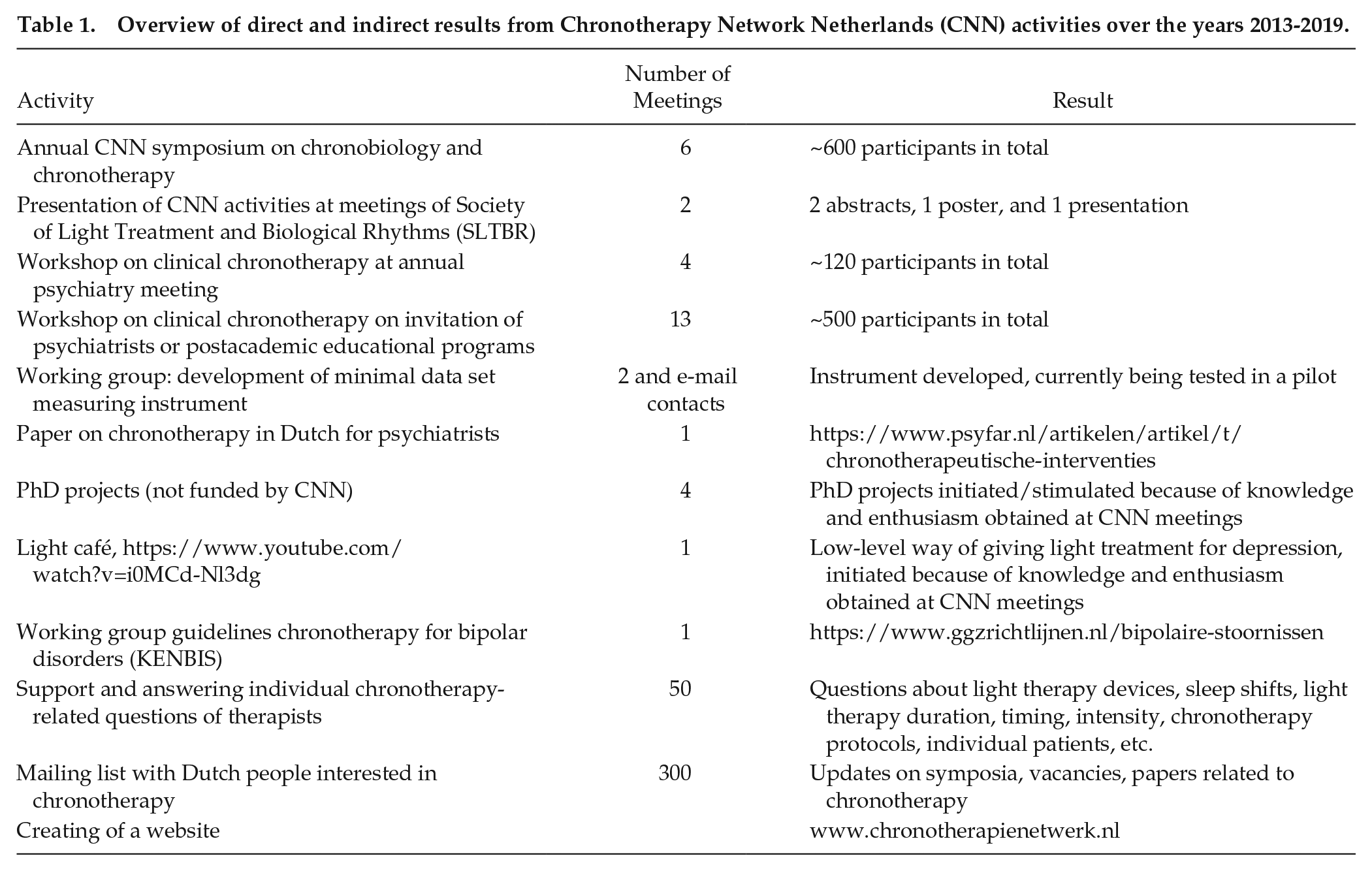
It is of course not easy to measure the direct result of CNN activities. However, several initiatives and collaborations in the Netherlands have found their basis during these informal meetings or afterwards in discussion platforms and individual contacts. In Table 1, the most direct and indirect results have been summarized.
Overview of direct and indirect results from Chronotherapy Network Netherlands (CNN) activities over the years 2013-2019.
The Future
The enthusiasm for and interest in the field of clinical chronotherapy in the Netherlands are growing. Colleagues from abroad present at international meetings are curious as to how we have organized this network and how we have been able to get so many people interested in this field (currently the mailing list consists of about 300 people).
In our opinion, the enthusiasm and willingness to share knowledge and experiences without financial or scientific thresholds have created a rather informal atmosphere in which lots of different people from the field feel comfortable. We do hope we can continue this network in the future and that chronotherapy will finally be recognized as a serious way to improve treatment success in a great number of patients.
With this letter, we would like to inform you about this initiative to stimulate more networks on chronotherapy all over the world.
