




Abstract
This article investigates how disinformation circulates on social media as adversarial narratives embedded in identity-driven controversies. Empirically, the article reports on the flat Earth echo chamber on YouTube, a controversial group arguing that the earth is a plane, not a sphere. By analyzing how they weave their arguments, this study demonstrates that disinformation circulates through identity-based grievances. As grudges intensify, back-and-forth argumentation becomes a form of knowing that solidifies viewpoints. Moreover, the argument resists fact-checking because it stokes the contradictions of identity work through grievances (pathos) and group identification (ethos). The conceptual contribution proposes a two-phase framework for how disinformation circulates on social media. The first phase, “seeding,” is when malicious actors strategically insert deceptions by masquerading their legitimacy (e.g., fake news). The second phase, “echoing,” enlists participants to cocreate the contentious narratives that disseminate disinformation. A definition of disinformation is proposed: Disinformation is an adversarial campaign that weaponizes multiple rhetorical strategies and forms of knowing—including not only falsehoods but also truths, half-truths, and value-laden judgments—to exploit and amplify identity-driven controversies. Finally, the paper has implications for policy makers in handling the spread of disinformation on social media.
Disinformation threatens democratic institutions because it stokes and amplifies the divisions that polarize society (Bennett and Livingston 2018; O’Shaughnessy 2020; Vosoughi, Roy, and Aral 2018), antagonizing groups that hold a different worldview (Braddock 2015). Current events, such as the Russian invasion of Ukraine, show the role of disinformation in radicalizing public opinion to support physical violence. Moreover, even when polarization does not involve actual violence, it still makes policy-making challenging, if not impossible, because public policy is interpreted through the lens of culture wars. The notion of “culture wars” refers to the phenomenon in which multiple groups of people, who hold entrenched values and ideologies, attempt to contentiously steer public policy (Hartman 2019). From introducing sensible gun control policies to convincing the public to wear masks during a global pandemic, culture wars set public policy as a never-ending altercation.
Echo chambers and disinformation are two essential concepts in disinformation research. An “echo chamber” (Nguyen 2020) is an epistemic environment in which participants encounter beliefs and opinions that coincide with their own; that is, “a self-reinforcing mechanism that moves the entire group toward more extreme positions” (Cinelli et al. 2021, p. 1). In the literature, disinformation refers to an orchestrated activity in which malicious actors plant or seed “strategic deceptions that may appear very credible to those consuming them” via “intentional falsehoods spreading as news stories or simulated documentary formats to advance political goals” (Bennett and Livingston 2018, p. 124).
Currently, disinformation research focuses on how actors plant falsehoods on social media (Anspach and Carlson 2020; Baccouche et al. 2020), primarily via fake news (Di Domenico et al. 2021). However, setting up strategic deceptions is just the first phase. From the disinformation agent's perspective, the intended outcome is that popular culture takes over, circulating as consumers’ beliefs while hiding sources and intentionality. In this article, we investigate a second phase in which people take what started as deceptions and circulate them as personal views.
Policy-making organizations (European Commission 2018; North Atlantic Treaty Organization 2020; World Health Organization 2020) and tech firms (Meta-Facebook 2021; Weedon, Nuland, and Stamos 2017; YouTube 2021) identify disinformation as a growing threat for which we lack effective countermeasures. Current policies have the limited goal of preventing factual falsehoods from taking hold on social media. The existing toolbox includes issuing authoritative factual corrections (fact-checking) and banning content/users that break community guidelines. These policies intend to limit actors from feeding disinformation onto social media, but provisions are missing when disinformation circulates as beliefs.
Although disinformation research and public policy aim to prevent falsehoods from spreading on social media (Ha, Andreu Perez, and Ray 2021), we lack a sufficient understanding of the process through which disinformation embeds with the consumers’ worldview, akin to any other cultural position that cannot be proved or disproved. Multiple fields—including political science, journalism, and communications—call for research on the propensity of people to believe and share disinformation (Anspach and Carlson 2020; Ha, Andreu Perez, and Ray 2021; Hughes and Waismel-Manor 2021; Waisbord 2018; Weeks and Gil de Zúñiga 2021).
The spread of disinformation on social media is a suitable research phenomenon for marketing scholars and consumer researchers. For example, the strategic vision set by the Journal of Public Policy & Marketing's coeditors (Martin and Scott 2021) calls for multidisciplinary research on matters of public interest, especially intersecting public and private sectors. However, few disinformation studies have been performed in marketing (Di Domenico et al. 2021), and those that exist primarily focus on the effects of false information on brands (Berthon and Pitt 2018; Borges-Tiago et al. 2020).
Previous research delineates disinformation's anatomy (or structure) and explores the obfuscation strategies to hide disinformation, such as fake news. However, few studies focus on the dissemination mechanisms of disinformation on social media. This gap is problematic because disinformation is the process of mass disseminating deceptions. Thus, we cannot limit ourselves to conceptualizing only the anatomy of those deceptions; we must also understand the dissemination process that turns falsehoods into collective beliefs. Therefore, our research question is:
How does social media disinformation persuade in and through its circulation in echo chambers?
We draw on rhetoric theory (Brown et al. 2018; Miles 2018; Miles and Nilsson 2018) to conceptualize persuasion in the antagonistic narratives between groups that disseminate disinformation. Furthermore, we draw on consumer culture theory regarding how consumers invest in identity projects to build a sense of worth both individually and as a group (Thompson 2014), especially when identity projects involve resistance and moral conflict (Luedicke, Thompson, and Giesler 2010).
This article empirically investigates the flat Earth echo chamber, which circulates the belief that the earth is flat, not spherical. Flat-earthers believe the spherical Earth is either an unproven theory or a conspiracy. Their audience is growing, and as of July 2021, four million people had subscribed to the top 122 YouTube channels that upload flat Earth content (only channels with more than 1,000 subscribers were counted). The flat Earth context has inspired academic research on religious media (Olshansky, Peaslee, and Landrum 2020) and conspiratorial thinking (Landrum and Olshansky 2019).
This investigation analyzes how the group's rhetorical strategies morph into extreme positions concerning science denialism, conspiracy, and religious zeal. In turn, our purpose is to understand disinformation's embeddedness in popular culture. The flat Earth echo chamber is a suitable context because of its resistance to fact-checking. Flat-earthers engage with the public, eliciting debates with scientists and making media appearances, even when facing ridicule. Their public profile offers an opportunity to understand narratives that promote the adoption of extremist, radicalizing beliefs (Braddock 2015). Given the overwhelming scientific evidence against their claims, the question is: How do flat-earthers argue within their echo chamber?
Extending O’Shaughnessy (2020), our findings show that consumers of disinformation argumentatively coproduce a contentious fantasy. Their views assemble an identity project that is reinforced, rather than subverted, when confronted with counterarguments; thus, their argumentation deflects fact-checking by reversing the burden of who must prove what and labeling critics as disinformation agents. In so doing, the echo chamber reinstates a Galilean society ruled by the dogma that displaces and rejects scientific rationality (see Boden and Epstein 2011).
The theoretical contribution of this study conceptualizes the rhetorical strategies that propel disinformation onto social media, finding that identity-driven controversies circulate disinformation. This article extends disinformation from referring exclusively to planting factual falsehoods to include its dissemination through grievances of group identification. Hereinafter, we study how disinformation encourages consumers to use any argumentative means at their disposal to win adversarial narratives, which defy fact-checking because identity cannot be proved wrong.
Theoretical Framework
This section reviews the literature on disinformation, extending its current focus on the anatomy of deceptions (Fallis 2015) that masquerade as legitimate (Bennett and Livingston 2018) to include what we know about disinformation's dissemination as controversies. Drawing from rhetoric theory (Perelman and Olbrechts-Tyteca 1971), we conceptualize controversies as epistemology.
Disinformation as Intentional Misinformation
Disinformation differs from misinformation in its intent (Bennett and Livingston 2018; Fallis 2015; Weedon, Nuland, and Stamos 2017). Misinformation refers to information quality in terms of flawed, misleading, or inaccurate information (Tucker et al. 2018; Weeks and Gil de Zúñiga 2021), and misinformation is unintentional, whereas disinformation is intentional. “Unlike an honest mistake, disinformation comes from someone who is actively engaged in an attempt to mislead” (Fallis 2015, p. 402). In other words, misinformation is “misleading or inaccurate information,” whereas disinformation “includes all forms of false, inaccurate, or misleading information designed, presented and promoted to cause harm intentionally or for profit” (European Commission 2018, p. 10).
The emphasis on intentionality builds on U.S. legal tradition. Meta-Facebook conceptualizes disinformation through “malice” (Weedon, Nuland, and Stamos 2017, p. 5), defined as an action that a reasonable person should know would cause harm. However, determining intentionality can be impractical, even unsubstantial. Unlike a court of law, social media is an environment in which it is often impossible to assess whether falsehoods are intentional. An agent planting disinformation on social media succeeds if enough consumers internalize the ideas that started as deception as their own beliefs.
It is challenging to track disinformation on social media to assert intentionality. A research team tracked one source of a disinformation campaign for the 2016 U.S. presidential election to Veles, a small town in central North Macedonia (Hughes and Waismel-Manor 2021). Mirko Ceselkoski, an entrepreneur, trained dozens of villagers in clickbait techniques to disparage a U.S. presidential candidate. However, it remains unclear whether this act was more than a scheme to monetize internet traffic. “Ceselkoski's course, the Facebook Marketing University, is not an introduction to fake news production and dissemination but rather a primer that teaches students how to utilize the Internet for financial gain by creating sensational content fitting a pay-per-click world” (Hughes and Waismel-Manor 2021, p. 21). Regardless of intent, the villagers did spread disinformation.
By conceptualizing disinformation as a strategic lie, current research casts the audience as the victim. However, studies on the psychology of propaganda show that “the ‘victim’ of disinformation is by no means necessarily naive: the process could more aptly be described as a co-production, with the target being invited to join a shared fantasy” (O'Shaughnessy 2020, p. 55). In other words, people sometimes consume disinformation they want to believe because it confirms their worldview and advances their interests. Therefore, although it remains essential to continue to track intentionally placed misinformation (Achimescu and Chachev 2021; Allcott, Gentzkow, and Yu 2019; Lewandowsky, Ecker, and Cook 2017), it is equally important to understand why people are eager to mobilize disinformation in adversarial narratives (Global Disinformation Index 2019).
Disinformation as a Rhetorical Act
This section argues not only that the rapid spread of disinformation on social media can be analyzed from the perspective of rhetoric but also that the core of disinformation can be understood as a rhetorical act that shapes what society considers possible. Therefore, this article focuses on the rhetorical actions that sow division and engender doubt, leading to both “self-deceit” and “other-deceit” (O’Shaughnessy 2020). Drawing on Burke (1969, p. 26), we argue that disinformation is not persuasive because of someone's extraordinary skills in placing falsehoods but rather as “trivial repetition and dull daily reinforcement [leading to] identification.”
Aristotle (Rhetoric 1.1.1355b) established the art of rhetoric around 350 BCE as the “detection of the persuasive aspects of each matter.” Three kinds of argumentative appeals can persuade: (1) Logos is an argumentative form based on logical reasoning, proof, and evidence, residing in the speech itself. (2) Ethos resides in the character or credibility of the speaker and has three dimensions: common sense, virtue, and goodwill. (3) Pathos is persuasion through emotional appeals that engage passion, fear, anger, and conflicts in the audience. Aristotle (Rhetoric 1.2.1356a) maintained that ethos, proof from character, is persuasive because, “we believe reasonable men on all matters in general and absolutely on question where precision is impossible and two views can be maintained.”
An example of the rhetorical power of ethos can be found in former U.S. President Trump's recurring accusation of “fake news” to undermine journalists (Mould 2018), delegitimizing them through character assassinations. Scott Adams, creator of the comic strip Dilbert and one of the earliest public figures to predict Trump's election, recognized that what the media misinterpreted as petty insults and bluster were effective persuasion techniques. His fittingly titled book, Win Bigly: Persuasion in a World Where Facts Don’t Matter, explains how Trump replaced facts with identity because identity cannot be disproved (Adams 2017).
There is growing interest in rhetorical analysis in academic marketing research (Brown et al. 2018; Miles 2018; Miles and Nilsson 2018). Marketing researchers draw from both Aristotle and contemporary rhetorical theory that investigates the rhetorical aspect of knowledge production (Billig 1996). In daily arguing, people constantly cross-examine and refute controversial ideas without being able to establish a “final word” on the controversy because “claim and counter-claim can be made indefinitely” (Billig 1996, p. 123).
Rhetoric theory recognizes that people in everyday situations know things without necessarily using scientific rationality. To explain further, people cocreate knowledge as they work through the structure of their arguments in everyday discussions (Perelman and Olbrechts-Tyteca 1971). For example, a recurring value judgement is whether all politicians are corrupt. As participants argue if the claim is true or false, the debate solidifies positions in ways that become so entrenched that it appears everybody knows politicians are corrupt.
In contrast with everyday arguing, formal academic fields have strict standards for assessing knowledge. Academic training emphasizes precision, formal logic, and supporting proofs, which means academics face difficulties with common, everyday arguing in which people use beliefs as factual statements (Perelman and Olbrechts-Tyteca 1971). Therefore, rhetoric theory can help bridge academics with lay arguments.
Recently, marketing scholars who are interested in rhetoric have been studying propaganda (Miles 2020; O’Shaughnessy 2020). As a rhetorical act, disinformation is more than spreading lies. Like disinformation, propaganda does not necessarily need to be false; instead, disinformation can be “largely or partly true, and often is, to make it more credible” (O'Shaughnessy 2020, p. 55).
A rhetorical approach addresses disinformation beyond falsehoods. One example is the tactic of systematic doubt, which is effective because few claims can be proved fully. Commentators delay closure by appealing to the relative nature of knowledge and thus ensure the debate remains unresolved. The cigarette industry lobby and climate change deniers use systematic doubt to undermine science by requesting unreasonable demands for proof (Nordhaus 2012). Similarly, media pundits avoid accusations of misinformation by phrasing statements as questions, thus camouflaging misinformation.
As arguments circulate, disinformation tactics shift what is factual into what is possible. A rhetorical approach focuses less on factual or objective truth and more on the probable claims that people persuade others to believe. In turn, building on rhetoric, we propose that disinformation involves falsehoods and a range of argumentative tactics to make the public believe that probable knowledge is factual.
Google (2019, p. 2) emphasizes the misuse of digital technologies: “We refer to these deliberate efforts to deceive and mislead using the speed, scale, and technologies of the open web as disinformation.” Consistent with Google's assessment, digital technologies, especially social media, spread disinformation into popular culture (Bennett and Livingston 2018; Lang, Erickson, and Jing-Schmidt 2021; Tucker et al. 2018). Whereas the rhetorical approach explains how consumers select and filter what claims people consider to be probably true, social media amplifies the circulation of those claims. Therefore, it is crucial to understand the argumentative context of disinformation on social media.
Disinformation Circulates as Popular Culture
To conceptualize the dissemination of disinformation, we draw on the concept of consumer identity from consumer culture theory (Thompson 2014). People use consumption as a proxy to create, maintain, and reinvent their self-understandings, both individually and collectively (Arsel and Thompson 2011; Diaz Ruiz and Makkar 2021; Diaz Ruiz, Peñaloza, and Holmqvist 2020). Identity is an ongoing project (Syrjälä 2016) in which consumption extends the self inward, as people use consumption to deal with personal frustrations, and outward, as people aim to belong to social groups such as LGBTQ+ subcultures.
In some cases, controversy motivates consumer groups because consumers build a sense of collective purpose by being against something (Luedicke, Thompson, and Giesler 2010; Scaraboto and Fischer 2013). For example, Harley-Davidson's motorcycle riders developed a group identity through the “rebel” identity against suburban entrapment (Schouten and McAlexander 1995). Participating in controversies offers individual consumers an escape from the anxieties they cannot ease, thus enabling them to circumvent or redress frustrations through experiencing intergroup tensions and opposing real or perceived adversaries (Mikkonen, Moisander, and Firat 2011). The resulting conflict is moral—such as in the Hummer boycott in which Hummer owners, seeing themselves as patriots, and their critics, seeing themselves as the earth's protectors, invoked opposing narratives (Luedicke, Thompson, and Giesler 2010).
Although some collectivities are social, others are epistemic (Haas 2008) because they refer to a shared way of thinking and circulating references. The fragmented nature of online culture, the importance of collective identity construction, and the argumentative nature of online controversies generate echo chambers in which participants encounter self-reinforcing beliefs (Cinelli et al. 2021; Jamieson and Cappella 2008; Nguyen 2020).
The notion of echo chambers originates in the study of how right-wing radio host Rush Limbaugh built a disparity of trust between his audience and his critics (Hayes 2009; Jamieson and Cappella 2008). Rhetorically, his strategies provided a restricted language (e.g., “snowflakes”), emphasizing group identity (conservatives are patriots) against adversaries (liberals are globalists, thus not patriots). Echo chambers are the trenches in which culture wars are fought as people enlist in identity-based controversies, steering narratives through oppositions against real or imaginary adversaries (Hartman 2019).
Online culture is fragmented by the emergence of online tribes (Diaz Ruiz, Peñaloza, and Holmqvist 2020), and algorithms expose consumers to information they already agree with and believe. In echo chambers, participants expose themselves mostly to self-reinforcing ideas within an ideological cohort (Barberá et al. 2015).
Method
Research Context: The Origins of the Flat Earth Movement
This section briefly introduces the research context before explaining the fieldwork and analysis. The contemporary flat Earth belief began with Samuel Rowbotham (Garwood 2007; Rowbotham 1881). Rowbotham was known for his raucous public debates in which he often referred to Newtonian physics as a conspiracy aiming to replace religion. In the United States, the flat Earth belief gained traction under Charles K. Johnson, founder of The International Flat Earth Research Society. Johnson presented himself as an ally of religious people who resisted those trying to replace their traditions with science. According to his obituary, Johnson was “an iconoclast who trusted his eyes and the Bible,” and he argued that scientists were “witch doctors pulling off a gigantic hoax to replace religion with science” (Martin 2001). By the mid-1990s, Johnson's operation enlisted 3,500 members who paid $25 to join. In the 2010s, the flat Earth group grew because of YouTube (Olshansky, Peaslee, and Landrum 2020).
Research Approach and Data Collection
This investigation uses a rhetorical approach to understand how flat-earthers disseminate extreme views on YouTube. Specifically, we investigate how flat-earthers build audiences through user-generated content by identifying and analyzing the most prominent flat Earth video channels.
A detailed account of the research protocols can be found in Web Appendix A. In addition, Web Appendix B reports on the empirical material, including media reports on the flat Earth theory (Table W1), YouTube channels (Table W2), and prominent videos on those channels (Table W3). Finally, Web Appendix C explains the analysis.
Fieldwork started with a Facebook post from 2016 that lists 282 pro-flat-Earth YouTube channels. We visited each channel manually, analyzed its traffic, corroborated the flat Earth content, and used the YouTube algorithm to find more channels. We reduced the list to 122 channels that had at least 1,000 subscribers and at least one video supporting flat Earth content. These 122 channels had 4,002,680 subscribers and 744,708,718 views as of July 2021. Then, we compiled and selected two flat Earth videos with the most views from each channel. These 178 videos had 44,552,330 views as of July 2021.
Analysis
The first analytical step was to establish themes (Table W4). We constructed a rough list of discursive themes about how the video presenters approach the flat Earth topic: (1) proof/evidence: videos proposing empirical evidence to support the flat Earth theory, (2) clues/conspiracy: videos explaining why and how the spherical Earth theory is supposedly imposed on unwitting people, (3) interview/documentary: videos in which two or more people discuss the flat Earth theory, (4) metaphysics/biblical/new age: videos approaching the flat Earth theory from a metaphysical perspective, usually through biblical sources, (5) explanation/model: videos explaining and modeling the flat Earth theory, (6) debunking: videos debunking or attacking the evidence for the spherical Earth theory, and (7) flat Earth pop culture: videos in which the flat Earth belief system intersects with popular culture, including music videos and even promotional material for a flat Earth–themed professional football team.
We selected a subset of 35 videos to analyze rhetorically. Table 1 shows the subset of videos that represent a broad spectrum of the flat Earth ecosystem. The videos represent archetypes of the most influential flat Earth videos on YouTube. In addition, we collected artifacts such as photos, links, diagrams, and videos (Web Appendix B).
Representative Videos of the Flat Earth Echo Chamber.

As of July 20, 2021.
The analysis focused on how presenters build rhetorical appeals (Diaz Ruiz and Kjellberg 2020) by analyzing logos, ethos, and pathos (Miles 2020). For example, some presenters reference the Bible as a source of credibility (ethos), report timely prophetic revelations (logos), or present spirited defenses of Christian values (pathos). We also identified the use of ethos to discredit sources. For instance, some videos are exposés that intend to tarnish the credibility of the U.S. National Aeronautics and Space Administration (NASA), scrutinizing the streaming video link from the International Space Station and digital imagery from satellites. Accordingly, the analysis focused on not only “opinions which the speaker is attempting to justify to the audience but [also] the counter-opinions which are implicitly or explicitly being criticized” (Billig 1996, p. 118). In addition, data include news coverage of the case (Table 2).
Selected News Reports on the Flat Earth Echo Chamber.

Findings
The flat Earth echo chamber on social media is not a single, monolithic group in which all members share a coherent set of views. Instead, it is a patchwork of subgroups or factions with disparate beliefs that share an adversarial narrative against rhetorically constructed rivals.
Table 3 is a guide to navigating and understanding the findings. It shows three rhetorical strategies flat-earthers use to establish that the earth cannot be spherical (and therefore, it must be flat): (1) “Because the Bible says so” (divine revelation), (2) “Because they conspire to hide the truth” (conspiracy), and (3) “Because I can see it myself” (naive empiricism). Each rhetorical strategy co-opts preexisting controversies, animating grudges against perceived antagonists and framing flat Earth narratives consistently with the internal logic and assumptions that consumers already believe. Participants encourage their audiences to take sides in never-ending debates that constitute identity-reinforcing work.
Findings: How Flat-Earthers Build Their Arguments.

The subsequent sections describe the rhetorical strategies in the flat Earth case and are structured as follows. First, we introduce each argument. Second, we discuss preexisting debate that anchors the argument. Third, we inquire about the epistemology by asking, “How do flat-earthers know they are right?” Fourth, we discuss the identity work that enables participation in a common project.
Divine Revelation: “Because the Bible Says So.”
Flat-earthers argue that the spherical view is a theory nonbelievers use to attack Christian traditions. They believe the spherical Earth theory casts God as abstract and intangible to make people feel insignificant and stop believing in God. Flat-earthers argue that the flat Earth view is compatible with the Christian doctrine if one pays close attention to the literal words in the Bible. Their goal is to enlist Christians in a culture war against secularism.
Identity-driven controversy
Flat-earthers co-opt a preexisting controversy between Christians and secularists, arguing that the earth’s shape is part of an attack against Christian traditions. Accordingly, the faithful must defend Christian values from nonbelievers, especially atheists, who use science to suppress faith and tradition, rejecting God. The following quote claims that secularists and atheists use scientific theories to deny God's existence, wielding science as a weapon against Christian values. If you isolate people into the idea that we are on a blue marble that is in the middle of the universe, and that it is insignificant. That there are thousands of thousands of other worlds, and maybe other civilizations. That makes most people think that we are insignificant. That we did come about as some sort of an accident. Now, when people believe that, then their minds are more malleable to the idea there is no God, and there is no creator. (Channel: scrawny2brawny; Video: “Flat Earth Explained – Why It Matters”) It is the unholy trinity: the big bang, evolution, and the round Earth. They invented the big bang to deny that God created everything, and they invented evolution to convince you that he cares more about monkeys than about you. We know that. We also know that they invented the round Earth because God cannot be above you if he is also below you, and they invented an infinite universe, to make you believe that God is far away from you. But we know that God is right above us. (Channel: Pillar of Truth Christian Church; Video: “Flat Earth Church Preaching from the Bible”)
The controversy calls the faithful in defense of their faith, striving to return Christianity to its righteous place as the pillar of society. Flat-earthers cast themselves as Christian heroes working to restore Christian prominence and arguing that the Bible has always been correct. If what we are seeing concerning the enclosed Earth is true, then we are all there is. We are the center stage. We are the main attraction. And there can be no argument as to whether there is a creator. None! His existence could not possibly become more blatantly obvious than in this model. If the flat enclosed Earth thesis is true, evolution goes out the window. (Channel: Celebrate Truth; Video: “Pastor Preaching Flat Earth Truth from the Bible”)
Epistemology
Knowledge emerges from the close reading of the Bible because it is divine revelation. Flat-earthers’ truth claims rest on biblical verses that they present as evidence. This epistemology is originalist in that the scripture’s statements must be understood word-by-word. For example, the Bible does not mention planets or evolution, so these concepts are suspect. Instead, flat-earthers argue that words such as creation and firmament are in the Bible, but evolution and galaxies are not. Therefore, their enclosed model argues the flat surface of the earth is surrounded by a solid dome called the firmament, as proclaimed in Genesis. There are over 240 Bible verses that say we are living on a stationary and flat Earth with a dome over our head.... We did not come from apes. We did not come from a big bang. We were spoken into existence by the very words of God himself, as proclaimed in Genesis. (Channel: Celebrate Truth; Video: “Pastor Preaching Flat Earth Truth from the Bible”)
Presenters frame the flat Earth argument through statements that their Christian audience already believes. For example, “Raise your hand if you agree with what I am about to say. Do you agree that the government or science lied to us about evolution? Raise your hand. Okay, that is the whole room” (Channel: Pillar of Truth Christian Church; Video: “Flat Earth Church Preaching from the Bible”). Their rhetorical strategy is originalist and prophetic because devoted students of the scripture are the only valid participants in the debate. As the following quote shows, if critics do not “have the scripture,” they are not credible. What I am preaching about today is called the flat Earth, and I am sure you guys have heard of this theory before. But I am sure you’ve never heard it from somebody who actually studied the Bible. (Channel: Celebrate Truth; Video: “Pastor Preaching Flat Earth Truth from the Bible”)
Identity work
Flat-earthers tell their personal stories as journeys of devotion and faith. Their accounts portray an almost monastic duty to strictly follow the scripture with an ethos of monastic warriors or inquisitors cleansing Christianity of apostates and heretics. As the following quote shows, the presenter conflates belief in a flat Earth with the Christian faith. When you read the Bible literally, you get an entirely different worldview than what you’ve been taught by the scientific community. Monkey man science, NASA, and the globalists have lied to us about the earth, sun, moon, and stars. God’s word the Bible has made it very clear. (Channel: Celebrate Truth; Video: “God’s Enclosed Flat Earth Investigation – Full Documentary”)
In flat-earthers’ accounts, the flat Earth journey is a pilgrimage into the unknown with the Bible as a guide. Their stories show a search for meaning about the self, society, and nature, aiming for a higher good, which they see as the return of a virtuous society. Their journey is transformative because it is revelatory. They claim to find dots hidden in the scripture, and they connect these dots to form lines that eventually reveal the bigger picture that God intended. Because this picture emerges from a deep understanding of the scripture, it is divine revelation. Their journey showcases a prophetic initiation. For me, I connect dots. I collect the dots, and then I line the dots up. And for me, my baseline is the Holy Bible. (Channel: Rob Skiba; Video: “The Genesis Revelation: Nephilim, Nimrod, NASA, Flat Earth and More”)
In their view, one cannot be a good Christian if one believes in sources other than the scripture. Flat-earthers present themselves as guardians of an originalist biblical interpretation in which the flat Earth account is consistent with Christian doctrine. How can you say “I’m a Christian believer and I believe God’s word” but still believe that Earth is spinning around? We are going through the galaxies at astronomical speeds, and there are planets. And we can land on planets. And there are possibly aliens. You can’t do that because the Bible doesn’t depict any of that. (Channel: Pillar of Truth Christian Church; Video: “Flat Earth Church Preaching from the Bible”)
The Conspiracy: “Because They Conspire to Hide the Truth.”
Flat-earthers believe that a vast conspiracy uses the spherical Earth theory to hide the truth about many other deceptions. The underlying idea is that knowledge is power, and those in power conspire to remain in power by keeping knowledge for themselves. In this view, the elite members of society engage in a centuries-long secret war to retain control, and the flat Earth is an overarching umbrella conspiracy that provides a platform to explain almost any other plot.
Identity-driven controversy
The preexisting controversy is about societal agency and whether society decides freely or a secret cabal steers events and leads society from the shadows. The conspiracy explains that events are initiated and directed by a sinister group of people in positions of power (Venturini 2022). In this context, flat-earthers cast themselves as folk heroes standing up against power, presenting themselves as truthtellers that expose corruption, reveal hidden knowledge, and unravel the conspiracy. Why is the flat Earth so important? Because it shows the deception. There are enough reasonable questions to create reasonable suspicion to believe they are lying to you. If God forbid everybody came demanding answers, and they can’t provide those answers, people will know they are busted. There cannot be a mistake. There cannot be anything but a deception of the control mechanism it is. That is why they fear the flat Earth. (Channel: Hibbeler Productions; Video: “The Greatest Deception – (2019 Documentary)”)
One recurring theme is resistance against control. Flat-earthers enlist several well-known conspiracies, including the September 11 “inside job” and moon landing conspiracies, to form one vast conspiracy. Their figures of speech include metaphors such as “the red pill” from The Matrix and references to the indoctrination of children in school. It is one of our two basic childhood facts. One plus one equals two. The earth is a globe. We are taught this before almost everything else. And that, right there, should give you a clue on how serious the secret is. (Channel: markksargent; Video: “FLAT EARTH Clues Introduction – Mark Sargent”) So, mainstream science tells us that the earth formed 4.6 billion years ago after a big bang that created the known universe. This wild theory is widely accepted as fact, and it’s mechanically repeated by most people due to the fact that it’s what public schools teach to the kids without challenge. (Channel: ODD TV; Video: “Epic Deception | Flat Earth Documentary”)
The quest to “save the children” is a rhetorical opportunity to gain allies because most people want to protect children. Other conspiracies such as QAnon and Pizzagate use the “save the children” argument by accusing political opponents of pedophilia. Flat-earthers believe that they protect children from atheists who are trying to sway them away from the Christian faith. Take, for instance, Rob Skiba's fight against children’s indoctrination: “Children who grow up in Christian families, grow up, you know, accepting Christ at a young age…. Then they go to secular high school or college and within a year or two they’re dumping all of it.” Skiba argues that the flat Earth removes the “roadblock that caused them to deviate and go down the path of atheism” (Channel: Rob Skiba; Video: “The Genesis Revelation: Nephilim, Nimrod, NASA, Flat Earth and More”).
Epistemology
Flat-earthers approach knowledge through power—that is, knowledge is power. In addition, they believe that authority corrupts, “Power corrupts; absolute power corrupts absolutely,” meaning that moral sense diminishes as people accumulate power. When put together, their epistemology of knowledge and power is that powerful people hide knowledge to remain in power. Therefore, authority figures cannot be trusted because their goal is as sinister as it is simple: keep knowledge hidden. Remember that we cannot ever trust NASA or the government about anything. If we think by ourselves, then we will finally be forced to stop trusting them as our sole source of truth. (Channel: Flat Earth Head; Video: “Best Flat Earth ‘Debate’ EVER!”)
To seek knowledge means to resist authority and power. Only the “common folk” or the “little people” can be trusted because they have little power; therefore, their motives are pure. However, if common folk speak against the conspiracy, then their arguments can be dismissed, leading to accusations of victims being “sheeple” (i.e., sheep people), a derogatory term for people who are docile enough to be led. Therefore, flat-earthers assess the validity of knowledge by assessing the source's motive and character (ethos). This rhetorical strategy makes their critics the real source of disinformation. Who has been involved in the deception to hide it from you? This clue covers the inevitable and sometimes frustrating question of why the authority would go to all the trouble of hiding the flat Earth only to reinforce the globe model. There is really only one reason they cared about this, and it takes a while to process, so let’s look. (Channel: markksargent; Video: “FLAT EARTH Clues Part 5 – Mark Sargent”)
In science, knowledge claims must stand independently of the source, such as through anonymous peer review. By contrast, flat-earthers embed knowledge claims with the source. Once an authoritative knowledge source is denounced as corrupt, multiple conspiratorial ideas can coexist, even if they are not entirely coherent. Connecting several conspiracies binds their claims together—if one conspiracy is possible, another will follow.
For example, flat-earthers use one conspiracy to assert the validity of another conspiracy, such as linking the flat Earth theory with the moon landing conspiracy theory, which states the U.S. military faked the moon landing. If the U.S. military had any reason to stage the moon landing, this possibility becomes the only plausible reason. Releasing the movie 2001: A Space Odyssey in 1968 right before the actual moon missions was no accident. It took the greatest director of all time five years to make, and several people who saw the theatre screenings claimed that many military groups were listed in the credits only to be removed years later. (Channel: markksargent; Video: “FLAT EARTH Clues Part 1 – Empty Theatre – Mark Sargent”)
Identity work
Flat-earthers speak of themselves as folk heroes who can be trusted because the little people have no power, thus lack motive to lie; the common folk tell it like it is. They construct an ethos of being ordinary people on a mission to liberate society from oppression and defeat tyranny. To claim that they can be trusted, flat-earthers talk about their personal stories as the reluctant heroes that those in power suppress. Their identity work consists of the trials, tribulations, and sacrifices of uncompromising truthtellers. The requirement to join the quest is a dedication to uncovering the conspiracy, which constitutes an identity project. The best way to brainwash the whole world, to lie to the whole world about what the world is. What is the earth under your feet? What is in the sky above your head? Where did we come from? (Channel: ODD TV; Video: “The Lie We Live | Best Flat Earth Interview Ever | Eric Dubay”)
To distinguish who can or cannot be trusted, flat-earthers rely on ulterior motives, which are hidden selfish reasons for acting. For instance, flat-earthers discuss how scientists, politicians, and journalists pursue hidden agendas, such as fame, power, and money. The presence of any selfish motivation corrupts the source (e.g., if scientists need funding to conduct research, then the only thing scientists care about is money). We know that knowledge-based workers like scientists, journalists, and politicians have complex jobs. Like everyone else, they can have more than one reason to act—some are selfish and some are altruistic. However, flat-earthers systematically discard any reason other than ulterior or malicious motives to frame their opponents as sources of disinformation. How many of you believe your government is 100% honest and trustworthy?… And how many of you know the military answers to their government? Okay, so if those three sources: space agencies which are typically military government organizations, government, and the militaries of the world are all proven liars, why would you trust them? (Channel: Rob Skiba; Video: “Too Big a Conspiracy? Why Flat Earth Is Important…”)
Purity tests are tools that assess whether sources can be trusted. They are showings of devotion or dedication meant to reveal a person's character. For the in-group, purity tests cement allegiance by attesting how flat-earthers act for the right reasons, but for the out-group, the tests are designed to fail to show that critics do not have the moral character to be trusted. If you aren’t aware of the Nazi origins of NASA, then this might come as a surprise to you, but NASA is nothing more than a pack of professional liars, pseudoscientists, charlatans, Freemasons, and Mormons. They’ve asserted their scientific godhood status wherein no one can question their official line without being ridiculed and dismissed as stupid or crazy. (Channel: TheMorgile; Video: “FLAT EARTH – The Nazis of NASA and the Infinite Plane”)
Naive Empiricism: “Because I Can See It Myself.”
Some flat-earthers use firsthand experimentation because they distrust “book knowledge” (i.e., knowledge gained from formal education rather than personal experience). Flat-earthers claim that real-world knowledge should not emerge from authority, tradition, or dogma. This faction of flat-earthers argues that they will not unquestioningly accept what so-called experts say. Thus, they engage in the form of naive empiricism in which only personal experience and observation matter. Trust your eyes and trust your experience. Look out: see the flat horizon. Feel for yourself. You’re not moving. Just sit still. Just sit still for a second. You know you’re not spinning around an axis at a thousand miles per hour, rotating around the sun at 67,000 miles per hour, spiraling around the galaxy at 500,000 miles per hour, and shooting off from a big bang at 67 million miles per hour. You are not. (Channel: Eric Dubay; Video: “200 Proofs Earth Is Not a Spinning Ball”)
Identity-driven controversy
The controversy casts regular folk against the intellectuals and experts who think they know everything because they read books. Flat-earthers’ grudge is that intellectuals despise others and view them as uninformed or ignorant masses. In response, flat-earthers portray their work as checks and balances against scientific overreach, claiming to perform a valuable service to society by keeping science accountable and becoming guardrails against unchallenged experts.
Flat-earthers weave their argument into a controversy between book and real-world knowledge, depreciating formal education as impractical. They dismiss government experts as agents who indoctrinate a passive and uninformed society that is uninterested in participating in democratic governance. In turn, flat-earthers frame their arguments in opposition to experts, devising ways to prove them wrong, debunking them. They always use fancy, complicated math, but you can test the curvature yourself. Ask any construction person if they use levels. We construct houses by leveling walls to 90°. Every house has walls at 90° because the ground is flat, not curved. If it was curved, walls would not be 90°. (Channel: Calvin Stroud; Video: “Flat Earth PROOF: Further Clarification – Flat Earth Proof Part 2”)
The opposition reverses who must provide evidence. In science, the burden of proof is the obligation of the party who proposes a knowledge claim to justify their claim; knowledge claims must have evidence. Flat-earthers appeal to naive empiricism to reverse the burden of who must prove what. Naive empiricism is the belief that knowledge emerges from personal observation; accordingly, flat-earthers anchor the human experience as the baseline for knowledge. Flatness and motionlessness are consistent with the human experience, so they do not require proof. Our common sense, everyday perception of the earth is that it is flat as far as we can tell. It is motionless as far as we can tell. And everything in the sky is revolving around us as far as we can tell. If nobody told us otherwise, we’d logically assume that the earth was flat, motionless. (Channel: ODD TV; Video: “The Lie We Live | Best Flat Earth Interview Ever | Eric Dubay”)
Epistemology
Knowledge emerges from personal experience, not books. Although critics often label flat-earthers as uninformed, this criticism is misplaced; they are deeply committed to seeking knowledge, but they do so by their own rules. Their motto is, “Do your research—Do your own homework, ask the questions. Get past the possibility and see if you can move into an even bigger picture.” Knowledge requires personal experiments, believing only what one can personally see and prove. I’ve spent 30 years of my life believing that we were on a spinning globe. It wasn’t until I unbiasedly and scientifically investigated the flat Earth claims that I started to realize that there is more to this theory than I originally gave it credit for. Now, after almost two years of research, I’m certain that the earth is flat. (Channel: ODD TV; Video: “Flat Earth in 5 Minutes”)
Because the baseline for knowledge is human experience, flat-earthers reverse the burden of proof by asking for evidence that proves the human experience wrong. Their epistemology needs only to show inconsistencies in evidence (for the spherical Earth) to prove the opposite. Therefore, their videos aim to disprove science by cherry-picking details. NASA is a recurring target, and flat-earthers present evidence of digital enhancements or edits in photos from space to imply a conspiracy. Internet sleuths have now found compelling new evidence that the image (Blue Marble 2) is indeed a fake. Now, let’s look at first the photo. Seems legit. I mean, it looks like Earth, the Earth that we have always been told we live on. But as the savvy internet sleuths point out, if you take a closer look, things start to take a somewhat sinister turn. Look closely at the repeating cloud pattern here. We can see clear examples that the photograph has not only been doctored or constructed, but also strong evidence that whoever did the doctoring used repeating photographic templates…. Why is NASA releasing fake pictures of Earth? (Channel: Removed; Video: “Flat Earth – NASA Graphic Designer Admits All Images About Space Are Fake Photoshopped CGIs”)
There are several legitimate reasons for releasing digitally composite images of Earth, and yet, for flat-earthers, the existence of doctored digital images means they are fake, thus debunking the spherical Earth theory by automatically proving the opposite. Debunking reverses who must provide evidence, and by reversing the burden of proof, flat-earthers have the much simpler task of disproving rather than proving. If you look at the pictures of satellites, and the pictures that these satellites are supposedly taking, they’re all CGI…. Why don’t we just get a frigging photograph? So, they say we get ribbons of imagery, and then they have to splice the ribbons of imagery together in Photoshop. They even admit it! NASA workers themselves have admitted that they use Photoshop on the satellite images. (Channel: ODD TV; Video: “The Lie We Live | Best Flat Earth Interview Ever | Eric Dubay”)
Identity work
This faction presents themselves as iconoclast scientists who advance humankind by challenging dogma. Their videos often compare their efforts to those of scientific visionaries, such as Darwin and Galileo, who were mocked in their time but later revered. Therefore, flat-earthers wear ridicule with pride because visionaries are unappreciated in their time. Their identity work reenacts the archetype ethos of the misunderstood inventor who is ahead of their time, like Nikola Tesla. Flat-earthers cast themselves as visionaries who dare to dream of a better tomorrow. I did my research. It took me nine months, but I am not going to accept, you know, what they say. Be critical! Question your teachers! So, I take their evidence, and I debunk it. This is how I know they are wrong. (Channel: Calvin Stroud; Video: “Flat Earth PROOF: Further Clarification – Flat Earth Proof Part 2”)
Their homemade experiments attest to their commitment. From levers and photographs to homemade rockets, flat-earthers go to great lengths to debunk the earth's curvature. One example is the documentary Rocketman: Mad Mike's Mission to Prove the Flat Earth (Linn and Brusseau 2019) in which flat-earther and inventor “Mad” Mike Hughes claimed, “I’m not going to take anyone else's word for it, or NASA, or especially Elon Musk.” Instead, he used personal observation, “I’m going to build my own rocket right here, and I’m going to see it with my own eyes what shape this world we live on is.” Unfortunately, his experiment went wrong, and he perished when his homemade rocket crashed (Doubek 2020).
Discussion
In the literature, disinformation is a process in which actors intentionally and strategically disseminate false or misleading information (Bennett and Livingston 2018). Although current research focuses on falsehoods and their obfuscation mechanisms, such as in fake news (Di Domenico et al. 2021), one can fact-check news but not beliefs. So far, the literature lacks an understanding of how disinformation intertwines with beliefs.
The case shows that disinformation is a program that stokes and amplifies preexisting grudges to mobilize misleading arguments as a rhetorical weapon. Therefore, we propose the following definition of disinformation:
Disinformation is an adversarial campaign that weaponizes multiple rhetorical strategies and forms of knowing—including not only falsehoods but also truths, half-truths, and value-laden judgments—to exploit and amplify identity-driven controversies.
Figure 1 illustrates a two-phase framework conceptualizing the dissemination of disinformation on social media. The first phase is “seeding,” in which actors strategically insert misleading deceptions by masquerading or obfuscating statements as legitimate. Seeding means planting or inserting adversarial narratives by hiding the source, decontextualizing information, loading opinions, and camouflaging them as legitimate conversations in trusted information sources (O’Shaughnessy 2020; Waisbord 2018). Currently, the seeding phase remains the focal point of disinformation research and public policy.

A Framework of How Disinformation Disseminates on Social Media Through Echo Chambers.
The second phase, “echoing,” represents how disinformation circulates in echo chambers through contradictions against opponents in cultural wars and other identity-driven controversies. Participants use falsehoods, selective truths, beliefs, value judgments, and all available controversies to rhetorically enact and exploit their identity in opposition to their perceived opponents. Extending current research on echo chambers (Nguyen 2020), the echoing phase shows how an adversarial identity project is a powerful vehicle for disseminating disinformation because it involves both other-deceit and self-deceit.
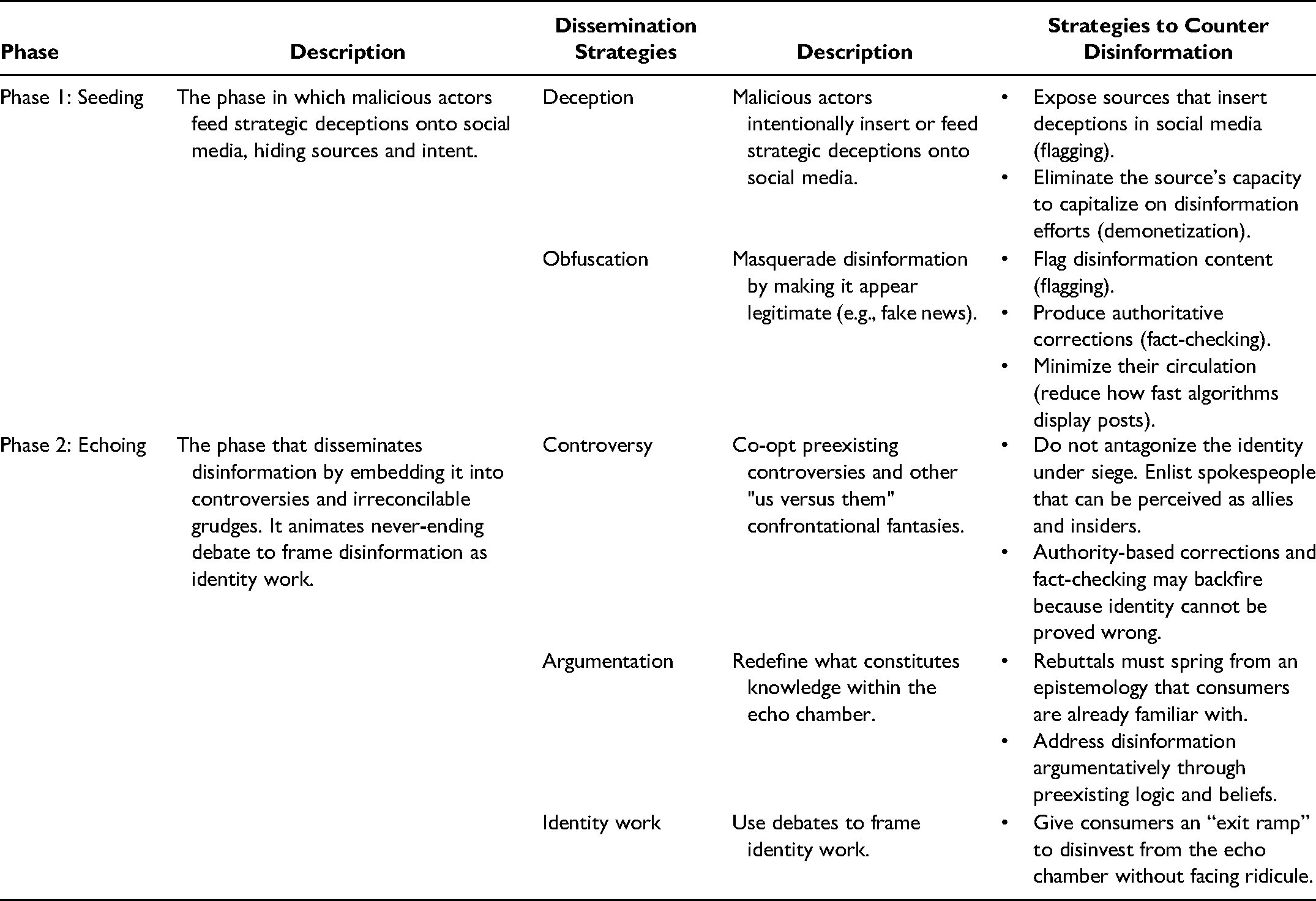
Table 4 details the dissemination mechanisms and strategies in the two phases. We propose that disinformation can be countered by preventing malicious actors from posting disinformation on social media (seeding) and countering their dissemination strategies (echoing). Building on rhetorical theory (Billig 1996; Perelman and Olbrechts-Tyteca 1971), we argue that disinformation can be understood as both epistemology and identity work. As our findings suggest, the process of disinformation redefines what constitutes knowledge and forces people to take sides against rhetorically constructed opponents.
The Disinformation Process on Social Media: Strategies and Counterstrategies.
Contributions to Disinformation Research
Table 5 details four contributions to disinformation research. The first contribution conceptualizes how echo chambers disseminate disinformation in a two-phase process (seeding and echoing). Extending research on echo chambers (Hayes 2009; Nguyen 2020), the second contribution shows the centrality of identity-driven controversies that circulate in the echo chamber. Third, drawing from rhetorical theory (Perelman and Olbrechts-Tyteca 1971), the study demonstrates that disinformation draws on diverse and contentious epistemologies. Finally, building on identity work (Thompson 2014), this article shows that participation in never-ending arguments that circulate disinformation constitutes identity work.
Summary of Theoretical Contributions and Policy-Level Implications.

Echo chambers disseminate disinformation in a two-phase process: seeding and echoing
Whereas the word “echo” in echo chambers implies that participants broadcast and amplify messages, the echo chamber is better thought of as a cocreation site. Consumers of disinformation do not just repeat or reverberate it because they do more than passively consume videos. Instead, they cocreate an adversarial fantasy, constructing antagonists to wage culture wars, which is a highly engaging activity.
In our case, YouTube personalities claim to have conducted extensive research to uncover dots and clues. By referring to decontextualized facts as dots or clues, participants connect them almost as if they were playing a game. Each dot is akin to a puzzle piece that can be combined with others to reveal the big picture. Participants form opinions by doing research, so in their view, it is their critics and “sheeple” who are uninformed. Cocreation explains why previous research shows that authority corrections often backfire (Nyhan and Reifler 2010).
Flat-earthers are not alone in gamifying disinformation. One notorious example is the QAnon conspiracy in which an elusive figure called Q, supposedly a high-level government employee, peppers the internet with clues called “breadcrumbs” that followers put together into conspiratorial narratives. Newcomers watch video after video to elucidate what the dots mean, forming opinions as they draw conclusions.
Preexisting controversies are prime vehicles to circulate disinformation
Disinformation thrives not despite raucous controversies with real or imagined enemies but as a result of them, because controversies provide fertile ground for never-ending argumentative disputes (Billig 1996; Perelman and Olbrechts-Tyteca 1971; Vatz 1973). As antagonistic interactions circulate, they solidify points of view because the arguments filter in and through what information is credible. For instance, if the out-group (they) believes something, the in-group (us) must believe the opposite. Identity-driven controversies are a vehicle through which disinformation disseminates on social media.
Disinformation draws on diverse, contradictory, and fragmented epistemologies
Building on rhetoric theory (Billig 1996), we know that arguing is thinking. Participation in an echo chamber involves substantial debate, so arguments become a tool for validating “real” knowledge. Accusing those who believe in conspiracies of being ignorant is a typical trope, but this assertion is misplaced. Participants spend considerable effort and time thinking about their arguments and misusing critical thinking skills to filter truth, which they frame into adversarial epistemologies. A fluid definition of what constitutes knowledge often asserts the validity of an argument on the basis of what is possible rather than factual. For example, if it is possible that the government participates in a specific conspiracy, then the possibility cannot be disproved by lack of evidence.
The strategy involves moving the goalposts regarding what constitutes knowledge. For example, the presenters’ goal is not to prove the earth is flat but to invert the burden of proof by sowing doubt about whether scientists have motives to lie, then asking deceivingly simple questions about what scientists lie about, hinting at the possibility of a more significant deception. The “just asking questions” argument is a tactic that avoids social media bans, by deflecting the burden of proof and averting conclusive statements.
Epistemologies diverge to make certain arguments seem rational. For example, biblical literalism accepts divine revelations as valid knowledge—if it is not in the Bible, it can be dismissed. Naive empiricism anchors knowledge in the human experience—trust the senses and naked-eye observation. Finally, conspiracy thinking equates power with corruption and knowledge—mistrusting authority-based arguments.
Argumentation constitutes identity work
Participation in continuous arguments against critics reifies and solidifies arguments into self-identification because it frames argumentative tools against rhetorically constructed adversaries. Consumer researchers know that antagonism and resistance motivate collective identity projects (Chatzidakis and Lee 2013; Mikkonen, Moisander, and Firat 2011; Scaraboto and Fischer 2013). A common enemy is a potent unifier, and an abundance of enemies is handy when arguing.
In the literature, isolation from external rebuttal and criticism is the critical component of the echo chamber (Nguyen 2020). Previous research shows that echo chambers build an asymmetry of trust between insiders and their critics (Hayes 2009); however, it is unclear how they do so. This article shows that the echo chamber equips participants with a repertoire of arguments to oppose critics, establishing rules for who is a valid participant in the debate and who is a critic that must be opposed. One strategy is accusing critics of having ulterior motives that corrupt them. Humans are complex and can have altruistic and selfish motives, but the echo chamber imposes impossibly high moral standards on its critics.
In addition, the echo chamber constantly tests members and critics for selfish motives. If any selfish motive can be discerned (i.e., guessed), that specific motivation becomes the only possible explanation for their opposition. For critics, purity tests are designed to fail to prove their corruption. For insiders, purity tests require only devotion and willingness to make sacrifices, framing them as heroes of the culture war. The rhetorical strategy works because it is an ethos device against source credibility.
Contributions to Public Policy
Most policies to counter social media disinformation target only the seeding phase and aim to deter malicious actors from planting or feeding disinformation on social media. Current counterstrategies include (1) flagging falsehoods (Achimescu and Chachev 2021), (2) reducing the exposure of deceptions to a broader audience (Bennett and Livingston 2018), (3) correcting factual statement (Vosoughi, Roy, and Aral 2018), and (4) deplatforming disinformation sources.
We recommend policy makers continue and intensify counterstrategies for the seeding phase and develop new counterstrategies for the echoing phase (Table 4). For example, initiate rhetorical counterarguments that address the internally coherent logos of identity projects, and provide ethos appeals with spokespeople who are perceived as allies of the echo chamber. Authoritative corrections that set the record straight are insufficient and can backfire (Nyhan and Reifler 2010) because identity and cultural positions cannot be disproved; they are impervious to fact-checking.
Counterstrategies in the seeding phase
Current policies regarding flagging disinformation and correcting falsehoods remain crucial and must continue. The goal is to prevent malicious actors from planting or feeding disinformation onto social media by flagging and exposing disinformation sources, minimizing the exposure of deceptions in search engines, and offering authoritative corrections (fact-checking).
Whereas fact-checking remains relatively uncontroversial, other interventions such as deplatforming and demonetizing are controversial because they flirt with censorship. It may be tempting to focus on silencing dissenting voices by claiming they are disinformation (Meta-Facebook 2021; YouTube 2021), but the potential for misuse cannot be overstated. Instead, policy makers must propose a compatible solution with democratic values.
Counterstrategies in the echoing phase
Policy makers must extend their strategies to counter the echoing phase. To do so, argumentative lines must align with the consumers’ epistemology. By using logos, policy makers focus on how the message aligns with the audience's worldview. For example, the baseline for naive empiricists is the human experience—they trust only their eyes. To convince naive empiricists, a homemade experiment is persuasive because it enables them to see cause and effect. Policy makers could develop a homemade experiment that anyone can replicate to demonstrate that certain policies work; for instance, homemade experiments could demonstrate that masks are helpful against a virus or vaccines work. For example, one YouTuber devised ingenious do-it-yourself experiments to debunk flat-earthers (Channel: Kurtis Baute, Video: “How I Proved the Earth Is Round with My Bike and Two Sticks”). However, the role of user-generated content in countering social media disinformation lacks sufficient research.
Policy makers cannot rely exclusively on factual statements delivered by authoritative figures because they lack ethos or credibility within the echo chamber. Instead, the message must come from allies of the identity-driven controversy. For example, the flat-earthers argue that good Christians must believe in the flat Earth; otherwise, they are heretics. To counter this argument, only a bona fide Christian can say that one can remain a devout Christian without being a flat-earther. Another example involves former President Trump's pro-vaccine statements (Keith 2021), which transformed a highly legitimate member of the conservative echo chamber into a credible spokesperson for vaccination policy.
Limitations and Further Research
Many questions remain, including what makes social media platforms fertile ground for disinformation. Further research should study how to counter disinformation in the attention economy, including the role of private companies in moderating speech acts. A second avenue for research is the study of how echo chambers lead to physical radicalization and violence. The rhetorical approach in this article can apply to violent groups, but more research is needed to understand how such groups make their arguments persuasive. Future research could investigate how echo chambers justify acts of violence against perceived opponents. In conflict zones, participants can become cocreators of a confrontational fantasy, leading to violence.
Conclusion
This article investigates the rhetorical strategies that propel disinformation on social media via echo chambers. We find that identity-driven controversies are prime vehicles to circulate disinformation. We use rhetorical theory to demonstrate that back-and-forth argumentation constitutes an epistemology that justifies what is valid knowledge within an echo chamber. Arguments solidify consumers’ positions, using disinformation as a rhetorical weapon in culture wars. Their participation in a controversy-based fantasy self-reinforces their identity project, both (North Atlantic Treaty Organization 2020) individually and collectively, by taking sides. For policy makers, the implication is that disinformation involves more than just fact-checking falsehoods. In addition, policy makers must counter disinformation argumentatively.
Supplemental Material
sj-pdf-1-ppo-10.1177_07439156221103852 - Supplemental material for Disinformation and Echo Chambers: How Disinformation Circulates on Social Media Through Identity-Driven Controversies
Supplemental material, sj-pdf-1-ppo-10.1177_07439156221103852 for Disinformation and Echo Chambers: How Disinformation Circulates on Social Media Through Identity-Driven Controversies by Carlos Diaz Ruiz and Tomas Nilsson in Journal of Public Policy & Marketing
Footnotes
Joint Editors in Chief
Kelly D. Martin and Maura L. Scott
Special Issue Editors
Yany Grégoire and Marie Louise Radanielina Hita
Declaration of Conflicting Interests
The author(s) declared no potential conflicts of interest with respect to the research, authorship, and/or publication of this article.
Funding
The author(s) received no financial support for the research, authorship, and/or publication of this article.

References
Supplementary Material
Please find the following supplemental material available below.
For Open Access articles published under a Creative Commons License, all supplemental material carries the same license as the article it is associated with.
For non-Open Access articles published, all supplemental material carries a non-exclusive license, and permission requests for re-use of supplemental material or any part of supplemental material shall be sent directly to the copyright owner as specified in the copyright notice associated with the article.
